International Journal of Computer Science, Engineering and Applications (IJCSEA) Vol.2, No.1, February 2012
DOI : 10.5121/ijcsea.2012.2107 67
ON AN OPTIMIZATION TECHNIQUE
USING BINARY DECISION DIAGRAM
Debajit Sensarma#
1, Subhashis Banerjee#1
, Krishnendu Basuli#1
,Saptarshi
Naskar#2
, Samar Sen Sarma#3
#1
West Bengal State University, West Bengal, India
debajit.sensarma2008@gmail.com, mail.sb88@gmail.com,
Krishnendu.basuli@gmail.com
#2
Sarsuna College, West Bengal, India
sapgrin@gmail.com
#3
University Of Calcutta, West Bengal, India
Sssarma2001@yahoo.com
ABSTRACT
Two-level logic minimization is a central problem in logic synthesis, and has applications in reliability
analysis and automated reasoning. This paper represents a method of minimizing Boolean sum of products
function with binary decision diagram and with disjoint sum of product minimization. Due to the symbolic
representation of cubes for large problem instances, the method is orders of magnitude faster than
previous enumerative techniques. But the quality of the approach largely depends on the variable ordering
of the underlying BDD. The application of Binary Decision Diagrams (BDDs) as an efficient approach for
the minimization of Disjoint Sums-of-Products (DSOPs). DSOPs are a starting point for several
applications.
The use of BDDs has the advantage of an implicit representation of terms. Due to this scheme the
algorithm is faster than techniques working on explicit representations and the application to large circuits
that could not be handled so far becomes possible. Theoretical studies on the influence of the BDDs to the
search space are carried out. In experiments the proposed technique is compared to others. The results
with respect to the size of the resulting DSOP are as good or better as those of the other techniques.
KEYWORDS
Binary Decision Diagram, DSOP, Unate Function, Binate Function.
INTRODUCTION
A Binary Decision Diagram is a rooted directed acyclic graph. It has one or two terminal nodes
of out-degree zero labeled 0 or 1, and a set of variable nodes also called as branch node of out-
degree two. Fig 1 depicts a BDD. The root node ‘a’ in Fig 1. Have two successors indicated by
International Journal of Computer Science, Engineering and Applications (IJCSEA) Vol.2, No.1, February 2012
68
descending lines. One of the successors is drawn as a dashed line, called ‘low’ and other is drawn
as a solid line, called ‘high’. These branch nodes define a path in the diagram for any values of
Boolean variables. The ‘0’ and ‘1’ nodes also called the sink node. If low branch is being
followed from the root, then that path will reach to sink node ‘0’ and if high branch is being
followed, then the path will reach to sink node ‘1’. The BDD obeys two important restrictions.
First, it must be ordered. Second, a BDD must be reduced, in the sense that it doesn’t waste
space. BDD’s are well-known and widely used in logic synthesis and formal verification of
integrated circuits. Due to the canonical representation of Boolean functions they are very
suitable for formal verification problems and used in a lot of tools to date [15, 16, 18].
A DSOP is a representation of a Boolean function as a sum of disjoint cubes. DSOPs are used in
several applications in the area of CAD, e.g. the calculation of spectra of Boolean functions or as
a starting point for the minimization of Exclusive-Or-Sum-Of-Products (ESOPs).
A hybrid approach for the minimization of DSOPs relying on BDDs in combination with
structural methods has recently been introduced in. It has been shown that BDDs are applicable
to the problem of DSOP minimization [6].
Given a BDD of a Boolean function, the DSOP can easily be constructed: each one-path [7], i.e. a
path from the root to the terminal 1 vertex, corresponds to a cube in the DSOP, and moreover,
different one-paths lead to disjoint cubes. For the construction of the BDD the variables of the
Boolean function are considered in a fixed order. The permutation of the variables largely
influences the number of one-paths in the BDD and thus the number of cubes in the
corresponding DSOP. Additionally, the importance of choosing a good variable order to get a
small DSOP has theoretically been supported.
0 1
Fig 1: The Binary Decision Diagram
1.1 MOTIVATION
As minimizing Boolean functions with many variables is n NP-Complete problem, so the
existence of a polynomial-time algorithm for minimizing Boolean circuits is unlikely. So, the
motivation of this work is to minimize the Boolean sum of product function by finding the
minimal irredundant expression. Here Binary Decision Diagram (BDD) is used for finding
disjoint cubes first, because BDD is the compact representation of a Boolean function, but it
highly depends on variable ordering. Then this disjoint cubes are minimizes to get the minimal
expression. In Quine-McCluskey method, it can be shown that for a function of n variables the
upper bound on the number of prime implicantes is 3n
/n. In this project a heuristic algorithm is
used to minimize the upper bound of the prime implicant generation and it gives the near optimal
solution.
a
b b
c
International Journal of Computer Science, Engineering and Applications (IJCSEA) Vol.2, No.1, February 2012
69
1.2 BINARY DECISION DIAGRAMS
A BDD is a directed acyclic graph Gf = (V, E) that represents a Boolean function f: Bn
→ Bm
.
The Shannon decomposition g = xigxi + xi’gxi’ is carried out in each internal node v labeled with
label (v) = xi of the graph, therefore v has the two successors then (v) and else (v). The leaves are
labeled with 0 or 1 and correspond to the constant Boolean functions. The root node root (Gf )
corresponds to the function f. In the following, BDD refers to a reduced ordered BDD (as defined
in [9]) and the size of a BDD is given by the number of nodes.
DEFINITION
A one-path in a BDD Gf = (V, E) is a path
p = (v0 ,…, vl-1, vl);
vi € V; (vi, vi+1) є E
with v0 = root(Gf ) and label(vl) = 1. p has length l + 1.
P1 (Gf) denotes the number of all different one-paths in the BDD Gf.
1.3 BDD AND DSOP
Consider a BDD Gf representing the Boolean function f(x1,…, xn). A one path
p = (v0 ,…, vl) of length l + 1 in Gf corresponds to an (n - l)-dimensional cube that is a subset of
ON(f)1
. The cube is described by:
mp =n li for i=0…l-1; where
li = label (vi); if vi+1 = else (vi)
label (vi); if vi+1 = then (vi)
Two paths p1 and p2 in a BDD are different if they differ in at least one edge. Since all paths
originate from root (Gf), there is a node v where the paths separate. Let label (v) = xi. Therefore
one of the cubes includes xi, the other xi. Hence, the cubes mp1 and mp2 are disjoint.
Now the DSOP can easily be built by summing up all cubes corresponding to the one-paths.
Remark 1 : Let Gf be a BDD of f(x1 ,…, xn) and M1 be the set of one-paths
in Gf . Then Gf represents the DSOP
∑ mp where p є M1
where mp is the cube given above.
From this it is clear that the number of cubes in the DSOP represented by Gf is equal to P1(Gf ).
Thus, as opposed to the usual goal of minimizing the number of nodes in a BDD, here the
number of one-paths is minimized. Known techniques to minimize the number of nodes can be
used to minimize the number of paths by changing the objective function. One such technique is
sifting. A variable is chosen and moved to any position of the variable order based on exchange
of adjacent variables. Then it is fixed at the best position (i.e. where the smallest BDD results),
afterwards another variable is chosen. No variable is chosen twice during this process.
International Journal of Computer Science, Engineering and Applications (IJCSEA) Vol.2, No.1, February 2012
70
2. TERMS RELATED TO SOP MINIMIZATION
Unate function: A function that is monotonically increasing or decreasing in each of its variable
is called unate function.
binate function: a function that is not unate. This can also be used to mean a cover of a function
that is not unate.
canonical cover/solution: the SOP cover of a function that contains only minterms, and
thus has not at all been reduced.
cube: a one-dimensional matrix in the form of an implicant. Two cubes are said to be disjoint if
their intersection of the set of minterms is null. The intersection is the operation of conjunction
(i.e. the Boolean AND operation).
Espresso algorithm: an algorithm that minimizes SOP functions.
essential prime implicant: a prime implicant that the cover of a function must contain in
order to cover the function
implicant: an ANDed string of literals. It is a term in an SOP function.
literal: an instance of a boolean variable. It may be the variable complemented,
uncomplemented, or ignored (don’t-care). In matrix representations or the Q-M algorithm, it may
have a value of 0, 1, or 2/X, corresponding to complemented, uncomplemented, and don’t-care,
respectively.
matrix representation of a function or implicant: The rows of a two-dimensional matrix
representation of a function are the implicants of the function. The columns of a one-dimensional
matrix representation of an implicant are the literals of the implicant.
minterm: an implicant that contains exactly one literal for each variable. It is not at all
simplified.
monotone decreasing: A function is monotone decreasing in a variable if changing the
value of the variable from 0 to 1 results in the output of the function being 0.
monotone increasing: A function is monotone increasing in a variable if changing the
value of the variable from 0 to 1 results in the output of the function being 1.
prime implicant: an implicant that cannot be further reduced by adjacency
Quine-McCluskey (Q-M) algorithms: two algorithms that minimize a Boolean function. The
first algorithm finds all prime implicants, and the second algorithm eliminates nonessential prime
implicants.
3. PROPOSED ALGORITHM
In this method at first from the given truth table suitable variable order is chosen based on
Shannon entropy measurement, then binary decision diagram is made considering this variable
order. After that disjoint cubes are calculated by following the 1-path of the BDD. Then from that
the covering matrix is created where columns represent the variables and row represents the
applicants or disjoints cubes. Then selecting the most binate variables and by unite simplification
the ultimate minimized sop function is obtained.
International Journal of Computer Science, Engineering and Applications (IJCSEA) Vol.2, No.1, February 2012
71
3.1 ALGORITHM
Step 1: Generation of truth table.
Step 2: Variable reordering using Shannon entropy measure-ment [3, 9] and create Binary
Decision Diagram [8, 14, 15].
Step 3: Finding Disjoint Cubes from Binary decision Diagram [6].
Step 4: Disjoint cube minimization using Binate Covering with Recursion and Unate
Simplification Method [12,13].
3.2 EXPLANATION
Step 1:
The truth table is generated from given Boolean expression.
Step2:
Choosing right variable order is very important for constructing Binary Decision Diagram,
because if bad variable order is chosen then number of 1-paths can be increased; even number of
nodes in the BDD may be increased exponentially.
The measures of a variable’s importance are based on information theoretic criteria, and require
computation of entropy of a variable. Entropy measures can be quite effective in distinguishing
the importance of variables. It is well known that a central problem in using OBDD is the severe
memory requirements that result from extremely large OBDD size that arise in many
instances.OBDD sizes are unfortunately very sensitive to the order chosen on input variables.
Determining the optimal order is a co-NP complete problem [9].Variable ordering heuristics can
be classified as either static or dynamic approaches. A static approach , analyzes the given
circuit/function and, based on its various properties, determines some variable order which has a
high “Probability” of being effective. In dynamic approach to compute variable ordering, one
starts with an initial order, which is analyzed and permuted at internal points in the
circuit/function, such that some cost function is minimized.
Step 3:
In this step Disjoint Cubes from Binary decision Diagram are found by following the 1-path [6].
Step 4:
Cover matrix is found from the resultant disjoint cubes and this is simplified using Unate
Recursive Paradigm [13].
4. ILLUSTRATION WITH AN EXPLANATION
f(a,b,c,d)=∑(1,5,6,9,12,13,14,15)
Step1: Given the truth table.
a b c d f
0 0 0 0 0
0 0 0 1 1
International Journal of Computer Science, Engineering and Applications (IJCSEA) Vol.2, No.1, February 2012
72
0 0 1 0 0
0 0 1 1 0
0 1 0 0 0
0 1 0 1 1
0 1 1 0 1
0 1 1 1 0
1 0 0 0 0
1 0 0 1 1
1 0 1 0 0
1 0 1 1 0
1 1 0 0 1
1 1 0 1 1
1 1 1 0 1
1 1 1 1 1
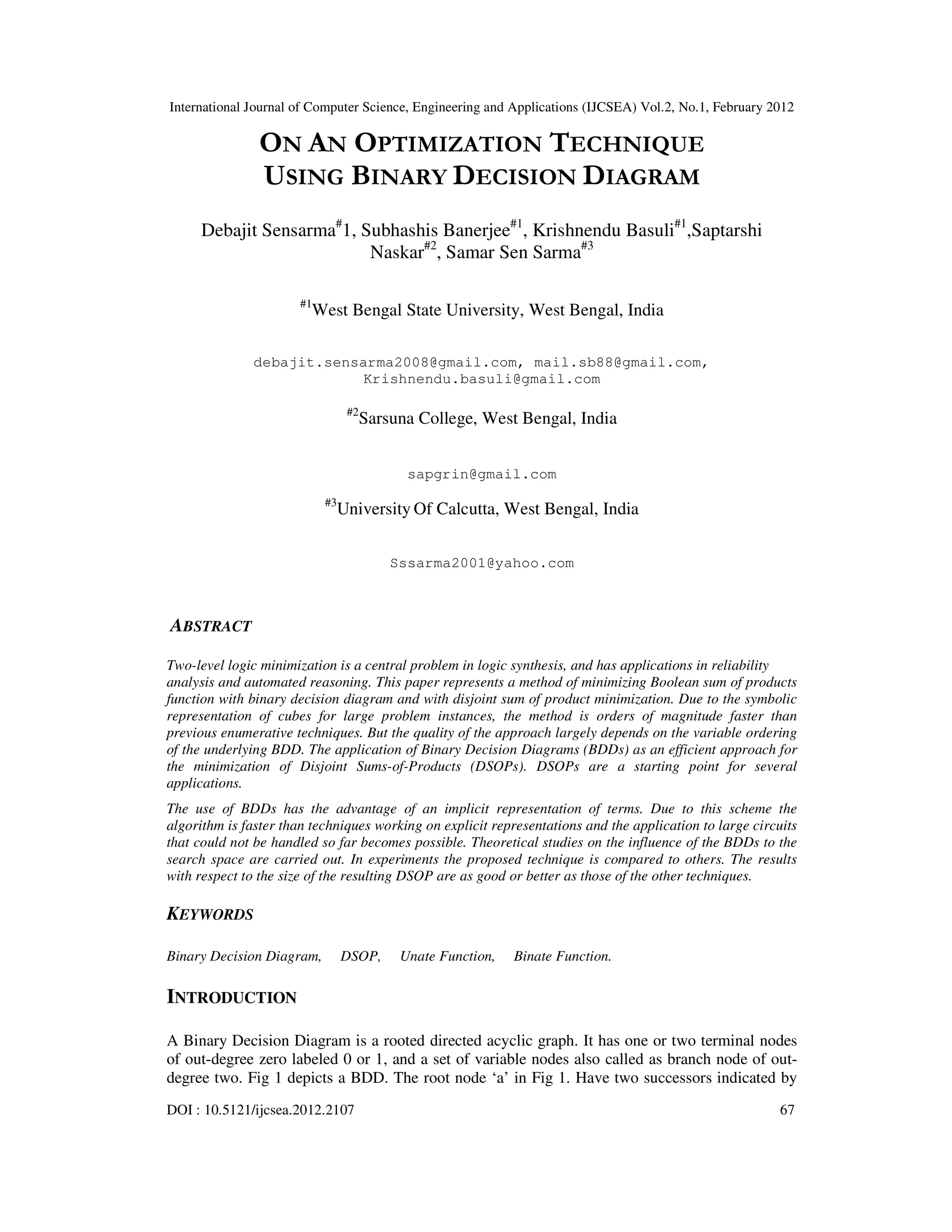
With this variable order the Binary Decision Diagram is:
1
0
0 1 1 0
Number of nodes=7
Step 2: Variable ordering by calculating Entropy and choosing most ambiguous variables.
I(a,0)=0.954
I(a,1)=0.954
E(a)=0.954
I(b,0)=0.811
I(b,1)=0.811
E(b)=0.811 Select ‘b’ as the first splitting variable.
I(c,0)=0.954
I(c,1)=0.954
E(c)=0.954
I(d,0)=0.954
a
b b
c
d d
c
International Journal of Computer Science, Engineering and Applications (IJCSEA) Vol.2, No.1, February 2012
73
I(d,1)=0.954
E(d)=0.954
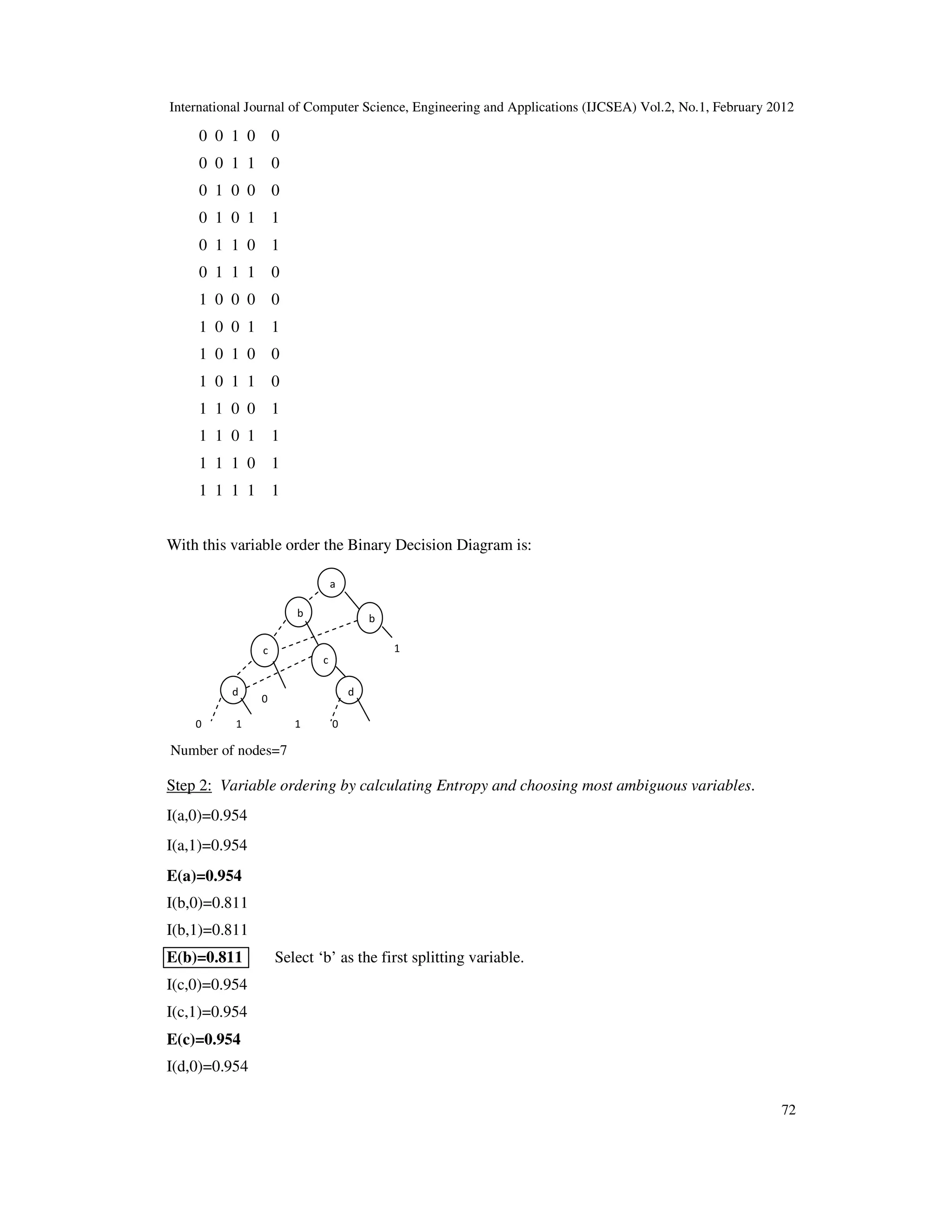
For b=0 the truth table is:
a c d f
0 0 0 0
0 0 1 1
0 1 0 0
0 1 1 0
1 0 0 0
1 0 1 1
1 1 0 0
1 1 1 0
I(a,0)=0.811
I(a,1)=0.811
E(a)=0.811
I(c,0)=1
I(c,1)=0
E(c)=0.5
I(d,0)=0
I(d,1)=1
E(d)=0.5
For b=1 the truth table is:
a c d f
0 0 0 0
0 0 1 1
0 1 0 1
0 1 1 0
1 0 0 1
1 0 1 1
1 1 0 1
1 1 1 1
International Journal of Computer Science, Engineering and Applications (IJCSEA) Vol.2, No.1, February 2012
74
I(a,0)=1
I(a,1)=0
E(a)=0.5 Select ‘a’ as the next splitting variable.
I(c,0)=0.811
I(c,1)=0.811
E(c)=0.811
I(d,0)=0.811
I(d,1)=0.811
E(d)=0.811
If we proceed like this we come up with the variable order →b,a,c,d
With this variable order the Binary Decision Diagram is:
1
0
0 1 1 0
Number of nodes=6
Step 3: Finding Disjoint Cubes from Above Binary Decision Diagram.
The Disjoint Cubes are: ab + a’bcd’+ b’c’d + a’bc’d
Step 4: Binate Covering with Recursion.
The Covering Matrix is:
a b c d
ab 1 1 2 2
a’bcd’ 0 1 1 0
b’c’d 2 0 0 1
abc’d 0 1 0 1
Case 1: Binate Select.
(Most binate variable)
b’ = (2022) b= (2122)
2201 1222
0201
b
a
c
d d
c
b
International Journal of Computer Science, Engineering and Applications (IJCSEA) Vol.2, No.1, February 2012
75
0210
(Most binate variable)
a =(1222) a’=(0222)
2222 2210
2201
(Most binate variable)
c ’=(2202) c=(2212)
2221 2220
Case 2: Merge.
2221 2220
c’ c
2201
2210 2222
a’ a
2201
2210
1222 2201
b b’
2201
2110
1122
After simplification the expression is: ab + c’d + bcd’.
KARNAUGH MAP REPRESENTATION
f(a,b,c,d)=∑(1,5,6,9,12,13,14,15)
cd
ab
00 01 11 10
00 1
01 1 1
11 1 1 1 1
10 1
a
c
a
b
c
International Journal of Computer Science, Engineering and Applications (IJCSEA) Vol.2, No.1, February 2012
76
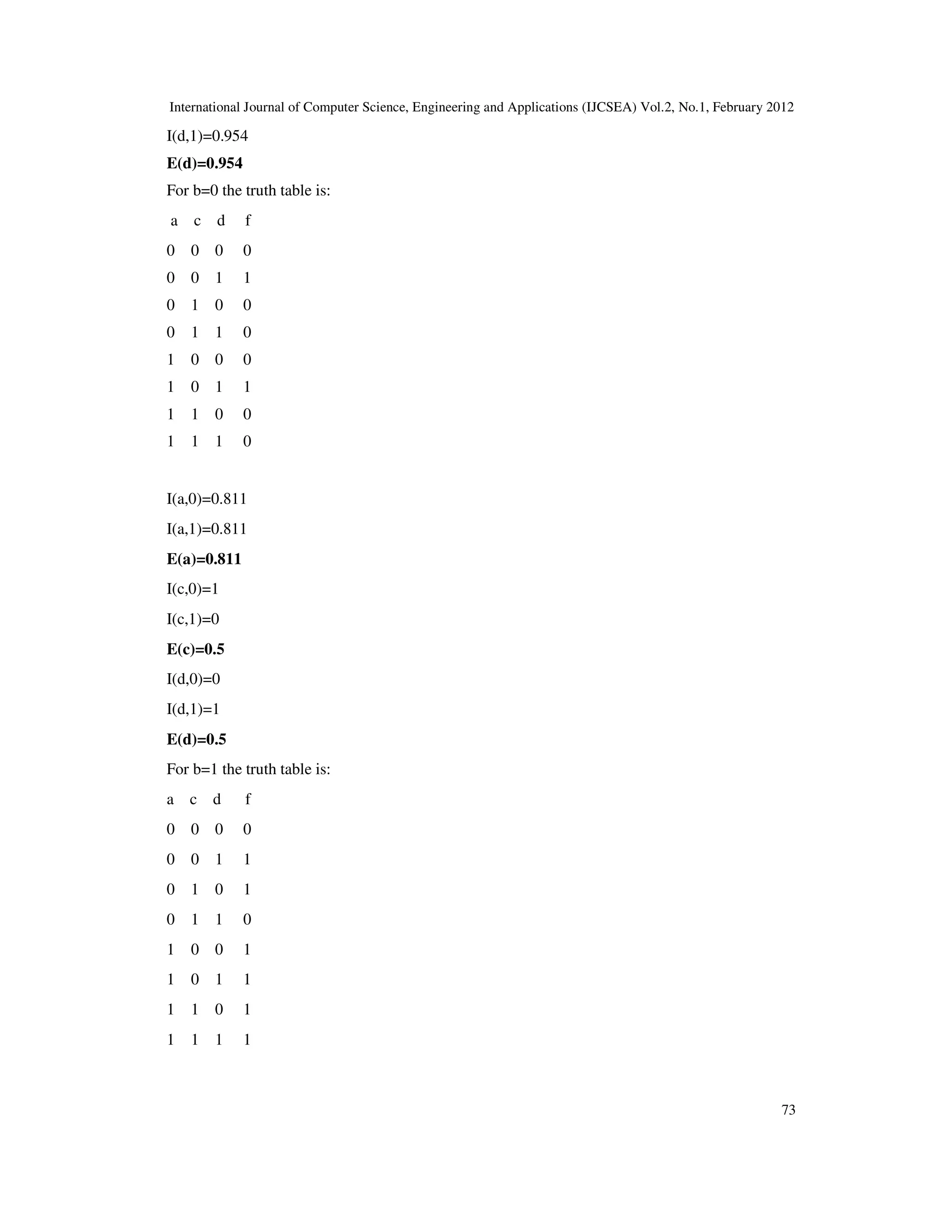
5. RESULT
This program is done on Intel Pentium 4 CPU, 2.80 GHz and 256 MB of RAM and with Visual
c++ 6.0 standard edition. The result is presented here with the following figures.
Fig 2: growth of Binary Decision Diagram. Here X-axis represents the number of inputs and Y-axis
represents the required time.
Here growth of the creation of Binary decision diagram with proposed method is shown with
respect to 6 variables.
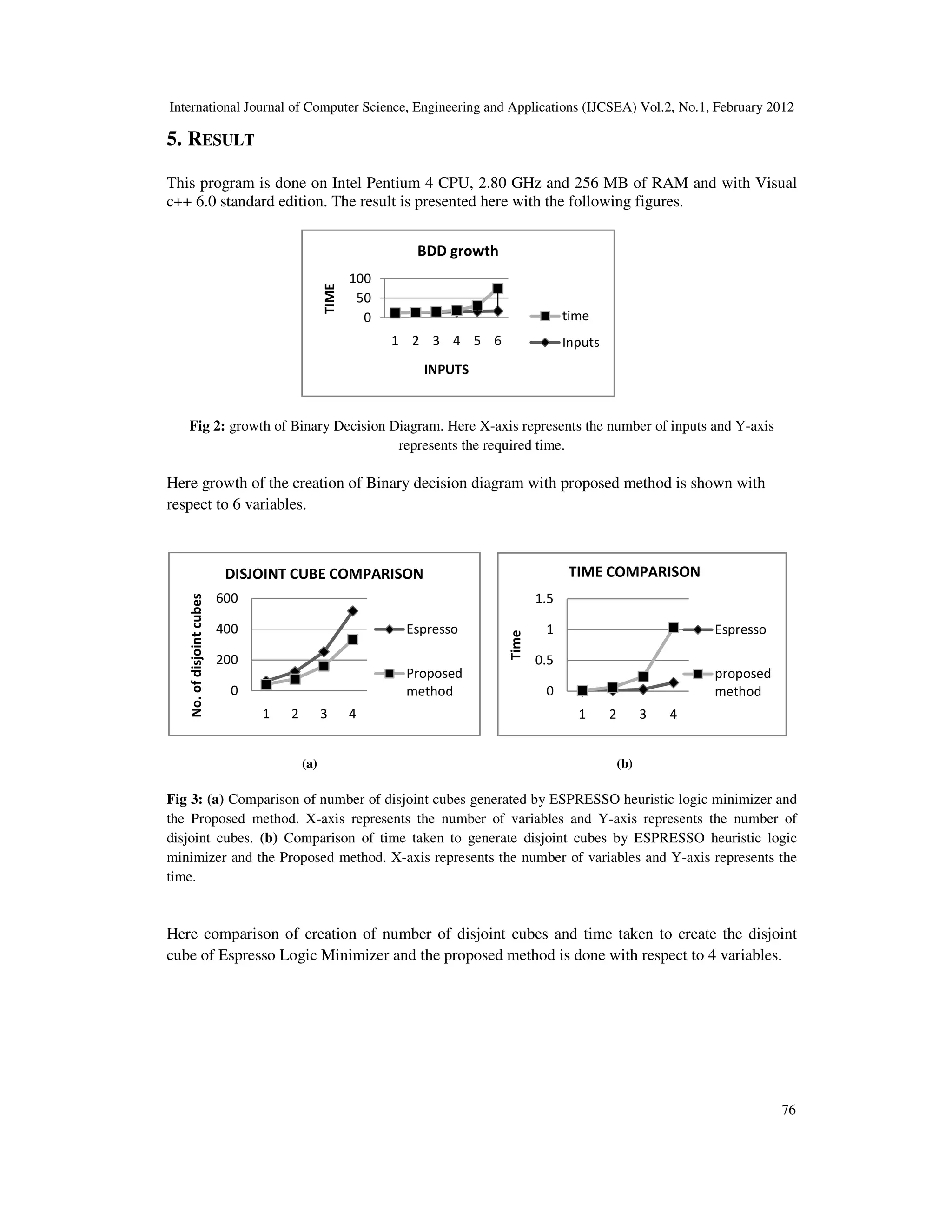
(a) (b)
Fig 3: (a) Comparison of number of disjoint cubes generated by ESPRESSO heuristic logic minimizer and
the Proposed method. X-axis represents the number of variables and Y-axis represents the number of
disjoint cubes. (b) Comparison of time taken to generate disjoint cubes by ESPRESSO heuristic logic
minimizer and the Proposed method. X-axis represents the number of variables and Y-axis represents the
time.
Here comparison of creation of number of disjoint cubes and time taken to create the disjoint
cube of Espresso Logic Minimizer and the proposed method is done with respect to 4 variables.
0
50
100
1 2 3 4 5 6
TIME
INPUTS
BDD growth
time
Inputs
0
0.5
1
1.5
1 2 3 4
Time
TIME COMPARISON
Espresso
proposed
method0
200
400
600
1 2 3 4
No.ofdisjointcubes
DISJOINT CUBE COMPARISON
Espresso
Proposed
method
International Journal of Computer Science, Engineering and Applications (IJCSEA) Vol.2, No.1, February 2012
77
Fig 4: Comparison of the number of literals and terms before simplification and generated by above
program for 4,5 and 6 variables.
Here number of literals and terms before and after minimizing the given Boolean sum-of-product
function is given with respect to 4,5 and 6 variables with the Proposed method.
0
20
40
60
litrals before
simplification
literals after
simplification
4 Variables
0
5
10
15
terms before
simplification
terms after
simplification
4 Variables
0
50
100
litrals before
simplification
literals after
simplification
5 Variables
0
5
10
15
terms before
simplification
terms after
simplification
5 Variables
0
100
200
litrals before
simplification
literals after
simplification
6 Variables
0
10
20
30
terms before
simplification
terms after
simplification
6 Variables
7
51
42
0 20 40 60
var
QM terms
propsed method…
Number of PI's
9
248
161
0 100 200 300
var
QM terms
proposed method…
Number of PI's
International Journal of Computer Science, Engineering and Applications (IJCSEA) Vol.2, No.1, February 2012
78
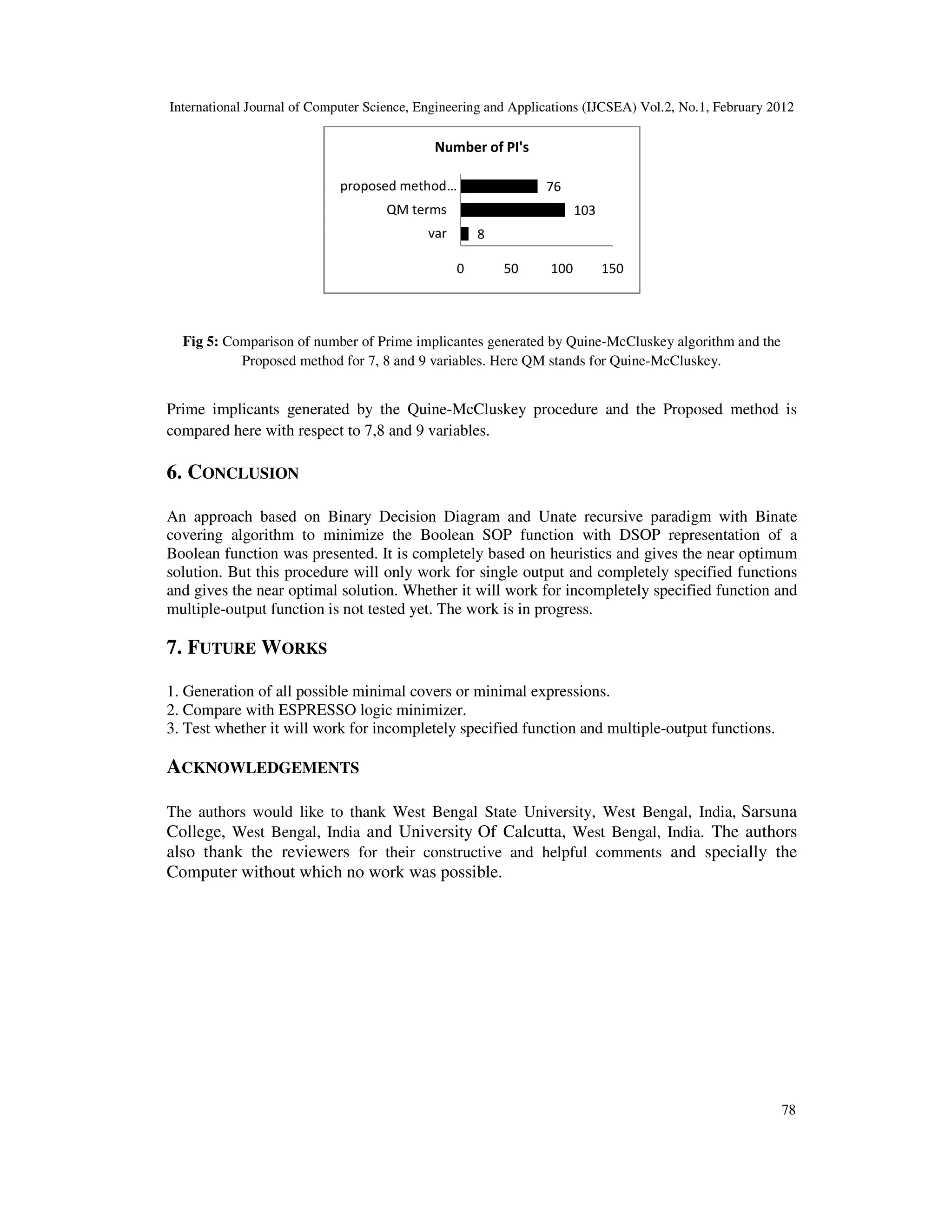
Fig 5: Comparison of number of Prime implicantes generated by Quine-McCluskey algorithm and the
Proposed method for 7, 8 and 9 variables. Here QM stands for Quine-McCluskey.
Prime implicants generated by the Quine-McCluskey procedure and the Proposed method is
compared here with respect to 7,8 and 9 variables.
6. CONCLUSION
An approach based on Binary Decision Diagram and Unate recursive paradigm with Binate
covering algorithm to minimize the Boolean SOP function with DSOP representation of a
Boolean function was presented. It is completely based on heuristics and gives the near optimum
solution. But this procedure will only work for single output and completely specified functions
and gives the near optimal solution. Whether it will work for incompletely specified function and
multiple-output function is not tested yet. The work is in progress.
7. FUTURE WORKS
1. Generation of all possible minimal covers or minimal expressions.
2. Compare with ESPRESSO logic minimizer.
3. Test whether it will work for incompletely specified function and multiple-output functions.
ACKNOWLEDGEMENTS
The authors would like to thank West Bengal State University, West Bengal, India, Sarsuna
College, West Bengal, India and University Of Calcutta, West Bengal, India. The authors
also thank the reviewers for their constructive and helpful comments and specially the
Computer without which no work was possible.
8
103
76
0 50 100 150
var
QM terms
proposed method…
Number of PI's
International Journal of Computer Science, Engineering and Applications (IJCSEA) Vol.2, No.1, February 2012
79
REFERENCES
[1] Sensarma D., Banerjee S., Basuli K., Naskar S., & Sarma, S. S. (2011) “Minimizing Boolean Sum of
Products Functions Using Binary Decision Diagram”, The Second International Conference on
Computer Science and Information Technology , Vol. 86, Part III, pp 36-48.
[2] Congguang Yang,Maciej Ciesielski.”BDD-BASED LOGIC OPTIMIZATION SYSTEM”.IEEE
transactions on computer aided design of integrated circuits and systems, Vol. 21, No.7, pp. – 866 -
876, July 2002.
[3] Denis V. Popel.”TOWARDS EFFICIENT CALCULATION OF INFORMATIONMEASURES FOR
REORDERING OF BINARY DECISION DIAGRAMS ”. Computing Research Repository - CORR
, vol. cs.AR/0207, 2002.
[4] Donald E. Knuth,”The Art of Computer Programming”, Volume 4.
[5] Gitanjali M. Swamy.”An Exact Logic Minimizer Using Implicit Binary Decision Diagram Based
Methods”. ICCAD '94 Proceedings of the 1994 IEEE/ACM international conference on Computer-
aided design.1994.
[6] Gorschwin Fey, Rolf Drechsler.”UTILIZING BDDS FOR DISJOINT SOP MINIMIZATION”. 45th
IEEE International Midwest Symposium on Circuits and Systems,2002.
[7] Günther R. Raidl et al.(Eds.).”Applications of evolutionary computing: EvoWorkshops 2004:
EvoBIO,EvoCOMNET,EvoHOT,EvoIASP,EvoMUSART,andEvoSTOC,Coimbra,Portugal,April
2004,Proceedings”.
[8] Henrik Reif Andersen. “An Introduction to Binary Decision Diagrams”. Lecture Notes (Technical
University of Denmark, October 1997).
[9] Jawhar Jain,James Bitner,Dinos Moundanos,Jacob A. Abraham,Donald S. Fussell.”A new scheme to
compute variable orders for binary decision diagrams”. VLSI, 1994. Design Automation of High
Performance VLSI Systems. GLSV '94, Proceedings., Fourth Great Lakes Symposium,pp. 105 – 108,
4-5 Mar 1994.
[10] M.Hilgemeier, N.Drechsler, and R.Drechsler.“Minimizing the number of one-paths in BDDs by an
evolutionary algorithm”. In Congress on Evolutionary Computation, 2003.
[11] Masoud Nosrati,Mehdi Hariri."An Algorithm for Minimizing of Boolean Functions Based on Graph
DS".World Applied Programming,Vol (1),No (3),August 2011.209-214.
[12] Olivier Coudert.”On solving Covering Problems”. in Proc. of 33rd DAC, Las Vegas, June 1996.
[13] Robert King Brayton. “Logic minimization algorithms for VLSI synthesis”.
[14] R.E. Bryant. “Graph-based algorithms for Boolean function manipulation”. IEEE Transactions on
Computers, C-35-8, pp.677-691, August, 1986.
[15] RANDAL E, BRYANT. “Symbolic Boolean Manipulation with Ordered Binary-Decision
Diagrams”. ACM Computing Surveys,1992.
[16] R.E. Bryant. “Binary decision diagrams and beyond: Enabeling techniques for formal verification”.In
Int’l Conf. on CAD, pages 236–243, 1995.
[17] Banerjee S., Sensarma D., Basuli K., Naskar S. & Sarma S. S. (2011) “The Reconstruction
Conjecture”, The Second International Conference on Computer Science and Information
Technology, Vol. 86, Part III, pp 17-25.
[18] R. Drechsler and B. Becker.”Binary Decision Diagrams – Theory and Implementation”. Kluwer
Academic Publishers, 1998.
[19] ZVI KOHAVI, Switching and Finite Automata Theory.
Authors
Debajit Sensarma
M. Sc. Computer Science
Subhashis Banerjee
M.Sc. Computer Science
International Journal of Computer Science, Engineering and Applications (IJCSEA) Vol.2, No.1, February 2012
80
Krishnendu Basuli
Assistant Professor,
Department of Computer Science,
West Bengal State University.
Saptarshi Naskar
Assistant Professor,
Department of Computer Science,
Sarsuna College, West Bengal, India.
Dr. Samar Sen Sarma
Professor, Department of Computer Science and
Engineering, University Of Calcutta, India

ON AN OPTIMIZATION TECHNIQUE USING BINARY DECISION DIAGRAM

  • 1.
    International Journal ofComputer Science, Engineering and Applications (IJCSEA) Vol.2, No.1, February 2012 DOI : 10.5121/ijcsea.2012.2107 67 ON AN OPTIMIZATION TECHNIQUE USING BINARY DECISION DIAGRAM Debajit Sensarma# 1, Subhashis Banerjee#1 , Krishnendu Basuli#1 ,Saptarshi Naskar#2 , Samar Sen Sarma#3 #1 West Bengal State University, West Bengal, India debajit.sensarma2008@gmail.com, mail.sb88@gmail.com, Krishnendu.basuli@gmail.com #2 Sarsuna College, West Bengal, India sapgrin@gmail.com #3 University Of Calcutta, West Bengal, India Sssarma2001@yahoo.com ABSTRACT Two-level logic minimization is a central problem in logic synthesis, and has applications in reliability analysis and automated reasoning. This paper represents a method of minimizing Boolean sum of products function with binary decision diagram and with disjoint sum of product minimization. Due to the symbolic representation of cubes for large problem instances, the method is orders of magnitude faster than previous enumerative techniques. But the quality of the approach largely depends on the variable ordering of the underlying BDD. The application of Binary Decision Diagrams (BDDs) as an efficient approach for the minimization of Disjoint Sums-of-Products (DSOPs). DSOPs are a starting point for several applications. The use of BDDs has the advantage of an implicit representation of terms. Due to this scheme the algorithm is faster than techniques working on explicit representations and the application to large circuits that could not be handled so far becomes possible. Theoretical studies on the influence of the BDDs to the search space are carried out. In experiments the proposed technique is compared to others. The results with respect to the size of the resulting DSOP are as good or better as those of the other techniques. KEYWORDS Binary Decision Diagram, DSOP, Unate Function, Binate Function. INTRODUCTION A Binary Decision Diagram is a rooted directed acyclic graph. It has one or two terminal nodes of out-degree zero labeled 0 or 1, and a set of variable nodes also called as branch node of out- degree two. Fig 1 depicts a BDD. The root node ‘a’ in Fig 1. Have two successors indicated by
  • 2.
    International Journal ofComputer Science, Engineering and Applications (IJCSEA) Vol.2, No.1, February 2012 68 descending lines. One of the successors is drawn as a dashed line, called ‘low’ and other is drawn as a solid line, called ‘high’. These branch nodes define a path in the diagram for any values of Boolean variables. The ‘0’ and ‘1’ nodes also called the sink node. If low branch is being followed from the root, then that path will reach to sink node ‘0’ and if high branch is being followed, then the path will reach to sink node ‘1’. The BDD obeys two important restrictions. First, it must be ordered. Second, a BDD must be reduced, in the sense that it doesn’t waste space. BDD’s are well-known and widely used in logic synthesis and formal verification of integrated circuits. Due to the canonical representation of Boolean functions they are very suitable for formal verification problems and used in a lot of tools to date [15, 16, 18]. A DSOP is a representation of a Boolean function as a sum of disjoint cubes. DSOPs are used in several applications in the area of CAD, e.g. the calculation of spectra of Boolean functions or as a starting point for the minimization of Exclusive-Or-Sum-Of-Products (ESOPs). A hybrid approach for the minimization of DSOPs relying on BDDs in combination with structural methods has recently been introduced in. It has been shown that BDDs are applicable to the problem of DSOP minimization [6]. Given a BDD of a Boolean function, the DSOP can easily be constructed: each one-path [7], i.e. a path from the root to the terminal 1 vertex, corresponds to a cube in the DSOP, and moreover, different one-paths lead to disjoint cubes. For the construction of the BDD the variables of the Boolean function are considered in a fixed order. The permutation of the variables largely influences the number of one-paths in the BDD and thus the number of cubes in the corresponding DSOP. Additionally, the importance of choosing a good variable order to get a small DSOP has theoretically been supported. 0 1 Fig 1: The Binary Decision Diagram 1.1 MOTIVATION As minimizing Boolean functions with many variables is n NP-Complete problem, so the existence of a polynomial-time algorithm for minimizing Boolean circuits is unlikely. So, the motivation of this work is to minimize the Boolean sum of product function by finding the minimal irredundant expression. Here Binary Decision Diagram (BDD) is used for finding disjoint cubes first, because BDD is the compact representation of a Boolean function, but it highly depends on variable ordering. Then this disjoint cubes are minimizes to get the minimal expression. In Quine-McCluskey method, it can be shown that for a function of n variables the upper bound on the number of prime implicantes is 3n /n. In this project a heuristic algorithm is used to minimize the upper bound of the prime implicant generation and it gives the near optimal solution. a b b c
  • 3.
    International Journal ofComputer Science, Engineering and Applications (IJCSEA) Vol.2, No.1, February 2012 69 1.2 BINARY DECISION DIAGRAMS A BDD is a directed acyclic graph Gf = (V, E) that represents a Boolean function f: Bn → Bm . The Shannon decomposition g = xigxi + xi’gxi’ is carried out in each internal node v labeled with label (v) = xi of the graph, therefore v has the two successors then (v) and else (v). The leaves are labeled with 0 or 1 and correspond to the constant Boolean functions. The root node root (Gf ) corresponds to the function f. In the following, BDD refers to a reduced ordered BDD (as defined in [9]) and the size of a BDD is given by the number of nodes. DEFINITION A one-path in a BDD Gf = (V, E) is a path p = (v0 ,…, vl-1, vl); vi € V; (vi, vi+1) є E with v0 = root(Gf ) and label(vl) = 1. p has length l + 1. P1 (Gf) denotes the number of all different one-paths in the BDD Gf. 1.3 BDD AND DSOP Consider a BDD Gf representing the Boolean function f(x1,…, xn). A one path p = (v0 ,…, vl) of length l + 1 in Gf corresponds to an (n - l)-dimensional cube that is a subset of ON(f)1 . The cube is described by: mp =n li for i=0…l-1; where li = label (vi); if vi+1 = else (vi) label (vi); if vi+1 = then (vi) Two paths p1 and p2 in a BDD are different if they differ in at least one edge. Since all paths originate from root (Gf), there is a node v where the paths separate. Let label (v) = xi. Therefore one of the cubes includes xi, the other xi. Hence, the cubes mp1 and mp2 are disjoint. Now the DSOP can easily be built by summing up all cubes corresponding to the one-paths. Remark 1 : Let Gf be a BDD of f(x1 ,…, xn) and M1 be the set of one-paths in Gf . Then Gf represents the DSOP ∑ mp where p є M1 where mp is the cube given above. From this it is clear that the number of cubes in the DSOP represented by Gf is equal to P1(Gf ). Thus, as opposed to the usual goal of minimizing the number of nodes in a BDD, here the number of one-paths is minimized. Known techniques to minimize the number of nodes can be used to minimize the number of paths by changing the objective function. One such technique is sifting. A variable is chosen and moved to any position of the variable order based on exchange of adjacent variables. Then it is fixed at the best position (i.e. where the smallest BDD results), afterwards another variable is chosen. No variable is chosen twice during this process.
  • 4.
    International Journal ofComputer Science, Engineering and Applications (IJCSEA) Vol.2, No.1, February 2012 70 2. TERMS RELATED TO SOP MINIMIZATION Unate function: A function that is monotonically increasing or decreasing in each of its variable is called unate function. binate function: a function that is not unate. This can also be used to mean a cover of a function that is not unate. canonical cover/solution: the SOP cover of a function that contains only minterms, and thus has not at all been reduced. cube: a one-dimensional matrix in the form of an implicant. Two cubes are said to be disjoint if their intersection of the set of minterms is null. The intersection is the operation of conjunction (i.e. the Boolean AND operation). Espresso algorithm: an algorithm that minimizes SOP functions. essential prime implicant: a prime implicant that the cover of a function must contain in order to cover the function implicant: an ANDed string of literals. It is a term in an SOP function. literal: an instance of a boolean variable. It may be the variable complemented, uncomplemented, or ignored (don’t-care). In matrix representations or the Q-M algorithm, it may have a value of 0, 1, or 2/X, corresponding to complemented, uncomplemented, and don’t-care, respectively. matrix representation of a function or implicant: The rows of a two-dimensional matrix representation of a function are the implicants of the function. The columns of a one-dimensional matrix representation of an implicant are the literals of the implicant. minterm: an implicant that contains exactly one literal for each variable. It is not at all simplified. monotone decreasing: A function is monotone decreasing in a variable if changing the value of the variable from 0 to 1 results in the output of the function being 0. monotone increasing: A function is monotone increasing in a variable if changing the value of the variable from 0 to 1 results in the output of the function being 1. prime implicant: an implicant that cannot be further reduced by adjacency Quine-McCluskey (Q-M) algorithms: two algorithms that minimize a Boolean function. The first algorithm finds all prime implicants, and the second algorithm eliminates nonessential prime implicants. 3. PROPOSED ALGORITHM In this method at first from the given truth table suitable variable order is chosen based on Shannon entropy measurement, then binary decision diagram is made considering this variable order. After that disjoint cubes are calculated by following the 1-path of the BDD. Then from that the covering matrix is created where columns represent the variables and row represents the applicants or disjoints cubes. Then selecting the most binate variables and by unite simplification the ultimate minimized sop function is obtained.
  • 5.
    International Journal ofComputer Science, Engineering and Applications (IJCSEA) Vol.2, No.1, February 2012 71 3.1 ALGORITHM Step 1: Generation of truth table. Step 2: Variable reordering using Shannon entropy measure-ment [3, 9] and create Binary Decision Diagram [8, 14, 15]. Step 3: Finding Disjoint Cubes from Binary decision Diagram [6]. Step 4: Disjoint cube minimization using Binate Covering with Recursion and Unate Simplification Method [12,13]. 3.2 EXPLANATION Step 1: The truth table is generated from given Boolean expression. Step2: Choosing right variable order is very important for constructing Binary Decision Diagram, because if bad variable order is chosen then number of 1-paths can be increased; even number of nodes in the BDD may be increased exponentially. The measures of a variable’s importance are based on information theoretic criteria, and require computation of entropy of a variable. Entropy measures can be quite effective in distinguishing the importance of variables. It is well known that a central problem in using OBDD is the severe memory requirements that result from extremely large OBDD size that arise in many instances.OBDD sizes are unfortunately very sensitive to the order chosen on input variables. Determining the optimal order is a co-NP complete problem [9].Variable ordering heuristics can be classified as either static or dynamic approaches. A static approach , analyzes the given circuit/function and, based on its various properties, determines some variable order which has a high “Probability” of being effective. In dynamic approach to compute variable ordering, one starts with an initial order, which is analyzed and permuted at internal points in the circuit/function, such that some cost function is minimized. Step 3: In this step Disjoint Cubes from Binary decision Diagram are found by following the 1-path [6]. Step 4: Cover matrix is found from the resultant disjoint cubes and this is simplified using Unate Recursive Paradigm [13]. 4. ILLUSTRATION WITH AN EXPLANATION f(a,b,c,d)=∑(1,5,6,9,12,13,14,15) Step1: Given the truth table. a b c d f 0 0 0 0 0 0 0 0 1 1
  • 6.
    International Journal ofComputer Science, Engineering and Applications (IJCSEA) Vol.2, No.1, February 2012 72 0 0 1 0 0 0 0 1 1 0 0 1 0 0 0 0 1 0 1 1 0 1 1 0 1 0 1 1 1 0 1 0 0 0 0 1 0 0 1 1 1 0 1 0 0 1 0 1 1 0 1 1 0 0 1 1 1 0 1 1 1 1 1 0 1 1 1 1 1 1 With this variable order the Binary Decision Diagram is: 1 0 0 1 1 0 Number of nodes=7 Step 2: Variable ordering by calculating Entropy and choosing most ambiguous variables. I(a,0)=0.954 I(a,1)=0.954 E(a)=0.954 I(b,0)=0.811 I(b,1)=0.811 E(b)=0.811 Select ‘b’ as the first splitting variable. I(c,0)=0.954 I(c,1)=0.954 E(c)=0.954 I(d,0)=0.954 a b b c d d c
  • 7.
    International Journal ofComputer Science, Engineering and Applications (IJCSEA) Vol.2, No.1, February 2012 73 I(d,1)=0.954 E(d)=0.954 For b=0 the truth table is: a c d f 0 0 0 0 0 0 1 1 0 1 0 0 0 1 1 0 1 0 0 0 1 0 1 1 1 1 0 0 1 1 1 0 I(a,0)=0.811 I(a,1)=0.811 E(a)=0.811 I(c,0)=1 I(c,1)=0 E(c)=0.5 I(d,0)=0 I(d,1)=1 E(d)=0.5 For b=1 the truth table is: a c d f 0 0 0 0 0 0 1 1 0 1 0 1 0 1 1 0 1 0 0 1 1 0 1 1 1 1 0 1 1 1 1 1
  • 8.
    International Journal ofComputer Science, Engineering and Applications (IJCSEA) Vol.2, No.1, February 2012 74 I(a,0)=1 I(a,1)=0 E(a)=0.5 Select ‘a’ as the next splitting variable. I(c,0)=0.811 I(c,1)=0.811 E(c)=0.811 I(d,0)=0.811 I(d,1)=0.811 E(d)=0.811 If we proceed like this we come up with the variable order →b,a,c,d With this variable order the Binary Decision Diagram is: 1 0 0 1 1 0 Number of nodes=6 Step 3: Finding Disjoint Cubes from Above Binary Decision Diagram. The Disjoint Cubes are: ab + a’bcd’+ b’c’d + a’bc’d Step 4: Binate Covering with Recursion. The Covering Matrix is: a b c d ab 1 1 2 2 a’bcd’ 0 1 1 0 b’c’d 2 0 0 1 abc’d 0 1 0 1 Case 1: Binate Select. (Most binate variable) b’ = (2022) b= (2122) 2201 1222 0201 b a c d d c b
  • 9.
    International Journal ofComputer Science, Engineering and Applications (IJCSEA) Vol.2, No.1, February 2012 75 0210 (Most binate variable) a =(1222) a’=(0222) 2222 2210 2201 (Most binate variable) c ’=(2202) c=(2212) 2221 2220 Case 2: Merge. 2221 2220 c’ c 2201 2210 2222 a’ a 2201 2210 1222 2201 b b’ 2201 2110 1122 After simplification the expression is: ab + c’d + bcd’. KARNAUGH MAP REPRESENTATION f(a,b,c,d)=∑(1,5,6,9,12,13,14,15) cd ab 00 01 11 10 00 1 01 1 1 11 1 1 1 1 10 1 a c a b c
  • 10.
    International Journal ofComputer Science, Engineering and Applications (IJCSEA) Vol.2, No.1, February 2012 76 5. RESULT This program is done on Intel Pentium 4 CPU, 2.80 GHz and 256 MB of RAM and with Visual c++ 6.0 standard edition. The result is presented here with the following figures. Fig 2: growth of Binary Decision Diagram. Here X-axis represents the number of inputs and Y-axis represents the required time. Here growth of the creation of Binary decision diagram with proposed method is shown with respect to 6 variables. (a) (b) Fig 3: (a) Comparison of number of disjoint cubes generated by ESPRESSO heuristic logic minimizer and the Proposed method. X-axis represents the number of variables and Y-axis represents the number of disjoint cubes. (b) Comparison of time taken to generate disjoint cubes by ESPRESSO heuristic logic minimizer and the Proposed method. X-axis represents the number of variables and Y-axis represents the time. Here comparison of creation of number of disjoint cubes and time taken to create the disjoint cube of Espresso Logic Minimizer and the proposed method is done with respect to 4 variables. 0 50 100 1 2 3 4 5 6 TIME INPUTS BDD growth time Inputs 0 0.5 1 1.5 1 2 3 4 Time TIME COMPARISON Espresso proposed method0 200 400 600 1 2 3 4 No.ofdisjointcubes DISJOINT CUBE COMPARISON Espresso Proposed method
  • 11.
    International Journal ofComputer Science, Engineering and Applications (IJCSEA) Vol.2, No.1, February 2012 77 Fig 4: Comparison of the number of literals and terms before simplification and generated by above program for 4,5 and 6 variables. Here number of literals and terms before and after minimizing the given Boolean sum-of-product function is given with respect to 4,5 and 6 variables with the Proposed method. 0 20 40 60 litrals before simplification literals after simplification 4 Variables 0 5 10 15 terms before simplification terms after simplification 4 Variables 0 50 100 litrals before simplification literals after simplification 5 Variables 0 5 10 15 terms before simplification terms after simplification 5 Variables 0 100 200 litrals before simplification literals after simplification 6 Variables 0 10 20 30 terms before simplification terms after simplification 6 Variables 7 51 42 0 20 40 60 var QM terms propsed method… Number of PI's 9 248 161 0 100 200 300 var QM terms proposed method… Number of PI's
  • 12.
    International Journal ofComputer Science, Engineering and Applications (IJCSEA) Vol.2, No.1, February 2012 78 Fig 5: Comparison of number of Prime implicantes generated by Quine-McCluskey algorithm and the Proposed method for 7, 8 and 9 variables. Here QM stands for Quine-McCluskey. Prime implicants generated by the Quine-McCluskey procedure and the Proposed method is compared here with respect to 7,8 and 9 variables. 6. CONCLUSION An approach based on Binary Decision Diagram and Unate recursive paradigm with Binate covering algorithm to minimize the Boolean SOP function with DSOP representation of a Boolean function was presented. It is completely based on heuristics and gives the near optimum solution. But this procedure will only work for single output and completely specified functions and gives the near optimal solution. Whether it will work for incompletely specified function and multiple-output function is not tested yet. The work is in progress. 7. FUTURE WORKS 1. Generation of all possible minimal covers or minimal expressions. 2. Compare with ESPRESSO logic minimizer. 3. Test whether it will work for incompletely specified function and multiple-output functions. ACKNOWLEDGEMENTS The authors would like to thank West Bengal State University, West Bengal, India, Sarsuna College, West Bengal, India and University Of Calcutta, West Bengal, India. The authors also thank the reviewers for their constructive and helpful comments and specially the Computer without which no work was possible. 8 103 76 0 50 100 150 var QM terms proposed method… Number of PI's
  • 13.
    International Journal ofComputer Science, Engineering and Applications (IJCSEA) Vol.2, No.1, February 2012 79 REFERENCES [1] Sensarma D., Banerjee S., Basuli K., Naskar S., & Sarma, S. S. (2011) “Minimizing Boolean Sum of Products Functions Using Binary Decision Diagram”, The Second International Conference on Computer Science and Information Technology , Vol. 86, Part III, pp 36-48. [2] Congguang Yang,Maciej Ciesielski.”BDD-BASED LOGIC OPTIMIZATION SYSTEM”.IEEE transactions on computer aided design of integrated circuits and systems, Vol. 21, No.7, pp. – 866 - 876, July 2002. [3] Denis V. Popel.”TOWARDS EFFICIENT CALCULATION OF INFORMATIONMEASURES FOR REORDERING OF BINARY DECISION DIAGRAMS ”. Computing Research Repository - CORR , vol. cs.AR/0207, 2002. [4] Donald E. Knuth,”The Art of Computer Programming”, Volume 4. [5] Gitanjali M. Swamy.”An Exact Logic Minimizer Using Implicit Binary Decision Diagram Based Methods”. ICCAD '94 Proceedings of the 1994 IEEE/ACM international conference on Computer- aided design.1994. [6] Gorschwin Fey, Rolf Drechsler.”UTILIZING BDDS FOR DISJOINT SOP MINIMIZATION”. 45th IEEE International Midwest Symposium on Circuits and Systems,2002. [7] Günther R. Raidl et al.(Eds.).”Applications of evolutionary computing: EvoWorkshops 2004: EvoBIO,EvoCOMNET,EvoHOT,EvoIASP,EvoMUSART,andEvoSTOC,Coimbra,Portugal,April 2004,Proceedings”. [8] Henrik Reif Andersen. “An Introduction to Binary Decision Diagrams”. Lecture Notes (Technical University of Denmark, October 1997). [9] Jawhar Jain,James Bitner,Dinos Moundanos,Jacob A. Abraham,Donald S. Fussell.”A new scheme to compute variable orders for binary decision diagrams”. VLSI, 1994. Design Automation of High Performance VLSI Systems. GLSV '94, Proceedings., Fourth Great Lakes Symposium,pp. 105 – 108, 4-5 Mar 1994. [10] M.Hilgemeier, N.Drechsler, and R.Drechsler.“Minimizing the number of one-paths in BDDs by an evolutionary algorithm”. In Congress on Evolutionary Computation, 2003. [11] Masoud Nosrati,Mehdi Hariri."An Algorithm for Minimizing of Boolean Functions Based on Graph DS".World Applied Programming,Vol (1),No (3),August 2011.209-214. [12] Olivier Coudert.”On solving Covering Problems”. in Proc. of 33rd DAC, Las Vegas, June 1996. [13] Robert King Brayton. “Logic minimization algorithms for VLSI synthesis”. [14] R.E. Bryant. “Graph-based algorithms for Boolean function manipulation”. IEEE Transactions on Computers, C-35-8, pp.677-691, August, 1986. [15] RANDAL E, BRYANT. “Symbolic Boolean Manipulation with Ordered Binary-Decision Diagrams”. ACM Computing Surveys,1992. [16] R.E. Bryant. “Binary decision diagrams and beyond: Enabeling techniques for formal verification”.In Int’l Conf. on CAD, pages 236–243, 1995. [17] Banerjee S., Sensarma D., Basuli K., Naskar S. & Sarma S. S. (2011) “The Reconstruction Conjecture”, The Second International Conference on Computer Science and Information Technology, Vol. 86, Part III, pp 17-25. [18] R. Drechsler and B. Becker.”Binary Decision Diagrams – Theory and Implementation”. Kluwer Academic Publishers, 1998. [19] ZVI KOHAVI, Switching and Finite Automata Theory. Authors Debajit Sensarma M. Sc. Computer Science Subhashis Banerjee M.Sc. Computer Science
  • 14.
    International Journal ofComputer Science, Engineering and Applications (IJCSEA) Vol.2, No.1, February 2012 80 Krishnendu Basuli Assistant Professor, Department of Computer Science, West Bengal State University. Saptarshi Naskar Assistant Professor, Department of Computer Science, Sarsuna College, West Bengal, India. Dr. Samar Sen Sarma Professor, Department of Computer Science and Engineering, University Of Calcutta, India