A Likely Pair: Engaging Technologies and
Student Achievement
Eighth Annual Conference on Teaching and Learning
Oakland University, Rochester, MI
May 14, 2014
A’Kena LongBenton, ABD, EdS
Wayne State University
akenalong@aol.com
Per J.D. Willms (2000), “…the theoretical literature argues that
engagement and academic achievement go hand-in-hand” (p. 9
http://goo.gl/5Sf0hc).
When instructors use technologies to teach and inform their
instruction, then they will not become victims of shock when their
students perhaps fail a course exam. Various technologies offer
instructors a greater sense of certainty that they have taught their
students the course content. Also, the below technologies allow
instructors to determine how much their students know before the
exam is given. Last, these technologies allow instructors an
opportunity to innovatively assist their students in preparation for
course exams.
Workshop Abstract
Share research literature on formative assessment and the technology
debate
Actively participate in a real-time technology-based poll
Witness what the aforementioned technologies (Poll Everywhere,
QuizBreak!, Quiz Revolution, StudyBlue, and SurveyMonkey) look like in
practice.
Brainstorm how they will use at least one of the formative assessment
interactive technologies
Observe how others will use these interactive technologies to improve
student achievement
Goals and Objectives
Workshop Questions Technology Tool (available until June 14, 2014):
http://todaysmeet.com/ctl
Today’s Workshop Slides http://goo.gl/?????
Online Slideshow & Questions
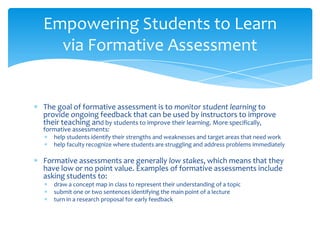
The goal of formative assessment is to monitor student learning to
provide ongoing feedback that can be used by instructors to improve
their teaching and by students to improve their learning. More specifically,
formative assessments:
help students identify their strengths and weaknesses and target areas that need work
help faculty recognize where students are struggling and address problems immediately
Formative assessments are generally low stakes, which means that they
have low or no point value. Examples of formative assessments include
asking students to:
draw a concept map in class to represent their understanding of a topic
submit one or two sentences identifying the main point of a lecture
turn in a research proposal for early feedback
Empowering Students to Learn
via Formative Assessment
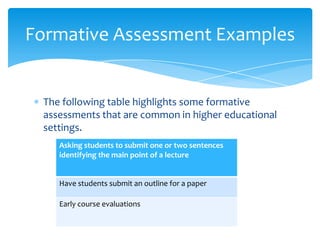
The following table highlights some formative
assessments that are common in higher educational
settings.
Formative Assessment Examples
Asking students to submit one or two sentences
identifying the main point of a lecture
Have students submit an outline for a paper
Early course evaluations
What formative assessment
strategies do you implement in
your classroom?
Audience Participation
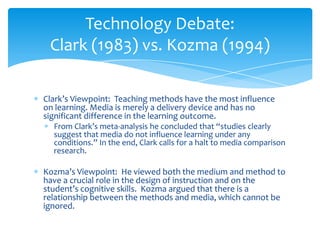
Clark’s Viewpoint: Teaching methods have the most influence
on learning. Media is merely a delivery device and has no
significant difference in the learning outcome.
From Clark’s meta-analysis he concluded that “studies clearly
suggest that media do not influence learning under any
conditions.” In the end, Clark calls for a halt to media comparison
research.
Kozma’s Viewpoint: He viewed both the medium and method to
have a crucial role in the design of instruction and on the
student’s cognitive skills. Kozma argued that there is a
relationship between the methods and media, which cannot be
ignored.
Technology Debate:
Clark (1983) vs. Kozma (1994)
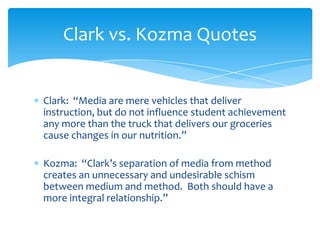
Clark: “Media are mere vehicles that deliver
instruction, but do not influence student achievement
any more than the truck that delivers our groceries
cause changes in our nutrition.”
Kozma: “Clark’s separation of media from method
creates an unnecessary and undesirable schism
between medium and method. Both should have a
more integral relationship.”
Clark vs. Kozma Quotes
Formative Assessment Animoto Video:
http://goo.gl/AenhyR
Poll Everywhere Survey: http://goo.gl/guKGO0
Interactive Activities
Screencast:
http://goo.gl/FRpxmV
An Online Tutorial
Benefits:
Multiple choice, open-ended, or T/F questions
Real-time survey results
Customize charts for the results
Student engagement
Up to 40 users per poll for FREE
Can use cell phone or laptop to enter responses
Can edit, stop, copy, or delete poll
http://goo.gl/ijdSxc
Web Address: http://www.polleverywhere.com/
Benefits:
FREE Jeopardy-style online quiz
Can include images and audio
http://goo.gl/sE3nXv
Web Address:
http://clear.msu.edu/quizbreak/
Quizbreak!
Benefits:
FREE tool that engages audience
Question analytics, e.g., how many answered it correctly
FB sharing component
Unlimited questions
T/F, multiple choice questions with image, text, or video options
Can provide feedback and/or set a time limit
Embed quizzes
http://goo.gl/1juBpG
Web Address: http://www.quizrevolution.com/
Quiz Revolution
Benefits:
FREE electronic flashcards can be sorted by
Hardest to easiest
In order
Least studied
Random
Wrong
Create a written review sheet
Group sharing opportunity
Great for short answer questions
http://goo.gl/Nvm0ZR
Web Address: http://www.studyblue.com/
Study Blue
Benefits:
FREE survey designing tool
Multiple choice, open-ended, and/or T/F questions
Collect responses via web link or FaceBook
Analyze results
http://goo.gl/aYqUnJ
Web Address:
https://www.surveymonkey.com/
Survey monkey
http://akenalong.weebly.com/
Please see Technology Integration Pages.
Technologies Website
The technologies explored promote: active and independent
learning; application; creativity; critical thinking; problem
solving; student engagement; and reflection—not mere
comprehension.
Word of Caution: Soft skills need to be addressed when
technologies are used, e.g., time management skills. There
are countless technologies and distractions on the
internet. If students are not instructor-guided and/or
focused, then tons of unproductive hours can be spent on
the web with no intellectual gains.
Words of
“What ideas, skills, and
knowledge will you be able to
take back and apply into their
own practice and/or share with
their colleagues?”
Audience Summary
Hopefully, you have had an opportunity to be
engaged via technologies and learn how engagement
is often a precursor to student achievement. By
participating in this workshop, perhaps you will re-
envision engagement, achievement, and especially
how your students can access your course content at
“anytime, any place any pace” (Governor Rick Snyder,
2011, http://goo.gl/BJ4wEW).
Departing Thoughts
Workshop Questions Technology Tool:
http://todaysmeet.com/ctl
Questions?
Carnegie Mellon University:
www.cmu.edu/teaching/assessment/basics/formative-summative.html
Florida Center for Instructional Technology:
http://fcit.usf.edu/assessment/basic/basica.html
Clark-Kozma Debate:
http://hansuk.wordpress.com/2010/02/08/based-on-kozma-clark-debate-what-is-your-
position-regarding-how-media-affect-learning/
http://dcmoffat71.wordpress.com/2013/04/17/clark-and-kozma-debate-is-it-still-relevant/
http://design2instruct.wordpress.com/2011/11/07/clark-vs-kozma-the-debate-continues/
http://stc.uws.edu.au/etext/debate.htm
References

A Likely Pair_OU Conf

  • 1.
    A Likely Pair:Engaging Technologies and Student Achievement Eighth Annual Conference on Teaching and Learning Oakland University, Rochester, MI May 14, 2014 A’Kena LongBenton, ABD, EdS Wayne State University akenalong@aol.com
  • 2.
    Per J.D. Willms(2000), “…the theoretical literature argues that engagement and academic achievement go hand-in-hand” (p. 9 http://goo.gl/5Sf0hc). When instructors use technologies to teach and inform their instruction, then they will not become victims of shock when their students perhaps fail a course exam. Various technologies offer instructors a greater sense of certainty that they have taught their students the course content. Also, the below technologies allow instructors to determine how much their students know before the exam is given. Last, these technologies allow instructors an opportunity to innovatively assist their students in preparation for course exams. Workshop Abstract
  • 3.
    Share research literatureon formative assessment and the technology debate Actively participate in a real-time technology-based poll Witness what the aforementioned technologies (Poll Everywhere, QuizBreak!, Quiz Revolution, StudyBlue, and SurveyMonkey) look like in practice. Brainstorm how they will use at least one of the formative assessment interactive technologies Observe how others will use these interactive technologies to improve student achievement Goals and Objectives
  • 4.
    Workshop Questions TechnologyTool (available until June 14, 2014): http://todaysmeet.com/ctl Today’s Workshop Slides http://goo.gl/????? Online Slideshow & Questions
  • 5.
    The goal offormative assessment is to monitor student learning to provide ongoing feedback that can be used by instructors to improve their teaching and by students to improve their learning. More specifically, formative assessments: help students identify their strengths and weaknesses and target areas that need work help faculty recognize where students are struggling and address problems immediately Formative assessments are generally low stakes, which means that they have low or no point value. Examples of formative assessments include asking students to: draw a concept map in class to represent their understanding of a topic submit one or two sentences identifying the main point of a lecture turn in a research proposal for early feedback Empowering Students to Learn via Formative Assessment
  • 6.
    The following tablehighlights some formative assessments that are common in higher educational settings. Formative Assessment Examples Asking students to submit one or two sentences identifying the main point of a lecture Have students submit an outline for a paper Early course evaluations
  • 7.
    What formative assessment strategiesdo you implement in your classroom? Audience Participation
  • 8.
    Clark’s Viewpoint: Teachingmethods have the most influence on learning. Media is merely a delivery device and has no significant difference in the learning outcome. From Clark’s meta-analysis he concluded that “studies clearly suggest that media do not influence learning under any conditions.” In the end, Clark calls for a halt to media comparison research. Kozma’s Viewpoint: He viewed both the medium and method to have a crucial role in the design of instruction and on the student’s cognitive skills. Kozma argued that there is a relationship between the methods and media, which cannot be ignored. Technology Debate: Clark (1983) vs. Kozma (1994)
  • 9.
    Clark: “Media aremere vehicles that deliver instruction, but do not influence student achievement any more than the truck that delivers our groceries cause changes in our nutrition.” Kozma: “Clark’s separation of media from method creates an unnecessary and undesirable schism between medium and method. Both should have a more integral relationship.” Clark vs. Kozma Quotes
  • 10.
    Formative Assessment AnimotoVideo: http://goo.gl/AenhyR Poll Everywhere Survey: http://goo.gl/guKGO0 Interactive Activities
  • 11.
  • 12.
    Benefits: Multiple choice, open-ended,or T/F questions Real-time survey results Customize charts for the results Student engagement Up to 40 users per poll for FREE Can use cell phone or laptop to enter responses Can edit, stop, copy, or delete poll http://goo.gl/ijdSxc Web Address: http://www.polleverywhere.com/
  • 13.
    Benefits: FREE Jeopardy-style onlinequiz Can include images and audio http://goo.gl/sE3nXv Web Address: http://clear.msu.edu/quizbreak/ Quizbreak!
  • 14.
    Benefits: FREE tool thatengages audience Question analytics, e.g., how many answered it correctly FB sharing component Unlimited questions T/F, multiple choice questions with image, text, or video options Can provide feedback and/or set a time limit Embed quizzes http://goo.gl/1juBpG Web Address: http://www.quizrevolution.com/ Quiz Revolution
  • 15.
    Benefits: FREE electronic flashcardscan be sorted by Hardest to easiest In order Least studied Random Wrong Create a written review sheet Group sharing opportunity Great for short answer questions http://goo.gl/Nvm0ZR Web Address: http://www.studyblue.com/ Study Blue
  • 16.
    Benefits: FREE survey designingtool Multiple choice, open-ended, and/or T/F questions Collect responses via web link or FaceBook Analyze results http://goo.gl/aYqUnJ Web Address: https://www.surveymonkey.com/ Survey monkey
  • 17.
    http://akenalong.weebly.com/ Please see TechnologyIntegration Pages. Technologies Website
  • 18.
    The technologies exploredpromote: active and independent learning; application; creativity; critical thinking; problem solving; student engagement; and reflection—not mere comprehension. Word of Caution: Soft skills need to be addressed when technologies are used, e.g., time management skills. There are countless technologies and distractions on the internet. If students are not instructor-guided and/or focused, then tons of unproductive hours can be spent on the web with no intellectual gains. Words of
  • 19.
    “What ideas, skills,and knowledge will you be able to take back and apply into their own practice and/or share with their colleagues?” Audience Summary
  • 20.
    Hopefully, you havehad an opportunity to be engaged via technologies and learn how engagement is often a precursor to student achievement. By participating in this workshop, perhaps you will re- envision engagement, achievement, and especially how your students can access your course content at “anytime, any place any pace” (Governor Rick Snyder, 2011, http://goo.gl/BJ4wEW). Departing Thoughts
  • 21.
    Workshop Questions TechnologyTool: http://todaysmeet.com/ctl Questions?
  • 22.
    Carnegie Mellon University: www.cmu.edu/teaching/assessment/basics/formative-summative.html FloridaCenter for Instructional Technology: http://fcit.usf.edu/assessment/basic/basica.html Clark-Kozma Debate: http://hansuk.wordpress.com/2010/02/08/based-on-kozma-clark-debate-what-is-your- position-regarding-how-media-affect-learning/ http://dcmoffat71.wordpress.com/2013/04/17/clark-and-kozma-debate-is-it-still-relevant/ http://design2instruct.wordpress.com/2011/11/07/clark-vs-kozma-the-debate-continues/ http://stc.uws.edu.au/etext/debate.htm References