Peeking over the horizon Technology’s mark on higher education’s future
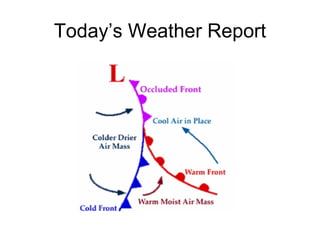
Today’s Weather Report
Technology and  The Changed Environment The higher education enterprise seems simultaneously threatened and creatively enabled by technology The personal and professional lives of students, staff, and faculty are inescapably changed by technology regardless of any effects on the enterprise
 
OMG! Morgan Pozgar will CUNS in four short years! She’s FTASB, and @TEOTD will change higher education
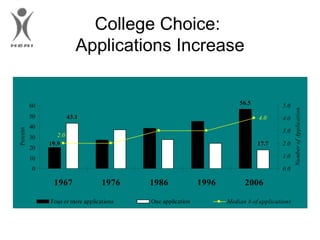
College Choice:  Applications Increase
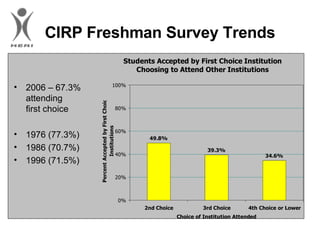
CIRP Freshman Survey Trends 2006 – 67.3% attending  first choice 1976 (77.3%) 1986 (70.7%) 1996 (71.5%)
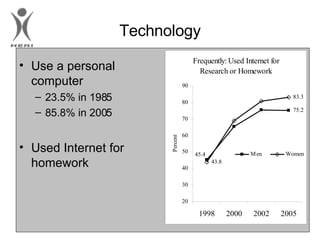
Technology Use a personal computer 23.5% in 1985 85.8% in 2005 Used Internet for homework
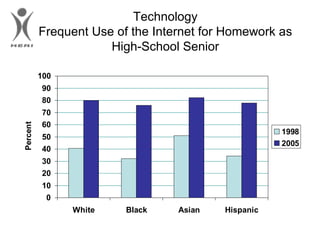
Technology Frequent Use of the Internet for Homework as High-School Senior
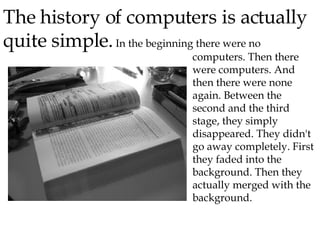
The history of computers is actually quite simple.  In the beginning there were no computers. Then there were computers. And then there were none again. Between the second and the third stage, they simply disappeared. They didn't go away completely. First they faded into the background. Then they actually merged with the background.


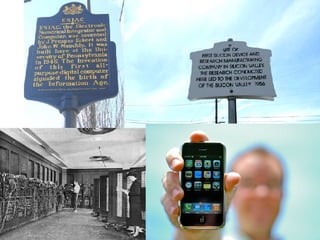
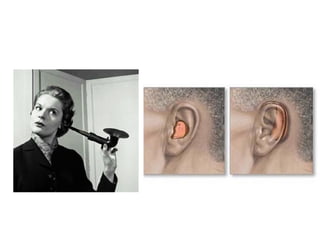
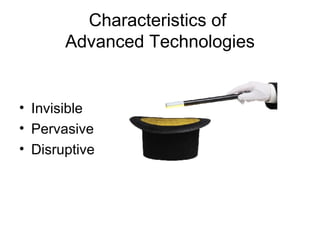
Characteristics of  Advanced Technologies Invisible Pervasive Disruptive
Opportunities Created by Technology Enhancing communication Redefining presence Connecting more directly with clients Leveraging existing activities Reducing bureaucratic friction Developing data, knowledge, and wisdom
The BIG Technology Threat
The BIG Technology Threat If you don’t like change you are going to like irrelevance even less General Eric Shinseki U.S. Army Chief of Staff, Retired
Moving Forward  as a Field of Practice What’s our evidence base? Using IT to create and leverage data Examining digital footprints Colorizing snapshots  Traditional data collections
Potential Campus Partners Students Faculty Learning support staff IT support staff  What’s on the minds of IT  directors? How can we connect?
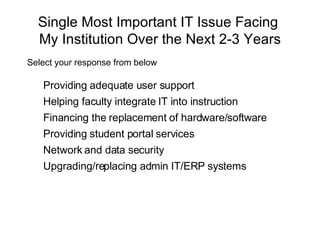
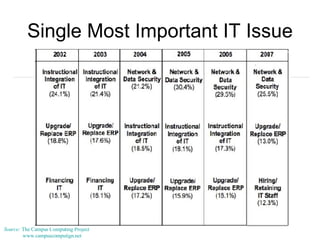
Single Most Important IT Issue Facing  My Institution Over the Next 2-3 Years Select your response from below Providing adequate user support Helping faculty integrate IT into instruction Financing the replacement of hardware/software Providing student portal services Network and data security Upgrading/replacing admin IT/ERP systems
Single Most Important IT Issue Source:  The Campus Computing Project www.campuscomputign.net
From context to projects Student and administrative response to Facebook at Michigan Capturing college teaching
Division of Student Affairs efforts Facebook Committee Support of thesis research Fullman, N. (2007). “Parents on Speed Dial: The Psychological Implications of Frequent Student-Parent Communication in Emerging Adulthood.” Middlebury College More studies will appear in the coming years as researchers dive into this array of student information.
Presentation overview Fast facts on Facebook Benefits and concerns regarding Facebook Theoretical implications Survey results Discussion and questions
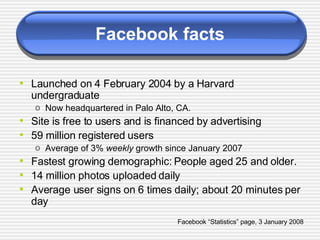
Facebook facts Launched on 4 February 2004 by a Harvard undergraduate Now headquartered in Palo Alto, CA. Site is free to users and is financed by advertising 59 million registered users Average of 3%  weekly  growth since January 2007 Fastest growing demographic: People aged 25 and older. 14 million photos uploaded daily Average user signs on 6 times daily; about 20 minutes per day Facebook “Statistics” page, 3 January 2008
Time UM students spend on Facebook CIRP 2007 (UM entering undergraduate students) 54.2% estimated spending 1-5 hours per week on social networks such as myspace.com and Facebook.  Another 12.8% estimated spending 6 or more hours per week on these networks. This is slightly  less  time than their peers spend nationally Only one third (33.2%) report reading internet blogs “frequently” or “occasionally.”
Sorting information from hype
Reframing the question Facebook has become a powerful tool Two possible directions to explore are  community  and  identity  development
Identity development: Traditional theories Arthur Chickering - Seven Vectors Focused on college student development • Developing Autonomy  - disengage from parents. Reliance on peers or other reference group • Establishing Identity  - refers to the person a student feels he/she is
Identity development: New theories “ Emerging Adulthood” term coined by Jeffrey Arnett.  A developmental phase between ages 18 and 35 when people assume adult  responsibilities   more gradually than previous generations.
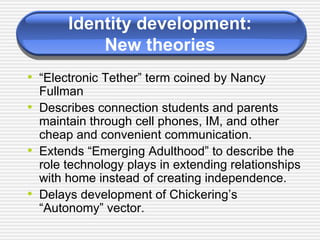
Identity development: New theories “ Electronic Tether” term coined by Nancy Fullman Describes connection students and parents maintain through cell phones, IM, and other cheap and convenient communication. Extends “Emerging Adulthood” to describe the role technology plays in extending relationships with home instead of creating independence. Delays development of Chickering’s “Autonomy” vector.
Benefits and concerns
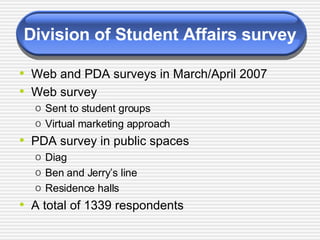
Division of Student Affairs survey Web and PDA surveys in March/April 2007 Web survey Sent to student groups Virtual marketing approach PDA survey in public spaces Diag Ben and Jerry’s line Residence halls  A total of 1339 respondents
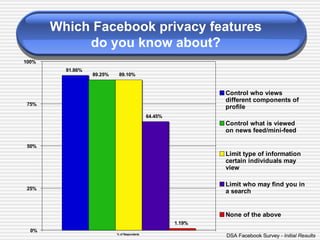
Which Facebook privacy features  do you know about?   DSA Facebook Survey  - Initial Results
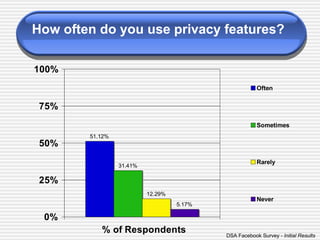
How often do you use privacy features?   DSA Facebook Survey  - Initial Results
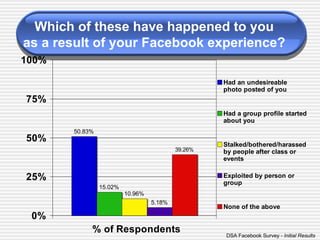
Which of these have happened to you  as a result of your Facebook experience?   DSA Facebook Survey  - Initial Results
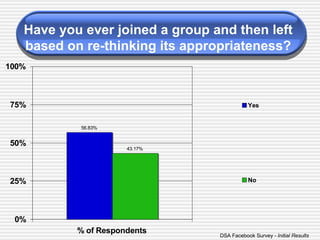
Have you ever joined a group and then left  based on re-thinking its appropriateness?  DSA Facebook Survey  - Initial Results
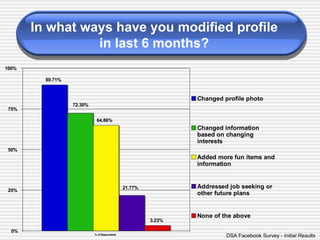
In what ways have you modified profile  in last 6 months?   DSA Facebook Survey  - Initial Results
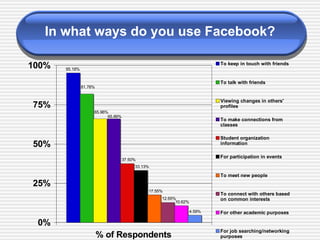
In what ways do you use Facebook?
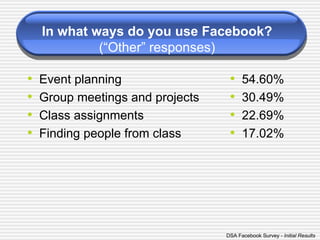
Event planning Group meetings and projects Class assignments Finding people from class 54.60% 30.49% 22.69% 17.02% In what ways do you use Facebook?   ( “ Other ”  responses) DSA Facebook Survey  - Initial Results
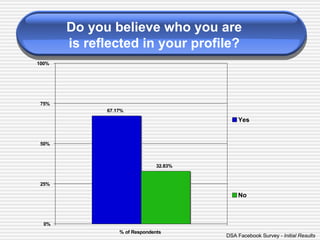
Do you believe who you are  is reflected in your profile?   DSA Facebook Survey  - Initial Results
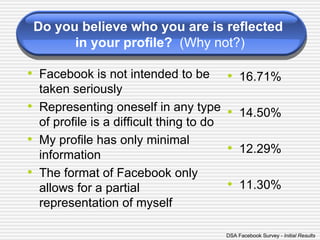
Facebook is not intended to be taken seriously Representing oneself in any type of profile is a difficult thing to do  My profile has only minimal information The format of Facebook only allows for a partial representation of myself 16.71% 14.50% 12.29% 11.30% Do you believe who you are is reflected  in your profile?   (Why not?) DSA Facebook Survey  - Initial Results
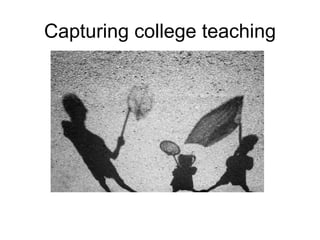
Capturing college teaching
 
Our true feelings about lecture
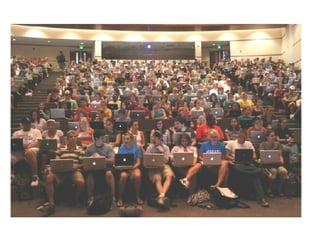
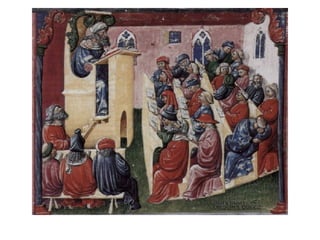
What is a lecture? A threat, a warning, or an apology An honor A good way of transmitting information Not so good for cultivating deep thought, affecting attitudes, teaching skills for social interaction
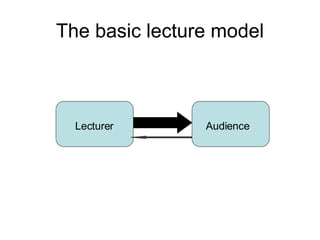
The basic lecture model Lecturer Audience
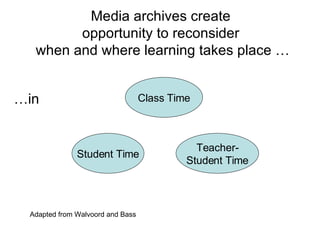
Media archives create  opportunity to reconsider  when and where learning takes place … …in Class Time Student Time Teacher- Student Time Adapted from Walvoord and Bass
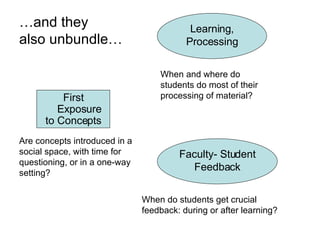
… and they  also unbundle… First Exposure to Concepts Faculty- Student Feedback Learning, Processing Are concepts introduced in a social space, with time for questioning, or in a one-way setting?  When and where do students do most of their processing of material? When do students get crucial feedback: during or after learning?
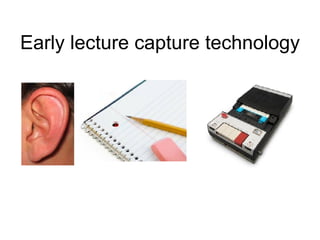
Early lecture capture technology
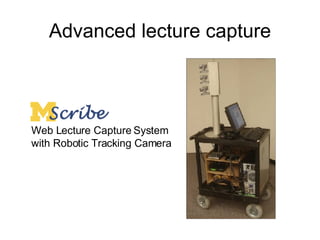
Advanced lecture capture Web Lecture Capture System with Robotic Tracking Camera
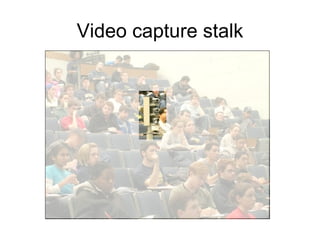
Video capture stalk
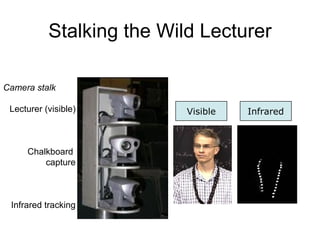
Stalking the Wild Lecturer Camera stalk Lecturer (visible) Chalkboard  capture Infrared tracking Visible Infrared
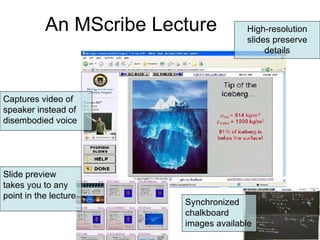
An MScribe Lecture Captures video of speaker instead of disembodied voice High-resolution slides preserve details Synchronized chalkboard images available Slide preview takes you to any point in the lecture
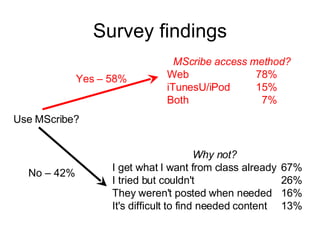
Survey findings Use MScribe? Yes – 58% No – 42% MScribe access method? Web 78% iTunesU/iPod 15% Both 7% Why not? I get what I want from class already 67% I tried but couldn't 26% They weren't posted when needed 16% It's difficult to find needed content  13%
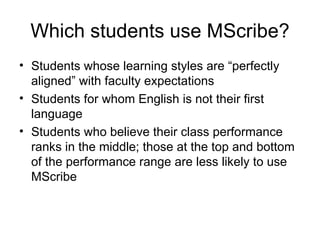
Which students use MScribe? Students whose learning styles are “perfectly aligned” with faculty expectations Students for whom English is not their first language Students who believe their class performance ranks in the middle; those at the top and bottom of the performance range are less likely to use MScribe
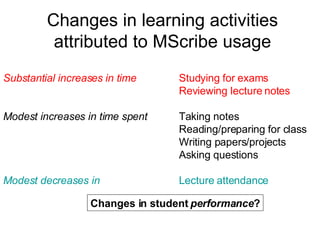
Changes in learning activities  attributed to MScribe usage Substantial increases in time Studying for exams Reviewing lecture notes Modest increases in time spent   Taking notes Reading/preparing for class Writing papers/projects Asking questions Modest decreases in Lecture attendance Changes in student  performance ?
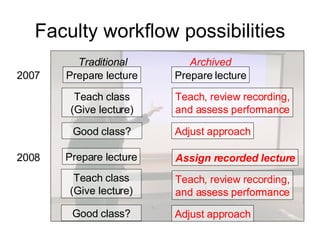
Faculty workflow possibilities Traditional Archived 2007 Prepare lecture Teach class (Give lecture) Good class? 2008 Prepare lecture Teach class (Give lecture) Good class? Teach, review recording, and assess performance Adjust approach Prepare lecture Assign recorded lecture Teach, review recording, and assess performance Adjust approach
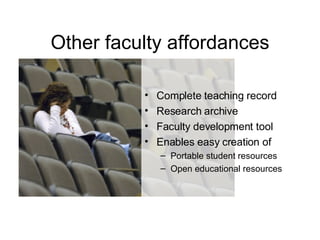
Other faculty affordances Complete teaching record  Research archive Faculty development tool Enables easy creation of Portable student resources Open educational resources
Future project goals Expanding scope of capture activities Enhanced recording and indexing technologies Understanding impact  on students Research to improve  teaching practice and learning outcomes
Creating Opportunities New expectations Mashup and remix culture Establish new partnerships See the invisible See the possibilities
Closing Thought A year from now you may wish you had started today Karen Lamb

080117 Peeking Over The Horizon

  • 1.
    Peeking over thehorizon Technology’s mark on higher education’s future
  • 2.
  • 3.
    Technology and The Changed Environment The higher education enterprise seems simultaneously threatened and creatively enabled by technology The personal and professional lives of students, staff, and faculty are inescapably changed by technology regardless of any effects on the enterprise
  • 4.
  • 5.
    OMG! Morgan Pozgarwill CUNS in four short years! She’s FTASB, and @TEOTD will change higher education
  • 6.
    College Choice: Applications Increase
  • 7.
    CIRP Freshman SurveyTrends 2006 – 67.3% attending first choice 1976 (77.3%) 1986 (70.7%) 1996 (71.5%)
  • 8.
    Technology Use apersonal computer 23.5% in 1985 85.8% in 2005 Used Internet for homework
  • 9.
    Technology Frequent Useof the Internet for Homework as High-School Senior
  • 10.
    The history ofcomputers is actually quite simple. In the beginning there were no computers. Then there were computers. And then there were none again. Between the second and the third stage, they simply disappeared. They didn't go away completely. First they faded into the background. Then they actually merged with the background.
  • 11.
  • 12.
  • 13.
  • 14.
    Characteristics of Advanced Technologies Invisible Pervasive Disruptive
  • 15.
    Opportunities Created byTechnology Enhancing communication Redefining presence Connecting more directly with clients Leveraging existing activities Reducing bureaucratic friction Developing data, knowledge, and wisdom
  • 16.
  • 17.
    The BIG TechnologyThreat If you don’t like change you are going to like irrelevance even less General Eric Shinseki U.S. Army Chief of Staff, Retired
  • 18.
    Moving Forward as a Field of Practice What’s our evidence base? Using IT to create and leverage data Examining digital footprints Colorizing snapshots Traditional data collections
  • 19.
    Potential Campus PartnersStudents Faculty Learning support staff IT support staff What’s on the minds of IT directors? How can we connect?
  • 20.
    Single Most ImportantIT Issue Facing My Institution Over the Next 2-3 Years Select your response from below Providing adequate user support Helping faculty integrate IT into instruction Financing the replacement of hardware/software Providing student portal services Network and data security Upgrading/replacing admin IT/ERP systems
  • 21.
    Single Most ImportantIT Issue Source: The Campus Computing Project www.campuscomputign.net
  • 22.
    From context toprojects Student and administrative response to Facebook at Michigan Capturing college teaching
  • 23.
    Division of StudentAffairs efforts Facebook Committee Support of thesis research Fullman, N. (2007). “Parents on Speed Dial: The Psychological Implications of Frequent Student-Parent Communication in Emerging Adulthood.” Middlebury College More studies will appear in the coming years as researchers dive into this array of student information.
  • 24.
    Presentation overview Fastfacts on Facebook Benefits and concerns regarding Facebook Theoretical implications Survey results Discussion and questions
  • 25.
    Facebook facts Launchedon 4 February 2004 by a Harvard undergraduate Now headquartered in Palo Alto, CA. Site is free to users and is financed by advertising 59 million registered users Average of 3% weekly growth since January 2007 Fastest growing demographic: People aged 25 and older. 14 million photos uploaded daily Average user signs on 6 times daily; about 20 minutes per day Facebook “Statistics” page, 3 January 2008
  • 26.
    Time UM studentsspend on Facebook CIRP 2007 (UM entering undergraduate students) 54.2% estimated spending 1-5 hours per week on social networks such as myspace.com and Facebook. Another 12.8% estimated spending 6 or more hours per week on these networks. This is slightly less time than their peers spend nationally Only one third (33.2%) report reading internet blogs “frequently” or “occasionally.”
  • 27.
  • 28.
    Reframing the questionFacebook has become a powerful tool Two possible directions to explore are community and identity development
  • 29.
    Identity development: Traditionaltheories Arthur Chickering - Seven Vectors Focused on college student development • Developing Autonomy - disengage from parents. Reliance on peers or other reference group • Establishing Identity - refers to the person a student feels he/she is
  • 30.
    Identity development: Newtheories “ Emerging Adulthood” term coined by Jeffrey Arnett. A developmental phase between ages 18 and 35 when people assume adult responsibilities more gradually than previous generations.
  • 31.
    Identity development: Newtheories “ Electronic Tether” term coined by Nancy Fullman Describes connection students and parents maintain through cell phones, IM, and other cheap and convenient communication. Extends “Emerging Adulthood” to describe the role technology plays in extending relationships with home instead of creating independence. Delays development of Chickering’s “Autonomy” vector.
  • 32.
  • 33.
    Division of StudentAffairs survey Web and PDA surveys in March/April 2007 Web survey Sent to student groups Virtual marketing approach PDA survey in public spaces Diag Ben and Jerry’s line Residence halls A total of 1339 respondents
  • 34.
    Which Facebook privacyfeatures do you know about? DSA Facebook Survey - Initial Results
  • 35.
    How often doyou use privacy features? DSA Facebook Survey - Initial Results
  • 36.
    Which of thesehave happened to you as a result of your Facebook experience? DSA Facebook Survey - Initial Results
  • 37.
    Have you everjoined a group and then left based on re-thinking its appropriateness? DSA Facebook Survey - Initial Results
  • 38.
    In what wayshave you modified profile in last 6 months? DSA Facebook Survey - Initial Results
  • 39.
    In what waysdo you use Facebook?
  • 40.
    Event planning Groupmeetings and projects Class assignments Finding people from class 54.60% 30.49% 22.69% 17.02% In what ways do you use Facebook? ( “ Other ” responses) DSA Facebook Survey - Initial Results
  • 41.
    Do you believewho you are is reflected in your profile? DSA Facebook Survey - Initial Results
  • 42.
    Facebook is notintended to be taken seriously Representing oneself in any type of profile is a difficult thing to do My profile has only minimal information The format of Facebook only allows for a partial representation of myself 16.71% 14.50% 12.29% 11.30% Do you believe who you are is reflected in your profile? (Why not?) DSA Facebook Survey - Initial Results
  • 43.
  • 44.
  • 45.
    Our true feelingsabout lecture
  • 46.
    What is alecture? A threat, a warning, or an apology An honor A good way of transmitting information Not so good for cultivating deep thought, affecting attitudes, teaching skills for social interaction
  • 47.
    The basic lecturemodel Lecturer Audience
  • 48.
    Media archives create opportunity to reconsider when and where learning takes place … …in Class Time Student Time Teacher- Student Time Adapted from Walvoord and Bass
  • 49.
    … and they also unbundle… First Exposure to Concepts Faculty- Student Feedback Learning, Processing Are concepts introduced in a social space, with time for questioning, or in a one-way setting? When and where do students do most of their processing of material? When do students get crucial feedback: during or after learning?
  • 50.
  • 51.
    Advanced lecture captureWeb Lecture Capture System with Robotic Tracking Camera
  • 52.
  • 53.
    Stalking the WildLecturer Camera stalk Lecturer (visible) Chalkboard capture Infrared tracking Visible Infrared
  • 54.
    An MScribe LectureCaptures video of speaker instead of disembodied voice High-resolution slides preserve details Synchronized chalkboard images available Slide preview takes you to any point in the lecture
  • 55.
    Survey findings UseMScribe? Yes – 58% No – 42% MScribe access method? Web 78% iTunesU/iPod 15% Both 7% Why not? I get what I want from class already 67% I tried but couldn't 26% They weren't posted when needed 16% It's difficult to find needed content 13%
  • 56.
    Which students useMScribe? Students whose learning styles are “perfectly aligned” with faculty expectations Students for whom English is not their first language Students who believe their class performance ranks in the middle; those at the top and bottom of the performance range are less likely to use MScribe
  • 57.
    Changes in learningactivities attributed to MScribe usage Substantial increases in time Studying for exams Reviewing lecture notes Modest increases in time spent Taking notes Reading/preparing for class Writing papers/projects Asking questions Modest decreases in Lecture attendance Changes in student performance ?
  • 58.
    Faculty workflow possibilitiesTraditional Archived 2007 Prepare lecture Teach class (Give lecture) Good class? 2008 Prepare lecture Teach class (Give lecture) Good class? Teach, review recording, and assess performance Adjust approach Prepare lecture Assign recorded lecture Teach, review recording, and assess performance Adjust approach
  • 59.
    Other faculty affordancesComplete teaching record Research archive Faculty development tool Enables easy creation of Portable student resources Open educational resources
  • 60.
    Future project goalsExpanding scope of capture activities Enhanced recording and indexing technologies Understanding impact on students Research to improve teaching practice and learning outcomes
  • 61.
    Creating Opportunities Newexpectations Mashup and remix culture Establish new partnerships See the invisible See the possibilities
  • 62.
    Closing Thought Ayear from now you may wish you had started today Karen Lamb