Michigan Reading Association
Cobo Hall
Detroit, MI
03/19/16
A’Kena LongBenton, ABD, EdS
Wayne State University
akenalong@gmail.com
Writing from their Lives: "The Power of One"
Academic/Creative Writing Prompts
Share their Stories
• To remove the angst of assessment, students
should be allowed to have academic creative
outlets, i.e., fiction, poetry, drama, non-
fiction, or prose writing.
• What better way to experience writing than
through our own stories?
• Alfred Tatum (2009), a literacy professor and author,
suggested that powerful teaching moments result
when students are allowed to read and write
personalized engaging texts.
• Texts become personalized when they are connected to
the students’ lineage.
• For our unengaged students, (especially African
American adolescent males) provocative topics, writing
prompts, and templates can serve as assistance to
them.
Writing from their Lives
• For example, students can write poems or short
stories on personal and relevant topics i.e.,
• to stop one bullet;
• to stop one pregnancy;
• to stop one drop out;
• to bring one father home;
• to save one younger brother; or
• a topic of their choice (Reading for their Life, p.
101).
The Power of One
• Similarly, Danielle DeFauw (2012) agreed and urged writers
to “zone in on one” instead of addressing a concept from a
large scheme/societal standpoint.
• With the “Power of One” angle, our stories become more
personalized and as a result more powerful.
• For example, how cancer affects my family is more
powerful than addressing cancer from a global and holistic
viewpoint.
• Clearly, this latter method is too broad and loses its effect
on writers and readers.
Guarding Against Stereotypes
• In contrast, Chimamanda Adichie (2009) in a TEDGlobal video passionately
disagreed. She argued that single stories perpetuate stereotypes (“The
Danger of a Single Story”
http://www.ted.com/talks/chimamanda_adichie_the_danger_of_a_single
_story.html).
• This position is readily accepted when cultures differ from the author and
his/her audience. However, when culture clashes do not exist, then the
“Power of One” writing method is quite effective.
• It is important to note that even when writers and readers’ culture is the
same, their frame of reference will always differ (No two people’s frame of
reference will ever be the same due to our varied experiences.).
• However, with this former example, writers and readers do not have the
double burden of culture clashes and varied frames of reference.
Thought-provoking Questions
• As teachers, we instruct our students to
“write…write…write…and write some more,”
but how often do we write?
• As much as we critique our students’ writing,
are we willing to be vulnerable enough to
share our creations, performances, and/or
writings with our overly critical students?
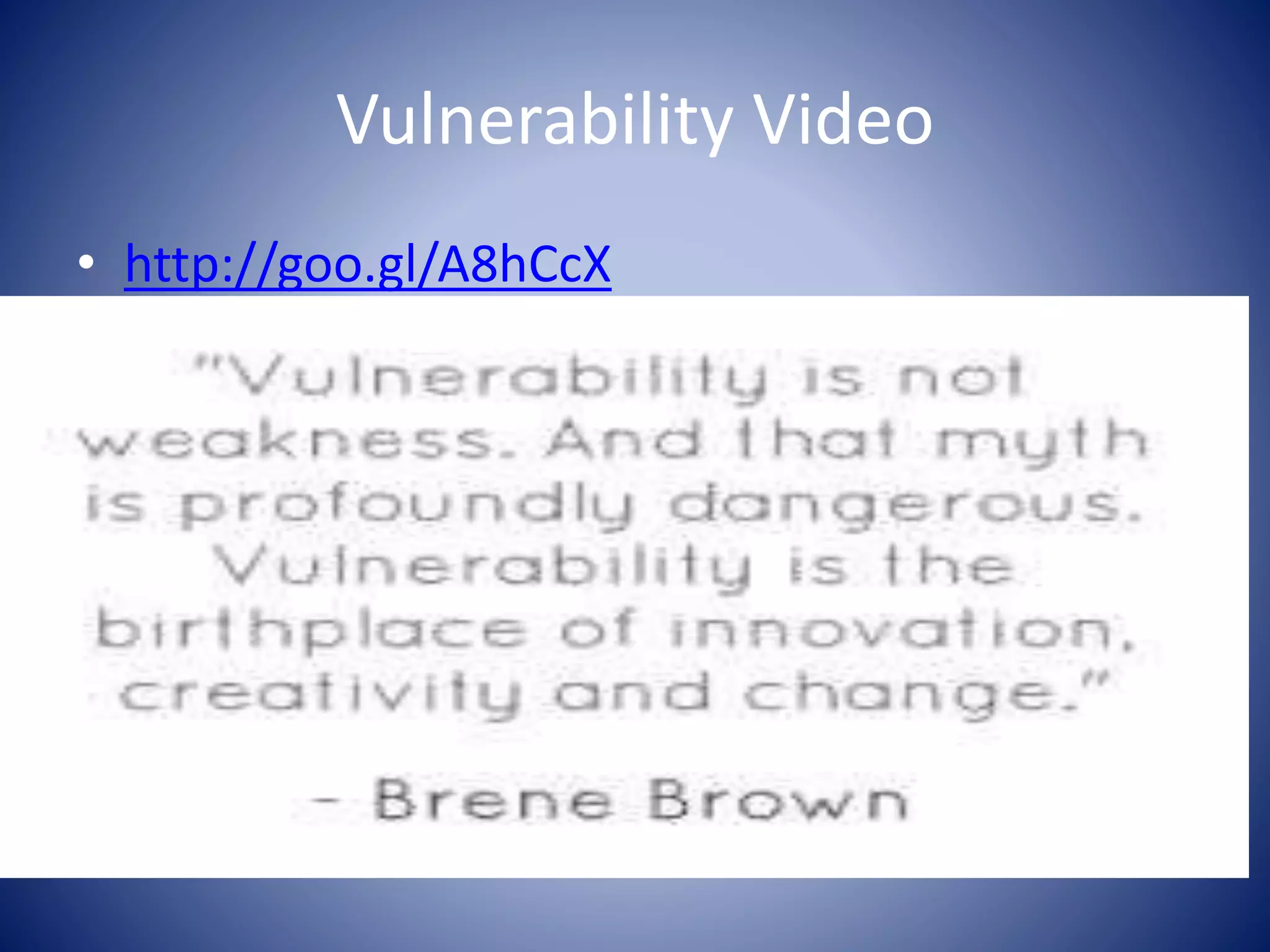
Vulnerability Video
• http://goo.gl/A8hCcX
Presentation Premise
• As a regular practice, I allow my students to
assess my performance.
• Specifically, in my college communication and
English courses, I deliver speeches and share
my published writings with students,
respectively.
• This sharing pre-exposes students to the grading rubric
that will assess their performance.
• It illustrates the confidence in my own performance.
• Student voices are heard.
• Builds students’ confidence.
• Builds classroom community, i.e., “We’re all in this
learning process together.”
Modeling Expectations
• Because, I am a proponent of modeling,
sharing my performances allows me to model
the behavioral objectives that I expect my
students to ultimately demonstrate.
• I believe that students best perform when
expectations are first modeled for them.
Turning the Tables
• Besides, students get a genuine “kick” out of
the “tables being turned” where they can
ultimately assess their teachers.
Student Engagement
• It’s also very interesting to witness how
engaged they are in this section of the lesson.
Naysayers
• Of course, you will have the student whose
goal is to give you a “C” or lower regardless of
how stellar your performance is.
Lies vs. Truth
• However, the majority of the class will not
have “personal axes to grind.”
• Plus, the “get even” students just expose
where their intentions lie (no pun intended).
• Their scores just serve as outliers and do not
affect the instructor’s median and mode
scores.
Who’s the author?
• As a former high school teacher, I remember
reading an engaging text to my 9th grade
students and them later asking who the
author was (I purposefully omitted this
notable detail.).
Focus on the Believers
• I casually responded, “Me.”
• The first time, most of the class was amazed!
• Of course, a few skeptics didn’t believe it, but
then again, they rarely believed anything. 
• Once proven, they later accepted my response as
“truth.”
Animoto Examples
• goo.gl/0zsp3k
• Nearly 30 self-created Animoto videos in the
following disciplines:
– English
– Math
– Science
– Social Studies
– Technology
– Writing
• Similarly, there is a creation, performance,
and/or writing in all of us…just waiting to be
shared. Have you shared yours lately?
Sharing cont.
• As a college instructor, I am committed to
further sharing mine as I instruct my students.
• Please join me and share your writings,
performances, and/or creations with your
students.
• It will positively change the relationship that
you have with them. Guaranteed!
No Guarantees
• OK, well…maybe, there are no guarantees in
education.
• Yet, this teaching practice is a safe bet to
winning some of your unengaged learners.
Rapport Building
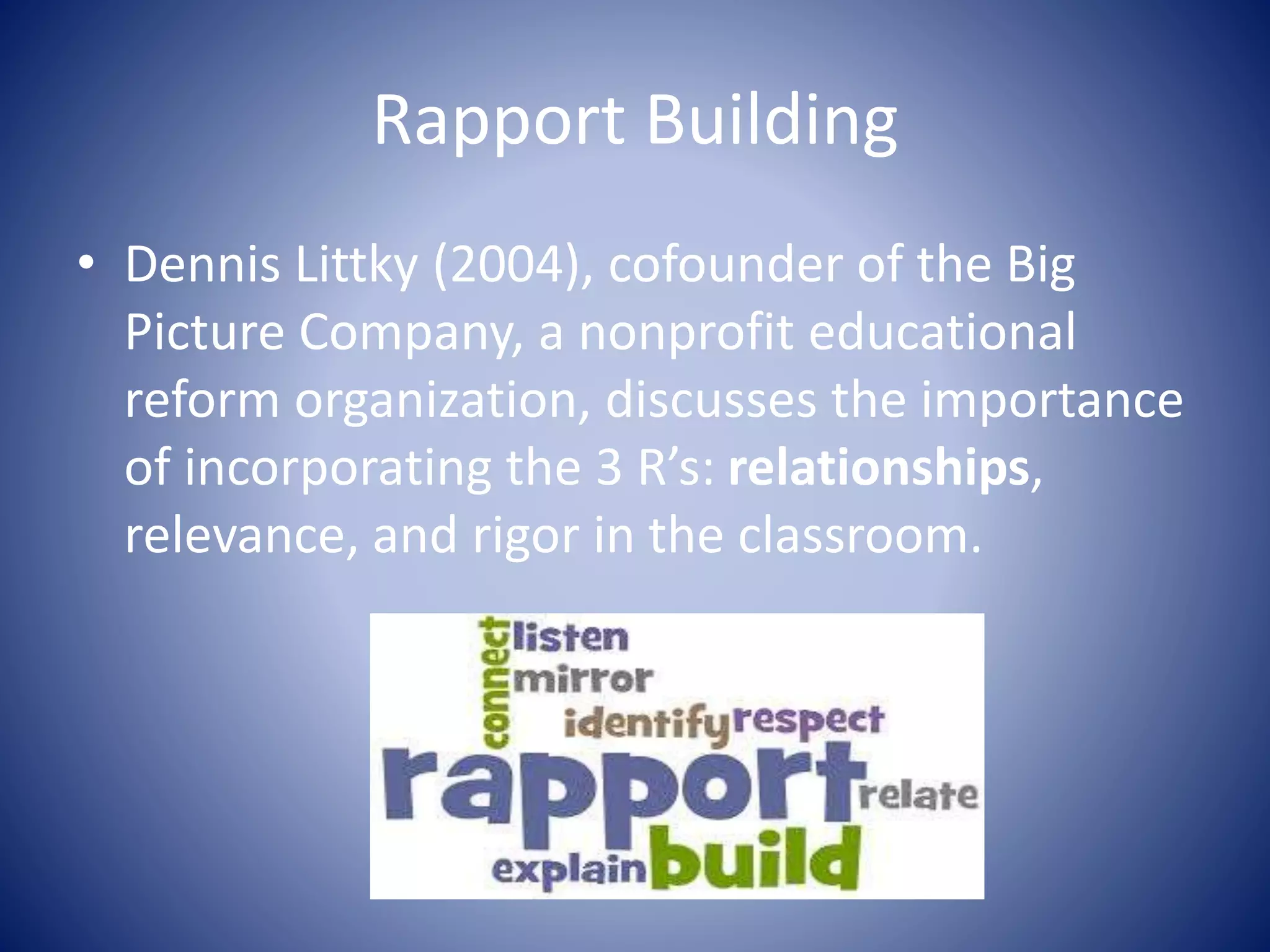
• Dennis Littky (2004), cofounder of the Big
Picture Company, a nonprofit educational
reform organization, discusses the importance
of incorporating the 3 R’s: relationships,
relevance, and rigor in the classroom.
Rapport Building cont.
• Also, the teacher has an opportunity to build a
better rapport with her class because students
value when teachers creatively instruct them
(whether they tell us or not).
• Furthermore, students notice and appreciate
when hard work goes into innovative lesson
planning.
Less Behavioral Problems
• Consequently, they began to see their teacher
from a positive vantage point.
• Less behavioral problems also a byproduct of
rapport building—a result that any instructor
would love to experience.
• Note: Sidebar conversations are often a result
of boredom and/or confusion.
Poetry Resources Example
• Below you will find sample poets via a web
link: http://www.famouspoetsandpoems.com
/top_poems.html
Outline Example
I. Introduction
A.Song—“You love me when nobody else would do it.”
B. A song by one of my favorite jazz artist, Rachelle Farrell.
C. All of us have been in love or will experience it one day.
D. That’s how powerful love is; it has no bounds.
E. Today, I will share with you a memorable dating experience for the author and one that eventually
led to love or…so she thought.
II. Body
A. The poet of the piece that I will share is A’Kena Long. She has authored six books, is near
completing her doctorate at WSU, an international college instructor, consultant and
teacher trainer, former K-8 principal and secondary teacher, current college curriculum developer, and is
certified to teach grades 6-college in the subjects of English, speech, and technology. (Show collage.)
B. From her book, YUP: A Young Urban Professional Speaks, I will read “I am You/ You are I.”
III. Conclusion
A. I have just shared with you an interesting “love” experience that I had.
B. It is clear by this date that this experience began rocky, but ended ironically.
C. As I close, I will leave you with this question: Have you tried love lately?
Rubric Example
The speaker had an appropriate
attention grabber.
10 6.67 3.34
The speaker related the speech to the
audience.
10 6.67 3.34
The speaker included a biographical
statement and a creative picture of the
poet.
10 6.67 3.34
The speaker included the poet and title
of a published piece (thesis statement).
10 6.67 3.34
The speaker used appropriate vocal
delivery.
10 6.67 3.34
The speaker used nonverbal messages
appropriately.
10 6.67 3.34
The speaker presented within the 4-6
minute time limit.
10 6.67 3.34
The speaker restated the thesis. 10 6.67 3.34
The speaker summarized the speech. 10 6.67 3.34
The speaker ends the speech with a
clincher.
10 6.67 3.34
Let’s Practice with the Rubric
• “I am You/You are I” Handouts (A Young Urban Professional
Speaks, 2003).
POWERS*: Writing Process
• P: Plan—brainstorm potential writing ideas in a list
• O: Organize—map or web those ideas
• W: Write—create a rough draft
• E: Evaluate—have someone edit your paper
• R: Revise—include the editors comments in your final
draft
• S*: Share—perform or publish your work
• POWER Video:
• http://animoto.com/play/GcQuw1IQVY9RuT5YuZCn7w

Writing from their Lives: The Power of One

  • 1.
    Michigan Reading Association CoboHall Detroit, MI 03/19/16 A’Kena LongBenton, ABD, EdS Wayne State University akenalong@gmail.com Writing from their Lives: "The Power of One" Academic/Creative Writing Prompts
  • 2.
    Share their Stories •To remove the angst of assessment, students should be allowed to have academic creative outlets, i.e., fiction, poetry, drama, non- fiction, or prose writing. • What better way to experience writing than through our own stories?
  • 3.
    • Alfred Tatum(2009), a literacy professor and author, suggested that powerful teaching moments result when students are allowed to read and write personalized engaging texts. • Texts become personalized when they are connected to the students’ lineage. • For our unengaged students, (especially African American adolescent males) provocative topics, writing prompts, and templates can serve as assistance to them.
  • 4.
    Writing from theirLives • For example, students can write poems or short stories on personal and relevant topics i.e., • to stop one bullet; • to stop one pregnancy; • to stop one drop out; • to bring one father home; • to save one younger brother; or • a topic of their choice (Reading for their Life, p. 101).
  • 5.
    The Power ofOne • Similarly, Danielle DeFauw (2012) agreed and urged writers to “zone in on one” instead of addressing a concept from a large scheme/societal standpoint. • With the “Power of One” angle, our stories become more personalized and as a result more powerful. • For example, how cancer affects my family is more powerful than addressing cancer from a global and holistic viewpoint. • Clearly, this latter method is too broad and loses its effect on writers and readers.
  • 6.
    Guarding Against Stereotypes •In contrast, Chimamanda Adichie (2009) in a TEDGlobal video passionately disagreed. She argued that single stories perpetuate stereotypes (“The Danger of a Single Story” http://www.ted.com/talks/chimamanda_adichie_the_danger_of_a_single _story.html). • This position is readily accepted when cultures differ from the author and his/her audience. However, when culture clashes do not exist, then the “Power of One” writing method is quite effective. • It is important to note that even when writers and readers’ culture is the same, their frame of reference will always differ (No two people’s frame of reference will ever be the same due to our varied experiences.). • However, with this former example, writers and readers do not have the double burden of culture clashes and varied frames of reference.
  • 7.
    Thought-provoking Questions • Asteachers, we instruct our students to “write…write…write…and write some more,” but how often do we write? • As much as we critique our students’ writing, are we willing to be vulnerable enough to share our creations, performances, and/or writings with our overly critical students?
  • 8.
  • 9.
    Presentation Premise • Asa regular practice, I allow my students to assess my performance. • Specifically, in my college communication and English courses, I deliver speeches and share my published writings with students, respectively.
  • 10.
    • This sharingpre-exposes students to the grading rubric that will assess their performance. • It illustrates the confidence in my own performance. • Student voices are heard. • Builds students’ confidence. • Builds classroom community, i.e., “We’re all in this learning process together.”
  • 11.
    Modeling Expectations • Because,I am a proponent of modeling, sharing my performances allows me to model the behavioral objectives that I expect my students to ultimately demonstrate. • I believe that students best perform when expectations are first modeled for them.
  • 12.
    Turning the Tables •Besides, students get a genuine “kick” out of the “tables being turned” where they can ultimately assess their teachers.
  • 13.
    Student Engagement • It’salso very interesting to witness how engaged they are in this section of the lesson.
  • 14.
    Naysayers • Of course,you will have the student whose goal is to give you a “C” or lower regardless of how stellar your performance is.
  • 15.
    Lies vs. Truth •However, the majority of the class will not have “personal axes to grind.” • Plus, the “get even” students just expose where their intentions lie (no pun intended). • Their scores just serve as outliers and do not affect the instructor’s median and mode scores.
  • 16.
    Who’s the author? •As a former high school teacher, I remember reading an engaging text to my 9th grade students and them later asking who the author was (I purposefully omitted this notable detail.).
  • 17.
    Focus on theBelievers • I casually responded, “Me.” • The first time, most of the class was amazed! • Of course, a few skeptics didn’t believe it, but then again, they rarely believed anything.  • Once proven, they later accepted my response as “truth.”
  • 18.
    Animoto Examples • goo.gl/0zsp3k •Nearly 30 self-created Animoto videos in the following disciplines: – English – Math – Science – Social Studies – Technology – Writing
  • 19.
    • Similarly, thereis a creation, performance, and/or writing in all of us…just waiting to be shared. Have you shared yours lately?
  • 20.
    Sharing cont. • Asa college instructor, I am committed to further sharing mine as I instruct my students. • Please join me and share your writings, performances, and/or creations with your students. • It will positively change the relationship that you have with them. Guaranteed!
  • 21.
    No Guarantees • OK,well…maybe, there are no guarantees in education. • Yet, this teaching practice is a safe bet to winning some of your unengaged learners.
  • 22.
    Rapport Building • DennisLittky (2004), cofounder of the Big Picture Company, a nonprofit educational reform organization, discusses the importance of incorporating the 3 R’s: relationships, relevance, and rigor in the classroom.
  • 23.
    Rapport Building cont. •Also, the teacher has an opportunity to build a better rapport with her class because students value when teachers creatively instruct them (whether they tell us or not). • Furthermore, students notice and appreciate when hard work goes into innovative lesson planning.
  • 24.
    Less Behavioral Problems •Consequently, they began to see their teacher from a positive vantage point. • Less behavioral problems also a byproduct of rapport building—a result that any instructor would love to experience. • Note: Sidebar conversations are often a result of boredom and/or confusion.
  • 25.
    Poetry Resources Example •Below you will find sample poets via a web link: http://www.famouspoetsandpoems.com /top_poems.html
  • 26.
    Outline Example I. Introduction A.Song—“Youlove me when nobody else would do it.” B. A song by one of my favorite jazz artist, Rachelle Farrell. C. All of us have been in love or will experience it one day. D. That’s how powerful love is; it has no bounds. E. Today, I will share with you a memorable dating experience for the author and one that eventually led to love or…so she thought. II. Body A. The poet of the piece that I will share is A’Kena Long. She has authored six books, is near completing her doctorate at WSU, an international college instructor, consultant and teacher trainer, former K-8 principal and secondary teacher, current college curriculum developer, and is certified to teach grades 6-college in the subjects of English, speech, and technology. (Show collage.) B. From her book, YUP: A Young Urban Professional Speaks, I will read “I am You/ You are I.” III. Conclusion A. I have just shared with you an interesting “love” experience that I had. B. It is clear by this date that this experience began rocky, but ended ironically. C. As I close, I will leave you with this question: Have you tried love lately?
  • 27.
    Rubric Example The speakerhad an appropriate attention grabber. 10 6.67 3.34 The speaker related the speech to the audience. 10 6.67 3.34 The speaker included a biographical statement and a creative picture of the poet. 10 6.67 3.34 The speaker included the poet and title of a published piece (thesis statement). 10 6.67 3.34 The speaker used appropriate vocal delivery. 10 6.67 3.34 The speaker used nonverbal messages appropriately. 10 6.67 3.34 The speaker presented within the 4-6 minute time limit. 10 6.67 3.34 The speaker restated the thesis. 10 6.67 3.34 The speaker summarized the speech. 10 6.67 3.34 The speaker ends the speech with a clincher. 10 6.67 3.34
  • 28.
    Let’s Practice withthe Rubric • “I am You/You are I” Handouts (A Young Urban Professional Speaks, 2003).
  • 29.
    POWERS*: Writing Process •P: Plan—brainstorm potential writing ideas in a list • O: Organize—map or web those ideas • W: Write—create a rough draft • E: Evaluate—have someone edit your paper • R: Revise—include the editors comments in your final draft • S*: Share—perform or publish your work • POWER Video: • http://animoto.com/play/GcQuw1IQVY9RuT5YuZCn7w