A Detailed Lesson Plan in MAPEH IV
I. Objectives
At the end of the lesson, the students will be able to:
1. Identify the different chess pieces and their moves;
2. Discuss the proper movement of the chess pieces using the chess
board; and
3. Show interest in playing chess.
II. Subject Matter
Chess Pieces and their Moves
Reference/s: MAPEH IV text book.
By: Agripino G. Darilag and Lordino A. Vergara
Pages 213-215
I Play Chess (work book)
By: Carlito O. Ramos
Pages 23-38
Materials: Visual Aids, Marker, Cartolina, Jigsaw Puzzle. Chess Pieces
III. Procedure
a. Daily routine
1. Prayer/Greetings
2. Checking of cleanliness
3. Checking of attendance
4. Checking of assignment
Teacher’s Activity
a. Motivation
(The students will solve a jigsaw puzzle
related on the game chess. The teacher will
select students to solve the puzzles.)
“What can you say about the solved puzzle?”
“You got it!”
“Do you have an idea regarding our lesson
for today?”
“Exactly!”
b. LessonProper
“Last meeting, I ask you to make some
research about the chess pieces and their
moves. Please bring out your assignments
and lets us have a group activity.”
“The class will be grouped into 6 and will
discuss the movement of the pieces that I’m
going to assign.”
Student’s Activity
(The students will solve the puzzle in front of
the class)
“Sir, those are pictures of chess pieces on the
chess board”
“Our lesson for today is about chess pieces”
(The class will proceed to their respected
group)
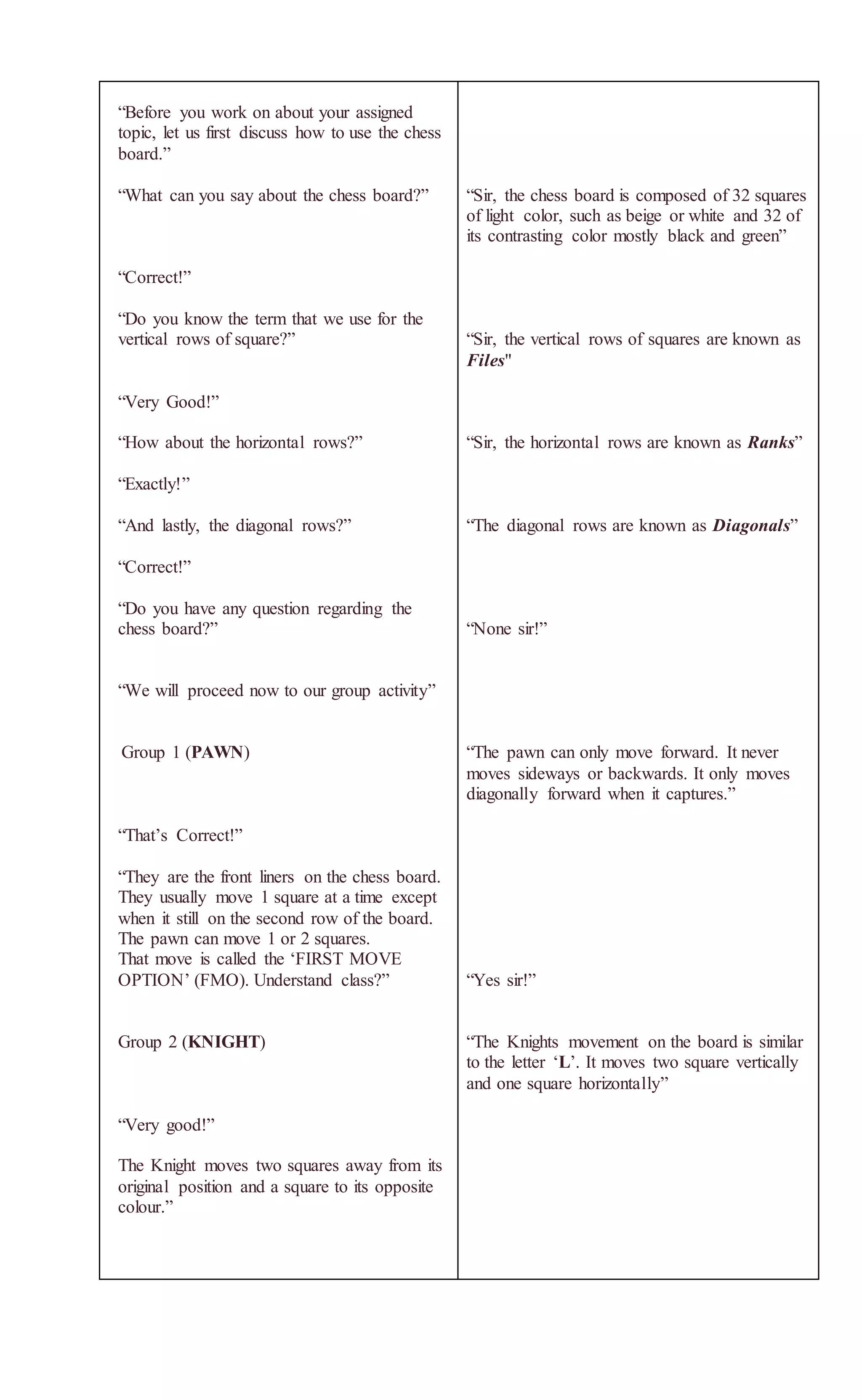
“Before you work on about your assigned
topic, let us first discuss how to use the chess
board.”
“What can you say about the chess board?”
“Correct!”
“Do you know the term that we use for the
vertical rows of square?”
“Very Good!”
“How about the horizontal rows?”
“Exactly!”
“And lastly, the diagonal rows?”
“Correct!”
“Do you have any question regarding the
chess board?”
“We will proceed now to our group activity”
Group 1 (PAWN)
“That’s Correct!”
“They are the front liners on the chess board.
They usually move 1 square at a time except
when it still on the second row of the board.
The pawn can move 1 or 2 squares.
That move is called the ‘FIRST MOVE
OPTION’ (FMO). Understand class?”
Group 2 (KNIGHT)
“Very good!”
The Knight moves two squares away from its
original position and a square to its opposite
colour.”
“Sir, the chess board is composed of 32 squares
of light color, such as beige or white and 32 of
its contrasting color mostly black and green”
“Sir, the vertical rows of squares are known as
Files"
“Sir, the horizontal rows are known as Ranks”
“The diagonal rows are known as Diagonals”
“None sir!”
“The pawn can only move forward. It never
moves sideways or backwards. It only moves
diagonally forward when it captures.”
“Yes sir!”
“The Knights movement on the board is similar
to the letter ‘L’. It moves two square vertically
and one square horizontally”
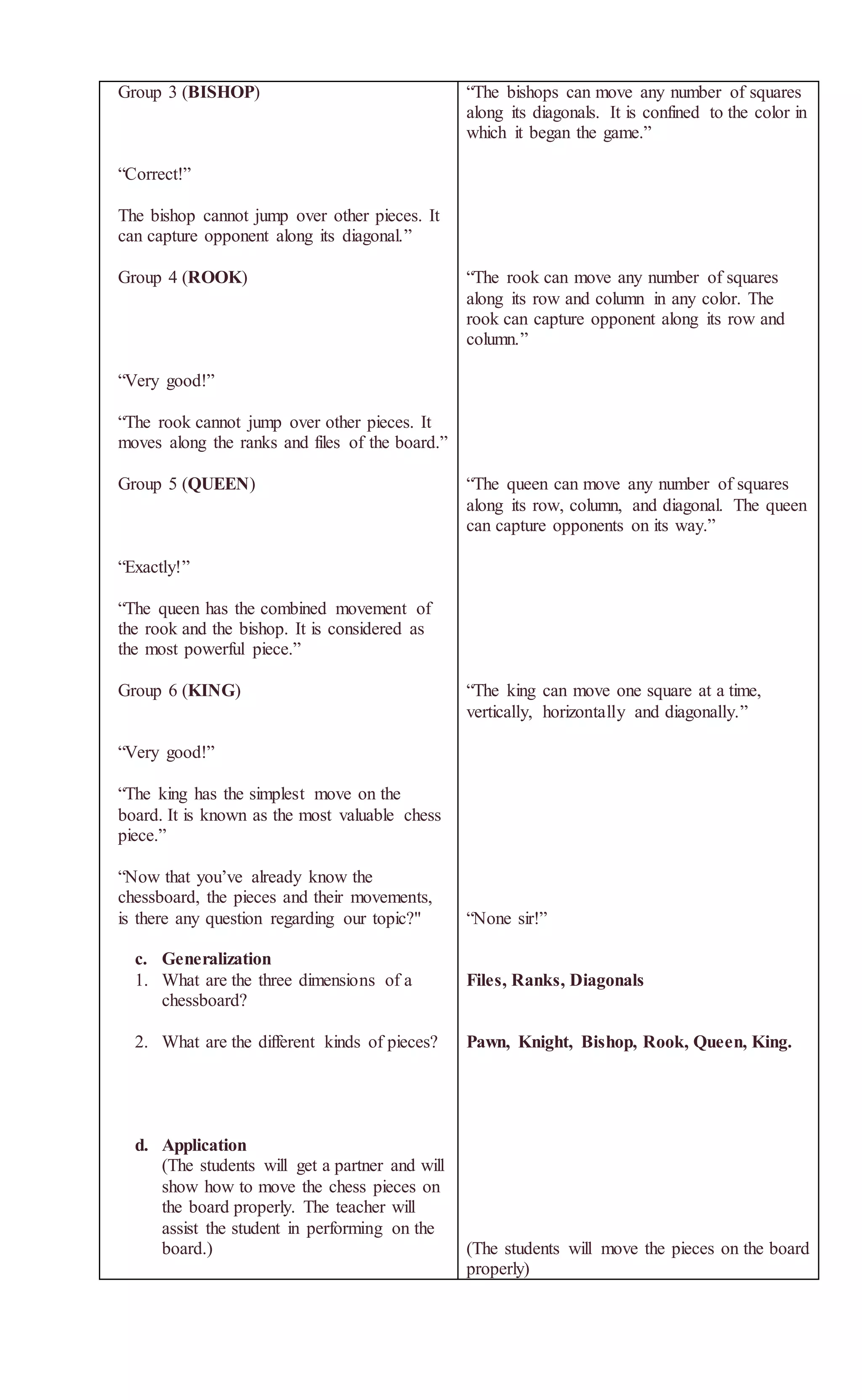
Group 3 (BISHOP)
“Correct!”
The bishop cannot jump over other pieces. It
can capture opponent along its diagonal.”
Group 4 (ROOK)
“Very good!”
“The rook cannot jump over other pieces. It
moves along the ranks and files of the board.”
Group 5 (QUEEN)
“Exactly!”
“The queen has the combined movement of
the rook and the bishop. It is considered as
the most powerful piece.”
Group 6 (KING)
“Very good!”
“The king has the simplest move on the
board. It is known as the most valuable chess
piece.”
“Now that you’ve already know the
chessboard, the pieces and their movements,
is there any question regarding our topic?"
c. Generalization
1. What are the three dimensions of a
chessboard?
2. What are the different kinds of pieces?
d. Application
(The students will get a partner and will
show how to move the chess pieces on
the board properly. The teacher will
assist the student in performing on the
board.)
“The bishops can move any number of squares
along its diagonals. It is confined to the color in
which it began the game.”
“The rook can move any number of squares
along its row and column in any color. The
rook can capture opponent along its row and
column.”
“The queen can move any number of squares
along its row, column, and diagonal. The queen
can capture opponents on its way.”
“The king can move one square at a time,
vertically, horizontally and diagonally.”
“None sir!”
Files, Ranks, Diagonals
Pawn, Knight, Bishop, Rook, Queen, King.
(The students will move the pieces on the board
properly)
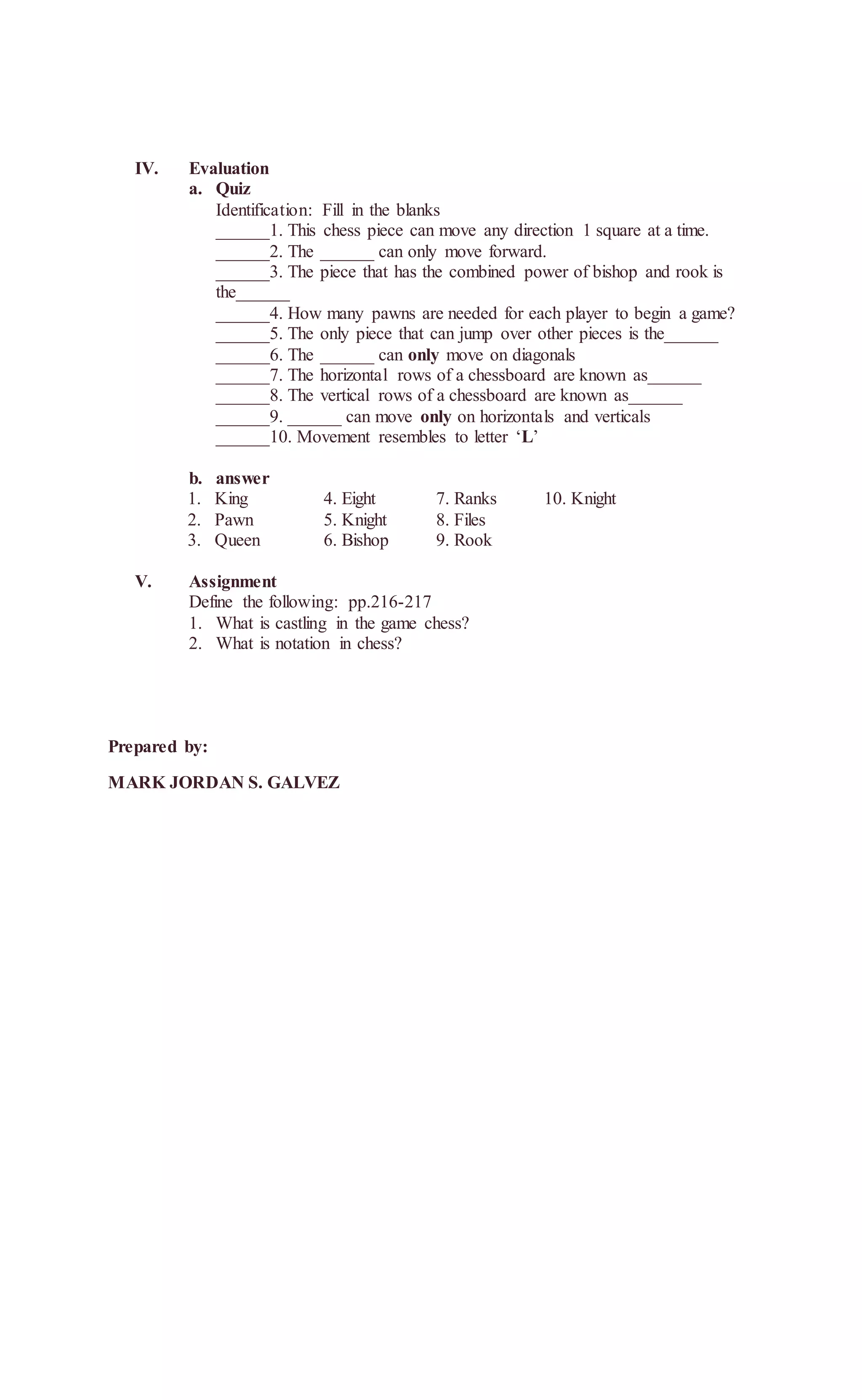
IV. Evaluation
a. Quiz
Identification: Fill in the blanks
______1. This chess piece can move any direction 1 square at a time.
______2. The ______ can only move forward.
______3. The piece that has the combined power of bishop and rook is
the______
______4. How many pawns are needed for each player to begin a game?
______5. The only piece that can jump over other pieces is the______
______6. The ______ can only move on diagonals
______7. The horizontal rows of a chessboard are known as______
______8. The vertical rows of a chessboard are known as______
______9. ______ can move only on horizontals and verticals
______10. Movement resembles to letter ‘L’
b. answer
1. King 4. Eight 7. Ranks 10. Knight
2. Pawn 5. Knight 8. Files
3. Queen 6. Bishop 9. Rook
V. Assignment
Define the following: pp.216-217
1. What is castling in the game chess?
2. What is notation in chess?
Prepared by:
MARK JORDAN S. GALVEZ

A detailed lesson plan in Chess

  • 1.
    A Detailed LessonPlan in MAPEH IV I. Objectives At the end of the lesson, the students will be able to: 1. Identify the different chess pieces and their moves; 2. Discuss the proper movement of the chess pieces using the chess board; and 3. Show interest in playing chess. II. Subject Matter Chess Pieces and their Moves Reference/s: MAPEH IV text book. By: Agripino G. Darilag and Lordino A. Vergara Pages 213-215 I Play Chess (work book) By: Carlito O. Ramos Pages 23-38 Materials: Visual Aids, Marker, Cartolina, Jigsaw Puzzle. Chess Pieces III. Procedure a. Daily routine 1. Prayer/Greetings 2. Checking of cleanliness 3. Checking of attendance 4. Checking of assignment Teacher’s Activity a. Motivation (The students will solve a jigsaw puzzle related on the game chess. The teacher will select students to solve the puzzles.) “What can you say about the solved puzzle?” “You got it!” “Do you have an idea regarding our lesson for today?” “Exactly!” b. LessonProper “Last meeting, I ask you to make some research about the chess pieces and their moves. Please bring out your assignments and lets us have a group activity.” “The class will be grouped into 6 and will discuss the movement of the pieces that I’m going to assign.” Student’s Activity (The students will solve the puzzle in front of the class) “Sir, those are pictures of chess pieces on the chess board” “Our lesson for today is about chess pieces” (The class will proceed to their respected group)
  • 2.
    “Before you workon about your assigned topic, let us first discuss how to use the chess board.” “What can you say about the chess board?” “Correct!” “Do you know the term that we use for the vertical rows of square?” “Very Good!” “How about the horizontal rows?” “Exactly!” “And lastly, the diagonal rows?” “Correct!” “Do you have any question regarding the chess board?” “We will proceed now to our group activity” Group 1 (PAWN) “That’s Correct!” “They are the front liners on the chess board. They usually move 1 square at a time except when it still on the second row of the board. The pawn can move 1 or 2 squares. That move is called the ‘FIRST MOVE OPTION’ (FMO). Understand class?” Group 2 (KNIGHT) “Very good!” The Knight moves two squares away from its original position and a square to its opposite colour.” “Sir, the chess board is composed of 32 squares of light color, such as beige or white and 32 of its contrasting color mostly black and green” “Sir, the vertical rows of squares are known as Files" “Sir, the horizontal rows are known as Ranks” “The diagonal rows are known as Diagonals” “None sir!” “The pawn can only move forward. It never moves sideways or backwards. It only moves diagonally forward when it captures.” “Yes sir!” “The Knights movement on the board is similar to the letter ‘L’. It moves two square vertically and one square horizontally”
  • 3.
    Group 3 (BISHOP) “Correct!” Thebishop cannot jump over other pieces. It can capture opponent along its diagonal.” Group 4 (ROOK) “Very good!” “The rook cannot jump over other pieces. It moves along the ranks and files of the board.” Group 5 (QUEEN) “Exactly!” “The queen has the combined movement of the rook and the bishop. It is considered as the most powerful piece.” Group 6 (KING) “Very good!” “The king has the simplest move on the board. It is known as the most valuable chess piece.” “Now that you’ve already know the chessboard, the pieces and their movements, is there any question regarding our topic?" c. Generalization 1. What are the three dimensions of a chessboard? 2. What are the different kinds of pieces? d. Application (The students will get a partner and will show how to move the chess pieces on the board properly. The teacher will assist the student in performing on the board.) “The bishops can move any number of squares along its diagonals. It is confined to the color in which it began the game.” “The rook can move any number of squares along its row and column in any color. The rook can capture opponent along its row and column.” “The queen can move any number of squares along its row, column, and diagonal. The queen can capture opponents on its way.” “The king can move one square at a time, vertically, horizontally and diagonally.” “None sir!” Files, Ranks, Diagonals Pawn, Knight, Bishop, Rook, Queen, King. (The students will move the pieces on the board properly)
  • 4.
    IV. Evaluation a. Quiz Identification:Fill in the blanks ______1. This chess piece can move any direction 1 square at a time. ______2. The ______ can only move forward. ______3. The piece that has the combined power of bishop and rook is the______ ______4. How many pawns are needed for each player to begin a game? ______5. The only piece that can jump over other pieces is the______ ______6. The ______ can only move on diagonals ______7. The horizontal rows of a chessboard are known as______ ______8. The vertical rows of a chessboard are known as______ ______9. ______ can move only on horizontals and verticals ______10. Movement resembles to letter ‘L’ b. answer 1. King 4. Eight 7. Ranks 10. Knight 2. Pawn 5. Knight 8. Files 3. Queen 6. Bishop 9. Rook V. Assignment Define the following: pp.216-217 1. What is castling in the game chess? 2. What is notation in chess? Prepared by: MARK JORDAN S. GALVEZ