IGKN
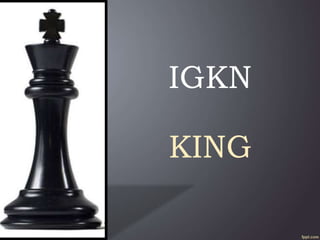
KING
ISHBOP
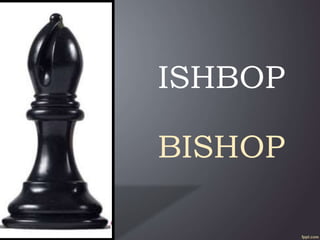
BISHOP
OORK
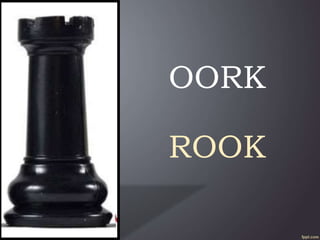
ROOK
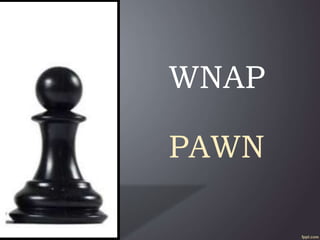
WNAP
PAWN
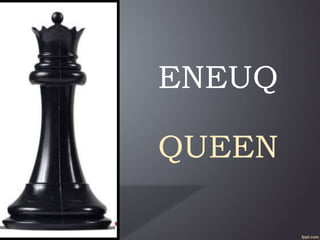
ENEUQ
QUEEN
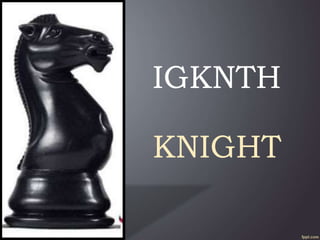
IGKNTH
KNIGHT
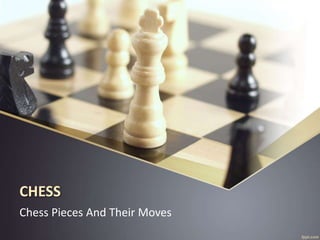
CHESS
Chess Pieces And Their Moves
OBJECTIVES:
1) Identify the different chess pieces and equipment
2) Execute the basic skills in playing chess
3) Explain the benefits that can be derived from
playing chess
Nature and Background of Chess
• Chess is a game that has been played for centuries
and was thought to have originated in India over the
15th century.
• Long ago, it was considered a game reserved only for
Kings and member of the upper class.
• Nowadays, chess is played by common people even
at early age.
Nature and Background of Chess
• The modern design of chess pieces bears the name
Staunton, who was an English master in the mid-
1800’s.
• London Tourney – the first international chess
tournament played in 1851
• Adolf Anderssen – a German who won the game,
London Tourney.
Nature and Background of Chess
• Paul Morphy – the first great American-born chess
player
• Paul traveled to Europe in the 1850’s where he beat
all challengers, including Adolf Anderssen.
• However, the English champion of the time
(Staunton) refused to play with him, so Morphy
never became a world chess champ.
Nature and Background of Chess
• The first official championship chess tournament was
played in 1866 in London, with sand clocks to restrict
the length of a game.
• Steinitz – a Bohemian (Czechoslovakian) Jew won the
game.
• Steinitz became the world’s first official chess
champion, holding this title until 1894.
Nature and Background of Chess
• Recently, Russia dominates the game of chess. This
results from the establishment of government
schools for talented chess players after the
communist revolution of 1917.
Nature and Background of Chess
• Since 1927, many of the top players have been
citizen of the former Union of Soviet Socialist
Republic (USSR), including: Tal, Alekhine, Petrosian,
Spassky, Smyslov, Anatoli Kaprov, and Gary
Kasparov.
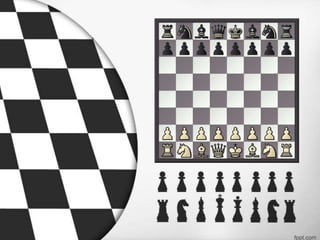
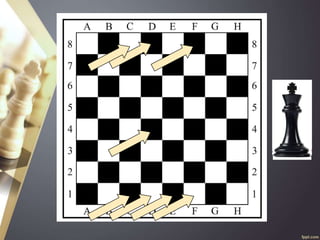
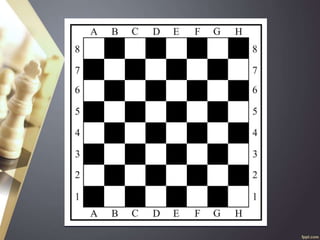
Setting Up A Chess Board
 Put the white corner to the right side.
• If the board has letters, they should read
A-H for the white player.
 Queen and King on the center. Queen on her
color.
 Bishops next to King and Queen
 Knights next to Bishops
 Rooks in the Corners
 Pawns in front.
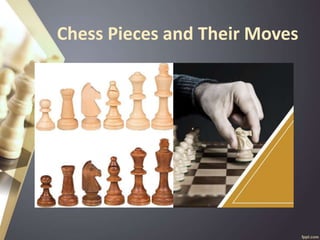
Chess Pieces and Their Moves
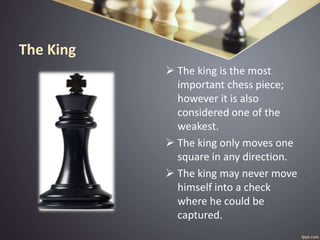
The King
 The king is the most
important chess piece;
however it is also
considered one of the
weakest.
 The king only moves one
square in any direction.
 The king may never move
himself into a check
where he could be
captured.
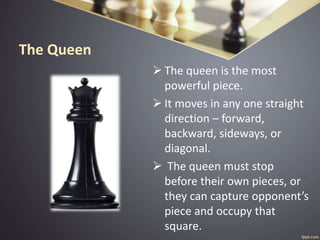
The Queen
 The queen is the most
powerful piece.
 It moves in any one straight
direction – forward,
backward, sideways, or
diagonal.
 The queen must stop
before their own pieces, or
they can capture opponent’s
piece and occupy that
square.
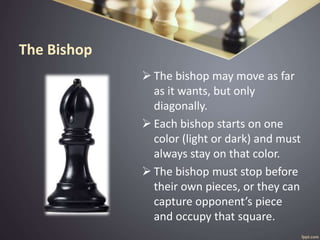
The Bishop
 The bishop may move as far
as it wants, but only
diagonally.
 Each bishop starts on one
color (light or dark) and must
always stay on that color.
 The bishop must stop before
their own pieces, or they can
capture opponent’s piece
and occupy that square.
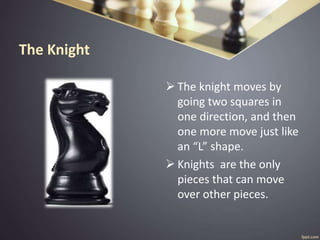
The Knight
 The knight moves by
going two squares in
one direction, and then
one more move just like
an “L” shape.
 Knights are the only
pieces that can move
over other pieces.
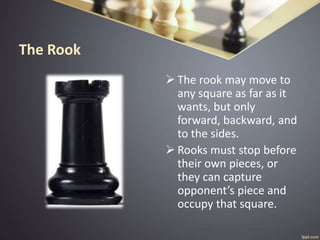
The Rook
 The rook may move to
any square as far as it
wants, but only
forward, backward, and
to the sides.
 Rooks must stop before
their own pieces, or
they can capture
opponent’s piece and
occupy that square.
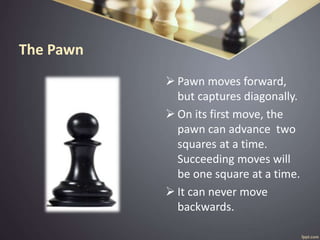
The Pawn
 Pawn moves forward,
but captures diagonally.
 On its first move, the
pawn can advance two
squares at a time.
Succeeding moves will
be one square at a time.
 It can never move
backwards.
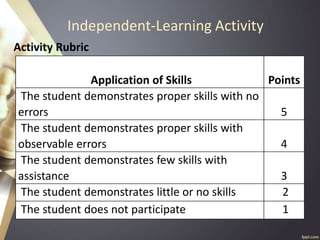
Independent-Learning Activity
Application of Skills Points
The student demonstrates proper skills with no
errors 5
The student demonstrates proper skills with
observable errors 4
The student demonstrates few skills with
assistance 3
The student demonstrates little or no skills 2
The student does not participate 1
Activity Rubric
Assessment
“Identification”
Direction: Identify what is being asked in each item.
1. This chess piece can move any direction 1 square
at a time.
2. The __________ can only move forward.
3. The piece that has the combined power of bishop
and rook is the __________.
4. How many pawns are needed for each player to
begin a game?
5. The only piece that can jump over the other
pieces is the ___________.
Assessment
6. The ___________ can only move on diagonals.
7. The horizontal rows of a chessboard are
known as ___________.
8. The vertical rows of a chessboard are known
as __________.
9. ___________ can move only on horizontals
and verticals.
10. Movement resembles to letter “L”.
Assignment
Answer the following.
1.Identify the rules for castling.
2.Explain the four rules in castling.
3.Identify the ways to draw a chess game.
Thank You !!!

COT_PE8_Q3_CHESS.pptx

  • 2.
  • 3.
  • 4.
  • 5.
  • 6.
  • 7.
  • 9.
  • 10.
    OBJECTIVES: 1) Identify thedifferent chess pieces and equipment 2) Execute the basic skills in playing chess 3) Explain the benefits that can be derived from playing chess
  • 11.
    Nature and Backgroundof Chess • Chess is a game that has been played for centuries and was thought to have originated in India over the 15th century. • Long ago, it was considered a game reserved only for Kings and member of the upper class. • Nowadays, chess is played by common people even at early age.
  • 12.
    Nature and Backgroundof Chess • The modern design of chess pieces bears the name Staunton, who was an English master in the mid- 1800’s. • London Tourney – the first international chess tournament played in 1851 • Adolf Anderssen – a German who won the game, London Tourney.
  • 13.
    Nature and Backgroundof Chess • Paul Morphy – the first great American-born chess player • Paul traveled to Europe in the 1850’s where he beat all challengers, including Adolf Anderssen. • However, the English champion of the time (Staunton) refused to play with him, so Morphy never became a world chess champ.
  • 14.
    Nature and Backgroundof Chess • The first official championship chess tournament was played in 1866 in London, with sand clocks to restrict the length of a game. • Steinitz – a Bohemian (Czechoslovakian) Jew won the game. • Steinitz became the world’s first official chess champion, holding this title until 1894.
  • 15.
    Nature and Backgroundof Chess • Recently, Russia dominates the game of chess. This results from the establishment of government schools for talented chess players after the communist revolution of 1917.
  • 16.
    Nature and Backgroundof Chess • Since 1927, many of the top players have been citizen of the former Union of Soviet Socialist Republic (USSR), including: Tal, Alekhine, Petrosian, Spassky, Smyslov, Anatoli Kaprov, and Gary Kasparov.
  • 18.
    Setting Up AChess Board  Put the white corner to the right side. • If the board has letters, they should read A-H for the white player.  Queen and King on the center. Queen on her color.  Bishops next to King and Queen  Knights next to Bishops  Rooks in the Corners  Pawns in front.
  • 19.
    Chess Pieces andTheir Moves
  • 20.
    The King  Theking is the most important chess piece; however it is also considered one of the weakest.  The king only moves one square in any direction.  The king may never move himself into a check where he could be captured.
  • 21.
    The Queen  Thequeen is the most powerful piece.  It moves in any one straight direction – forward, backward, sideways, or diagonal.  The queen must stop before their own pieces, or they can capture opponent’s piece and occupy that square.
  • 22.
    The Bishop  Thebishop may move as far as it wants, but only diagonally.  Each bishop starts on one color (light or dark) and must always stay on that color.  The bishop must stop before their own pieces, or they can capture opponent’s piece and occupy that square.
  • 23.
    The Knight  Theknight moves by going two squares in one direction, and then one more move just like an “L” shape.  Knights are the only pieces that can move over other pieces.
  • 24.
    The Rook  Therook may move to any square as far as it wants, but only forward, backward, and to the sides.  Rooks must stop before their own pieces, or they can capture opponent’s piece and occupy that square.
  • 25.
    The Pawn  Pawnmoves forward, but captures diagonally.  On its first move, the pawn can advance two squares at a time. Succeeding moves will be one square at a time.  It can never move backwards.
  • 26.
    Independent-Learning Activity Application ofSkills Points The student demonstrates proper skills with no errors 5 The student demonstrates proper skills with observable errors 4 The student demonstrates few skills with assistance 3 The student demonstrates little or no skills 2 The student does not participate 1 Activity Rubric
  • 27.
    Assessment “Identification” Direction: Identify whatis being asked in each item. 1. This chess piece can move any direction 1 square at a time. 2. The __________ can only move forward. 3. The piece that has the combined power of bishop and rook is the __________. 4. How many pawns are needed for each player to begin a game? 5. The only piece that can jump over the other pieces is the ___________.
  • 28.
    Assessment 6. The ___________can only move on diagonals. 7. The horizontal rows of a chessboard are known as ___________. 8. The vertical rows of a chessboard are known as __________. 9. ___________ can move only on horizontals and verticals. 10. Movement resembles to letter “L”.
  • 29.
    Assignment Answer the following. 1.Identifythe rules for castling. 2.Explain the four rules in castling. 3.Identify the ways to draw a chess game.
  • 30.