• A popular game crossword puzzle-like board 
game played by two or four people. 
• This word game was conceived by Architect 
Alfred M. Butts and patented by the Selchow and 
Riger Co. in 1948. 
• It was soon rendered in numerous foreign 
languages as well as in a Braille version for the 
blind and at the dimensional form.
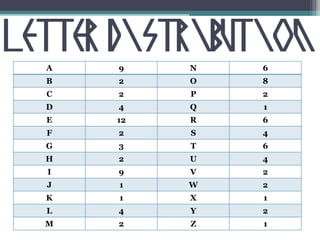
A 9 N 6 
B 2 O 8 
C 2 P 2 
D 4 Q 1 
E 12 R 6 
F 2 S 4 
G 3 T 6 
H 2 U 4 
I 9 V 2 
J 1 W 2 
K 1 X 1 
L 4 Y 2 
M 2 Z 1
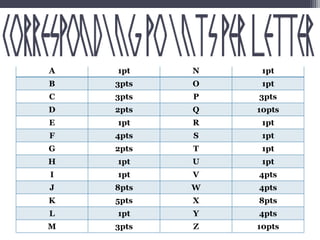
A 1pt N 1pt 
B 3pts O 1pt 
C 3pts P 3pts 
D 2pts Q 10pts 
E 1pt R 1pt 
F 4pts S 1pt 
G 2pts T 1pt 
H 1pt U 1pt 
I 1pt V 4pts 
J 8pts W 4pts 
K 5pts X 8pts 
L 1pt Y 4pts 
M 3pts Z 10pts
The play is consists of forming 
interlocking words, crossword fashion, on 
the scrabble playing board using letter tiles 
with various score values. Each player 
competes for high score by using his letters 
in combinations and locations that take 
best advantage of letter values and 
premium squares on the board.
1. Turn all letters face down at the side of the 
board and shuffle. 
2. Draw for first play. 
3. The player drawing the letter nearest the 
beginning of the alphabet plays first. 
4. Put the exposed letters back and reshuffle. 
5. Each player then draws 7 new letters and 
places them on his rack.
1. The 1st player combines two or more of his 
letters to form a word with 1 letter on the 
center square. DIAGONAL WORDS ARE NOT 
PERMITTED. 
2. A player completes his turn by counting and 
announcing his score. He then draws as many 
new letters as he has played, thus always 
keeping 7 letters in his rack. 
3. Play passes to the left.
4. New words may be formed by: 
a. Adding one or more letters to a word. 
b. Placing a word at right angles to a word already on 
the board. 
c. Placing a complete word parallel to a word already 
played. 
5. No letter may be moved after it has been played. 
6. The two blanks/jokers tiles may be used as any 
desired. 
7. Any player may use his turn to replace any or all of the 
letters in his rack. He then awaits his next turn to 
play. 
8. Any words found in a standard dictionary are 
permitted except PROPER NOUNS. Consult a 
dictionary only to check spelling or sage.
1. The score value of each letter is indicated by a 
number at the bottom of the tile. The score value 
of a blank/joker is zero. 
2. The score for each turn is the sum of the score 
values of all the letters in each word formed or 
modified in the play plus the premium values 
resulting from placing letters on premium squares 
which are apply only in turn in which they are first 
played. 
3. Any player who plays all seven of his tiles in single 
turn scores a premium of 50 points addition to his 
regular score for the play.
Good luck 
players! 
-Friday Group

SCRABBLE

  • 2.
    • A populargame crossword puzzle-like board game played by two or four people. • This word game was conceived by Architect Alfred M. Butts and patented by the Selchow and Riger Co. in 1948. • It was soon rendered in numerous foreign languages as well as in a Braille version for the blind and at the dimensional form.
  • 3.
    A 9 N6 B 2 O 8 C 2 P 2 D 4 Q 1 E 12 R 6 F 2 S 4 G 3 T 6 H 2 U 4 I 9 V 2 J 1 W 2 K 1 X 1 L 4 Y 2 M 2 Z 1
  • 4.
    A 1pt N1pt B 3pts O 1pt C 3pts P 3pts D 2pts Q 10pts E 1pt R 1pt F 4pts S 1pt G 2pts T 1pt H 1pt U 1pt I 1pt V 4pts J 8pts W 4pts K 5pts X 8pts L 1pt Y 4pts M 3pts Z 10pts
  • 5.
    The play isconsists of forming interlocking words, crossword fashion, on the scrabble playing board using letter tiles with various score values. Each player competes for high score by using his letters in combinations and locations that take best advantage of letter values and premium squares on the board.
  • 6.
    1. Turn allletters face down at the side of the board and shuffle. 2. Draw for first play. 3. The player drawing the letter nearest the beginning of the alphabet plays first. 4. Put the exposed letters back and reshuffle. 5. Each player then draws 7 new letters and places them on his rack.
  • 7.
    1. The 1stplayer combines two or more of his letters to form a word with 1 letter on the center square. DIAGONAL WORDS ARE NOT PERMITTED. 2. A player completes his turn by counting and announcing his score. He then draws as many new letters as he has played, thus always keeping 7 letters in his rack. 3. Play passes to the left.
  • 8.
    4. New wordsmay be formed by: a. Adding one or more letters to a word. b. Placing a word at right angles to a word already on the board. c. Placing a complete word parallel to a word already played. 5. No letter may be moved after it has been played. 6. The two blanks/jokers tiles may be used as any desired. 7. Any player may use his turn to replace any or all of the letters in his rack. He then awaits his next turn to play. 8. Any words found in a standard dictionary are permitted except PROPER NOUNS. Consult a dictionary only to check spelling or sage.
  • 9.
    1. The scorevalue of each letter is indicated by a number at the bottom of the tile. The score value of a blank/joker is zero. 2. The score for each turn is the sum of the score values of all the letters in each word formed or modified in the play plus the premium values resulting from placing letters on premium squares which are apply only in turn in which they are first played. 3. Any player who plays all seven of his tiles in single turn scores a premium of 50 points addition to his regular score for the play.
  • 10.
    Good luck players! -Friday Group