CHESS
WHAT IS CHESS ?
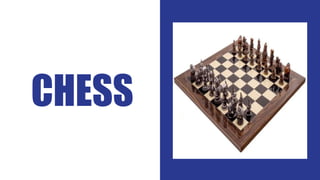
1. Chess is an abstract strategy game and involves no hidden information.
2. It is played on a square chessboard with 64 squares arranged in an eight-
by-eight grid.
3. At the start, each player [one controlling the white pieces, the other
controlling the black pieces] controls sixteen pieces: one king, one queen, two
rooks, two knights, two bishops, and eight pawns.
4. The object of the game is to checkmate the opponent's king, whereby the king
is under immediate attack [in "check"] and there is no way for it to escape.
5. There are also several ways a game can end in a draw.
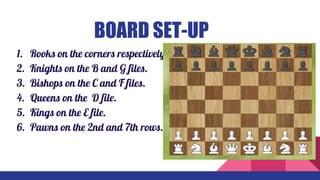
BOARD SET-UP
1. Rooks on the corners respectively.
2. Knights on the B and G files.
3. Bishops on the C and F files.
4. Queens on the D file.
5. Kings on the E file.
6. Pawns on the 2nd and 7th rows.
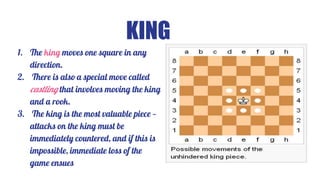
KING
1. The king moves one square in any
direction.
2. There is also a special move called
castling that involves moving the king
and a rook.
3. The king is the most valuable piece —
attacks on the king must be
immediately countered, and if this is
impossible, immediate loss of the
game ensues
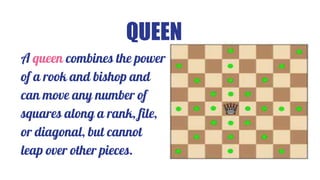
QUEEN
A queen combines the power
of a rook and bishop and
can move any number of
squares along a rank, file,
or diagonal, but cannot
leap over other pieces.
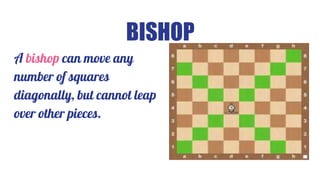
BISHOP
A bishop can move any
number of squares
diagonally, but cannot leap
over other pieces.
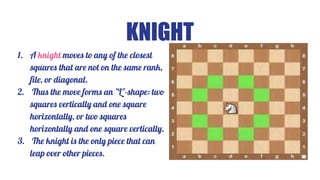
KNIGHT
1. A knight moves to any of the closest
squares that are not on the same rank,
file, or diagonal.
2. Thus the move forms an "L"-shape: two
squares vertically and one square
horizontally, or two squares
horizontally and one square vertically.
3. The knight is the only piece that can
leap over other pieces.
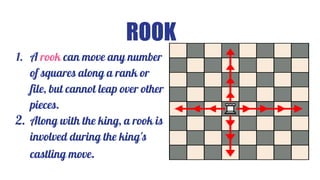
ROOK
1. A rook can move any number
of squares along a rank or
file, but cannot leap over other
pieces.
2. Along with the king, a rook is
involved during the king's
castling move.
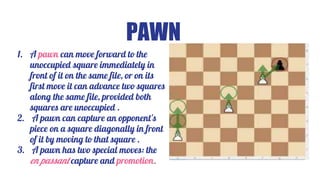
PAWN
1. A pawn can move forward to the
unoccupied square immediately in
front of it on the same file, or on its
first move it can advance two squares
along the same file, provided both
squares are unoccupied .
2. A pawn can capture an opponent's
piece on a square diagonally in front
of it by moving to that square .
3. A pawn has two special moves: the
en passant capture and promotion.
THANK YOU

About Chess For Beginners

  • 1.
  • 2.
    WHAT IS CHESS? 1. Chess is an abstract strategy game and involves no hidden information. 2. It is played on a square chessboard with 64 squares arranged in an eight- by-eight grid. 3. At the start, each player [one controlling the white pieces, the other controlling the black pieces] controls sixteen pieces: one king, one queen, two rooks, two knights, two bishops, and eight pawns. 4. The object of the game is to checkmate the opponent's king, whereby the king is under immediate attack [in "check"] and there is no way for it to escape. 5. There are also several ways a game can end in a draw.
  • 3.
    BOARD SET-UP 1. Rookson the corners respectively. 2. Knights on the B and G files. 3. Bishops on the C and F files. 4. Queens on the D file. 5. Kings on the E file. 6. Pawns on the 2nd and 7th rows.
  • 4.
    KING 1. The kingmoves one square in any direction. 2. There is also a special move called castling that involves moving the king and a rook. 3. The king is the most valuable piece — attacks on the king must be immediately countered, and if this is impossible, immediate loss of the game ensues
  • 5.
    QUEEN A queen combinesthe power of a rook and bishop and can move any number of squares along a rank, file, or diagonal, but cannot leap over other pieces.
  • 6.
    BISHOP A bishop canmove any number of squares diagonally, but cannot leap over other pieces.
  • 7.
    KNIGHT 1. A knightmoves to any of the closest squares that are not on the same rank, file, or diagonal. 2. Thus the move forms an "L"-shape: two squares vertically and one square horizontally, or two squares horizontally and one square vertically. 3. The knight is the only piece that can leap over other pieces.
  • 8.
    ROOK 1. A rookcan move any number of squares along a rank or file, but cannot leap over other pieces. 2. Along with the king, a rook is involved during the king's castling move.
  • 9.
    PAWN 1. A pawncan move forward to the unoccupied square immediately in front of it on the same file, or on its first move it can advance two squares along the same file, provided both squares are unoccupied . 2. A pawn can capture an opponent's piece on a square diagonally in front of it by moving to that square . 3. A pawn has two special moves: the en passant capture and promotion.
  • 10.