Year10 TFD
Menu Design
Menu Fundamentals and Design
• Always be on time
• Always bring your equipment
• Laptop
• Pens/writing materials
• Notebook
• Come to class ready to learn
• Don’t put anyone a risk of injury
• Kitchen safety
PHONES OFF – Learning ON
Lesson - Week 5
LO: The
importance of
Menu development
and layout for
success.
SC: I understand
and escribe the
key factors around
effective menu
development.
What is a Menu?
• In a restaurant, the menu is a list of food
and beverages offered to customers and the
prices. A menu may be à la carte – which
presents a list of options from which
customers choose – or table d'hôte, in which
case a pre-established sequence of courses
is offered. Menus may be printed on paper
sheets provided to the diners, put on a
large poster or display board inside the
establishment, displayed outside the
restaurant, or put on a digital screen. Since
the late 1990s, some restaurants have put
their menus online.
• Menus are also often a feature of very
formal meals other than in restaurants, for
example at weddings. In the 19th and 20th
centuries printed menus were often used
for society dinner-parties in homes; indeed
this was their original use in Europe.
Why are they
Important?
• Menu writing is a process of writing
menu descriptions of food items that
are appetizing, informative, and
accurate. Menu writing directly
influences restaurant sales and is
part of a restaurant marketing plan.
• The menu has been called “a map
that encourages easy navigation
between hunger and satisfaction.”
Mouthwatering restaurant menu
descriptions can make your clients
crave your offerings and happy
patrons come back many times.
Key Aspects of a Menu
• Business Logo – Ensures menu matches the business
• Names of Menu Items – Tells the Customer what they can order
• Descriptions of Menu Items – Tells the customer what is in the
menu items
• Price – indicates what the customer will need to pay for that item
• Pictures – To attract interest and highlights certain menu items
• Allergen Information – important to advise customers of common
allergy information
• Currency – Ensures the menu is up to date and in season. Customer
knows that the items are available, and shows sustainable practices,
by having seasonal and ready available ingredients.
Business logo/ Branding
• Branding is important on a
menu because it sets you apart
from competitors, creates an
emotional connection with
customers, increases customer
loyalty, reflects the
restaurant's culture and
identity, and creates a
memorable dining experience
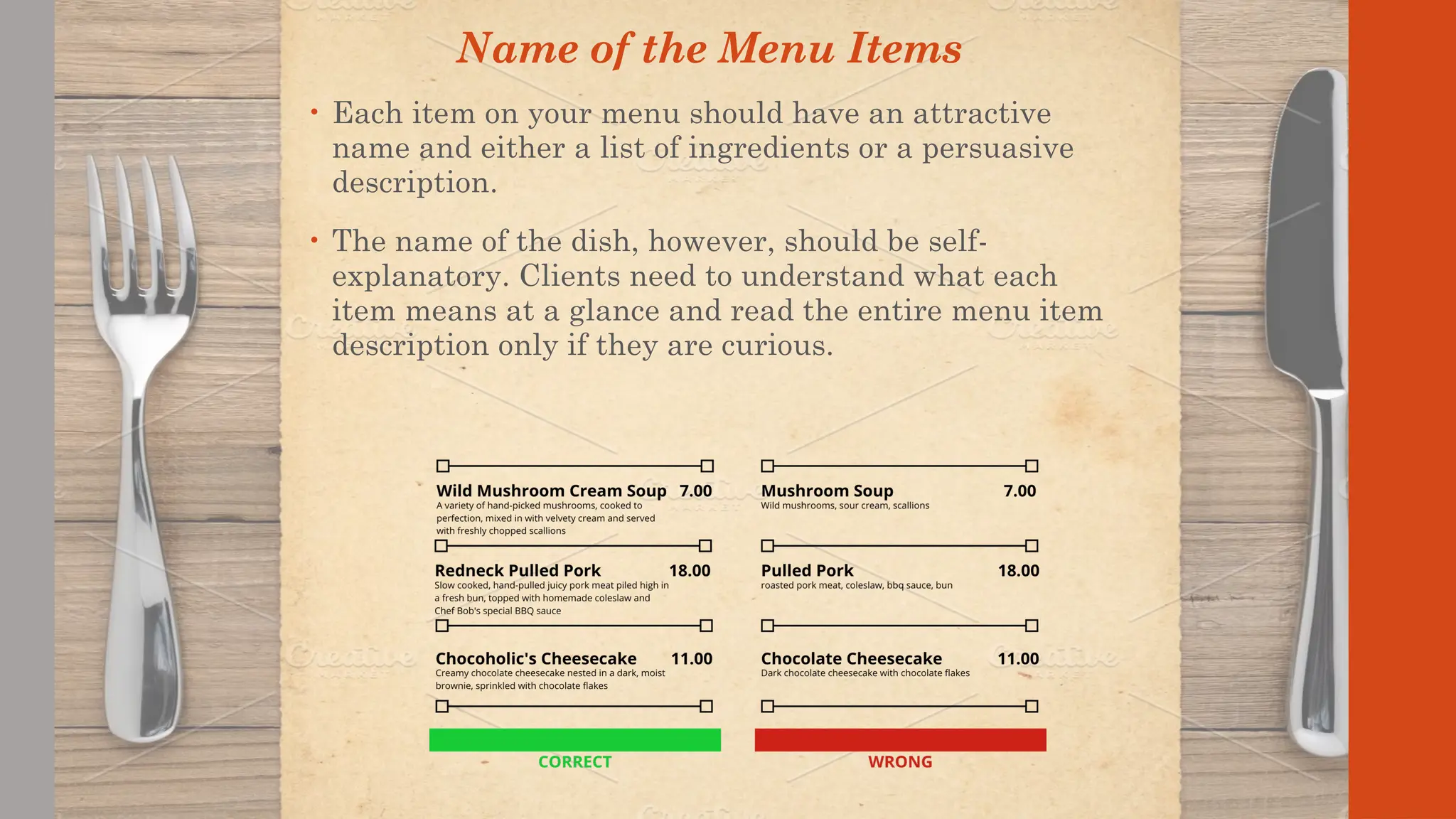
Name of the Menu Items
• Each item on your menu should have an attractive
name and either a list of ingredients or a persuasive
description.
• The name of the dish, however, should be self-
explanatory. Clients need to understand what each
item means at a glance and read the entire menu item
description only if they are curious.
Descriptions of Menu Items
What is the importance of menu descriptions?
• In today’s competitive restaurant industry, businesses must
create informative, engaging, and descriptive menu
descriptions in order to stand out from their competitors.
Additionally, keeping menu descriptions short has a great
influence on customers’ buying decisions as well. The National
Restaurant Association conducted a survey which showed that
87% of diners say that menu descriptions are a crucial factor
in deciding what to order.
DISCUSS
• What do you think are the factors that that influence
customer buying decisions?
Customers are influenced by:
• A dish is made with organic ingredients to show you care about
health and the environment.
• Ingredients are from local farms to show you support local farmers.
• The use of proper names and authentic ingredients of the geographic
origin of dishes to give customers a more authentic experience.
• Add menu items that show your culture to make customers feel like
they are in a unique place.
• Tell stories about your dishes, the cooking method, or the
geographical origin of your cuisine to make each dish unique.
• Use descriptive and exciting words to make the food sound
appetizing and to make your customers crave it.
#1 Trigger the senses with longer menu food descriptions
• Each item on your menu should have an attractive name
and either a list of ingredients or a persuasive description.
• The name of the dish, however, should be self-explanatory.
Clients need to understand what each item means at a
glance and read the entire menu item description only if
they are curious.
• When writing a menu for a restaurant, you need to find the
right balance between the number of words you use to
convince customers that they are getting a good deal and
keeping their attention. For a higher price, it is best to list
more explanations and ingredients to justify it.
• Think about what makes each dish unique. Write down
adjectives focusing on smell, taste, texture, or the cooking
method.
• Meat can be smoky, spicy, well-done, tender, juicy, lean, or
aged.
• Vegetables can range between fresh, earthy, and zesty.
• Sauces are sweet, sour, bitter, tangy, rich, or fruity.
• You don’t need an adjective for each ingredient. Just focus
on the most important ones and the overall value of the dish.
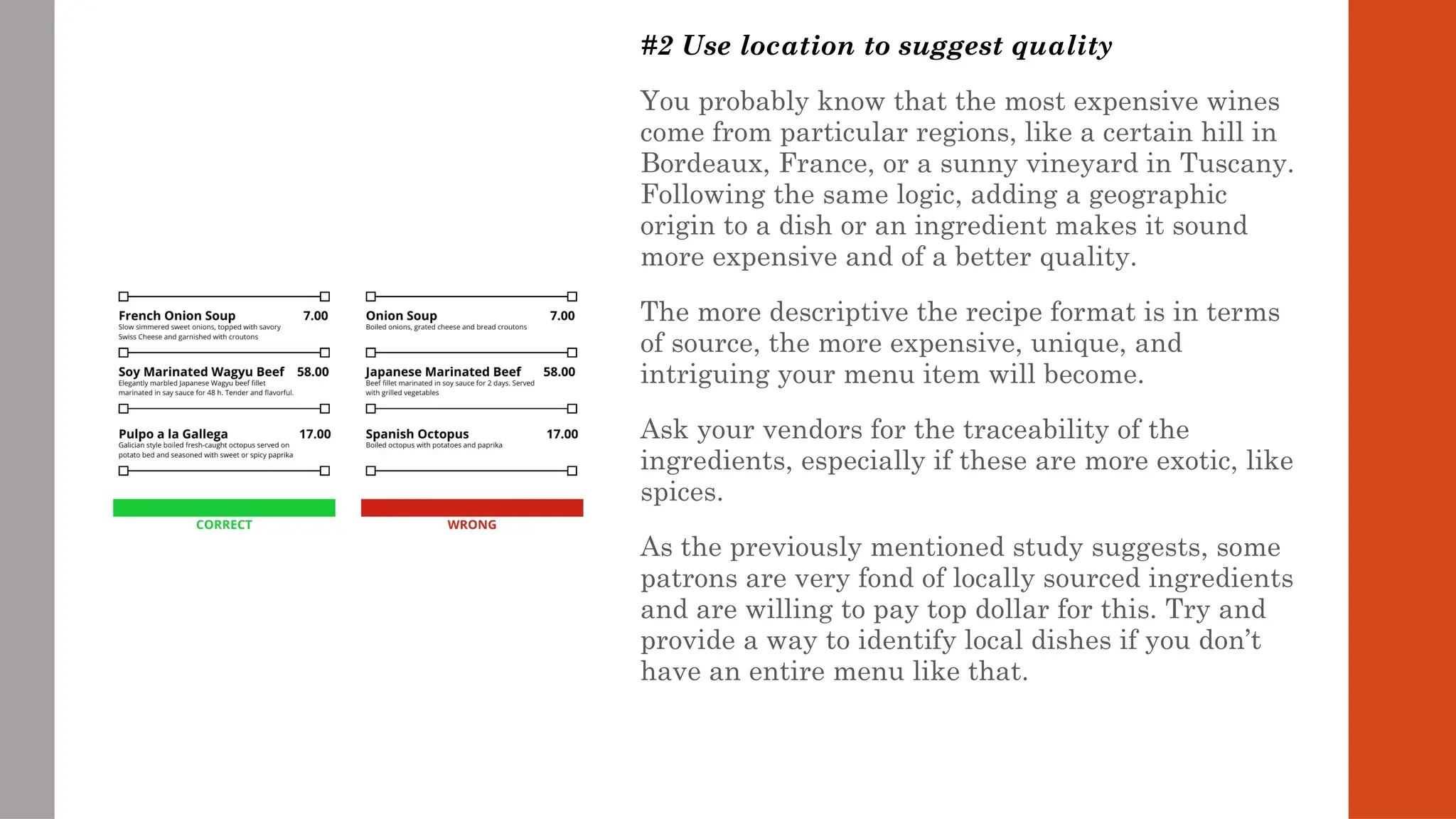
#2 Use location to suggest quality
You probably know that the most expensive wines
come from particular regions, like a certain hill in
Bordeaux, France, or a sunny vineyard in Tuscany.
Following the same logic, adding a geographic
origin to a dish or an ingredient makes it sound
more expensive and of a better quality.
The more descriptive the recipe format is in terms
of source, the more expensive, unique, and
intriguing your menu item will become.
Ask your vendors for the traceability of the
ingredients, especially if these are more exotic, like
spices.
As the previously mentioned study suggests, some
patrons are very fond of locally sourced ingredients
and are willing to pay top dollar for this. Try and
provide a way to identify local dishes if you don’t
have an entire menu like that.
• However, beware of this method, as it could backfire and scare your customers. If you think it is
necessary, include a short description of the unfamiliar ingredient to make clients feel more confident
when ordering.
• If your establishment is upscale, you can use the original name of the dish to cater to the well-travelled
client who will be intrigued by an exotic name or will happily recognize something they had abroad.
#3 Incorporate diets, customs and religion
• We live in a globalized world, which means you are bound to serve a wide range of customers. Even if
you aim to emphasize local flavours, you can make extra sales if you cater to specific needs and beliefs.
• The vegetarian, vegan, and even raw-vegan movements are on the rise. Make sure you have at least one
dish in each category to serve to clients following these dietary customs. Religious customers also praise
vegan recipes during Lent.
• If it makes sense for your client base and the specific of the restaurant, you could mark some of the
dishes as being appropriate for those following religious-based diets or those restricted by health
conditions (gluten-free, lactose-free).
• Being sensitive to your clients’ individual requirements can lead to excellent word of mouth within their
communities. When writing the descriptions, be discreet about this; you could use well-known symbols
next to the name of the dish, or include them in the longer description instead of the title so that you
don’t discourage your regular clients.
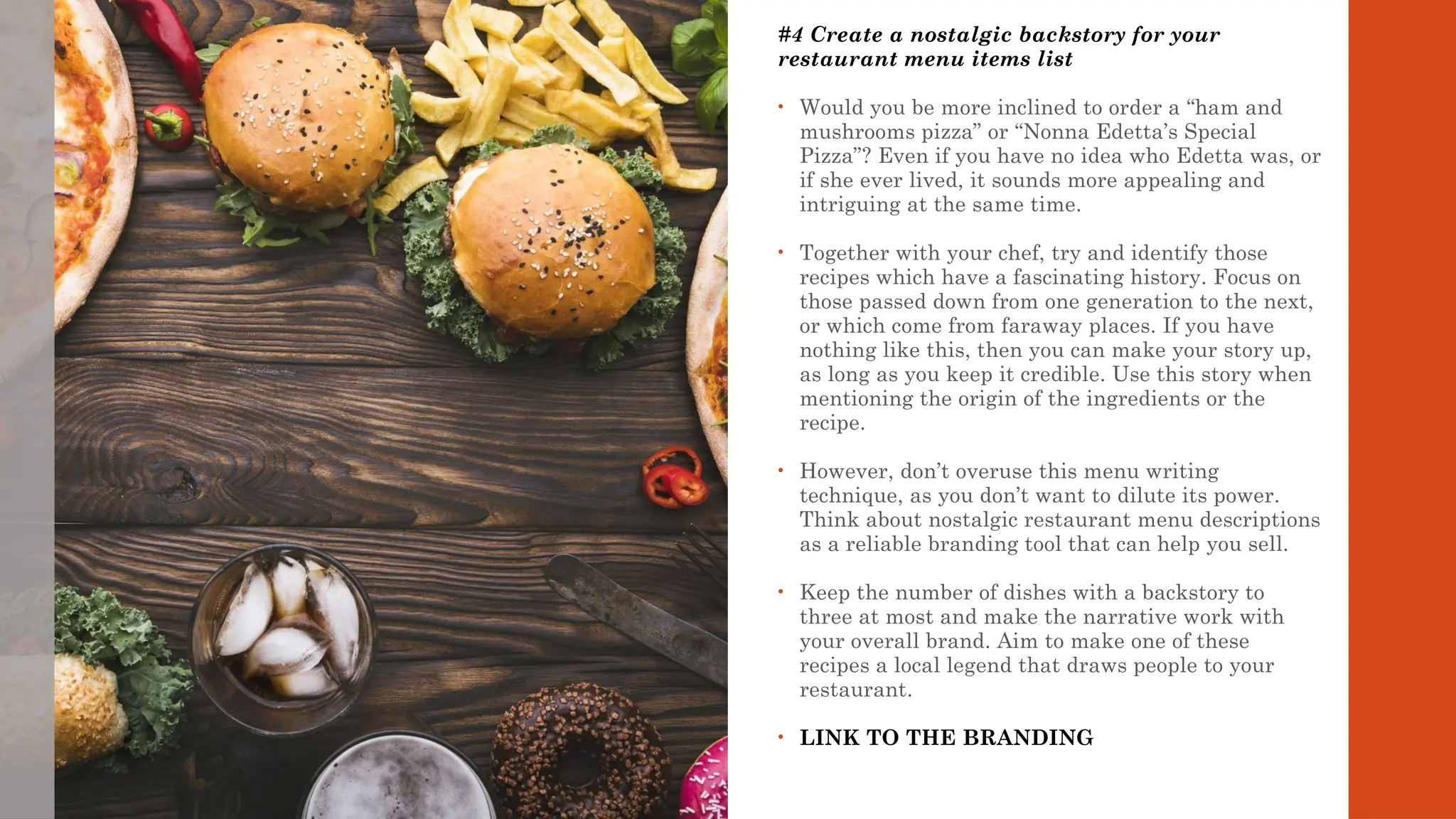
#4 Create a nostalgic backstory for your
restaurant menu items list
• Would you be more inclined to order a “ham and
mushrooms pizza” or “Nonna Edetta’s Special
Pizza”? Even if you have no idea who Edetta was, or
if she ever lived, it sounds more appealing and
intriguing at the same time.
• Together with your chef, try and identify those
recipes which have a fascinating history. Focus on
those passed down from one generation to the next,
or which come from faraway places. If you have
nothing like this, then you can make your story up,
as long as you keep it credible. Use this story when
mentioning the origin of the ingredients or the
recipe.
• However, don’t overuse this menu writing
technique, as you don’t want to dilute its power.
Think about nostalgic restaurant menu descriptions
as a reliable branding tool that can help you sell.
• Keep the number of dishes with a backstory to
three at most and make the narrative work with
your overall brand. Aim to make one of these
recipes a local legend that draws people to your
restaurant.
• LINK TO THE BRANDING
#5. Emphasize the cooking process in the restaurant food
description
When you write a menu dish description, you have to answer the
question: what makes it special? Why should customers choose this food
item compared to others?
An inciting reason could be the way the dish was prepared, especially if
it was a complicated or time-consuming one. Let’s say, you have these
food description examples: “slow-cooked pork ribs in garlic marinade”
and “pork ribs with garlic.”
The first one makes your mouth water instantly, you can just imagine
how juicy the ribs will be, while the second one is correct, but only
states the ingredients.
Here are some words you can use to highlight the cooking process in
your food menu description: (Complete a definition of these terms)
Pan-seared;
Chargrilled;
Slow-roasted;
Marinated;
Flambeed;
Poached;
Braised.
#6. Use these restaurant menu descriptions examples to draw
inspiration from
You don’t need to go to a restaurant description creative writing class,
you know your food best. You know what ingredients you used, the
story behind every dish, and what goes into cooking the menu items.
All you need are some striking words to take any food description for
the menu to the next level and entice people to click the add to cart
button. Here are a few examples:
About texture: buttered, caramelized, crispy, leafy, tender, creamy,
velvety, sticky
About taste: zesty, aromatic, succulent, melt-in-your-mouth, tart
About looks: elegant, vibrant
Check out these food menu description examples to get an idea about
how you could use the previous illustrative words:
“Pizza Siciliana: Fire-oven roasted dough, succulent Stracciatella,
organic prosciutto cotto and authentic Sicilian pistachio”
“Kimcheese – caramelized sourdough bread with sharp cheddar and
vibrant punchy kimchi”
“Carbonara pasta – creamy linguine with home-grown eggs, authentic
guanciale, Italian pecorino and a splash of aromatic chili oil”
#7 Write funny menu descriptions of food
• Humour sells and fun menu descriptions often end up on social media and get
thousands of shares. That means free organic advertising with minimum effort.
• After coming up with funny, descriptive menu words, you can enjoy the stream of
incoming clients for months. However, not every restaurant can benefit from this, as
it has to go with your overall branding and company’s tone of voice.
• Use funny menu item names for desserts, cocktail names or the kid’s section if you
want to have some fun while keeping a serious branding.
• Of course, you could go full steam ahead and make the entire menu hilarious.
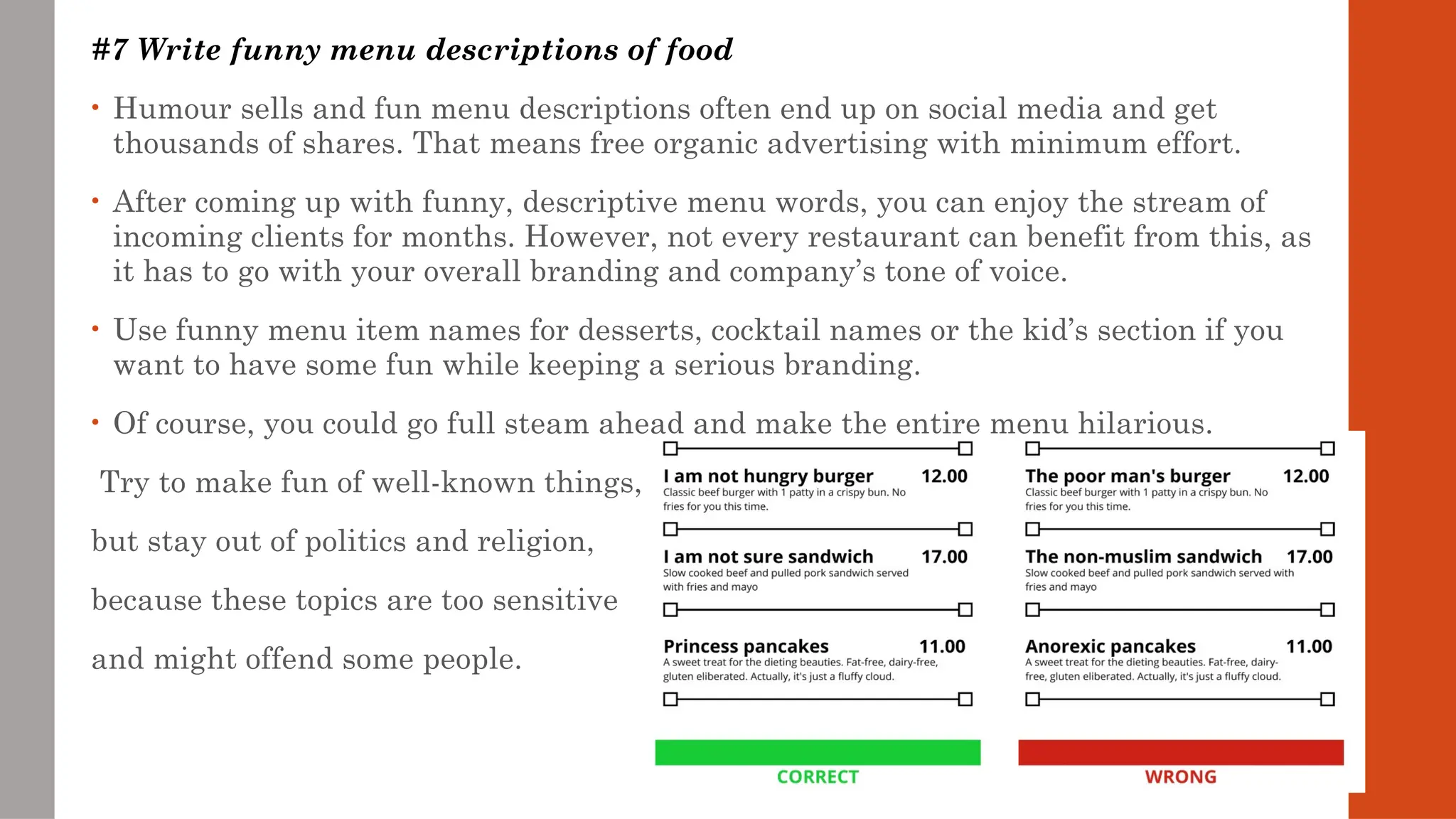
Try to make fun of well-known things,
but stay out of politics and religion,
because these topics are too sensitive
and might offend some people.
#8 Use good quality photos, but sparingly
• Most upscale restaurants don’t use pictures in their brick-and-mortar location menu.
There are several reasons for this decision.
• The first one is because it makes the list longer and gives a cheap fast-food feeling.
Another reason is that it creates certain expectations in the minds of the consumers
that can lead to disappointment if the plate doesn’t look like the picture.
• However, we advise you to use pictures to compliment your online restaurant menu
descriptions because you don’t face printing constraints, and people are used to
seeing visual cues in the digital world.
#9 Update your restaurant menu descriptions to keep the content fresh
• Have you noticed one of your menu items is not selling as well as others? It may be
the description!
• Take a look at the best-selling items and try to emulate their description, experiment
with funny words, focus on ingredients, story or location. Nothing is set in stone, so
change the description until you get the best results.
• But be patient and only make an update once every two weeks as to not confuse
customers and have time to see if the sales increase.
#10 Menu writing mistakes you should avoid
As you probably learned by now, writing a restaurant menu that sells is not easy, but with a little practice, it can boost your profits. Here are a few of the
most common pitfalls when writing menu descriptions.
1. Don’t use complicated menu description words
2. Stay away from negative words
3. Eliminate currency signs
4. Don’t make the menu too long
5. Don’t ignore your audience
When you are searching for menu description examples, keep in mind that one size doesn’t fit all. What works for other restaurants in your area may not
work for you, simply because you have a different audience.
Therefore, you must first identify what type of customers visit or order from your restaurant. Start with your cuisine. If your menu items are more on the
pricier range with fancy ingredients, you should be on the lookout for fine dining menu descriptions, such as:
“Pan-seared Saint-Jacques Scallops caught in the Mediterranean, served with a fresh vinaigrette of locally sourced wild berries and micro-herbs”
If you have a restaurant that promotes high-quality meat consumption, go for a steak menu description that emphasizes the type of meat and the cooking
process. For example:
“60-day maturated rib-eye cooked on wood-fired grill, served with an aromatic green salad and potato chips”
On the other hand, if you have a younger, hip, audience, use funny descriptions they can relate to. Start up a conversion on social media to find out your
clients’ preferences, so you can best fit their style and motivate them to order more.
https://www.restaurant-website-builder.com/restaurant-menu-descriptions
Price
• You could serve the most delicious food and have clients ordering non-stop, but if
you don’t price your menu items right, you won’t make a profit and your business
will inevitably fail.
• One of the most common ways used by restaurants to price menu items is the ideal
food cost formula:
• Price = COGS/Ideal Food Cost
• The ideal food cost is usually between 25 to 35%, but the lower you go, the bigger
the profit is. The COGS (cost of goods sold) is the price you pay for the ingredients
you will use to prepare the specific menu item.
• Let’s see an example. Let’s say you pay $5 for ingredients and you want an ideal
food cost of 30%.
• Price = $5/0.3 = $16
• Always keep an eye on the competition and their pricing and change your price
according to the demand. If you start to sell more and have a big base of
reoccurring clients, you can start slowly increasing your prices to make more
profit.
Pictures
• When you create a paper menu for your
restaurant location, you can skip pictures
for a cleaner look. But an online restaurant
menu relies on images to convince people to
click on the order button.
• But not just any kind of photos. If you add
blurry pictures taken with your phone, they
will look unprofessional and they won’t
build trust with your clients. Instead,
consider hiring a professional photographer
or learning more about food photography so
you can impress your clients.
• Visit this link and discuss the images;
Food Photography Images Folder
Pictures
Now search online for some professional food imagery.
Answer the following questions in your workbooks.
What do the photos make you think? Feel?
What are you seeing?
What is the common themes?
Plow Back - Homework
Task – Design Challenge
Using the skills in the PowerPoint
• Write a 3-course menu that is balanced and is sustainable
and has allergen information and has at least 2 different
dietary requirements catered for. Must contain 2 entrees, 3
mains and 2 desserts.
• Menu needs to be in Colour, show Branding, Menu
descriptions and relevant layout for the type of business
you are writing a menu for. See the templates used in class
to assist with this activity.
• This can be completed on any Online format that is
available. Submissions to be submitted online via
QLEARN. Prefer Microsoft docs or PDF.
• BE CREATIVE
• DUE end of Week 6.

How to write effective Menus in Hospitality

  • 1.
    Year10 TFD Menu Design MenuFundamentals and Design
  • 2.
    • Always beon time • Always bring your equipment • Laptop • Pens/writing materials • Notebook • Come to class ready to learn • Don’t put anyone a risk of injury • Kitchen safety PHONES OFF – Learning ON
  • 3.
    Lesson - Week5 LO: The importance of Menu development and layout for success. SC: I understand and escribe the key factors around effective menu development.
  • 4.
    What is aMenu? • In a restaurant, the menu is a list of food and beverages offered to customers and the prices. A menu may be à la carte – which presents a list of options from which customers choose – or table d'hôte, in which case a pre-established sequence of courses is offered. Menus may be printed on paper sheets provided to the diners, put on a large poster or display board inside the establishment, displayed outside the restaurant, or put on a digital screen. Since the late 1990s, some restaurants have put their menus online. • Menus are also often a feature of very formal meals other than in restaurants, for example at weddings. In the 19th and 20th centuries printed menus were often used for society dinner-parties in homes; indeed this was their original use in Europe.
  • 5.
    Why are they Important? •Menu writing is a process of writing menu descriptions of food items that are appetizing, informative, and accurate. Menu writing directly influences restaurant sales and is part of a restaurant marketing plan. • The menu has been called “a map that encourages easy navigation between hunger and satisfaction.” Mouthwatering restaurant menu descriptions can make your clients crave your offerings and happy patrons come back many times.
  • 6.
    Key Aspects ofa Menu • Business Logo – Ensures menu matches the business • Names of Menu Items – Tells the Customer what they can order • Descriptions of Menu Items – Tells the customer what is in the menu items • Price – indicates what the customer will need to pay for that item • Pictures – To attract interest and highlights certain menu items • Allergen Information – important to advise customers of common allergy information • Currency – Ensures the menu is up to date and in season. Customer knows that the items are available, and shows sustainable practices, by having seasonal and ready available ingredients.
  • 7.
    Business logo/ Branding •Branding is important on a menu because it sets you apart from competitors, creates an emotional connection with customers, increases customer loyalty, reflects the restaurant's culture and identity, and creates a memorable dining experience
  • 8.
    Name of theMenu Items • Each item on your menu should have an attractive name and either a list of ingredients or a persuasive description. • The name of the dish, however, should be self- explanatory. Clients need to understand what each item means at a glance and read the entire menu item description only if they are curious.
  • 9.
    Descriptions of MenuItems What is the importance of menu descriptions? • In today’s competitive restaurant industry, businesses must create informative, engaging, and descriptive menu descriptions in order to stand out from their competitors. Additionally, keeping menu descriptions short has a great influence on customers’ buying decisions as well. The National Restaurant Association conducted a survey which showed that 87% of diners say that menu descriptions are a crucial factor in deciding what to order. DISCUSS • What do you think are the factors that that influence customer buying decisions?
  • 10.
    Customers are influencedby: • A dish is made with organic ingredients to show you care about health and the environment. • Ingredients are from local farms to show you support local farmers. • The use of proper names and authentic ingredients of the geographic origin of dishes to give customers a more authentic experience. • Add menu items that show your culture to make customers feel like they are in a unique place. • Tell stories about your dishes, the cooking method, or the geographical origin of your cuisine to make each dish unique. • Use descriptive and exciting words to make the food sound appetizing and to make your customers crave it.
  • 11.
    #1 Trigger thesenses with longer menu food descriptions • Each item on your menu should have an attractive name and either a list of ingredients or a persuasive description. • The name of the dish, however, should be self-explanatory. Clients need to understand what each item means at a glance and read the entire menu item description only if they are curious. • When writing a menu for a restaurant, you need to find the right balance between the number of words you use to convince customers that they are getting a good deal and keeping their attention. For a higher price, it is best to list more explanations and ingredients to justify it. • Think about what makes each dish unique. Write down adjectives focusing on smell, taste, texture, or the cooking method. • Meat can be smoky, spicy, well-done, tender, juicy, lean, or aged. • Vegetables can range between fresh, earthy, and zesty. • Sauces are sweet, sour, bitter, tangy, rich, or fruity. • You don’t need an adjective for each ingredient. Just focus on the most important ones and the overall value of the dish.
  • 12.
    #2 Use locationto suggest quality You probably know that the most expensive wines come from particular regions, like a certain hill in Bordeaux, France, or a sunny vineyard in Tuscany. Following the same logic, adding a geographic origin to a dish or an ingredient makes it sound more expensive and of a better quality. The more descriptive the recipe format is in terms of source, the more expensive, unique, and intriguing your menu item will become. Ask your vendors for the traceability of the ingredients, especially if these are more exotic, like spices. As the previously mentioned study suggests, some patrons are very fond of locally sourced ingredients and are willing to pay top dollar for this. Try and provide a way to identify local dishes if you don’t have an entire menu like that.
  • 13.
    • However, bewareof this method, as it could backfire and scare your customers. If you think it is necessary, include a short description of the unfamiliar ingredient to make clients feel more confident when ordering. • If your establishment is upscale, you can use the original name of the dish to cater to the well-travelled client who will be intrigued by an exotic name or will happily recognize something they had abroad. #3 Incorporate diets, customs and religion • We live in a globalized world, which means you are bound to serve a wide range of customers. Even if you aim to emphasize local flavours, you can make extra sales if you cater to specific needs and beliefs. • The vegetarian, vegan, and even raw-vegan movements are on the rise. Make sure you have at least one dish in each category to serve to clients following these dietary customs. Religious customers also praise vegan recipes during Lent. • If it makes sense for your client base and the specific of the restaurant, you could mark some of the dishes as being appropriate for those following religious-based diets or those restricted by health conditions (gluten-free, lactose-free). • Being sensitive to your clients’ individual requirements can lead to excellent word of mouth within their communities. When writing the descriptions, be discreet about this; you could use well-known symbols next to the name of the dish, or include them in the longer description instead of the title so that you don’t discourage your regular clients.
  • 14.
    #4 Create anostalgic backstory for your restaurant menu items list • Would you be more inclined to order a “ham and mushrooms pizza” or “Nonna Edetta’s Special Pizza”? Even if you have no idea who Edetta was, or if she ever lived, it sounds more appealing and intriguing at the same time. • Together with your chef, try and identify those recipes which have a fascinating history. Focus on those passed down from one generation to the next, or which come from faraway places. If you have nothing like this, then you can make your story up, as long as you keep it credible. Use this story when mentioning the origin of the ingredients or the recipe. • However, don’t overuse this menu writing technique, as you don’t want to dilute its power. Think about nostalgic restaurant menu descriptions as a reliable branding tool that can help you sell. • Keep the number of dishes with a backstory to three at most and make the narrative work with your overall brand. Aim to make one of these recipes a local legend that draws people to your restaurant. • LINK TO THE BRANDING
  • 15.
    #5. Emphasize thecooking process in the restaurant food description When you write a menu dish description, you have to answer the question: what makes it special? Why should customers choose this food item compared to others? An inciting reason could be the way the dish was prepared, especially if it was a complicated or time-consuming one. Let’s say, you have these food description examples: “slow-cooked pork ribs in garlic marinade” and “pork ribs with garlic.” The first one makes your mouth water instantly, you can just imagine how juicy the ribs will be, while the second one is correct, but only states the ingredients. Here are some words you can use to highlight the cooking process in your food menu description: (Complete a definition of these terms) Pan-seared; Chargrilled; Slow-roasted; Marinated; Flambeed; Poached; Braised.
  • 16.
    #6. Use theserestaurant menu descriptions examples to draw inspiration from You don’t need to go to a restaurant description creative writing class, you know your food best. You know what ingredients you used, the story behind every dish, and what goes into cooking the menu items. All you need are some striking words to take any food description for the menu to the next level and entice people to click the add to cart button. Here are a few examples: About texture: buttered, caramelized, crispy, leafy, tender, creamy, velvety, sticky About taste: zesty, aromatic, succulent, melt-in-your-mouth, tart About looks: elegant, vibrant Check out these food menu description examples to get an idea about how you could use the previous illustrative words: “Pizza Siciliana: Fire-oven roasted dough, succulent Stracciatella, organic prosciutto cotto and authentic Sicilian pistachio” “Kimcheese – caramelized sourdough bread with sharp cheddar and vibrant punchy kimchi” “Carbonara pasta – creamy linguine with home-grown eggs, authentic guanciale, Italian pecorino and a splash of aromatic chili oil”
  • 17.
    #7 Write funnymenu descriptions of food • Humour sells and fun menu descriptions often end up on social media and get thousands of shares. That means free organic advertising with minimum effort. • After coming up with funny, descriptive menu words, you can enjoy the stream of incoming clients for months. However, not every restaurant can benefit from this, as it has to go with your overall branding and company’s tone of voice. • Use funny menu item names for desserts, cocktail names or the kid’s section if you want to have some fun while keeping a serious branding. • Of course, you could go full steam ahead and make the entire menu hilarious. Try to make fun of well-known things, but stay out of politics and religion, because these topics are too sensitive and might offend some people.
  • 18.
    #8 Use goodquality photos, but sparingly • Most upscale restaurants don’t use pictures in their brick-and-mortar location menu. There are several reasons for this decision. • The first one is because it makes the list longer and gives a cheap fast-food feeling. Another reason is that it creates certain expectations in the minds of the consumers that can lead to disappointment if the plate doesn’t look like the picture. • However, we advise you to use pictures to compliment your online restaurant menu descriptions because you don’t face printing constraints, and people are used to seeing visual cues in the digital world. #9 Update your restaurant menu descriptions to keep the content fresh • Have you noticed one of your menu items is not selling as well as others? It may be the description! • Take a look at the best-selling items and try to emulate their description, experiment with funny words, focus on ingredients, story or location. Nothing is set in stone, so change the description until you get the best results. • But be patient and only make an update once every two weeks as to not confuse customers and have time to see if the sales increase.
  • 19.
    #10 Menu writingmistakes you should avoid As you probably learned by now, writing a restaurant menu that sells is not easy, but with a little practice, it can boost your profits. Here are a few of the most common pitfalls when writing menu descriptions. 1. Don’t use complicated menu description words 2. Stay away from negative words 3. Eliminate currency signs 4. Don’t make the menu too long 5. Don’t ignore your audience When you are searching for menu description examples, keep in mind that one size doesn’t fit all. What works for other restaurants in your area may not work for you, simply because you have a different audience. Therefore, you must first identify what type of customers visit or order from your restaurant. Start with your cuisine. If your menu items are more on the pricier range with fancy ingredients, you should be on the lookout for fine dining menu descriptions, such as: “Pan-seared Saint-Jacques Scallops caught in the Mediterranean, served with a fresh vinaigrette of locally sourced wild berries and micro-herbs” If you have a restaurant that promotes high-quality meat consumption, go for a steak menu description that emphasizes the type of meat and the cooking process. For example: “60-day maturated rib-eye cooked on wood-fired grill, served with an aromatic green salad and potato chips” On the other hand, if you have a younger, hip, audience, use funny descriptions they can relate to. Start up a conversion on social media to find out your clients’ preferences, so you can best fit their style and motivate them to order more. https://www.restaurant-website-builder.com/restaurant-menu-descriptions
  • 20.
    Price • You couldserve the most delicious food and have clients ordering non-stop, but if you don’t price your menu items right, you won’t make a profit and your business will inevitably fail. • One of the most common ways used by restaurants to price menu items is the ideal food cost formula: • Price = COGS/Ideal Food Cost • The ideal food cost is usually between 25 to 35%, but the lower you go, the bigger the profit is. The COGS (cost of goods sold) is the price you pay for the ingredients you will use to prepare the specific menu item. • Let’s see an example. Let’s say you pay $5 for ingredients and you want an ideal food cost of 30%. • Price = $5/0.3 = $16 • Always keep an eye on the competition and their pricing and change your price according to the demand. If you start to sell more and have a big base of reoccurring clients, you can start slowly increasing your prices to make more profit.
  • 21.
    Pictures • When youcreate a paper menu for your restaurant location, you can skip pictures for a cleaner look. But an online restaurant menu relies on images to convince people to click on the order button. • But not just any kind of photos. If you add blurry pictures taken with your phone, they will look unprofessional and they won’t build trust with your clients. Instead, consider hiring a professional photographer or learning more about food photography so you can impress your clients. • Visit this link and discuss the images; Food Photography Images Folder
  • 22.
    Pictures Now search onlinefor some professional food imagery. Answer the following questions in your workbooks. What do the photos make you think? Feel? What are you seeing? What is the common themes?
  • 23.
    Plow Back -Homework Task – Design Challenge Using the skills in the PowerPoint • Write a 3-course menu that is balanced and is sustainable and has allergen information and has at least 2 different dietary requirements catered for. Must contain 2 entrees, 3 mains and 2 desserts. • Menu needs to be in Colour, show Branding, Menu descriptions and relevant layout for the type of business you are writing a menu for. See the templates used in class to assist with this activity. • This can be completed on any Online format that is available. Submissions to be submitted online via QLEARN. Prefer Microsoft docs or PDF. • BE CREATIVE • DUE end of Week 6.