



©2020 Morningstar, Inc. All rights reserved.
A Blueprint for Behavioral Design
Steve Wendel
Head of Behavioral Science at Morningstar
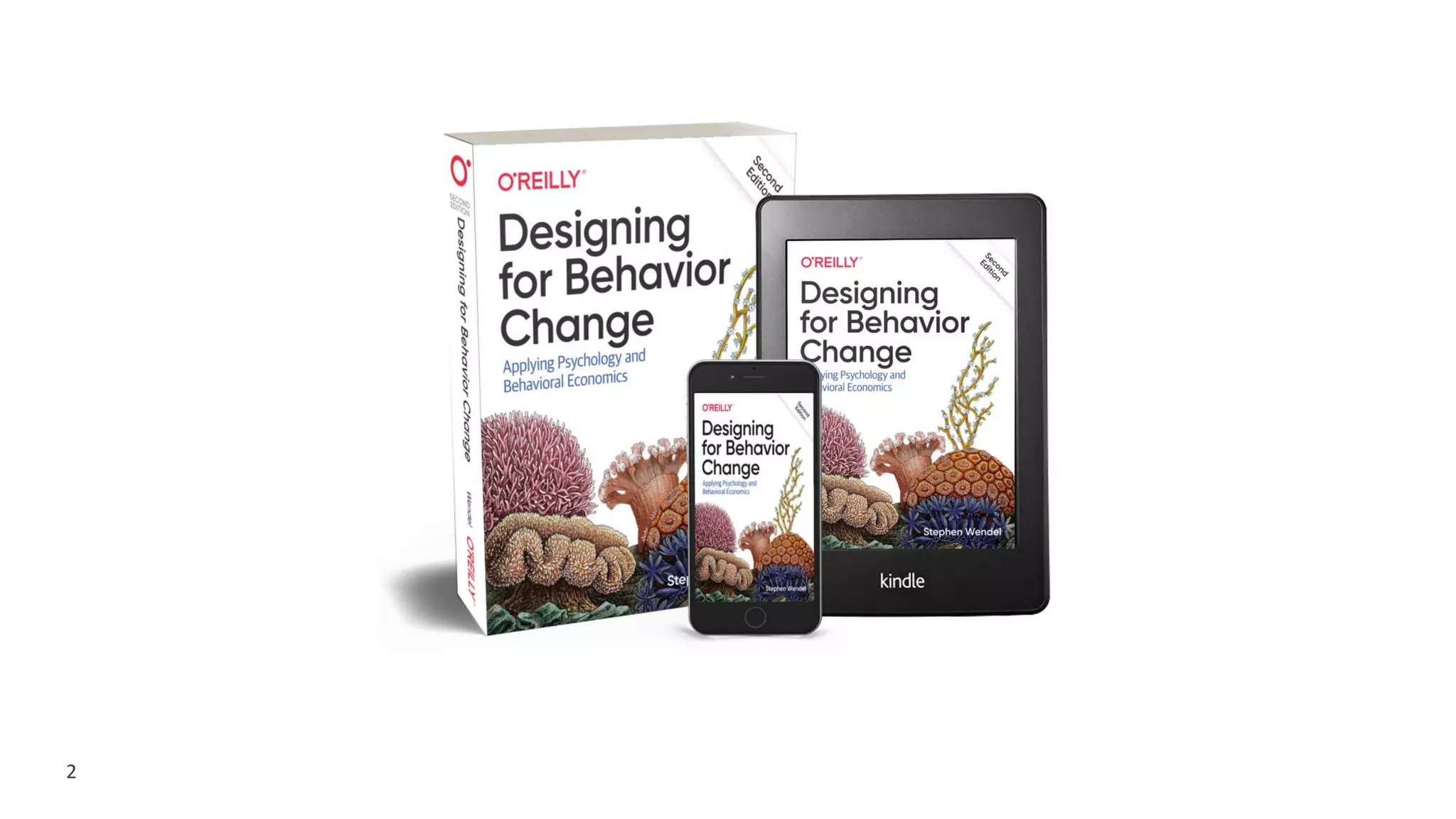
Author of Designing for Behavior Change
@sawendel
2
3
1. BeSci Complements Design
2. DECIDE: A Blueprint
3. How Do We Stay Ethical?
4. Q&A
Where we’re going
4
5
6
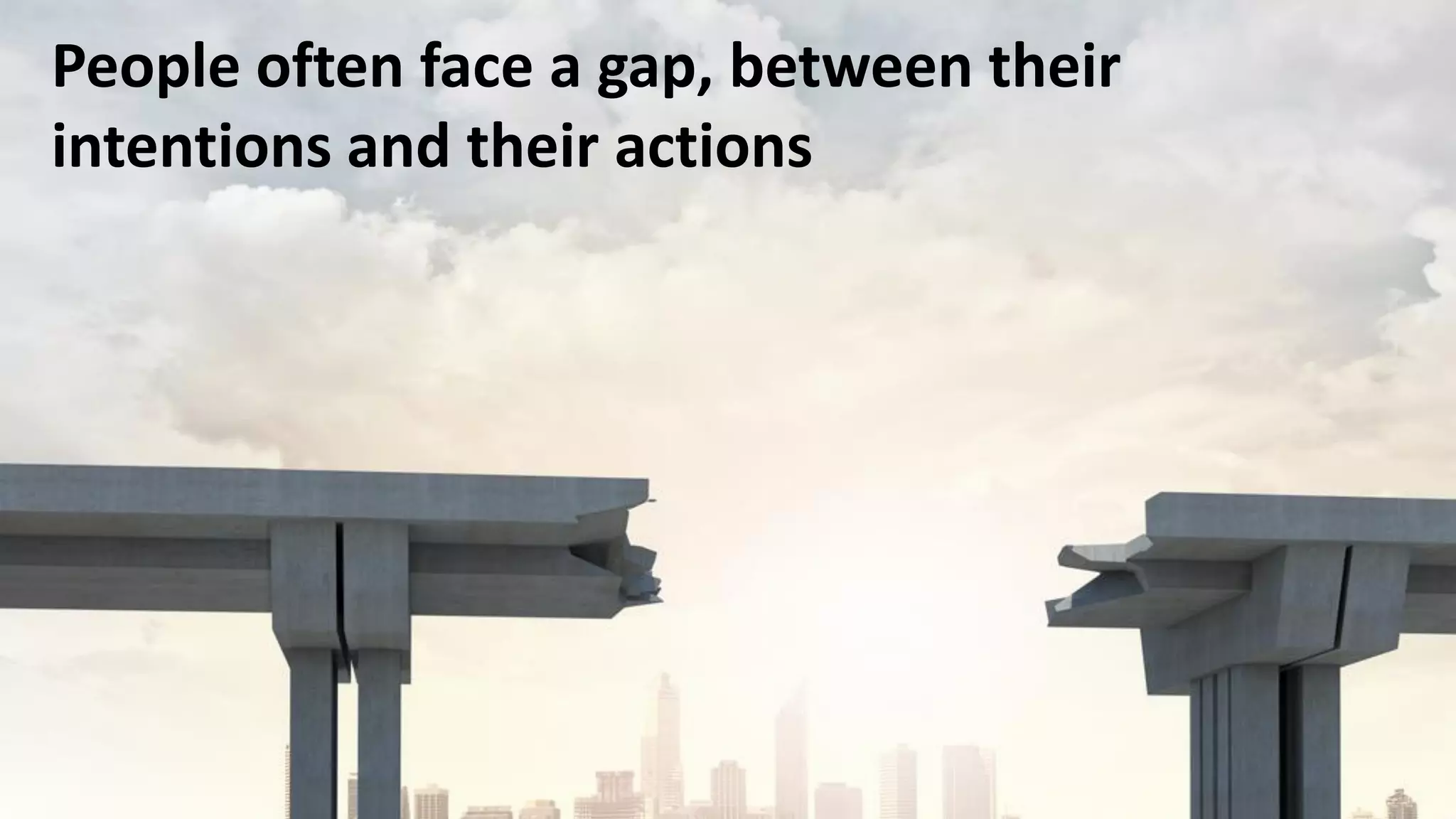
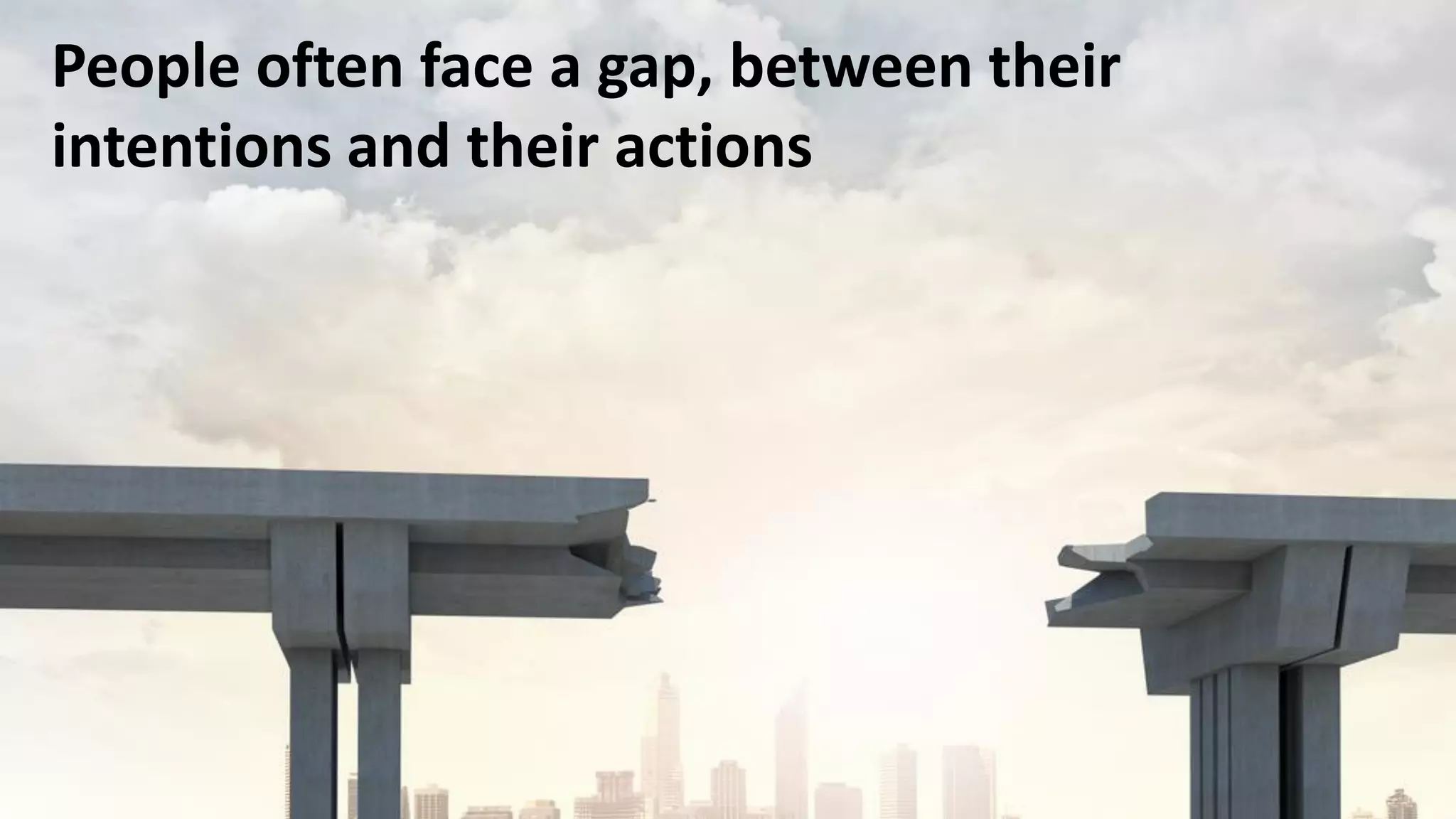
People often face a gap, between their
intentions and their actions
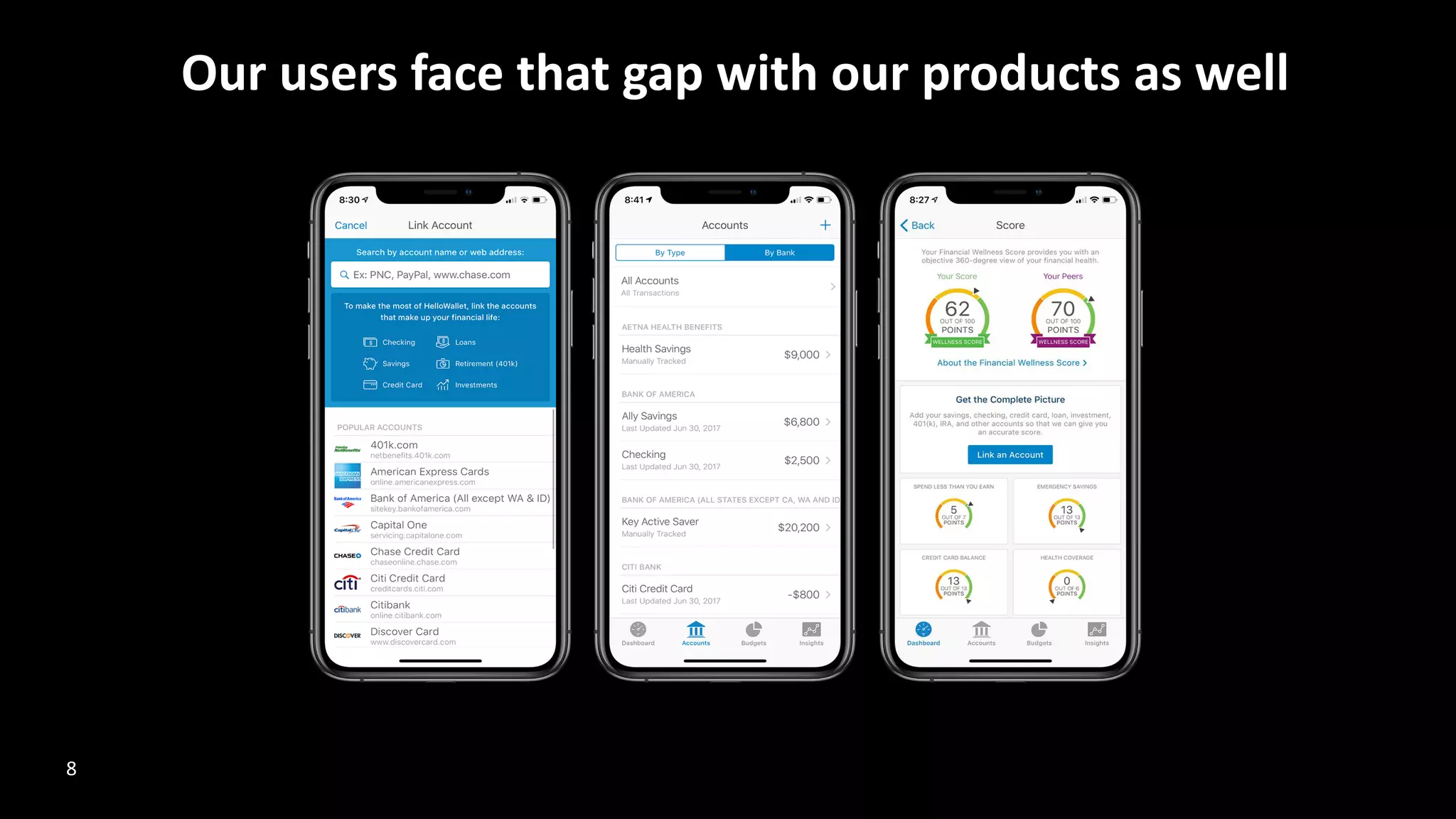
Our users face that gap with our products as well
8
An understanding of how people decide & act
What is behavioral science?
Tools to potentially help people do better
Rigorous testing to find results
9
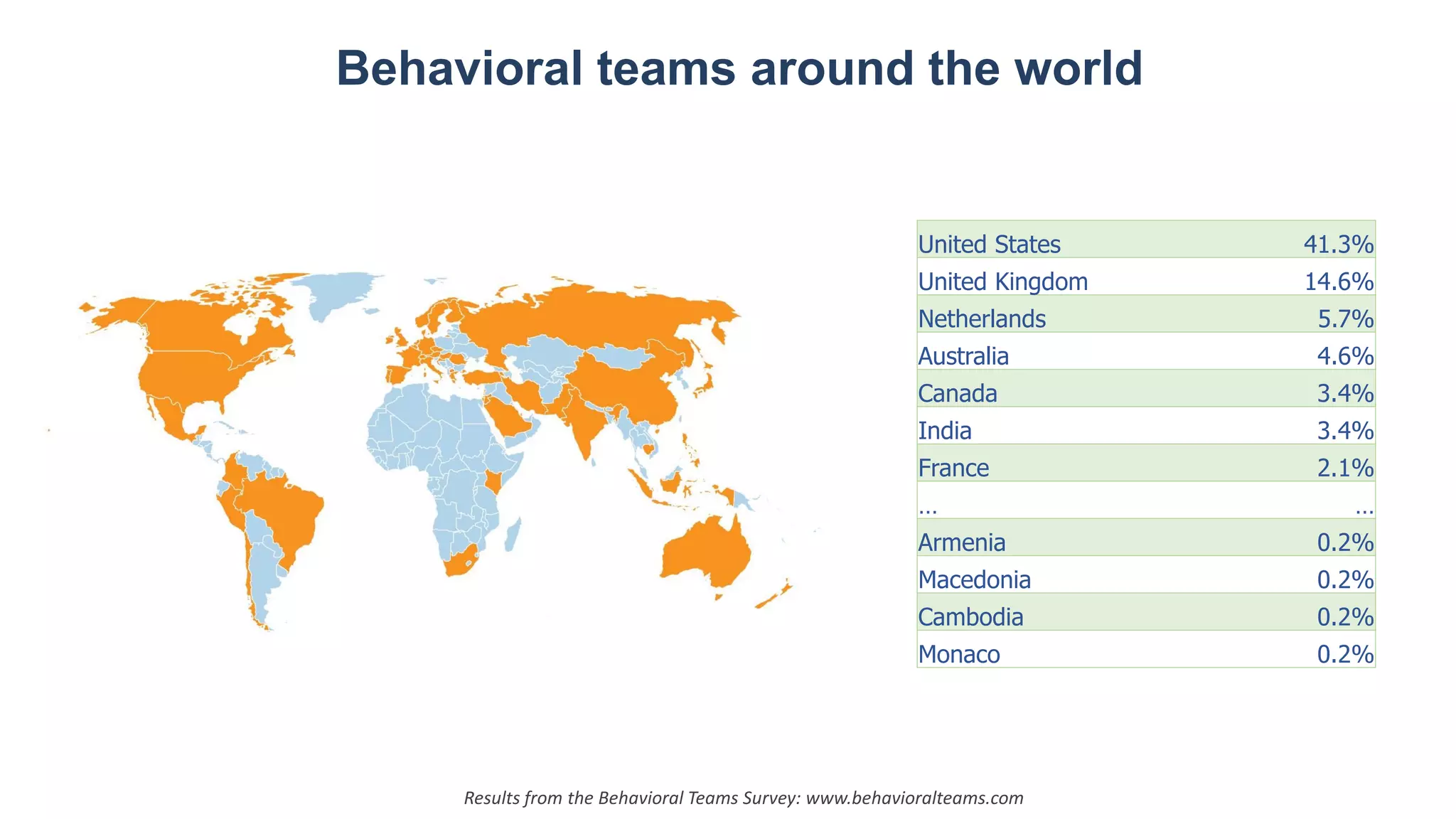
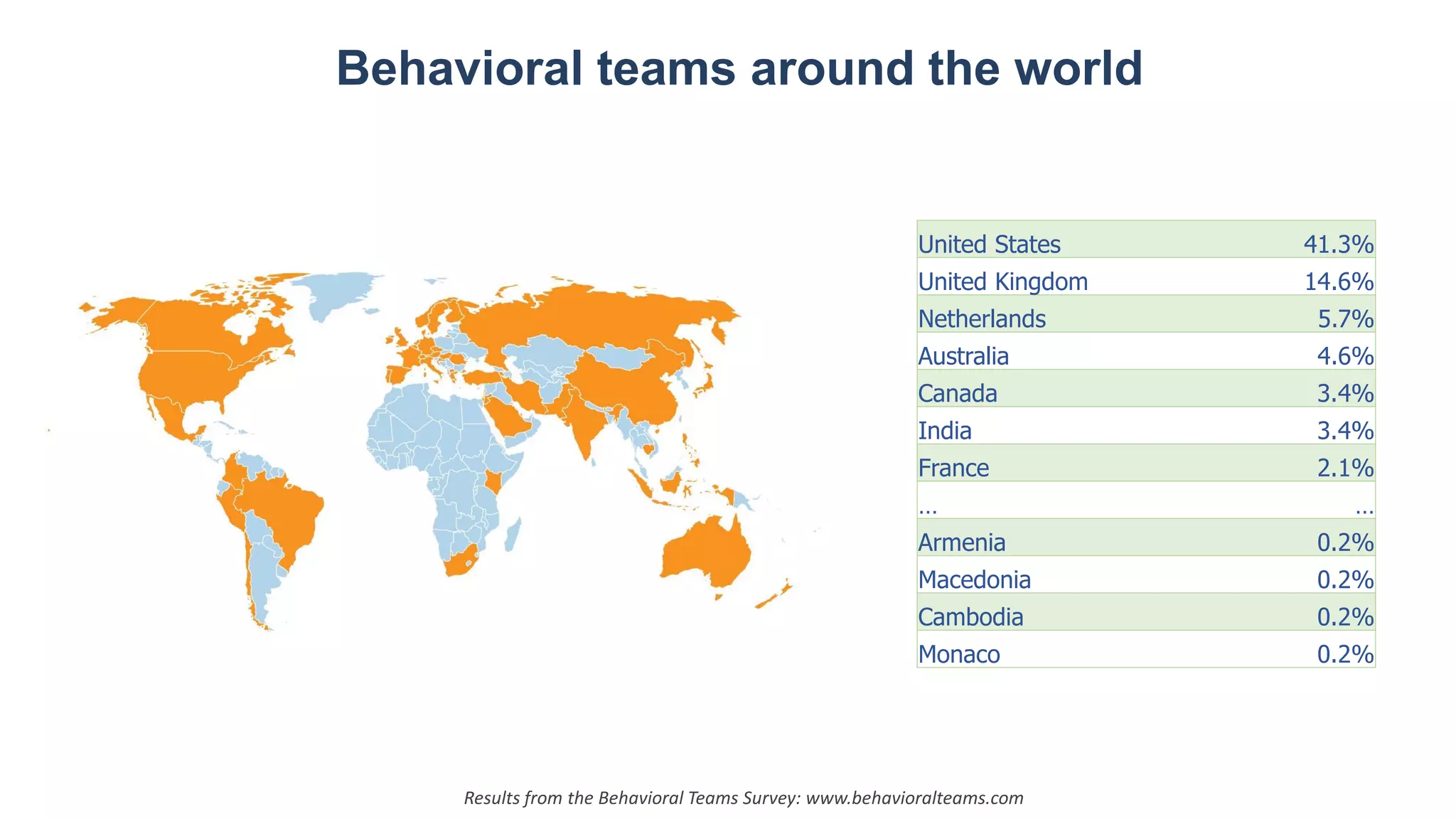
Behavioral teams around the world
Results from the Behavioral Teams Survey: www.behavioralteams.com
United States 41.3%
United Kingdom 14.6%
Netherlands 5.7%
Australia 4.6%
Canada 3.4%
India 3.4%
France 2.1%
… …
Armenia 0.2%
Macedonia 0.2%
Cambodia 0.2%
Monaco 0.2%
11
12
13
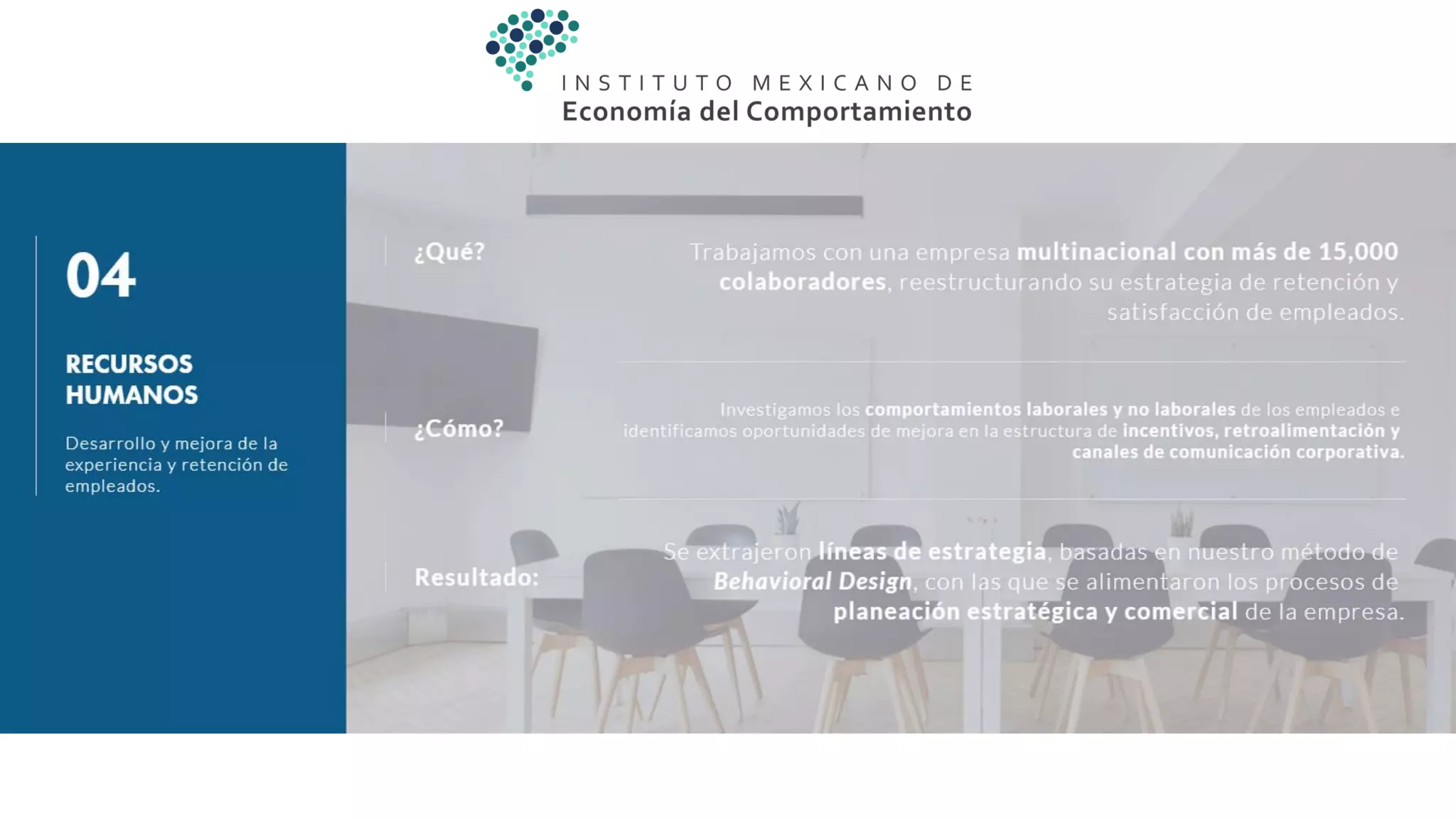
Example from Mexico:
Company
(With mention of IMEC)
1. BeSci Complements Design
2. DECIDE: A Blueprint
3. How do we stay ethical?
4. Q&A
What’s Next
16
17
18
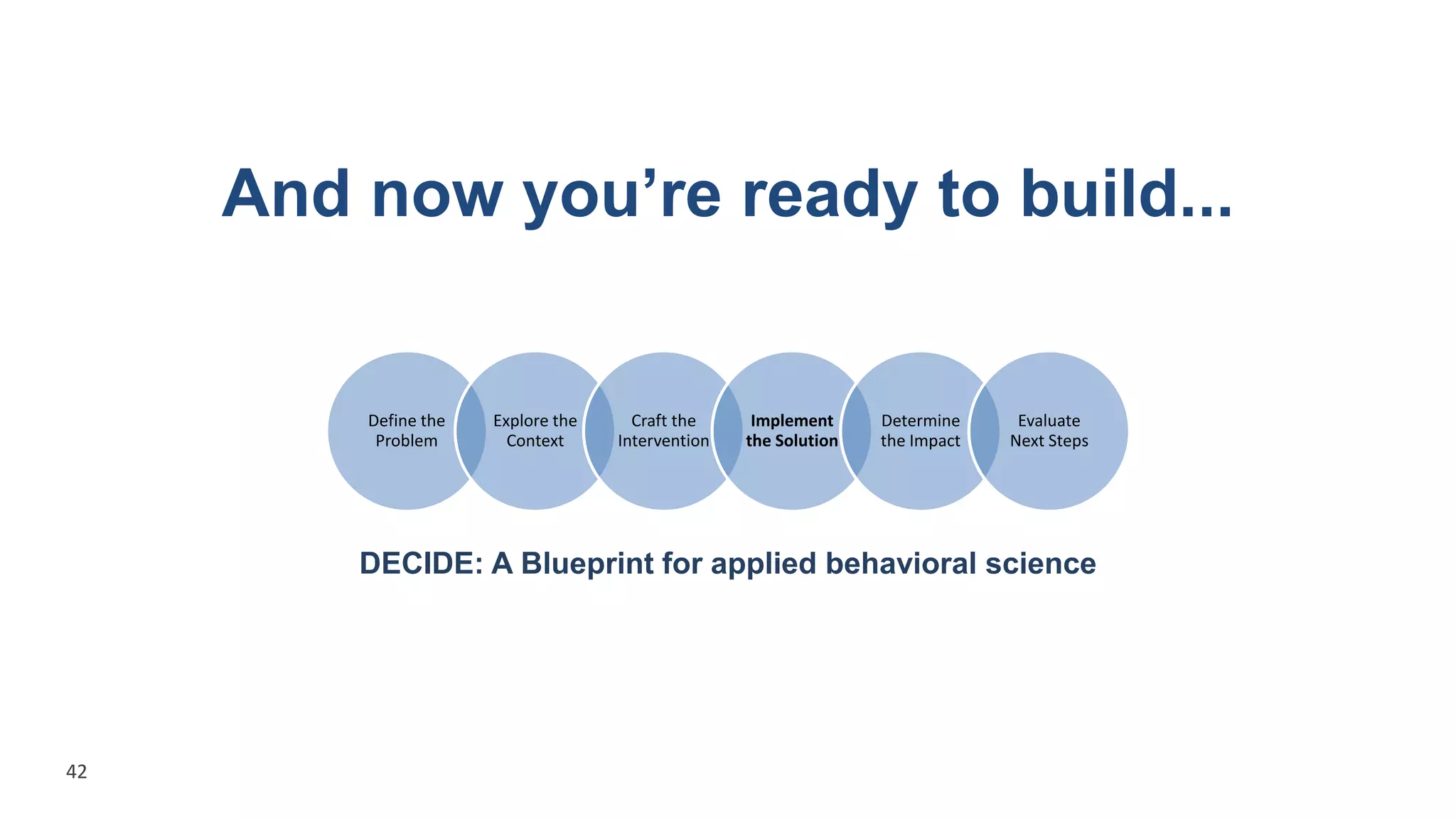
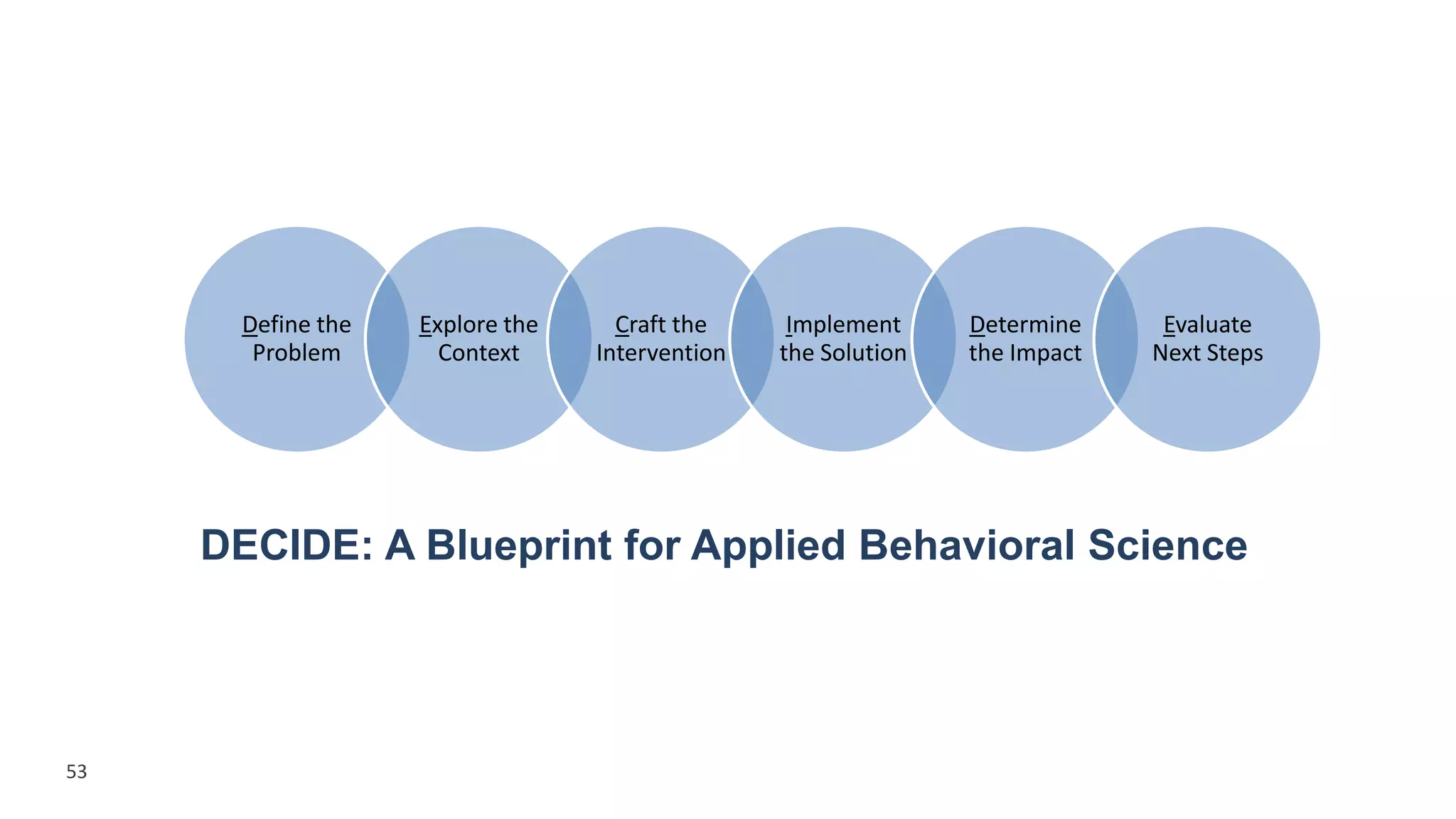
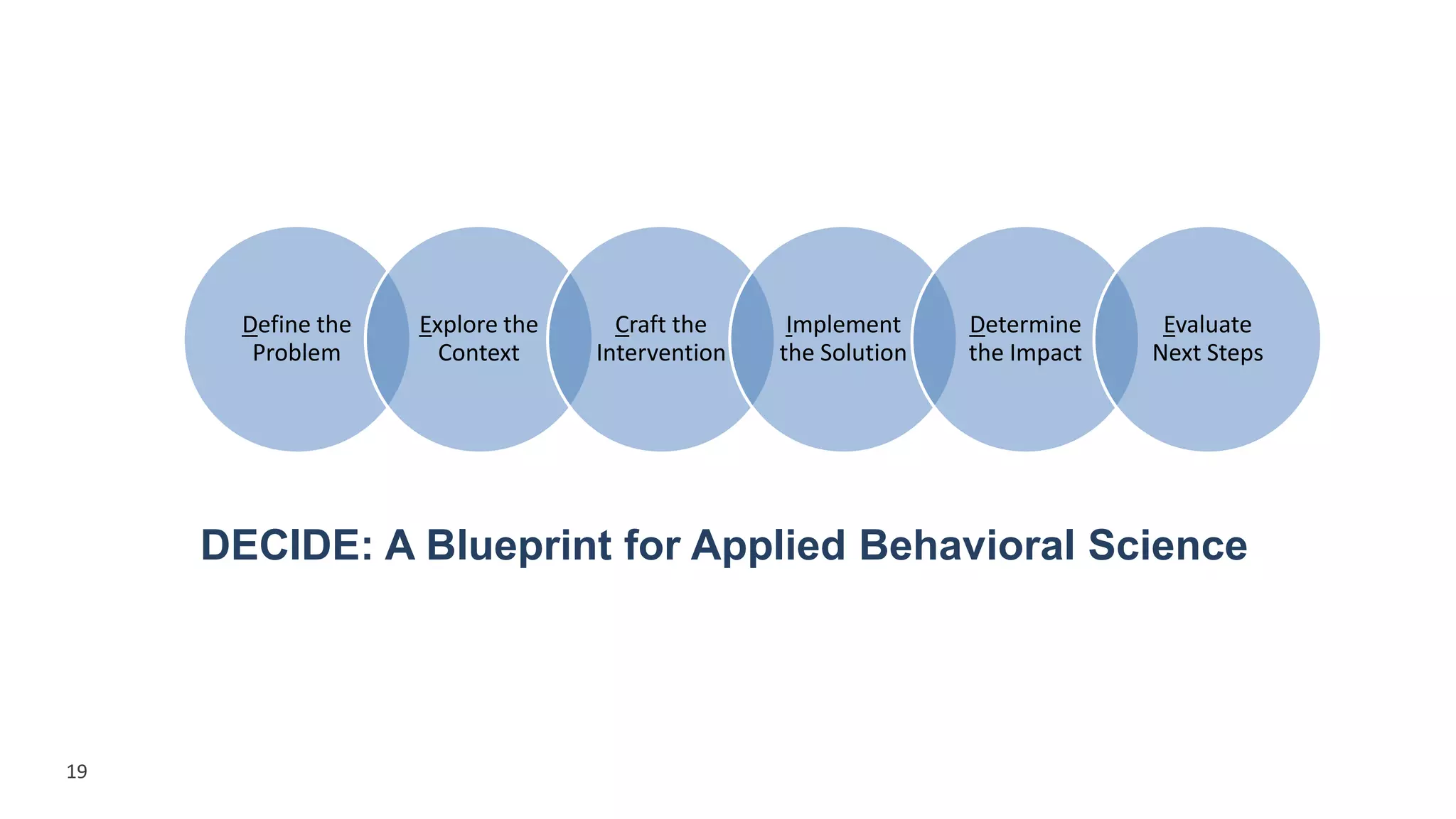
Define the
Problem
Explore the
Context
Craft the
Intervention
Implement
the Solution
Determine
the Impact
Evaluate
Next Steps
DECIDE: A Blueprint for Applied Behavioral Science
19
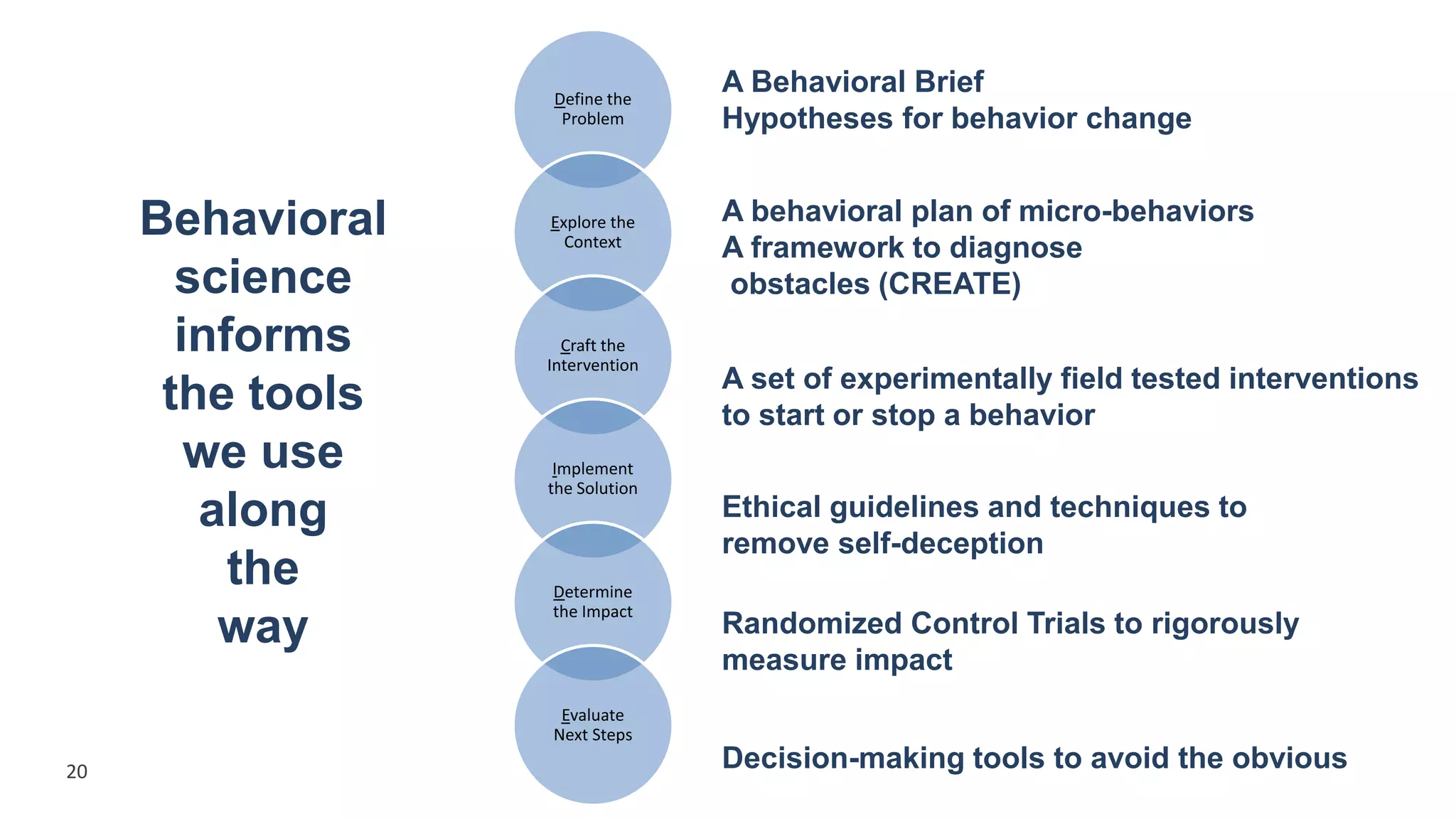
A Behavioral Brief
Hypotheses for behavior change
A behavioral plan of micro-behaviors
A framework to diagnose
obstacles (CREATE)
A set of experimentally field tested interventions
to start or stop a behavior
Ethical guidelines and techniques to
remove self-deception
Randomized Control Trials to rigorously
measure impact
Decision-making tools to avoid the obvious
Define the
Problem
Explore the
Context
Craft the
Intervention
Implement
the Solution
Determine
the Impact
Evaluate
Next Steps
Behavioral
science
informs
the tools
we use
along
the
way
20
21
www.behavioraltechnology.co
Define the
Problem
Explore the
Context
Craft the
Intervention
Implement
the Solution
Determine
the Impact
Evaluate
Next Steps
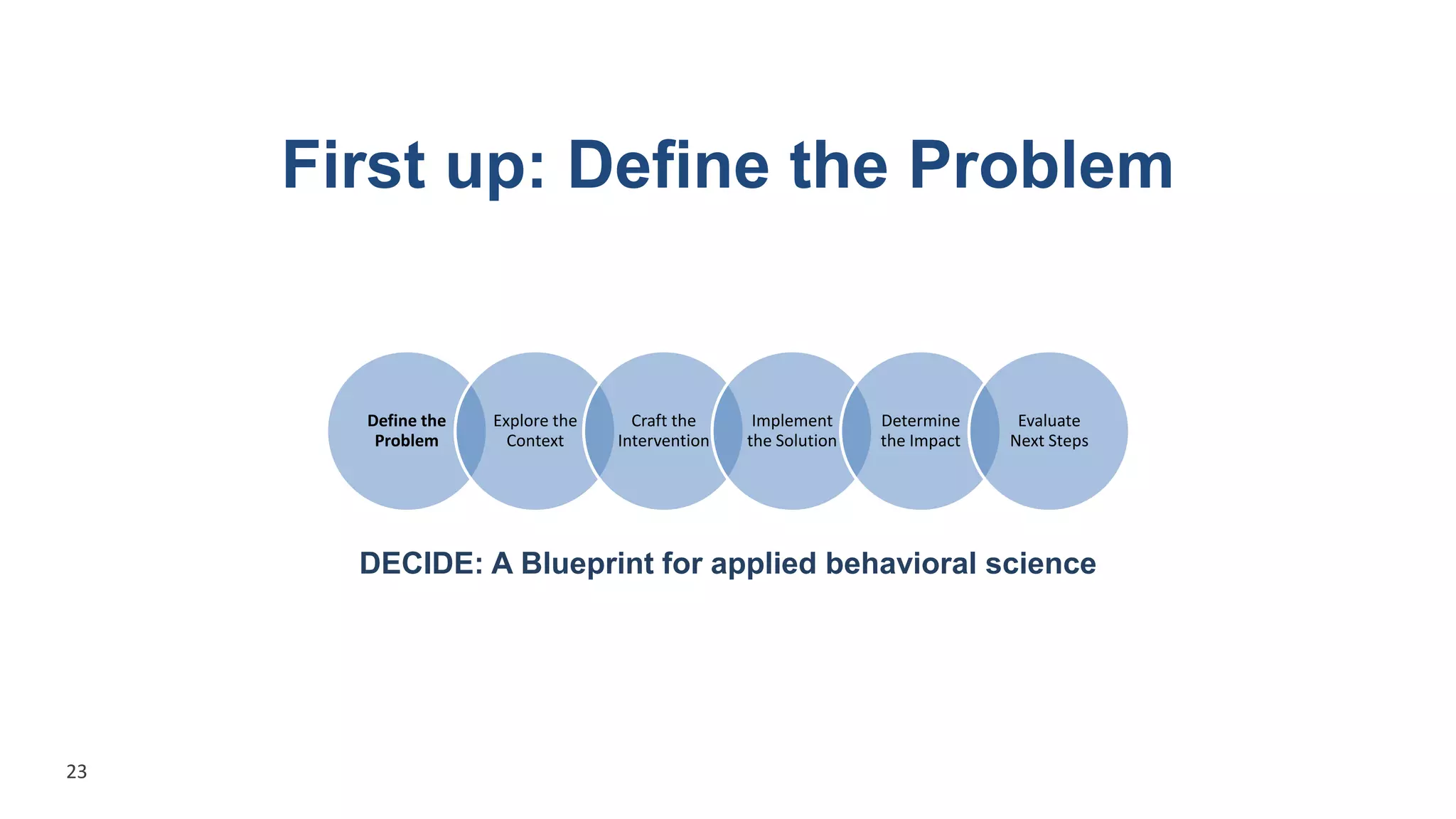
First up: Define the Problem
DECIDE: A Blueprint for applied behavioral science
23
Define the Behavioral Problem
By helping sedentary white-collar workers to start going to the gym,
we will cause them to have less joint pain (<50% incidences of PT & doctors visits).
By helping [actor] [start / stop] doing [describe action], we will cause [outcome].
24
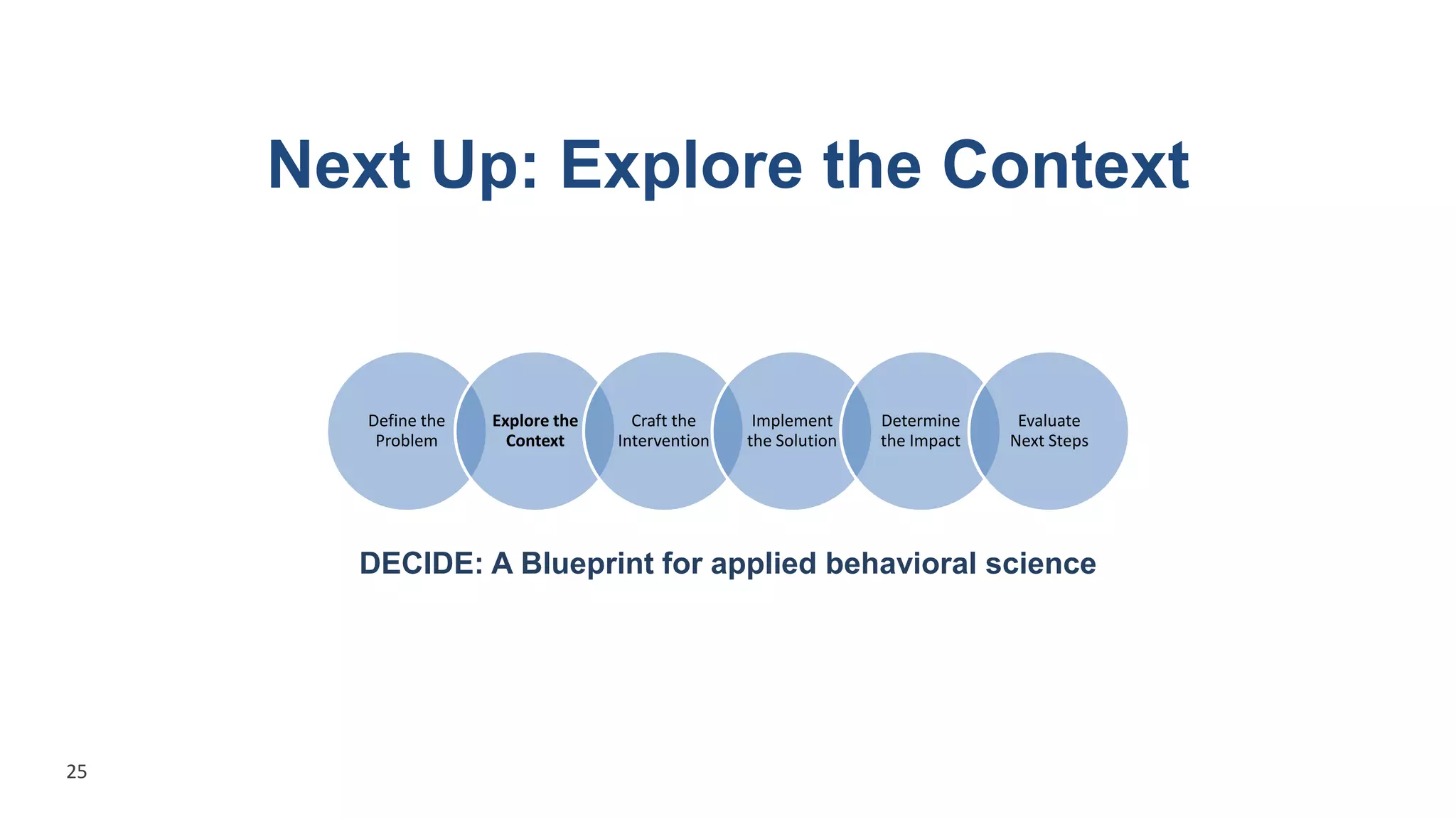
Define the
Problem
Explore the
Context
Craft the
Intervention
Implement
the Solution
Determine
the Impact
Evaluate
Next Steps
Next Up: Explore the Context
DECIDE: A Blueprint for applied behavioral science
25
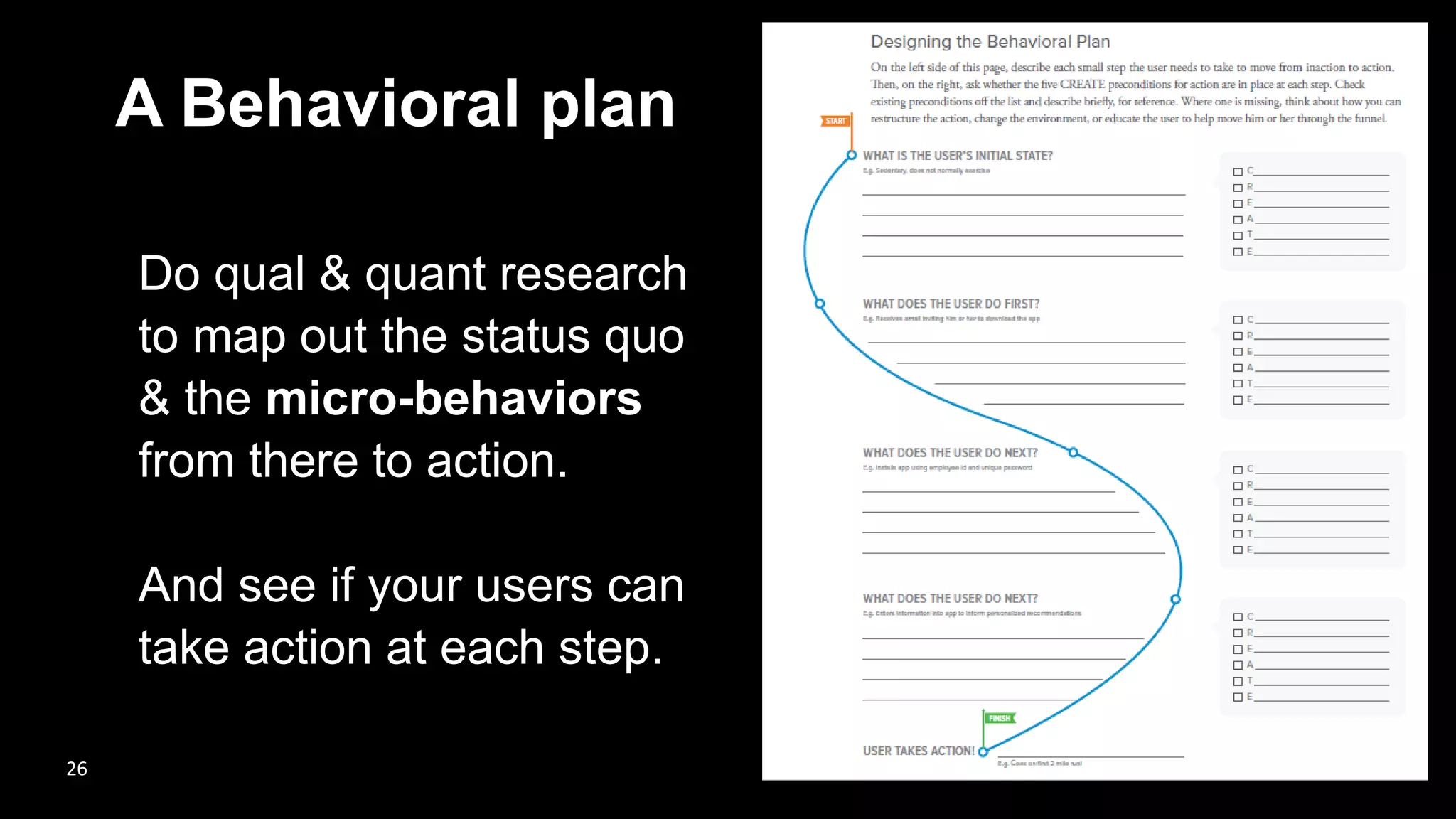
A Behavioral plan
Do qual & quant research
to map out the status quo
& the micro-behaviors
from there to action.
And see if your users can
take action at each step.
26
What happens
between sitting at
home and going to
the gym?
27
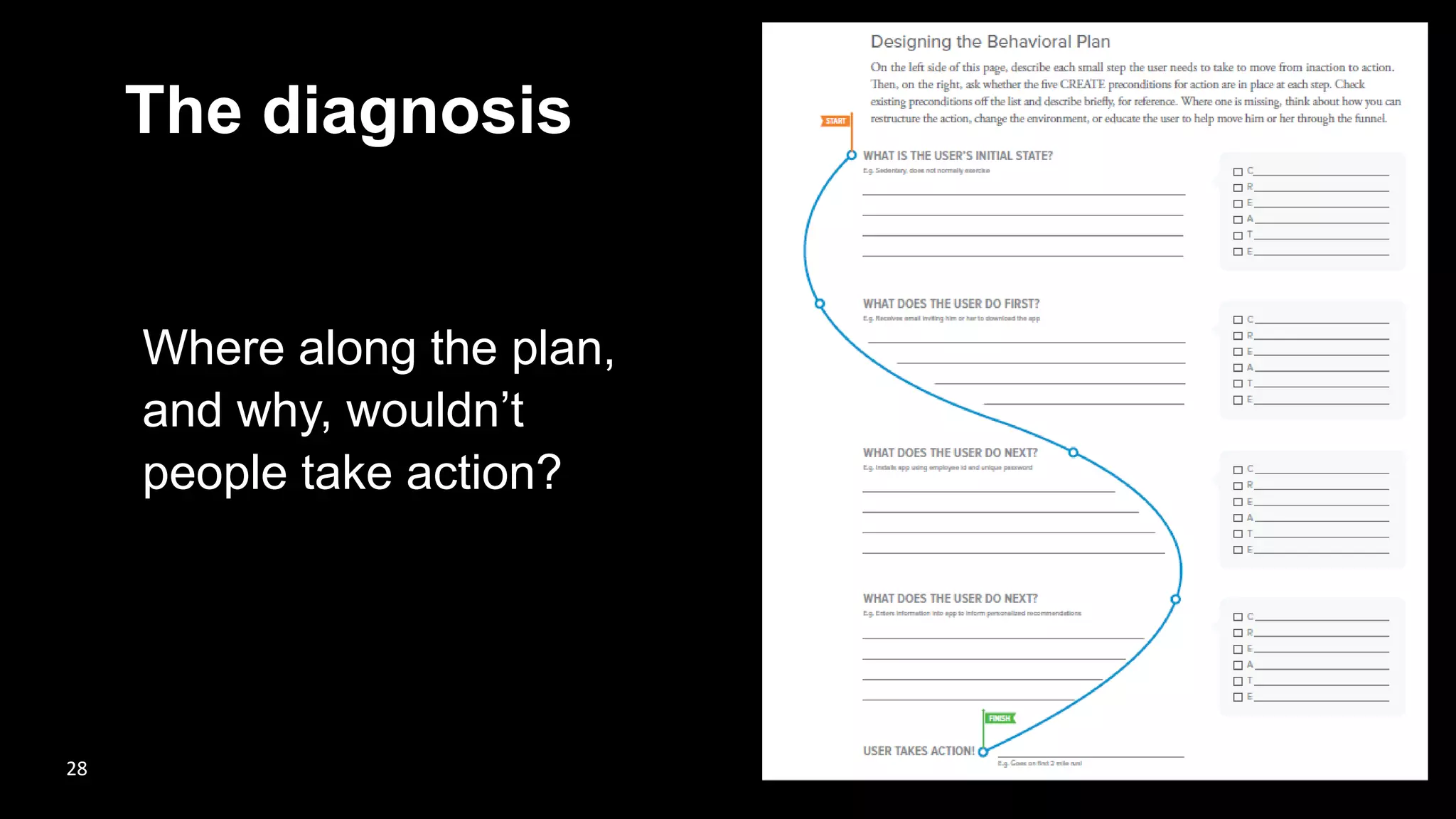
The diagnosis
Where along the plan,
and why, wouldn’t
people take action?
28
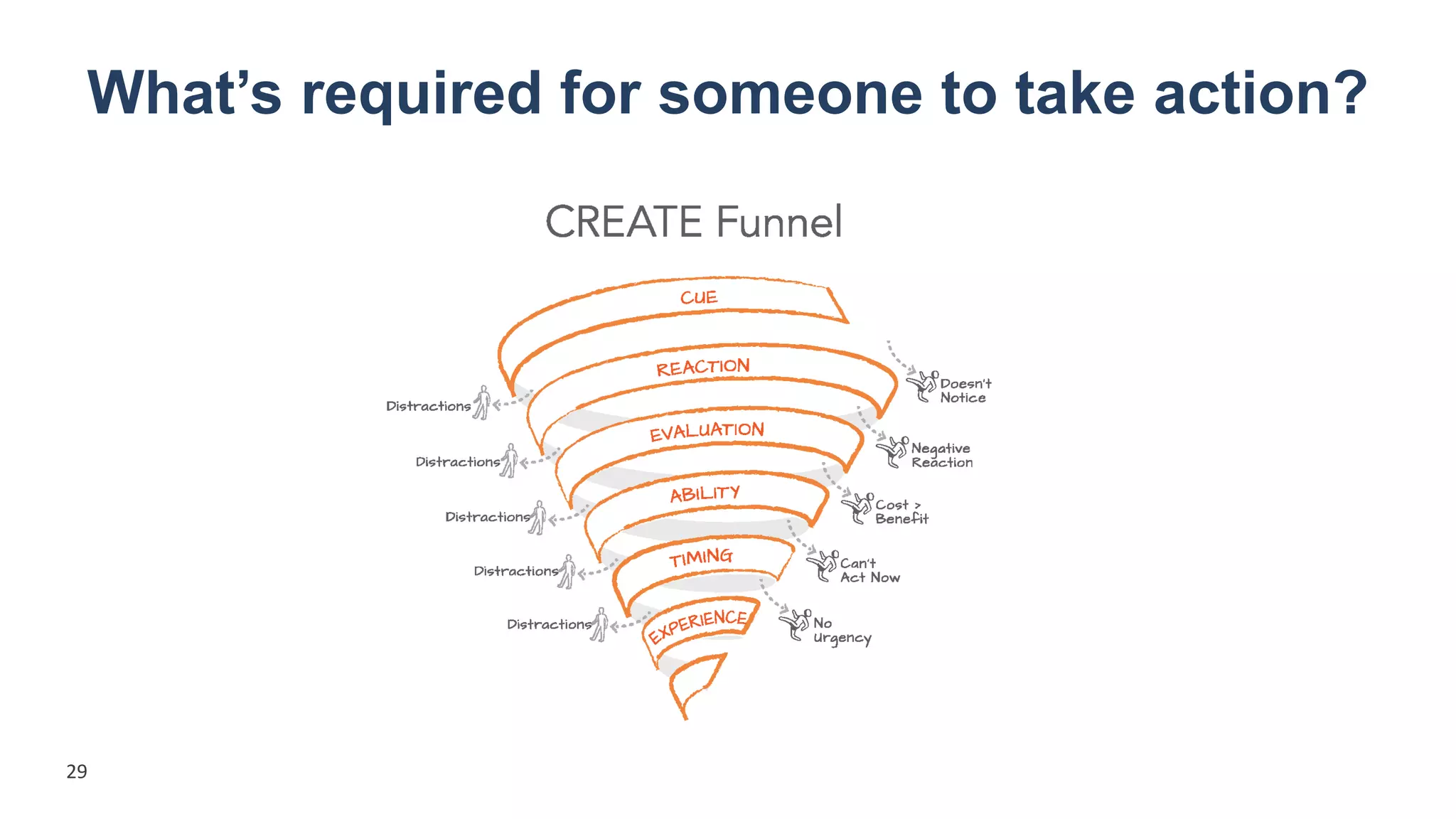
What’s required for someone to take action?
29
Define the
Problem
Explore the
Context
Craft the
Intervention
Implement
the Solution
Determine
the Impact
Evaluate
Next Steps
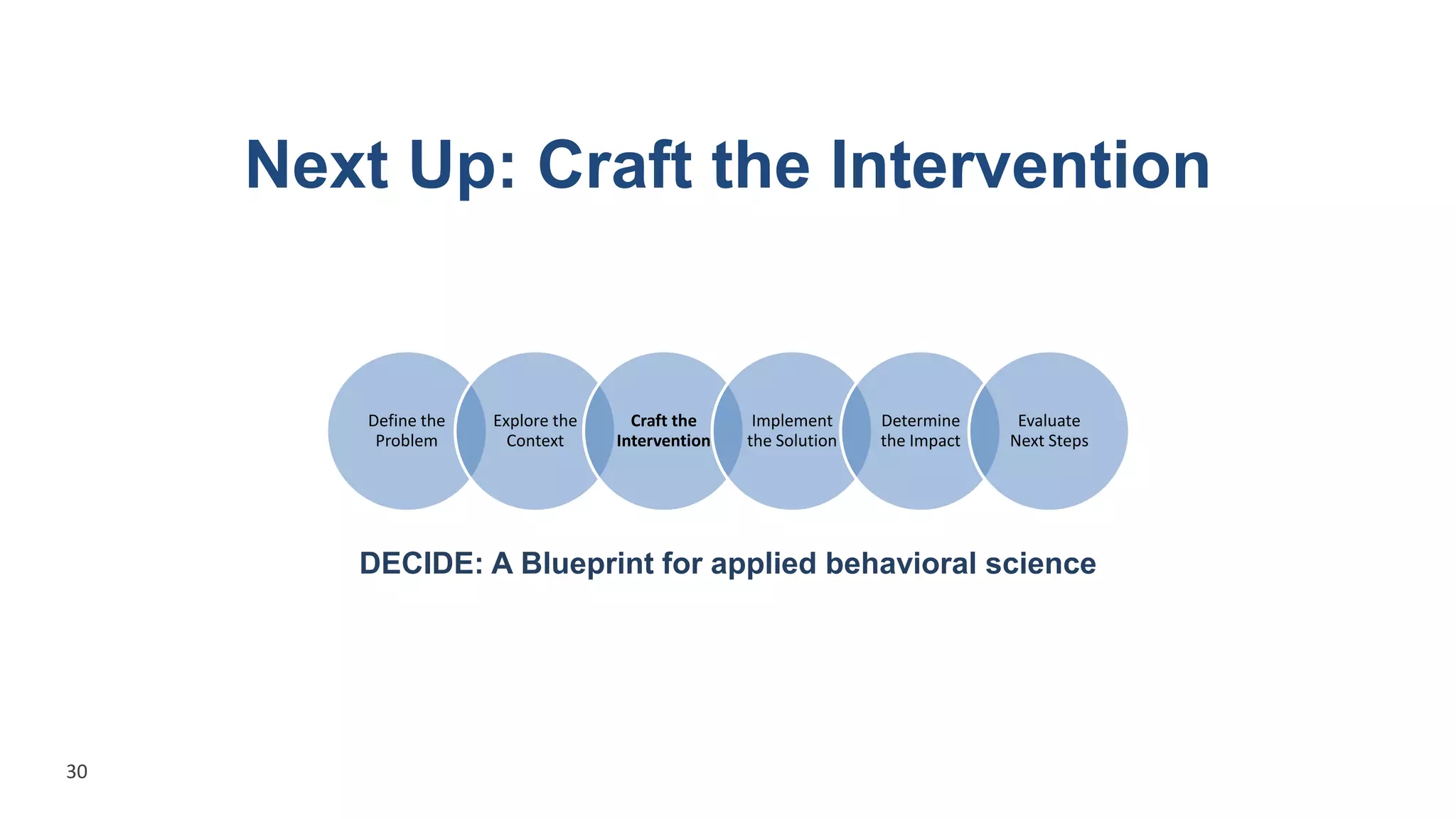
Next Up: Craft the Intervention
DECIDE: A Blueprint for applied behavioral science
30
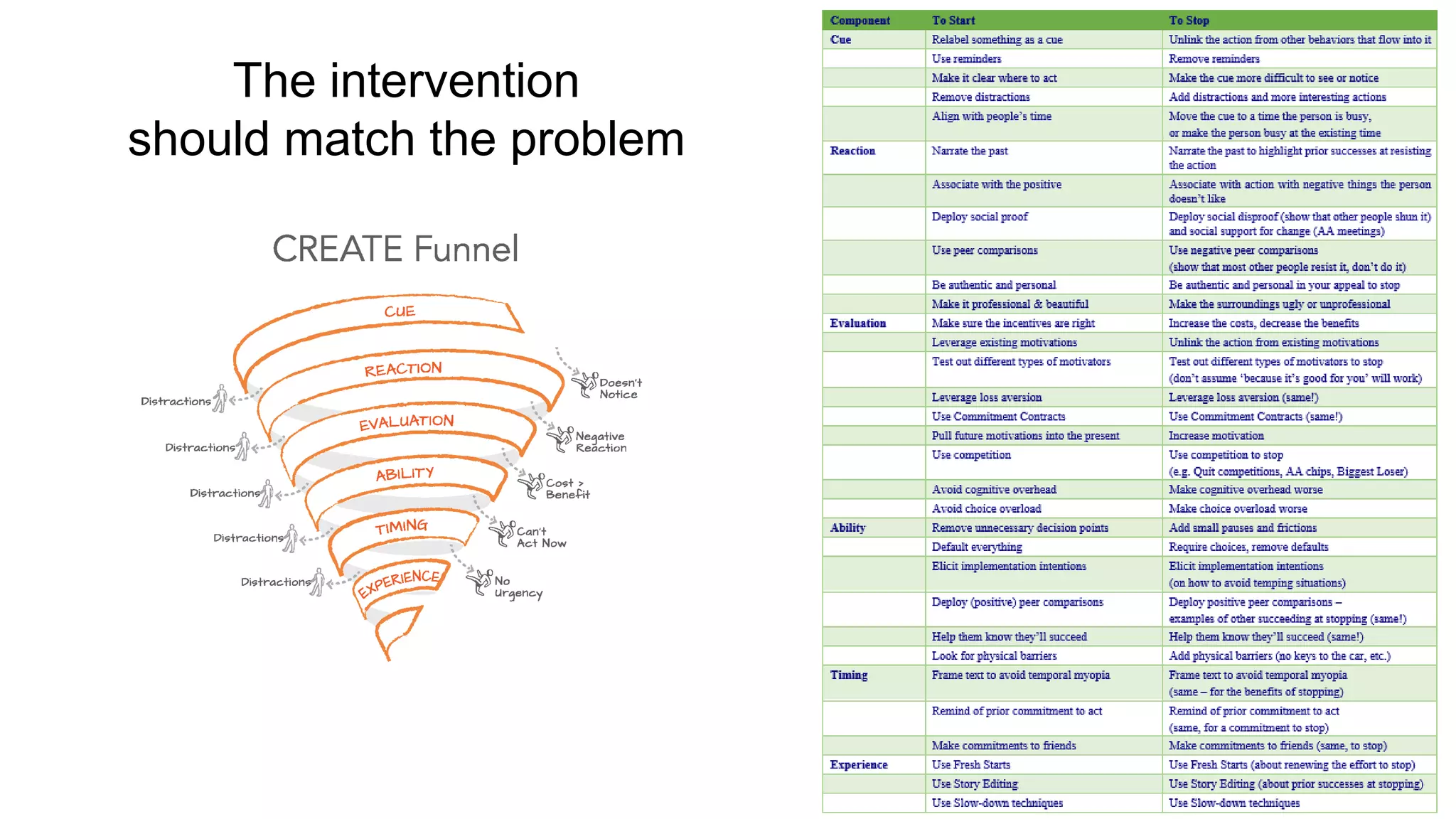
The intervention
should match the problem
Cue
What would cue your users to think about
taking action, in a specific moment?
32
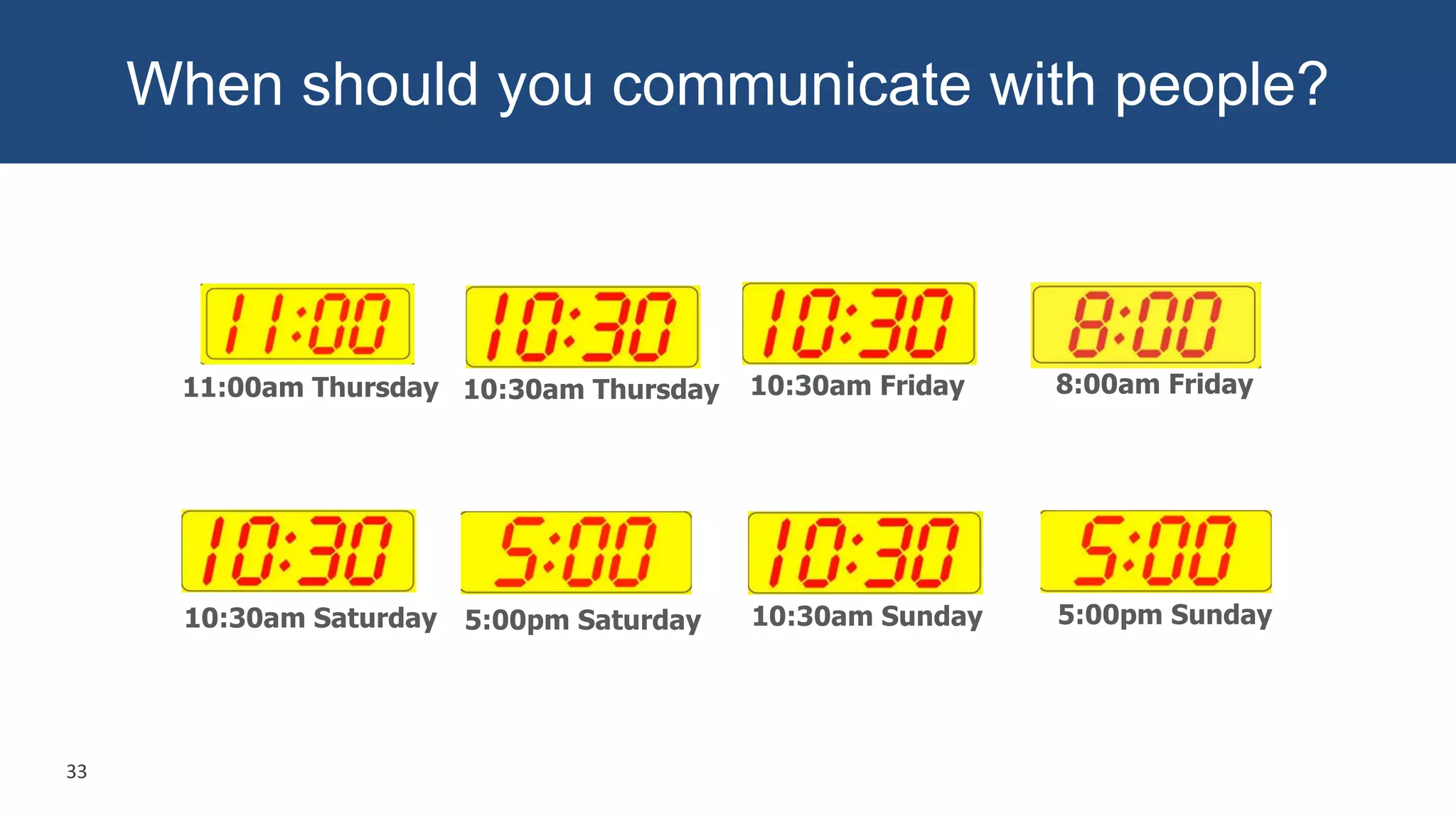
When should you communicate with people?
10:30am Saturday 5:00pm Saturday 10:30am Sunday 5:00pm Sunday
11:00am Thursday 10:30am Thursday 10:30am Friday 8:00am Friday
33
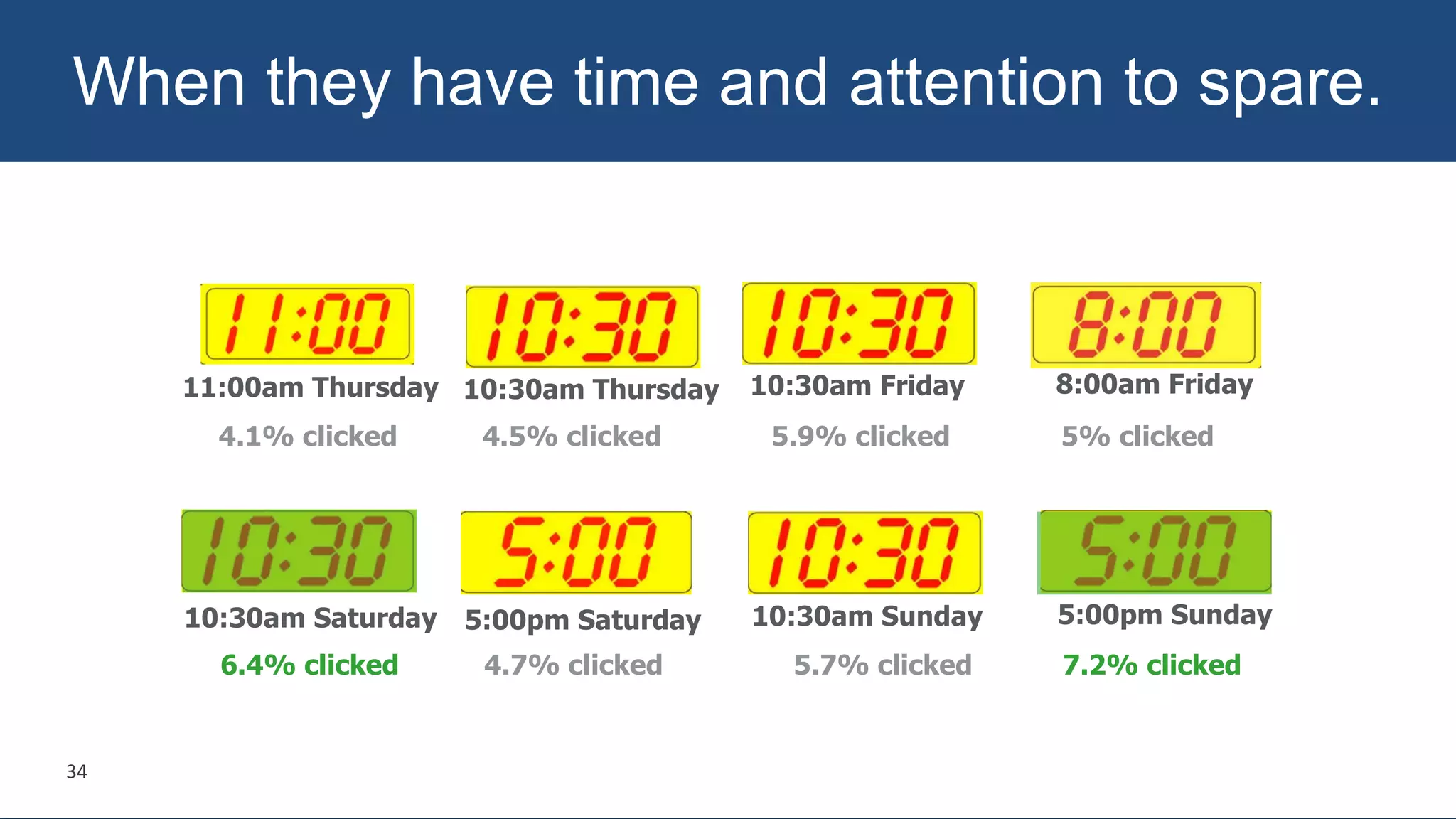
10:30am Saturday 5:00pm Saturday 10:30am Sunday 5:00pm Sunday
11:00am Thursday 10:30am Thursday 10:30am Friday 8:00am Friday
6.4% clicked 7.2% clicked4.7% clicked 5.7% clicked
4.1% clicked 5% clicked4.5% clicked 5.9% clicked
When they have time and attention to spare.
34
Reaction
What emotional reaction do they have,
in that moment?
35
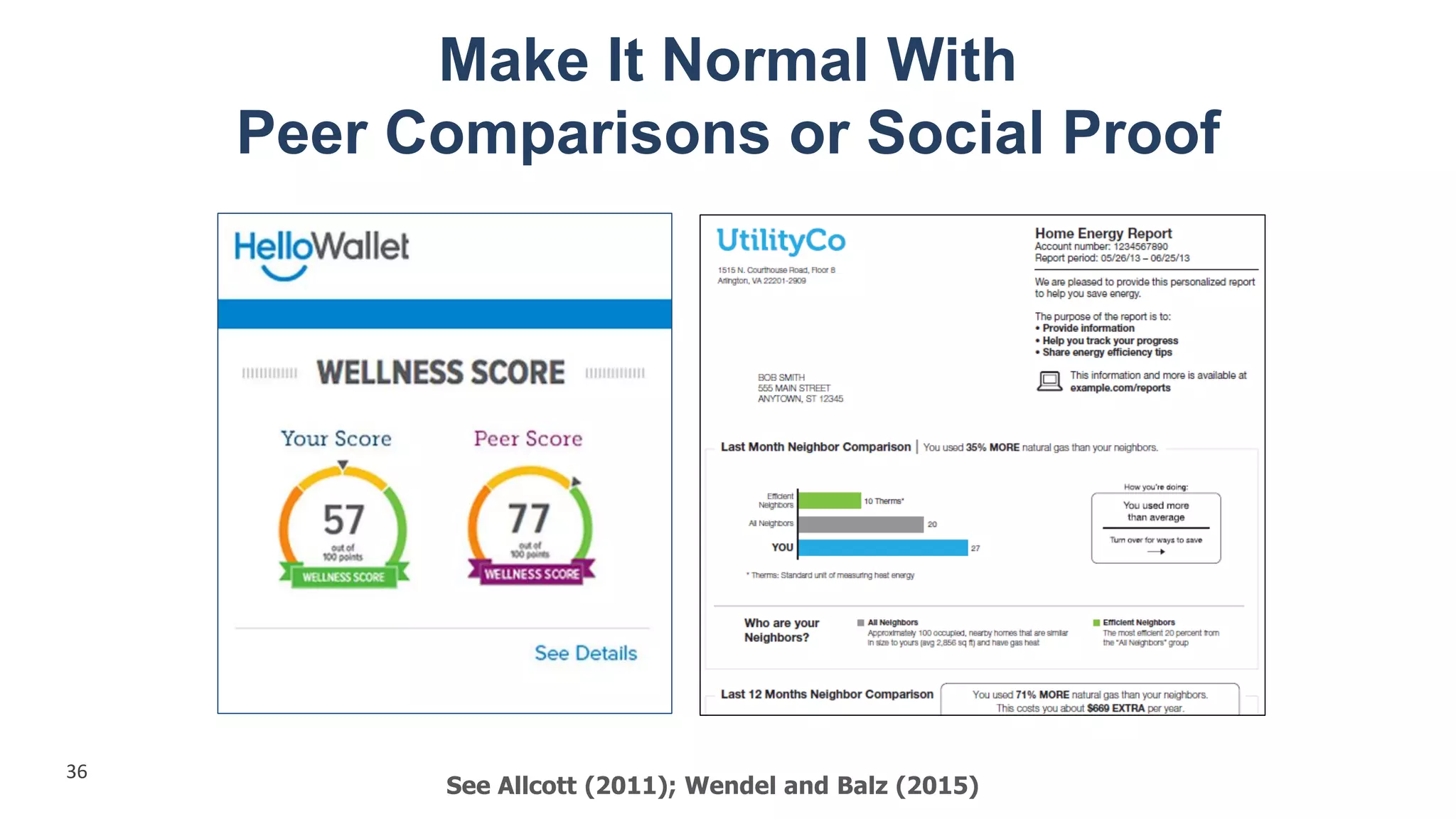
Make It Normal With
Peer Comparisons or Social Proof
See Allcott (2011); Wendel and Balz (2015)
36
Evaluation
What’s their evaluation of the costs and benefits?
Does it seem worthwhile to do?
37
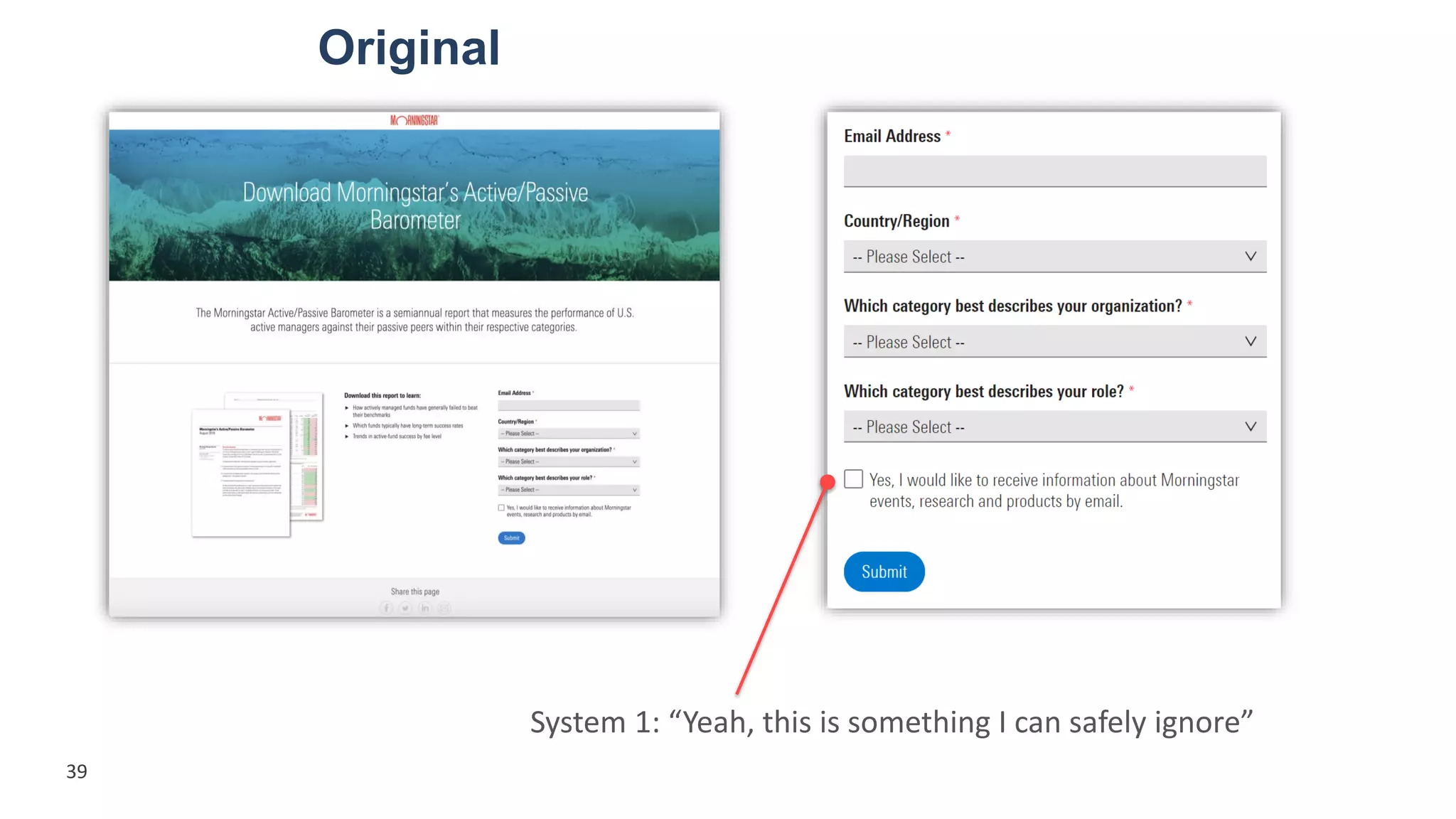
Original
System 1: “Yeah, this is something I can safely ignore”
39
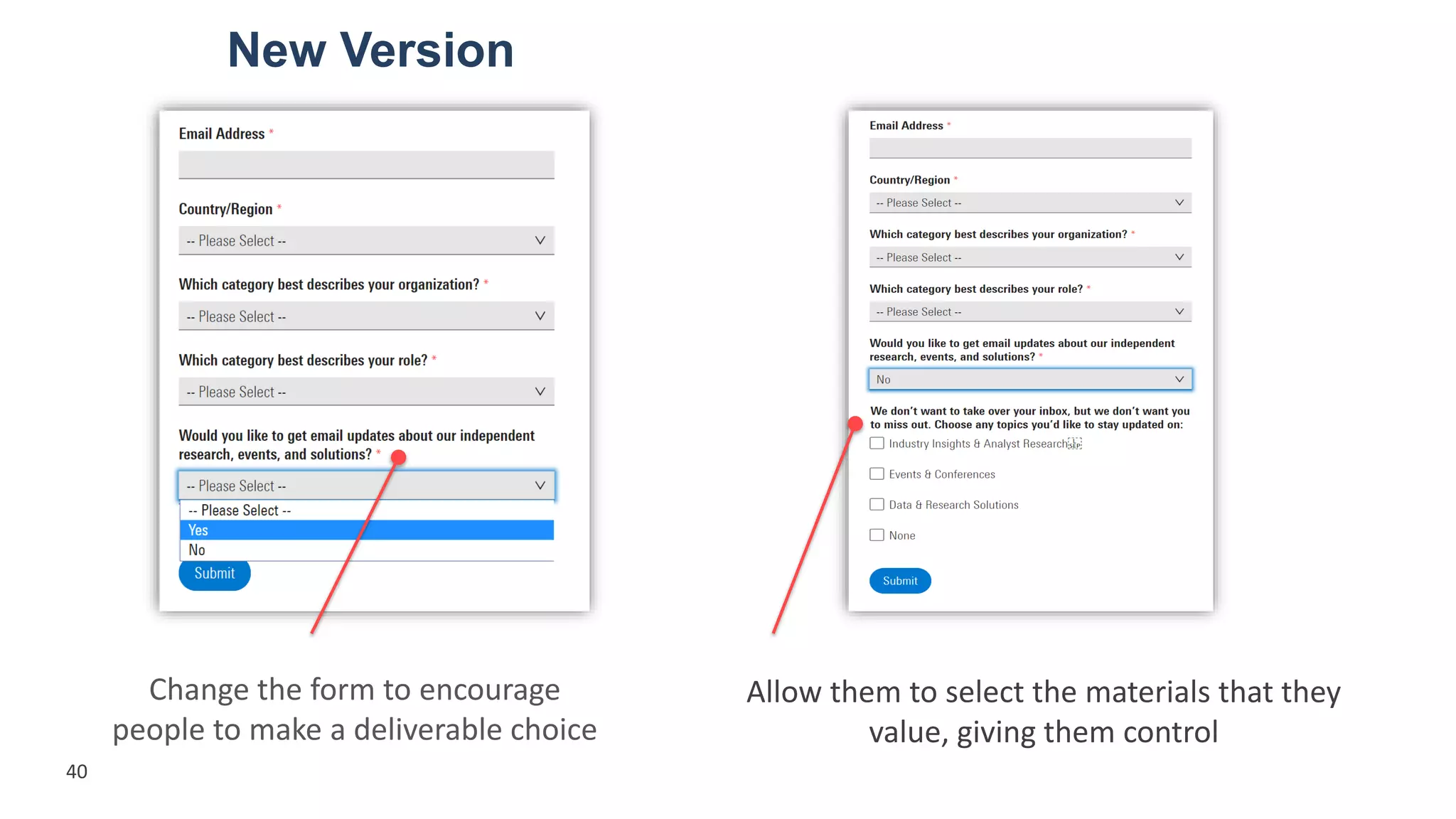
New Version
Change the form to encourage
people to make a deliverable choice
Allow them to select the materials that they
value, giving them control
40
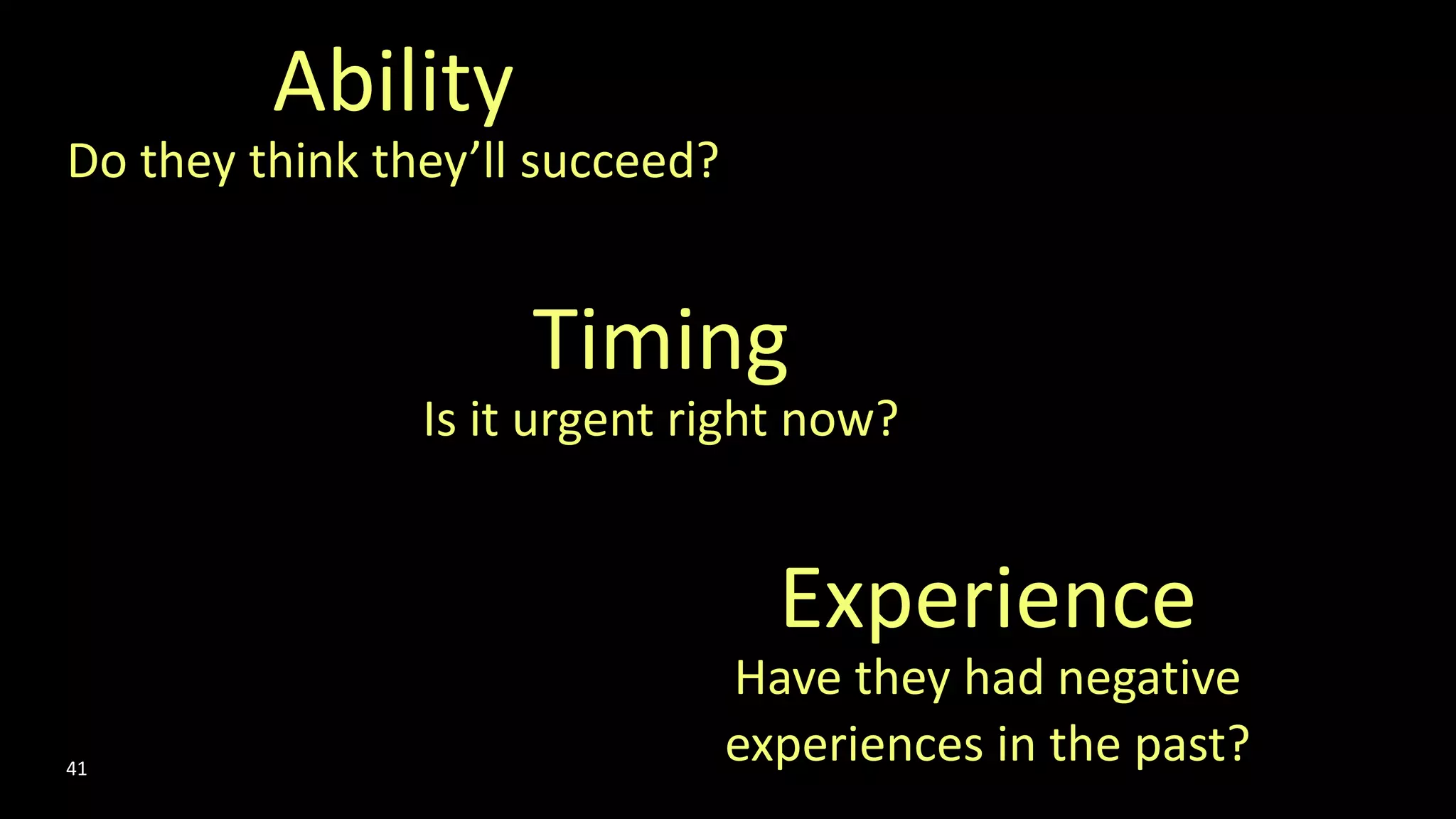
Ability
Do they think they’ll succeed?
Timing
Is it urgent right now?
Experience
Have they had negative
experiences in the past?41
Define the
Problem
Explore the
Context
Craft the
Intervention
Implement
the Solution
Determine
the Impact
Evaluate
Next Steps
And now you’re ready to build...
DECIDE: A Blueprint for applied behavioral science
42
1. BeSci Complements Design
2. DECIDE: A Blueprint
3. How Do We Stay Ethical?
4. Q&A
What’s Next
43
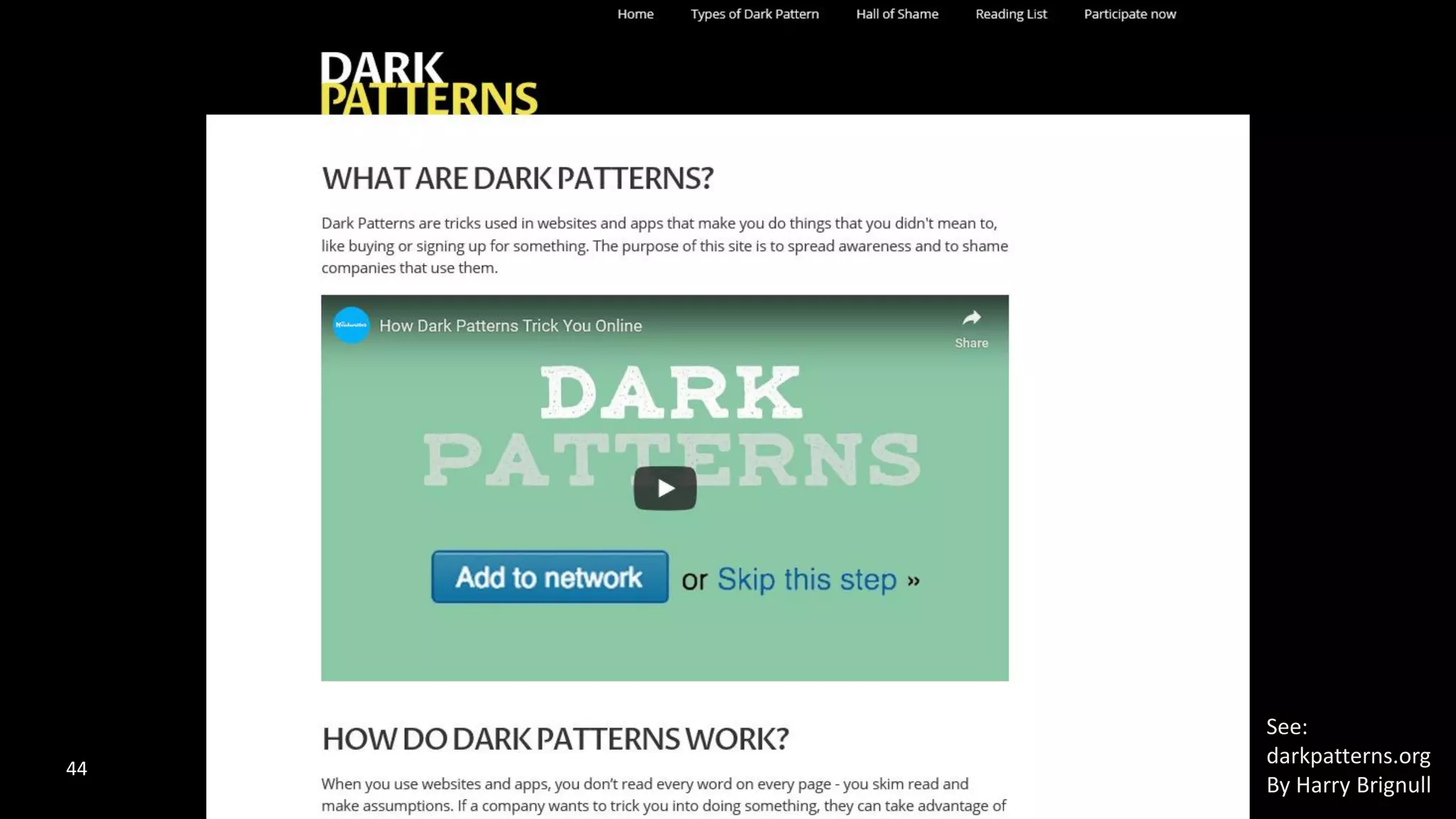
And we’ve earned it.
See:
darkpatterns.org
By Harry Brignull
44
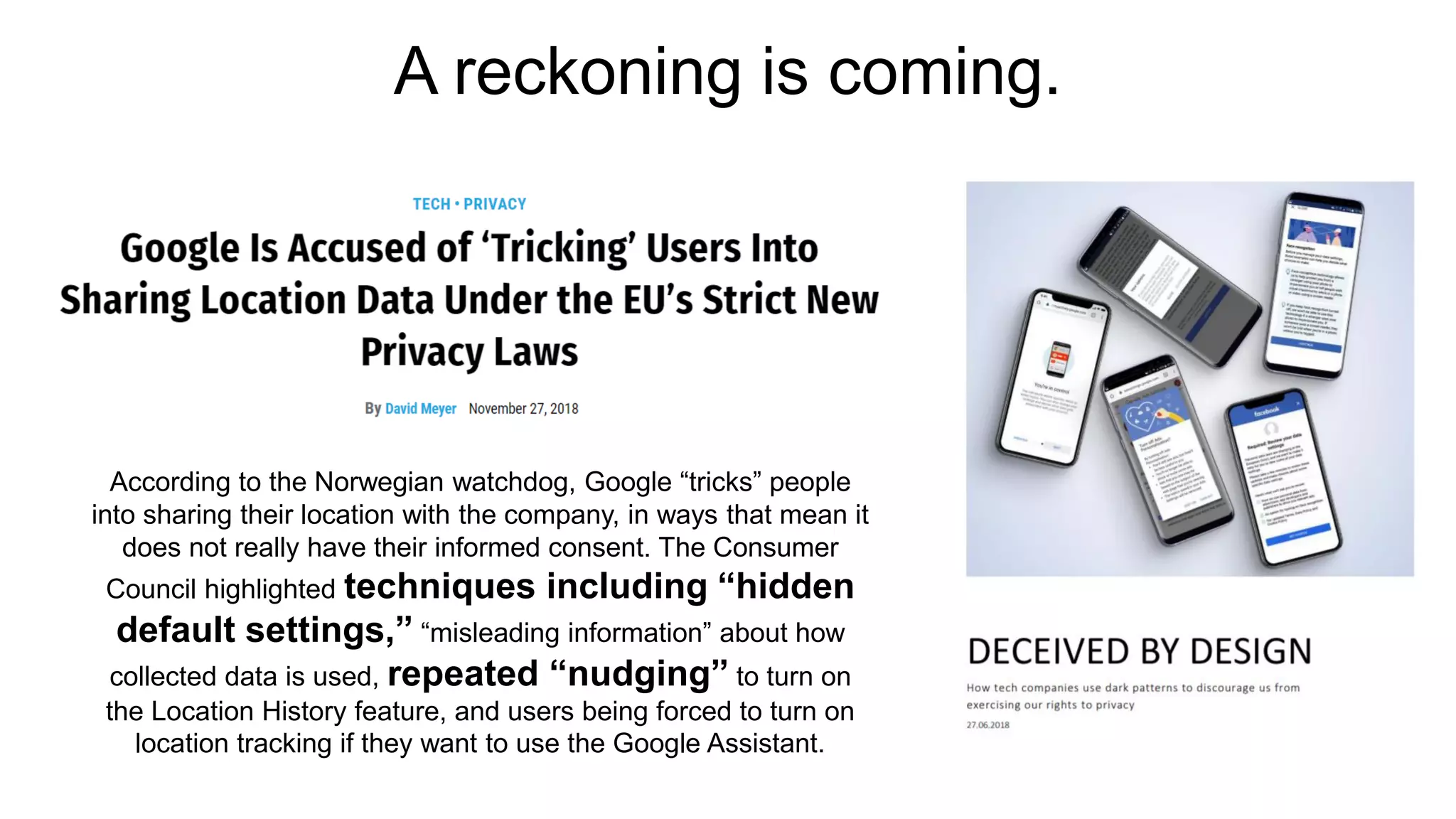
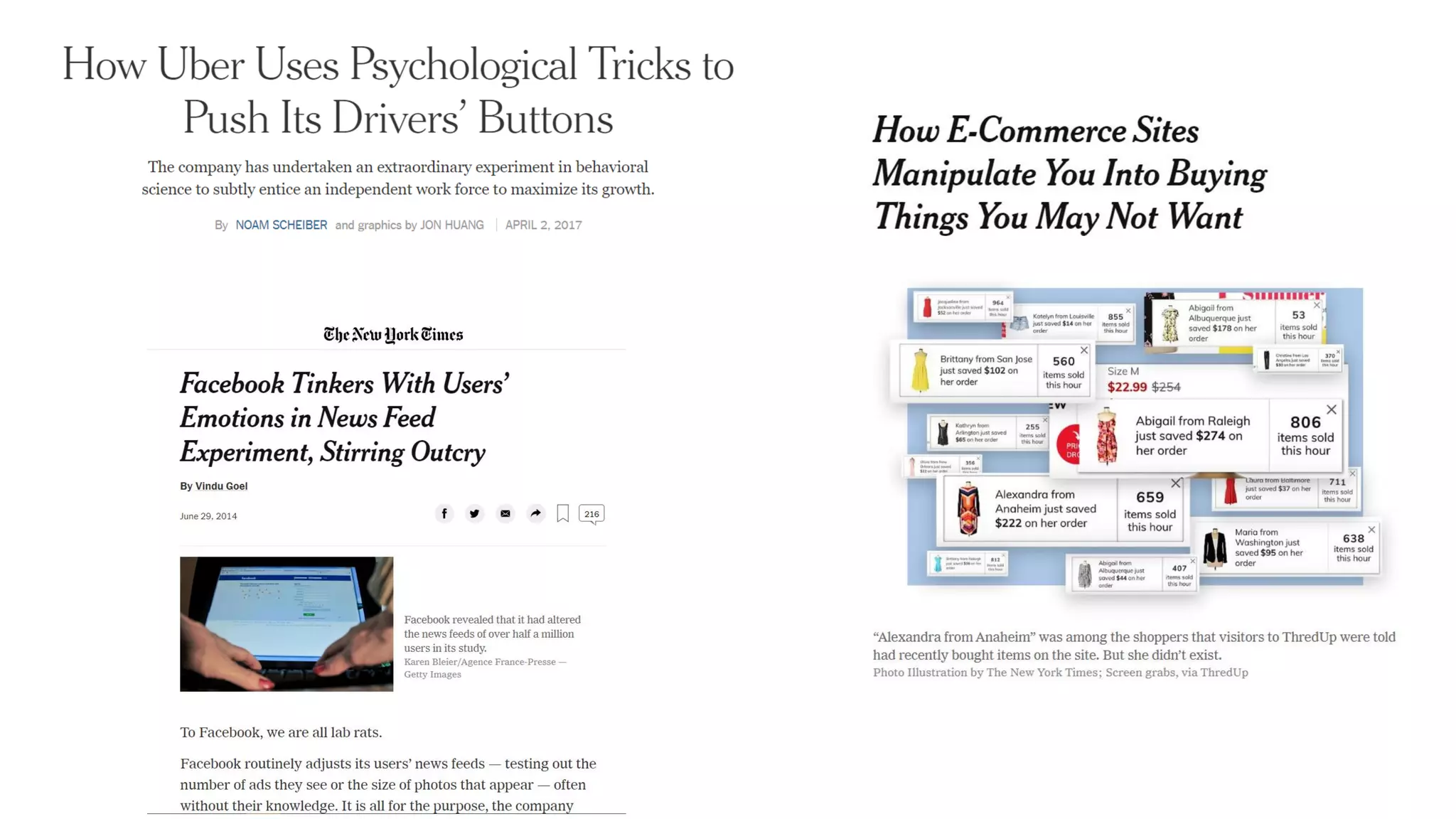
A reckoning is coming.
According to the Norwegian watchdog, Google “tricks” people
into sharing their location with the company, in ways that mean it
does not really have their informed consent. The Consumer
Council highlighted techniques including “hidden
default settings,” “misleading information” about how
collected data is used, repeated “nudging” to turn on
the Location History feature, and users being forced to turn on
location tracking if they want to use the Google Assistant.
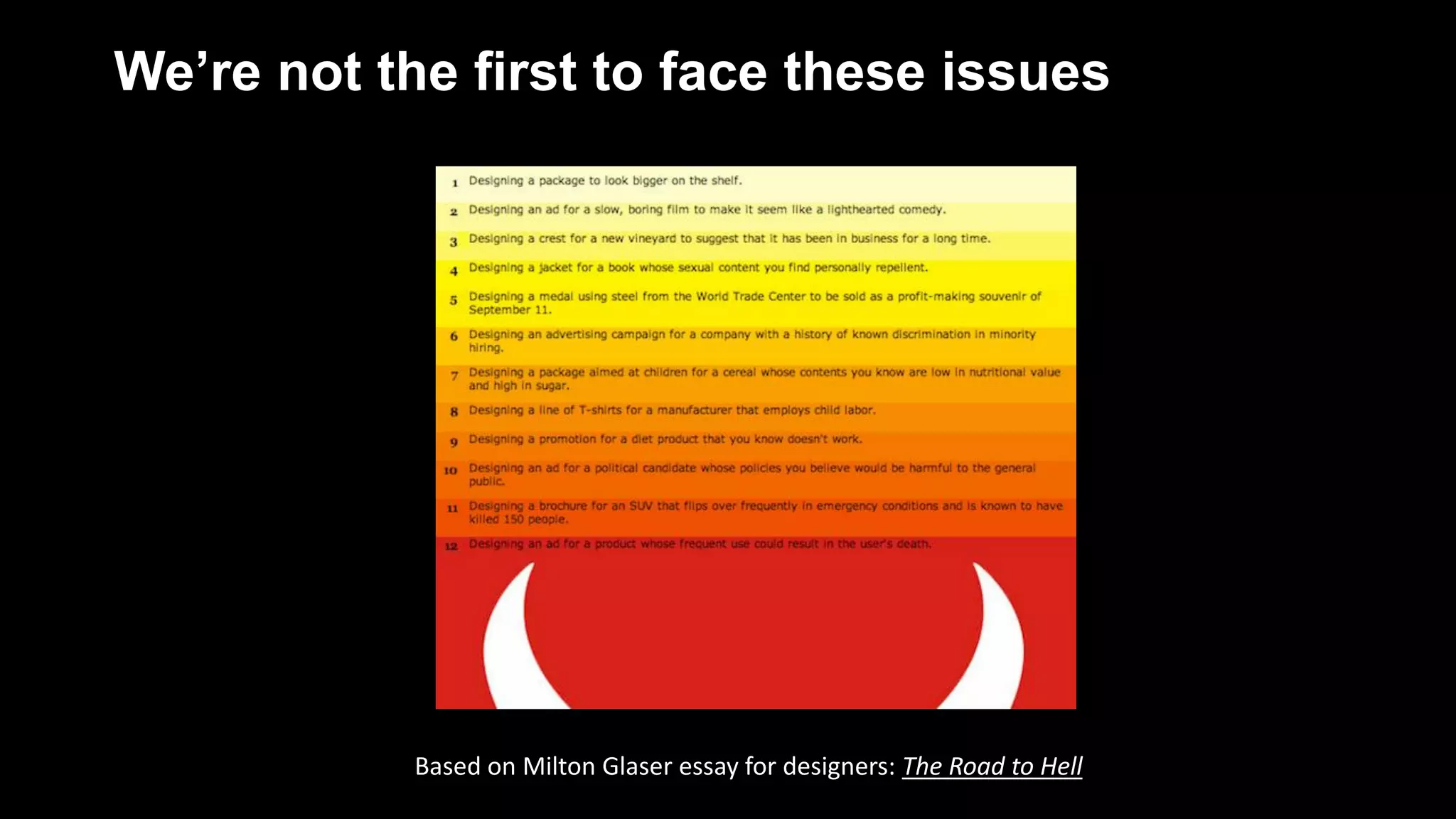
We’re not the first to face these issues
Based on Milton Glaser essay for designers: The Road to Hell
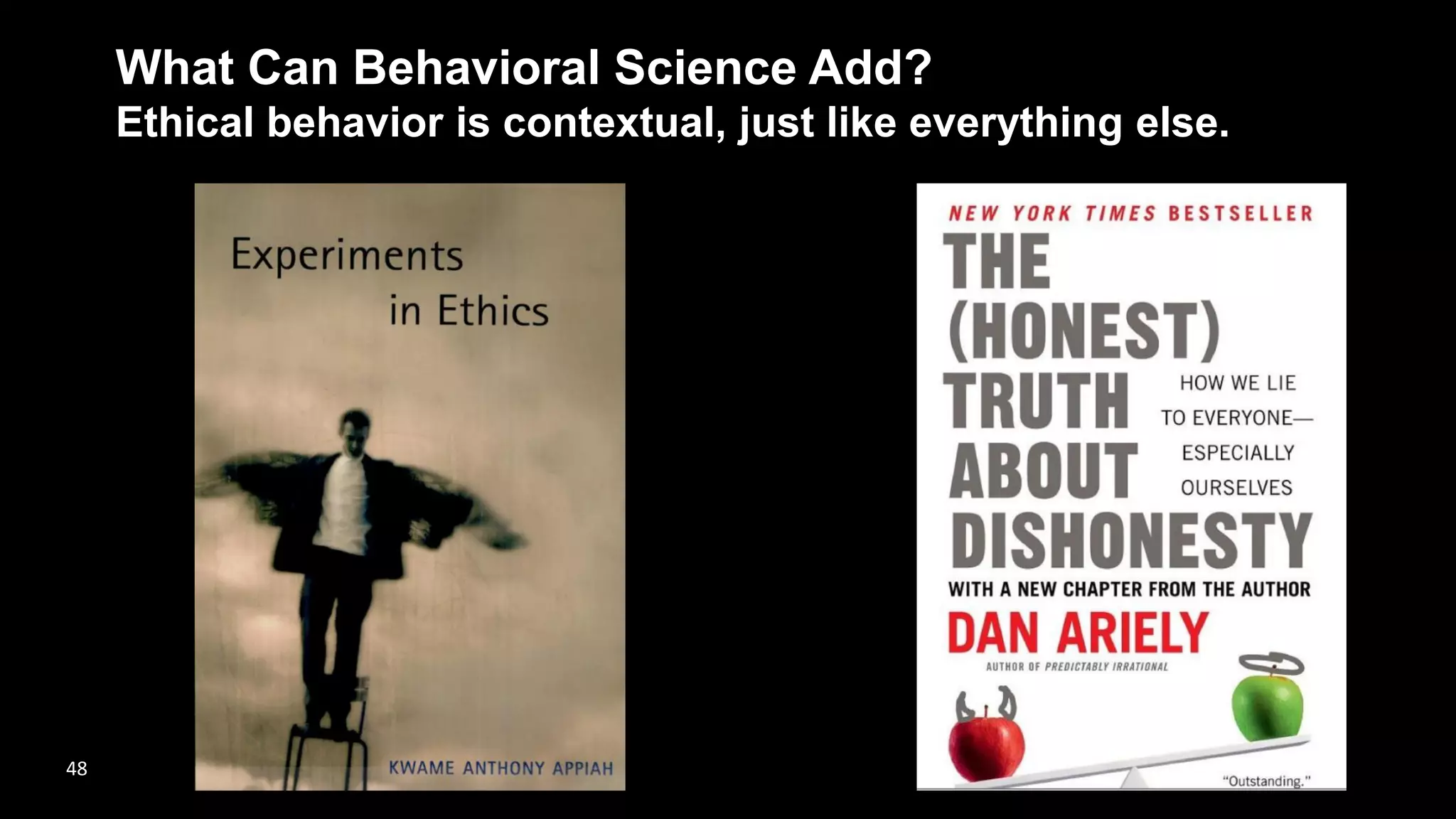
What Can Behavioral Science Add?
Ethical behavior is contextual, just like everything else.
48
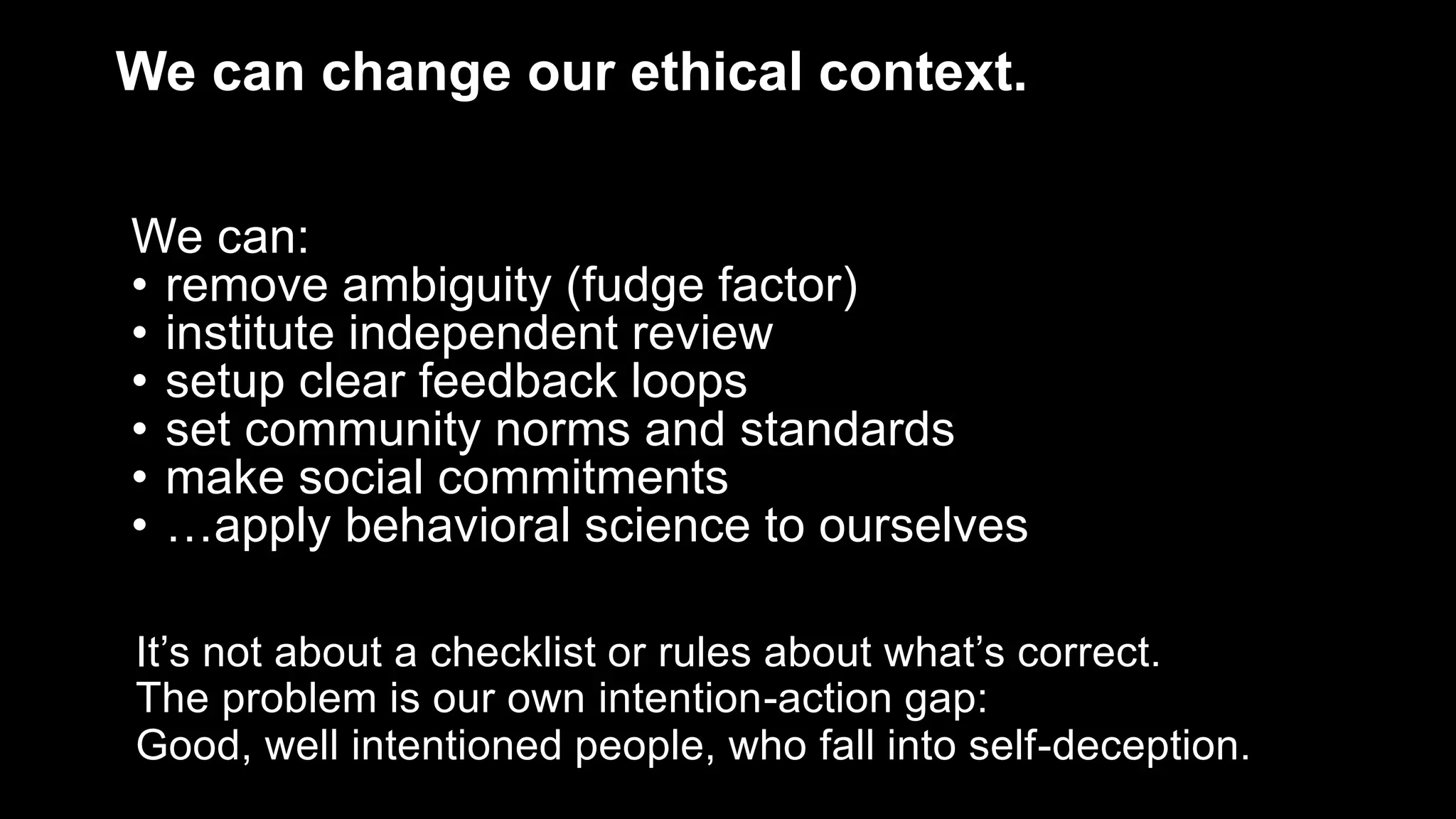
We can change our ethical context.
We can:
• remove ambiguity (fudge factor)
• institute independent review
• setup clear feedback loops
• set community norms and standards
• make social commitments
• …apply behavioral science to ourselves
It’s not about a checklist or rules about what’s correct.
The problem is our own intention-action gap:
Good, well intentioned people, who fall into self-deception.
1. BeSci Complements Design
2. DECIDE: A Blueprint
3. How Do We Stay Ethical?
4. Q&A
What’s Next
50
People often face a gap, between their
intentions and their actions
Behavioral teams around the world
Results from the Behavioral Teams Survey: www.behavioralteams.com
United States 41.3%
United Kingdom 14.6%
Netherlands 5.7%
Australia 4.6%
Canada 3.4%
India 3.4%
France 2.1%
… …
Armenia 0.2%
Macedonia 0.2%
Cambodia 0.2%
Monaco 0.2%
Define the
Problem
Explore the
Context
Craft the
Intervention
Implement
the Solution
Determine
the Impact
Evaluate
Next Steps
DECIDE: A Blueprint for Applied Behavioral Science
53
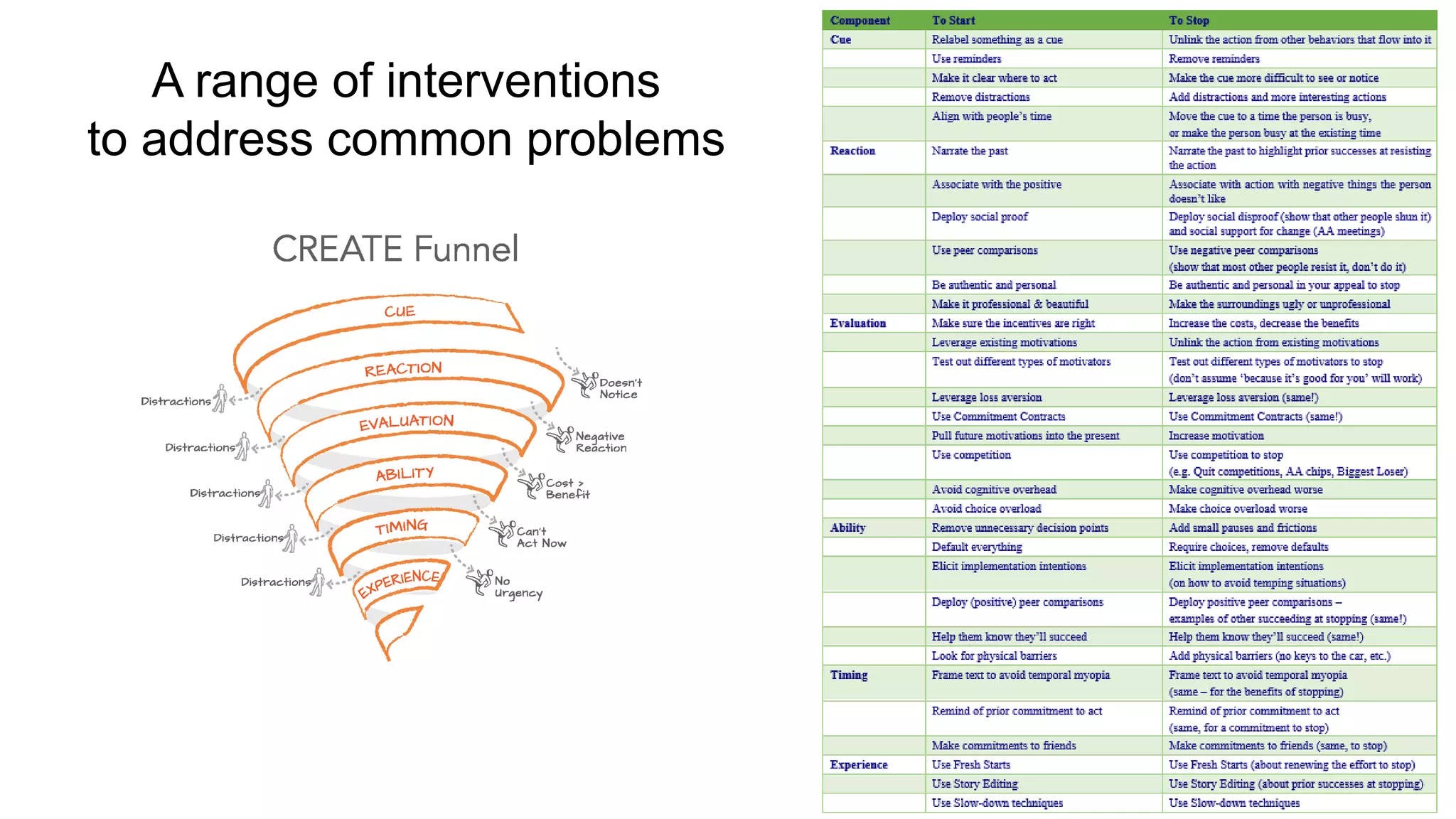
A range of interventions
to address common problems
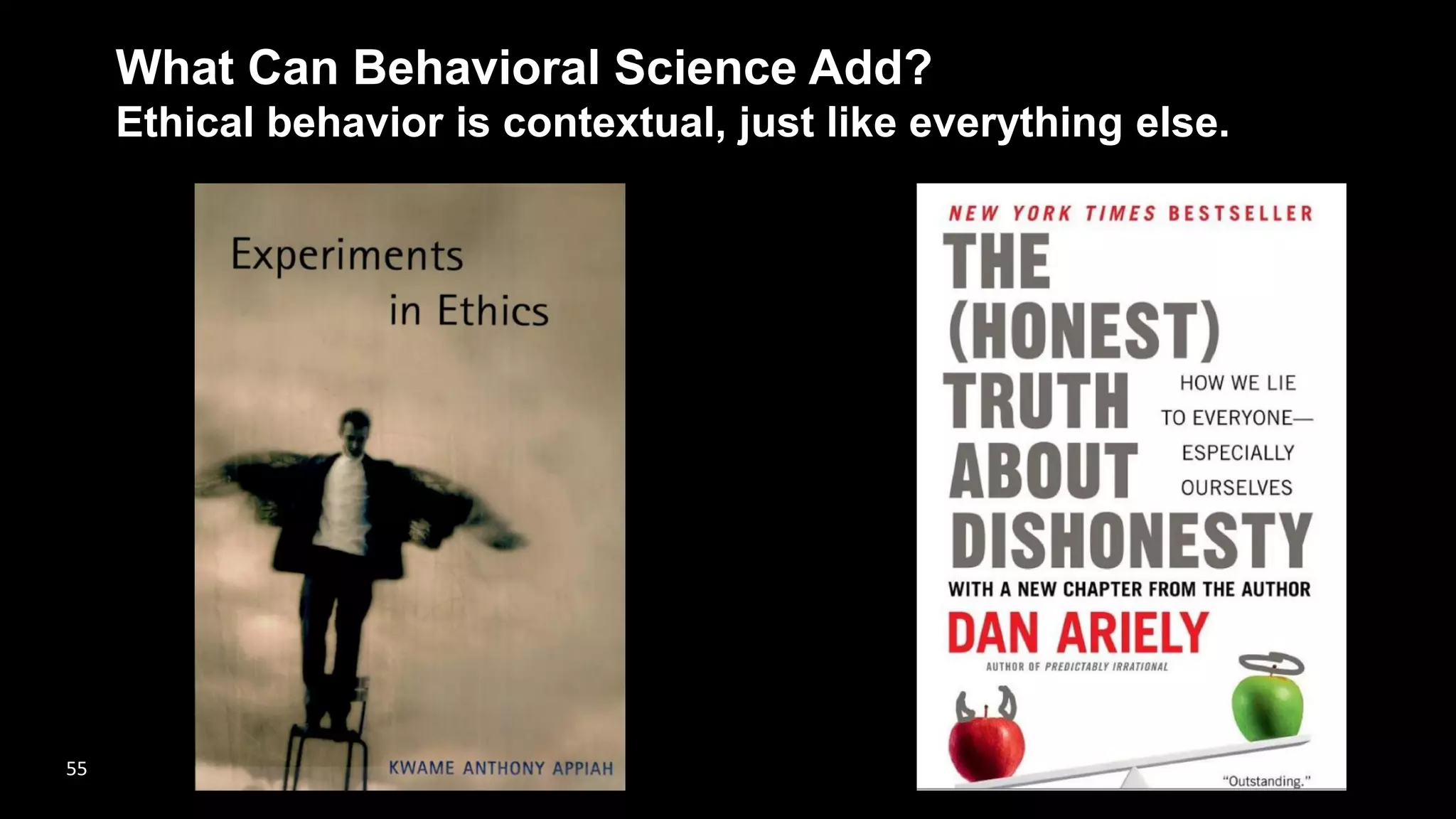
What Can Behavioral Science Add?
Ethical behavior is contextual, just like everything else.
55
56
www.behavioraltechnology.co

A Blueprint for Behavioral Design

  • 1.
    ©2020 Morningstar, Inc.All rights reserved. A Blueprint for Behavioral Design Steve Wendel Head of Behavioral Science at Morningstar Author of Designing for Behavior Change @sawendel
  • 2.
  • 3.
  • 4.
    1. BeSci ComplementsDesign 2. DECIDE: A Blueprint 3. How Do We Stay Ethical? 4. Q&A Where we’re going 4
  • 5.
  • 6.
  • 7.
    People often facea gap, between their intentions and their actions
  • 8.
    Our users facethat gap with our products as well 8
  • 9.
    An understanding ofhow people decide & act What is behavioral science? Tools to potentially help people do better Rigorous testing to find results 9
  • 10.
    Behavioral teams aroundthe world Results from the Behavioral Teams Survey: www.behavioralteams.com United States 41.3% United Kingdom 14.6% Netherlands 5.7% Australia 4.6% Canada 3.4% India 3.4% France 2.1% … … Armenia 0.2% Macedonia 0.2% Cambodia 0.2% Monaco 0.2%
  • 11.
  • 12.
  • 13.
  • 14.
  • 16.
    1. BeSci ComplementsDesign 2. DECIDE: A Blueprint 3. How do we stay ethical? 4. Q&A What’s Next 16
  • 17.
  • 18.
  • 19.
    Define the Problem Explore the Context Craftthe Intervention Implement the Solution Determine the Impact Evaluate Next Steps DECIDE: A Blueprint for Applied Behavioral Science 19
  • 20.
    A Behavioral Brief Hypothesesfor behavior change A behavioral plan of micro-behaviors A framework to diagnose obstacles (CREATE) A set of experimentally field tested interventions to start or stop a behavior Ethical guidelines and techniques to remove self-deception Randomized Control Trials to rigorously measure impact Decision-making tools to avoid the obvious Define the Problem Explore the Context Craft the Intervention Implement the Solution Determine the Impact Evaluate Next Steps Behavioral science informs the tools we use along the way 20
  • 21.
  • 23.
    Define the Problem Explore the Context Craftthe Intervention Implement the Solution Determine the Impact Evaluate Next Steps First up: Define the Problem DECIDE: A Blueprint for applied behavioral science 23
  • 24.
    Define the BehavioralProblem By helping sedentary white-collar workers to start going to the gym, we will cause them to have less joint pain (<50% incidences of PT & doctors visits). By helping [actor] [start / stop] doing [describe action], we will cause [outcome]. 24
  • 25.
    Define the Problem Explore the Context Craftthe Intervention Implement the Solution Determine the Impact Evaluate Next Steps Next Up: Explore the Context DECIDE: A Blueprint for applied behavioral science 25
  • 26.
    A Behavioral plan Doqual & quant research to map out the status quo & the micro-behaviors from there to action. And see if your users can take action at each step. 26
  • 27.
    What happens between sittingat home and going to the gym? 27
  • 28.
    The diagnosis Where alongthe plan, and why, wouldn’t people take action? 28
  • 29.
    What’s required forsomeone to take action? 29
  • 30.
    Define the Problem Explore the Context Craftthe Intervention Implement the Solution Determine the Impact Evaluate Next Steps Next Up: Craft the Intervention DECIDE: A Blueprint for applied behavioral science 30
  • 31.
  • 32.
    Cue What would cueyour users to think about taking action, in a specific moment? 32
  • 33.
    When should youcommunicate with people? 10:30am Saturday 5:00pm Saturday 10:30am Sunday 5:00pm Sunday 11:00am Thursday 10:30am Thursday 10:30am Friday 8:00am Friday 33
  • 34.
    10:30am Saturday 5:00pmSaturday 10:30am Sunday 5:00pm Sunday 11:00am Thursday 10:30am Thursday 10:30am Friday 8:00am Friday 6.4% clicked 7.2% clicked4.7% clicked 5.7% clicked 4.1% clicked 5% clicked4.5% clicked 5.9% clicked When they have time and attention to spare. 34
  • 35.
    Reaction What emotional reactiondo they have, in that moment? 35
  • 36.
    Make It NormalWith Peer Comparisons or Social Proof See Allcott (2011); Wendel and Balz (2015) 36
  • 37.
    Evaluation What’s their evaluationof the costs and benefits? Does it seem worthwhile to do? 37
  • 39.
    Original System 1: “Yeah,this is something I can safely ignore” 39
  • 40.
    New Version Change theform to encourage people to make a deliverable choice Allow them to select the materials that they value, giving them control 40
  • 41.
    Ability Do they thinkthey’ll succeed? Timing Is it urgent right now? Experience Have they had negative experiences in the past?41
  • 42.
    Define the Problem Explore the Context Craftthe Intervention Implement the Solution Determine the Impact Evaluate Next Steps And now you’re ready to build... DECIDE: A Blueprint for applied behavioral science 42
  • 43.
    1. BeSci ComplementsDesign 2. DECIDE: A Blueprint 3. How Do We Stay Ethical? 4. Q&A What’s Next 43
  • 44.
    And we’ve earnedit. See: darkpatterns.org By Harry Brignull 44
  • 45.
    A reckoning iscoming. According to the Norwegian watchdog, Google “tricks” people into sharing their location with the company, in ways that mean it does not really have their informed consent. The Consumer Council highlighted techniques including “hidden default settings,” “misleading information” about how collected data is used, repeated “nudging” to turn on the Location History feature, and users being forced to turn on location tracking if they want to use the Google Assistant.
  • 47.
    We’re not thefirst to face these issues Based on Milton Glaser essay for designers: The Road to Hell
  • 48.
    What Can BehavioralScience Add? Ethical behavior is contextual, just like everything else. 48
  • 49.
    We can changeour ethical context. We can: • remove ambiguity (fudge factor) • institute independent review • setup clear feedback loops • set community norms and standards • make social commitments • …apply behavioral science to ourselves It’s not about a checklist or rules about what’s correct. The problem is our own intention-action gap: Good, well intentioned people, who fall into self-deception.
  • 50.
    1. BeSci ComplementsDesign 2. DECIDE: A Blueprint 3. How Do We Stay Ethical? 4. Q&A What’s Next 50
  • 51.
    People often facea gap, between their intentions and their actions
  • 52.
    Behavioral teams aroundthe world Results from the Behavioral Teams Survey: www.behavioralteams.com United States 41.3% United Kingdom 14.6% Netherlands 5.7% Australia 4.6% Canada 3.4% India 3.4% France 2.1% … … Armenia 0.2% Macedonia 0.2% Cambodia 0.2% Monaco 0.2%
  • 53.
    Define the Problem Explore the Context Craftthe Intervention Implement the Solution Determine the Impact Evaluate Next Steps DECIDE: A Blueprint for Applied Behavioral Science 53
  • 54.
    A range ofinterventions to address common problems
  • 55.
    What Can BehavioralScience Add? Ethical behavior is contextual, just like everything else. 55
  • 56.