Behavioral Design
User Guide
VERSION 3.1
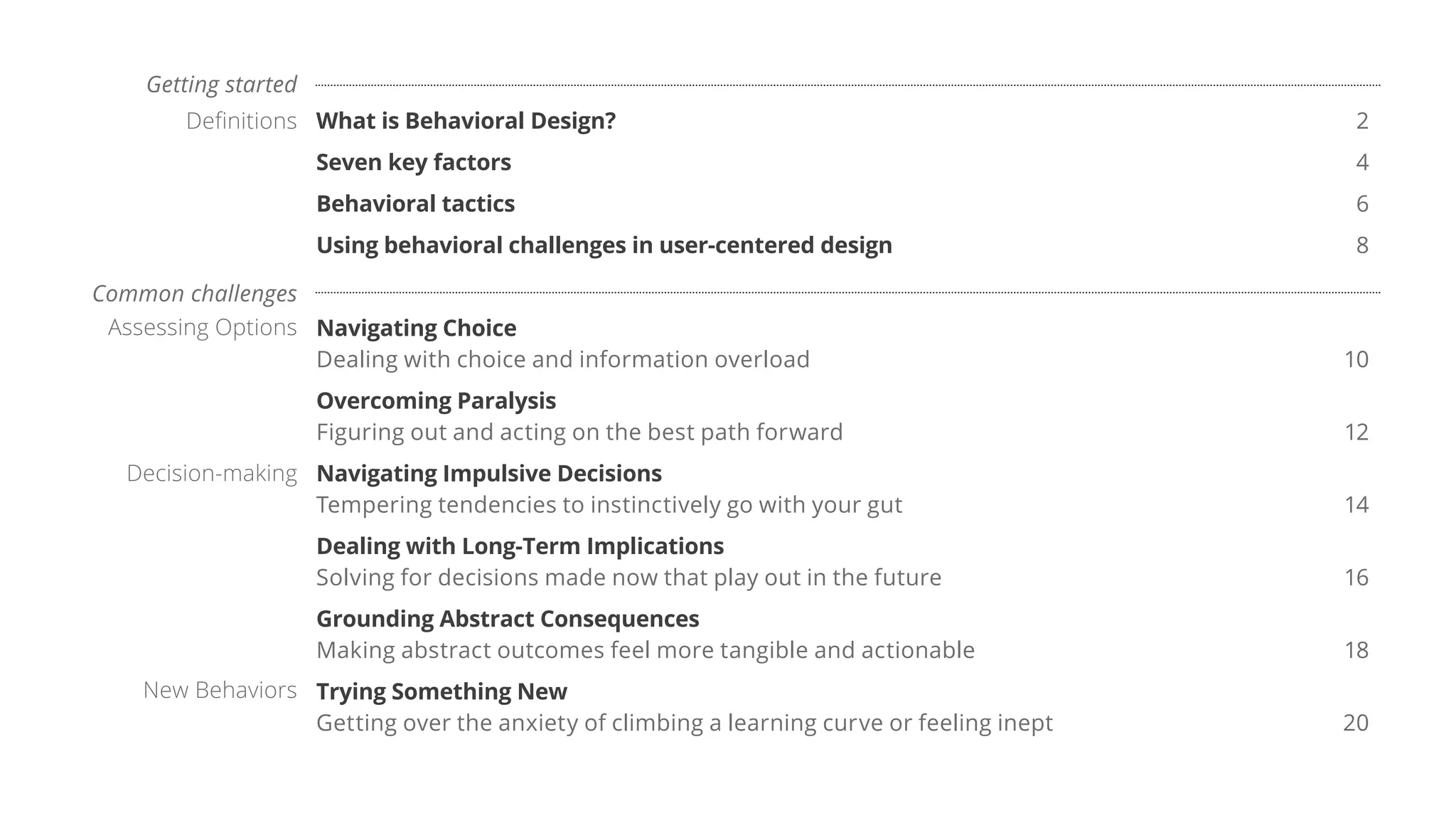
What is Behavioral Design? 2
Seven key factors 4
Behavioral tactics 6
Using behavioral challenges in user-centered design 8
Navigating Choice
Dealing with choice and information overload 10
Overcoming Paralysis
Figuring out and acting on the best path forward 12
Navigating Impulsive Decisions
Tempering tendencies to instinctively go with your gut 14
Dealing with Long-Term Implications
Solving for decisions made now that play out in the future 16
Grounding Abstract Consequences
Making abstract outcomes feel more tangible and actionable 18
Trying Something New
Getting over the anxiety of climbing a learning curve or feeling inept 20
Assessing Options
Decision-making
New Behaviors
Common challenges
Definitions
Getting started
Overcoming Distrust
Reducing skepticism that prevents or limits engagement 22
Conquering Inertia
Taking that first step when “I know I should, but I just don’t feel like it” 24
Sticking with It
Persevering in the face of obstacles or when initial interest fades 26
Closing the Loop
Getting to closure by crossing that thing off the to-do list for good 28
Developing & Breaking Habits
Starting good habits and breaking bad ones 30
Instilling Self-Control
Resisting your own worst temptations and tendencies 32
Making Habits Persist:
Creating a level of stickiness to help habits endure over time 34
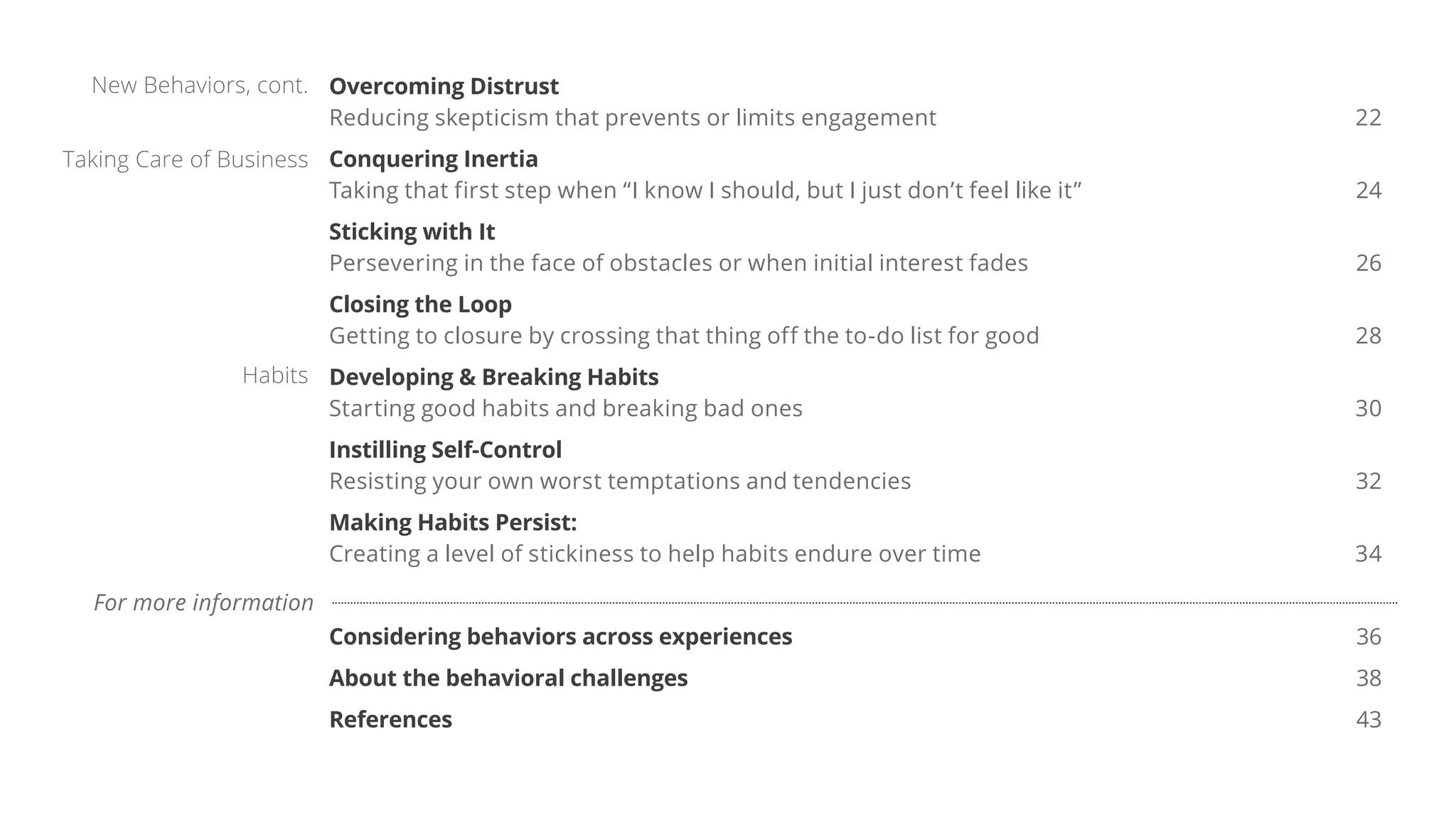
Considering behaviors across experiences 36
About the behavioral challenges 38
References 43
Taking Care of Business
New Behaviors, cont.
Habits
For more information
2
Behavioral design combines key principles
of behavioral economics with user insights
and business context to help de-risk
innovation and increase user adoption.
3
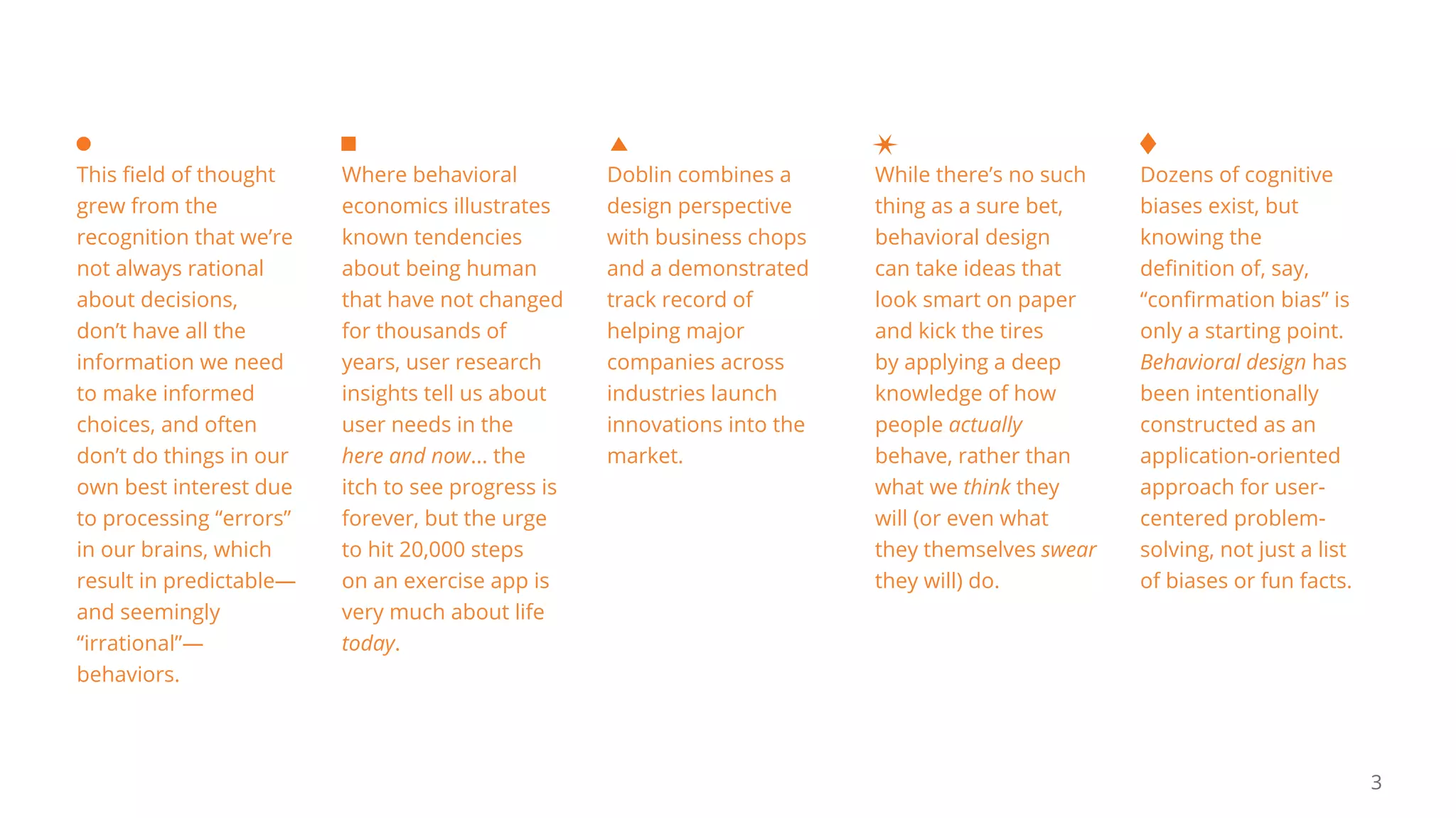
While there’s no such
thing as a sure bet,
behavioral design
can take ideas that
look smart on paper
and kick the tires
by applying a deep
knowledge of how
people actually
behave, rather than
what we think they
will (or even what
they themselves swear
they will) do.
This field of thought
grew from the
recognition that we’re
not always rational
about decisions,
don’t have all the
information we need
to make informed
choices, and often
don’t do things in our
own best interest due
to processing “errors”
in our brains, which
result in predictable—
and seemingly
“irrational”—
behaviors.
Doblin combines a
design perspective
with business chops
and a demonstrated
track record of
helping major
companies across
industries launch
innovations into the
market.
Where behavioral
economics illustrates
known tendencies
about being human
that have not changed
for thousands of
years, user research
insights tell us about
user needs in the
here and now... the
itch to see progress is
forever, but the urge
to hit 20,000 steps
on an exercise app is
very much about life
today.
Dozens of cognitive
biases exist, but
knowing the
definition of, say,
“confirmation bias” is
only a starting point.
Behavioral design has
been intentionally
constructed as an
application-oriented
approach for user-
centered problem-
solving, not just a list
of biases or fun facts.
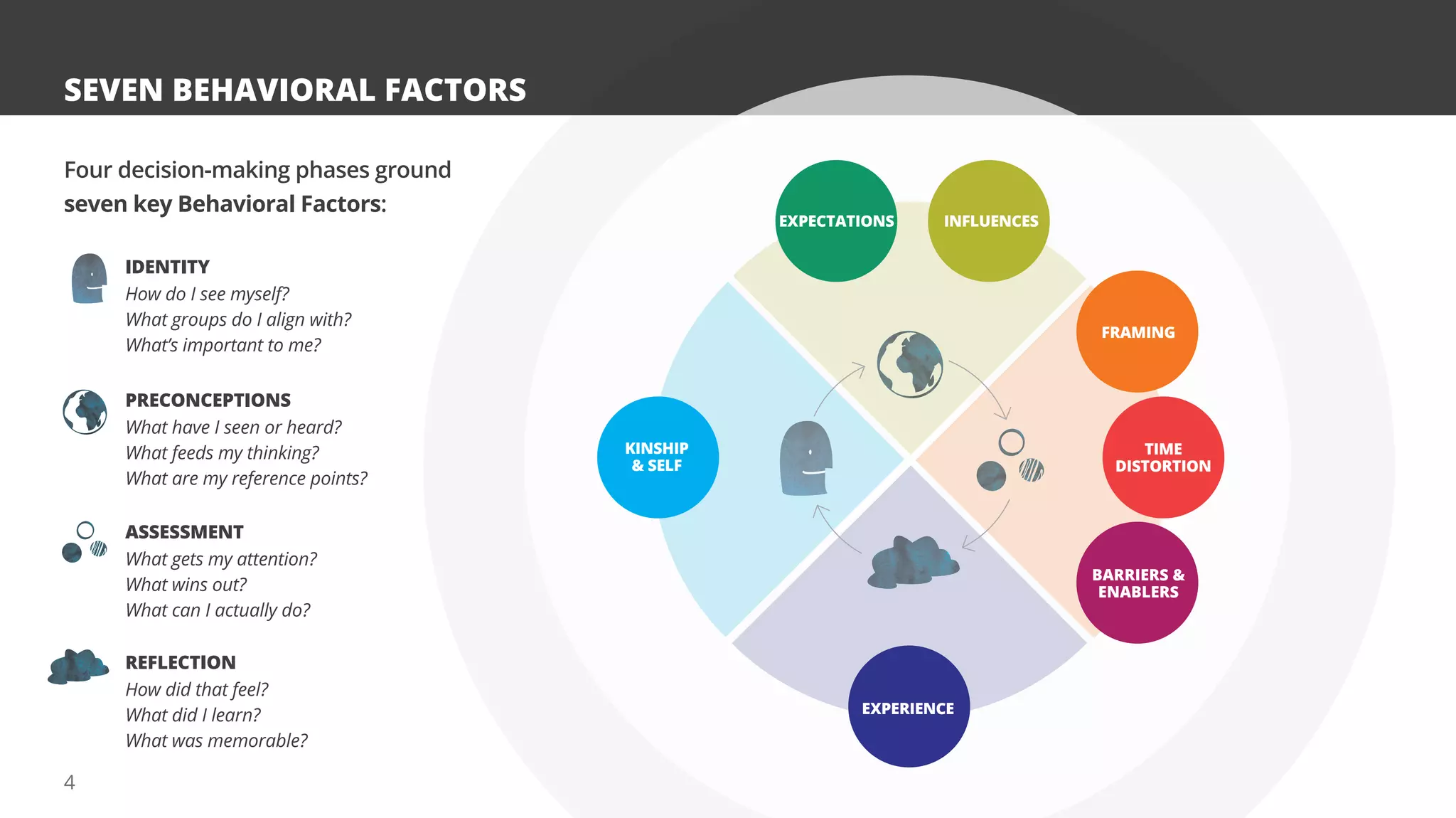
KINSHIP
& SELF
TIME
DISTORTION
INFLUENCES
EXPECTATIONS
EXPERIENCE
FRAMING
BARRIERS &
ENABLERS
4
SEVEN BEHAVIORAL FACTORS
Four decision-making phases ground
seven key Behavioral Factors:
IDENTITY
How do I see myself?
What groups do I align with?
What’s important to me?
PRECONCEPTIONS
What have I seen or heard?
What feeds my thinking?
What are my reference points?
REFLECTION
How did that feel?
What did I learn?
What was memorable?
ASSESSMENT
What gets my attention?
What wins out?
What can I actually do?
5
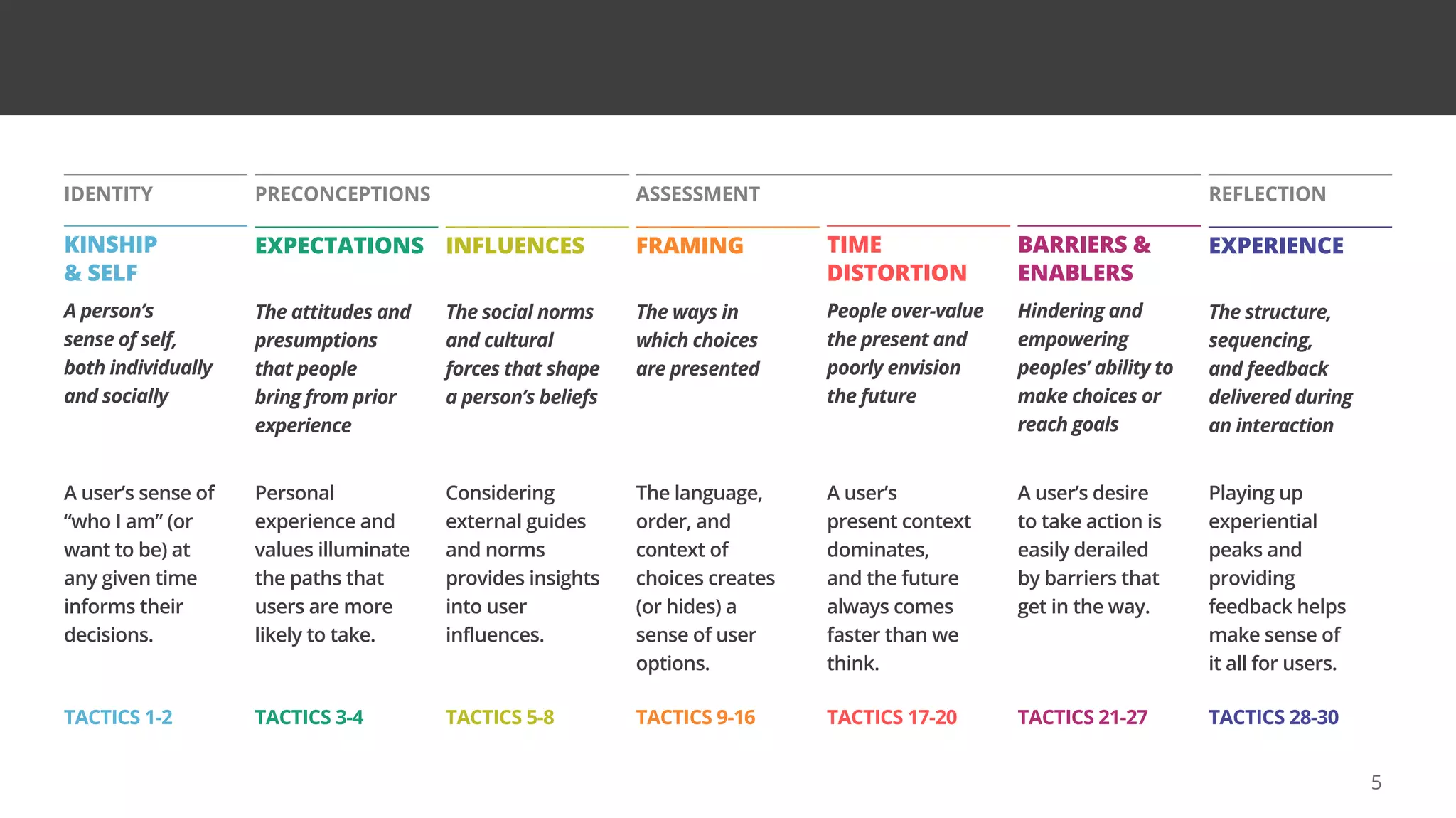
PRECONCEPTIONS ASSESSMENT
IDENTITY REFLECTION
FRAMING
The ways in
which choices
are presented
The language,
order, and
context of
choices creates
(or hides) a
sense of user
options.
TACTICS 9-16
TIME
DISTORTION
People over-value
the present and
poorly envision
the future
A user’s
present context
dominates,
and the future
always comes
faster than we
think.
TACTICS 17-20
KINSHIP
& SELF
A person’s
sense of self,
both individually
and socially
A user’s sense of
“who I am” (or
want to be) at
any given time
informs their
decisions.
TACTICS 1-2
BARRIERS &
ENABLERS
Hindering and
empowering
peoples’ ability to
make choices or
reach goals
A user’s desire
to take action is
easily derailed
by barriers that
get in the way.
TACTICS 21-27
EXPECTATIONS
The attitudes and
presumptions
that people
bring from prior
experience
Personal
experience and
values illuminate
the paths that
users are more
likely to take.
TACTICS 3-4
EXPERIENCE
The structure,
sequencing,
and feedback
delivered during
an interaction
Playing up
experiential
peaks and
providing
feedback helps
make sense of
it all for users.
TACTICS 28-30
INFLUENCES
The social norms
and cultural
forces that shape
a person’s beliefs
Considering
external guides
and norms
provides insights
into user
influences.
TACTICS 5-8
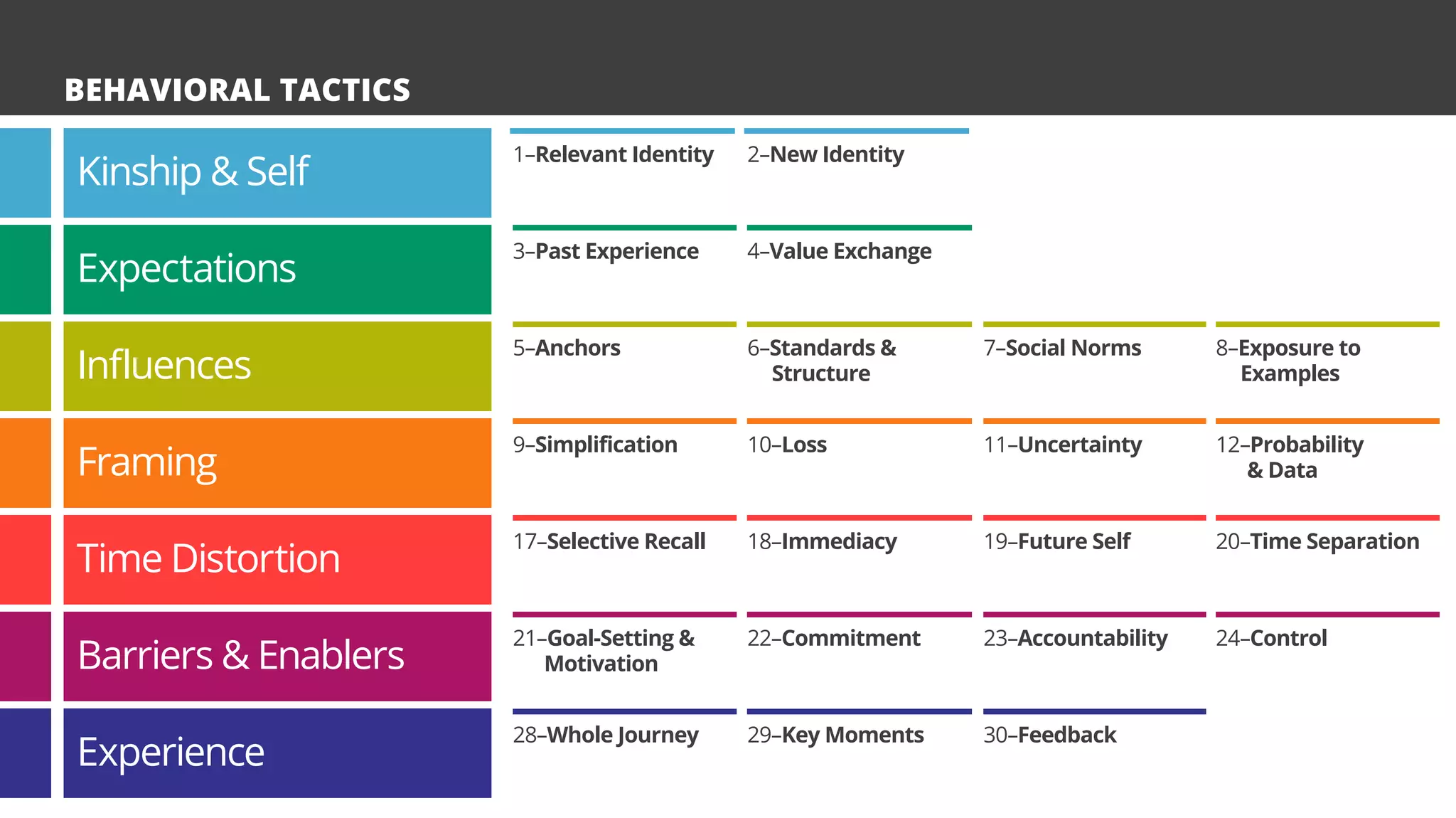
BEHAVIORAL TACTICS
Experience
Kinship & Self
Expectations
Influences
Framing
Time Distortion
Barriers & Enablers
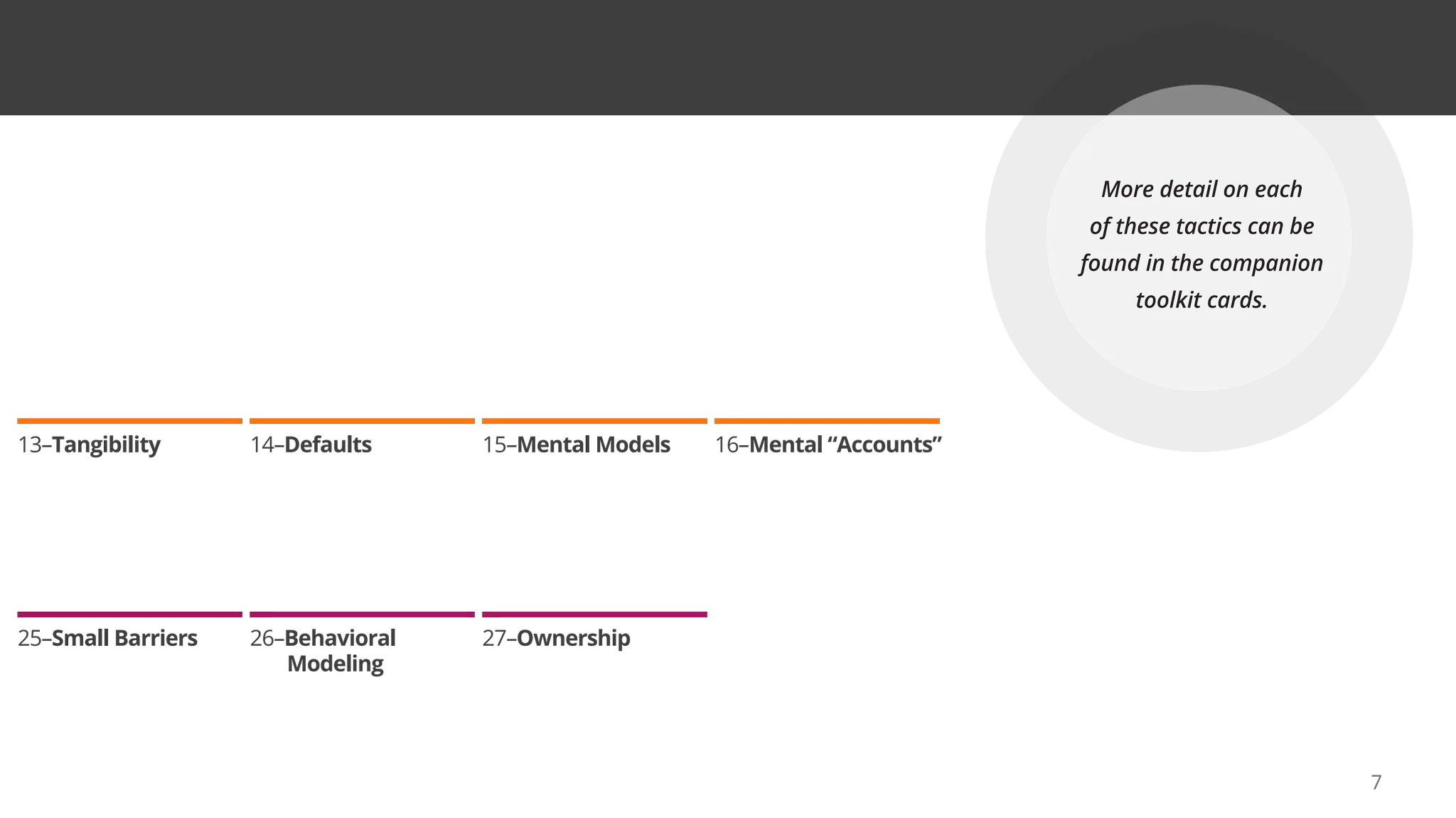
5–Anchors
21–Goal-Setting &
Motivation
28–Whole Journey
3–Past Experience
1–Relevant Identity
9–Simplification
6–Standards &
Structure
22–Commitment
29–Key Moments
4–Value Exchange
2–New Identity
10–Loss
17–Selective Recall 18–Immediacy
7–Social Norms 8–Exposure to
Examples
23–Accountability 24–Control
30–Feedback
11–Uncertainty 12–Probability
& Data
19–Future Self 20–Time Separation
25–Small Barriers 27–Ownership
26–Behavioral
Modeling
13–Tangibility 15–Mental Models
14–Defaults 16–Mental “Accounts”
7
More detail on each
of these tactics can be
found in the companion
toolkit cards.
8
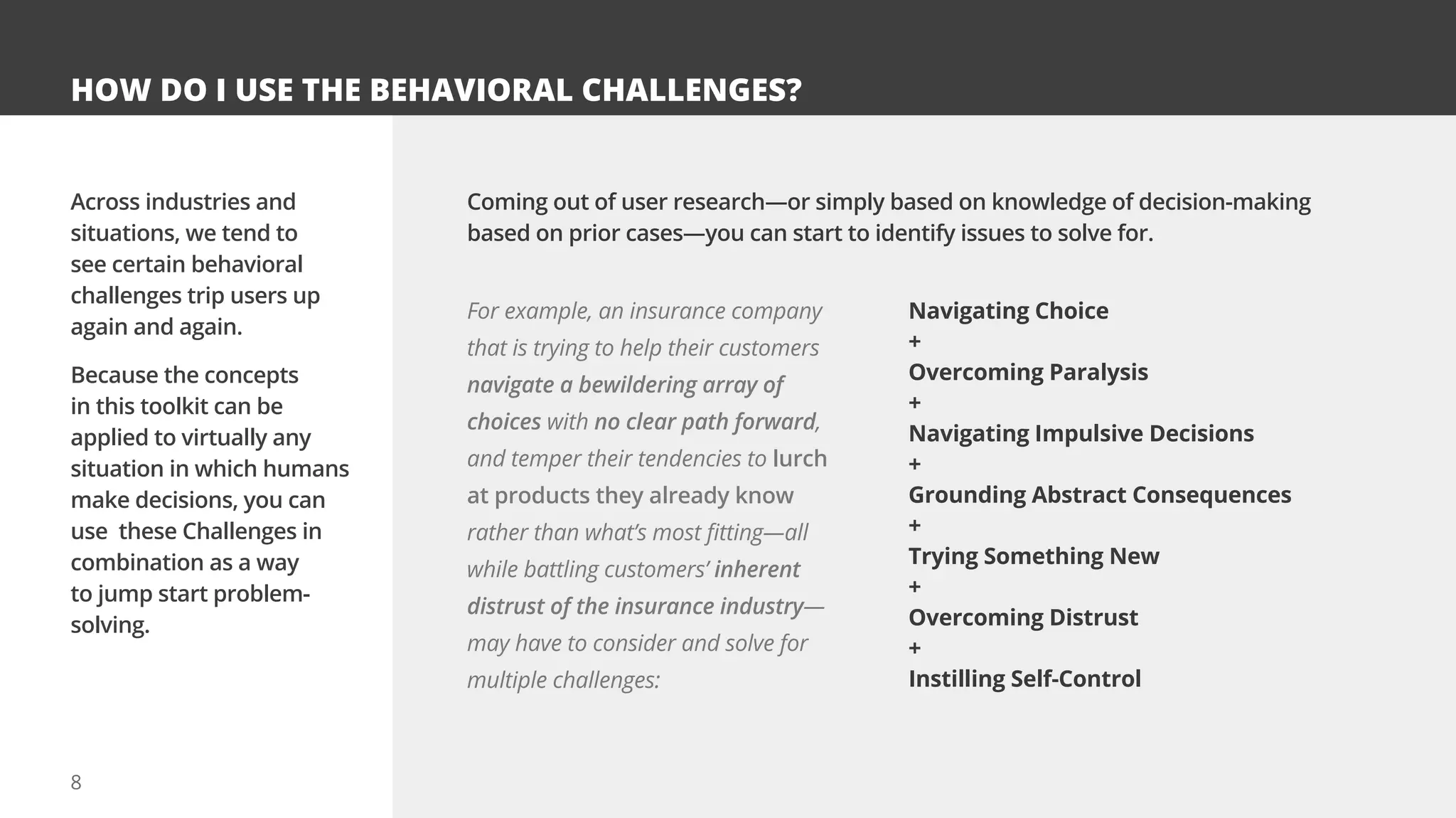
HOW DO I USE THE BEHAVIORAL CHALLENGES?
Across industries and
situations, we tend to
see certain behavioral
challenges trip users up
again and again.
Because the concepts
in this toolkit can be
applied to virtually any
situation in which humans
make decisions, you can
use these Challenges in
combination as a way
to jump start problem-
solving.
Coming out of user research—or simply based on knowledge of decision-making
based on prior cases—you can start to identify issues to solve for.
For example, an insurance company
that is trying to help their customers
navigate a bewildering array of
choices with no clear path forward,
and temper their tendencies to lurch
at products they already know
rather than what’s most fitting—all
while battling customers’ inherent
distrust of the insurance industry—
may have to consider and solve for
multiple challenges:
Navigating Choice
+
Overcoming Paralysis
+
Navigating Impulsive Decisions
+
Grounding Abstract Consequences
+
Trying Something New
+
Overcoming Distrust
+
Instilling Self-Control
9
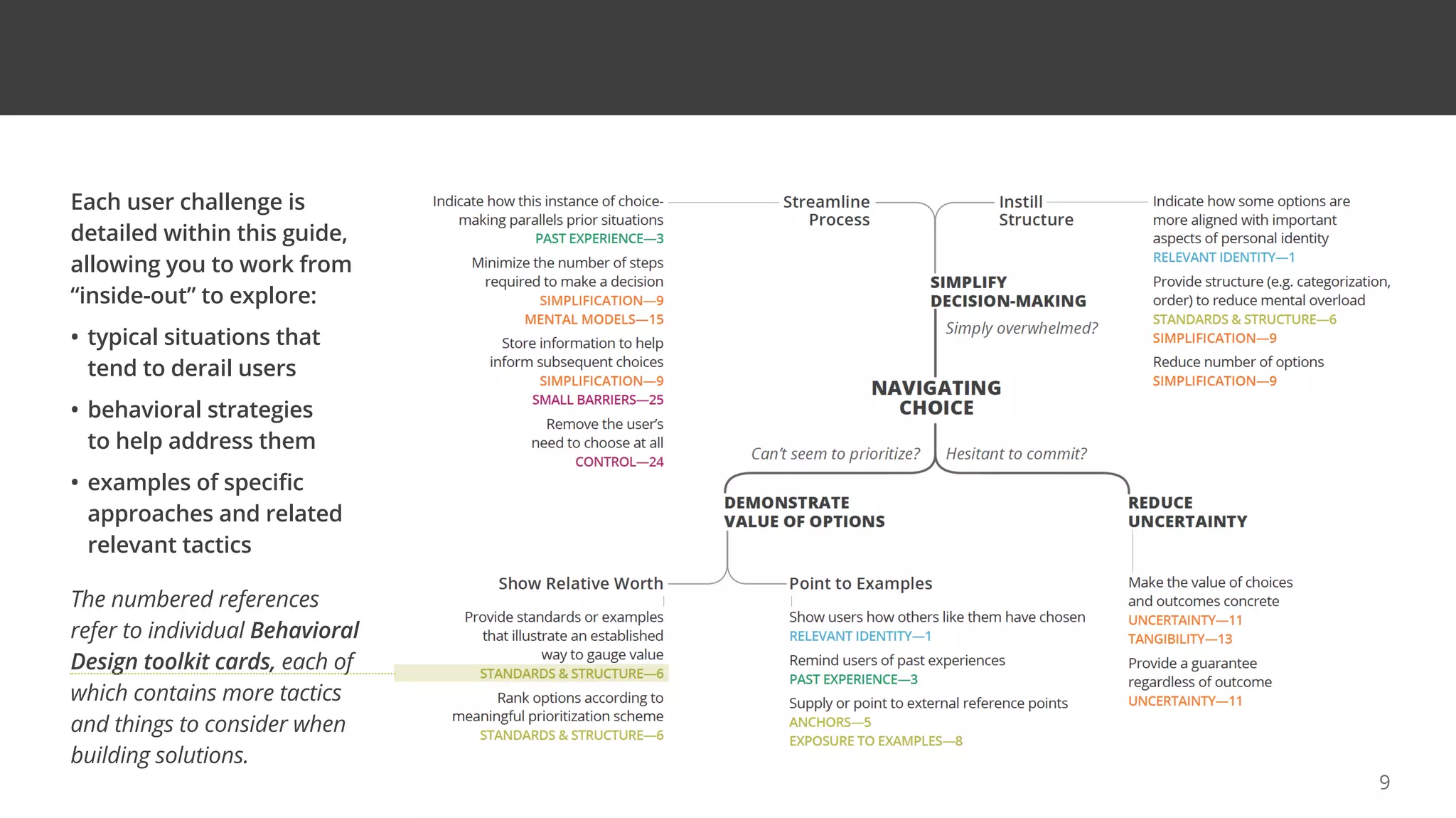
Each user challenge is
detailed within this guide,
allowing you to work from
“inside-out” to explore:
• typical situations that
tend to derail users
• behavioral strategies
to help address them
• examples of specific
approaches and related
relevant tactics
The numbered references
refer to individual Behavioral
Design toolkit cards, each of
which contains more tactics
and things to consider when
building solutions.
10
Navigating
Choice
ASSESSING
OPTIONS
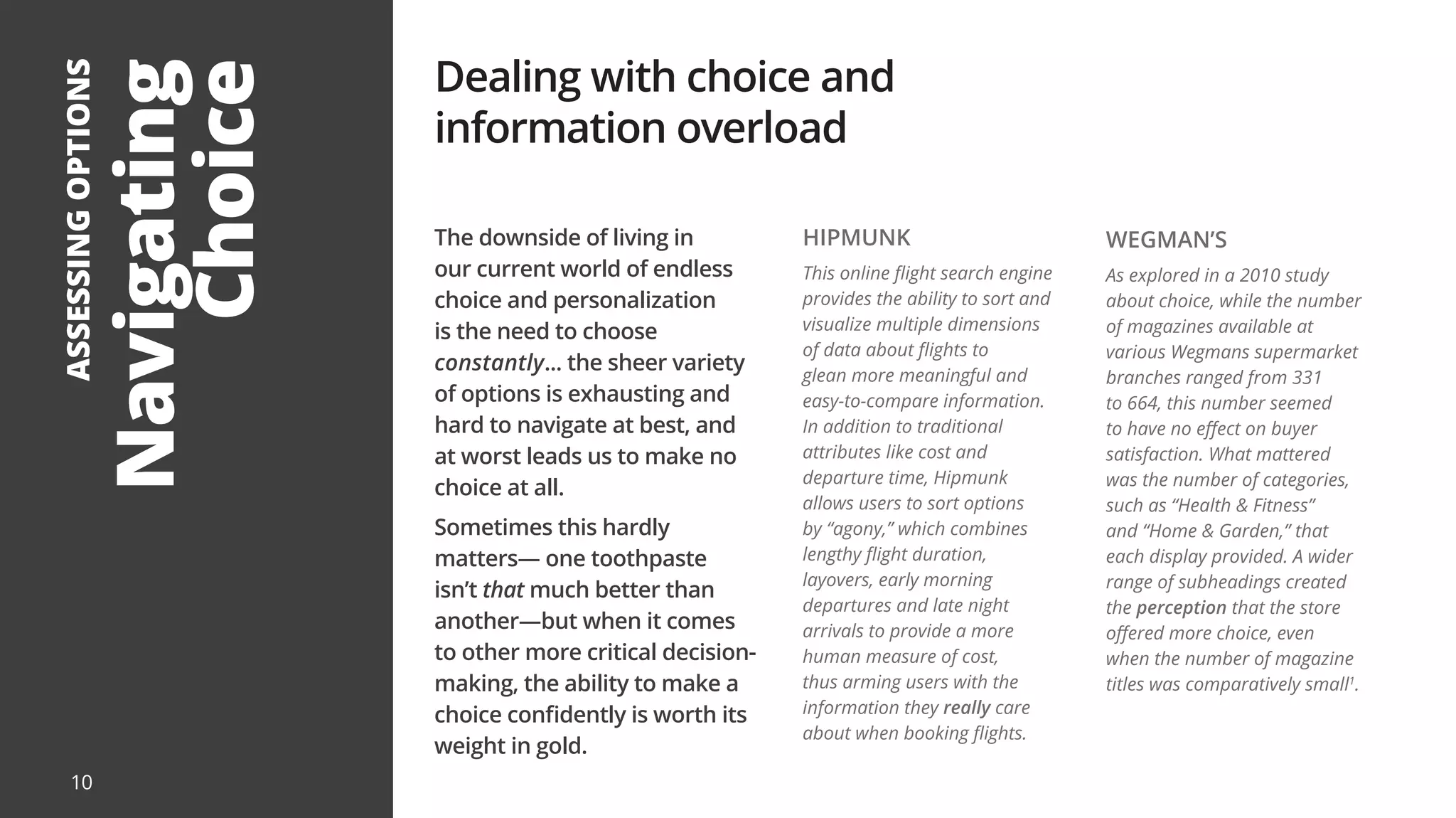
The downside of living in
our current world of endless
choice and personalization
is the need to choose
constantly... the sheer variety
of options is exhausting and
hard to navigate at best, and
at worst leads us to make no
choice at all.
Sometimes this hardly
matters— one toothpaste
isn’t that much better than
another—but when it comes
to other more critical decision-
making, the ability to make a
choice confidently is worth its
weight in gold.
Dealing with choice and
information overload
HIPMUNK
This online flight search engine
provides the ability to sort and
visualize multiple dimensions
of data about flights to
glean more meaningful and
easy-to-compare information.
In addition to traditional
attributes like cost and
departure time, Hipmunk
allows users to sort options
by “agony,” which combines
lengthy flight duration,
layovers, early morning
departures and late night
arrivals to provide a more
human measure of cost,
thus arming users with the
information they really care
about when booking flights.
WEGMAN’S
As explored in a 2010 study
about choice, while the number
of magazines available at
various Wegmans supermarket
branches ranged from 331
to 664, this number seemed
to have no effect on buyer
satisfaction. What mattered
was the number of categories,
such as “Health & Fitness”
and “Home & Garden,” that
each display provided. A wider
range of subheadings created
the perception that the store
offered more choice, even
when the number of magazine
titles was comparatively small1
.
11
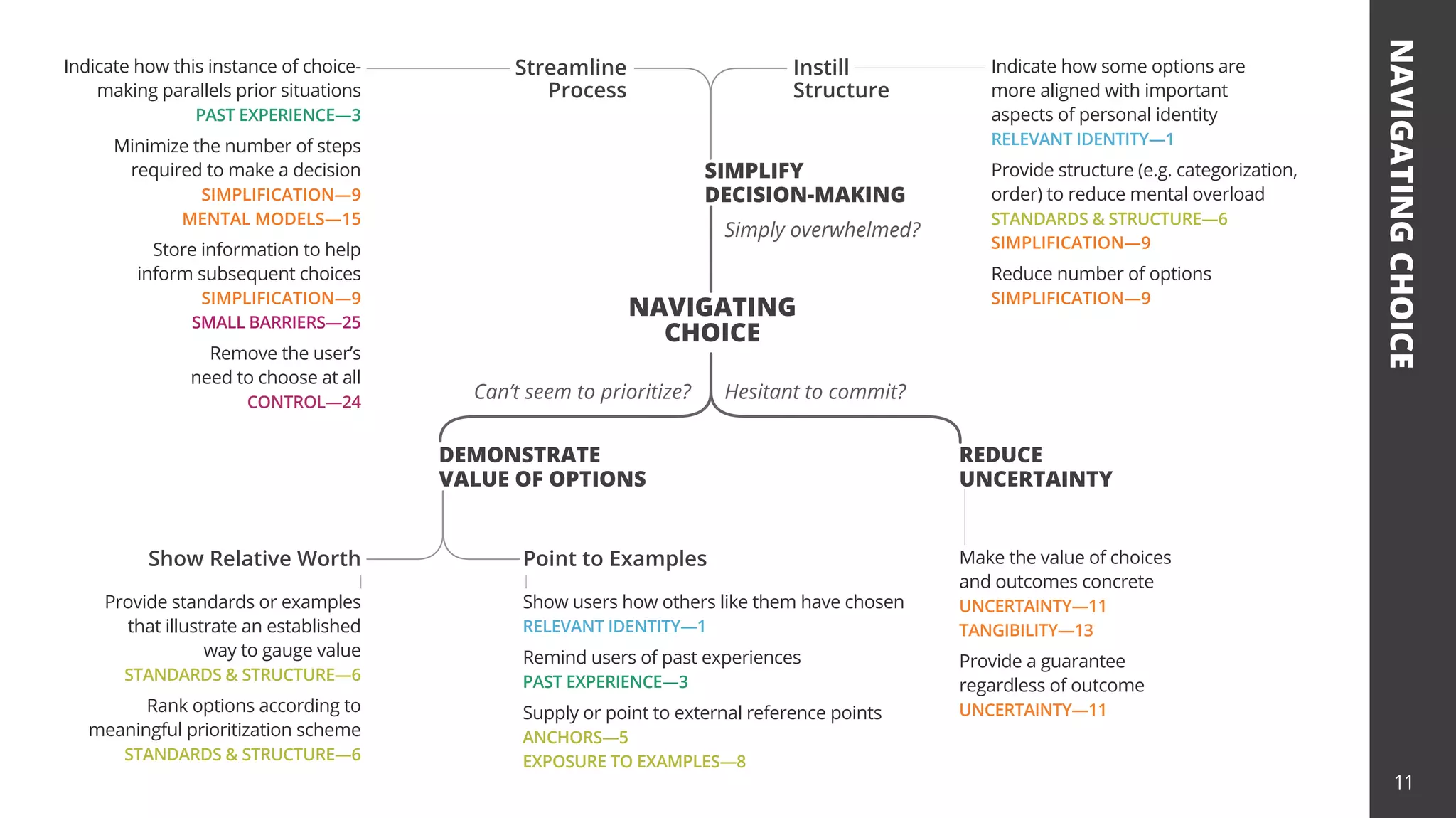
NAVIGATING
CHOICE
NAVIGATING
CHOICE
SIMPLIFY
DECISION-MAKING
Simply overwhelmed?
Can’t seem to prioritize? Hesitant to commit?
Streamline
Process
DEMONSTRATE
VALUE OF OPTIONS
REDUCE
UNCERTAINTY
Indicate how this instance of choice-
making parallels prior situations
PAST EXPERIENCE—3
Minimize the number of steps
required to make a decision
SIMPLIFICATION—9
MENTAL MODELS—15
Store information to help
inform subsequent choices
SIMPLIFICATION—9
SMALL BARRIERS—25
Remove the user’s
need to choose at all
CONTROL—24
Provide standards or examples
that illustrate an established
way to gauge value
STANDARDS & STRUCTURE—6
Rank options according to
meaningful prioritization scheme
STANDARDS & STRUCTURE—6
Instill
Structure
Indicate how some options are
more aligned with important
aspects of personal identity
RELEVANT IDENTITY—1
Provide structure (e.g. categorization,
order) to reduce mental overload
STANDARDS & STRUCTURE—6
SIMPLIFICATION—9
Reduce number of options
SIMPLIFICATION—9
Show users how others like them have chosen
RELEVANT IDENTITY—1
Remind users of past experiences
PAST EXPERIENCE—3
Supply or point to external reference points
ANCHORS—5
EXPOSURE TO EXAMPLES—8
Make the value of choices
and outcomes concrete
UNCERTAINTY—11
TANGIBILITY—13
Provide a guarantee
regardless of outcome
UNCERTAINTY—11
Point to Examples
Show Relative Worth
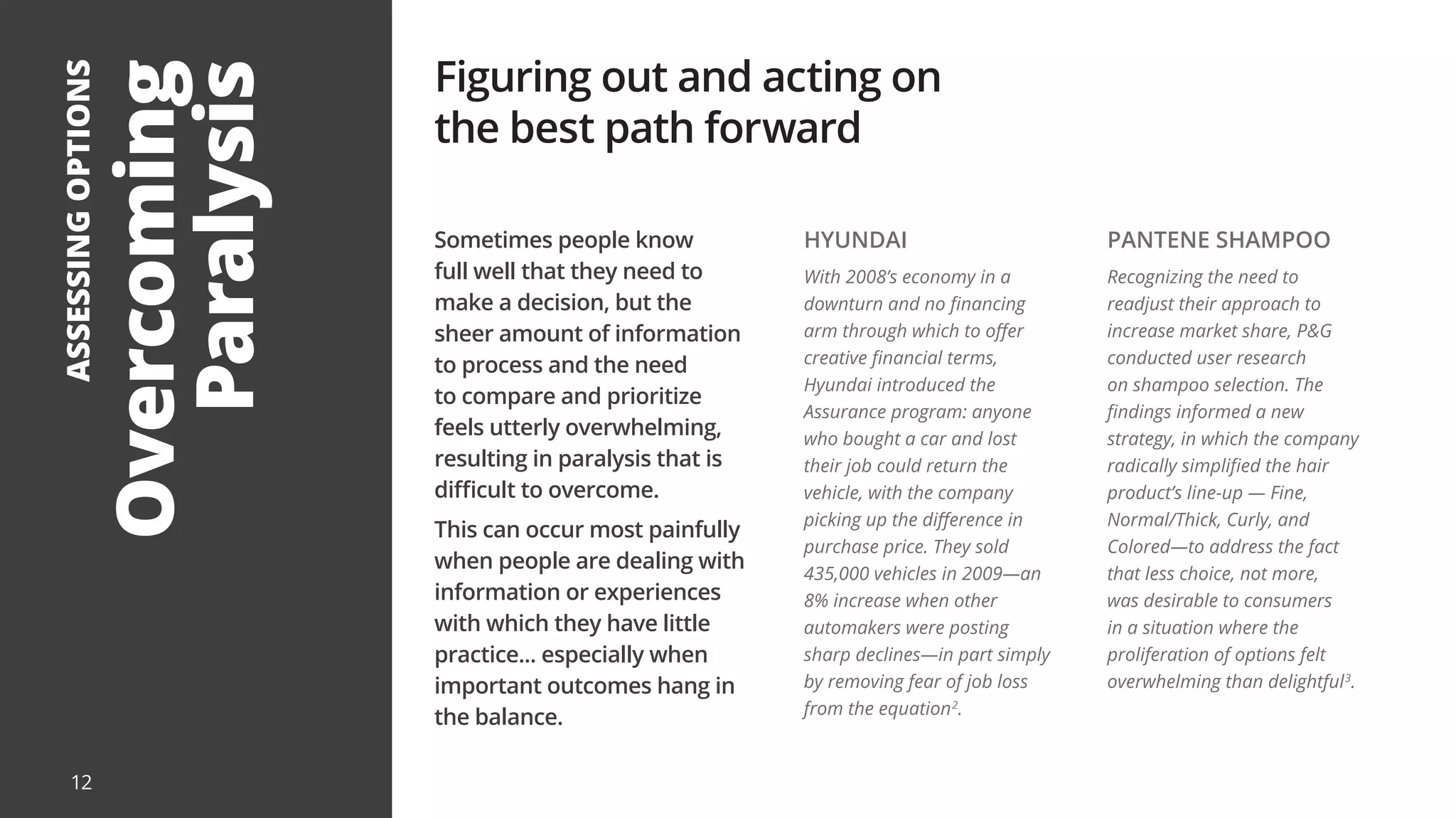
Sometimes people know
full well that they need to
make a decision, but the
sheer amount of information
to process and the need
to compare and prioritize
feels utterly overwhelming,
resulting in paralysis that is
difficult to overcome.
This can occur most painfully
when people are dealing with
information or experiences
with which they have little
practice... especially when
important outcomes hang in
the balance.
12
Overcoming
Paralysis
ASSESSING
OPTIONS Figuring out and acting on
the best path forward
HYUNDAI
With 2008’s economy in a
downturn and no financing
arm through which to offer
creative financial terms,
Hyundai introduced the
Assurance program: anyone
who bought a car and lost
their job could return the
vehicle, with the company
picking up the difference in
purchase price. They sold
435,000 vehicles in 2009—an
8% increase when other
automakers were posting
sharp declines—in part simply
by removing fear of job loss
from the equation2
.
PANTENE SHAMPOO
Recognizing the need to
readjust their approach to
increase market share, P&G
conducted user research
on shampoo selection. The
findings informed a new
strategy, in which the company
radically simplified the hair
product’s line-up — Fine,
Normal/Thick, Curly, and
Colored—to address the fact
that less choice, not more,
was desirable to consumers
in a situation where the
proliferation of options felt
overwhelming than delightful3
.
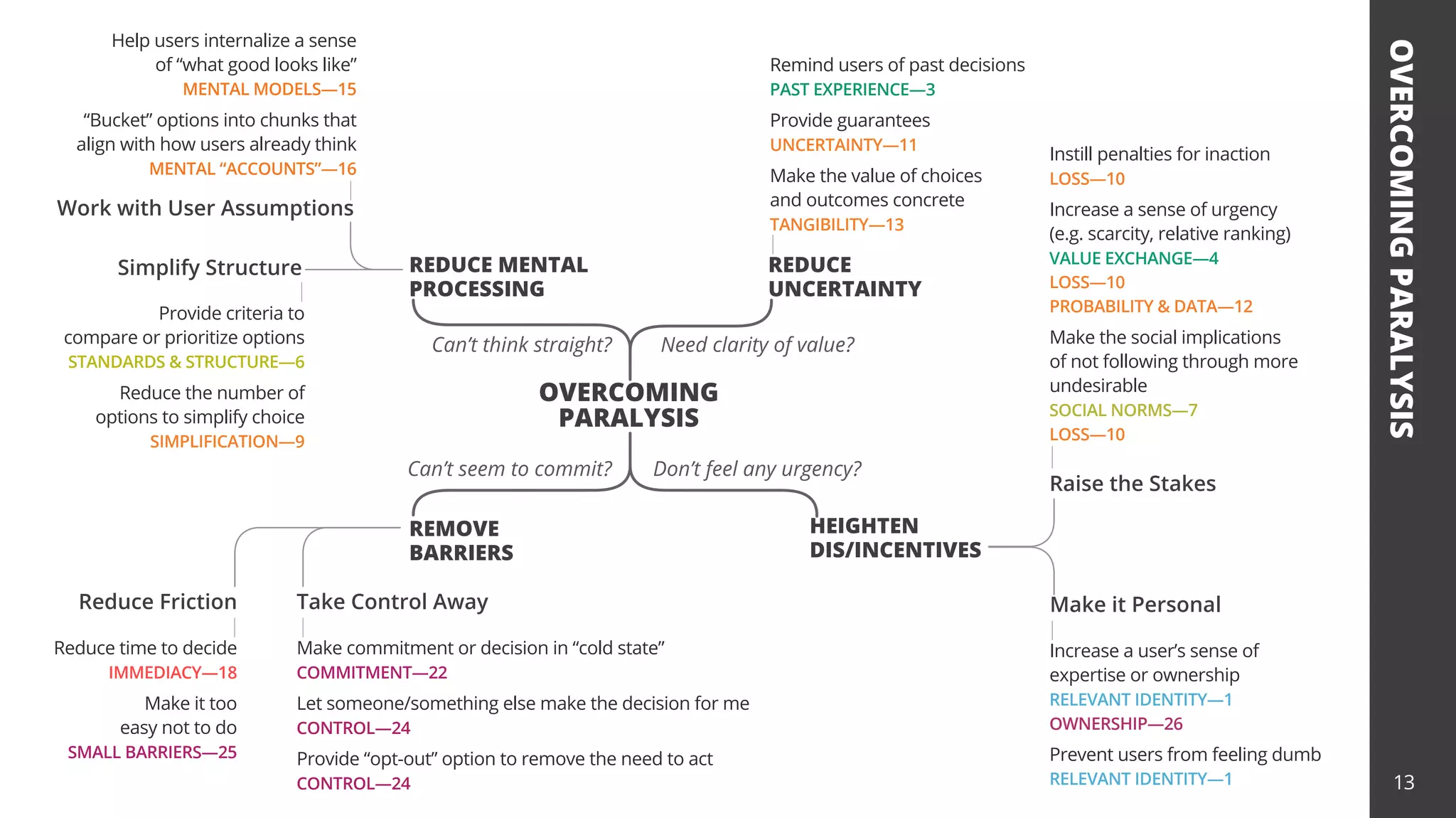
OVERCOMING
PARALYSIS
OVERCOMING
PARALYSIS
Reduce time to decide
IMMEDIACY—18
Make it too
easy not to do
SMALL BARRIERS—25
Increase a user’s sense of
expertise or ownership
RELEVANT IDENTITY—1
OWNERSHIP—26
Prevent users from feeling dumb
RELEVANT IDENTITY—1
Make commitment or decision in “cold state”
COMMITMENT—22
Let someone/something else make the decision for me
CONTROL—24
Provide “opt-out” option to remove the need to act
CONTROL—24
Remind users of past decisions
PAST EXPERIENCE—3
Provide guarantees
UNCERTAINTY—11
Make the value of choices
and outcomes concrete
TANGIBILITY—13
REMOVE
BARRIERS
HEIGHTEN
DIS/INCENTIVES
Take Control Away Make it Personal
Simplify Structure
Work with User Assumptions
Reduce Friction
REDUCE
UNCERTAINTY
Help users internalize a sense
of “what good looks like”
MENTAL MODELS—15
“Bucket” options into chunks that
align with how users already think
MENTAL “ACCOUNTS”—16
Provide criteria to
compare or prioritize options
STANDARDS & STRUCTURE—6
Reduce the number of
options to simplify choice
SIMPLIFICATION—9
REDUCE MENTAL
PROCESSING
Instill penalties for inaction
LOSS—10
Increase a sense of urgency
(e.g. scarcity, relative ranking)
VALUE EXCHANGE—4
LOSS—10
PROBABILITY & DATA—12
Make the social implications
of not following through more
undesirable
SOCIAL NORMS—7
LOSS—10
Raise the Stakes
Can’t seem to commit? Don’t feel any urgency?
Need clarity of value?
Can’t think straight?
13
Navigating
Impulsive
Decisions
DECISION-MAKING
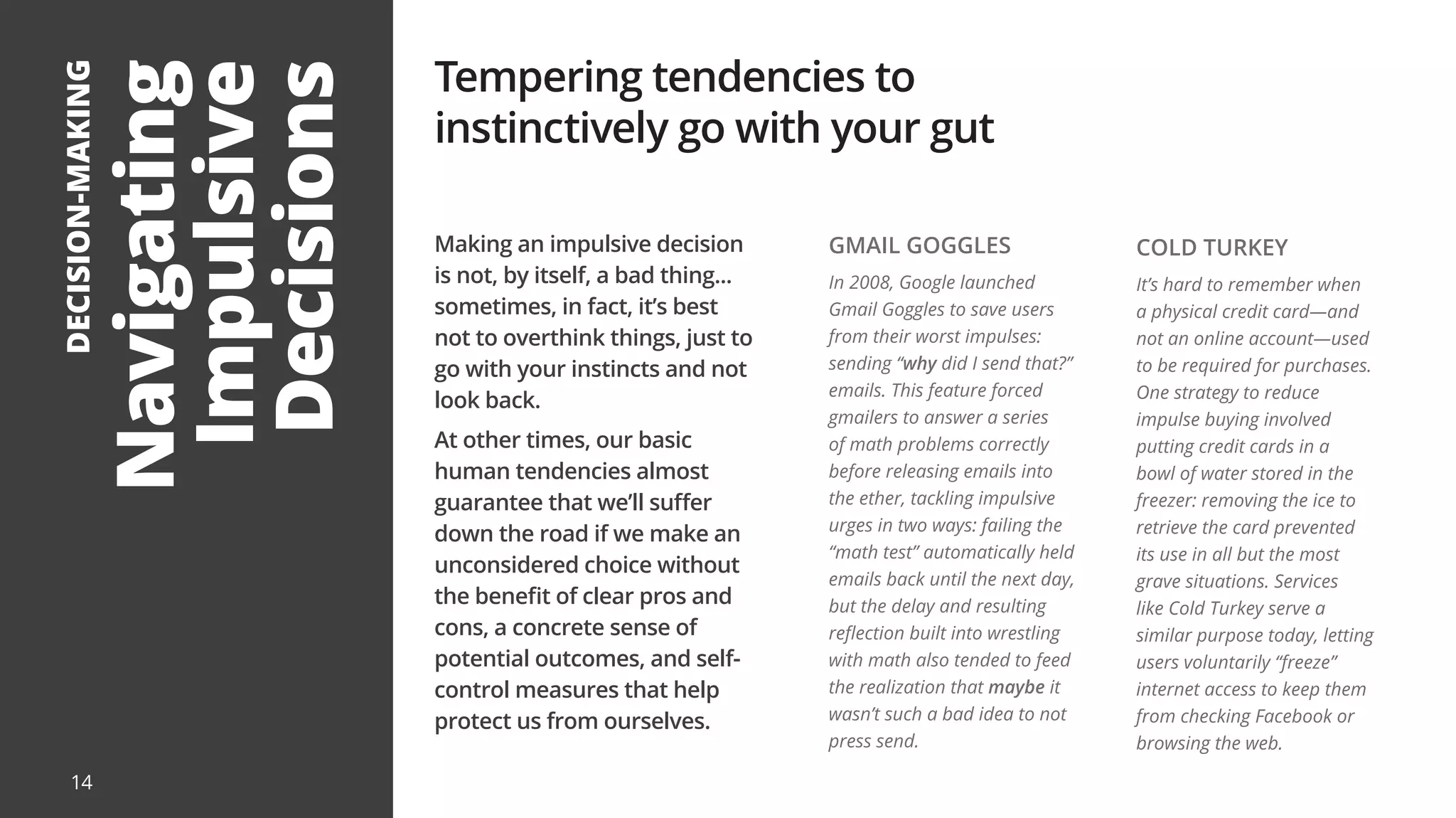
Making an impulsive decision
is not, by itself, a bad thing...
sometimes, in fact, it’s best
not to overthink things, just to
go with your instincts and not
look back.
At other times, our basic
human tendencies almost
guarantee that we’ll suffer
down the road if we make an
unconsidered choice without
the benefit of clear pros and
cons, a concrete sense of
potential outcomes, and self-
control measures that help
protect us from ourselves.
Tempering tendencies to
instinctively go with your gut
GMAIL GOGGLES
In 2008, Google launched
Gmail Goggles to save users
from their worst impulses:
sending “why did I send that?”
emails. This feature forced
gmailers to answer a series
of math problems correctly
before releasing emails into
the ether, tackling impulsive
urges in two ways: failing the
“math test” automatically held
emails back until the next day,
but the delay and resulting
reflection built into wrestling
with math also tended to feed
the realization that maybe it
wasn’t such a bad idea to not
press send.
COLD TURKEY
It’s hard to remember when
a physical credit card—and
not an online account—used
to be required for purchases.
One strategy to reduce
impulse buying involved
putting credit cards in a
bowl of water stored in the
freezer: removing the ice to
retrieve the card prevented
its use in all but the most
grave situations. Services
like Cold Turkey serve a
similar purpose today, letting
users voluntarily “freeze”
internet access to keep them
from checking Facebook or
browsing the web.
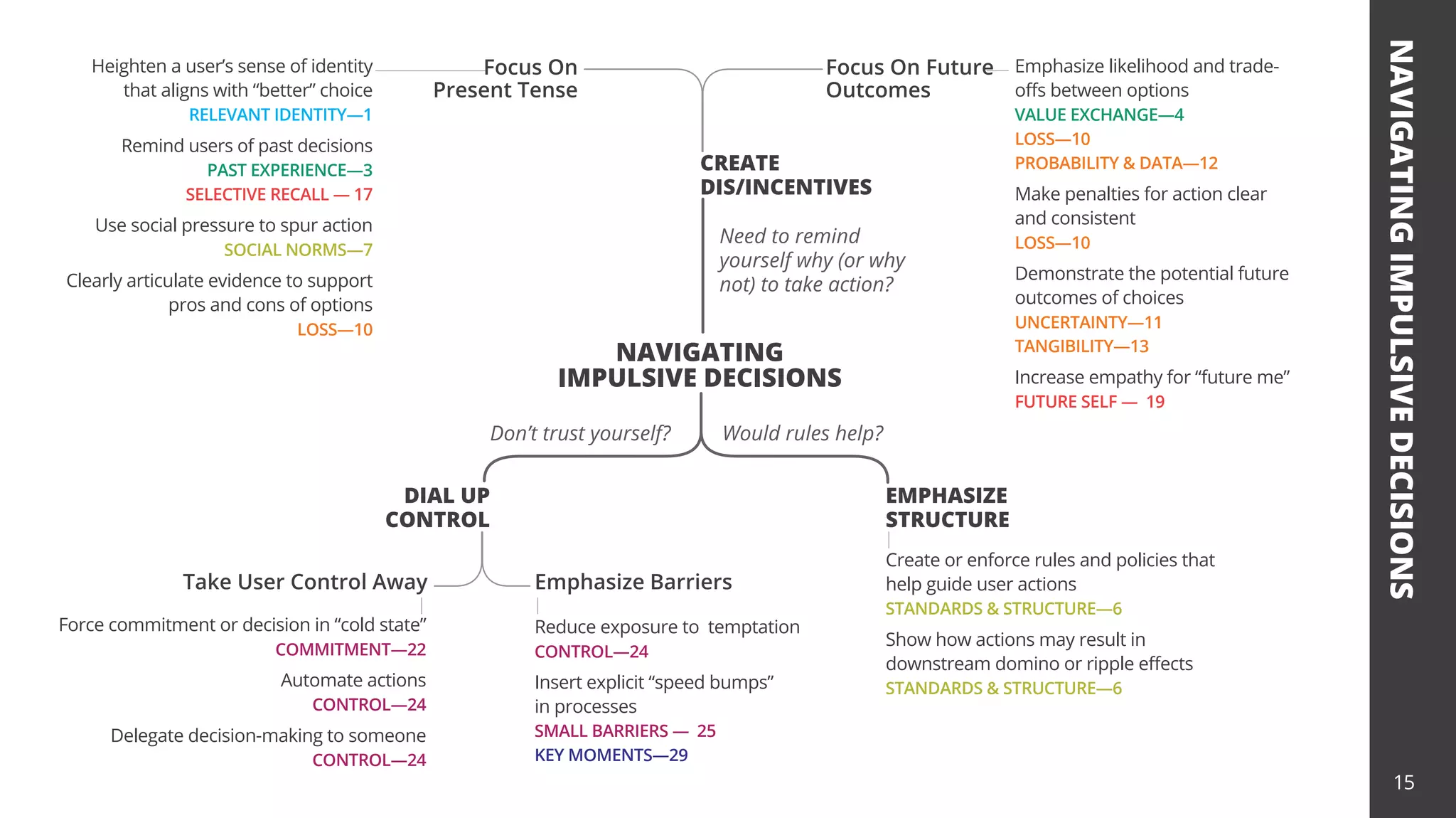
14
NAVIGATING
IMPULSIVE
DECISIONS
Create or enforce rules and policies that
help guide user actions
STANDARDS & STRUCTURE—6
Show how actions may result in
downstream domino or ripple effects
STANDARDS & STRUCTURE—6
Emphasize likelihood and trade-
offs between options
VALUE EXCHANGE—4
LOSS—10
PROBABILITY & DATA—12
Make penalties for action clear
and consistent
LOSS—10
Demonstrate the potential future
outcomes of choices
UNCERTAINTY—11
TANGIBILITY—13
Increase empathy for “future me”
FUTURE SELF — 19
Heighten a user’s sense of identity
that aligns with “better” choice
RELEVANT IDENTITY—1
Remind users of past decisions
PAST EXPERIENCE—3
SELECTIVE RECALL — 17
Use social pressure to spur action
SOCIAL NORMS—7
Clearly articulate evidence to support
pros and cons of options
LOSS—10
Focus On Future
Outcomes
Focus On
Present Tense
Take User Control Away Emphasize Barriers
Force commitment or decision in “cold state”
COMMITMENT—22
Automate actions
CONTROL—24
Delegate decision-making to someone
CONTROL—24
Reduce exposure to temptation
CONTROL—24
Insert explicit “speed bumps”
in processes
SMALL BARRIERS — 25
KEY MOMENTS—29
CREATE
DIS/INCENTIVES
NAVIGATING
IMPULSIVE DECISIONS
DIAL UP
CONTROL
EMPHASIZE
STRUCTURE
Need to remind
yourself why (or why
not) to take action?
Don’t trust yourself? Would rules help?
15
12
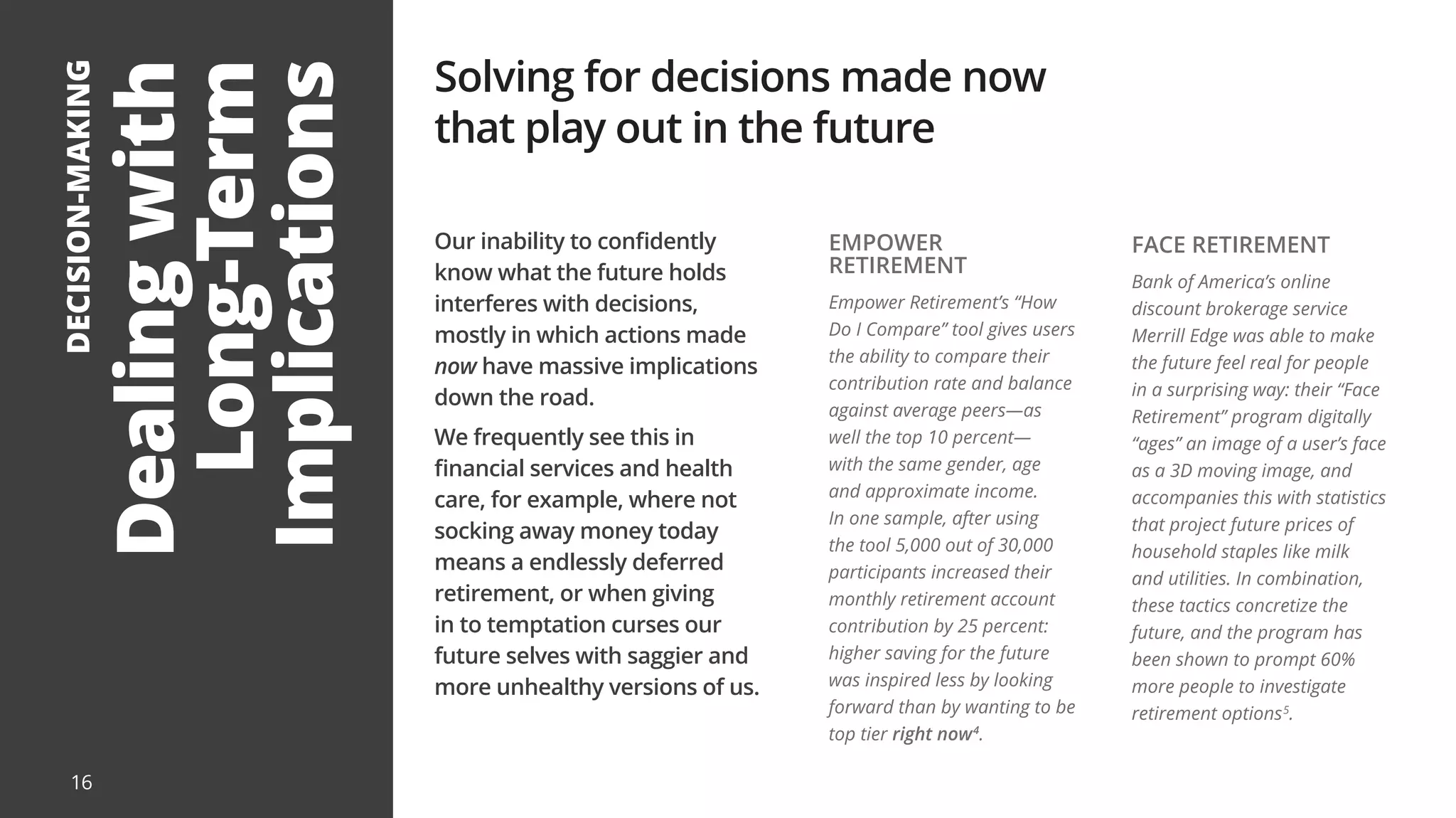
FACE RETIREMENT
Bank of America’s online
discount brokerage service
Merrill Edge was able to make
the future feel real for people
in a surprising way: their “Face
Retirement” program digitally
“ages” an image of a user’s face
as a 3D moving image, and
accompanies this with statistics
that project future prices of
household staples like milk
and utilities. In combination,
these tactics concretize the
future, and the program has
been shown to prompt 60%
more people to investigate
retirement options5
.
Dealing
with
Long-Term
Implications
DECISION-MAKING
Our inability to confidently
know what the future holds
interferes with decisions,
mostly in which actions made
now have massive implications
down the road.
We frequently see this in
financial services and health
care, for example, where not
socking away money today
means a endlessly deferred
retirement, or when giving
in to temptation curses our
future selves with saggier and
more unhealthy versions of us.
Solving for decisions made now
that play out in the future
EMPOWER
RETIREMENT
Empower Retirement’s “How
Do I Compare” tool gives users
the ability to compare their
contribution rate and balance
against average peers—as
well the top 10 percent—
with the same gender, age
and approximate income.
In one sample, after using
the tool 5,000 out of 30,000
participants increased their
monthly retirement account
contribution by 25 percent:
higher saving for the future
was inspired less by looking
forward than by wanting to be
top tier right now4
.
16
DEALING
WITH
LONG-TERM
IMPLICATIONS
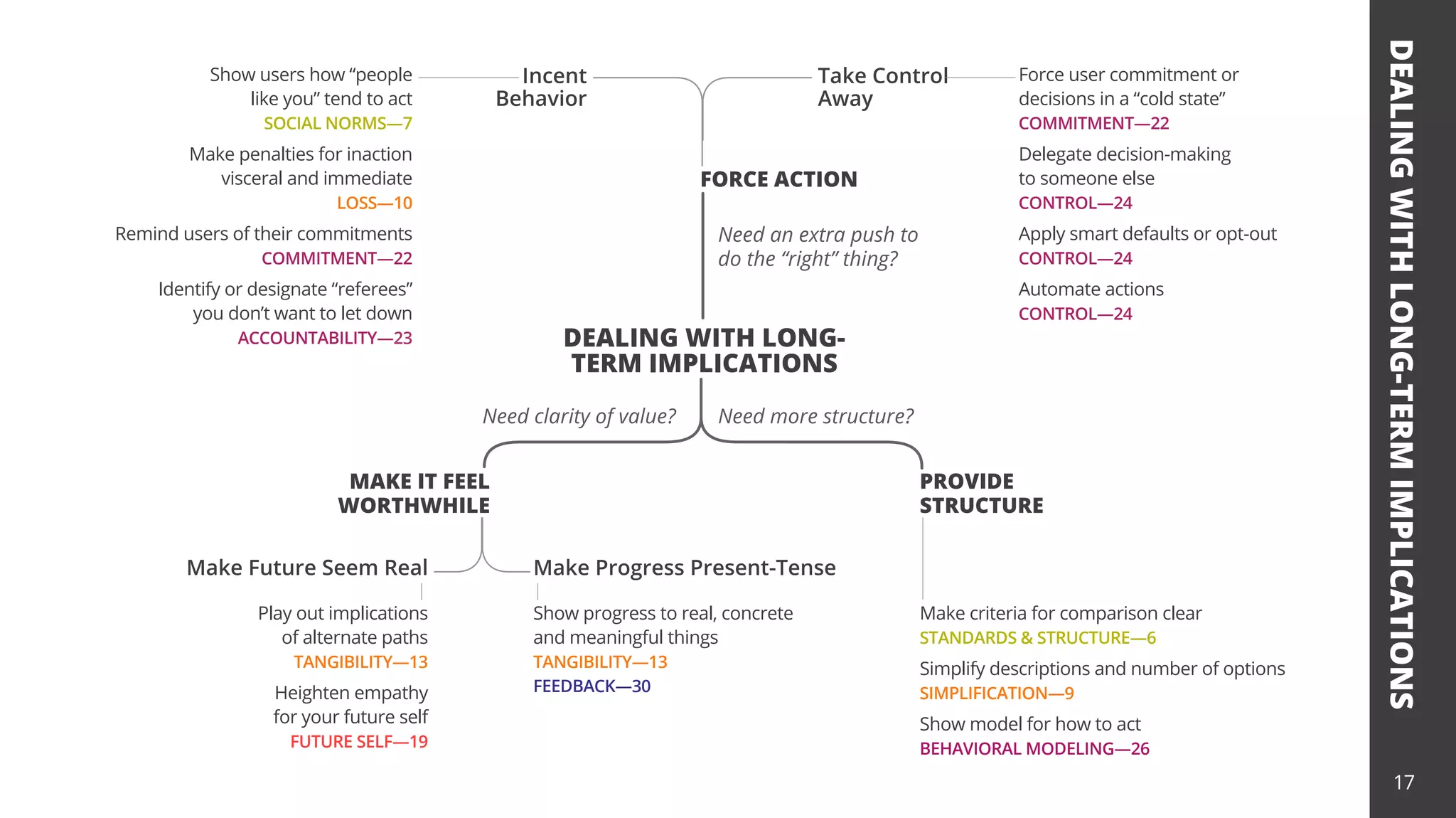
17
Make criteria for comparison clear
STANDARDS & STRUCTURE—6
Simplify descriptions and number of options
SIMPLIFICATION—9
Show model for how to act
BEHAVIORAL MODELING—26
DEALING WITH LONG-
TERM IMPLICATIONS
Force user commitment or
decisions in a “cold state”
COMMITMENT—22
Delegate decision-making
to someone else
CONTROL—24
Apply smart defaults or opt-out
CONTROL—24
Automate actions
CONTROL—24
Show users how “people
like you” tend to act
SOCIAL NORMS—7
Make penalties for inaction
visceral and immediate
LOSS—10
Remind users of their commitments
COMMITMENT—22
Identify or designate “referees”
you don’t want to let down
ACCOUNTABILITY—23
Take Control
Away
Play out implications
of alternate paths
TANGIBILITY—13
Heighten empathy
for your future self
FUTURE SELF—19
Show progress to real, concrete
and meaningful things
TANGIBILITY—13
FEEDBACK—30
Incent
Behavior
FORCE ACTION
Make Progress Present-Tense
Make Future Seem Real
MAKE IT FEEL
WORTHWHILE
PROVIDE
STRUCTURE
Need an extra push to
do the “right” thing?
Need clarity of value? Need more structure?
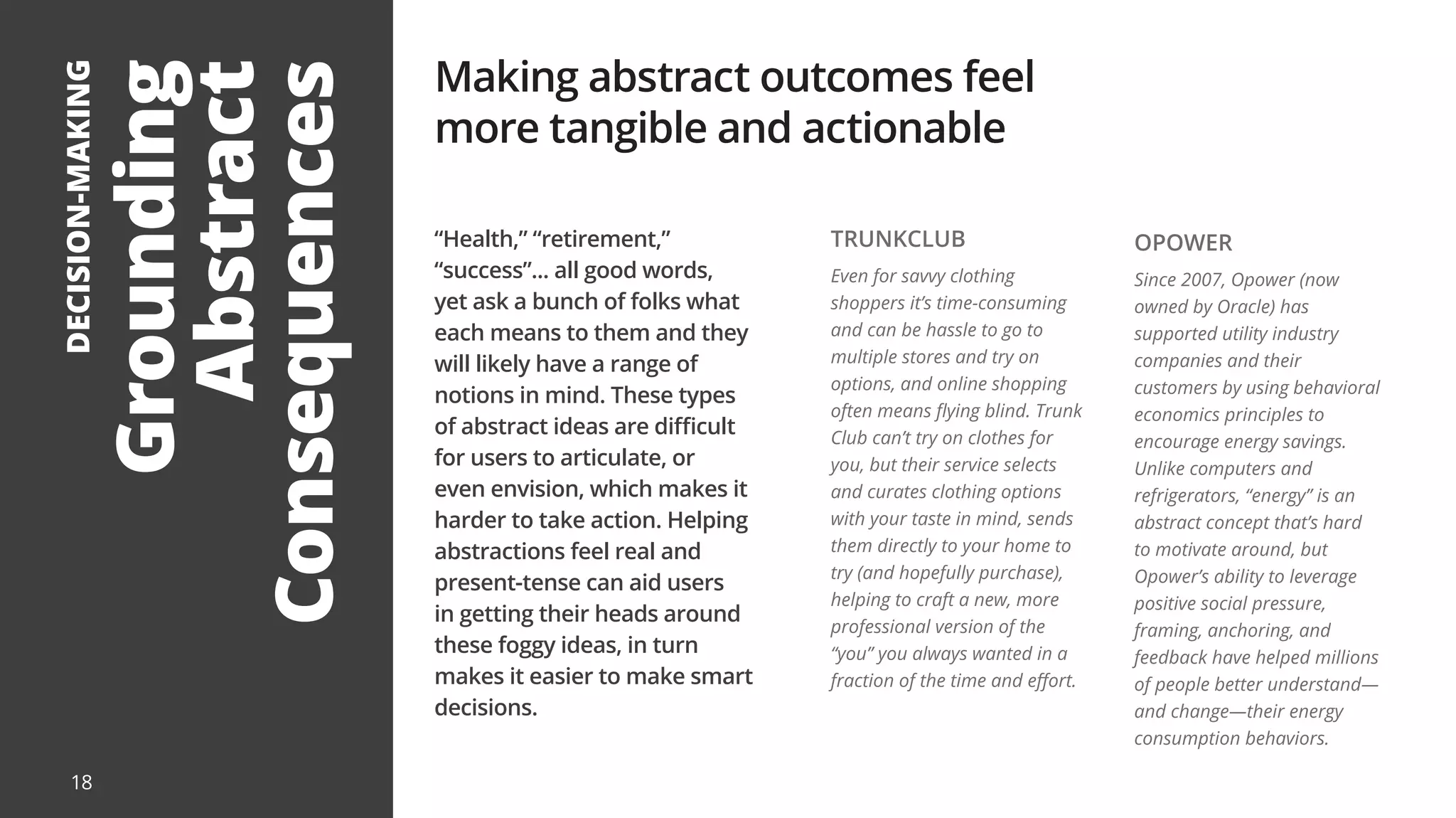
Grounding
Abstract
Consequences
DECISION-MAKING
“Health,” “retirement,”
“success”... all good words,
yet ask a bunch of folks what
each means to them and they
will likely have a range of
notions in mind. These types
of abstract ideas are difficult
for users to articulate, or
even envision, which makes it
harder to take action. Helping
abstractions feel real and
present-tense can aid users
in getting their heads around
these foggy ideas, in turn
makes it easier to make smart
decisions.
Making abstract outcomes feel
more tangible and actionable
TRUNKCLUB
Even for savvy clothing
shoppers it’s time-consuming
and can be hassle to go to
multiple stores and try on
options, and online shopping
often means flying blind. Trunk
Club can’t try on clothes for
you, but their service selects
and curates clothing options
with your taste in mind, sends
them directly to your home to
try (and hopefully purchase),
helping to craft a new, more
professional version of the
“you” you always wanted in a
fraction of the time and effort.
OPOWER
Since 2007, Opower (now
owned by Oracle) has
supported utility industry
companies and their
customers by using behavioral
economics principles to
encourage energy savings.
Unlike computers and
refrigerators, “energy” is an
abstract concept that’s hard
to motivate around, but
Opower’s ability to leverage
positive social pressure,
framing, anchoring, and
feedback have helped millions
of people better understand—
and change—their energy
consumption behaviors.
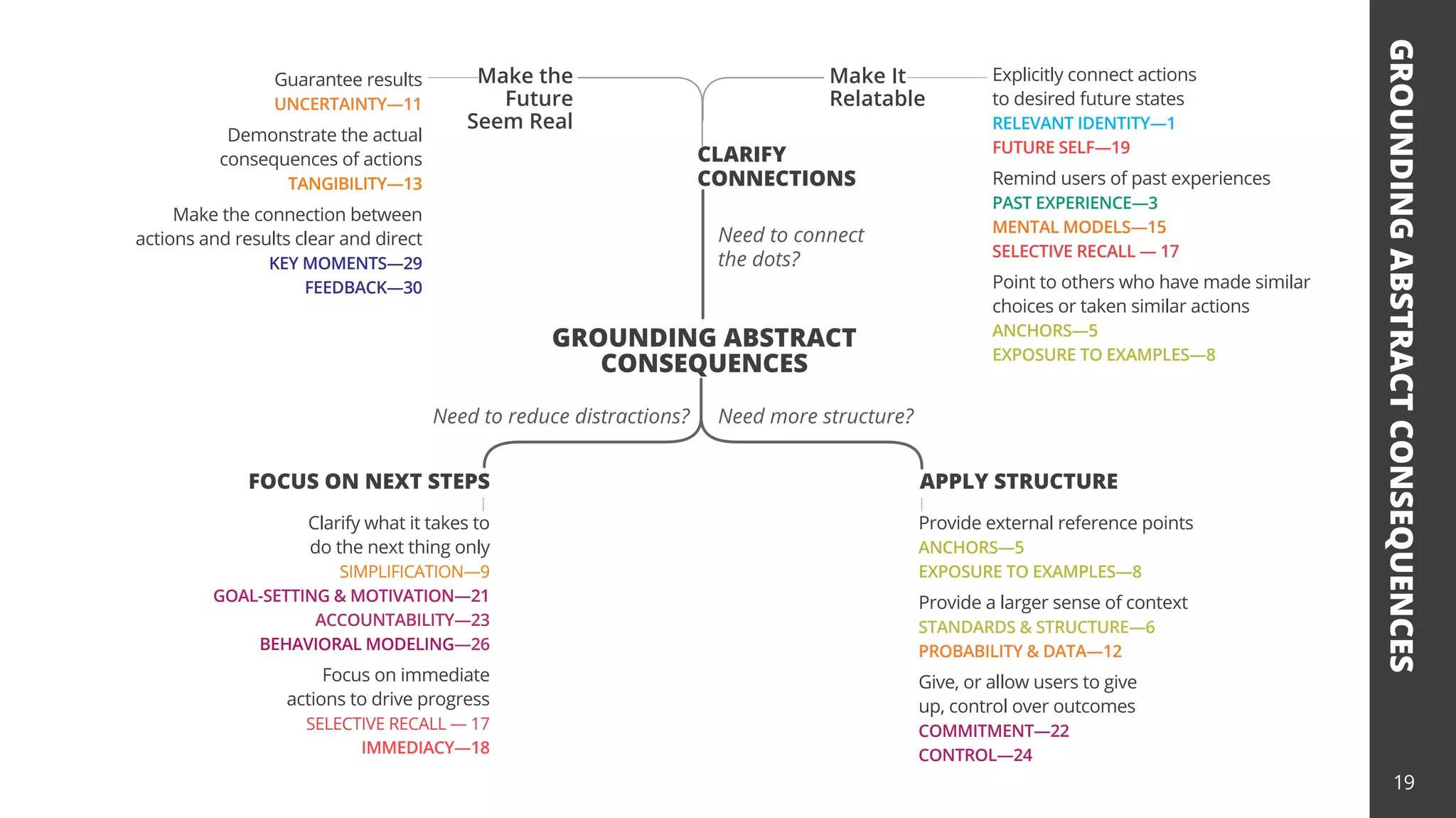
18
GROUNDING
ABSTRACT
CONSEQUENCES
GROUNDING ABSTRACT
CONSEQUENCES
Explicitly connect actions
to desired future states
RELEVANT IDENTITY—1
FUTURE SELF—19
Remind users of past experiences
PAST EXPERIENCE—3
MENTAL MODELS—15
SELECTIVE RECALL — 17
Point to others who have made similar
choices or taken similar actions
ANCHORS—5
EXPOSURE TO EXAMPLES—8
Guarantee results
UNCERTAINTY—11
Demonstrate the actual
consequences of actions
TANGIBILITY—13
Make the connection between
actions and results clear and direct
KEY MOMENTS—29
FEEDBACK—30
Make It
Relatable
Make the
Future
Seem Real
CLARIFY
CONNECTIONS
FOCUS ON NEXT STEPS APPLY STRUCTURE
Need to connect
the dots?
Need to reduce distractions? Need more structure?
Provide external reference points
ANCHORS—5
EXPOSURE TO EXAMPLES—8
Provide a larger sense of context
STANDARDS & STRUCTURE—6
PROBABILITY & DATA—12
Give, or allow users to give
up, control over outcomes
COMMITMENT—22
CONTROL—24
Clarify what it takes to
do the next thing only
SIMPLIFICATION—9
GOAL-SETTING & MOTIVATION—21
ACCOUNTABILITY—23
BEHAVIORAL MODELING—26
Focus on immediate
actions to drive progress
SELECTIVE RECALL — 17
IMMEDIACY—18
19
Trying
Something
New
NEW
BEHAVIORS
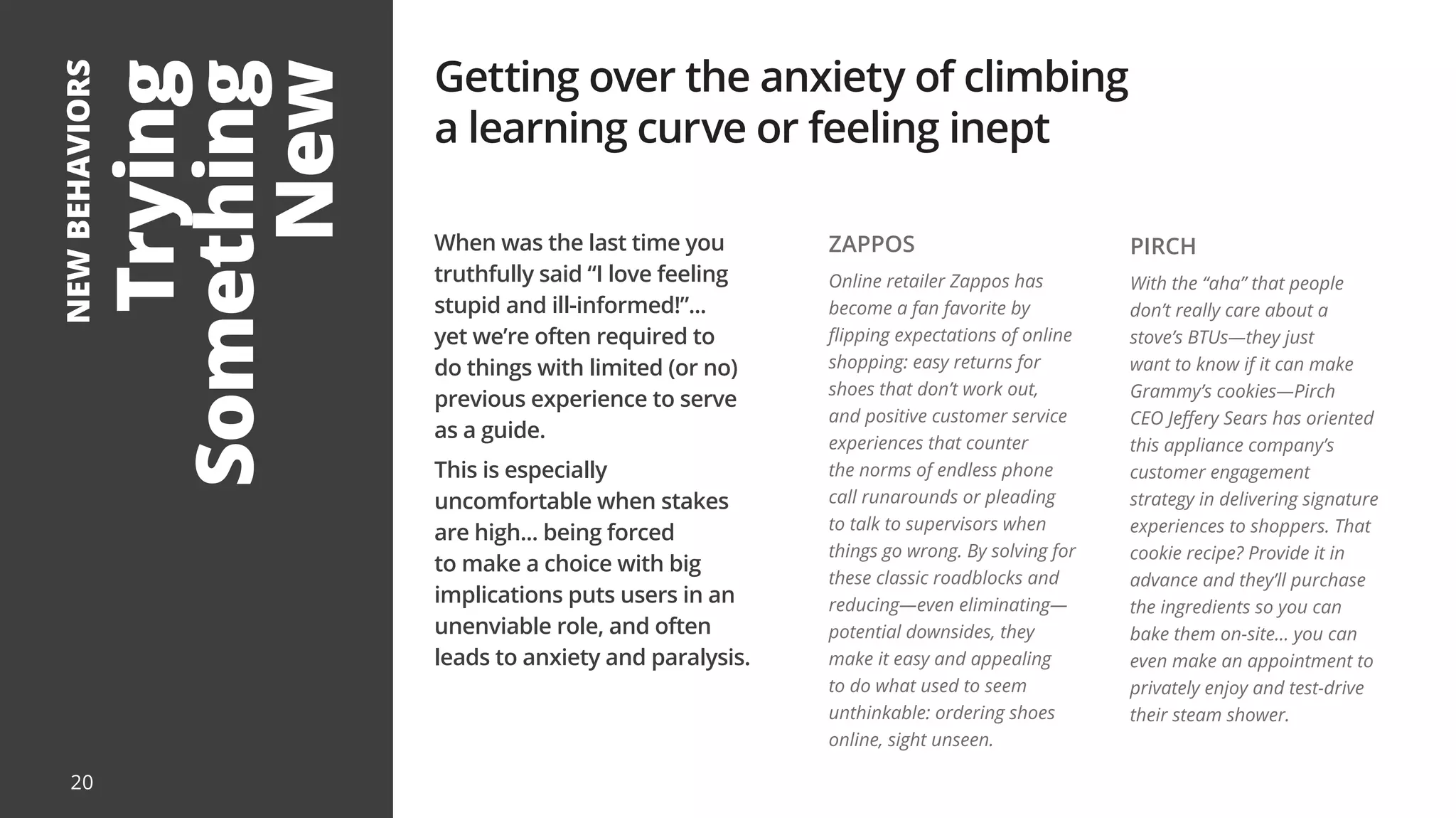
When was the last time you
truthfully said “I love feeling
stupid and ill-informed!”...
yet we’re often required to
do things with limited (or no)
previous experience to serve
as a guide.
This is especially
uncomfortable when stakes
are high... being forced
to make a choice with big
implications puts users in an
unenviable role, and often
leads to anxiety and paralysis.
Getting over the anxiety of climbing
a learning curve or feeling inept
ZAPPOS
Online retailer Zappos has
become a fan favorite by
flipping expectations of online
shopping: easy returns for
shoes that don’t work out,
and positive customer service
experiences that counter
the norms of endless phone
call runarounds or pleading
to talk to supervisors when
things go wrong. By solving for
these classic roadblocks and
reducing—even eliminating—
potential downsides, they
make it easy and appealing
to do what used to seem
unthinkable: ordering shoes
online, sight unseen.
PIRCH
With the “aha” that people
don’t really care about a
stove’s BTUs—they just
want to know if it can make
Grammy’s cookies—Pirch
CEO Jeffery Sears has oriented
this appliance company’s
customer engagement
strategy in delivering signature
experiences to shoppers. That
cookie recipe? Provide it in
advance and they’ll purchase
the ingredients so you can
bake them on-site... you can
even make an appointment to
privately enjoy and test-drive
their steam shower.
20
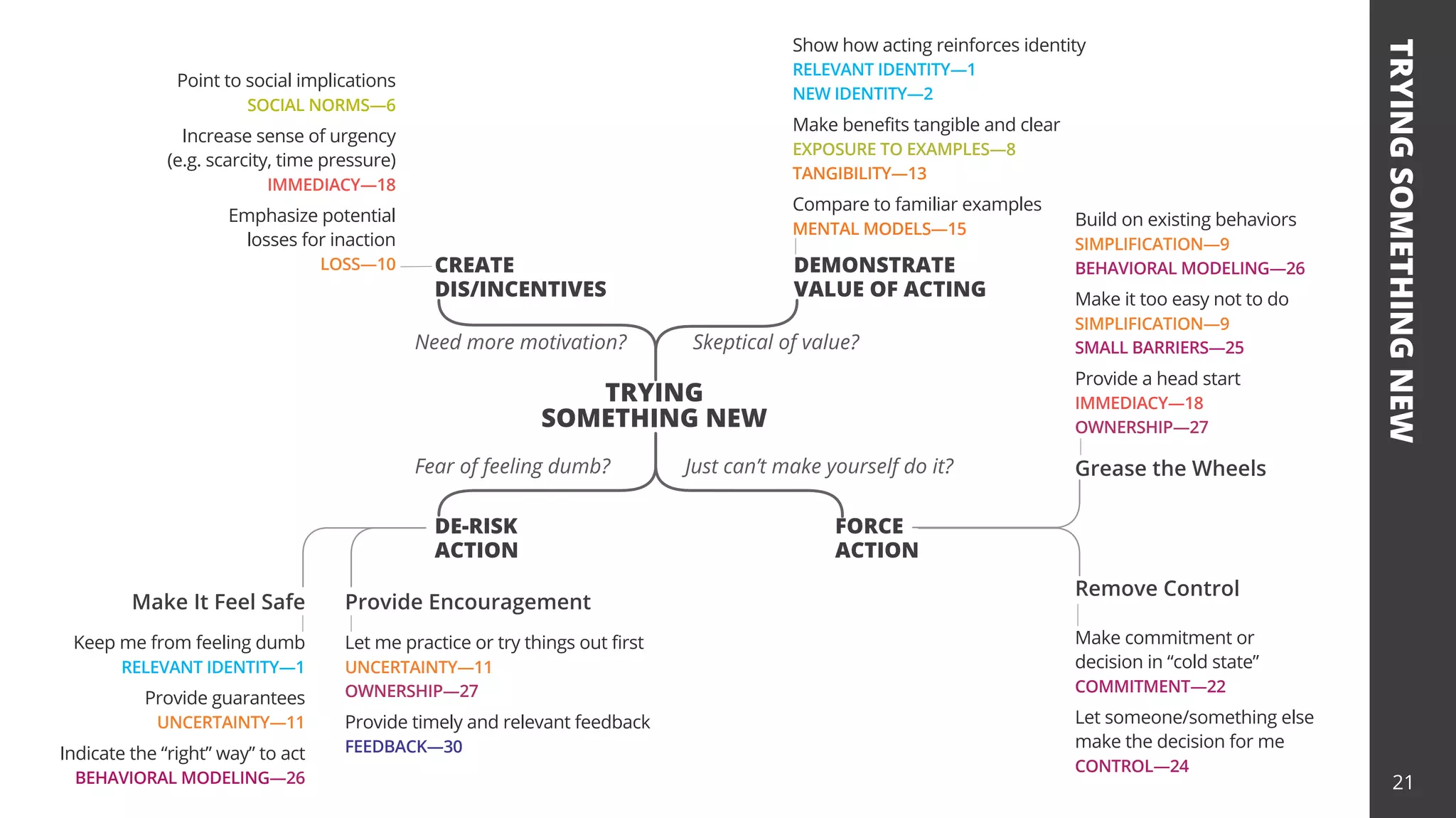
TRYING
SOMETHING
NEW
TRYING
SOMETHING NEW
Keep me from feeling dumb
RELEVANT IDENTITY—1
Provide guarantees
UNCERTAINTY—11
Indicate the “right” way” to act
BEHAVIORAL MODELING—26
Build on existing behaviors
SIMPLIFICATION—9
BEHAVIORAL MODELING—26
Make it too easy not to do
SIMPLIFICATION—9
SMALL BARRIERS—25
Provide a head start
IMMEDIACY—18
OWNERSHIP—27
Let me practice or try things out first
UNCERTAINTY—11
OWNERSHIP—27
Provide timely and relevant feedback
FEEDBACK—30
Show how acting reinforces identity
RELEVANT IDENTITY—1
NEW IDENTITY—2
Make benefits tangible and clear
EXPOSURE TO EXAMPLES—8
TANGIBILITY—13
Compare to familiar examples
MENTAL MODELS—15
DE-RISK
ACTION
FORCE
ACTION
Provide Encouragement
Grease the Wheels
Make It Feel Safe
DEMONSTRATE
VALUE OF ACTING
Point to social implications
SOCIAL NORMS—6
Increase sense of urgency
(e.g. scarcity, time pressure)
IMMEDIACY—18
Emphasize potential
losses for inaction
LOSS—10 CREATE
DIS/INCENTIVES
Make commitment or
decision in “cold state”
COMMITMENT—22
Let someone/something else
make the decision for me
CONTROL—24
Remove Control
Fear of feeling dumb? Just can’t make yourself do it?
Skeptical of value?
Need more motivation?
21
Overcoming
Distrust
NEW
BEHAVIORS
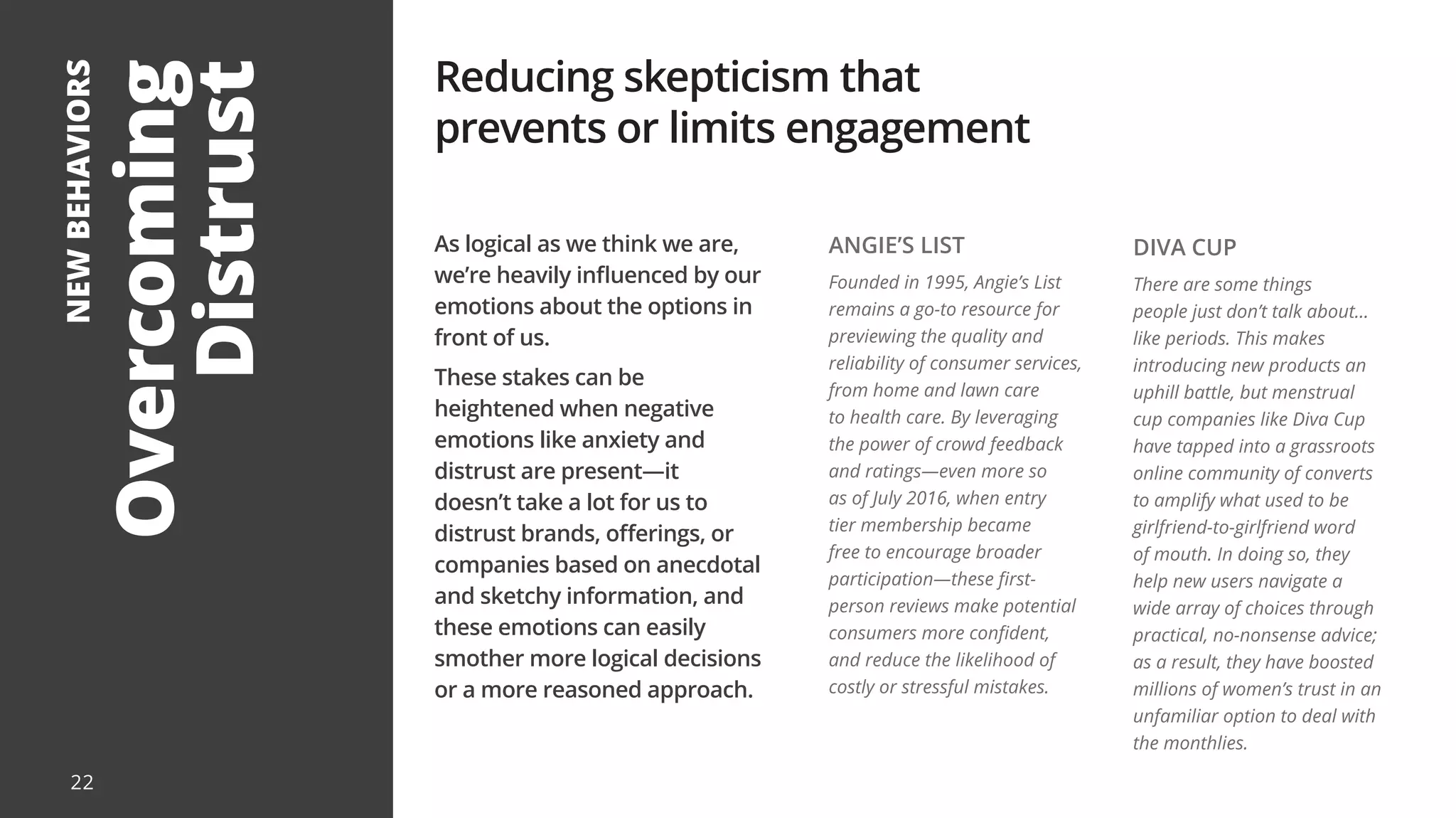
As logical as we think we are,
we’re heavily influenced by our
emotions about the options in
front of us.
These stakes can be
heightened when negative
emotions like anxiety and
distrust are present—it
doesn’t take a lot for us to
distrust brands, offerings, or
companies based on anecdotal
and sketchy information, and
these emotions can easily
smother more logical decisions
or a more reasoned approach.
Reducing skepticism that
prevents or limits engagement
ANGIE’S LIST
Founded in 1995, Angie’s List
remains a go-to resource for
previewing the quality and
reliability of consumer services,
from home and lawn care
to health care. By leveraging
the power of crowd feedback
and ratings—even more so
as of July 2016, when entry
tier membership became
free to encourage broader
participation—these first-
person reviews make potential
consumers more confident,
and reduce the likelihood of
costly or stressful mistakes.
DIVA CUP
There are some things
people just don’t talk about...
like periods. This makes
introducing new products an
uphill battle, but menstrual
cup companies like Diva Cup
have tapped into a grassroots
online community of converts
to amplify what used to be
girlfriend-to-girlfriend word
of mouth. In doing so, they
help new users navigate a
wide array of choices through
practical, no-nonsense advice;
as a result, they have boosted
millions of women’s trust in an
unfamiliar option to deal with
the monthlies.
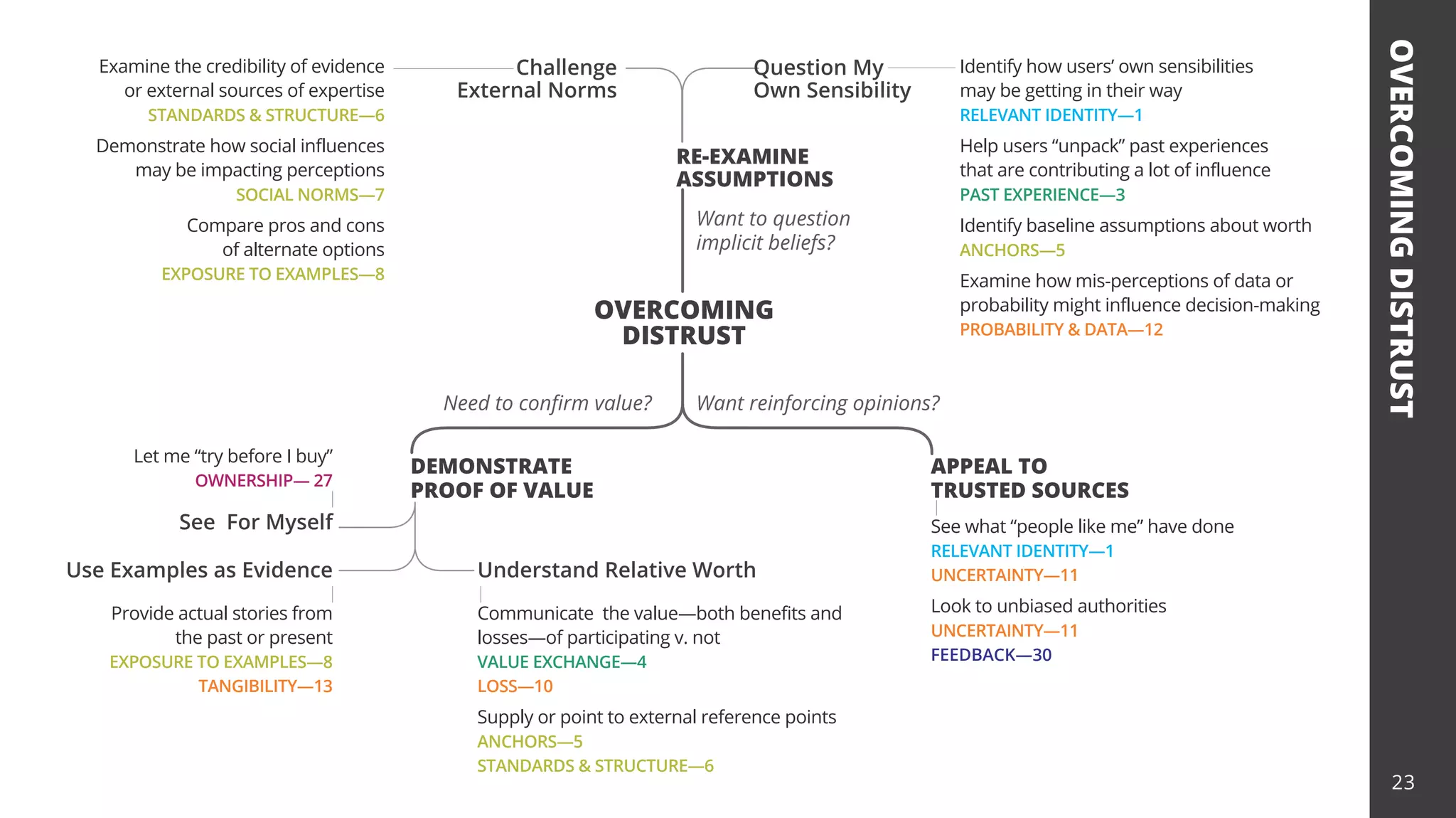
22
OVERCOMING
DISTRUST
OVERCOMING
DISTRUST
RE-EXAMINE
ASSUMPTIONS
Want to question
implicit beliefs?
Need to confirm value? Want reinforcing opinions?
Challenge
External Norms
DEMONSTRATE
PROOF OF VALUE
APPEAL TO
TRUSTED SOURCES
Examine the credibility of evidence
or external sources of expertise
STANDARDS & STRUCTURE—6
Demonstrate how social influences
may be impacting perceptions
SOCIAL NORMS—7
Compare pros and cons
of alternate options
EXPOSURE TO EXAMPLES—8
Provide actual stories from
the past or present
EXPOSURE TO EXAMPLES—8
TANGIBILITY—13
Let me “try before I buy”
OWNERSHIP— 27
Question My
Own Sensibility
Identify how users’ own sensibilities
may be getting in their way
RELEVANT IDENTITY—1
Help users “unpack” past experiences
that are contributing a lot of influence
PAST EXPERIENCE—3
Identify baseline assumptions about worth
ANCHORS—5
Examine how mis-perceptions of data or
probability might influence decision-making
PROBABILITY & DATA—12
Communicate the value—both benefits and
losses—of participating v. not
VALUE EXCHANGE—4
LOSS—10
Supply or point to external reference points
ANCHORS—5
STANDARDS & STRUCTURE—6
See what “people like me” have done
RELEVANT IDENTITY—1
UNCERTAINTY—11
Look to unbiased authorities
UNCERTAINTY—11
FEEDBACK—30
Understand Relative Worth
Use Examples as Evidence
See For Myself
23
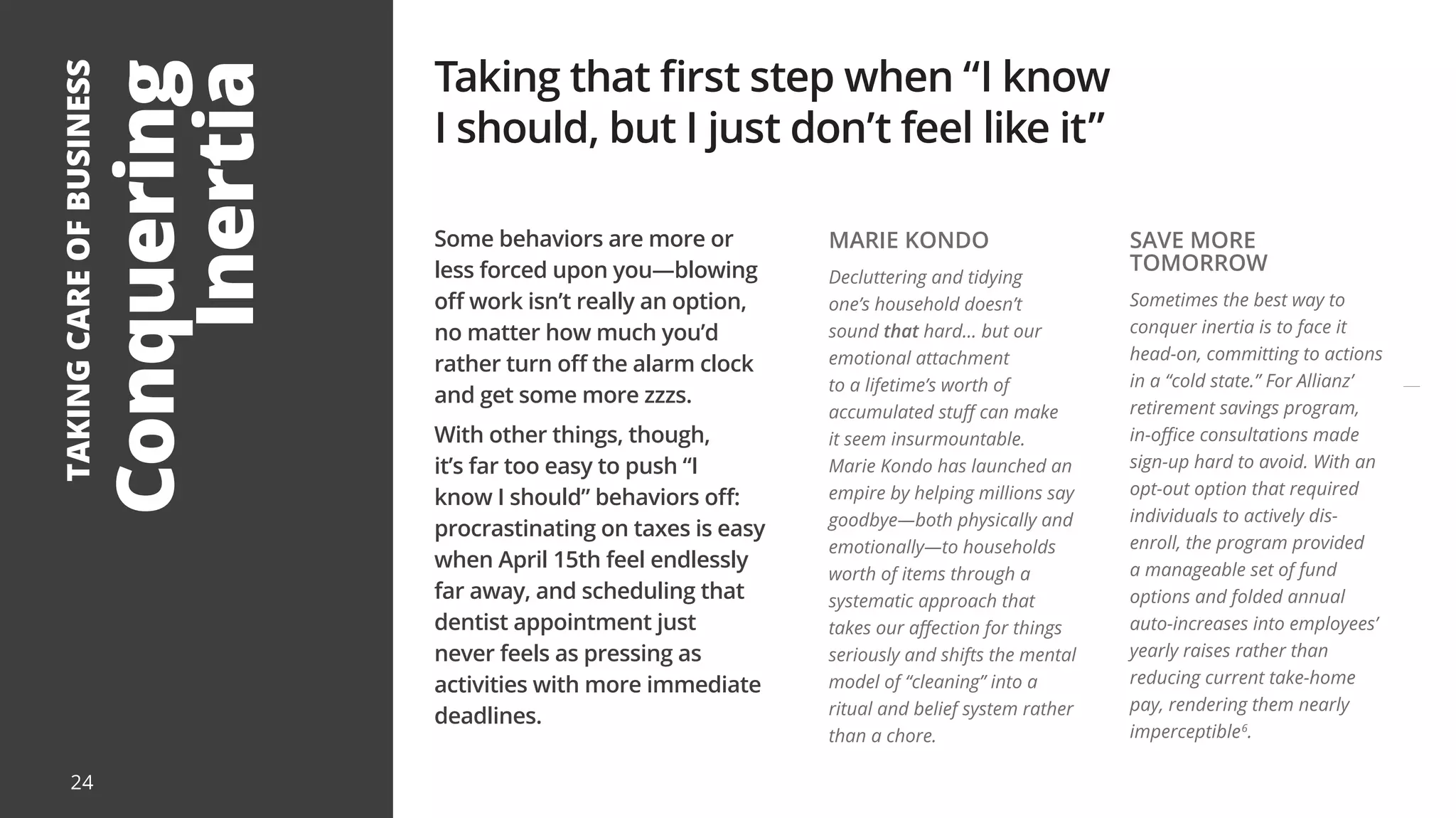
Conquering
Inertia
TAKING
CARE
OF
BUSINESS
Some behaviors are more or
less forced upon you—blowing
off work isn’t really an option,
no matter how much you’d
rather turn off the alarm clock
and get some more zzzs.
With other things, though,
it’s far too easy to push “I
know I should” behaviors off:
procrastinating on taxes is easy
when April 15th feel endlessly
far away, and scheduling that
dentist appointment just
never feels as pressing as
activities with more immediate
deadlines.
Taking that first step when “I know
I should, but I just don’t feel like it”
MARIE KONDO
Decluttering and tidying
one’s household doesn’t
sound that hard... but our
emotional attachment
to a lifetime’s worth of
accumulated stuff can make
it seem insurmountable.
Marie Kondo has launched an
empire by helping millions say
goodbye—both physically and
emotionally—to households
worth of items through a
systematic approach that
takes our affection for things
seriously and shifts the mental
model of “cleaning” into a
ritual and belief system rather
than a chore.
SAVE MORE
TOMORROW
Sometimes the best way to
conquer inertia is to face it
head-on, committing to actions
in a “cold state.” For Allianz’
retirement savings program,
in-office consultations made
sign-up hard to avoid. With an
opt-out option that required
individuals to actively dis-
enroll, the program provided
a manageable set of fund
options and folded annual
auto-increases into employees’
yearly raises rather than
reducing current take-home
pay, rendering them nearly
imperceptible6
.
24
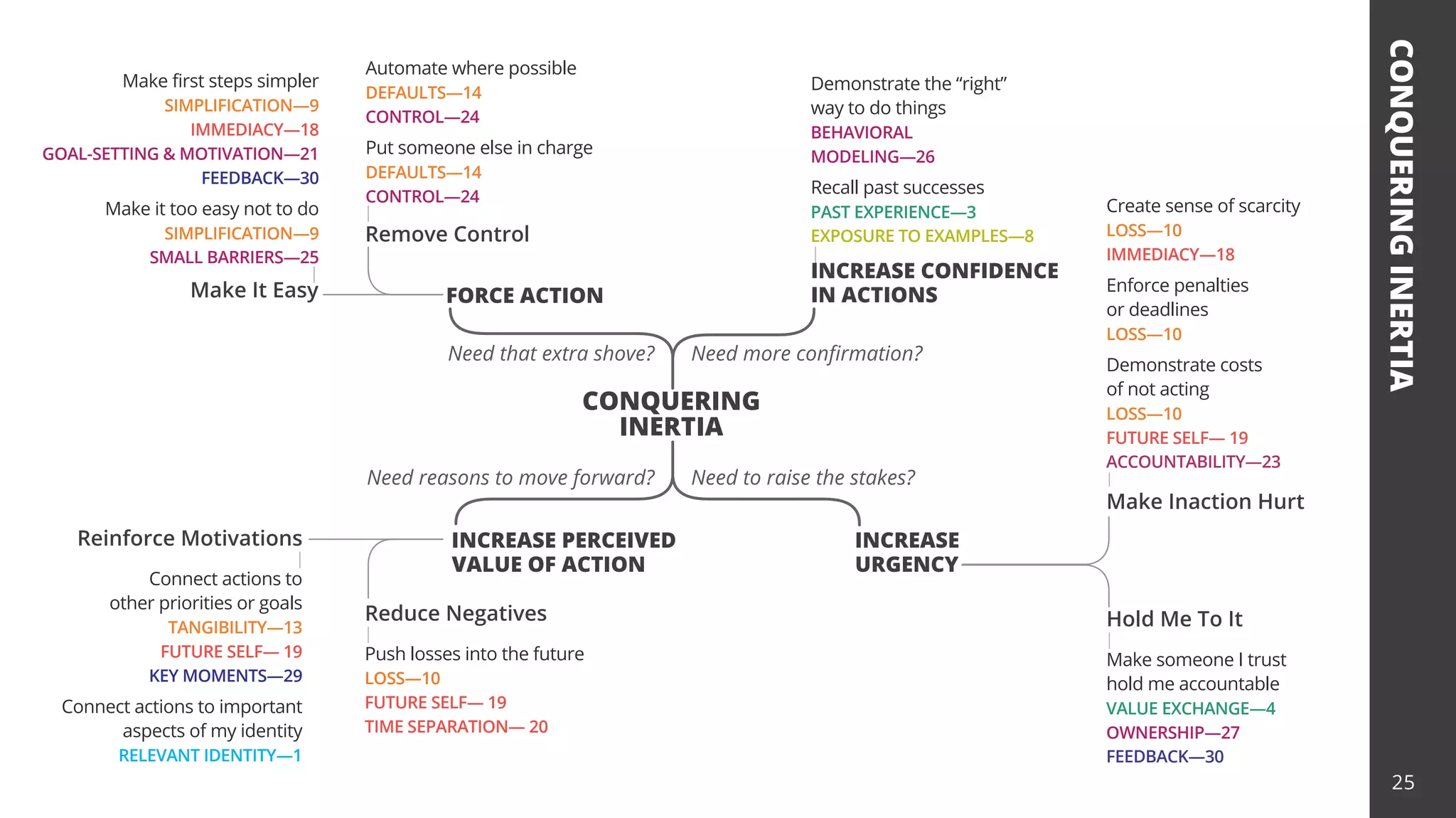
CONQUERING
INERTIA
CONQUERING
INERTIA
Connect actions to
other priorities or goals
TANGIBILITY—13
FUTURE SELF— 19
KEY MOMENTS—29
Connect actions to important
aspects of my identity
RELEVANT IDENTITY—1
Make first steps simpler
SIMPLIFICATION—9
IMMEDIACY—18
GOAL-SETTING & MOTIVATION—21
FEEDBACK—30
Make it too easy not to do
SIMPLIFICATION—9
SMALL BARRIERS—25
Automate where possible
DEFAULTS—14
CONTROL—24
Put someone else in charge
DEFAULTS—14
CONTROL—24
Push losses into the future
LOSS—10
FUTURE SELF— 19
TIME SEPARATION— 20
Make someone I trust
hold me accountable
VALUE EXCHANGE—4
OWNERSHIP—27
FEEDBACK—30
Create sense of scarcity
LOSS—10
IMMEDIACY—18
Enforce penalties
or deadlines
LOSS—10
Demonstrate costs
of not acting
LOSS—10
FUTURE SELF— 19
ACCOUNTABILITY—23
INCREASE PERCEIVED
VALUE OF ACTION
INCREASE
URGENCY
Reduce Negatives
Reinforce Motivations
INCREASE CONFIDENCE
IN ACTIONS
Demonstrate the “right”
way to do things
BEHAVIORAL
MODELING—26
Recall past successes
PAST EXPERIENCE—3
EXPOSURE TO EXAMPLES—8
FORCE ACTION
Need reasons to move forward?
Need that extra shove?
Need to raise the stakes?
Need more confirmation?
Hold Me To It
Remove Control
Make Inaction Hurt
Make It Easy
25
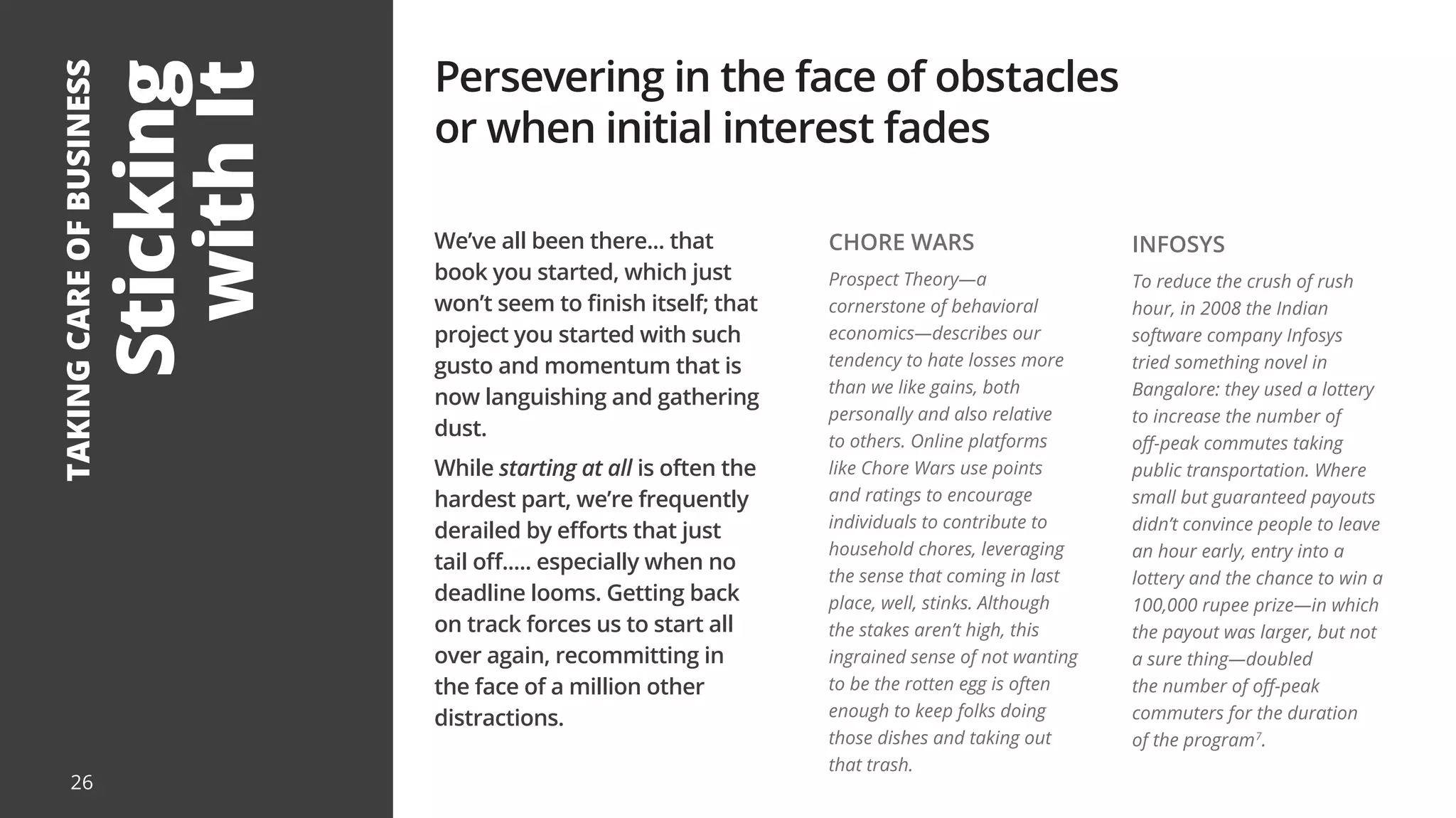
Sticking
with
It
TAKING
CARE
OF
BUSINESS
We’ve all been there... that
book you started, which just
won’t seem to finish itself; that
project you started with such
gusto and momentum that is
now languishing and gathering
dust.
While starting at all is often the
hardest part, we’re frequently
derailed by efforts that just
tail off..... especially when no
deadline looms. Getting back
on track forces us to start all
over again, recommitting in
the face of a million other
distractions.
Persevering in the face of obstacles
or when initial interest fades
CHORE WARS
Prospect Theory—a
cornerstone of behavioral
economics—describes our
tendency to hate losses more
than we like gains, both
personally and also relative
to others. Online platforms
like Chore Wars use points
and ratings to encourage
individuals to contribute to
household chores, leveraging
the sense that coming in last
place, well, stinks. Although
the stakes aren’t high, this
ingrained sense of not wanting
to be the rotten egg is often
enough to keep folks doing
those dishes and taking out
that trash.
INFOSYS
To reduce the crush of rush
hour, in 2008 the Indian
software company Infosys
tried something novel in
Bangalore: they used a lottery
to increase the number of
off-peak commutes taking
public transportation. Where
small but guaranteed payouts
didn’t convince people to leave
an hour early, entry into a
lottery and the chance to win a
100,000 rupee prize—in which
the payout was larger, but not
a sure thing—doubled
the number of off-peak
commuters for the duration
of the program7
.
26
STICKING
WITH
IT
STICKING
WITH IT
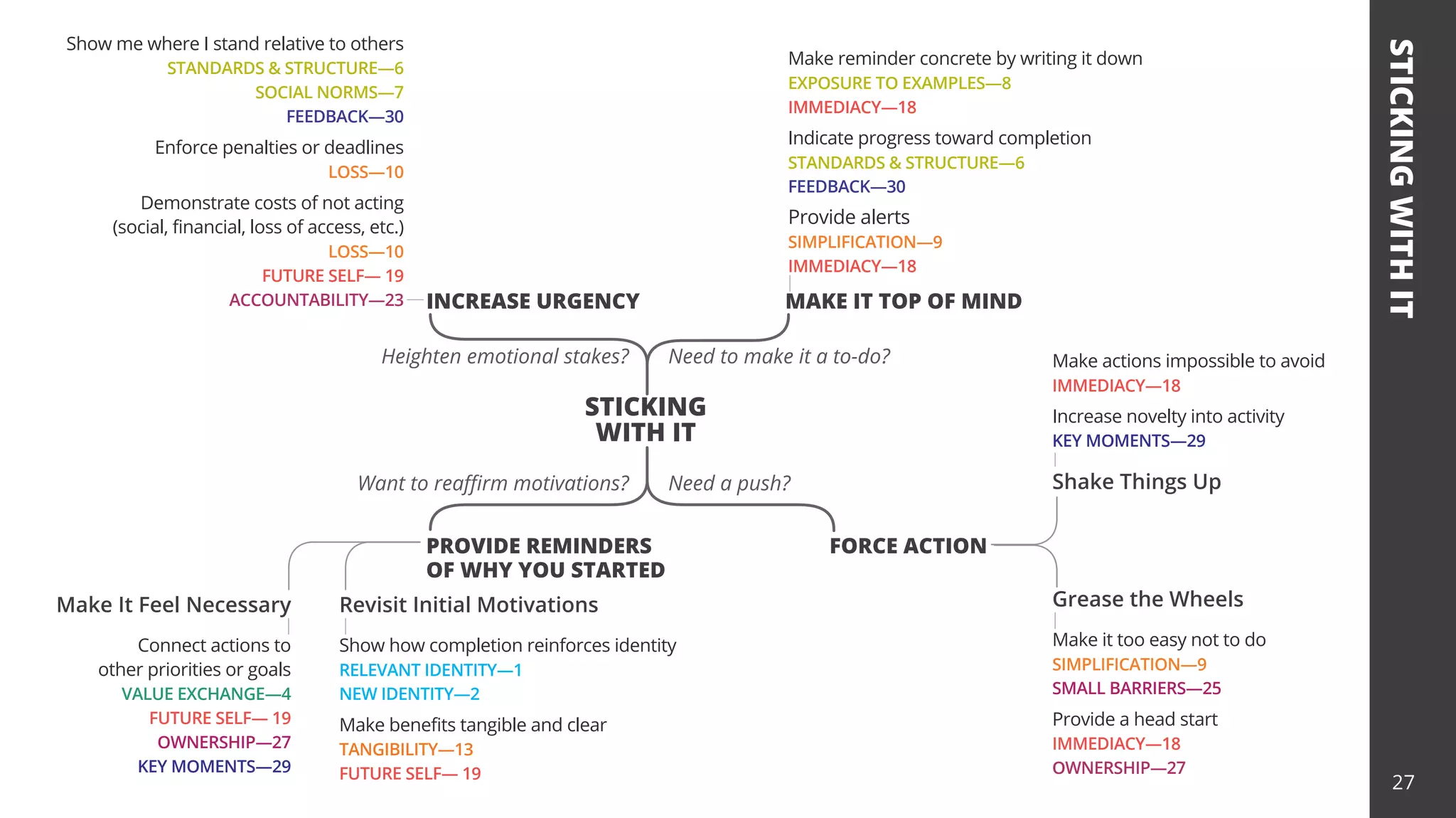
Connect actions to
other priorities or goals
VALUE EXCHANGE—4
FUTURE SELF— 19
OWNERSHIP—27
KEY MOMENTS—29
Make it too easy not to do
SIMPLIFICATION—9
SMALL BARRIERS—25
Provide a head start
IMMEDIACY—18
OWNERSHIP—27
Show how completion reinforces identity
RELEVANT IDENTITY—1
NEW IDENTITY—2
Make benefits tangible and clear
TANGIBILITY—13
FUTURE SELF— 19
Show me where I stand relative to others
STANDARDS & STRUCTURE—6
SOCIAL NORMS—7
FEEDBACK—30
Enforce penalties or deadlines
LOSS—10
Demonstrate costs of not acting
(social, financial, loss of access, etc.)
LOSS—10
FUTURE SELF— 19
ACCOUNTABILITY—23
PROVIDE REMINDERS
OF WHY YOU STARTED
FORCE ACTION
Revisit Initial Motivations Grease the Wheels
Make It Feel Necessary
MAKE IT TOP OF MIND
Make reminder concrete by writing it down
EXPOSURE TO EXAMPLES—8
IMMEDIACY—18
Indicate progress toward completion
STANDARDS & STRUCTURE—6
FEEDBACK—30
Provide alerts
SIMPLIFICATION—9
IMMEDIACY—18
INCREASE URGENCY
Make actions impossible to avoid
IMMEDIACY—18
Increase novelty into activity
KEY MOMENTS—29
Shake Things Up
Want to reaffirm motivations? Need a push?
Need to make it a to-do?
Heighten emotional stakes?
27
Closing
the
Loop
TAKING
CARE
OF
BUSINESS
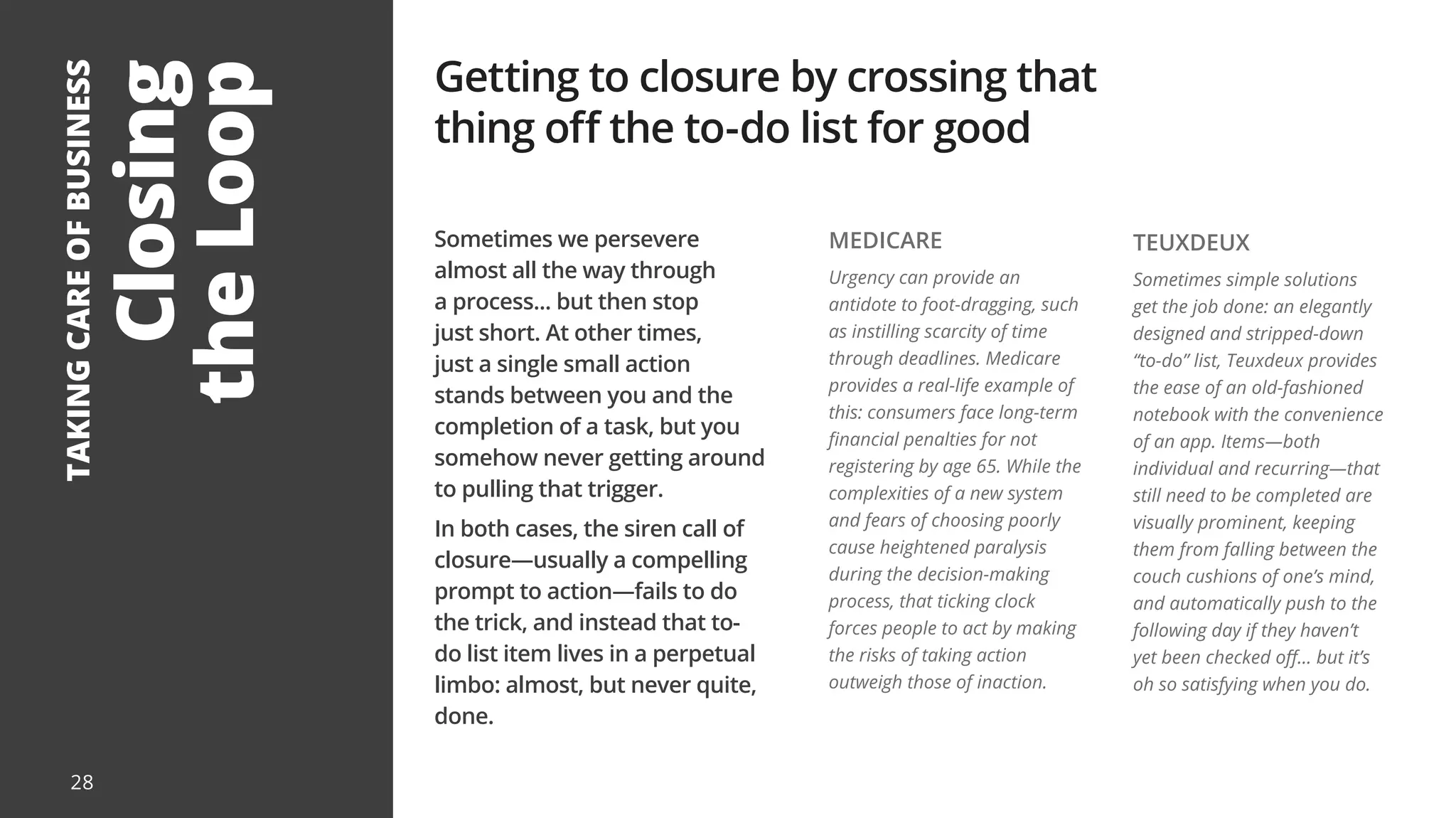
Sometimes we persevere
almost all the way through
a process... but then stop
just short. At other times,
just a single small action
stands between you and the
completion of a task, but you
somehow never getting around
to pulling that trigger.
In both cases, the siren call of
closure—usually a compelling
prompt to action—fails to do
the trick, and instead that to-
do list item lives in a perpetual
limbo: almost, but never quite,
done.
Getting to closure by crossing that
thing off the to-do list for good
MEDICARE
Urgency can provide an
antidote to foot-dragging, such
as instilling scarcity of time
through deadlines. Medicare
provides a real-life example of
this: consumers face long-term
financial penalties for not
registering by age 65. While the
complexities of a new system
and fears of choosing poorly
cause heightened paralysis
during the decision-making
process, that ticking clock
forces people to act by making
the risks of taking action
outweigh those of inaction.
TEUXDEUX
Sometimes simple solutions
get the job done: an elegantly
designed and stripped-down
“to-do” list, Teuxdeux provides
the ease of an old-fashioned
notebook with the convenience
of an app. Items—both
individual and recurring—that
still need to be completed are
visually prominent, keeping
them from falling between the
couch cushions of one’s mind,
and automatically push to the
following day if they haven’t
yet been checked off... but it’s
oh so satisfying when you do.
28
CLOSING
THE
LOOP
CLOSING
THE LOOP
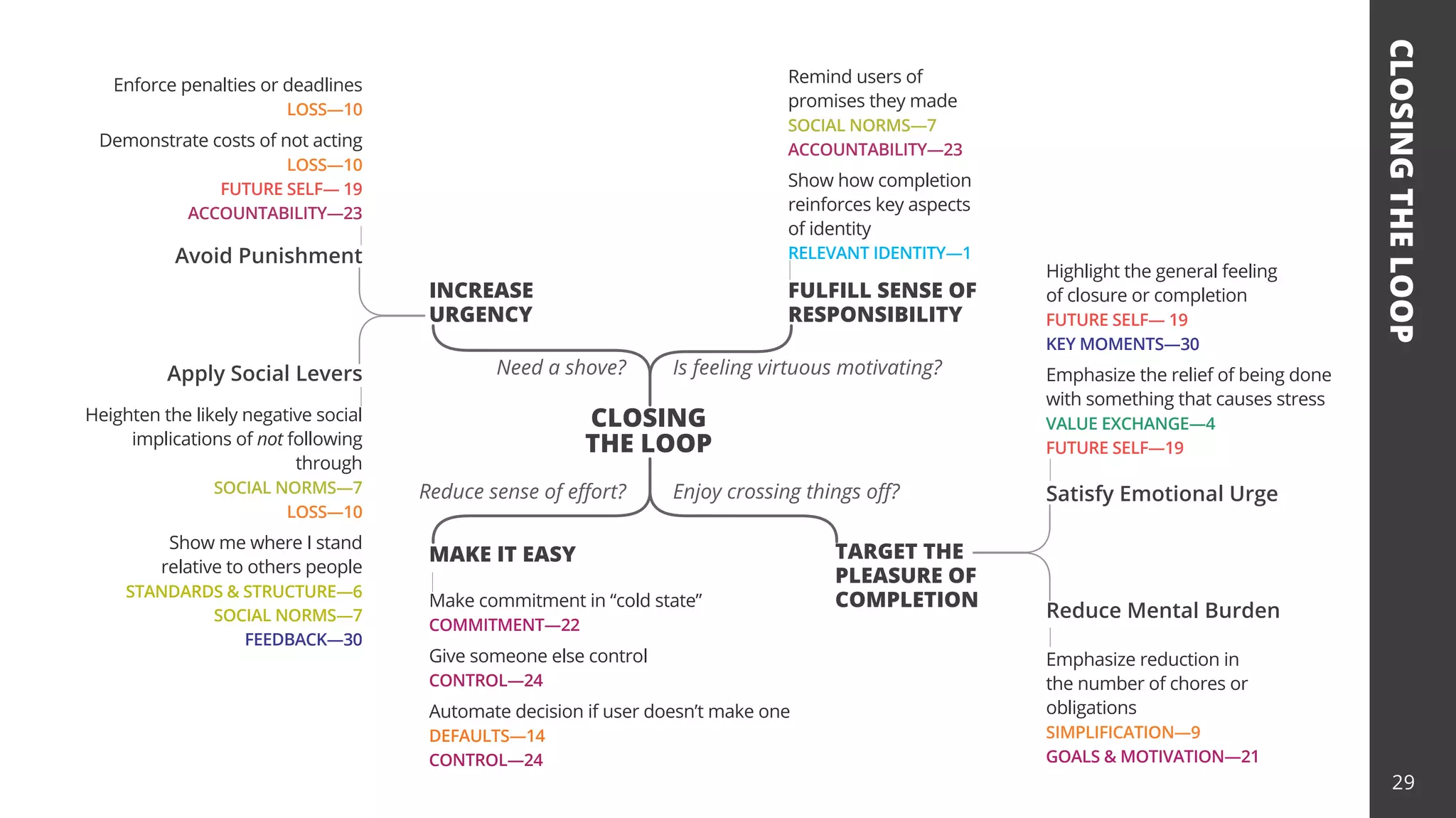
Make commitment in “cold state”
COMMITMENT—22
Give someone else control
CONTROL—24
Automate decision if user doesn’t make one
DEFAULTS—14
CONTROL—24
Emphasize reduction in
the number of chores or
obligations
SIMPLIFICATION—9
GOALS & MOTIVATION—21
Highlight the general feeling
of closure or completion
FUTURE SELF— 19
KEY MOMENTS—30
Emphasize the relief of being done
with something that causes stress
VALUE EXCHANGE—4
FUTURE SELF—19
Remind users of
promises they made
SOCIAL NORMS—7
ACCOUNTABILITY—23
Show how completion
reinforces key aspects
of identity
RELEVANT IDENTITY—1
MAKE IT EASY TARGET THE
PLEASURE OF
COMPLETION
Apply Social Levers
Reduce Mental Burden
FULFILL SENSE OF
RESPONSIBILITY
INCREASE
URGENCY
Avoid Punishment
Satisfy Emotional Urge
Reduce sense of effort? Enjoy crossing things off?
Is feeling virtuous motivating?
Need a shove?
Enforce penalties or deadlines
LOSS—10
Demonstrate costs of not acting
LOSS—10
FUTURE SELF— 19
ACCOUNTABILITY—23
Heighten the likely negative social
implications of not following
through
SOCIAL NORMS—7
LOSS—10
Show me where I stand
relative to others people
STANDARDS & STRUCTURE—6
SOCIAL NORMS—7
FEEDBACK—30
29
Developing
&
Breaking
Habits
HABITS
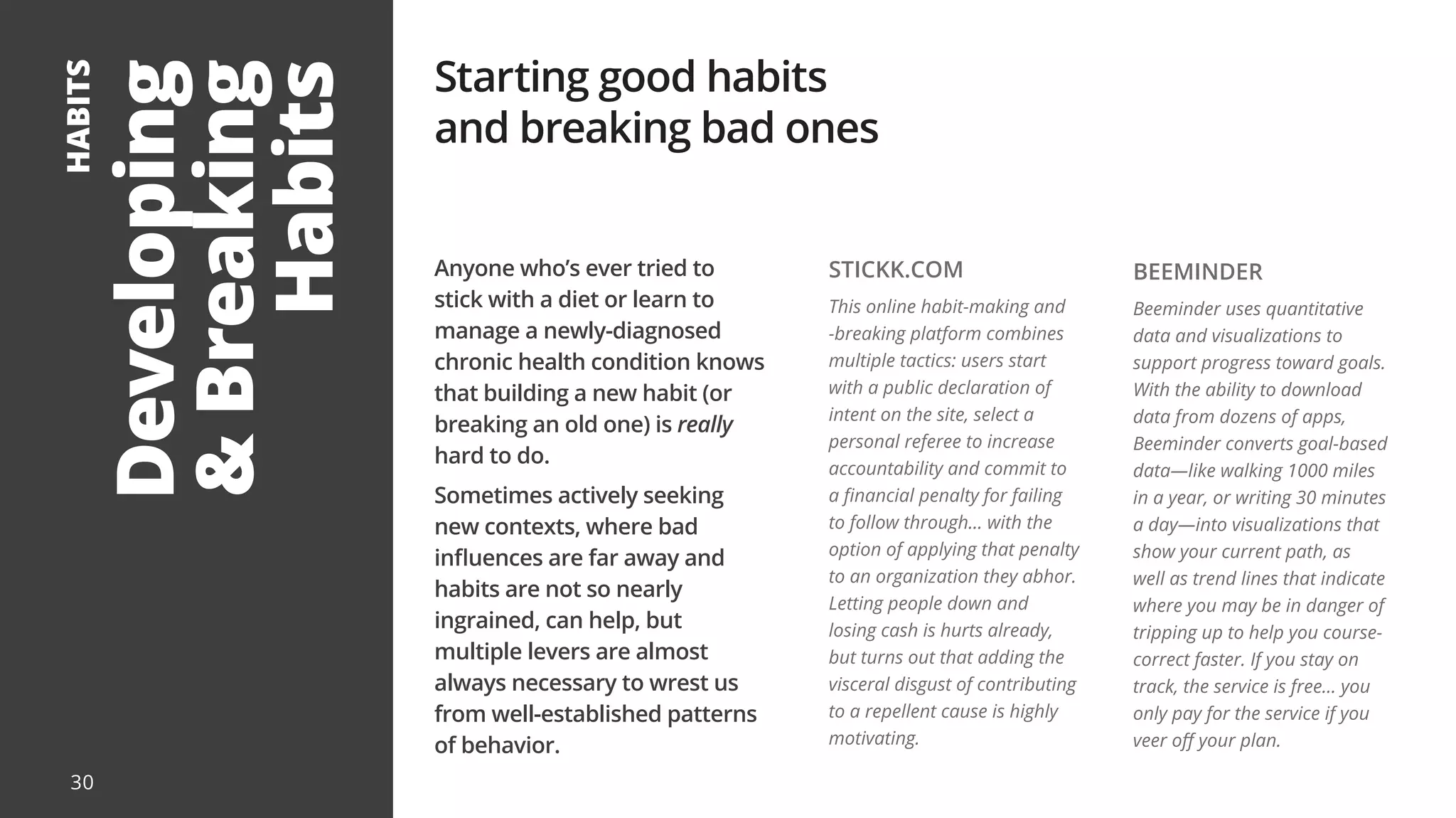
Anyone who’s ever tried to
stick with a diet or learn to
manage a newly-diagnosed
chronic health condition knows
that building a new habit (or
breaking an old one) is really
hard to do.
Sometimes actively seeking
new contexts, where bad
influences are far away and
habits are not so nearly
ingrained, can help, but
multiple levers are almost
always necessary to wrest us
from well-established patterns
of behavior.
Starting good habits
and breaking bad ones
STICKK.COM
This online habit-making and
-breaking platform combines
multiple tactics: users start
with a public declaration of
intent on the site, select a
personal referee to increase
accountability and commit to
a financial penalty for failing
to follow through... with the
option of applying that penalty
to an organization they abhor.
Letting people down and
losing cash is hurts already,
but turns out that adding the
visceral disgust of contributing
to a repellent cause is highly
motivating.
BEEMINDER
Beeminder uses quantitative
data and visualizations to
support progress toward goals.
With the ability to download
data from dozens of apps,
Beeminder converts goal-based
data—like walking 1000 miles
in a year, or writing 30 minutes
a day—into visualizations that
show your current path, as
well as trend lines that indicate
where you may be in danger of
tripping up to help you course-
correct faster. If you stay on
track, the service is free... you
only pay for the service if you
veer off your plan.
30
DEVELOPING
&
BREAKING
HABITS
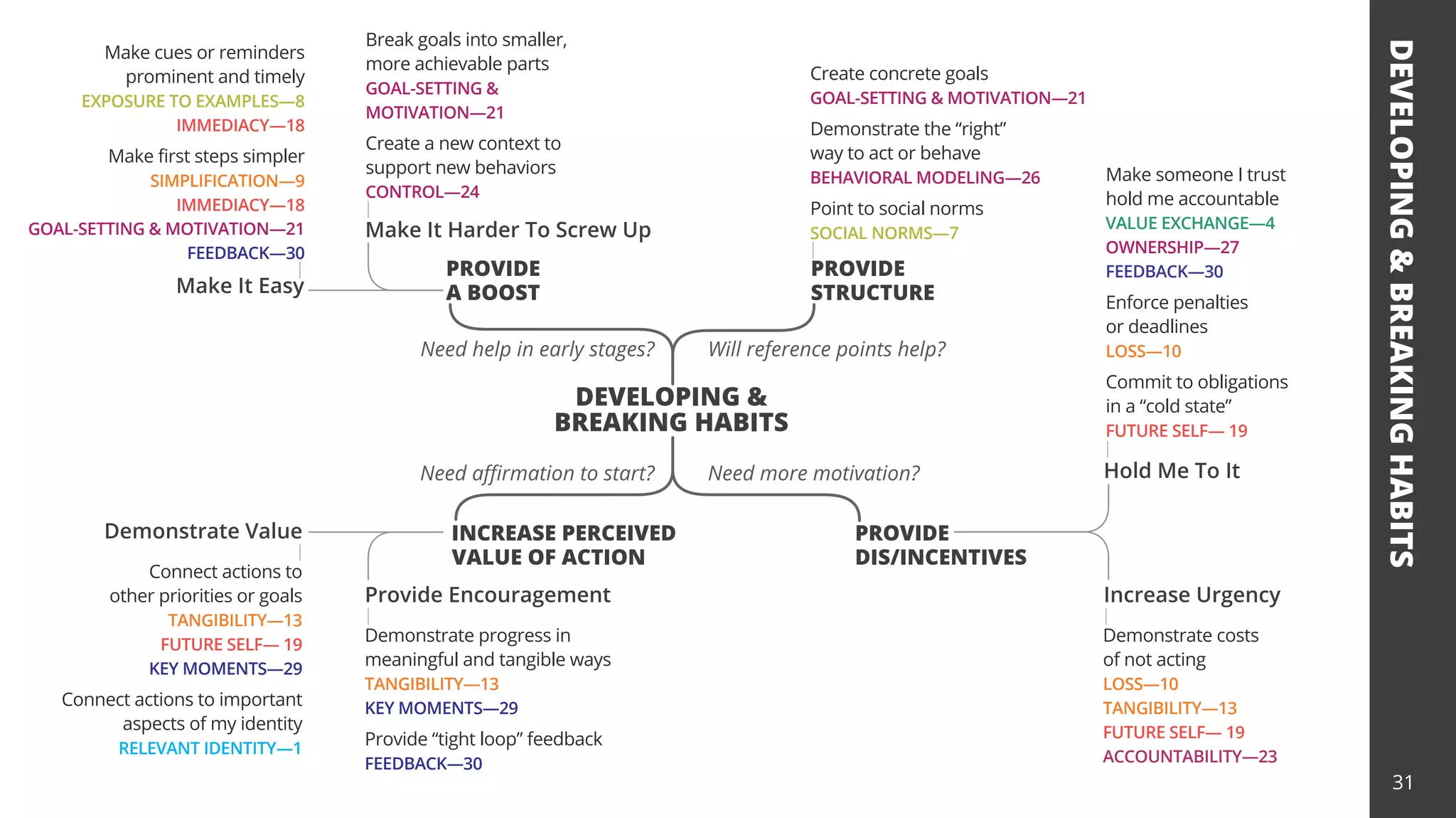
DEVELOPING &
BREAKING HABITS
Connect actions to
other priorities or goals
TANGIBILITY—13
FUTURE SELF— 19
KEY MOMENTS—29
Connect actions to important
aspects of my identity
RELEVANT IDENTITY—1
Make cues or reminders
prominent and timely
EXPOSURE TO EXAMPLES—8
IMMEDIACY—18
Make first steps simpler
SIMPLIFICATION—9
IMMEDIACY—18
GOAL-SETTING & MOTIVATION—21
FEEDBACK—30
Break goals into smaller,
more achievable parts
GOAL-SETTING &
MOTIVATION—21
Create a new context to
support new behaviors
CONTROL—24
Create concrete goals
GOAL-SETTING & MOTIVATION—21
Demonstrate the “right”
way to act or behave
BEHAVIORAL MODELING—26
Point to social norms
SOCIAL NORMS—7
Demonstrate progress in
meaningful and tangible ways
TANGIBILITY—13
KEY MOMENTS—29
Provide “tight loop” feedback
FEEDBACK—30
Demonstrate costs
of not acting
LOSS—10
TANGIBILITY—13
FUTURE SELF— 19
ACCOUNTABILITY—23
INCREASE PERCEIVED
VALUE OF ACTION
PROVIDE
DIS/INCENTIVES
Provide Encouragement Increase Urgency
Hold Me To It
Demonstrate Value
PROVIDE
STRUCTURE
Make someone I trust
hold me accountable
VALUE EXCHANGE—4
OWNERSHIP—27
FEEDBACK—30
Enforce penalties
or deadlines
LOSS—10
Commit to obligations
in a “cold state”
FUTURE SELF— 19
PROVIDE
A BOOST
Need affirmation to start?
Need help in early stages?
Need more motivation?
Will reference points help?
Make It Harder To Screw Up
Make It Easy
31
Instilling
Self-Control
HABITS
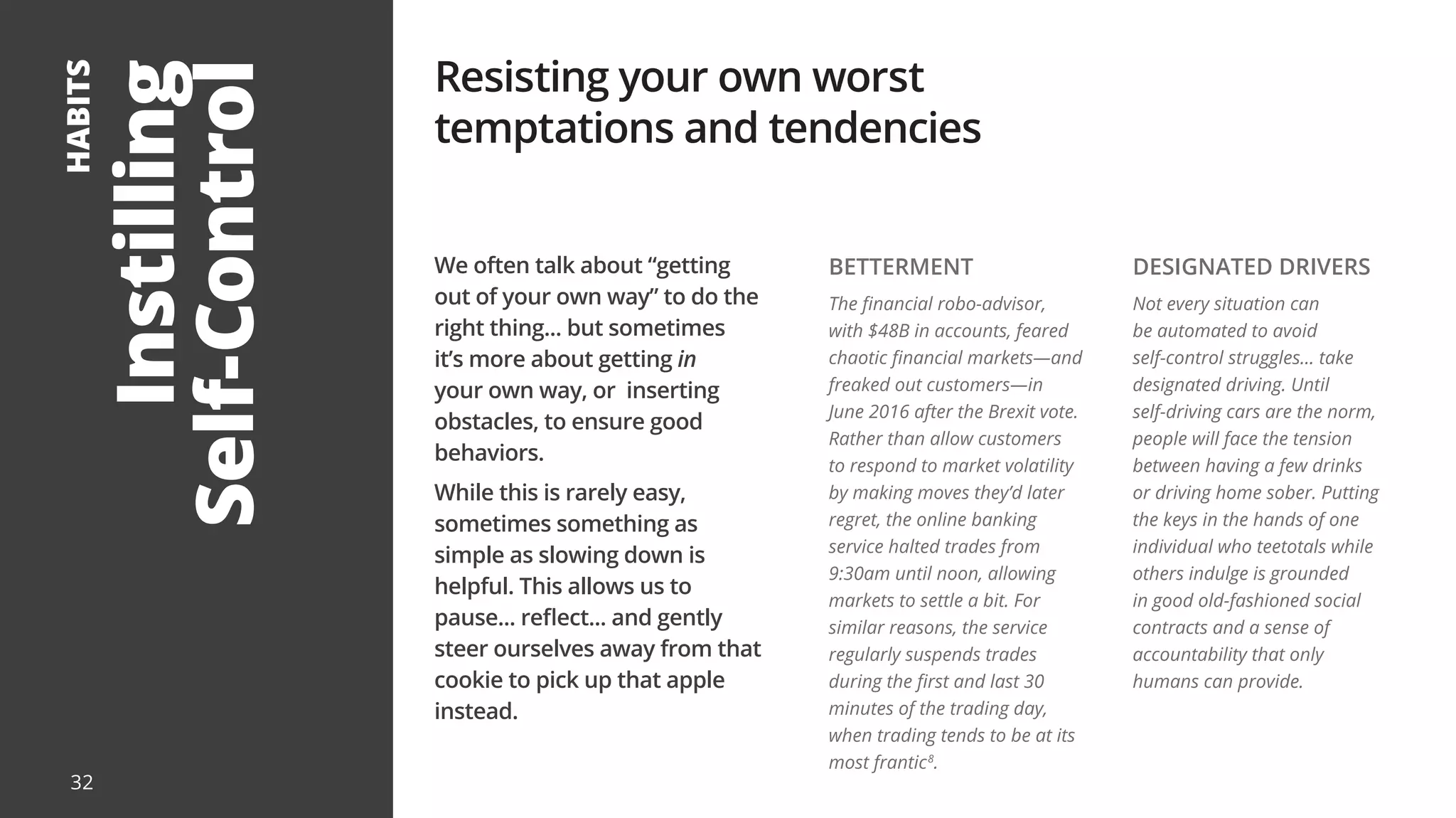
We often talk about “getting
out of your own way” to do the
right thing... but sometimes
it’s more about getting in
your own way, or inserting
obstacles, to ensure good
behaviors.
While this is rarely easy,
sometimes something as
simple as slowing down is
helpful. This allows us to
pause... reflect... and gently
steer ourselves away from that
cookie to pick up that apple
instead.
Resisting your own worst
temptations and tendencies
BETTERMENT
The financial robo-advisor,
with $48B in accounts, feared
chaotic financial markets—and
freaked out customers—in
June 2016 after the Brexit vote.
Rather than allow customers
to respond to market volatility
by making moves they’d later
regret, the online banking
service halted trades from
9:30am until noon, allowing
markets to settle a bit. For
similar reasons, the service
regularly suspends trades
during the first and last 30
minutes of the trading day,
when trading tends to be at its
most frantic8
.
DESIGNATED DRIVERS
Not every situation can
be automated to avoid
self-control struggles... take
designated driving. Until
self-driving cars are the norm,
people will face the tension
between having a few drinks
or driving home sober. Putting
the keys in the hands of one
individual who teetotals while
others indulge is grounded
in good old-fashioned social
contracts and a sense of
accountability that only
humans can provide.
32
INSTILLING
SELF-CONTROL
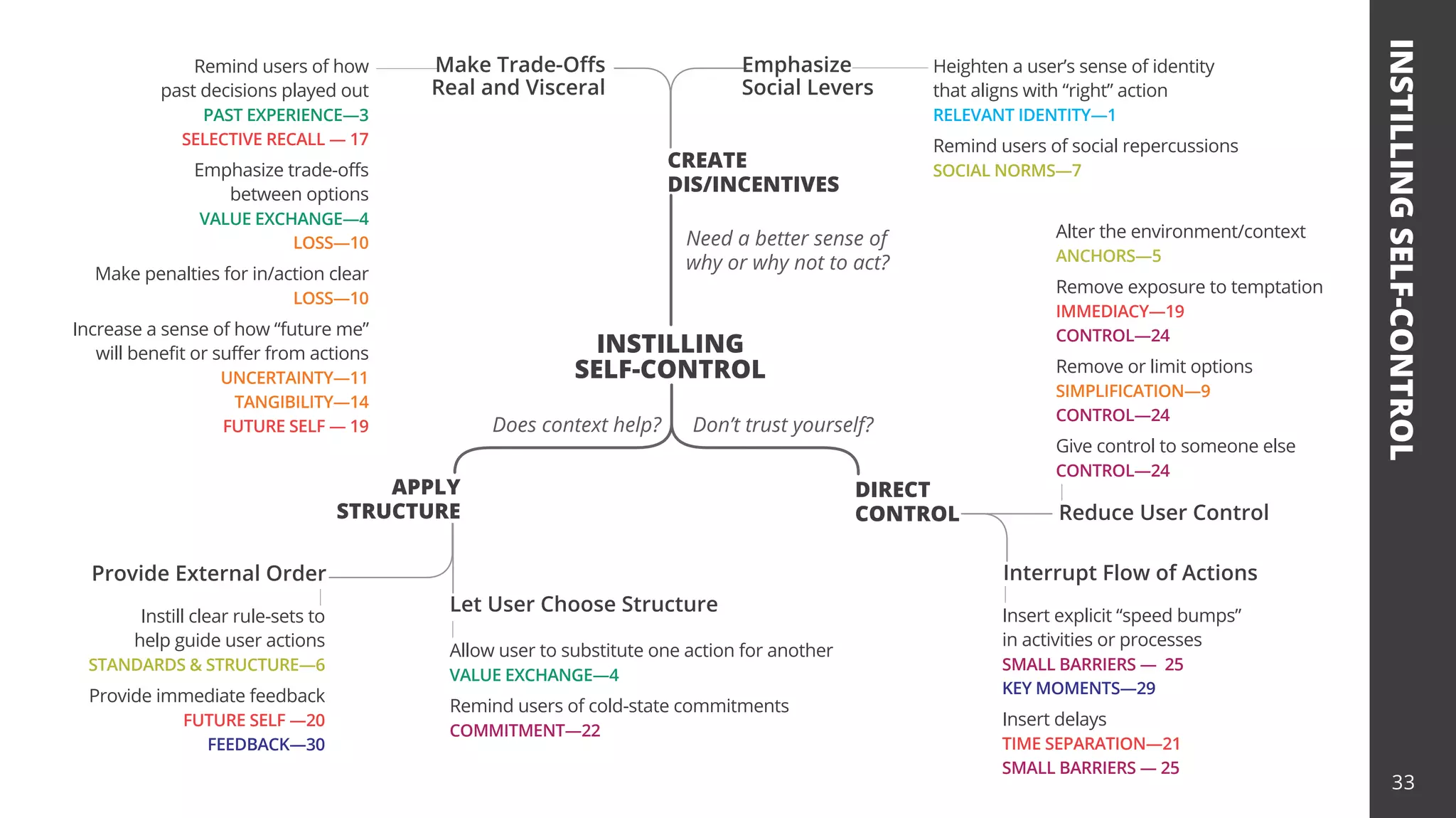
Remind users of how
past decisions played out
PAST EXPERIENCE—3
SELECTIVE RECALL — 17
Emphasize trade-offs
between options
VALUE EXCHANGE—4
LOSS—10
Make penalties for in/action clear
LOSS—10
Increase a sense of how “future me”
will benefit or suffer from actions
UNCERTAINTY—11
TANGIBILITY—14
FUTURE SELF — 19
Heighten a user’s sense of identity
that aligns with “right” action
RELEVANT IDENTITY—1
Remind users of social repercussions
SOCIAL NORMS—7
Provide External Order
Let User Choose Structure
Instill clear rule-sets to
help guide user actions
STANDARDS & STRUCTURE—6
Provide immediate feedback
FUTURE SELF —20
FEEDBACK—30
Allow user to substitute one action for another
VALUE EXCHANGE—4
Remind users of cold-state commitments
COMMITMENT—22
INSTILLING
SELF-CONTROL
APPLY
STRUCTURE
Does context help? Don’t trust yourself?
Insert explicit “speed bumps”
in activities or processes
SMALL BARRIERS — 25
KEY MOMENTS—29
Insert delays
TIME SEPARATION—21
SMALL BARRIERS — 25
DIRECT
CONTROL
Interrupt Flow of Actions
Reduce User Control
Alter the environment/context
ANCHORS—5
Remove exposure to temptation
IMMEDIACY—19
CONTROL—24
Remove or limit options
SIMPLIFICATION—9
CONTROL—24
Give control to someone else
CONTROL—24
CREATE
DIS/INCENTIVES
Need a better sense of
why or why not to act?
Make Trade-Offs
Real and Visceral
Emphasize
Social Levers
33
Making
Habits
Persist
HABITS
Popular wisdom says that
it take about 40-60 days to
effectively instill a new habit...
but what about day 200? Or
100? Or even day 61? For
people managing long-term
health conditions this question
is all too real.
Building truly “sticky” habits
means moving from manual
behavioral over-rides to
autopilot defaults, where
success takes the form of
prompts and feedback that
gradually become business
as usual.
Creating a level of stickiness to
help habits endure over time
WEIGHT WATCHERS
Appeals to social or
interpersonal motivators are
powerful... consider two people
who each make a resolution to
go to the gym more often. One
decides to go solo, while the
other makes the commitment
with a friend. Whom do you
think is more likely to keep at
it? Weight Watchers applies
these kinds of social pressures
in a positive way, using social
accountability and support to
supplement their well-known
point system for food selection
and portion size.
WORLD OF WARCRAFT
A game as an example of
successful habit formation
feels too easy... but WOW has
so successfully maintained a
long-term devoted audience
for good reason. What
contributes to such stickiness?
The sense of novelty within
a developing narrative
contributes peaks of urgency;
a rich parallel world allows
players to live out alternate
identities; accomplishments
are tangible and defined;
collaborative play scratches
social itches. All in all, a
potent combination.
34
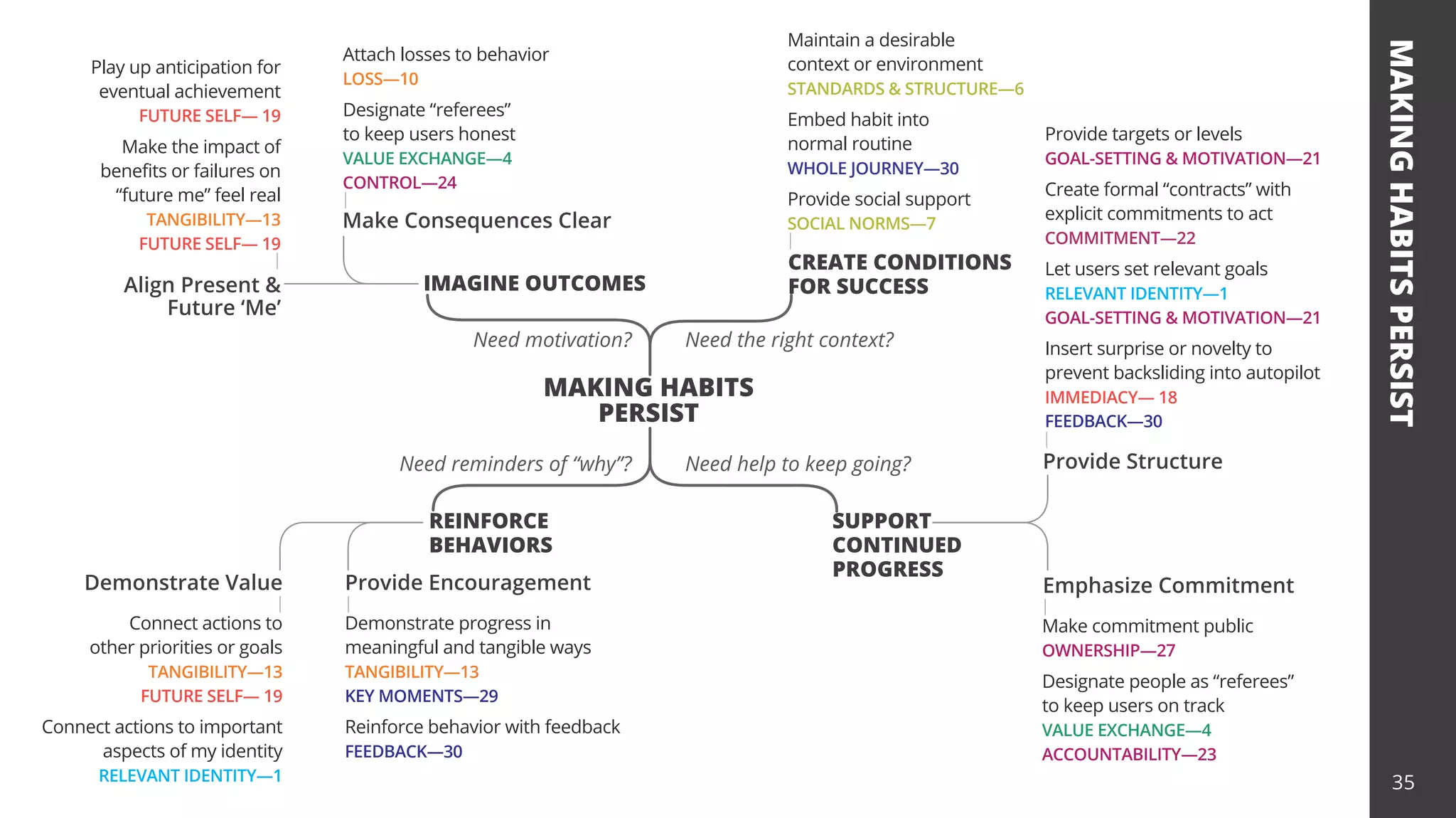
MAKING
HABITS
PERSIST
MAKING HABITS
PERSIST
Connect actions to
other priorities or goals
TANGIBILITY—13
FUTURE SELF— 19
Connect actions to important
aspects of my identity
RELEVANT IDENTITY—1
Play up anticipation for
eventual achievement
FUTURE SELF— 19
Make the impact of
benefits or failures on
“future me” feel real
TANGIBILITY—13
FUTURE SELF— 19
Attach losses to behavior
LOSS—10
Designate “referees”
to keep users honest
VALUE EXCHANGE—4
CONTROL—24
Maintain a desirable
context or environment
STANDARDS & STRUCTURE—6
Embed habit into
normal routine
WHOLE JOURNEY—30
Provide social support
SOCIAL NORMS—7
Demonstrate progress in
meaningful and tangible ways
TANGIBILITY—13
KEY MOMENTS—29
Reinforce behavior with feedback
FEEDBACK—30
Make commitment public
OWNERSHIP—27
Designate people as “referees”
to keep users on track
VALUE EXCHANGE—4
ACCOUNTABILITY—23
REINFORCE
BEHAVIORS
SUPPORT
CONTINUED
PROGRESS
Provide Encouragement Emphasize Commitment
Provide Structure
Demonstrate Value
CREATE CONDITIONS
FOR SUCCESS
Provide targets or levels
GOAL-SETTING & MOTIVATION—21
Create formal “contracts” with
explicit commitments to act
COMMITMENT—22
Let users set relevant goals
RELEVANT IDENTITY—1
GOAL-SETTING & MOTIVATION—21
Insert surprise or novelty to
prevent backsliding into autopilot
IMMEDIACY— 18
FEEDBACK—30
IMAGINE OUTCOMES
Need reminders of “why”?
Need motivation?
Need help to keep going?
Need the right context?
Make Consequences Clear
Align Present &
Future ‘Me’
35
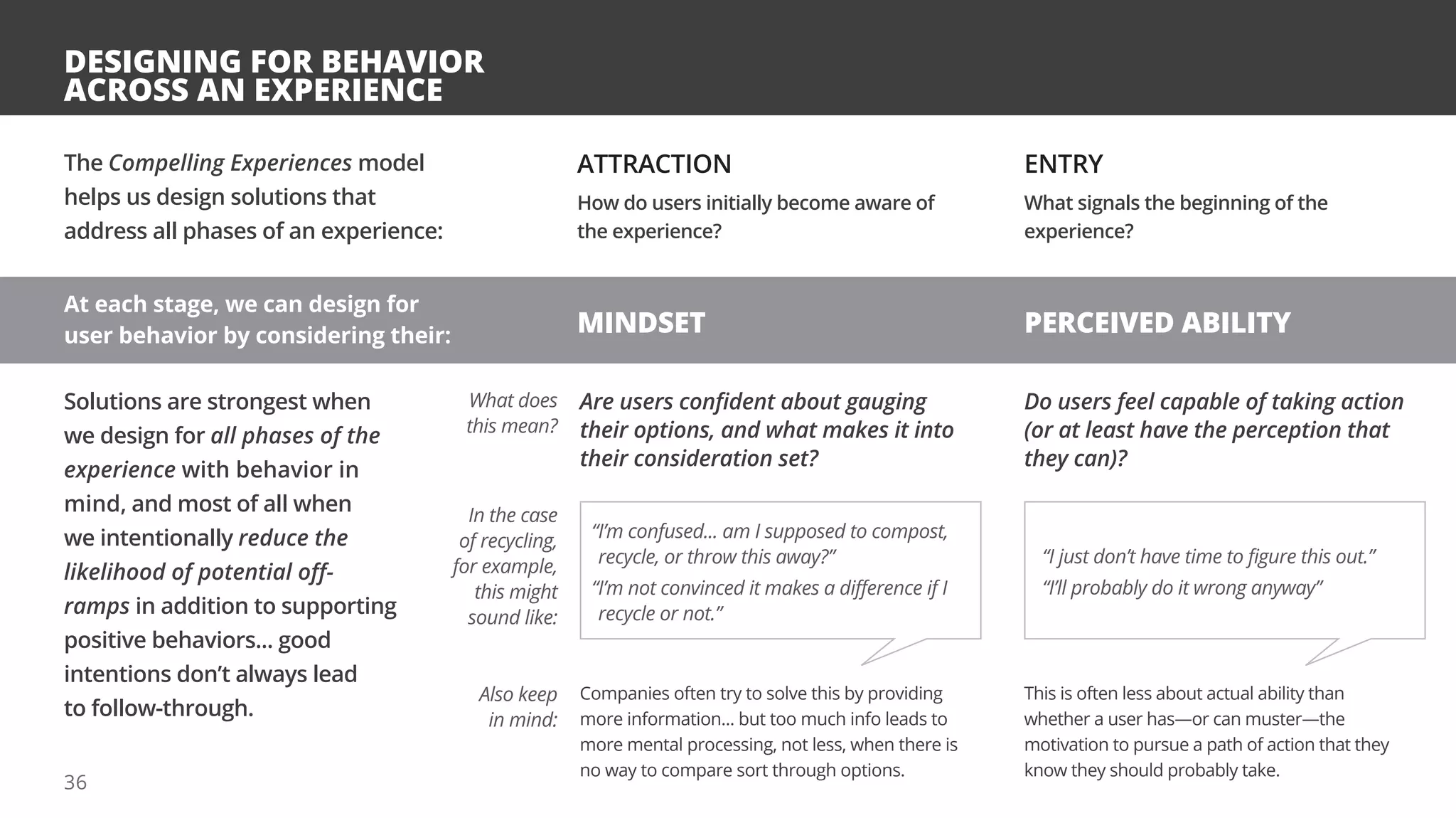
DESIGNING FOR BEHAVIOR
ACROSS AN EXPERIENCE
Are users confident about gauging
their options, and what makes it into
their consideration set?
Do users feel capable of taking action
(or at least have the perception that
they can)?
MINDSET
ATTRACTION
How do users initially become aware of
the experience?
PERCEIVED ABILITY
ENTRY
What signals the beginning of the
experience?
The Compelling Experiences model
helps us design solutions that
address all phases of an experience:
Solutions are strongest when
we design for all phases of the
experience with behavior in
mind, and most of all when
we intentionally reduce the
likelihood of potential off-
ramps in addition to supporting
positive behaviors... good
intentions don’t always lead
to follow-through.
At each stage, we can design for
user behavior by considering their:
Companies often try to solve this by providing
more information... but too much info leads to
more mental processing, not less, when there is
no way to compare sort through options.
This is often less about actual ability than
whether a user has—or can muster—the
motivation to pursue a path of action that they
know they should probably take.
“I just don’t have time to figure this out.”
“I’ll probably do it wrong anyway”
“
I’m confused... am I supposed to compost,
recycle, or throw this away?”
“
I’m not convinced it makes a difference if I
recycle or not.”
In the case
of recycling,
for example,
this might
sound like:
What does
this mean?
Also keep
in mind:
36
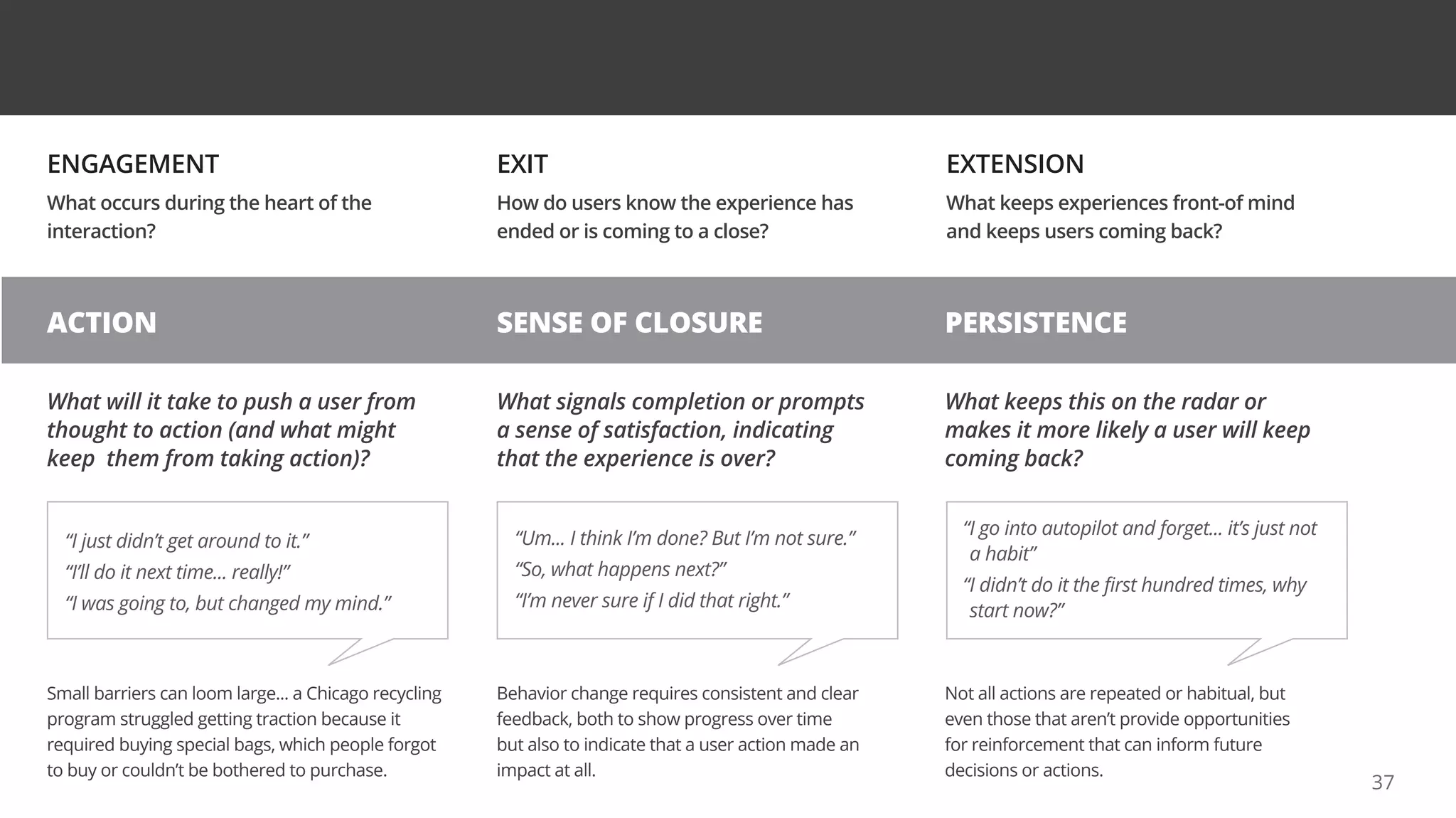
What will it take to push a user from
thought to action (and what might
keep them from taking action)?
What signals completion or prompts
a sense of satisfaction, indicating
that the experience is over?
What keeps this on the radar or
makes it more likely a user will keep
coming back?
ACTION
ENGAGEMENT
What occurs during the heart of the
interaction?
SENSE OF CLOSURE PERSISTENCE
EXIT
How do users know the experience has
ended or is coming to a close?
EXTENSION
What keeps experiences front-of mind
and keeps users coming back?
Small barriers can loom large... a Chicago recycling
program struggled getting traction because it
required buying special bags, which people forgot
to buy or couldn’t be bothered to purchase.
Behavior change requires consistent and clear
feedback, both to show progress over time
but also to indicate that a user action made an
impact at all.
Not all actions are repeated or habitual, but
even those that aren’t provide opportunities
for reinforcement that can inform future
decisions or actions.
“I just didn’t get around to it.”
“I’ll do it next time... really!”
“I was going to, but changed my mind.”
“
Um... I think I’m done? But I’m not sure.”
“So, what happens next?”
“I’m never sure if I did that right.”
“
I go into autopilot and forget... it’s just not
a habit”
“
I didn’t do it the first hundred times, why
start now?”
37
BEHAVIORAL CHALLENGES: ASSESSING OPTIONS
Navigating Choice
Overcoming Paralysis
In today’s complex world, information overload and anxiety around choosing the best
course of action is increasingly common. Too many options make users’ lives more
difficult rather than less; the uncertainty of comparing and selecting a “best option”
in response to a vast diversity of choices—whether of toothpaste, health plans, or
options on TV—transforms people’s ability to find just the right thing for me from a
benefit to a burden.
Users’ uncertainty about how choices they make will play out in the future only
heightens their anxiety about making bad decisions—as a result, paralysis sets in,
which often keeps them from taking any action at all.
FOR MORE INFORMATION
Barry Schwartz’s classic book
“The Paradox of Choice”
investigates how the sheer
number of options available
to us creates mental overload
and leads to less satisfying
decisions. Decisions made in
the absence of goals, structure,
and a means to evaluate
options increases anxiety and
regret about having made sub-
par choices—while consumer
goods are the book’s focus,
this same dynamic can be
readily applied to other
situations in which users have
difficulty assessing the options
before them.
38
BEHAVIORAL CHALLENGES: DECISION-MAKING
Navigating Impulsive Decisions
Dealing with Long-Term Implications
Grounding Abstract Consequences
Our inability to accurately envision the future creates a persistent struggle between
the very real, vivid, and immediate present and the abstract, distant, and unknowable
future.
As a result, short-term choices with long-term consequences often lead to “irrational”
decision-making: when users make decisions in the context of health care or financial
services, for example, they often overweight their present-tense interests (going
on a luxury vacation rather than saving for a rainy day, or eating an extra piece of
fried chicken) in ways that give their future selves the short end of the stick (meager
retirement savings, or an extra 10 pounds and an impending heart attack).
FOR MORE INFORMATION
Shlomo Benartzi and Allianz
have explored solutions
that align users’ “cold self”
planner mindsets with “hot
self” impulsiveness through
tools such as pre-commitment
contracts, or allowing users
to see an aged version of
themselves to increase their
tendency to contribute to
retirement savings at higher
rates.
39
BEHAVIORAL CHALLENGES: NEW BEHAVIORS
Trying Something New
Overcoming Distrust
Trying or adopting new behaviors can be difficult; simply weighing pros and cons is
challenging when there is little data from prior experiences or system of standards to
inform a decision. This can be amplified by strong demotivating effects of potentially
feeling stupid about making a poor choice.
In some cases a solution may be oriented toward removing roadblocks to adoption;
in others it may be about heightening an experience to truly differentiate and create
new expectations for engagement. Recognizing existing biases and mental shortcuts,
understanding active user identities, and removing the “small barriers” that get in the
way of actions all can be used to persuade people to try new things (and ideally create
a better, “stickier” experience that keeps them coming back).
FOR MORE INFORMATION
While some examples in John
Gourville’s 2004 article “Why
Consumers Don’t Buy: The
Psychology of New Product
Adoption” may feel dated, his
point—that adopting a new
offering typically requires a
consumer to give up something
known, proven and valuable for
something uncertain—still rings
true. The human tendency to
“loss version” (we hate losing
more than we like to gain a
commensurable amount)
means that any new experience
likely faces a larger uphill battle
than we might initially suspect
or plan for.
40
BEHAVIORAL CHALLENGES: TAKING CARE OF BUSINESS
Conquering Inertia
Sticking with It
Closing the Loop
Sometimes the biggest challenges come in small packages: simply never getting
around to doing things you know you really should do. Starting to do the taxes,
rescheduling that doctor’s appointment that’s long overdue, finishing the novel you
promised your friend you’d read... none are game-changers, but our tendencies
toward inertia, distraction, and inaction kick in nonetheless.
The idea of “nudging” has provided useful prompts for these everyday hurdles:
making forms one page instead of two and using simpler language can dial down our
instinctive response to continually put it off, or simple reminders can return an item
to the top of the mental to-do list and keep it from slipping indefinitely out-of-sight,
out-of-mind.
FOR MORE INFORMATION
Richard Thaler and Cass
Sunstein’s “Nudge: Improving
Decisions About Health,
Wealth, and Happiness,”
popularized the concept of
“nudges” in smart behavioral
design. By recognizing triggers
and incentives that motivate
user action, they propose a
variety of strategies to gently
guide people to do the “right”
thing.
41
BEHAVIORAL CHALLENGES: HABITS
Developing  Breaking Habits
Instilling Self-Control
Making Habits Persist
Humans have an enormous amount of difficulty enforcing or maintaining changes to
their own behavior, and many behavioral challenges are grounded in peoples’ inability
to align what they want to do with what they actually do.
The ability to successfully help new habits take root is at the core of many desirable
behaviors in management of health and well-being, such as new diet or exercise
regimens. Thoughtful applications of social pressure, proper cues and scaffolding of
the user’s environment, reinforcement of “good behavior” and real repercussions
for falling off the wagon can more reliably and effectively instill long-term behavioral
change.
FOR MORE INFORMATION
In a series of case studies
across multiple industries,
Charles Duhigg’s 2012
book “The Power of Habit”
dissects the ways in which a
behavioral cycle—cue, routine,
reward—can effectively tackle
the difficult challenge of
introducing and reinforcing
new habits or breaking
old ones. With a focus on
motivators and feedback, he
indicates how this model can
be successfully applied to
situations in both business and
in regular life.
42
References
1. A Better Choosing Experience. Iyengar, S.  Agrawal, K. Strategy  Business. Issue
61 Winter 2010
2. http://money.cnn.com/2011/03/30/autos/hyundai_job_loss_buy_back/
3. Datamonitor Pantene Case Study, published July 2010. http://acervo-digital.espm.
br/cases/306396.pdf
4. http://www.bloomberg.com/news/articles/2015-08-07/look-how-much-your-
peers-are-saving-for-retirement-you-loser-
5. http://newsroom.bankofamerica.com/press-releases/consumer-banking/new-
merrill-edge-mobile-app-uses-3d-technology-put-retirement-planni
6. Save More TomorrowTM: Using Behavioral Economics to Increase Employee
Saving. Richard H. Thaler, Shlomo Benartzi, July 2003
7. http://www.economist.com/blogs/freeexchange/2011/07/public-transport
8. http://www.wsj.com/articles/robo-adviser-betterment-suspended-trading-
during-brexit-market-turmoil-1466811073
43
As used in this document, “Doblin” means an innovation practice within
Deloitte Digital LLP, a subsidiary of Deloitte LLP. Please see www.deloitte.com/
us/about for a detailed description of the legal structure of Deloitte LLP and
its subsidiaries. Certain services may not be available to attest clients under
the rules and regulations of public accounting.
This communication contains general information only, and none of Deloitte
Touche Tohmatsu Limited, its member firms, or their related entities
(collectively, the “Deloitte Network”) is, by means of this communication,
rendering professional advice or services. Before making any decision or
taking any action that may affect your finances or your business, you should
consult a qualified professional adviser. No entity in the Deloitte Network
shall be responsible for any loss whatsoever sustained by any person who
relies on this communication.
Copyright © 2017 Deloitte Development LLC. All rights reserved.
Doblin is one of the world’s leading design-driven
innovation practices.
Taking a user-centric, systematic approach, our
multi-disciplinary teams combine deep experience
in strategy, research, and design to help clients set
innovation strategy; to design, build, and launch
bold breakthroughs; and to become more effective
innovators.
Headquartered in Chicago with offices in New
York, Toronto, Portland, Boston, Delhi, Hamburg,
and London, Doblin is part of Deloitte Digital LLP.
www.doblin.com
@DoblinGlobal
Doblin-BehavioralDesign-UserGuide.pdf

Doblin-BehavioralDesign-UserGuide.pdf

  • 2.
  • 3.
    What is BehavioralDesign? 2 Seven key factors 4 Behavioral tactics 6 Using behavioral challenges in user-centered design 8 Navigating Choice Dealing with choice and information overload 10 Overcoming Paralysis Figuring out and acting on the best path forward 12 Navigating Impulsive Decisions Tempering tendencies to instinctively go with your gut 14 Dealing with Long-Term Implications Solving for decisions made now that play out in the future 16 Grounding Abstract Consequences Making abstract outcomes feel more tangible and actionable 18 Trying Something New Getting over the anxiety of climbing a learning curve or feeling inept 20 Assessing Options Decision-making New Behaviors Common challenges Definitions Getting started
  • 4.
    Overcoming Distrust Reducing skepticismthat prevents or limits engagement 22 Conquering Inertia Taking that first step when “I know I should, but I just don’t feel like it” 24 Sticking with It Persevering in the face of obstacles or when initial interest fades 26 Closing the Loop Getting to closure by crossing that thing off the to-do list for good 28 Developing & Breaking Habits Starting good habits and breaking bad ones 30 Instilling Self-Control Resisting your own worst temptations and tendencies 32 Making Habits Persist: Creating a level of stickiness to help habits endure over time 34 Considering behaviors across experiences 36 About the behavioral challenges 38 References 43 Taking Care of Business New Behaviors, cont. Habits For more information
  • 5.
    2 Behavioral design combineskey principles of behavioral economics with user insights and business context to help de-risk innovation and increase user adoption.
  • 6.
    3 While there’s nosuch thing as a sure bet, behavioral design can take ideas that look smart on paper and kick the tires by applying a deep knowledge of how people actually behave, rather than what we think they will (or even what they themselves swear they will) do. This field of thought grew from the recognition that we’re not always rational about decisions, don’t have all the information we need to make informed choices, and often don’t do things in our own best interest due to processing “errors” in our brains, which result in predictable— and seemingly “irrational”— behaviors. Doblin combines a design perspective with business chops and a demonstrated track record of helping major companies across industries launch innovations into the market. Where behavioral economics illustrates known tendencies about being human that have not changed for thousands of years, user research insights tell us about user needs in the here and now... the itch to see progress is forever, but the urge to hit 20,000 steps on an exercise app is very much about life today. Dozens of cognitive biases exist, but knowing the definition of, say, “confirmation bias” is only a starting point. Behavioral design has been intentionally constructed as an application-oriented approach for user- centered problem- solving, not just a list of biases or fun facts.
  • 7.
    KINSHIP & SELF TIME DISTORTION INFLUENCES EXPECTATIONS EXPERIENCE FRAMING BARRIERS & ENABLERS 4 SEVENBEHAVIORAL FACTORS Four decision-making phases ground seven key Behavioral Factors: IDENTITY How do I see myself? What groups do I align with? What’s important to me? PRECONCEPTIONS What have I seen or heard? What feeds my thinking? What are my reference points? REFLECTION How did that feel? What did I learn? What was memorable? ASSESSMENT What gets my attention? What wins out? What can I actually do?
  • 8.
    5 PRECONCEPTIONS ASSESSMENT IDENTITY REFLECTION FRAMING Theways in which choices are presented The language, order, and context of choices creates (or hides) a sense of user options. TACTICS 9-16 TIME DISTORTION People over-value the present and poorly envision the future A user’s present context dominates, and the future always comes faster than we think. TACTICS 17-20 KINSHIP & SELF A person’s sense of self, both individually and socially A user’s sense of “who I am” (or want to be) at any given time informs their decisions. TACTICS 1-2 BARRIERS & ENABLERS Hindering and empowering peoples’ ability to make choices or reach goals A user’s desire to take action is easily derailed by barriers that get in the way. TACTICS 21-27 EXPECTATIONS The attitudes and presumptions that people bring from prior experience Personal experience and values illuminate the paths that users are more likely to take. TACTICS 3-4 EXPERIENCE The structure, sequencing, and feedback delivered during an interaction Playing up experiential peaks and providing feedback helps make sense of it all for users. TACTICS 28-30 INFLUENCES The social norms and cultural forces that shape a person’s beliefs Considering external guides and norms provides insights into user influences. TACTICS 5-8
  • 9.
    BEHAVIORAL TACTICS Experience Kinship &Self Expectations Influences Framing Time Distortion Barriers & Enablers 5–Anchors 21–Goal-Setting & Motivation 28–Whole Journey 3–Past Experience 1–Relevant Identity 9–Simplification 6–Standards & Structure 22–Commitment 29–Key Moments 4–Value Exchange 2–New Identity 10–Loss 17–Selective Recall 18–Immediacy 7–Social Norms 8–Exposure to Examples 23–Accountability 24–Control 30–Feedback 11–Uncertainty 12–Probability & Data 19–Future Self 20–Time Separation
  • 10.
    25–Small Barriers 27–Ownership 26–Behavioral Modeling 13–Tangibility15–Mental Models 14–Defaults 16–Mental “Accounts” 7 More detail on each of these tactics can be found in the companion toolkit cards.
  • 11.
    8 HOW DO IUSE THE BEHAVIORAL CHALLENGES? Across industries and situations, we tend to see certain behavioral challenges trip users up again and again. Because the concepts in this toolkit can be applied to virtually any situation in which humans make decisions, you can use these Challenges in combination as a way to jump start problem- solving. Coming out of user research—or simply based on knowledge of decision-making based on prior cases—you can start to identify issues to solve for. For example, an insurance company that is trying to help their customers navigate a bewildering array of choices with no clear path forward, and temper their tendencies to lurch at products they already know rather than what’s most fitting—all while battling customers’ inherent distrust of the insurance industry— may have to consider and solve for multiple challenges: Navigating Choice + Overcoming Paralysis + Navigating Impulsive Decisions + Grounding Abstract Consequences + Trying Something New + Overcoming Distrust + Instilling Self-Control
  • 12.
    9 Each user challengeis detailed within this guide, allowing you to work from “inside-out” to explore: • typical situations that tend to derail users • behavioral strategies to help address them • examples of specific approaches and related relevant tactics The numbered references refer to individual Behavioral Design toolkit cards, each of which contains more tactics and things to consider when building solutions.
  • 13.
    10 Navigating Choice ASSESSING OPTIONS The downside ofliving in our current world of endless choice and personalization is the need to choose constantly... the sheer variety of options is exhausting and hard to navigate at best, and at worst leads us to make no choice at all. Sometimes this hardly matters— one toothpaste isn’t that much better than another—but when it comes to other more critical decision- making, the ability to make a choice confidently is worth its weight in gold. Dealing with choice and information overload HIPMUNK This online flight search engine provides the ability to sort and visualize multiple dimensions of data about flights to glean more meaningful and easy-to-compare information. In addition to traditional attributes like cost and departure time, Hipmunk allows users to sort options by “agony,” which combines lengthy flight duration, layovers, early morning departures and late night arrivals to provide a more human measure of cost, thus arming users with the information they really care about when booking flights. WEGMAN’S As explored in a 2010 study about choice, while the number of magazines available at various Wegmans supermarket branches ranged from 331 to 664, this number seemed to have no effect on buyer satisfaction. What mattered was the number of categories, such as “Health & Fitness” and “Home & Garden,” that each display provided. A wider range of subheadings created the perception that the store offered more choice, even when the number of magazine titles was comparatively small1 .
  • 14.
    11 NAVIGATING CHOICE NAVIGATING CHOICE SIMPLIFY DECISION-MAKING Simply overwhelmed? Can’t seemto prioritize? Hesitant to commit? Streamline Process DEMONSTRATE VALUE OF OPTIONS REDUCE UNCERTAINTY Indicate how this instance of choice- making parallels prior situations PAST EXPERIENCE—3 Minimize the number of steps required to make a decision SIMPLIFICATION—9 MENTAL MODELS—15 Store information to help inform subsequent choices SIMPLIFICATION—9 SMALL BARRIERS—25 Remove the user’s need to choose at all CONTROL—24 Provide standards or examples that illustrate an established way to gauge value STANDARDS & STRUCTURE—6 Rank options according to meaningful prioritization scheme STANDARDS & STRUCTURE—6 Instill Structure Indicate how some options are more aligned with important aspects of personal identity RELEVANT IDENTITY—1 Provide structure (e.g. categorization, order) to reduce mental overload STANDARDS & STRUCTURE—6 SIMPLIFICATION—9 Reduce number of options SIMPLIFICATION—9 Show users how others like them have chosen RELEVANT IDENTITY—1 Remind users of past experiences PAST EXPERIENCE—3 Supply or point to external reference points ANCHORS—5 EXPOSURE TO EXAMPLES—8 Make the value of choices and outcomes concrete UNCERTAINTY—11 TANGIBILITY—13 Provide a guarantee regardless of outcome UNCERTAINTY—11 Point to Examples Show Relative Worth
  • 15.
    Sometimes people know fullwell that they need to make a decision, but the sheer amount of information to process and the need to compare and prioritize feels utterly overwhelming, resulting in paralysis that is difficult to overcome. This can occur most painfully when people are dealing with information or experiences with which they have little practice... especially when important outcomes hang in the balance. 12 Overcoming Paralysis ASSESSING OPTIONS Figuring out and acting on the best path forward HYUNDAI With 2008’s economy in a downturn and no financing arm through which to offer creative financial terms, Hyundai introduced the Assurance program: anyone who bought a car and lost their job could return the vehicle, with the company picking up the difference in purchase price. They sold 435,000 vehicles in 2009—an 8% increase when other automakers were posting sharp declines—in part simply by removing fear of job loss from the equation2 . PANTENE SHAMPOO Recognizing the need to readjust their approach to increase market share, P&G conducted user research on shampoo selection. The findings informed a new strategy, in which the company radically simplified the hair product’s line-up — Fine, Normal/Thick, Curly, and Colored—to address the fact that less choice, not more, was desirable to consumers in a situation where the proliferation of options felt overwhelming than delightful3 .
  • 16.
    OVERCOMING PARALYSIS OVERCOMING PARALYSIS Reduce time todecide IMMEDIACY—18 Make it too easy not to do SMALL BARRIERS—25 Increase a user’s sense of expertise or ownership RELEVANT IDENTITY—1 OWNERSHIP—26 Prevent users from feeling dumb RELEVANT IDENTITY—1 Make commitment or decision in “cold state” COMMITMENT—22 Let someone/something else make the decision for me CONTROL—24 Provide “opt-out” option to remove the need to act CONTROL—24 Remind users of past decisions PAST EXPERIENCE—3 Provide guarantees UNCERTAINTY—11 Make the value of choices and outcomes concrete TANGIBILITY—13 REMOVE BARRIERS HEIGHTEN DIS/INCENTIVES Take Control Away Make it Personal Simplify Structure Work with User Assumptions Reduce Friction REDUCE UNCERTAINTY Help users internalize a sense of “what good looks like” MENTAL MODELS—15 “Bucket” options into chunks that align with how users already think MENTAL “ACCOUNTS”—16 Provide criteria to compare or prioritize options STANDARDS & STRUCTURE—6 Reduce the number of options to simplify choice SIMPLIFICATION—9 REDUCE MENTAL PROCESSING Instill penalties for inaction LOSS—10 Increase a sense of urgency (e.g. scarcity, relative ranking) VALUE EXCHANGE—4 LOSS—10 PROBABILITY & DATA—12 Make the social implications of not following through more undesirable SOCIAL NORMS—7 LOSS—10 Raise the Stakes Can’t seem to commit? Don’t feel any urgency? Need clarity of value? Can’t think straight? 13
  • 17.
    Navigating Impulsive Decisions DECISION-MAKING Making an impulsivedecision is not, by itself, a bad thing... sometimes, in fact, it’s best not to overthink things, just to go with your instincts and not look back. At other times, our basic human tendencies almost guarantee that we’ll suffer down the road if we make an unconsidered choice without the benefit of clear pros and cons, a concrete sense of potential outcomes, and self- control measures that help protect us from ourselves. Tempering tendencies to instinctively go with your gut GMAIL GOGGLES In 2008, Google launched Gmail Goggles to save users from their worst impulses: sending “why did I send that?” emails. This feature forced gmailers to answer a series of math problems correctly before releasing emails into the ether, tackling impulsive urges in two ways: failing the “math test” automatically held emails back until the next day, but the delay and resulting reflection built into wrestling with math also tended to feed the realization that maybe it wasn’t such a bad idea to not press send. COLD TURKEY It’s hard to remember when a physical credit card—and not an online account—used to be required for purchases. One strategy to reduce impulse buying involved putting credit cards in a bowl of water stored in the freezer: removing the ice to retrieve the card prevented its use in all but the most grave situations. Services like Cold Turkey serve a similar purpose today, letting users voluntarily “freeze” internet access to keep them from checking Facebook or browsing the web. 14
  • 18.
    NAVIGATING IMPULSIVE DECISIONS Create or enforcerules and policies that help guide user actions STANDARDS & STRUCTURE—6 Show how actions may result in downstream domino or ripple effects STANDARDS & STRUCTURE—6 Emphasize likelihood and trade- offs between options VALUE EXCHANGE—4 LOSS—10 PROBABILITY & DATA—12 Make penalties for action clear and consistent LOSS—10 Demonstrate the potential future outcomes of choices UNCERTAINTY—11 TANGIBILITY—13 Increase empathy for “future me” FUTURE SELF — 19 Heighten a user’s sense of identity that aligns with “better” choice RELEVANT IDENTITY—1 Remind users of past decisions PAST EXPERIENCE—3 SELECTIVE RECALL — 17 Use social pressure to spur action SOCIAL NORMS—7 Clearly articulate evidence to support pros and cons of options LOSS—10 Focus On Future Outcomes Focus On Present Tense Take User Control Away Emphasize Barriers Force commitment or decision in “cold state” COMMITMENT—22 Automate actions CONTROL—24 Delegate decision-making to someone CONTROL—24 Reduce exposure to temptation CONTROL—24 Insert explicit “speed bumps” in processes SMALL BARRIERS — 25 KEY MOMENTS—29 CREATE DIS/INCENTIVES NAVIGATING IMPULSIVE DECISIONS DIAL UP CONTROL EMPHASIZE STRUCTURE Need to remind yourself why (or why not) to take action? Don’t trust yourself? Would rules help? 15
  • 19.
    12 FACE RETIREMENT Bank ofAmerica’s online discount brokerage service Merrill Edge was able to make the future feel real for people in a surprising way: their “Face Retirement” program digitally “ages” an image of a user’s face as a 3D moving image, and accompanies this with statistics that project future prices of household staples like milk and utilities. In combination, these tactics concretize the future, and the program has been shown to prompt 60% more people to investigate retirement options5 . Dealing with Long-Term Implications DECISION-MAKING Our inability to confidently know what the future holds interferes with decisions, mostly in which actions made now have massive implications down the road. We frequently see this in financial services and health care, for example, where not socking away money today means a endlessly deferred retirement, or when giving in to temptation curses our future selves with saggier and more unhealthy versions of us. Solving for decisions made now that play out in the future EMPOWER RETIREMENT Empower Retirement’s “How Do I Compare” tool gives users the ability to compare their contribution rate and balance against average peers—as well the top 10 percent— with the same gender, age and approximate income. In one sample, after using the tool 5,000 out of 30,000 participants increased their monthly retirement account contribution by 25 percent: higher saving for the future was inspired less by looking forward than by wanting to be top tier right now4 . 16
  • 20.
    DEALING WITH LONG-TERM IMPLICATIONS 17 Make criteria forcomparison clear STANDARDS & STRUCTURE—6 Simplify descriptions and number of options SIMPLIFICATION—9 Show model for how to act BEHAVIORAL MODELING—26 DEALING WITH LONG- TERM IMPLICATIONS Force user commitment or decisions in a “cold state” COMMITMENT—22 Delegate decision-making to someone else CONTROL—24 Apply smart defaults or opt-out CONTROL—24 Automate actions CONTROL—24 Show users how “people like you” tend to act SOCIAL NORMS—7 Make penalties for inaction visceral and immediate LOSS—10 Remind users of their commitments COMMITMENT—22 Identify or designate “referees” you don’t want to let down ACCOUNTABILITY—23 Take Control Away Play out implications of alternate paths TANGIBILITY—13 Heighten empathy for your future self FUTURE SELF—19 Show progress to real, concrete and meaningful things TANGIBILITY—13 FEEDBACK—30 Incent Behavior FORCE ACTION Make Progress Present-Tense Make Future Seem Real MAKE IT FEEL WORTHWHILE PROVIDE STRUCTURE Need an extra push to do the “right” thing? Need clarity of value? Need more structure?
  • 21.
    Grounding Abstract Consequences DECISION-MAKING “Health,” “retirement,” “success”... allgood words, yet ask a bunch of folks what each means to them and they will likely have a range of notions in mind. These types of abstract ideas are difficult for users to articulate, or even envision, which makes it harder to take action. Helping abstractions feel real and present-tense can aid users in getting their heads around these foggy ideas, in turn makes it easier to make smart decisions. Making abstract outcomes feel more tangible and actionable TRUNKCLUB Even for savvy clothing shoppers it’s time-consuming and can be hassle to go to multiple stores and try on options, and online shopping often means flying blind. Trunk Club can’t try on clothes for you, but their service selects and curates clothing options with your taste in mind, sends them directly to your home to try (and hopefully purchase), helping to craft a new, more professional version of the “you” you always wanted in a fraction of the time and effort. OPOWER Since 2007, Opower (now owned by Oracle) has supported utility industry companies and their customers by using behavioral economics principles to encourage energy savings. Unlike computers and refrigerators, “energy” is an abstract concept that’s hard to motivate around, but Opower’s ability to leverage positive social pressure, framing, anchoring, and feedback have helped millions of people better understand— and change—their energy consumption behaviors. 18
  • 22.
    GROUNDING ABSTRACT CONSEQUENCES GROUNDING ABSTRACT CONSEQUENCES Explicitly connectactions to desired future states RELEVANT IDENTITY—1 FUTURE SELF—19 Remind users of past experiences PAST EXPERIENCE—3 MENTAL MODELS—15 SELECTIVE RECALL — 17 Point to others who have made similar choices or taken similar actions ANCHORS—5 EXPOSURE TO EXAMPLES—8 Guarantee results UNCERTAINTY—11 Demonstrate the actual consequences of actions TANGIBILITY—13 Make the connection between actions and results clear and direct KEY MOMENTS—29 FEEDBACK—30 Make It Relatable Make the Future Seem Real CLARIFY CONNECTIONS FOCUS ON NEXT STEPS APPLY STRUCTURE Need to connect the dots? Need to reduce distractions? Need more structure? Provide external reference points ANCHORS—5 EXPOSURE TO EXAMPLES—8 Provide a larger sense of context STANDARDS & STRUCTURE—6 PROBABILITY & DATA—12 Give, or allow users to give up, control over outcomes COMMITMENT—22 CONTROL—24 Clarify what it takes to do the next thing only SIMPLIFICATION—9 GOAL-SETTING & MOTIVATION—21 ACCOUNTABILITY—23 BEHAVIORAL MODELING—26 Focus on immediate actions to drive progress SELECTIVE RECALL — 17 IMMEDIACY—18 19
  • 23.
    Trying Something New NEW BEHAVIORS When was thelast time you truthfully said “I love feeling stupid and ill-informed!”... yet we’re often required to do things with limited (or no) previous experience to serve as a guide. This is especially uncomfortable when stakes are high... being forced to make a choice with big implications puts users in an unenviable role, and often leads to anxiety and paralysis. Getting over the anxiety of climbing a learning curve or feeling inept ZAPPOS Online retailer Zappos has become a fan favorite by flipping expectations of online shopping: easy returns for shoes that don’t work out, and positive customer service experiences that counter the norms of endless phone call runarounds or pleading to talk to supervisors when things go wrong. By solving for these classic roadblocks and reducing—even eliminating— potential downsides, they make it easy and appealing to do what used to seem unthinkable: ordering shoes online, sight unseen. PIRCH With the “aha” that people don’t really care about a stove’s BTUs—they just want to know if it can make Grammy’s cookies—Pirch CEO Jeffery Sears has oriented this appliance company’s customer engagement strategy in delivering signature experiences to shoppers. That cookie recipe? Provide it in advance and they’ll purchase the ingredients so you can bake them on-site... you can even make an appointment to privately enjoy and test-drive their steam shower. 20
  • 24.
    TRYING SOMETHING NEW TRYING SOMETHING NEW Keep mefrom feeling dumb RELEVANT IDENTITY—1 Provide guarantees UNCERTAINTY—11 Indicate the “right” way” to act BEHAVIORAL MODELING—26 Build on existing behaviors SIMPLIFICATION—9 BEHAVIORAL MODELING—26 Make it too easy not to do SIMPLIFICATION—9 SMALL BARRIERS—25 Provide a head start IMMEDIACY—18 OWNERSHIP—27 Let me practice or try things out first UNCERTAINTY—11 OWNERSHIP—27 Provide timely and relevant feedback FEEDBACK—30 Show how acting reinforces identity RELEVANT IDENTITY—1 NEW IDENTITY—2 Make benefits tangible and clear EXPOSURE TO EXAMPLES—8 TANGIBILITY—13 Compare to familiar examples MENTAL MODELS—15 DE-RISK ACTION FORCE ACTION Provide Encouragement Grease the Wheels Make It Feel Safe DEMONSTRATE VALUE OF ACTING Point to social implications SOCIAL NORMS—6 Increase sense of urgency (e.g. scarcity, time pressure) IMMEDIACY—18 Emphasize potential losses for inaction LOSS—10 CREATE DIS/INCENTIVES Make commitment or decision in “cold state” COMMITMENT—22 Let someone/something else make the decision for me CONTROL—24 Remove Control Fear of feeling dumb? Just can’t make yourself do it? Skeptical of value? Need more motivation? 21
  • 25.
    Overcoming Distrust NEW BEHAVIORS As logical aswe think we are, we’re heavily influenced by our emotions about the options in front of us. These stakes can be heightened when negative emotions like anxiety and distrust are present—it doesn’t take a lot for us to distrust brands, offerings, or companies based on anecdotal and sketchy information, and these emotions can easily smother more logical decisions or a more reasoned approach. Reducing skepticism that prevents or limits engagement ANGIE’S LIST Founded in 1995, Angie’s List remains a go-to resource for previewing the quality and reliability of consumer services, from home and lawn care to health care. By leveraging the power of crowd feedback and ratings—even more so as of July 2016, when entry tier membership became free to encourage broader participation—these first- person reviews make potential consumers more confident, and reduce the likelihood of costly or stressful mistakes. DIVA CUP There are some things people just don’t talk about... like periods. This makes introducing new products an uphill battle, but menstrual cup companies like Diva Cup have tapped into a grassroots online community of converts to amplify what used to be girlfriend-to-girlfriend word of mouth. In doing so, they help new users navigate a wide array of choices through practical, no-nonsense advice; as a result, they have boosted millions of women’s trust in an unfamiliar option to deal with the monthlies. 22
  • 26.
    OVERCOMING DISTRUST OVERCOMING DISTRUST RE-EXAMINE ASSUMPTIONS Want to question implicitbeliefs? Need to confirm value? Want reinforcing opinions? Challenge External Norms DEMONSTRATE PROOF OF VALUE APPEAL TO TRUSTED SOURCES Examine the credibility of evidence or external sources of expertise STANDARDS & STRUCTURE—6 Demonstrate how social influences may be impacting perceptions SOCIAL NORMS—7 Compare pros and cons of alternate options EXPOSURE TO EXAMPLES—8 Provide actual stories from the past or present EXPOSURE TO EXAMPLES—8 TANGIBILITY—13 Let me “try before I buy” OWNERSHIP— 27 Question My Own Sensibility Identify how users’ own sensibilities may be getting in their way RELEVANT IDENTITY—1 Help users “unpack” past experiences that are contributing a lot of influence PAST EXPERIENCE—3 Identify baseline assumptions about worth ANCHORS—5 Examine how mis-perceptions of data or probability might influence decision-making PROBABILITY & DATA—12 Communicate the value—both benefits and losses—of participating v. not VALUE EXCHANGE—4 LOSS—10 Supply or point to external reference points ANCHORS—5 STANDARDS & STRUCTURE—6 See what “people like me” have done RELEVANT IDENTITY—1 UNCERTAINTY—11 Look to unbiased authorities UNCERTAINTY—11 FEEDBACK—30 Understand Relative Worth Use Examples as Evidence See For Myself 23
  • 27.
    Conquering Inertia TAKING CARE OF BUSINESS Some behaviors aremore or less forced upon you—blowing off work isn’t really an option, no matter how much you’d rather turn off the alarm clock and get some more zzzs. With other things, though, it’s far too easy to push “I know I should” behaviors off: procrastinating on taxes is easy when April 15th feel endlessly far away, and scheduling that dentist appointment just never feels as pressing as activities with more immediate deadlines. Taking that first step when “I know I should, but I just don’t feel like it” MARIE KONDO Decluttering and tidying one’s household doesn’t sound that hard... but our emotional attachment to a lifetime’s worth of accumulated stuff can make it seem insurmountable. Marie Kondo has launched an empire by helping millions say goodbye—both physically and emotionally—to households worth of items through a systematic approach that takes our affection for things seriously and shifts the mental model of “cleaning” into a ritual and belief system rather than a chore. SAVE MORE TOMORROW Sometimes the best way to conquer inertia is to face it head-on, committing to actions in a “cold state.” For Allianz’ retirement savings program, in-office consultations made sign-up hard to avoid. With an opt-out option that required individuals to actively dis- enroll, the program provided a manageable set of fund options and folded annual auto-increases into employees’ yearly raises rather than reducing current take-home pay, rendering them nearly imperceptible6 . 24
  • 28.
    CONQUERING INERTIA CONQUERING INERTIA Connect actions to otherpriorities or goals TANGIBILITY—13 FUTURE SELF— 19 KEY MOMENTS—29 Connect actions to important aspects of my identity RELEVANT IDENTITY—1 Make first steps simpler SIMPLIFICATION—9 IMMEDIACY—18 GOAL-SETTING & MOTIVATION—21 FEEDBACK—30 Make it too easy not to do SIMPLIFICATION—9 SMALL BARRIERS—25 Automate where possible DEFAULTS—14 CONTROL—24 Put someone else in charge DEFAULTS—14 CONTROL—24 Push losses into the future LOSS—10 FUTURE SELF— 19 TIME SEPARATION— 20 Make someone I trust hold me accountable VALUE EXCHANGE—4 OWNERSHIP—27 FEEDBACK—30 Create sense of scarcity LOSS—10 IMMEDIACY—18 Enforce penalties or deadlines LOSS—10 Demonstrate costs of not acting LOSS—10 FUTURE SELF— 19 ACCOUNTABILITY—23 INCREASE PERCEIVED VALUE OF ACTION INCREASE URGENCY Reduce Negatives Reinforce Motivations INCREASE CONFIDENCE IN ACTIONS Demonstrate the “right” way to do things BEHAVIORAL MODELING—26 Recall past successes PAST EXPERIENCE—3 EXPOSURE TO EXAMPLES—8 FORCE ACTION Need reasons to move forward? Need that extra shove? Need to raise the stakes? Need more confirmation? Hold Me To It Remove Control Make Inaction Hurt Make It Easy 25
  • 29.
    Sticking with It TAKING CARE OF BUSINESS We’ve all beenthere... that book you started, which just won’t seem to finish itself; that project you started with such gusto and momentum that is now languishing and gathering dust. While starting at all is often the hardest part, we’re frequently derailed by efforts that just tail off..... especially when no deadline looms. Getting back on track forces us to start all over again, recommitting in the face of a million other distractions. Persevering in the face of obstacles or when initial interest fades CHORE WARS Prospect Theory—a cornerstone of behavioral economics—describes our tendency to hate losses more than we like gains, both personally and also relative to others. Online platforms like Chore Wars use points and ratings to encourage individuals to contribute to household chores, leveraging the sense that coming in last place, well, stinks. Although the stakes aren’t high, this ingrained sense of not wanting to be the rotten egg is often enough to keep folks doing those dishes and taking out that trash. INFOSYS To reduce the crush of rush hour, in 2008 the Indian software company Infosys tried something novel in Bangalore: they used a lottery to increase the number of off-peak commutes taking public transportation. Where small but guaranteed payouts didn’t convince people to leave an hour early, entry into a lottery and the chance to win a 100,000 rupee prize—in which the payout was larger, but not a sure thing—doubled the number of off-peak commuters for the duration of the program7 . 26
  • 30.
    STICKING WITH IT STICKING WITH IT Connect actionsto other priorities or goals VALUE EXCHANGE—4 FUTURE SELF— 19 OWNERSHIP—27 KEY MOMENTS—29 Make it too easy not to do SIMPLIFICATION—9 SMALL BARRIERS—25 Provide a head start IMMEDIACY—18 OWNERSHIP—27 Show how completion reinforces identity RELEVANT IDENTITY—1 NEW IDENTITY—2 Make benefits tangible and clear TANGIBILITY—13 FUTURE SELF— 19 Show me where I stand relative to others STANDARDS & STRUCTURE—6 SOCIAL NORMS—7 FEEDBACK—30 Enforce penalties or deadlines LOSS—10 Demonstrate costs of not acting (social, financial, loss of access, etc.) LOSS—10 FUTURE SELF— 19 ACCOUNTABILITY—23 PROVIDE REMINDERS OF WHY YOU STARTED FORCE ACTION Revisit Initial Motivations Grease the Wheels Make It Feel Necessary MAKE IT TOP OF MIND Make reminder concrete by writing it down EXPOSURE TO EXAMPLES—8 IMMEDIACY—18 Indicate progress toward completion STANDARDS & STRUCTURE—6 FEEDBACK—30 Provide alerts SIMPLIFICATION—9 IMMEDIACY—18 INCREASE URGENCY Make actions impossible to avoid IMMEDIACY—18 Increase novelty into activity KEY MOMENTS—29 Shake Things Up Want to reaffirm motivations? Need a push? Need to make it a to-do? Heighten emotional stakes? 27
  • 31.
    Closing the Loop TAKING CARE OF BUSINESS Sometimes we persevere almostall the way through a process... but then stop just short. At other times, just a single small action stands between you and the completion of a task, but you somehow never getting around to pulling that trigger. In both cases, the siren call of closure—usually a compelling prompt to action—fails to do the trick, and instead that to- do list item lives in a perpetual limbo: almost, but never quite, done. Getting to closure by crossing that thing off the to-do list for good MEDICARE Urgency can provide an antidote to foot-dragging, such as instilling scarcity of time through deadlines. Medicare provides a real-life example of this: consumers face long-term financial penalties for not registering by age 65. While the complexities of a new system and fears of choosing poorly cause heightened paralysis during the decision-making process, that ticking clock forces people to act by making the risks of taking action outweigh those of inaction. TEUXDEUX Sometimes simple solutions get the job done: an elegantly designed and stripped-down “to-do” list, Teuxdeux provides the ease of an old-fashioned notebook with the convenience of an app. Items—both individual and recurring—that still need to be completed are visually prominent, keeping them from falling between the couch cushions of one’s mind, and automatically push to the following day if they haven’t yet been checked off... but it’s oh so satisfying when you do. 28
  • 32.
    CLOSING THE LOOP CLOSING THE LOOP Make commitmentin “cold state” COMMITMENT—22 Give someone else control CONTROL—24 Automate decision if user doesn’t make one DEFAULTS—14 CONTROL—24 Emphasize reduction in the number of chores or obligations SIMPLIFICATION—9 GOALS & MOTIVATION—21 Highlight the general feeling of closure or completion FUTURE SELF— 19 KEY MOMENTS—30 Emphasize the relief of being done with something that causes stress VALUE EXCHANGE—4 FUTURE SELF—19 Remind users of promises they made SOCIAL NORMS—7 ACCOUNTABILITY—23 Show how completion reinforces key aspects of identity RELEVANT IDENTITY—1 MAKE IT EASY TARGET THE PLEASURE OF COMPLETION Apply Social Levers Reduce Mental Burden FULFILL SENSE OF RESPONSIBILITY INCREASE URGENCY Avoid Punishment Satisfy Emotional Urge Reduce sense of effort? Enjoy crossing things off? Is feeling virtuous motivating? Need a shove? Enforce penalties or deadlines LOSS—10 Demonstrate costs of not acting LOSS—10 FUTURE SELF— 19 ACCOUNTABILITY—23 Heighten the likely negative social implications of not following through SOCIAL NORMS—7 LOSS—10 Show me where I stand relative to others people STANDARDS & STRUCTURE—6 SOCIAL NORMS—7 FEEDBACK—30 29
  • 33.
    Developing & Breaking Habits HABITS Anyone who’s evertried to stick with a diet or learn to manage a newly-diagnosed chronic health condition knows that building a new habit (or breaking an old one) is really hard to do. Sometimes actively seeking new contexts, where bad influences are far away and habits are not so nearly ingrained, can help, but multiple levers are almost always necessary to wrest us from well-established patterns of behavior. Starting good habits and breaking bad ones STICKK.COM This online habit-making and -breaking platform combines multiple tactics: users start with a public declaration of intent on the site, select a personal referee to increase accountability and commit to a financial penalty for failing to follow through... with the option of applying that penalty to an organization they abhor. Letting people down and losing cash is hurts already, but turns out that adding the visceral disgust of contributing to a repellent cause is highly motivating. BEEMINDER Beeminder uses quantitative data and visualizations to support progress toward goals. With the ability to download data from dozens of apps, Beeminder converts goal-based data—like walking 1000 miles in a year, or writing 30 minutes a day—into visualizations that show your current path, as well as trend lines that indicate where you may be in danger of tripping up to help you course- correct faster. If you stay on track, the service is free... you only pay for the service if you veer off your plan. 30
  • 34.
    DEVELOPING & BREAKING HABITS DEVELOPING & BREAKING HABITS Connectactions to other priorities or goals TANGIBILITY—13 FUTURE SELF— 19 KEY MOMENTS—29 Connect actions to important aspects of my identity RELEVANT IDENTITY—1 Make cues or reminders prominent and timely EXPOSURE TO EXAMPLES—8 IMMEDIACY—18 Make first steps simpler SIMPLIFICATION—9 IMMEDIACY—18 GOAL-SETTING & MOTIVATION—21 FEEDBACK—30 Break goals into smaller, more achievable parts GOAL-SETTING & MOTIVATION—21 Create a new context to support new behaviors CONTROL—24 Create concrete goals GOAL-SETTING & MOTIVATION—21 Demonstrate the “right” way to act or behave BEHAVIORAL MODELING—26 Point to social norms SOCIAL NORMS—7 Demonstrate progress in meaningful and tangible ways TANGIBILITY—13 KEY MOMENTS—29 Provide “tight loop” feedback FEEDBACK—30 Demonstrate costs of not acting LOSS—10 TANGIBILITY—13 FUTURE SELF— 19 ACCOUNTABILITY—23 INCREASE PERCEIVED VALUE OF ACTION PROVIDE DIS/INCENTIVES Provide Encouragement Increase Urgency Hold Me To It Demonstrate Value PROVIDE STRUCTURE Make someone I trust hold me accountable VALUE EXCHANGE—4 OWNERSHIP—27 FEEDBACK—30 Enforce penalties or deadlines LOSS—10 Commit to obligations in a “cold state” FUTURE SELF— 19 PROVIDE A BOOST Need affirmation to start? Need help in early stages? Need more motivation? Will reference points help? Make It Harder To Screw Up Make It Easy 31
  • 35.
    Instilling Self-Control HABITS We often talkabout “getting out of your own way” to do the right thing... but sometimes it’s more about getting in your own way, or inserting obstacles, to ensure good behaviors. While this is rarely easy, sometimes something as simple as slowing down is helpful. This allows us to pause... reflect... and gently steer ourselves away from that cookie to pick up that apple instead. Resisting your own worst temptations and tendencies BETTERMENT The financial robo-advisor, with $48B in accounts, feared chaotic financial markets—and freaked out customers—in June 2016 after the Brexit vote. Rather than allow customers to respond to market volatility by making moves they’d later regret, the online banking service halted trades from 9:30am until noon, allowing markets to settle a bit. For similar reasons, the service regularly suspends trades during the first and last 30 minutes of the trading day, when trading tends to be at its most frantic8 . DESIGNATED DRIVERS Not every situation can be automated to avoid self-control struggles... take designated driving. Until self-driving cars are the norm, people will face the tension between having a few drinks or driving home sober. Putting the keys in the hands of one individual who teetotals while others indulge is grounded in good old-fashioned social contracts and a sense of accountability that only humans can provide. 32
  • 36.
    INSTILLING SELF-CONTROL Remind users ofhow past decisions played out PAST EXPERIENCE—3 SELECTIVE RECALL — 17 Emphasize trade-offs between options VALUE EXCHANGE—4 LOSS—10 Make penalties for in/action clear LOSS—10 Increase a sense of how “future me” will benefit or suffer from actions UNCERTAINTY—11 TANGIBILITY—14 FUTURE SELF — 19 Heighten a user’s sense of identity that aligns with “right” action RELEVANT IDENTITY—1 Remind users of social repercussions SOCIAL NORMS—7 Provide External Order Let User Choose Structure Instill clear rule-sets to help guide user actions STANDARDS & STRUCTURE—6 Provide immediate feedback FUTURE SELF —20 FEEDBACK—30 Allow user to substitute one action for another VALUE EXCHANGE—4 Remind users of cold-state commitments COMMITMENT—22 INSTILLING SELF-CONTROL APPLY STRUCTURE Does context help? Don’t trust yourself? Insert explicit “speed bumps” in activities or processes SMALL BARRIERS — 25 KEY MOMENTS—29 Insert delays TIME SEPARATION—21 SMALL BARRIERS — 25 DIRECT CONTROL Interrupt Flow of Actions Reduce User Control Alter the environment/context ANCHORS—5 Remove exposure to temptation IMMEDIACY—19 CONTROL—24 Remove or limit options SIMPLIFICATION—9 CONTROL—24 Give control to someone else CONTROL—24 CREATE DIS/INCENTIVES Need a better sense of why or why not to act? Make Trade-Offs Real and Visceral Emphasize Social Levers 33
  • 37.
    Making Habits Persist HABITS Popular wisdom saysthat it take about 40-60 days to effectively instill a new habit... but what about day 200? Or 100? Or even day 61? For people managing long-term health conditions this question is all too real. Building truly “sticky” habits means moving from manual behavioral over-rides to autopilot defaults, where success takes the form of prompts and feedback that gradually become business as usual. Creating a level of stickiness to help habits endure over time WEIGHT WATCHERS Appeals to social or interpersonal motivators are powerful... consider two people who each make a resolution to go to the gym more often. One decides to go solo, while the other makes the commitment with a friend. Whom do you think is more likely to keep at it? Weight Watchers applies these kinds of social pressures in a positive way, using social accountability and support to supplement their well-known point system for food selection and portion size. WORLD OF WARCRAFT A game as an example of successful habit formation feels too easy... but WOW has so successfully maintained a long-term devoted audience for good reason. What contributes to such stickiness? The sense of novelty within a developing narrative contributes peaks of urgency; a rich parallel world allows players to live out alternate identities; accomplishments are tangible and defined; collaborative play scratches social itches. All in all, a potent combination. 34
  • 38.
    MAKING HABITS PERSIST MAKING HABITS PERSIST Connect actionsto other priorities or goals TANGIBILITY—13 FUTURE SELF— 19 Connect actions to important aspects of my identity RELEVANT IDENTITY—1 Play up anticipation for eventual achievement FUTURE SELF— 19 Make the impact of benefits or failures on “future me” feel real TANGIBILITY—13 FUTURE SELF— 19 Attach losses to behavior LOSS—10 Designate “referees” to keep users honest VALUE EXCHANGE—4 CONTROL—24 Maintain a desirable context or environment STANDARDS & STRUCTURE—6 Embed habit into normal routine WHOLE JOURNEY—30 Provide social support SOCIAL NORMS—7 Demonstrate progress in meaningful and tangible ways TANGIBILITY—13 KEY MOMENTS—29 Reinforce behavior with feedback FEEDBACK—30 Make commitment public OWNERSHIP—27 Designate people as “referees” to keep users on track VALUE EXCHANGE—4 ACCOUNTABILITY—23 REINFORCE BEHAVIORS SUPPORT CONTINUED PROGRESS Provide Encouragement Emphasize Commitment Provide Structure Demonstrate Value CREATE CONDITIONS FOR SUCCESS Provide targets or levels GOAL-SETTING & MOTIVATION—21 Create formal “contracts” with explicit commitments to act COMMITMENT—22 Let users set relevant goals RELEVANT IDENTITY—1 GOAL-SETTING & MOTIVATION—21 Insert surprise or novelty to prevent backsliding into autopilot IMMEDIACY— 18 FEEDBACK—30 IMAGINE OUTCOMES Need reminders of “why”? Need motivation? Need help to keep going? Need the right context? Make Consequences Clear Align Present & Future ‘Me’ 35
  • 39.
    DESIGNING FOR BEHAVIOR ACROSSAN EXPERIENCE Are users confident about gauging their options, and what makes it into their consideration set? Do users feel capable of taking action (or at least have the perception that they can)? MINDSET ATTRACTION How do users initially become aware of the experience? PERCEIVED ABILITY ENTRY What signals the beginning of the experience? The Compelling Experiences model helps us design solutions that address all phases of an experience: Solutions are strongest when we design for all phases of the experience with behavior in mind, and most of all when we intentionally reduce the likelihood of potential off- ramps in addition to supporting positive behaviors... good intentions don’t always lead to follow-through. At each stage, we can design for user behavior by considering their: Companies often try to solve this by providing more information... but too much info leads to more mental processing, not less, when there is no way to compare sort through options. This is often less about actual ability than whether a user has—or can muster—the motivation to pursue a path of action that they know they should probably take. “I just don’t have time to figure this out.” “I’ll probably do it wrong anyway” “ I’m confused... am I supposed to compost, recycle, or throw this away?” “ I’m not convinced it makes a difference if I recycle or not.” In the case of recycling, for example, this might sound like: What does this mean? Also keep in mind: 36
  • 40.
    What will ittake to push a user from thought to action (and what might keep them from taking action)? What signals completion or prompts a sense of satisfaction, indicating that the experience is over? What keeps this on the radar or makes it more likely a user will keep coming back? ACTION ENGAGEMENT What occurs during the heart of the interaction? SENSE OF CLOSURE PERSISTENCE EXIT How do users know the experience has ended or is coming to a close? EXTENSION What keeps experiences front-of mind and keeps users coming back? Small barriers can loom large... a Chicago recycling program struggled getting traction because it required buying special bags, which people forgot to buy or couldn’t be bothered to purchase. Behavior change requires consistent and clear feedback, both to show progress over time but also to indicate that a user action made an impact at all. Not all actions are repeated or habitual, but even those that aren’t provide opportunities for reinforcement that can inform future decisions or actions. “I just didn’t get around to it.” “I’ll do it next time... really!” “I was going to, but changed my mind.” “ Um... I think I’m done? But I’m not sure.” “So, what happens next?” “I’m never sure if I did that right.” “ I go into autopilot and forget... it’s just not a habit” “ I didn’t do it the first hundred times, why start now?” 37
  • 41.
    BEHAVIORAL CHALLENGES: ASSESSINGOPTIONS Navigating Choice Overcoming Paralysis In today’s complex world, information overload and anxiety around choosing the best course of action is increasingly common. Too many options make users’ lives more difficult rather than less; the uncertainty of comparing and selecting a “best option” in response to a vast diversity of choices—whether of toothpaste, health plans, or options on TV—transforms people’s ability to find just the right thing for me from a benefit to a burden. Users’ uncertainty about how choices they make will play out in the future only heightens their anxiety about making bad decisions—as a result, paralysis sets in, which often keeps them from taking any action at all. FOR MORE INFORMATION Barry Schwartz’s classic book “The Paradox of Choice” investigates how the sheer number of options available to us creates mental overload and leads to less satisfying decisions. Decisions made in the absence of goals, structure, and a means to evaluate options increases anxiety and regret about having made sub- par choices—while consumer goods are the book’s focus, this same dynamic can be readily applied to other situations in which users have difficulty assessing the options before them. 38
  • 42.
    BEHAVIORAL CHALLENGES: DECISION-MAKING NavigatingImpulsive Decisions Dealing with Long-Term Implications Grounding Abstract Consequences Our inability to accurately envision the future creates a persistent struggle between the very real, vivid, and immediate present and the abstract, distant, and unknowable future. As a result, short-term choices with long-term consequences often lead to “irrational” decision-making: when users make decisions in the context of health care or financial services, for example, they often overweight their present-tense interests (going on a luxury vacation rather than saving for a rainy day, or eating an extra piece of fried chicken) in ways that give their future selves the short end of the stick (meager retirement savings, or an extra 10 pounds and an impending heart attack). FOR MORE INFORMATION Shlomo Benartzi and Allianz have explored solutions that align users’ “cold self” planner mindsets with “hot self” impulsiveness through tools such as pre-commitment contracts, or allowing users to see an aged version of themselves to increase their tendency to contribute to retirement savings at higher rates. 39
  • 43.
    BEHAVIORAL CHALLENGES: NEWBEHAVIORS Trying Something New Overcoming Distrust Trying or adopting new behaviors can be difficult; simply weighing pros and cons is challenging when there is little data from prior experiences or system of standards to inform a decision. This can be amplified by strong demotivating effects of potentially feeling stupid about making a poor choice. In some cases a solution may be oriented toward removing roadblocks to adoption; in others it may be about heightening an experience to truly differentiate and create new expectations for engagement. Recognizing existing biases and mental shortcuts, understanding active user identities, and removing the “small barriers” that get in the way of actions all can be used to persuade people to try new things (and ideally create a better, “stickier” experience that keeps them coming back). FOR MORE INFORMATION While some examples in John Gourville’s 2004 article “Why Consumers Don’t Buy: The Psychology of New Product Adoption” may feel dated, his point—that adopting a new offering typically requires a consumer to give up something known, proven and valuable for something uncertain—still rings true. The human tendency to “loss version” (we hate losing more than we like to gain a commensurable amount) means that any new experience likely faces a larger uphill battle than we might initially suspect or plan for. 40
  • 44.
    BEHAVIORAL CHALLENGES: TAKINGCARE OF BUSINESS Conquering Inertia Sticking with It Closing the Loop Sometimes the biggest challenges come in small packages: simply never getting around to doing things you know you really should do. Starting to do the taxes, rescheduling that doctor’s appointment that’s long overdue, finishing the novel you promised your friend you’d read... none are game-changers, but our tendencies toward inertia, distraction, and inaction kick in nonetheless. The idea of “nudging” has provided useful prompts for these everyday hurdles: making forms one page instead of two and using simpler language can dial down our instinctive response to continually put it off, or simple reminders can return an item to the top of the mental to-do list and keep it from slipping indefinitely out-of-sight, out-of-mind. FOR MORE INFORMATION Richard Thaler and Cass Sunstein’s “Nudge: Improving Decisions About Health, Wealth, and Happiness,” popularized the concept of “nudges” in smart behavioral design. By recognizing triggers and incentives that motivate user action, they propose a variety of strategies to gently guide people to do the “right” thing. 41
  • 45.
    BEHAVIORAL CHALLENGES: HABITS Developing Breaking Habits Instilling Self-Control Making Habits Persist Humans have an enormous amount of difficulty enforcing or maintaining changes to their own behavior, and many behavioral challenges are grounded in peoples’ inability to align what they want to do with what they actually do. The ability to successfully help new habits take root is at the core of many desirable behaviors in management of health and well-being, such as new diet or exercise regimens. Thoughtful applications of social pressure, proper cues and scaffolding of the user’s environment, reinforcement of “good behavior” and real repercussions for falling off the wagon can more reliably and effectively instill long-term behavioral change. FOR MORE INFORMATION In a series of case studies across multiple industries, Charles Duhigg’s 2012 book “The Power of Habit” dissects the ways in which a behavioral cycle—cue, routine, reward—can effectively tackle the difficult challenge of introducing and reinforcing new habits or breaking old ones. With a focus on motivators and feedback, he indicates how this model can be successfully applied to situations in both business and in regular life. 42
  • 46.
    References 1. A BetterChoosing Experience. Iyengar, S. Agrawal, K. Strategy Business. Issue 61 Winter 2010 2. http://money.cnn.com/2011/03/30/autos/hyundai_job_loss_buy_back/ 3. Datamonitor Pantene Case Study, published July 2010. http://acervo-digital.espm. br/cases/306396.pdf 4. http://www.bloomberg.com/news/articles/2015-08-07/look-how-much-your- peers-are-saving-for-retirement-you-loser- 5. http://newsroom.bankofamerica.com/press-releases/consumer-banking/new- merrill-edge-mobile-app-uses-3d-technology-put-retirement-planni 6. Save More TomorrowTM: Using Behavioral Economics to Increase Employee Saving. Richard H. Thaler, Shlomo Benartzi, July 2003 7. http://www.economist.com/blogs/freeexchange/2011/07/public-transport 8. http://www.wsj.com/articles/robo-adviser-betterment-suspended-trading- during-brexit-market-turmoil-1466811073 43
  • 47.
    As used inthis document, “Doblin” means an innovation practice within Deloitte Digital LLP, a subsidiary of Deloitte LLP. Please see www.deloitte.com/ us/about for a detailed description of the legal structure of Deloitte LLP and its subsidiaries. Certain services may not be available to attest clients under the rules and regulations of public accounting. This communication contains general information only, and none of Deloitte Touche Tohmatsu Limited, its member firms, or their related entities (collectively, the “Deloitte Network”) is, by means of this communication, rendering professional advice or services. Before making any decision or taking any action that may affect your finances or your business, you should consult a qualified professional adviser. No entity in the Deloitte Network shall be responsible for any loss whatsoever sustained by any person who relies on this communication. Copyright © 2017 Deloitte Development LLC. All rights reserved. Doblin is one of the world’s leading design-driven innovation practices. Taking a user-centric, systematic approach, our multi-disciplinary teams combine deep experience in strategy, research, and design to help clients set innovation strategy; to design, build, and launch bold breakthroughs; and to become more effective innovators. Headquartered in Chicago with offices in New York, Toronto, Portland, Boston, Delhi, Hamburg, and London, Doblin is part of Deloitte Digital LLP. www.doblin.com @DoblinGlobal