TYPES OF
CATARACT SURGERY
Dr. Jimmy Lim
1
WHAT ARE
CATARACTS?
A cataract is a degenerative condition of the eye
where the lens gradually clouds over. The lenses are
transparent, flexible structures in the front of your
eye that allows you to focus on objects and form a
sharp image of whatever you are looking at. Cataract
formation leads to blurring of vision and, when left
untreated, may result in vision loss.
2
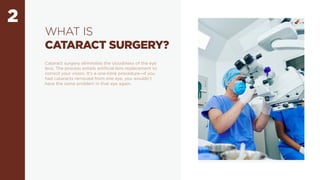
WHAT IS
CATARACT SURGERY?
Cataract surgery eliminates the cloudiness of the eye
lens. The process entails artificial lens replacement to
correct your vision. It’s a one-time procedure—if you
had cataracts removed from one eye, you wouldn’t
have the same problem in that eye again.
3
THREE TYPES OF
CATARACT SURGERY
4
1.
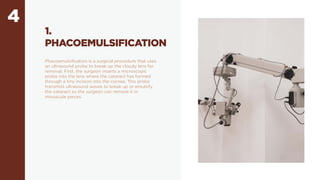
PHACOEMULSIFICATION
Phacoemulsification is a surgical procedure that uses
an ultrasound probe to break up the cloudy lens for
removal. First, the surgeon inserts a microscopic
probe into the lens where the cataract has formed
through a tiny incision into the cornea. This probe
transmits ultrasound waves to break up or emulsify
the cataract so the surgeon can remove it in
minuscule pieces.
5
2.
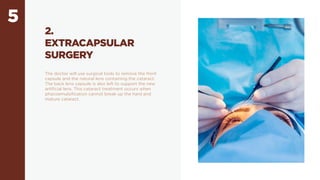
EXTRACAPSULAR
SURGERY
The doctor will use surgical tools to remove the front
capsule and the natural lens containing the cataract.
The back lens capsule is also left to support the new
artificial lens. This cataract treatment occurs when
phacoemulsification cannot break up the hard and
mature cataract.
6
3.
LASER-ASSISTED
CATARACT SURGERY
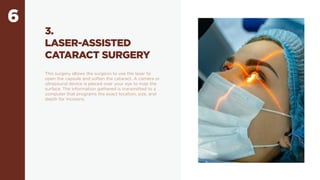
This surgery allows the surgeon to use the laser to
open the capsule and soften the cataract. A camera or
ultrasound device is placed over your eye to map the
surface. The information gathered is transmitted to a
computer that programs the exact location, size, and
depth for incisions.
7
WHAT IS AN
ARTIFICIAL
INTRAOCULAR LENS?
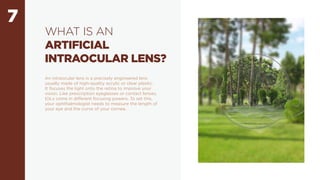
An intraocular lens is a precisely engineered lens
usually made of high-quality acrylic or clear plastic.
It focuses the light onto the retina to improve your
vision. Like prescription eyeglasses or contact lenses,
IOLs come in different focusing powers. To set this,
your ophthalmologist needs to measure the length of
your eye and the curve of your cornea.
8
TYPES OF
INTRAOCULAR
LENSES (IOL)
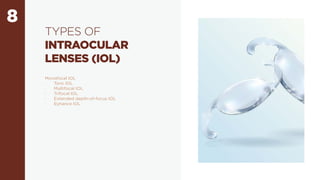
Monofocal IOL
· Toric IOL
· Multifocal IOL
· Trifocal IOL
· Extended depth-of-focus IOL
· Eyhance IOL
9
WHAT TO EXPECT
DURING CATARACT SURGERY
10 Typically, these are the following steps involved in
cataract removal and lens replacement:
• The surgeon may use anaesthetic eye drops or
injections to numb your eye.
• A small incision is made along the side of the
cornea.
• A high-frequency ultrasound device or laser breaks
the cloudy lens into small fragments.
• Once the lens is fragmented, it is gently removed
from the eye using suction.
• Once the fragments are suctioned off, the surgeon
places the IOL behind the pupil, where your natural
lens is situated.
• The incision will heal on its own without any stitches.
• A protective shield is placed over the eye to secure
it during the early stages of recovery.
• If surgery is necessary for both eyes, your surgeon
will typically wait for a few days or weeks. This
time frame gives the first eye time a chance to heal
and for the surgeon to understand the refractive
outcome
11
WHAT TO EXPECT
AFTER CATARACT SURGERY
12
• After cataract surgery, your vision will be blurry at
first, but it will begin to improve within a few days. A
cataract may mute the colours and cause your vision
to appear yellow or brown-tinted, but colours may
seem brighter after surgery.
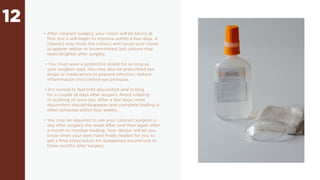
• You must wear a protective shield for as long as
your surgeon says. You may also be prescribed eye
drops or medications to prevent infection, reduce
inflammation and control eye pressure.
• It’s normal to feel mild discomfort and itching
for a couple of days after surgery. Avoid rubbing
or pushing on your eye. After a few days, most
discomfort should disappear, and complete healing is
often achieved within four weeks.
• You may be required to see your cataract surgeon a
day after surgery, the week after, and then again after
a month to monitor healing. Your doctor will let you
know when your eyes have finally healed for you to
get a final prescription for eyeglasses around one to
three months after surgery.
If you want to learn more about cataract surgery,
please call us, and we would like to discuss these in
detail with you.
JL Eye Specialists
Dr Lim Wei Kheong Jimmy
MBBS, MMed (Ophth), MRCSEd (Ophth), FRCSEd (Ophth), FAMS
Website: https://jleyespecialists.com/
Address:
Gleneagles Medical Centre
6 Napier Road #07-10,
Singapore 258499
Phone: +65 6258 8966
Fax: +65 6258 8766
Facebook: https://www.facebook.com/jleyespecialists/
LinkedIn: https://www.linkedin.com/company/jleyespecialists/
Instagram: https://www.instagram.com/jleyespecialists/

Types of Cataract Surgery.pdf

  • 1.
  • 2.
    1 WHAT ARE CATARACTS? A cataractis a degenerative condition of the eye where the lens gradually clouds over. The lenses are transparent, flexible structures in the front of your eye that allows you to focus on objects and form a sharp image of whatever you are looking at. Cataract formation leads to blurring of vision and, when left untreated, may result in vision loss.
  • 3.
    2 WHAT IS CATARACT SURGERY? Cataractsurgery eliminates the cloudiness of the eye lens. The process entails artificial lens replacement to correct your vision. It’s a one-time procedure—if you had cataracts removed from one eye, you wouldn’t have the same problem in that eye again.
  • 4.
  • 5.
    4 1. PHACOEMULSIFICATION Phacoemulsification is asurgical procedure that uses an ultrasound probe to break up the cloudy lens for removal. First, the surgeon inserts a microscopic probe into the lens where the cataract has formed through a tiny incision into the cornea. This probe transmits ultrasound waves to break up or emulsify the cataract so the surgeon can remove it in minuscule pieces.
  • 6.
    5 2. EXTRACAPSULAR SURGERY The doctor willuse surgical tools to remove the front capsule and the natural lens containing the cataract. The back lens capsule is also left to support the new artificial lens. This cataract treatment occurs when phacoemulsification cannot break up the hard and mature cataract.
  • 7.
    6 3. LASER-ASSISTED CATARACT SURGERY This surgeryallows the surgeon to use the laser to open the capsule and soften the cataract. A camera or ultrasound device is placed over your eye to map the surface. The information gathered is transmitted to a computer that programs the exact location, size, and depth for incisions.
  • 8.
    7 WHAT IS AN ARTIFICIAL INTRAOCULARLENS? An intraocular lens is a precisely engineered lens usually made of high-quality acrylic or clear plastic. It focuses the light onto the retina to improve your vision. Like prescription eyeglasses or contact lenses, IOLs come in different focusing powers. To set this, your ophthalmologist needs to measure the length of your eye and the curve of your cornea.
  • 9.
    8 TYPES OF INTRAOCULAR LENSES (IOL) MonofocalIOL · Toric IOL · Multifocal IOL · Trifocal IOL · Extended depth-of-focus IOL · Eyhance IOL
  • 10.
    9 WHAT TO EXPECT DURINGCATARACT SURGERY
  • 11.
    10 Typically, theseare the following steps involved in cataract removal and lens replacement: • The surgeon may use anaesthetic eye drops or injections to numb your eye. • A small incision is made along the side of the cornea. • A high-frequency ultrasound device or laser breaks the cloudy lens into small fragments. • Once the lens is fragmented, it is gently removed from the eye using suction. • Once the fragments are suctioned off, the surgeon places the IOL behind the pupil, where your natural lens is situated. • The incision will heal on its own without any stitches. • A protective shield is placed over the eye to secure it during the early stages of recovery. • If surgery is necessary for both eyes, your surgeon will typically wait for a few days or weeks. This time frame gives the first eye time a chance to heal and for the surgeon to understand the refractive outcome
  • 12.
    11 WHAT TO EXPECT AFTERCATARACT SURGERY
  • 13.
    12 • After cataractsurgery, your vision will be blurry at first, but it will begin to improve within a few days. A cataract may mute the colours and cause your vision to appear yellow or brown-tinted, but colours may seem brighter after surgery. • You must wear a protective shield for as long as your surgeon says. You may also be prescribed eye drops or medications to prevent infection, reduce inflammation and control eye pressure. • It’s normal to feel mild discomfort and itching for a couple of days after surgery. Avoid rubbing or pushing on your eye. After a few days, most discomfort should disappear, and complete healing is often achieved within four weeks. • You may be required to see your cataract surgeon a day after surgery, the week after, and then again after a month to monitor healing. Your doctor will let you know when your eyes have finally healed for you to get a final prescription for eyeglasses around one to three months after surgery.
  • 14.
    If you wantto learn more about cataract surgery, please call us, and we would like to discuss these in detail with you.
  • 15.
    JL Eye Specialists DrLim Wei Kheong Jimmy MBBS, MMed (Ophth), MRCSEd (Ophth), FRCSEd (Ophth), FAMS Website: https://jleyespecialists.com/ Address: Gleneagles Medical Centre 6 Napier Road #07-10, Singapore 258499 Phone: +65 6258 8966 Fax: +65 6258 8766 Facebook: https://www.facebook.com/jleyespecialists/ LinkedIn: https://www.linkedin.com/company/jleyespecialists/ Instagram: https://www.instagram.com/jleyespecialists/