行政院國家科學委員會專題研究計畫 期中進度報告
控制系統之性能評估與線上監控(2/3)
計畫類別: 個別型計畫
計畫編號: NSC92-2214-E-002-013-
執行期間: 92 年 08 月 01 日至 93 年 07 月 31 日
執行單位: 國立臺灣大學化學工程學系暨研究所
計畫主持人: 黃孝平
計畫參與人員: 鄭智成
報告類型: 精簡報告
報告附件: 出席國際會議研究心得報告及發表論文
處理方式: 本計畫可公開查詢
中 華 民 國 93 年 5 月 31 日
控制系統之性能評估與線上監控 (2/3)
Performance Assessment and On-line Monitoring of Control Systems (2/3)
摘 要
在本計畫之上一期研究中,針對不同之控制目標,探討了單環路控制系統之性能評估方式。
而性能評估必須以程序之低階模式為基礎,因此本期計畫之重點在於程序模式之識別,尤
其是程序之等效時延部分。此識別方法利用繼電器回饋測試得到的資料,並配合上類神經
網路,可以準確的估計出程序二階模式之等效時延,進而判別此程序應該用 FOPDT 或
SOPDT 模式來表示,然後計算出對應模式之參數。此模式可以用於系統之性能評估與線上
監控,此外,更可應用於控制器之調諧,成為一個自動調諧系統並且有效地改善控制系統
之性能。
關鍵詞: 控制性能評估、繼電器回饋測試、等效時延、人工類神經網路、自動調諧
Abstract
The previous project has investigated the performance assessment of single-loop control systems.
Such assessment is based on the low-order models of the processes. Therefore, this project
mainly deals with the identification of the process, especially for the apparent deadtime. The
identification method uses the relay feedback test and artificial neural network (ANN) to estimate
the apparent deadtime first. Then, the processes are classified to be represented as FOPDT or
SOPDT models, and the model parameters are estimated accordingly. The identified models can
be used not only for performance assessment but also for controller tuning. It becomes an
auto-tuning system and can improve control performance effectively.
Keywords: control performance assessment, relay feedback test, apparent deadtime, artificial
neural network, auto-tuning
Introduction
The control performance which a PI/PID control system can achieve depends on the
dynamics of the process being controlled (Huang and Jeng, 2002). Thus, a reliable process model
is essential to the success of control performance assessment. This project focuses on the
identification of such low-order models (FOPDT and SOPDT) for performance assessment.
In 1984, Astrom and Hagglund (1984) presented a relay feedback system to generate
sustained oscillation for controller tuning. As shown in Fig. 1(a) is the block diagram of the relay
feedback loop. Fig. 1(b) illustrates the typical response curves from the relay feedback system.
Because this test is operated under closed-loop and no a prior knowledge of the system is need, it
has been often adopted for the identification of low-order model of process in the literature.
Nevertheless, according to those reports in the literature, the apparent deadtime is usually read
from the initial output response or computed using the ultimate information (e.g. Li et al., 1991).
The results thus obtained are very rough, and estimation errors may be very large for high-order
processes. In addition, due to only frequency-domain information being extracted from the test,
more than one relay feedback test is usually required to provide sufficient information for
identification (e.g. Scali et al., 1999).
In this project, a new identification method for performance assessment using the relay
feedback test is proposed. The steady-state gain and ultimate controller gain are estimated along
with the experiment until constant cycling occurs. The constant cycles at the output and a
prepared neural network are then used to estimate the apparent deadtime. Once the apparent is
obtained, the process is classified to be represented as FOPDT or SOPDT model using the
normalized amplitude and period of constant output cycles. After classifying, the model
parameters are estimated accordingly. With the identified model, the performance assessment and
controller tuning can proceed.
Process Identification using Relay Feedback Test
The models considered for performance assessment are FOPDT and SOPDT of the
following:
FOPDT ( )
1
s
p
p
k e
G s
s
θ
τ
−
=
+
(1)
SOPDT 2 2
( )
2 1
s
p
p
k e
G s
s s
θ
τ τζ
−
=
+ +
(2)
These two models can be used to represent most open-loop stable processes. In general,
overdamped or slightly underdamped processes can be modeled as FOPDT, whereas significantly
underdamped processes have to be modeled as SOPDT.
A relay feedback response is used to develop such parametric models. As shown in Fig. 1(a)
is a relay feedback system which consists of process, pG , and a relay controller. The relay
controller provides output at h+ or h− only as on-off control. The controlled process output
consists of transient oscillations after a pure deadtime, o
θ , and develops constant cycling with
magnitude, A , and period, uP . Notice that A and uP are used in the auto-tuning system of
Astrom and Hagglund (1984) to apply Z-N method to compute the PI/PID controller
parameters. In the meantime, pT , θ and an associated height, Aθ , within one of the constant
cycles are also indicated in Fig. 1(b). Here, θ is used to designate an apparent deadtime in the
FOPDT or SOPDT model, which is used to represent the dynamics of higher order processes. All
these quantities measured from a relay feedback response are governed by the dynamic model
and the relay. In other words, they can be expressed as:
1 1( ) or ( , )
p
A
f f
k h
τ τ ζ= (3)
2 2( ) or ( , )uP
f fτ τ ζ
θ
= (4)
3 3( ) or ( , )
A
f f
A
θ
τ τ ζ= (5)
4 4( ) or ( , )
p
f f
T
θ
τ τ ζ= (6)
where τ represents /τ θ . The equations given above describe the dynamic features of the relay
feedback response in time domain. Two equations which correspond to Eqs.(3) and (4) derived
from frequency domain are:
1
2 2
2
tan
1
u
u
u
ω τζ
ω θ π
ω τ
−  
+ = 
− 
(7)
( )
2
2 2 2 2 2
1
1 4
p
cu
u u
k
kω τ ω τ ζ
=
− +
(8)
where uω is taken as 2 / uPπ . Theoretically, provided that pk and cuk are given, the
identification problem to find an reduced order SOPDT model can be solved by finding τ , ζ ,
and θ that fit Eqs.(3)-(6) or Eqs.(5)-(8) in the sense of least-squares. The explicit functional
forms for Eqs.(3)-(6) are not available, and numerical method to solve the above equations will
not be convenient. In the following, a simplified algorithm will be presented to estimate these
required data from relay feedback test.
Estimation of pk and cuk
To estimate pk , the experimental relay feedback test is started with a temporal disturbance
to either the set-point or the process input (i.e. u ) for a short period of time and restored back to
its origin. The disturbance introduced has two main purposes. One is to initialize the relay
feedback control, and the other one is to generate data for computing the steady-state process gain.
The estimation is made along the relay feedback test in one run as the following. Let I
y and I
u
designate the integrations of y and u from the very beginning of the experiment in one run.
That is:
0 0
( ) ( ) ; ( ) ( )
t t
I I
y t y d u t u dτ τ τ τ= =∫ ∫ (9)
For some t T> when y in relay feedback test starts to oscillate with constant period and
amplitude, I
y and I
u will have similar cycling responses. Typical curves of I
y and I
u are
shown in Fig. 2. Let I
avy and I
avu designate the average heights of constant cycles of I
y and
I
u , respectively. The value of pk can be estimated as:
I
av
p I
av
y
k
u
= (10)
On the other hand, due to the use of describing function for estimation, the ultimate gain
computed from 4cuk h Aπ= is subjected to error, which may, sometimes, be as high as 20%. In
order to give more accurate cuk , the following estimation step is considered. Since ( )u t and
( )y t are periodic with period uP , they can be expanded into Fourier series. If the first harmonics
are extracted, their coefficients give one point of process frequency response at ultimate
frequency uω via the following equation:
( )
0
0
0
0
( )
( )
u
u
u
u
t P
j t
t
p u t P
j t
t
y t e dt
G j
u t e dt
ω
ω
ω
+
−
+
−
=
∫
∫
(11)
where 0t is taken as any time instant in a constant cycle. Then, the ultimate gain can be
computed exactly as:
( )
1
cu
p u
k
G jω
= (12)
Estimation of apparent deadtime θ
The apparent deadtime is the deadtime appearing in an FOPDT or SOPDT model that
approximates best the higher order process. As a result, this apparent deadtime differs, in general,
from its true deadtime which is designated as o
θ and can be detected at the very beginning of
the test. Features in the cycling response can be used to distinguish the FOPDT from SOPDT
dynamics. For example, in case of FOPDT process, pT equals o
θ or θ . The same equality
does not apply to the SOPDT case. In a relay feedback test, two measured quantities, A Aθ and
pTθ , are used to characterize the effect of the apparent deadtime. These two quantities, as
mentioned earlier, are functions of τ and ζ . To explore their functional relations, simulations
of relay feedback tests on the standard SOPDT processes covering wide range of τ (in
dimensionless form) and ζ are carried out. Results of A Aθ and pTθ for underdamped
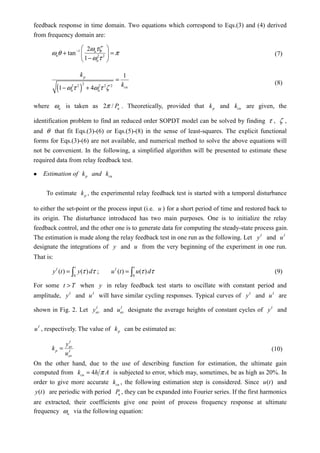
SOPDT processes are plotted as a graph as shown in Fig. 3(a), using τ and ζ as parameters.
Each pair of the two measured quantities corresponds to a point in the graph, where a specific
pair of values for τ and ζ can be found. As shown in the figure, it is difficult to read τ and
ζ from the figure. In order to make each curve in Fig. 3(a) more readable, the coordinate is
rotated through the following transformation.
( ) ( )
( ) ( )
cos 3 sin 3
sin 3 cos 3
p
p
A
X
T A
A
Y
T A
θ
θ
θ
π π
θ
π π
= −
= +
(13)
The results are plotted in Fig. 3(b). Moreover, for applying these data efficiently, two artificial
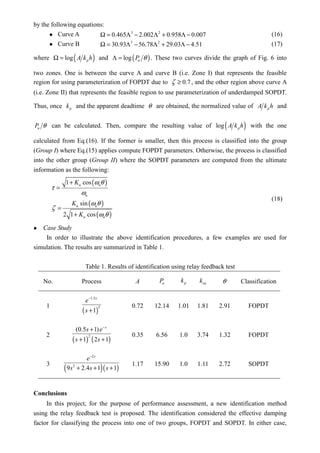
neural networks (ANN) are constructed. The network architecture is as shown in Fig. 4. These
two neural networks are fed with X and Y, and compute τ and ζ , respectively. Each network
consists of feedforward net with one input layer, one hidden layer, and one output layer. The
sigmoid function if is used in an error backpropagation technique to minimize the error
between prediction and target values.
With these two networks, estimation of the apparent deadtime can be proceeded. The
estimation makes uses of the phase criterion in Eq.(7). Notice that three unknowns are required to
satisfy at least four functional relations (i.e. Eqs.(3)-(6) or Eqs.(5)-(8)), and iterative check is thus
necessary to find the solution in a least-squares sense. By solving Eqs.(5)-(7), a unique solution
for τ , ζ and θ can be found. But, the resulting solution may not necessarily satisfy Eq.(8).
The final solution needs further iterative procedures. To satisfy the extra Eq.(8), it is found that
manifold in the space of τ and ζ results from the relation of the following:
1
2 2
2
tan
1
u
u
u
ω τζ
π ω θ
ω τ
−  
= − 
− 
(14)
With uω and θ being fixed, there are many pairs of τ and ζ that satisfy Eq.(7), and one of
these pairs would make Eq.(8) satisfied.
With the theory presented above, the algorithm for the estimation of apparent deadtime can
be made in a simpler way as the following:
1. Starting from a guessed value of θ , which is initially taken as o
θ .
2. The values of X and Y are calculated and fed into two networks. Then, parameters τ and ζ
are computed, and check if Eq.(7) holds. The procedure proceeds iteratively by increasing the
guess value of θ until θ equals pT .
3. When, at certain value of guessed θ , Eq.(7) holds true, the resulting guess value θ is taken
as the estimated value of apparent deadtime.
4. If, until the guessed value of θ exceeds pT and no candidate solution is found, the
underdamped SOPDT model is not good for describing the dynamics of the process. As a
result, model of FOPDT or overdamped SOPDT should be used.
Process Classification for modeling
In general, processes with SOPDT dynamics, which are overdamped or slightly
underdamped, are sometimes identified with FOPDT models for controller design without
significant difference in performance. It is thus curious to know under what condition can an
SOPDT process has controller parameters in terms of an FOPDT parameterization. The FOPDT
parameters in terms of ultimate gain and ultimate frequency can be written as:
( )
2
1 2
1
tan 1
u
u
u
u
K
K
τ
ω
π
θ
ω
−
−
=
− −
=
(15)
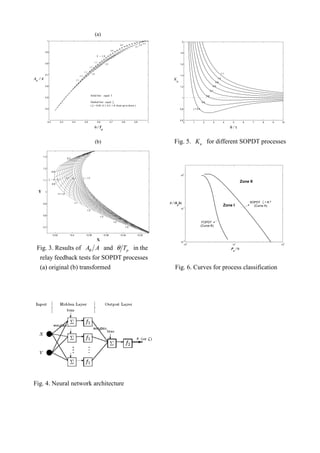
where u p cuK k k= . The result in Eq.(15) indicates that it is necessary with 1uK > . As shown in
Fig. 5, uK of SOPDT processes is plotted against /θ τ using ζ as a parameter. It is found
that 1uK > happens when 0.7ζ ≥ (accurately, 1 2ζ ≥ ). Thus, the uses of FOPDT or
SOPDT for modeling are discriminated using 1 2ζ = as a boundary. As mentioned earlier,
from the ATV test, it provides pA k h and uP θ which are functions of τ and ζ . As shown
in Fig. 6, there are two curves that correspond to SOPDT processes with 0.7ζ = (curve A) and
true FOPDT processes (curve B). Curve A and curve B are found to be represented, respectively,
by the following equations:
Curve A 3 2
0.465 2.002 0.958 0.007Ω = Λ − Λ + Λ − (16)
Curve B 3 2
30.93 56.78 29.03 4.51Ω = Λ − Λ + Λ − (17)
where ( )log pA k hΩ = and ( )log uP θΛ = . These two curves divide the graph of Fig. 6 into
two zones. One is between the curve A and curve B (i.e. Zone I) that represents the feasible
region for using parameterization of FOPDT due to 0.7ζ ≥ , and the other region above curve A
(i.e. Zone II) that represents the feasible region to use parameterization of underdamped SOPDT.
Thus, once pk and the apparent deadtime θ are obtained, the normalized value of pA k h and
uP θ can be calculated. Then, compare the resulting value of ( )log pA k h with the one
calculated from Eq.(16). If the former is smaller, then this process is classified into the group
(Group I) where Eq.(15) applies compute FOPDT parameters. Otherwise, the process is classified
into the other group (Group II) where the SOPDT parameters are computed from the ultimate
information as the following:
( )
( )
( )
1 cos
sin
2 1 cos
u u
u
u u
u u
K
K
K
ω θ
τ
ω
ω θ
ζ
ω θ
+
=
=
+
(18)
Case Study
In order to illustrate the above identification procedures, a few examples are used for
simulation. The results are summarized in Table 1.
Table 1. Results of identification using relay feedback test
No. Process A uP pk cuk θ Classification
1
( )
1.5
5
1
s
e
s
−
+
0.72 12.14 1.01 1.81 2.91 FOPDT
2
( ) ( )
2
(0.5 1)
1 2 1
s
s e
s s
−
+
+ +
0.35 6.56 1.0 3.74 1.32 FOPDT
3
( )( )
2
2
9 2.4 1 1
s
e
s s s
−
+ + +
1.17 15.90 1.0 1.11 2.72 SOPDT
Conclusions
In this project, for the purpose of performance assessment, a new identification method
using the relay feedback test is proposed. The identification considered the effective damping
factor for classifying the process into one of two groups, FOPDT and SOPDT. In either case,
besides parameters pk and θ , the model parameters are given in terms of ultimate gain and
ultimate frequency obtained from a constant cycle. These parameters can be estimated within one
relay feedback experiment. Two ANNs are constructed to enhance the estimation of apparent
deadtime. The identified models can be used not only for performance assessment but also for
controller tuning. It becomes an auto-tuning system and can improve control performance
effectively. In the next project, the method will be extended to multivariable processes to deal
with the performance assessment of multi-loop control systems.
References
Astrom, K. J. and T. Hagglund, “Automatic Tuning of Simple Regulators with Specifications on
Phase and Amplitude Margins,” Automatica, 20, 645-651 (1984).
Huang, H. P. and J. C. Jeng, “Monitoring and Assessment of Control Performance for Single
Loop Systems,” Ind. Eng. Chem. Res., 41, 1297-1309 (2002).
Li, W., E. Eskinat and W. L. Luyben, “An Improved Autotune Identification Method,” Ind. Eng.
Chem. Res., 30, 1530-1541 (1991).
Scali, C., G. Marchetti and D. Semino, “Relay with Additional Delay for Identification and
Autotuning of Completely Unknown Processes,” Ind. Eng. Chem. Res., 38, 1987-1997
(1999).
(b)
Fig. 1. (a) Block diagram of a relay feedback
system (b) Response curves in relay feedback test
0
y I
0
Time
u I
y
av
I
u
av
I
(a)
Gp(s)
hR yu
ProcessRelay
+
−
(b)
y
u
t
t
Tp
θo A
Pu
h
θ
Aθ
Fig . 2. Typical curves of I
y and I
u in
proposed relay feedback test
(a)
(b) Fig. 5. uK for different SOPDT processes
Fig. 3. Results of A Aθ and pTθ in the
relay feedback tests for SOPDT processes
(a) original (b) transformed Fig. 6. Curves for process classification
Fig. 4. Neural network architecture
0.2 0.3 0.4 0.5 0.6 0.7 0.8 0.9 1
0.4
0.5
0.6
0.7
0.8
0.9
1
θ / Tp
A
θ
/ A
τ = 1.0
0.9
0.8
0.7
0.6
0.5
1.5
3.0
2.0
Solid line : equal τ
Dashed line : equal ζ
( ζ = 0.05, 0.1, 0.5, 1.0; from up to down )
1.1
1.2
1.3
1.4
−0.42 −0.4 −0.38 −0.36 −0.34 −0.32
0.7
0.8
0.9
1
1.1
1.2
1.3
X
Y
ζ = .05
ζ = 1.0
τ = 1.0
1.5
0.8
1.1
1.2
1.3
1.4
0.50.1
0.9
0.7
0.3
0 1 2 3 4 5 6 7 8 9 10
0.6
0.8
1
1.2
1.4
1.6
1.8
2
θ / τ
Ku
ζ = 0.4
0.5
0.6
0.7
0.8
0.9
1.1
1.0
10
0
10
1
10
2
10
−2
10
−1
10
0
Pu
/ θ
A / (k
p
h)
Zone I
Zone II
FOPDT
(Curve B)
SOPDT
(Curve A)
ζ = 0.7

922214 e002013

  • 1.
    行政院國家科學委員會專題研究計畫 期中進度報告 控制系統之性能評估與線上監控(2/3) 計畫類別: 個別型計畫 計畫編號:NSC92-2214-E-002-013- 執行期間: 92 年 08 月 01 日至 93 年 07 月 31 日 執行單位: 國立臺灣大學化學工程學系暨研究所 計畫主持人: 黃孝平 計畫參與人員: 鄭智成 報告類型: 精簡報告 報告附件: 出席國際會議研究心得報告及發表論文 處理方式: 本計畫可公開查詢 中 華 民 國 93 年 5 月 31 日
  • 2.
    控制系統之性能評估與線上監控 (2/3) Performance Assessmentand On-line Monitoring of Control Systems (2/3) 摘 要 在本計畫之上一期研究中,針對不同之控制目標,探討了單環路控制系統之性能評估方式。 而性能評估必須以程序之低階模式為基礎,因此本期計畫之重點在於程序模式之識別,尤 其是程序之等效時延部分。此識別方法利用繼電器回饋測試得到的資料,並配合上類神經 網路,可以準確的估計出程序二階模式之等效時延,進而判別此程序應該用 FOPDT 或 SOPDT 模式來表示,然後計算出對應模式之參數。此模式可以用於系統之性能評估與線上 監控,此外,更可應用於控制器之調諧,成為一個自動調諧系統並且有效地改善控制系統 之性能。 關鍵詞: 控制性能評估、繼電器回饋測試、等效時延、人工類神經網路、自動調諧 Abstract The previous project has investigated the performance assessment of single-loop control systems. Such assessment is based on the low-order models of the processes. Therefore, this project mainly deals with the identification of the process, especially for the apparent deadtime. The identification method uses the relay feedback test and artificial neural network (ANN) to estimate the apparent deadtime first. Then, the processes are classified to be represented as FOPDT or SOPDT models, and the model parameters are estimated accordingly. The identified models can be used not only for performance assessment but also for controller tuning. It becomes an auto-tuning system and can improve control performance effectively. Keywords: control performance assessment, relay feedback test, apparent deadtime, artificial neural network, auto-tuning Introduction The control performance which a PI/PID control system can achieve depends on the dynamics of the process being controlled (Huang and Jeng, 2002). Thus, a reliable process model is essential to the success of control performance assessment. This project focuses on the identification of such low-order models (FOPDT and SOPDT) for performance assessment. In 1984, Astrom and Hagglund (1984) presented a relay feedback system to generate sustained oscillation for controller tuning. As shown in Fig. 1(a) is the block diagram of the relay feedback loop. Fig. 1(b) illustrates the typical response curves from the relay feedback system. Because this test is operated under closed-loop and no a prior knowledge of the system is need, it has been often adopted for the identification of low-order model of process in the literature. Nevertheless, according to those reports in the literature, the apparent deadtime is usually read from the initial output response or computed using the ultimate information (e.g. Li et al., 1991). The results thus obtained are very rough, and estimation errors may be very large for high-order processes. In addition, due to only frequency-domain information being extracted from the test, more than one relay feedback test is usually required to provide sufficient information for
  • 3.
    identification (e.g. Scaliet al., 1999). In this project, a new identification method for performance assessment using the relay feedback test is proposed. The steady-state gain and ultimate controller gain are estimated along with the experiment until constant cycling occurs. The constant cycles at the output and a prepared neural network are then used to estimate the apparent deadtime. Once the apparent is obtained, the process is classified to be represented as FOPDT or SOPDT model using the normalized amplitude and period of constant output cycles. After classifying, the model parameters are estimated accordingly. With the identified model, the performance assessment and controller tuning can proceed. Process Identification using Relay Feedback Test The models considered for performance assessment are FOPDT and SOPDT of the following: FOPDT ( ) 1 s p p k e G s s θ τ − = + (1) SOPDT 2 2 ( ) 2 1 s p p k e G s s s θ τ τζ − = + + (2) These two models can be used to represent most open-loop stable processes. In general, overdamped or slightly underdamped processes can be modeled as FOPDT, whereas significantly underdamped processes have to be modeled as SOPDT. A relay feedback response is used to develop such parametric models. As shown in Fig. 1(a) is a relay feedback system which consists of process, pG , and a relay controller. The relay controller provides output at h+ or h− only as on-off control. The controlled process output consists of transient oscillations after a pure deadtime, o θ , and develops constant cycling with magnitude, A , and period, uP . Notice that A and uP are used in the auto-tuning system of Astrom and Hagglund (1984) to apply Z-N method to compute the PI/PID controller parameters. In the meantime, pT , θ and an associated height, Aθ , within one of the constant cycles are also indicated in Fig. 1(b). Here, θ is used to designate an apparent deadtime in the FOPDT or SOPDT model, which is used to represent the dynamics of higher order processes. All these quantities measured from a relay feedback response are governed by the dynamic model and the relay. In other words, they can be expressed as: 1 1( ) or ( , ) p A f f k h τ τ ζ= (3) 2 2( ) or ( , )uP f fτ τ ζ θ = (4) 3 3( ) or ( , ) A f f A θ τ τ ζ= (5) 4 4( ) or ( , ) p f f T θ τ τ ζ= (6) where τ represents /τ θ . The equations given above describe the dynamic features of the relay
  • 4.
    feedback response intime domain. Two equations which correspond to Eqs.(3) and (4) derived from frequency domain are: 1 2 2 2 tan 1 u u u ω τζ ω θ π ω τ −   + =  −  (7) ( ) 2 2 2 2 2 2 1 1 4 p cu u u k kω τ ω τ ζ = − + (8) where uω is taken as 2 / uPπ . Theoretically, provided that pk and cuk are given, the identification problem to find an reduced order SOPDT model can be solved by finding τ , ζ , and θ that fit Eqs.(3)-(6) or Eqs.(5)-(8) in the sense of least-squares. The explicit functional forms for Eqs.(3)-(6) are not available, and numerical method to solve the above equations will not be convenient. In the following, a simplified algorithm will be presented to estimate these required data from relay feedback test. Estimation of pk and cuk To estimate pk , the experimental relay feedback test is started with a temporal disturbance to either the set-point or the process input (i.e. u ) for a short period of time and restored back to its origin. The disturbance introduced has two main purposes. One is to initialize the relay feedback control, and the other one is to generate data for computing the steady-state process gain. The estimation is made along the relay feedback test in one run as the following. Let I y and I u designate the integrations of y and u from the very beginning of the experiment in one run. That is: 0 0 ( ) ( ) ; ( ) ( ) t t I I y t y d u t u dτ τ τ τ= =∫ ∫ (9) For some t T> when y in relay feedback test starts to oscillate with constant period and amplitude, I y and I u will have similar cycling responses. Typical curves of I y and I u are shown in Fig. 2. Let I avy and I avu designate the average heights of constant cycles of I y and I u , respectively. The value of pk can be estimated as: I av p I av y k u = (10) On the other hand, due to the use of describing function for estimation, the ultimate gain computed from 4cuk h Aπ= is subjected to error, which may, sometimes, be as high as 20%. In order to give more accurate cuk , the following estimation step is considered. Since ( )u t and ( )y t are periodic with period uP , they can be expanded into Fourier series. If the first harmonics are extracted, their coefficients give one point of process frequency response at ultimate frequency uω via the following equation:
  • 5.
    ( ) 0 0 0 0 ( ) () u u u u t P j t t p u t P j t t y t e dt G j u t e dt ω ω ω + − + − = ∫ ∫ (11) where 0t is taken as any time instant in a constant cycle. Then, the ultimate gain can be computed exactly as: ( ) 1 cu p u k G jω = (12) Estimation of apparent deadtime θ The apparent deadtime is the deadtime appearing in an FOPDT or SOPDT model that approximates best the higher order process. As a result, this apparent deadtime differs, in general, from its true deadtime which is designated as o θ and can be detected at the very beginning of the test. Features in the cycling response can be used to distinguish the FOPDT from SOPDT dynamics. For example, in case of FOPDT process, pT equals o θ or θ . The same equality does not apply to the SOPDT case. In a relay feedback test, two measured quantities, A Aθ and pTθ , are used to characterize the effect of the apparent deadtime. These two quantities, as mentioned earlier, are functions of τ and ζ . To explore their functional relations, simulations of relay feedback tests on the standard SOPDT processes covering wide range of τ (in dimensionless form) and ζ are carried out. Results of A Aθ and pTθ for underdamped SOPDT processes are plotted as a graph as shown in Fig. 3(a), using τ and ζ as parameters. Each pair of the two measured quantities corresponds to a point in the graph, where a specific pair of values for τ and ζ can be found. As shown in the figure, it is difficult to read τ and ζ from the figure. In order to make each curve in Fig. 3(a) more readable, the coordinate is rotated through the following transformation. ( ) ( ) ( ) ( ) cos 3 sin 3 sin 3 cos 3 p p A X T A A Y T A θ θ θ π π θ π π = − = + (13) The results are plotted in Fig. 3(b). Moreover, for applying these data efficiently, two artificial neural networks (ANN) are constructed. The network architecture is as shown in Fig. 4. These two neural networks are fed with X and Y, and compute τ and ζ , respectively. Each network consists of feedforward net with one input layer, one hidden layer, and one output layer. The sigmoid function if is used in an error backpropagation technique to minimize the error between prediction and target values. With these two networks, estimation of the apparent deadtime can be proceeded. The estimation makes uses of the phase criterion in Eq.(7). Notice that three unknowns are required to satisfy at least four functional relations (i.e. Eqs.(3)-(6) or Eqs.(5)-(8)), and iterative check is thus necessary to find the solution in a least-squares sense. By solving Eqs.(5)-(7), a unique solution for τ , ζ and θ can be found. But, the resulting solution may not necessarily satisfy Eq.(8).
  • 6.
    The final solutionneeds further iterative procedures. To satisfy the extra Eq.(8), it is found that manifold in the space of τ and ζ results from the relation of the following: 1 2 2 2 tan 1 u u u ω τζ π ω θ ω τ −   = −  −  (14) With uω and θ being fixed, there are many pairs of τ and ζ that satisfy Eq.(7), and one of these pairs would make Eq.(8) satisfied. With the theory presented above, the algorithm for the estimation of apparent deadtime can be made in a simpler way as the following: 1. Starting from a guessed value of θ , which is initially taken as o θ . 2. The values of X and Y are calculated and fed into two networks. Then, parameters τ and ζ are computed, and check if Eq.(7) holds. The procedure proceeds iteratively by increasing the guess value of θ until θ equals pT . 3. When, at certain value of guessed θ , Eq.(7) holds true, the resulting guess value θ is taken as the estimated value of apparent deadtime. 4. If, until the guessed value of θ exceeds pT and no candidate solution is found, the underdamped SOPDT model is not good for describing the dynamics of the process. As a result, model of FOPDT or overdamped SOPDT should be used. Process Classification for modeling In general, processes with SOPDT dynamics, which are overdamped or slightly underdamped, are sometimes identified with FOPDT models for controller design without significant difference in performance. It is thus curious to know under what condition can an SOPDT process has controller parameters in terms of an FOPDT parameterization. The FOPDT parameters in terms of ultimate gain and ultimate frequency can be written as: ( ) 2 1 2 1 tan 1 u u u u K K τ ω π θ ω − − = − − = (15) where u p cuK k k= . The result in Eq.(15) indicates that it is necessary with 1uK > . As shown in Fig. 5, uK of SOPDT processes is plotted against /θ τ using ζ as a parameter. It is found that 1uK > happens when 0.7ζ ≥ (accurately, 1 2ζ ≥ ). Thus, the uses of FOPDT or SOPDT for modeling are discriminated using 1 2ζ = as a boundary. As mentioned earlier, from the ATV test, it provides pA k h and uP θ which are functions of τ and ζ . As shown in Fig. 6, there are two curves that correspond to SOPDT processes with 0.7ζ = (curve A) and true FOPDT processes (curve B). Curve A and curve B are found to be represented, respectively,
  • 7.
    by the followingequations: Curve A 3 2 0.465 2.002 0.958 0.007Ω = Λ − Λ + Λ − (16) Curve B 3 2 30.93 56.78 29.03 4.51Ω = Λ − Λ + Λ − (17) where ( )log pA k hΩ = and ( )log uP θΛ = . These two curves divide the graph of Fig. 6 into two zones. One is between the curve A and curve B (i.e. Zone I) that represents the feasible region for using parameterization of FOPDT due to 0.7ζ ≥ , and the other region above curve A (i.e. Zone II) that represents the feasible region to use parameterization of underdamped SOPDT. Thus, once pk and the apparent deadtime θ are obtained, the normalized value of pA k h and uP θ can be calculated. Then, compare the resulting value of ( )log pA k h with the one calculated from Eq.(16). If the former is smaller, then this process is classified into the group (Group I) where Eq.(15) applies compute FOPDT parameters. Otherwise, the process is classified into the other group (Group II) where the SOPDT parameters are computed from the ultimate information as the following: ( ) ( ) ( ) 1 cos sin 2 1 cos u u u u u u u K K K ω θ τ ω ω θ ζ ω θ + = = + (18) Case Study In order to illustrate the above identification procedures, a few examples are used for simulation. The results are summarized in Table 1. Table 1. Results of identification using relay feedback test No. Process A uP pk cuk θ Classification 1 ( ) 1.5 5 1 s e s − + 0.72 12.14 1.01 1.81 2.91 FOPDT 2 ( ) ( ) 2 (0.5 1) 1 2 1 s s e s s − + + + 0.35 6.56 1.0 3.74 1.32 FOPDT 3 ( )( ) 2 2 9 2.4 1 1 s e s s s − + + + 1.17 15.90 1.0 1.11 2.72 SOPDT Conclusions In this project, for the purpose of performance assessment, a new identification method using the relay feedback test is proposed. The identification considered the effective damping factor for classifying the process into one of two groups, FOPDT and SOPDT. In either case,
  • 8.
    besides parameters pkand θ , the model parameters are given in terms of ultimate gain and ultimate frequency obtained from a constant cycle. These parameters can be estimated within one relay feedback experiment. Two ANNs are constructed to enhance the estimation of apparent deadtime. The identified models can be used not only for performance assessment but also for controller tuning. It becomes an auto-tuning system and can improve control performance effectively. In the next project, the method will be extended to multivariable processes to deal with the performance assessment of multi-loop control systems. References Astrom, K. J. and T. Hagglund, “Automatic Tuning of Simple Regulators with Specifications on Phase and Amplitude Margins,” Automatica, 20, 645-651 (1984). Huang, H. P. and J. C. Jeng, “Monitoring and Assessment of Control Performance for Single Loop Systems,” Ind. Eng. Chem. Res., 41, 1297-1309 (2002). Li, W., E. Eskinat and W. L. Luyben, “An Improved Autotune Identification Method,” Ind. Eng. Chem. Res., 30, 1530-1541 (1991). Scali, C., G. Marchetti and D. Semino, “Relay with Additional Delay for Identification and Autotuning of Completely Unknown Processes,” Ind. Eng. Chem. Res., 38, 1987-1997 (1999). (b) Fig. 1. (a) Block diagram of a relay feedback system (b) Response curves in relay feedback test 0 y I 0 Time u I y av I u av I (a) Gp(s) hR yu ProcessRelay + − (b) y u t t Tp θo A Pu h θ Aθ Fig . 2. Typical curves of I y and I u in proposed relay feedback test
  • 9.
    (a) (b) Fig. 5.uK for different SOPDT processes Fig. 3. Results of A Aθ and pTθ in the relay feedback tests for SOPDT processes (a) original (b) transformed Fig. 6. Curves for process classification Fig. 4. Neural network architecture 0.2 0.3 0.4 0.5 0.6 0.7 0.8 0.9 1 0.4 0.5 0.6 0.7 0.8 0.9 1 θ / Tp A θ / A τ = 1.0 0.9 0.8 0.7 0.6 0.5 1.5 3.0 2.0 Solid line : equal τ Dashed line : equal ζ ( ζ = 0.05, 0.1, 0.5, 1.0; from up to down ) 1.1 1.2 1.3 1.4 −0.42 −0.4 −0.38 −0.36 −0.34 −0.32 0.7 0.8 0.9 1 1.1 1.2 1.3 X Y ζ = .05 ζ = 1.0 τ = 1.0 1.5 0.8 1.1 1.2 1.3 1.4 0.50.1 0.9 0.7 0.3 0 1 2 3 4 5 6 7 8 9 10 0.6 0.8 1 1.2 1.4 1.6 1.8 2 θ / τ Ku ζ = 0.4 0.5 0.6 0.7 0.8 0.9 1.1 1.0 10 0 10 1 10 2 10 −2 10 −1 10 0 Pu / θ A / (k p h) Zone I Zone II FOPDT (Curve B) SOPDT (Curve A) ζ = 0.7