The document presents a comparative analysis of four multi-sensor data fusion algorithms based on Kalman filtering, exploring their computational complexities as the number of sensors increases. The study finds that the inverse covariance method is most efficient for more than 20 sensors, while group sensor methods are preferable for fewer sensors. This research emphasizes the importance of computational load in practical implementations of data fusion methods.
![International Journal of Chaos, Control, Modelling and Simulation (IJCCMS) Vol.2, No.2, June 2013
DOI : 10.5121/ijccms.2013.2201 1
COMPUTATIONAL COMPLEXITY COMPARISON OF
MULTI-SENSOR SINGLE TARGET DATA FUSION
METHODS BY MATLAB
Sayed Amir Hoseini1
and Mohammad Reza Ashraf 2
1
Department of Electrical Engineering, Amirkabir University of technology, Tehran, Iran
a.hoseini@aut.ac.ir
2
Department of Electrical Engineering, University of Tehran, Tehran, Iran
m.r.ashraf@ut.ac.ir
ABSTRACT
Target tracking using observations from multiple sensors can achieve better estimation performance than
a single sensor. The most famous estimation tool in target tracking is Kalman filter. There are several
mathematical approaches to combine the observations of multiple sensors by use of Kalman filter. An
important issue in applying a proper approach is computational complexity. In this paper, four data fusion
algorithms based on Kalman filter are considered including three centralized and one decentralized
methods. Using MATLAB, computational loads of these methods are compared while number of sensors
increases. The results show that inverse covariance method has the best computational performance if the
number of sensors is above 20. For a smaller number of sensors, other methods, especially group sensors,
are more appropriate..
KEYWORDS
Data fusion, Target Tracking, Kalman Filter, Multi-sensor, MATLAB
1. INTRODUCTION
Data fusion is the process of combining information from a number of different sources to
provide a robust and complete description of an environment or process of interest. Data fusion
is of special significance in any application where large amounts of data must be combined,
fused and distilled to obtain information of appropriate quality and integrity on which decisions
can be made. Data fusion finds application in many military systems, in civilian surveillance and
monitoring tasks, in process control and in information systems. Data fusion methods are
particularly important in the drive toward autonomous systems in all these applications [1].
Estimation is the single most important problem in sensor data fusion. Fundamentally, an
estimator is a decision rule which takes as an argument a sequence of observations and whose
action is to compute a value for the parameter or state of interest. Almost all data fusion
problems involve this estimation process: we obtain a number of observations from a group of
sensors and using this information we wish to find some estimate of the true state of the
environment we are observing. Estimation encompasses all important aspects of the data fusion
problem. The most famous estimation tool in target tracking is Kalman filter.
Tracking targets with Kalman filtering is an active research area and there are substantial
literatures in this field such as [2], [3] and [4]. [1,4] talk about several multi-sensor data fusion
methods. [5] and [6] are also the same but latest attempts. In [1], the computational complexities
of these methods are compared based on mathematical formulation, but no simulation or
implementation proof is presented. In this paper, the aim is to continue the related work in [1]
and evaluate its claim using MATLAB simulations.](https://image.slidesharecdn.com/2213ijccms01-191213112712/85/COMPUTATIONAL-COMPLEXITY-COMPARISON-OF-MULTI-SENSOR-SINGLE-TARGET-DATA-FUSION-METHODS-BY-MATLAB-1-320.jpg)
![International Journal of Chaos, Control, Modelling and Simulation (IJCCMS) Vol.2, No.2, June 2013
DOI : 10.5121/ijccms.2013.2201 1
COMPUTATIONAL COMPLEXITY COMPARISON OF
MULTI-SENSOR SINGLE TARGET DATA FUSION
METHODS BY MATLAB
Sayed Amir Hoseini1
and Mohammad Reza Ashraf 2
1
Department of Electrical Engineering, Amirkabir University of technology, Tehran, Iran
a.hoseini@aut.ac.ir
2
Department of Electrical Engineering, University of Tehran, Tehran, Iran
m.r.ashraf@ut.ac.ir
ABSTRACT
Target tracking using observations from multiple sensors can achieve better estimation performance than
a single sensor. The most famous estimation tool in target tracking is Kalman filter. There are several
mathematical approaches to combine the observations of multiple sensors by use of Kalman filter. An
important issue in applying a proper approach is computational complexity. In this paper, four data fusion
algorithms based on Kalman filter are considered including three centralized and one decentralized
methods. Using MATLAB, computational loads of these methods are compared while number of sensors
increases. The results show that inverse covariance method has the best computational performance if the
number of sensors is above 20. For a smaller number of sensors, other methods, especially group sensors,
are more appropriate..
KEYWORDS
Data fusion, Target Tracking, Kalman Filter, Multi-sensor, MATLAB
1. INTRODUCTION
Data fusion is the process of combining information from a number of different sources to
provide a robust and complete description of an environment or process of interest. Data fusion
is of special significance in any application where large amounts of data must be combined,
fused and distilled to obtain information of appropriate quality and integrity on which decisions
can be made. Data fusion finds application in many military systems, in civilian surveillance and
monitoring tasks, in process control and in information systems. Data fusion methods are
particularly important in the drive toward autonomous systems in all these applications [1].
Estimation is the single most important problem in sensor data fusion. Fundamentally, an
estimator is a decision rule which takes as an argument a sequence of observations and whose
action is to compute a value for the parameter or state of interest. Almost all data fusion
problems involve this estimation process: we obtain a number of observations from a group of
sensors and using this information we wish to find some estimate of the true state of the
environment we are observing. Estimation encompasses all important aspects of the data fusion
problem. The most famous estimation tool in target tracking is Kalman filter.
Tracking targets with Kalman filtering is an active research area and there are substantial
literatures in this field such as [2], [3] and [4]. [1,4] talk about several multi-sensor data fusion
methods. [5] and [6] are also the same but latest attempts. In [1], the computational complexities
of these methods are compared based on mathematical formulation, but no simulation or
implementation proof is presented. In this paper, the aim is to continue the related work in [1]
and evaluate its claim using MATLAB simulations.](https://image.slidesharecdn.com/2213ijccms01-191213112712/75/COMPUTATIONAL-COMPLEXITY-COMPARISON-OF-MULTI-SENSOR-SINGLE-TARGET-DATA-FUSION-METHODS-BY-MATLAB-1-2048.jpg)
![International Journal of Chaos, Control, Modelling and Simulation (IJCCMS) Vol.2, No.2, June 2013
2
This paper begins with a brief summary of the Kalman filter algorithm. The intention is to
introduce notation and key data fusion concepts; Prior familiarity with the basic Kalman Filter
algorithm is assumed. The multi-sensor Kalman filter is then discussed. Four main algorithms are
considered; the group-sensor method, the sequential sensor method, the inverse covariance form
and the track-to-track fusion. For the related concepts and additional formulation refer to [1].
After that, in section 3, these methods are evaluated in theory and simulation. Finally, Simulation
results and a comparison of these methods are presented in section 4.
2. KALMAN FILTER IN TARGET TRACKING
The Kalman Filter is a recursive linear estimator which successively calculates an estimate for a
continuous valued state, that evolves over time, on the basis of periodic observations that of this
state.
2.1. State and Observation Models
The starting point for the Kalman filter algorithm is to define a model for the states to be
estimated in the standard state-space form and observation model for data received from sensor
[7]. A general motion model used in discrete Kalman filter for target tracking is:
( ) ( ) ( 1) ( ) ( )x k F k x k G k v k= − + (1)
( ) ( ) ( ) ( )z k H k x k w k= + (2)
where F(k) is the state transition matrix, x(k) is the state vector at time k, G(k) is the process
noise gain matrix, The process noise v(k) and the measurement noise w(k) are zero mean,
mutually independent, white, Gaussian with covariance Q and R respectively. z(k) is the
measurement vector at time k and H(k) is observation matrix of the states computed at time k.
{ } { }( ) ( ) 0, ,E v k E w k k= = ∀ (3)
{ } { }( ) ( ) ( ), ( ) ( ) ( ).T T
ij ijE v i v j Q i E w i w j R i = = (4)
2.1.1. State Prediction
The state and state covariance matrix at time k-1 are predicted to time k as follows:
ˆ ˆ( | 1) ( ) ( 1| 1)x k k F k x k k− = − − (5)
( | 1) ( ) ( 1| 1) ( ) ( ) ( ) ( ),T T
P k k F k P k k F k G k Q k G k− = − − + (6)
where ˆ( 1| 1)x k k− − is the estimated state vector at time k, ( 1| 1)P k k− − is the estimated state
covariance matrix at the same time, ˆ( | 1)x k k − is the predicted state and ( | 1)P k k − is the
predicted state covariance matrix.
2.1.2. Measurement update
At time k an observation ( )z k is made and the updated estimate ˆ( | )x k k of the state ( )x k ,
together with the updated estimate covariance ( )|P k k is computed from the state prediction
and observation according to:
ˆ ˆ ˆ( | ) ( | 1) ( )( ( ) ( ) ( | 1))x k k x k k W k z k H k x k k= − + − − (7)
and
( | ) (1 ( ) ( )) ( | 1)(1 ( ) ( )) ( ) ( ) ( )T T
P k k W k H k P k k W k H k W k R k W k= − − − + (8)
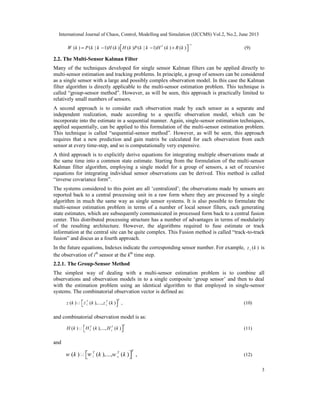
where the gain matrix ( )W k is given by:](https://image.slidesharecdn.com/2213ijccms01-191213112712/85/COMPUTATIONAL-COMPLEXITY-COMPARISON-OF-MULTI-SENSOR-SINGLE-TARGET-DATA-FUSION-METHODS-BY-MATLAB-2-320.jpg)
![International Journal of Chaos, Control, Modelling and Simulation (IJCCMS) Vol.2, No.2, June 2013
4
and
{ } { }
{ }
1 1
1
( ) ( ) ( ) ( ),..., ( ) ( ),..., ( )
( ),..., ( ) ,
TT T T T T
s s
s
R k E w k w k w k w k w k w k
blockdiag R k R k
= = Ε =
=
(13)
Observation noise covariance is as a block-diagonal matrix which each block of diagonal is the
observation noise matrix of each sensor. Observation vector are made in a combinatorial manner.
Predication equations are like single sensor Kalman filter (equations (1) and (2)).
2.2.2 The Sequential-Sensor Method
A second approach to the multi-sensor estimation problem is to consider each sensor observation
as an independent, sequential update to the state estimate and for each observation to compute an
appropriate prediction and gain matrix. The final formulation provide below:
ˆ ˆ( | 1) ( ) ( 1| 1)x k k F k x k k− = − − (14)
( | 1) ( ) ( 1| 1) ( ) ( ) ( ) ( ).T T
P k k F k P k k F k G k Q k G k− = − − + (15)
( ) ( ) ( | , 1) ( ) ( )T
p p p pS k H k P k k p H k R k= − + (16)
1
( ) ( | , 1) ( ) ( )T
p p pW k P k k p H k S k−
= − (17)
11 1
ˆ ˆ( | ) (1 ( ) ( )) ( | 1) (1 ( ) ( )) ( ) ( )
S SS
i i j j i i
ii j i
x k k W k H k x k k W k H k W k z k
== = +
= − − + −∑∏ ∏
(18)
For the further information refer to [1].
2.2.3. The Inverse Covariance Method
This method was developed to exploit direct equations for filter response. The matrices which
are inverted are not so massive. State predication and covariance matrices are as in (1) and (2):
1
1 1
1
( | ) ( | 1) ( ) ( ) ( )
S
T
i i i
i
P k k P k k H k R k H k
−
− −
=
= − + ∑
(19)
1 1
1
ˆ ˆ( | ) ( | )[ ( | 1) ( | 1) ( ) ( ) ( )]
S
T
i i i
i
x k k P k k P k k x k k H k R k z k− −
=
= − − + ∑ (20)
2.2.4. The Track-to-track Fusion Method
Track-to-track fusion is an algorithm which combines the estimations which are made at the
place of sensors. Indeed, Kalman Filter estimations are made aside for each sensor.
For each single sensor Kalman filter we have:
[ ]ˆ ˆ ˆ( | ) ( | 1) ( ) ( ) ( ) ( | 1) ,i i i i i ix k k x k k W k z k H k x k k= − + − − (21)
and
( | ) ( | 1) ( ) ( ) ( )T
i i i i iP k k P k k W k S k W k= − − (22)
which
( ) ( ) ( | 1) ( ) ( ) .T
i i i i iS k H k P k k H k R k = − + (23)
Predictions of local states are made from common states model.](https://image.slidesharecdn.com/2213ijccms01-191213112712/85/COMPUTATIONAL-COMPLEXITY-COMPARISON-OF-MULTI-SENSOR-SINGLE-TARGET-DATA-FUSION-METHODS-BY-MATLAB-4-320.jpg)
![International Journal of Chaos, Control, Modelling and Simulation (IJCCMS) Vol.2, No.2, June 2013
5
ˆ ˆ( | 1) ( ) ( 1| 1)i ix k k F k x k k− = − − (24)
and
( | 1) ( ) ( 1 | 1) ( ) ( ) ( ) ( )T T
i iP k k F k P k k F k G k Q k G k− = − − + (25)
So the path fusion algorithm simply computes a weighted average of paths based on variance
weights.
1
1
ˆ ˆ( | ) ( | ) ( | ) ( | )
N
T T i i
i
x k k P k k P k k x k k−
=
= ∑ (26)
1
1
1
( | ) ( | ) .
N
T i
i
P k k P k k
−
−
=
= ∑
(27)
This method is not an optimal estimation because of correlation between tracks [8], but it is
simple and functional.
3. PERFORMANCE EVALUATION
3.1 Evaluation Theorize
As stated before, computational complexity of fusion algorithms is among the most important
factors for its implementation. With respect to matrix operations and its complexity especially
for inverse matrix computation, it should be considered as a key factor while hardware or
software implementation. More computational load means more powerful and more expensive
hardware. From another perspective it needs more time to execute computations.
One of the main factors which impact the computational load is the number of sensors or data
fusions sources. This is not necessarily the same for different methods, as there may be a
different method for distinct number of sensors which has the least computational load.
In [1], it is mentioned that for inverse matrix calculation, the computational load is proportional
to the square of the matrix dimensions. Among the proposed methods, the group sensor method
has the most computational complexity. The dimensions of the innovation matrix are
proportional to the number of sensors. This matrix should be inverted in each time steps. As a
result with the increasing number of sensors, the computational load increases more rapidly.
In sequential-sensor method although the innovation matrix dimensions do not change with the
number of sensors, for each sensor an inversing matrix operation has been added. So again the
computational load would be increased, but with a linear rate.
Regardless of the number of sensors employed, the largest matrix inversion that is required is of
dimension the state vector. The addition of new sensors simply requires that the new of
terms 1
( ) ( ) ( )T
i i iH k R k z k−
and 1
( ) ( ) ( )T
i i iH k R k H k−
. Thus the complexity of the update algorithm
grows only linearly with the number of sensors employed. In addition, the update stage can take
place in one single step.
Excellence of the inverse covariance estimator is more obvious when significant number of
sensors is employed. From (10), it is clear that in each cycle of filter, both the prediction
covariance matrix and the updated inverse covariance matrix must be inverted. As a result,
inverse covariance filter shows its superior characteristics just when the dimensions of the
combined observation vector are approximately more than two times of the common state vector
dimensions.](https://image.slidesharecdn.com/2213ijccms01-191213112712/85/COMPUTATIONAL-COMPLEXITY-COMPARISON-OF-MULTI-SENSOR-SINGLE-TARGET-DATA-FUSION-METHODS-BY-MATLAB-5-320.jpg)
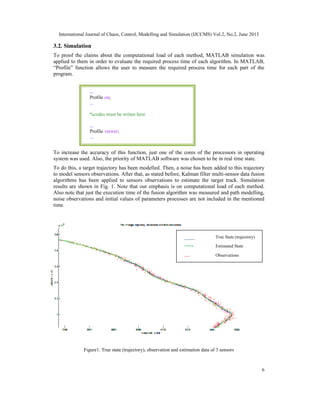
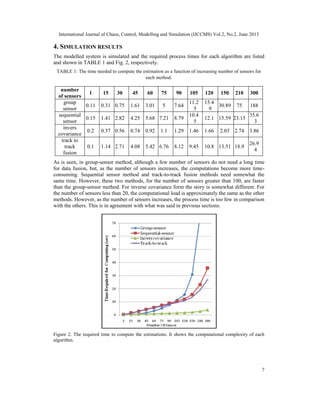
![International Journal of Chaos, Control, Modelling and Simulation (IJCCMS) Vol.2, No.2, June 2013
8
5. CONCLUSION
In order to investigate Multi-sensor single target tracking algorithms base on Kalman filter, four
methods were simulated and compared. For this purpose, the time needed to compute the
estimation as a function of increasing number of sensors for each method is calculated. In
summary, for the number of sensors less than 20, the group-sensor method has the least
computational complexity and the inverse covariance method has the second priority. For greater
number of sensors, inverse covariance method strongly needs the least process time.
Nevertheless, for hardware implementation, type of the hardware (FPGAs, DSPs or so on) and
the mathematical relations of algorithms should be taken into account to choose the best method.
REFERENCES
[1] Hugh Durrant-Whyte, Multi Sensor Data Fusion. Australian Centre for Field Robotics, The
University of Sydney NSW 2006.
[2] Y. Bar-Shalom and X.-R. Li, Multitarget-Multisensor Tracking: Principles and Techniques. ISBN
0-9648312-0-1, 1995.B.D.O. Anderson and J.B. Moore. Optimal Filtering. Prentice Hall, 1979.
[3] Y. Bar-Shalom and T. E. Fortmann, Tracking and Data Association. Academic Press, Orlando,
FL, 1988.
[4] Jitendra R. Raol, Multi-Sensor Data Fusion with MATLAB, CRC Press, Taylor & Francis Group,
2010.
[5] Zou, Wei, and Wei Sun., “ A multi-dimensional data association algorithm for multi-sensor
fusion,” Intelligent Science and Intelligent Data Engineering. Springer Berlin Heidelberg, 2013.
280-288.
[6] Cho, Taehwan, Changho Lee, and Sangbang Choi, “Multi-sensor fusion with interacting multiple
model filter for improved aircraft position accuracy,” Sensors 13.4 (2013): 4122-4137.
[7] Brookner, Eli. Tracking and Kalman filtering made easy. New York: Wiley, 1998.
[8] Y. Bar-Shalom, “On the track to track correlation problem,”. IEEE Trans. Automatic Control,
25(8):802–807, 1981.](https://image.slidesharecdn.com/2213ijccms01-191213112712/85/COMPUTATIONAL-COMPLEXITY-COMPARISON-OF-MULTI-SENSOR-SINGLE-TARGET-DATA-FUSION-METHODS-BY-MATLAB-8-320.jpg)


