Transport in Angiosperms
9.2 part 1
Roots

  A. Plants take in water and minerals through their roots

  B. Roots have large surface area to allow for adequate uptake of
  water and minerals

        -they are branched and they have root hairs

  C. Function of the cortex=to facilitate water uptake

  D. Roots also act as anchorage to ground
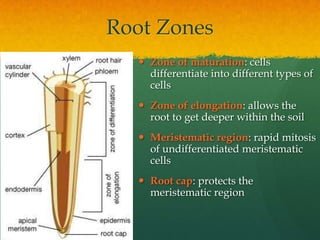
 Zone of maturation: cells
  differentiate into different types of
  cells
 Zone of elongation: allows the
  root to get deeper within the soil
 Meristematic region: rapid mitosis
  of undifferentiated meristematic
  cells
 Root cap: protects the
  meristematic region
Roots and active transport


A. Mineral concentrations are often higher in the root than in
  the soil

  B. This suggests active transport (going against the
  concentration gradient)

  C. Cortex cells can absorb ions that are dissolved in the
  water that is drawn by capillary action through the cortex
  cell walls
Water Uptake By Roots


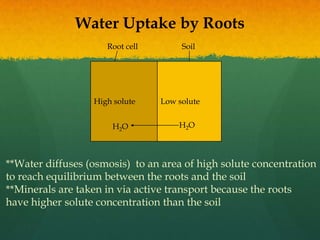
Roots take in water via osmosis
       -Water in the soil contains a lower
       concentration of solutes than the cytoplasm of root
  cells

  -This causes water to diffuse in to the roots
Water Uptake by Roots
                     Root cell        Soil


                  High solute    Low solute


                      H2O            H2O


**Water diffuses (osmosis) to an area of high solute concentration
to reach equilibrium between the roots and the soil
**Minerals are taken in via active transport because the roots
have higher solute concentration than the soil
Water Uptake By Roots (continued)

Most absorbed water is eventually drawn to the rest of the
 plant because of transpiration

      -as water exits the leaves it must be replaced

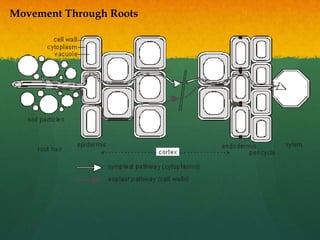
To get water from the root hairs to the xylem, there
  are two possible methods
-apoplast or symplast
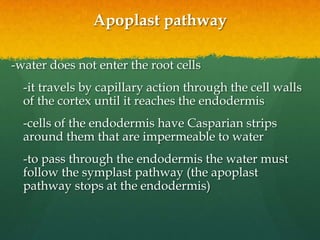
Apoplast pathway

-water does not enter the root cells
  -it travels by capillary action through the cell walls
  of the cortex until it reaches the endodermis
  -cells of the endodermis have Casparian strips
  around them that are impermeable to water
  -to pass through the endodermis the water must
  follow the symplast pathway (the apoplast
  pathway stops at the endodermis)
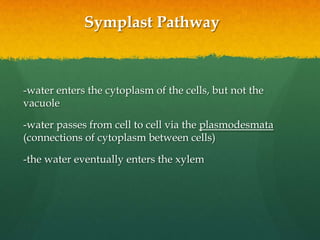
Symplast Pathway


-water enters the cytoplasm of the cells, but not the
vacuole

-water passes from cell to cell via the plasmodesmata
(connections of cytoplasm between cells)

-the water eventually enters the xylem
Movement Through Roots
Assignment: (in notebook)
Make a chart to compare apoplast
    and symplast pathways

9.2 transport- part1

  • 1.
  • 2.
    Roots A.Plants take in water and minerals through their roots B. Roots have large surface area to allow for adequate uptake of water and minerals -they are branched and they have root hairs C. Function of the cortex=to facilitate water uptake D. Roots also act as anchorage to ground
  • 3.
     Zone ofmaturation: cells differentiate into different types of cells  Zone of elongation: allows the root to get deeper within the soil  Meristematic region: rapid mitosis of undifferentiated meristematic cells  Root cap: protects the meristematic region
  • 4.
    Roots and activetransport A. Mineral concentrations are often higher in the root than in the soil B. This suggests active transport (going against the concentration gradient) C. Cortex cells can absorb ions that are dissolved in the water that is drawn by capillary action through the cortex cell walls
  • 5.
    Water Uptake ByRoots Roots take in water via osmosis -Water in the soil contains a lower concentration of solutes than the cytoplasm of root cells -This causes water to diffuse in to the roots
  • 6.
    Water Uptake byRoots Root cell Soil High solute Low solute H2O H2O **Water diffuses (osmosis) to an area of high solute concentration to reach equilibrium between the roots and the soil **Minerals are taken in via active transport because the roots have higher solute concentration than the soil
  • 7.
    Water Uptake ByRoots (continued) Most absorbed water is eventually drawn to the rest of the plant because of transpiration -as water exits the leaves it must be replaced To get water from the root hairs to the xylem, there are two possible methods -apoplast or symplast
  • 8.
    Apoplast pathway -water doesnot enter the root cells -it travels by capillary action through the cell walls of the cortex until it reaches the endodermis -cells of the endodermis have Casparian strips around them that are impermeable to water -to pass through the endodermis the water must follow the symplast pathway (the apoplast pathway stops at the endodermis)
  • 9.
    Symplast Pathway -water entersthe cytoplasm of the cells, but not the vacuole -water passes from cell to cell via the plasmodesmata (connections of cytoplasm between cells) -the water eventually enters the xylem
  • 10.
  • 11.
    Assignment: (in notebook) Makea chart to compare apoplast and symplast pathways