Further studies in behaviour
        Sheikh and Earn
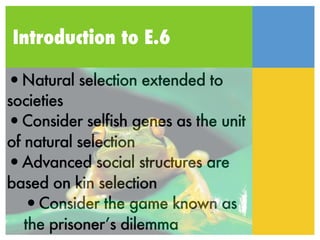
Introduction to E.6

•Natural selection extended to
societies
•Consider selfish genes as the unit
of natural selection
•Advanced social structures are
based on kin selection
   •Consider the game known as
   the prisoner’s dilemma
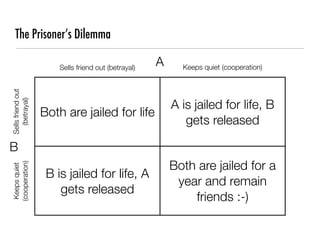
The Prisoner’s Dilemma

                       Sells friend out (betrayal)
                                                     A     Keeps quiet (cooperation)
Sells friend out


                                                         A is jailed for life, B
  (betrayal)


                   Both are jailed for life
                                                            gets released

B
                                                         Both are jailed for a
(cooperation)
 Keeps quiet


                    B is jailed for life, A
                                                          year and remain
                       gets released
                                                             friends :-)
Social structure of the eusocial Honeybees
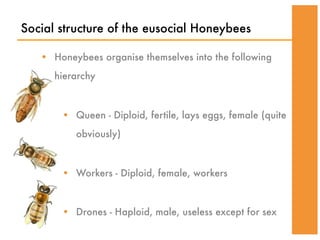
   • Honeybees organise themselves into the following
      hierarchy


       • Queen - Diploid, fertile, lays eggs, female (quite
          obviously)


       • Workers - Diploid, female, workers


       • Drones - Haploid, male, useless except for sex
Social organisation of elephants

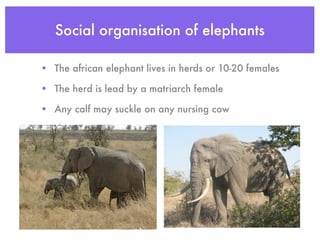
• The african elephant lives in herds or 10-20 females

• The herd is lead by a matriarch female

• Any calf may suckle on any nursing cow
Mathematics behind altruism


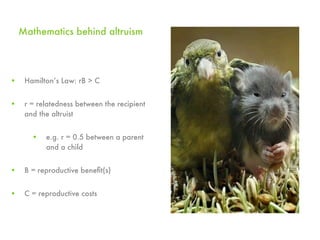
•    Hamilton’s Law: rB > C


•    r = relatedness between the recipient
     and the altruist


       •   e.g. r = 0.5 between a parent
           and a child


•    B = reproductive benefit(s)


•    C = reproductive costs
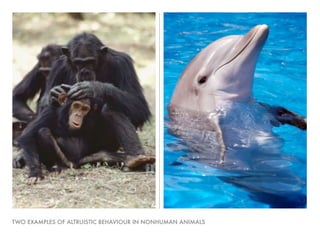
TWO EXAMPLES OF ALTRUISTIC BEHAVIOUR IN NONHUMAN ANIMALS
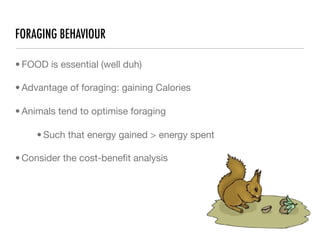
FORAGING BEHAVIOUR

• FOOD is essential (well duh)

• Advantage of foraging: gaining Calories

• Animals tend to optimise foraging

     • Such that energy gained > energy spent

• Consider the cost-benefit analysis
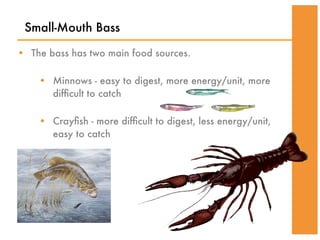
Small-Mouth Bass

• The bass has two main food sources.

    • Minnows - easy to digest, more energy/unit, more
      difficult to catch

    • Crayfish - more difficult to digest, less energy/unit,
      easy to catch
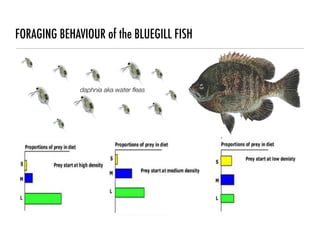
FORAGING BEHAVIOUR of the BLUEGILL FISH


              daphnia aka water fleas
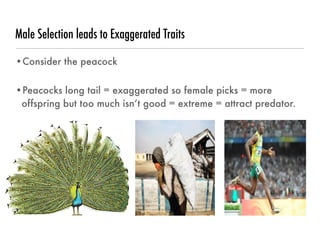
Male Selection leads to Exaggerated Traits

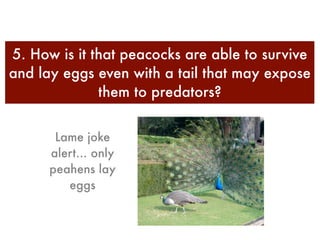
•Consider the peacock


•Peacocks long tail = exaggerated so female picks = more
 offspring but too much isn’t good = extreme = attract predator.
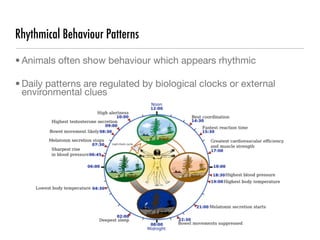
Rhythmical Behaviour Patterns
• Animals often show behaviour which appears rhythmic

• Daily patterns are regulated by biological clocks or external
  environmental clues
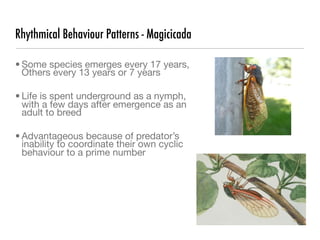
Rhythmical Behaviour Patterns - Magicicada

• Some species emerges every 17 years,
  Others every 13 years or 7 years

• Life is spent underground as a nymph,
  with a few days after emergence as an
  adult to breed

• Advantageous because of predator’s
  inability to coordinate their own cyclic
  behaviour to a prime number
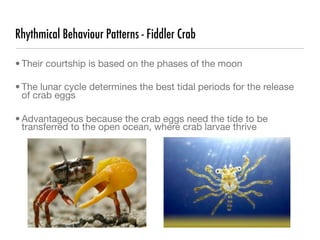
Rhythmical Behaviour Patterns - Fiddler Crab

• Their courtship is based on the phases of the moon

• The lunar cycle determines the best tidal periods for the release
  of crab eggs

• Advantageous because the crab eggs need the tide to be
  transferred to the open ocean, where crab larvae thrive
Blue questions


             QUIZ TIME

Red questions
1. Describe a drone.
A drone is a haploid male honeybee that does
  nothing but have sex with the queen bee.
2. Give an example of altruistic behaviour that was
                 not discussed.
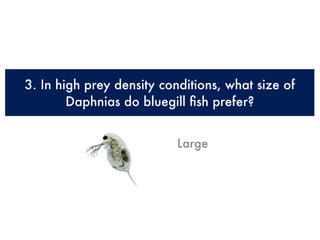
3. In high prey density conditions, what size of
        Daphnias do bluegill fish prefer?
3. In high prey density conditions, what size of
        Daphnias do bluegill fish prefer?


                           Large
4. Identify one problem with altruistic
 behaviour over evolutionary time.
4. Identify one problem with altruistic
   behaviour over evolutionary time.

The behaviour may linger on while its benefits may
 no longer be there (e.g. dolphins helping whales,
 our own tendency to donate to places like Africa)
5. How is it that peacocks are able to survive
  to lay eggs even with a tail that obviously
          exposes them to predators?
5. How is it that peacocks are able to survive
and lay eggs even with a tail that may expose
              them to predators?


       Lame joke
      alert... only
      peahens lay
         eggs
TRIVIAL CLASSMATE QUESTIONS!!!
1. What is Ms. Paige’s middle name?

               Anne
2. What do I call my co-presenter?


              Sheikh
3. Name one game Thon plays in class.
4. Who has longer hair? Narissa or Leena?
5. Who here is from Chennai?


           Sugan
6. Who recently changed his/her name?

                Mint
7. Where is Ms. Paige from?

       Santa Fe, NM
8. Spell Perle’s last name. You have 10
    seconds to spell it without error.
8. Spell Perle’s last name. You have 10
    seconds to spell it without error.

           Narumit - something
9. In the E.2 presentation, approximately how
many times did Thon use the word ‘basically’?
       (as counted meticulously by Earn)
9. In the E.2 presentation, approximately how
many times did Thon use the word ‘basically’?
       (as counted meticulously by Earn)

                    ~23
Thanks for listening.

E6- Further studies of Behavior

  • 1.
    Further studies inbehaviour Sheikh and Earn
  • 2.
    Introduction to E.6 •Naturalselection extended to societies •Consider selfish genes as the unit of natural selection •Advanced social structures are based on kin selection •Consider the game known as the prisoner’s dilemma
  • 3.
    The Prisoner’s Dilemma Sells friend out (betrayal) A Keeps quiet (cooperation) Sells friend out A is jailed for life, B (betrayal) Both are jailed for life gets released B Both are jailed for a (cooperation) Keeps quiet B is jailed for life, A year and remain gets released friends :-)
  • 4.
    Social structure ofthe eusocial Honeybees • Honeybees organise themselves into the following hierarchy • Queen - Diploid, fertile, lays eggs, female (quite obviously) • Workers - Diploid, female, workers • Drones - Haploid, male, useless except for sex
  • 5.
    Social organisation ofelephants • The african elephant lives in herds or 10-20 females • The herd is lead by a matriarch female • Any calf may suckle on any nursing cow
  • 6.
    Mathematics behind altruism • Hamilton’s Law: rB > C • r = relatedness between the recipient and the altruist • e.g. r = 0.5 between a parent and a child • B = reproductive benefit(s) • C = reproductive costs
  • 7.
    TWO EXAMPLES OFALTRUISTIC BEHAVIOUR IN NONHUMAN ANIMALS
  • 8.
    FORAGING BEHAVIOUR • FOODis essential (well duh) • Advantage of foraging: gaining Calories • Animals tend to optimise foraging • Such that energy gained > energy spent • Consider the cost-benefit analysis
  • 9.
    Small-Mouth Bass • Thebass has two main food sources. • Minnows - easy to digest, more energy/unit, more difficult to catch • Crayfish - more difficult to digest, less energy/unit, easy to catch
  • 10.
    FORAGING BEHAVIOUR ofthe BLUEGILL FISH daphnia aka water fleas
  • 11.
    Male Selection leadsto Exaggerated Traits •Consider the peacock •Peacocks long tail = exaggerated so female picks = more offspring but too much isn’t good = extreme = attract predator.
  • 12.
    Rhythmical Behaviour Patterns •Animals often show behaviour which appears rhythmic • Daily patterns are regulated by biological clocks or external environmental clues
  • 13.
    Rhythmical Behaviour Patterns- Magicicada • Some species emerges every 17 years, Others every 13 years or 7 years • Life is spent underground as a nymph, with a few days after emergence as an adult to breed • Advantageous because of predator’s inability to coordinate their own cyclic behaviour to a prime number
  • 14.
    Rhythmical Behaviour Patterns- Fiddler Crab • Their courtship is based on the phases of the moon • The lunar cycle determines the best tidal periods for the release of crab eggs • Advantageous because the crab eggs need the tide to be transferred to the open ocean, where crab larvae thrive
  • 15.
    Blue questions QUIZ TIME Red questions
  • 16.
  • 17.
    1. Describe adrone. A drone is a haploid male honeybee that does nothing but have sex with the queen bee.
  • 18.
    2. Give anexample of altruistic behaviour that was not discussed.
  • 19.
    3. In highprey density conditions, what size of Daphnias do bluegill fish prefer?
  • 20.
    3. In highprey density conditions, what size of Daphnias do bluegill fish prefer? Large
  • 21.
    4. Identify oneproblem with altruistic behaviour over evolutionary time.
  • 22.
    4. Identify oneproblem with altruistic behaviour over evolutionary time. The behaviour may linger on while its benefits may no longer be there (e.g. dolphins helping whales, our own tendency to donate to places like Africa)
  • 23.
    5. How isit that peacocks are able to survive to lay eggs even with a tail that obviously exposes them to predators?
  • 24.
    5. How isit that peacocks are able to survive and lay eggs even with a tail that may expose them to predators? Lame joke alert... only peahens lay eggs
  • 25.
  • 26.
    1. What isMs. Paige’s middle name?
  • 27.
    1. What isMs. Paige’s middle name? Anne
  • 28.
    2. What doI call my co-presenter?
  • 29.
    2. What doI call my co-presenter? Sheikh
  • 30.
    3. Name onegame Thon plays in class.
  • 31.
    4. Who haslonger hair? Narissa or Leena?
  • 32.
    5. Who hereis from Chennai?
  • 33.
    5. Who hereis from Chennai? Sugan
  • 34.
    6. Who recentlychanged his/her name?
  • 35.
    6. Who recentlychanged his/her name? Mint
  • 36.
    7. Where isMs. Paige from?
  • 37.
    7. Where isMs. Paige from? Santa Fe, NM
  • 38.
    8. Spell Perle’slast name. You have 10 seconds to spell it without error.
  • 39.
    8. Spell Perle’slast name. You have 10 seconds to spell it without error. Narumit - something
  • 40.
    9. In theE.2 presentation, approximately how many times did Thon use the word ‘basically’? (as counted meticulously by Earn)
  • 41.
    9. In theE.2 presentation, approximately how many times did Thon use the word ‘basically’? (as counted meticulously by Earn) ~23
  • 42.