Photosynthesis
Photosynthesis is a metabolic pathway consisting of
  light-dependent and light-independent reactions.
  Overall, water and carbon dioxide are used to produce
  carbohydrates, with oxygen as a waste product.
• Photosynthesis is anendergonic process of
  carbon reduction
• Cell respiration is anexergonicprocess of
  carbon oxidation.
• Photosynthesis can be considered anabolic,
  while respiration is catabolic.
An Overview
• Light-dependent reactions-
  – Occurs in the thylakoids and grana of chloroplasts
  – Solar energy is converted to chemical energy
  – Chlorophyll drives the transfer of electrons and
    hydrogen from water to the electron acceptor
    NADP+
  – Oxygen is released when water splits (photolysis)
  – ATP is formed during the light reactions through
    chemiosmosis by photophosphorylation
  – Products include: NADPH and ATP
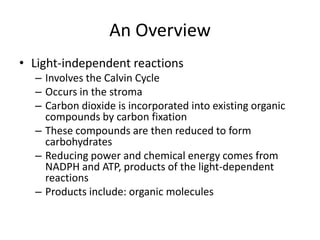
An Overview
• Light-independent reactions
  – Involves the Calvin Cycle
  – Occurs in the stroma
  – Carbon dioxide is incorporated into existing organic
    compounds by carbon fixation
  – These compounds are then reduced to form
    carbohydrates
  – Reducing power and chemical energy comes from
    NADPH and ATP, products of the light-dependent
    reactions
  – Products include: organic molecules
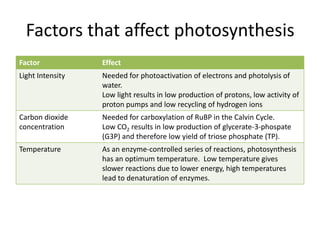
Factors that affect photosynthesis
There are many steps in the reactions of
  photosynthesis, each requiring optimal
  conditions for maximum activity. Whichever
  factor is closest to the minimum is known as
  the limiting factor. It will therefore slow the
  whole process down.
Factors that affect photosynthesis
Factor            Effect
Light Intensity   Needed for photoactivation of electrons and photolysis of
                  water.
                  Low light results in low production of protons, low activity of
                  proton pumps and low recycling of hydrogen ions
Carbon dioxide    Needed for carboxylation of RuBP in the Calvin Cycle.
concentration     Low CO2 results in low production of glycerate-3-phospate
                  (G3P) and therefore low yield of triose phosphate (TP).
Temperature       As an enzyme-controlled series of reactions, photosynthesis
                  has an optimum temperature. Low temperature gives
                  slower reactions due to lower energy, high temperatures
                  lead to denaturation of enzymes.
Action Spectrum
• The action spectrum of photosynthesis is the
  range of wavelengths of light over which
  photosynthesis is most active.
• The effectiveness of different wavelengths in
  fuelling photosynthesis shows that red and
  blue/violet influence the rate more than the
  other colors.
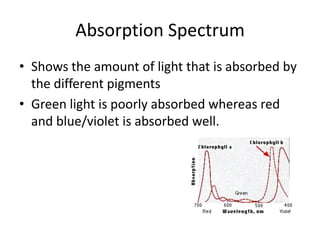
Absorption Spectrum
• Shows the amount of light that is absorbed by
  the different pigments
• Green light is poorly absorbed whereas red
  and blue/violet is absorbed well.

Photosynthesis- overview

  • 1.
  • 2.
    Photosynthesis is ametabolic pathway consisting of light-dependent and light-independent reactions. Overall, water and carbon dioxide are used to produce carbohydrates, with oxygen as a waste product.
  • 3.
    • Photosynthesis isanendergonic process of carbon reduction • Cell respiration is anexergonicprocess of carbon oxidation. • Photosynthesis can be considered anabolic, while respiration is catabolic.
  • 4.
    An Overview • Light-dependentreactions- – Occurs in the thylakoids and grana of chloroplasts – Solar energy is converted to chemical energy – Chlorophyll drives the transfer of electrons and hydrogen from water to the electron acceptor NADP+ – Oxygen is released when water splits (photolysis) – ATP is formed during the light reactions through chemiosmosis by photophosphorylation – Products include: NADPH and ATP
  • 5.
    An Overview • Light-independentreactions – Involves the Calvin Cycle – Occurs in the stroma – Carbon dioxide is incorporated into existing organic compounds by carbon fixation – These compounds are then reduced to form carbohydrates – Reducing power and chemical energy comes from NADPH and ATP, products of the light-dependent reactions – Products include: organic molecules
  • 6.
    Factors that affectphotosynthesis There are many steps in the reactions of photosynthesis, each requiring optimal conditions for maximum activity. Whichever factor is closest to the minimum is known as the limiting factor. It will therefore slow the whole process down.
  • 7.
    Factors that affectphotosynthesis Factor Effect Light Intensity Needed for photoactivation of electrons and photolysis of water. Low light results in low production of protons, low activity of proton pumps and low recycling of hydrogen ions Carbon dioxide Needed for carboxylation of RuBP in the Calvin Cycle. concentration Low CO2 results in low production of glycerate-3-phospate (G3P) and therefore low yield of triose phosphate (TP). Temperature As an enzyme-controlled series of reactions, photosynthesis has an optimum temperature. Low temperature gives slower reactions due to lower energy, high temperatures lead to denaturation of enzymes.
  • 8.
    Action Spectrum • Theaction spectrum of photosynthesis is the range of wavelengths of light over which photosynthesis is most active. • The effectiveness of different wavelengths in fuelling photosynthesis shows that red and blue/violet influence the rate more than the other colors.
  • 9.
    Absorption Spectrum • Showsthe amount of light that is absorbed by the different pigments • Green light is poorly absorbed whereas red and blue/violet is absorbed well.