CHRONIC
RENAL FAILURE
By: Miss Santoshi Naik
Assistant Professor
Yenepoya Pharmacy College & Research Centre
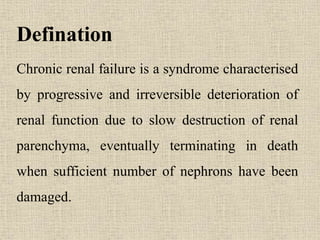
Defination
Chronic renal failure is a syndrome characterised
by progressive and irreversible deterioration of
renal function due to slow destruction of renal
parenchyma, eventually terminating in death
when sufficient number of nephrons have been
damaged.
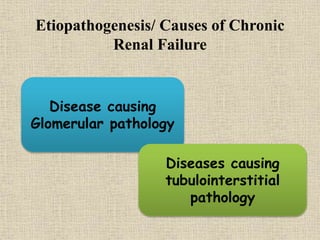
Etiopathogenesis/ Causes of Chronic
Renal Failure
Disease causing
Glomerular pathology
Diseases causing
tubulointerstitial
pathology
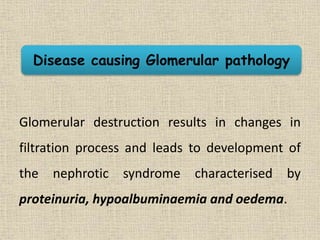
Glomerular destruction results in changes in
filtration process and leads to development of
the nephrotic syndrome characterised by
proteinuria, hypoalbuminaemia and oedema.
Disease causing Glomerular pathology
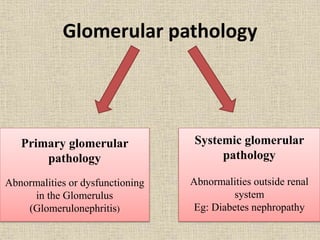
Glomerular pathology
Primary glomerular
pathology
Abnormalities or dysfunctioning
in the Glomerulus
(Glomerulonephritis)
Systemic glomerular
pathology
Abnormalities outside renal
system
Eg: Diabetes nephropathy
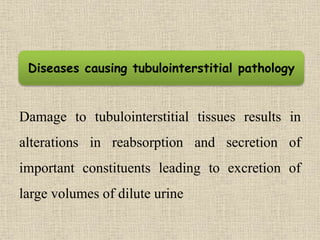
Damage to tubulointerstitial tissues results in
alterations in reabsorption and secretion of
important constituents leading to excretion of
large volumes of dilute urine
Diseases causing tubulointerstitial pathology
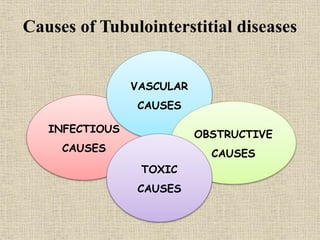
Causes of Tubulointerstitial diseases
INFECTIOUS
CAUSES
VASCULAR
CAUSES
OBSTRUCTIVE
CAUSES
TOXIC
CAUSES
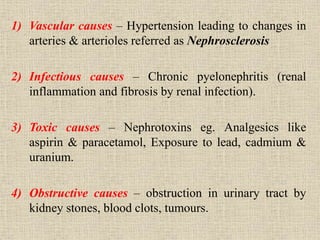
1) Vascular causes – Hypertension leading to changes in
arteries & arterioles referred as Nephrosclerosis
2) Infectious causes – Chronic pyelonephritis (renal
inflammation and fibrosis by renal infection).
3) Toxic causes – Nephrotoxins eg. Analgesics like
aspirin & paracetamol, Exposure to lead, cadmium &
uranium.
4) Obstructive causes – obstruction in urinary tract by
kidney stones, blood clots, tumours.
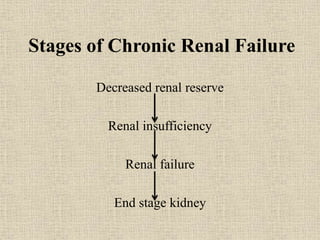
Stages of Chronic Renal Failure
Decreased renal reserve
Renal insufficiency
Renal failure
End stage kidney
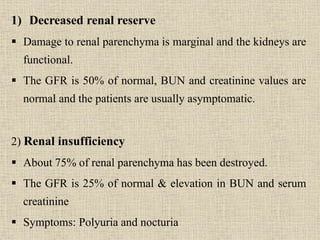
1) Decreased renal reserve
 Damage to renal parenchyma is marginal and the kidneys are
functional.
 The GFR is 50% of normal, BUN and creatinine values are
normal and the patients are usually asymptomatic.
2) Renal insufficiency
 About 75% of renal parenchyma has been destroyed.
 The GFR is 25% of normal & elevation in BUN and serum
creatinine
 Symptoms: Polyuria and nocturia
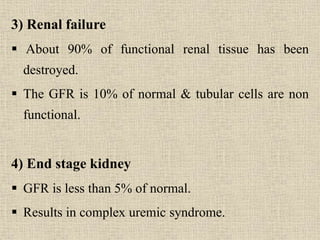
3) Renal failure
 About 90% of functional renal tissue has been
destroyed.
 The GFR is 10% of normal & tubular cells are non
functional.
4) End stage kidney
 GFR is less than 5% of normal.
 Results in complex uremic syndrome.
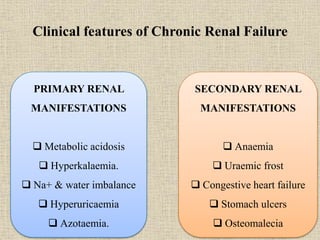
Clinical features of Chronic Renal Failure
PRIMARY RENAL
MANIFESTATIONS
 Metabolic acidosis
 Hyperkalaemia.
 Na+ & water imbalance
 Hyperuricaemia
 Azotaemia.
SECONDARY RENAL
MANIFESTATIONS
 Anaemia
 Uraemic frost
 Congestive heart failure
 Stomach ulcers
 Osteomalecia
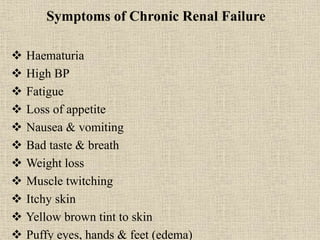
Symptoms of Chronic Renal Failure
 Haematuria
 High BP
 Fatigue
 Loss of appetite
 Nausea & vomiting
 Bad taste & breath
 Weight loss
 Muscle twitching
 Itchy skin
 Yellow brown tint to skin
 Puffy eyes, hands & feet (edema)
Diagnosis of Chronic Renal Failure
 Blood & urine examination
 X –Ray of kidney
 Abdominal MRI (Magnetic Resonance Imaging)
 Abdominal ultrasound
Treatment of Chronic Renal Failure
 Low protein & high carbohydrate diet
Managing electrolyte imbalance
 Dialysis
 Kidney transplant
 Managing blood pressure
THANK
YOU

3. chronic renal failure

  • 1.
    CHRONIC RENAL FAILURE By: MissSantoshi Naik Assistant Professor Yenepoya Pharmacy College & Research Centre
  • 2.
    Defination Chronic renal failureis a syndrome characterised by progressive and irreversible deterioration of renal function due to slow destruction of renal parenchyma, eventually terminating in death when sufficient number of nephrons have been damaged.
  • 3.
    Etiopathogenesis/ Causes ofChronic Renal Failure Disease causing Glomerular pathology Diseases causing tubulointerstitial pathology
  • 4.
    Glomerular destruction resultsin changes in filtration process and leads to development of the nephrotic syndrome characterised by proteinuria, hypoalbuminaemia and oedema. Disease causing Glomerular pathology
  • 5.
    Glomerular pathology Primary glomerular pathology Abnormalitiesor dysfunctioning in the Glomerulus (Glomerulonephritis) Systemic glomerular pathology Abnormalities outside renal system Eg: Diabetes nephropathy
  • 6.
    Damage to tubulointerstitialtissues results in alterations in reabsorption and secretion of important constituents leading to excretion of large volumes of dilute urine Diseases causing tubulointerstitial pathology
  • 7.
    Causes of Tubulointerstitialdiseases INFECTIOUS CAUSES VASCULAR CAUSES OBSTRUCTIVE CAUSES TOXIC CAUSES
  • 8.
    1) Vascular causes– Hypertension leading to changes in arteries & arterioles referred as Nephrosclerosis 2) Infectious causes – Chronic pyelonephritis (renal inflammation and fibrosis by renal infection). 3) Toxic causes – Nephrotoxins eg. Analgesics like aspirin & paracetamol, Exposure to lead, cadmium & uranium. 4) Obstructive causes – obstruction in urinary tract by kidney stones, blood clots, tumours.
  • 9.
    Stages of ChronicRenal Failure Decreased renal reserve Renal insufficiency Renal failure End stage kidney
  • 10.
    1) Decreased renalreserve  Damage to renal parenchyma is marginal and the kidneys are functional.  The GFR is 50% of normal, BUN and creatinine values are normal and the patients are usually asymptomatic. 2) Renal insufficiency  About 75% of renal parenchyma has been destroyed.  The GFR is 25% of normal & elevation in BUN and serum creatinine  Symptoms: Polyuria and nocturia
  • 11.
    3) Renal failure About 90% of functional renal tissue has been destroyed.  The GFR is 10% of normal & tubular cells are non functional. 4) End stage kidney  GFR is less than 5% of normal.  Results in complex uremic syndrome.
  • 12.
    Clinical features ofChronic Renal Failure PRIMARY RENAL MANIFESTATIONS  Metabolic acidosis  Hyperkalaemia.  Na+ & water imbalance  Hyperuricaemia  Azotaemia. SECONDARY RENAL MANIFESTATIONS  Anaemia  Uraemic frost  Congestive heart failure  Stomach ulcers  Osteomalecia
  • 13.
    Symptoms of ChronicRenal Failure  Haematuria  High BP  Fatigue  Loss of appetite  Nausea & vomiting  Bad taste & breath  Weight loss  Muscle twitching  Itchy skin  Yellow brown tint to skin  Puffy eyes, hands & feet (edema)
  • 14.
    Diagnosis of ChronicRenal Failure  Blood & urine examination  X –Ray of kidney  Abdominal MRI (Magnetic Resonance Imaging)  Abdominal ultrasound
  • 15.
    Treatment of ChronicRenal Failure  Low protein & high carbohydrate diet Managing electrolyte imbalance  Dialysis  Kidney transplant  Managing blood pressure
  • 16.