Visual Imagination
Cognition
How can people look at a particular situation
and come to such completely different
conclusions? How can they hold such
different interpretations of reality?
Understanding such differences depends
upon recognizing the power of cognition.
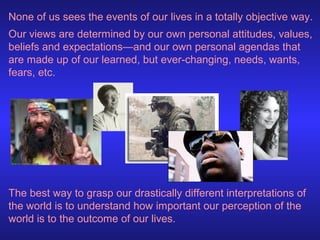
None of us sees the events of our lives in a totally objective way.
Our views are determined by our own personal attitudes, values,
beliefs and expectations—and our own personal agendas that
are made up of our learned, but ever-changing, needs, wants,
fears, etc.

The best way to grasp our drastically different interpretations of
the world is to understand how important our perception of the
world is to the outcome of our lives.
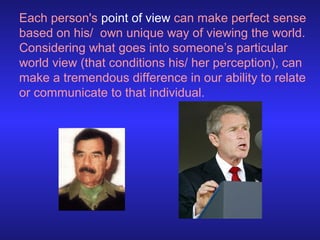
Each person's point of view can make perfect sense
based on his/ own unique way of viewing the world.
Considering what goes into someone’s particular
world view (that conditions his/ her perception), can
make a tremendous difference in our ability to relate
or communicate to that individual.
As we have seen, Visual Perception deals with:
the discrimination of color, shapes, patterns. scale ,
distance between objects, background and foreground.
Cognition is a, high level, brain function dealing with
awareness, including:
• thought formation
• comprehension
• planning
• problem solving
• Memorization
• concentration
• self-monitoring
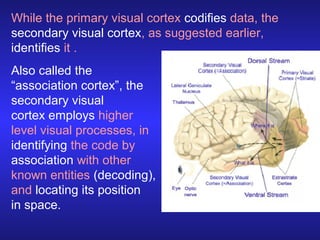
While the primary visual cortex codifies data, the
secondary visual cortex, as suggested earlier,
identifies it .
Also called the
“association cortex”, the
secondary visual
cortex employs higher
level visual processes, in
identifying the code by
association with other
known entities (decoding),
and locating its position
in space.
What is cognition?
 Cognition is a process by which individuals
interpret their thoughts and images in order to
make sense and give meaning to their world.
Cognition is also an associative process
between awareness and knowledge. It is the
formulation of opinion based on that which we
sense, perceive and that which we already
know.
Why is cognition important?
Cognition is important because
people’s behavior is based on their
interpretation of reality, not reality
itself.

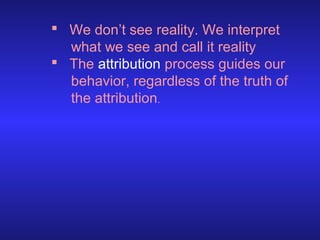
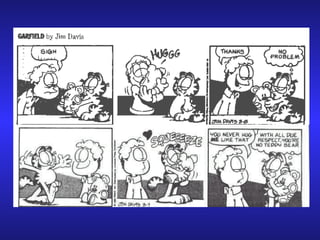
 We don’t see reality. We interpret
what we see and call it reality
 The attribution process guides our
behavior, regardless of the truth of
the attribution.
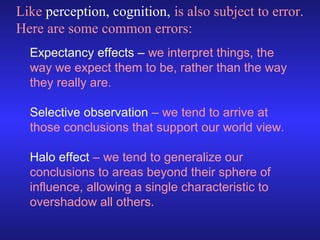
Like perception, cognition, is also subject to error.
Here are some common errors:
Expectancy effects – we interpret things, the
way we expect them to be, rather than the way
they really are.
Selective observation – we tend to arrive at
those conclusions that support our world view.
Halo effect – we tend to generalize our
conclusions to areas beyond their sphere of
influence, allowing a single characteristic to
overshadow all others.
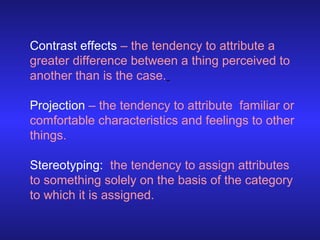
Contrast effects – the tendency to attribute a
greater difference between a thing perceived to
another than is the case.
Projection – the tendency to attribute familiar or
comfortable characteristics and feelings to other
things.
Stereotyping: the tendency to assign attributes
to something solely on the basis of the category
to which it is assigned.
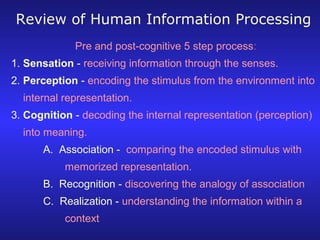
Review of Human Information Processing
Pre and post-cognitive 5 step process:
1. Sensation - receiving information through the senses.
2. Perception - encoding the stimulus from the environment into
internal representation.
3. Cognition - decoding the internal representation (perception)
into meaning.
A. Association - comparing the encoded stimulus with
memorized representation.
B. Recognition - discovering the analogy of association
C. Realization - understanding the information within a
context
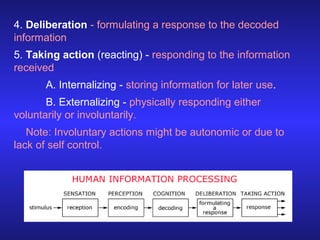
4. Deliberation - formulating a response to the decoded
information
5. Taking action (reacting) - responding to the information
received
A. Internalizing - storing information for later use.
B. Externalizing - physically responding either
voluntarily or involuntarily.
Note: Involuntary actions might be autonomic or due to
lack of self control.
9   cognition

9 cognition

  • 1.
  • 2.
    Cognition How can peoplelook at a particular situation and come to such completely different conclusions? How can they hold such different interpretations of reality? Understanding such differences depends upon recognizing the power of cognition.
  • 3.
    None of ussees the events of our lives in a totally objective way. Our views are determined by our own personal attitudes, values, beliefs and expectations—and our own personal agendas that are made up of our learned, but ever-changing, needs, wants, fears, etc. The best way to grasp our drastically different interpretations of the world is to understand how important our perception of the world is to the outcome of our lives.
  • 4.
    Each person's pointof view can make perfect sense based on his/ own unique way of viewing the world. Considering what goes into someone’s particular world view (that conditions his/ her perception), can make a tremendous difference in our ability to relate or communicate to that individual.
  • 5.
    As we haveseen, Visual Perception deals with: the discrimination of color, shapes, patterns. scale , distance between objects, background and foreground. Cognition is a, high level, brain function dealing with awareness, including: • thought formation • comprehension • planning • problem solving • Memorization • concentration • self-monitoring
  • 6.
    While the primaryvisual cortex codifies data, the secondary visual cortex, as suggested earlier, identifies it . Also called the “association cortex”, the secondary visual cortex employs higher level visual processes, in identifying the code by association with other known entities (decoding), and locating its position in space.
  • 7.
    What is cognition? Cognition is a process by which individuals interpret their thoughts and images in order to make sense and give meaning to their world. Cognition is also an associative process between awareness and knowledge. It is the formulation of opinion based on that which we sense, perceive and that which we already know.
  • 8.
    Why is cognitionimportant? Cognition is important because people’s behavior is based on their interpretation of reality, not reality itself. 
  • 9.
     We don’tsee reality. We interpret what we see and call it reality  The attribution process guides our behavior, regardless of the truth of the attribution.
  • 11.
    Like perception, cognition,is also subject to error. Here are some common errors: Expectancy effects – we interpret things, the way we expect them to be, rather than the way they really are. Selective observation – we tend to arrive at those conclusions that support our world view. Halo effect – we tend to generalize our conclusions to areas beyond their sphere of influence, allowing a single characteristic to overshadow all others.
  • 12.
    Contrast effects –the tendency to attribute a greater difference between a thing perceived to another than is the case. Projection – the tendency to attribute familiar or comfortable characteristics and feelings to other things. Stereotyping: the tendency to assign attributes to something solely on the basis of the category to which it is assigned.
  • 13.
    Review of HumanInformation Processing Pre and post-cognitive 5 step process: 1. Sensation - receiving information through the senses. 2. Perception - encoding the stimulus from the environment into internal representation. 3. Cognition - decoding the internal representation (perception) into meaning. A. Association - comparing the encoded stimulus with memorized representation. B. Recognition - discovering the analogy of association C. Realization - understanding the information within a context
  • 14.
    4. Deliberation -formulating a response to the decoded information 5. Taking action (reacting) - responding to the information received A. Internalizing - storing information for later use. B. Externalizing - physically responding either voluntarily or involuntarily. Note: Involuntary actions might be autonomic or due to lack of self control.

Editor's Notes

  • #2 These impulses are then sent down the optic tract to a part of the brain called the lateral geniculate body. Here the information undergoes something like a preliminary inspection, which involves a categorization of the data. The newly categorized info is then sent on to the visual cortex, which is part of the cerebral cortex of the brain. It is in the cerebral cortex where the brain assembles a processed image and we actually “see” what is in front of us. Like other visual information, signals coding color travel from the retina, via axons of the ganglion cells, to the lateral geniculate nucleus of the thalamus. Axons from color-processing cells in the geniculate are connected to color-detecting cells in the visual cortex, in the occipital lobe at the back of the brain (Figure 4). Within the occipital lobe, cells in the primary visual cortex, often called "area 17" by researchers, are the first to receive messages from the geniculate. Signals conveying color information then go on to several nearby visual areas for further processing, mainly to an area termed "V4." For perception and recognition, signals are then sent to so-called "higher centers," where they interact with stored memories and input from other sensory and motor centers. One "set" of information is spatial and goes mainly to the parietal lobe, while a second "set" concerned with object recognition and color perception goes to the lower part of the temporal lobe. However, scientists have also found that even when these parietal and temporal lobe areas are damaged, people can perform tasks involving spatial relationships, object recognition, and color information, so the brain must also process this visual data in additional places. The lateral geniculate nucleus forms the main stream of visual information to the cerebral cortex. It is a transfer center that disentangles the various retinal subsystems serving the contralateral visual fields and organizes their projections to striate cortex.
  • #7 The visual signal entering the secondary visual cortex, is principally responsible for perceiving color and the relationships between form and color. The secondary visual cortex performs two broad tasks of perceiving "what" forms are in the visual image and "where" objects are in space. The "what" tasks correspond to a stream of connections into the temporal lobe, which contains areas that recognize objects and faces. The "where" tasks are performed through a stream into the parietal lobe, which houses areas dedicated to perceiving movement and spatial relationships. Together, through simultaneous activity, these cortical centers allow us to very quickly see, understand, and respond to an enormous range of visual scenes.