Dr.Alaa Mohammad AbuZaineh
Teaching Assistant
RAKCOMS
RAKMHSU
Keloids
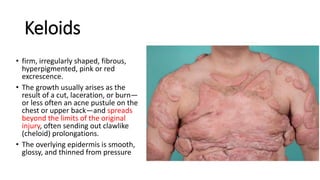
• firm, irregularly shaped, fibrous,
hyperpigmented, pink or red
excrescence.
• The growth usually arises as the
result of a cut, laceration, or burn—
or less often an acne pustule on the
chest or upper back—and spreads
beyond the limits of the original
injury, often sending out clawlike
(cheloid) prolongations.
• The overlying epidermis is smooth,
glossy, and thinned from pressure
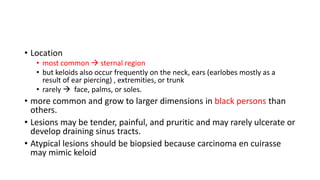
• Location
• most common  sternal region
• but keloids also occur frequently on the neck, ears (earlobes mostly as a
result of ear piercing) , extremities, or trunk
• rarely  face, palms, or soles.
• more common and grow to larger dimensions in black persons than
others.
• Lesions may be tender, painful, and pruritic and may rarely ulcerate or
develop draining sinus tracts.
• Atypical lesions should be biopsied because carcinoma en cuirasse
may mimic keloid
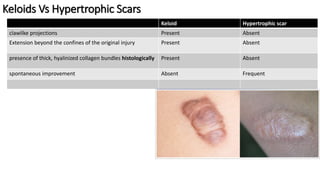
Keloids Vs Hypertrophic Scars
Keloid Hypertrophic scar
clawlike projections Present Absent
Extension beyond the confines of the original injury Present Absent
presence of thick, hyalinized collagen bundles histologically Present Absent
spontaneous improvement Absent Frequent
Treatment
• Initial Tx  intralesional injection of triamcinolone (Corticosteroid)
alone or in combination with 5-fluorouracil (5-FU), methotrexate,
verapamil, and/or lasers
• Chemotherapeutic agents Inhibits fibroblastic proliferation in tissue culture and is believed to reduce postoperative scarring by
decreasing fibroblast proliferation.
• Verapamil has been proven to increase the synthesis of procollagenase in keloids, hypertrophic scars, and normal cultured
fibroblasts.
• surgical removal
Thank You
• Reference :
• William James, Dirk Elston, James Treat, Misha Rosenbach, Isaac Neuhaus -
Andrews’ Diseases of the Skin_ Clinical Dermatology-Elsevier (2019)

8.keloid

  • 1.
    Dr.Alaa Mohammad AbuZaineh TeachingAssistant RAKCOMS RAKMHSU
  • 3.
    Keloids • firm, irregularlyshaped, fibrous, hyperpigmented, pink or red excrescence. • The growth usually arises as the result of a cut, laceration, or burn— or less often an acne pustule on the chest or upper back—and spreads beyond the limits of the original injury, often sending out clawlike (cheloid) prolongations. • The overlying epidermis is smooth, glossy, and thinned from pressure
  • 4.
    • Location • mostcommon  sternal region • but keloids also occur frequently on the neck, ears (earlobes mostly as a result of ear piercing) , extremities, or trunk • rarely  face, palms, or soles. • more common and grow to larger dimensions in black persons than others. • Lesions may be tender, painful, and pruritic and may rarely ulcerate or develop draining sinus tracts. • Atypical lesions should be biopsied because carcinoma en cuirasse may mimic keloid
  • 5.
    Keloids Vs HypertrophicScars Keloid Hypertrophic scar clawlike projections Present Absent Extension beyond the confines of the original injury Present Absent presence of thick, hyalinized collagen bundles histologically Present Absent spontaneous improvement Absent Frequent
  • 6.
    Treatment • Initial Tx intralesional injection of triamcinolone (Corticosteroid) alone or in combination with 5-fluorouracil (5-FU), methotrexate, verapamil, and/or lasers • Chemotherapeutic agents Inhibits fibroblastic proliferation in tissue culture and is believed to reduce postoperative scarring by decreasing fibroblast proliferation. • Verapamil has been proven to increase the synthesis of procollagenase in keloids, hypertrophic scars, and normal cultured fibroblasts. • surgical removal
  • 7.
    Thank You • Reference: • William James, Dirk Elston, James Treat, Misha Rosenbach, Isaac Neuhaus - Andrews’ Diseases of the Skin_ Clinical Dermatology-Elsevier (2019)

Editor's Notes

  • #5 Carcinoma en cuirasse is an unusual skin metastasis of breast cancer with diffuse carcinomatous cutaneous and subcutaneous infiltration that may affect the chest and abdomen, by extension.