HEALTHCARE CONSTRUCTION ( H .C.C )
FOR
SAFER ENVIRONMENT AND QUALITY CARE
Soe Hlaing . Dip.Civil.Eng:B,S.,BSC,MPA
Associate of American Healthcare Engineering
Certified MRSO ,DOT( USA )
8 th March .2017 UOPH YGN:
Medical Professions Role in Hospital Design
Team
Architects
Researchers
Facility
Administrators
Based on:
• Strong
knowle
-dge
• Experie
-nce
Health Care
Providers
• Reduce
Risks
• Spur
Design
Innovati
on
Preliminary Survey
Physical Facilities
Condition
Needs & Objectives
( Short Term )
Volume & Kinds
Hospital Service
Needs & Objectives
( Long Term )
Hospital Occupancy
Rate
Full-time Specialists
&
Advanced Equipment
Bed Capacity
Institution
Bed Distribution Quality of Facilities
& Services
Facility Master Plan
Mission
Projection of
Facility Needs
Short term
Long term
GROWTH TARGET
Facility
Master Plan
Financial
Feasibility
Debt &
Borrowing
Potential
REVIEW OF
PREVIOUS
PLAN
 Master plan
 Land
Acquisition
 Building
Potential
PRIMARY GOALS
Building
Programme
Potential
Filling + Preparation
Long Term
Needs
Short Term
Needs
Conceptual Design
 Preliminary Departmental Block Diagrams
 Conceptual site master plan
 Regulatory framework review and analysis
 Study model for building mass
 Preliminary Cost Estimates
Schematic Design
 Room by Room department layout
 Regulatory compliance conformation
 Selection of appropriate structural system
 General arrangement of structural grid
 Major equipment and furniture layouts
 MEP identification and design
 Perspective Views
 Outline specification
 Cost Estimate Update
Regulatory Approval Process

Municipal drawing and document
 Fire Safety drawing
 Submission to Authorities
 Liaison services or seeking / procuring
approvals
Functional Design Development
 Detail functional development of the design
 MEP system detail
 Detail Structural Design
 Medical Equipment Sitting drawing
 Integration of interior design concepts
 Detail site plan, integrating landscape design
 Building elevation and section
 Select-reflected ceiling plans
 Final specification
 Detail architectural model
 Cost - Estimate Update
Planning parameters
• The design should support functional segregation of
OPD, inpatients, diagnostic services and supportive
services so that mixing of patient flow is avoided.
• Separation of critical areas like OT, ICU from
general traffic and avoidance of air movement from
areas like laboratories and infectious diseases wards
towards critical areas.
• The design should support concept of zoning and
ventilation standards in acute care areas.
• The clean corridor and dirty corridor should not be
adjacent and they should facilitate traffic flow of
clean and dirty items separately
Planning parameters
• Isolation wards for infectious cases to be kept out
of routine circulation.
• Adequate number of wash hand basins should be
provided within the patient care areas and nursing
stations with a view to facilitate hand washing
practice.
• Separate arrangements for garbage and infectious
waste removal from wards and departments in the
form of separate staircases and lifts.
Planning parameters
• Construction of isolation rooms within the
wards including ICU and acute care areas.
• Provision of airlock and anteroom before
entering into critical care areas.
M E P SCHEMATIC
MEDICAL EQUIPMENTS SITTING
AND ROOM DETAIL
PDC Model of HCC
• Fire Safety
• Medical Gas
• Life Safety
• Infection Control
• Security
• Risk Assessment
• MEP System
• ILSM
• Codes & Standard
• Abb : PDC - PLANNING DESIGN & CONSTRUCTION
• HCC - Healthcare Construction
• ILSM - Interim life safety measure
Planning / Programming
Schematic Design
Design Development
Construction Documents
Construction
Occupancy
Healthcare Associated Infections ( HAIs )
• Threat to Patient safety
• Threat to HCP & visits safety
• CDC count 99,000 death /yr
• Aspergillus- Fungal spores
• Viruses TB or Hepatitis
• Bactria as Legionella
Lethal/pneumonia
• http://www.cdc.gov/HAI/burden.html
HEALTHCARE FACILITIES VS CONTERMINATION
Potential
Microbiological Risk
Contact
Personals/surfaces
Airborne Transmission
( IAQ )
Common Vehicles
(traffics)
Droplets
Infection Control Risk Assessment
(ICRA)
• Safe Design
• HVAC ( SSI , AII,PE )
• Plumbing Systems (hand wash, shower tub, scrub sink, equipment
wash , bedpan wash, sanitary etc: )
• Surface and Finishing Materials Selection
( bld: envelopes)
• Abb: SSI (Surgical Suits Infection) / AII(Airborne Infection Isolation/
PE(Protective Environment)
Integrated
Facility
Planning
Design
Construction
Commissioning
Activities
Infection Prevention
Green Field project/New construction
• Impact to patients varies on adjacencies
• Hazard points:
– Dust from demolition to pedestrains, adjacent buildings.
– Water damage to building materials
– Focus on design, keeping materials & building clean & dry,
function prior to occupancy
• Solution to impacts:
– Dust control
– Appropriate plan for materials
– Infection prevention planning in design
Infection Prevention
Renovation of existing or completion of Shell space
• Hazard points:
– Noise & vibration
– Air infiltration to adjacent care areas
– Barrier management
– Utilities affected (leaks, outages)
– Traffic routes
• Solution for issues:
– Communication
– Effective barriers & pressure mgt
– Patient relocation when a must
– Contingency plans for emergencies
– Plan routes for demolition waste
BUILDING CODES and REGULATIONS
MNBC 2012
• Appendix 2.2 A-2.2.1
2.2.1.1 Health Care Buildings
proper garbage disposal system
hygienic arrangements
2.2.1.2 window area 10% of floor
min-distance between building 5’
min 1 toilet/8 beds
min 1 shower/16 beds
One mortuary with proper cooling
system for over 20 beds
2.2.1.3
minimum 1 toilet/15
2.2.1.5. Ambulatory healthcare facilities
2.2.1.5.2 smoke barriers
2.2.1.5.3 Refuge area etc:
Ref: page 43-44-55
2.5.6.2. Room Height
2.5.6.2 .2 Hospitals
Clear Height of the rooms(head
rooms) used fro the
accommodation of patients shell
not be less than 9.5 feet
The height of the rooms used for
operation, treatment etc: shell
conform to concerned
authorities
Ref: page 88
2.6.18.1 Emergency Escape/
refuge area
Page Ref: 107, 108,109,111
WHO Guide Line
Chapter 8 Environment
8.1.1 Planning for construction or renovation
• Traffic flow to minimize exposure of high risk patients and facilitate
patient transport
• Adequate spatial separation of patients
• Adequate number and type of isolation rooms
• Appropriate access to hand washing facilities
• Materials( carpets ,floors) that can be adequate cleaned
• Appropriate Ventilation for special patients care area(isolation OT,
Transplant units)
• Prevention patient exposure to fungal spores with renovation
International Accreditation
• Australia : Australian Council on Healthcare
Standards International (ACHSI)
• Canada: Accreditation Canada International (ACI)
• France: HAS (Haute Autorité de Santé)
• India: National Accreditation Board for Hospitals
& Healthcare Providers (NABH)
• ISQua Umbrella Organization Responsible for
accrediting the JCI accreditation scheme in the USA
and Accreditation Canada International, as well as
accreditation organizations in the United Kingdom and
Australia.
International Accreditation
• New Zealand: Quality Health New Zealand (QHNZ)
under ISQUA
• Saudi Arabia: Saudi Central Board for Accreditation of
Healthcare Institutions (CBAHI), Jeddah.
• United Kingdom: QHA Trent Accreditation
• UKAF:
• United States: Joint Commission International (JCI)
• Turkey: SAS Accreditation (Standards of Accreditation
in Health) by Turkish Ministry of Health
JCI -Designed to drive positive change
1. Designed to stimulate and support sustained quality
improvement
2. Created to reduce risk
3. Focused on building a culture of patient safety
4. Developed by health care experts from around the
world—and tested in every world region
5. Developed by health professionals specifically for
the health care sector
6. Applicable to individual health care organizations
and national health care systems
Recommended Patient Ward
• Floor space area per bed 7sqm: (75.3 sqft )
excluding central corridor of 2.4 meters.
• Single bed rooms were given 14 sqm: (150 sqft)
• distance between centers of beds in 6 bedded
rooms was coming to more than 2.4 meters
(7.8 ft)
• averaging one WHB per six beds was
provisioned for hand hygiene.
• INFLUENCE
1- Patient Satisfaction
2- The Public Image of the Hospital
• Physical Design Goals should not be confused
with Operational Goals
Ref: Australasian College for Emergency Medicine
guide line G15
Core Consideration
• High patient turnover
• Varied case mix
• Large workforce
• Safety and security
• Amenity
• Image and consumer expectations
• Evolving work practices
• Ability to respond to clinical demands
• Prevent cross infection / cross contaminations
• Additional information which pertain to the role of
delineation of the department
( ie. Trauma service, regional referral service)
Internal functional relationships
1. An entrance/waiting room/reception area
2. A triage area;
3. A resuscitation area;
4. A mental health assessment area;
5. An acute treatment area (also referred to as acute/majors);
6. A consultation area (also called Fast Track area/sub-
acute/minors/ambulatory care);
7. Adjunctive areas (x-ray, Short Stay Unit (SSU), allied health,
investigations room (point of care testing)
8. Staff/amenities areas;
Internal functional relationships
9. Administrative areas;
10. Storage areas;
11. Clean preparation and drug preparation room(s);
12. Dirty utility and disposal areas;
13. Patient amenities areas e.g. a food storage fridge that
meets OH&S standards for patient sandwiches (for after
hours);
14. Toilet (staff and patient including for disabled patients)
and bathroom/shower facilities;
15. Teaching and research areas
Conceptual Service Flow Plan
Public Traffic
Fast Track
Waiting
Customer
Amenities
Emergency
Department
Waiting
Pod # 3
Non-Urgent Care
( Fast Track )
Pod # 4
Observation /
Holding area
( Optional )
Staff
traffic
Adinistrative /
Support Space
Pod # 2
Acute Care
Pod # 1
Acute Care
Triage
Register /
Discharge
Trauma /
Resuscitation
Ambulance EntryWalk in Entry
Fast Track
intake
Emergency Department
Handicapped Person Sanitation
Diagnostic Radiology and Imaging
• -to improvements in quality care, patient
safety and appropriate use of radiology.
• Quality and Safety - ICRQS
I.S.R
Radiation Safety issue
RADIATION SAFITY STAKEHOLDER
D .A.E
I.A.E.A
Law Enforcement
8.June.1998
Inspection Procedure Aligned
Regulation
• First Time Inspection for Licensing of Radiation
Apparatus
- Information check of X-ray Machine
- Room layout diagram
- Particular and qualification of Operators
- Leakage test
- Personal Monitoring
Second and next inspections for renewal License
- Information check of X-ray machine
- Accuracy test (voltage, timer and beam alignment)
- Radiation Safety Control of Operator, Public areas
X-rays Room
C.T. (Phillip) Y.C.H
C.T ( GE ) . Y G H
CT . Simulator
(Zabuthiri Hospital)
M.R.I (Phillip) Y.C.H
M.R.I (GE) Y.G.H
FARADAY CAGE
TO PROTECT
RADIO-FREQUENCY
PROTECTION SHIELDING
RESPONSIBLE BY SUPPLIER
MRI CONSTRUCTION
Linear Accelerator for RT
INTENSIVE CARE I.C.U
• Critically ill Patients requiring highly skilled
life-saving medical aid and nursing care round
the clock are concentrated.
• (Dr.Malhotra step by step hospital designing and planning)
Consideration Floor Plan
• Patient Admission Patterns/ 8 beds/group
• Staff and Visitors Traffic Patterns
• Functional requirements/Support Facilities
• Natural Light/ Positioning fitting and fixtures
/Screen
• Near by OT / imaging /lab
• HVAC and Medical gas/Electrical S.D.B/fire safety
• Storage/ Clerical Space
• Administrative & Educational requirement
Operational Requirement
1. Patient Area 215 SQ’/Bed 270
SQ ‘ / room
2. Central Station
3. X-Ray Viewing Area
4. Work Area and Storage
5. Receptionist Area
6. Special Procedure Room
7. Clean and Dirty Utility
8. Equipment Storage
9. Positive and Negative
room
10. Nourishment Preparation
Area
11. Staff Lounge
12. Conference Room
13. Visitor’s Lounge
14. Staff Lounge
15. Patient Transport routes
16. Supply and service
Corridors
Intensive Care Unit
Ref: ICU Naypyitaw 1000 bedded Hospital
Operating Theater
An operating theatre, operating room (OR) or operating suite,
is a facility within a hospital where surgical operations are
carried out in a sterile environment.
Patient and HCP Safety
Minimized Contamination
Safe and Sound working Environment
Quality of Health Care
Theme of OT concept
• Goals of design Concepts- Maximum Patient
Safety & Work Efficiency
• High potential for Cross-Contamination by
disease-carrying organisms
• Surfaces – Smooth, nonporous (impervious) ,
fire proof , withstand with strong
disinfectants, conductive,
Ventilation ( IAQ )
• Prevent – air-borne bacteria contamination
pathogen generate aerosol particles or droplets
• 20 air-exchange per hour
• Ideal Humidity control – 50% to 53 %
minimize static electricity and prevent ignition
of flammable solutions and gas
• Ideal temperature range 20 C °-24°C (68°F-73°F)
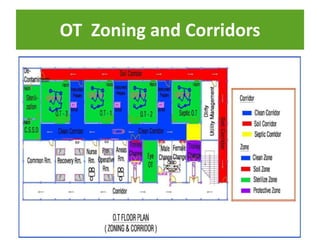
OT Zoning and Corridors
Laminar and
Non Laminar
Process of Modular O.T
Concept of CSSD Zoning
Detercontermination
Sterilization
C .S .S .D
Hospital Corridor
• In Area- where patient beds, trolleys and
stretchers will be move regularly,
• minimum clear corridor width shall be 2300
mm ( 7.5 ‘)
• recommended clear width of corridor 2400
mm ( 7.9 ‘)
• Ref: space standards & dimensions part C- version 3.3 April 2014
• Ref: American Hospital Association (AHA)
Evacuation and Escape
• Comply with Evacuation and Emergency Exit
• Maximum travel distance of 40 Meters from the
furthest point of the floor
• Exit Number – minimum number of exit points per
floor to be two(2) Locations
• Above 500 peoples require 3 Exits
• Above 1000 peoples require 4 Exits
• Single Signage Visibility and Exit Opening Direction
• Minimum clear width 1.2 M(47’’)
• REF: (Design Planning Manual for Building 2014 UN office of Project
Service)
Better Future by Better Society
References:
• Society of Critical Care Medicine
• Intensive Care Med
• The Intensive Care Society ( UK )
• Dr GD Kunder’ Hospitals Planning and Management
• MNBC 2012
• WHO/CDS/CSR/EPH/2002.12 Prevention of hospital-acquired infection
• UNOPS Design Planning Manual for Building 2014
• JCI
• Dr Malhotra’s Hospital Designing and Planning
• Western Australia Healthcare Facility Guidelines 2006
• American Healthcare Engineering
• Space Med
• US Department of Energy
• D.A.E ( Myanmar )
Presented by @Soe Hlaing (09 5127071)
Email . Strength.engineering@gmail.com

8.healthcare construction

  • 1.
    HEALTHCARE CONSTRUCTION (H .C.C ) FOR SAFER ENVIRONMENT AND QUALITY CARE Soe Hlaing . Dip.Civil.Eng:B,S.,BSC,MPA Associate of American Healthcare Engineering Certified MRSO ,DOT( USA ) 8 th March .2017 UOPH YGN:
  • 2.
    Medical Professions Rolein Hospital Design Team Architects Researchers Facility Administrators Based on: • Strong knowle -dge • Experie -nce Health Care Providers • Reduce Risks • Spur Design Innovati on
  • 3.
    Preliminary Survey Physical Facilities Condition Needs& Objectives ( Short Term ) Volume & Kinds Hospital Service Needs & Objectives ( Long Term ) Hospital Occupancy Rate Full-time Specialists & Advanced Equipment Bed Capacity Institution Bed Distribution Quality of Facilities & Services
  • 4.
    Facility Master Plan Mission Projectionof Facility Needs Short term Long term GROWTH TARGET Facility Master Plan Financial Feasibility Debt & Borrowing Potential REVIEW OF PREVIOUS PLAN  Master plan  Land Acquisition  Building Potential PRIMARY GOALS Building Programme Potential
  • 5.
    Filling + Preparation LongTerm Needs Short Term Needs
  • 6.
    Conceptual Design  PreliminaryDepartmental Block Diagrams  Conceptual site master plan  Regulatory framework review and analysis  Study model for building mass  Preliminary Cost Estimates
  • 7.
    Schematic Design  Roomby Room department layout  Regulatory compliance conformation  Selection of appropriate structural system  General arrangement of structural grid  Major equipment and furniture layouts  MEP identification and design  Perspective Views  Outline specification  Cost Estimate Update
  • 8.
    Regulatory Approval Process  Municipaldrawing and document  Fire Safety drawing  Submission to Authorities  Liaison services or seeking / procuring approvals
  • 9.
    Functional Design Development Detail functional development of the design  MEP system detail  Detail Structural Design  Medical Equipment Sitting drawing  Integration of interior design concepts  Detail site plan, integrating landscape design  Building elevation and section  Select-reflected ceiling plans  Final specification  Detail architectural model  Cost - Estimate Update
  • 10.
    Planning parameters • Thedesign should support functional segregation of OPD, inpatients, diagnostic services and supportive services so that mixing of patient flow is avoided. • Separation of critical areas like OT, ICU from general traffic and avoidance of air movement from areas like laboratories and infectious diseases wards towards critical areas. • The design should support concept of zoning and ventilation standards in acute care areas. • The clean corridor and dirty corridor should not be adjacent and they should facilitate traffic flow of clean and dirty items separately
  • 11.
    Planning parameters • Isolationwards for infectious cases to be kept out of routine circulation. • Adequate number of wash hand basins should be provided within the patient care areas and nursing stations with a view to facilitate hand washing practice. • Separate arrangements for garbage and infectious waste removal from wards and departments in the form of separate staircases and lifts.
  • 12.
    Planning parameters • Constructionof isolation rooms within the wards including ICU and acute care areas. • Provision of airlock and anteroom before entering into critical care areas.
  • 13.
    M E PSCHEMATIC
  • 14.
  • 15.
    PDC Model ofHCC • Fire Safety • Medical Gas • Life Safety • Infection Control • Security • Risk Assessment • MEP System • ILSM • Codes & Standard • Abb : PDC - PLANNING DESIGN & CONSTRUCTION • HCC - Healthcare Construction • ILSM - Interim life safety measure Planning / Programming Schematic Design Design Development Construction Documents Construction Occupancy
  • 16.
    Healthcare Associated Infections( HAIs ) • Threat to Patient safety • Threat to HCP & visits safety • CDC count 99,000 death /yr • Aspergillus- Fungal spores • Viruses TB or Hepatitis • Bactria as Legionella Lethal/pneumonia • http://www.cdc.gov/HAI/burden.html
  • 17.
    HEALTHCARE FACILITIES VSCONTERMINATION Potential Microbiological Risk Contact Personals/surfaces Airborne Transmission ( IAQ ) Common Vehicles (traffics) Droplets
  • 18.
    Infection Control RiskAssessment (ICRA) • Safe Design • HVAC ( SSI , AII,PE ) • Plumbing Systems (hand wash, shower tub, scrub sink, equipment wash , bedpan wash, sanitary etc: ) • Surface and Finishing Materials Selection ( bld: envelopes) • Abb: SSI (Surgical Suits Infection) / AII(Airborne Infection Isolation/ PE(Protective Environment) Integrated Facility Planning Design Construction Commissioning Activities
  • 19.
    Infection Prevention Green Fieldproject/New construction • Impact to patients varies on adjacencies • Hazard points: – Dust from demolition to pedestrains, adjacent buildings. – Water damage to building materials – Focus on design, keeping materials & building clean & dry, function prior to occupancy • Solution to impacts: – Dust control – Appropriate plan for materials – Infection prevention planning in design
  • 20.
    Infection Prevention Renovation ofexisting or completion of Shell space • Hazard points: – Noise & vibration – Air infiltration to adjacent care areas – Barrier management – Utilities affected (leaks, outages) – Traffic routes • Solution for issues: – Communication – Effective barriers & pressure mgt – Patient relocation when a must – Contingency plans for emergencies – Plan routes for demolition waste
  • 21.
    BUILDING CODES andREGULATIONS
  • 22.
    MNBC 2012 • Appendix2.2 A-2.2.1 2.2.1.1 Health Care Buildings proper garbage disposal system hygienic arrangements 2.2.1.2 window area 10% of floor min-distance between building 5’ min 1 toilet/8 beds min 1 shower/16 beds One mortuary with proper cooling system for over 20 beds 2.2.1.3 minimum 1 toilet/15 2.2.1.5. Ambulatory healthcare facilities 2.2.1.5.2 smoke barriers 2.2.1.5.3 Refuge area etc: Ref: page 43-44-55 2.5.6.2. Room Height 2.5.6.2 .2 Hospitals Clear Height of the rooms(head rooms) used fro the accommodation of patients shell not be less than 9.5 feet The height of the rooms used for operation, treatment etc: shell conform to concerned authorities Ref: page 88 2.6.18.1 Emergency Escape/ refuge area Page Ref: 107, 108,109,111
  • 23.
    WHO Guide Line Chapter8 Environment 8.1.1 Planning for construction or renovation • Traffic flow to minimize exposure of high risk patients and facilitate patient transport • Adequate spatial separation of patients • Adequate number and type of isolation rooms • Appropriate access to hand washing facilities • Materials( carpets ,floors) that can be adequate cleaned • Appropriate Ventilation for special patients care area(isolation OT, Transplant units) • Prevention patient exposure to fungal spores with renovation
  • 24.
    International Accreditation • Australia: Australian Council on Healthcare Standards International (ACHSI) • Canada: Accreditation Canada International (ACI) • France: HAS (Haute Autorité de Santé) • India: National Accreditation Board for Hospitals & Healthcare Providers (NABH) • ISQua Umbrella Organization Responsible for accrediting the JCI accreditation scheme in the USA and Accreditation Canada International, as well as accreditation organizations in the United Kingdom and Australia.
  • 25.
    International Accreditation • NewZealand: Quality Health New Zealand (QHNZ) under ISQUA • Saudi Arabia: Saudi Central Board for Accreditation of Healthcare Institutions (CBAHI), Jeddah. • United Kingdom: QHA Trent Accreditation • UKAF: • United States: Joint Commission International (JCI) • Turkey: SAS Accreditation (Standards of Accreditation in Health) by Turkish Ministry of Health
  • 26.
    JCI -Designed todrive positive change 1. Designed to stimulate and support sustained quality improvement 2. Created to reduce risk 3. Focused on building a culture of patient safety 4. Developed by health care experts from around the world—and tested in every world region 5. Developed by health professionals specifically for the health care sector 6. Applicable to individual health care organizations and national health care systems
  • 27.
    Recommended Patient Ward •Floor space area per bed 7sqm: (75.3 sqft ) excluding central corridor of 2.4 meters. • Single bed rooms were given 14 sqm: (150 sqft) • distance between centers of beds in 6 bedded rooms was coming to more than 2.4 meters (7.8 ft) • averaging one WHB per six beds was provisioned for hand hygiene.
  • 28.
    • INFLUENCE 1- PatientSatisfaction 2- The Public Image of the Hospital • Physical Design Goals should not be confused with Operational Goals Ref: Australasian College for Emergency Medicine guide line G15
  • 29.
    Core Consideration • Highpatient turnover • Varied case mix • Large workforce • Safety and security • Amenity • Image and consumer expectations • Evolving work practices • Ability to respond to clinical demands • Prevent cross infection / cross contaminations • Additional information which pertain to the role of delineation of the department ( ie. Trauma service, regional referral service)
  • 30.
    Internal functional relationships 1.An entrance/waiting room/reception area 2. A triage area; 3. A resuscitation area; 4. A mental health assessment area; 5. An acute treatment area (also referred to as acute/majors); 6. A consultation area (also called Fast Track area/sub- acute/minors/ambulatory care); 7. Adjunctive areas (x-ray, Short Stay Unit (SSU), allied health, investigations room (point of care testing) 8. Staff/amenities areas;
  • 31.
    Internal functional relationships 9.Administrative areas; 10. Storage areas; 11. Clean preparation and drug preparation room(s); 12. Dirty utility and disposal areas; 13. Patient amenities areas e.g. a food storage fridge that meets OH&S standards for patient sandwiches (for after hours); 14. Toilet (staff and patient including for disabled patients) and bathroom/shower facilities; 15. Teaching and research areas
  • 32.
    Conceptual Service FlowPlan Public Traffic Fast Track Waiting Customer Amenities Emergency Department Waiting Pod # 3 Non-Urgent Care ( Fast Track ) Pod # 4 Observation / Holding area ( Optional ) Staff traffic Adinistrative / Support Space Pod # 2 Acute Care Pod # 1 Acute Care Triage Register / Discharge Trauma / Resuscitation Ambulance EntryWalk in Entry Fast Track intake
  • 33.
  • 34.
  • 35.
    Diagnostic Radiology andImaging • -to improvements in quality care, patient safety and appropriate use of radiology. • Quality and Safety - ICRQS I.S.R
  • 36.
    Radiation Safety issue RADIATIONSAFITY STAKEHOLDER D .A.E I.A.E.A
  • 38.
  • 39.
    Inspection Procedure Aligned Regulation •First Time Inspection for Licensing of Radiation Apparatus - Information check of X-ray Machine - Room layout diagram - Particular and qualification of Operators - Leakage test - Personal Monitoring Second and next inspections for renewal License - Information check of X-ray machine - Accuracy test (voltage, timer and beam alignment) - Radiation Safety Control of Operator, Public areas
  • 40.
  • 41.
  • 42.
    C.T ( GE) . Y G H
  • 43.
  • 44.
  • 45.
  • 46.
    FARADAY CAGE TO PROTECT RADIO-FREQUENCY PROTECTIONSHIELDING RESPONSIBLE BY SUPPLIER MRI CONSTRUCTION
  • 47.
  • 48.
    INTENSIVE CARE I.C.U •Critically ill Patients requiring highly skilled life-saving medical aid and nursing care round the clock are concentrated. • (Dr.Malhotra step by step hospital designing and planning)
  • 49.
    Consideration Floor Plan •Patient Admission Patterns/ 8 beds/group • Staff and Visitors Traffic Patterns • Functional requirements/Support Facilities • Natural Light/ Positioning fitting and fixtures /Screen • Near by OT / imaging /lab • HVAC and Medical gas/Electrical S.D.B/fire safety • Storage/ Clerical Space • Administrative & Educational requirement
  • 50.
    Operational Requirement 1. PatientArea 215 SQ’/Bed 270 SQ ‘ / room 2. Central Station 3. X-Ray Viewing Area 4. Work Area and Storage 5. Receptionist Area 6. Special Procedure Room 7. Clean and Dirty Utility 8. Equipment Storage 9. Positive and Negative room 10. Nourishment Preparation Area 11. Staff Lounge 12. Conference Room 13. Visitor’s Lounge 14. Staff Lounge 15. Patient Transport routes 16. Supply and service Corridors
  • 51.
    Intensive Care Unit Ref:ICU Naypyitaw 1000 bedded Hospital
  • 52.
    Operating Theater An operatingtheatre, operating room (OR) or operating suite, is a facility within a hospital where surgical operations are carried out in a sterile environment.
  • 53.
    Patient and HCPSafety Minimized Contamination Safe and Sound working Environment Quality of Health Care
  • 54.
    Theme of OTconcept • Goals of design Concepts- Maximum Patient Safety & Work Efficiency • High potential for Cross-Contamination by disease-carrying organisms • Surfaces – Smooth, nonporous (impervious) , fire proof , withstand with strong disinfectants, conductive,
  • 55.
    Ventilation ( IAQ) • Prevent – air-borne bacteria contamination pathogen generate aerosol particles or droplets • 20 air-exchange per hour • Ideal Humidity control – 50% to 53 % minimize static electricity and prevent ignition of flammable solutions and gas • Ideal temperature range 20 C °-24°C (68°F-73°F)
  • 56.
    OT Zoning andCorridors
  • 58.
  • 59.
  • 60.
    Concept of CSSDZoning Detercontermination Sterilization C .S .S .D
  • 61.
    Hospital Corridor • InArea- where patient beds, trolleys and stretchers will be move regularly, • minimum clear corridor width shall be 2300 mm ( 7.5 ‘) • recommended clear width of corridor 2400 mm ( 7.9 ‘) • Ref: space standards & dimensions part C- version 3.3 April 2014 • Ref: American Hospital Association (AHA)
  • 62.
    Evacuation and Escape •Comply with Evacuation and Emergency Exit • Maximum travel distance of 40 Meters from the furthest point of the floor • Exit Number – minimum number of exit points per floor to be two(2) Locations • Above 500 peoples require 3 Exits • Above 1000 peoples require 4 Exits • Single Signage Visibility and Exit Opening Direction • Minimum clear width 1.2 M(47’’) • REF: (Design Planning Manual for Building 2014 UN office of Project Service)
  • 63.
    Better Future byBetter Society
  • 64.
    References: • Society ofCritical Care Medicine • Intensive Care Med • The Intensive Care Society ( UK ) • Dr GD Kunder’ Hospitals Planning and Management • MNBC 2012 • WHO/CDS/CSR/EPH/2002.12 Prevention of hospital-acquired infection • UNOPS Design Planning Manual for Building 2014 • JCI • Dr Malhotra’s Hospital Designing and Planning • Western Australia Healthcare Facility Guidelines 2006 • American Healthcare Engineering • Space Med • US Department of Energy • D.A.E ( Myanmar ) Presented by @Soe Hlaing (09 5127071) Email . Strength.engineering@gmail.com