8D Report Case Study
Presenter Name: Atul Rastogi
Date: 3rd October, 2012
Agenda / Contents
Team Identification
Problem Description
Containment
Root Cause
Corrective Actions and Verification
Prevent Reoccurrence
Summary (Congratulate the Team)
Questions
• Customer Sales Rep logged in issue in the Excel
tracking sheet and notified me of the issue
• Determined assembly/test location
of the unit in question and issued
transmittal to the customer to ship
the units to the responsible facility
• Communicated and discussed issue with appropriate
QRA team, specifically the team lead, in China
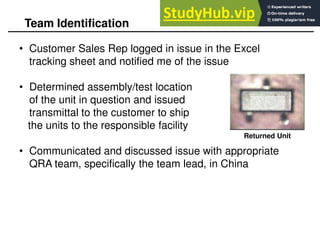
Returned Unit
Team Identification
• Identified the problem with the returned unit
• ATE testing revealed a short
• X-ray revealed that the die inside the package was not in
the correct position
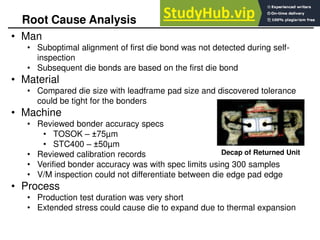
• Deprocessing of the returned unit verified that the die
inside was bonded incorrectly
Decap of Returned Unit
X-ray of Returned Unit
Problem Description
• Identified affected lot from product marking and shipping
records
• Requested material from affected lot to be put on hold at the
customer location and in-house inventories
• Asked customer to return all unused material for disposition
• Issued 3D Report (preliminary version of the 8D Report)
Containment
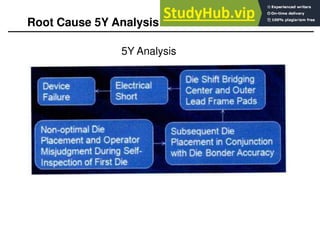
5Y Analysis
Root Cause 5Y Analysis
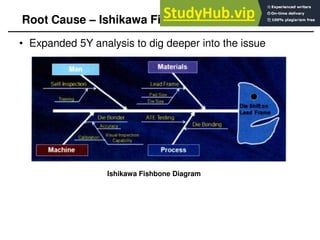
• Expanded 5Y analysis to dig deeper into the issue
Ishikawa Fishbone Diagram
Root Cause – Ishikawa Fishbone Diagram
• Man
• Suboptimal alignment of first die bond was not detected during self-
inspection
• Subsequent die bonds are based on the first die bond
• Material
• Compared die size with leadframe pad size and discovered tolerance
could be tight for the bonders
• Machine
• Reviewed bonder accuracy specs
• TOSOK – ±75µm
• STC400 – ±50µm
• Reviewed calibration records
• Verified bonder accuracy was with spec limits using 300 samples
• V/M inspection could not differentiate between die edge pad edge
• Process
• Production test duration was very short
• Extended stress could cause die to expand due to thermal expansion
Decap of Returned Unit
Root Cause Analysis
• Actions taken, verified, and documented immediately after
root cause analysis
• Man
• Operators were notified of the issue and were re-trained to take time to
verify self-inspection
• Remarks were added to the bonding diagram highlighting the tight
tolerance
• Shift supervisor verified that the preceding actions were implemented
and documented
• Machine
• Bonder STC500 with an accuracy of ±35µm is to be used going forward
• Remarks were added to the bonding diagram to specifically use the
STC500
• Shift supervisor verified that the preceding actions were implemented
and documented
• Implemented corrective actions on other devices with similar
die/leadframe pad size ratios
Corrective Actions
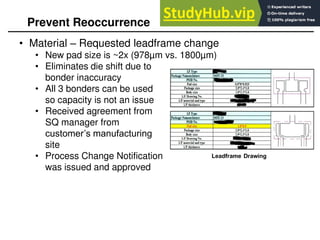
• Material – Requested leadframe change
• New pad size is ~2x (978µm vs. 1800µm)
• Eliminates die shift due to
bonder inaccuracy
• All 3 bonders can be used b bonder
so capacity is not an issue
• Received agreement from
SQ manager from
customer’s manufacturing
site
• Process Change Notification
was issued and approved
Prevent Reoccurrence
• Verified customer issue
• After initial assessment, highlighted and added visibility
to the tight die/leadframe pad tolerance
• Provided additional training to operators
• Reminders were incorporated in the bonding diagrams
• Requested change in leadframe increasing the pad size
by 2x, virtually eliminating the issue
• Closed the issue with the China team and the CSR,
thanking them for their support and moved on to the
next issue
• During this process, the customer was kept abreast of
our findings
Summary (Congratulate the Team)
Questions

8D Report Case Study

  • 1.
    8D Report CaseStudy Presenter Name: Atul Rastogi Date: 3rd October, 2012
  • 2.
    Agenda / Contents TeamIdentification Problem Description Containment Root Cause Corrective Actions and Verification Prevent Reoccurrence Summary (Congratulate the Team) Questions
  • 3.
    • Customer SalesRep logged in issue in the Excel tracking sheet and notified me of the issue • Determined assembly/test location of the unit in question and issued transmittal to the customer to ship the units to the responsible facility • Communicated and discussed issue with appropriate QRA team, specifically the team lead, in China Returned Unit Team Identification
  • 4.
    • Identified theproblem with the returned unit • ATE testing revealed a short • X-ray revealed that the die inside the package was not in the correct position • Deprocessing of the returned unit verified that the die inside was bonded incorrectly Decap of Returned Unit X-ray of Returned Unit Problem Description
  • 5.
    • Identified affectedlot from product marking and shipping records • Requested material from affected lot to be put on hold at the customer location and in-house inventories • Asked customer to return all unused material for disposition • Issued 3D Report (preliminary version of the 8D Report) Containment
  • 6.
  • 7.
    • Expanded 5Yanalysis to dig deeper into the issue Ishikawa Fishbone Diagram Root Cause – Ishikawa Fishbone Diagram
  • 8.
    • Man • Suboptimalalignment of first die bond was not detected during self- inspection • Subsequent die bonds are based on the first die bond • Material • Compared die size with leadframe pad size and discovered tolerance could be tight for the bonders • Machine • Reviewed bonder accuracy specs • TOSOK – ±75µm • STC400 – ±50µm • Reviewed calibration records • Verified bonder accuracy was with spec limits using 300 samples • V/M inspection could not differentiate between die edge pad edge • Process • Production test duration was very short • Extended stress could cause die to expand due to thermal expansion Decap of Returned Unit Root Cause Analysis
  • 9.
    • Actions taken,verified, and documented immediately after root cause analysis • Man • Operators were notified of the issue and were re-trained to take time to verify self-inspection • Remarks were added to the bonding diagram highlighting the tight tolerance • Shift supervisor verified that the preceding actions were implemented and documented • Machine • Bonder STC500 with an accuracy of ±35µm is to be used going forward • Remarks were added to the bonding diagram to specifically use the STC500 • Shift supervisor verified that the preceding actions were implemented and documented • Implemented corrective actions on other devices with similar die/leadframe pad size ratios Corrective Actions
  • 10.
    • Material –Requested leadframe change • New pad size is ~2x (978µm vs. 1800µm) • Eliminates die shift due to bonder inaccuracy • All 3 bonders can be used b bonder so capacity is not an issue • Received agreement from SQ manager from customer’s manufacturing site • Process Change Notification was issued and approved Prevent Reoccurrence
  • 11.
    • Verified customerissue • After initial assessment, highlighted and added visibility to the tight die/leadframe pad tolerance • Provided additional training to operators • Reminders were incorporated in the bonding diagrams • Requested change in leadframe increasing the pad size by 2x, virtually eliminating the issue • Closed the issue with the China team and the CSR, thanking them for their support and moved on to the next issue • During this process, the customer was kept abreast of our findings Summary (Congratulate the Team)
  • 12.