Business Cycles
So far………
Development & analysis of
determination of income and output =>
how investment, savings &
consumption interact to determine
income –
static theory of income determination.
Dynamics of Income
Movements
Why expansion comes to an end?
Why does the economy move
downwards?
Why and how does a slump come to an
end?
How a recovery begins and gives rise to
prosperity?
Business Cycles
An important feature of a capitalist
economy is the existence of alternate
periods of prosperity and depression.
Sweeping fluctuations in economic
activity, viz. Production, prices,
employment, etc.
“A trade cycle is composed of good
trade characterized by rising prices and
low unemployment percentages,
alternating with periods of bad trade
characterized by falling prices and high
unemployment percentages.”
Keynes
The business cycle represents wavelike
fluctuations in the level of business
activity from the equilibrium or trend
line.
Schumpeter
Generalising…
The business cycle is an alternate
expansion and contraction in overall
business activity, as evidenced by
fluctuations in measures of aggregate
economic activity, such as the gross
product, the index of industrial
production, and employment and
income.
Phases of Business
Cycle
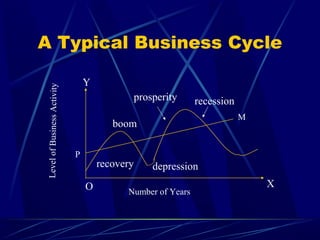
A Typical Business Cycle
Number of Years
LevelofBusinessActivity
P
M
depression
boom
recessionprosperity
recovery
X
Y
O
Depression
Business activity is far below normal.
Sharp reduction in production, mass
unemployment, falling prices, falling profits,
low wages, contraction of credit, high rate of
business failure => all-round pessimism.
Construction activity comes more or less to a
standstill.
Food, clothing industry not much affected.
Recovery
Slight improvement in economic activity.
Industrial production picks up.
Employment increases.
Slow but sure rise in prices & profits.
Wages also rise.
New investments in K-goods industry.
Banks expand credit
Business inventories start rising slowly.
Atmosphere of cautious hope.
Prosperity
Increased production.
High capital investment in basic
industries
Expansion of bank credit.
High prices and profits
Optimism is very high.
Boom
Stage of rapid expansion in business
activity to new highs.
High stock and commodity prices.
High profits.
Overfull employment.
Boom carries within in the seeds of self-
destruction.
Boom is followed by bust.
Recession
Collapse of firms creates panic.
Banks withdraw loans.
Prices fall and confidence is shaken.
Construction activity slows down.
Unemployment appears in basic capital
goods industry => spreads to other
industries.
Fall in income, prices, profits……
Classification of
Business Cycles
Prof. James Estey
Major & Minor Cycles
Major cycles may be defined as the
fluctuations of business activity occurring
between successive crises.
Also called Juglar cycles.
Approx. Length – 8.33 yrs.
Each major cycle is made up of 2 or 3 minor
cycles. The upswing of business in major
cycles is often interrupted by minor
downswings. Likewise, the downswings.
Also called Kitchin cycles.
Approx Length - 40 months
Building Cycles
This refers to the cycle of building
construction.
The duration of the building cycle is longer
than that of the business cycle.
The duration of the building cycle varies
between 15 – 20 years. The average of the
building cycle is 18 yrs, just twice the length
of the business cycles.
There were 6 complex building cycles in the
USA in the period 1830 to 1934.
Kondratieff Cycles or
Long Waves
They are a 50 – 60 years cycle.
The long waves in economic activity were
discovered by the Russian economist,
Kondratieff, hence the name.
On the basis of statistical data for the period
1780–1920, Kondratieff was able to establish
2 ½ long cycles in England and France, each
full cycle being of the duration of 60 years.
Theories of Business
Cycle
Sunspot theory
W. Stanley Jevons (British) 1875
Variations in atmosphere of the sun –
frequency and magnitude of sunspots –
cause rhythmical fluctuations in business
activity
Dark spots on the surface of the sun => affect
agricultural crops => affect other sectors =>
influence the level of business activity
Prof Henry L. Moore – 8 yr cycle of rainfall in
America
Psychological theory
Prof A. C. Pigou => in his work
Industrial Fluctuations
Changes in psychology of industrialists
=> waves of optimism and pessimism
He could not explain the cause of the
changes in psychology.
Overproduction theory
Socialist minded economists
Several rival firms producing the same
commodity
want to capture market => produce
more stocks than can sell =>
overproduction => prices fall => rise in
cost of production => marginal firms
collapse => depression
Over-saving theory
Under-consumption theory
Capitalist society => inequality of incomes
Propertied class has too much wealth =>
save => invest the savings in business
Worker class => not enough purchasing
power to buy goods produced
Overproduction => fall in prices =>
depression
Too much saving and too little consumption is
the cause of business depression.
Innovation theory
Joseph Schumpeter (USA)
Innovation
– something new that changes the
existing method of production
Whenever innovation takes place, it
causes disequilibrium in the economy
=> continues till re-adjustment at some
new equilibrium level.
Monetary theory
Business cycle is a “purely monetary
phenomenon”
An elastic money supply => alternate
expansion and contraction of money
Theories of Business
Cycles
Hick’s Theory
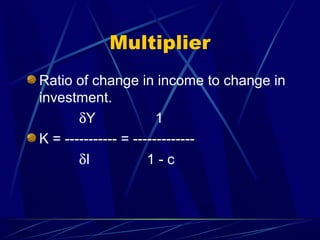
Multiplier
Ratio of change in income to change in
investment.
δY 1
K = ----------- = -------------
δI 1 - c
Accelerator
Invented by A. Aftalion and T.N. Carver.
Shows the effect of a change in consumption
on investment.
Hayek explains the concept:
“since the production of any given amount of
final output usually requires an amount of
capital several times larger……. during any
short period of time, any increase in final
demand will give rise an additional demand
for capital goods several times larger than the
new final demand”.
Acceleration principle
Investment depends on rate of interest
Investment an endogenous variable –
by being dependent on changes in
national income
Lipsey – possibility of systematic
fluctuations because level of investment
is related to changes in national
income.
Two relationships…
Between consumption demand and investment
spending:
An increase in demand for consumption goods can
cause a proportionately larger accelerated increase
in investment spending. E.g. a 10% increase in
demand may lead to 100% increase in investment
spending as business firms increase their production
capacity to meet increased demand.
When an increase in aggregate demand slows it’s
upward pace and begins to level off, a decline in
investment spending can occur, even if aggregate
demand continues to grow.
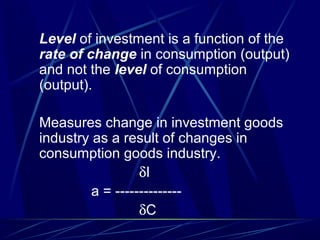
Level of investment is a function of the
rate of change in consumption (output)
and not the level of consumption
(output).
Measures change in investment goods
industry as a result of changes in
consumption goods industry.
δI
a = --------------
δC
Generation of Business
Cycle
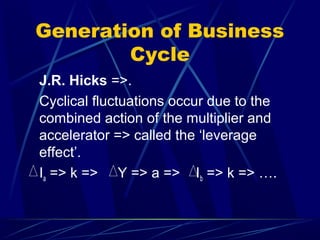
J.R. Hicks =>.
Cyclical fluctuations occur due to the
combined action of the multiplier and
accelerator => called the ‘leverage
effect’.
Ia => k => Y => a => Ib => k => ….
Example:
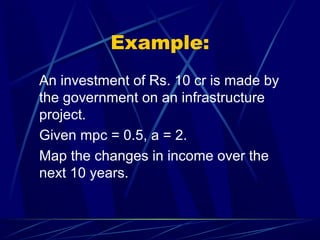
An investment of Rs. 10 cr is made by
the government on an infrastructure
project.
Given mpc = 0.5, a = 2.
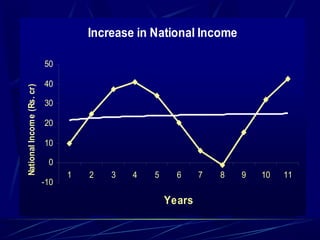
Map the changes in income over the
next 10 years.
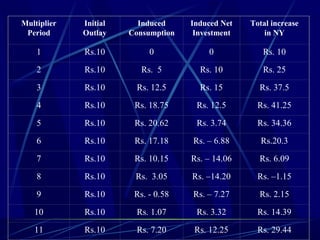
Multiplier
Period
Initial
Outlay
Induced
Consumption
Induced Net
Investment
Total increase
in NY
1 Rs.10 0 0 Rs. 10
2 Rs.10 Rs. 5 Rs. 10 Rs. 25
3 Rs.10 Rs. 12.5 Rs. 15 Rs. 37.5
4 Rs.10 Rs. 18.75 Rs. 12.5 Rs. 41.25
5 Rs.10 Rs. 20.62 Rs. 3.74 Rs. 34.36
6 Rs.10 Rs. 17.18 Rs. – 6.88 Rs.20.3
7 Rs.10 Rs. 10.15 Rs. – 14.06 Rs. 6.09
8 Rs.10 Rs. 3.05 Rs. –14.20 Rs. –1.15
9 Rs.10 Rs. - 0.58 Rs. – 7.27 Rs. 2.15
10 Rs.10 Rs. 1.07 Rs. 3.32 Rs. 14.39
11 Rs.10 Rs. 7.20 Rs. 12.25 Rs. 29.44
Increase in National Income
-10
0
10
20
30
40
50
1 2 3 4 5 6 7 8 9 10 11
Years
NationalIncome(Rs.cr)
Methods to Control
Business Cycles
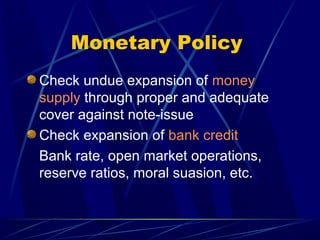
Monetary Policy
Check undue expansion of money
supply through proper and adequate
cover against note-issue
Check expansion of bank credit
Bank rate, open market operations,
reserve ratios, moral suasion, etc.
Fiscal Policy
Taxation
Spending
Borrowing
Automatic Stabilizers
An automatic stabilizer is an economic
shock absorber that helps smooth the
cyclical business fluctuations of its own
accord, without requiring deliberate
action on the part of the government.
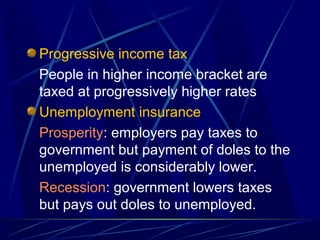
Progressive income tax
People in higher income bracket are
taxed at progressively higher rates
Unemployment insurance
Prosperity: employers pay taxes to
government but payment of doles to the
unemployed is considerably lower.
Recession: government lowers taxes
but pays out doles to unemployed.

8business cycles-110505123053-phpapp01

  • 1.
  • 2.
    So far……… Development &analysis of determination of income and output => how investment, savings & consumption interact to determine income – static theory of income determination.
  • 3.
    Dynamics of Income Movements Whyexpansion comes to an end? Why does the economy move downwards? Why and how does a slump come to an end? How a recovery begins and gives rise to prosperity?
  • 4.
    Business Cycles An importantfeature of a capitalist economy is the existence of alternate periods of prosperity and depression. Sweeping fluctuations in economic activity, viz. Production, prices, employment, etc.
  • 5.
    “A trade cycleis composed of good trade characterized by rising prices and low unemployment percentages, alternating with periods of bad trade characterized by falling prices and high unemployment percentages.” Keynes
  • 6.
    The business cyclerepresents wavelike fluctuations in the level of business activity from the equilibrium or trend line. Schumpeter
  • 7.
    Generalising… The business cycleis an alternate expansion and contraction in overall business activity, as evidenced by fluctuations in measures of aggregate economic activity, such as the gross product, the index of industrial production, and employment and income.
  • 8.
  • 9.
    A Typical BusinessCycle Number of Years LevelofBusinessActivity P M depression boom recessionprosperity recovery X Y O
  • 10.
    Depression Business activity isfar below normal. Sharp reduction in production, mass unemployment, falling prices, falling profits, low wages, contraction of credit, high rate of business failure => all-round pessimism. Construction activity comes more or less to a standstill. Food, clothing industry not much affected.
  • 11.
    Recovery Slight improvement ineconomic activity. Industrial production picks up. Employment increases. Slow but sure rise in prices & profits. Wages also rise. New investments in K-goods industry. Banks expand credit Business inventories start rising slowly. Atmosphere of cautious hope.
  • 12.
    Prosperity Increased production. High capitalinvestment in basic industries Expansion of bank credit. High prices and profits Optimism is very high.
  • 13.
    Boom Stage of rapidexpansion in business activity to new highs. High stock and commodity prices. High profits. Overfull employment. Boom carries within in the seeds of self- destruction. Boom is followed by bust.
  • 14.
    Recession Collapse of firmscreates panic. Banks withdraw loans. Prices fall and confidence is shaken. Construction activity slows down. Unemployment appears in basic capital goods industry => spreads to other industries. Fall in income, prices, profits……
  • 15.
  • 16.
    Major & MinorCycles Major cycles may be defined as the fluctuations of business activity occurring between successive crises. Also called Juglar cycles. Approx. Length – 8.33 yrs. Each major cycle is made up of 2 or 3 minor cycles. The upswing of business in major cycles is often interrupted by minor downswings. Likewise, the downswings. Also called Kitchin cycles. Approx Length - 40 months
  • 17.
    Building Cycles This refersto the cycle of building construction. The duration of the building cycle is longer than that of the business cycle. The duration of the building cycle varies between 15 – 20 years. The average of the building cycle is 18 yrs, just twice the length of the business cycles. There were 6 complex building cycles in the USA in the period 1830 to 1934.
  • 18.
    Kondratieff Cycles or LongWaves They are a 50 – 60 years cycle. The long waves in economic activity were discovered by the Russian economist, Kondratieff, hence the name. On the basis of statistical data for the period 1780–1920, Kondratieff was able to establish 2 ½ long cycles in England and France, each full cycle being of the duration of 60 years.
  • 19.
  • 20.
    Sunspot theory W. StanleyJevons (British) 1875 Variations in atmosphere of the sun – frequency and magnitude of sunspots – cause rhythmical fluctuations in business activity Dark spots on the surface of the sun => affect agricultural crops => affect other sectors => influence the level of business activity Prof Henry L. Moore – 8 yr cycle of rainfall in America
  • 21.
    Psychological theory Prof A.C. Pigou => in his work Industrial Fluctuations Changes in psychology of industrialists => waves of optimism and pessimism He could not explain the cause of the changes in psychology.
  • 22.
    Overproduction theory Socialist mindedeconomists Several rival firms producing the same commodity want to capture market => produce more stocks than can sell => overproduction => prices fall => rise in cost of production => marginal firms collapse => depression
  • 23.
    Over-saving theory Under-consumption theory Capitalistsociety => inequality of incomes Propertied class has too much wealth => save => invest the savings in business Worker class => not enough purchasing power to buy goods produced Overproduction => fall in prices => depression Too much saving and too little consumption is the cause of business depression.
  • 24.
    Innovation theory Joseph Schumpeter(USA) Innovation – something new that changes the existing method of production Whenever innovation takes place, it causes disequilibrium in the economy => continues till re-adjustment at some new equilibrium level.
  • 25.
    Monetary theory Business cycleis a “purely monetary phenomenon” An elastic money supply => alternate expansion and contraction of money
  • 26.
  • 27.
    Multiplier Ratio of changein income to change in investment. δY 1 K = ----------- = ------------- δI 1 - c
  • 28.
    Accelerator Invented by A.Aftalion and T.N. Carver. Shows the effect of a change in consumption on investment. Hayek explains the concept: “since the production of any given amount of final output usually requires an amount of capital several times larger……. during any short period of time, any increase in final demand will give rise an additional demand for capital goods several times larger than the new final demand”.
  • 29.
    Acceleration principle Investment dependson rate of interest Investment an endogenous variable – by being dependent on changes in national income Lipsey – possibility of systematic fluctuations because level of investment is related to changes in national income.
  • 30.
    Two relationships… Between consumptiondemand and investment spending: An increase in demand for consumption goods can cause a proportionately larger accelerated increase in investment spending. E.g. a 10% increase in demand may lead to 100% increase in investment spending as business firms increase their production capacity to meet increased demand. When an increase in aggregate demand slows it’s upward pace and begins to level off, a decline in investment spending can occur, even if aggregate demand continues to grow.
  • 31.
    Level of investmentis a function of the rate of change in consumption (output) and not the level of consumption (output). Measures change in investment goods industry as a result of changes in consumption goods industry. δI a = -------------- δC
  • 32.
    Generation of Business Cycle J.R.Hicks =>. Cyclical fluctuations occur due to the combined action of the multiplier and accelerator => called the ‘leverage effect’. Ia => k => Y => a => Ib => k => ….
  • 33.
    Example: An investment ofRs. 10 cr is made by the government on an infrastructure project. Given mpc = 0.5, a = 2. Map the changes in income over the next 10 years.
  • 34.
    Multiplier Period Initial Outlay Induced Consumption Induced Net Investment Total increase inNY 1 Rs.10 0 0 Rs. 10 2 Rs.10 Rs. 5 Rs. 10 Rs. 25 3 Rs.10 Rs. 12.5 Rs. 15 Rs. 37.5 4 Rs.10 Rs. 18.75 Rs. 12.5 Rs. 41.25 5 Rs.10 Rs. 20.62 Rs. 3.74 Rs. 34.36 6 Rs.10 Rs. 17.18 Rs. – 6.88 Rs.20.3 7 Rs.10 Rs. 10.15 Rs. – 14.06 Rs. 6.09 8 Rs.10 Rs. 3.05 Rs. –14.20 Rs. –1.15 9 Rs.10 Rs. - 0.58 Rs. – 7.27 Rs. 2.15 10 Rs.10 Rs. 1.07 Rs. 3.32 Rs. 14.39 11 Rs.10 Rs. 7.20 Rs. 12.25 Rs. 29.44
  • 35.
    Increase in NationalIncome -10 0 10 20 30 40 50 1 2 3 4 5 6 7 8 9 10 11 Years NationalIncome(Rs.cr)
  • 36.
  • 37.
    Monetary Policy Check undueexpansion of money supply through proper and adequate cover against note-issue Check expansion of bank credit Bank rate, open market operations, reserve ratios, moral suasion, etc.
  • 38.
  • 39.
    Automatic Stabilizers An automaticstabilizer is an economic shock absorber that helps smooth the cyclical business fluctuations of its own accord, without requiring deliberate action on the part of the government.
  • 40.
    Progressive income tax Peoplein higher income bracket are taxed at progressively higher rates Unemployment insurance Prosperity: employers pay taxes to government but payment of doles to the unemployed is considerably lower. Recession: government lowers taxes but pays out doles to unemployed.