ARTICULATORS
Dr. Pratik Bhatnagar
Reader
Deptt. of Prosthodontics
Subharti Dental College & Hospital
Swami Vivekanand Subharti University
Meerut, Uttar Pradesh
DEFINITIO
N
Articulator is defined as a “mechanical
device which represents the
temporomandibular joints and the jaw
members to which maxillary and
mandibular casts may be attached to
simulate jaw movements” GPT
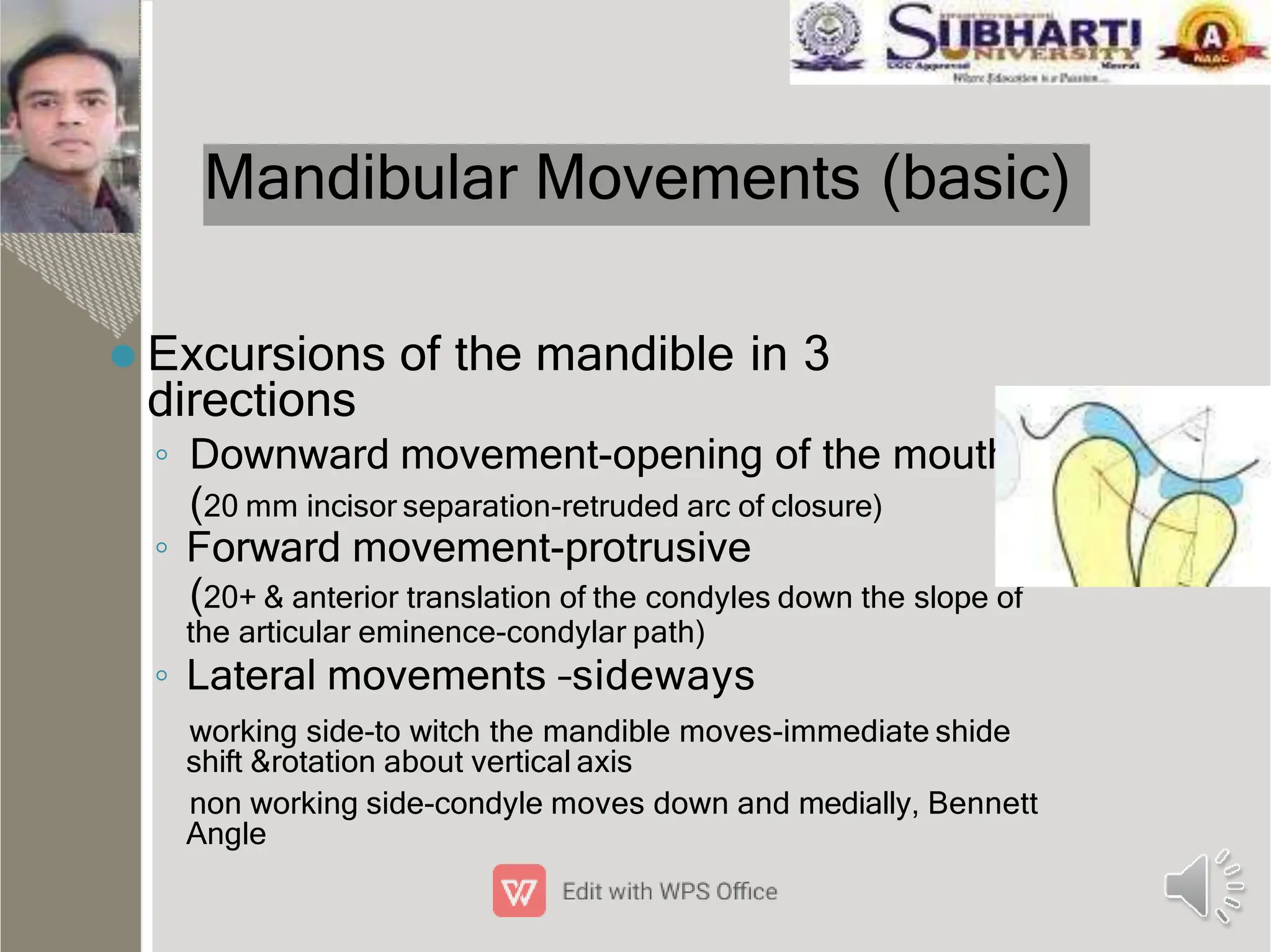
Mandibular Movements (basic)
 Excursions of the mandible in 3
directions
◦ Downward movement-opening of the mouth
(20 mm incisor separation-retruded arc of closure)
◦ Forward movement-protrusive
(20+ & anterior translation of the condyles down the slope of
the articular eminence-condylar path)
◦ Lateral movements –sideways
working side-to witch the mandible moves-immediate shide
shift &rotation about vertical axis
non working side-condyle moves down and medially, Bennett
Angle
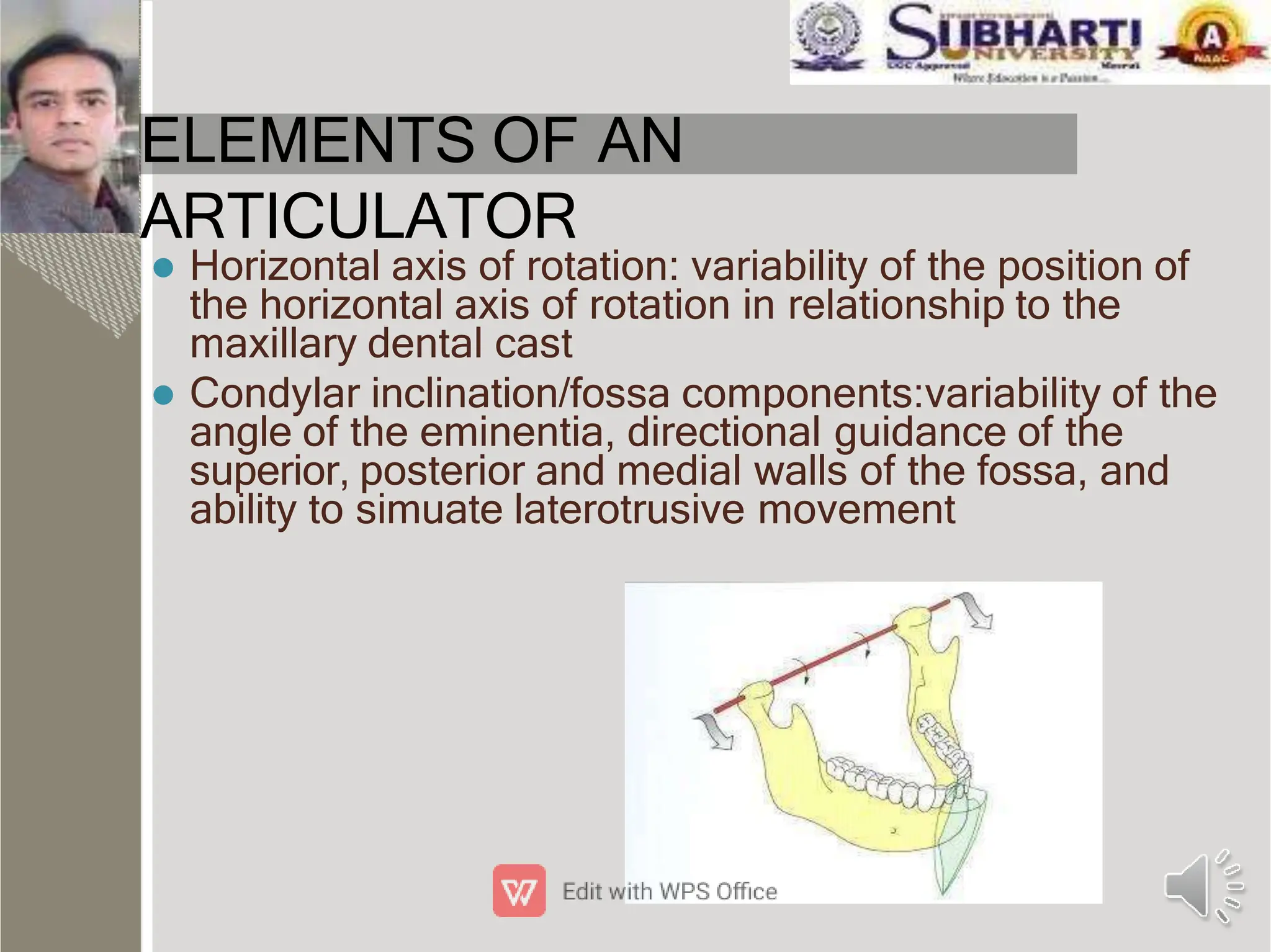
ELEMENTS OF AN
ARTICULATOR
 Horizontal axis of rotation: variability of the position of
the horizontal axis of rotation in relationship to the
maxillary dental cast
 Condylar inclination/fossa components:variability of the
angle of the eminentia, directional guidance of the
superior, posterior and medial walls of the fossa, and
ability to simuate laterotrusive movement
ADJUSTABILITY OF
AN ARTICULATOR
The capability of the articulator to closely
simulate the movements of the mandible.
(dependent on the adjustability of the articulator elements)
PURPOSE OF AN
ARTICULATOR
To hold the maxillary and mandibular casts
in a determined fixed relationship.
To simulate the jaw movements like
opening and closing.
To produce border movements (extreme
lateral and protrusive movements) and
intraborder movements (within the border
movement) of the teeth similar to those in
the mouth.
USES OF AN
ARTICULATOR
To diagnose the state of occlusion in both the
natural and artificial dentition.
To plan dental procedures based on the
relationship between opposing natural and
artificial teeth eg; evaluation of the possibility of
balanced occlusion.
Toaid in fabrication of restorations and
prosthodontic replacement.
To correct and modify completed restoration.
To arrange artificial teeth.
REQUIREMENTS OF
AN ARTICULATOR
Hold cast in correct horizontal
relationship.
Hold cast in correct vertical
relationship.
Should be easily removable and
re- attachable.
Should provide positive anterior
vertical stop (incisal pin).
Should be made of non corrosive and
and rigid material that resist wear and
tear.
Should not be bulky.
Moving part should move without any
kind of friction.
Should accept facebow transfer record.
Non-moving part should be of rigid
construction.
ADVANTAGE
S
Properly-mounted casts allow the
operator to visualize the patient’s
occlusion, especially from the lingual
view.
Patient cooperation is not a factor
when using an articulator once the
appropriate interocclusal records are
obtained from the patient.
Correction of complete denture
occlusion in mouth is extremely difficult
because of shifting denture bases and
resiliency of the supporting tissue. This
difficulty is eliminated when articulators
are used.
Reduce chair time,
patient’s appointment time.
LIMITATIO
N
Articulator may be made of metal or
plastic. Metal articulator show errors in
tooling or errors resulting from metal
fatigue.
The articulator may not exactly
simulate the intraborder and functional
movements of the mandible.
Errors in jaw relation procedures
are reproduced as errors in
prosthesis occlusion.
CLASSIFICATIO
N

Based on the theories of occlusion.
Based on the type of inter-occlusal
records used.
Based on the ability to simulate jaw
movement.
Based on the adjustability of the
articulator.
ARTICULATOR
BASED T
OH
NEORY OF
OCCLUSION:
 BONWILL THEORY
ARTICULATORS:
 Designed by WGA Bonwill.
 According to this the teeth move in
relation to each other as guided by the
condylar and the incisal guidance.
 Also known as theTheory of
equilateral triangle according to which,
the distance between the condyles is
equal to the midpoint of the
mandibular incisors.
 Equilateral triangle is formed between
the two condyles and the incisal point.
CONICAL
THEORY
ARTICULATOR
 Proposed by RH HALL
 It proposed that the lower teeth move over the
surfaces of the upper teeth as over the surface
of a cone, generating an angle of 45degrees
with the central axis of the cone tipped 45
degree to the occlusal plane.
SPHERICAL
THEORY
ARTICULATOR
The articulator was devised by G.S Monson.
This theory proposed that lower teeth move
over the surface of the upper teeth as over
a surface of sphere with a diameter of 8
inches.
The center of sphere located in the region of
glabella. The surface of the sphere passed
through the glenoid fossa and along through
BASED ON TYPES
OF U
RE
SC
ED
OR
FD
OS
R THEIR
ADJUSTMENT
Inter-occlusal record adjustment:
articulator adjusted by some kind of
inter-occlusal records. These records
are made of base plate wax, plaster of
Paris, zinc oxide eugenol or cold cure
acrylic.
Graphic record adjustment: Graphic
records consist of records of the
extreme borders positions of
mandibular movements.
These are capable of accurately
reproducing the border movement of
mandible.
Hinge axis location for adjusting
articulators: A transographic record
can be used to record the accurate
location of hinge axis in an articulator.
Based on ability to simulate jaw
movement
Class I:
 simple articulators capable of
accepting a single static registration.
Only vertical motion possible.
Used in cases of tentative jaw relation.
E.g. slab articulator,
Barndoor articulator.
Class
IIArticulator which permit
horizontal and vertical motion but
they do not orient the movement
to TMJ with a face bow.
Three types
Type a Type b Type c
:limited eccentric
motion. E.g. mean
value articulator
: limited eccentric
motion possible based
on theories of arbitrary
motion. E.g. monsoon’s
and hall’s articulator
: limited eccentric
motion possible based
on engraving records
obtained from the
patient. E.g. house’s
articulator
Class
III
Permit horizontal and vertical
movements.
Two types:
Type a Type b
they accept a static
protrusive registration and
they use equivalents for
other types of motioneg.
Hanau h, hanau II
bergstrom articulator.
they accept static lateral
protrusive registration and
they use equivalents for
other types of motion, eg.
Panadent, trubite,
teledyne hanau university
series.
Class
IV
Articulator accept three dimensional
dynamic registrations. The are
capable of accurately reproducing the
condylar pathway for each patient.
Time for a short
break…!!!
Based on adjustability of the
articulator
Non-adjustable
Semi-adjustable
Fully-adjustable
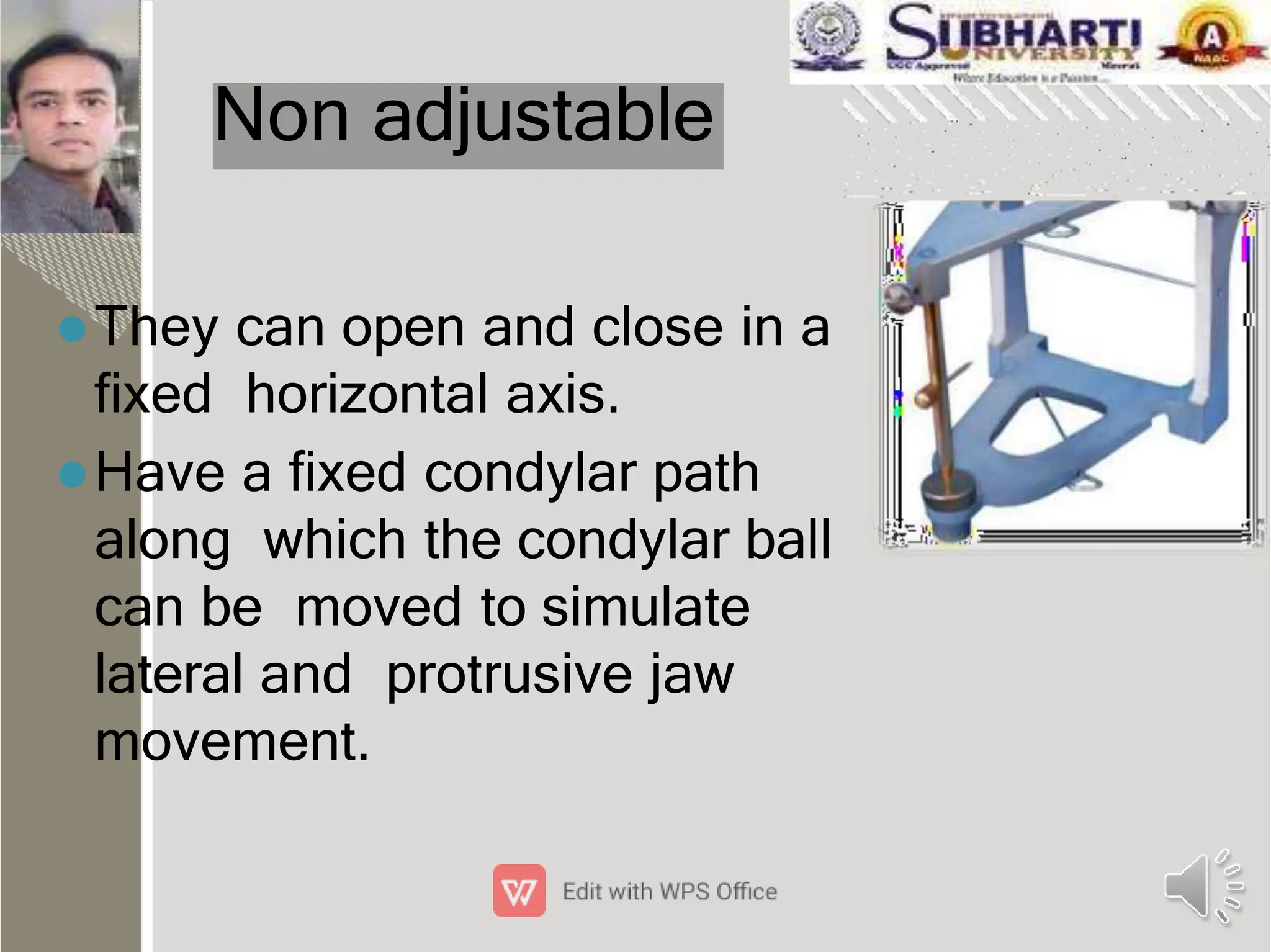
Non adjustable
They can open and close in a
fixed horizontal axis.
Have a fixed condylar path
along which the condylar ball
can be moved to simulate
lateral and protrusive jaw
movement.
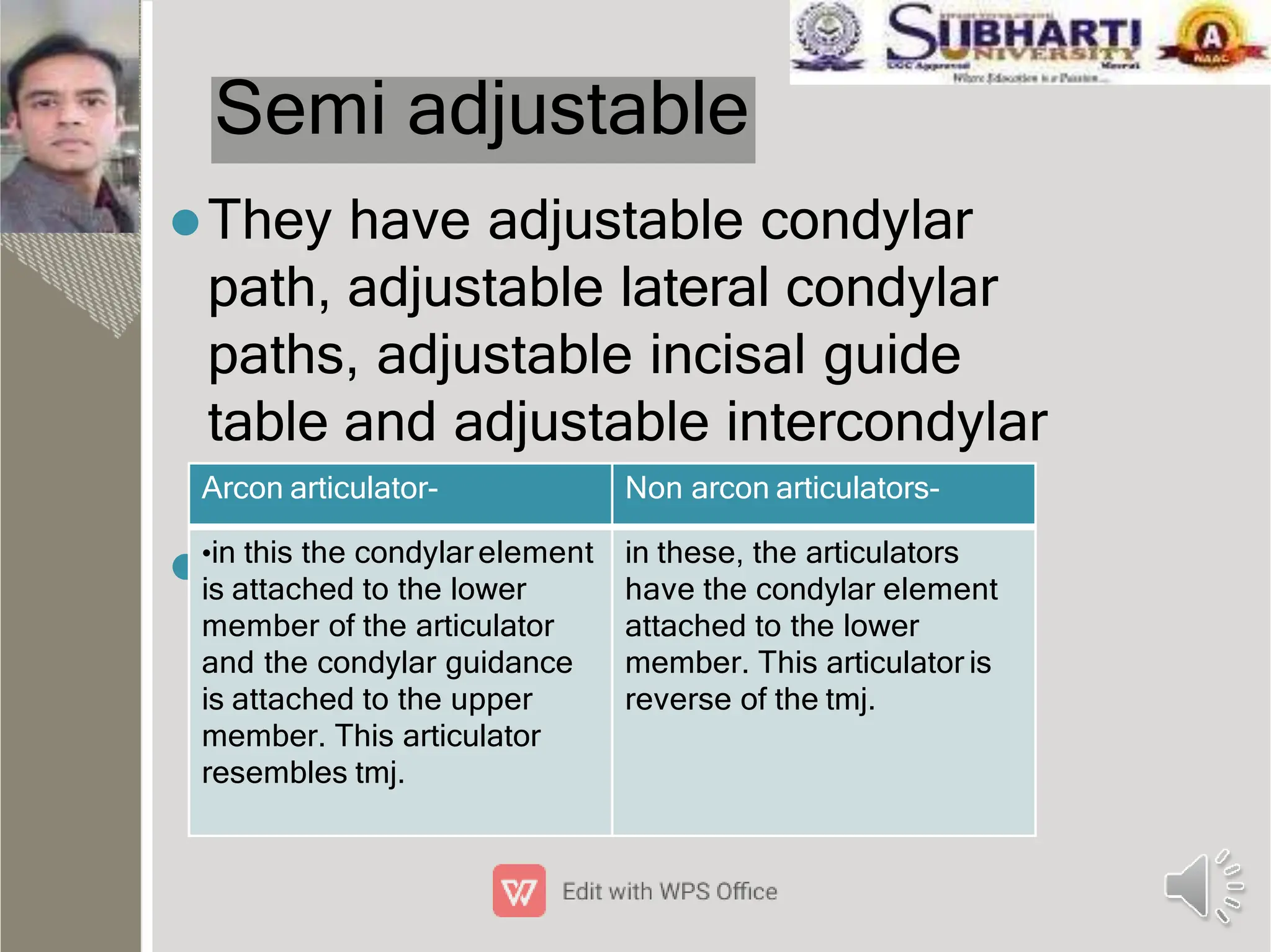
Semi adjustable
They have adjustable condylar
path, adjustable lateral condylar
paths, adjustable incisal guide
table and adjustable intercondylar
distances.
Two types:
Arcon articulator- Non arcon articulators-
•in this the condylar element
is attached to the lower
member of the articulator
and the condylar guidance
is attached to the upper
member. This articulator
resembles tmj.
in these, the articulators
have the condylar element
attached to the lower
member. This articulator is
reverse of the tmj.
Arcon articulator- Non arcon articulators-
attached to the lower member of the
articulator and the condylar guidance
is attached to the upper member.This
articulator resembles tmj.
•in this the condylar elementis in these, the articulators have the
condylar element attached to the
lower member. This articulator is
reverse of the tmj.
SEMI ADJUSTABLE
ARTICULATOR
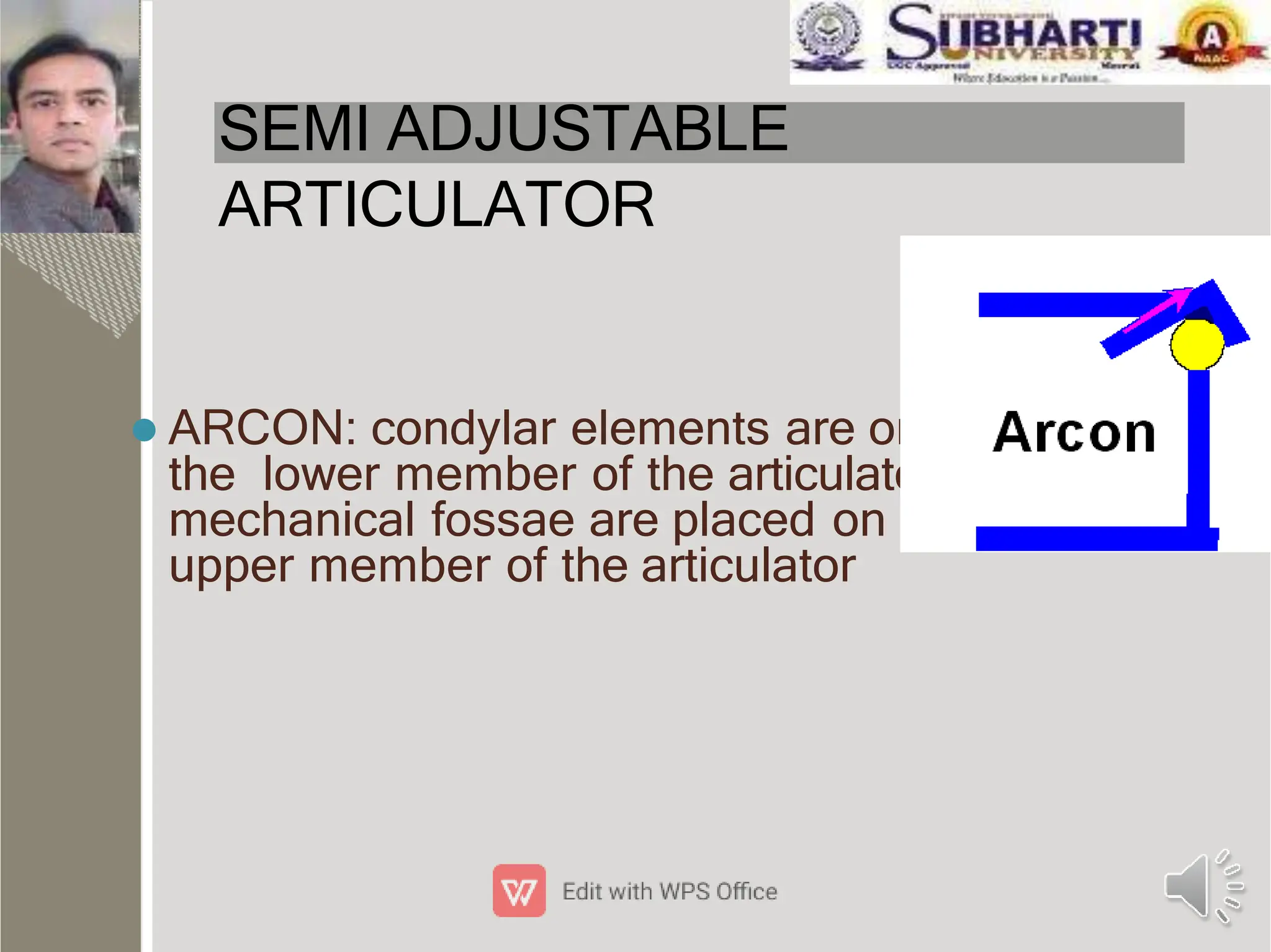
 ARCON: condylar elements are on
the lower member of the articulator,
mechanical fossae are placed on the
upper member of the articulator
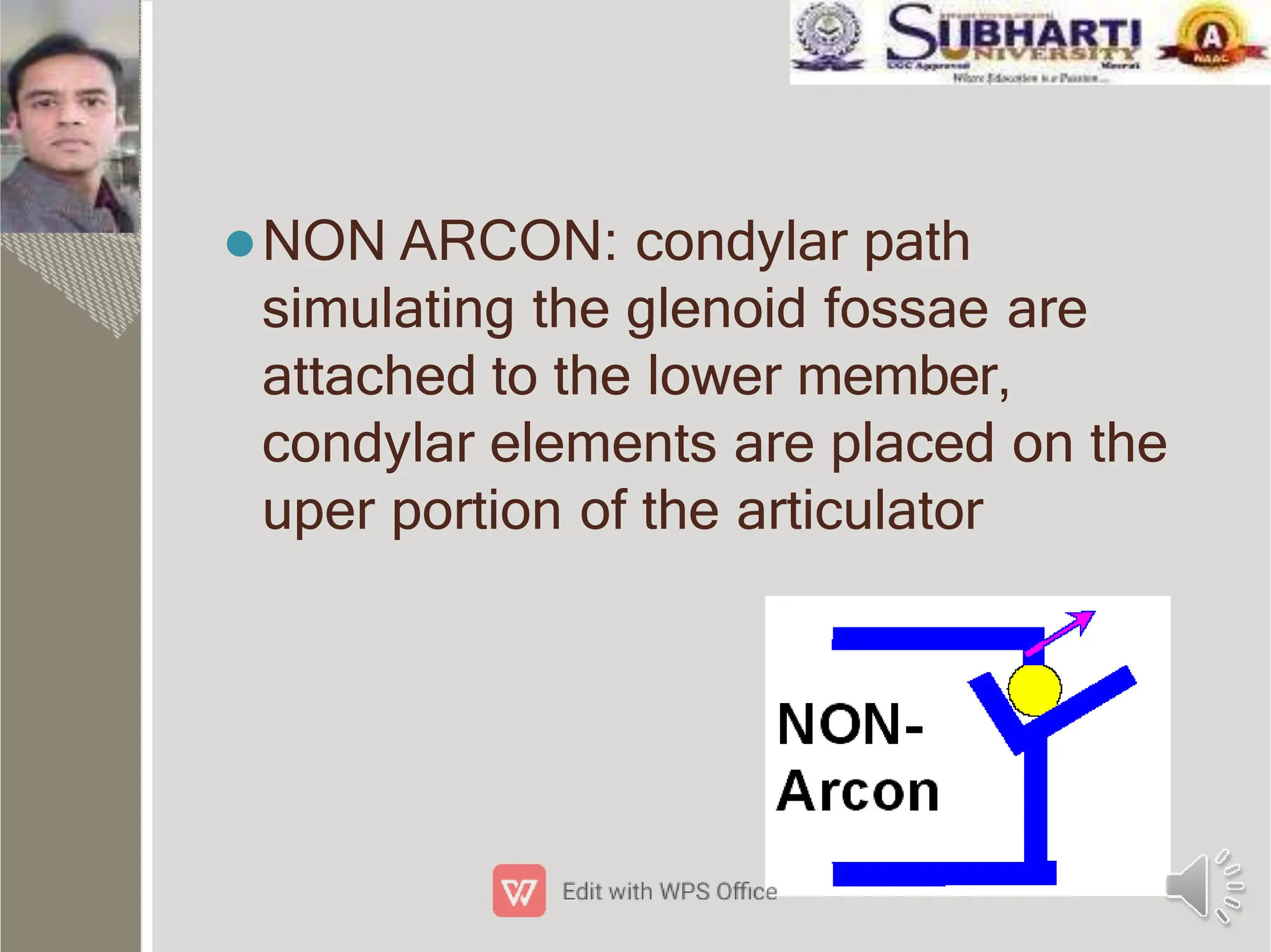
NON ARCON: condylar path
simulating the glenoid fossae are
attached to the lower member,
condylar elements are placed on the
uper portion of the articulator
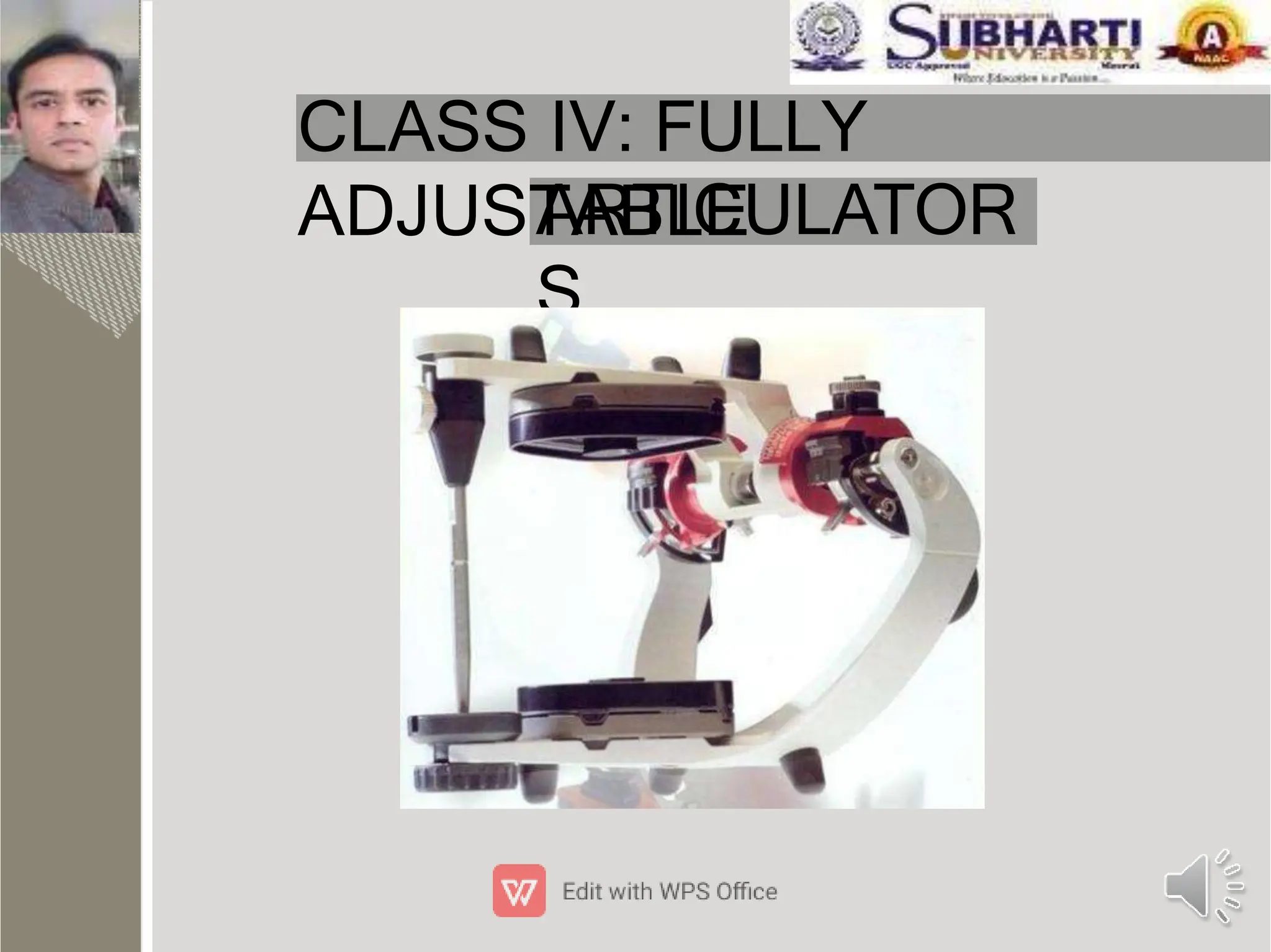
FULLY ADJUSTABLE
ARTICULATOR
Capable of being
adjusted to follow the
mandible movement in
all direction.
These articulators have a
number of readings which
can be customized for
each patient.
They do not have condylar
guidance.
Instead have receptacles in which
acrylic dough can be contoured to
form a customized condylar and
incisal guidance.
E.g. Stuart instrument
gnathoscope, simulator by E
Granger.
MEAN VALUE
It is non adjustableAaRrticTuIlaCtoUr.LATO
RDesigned using fixed dimensions, which
are derived from average distance
between the incisal and condylar
guidance of the population.
Condylar guidance equivalent to
glenoid fossa is attached to the lower
member and condylar element
equivalent to mandibular condyle is
attached to the upper member, hence it
is a non arcon articulator.
Components of articulator
Upper Member
Lower Member
Incisal Guide Table
Condylar
Guidance
Incisal Pin
• Upper member
It is a triangular frame with the base of
the triangle placed posteriorly.
The apex of triangle contains aprovision
to accommodate the incisal pin.
Two condylar elements are seen
projecting on either side of the base of
the triangle.
They articulate with the condylar
guidance of the lower member.
The maxillary cast is attached to the
upper member during articulation.
• Lower member
L shaped frame with horizontal and
vertical arm.
The horizontal arm is triangular in
shape and corresponds to the upper
member.
The apex of the triangle of the
horizontal arm contains the incisal
guide table.
The vertical arm is rectangular
containing the condylar guidance slot
at the upper position.
Incisal
guide table
INCISAL GUIDE
TABL
EIt is defined as ‘that part of the articulator
which maintains the incisal guide angle’ GPT.
The incisal guide table gives the incisal
guidance of the articulator.
It can be describes as a very short
cylindrical whose upper surface is concave.
The vertical rod should rest on the center of
the incisal guide table during articulation.
The incisal guide angle is fixed and
non customizable.
It can
short cylindrical whose
be describes as a very
upper
surface is concave.
The vertical rod should rest on the
center of the incisal guide table during
articulation.
The incisal guide angle is fixed
and non customizable.
INCISAL
It helps
PtI
o
N
keep a fixed
distance between the
upper and lower members
at the anterior end.
The vertical rod has a
pointed tip, which should
rest on the center of the
incisal guide table during
articulation.
The tip of the incisal guide pin is the
anterior reference point in this
articulator.
The incisal edge of the maxillary
incisors at the midpoint of the
occlusal rim should touch the tip of
the incisal pin during articulation.
NON ADJUSTABLE-SIMPLE
HINGE
 opening and closing around a fixed axis (maximum
intercuspation is the only position reproduced)
NON
A
C
D
l
a
J
s
U
s
S
I
I
T
:A
B
v
e
L
r
E
a
g
e
value
 capable for lateral movement, some are cabaple
of variable location of the horizontal axis of
rotation
all of this type have fixed, arbitrary condylar
inclination settings, vertical axes of rotation
settings, and Benett angle. No adjustment of
these elements is available. Some have a
provision for incisal guidance.
NON ADJUSTABLE-AVERAGE
VALUE
 condylar angle relative to
occlusal plane in average
patient: : 34° Condylus
sagittalis
 Capable for lateral movement,
15° Condylus lateralis
 Incisal guidance:10°
No adjustment of movements
Class III: SEMI
ADJUSTABLE
Simulate lateral, protrusive
and Benett movements to
varying degrees
The amount of adjustability
incorporated in the design
provides the degree of
simulation available.
CLASS IV: FULLY
ADJUST
AA
R
B
TL
IC
EULATOR
S
Quick
R
A
erv
tic
is
uila
otn
ors
Uses
Classification
Points to remember
Q: Define Articuators.
Q: Classify types of articulators.
Q: Difference btween ArCon and
non- ArCon articulators.
Q: Difference between non-
adjustable and semi-adjustable
articulators with examples.
REFERENC
E
 E
S
ssentials Of Complete Denture
Prosthodontics- Sheldon Winkler (3rd Edition).
 The classification of articulators- Journal of
Prosthetic Dentistry.
53
Dr. Pratik Bhatnagar
Email id: bhatnagarpratik99@gmail.com

ARTICULATORS IN DENTISTERY PPT REGARDING THE SAME

  • 1.
    ARTICULATORS Dr. Pratik Bhatnagar Reader Deptt.of Prosthodontics Subharti Dental College & Hospital Swami Vivekanand Subharti University Meerut, Uttar Pradesh
  • 2.
    DEFINITIO N Articulator is definedas a “mechanical device which represents the temporomandibular joints and the jaw members to which maxillary and mandibular casts may be attached to simulate jaw movements” GPT
  • 3.
    Mandibular Movements (basic) Excursions of the mandible in 3 directions ◦ Downward movement-opening of the mouth (20 mm incisor separation-retruded arc of closure) ◦ Forward movement-protrusive (20+ & anterior translation of the condyles down the slope of the articular eminence-condylar path) ◦ Lateral movements –sideways working side-to witch the mandible moves-immediate shide shift &rotation about vertical axis non working side-condyle moves down and medially, Bennett Angle
  • 4.
    ELEMENTS OF AN ARTICULATOR Horizontal axis of rotation: variability of the position of the horizontal axis of rotation in relationship to the maxillary dental cast  Condylar inclination/fossa components:variability of the angle of the eminentia, directional guidance of the superior, posterior and medial walls of the fossa, and ability to simuate laterotrusive movement
  • 5.
    ADJUSTABILITY OF AN ARTICULATOR Thecapability of the articulator to closely simulate the movements of the mandible. (dependent on the adjustability of the articulator elements)
  • 6.
    PURPOSE OF AN ARTICULATOR Tohold the maxillary and mandibular casts in a determined fixed relationship. To simulate the jaw movements like opening and closing. To produce border movements (extreme lateral and protrusive movements) and intraborder movements (within the border movement) of the teeth similar to those in the mouth.
  • 7.
    USES OF AN ARTICULATOR Todiagnose the state of occlusion in both the natural and artificial dentition. To plan dental procedures based on the relationship between opposing natural and artificial teeth eg; evaluation of the possibility of balanced occlusion. Toaid in fabrication of restorations and prosthodontic replacement. To correct and modify completed restoration. To arrange artificial teeth.
  • 8.
    REQUIREMENTS OF AN ARTICULATOR Holdcast in correct horizontal relationship. Hold cast in correct vertical relationship. Should be easily removable and re- attachable. Should provide positive anterior vertical stop (incisal pin).
  • 9.
    Should be madeof non corrosive and and rigid material that resist wear and tear. Should not be bulky. Moving part should move without any kind of friction. Should accept facebow transfer record. Non-moving part should be of rigid construction.
  • 10.
    ADVANTAGE S Properly-mounted casts allowthe operator to visualize the patient’s occlusion, especially from the lingual view. Patient cooperation is not a factor when using an articulator once the appropriate interocclusal records are obtained from the patient.
  • 11.
    Correction of completedenture occlusion in mouth is extremely difficult because of shifting denture bases and resiliency of the supporting tissue. This difficulty is eliminated when articulators are used. Reduce chair time, patient’s appointment time.
  • 12.
    LIMITATIO N Articulator may bemade of metal or plastic. Metal articulator show errors in tooling or errors resulting from metal fatigue. The articulator may not exactly simulate the intraborder and functional movements of the mandible. Errors in jaw relation procedures are reproduced as errors in prosthesis occlusion.
  • 13.
    CLASSIFICATIO N  Based on thetheories of occlusion. Based on the type of inter-occlusal records used. Based on the ability to simulate jaw movement. Based on the adjustability of the articulator.
  • 14.
    ARTICULATOR BASED T OH NEORY OF OCCLUSION: BONWILL THEORY ARTICULATORS:  Designed by WGA Bonwill.  According to this the teeth move in relation to each other as guided by the condylar and the incisal guidance.
  • 15.
     Also knownas theTheory of equilateral triangle according to which, the distance between the condyles is equal to the midpoint of the mandibular incisors.  Equilateral triangle is formed between the two condyles and the incisal point.
  • 16.
    CONICAL THEORY ARTICULATOR  Proposed byRH HALL  It proposed that the lower teeth move over the surfaces of the upper teeth as over the surface of a cone, generating an angle of 45degrees with the central axis of the cone tipped 45 degree to the occlusal plane.
  • 17.
    SPHERICAL THEORY ARTICULATOR The articulator wasdevised by G.S Monson. This theory proposed that lower teeth move over the surface of the upper teeth as over a surface of sphere with a diameter of 8 inches. The center of sphere located in the region of glabella. The surface of the sphere passed through the glenoid fossa and along through
  • 18.
    BASED ON TYPES OFU RE SC ED OR FD OS R THEIR ADJUSTMENT Inter-occlusal record adjustment: articulator adjusted by some kind of inter-occlusal records. These records are made of base plate wax, plaster of Paris, zinc oxide eugenol or cold cure acrylic.
  • 19.
    Graphic record adjustment:Graphic records consist of records of the extreme borders positions of mandibular movements. These are capable of accurately reproducing the border movement of mandible.
  • 20.
    Hinge axis locationfor adjusting articulators: A transographic record can be used to record the accurate location of hinge axis in an articulator.
  • 21.
    Based on abilityto simulate jaw movement Class I:  simple articulators capable of accepting a single static registration. Only vertical motion possible. Used in cases of tentative jaw relation. E.g. slab articulator, Barndoor articulator.
  • 22.
    Class IIArticulator which permit horizontaland vertical motion but they do not orient the movement to TMJ with a face bow. Three types
  • 23.
    Type a Typeb Type c :limited eccentric motion. E.g. mean value articulator : limited eccentric motion possible based on theories of arbitrary motion. E.g. monsoon’s and hall’s articulator : limited eccentric motion possible based on engraving records obtained from the patient. E.g. house’s articulator
  • 24.
    Class III Permit horizontal andvertical movements. Two types: Type a Type b they accept a static protrusive registration and they use equivalents for other types of motioneg. Hanau h, hanau II bergstrom articulator. they accept static lateral protrusive registration and they use equivalents for other types of motion, eg. Panadent, trubite, teledyne hanau university series.
  • 25.
    Class IV Articulator accept threedimensional dynamic registrations. The are capable of accurately reproducing the condylar pathway for each patient.
  • 26.
    Time for ashort break…!!!
  • 28.
    Based on adjustabilityof the articulator Non-adjustable Semi-adjustable Fully-adjustable
  • 29.
    Non adjustable They canopen and close in a fixed horizontal axis. Have a fixed condylar path along which the condylar ball can be moved to simulate lateral and protrusive jaw movement.
  • 30.
    Semi adjustable They haveadjustable condylar path, adjustable lateral condylar paths, adjustable incisal guide table and adjustable intercondylar distances. Two types: Arcon articulator- Non arcon articulators- •in this the condylar element is attached to the lower member of the articulator and the condylar guidance is attached to the upper member. This articulator resembles tmj. in these, the articulators have the condylar element attached to the lower member. This articulator is reverse of the tmj.
  • 31.
    Arcon articulator- Nonarcon articulators- attached to the lower member of the articulator and the condylar guidance is attached to the upper member.This articulator resembles tmj. •in this the condylar elementis in these, the articulators have the condylar element attached to the lower member. This articulator is reverse of the tmj.
  • 32.
    SEMI ADJUSTABLE ARTICULATOR  ARCON:condylar elements are on the lower member of the articulator, mechanical fossae are placed on the upper member of the articulator
  • 33.
    NON ARCON: condylarpath simulating the glenoid fossae are attached to the lower member, condylar elements are placed on the uper portion of the articulator
  • 34.
    FULLY ADJUSTABLE ARTICULATOR Capable ofbeing adjusted to follow the mandible movement in all direction. These articulators have a number of readings which can be customized for each patient.
  • 35.
    They do nothave condylar guidance. Instead have receptacles in which acrylic dough can be contoured to form a customized condylar and incisal guidance. E.g. Stuart instrument gnathoscope, simulator by E Granger.
  • 36.
    MEAN VALUE It isnon adjustableAaRrticTuIlaCtoUr.LATO RDesigned using fixed dimensions, which are derived from average distance between the incisal and condylar guidance of the population. Condylar guidance equivalent to glenoid fossa is attached to the lower member and condylar element equivalent to mandibular condyle is attached to the upper member, hence it is a non arcon articulator.
  • 37.
    Components of articulator UpperMember Lower Member Incisal Guide Table Condylar Guidance Incisal Pin
  • 38.
    • Upper member Itis a triangular frame with the base of the triangle placed posteriorly. The apex of triangle contains aprovision to accommodate the incisal pin. Two condylar elements are seen projecting on either side of the base of the triangle. They articulate with the condylar guidance of the lower member. The maxillary cast is attached to the upper member during articulation.
  • 39.
    • Lower member Lshaped frame with horizontal and vertical arm. The horizontal arm is triangular in shape and corresponds to the upper member. The apex of the triangle of the horizontal arm contains the incisal guide table. The vertical arm is rectangular containing the condylar guidance slot at the upper position.
  • 40.
  • 41.
    INCISAL GUIDE TABL EIt isdefined as ‘that part of the articulator which maintains the incisal guide angle’ GPT. The incisal guide table gives the incisal guidance of the articulator. It can be describes as a very short cylindrical whose upper surface is concave. The vertical rod should rest on the center of the incisal guide table during articulation. The incisal guide angle is fixed and non customizable.
  • 42.
    It can short cylindricalwhose be describes as a very upper surface is concave. The vertical rod should rest on the center of the incisal guide table during articulation. The incisal guide angle is fixed and non customizable.
  • 43.
    INCISAL It helps PtI o N keep afixed distance between the upper and lower members at the anterior end. The vertical rod has a pointed tip, which should rest on the center of the incisal guide table during articulation.
  • 44.
    The tip ofthe incisal guide pin is the anterior reference point in this articulator. The incisal edge of the maxillary incisors at the midpoint of the occlusal rim should touch the tip of the incisal pin during articulation.
  • 45.
    NON ADJUSTABLE-SIMPLE HINGE  openingand closing around a fixed axis (maximum intercuspation is the only position reproduced)
  • 46.
    NON A C D l a J s U s S I I T :A B v e L r E a g e value  capable forlateral movement, some are cabaple of variable location of the horizontal axis of rotation all of this type have fixed, arbitrary condylar inclination settings, vertical axes of rotation settings, and Benett angle. No adjustment of these elements is available. Some have a provision for incisal guidance.
  • 47.
    NON ADJUSTABLE-AVERAGE VALUE  condylarangle relative to occlusal plane in average patient: : 34° Condylus sagittalis  Capable for lateral movement, 15° Condylus lateralis  Incisal guidance:10° No adjustment of movements
  • 48.
    Class III: SEMI ADJUSTABLE Simulatelateral, protrusive and Benett movements to varying degrees The amount of adjustability incorporated in the design provides the degree of simulation available.
  • 49.
  • 50.
  • 51.
    Q: Define Articuators. Q:Classify types of articulators. Q: Difference btween ArCon and non- ArCon articulators. Q: Difference between non- adjustable and semi-adjustable articulators with examples.
  • 52.
    REFERENC E  E S ssentials OfComplete Denture Prosthodontics- Sheldon Winkler (3rd Edition).  The classification of articulators- Journal of Prosthetic Dentistry.
  • 53.
    53 Dr. Pratik Bhatnagar Emailid: bhatnagarpratik99@gmail.com