Inside PostgreSQL Shared Memory
BRUCE MOMJIAN
September, 2013
POSTGRESQL is an open-source, full-featured relational database.
This presentation gives an overview of the shared memory
structures used by Postgres.
Creative Commons Attribution License http://momjian.us/presentations
Inside PostgreSQL Shared Memory 1 / 25
Outline
1. File storage format
2. Shared memory creation
3. Shared buffers
4. Row value access
5. Locking
6. Other structures
Inside PostgreSQL Shared Memory 2 / 25
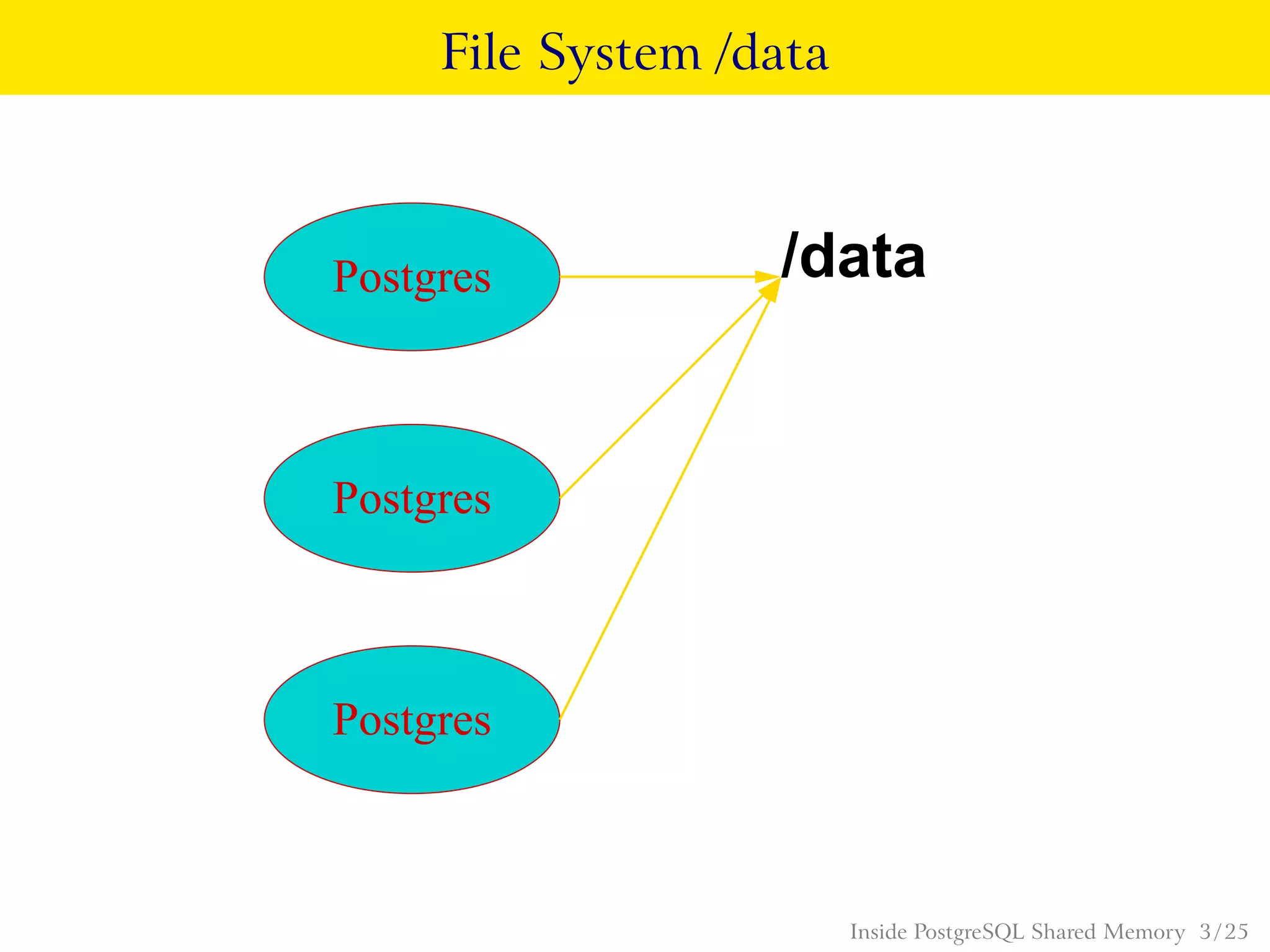
File System /data
Postgres
Postgres
Postgres
/data
Inside PostgreSQL Shared Memory 3 / 25
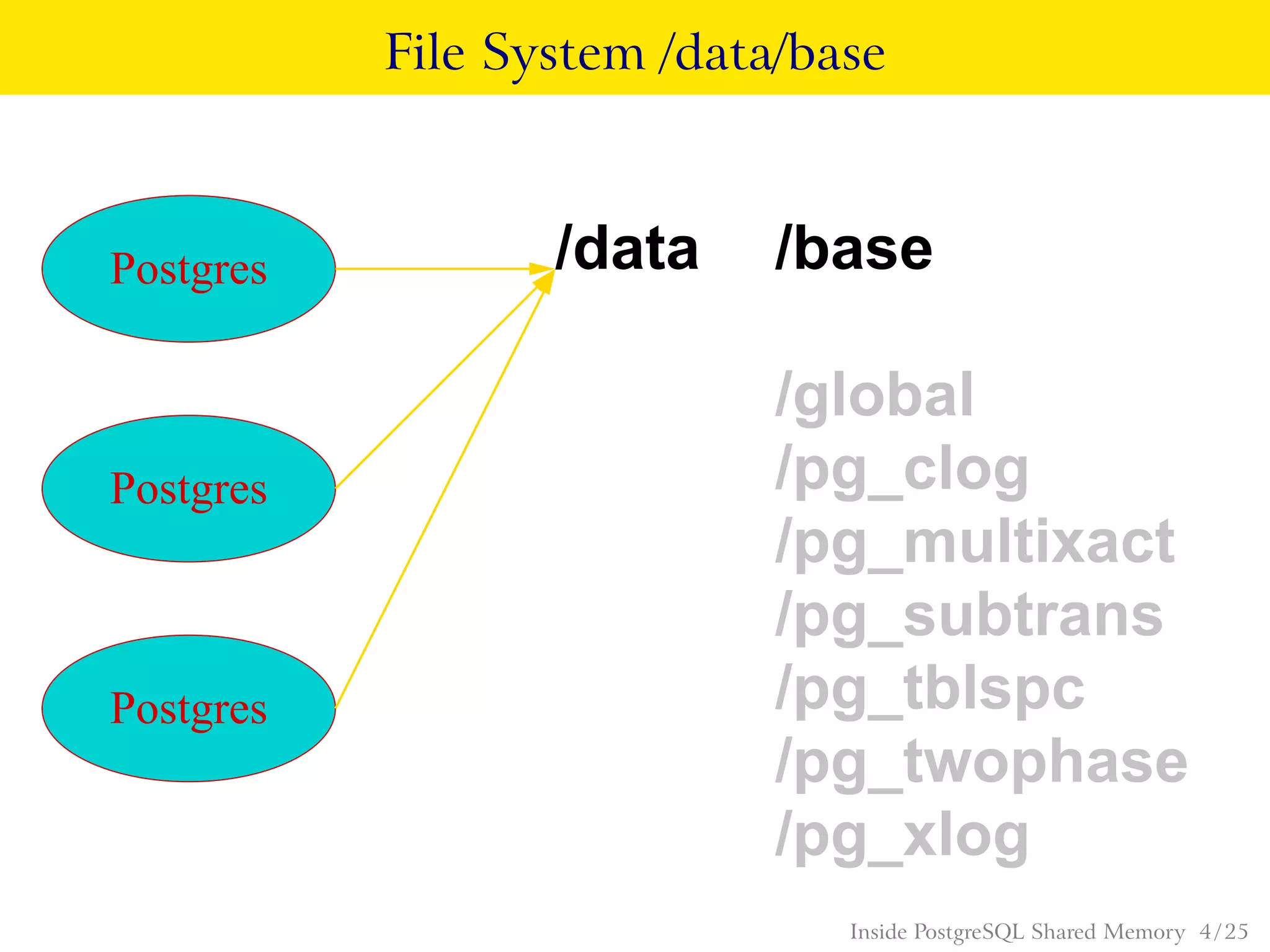
File System /data/base
Postgres
Postgres
Postgres
/data
/pg_clog
/pg_multixact
/pg_subtrans
/pg_tblspc
/pg_xlog
/global
/pg_twophase
/base
Inside PostgreSQL Shared Memory 4 / 25
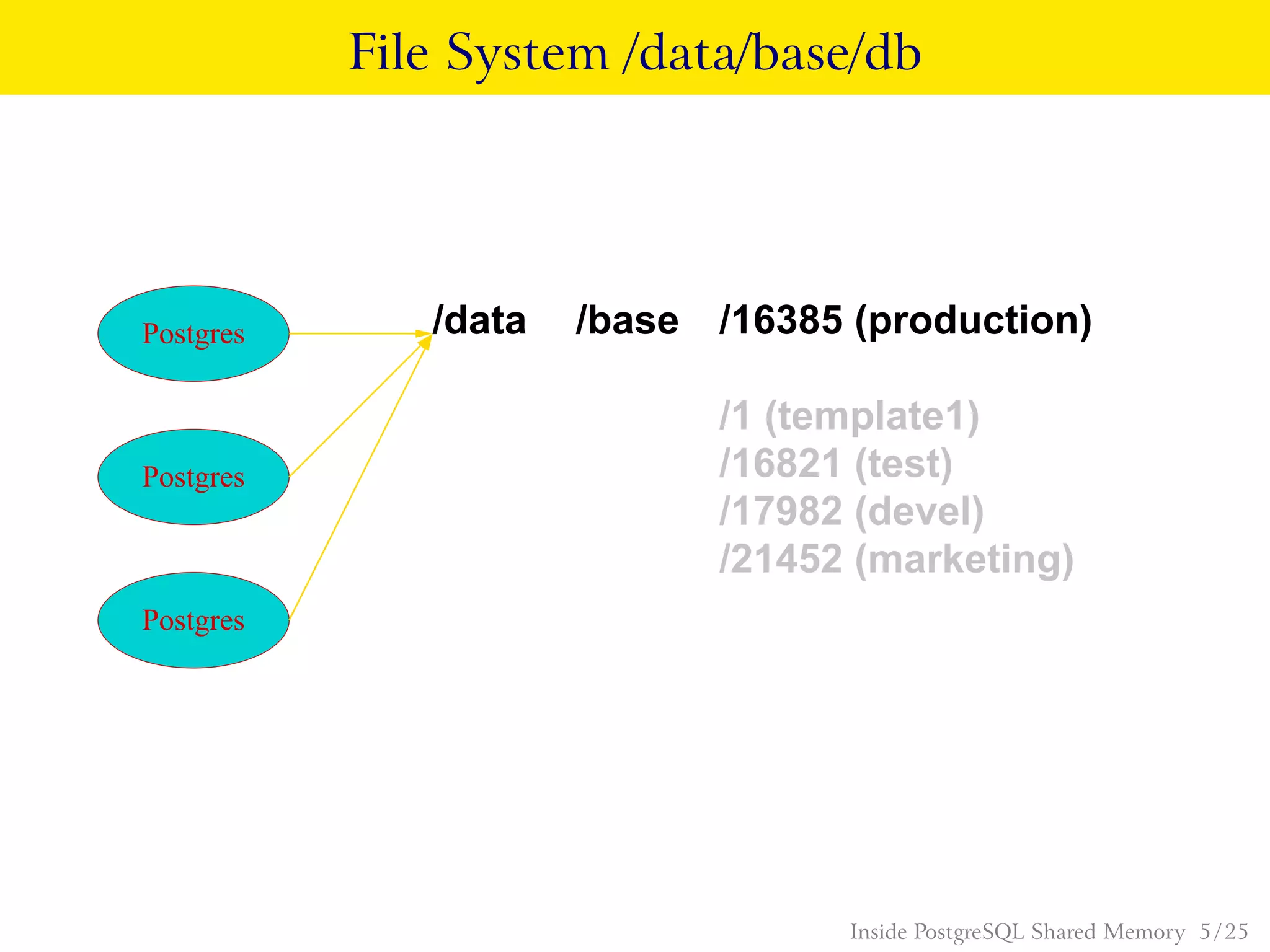
File System /data/base/db
Postgres
Postgres
Postgres
/data /base /16385 (production)
/1 (template1)
/17982 (devel)
/16821 (test)
/21452 (marketing)
Inside PostgreSQL Shared Memory 5 / 25
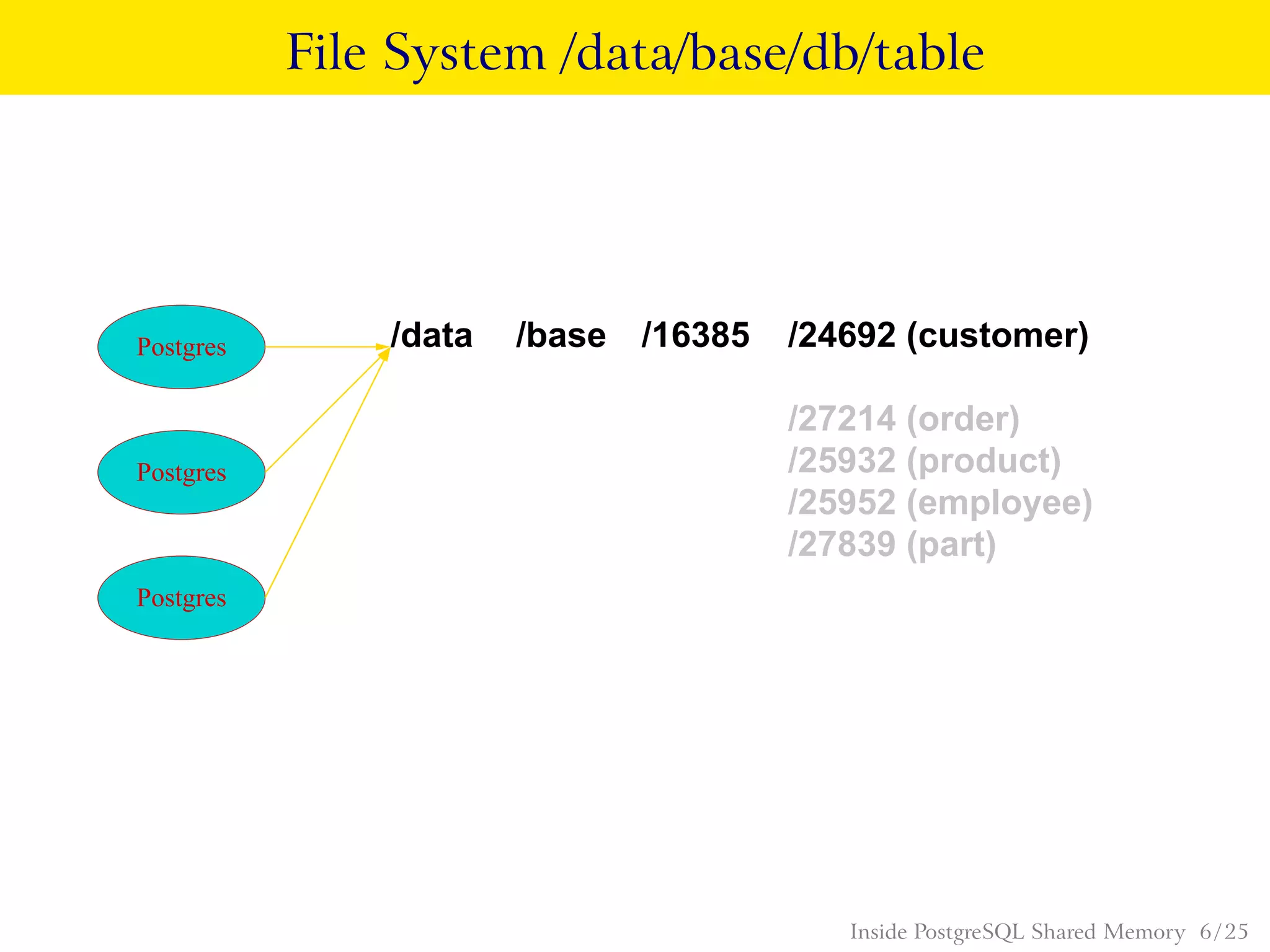
File System /data/base/db/table
Postgres
Postgres
Postgres
/data /base /16385 /24692 (customer)
/27214 (order)
/25932 (product)
/25952 (employee)
/27839 (part)
Inside PostgreSQL Shared Memory 6 / 25
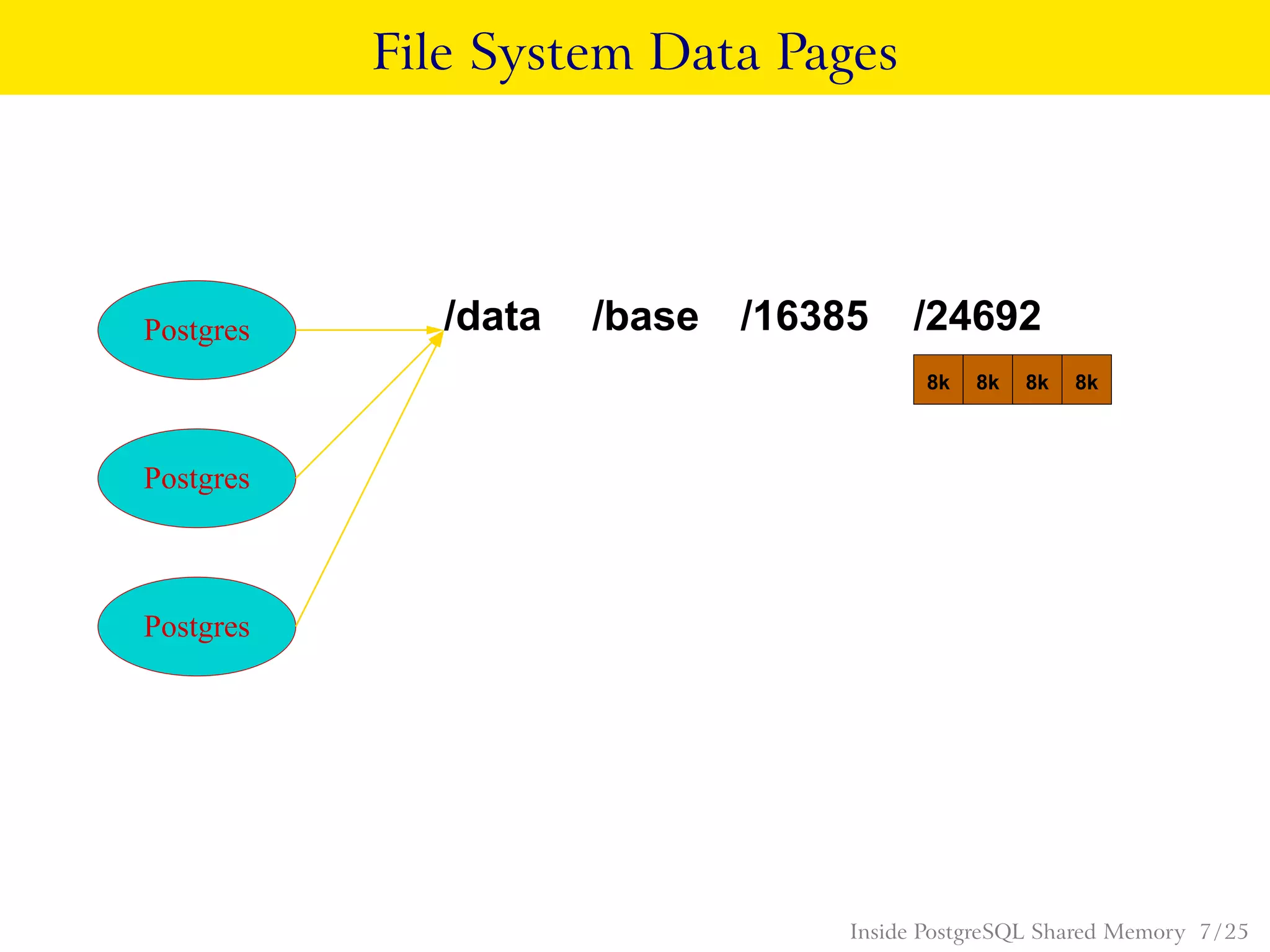
File System Data Pages
Postgres
Postgres
Postgres
8k 8k 8k 8k
/data /base /16385 /24692
Inside PostgreSQL Shared Memory 7 / 25
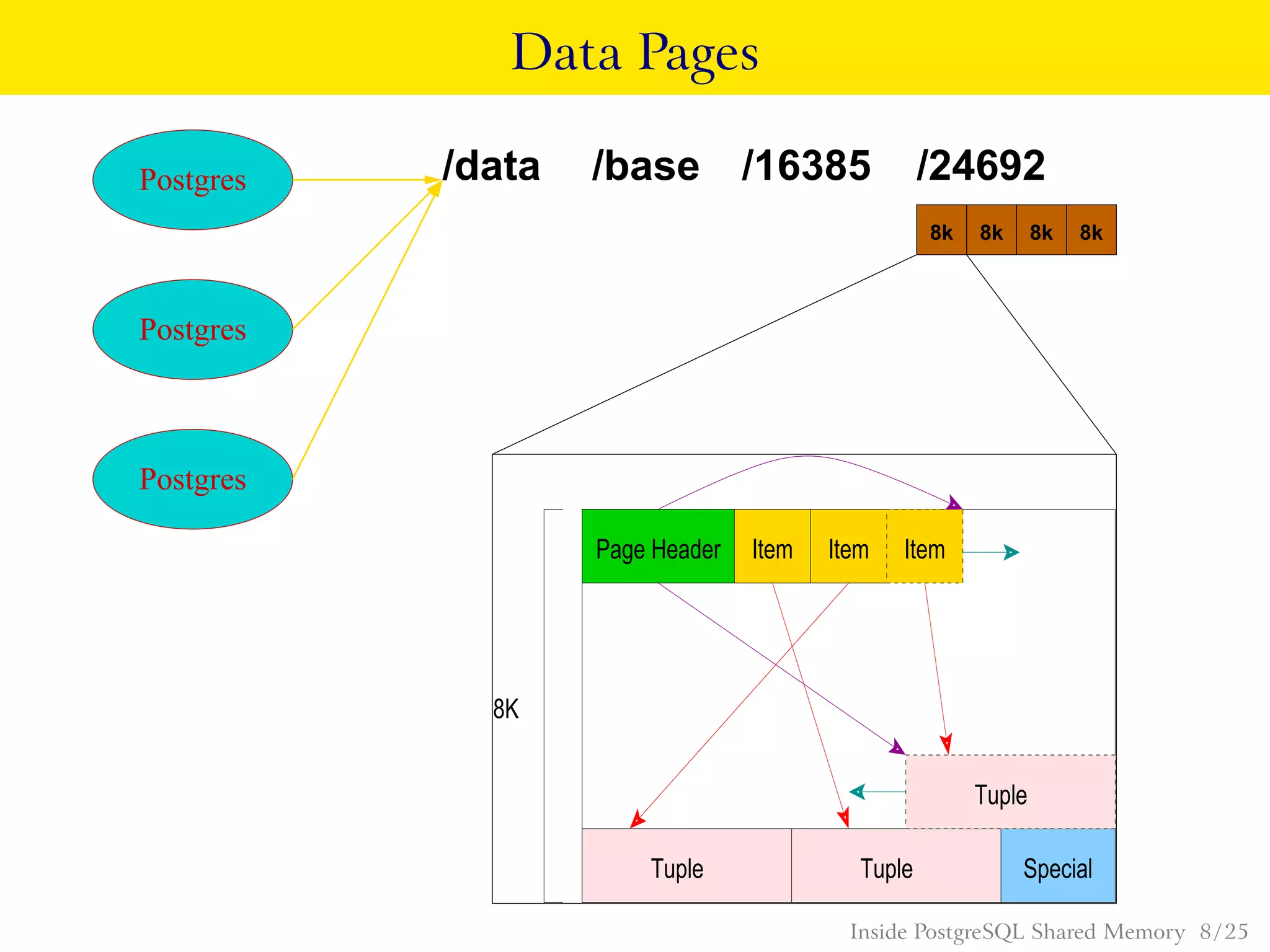
Data Pages
Postgres
Postgres
Postgres
Page Header Item Item Item
Tuple
Tuple Tuple Special
8K
8k 8k 8k 8k
/data /base /16385 /24692
Inside PostgreSQL Shared Memory 8 / 25
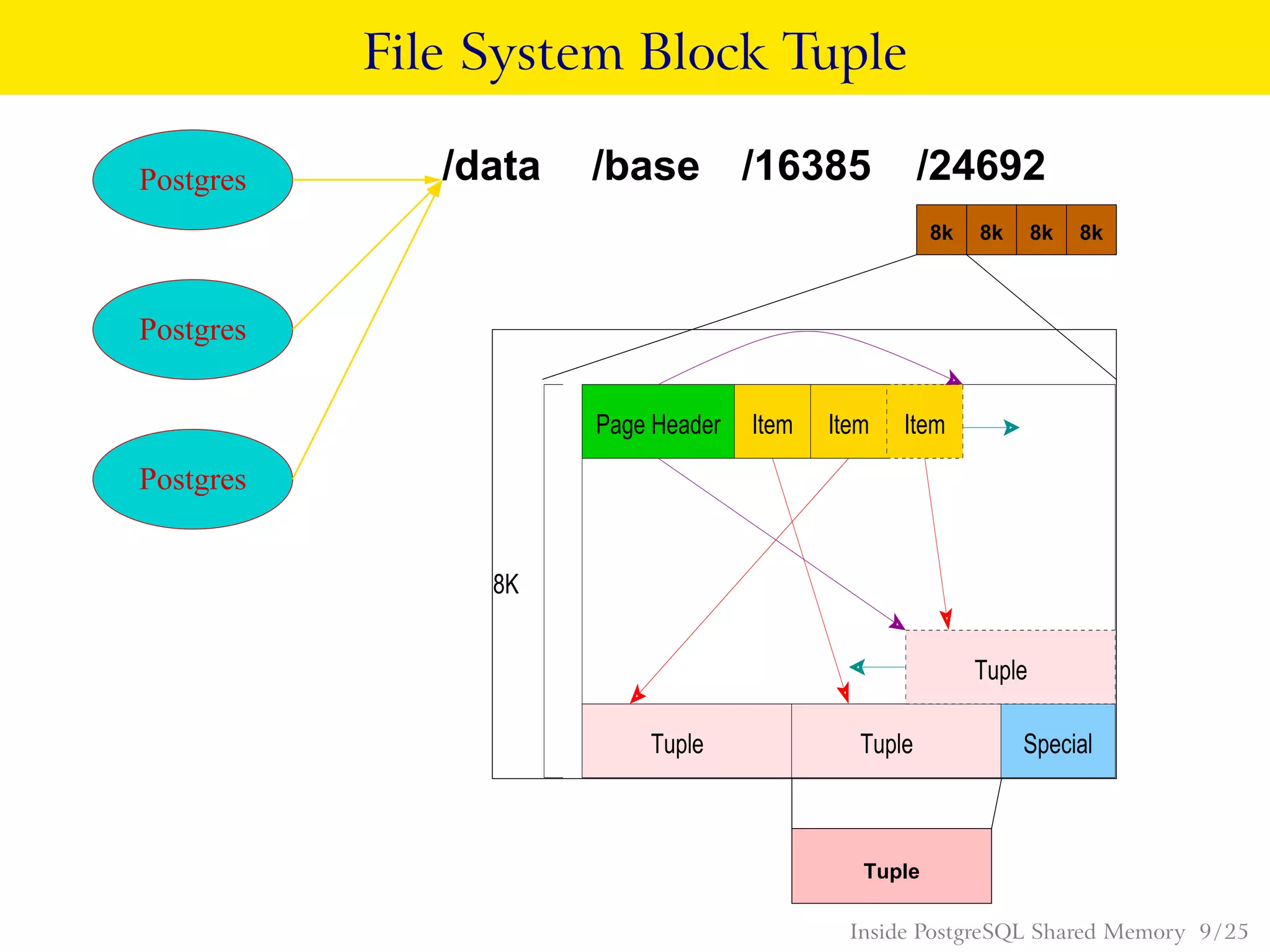
File System Block Tuple
Postgres
Postgres
Postgres
Page Header Item Item Item
Tuple
Tuple Tuple Special
8K
8k 8k 8k 8k
/data /base /16385 /24692
Tuple
Inside PostgreSQL Shared Memory 9 / 25
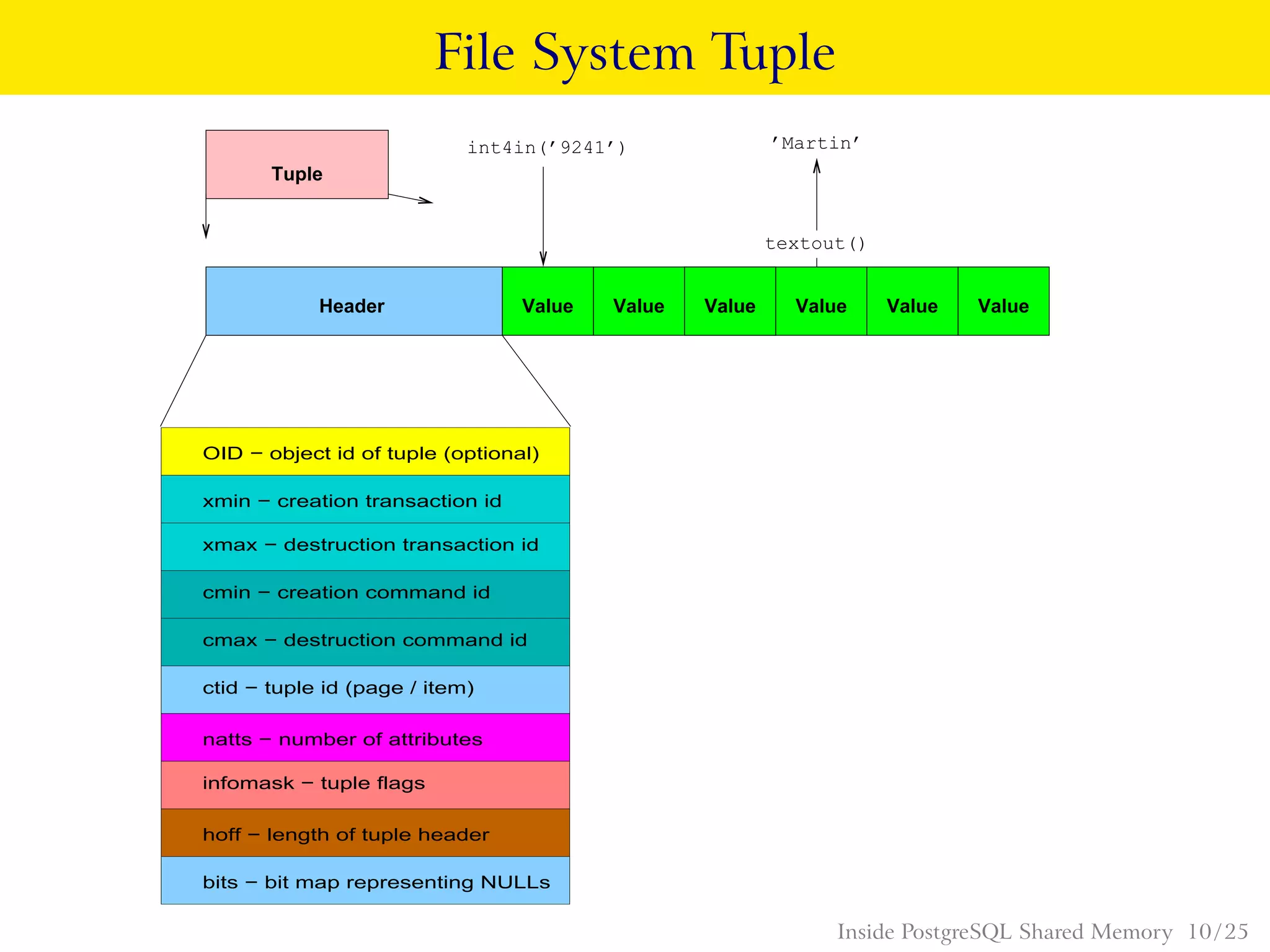
File System Tuple
hoff − length of tuple header
infomask − tuple flags
natts − number of attributes
ctid − tuple id (page / item)
cmax − destruction command id
xmin − creation transaction id
xmax − destruction transaction id
cmin − creation command id
bits − bit map representing NULLs
OID − object id of tuple (optional)
Tuple
Value Value ValueValue Value Value ValueHeader
int4in(’9241’)
textout()
’Martin’
Inside PostgreSQL Shared Memory 10 / 25
Tuple Header C Structures
typedef struct HeapTupleFields
{
TransactionId t_xmin; /* inserting xact ID */
TransactionId t_xmax; /* deleting or locking xact ID */
union
{
CommandId t_cid; /* inserting or deleting command ID, or both */
TransactionId t_xvac; /* VACUUM FULL xact ID */
} t_field3;
} HeapTupleFields;
typedef struct HeapTupleHeaderData
{
union
{
HeapTupleFields t_heap;
DatumTupleFields t_datum;
} t_choice;
ItemPointerData t_ctid; /* current TID of this or newer tuple */
/* Fields below here must match MinimalTupleData! */
uint16 t_infomask2; /* number of attributes + various flags */
uint16 t_infomask; /* various flag bits, see below */
uint8 t_hoff; /* sizeof header incl. bitmap, padding */
/* ^ − 23 bytes − ^ */
bits8 t_bits[1]; /* bitmap of NULLs −− VARIABLE LENGTH */
/* MORE DATA FOLLOWS AT END OF STRUCT */
} HeapTupleHeaderData; Inside PostgreSQL Shared Memory 11 / 25
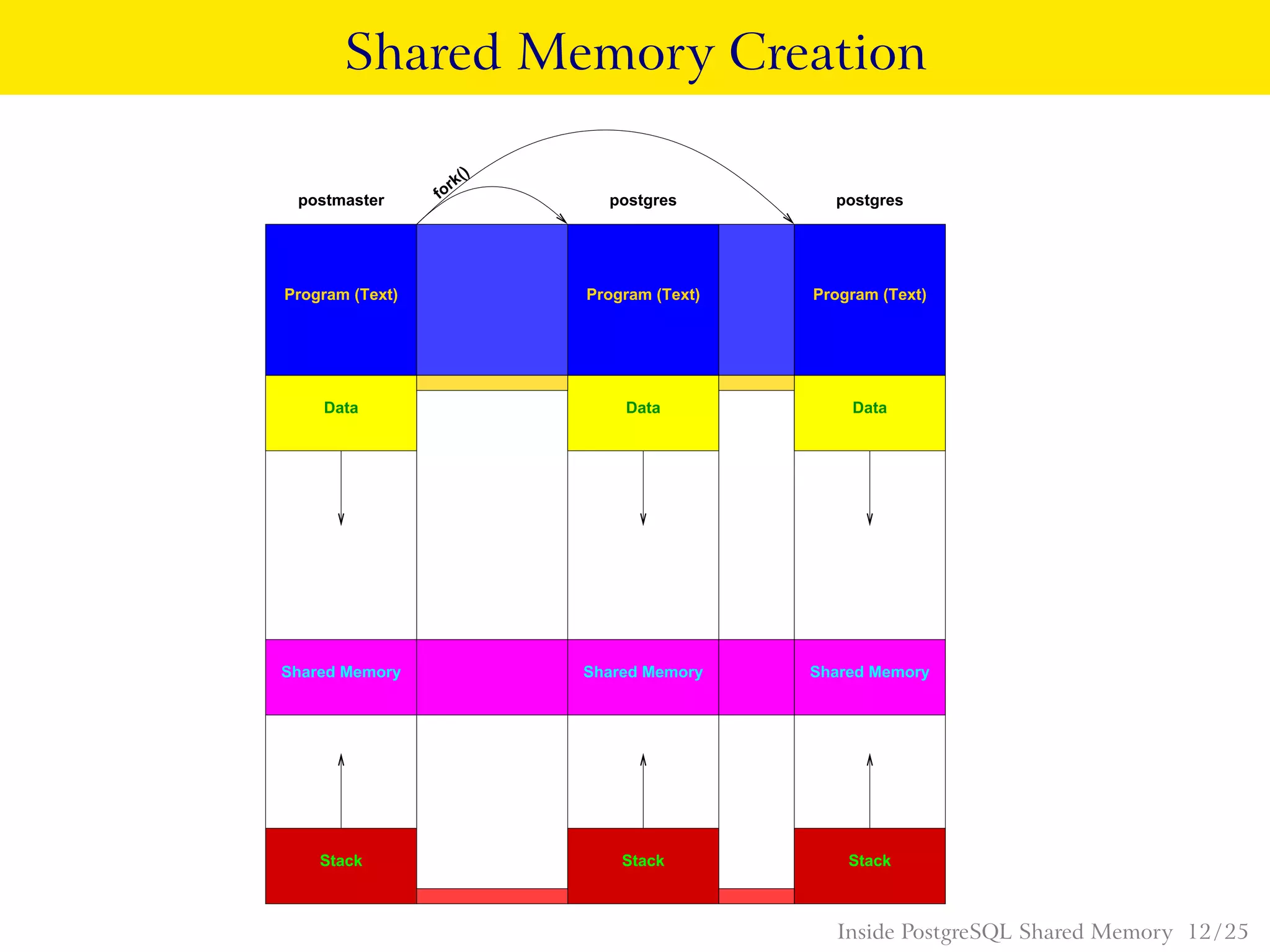
Shared Memory Creation
postmaster postgres postgres
Program (Text)
Data
Program (Text)
Data
Shared Memory
Program (Text)
Data
Shared Memory Shared Memory
Stack Stack
fork()
Stack
Inside PostgreSQL Shared Memory 12 / 25
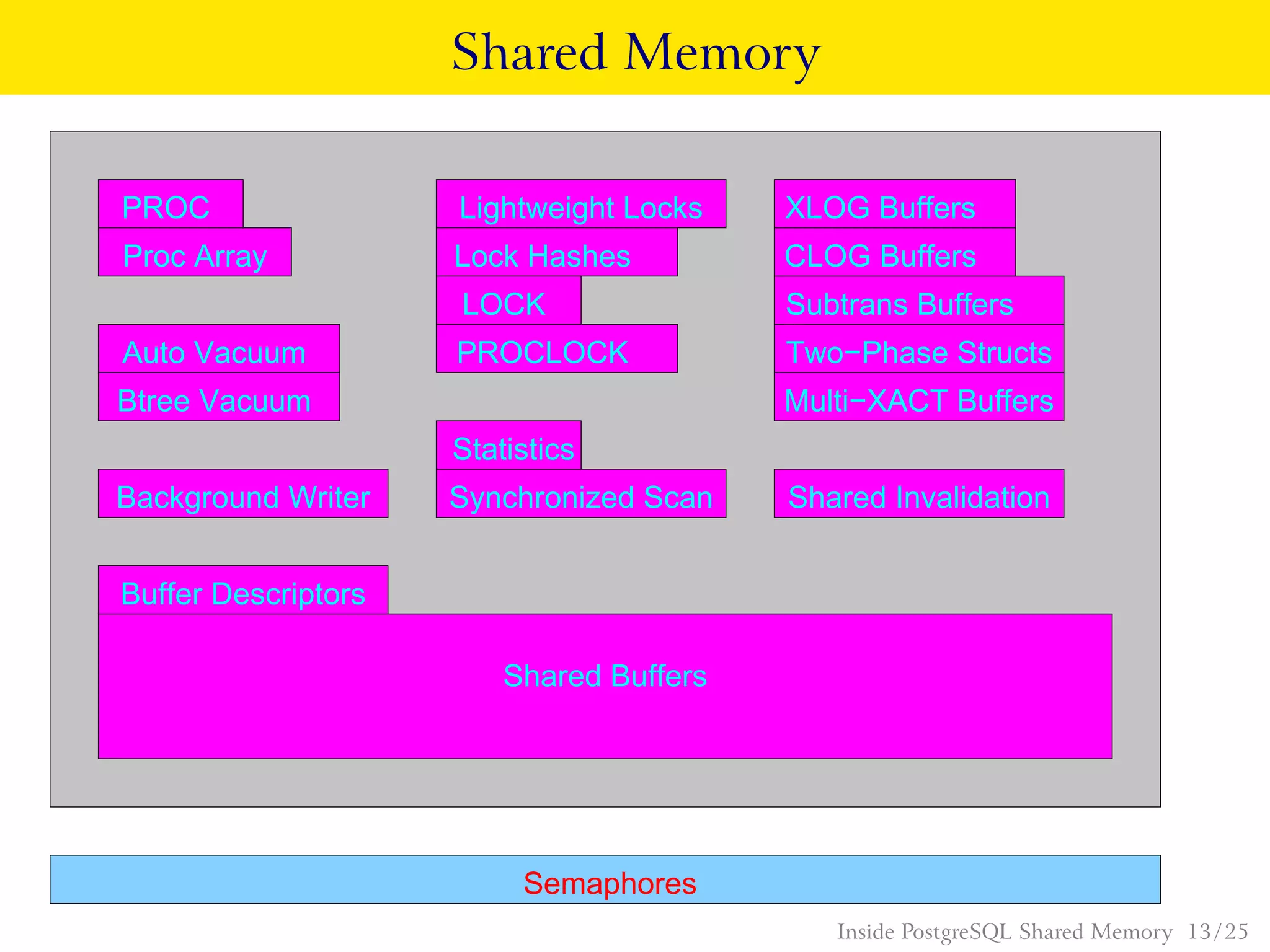
Shared Memory
Shared Buffers
Proc Array
PROC
Multi−XACT Buffers
Two−Phase Structs
Subtrans Buffers
CLOG Buffers
XLOG Buffers
Shared Invalidation
Lightweight Locks
Lock Hashes
Auto Vacuum
Btree Vacuum
Buffer Descriptors
Background Writer Synchronized Scan
Semaphores
Statistics
LOCK
PROCLOCK
Inside PostgreSQL Shared Memory 13 / 25
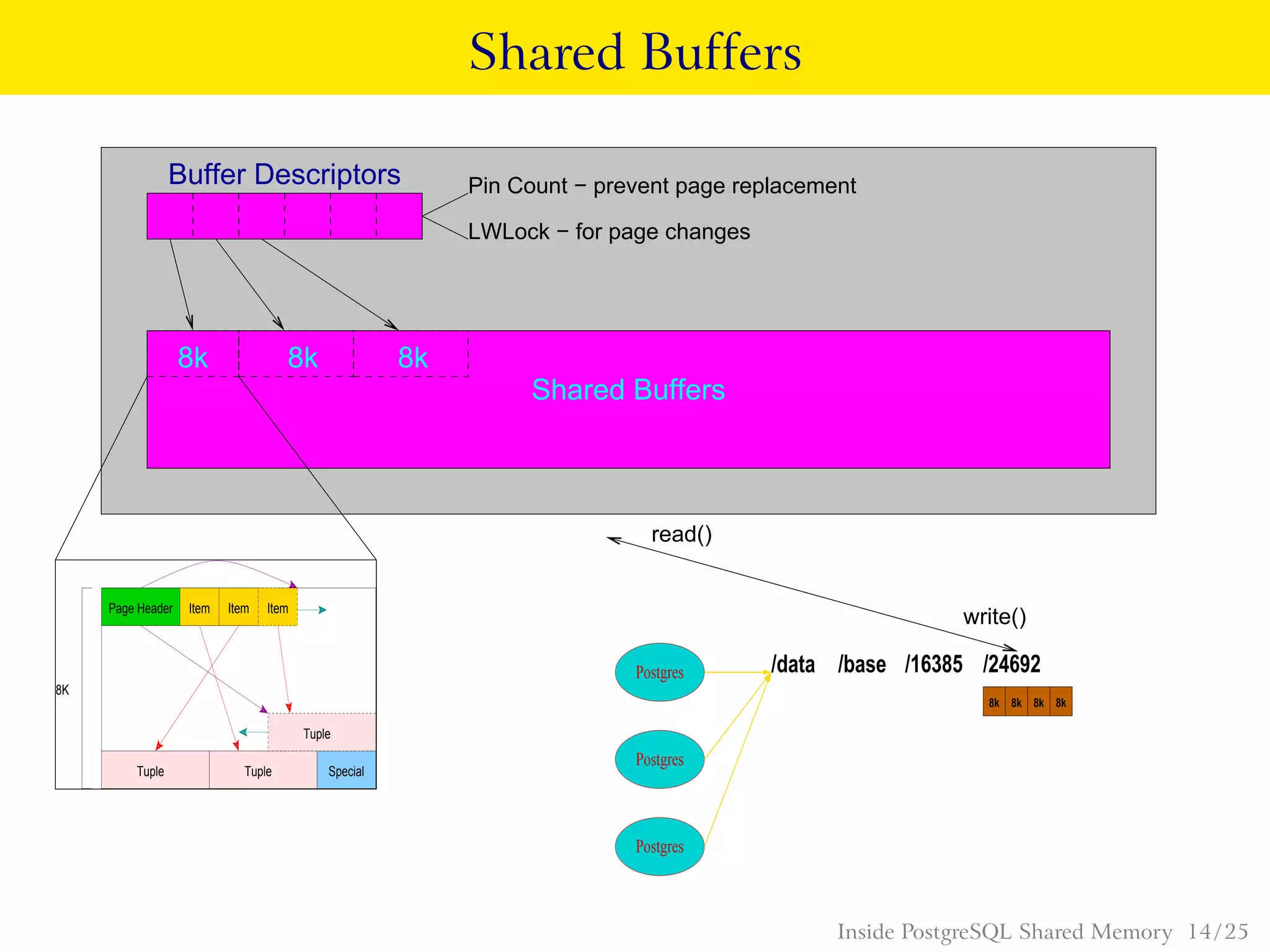
Shared Buffers
Page Header Item Item Item
Tuple
Tuple Tuple Special
8K
Postgres
Postgres
Postgres
8k 8k 8k 8k
/data /base /16385 /24692
Shared Buffers
LWLock − for page changes
Pin Count − prevent page replacement
read()
write()
8k 8k 8k
Buffer Descriptors
Inside PostgreSQL Shared Memory 14 / 25
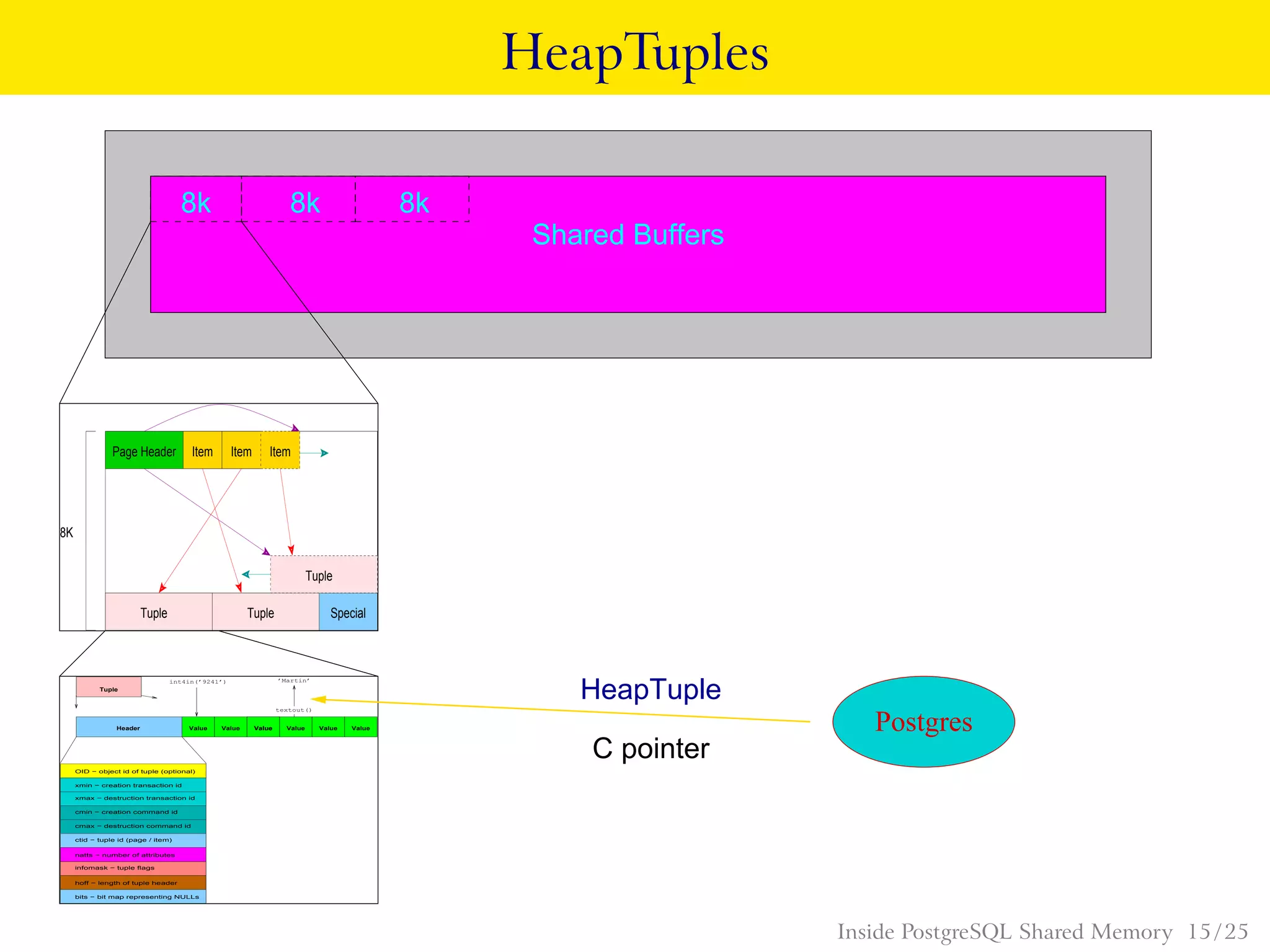
HeapTuples
Shared Buffers
Postgres
HeapTuple
C pointer
hoff − length of tuple header
infomask − tuple flags
natts − number of attributes
ctid − tuple id (page / item)
cmax − destruction command id
xmin − creation transaction id
xmax − destruction transaction id
cmin − creation command id
bits − bit map representing NULLs
OID − object id of tuple (optional)
Tuple
Value Value ValueValue Value Value ValueHeader
int4in(’9241’)
textout()
’Martin’
Page Header Item Item Item
Tuple
Tuple Tuple Special
8K
8k 8k 8k
Inside PostgreSQL Shared Memory 15 / 25
Finding A Tuple Value in C
Datum
nocachegetattr(HeapTuple tuple,
int attnum,
TupleDesc tupleDesc,
bool *isnull)
{
HeapTupleHeader tup = tuple−>t_data;
Form_pg_attribute *att = tupleDesc−>attrs;
{
int i;
/*
* Note − This loop is a little tricky. For each non−null attribute,
* we have to first account for alignment padding before the attr,
* then advance over the attr based on its length. Nulls have no
* storage and no alignment padding either. We can use/set
* attcacheoff until we reach either a null or a var−width attribute.
*/
off = 0;
for (i = 0;; i++) /* loop exit is at "break" */
{
if (HeapTupleHasNulls(tuple) && att_isnull(i, bp))
continue; /* this cannot be the target att */
if (att[i]−>attlen == −1)
off = att_align_pointer(off, att[i]−>attalign, −1,
tp + off);
else
/* not varlena, so safe to use att_align_nominal */
off = att_align_nominal(off, att[i]−>attalign);
if (i == attnum)
break;
off = att_addlength_pointer(off, att[i]−>attlen, tp + off);
}
}
return fetchatt(att[attnum], tp + off);
} Inside PostgreSQL Shared Memory 16 / 25
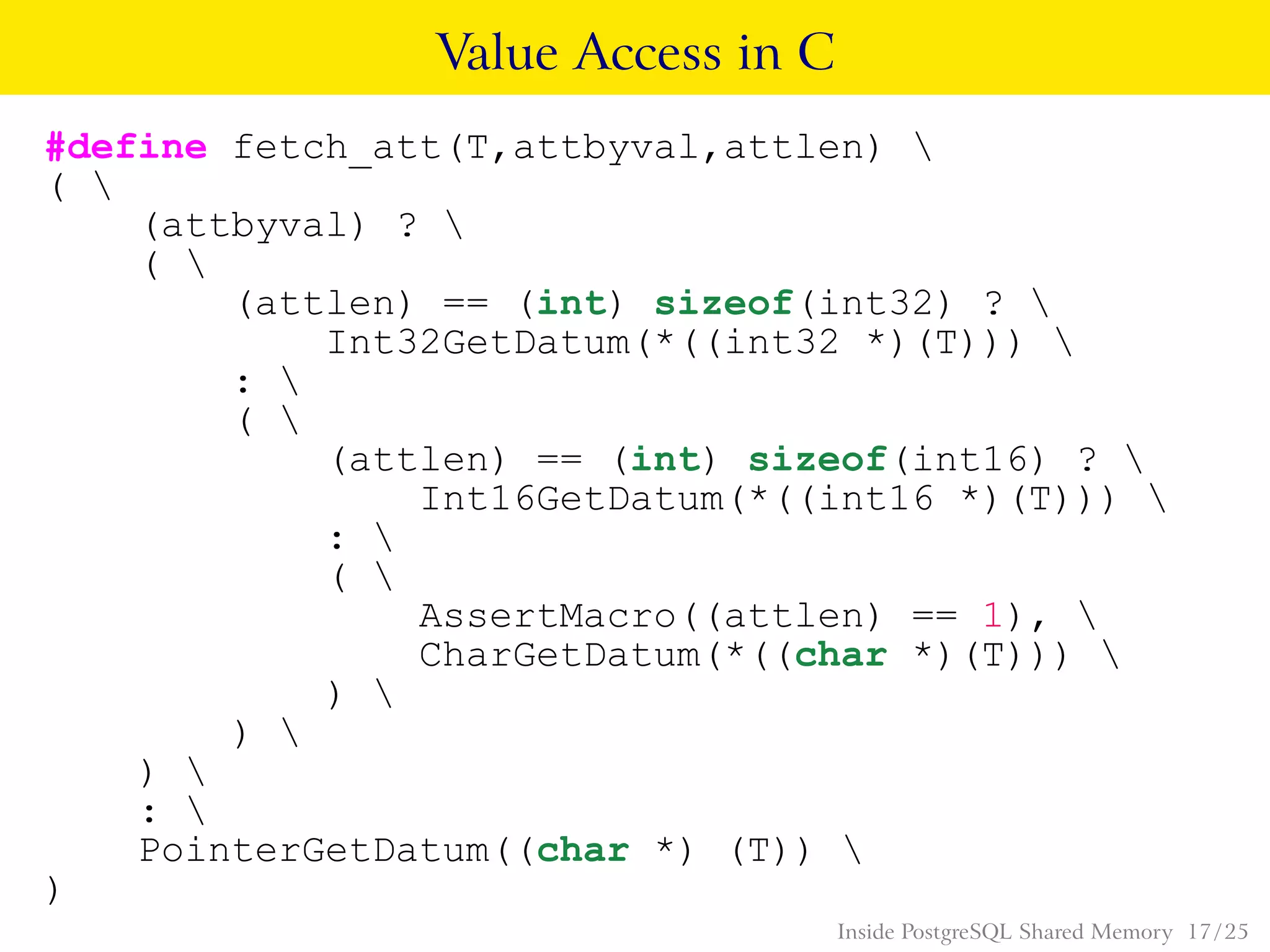
Value Access in C
#define fetch_att(T,attbyval,attlen) 
( 
(attbyval) ? 
( 
(attlen) == (int) sizeof(int32) ? 
Int32GetDatum(*((int32 *)(T))) 
: 
( 
(attlen) == (int) sizeof(int16) ? 
Int16GetDatum(*((int16 *)(T))) 
: 
( 
AssertMacro((attlen) == 1), 
CharGetDatum(*((char *)(T))) 
) 
) 
) 
: 
PointerGetDatum((char *) (T)) 
)
Inside PostgreSQL Shared Memory 17 / 25
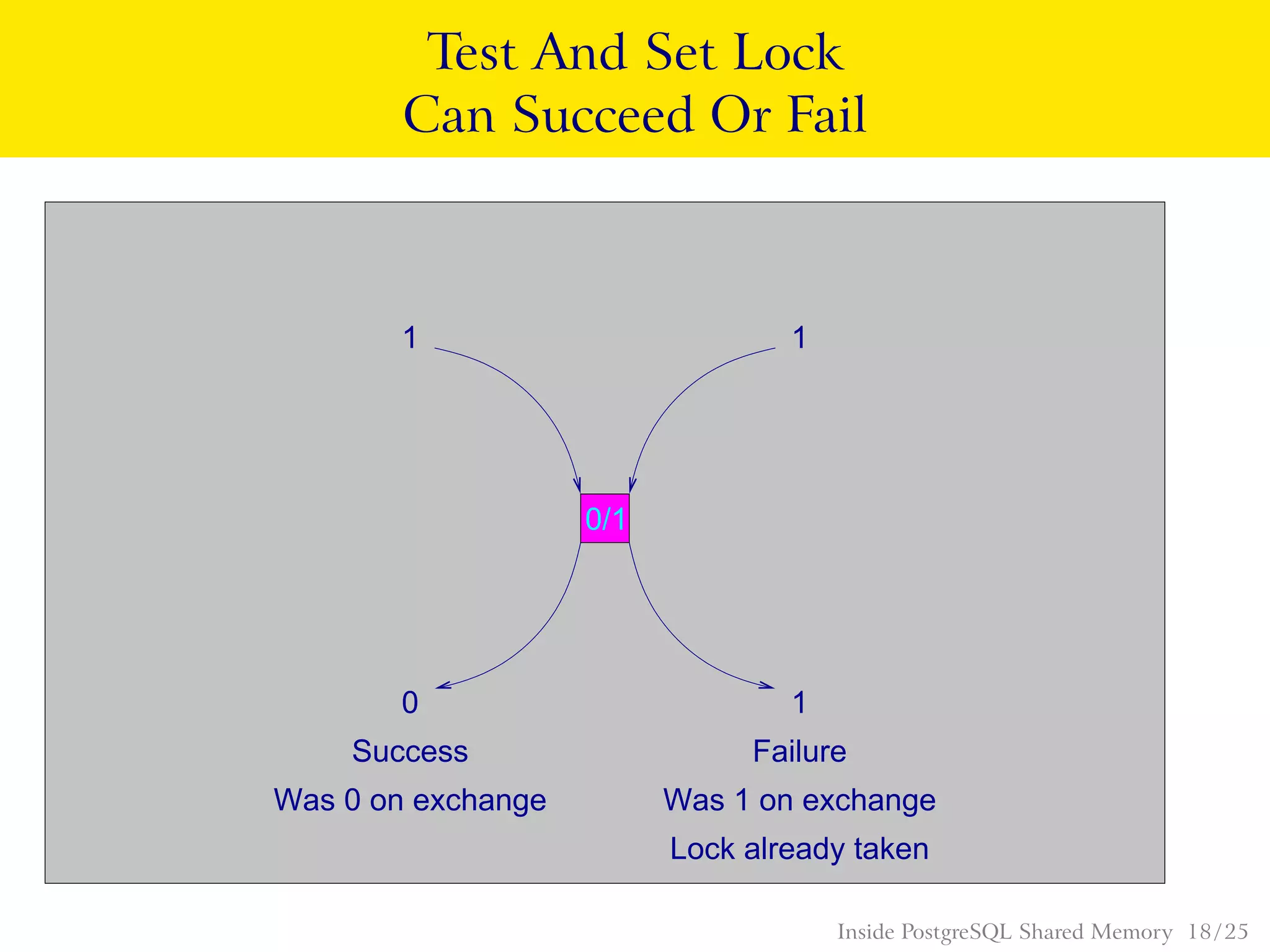
Test And Set Lock
Can Succeed Or Fail
0/1
1
0
Success
Was 0 on exchange
Lock already taken
Was 1 on exchange
Failure
1
1
Inside PostgreSQL Shared Memory 18 / 25
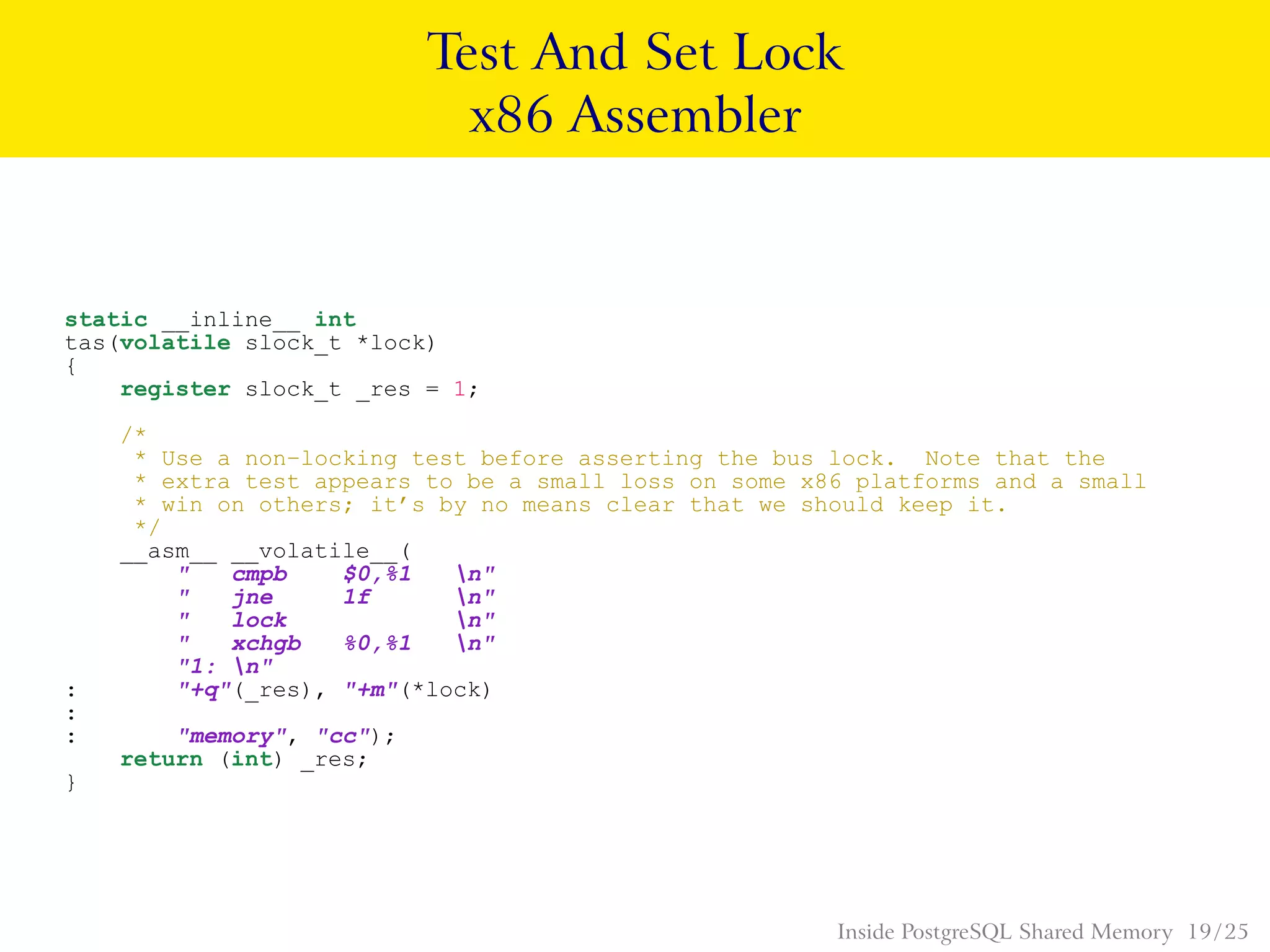
Test And Set Lock
x86 Assembler
static __inline__ int
tas(volatile slock_t *lock)
{
register slock_t _res = 1;
/*
* Use a non−locking test before asserting the bus lock. Note that the
* extra test appears to be a small loss on some x86 platforms and a small
* win on others; it’s by no means clear that we should keep it.
*/
__asm__ __volatile__(
" cmpb $0,%1 n"
" jne 1f n"
" lock n"
" xchgb %0,%1 n"
"1: n"
: "+q"(_res), "+m"(*lock)
:
: "memory", "cc");
return (int) _res;
}
Inside PostgreSQL Shared Memory 19 / 25
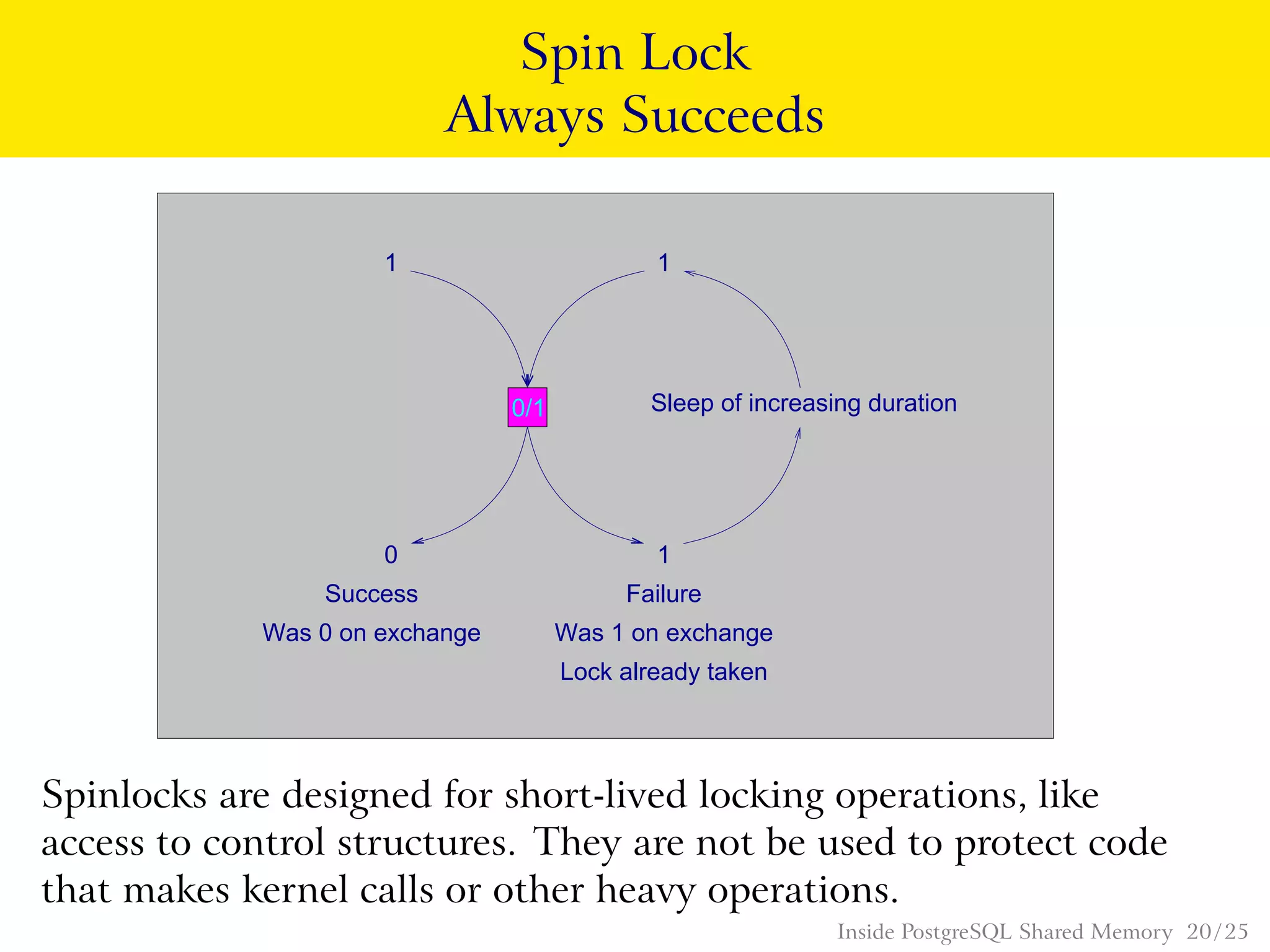
Spin Lock
Always Succeeds
0/1
1
Success
Was 0 on exchange
Failure
Was 1 on exchange
Lock already taken
Sleep of increasing duration
0 1
1
Spinlocks are designed for short-lived locking operations, like
access to control structures. They are not be used to protect code
that makes kernel calls or other heavy operations.
Inside PostgreSQL Shared Memory 20 / 25
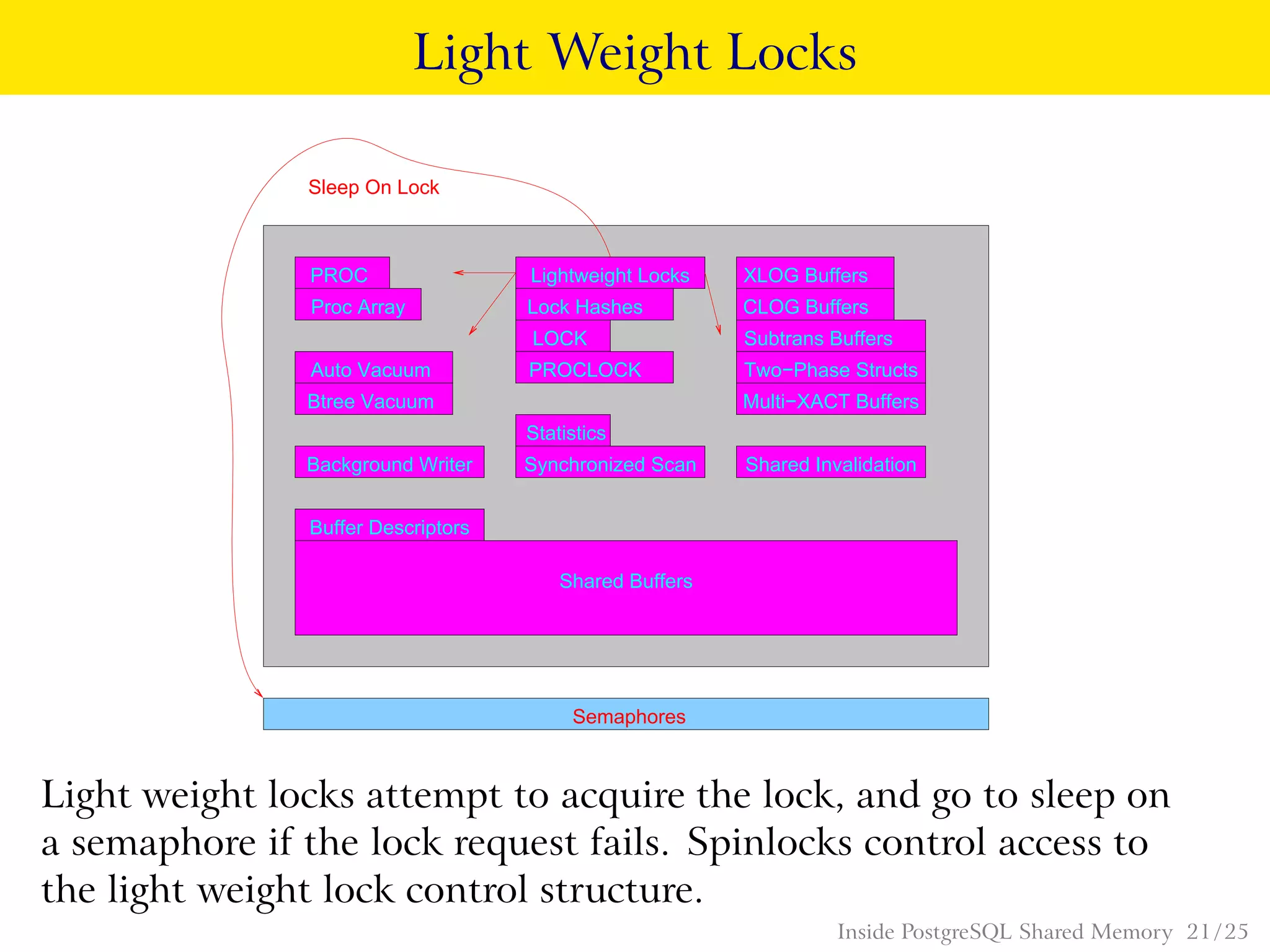
Light Weight Locks
Shared Buffers
Proc Array
PROC
Multi−XACT Buffers
Two−Phase Structs
Subtrans Buffers
CLOG Buffers
XLOG Buffers
Shared Invalidation
Lightweight Locks
Auto Vacuum
Btree Vacuum
Background Writer Synchronized Scan
Semaphores
Statistics
LOCK
PROCLOCK
Lock Hashes
Buffer Descriptors
Sleep On Lock
Light weight locks attempt to acquire the lock, and go to sleep on
a semaphore if the lock request fails. Spinlocks control access to
the light weight lock control structure.
Inside PostgreSQL Shared Memory 21 / 25
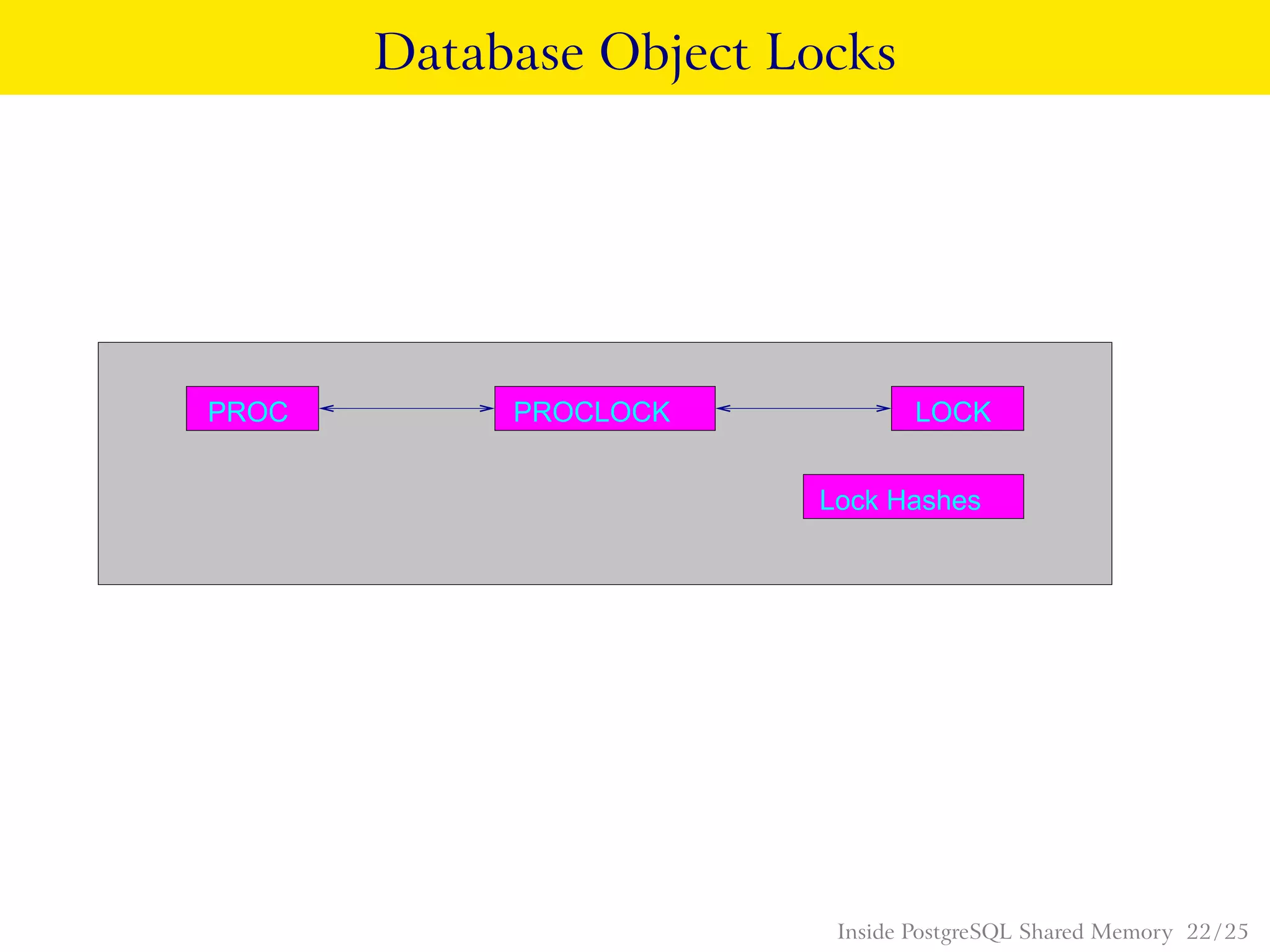
Database Object Locks
PROCLOCKPROC LOCK
Lock Hashes
Inside PostgreSQL Shared Memory 22 / 25
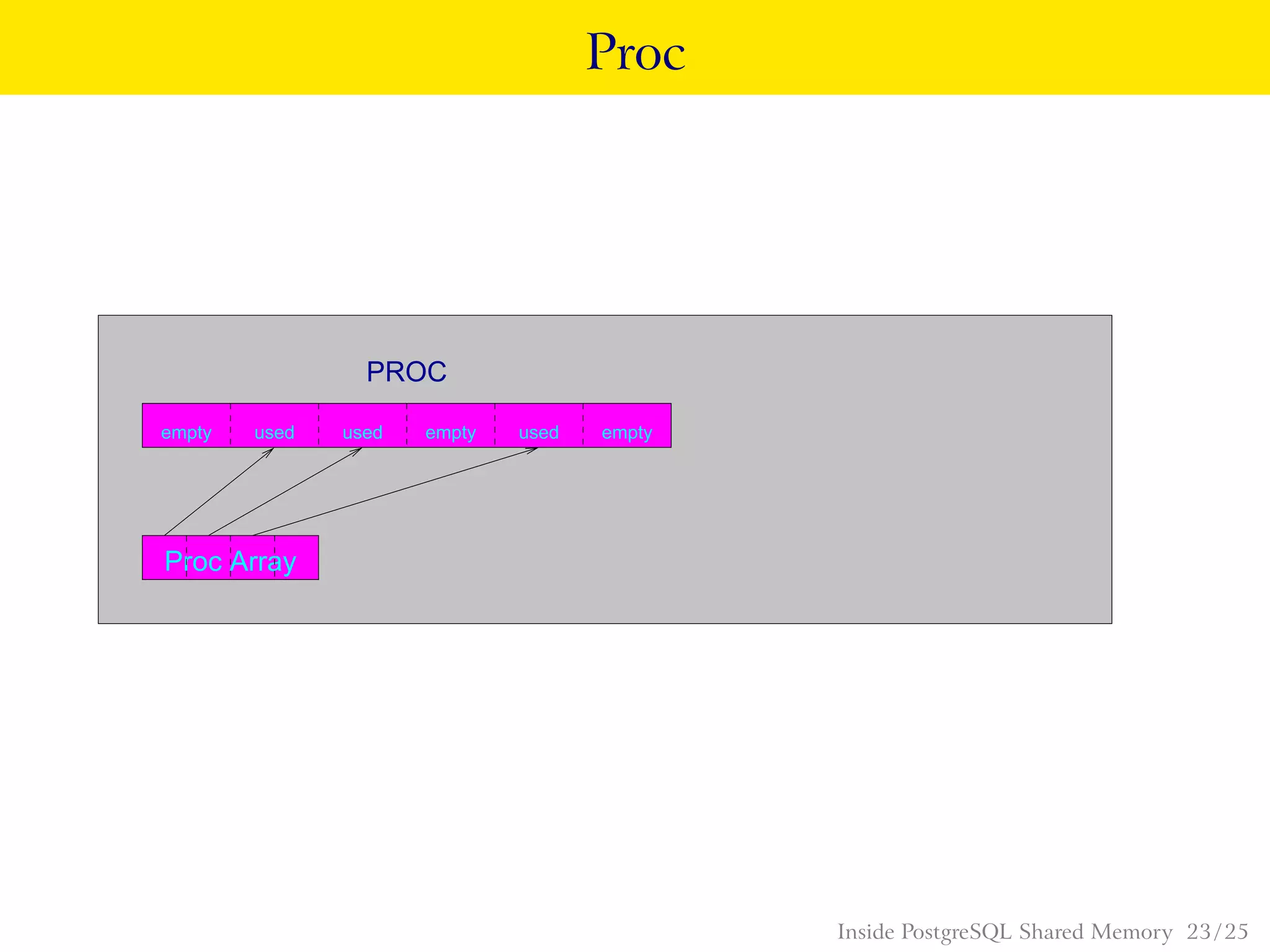
Proc
Proc Array
used usedusedempty empty empty
PROC
Inside PostgreSQL Shared Memory 23 / 25
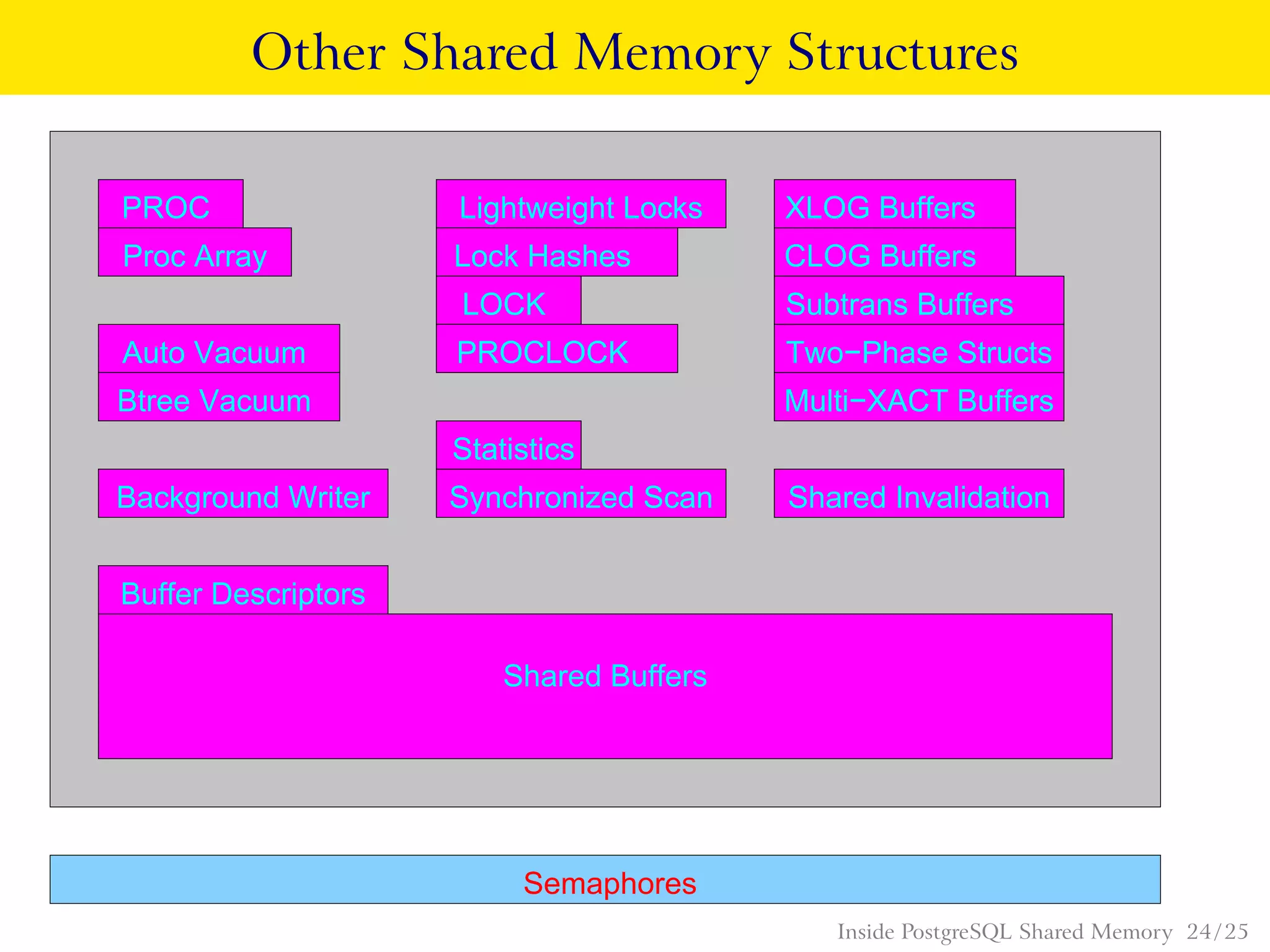
Other Shared Memory Structures
Shared Buffers
Proc Array
PROC
Multi−XACT Buffers
Two−Phase Structs
Subtrans Buffers
CLOG Buffers
XLOG Buffers
Shared Invalidation
Lightweight Locks
Lock Hashes
Auto Vacuum
Btree Vacuum
Buffer Descriptors
Background Writer Synchronized Scan
Semaphores
Statistics
LOCK
PROCLOCK
Inside PostgreSQL Shared Memory 24 / 25
Conclusion
http://momjian.us/presentations Pink Floyd: Wish You Were Here
Inside PostgreSQL Shared Memory 25 / 25

Bruce Momjian - Inside PostgreSQL Shared Memory @ Postgres Open

  • 1.
    Inside PostgreSQL SharedMemory BRUCE MOMJIAN September, 2013 POSTGRESQL is an open-source, full-featured relational database. This presentation gives an overview of the shared memory structures used by Postgres. Creative Commons Attribution License http://momjian.us/presentations Inside PostgreSQL Shared Memory 1 / 25
  • 2.
    Outline 1. File storageformat 2. Shared memory creation 3. Shared buffers 4. Row value access 5. Locking 6. Other structures Inside PostgreSQL Shared Memory 2 / 25
  • 3.
  • 4.
  • 5.
    File System /data/base/db Postgres Postgres Postgres /data/base /16385 (production) /1 (template1) /17982 (devel) /16821 (test) /21452 (marketing) Inside PostgreSQL Shared Memory 5 / 25
  • 6.
    File System /data/base/db/table Postgres Postgres Postgres /data/base /16385 /24692 (customer) /27214 (order) /25932 (product) /25952 (employee) /27839 (part) Inside PostgreSQL Shared Memory 6 / 25
  • 7.
    File System DataPages Postgres Postgres Postgres 8k 8k 8k 8k /data /base /16385 /24692 Inside PostgreSQL Shared Memory 7 / 25
  • 8.
    Data Pages Postgres Postgres Postgres Page HeaderItem Item Item Tuple Tuple Tuple Special 8K 8k 8k 8k 8k /data /base /16385 /24692 Inside PostgreSQL Shared Memory 8 / 25
  • 9.
    File System BlockTuple Postgres Postgres Postgres Page Header Item Item Item Tuple Tuple Tuple Special 8K 8k 8k 8k 8k /data /base /16385 /24692 Tuple Inside PostgreSQL Shared Memory 9 / 25
  • 10.
    File System Tuple hoff− length of tuple header infomask − tuple flags natts − number of attributes ctid − tuple id (page / item) cmax − destruction command id xmin − creation transaction id xmax − destruction transaction id cmin − creation command id bits − bit map representing NULLs OID − object id of tuple (optional) Tuple Value Value ValueValue Value Value ValueHeader int4in(’9241’) textout() ’Martin’ Inside PostgreSQL Shared Memory 10 / 25
  • 11.
    Tuple Header CStructures typedef struct HeapTupleFields { TransactionId t_xmin; /* inserting xact ID */ TransactionId t_xmax; /* deleting or locking xact ID */ union { CommandId t_cid; /* inserting or deleting command ID, or both */ TransactionId t_xvac; /* VACUUM FULL xact ID */ } t_field3; } HeapTupleFields; typedef struct HeapTupleHeaderData { union { HeapTupleFields t_heap; DatumTupleFields t_datum; } t_choice; ItemPointerData t_ctid; /* current TID of this or newer tuple */ /* Fields below here must match MinimalTupleData! */ uint16 t_infomask2; /* number of attributes + various flags */ uint16 t_infomask; /* various flag bits, see below */ uint8 t_hoff; /* sizeof header incl. bitmap, padding */ /* ^ − 23 bytes − ^ */ bits8 t_bits[1]; /* bitmap of NULLs −− VARIABLE LENGTH */ /* MORE DATA FOLLOWS AT END OF STRUCT */ } HeapTupleHeaderData; Inside PostgreSQL Shared Memory 11 / 25
  • 12.
    Shared Memory Creation postmasterpostgres postgres Program (Text) Data Program (Text) Data Shared Memory Program (Text) Data Shared Memory Shared Memory Stack Stack fork() Stack Inside PostgreSQL Shared Memory 12 / 25
  • 13.
    Shared Memory Shared Buffers ProcArray PROC Multi−XACT Buffers Two−Phase Structs Subtrans Buffers CLOG Buffers XLOG Buffers Shared Invalidation Lightweight Locks Lock Hashes Auto Vacuum Btree Vacuum Buffer Descriptors Background Writer Synchronized Scan Semaphores Statistics LOCK PROCLOCK Inside PostgreSQL Shared Memory 13 / 25
  • 14.
    Shared Buffers Page HeaderItem Item Item Tuple Tuple Tuple Special 8K Postgres Postgres Postgres 8k 8k 8k 8k /data /base /16385 /24692 Shared Buffers LWLock − for page changes Pin Count − prevent page replacement read() write() 8k 8k 8k Buffer Descriptors Inside PostgreSQL Shared Memory 14 / 25
  • 15.
    HeapTuples Shared Buffers Postgres HeapTuple C pointer hoff− length of tuple header infomask − tuple flags natts − number of attributes ctid − tuple id (page / item) cmax − destruction command id xmin − creation transaction id xmax − destruction transaction id cmin − creation command id bits − bit map representing NULLs OID − object id of tuple (optional) Tuple Value Value ValueValue Value Value ValueHeader int4in(’9241’) textout() ’Martin’ Page Header Item Item Item Tuple Tuple Tuple Special 8K 8k 8k 8k Inside PostgreSQL Shared Memory 15 / 25
  • 16.
    Finding A TupleValue in C Datum nocachegetattr(HeapTuple tuple, int attnum, TupleDesc tupleDesc, bool *isnull) { HeapTupleHeader tup = tuple−>t_data; Form_pg_attribute *att = tupleDesc−>attrs; { int i; /* * Note − This loop is a little tricky. For each non−null attribute, * we have to first account for alignment padding before the attr, * then advance over the attr based on its length. Nulls have no * storage and no alignment padding either. We can use/set * attcacheoff until we reach either a null or a var−width attribute. */ off = 0; for (i = 0;; i++) /* loop exit is at "break" */ { if (HeapTupleHasNulls(tuple) && att_isnull(i, bp)) continue; /* this cannot be the target att */ if (att[i]−>attlen == −1) off = att_align_pointer(off, att[i]−>attalign, −1, tp + off); else /* not varlena, so safe to use att_align_nominal */ off = att_align_nominal(off, att[i]−>attalign); if (i == attnum) break; off = att_addlength_pointer(off, att[i]−>attlen, tp + off); } } return fetchatt(att[attnum], tp + off); } Inside PostgreSQL Shared Memory 16 / 25
  • 17.
    Value Access inC #define fetch_att(T,attbyval,attlen) ( (attbyval) ? ( (attlen) == (int) sizeof(int32) ? Int32GetDatum(*((int32 *)(T))) : ( (attlen) == (int) sizeof(int16) ? Int16GetDatum(*((int16 *)(T))) : ( AssertMacro((attlen) == 1), CharGetDatum(*((char *)(T))) ) ) ) : PointerGetDatum((char *) (T)) ) Inside PostgreSQL Shared Memory 17 / 25
  • 18.
    Test And SetLock Can Succeed Or Fail 0/1 1 0 Success Was 0 on exchange Lock already taken Was 1 on exchange Failure 1 1 Inside PostgreSQL Shared Memory 18 / 25
  • 19.
    Test And SetLock x86 Assembler static __inline__ int tas(volatile slock_t *lock) { register slock_t _res = 1; /* * Use a non−locking test before asserting the bus lock. Note that the * extra test appears to be a small loss on some x86 platforms and a small * win on others; it’s by no means clear that we should keep it. */ __asm__ __volatile__( " cmpb $0,%1 n" " jne 1f n" " lock n" " xchgb %0,%1 n" "1: n" : "+q"(_res), "+m"(*lock) : : "memory", "cc"); return (int) _res; } Inside PostgreSQL Shared Memory 19 / 25
  • 20.
    Spin Lock Always Succeeds 0/1 1 Success Was0 on exchange Failure Was 1 on exchange Lock already taken Sleep of increasing duration 0 1 1 Spinlocks are designed for short-lived locking operations, like access to control structures. They are not be used to protect code that makes kernel calls or other heavy operations. Inside PostgreSQL Shared Memory 20 / 25
  • 21.
    Light Weight Locks SharedBuffers Proc Array PROC Multi−XACT Buffers Two−Phase Structs Subtrans Buffers CLOG Buffers XLOG Buffers Shared Invalidation Lightweight Locks Auto Vacuum Btree Vacuum Background Writer Synchronized Scan Semaphores Statistics LOCK PROCLOCK Lock Hashes Buffer Descriptors Sleep On Lock Light weight locks attempt to acquire the lock, and go to sleep on a semaphore if the lock request fails. Spinlocks control access to the light weight lock control structure. Inside PostgreSQL Shared Memory 21 / 25
  • 22.
    Database Object Locks PROCLOCKPROCLOCK Lock Hashes Inside PostgreSQL Shared Memory 22 / 25
  • 23.
    Proc Proc Array used usedusedemptyempty empty PROC Inside PostgreSQL Shared Memory 23 / 25
  • 24.
    Other Shared MemoryStructures Shared Buffers Proc Array PROC Multi−XACT Buffers Two−Phase Structs Subtrans Buffers CLOG Buffers XLOG Buffers Shared Invalidation Lightweight Locks Lock Hashes Auto Vacuum Btree Vacuum Buffer Descriptors Background Writer Synchronized Scan Semaphores Statistics LOCK PROCLOCK Inside PostgreSQL Shared Memory 24 / 25
  • 25.
    Conclusion http://momjian.us/presentations Pink Floyd:Wish You Were Here Inside PostgreSQL Shared Memory 25 / 25