Warm Up!
Get your journal to take notes.
Copyright © 2003 Pearson Education, Inc. publishing as Benjamin Cummings.
RESPIRATORY SYSTEM
PowerPoint® Lecture Slide Presentation by Robert J. Sullivan, Marist College
EXCHANGE OF GASES
The Respiratory System
Weird.
#1 First, a Review
•Function = job
•Homeostasis = equilibrium for the body. Your body tries
to maintain a healthy balance of all things.
•Stimulus/response = how your body reacts to situations
and messages that require action.
Easy. No heart
attacks this time,
right?
Sure, Joe…no heart attacks. No other promises, though.
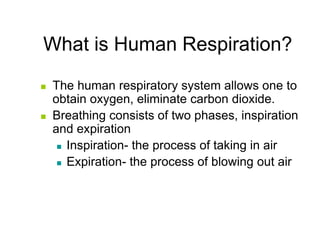
What is Human Respiration?
 The human respiratory system allows one to
obtain oxygen, eliminate carbon dioxide.
 Breathing consists of two phases, inspiration
and expiration
 Inspiration- the process of taking in air
 Expiration- the process of blowing out air
#2 Respiratory System
Overview
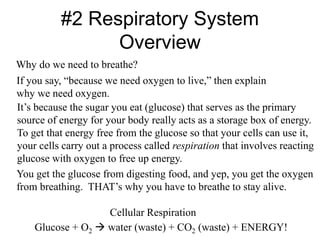
Why do we need to breathe?
If you say, “because we need oxygen to live,” then explain
why we need oxygen.
It’s because the sugar you eat (glucose) that serves as the primary
source of energy for your body really acts as a storage box of energy.
To get that energy free from the glucose so that your cells can use it,
your cells carry out a process called respiration that involves reacting
glucose with oxygen to free up energy.
You get the glucose from digesting food, and yep, you get the oxygen
from breathing. THAT’s why you have to breathe to stay alive.
Glucose + O2  water (waste) + CO2 (waste) + ENERGY!
Cellular Respiration
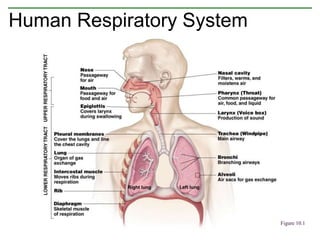
Human Respiratory System
Figure 10.1
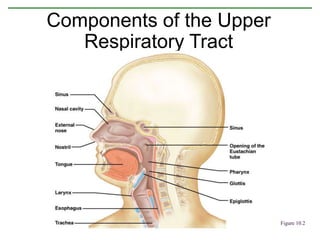
Components of the Upper
Respiratory Tract
Figure 10.2
 Passageway for respiration
 Receptors for smell
 Filters incoming air to filter larger foreign
material
 Moistens and warms incoming air
 Resonating chambers for voice
Upper Respiratory Tract
Functions
#4 FUNCTIONS of the Resp.
Sys.
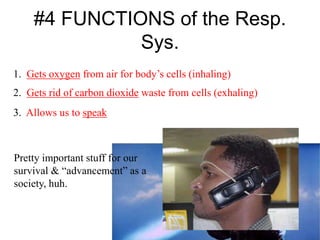
1. Gets oxygen from air for body’s cells (inhaling)
2. Gets rid of carbon dioxide waste from cells (exhaling)
3. Allows us to speak
Pretty important stuff for our
survival & “advancement” as a
society, huh.
#5 How do we actually breathe?
What actually causes air to fill our lungs when we breathe in???
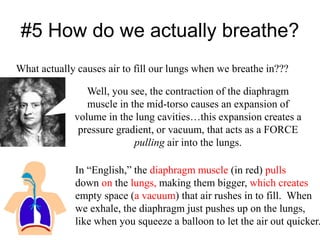
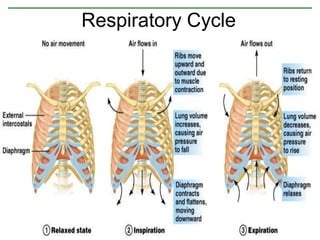
Well, you see, the contraction of the diaphragm
muscle in the mid-torso causes an expansion of
volume in the lung cavities…this expansion creates a
pressure gradient, or vacuum, that acts as a FORCE
pulling air into the lungs.
In “English,” the diaphragm muscle (in red) pulls
down on the lungs, making them bigger, which creates
empty space (a vacuum) that air rushes in to fill. When
we exhale, the diaphragm just pushes up on the lungs,
like when you squeeze a balloon to let the air out quicker.
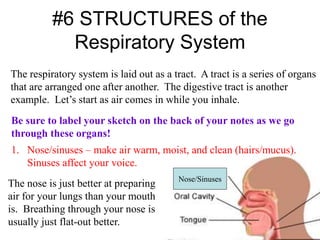
Nose/Sinuses
#6 STRUCTURES of the
Respiratory System
The respiratory system is laid out as a tract. A tract is a series of organs
that are arranged one after another. The digestive tract is another
example. Let’s start as air comes in while you inhale.
Be sure to label your sketch on the back of your notes as we go
through these organs!
1. Nose/sinuses – make air warm, moist, and clean (hairs/mucus).
Sinuses affect your voice.
The nose is just better at preparing
air for your lungs than your mouth
is. Breathing through your nose is
usually just flat-out better.
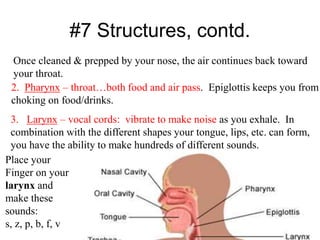
#7 Structures, contd.
Once cleaned & prepped by your nose, the air continues back toward
your throat.
2. Pharynx – throat…both food and air pass. Epiglottis keeps you from
choking on food/drinks.
3. Larynx – vocal cords: vibrate to make noise as you exhale. In
combination with the different shapes your tongue, lips, etc. can form,
you have the ability to make hundreds of different sounds.
Place your
Finger on your
larynx and
make these
sounds:
s, z, p, b, f, v
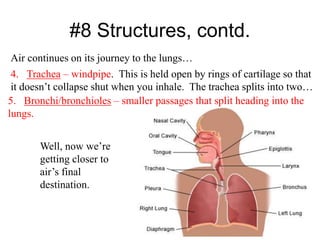
#8 Structures, contd.
Air continues on its journey to the lungs…
4. Trachea – windpipe. This is held open by rings of cartilage so that
it doesn’t collapse shut when you inhale. The trachea splits into two…
5. Bronchi/bronchioles – smaller passages that split heading into the
lungs.
Well, now we’re
getting closer to
air’s final
destination.
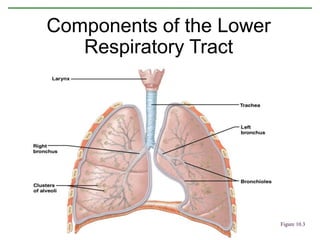
Components of the Lower
Respiratory Tract
Figure 10.3
 Functions:
 Larynx: maintains an open airway, routes food
and air appropriately, assists in sound production
 Trachea: transports air to and from lungs
 Bronchi: branch into lungs
 Lungs: transport air to alveoli for gas exchange
Lower Respiratory Tract
#3 Resp. System Overview,
Cont.
The respiratory system’s main job is to exchange gases in
the lungs.
The whole system…
All your cells are doing…
#9 Structures, contd.
Air is now finally inside the…
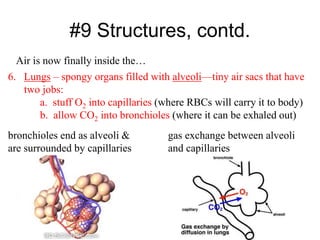
6. Lungs – spongy organs filled with alveoli—tiny air sacs that have
two jobs:
a. stuff O2 into capillaries (where RBCs will carry it to body)
b. allow CO2 into bronchioles (where it can be exhaled out)
bronchioles end as alveoli &
are surrounded by capillaries
gas exchange between alveoli
and capillaries
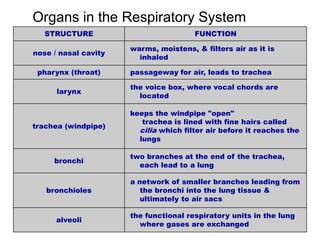
Organs in the Respiratory System
STRUCTURE FUNCTION
nose / nasal cavity
warms, moistens, & filters air as it is
inhaled
pharynx (throat) passageway for air, leads to trachea
larynx
the voice box, where vocal chords are
located
trachea (windpipe)
keeps the windpipe "open"
trachea is lined with fine hairs called
cilia which filter air before it reaches the
lungs
bronchi
two branches at the end of the trachea,
each lead to a lung
bronchioles
a network of smaller branches leading from
the bronchi into the lung tissue &
ultimately to air sacs
alveoli
the functional respiratory units in the lung
where gases are exchanged
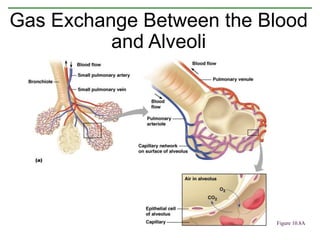
Gas Exchange Between the Blood
and Alveoli
Figure 10.8A
Respiratory Cycle
Figure 10.9
#10 Structures, contd.
And of course, since the organs make a tract, air just reverses through
them as the diaphragm pushes and you exhale.
Every time you exhale,
you release waste gases into
the air, or into a bubble, into
a trumpet, or whatever.
Plants love it though…our
waste is their treasure!
 Breathing (ventilation): air in to and out of
lungs
 External respiration: gas exchange
between air and blood
 Internal respiration: gas exchange
between blood and tissues
 Cellular respiration: oxygen use to produce
ATP, carbon dioxide as waste
REVIEW
Four Respiration Processes
Amazing Facts
•The exhaling rate is faster in kids than in adults?
• The trachea is made out of cartilage shaped rings?
• The fastest recorded “ sneeze speed” is 165 km per hour?
• It is healthier to breathe through your nose than your mouth,
because your nose hairs and mucus clean the air.

Respiratory system

  • 1.
    Warm Up! Get yourjournal to take notes.
  • 2.
    Copyright © 2003Pearson Education, Inc. publishing as Benjamin Cummings. RESPIRATORY SYSTEM PowerPoint® Lecture Slide Presentation by Robert J. Sullivan, Marist College EXCHANGE OF GASES
  • 3.
  • 4.
    #1 First, aReview •Function = job •Homeostasis = equilibrium for the body. Your body tries to maintain a healthy balance of all things. •Stimulus/response = how your body reacts to situations and messages that require action. Easy. No heart attacks this time, right? Sure, Joe…no heart attacks. No other promises, though.
  • 5.
    What is HumanRespiration?  The human respiratory system allows one to obtain oxygen, eliminate carbon dioxide.  Breathing consists of two phases, inspiration and expiration  Inspiration- the process of taking in air  Expiration- the process of blowing out air
  • 6.
    #2 Respiratory System Overview Whydo we need to breathe? If you say, “because we need oxygen to live,” then explain why we need oxygen. It’s because the sugar you eat (glucose) that serves as the primary source of energy for your body really acts as a storage box of energy. To get that energy free from the glucose so that your cells can use it, your cells carry out a process called respiration that involves reacting glucose with oxygen to free up energy. You get the glucose from digesting food, and yep, you get the oxygen from breathing. THAT’s why you have to breathe to stay alive. Glucose + O2  water (waste) + CO2 (waste) + ENERGY! Cellular Respiration
  • 7.
  • 8.
    Components of theUpper Respiratory Tract Figure 10.2
  • 9.
     Passageway forrespiration  Receptors for smell  Filters incoming air to filter larger foreign material  Moistens and warms incoming air  Resonating chambers for voice Upper Respiratory Tract Functions
  • 10.
    #4 FUNCTIONS ofthe Resp. Sys. 1. Gets oxygen from air for body’s cells (inhaling) 2. Gets rid of carbon dioxide waste from cells (exhaling) 3. Allows us to speak Pretty important stuff for our survival & “advancement” as a society, huh.
  • 11.
    #5 How dowe actually breathe? What actually causes air to fill our lungs when we breathe in??? Well, you see, the contraction of the diaphragm muscle in the mid-torso causes an expansion of volume in the lung cavities…this expansion creates a pressure gradient, or vacuum, that acts as a FORCE pulling air into the lungs. In “English,” the diaphragm muscle (in red) pulls down on the lungs, making them bigger, which creates empty space (a vacuum) that air rushes in to fill. When we exhale, the diaphragm just pushes up on the lungs, like when you squeeze a balloon to let the air out quicker.
  • 12.
    Nose/Sinuses #6 STRUCTURES ofthe Respiratory System The respiratory system is laid out as a tract. A tract is a series of organs that are arranged one after another. The digestive tract is another example. Let’s start as air comes in while you inhale. Be sure to label your sketch on the back of your notes as we go through these organs! 1. Nose/sinuses – make air warm, moist, and clean (hairs/mucus). Sinuses affect your voice. The nose is just better at preparing air for your lungs than your mouth is. Breathing through your nose is usually just flat-out better.
  • 13.
    #7 Structures, contd. Oncecleaned & prepped by your nose, the air continues back toward your throat. 2. Pharynx – throat…both food and air pass. Epiglottis keeps you from choking on food/drinks. 3. Larynx – vocal cords: vibrate to make noise as you exhale. In combination with the different shapes your tongue, lips, etc. can form, you have the ability to make hundreds of different sounds. Place your Finger on your larynx and make these sounds: s, z, p, b, f, v
  • 14.
    #8 Structures, contd. Aircontinues on its journey to the lungs… 4. Trachea – windpipe. This is held open by rings of cartilage so that it doesn’t collapse shut when you inhale. The trachea splits into two… 5. Bronchi/bronchioles – smaller passages that split heading into the lungs. Well, now we’re getting closer to air’s final destination.
  • 15.
    Components of theLower Respiratory Tract Figure 10.3
  • 16.
     Functions:  Larynx:maintains an open airway, routes food and air appropriately, assists in sound production  Trachea: transports air to and from lungs  Bronchi: branch into lungs  Lungs: transport air to alveoli for gas exchange Lower Respiratory Tract
  • 17.
    #3 Resp. SystemOverview, Cont. The respiratory system’s main job is to exchange gases in the lungs. The whole system… All your cells are doing…
  • 18.
    #9 Structures, contd. Airis now finally inside the… 6. Lungs – spongy organs filled with alveoli—tiny air sacs that have two jobs: a. stuff O2 into capillaries (where RBCs will carry it to body) b. allow CO2 into bronchioles (where it can be exhaled out) bronchioles end as alveoli & are surrounded by capillaries gas exchange between alveoli and capillaries
  • 19.
    Organs in theRespiratory System STRUCTURE FUNCTION nose / nasal cavity warms, moistens, & filters air as it is inhaled pharynx (throat) passageway for air, leads to trachea larynx the voice box, where vocal chords are located trachea (windpipe) keeps the windpipe "open" trachea is lined with fine hairs called cilia which filter air before it reaches the lungs bronchi two branches at the end of the trachea, each lead to a lung bronchioles a network of smaller branches leading from the bronchi into the lung tissue & ultimately to air sacs alveoli the functional respiratory units in the lung where gases are exchanged
  • 20.
    Gas Exchange Betweenthe Blood and Alveoli Figure 10.8A
  • 21.
  • 22.
    #10 Structures, contd. Andof course, since the organs make a tract, air just reverses through them as the diaphragm pushes and you exhale. Every time you exhale, you release waste gases into the air, or into a bubble, into a trumpet, or whatever. Plants love it though…our waste is their treasure!
  • 23.
     Breathing (ventilation):air in to and out of lungs  External respiration: gas exchange between air and blood  Internal respiration: gas exchange between blood and tissues  Cellular respiration: oxygen use to produce ATP, carbon dioxide as waste REVIEW Four Respiration Processes
  • 24.
    Amazing Facts •The exhalingrate is faster in kids than in adults? • The trachea is made out of cartilage shaped rings? • The fastest recorded “ sneeze speed” is 165 km per hour? • It is healthier to breathe through your nose than your mouth, because your nose hairs and mucus clean the air.