Handwriting Analysis
The CompZete Basic Book
NEW PAGE BOOKS
A division of The Career Press, Inc.
Franklin Lakes, NJ
Copyright0 1980 by Karen Amend and Mary S. Ruiz
All rights reserved under the Pan-American and International Copyright Conventions. This book may
not be reproduced, in whole or in part, in any form or by any means electronic or mechanical, includ-
ing photocopying, recording, or by any information storage and retrieval system now known or here-
after invented,without written permission from the publisher,The Career Press.
HANDWRITING
ANALYSIS
Printed in the U.S.A. by Book-mart Press
ISBN 0-87877-050-X
To order this title, please call toll-fiee I-800-CAREER-1 (NJ and Canada: 201-848-0310) to order
using VISA or MasterCard,or for fbrther information on books fiom Career Press.
The Career Press, Inc., 3 Tice Road, PO Box 687, Franklin Lakes, NJ 07417
The author of this book does not dispense medical advice nor prescribe the use of any technique as a
form of treatment for medical problems without the advice of a physician, either directly or indirectly.
The intent of the author is only to offer information.ofa generalnature to help you cooperate with your
doctor in your mutual quest for health. In the event you use any of the information in this book for
yourself,you are prescribing for yourselc which is your constitutional right, but the author and pub
lisher assumeno responsibility for your actions.
Library of CongressCataloging-in-Publicationinformationavailable upon request.
To the Reader:
The authors and editors of this manual have taken painstaking efforts to maintain the anonymity and
rights of privacy of all persons whose handwriting samples appear herein. With respect to the hand-
writing samples of any person who is not a public figure, such samples may in fact have been altered,
for purposes of concealing their identity, and will not necessarily be actual examples of any person’s
true penmanship. Notwithstanding this, if it occurs that any person is thought to be identified, on the
basis of any handwriting sample contained herein, the reader should bear in mind that the text accom-
panying each respective sample represents only the authors’ analysis of said sample, based on gener-
ally acceptedgraphologicalprinciples, and makes no comment on the characterof any real person.
Introduction
In this closing quarter of the 20th century, we live in an era emphasizing the
achievement of inner peace and harmony. Institutions, groups and individuals have
dedicated themselves to helping others attain personal enlightenment and self
awareness; synthesizing the mind and body into one smoothly functioning unit is the
goal. Physical well-being is an indication of mental well-being,yet when we speak of
the healthy individual, we refer to more than the akppearance of a trim, active and
disease-free body. Some people have the ability to mask their mental and emotional
instabilities with an external personality facade designed to give an impression of
inner balance. Occasionally the facade is so complete that even the person himself is
fooled and the communication with deeper needs and feelings is lost. The outer
behavior protects the vulnerable self within; the individual has succeeded in con-
structing a protective shield against the pain of negative experience.
While we cannot read minds, we can see certain body movements. Tone of voice,
gestures, posture, body structure and manner of dress can be interpreted as clues to
inner psychological make-up and behavior. Often, the outer style reflects the inner
one. It is possible through thoughtful observation to penetrate the disguise and re-
veal the inner character behind the mask.
Certain facial expressions are associated with certain moods. We can watch a
conversation taking place inside a telephone booth and without a sound escaping,
still sense the mood of the conversation. The caller tells all with facial expressions
and body posture. Thus we demonstrate thoughts arid feelings through the silent yet
expressive language of our bodies. Handwriting, too, is an expressive and silent
gesture.
As you write you are consciously attempting a message. Beyond the conscious
information contained in the written words, the handwriting also divulges informa-
tion about you and how you felt unconsciously as you wrote.
Writing is a physical process. The brain sends an order through the nervous sys-
tem to the arm, hand and fingers, where together they manipulate the writing tool.
In this way, the intent to write forms deep within the creative processes of the mind
and makes writing an expressive gesture representative of the mind behind the pen.
Despite the teaching of a standard letter model to form the letters and words
necessary to express our ideas, no two writings are exactly alike. An American
statistician determined that the possibility of two writings being identical is one
chance in 68 trillion!
iV HANDWRITlNG ANALYSIS THE COMPLETE BASIC BOOK
Every written sample displays the same wonderful variety as the Faces, finger-
prints, voices and bodies of us all. We recognize our friends’voices on the phone,
and by the tone alone know their state of happiness or sadness, anger or warmth.
Handwriting is a reflection of mood changes, characterizing the writer’s state of
mind at that moment.
Emotional factors dictate the form of the writing stroke. It is possible to deter-
mine personal behavior by studying the mannerisms of formation and spacing
within a writing. Handwriting matures, grows or disintegrates along with the per-
sonality, or with physical changes due to age, health, or tension. Personality devel-
opment can be studied by examining samples penned at various times through the
years. These examples provide a visual history of the development of a life emo-
tionally, physically and mentally.
The word “graphology” is a combination of the Greek word grapheirt, which
means “to write,” and the suffix “ology,” a branch of scientific study. Graphology,
then, is the study of writing based on a growing body of knowledge which is con-
stantly being tested in practical use. Since it is a continuing and growing body of
knowledge, and not a codified system like basic arithmetic, the student should not
be alarmed to find varying, sometimes conflicting interpretations assigned to a
stroke or shape. It is possible to understand writing character using different ap-
proaches to the specific origins, just as the medical and psychological fields get re-
sults even when starting from different positions. And like medicine, graphology is
also an art of combining and synthesizing information that requires training and
judgment in its application. This book gives the most widely accepted and most
practical basic elements of graphology and their meanings. At the end of the book,
you will find tips and guidelines for doing your own analyses.
People study handwriting for various reasons. For example, the science of crim-
inology offers courses of study which entitle one to be licensed as a handwriting
expert. Testimony of the handwriting expert is admissable in a court of law for pur-
poses of establishing identification or validity of a particular docurlien t,. The profes-
sional title for one qualified in this field is “examiner of questioned documents.”
These experts work in cooperation with law enforcement agencies, attorneys or
anyone interested in determining officially who wrote what, where and under what
conditions. Famous trial cases have involved the services of a handwriting expert to
help determine guilt or innocence of the defendant, just as such trials have involved
psychologists and psychi3trists.
There is another, larger group of people who study handwriting as a means to
discover themselves and others. These people are called graphologists. They know
that exaggerations in writing formations suggest similar exaggerations in the per-
sonality of the writer. Character traits that deviate from the norm will show up in
the handwriting. The graphologist learns to analyze the difference between normal
and abnormal traits in the writing. Both fundamental knowledge and interpretive
skill have their importance in an accurate analysis of a handwriting sample, and all
INTRODUCTION V
interpreters unavoidably bring their own personal shadings and colorings to the
portrait. The realm of the mind is a subjective area of study. Any kind of psycho-
analytic diagnosis or therapy presents the same problem of subjectivity. Hand-
writing analysis is not infallible.
The systematic and critical study of our bodies and minds teaches us about our-
selves. We take blood samples to look for possible negative elements in the body and
biopsies to test for possible malignancy. These examples could continue, but the
point is that analyzing specific information helps us to understand ourselves.
Writing is initially motivated by the mind. The intricate nerve-muscle interplay
necessary to accomplish the writing task originates in the central nervous system.
Therefore the study of writing has its analytical importance in dealing with both the
mind and the body. Medical science is demonstrating new interest in the clues hand-
writing provides to physical illness or abnormality. In the past, the medical focus
has been to determine what changes emotional and mental disorders cause in hand-
writing. Now there are handwriting tests that discriminate between certain medical
disorders, such as shaking palsy and Parkinson’s Disease or between the hardening
of the arteries that nourish the brain and those that feed the heart. Handwriting
analysis can distinguish between those crippled with arthritis and those suffering
from high blood pressure. Other diseases that indicate a loss of nerve control over
fine muscular coordination are tuberculosis, cancer, some psychoses, epilepsy, alco-
holism and drug addiction. Such factors as the appearance of a tremor in the
writing stroke, changes in pressure or inking patteirns, and rigidity or loss of free
flow within the writing are indicative of such physical illnesses within the writer.
Graphology dynamically enlarges its scope in combination with insights from
other projective techniques. It is now widely applied as an additional diagnostic tool
by psychologists and psychiatrists who have found it as helpful as the famed Ror-
schach inkblot test. The structural ambiguity of the Rorschach inkblots allows a
wide variety of interpretation for both patient and psychologist. This is also the case
with handwriting when writers unconsciously choose the movements and forma-
tions characteristic of their state of mind at that time, and the graphologists draw
conclusions on the basis of their training.
The academic community resists acceptance of graphology-perhaps because
the scientific mind is most comfortable applying sequential thinking to a one-
directed end. Students of graphology must by necessity broaden their scope of ap-
praisal from a narrow, linear focus to one of more diversity which provides an
understanding of the nature of pattern thinking. Creative minds are more comfor-
table with the idea that the whole is greater than the sum of its parts and gain advan-
tage through their ability to easily appraise patteirn qualities. It is due to a few
particularly visionary academicians that graphology has gained its admittedly
tenuous footholds in its climb toward deserved respect within the American college
and university systems. Interesting to note is the fact that graphology has been part
of the accredited curriculum in the psychology departments of universities in
France, Germany and Switzerland since the end of the 19th century.
Toward the hope that you the reader will discover an unexplored area within
yourself and come to a closer understanding of yourself and others, we inscribe
this book.
Contents
...
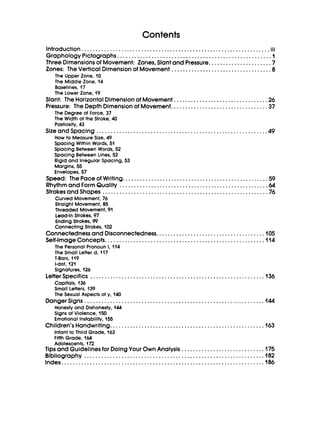
Introduction..................................................................III
GraphologyPictographs...................................................... I
ThreeDimensionsof Movement: Zones,Slantand Pressure...................... 7
Zones: The VerticalDimensionof Movement ................................... 8
The Upper Zone, 10
The Middle Zone, 14
Baselines, 17
The Lower Zone, 19
Slant: The HorizontalDimensionof Movement.. ........, ......................26
Pressure: The DepthDimensionof Movement.. ............................., ..37
The Degree of Force, 37
The Width of the Stroke, 40
Pastiosity,43
How to MeasureSize, 49
Spacing Within Words, 51
Spacing Between Words, 52
Spacing Between Lines, 52
Rigidand Irregular Spacing,53
Margins, 55
Envelopes,57
SizeandSpacing ........................................................., ..49
Speed: The Paceof Writing. ...................................., ..........., .59
Rhythmand FormQuality ................................................., ..64
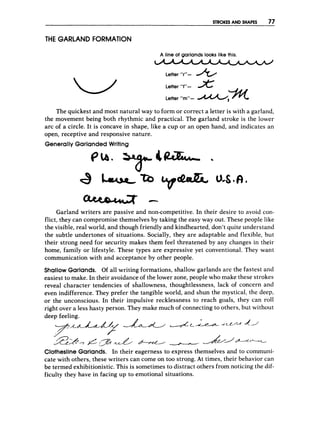
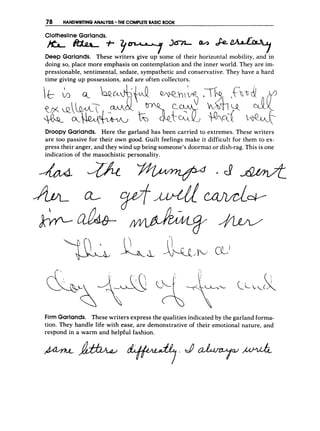
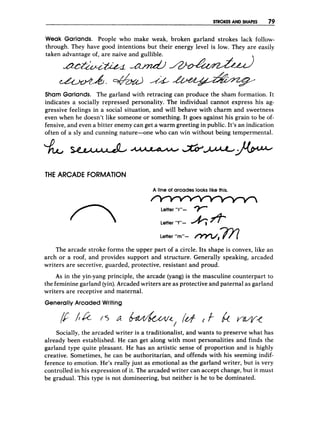
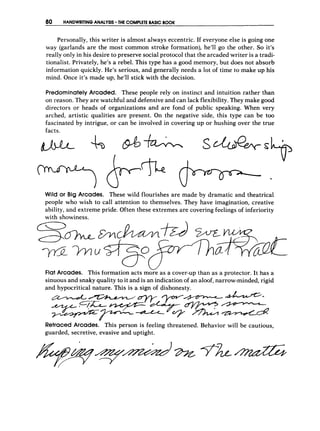
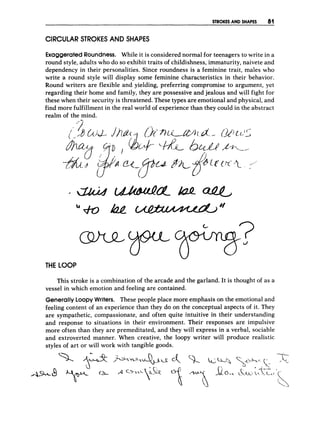
StrokesandShapes ..........................................................76
Curved Movement, 76
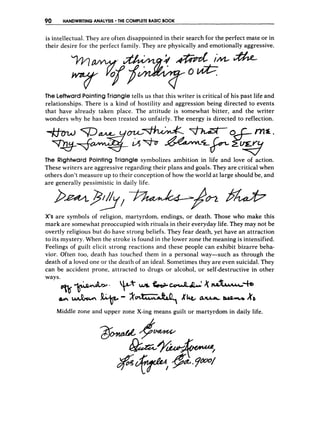
Straight Movement, 85
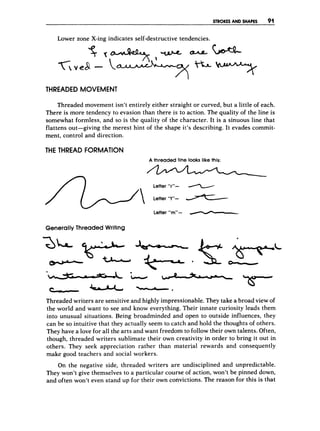
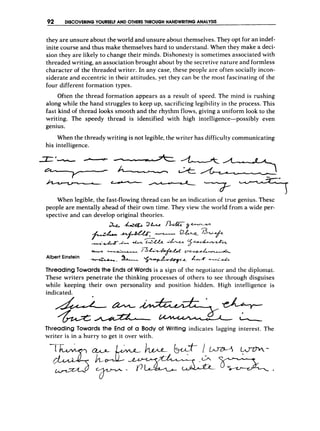
Threaded Movement, 91
lead-InStrokes, 97
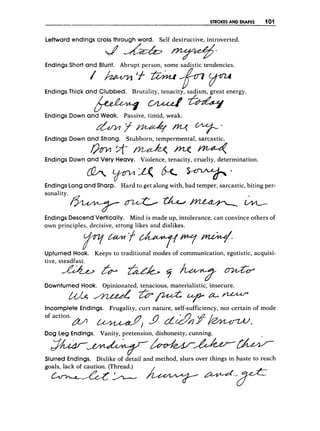
Ending Strokes, 99
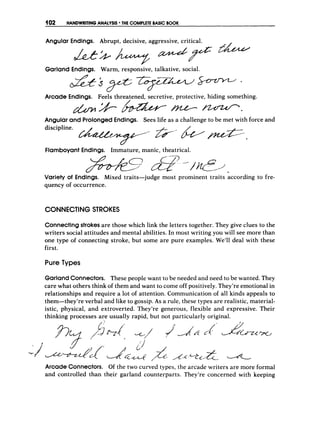
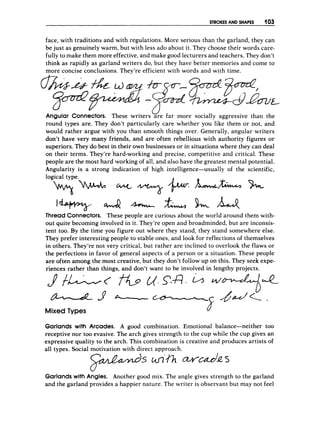
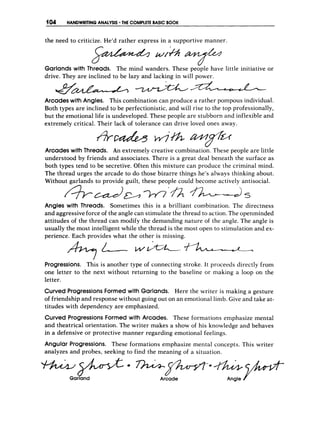
ConnectingStrokes, 102
Connectednessand Disconnectedness.........., ..........................,105
Self-ImageConcepts.......................................................,114
The Personal Pronoun I, 114
The Small Letter d, 117
T-Bars, 119
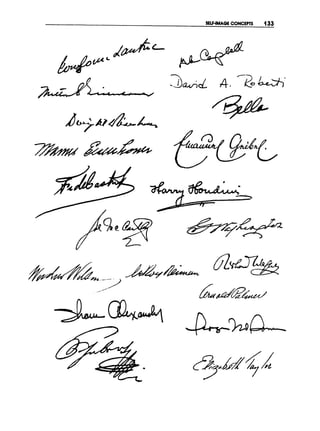
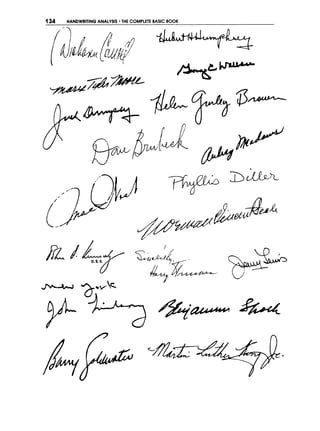
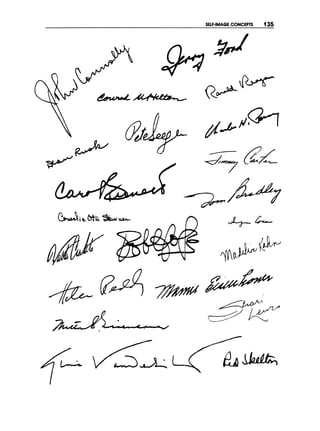
Signatures, 126
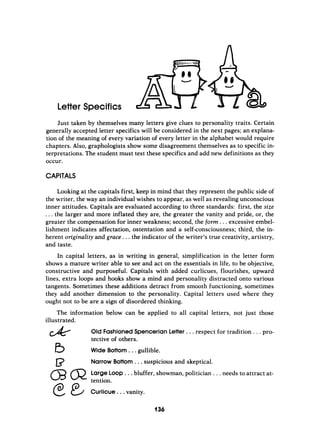
Capitals, 136
Small Letters, 139
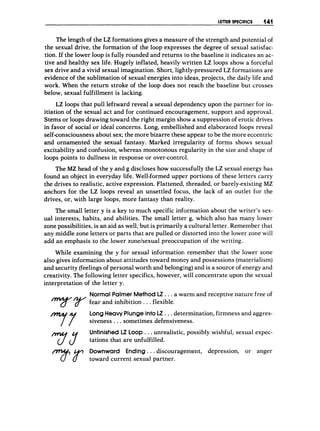
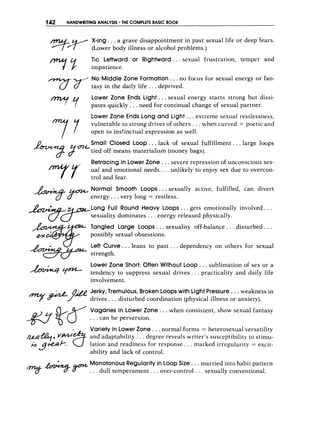
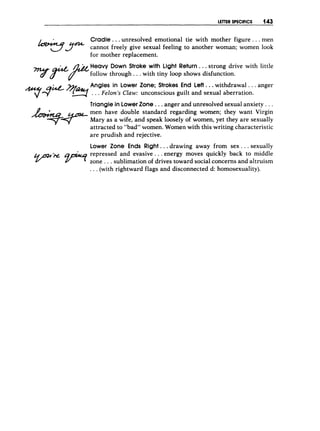
The Sexual Aspects of y, 140
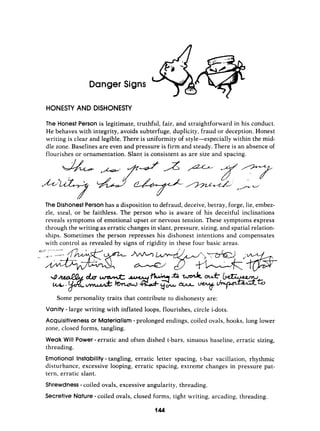
Honesty and Dishonesty, 144
Signs of Violence, 150
Emotional Instability,155
Infant to Third Grade, 163
Fifth Grade, 164
Adolescents, 172
I-dot,121
LetterSpecifics .............................................................I36
DangerSigns ...............................................................I 4 4
Children’sHandwriting......................................................I63
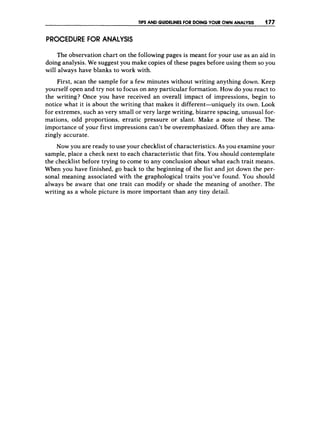
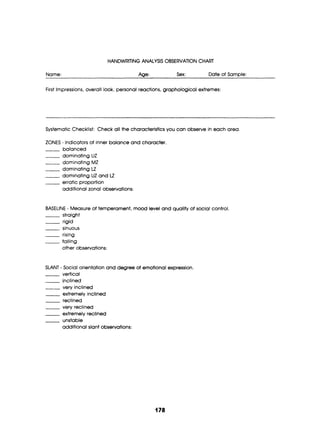
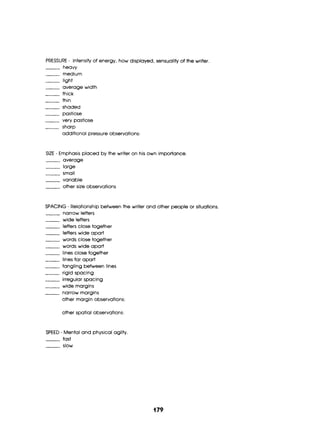
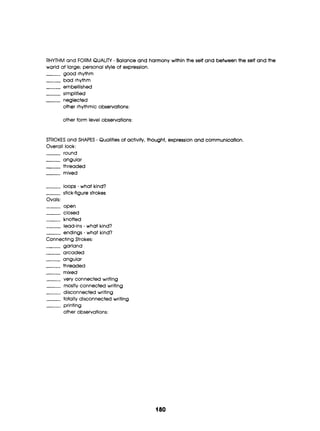
Tips andGuidelinesfor DoingYour OwnAnalysis , , ........................, , .I75
Bibliography ., , .........., .................................................I82
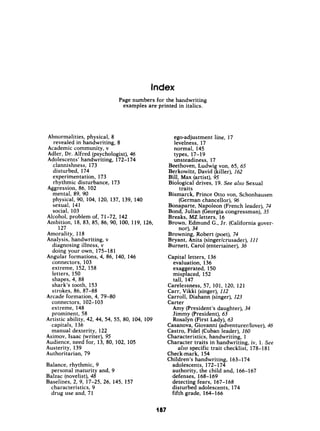
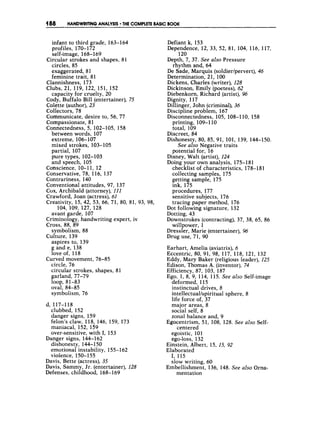
Index..., ...................................................................I86
YOUR OWN WRITING: A LAST NAIVE SAMPLE
Write a letter to yourself of at least two paragraphs. The verbal content of your
message is unimportant, so just relax and write in your usual style with no pre-
tenses. If you often print or have more than one style of writing, provide a sample of
these as well. Sign and date your sample. Remember, the more you write now, the
happier you’ll be later to have this last unbiased sample.
viii
1
2
12
4
5
This page intentionally left blank
Three Dimensionsof
Zones, Slant and
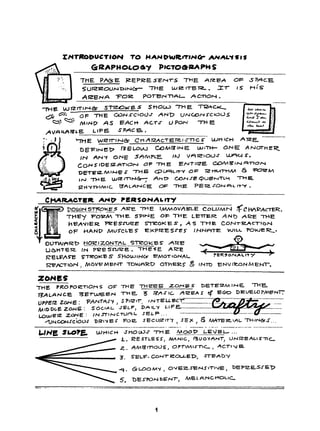
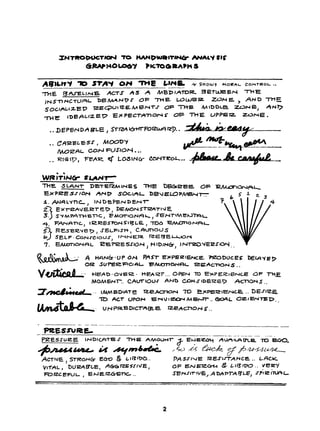
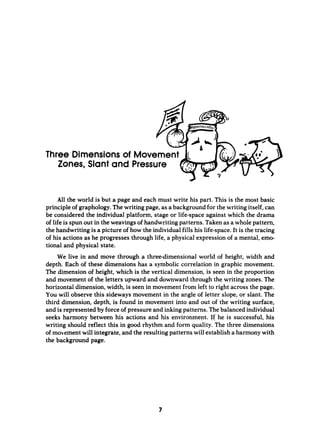
All the world is but a page and each must write his part. This is the most basic
principle of graphology.Thewriting page, as a background for the writing itself, can
be considered the individual platform, stage or life-spaceagainst which the drama
of life is spun out in the weavingso
fhandwriting patterns. Takenas a whole pattern,
the handwriting is a picture of how the individual fills his life-space.It is the tracing
of his actions as he progresses through life, a physical expression of a mental, emo-
tional and physical state.
We live in and move through a three-dimensional world of height, width and
depth. Each of these dimensions has a symbolic correlation in graphic movement.
The dimension of height, which is the vertical dimension, is seen in the proportion
and movement of the letters upward and downward through the writing zones. The
horizontal dimension,width, is seen in movement from left to right across the page.
You will observe this sideways movement in the angle of letter slope, or slant. The
third dimension, depth, is found in movement into and out of the writing surface,
and is represented by force of pressure and inkingpatterns. Thebalanced individual
seeks harmony between his actions and his environment. If he is successful, his
writing should reflect this in good rhythm and form quality. The three dimensions
of mokementwill integrate, and the resulting patterns will establish a harmony with
the background page.
7
Zones: The Vertical Dimen
THE THREE ZONES O
F HANDWRITING: UPPER, MIDDLE, AND LOWER
Zonal movement takes place in the vertical dimension o
f writing, the dimension
of the self, and thus is the sturdy column of character. Zonal movement supports all
of the horizontal and peripheral flourishes of personality like a backbone or a tree
trunk. The proportions of the three zones determine the balance between the three
major areas of ego development: the intellectual and spiritual sphere of the indi-
vidual, his everyday social self and his often unconscious instinctual drives. Zonal
symmetry in handwriting is a measure of the person’s inner equilibrium and
maturity. Symbolically the three zones can be interpreted in terms of time and
space, as divisions of the body and as levels of consciousness as first defined by
Sigmund Freud.
In the sequence of time, the upper zone represents the future, the middle zone
the present and the lower zone the past. A spatial analogy to this would be a tree,
with its branches and leaves reaching into the sky, the playground of the mind and
abstract thought, its trunk thrusting out of the baseline earth, the area closest to the
concerns of human endeavor, and the root system reaching unseen below repre-
senting energy in the area of instinctual drives. Good growth balance between
branches, trunk and roots promises that our tree/writer will withstand many a
storm.
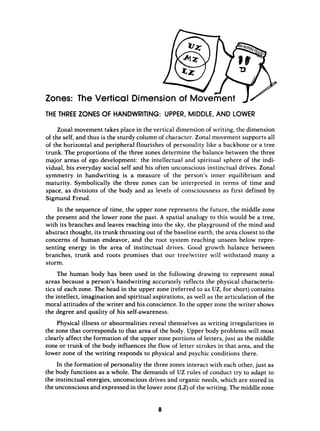
The human body has been used in the following drawing to represent zonal
areas because a person’s handwriting accurately reflects the physical characteris-
tics of each zone. The head in the upper zone (referred to as UZ, for short)contains
the intellect, imagination and spiritual aspirations, as well as the articulation of the
moral attitudes of the writer and his conscience. In the upper zone the writer shows
the degree and quality of his self-awareness.
Physical illness or abnormalities reveal themselves as writing irregularities in
the zone that corresponds to that area of the body. Upper body problems will most
clearly affect the formation of the upper zone portions of letters, just as the middle
zone or trunk of the body influences the flow of letter strokes in that area, and the
lower zone of the writing responds to physical and psychic conditions there.
In the formation o
f personality the three zones interact with each other, just as
the body functions as a whole. The demands of UZ rules’of conduct try to adapt to
the instinctual energies, unconscious drives and organic needs, which are stored in
the unconscious and expressed in the lower zone (LZ)of the writing. The middle zone
8
ZONES: THE VERTICAL DIMENSIONOF MOVEMENT 9
(MZ)of handwriting embodies the ego or self-conscious, social, goal-oriented part of
personality, which acts in the real world of facts, events, and other people.
Along the baseline, or morals line, of the writing can be traced the success of the
balancing act between the zones. The ego is obliged to effect a smooth compromise
that will satisfy both intellectual and moral considerations, as well as allow fair ex-
pression to the innate physical energies and drives welling up from the unconscious.
The characteristics of the baseline indicate the degree of success the ego is having in
managing these often conflicting forces in such a way as to accomplish the ego’s
own social and practical goals. Thus we see that handwriting, which is the mirror of
the total person, cannot have one “good” zone or one “bad” zone. Here rhythmic
balance is all-important for personal maturity.
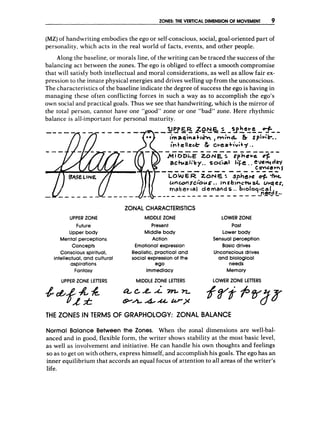
----
UPPER &QEGj -sp+e_ ,em
-
imaqinxh& ,mkct & s p i ~ k .
;vrtte& Er cket+iv;+y..
UPPER Z
O
N
E
Future
Upper body
Mental perceptions
Concepts
Conscious spiritual,
intellectual, and cultural
aspirations
Fantasy
ZONAL CHARACTERISTICS
MIDDLEZ
O
N
E
Present
Middle body
Action
Emotional expression
Realistic,practical and
social expression of the
ego
Immediacy
L
O
W
E
R Z
O
N
E
Past
Lower body
Sensual perception
Basic drives
Unconsciousdrives
and biological
needs
Memory
UPPER Z
O
N
E LETTERS MIDDLEZ
O
N
E LETTERS L
O
W
E
R Z
O
N
E LETTERS
THE ZONES IN T
E
R
M
S OF GRAPHOLOGY: ZONAL BALANCE
Normal Balance Between the Zones. When the zonal dimensions are well-bal-
anced and in good, flexible form, the writer shows stability at the most basic level,
as well as involvement and initiative. He can handle his own thoughts and feelings
so as to get on with others, express himself, and accomplish his goals. The egohas an
inner equilibrium that accords an equal focus of attention to all areas of the writer’s
life.
10 HANDWRITINGANALYSIS THE COMPLETEBASIC BOOK
- -4hq[Lzy
9&-& 4
t
.
- :&*- [
'
[
A
d
74. >
+
J
2
& -
-
t
'
T
;
.
3
.
dC T V L S A G 2
+4/2A+'~ C t C4k-L A
A C d 2 ? t p - yl7
n-tcc/t *J /cM,cG, ;
&
A C & h d s
*
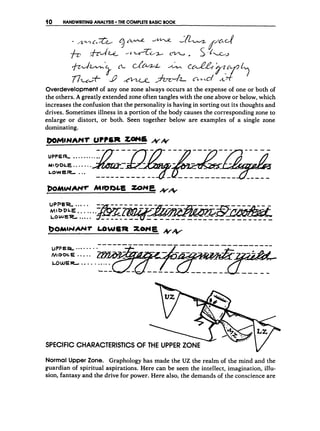
Overdevelopment of any one zone always occurs at the expense of one or both of
the others. A greatly extended zone often tangles with the one above or below, which
increases the confusion that the personality is having in sorting out its thoughts and
drives. Sometimes illness in a portion of the body causes the corresponding zone to
enlarge or distort, or both. Seen together below are examples of a single zone
dominating.
SPECIFIC CHARACTERISTlC
S O
F
Normal Upper Zone. Graphology has made the U2 the realm of the mind and the
guardian of spiritual aspirations. Here can be seen the intellect, imagination, illu-
sion, fantasy and the drive for power. Here also, the demands of the conscienceare
ZONES THE VERTICAL DIMENSIONOF MOVEMENT 11
formed, as well as an individual’s idea of himself. Well-proportioned loops and
stems with sensibly placed i-dots and t-bars reveal mental capability and alertness,
If the UpperZone is Overly Extendedat the expenseof the MZ and the LZ,the writer
will be a person of intelligenceand ambition whose emotional developmenthas not
matured enough to carry out his plans with much success. Great UZ height reveals
the idealist and dreamer with a wealth of theories that he cannot seem to carry
through in practical experience.The tall UZ is quite literally too far away-too “far
out”-to reach daily life in the MZ.
Yet a step farther from reality is the extremely tall, distorted, cracked or
embellished UZ, which shows totally undirected mental activity, a retreat into fan-
tasy that can be serious enough to indicate mentaJ illness.
The dominant UZ also indicates the presence of a demandingconscience,one in-
corporating the uncomprising ideas of right and wrong learned as a child, which in-
hibits and depresses both the daily life and the instincts. Such a person is critical of
himself and others, finds little joy in life, and under pressure flees to dreams.
When the Upper Zone is Very Small in relation to the MZ and LZ, the writer is one
who lacks creativity and imagination; he has little capacity for and takes small
pleasure in intellectual matters. His importance is placed instead upon practical
considerations. In a good script he is self-reliant,,realistic and sociable; with poor
12 HANDWRITING ANALYSIS THE COMPLETE BASICB
O
O
K
form level, the absence of the monitoring function of the U2 conscience leads to
greed, materialism and sensuality.
Since the UZ is the origin o
f conceptual self-orientation and much of a person’s
self-awareness, when this zone is stunted, the writer is likely to lack understanding
of his goals, his self-image or the impression he wishes to make.
*
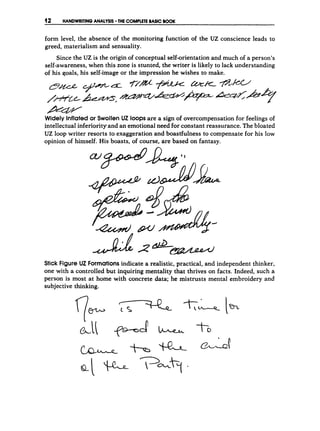
Widely Inflated or Swollen U2 loops are a sign o
f overcompensation for feelings of
intellectual inferiorityand an emotional need for constant reassurance. The bloated
UZ loop writer resorts to exaggeration and boastfulness to compensate for his low
opinion of himself. His boasts, of course, are based on fantasy.
Stick Figure UZ Formations indicate a realistic, practical, and independent thinker,
one with a controlled but inquiring mentality that thrives on facts. Indeed, such a
person is most at home with concrete data; he mistrusts mental embroidery and
subjective thinking.
ZONES THE VERTICAL DIMENSIONOF MOVEMENT 13
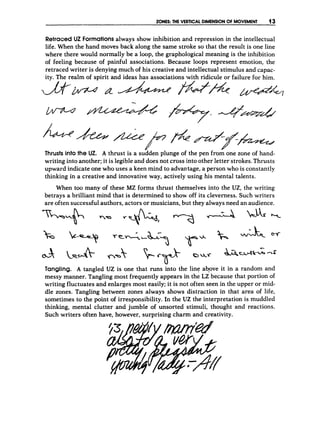
Retraced U2 Formations always show inhibition and repression in the intellectual
life. When the hand moves back along the same stroke so that the result is one line
where there would normally be a loop, the graphological meaning is the inhibition
of feeling because of painful associations. Because loops represent emotion, the
retraced writer is denying much of his creative and intellectual stimulus and capac-
ity. The realm of spirit and ideas has associations with ridicule or failure for him.
Thrusts into the UZ. A thrust is a sudden plunge of the pen from one zone of hand-
writing into another; it is legible and does not cross into other letter strokes.Thrusts
upward indicate one who uses a keen mind to advantage, a person who is constantly
thinking in a creative and innovative way, actively using his mental talents.
When too many of these MZ forms thrust themselves into the UZ, the writing
betrays a brilliant mind that is determined to show off its cleverness. Such writers
are often successful authors, actors or musicians, brit they always need an audience.
Tangling. A tangled UZ is one that runs into the line abqve it in a random and
messy manner. Tangling most frequently appears in the LZ because that portion of
writing fluctuates and enlarges most easily; it is noltoften seen in the upper or mid-
dle zones. Tangling between zones always shows distraction in that area of life,
sometimes to the point of irresponsibility. In the IJZ the interpretation is muddled
thinking, mental clutter and jumble of unsorted stimuli, thought and reactions.
Such writers often have, however, surprising charm and creativity.
(I4 HANDWRITINGANALYSIS THE COMPLETE BASIC BOOK
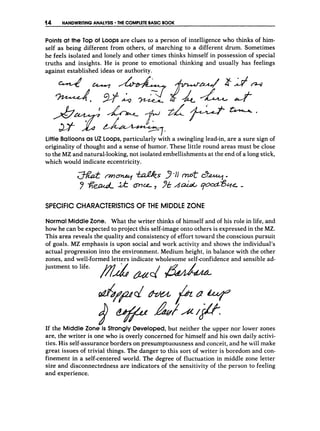
Points at the Top of LOOPS are clues to a person of intelligence who thinks of him-
self as being different from others, of marching to a different drum. Sometimes
he feels isolated and lonely and other times thinks himself in possession of special
truths and insights. He is prone to emotional thinking and usually has feelings
against established ideas or authority.
Little Balloons as UZ LOOPS, particularly with a swingling lead-in, are a sure sign of
originality of thought and a sense of humor. These little round areas must be close
to the MZand natural-looking, not isolated embellishments at the end of a long stick,
which would indicate eccentricity.
SPECIFIC CHARACTERISTICS OF THE MIDDLE ZONE
Normal MiddleZone. What the writer thinks of himself and of his role in life, and
how he can be expected to project this self-image onto others is expressed in the MZ.
This area reveals the quality and consistency of effort toward the conscious pursuit
of goals. MZ emphasis is upon social and work activity and shows the individual's
actual progression into the environment. Medium height, in balance with the other
zones, and well-formed letters indicate wholesome selfconfidence and sensible ad-
fld &d &
justment to life.
If the Middle Zone is Strongly Developed, but neither the upper nor lower zones
are, the writer is one who is overly concerned for himself and his own daily activi-
ties. His self-assuranceborders on presumptuousness and conceit, and he will make
great issues of trivial things. The danger to this sort of writer is boredom and con-
finement in a self-centered world. The degree of fluctuation in middle zone letter
size and disconnectedness are indicators of the sensitivity of the person to feeling
and experience.
ZONES: THE VERTICAL DIMENSION OF MOVEMENT 45
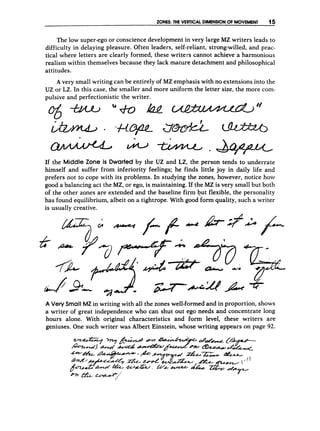
The low super-ego or conscience development in very large MZ writers leads to
difficulty in delaying pleasure. Often leaders, self-reliant, strong-willed, and prac-
tical where letters are clearly formed, these writers cannot achieve a harmonious
realism within themselves because they lack mature detachment and philosophical
attitudes.
A very small writing can be entirely of MZ emphasis with no extensions into the
UZ or LZ.In this case, the smaller and more uniform the letter size, the more com-
pulsive and perfectionistic the writer.
If the Middle Zone is Dwarfed by the UZ and LZ, the person tends to underrate
himself and suffer from inferiority feelings; he finds little joy in daily life and
prefers not to cope with its problems. In studying the zones, however, notice how
good a balancing act the MZ, or ego, is maintaining. If the MZ is very small but both
of the other zones are extended and the baseline firin but flexible, the personality
has found equilibrium, albeit on a tightrope. With good form quality, such a writer
is usually creative.
A Very Small M
Z in writing with all the zones well-formed and in proportion, shows
a writer of great independence who can shut out ego needs and concentrate long
hours alone. With original characteristics and form level, these writers are
geniuses. One such writer was Albert Einstein, whose writing appears on page 92.
16 HANDWRITINGANALYSIS THE COMPLETEBASIC BOOK
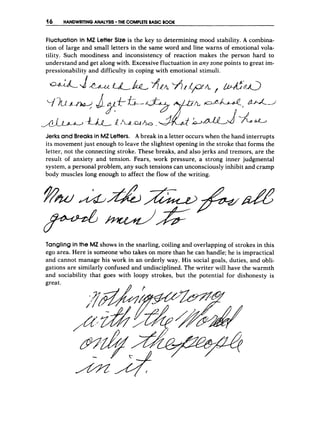
Fluctuation in MZ Letter Size is the key to determining mood stability. A combina-
tion of large and small letters in the same word and line warns of emotional vola-
tility. Such moodiness and inconsistency of reaction makes the person hard to
understand and get along with. Excessive fluctuation in any zone points to great im-
pressionability and difficulty in coping with emotional stimuli.
Jerksand Breaksin MZ Letters. A break in a letter occurs when the hand interrupts
its movement just enough to leave the slightest opening in the stroke that forms the
letter, not the connecting stroke. These breaks, and also jerks and tremors, are the
result of anxiety and tension. Fears, work pressure, a strong inner judgmental
system, a personal problem, any such tensions can unconsciously inhibit and cramp
body muscles long enough to affect the flow of the writing.
Tangling in the MZ shows in the snarling, coiling and overlapping of strokes in this
ego area. Here is someone who takes on more than he can handle; he is impractical
and cannot manage his work in an orderly way. His social goals, duties, and obli-
gations are similarly confused and undisciplined. The writer will have the warmth
and sociability that goes with loopy strokes, but the potential for dishonesty is
great.
ZONES THE VERTICAL DIMENSIONOF MOVEMENT 17
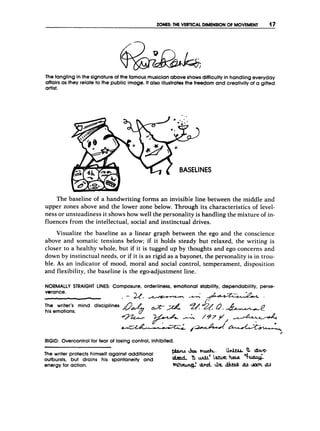
The tangling inthe signatureof the famous musicianaboveshows difficulty in handlingeveryday
affairs as they relateto the public image. It also illustratesthe freedom and creativityof a gifted
artist.
The baseline of a handwriting forms an invisible line between the middle and
upper zones above and the lower zone below. Through its characteristics of level-
ness or unsteadiness it shows how well the personality is handling the mixture of in-
fluences from the intellectual, social and instinctual drives.
Visualize the baseline as a linear graph between the ego and the conscience
above and somatic tensions below; if it holds stea,dy but relaxed, the writing is
closer to a healthy whole, but if it is tugged up by thoughts and ego concerns and
down by instinctual needs, or if it is as rigid as a bayonet, the personality is in trou-
ble. As an indicator of mood, moral and social control, temperament, disposition
and flexibility, the baseline is the ego-adjustment line.
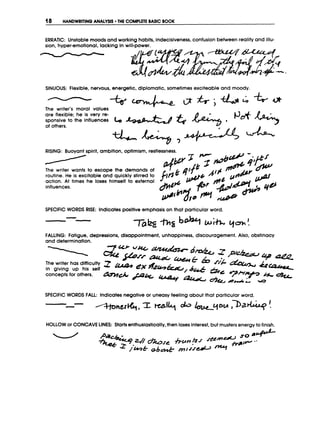
NORMALLY STRAIGHT LINES: Composure, orderliness, emotional stability, dependability, perse-
verance.
-mind disciplines &
d
' c;t-A
his emotions.
A , - 2. -
*
&(3, L p
-
-
A
/
-
-
-
+
-
-
%
RIGID: Overcontrol for fear of losing control, inhibited.
. p t l W d m h r r J I . UmLeaa.8.-
IdAzlfL 9 UXLL' lonuehepe L)n+
The writer protects himself against additional
outbursts, but drains his spontaneity and
energy for action. ltlmhm$ umi dk it)tvce N
u
n(LLb
18 HANDWRITING ANALYSIS THECOMPLETE
BASIC BOOK
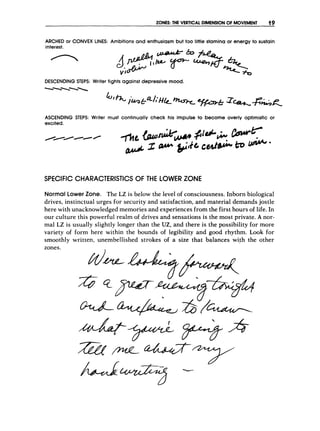
ERRATIC: Unstablemoodsand working habits, indecisiveness, confusion between realityand iilu-
sion, hyper-emotlonal,lacklng Inwill-power.
r
-.
SINUOUS: Flexible, nervous,energetic,diplomatic, sometimes exciteable and moody.
a
The writer’s moral values
are flexible; he is very re-
sponsive to the influences
of others.
RISING: Buoyant spirit, ambition, optimism, restlessness.
The writer wants to escape the demands of
routine. He is excitable and quickly stlrred to
action. At times he loses himself to external
influences.
SPECIFIC W
O
R
D
S RISE: Indicatespositive emphasis on that particular word.
b% w i h yah!
-
T a b
- -
FALLING: Fatigue, depressions, disappointment, unhappiness, discouragement.Also, obstinacy
and determination.
SPECIFIC W
O
R
D
S FALL: Indicates negativeor uneasy feeling about that particular word.
- -
-
HOLLOWor CONCAVELINES: Startsenthusiastically,then losesinterest, butmustersenergy tofinish.
ZONES: THE VERTICAL DIMENSION O
F MOVEMENT 19
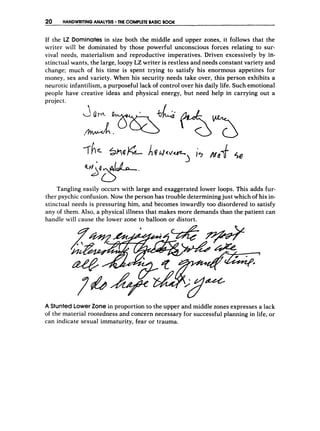
ARCHED or CONVEX LINES: Ambitions and enthusiasm but too little stamina or energy to sustain
interest.
V‘
DESCENDINGSTEPS: Writer fights against depressive mood.
-
-

-

ASCENDING STEPS: Writer must continually check his impulse to become overly optimistic or
excited.
SPECIFIC CHARACTERISTICS OF THE LOWER ZONE
Normal Lower Zone. The LZ is below the level of consciousness. Inborn biological
drives, instinctual urges for security and satisfaction, and material demands jostle
here with unacknowledged memories and experiences from the first hours of life. In
our culture this powerful realm of drives and sensations is the most private. A nor-
mal LZ is usually slightly longer than the UZ,and there is the possibility for more
variety of form here within the bounds of legibility and good rhythm. Look for
smoothly written, unembellished strokes of a size that balances with the other
zones.
20 HANDWRITING ANALYSIS THE COMPLETEBASIC 5OOK *
If the LZ Dominates in size both the middle and upper zones, it follows that the
writer will be dominated by those powerful unconscious forces relating to sur-
vival needs, materialism and reproductive imperatives. Driven excessively by in-
stinctual wants, the large, loopy LZ writer is restless and needs constant variety and
change; much of his time is spent trying to satisfy his enormous appetites for
money, sex and variety. When his security needs take over, this person exhibits a
neurotic infantilism, a purposeful lack of control over his daily life. Such emotional
people have creative ideas and physical energy, but need help in carrying out a
project.
f
J
Tangling easily occurs with large and exaggerated lower loops. This adds fur-
ther psychic confusion. Now the person has trouble determiningjust which of his in-
stinctual needs is pressuring him, and becomes inwardly too disordered to satisfy
any of them. Also, a physical illness that makes more demands than the patient can
handle will cause the lower zone to balloon or distort.
A Stunted Lower Zone in proportion to the upper and middle zones expresses a lack
of the material rootedness and concern necessary for successful planning in life, or
can indicate sexual immaturity, fear or trauma.
ZONES THE VERTICAL DIMENSIONO
F MOVEMENT 21
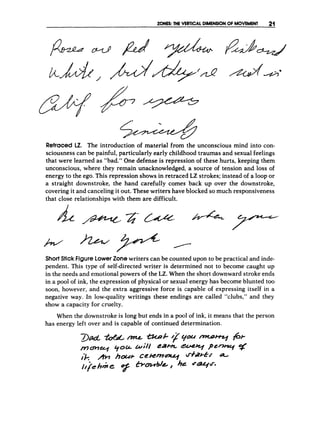
Retraced LZ. The introduction of material from the unconscious mind into con-
sciousness can be painful,particularly early childhlood traumas and sexual feelings
that were learned as "bad." One defense is repression of these hurts, keeping them
unconscious, where they remain unacknowledged, a source of tension and loss of
energy to the ego. This repression shows in retraceld LZ strokes; instead of a loop or
a straight downstroke, the hand carefully comes back up over the downstroke,
covering it and canceling it out. These writers have blocked somuch responsiveness
that close relationships with them are difficult.
w h c " y /-
ShortStick FigureLowerZone writers can be counted upon to be practical and inde-
pendent. This type of self-directed writer is determined not to become caught up
in the needs and emotional powers of the LZ. When the short downward stroke ends
in a pool of ink, the expression of physical or sexuatlenergy has become blunted too
soon, however, and the extra aggressive force is capable of expressing itself in a
negative way. In low-quality writings these endings are called "clubs," and they
show a capacity for cruelty.
When the downstroke is long but ends in a pool of ink, it means that the person
has energy left over and is capable of continued determination.
22 HANDWRITINGANALYSIS THE COMPLETEBASIC BOOK
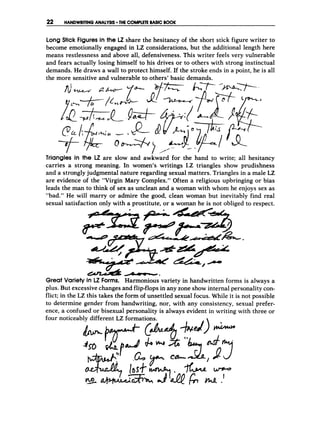
Long Stick Figures in the U share the hesitancy of the short stick figure writer to
become emotionally engaged in LZ considerations, but the additional length here
means restlessness and above all, defensiveness.This writer feels very vulnerable
and fears actually losing himself to his drives or to others with strong instinctual
demands. He draws a wall to protect himself. If the stroke ends in a point, he is all
the more sensitive and vulnerable to others’ basic demands.
Triangles in the E are slow and awkward for the hand to write; all hesitancy
carries a strong meaning. In women’s writings 1.Z triangles show prudishness
and a strongly judgmental nature regarding sexual matters. Triangles in a male LZ
are evidence of the “Virgin Mary Complex.’’Often a religious upbringing or bias
leads the man to think of sex as unclean and a woman with whom he enjoys sex as
“bad.” He will marry or admire the good, clean woman but inevitably find real
sexual satisfaction only with a prostitute, or a woman he is not obliged to respect.
d
-
.
Great Variety in LZ Forms. Harmonious variety in handwritten forms is always a
plus. But excessivechanges and flip-flopsin any zone show internal personality con-
flict; in the LZ this takes the form of unsettled sexual focus. While it is not possible
to determine gender from handwriting, nor, with any consistency, sexual prefer-
ence, a confused or bisexual personality is always evident in writing with three or
four noticeably different LZ formations.
-
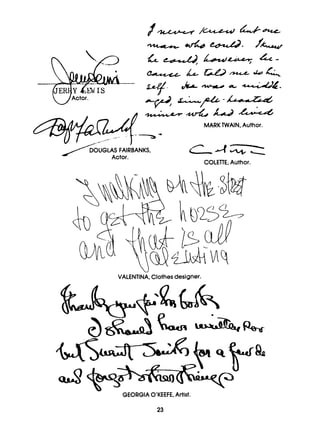
GEORGIA O’KEEFE,Artist.
23
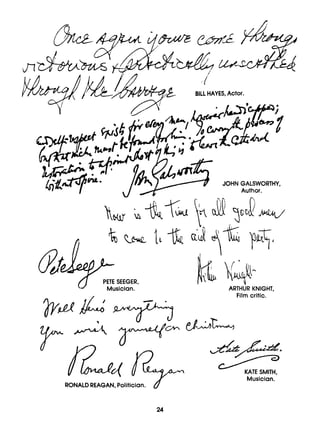
JOHN GALSWORTHY,
Author.
ARTHUR KNIGHT,
Film critic.
Musician.
24
RED SKELTON
Cornedian.
H
E
D
Y LAMARR,Actress.
c
A -
German general.
TED KENNEDY,Politician.
Y
H
E
N
R
YTHOREAU,Author.
25
Slant: The Horizontal Dimension of Movement
Whenever you write, you are expressing your present situation, so that all
writing is an instantaneous graph of that exact moment. But writing is also a se-
quential movement that takes place through time. The beginning of a message is
older than its end. The beginning of a line at the left of a page is older than the end of
that same line at the right. As you move away from the left side of the page, you are
beginning. You are moving away from your past. As you progress to the right, you
are moving toward your goal, completion.
The left of the page, left of a word, the beginning stroke-these are all place-
ments in the past. Alternately, the right of the page, the right of a word and the
ending strokes are all directions to the future. It can be seen that this leftlright
movement through time takes place along the baseline in the horizontal dimension.
Since the baseline has already been identified in meaning with the surface of the
earth, action along it implies contact with environment. Horizontal movement is a
measure of external orientation and social development. Here you can observe the
manner in which the writer faces life situations, his abilities to communicate and ex-
press himself emotionally, his choices of behavior and his objectives. Along this hor-
izontal plane, all of these aspects of personality are clearly revealed.
The angle of slant observed in a writing will tell you more about the nature of
the writer’s personality than any other consideration of horizontal movement. It is
extremely important to recognize the differences between what an appraisal of
zones tells you about the writer’s inner character, and what slant tells you about his
outer personality.
ZONES AND THE VERTICAL DIMENSION SLANT AND THE HORIZONTAL DIMENSION
Character
Self
Perception
Internal
Containment
Perception
Analysis
Thought
Individual
PersonaIity
Others
Emotion
External
Dispersement
Reaction
Relationship
Communication
Social
26
SLANT:
THEHORIZONTAL
DIMENSIONOFMOVEMENT 27
HOW T
O MEASURE SLANT
The slant of a writing refers to the direction of letter slope and is determined by
the angle formed between the downstroke and the baseline.
Measure upper and middle zone letters to determine slant. Whenever possible,
use stick figures, as they are less confusing than loops. With loopy writing, take an
average of the loop by measuring from the apex at the highest point of the letter to
where the lines cross near the baseline. Downstrokes will give you a more accurate
measurement than upstrokes.
1.
2
.
I
S.
Baseline Baseline
Place the slant graph over or near the writing sample you wish to measure.
Locate the angle of slant that most closely approximates that of the sample. Remem-
ber to keep the baseline of the graph parallel to and on top of the baseline of the sam-
ple. The point of the arrow should be on the baseline at the base of the letter you
wish to measure. Measure several upper and middle zone letters, note the corres-
ponding numbers, and then check your measurement on the expanded graph.
28 HANDWRITING ANALYSIS.THECOMPLETE
BASIC BOOK
EXPANDEDGRAPH
A variation between two positions on the slant chart is considered a normal
degree of fluctuation. With a variation of niore than two positions, the slant is con-
sidered unstable. The more extreme the degree of variation, the more unstable is the
emotional and social expression of the writer.
When the slant never varies at all, it can be determined that there is some emo-
tional rigidity being expressed by the writer.
mine slant with just your eye.
After some practice measuring slant with the graph, you will be able to deter-
SOME KEY WORDS ASSOCIATED WITH VARIOUS SLANTS
RECLINED
past
influence of mother
fear
deflance
introverslon
lack of involvement
repression
self-absorption
caution
VERTICAL
present
independence
inner strength
self-reliance
self-control
judgment
suppression
Independence
action
INCLINED
future
goals of father
courage
compliance
extroversion
compassion
expression
drawn to others
reaction
*Observe that the vertical slant has many traits in common with zones and the ver-
tical dimension in general.
SPECIFIC CHARACTERISTICS O
F SLANT
2. Vertical. This type has a head-over-heart emotional attitude. He is open to the
experience of the moment, but his responses are cautious and considered. Here
emotional expression is under control. The manner is undemonstrative, indepen-
dent, detached and even indifferent. Once emotional control is lost it is quickly
regained, hence this type functions well in emergencies and makes a good leader or
contented loner. The person is self-interested and asks, “What can the situation do
s
u
r
a THE HOR~XONTAL
DIME” OFMOVEMENT 29
for me?”In arguing a point, this writer will make an appeal tojudgment rather than
to emotion. Often he has a great deal of personal magnetism arid a dry wit that is
quite attractive.
2. Inclined. This slant is considered the “normal” one. The writer is normally sen-
sitive and emotionallyhealthy, but modest with responses. Judgment and logicrule,
yet more sympathy and compassion are expressed here than in the vertical slant.
The range of expression is seldom overdemonstrative.
3. Very Inclined. These people cry and laugh readily, give vent to their feelings,
are future-and goal-orientedand have an ardent, affectionate, amiable and sensitive
emotional nature. They express their emotional self impulsively. Feelings will influ-
ence decisions, and they are quick to react with elation or discouragement, They
identifywith their surroundings and with another person’spoint o
fview and will re-
spond with compassion.
30 HANDWRITING ANALYSIS THE COMPLETE BASIC BOOK
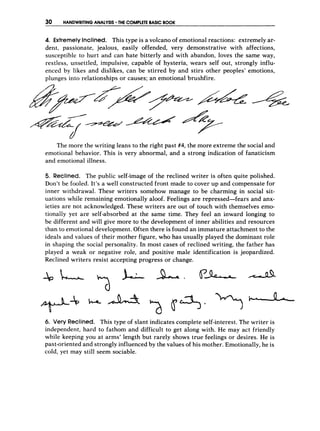
4. Extremely Inclined. This type is a volcano of emotional reactions: extremely ar-
dent, passionate, jealous, easily offended, very demonstrative with affections,
susceptible to hurt arid can hate bitterly and with abandon, loves the same way,
restless, unsettled, impulsive, capable of hysteria, wears self out, strongly influ-
enced by likes and dislikes, can be stirred by and stirs other peoples' emotions,
plunges into relationships or causes: an emotional brushfire.
The more the writing leans to the right past #4, the more extreme the social and
emotional behavior. This is very abnormal, and a strong indication of fanaticism
and emotional illness.
5, Reclined. The public self-image of the reclined writer is often quite polished.
Don't be fooled. It's a well constructed front made to cover up and compensate for
inner withdrawal. These writers somehow manage to be charming in social sit-
uations while remaining emotionally aloof. Feelings are repressed-fears and anx-
ieties are not acknowledged. These writers are out of touch with themselves emo-
tionally yet are self-absorbed at the same time. They feel an inward longing to
be different and will give more to the development of inner abilities and resources
than to emotional development. Often there is found an immature attachment to the
ideals and values of their mother figure, who has usually played the dominant role
in shaping the social personality. In most cases of reclined writing, the father has
played a weak or negative role, and positive male identification is jeopardized.
Reclined writers resist accepting progress or change.
6. Very Reclined. This type of slant indicates complete self-interest.The writer is
independent, hard to fathom and difficult to get along with. He may act friendly
while keeping you at arms' length but rarely shows true feelings or desires. He is
past-oriented and strongly influenced by the values of his mother. Emotionally,he is
cold, yet may still seem sociable.
SLANT: THE HORIZONTALDIMENSION OF MOVEMENT 31
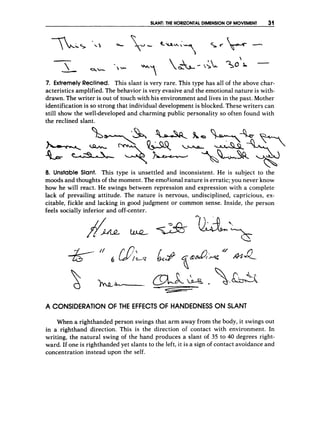
7. Extremely Reclined. This slant is very rare. This type has all of the above char-
acteristics amplified. The behavior is very evasive and the emotional nature is with-
drawn. The writer is out of touch with his environment and lives in the past. Mother
identification is so strong that individual development is blocked. These writers can
still show the well-developed and charming public personality so often found with
the reclined slant.
8. Unstable Slant. This type is unsettled and inconsistent. He is subject to the
moods and thoughts of the moment. The emotional nature is erratic; you never know
how he will react. He swings between repression and expression with a complete
lack of prevailing attitude. The nature is nervous, undisciplined, capricious, ex-
citable, fickle and lacking in good judgment or common sense. Inside, the person
feels socially inferior and off-center.
6
A CONSIDERATION O
F THE EFFECTS OF HANDEDNESSON SLANT
When a righthanded person swings that arm away from the body, it swings out
in a righthand direction. This is the direction of contact with environment. In
writing, the natural swing of the hand produces a slant of 35 to 40 degrees right-
ward. If one is righthanded yet slants to the left, it is a sign of contact avoidance and
concentration instead upon the self.
32 HANDWRITINGANALYSIS THE COMPLETEBASIC 600%
But what about lefthanders? Research has shown that they have an impulse to
swing the left arm away from the body in a leftward direction. The most natural
writing for a lefthander would be from right to left with reversed letter formations
and a leftward slope of 35 to 40 degrees. In order to conform to the writing style of
the western world, he must continually fight the impulse to go to the left, and must
come up with a more natural way of producing a rightward slant and direction.
Sope lefthanded writings reveal the frustration of their counter-movements while
others do not. Why is this so?
Physically, the angle of slant comes about as a result of body positioning. The
pen to the fingers and hand, the hand to the writing surface, the angle of that surface
to the writers body-all are important factors. But body position is only the means
of achieving the slant on life which has been dictated by the emotions.
It is possible for a lefthander to achieve a fluid, rightward motion by adjusting
his body and the paper, so there is very little evidence to support the popular notion
that lefthanders will always slant to the left. In fact, there is only a small percentage
of difference between the number of lefthanders who do so and the number of right-
handers. This is not to deny that handedness plays a role in the social development
of an individual. There is evidence that it does. Yet in the final analysis, we must
assume that when a writer is allowed to adjust his body position to the pen and
writing surface, he will, regardless of handedness, produce the slant that correctly
describes his ability to express himself socially.
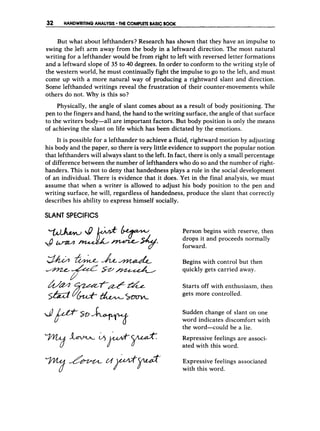
SLANT SPECIFICS
Person begins with reserve, then
drops it and proceeds normally
forward.
Begins with control but then
quickly gets carried away.
Starts off with enthusiasm, then
gets more controlled.
Sudden change of slant on one
word indicates discomfort with
the word-could be a lie.
Repressive feelings are associ-
ated with this word.
Expressive feelings associated
with this word.
SLANT THE HORIZONTAL DIMENSION OF MOVEMENT 33
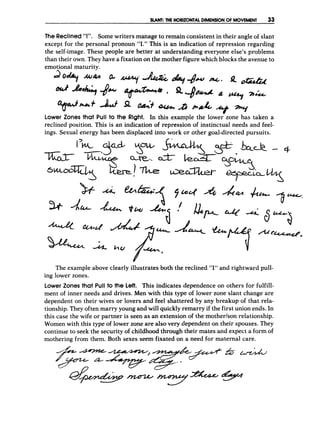
The Reclined“I”. Somewriters manage to remain consistent in their angle of slant
except for the personal pronoun “I.” This is an indication of repression regarding
the self-image. These people are better at understanding everyone else’s problems
than their own. They have a fixation on the mother figure which blocks the avenue to
emotional maturity.
Lower Zones that Pull to the Right. In this example the lower-zone has taken a
reclined position. This is an indication of repression of instinctual needs and feel-
ings. Sexual energy has been displaced into work or other goal-directed pursuits.
U
The example above clearly illustrates both the reclined “I”and rightward pull-
ing lower zones.
Lower Zones that Pull to the L
e
f
t
. This indicates dependence on others for fulfill-
ment of inner needs and drives. Men with this type of lower zone slant change are
dependent on their wives or lovers and feel shattered by any breakup of that rela-
tionship. They often marry young and will quickly remarry if the first union ends. In
this case the wife or partner is seen as an extension of the motherlson relationship.
Women with this type of lower zone are also very dependent on their spouses. They
continue to seek the security of childhood through their mates and expect a form of
mothering from them. Both sexes seem fixated on a need for maternal care.
i
34
L
expressingdifferent
moods.
O
R
A
L R
O
B
E
R
T
S
,
Religious leader.
d
J
4 @ L h
K H
’ a.
JOHNLENNON,Musician,
.  one o
f the Beatles.
35
H
E
N
R
Y WADSWORTH LONGFELLOW,Writer.
LADY BIRDJOHNSON,
Wife of President
LyndonJohnson.
U
&
CAROL B
U
R
N
E
T
T
,
Entertainer.
36
Pressure: The Depth Dimension of Movement
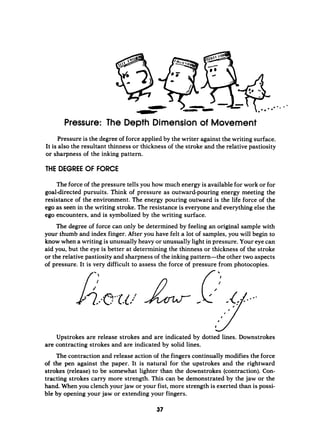
Pressure is the degreeof force applied by the writer against the writing surface.
It is also the resultant thinness or thickness of the stroke and the relative pastiosity
or sharpness of the inking pattern.
THE DEGREE OF FORCE
Theforce of the pressure tells you how much energy is available for work or for
goal-directed pursuits. Think of pressure as outward-pouring energy meeting the
resistance of the environment. The energy pouring outward is the life force of the
ego as seen in the writing stroke. The resistance is everyone and everything else the
ego encounters, and is symbolized by the writing surface.
The degree of force can only be determined by feeling an original sample with
your thumb and index finger. After you have felt a lot of samples, you will begin to
know when a writing is unusually heavy or unusually light in pressure. Your eye can
aid you, but the eye is better at determining the thinness or thickness of the stroke
or the relative pastiosity and sharpness of the inking pattern-the other two aspects
of pressure. It is very difficult to assess the force of pressure from photocopies.
Upstrokes are release strokes and are indicated by dotted lines. Downstrokes
are contracting strokes and are indicated by solid lines.
The contraction and release action of the fingers continually modifies the force
o
f the pen against the paper. It is natural for the upstrokes and the rightward
strokes (release) to be somewhat lighter than the downstrokes (contraction). Con-
tracting strokes carry more strength. This can be demonstrated by the jaw or the
hand. When you clench your jaw or your fist, more strength is exerted than is possi-
ble by opening your jaw or extending your fingers.
37
38 HANDWRITINGANALYSIS THECOMPLETE
BASIC BOOK
It is important to observe how the strength of pressure is maintained as the
direction of the stroke changes. This determines how the writer is able to project his
available energy upon his environment.
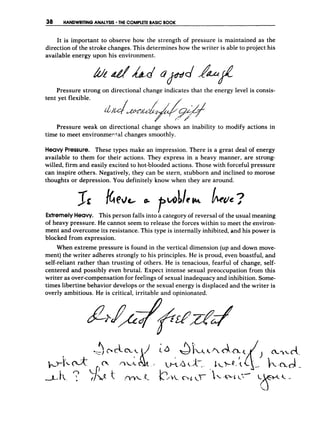
Pressure strong on directional change indicates that the energy level is consis-
Pressure weak on directional change shows an inability to modify actions in
time to meet environmerfal changes smoothly.
Heavy Pressure. These types make an impression. There is a great deal of energy
available to them for their actions. They express in a heavy manner, are strong-
willed, firm and easily excited to hot-blooded actions. Those with forceful pressure
can inspire others. Negatively, they can be stern, stubborn and inclined to morose
thoughts or depression. You definitely know when they are around.
ExtremelyHeavy. This person falls into kcategory of reversal of the usual meaning
of heavy pressure. He cannot seem to release the forces within to meet the environ-
ment and overcome its resistance. This type is internally inhibited, and his power is
blocked from expression.
When extreme pressure is found in the vertical dimension (up and down move-
ment) the writer adheres strongly to his principles. He is proud, even boastful, and
self-reliant rather than trusting of others. He is tenacious, fearful of change, self-
centered and possibly even brutal. Expect intense sexual preoccupation from this
writer as over-compensation for feelings of sexual inadequacy and inhibition. Some-
times libertine behavior develops or the sexual energy is displaced and the writer is
overly ambitious. He is critical, irritable and opinionated.
P
R
E
S
S
U
R
E
:THE D
E
P
T
H DIMENSION OF MOVEMENT 39
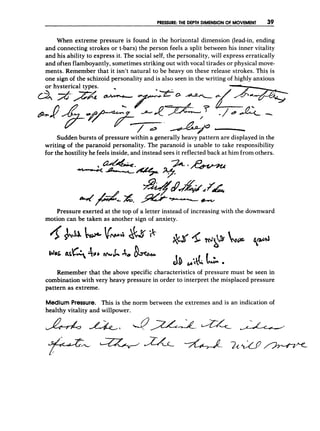
When extreme pressure is found in the horizontal dimension (lead-in, ending
and connecting strokes or t-bars) the person feels a split between his inner vitality
and his ability to express it. The social self, the personality, will express erratically
and often flamboyantly, sometimes striking out with vocal tirades or physical move-
ments. Remember that it isn't natural to be heavy on these release strokes. This is
one sign of the schizoid personality and is also seen in the writing of highly-anxious
Sudden bursts of pressure within a generally heavypattern are displayed in the
writing of the paranoid personality. The paranoid is unable to take responsibility
for the hostility he feels inside, and instead sees it reflected back at him from others.
Pressure exerted at the top of a letter instead of increasing with the downward
motion can be taken as another sign of anxiety.
Remember that the above specific characteristics of pressure must be seen in
combination with very heavy pressure in order to interpret the misplaced pressure
pattern as extreme.
Medium Pressure. This is the norm between the extremes and is an indication of
healthy vitality and willpower.
40 HANDWRITINGANALYSIS THE COMPLETEBASICBOOK
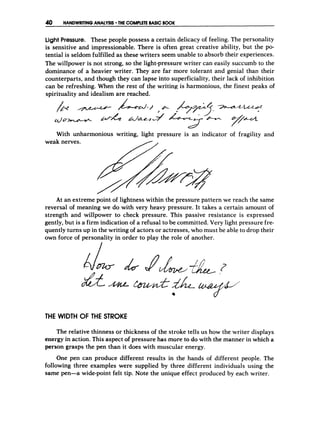
Light Pressure. These people possess a certain delicacy of feeling. The personality
is sensitive and impressionable. There is often great creative ability, but the po-
tential is seldom fulfilled as these writers seem unable to absorb their experiences.
The willpower is not strong, so the light-pressure writer can easily succumb to the
dominance of a heavier writer. They are far more tolerant and genial than their
counterparts, and though they can lapse into superficiality, their lack of inhibition
can be refreshing. When the rest of the writing is harmonious, the finest peaks of
spirituality and idealism are reached.
&
p
-
With unharmonious writing, light pressure is an indicator of fragility and
At an extreme point of lightness within the pressure pattern we reach the same
reversal of meaning we do with very heavy pressure. It takes a certain amount of
strength and willpower to check pressure. This passive resistance is expressed
gently, but is a firm indication of a refusal to be committed. Very light pressure fre-
quently turns up in the writing of actors or actresses, who must be able to drop their
own force of personality in order to play the role of another.
THE WIDTH OF THE STROKE
The relative thinness or thickness of the stroke tells us how the writer displays
energy in action. This aspect o
f pressure has more to do with the manner in which a
person grasps the pen than it does with muscular energy.
One pen can produce different results in the hands of different people. The
following three examples were supplied by three different individuals using the
same pen-a wide-point felt tip. Note the unique effect produced by each writer.
P
R
E
S
S
U
R
E
: THE DEPTH DIMENSION O
F MOVEMENT 41
-
fie”+
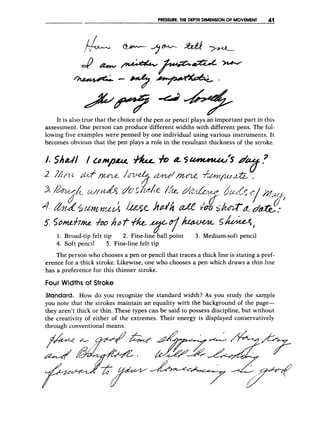
It is also true that the choice of the pen or penci! plays an important part in this
assessment. One person can produce different widths with different pens. The fol-
lowing five examples were penned by one individual using various instruments. It
becomes obvious that the pen plays a role in the resultant thickness of the stroke.
The person who chooses a pen or pencil that traces a thick line is stating a pref-
erence for a thick stroke. Likewise, one who chooses a pen which draws a thin line
has a preference for this thinner stroke.
Four Widths of Stroke
Standard. How do you recognize the standard width? As you study the sample
you note that the strokes maintain an equality with the background of the page-
they aren’t thick or thin. These types can be said to possess discipline, but without
the creativity of either of the extremes. Their energy is displayed conservatively
through conventional means.
42 HANDWRITINGANALYSIS THECOMPLETE
BASIC BOOK
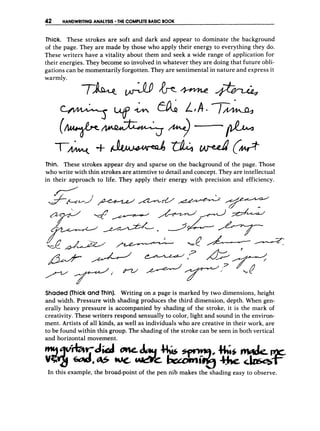
Thick. These strokes are soft and dark and appear to dominate the background
of the page. They are made by those who apply their energy to everything they do.
These writers have a vitality about them and seek a wide range of application for
their energies. They become so involved in whatever they are doing that future obli-
gations can be momentarily forgotten. They are sentimental in nature and express it
warmly.
Thin. These strokes appear dry and sparse on the background of the page. Those
who write with thin strokes are attentive to detail and concept. They are intellectual
in their approach to life. They apply their energy with precision and efficiency.
&/AA /A-
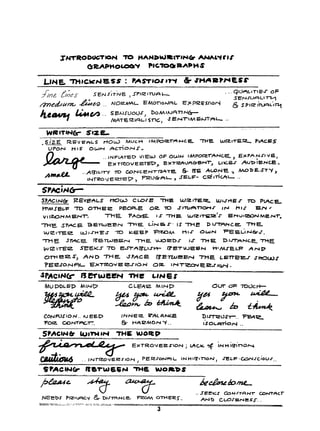
4 r
b-
G & / J :
?
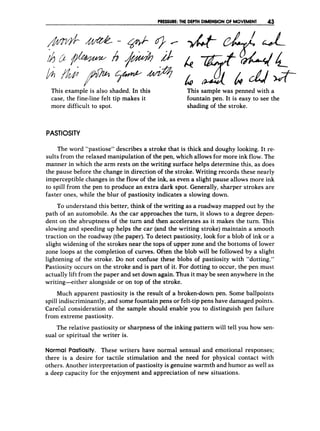
Shaded (Thick andThin). Writing on a page is marked by two dimensions, height
and width. Pressure with shading produces the third dimension, depth. When gen-
erally heavy pressure is accompanied by shading of the stroke, it is the mark of
creativity. These writers respond sensually to color, light and sound in the environ-
ment. Artists of all kinds, as well as individuals who are creative in their work, are
to be found within this group. The shading of the stroke can be seen in both vertical
and horizontal movement.
In this example, the broad-point of the pen nib makes theshading easy to observe.
PRESSURE: THE D
E
P
T
H DIMENSIONOF MOVEMENT 43
This example is also shaded. In this
case, the fine-line felt tip makes it
more difficult to spot.
This sample was penned with a
fountain pen. It is easy to see the
shading of the stroke.
PASTIOSITY
The word “pastiose” describes a stroke that is thick and doughy looking. It re-
sults from the relaxed manipulation of the pen, which allows for more ink flow. The
manner in which the arm rests on the writing surface helps determine this, as does
the pause before the change in direction of the stroke. Writing records these nearly
imperceptible changes in the flow of the ink, as even a slight pause allows more ink
to spill from the pen to produce an extra dark spot. Generally, sharper strokes are
faster ones, while the blur of pastiosity indicates a slowing down.
To understand this better, think of the writing as a roadway mapped out by the
path of an automobile. As the car approaches the turn, it slows to a degree depen-
dent on the abruptness of the turn and then accelerates as it makes the turn. This
slowing and speeding up helps the car (and the writing stroke) maintain a smooth
traction on the roadway (the paper). To detect pastiosity, look for a blob of ink or a
slight widening of the strokes near the tops of upper zone and the bottoms of lower
zone loops at the completion of curves. Often the blob will be followed by a slight
lightening of the stroke. Do not confuse these blobs of pastiosity with “dotting.”
Pastiosity occurs on the stroke and is part of it. For dotting to occur, the pen must
actually lift from the paper and set down again. Thus it may be seen anywhere in the
writing-either alongside or on top of the stroke.
Much apparent pastiosity is the result of a broken-down pen. Some ballpoints
spill indiscriminantly, and some fountain pens or felt-tippens have damaged points.
Carehl consideration of the sample should enable you to distinguish pen failure
from extreme pastiosity.
The relative pastiosity or sharpness of the inking pattern will tell you how sen-
sual or spiritual the writer is.
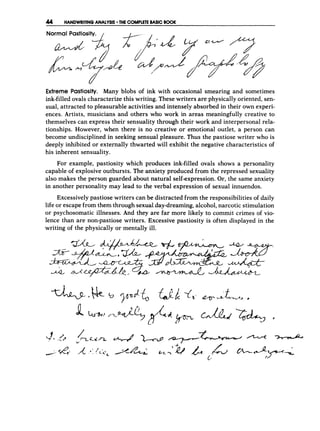
Normal Pastiosity. These writers have normal sensual and emotional responses;
there is a desire for tactile stimulation and the need for physical contact with
others. Another interpretation of pastiosity is genuine warmth and humor as well as
a deep capacity for the enjoyment and appreciation of new situations.
44 HANDWRITINGANALYSIS THE COMPLETEBASIC 800K
Normal Pastiosity. ,
a t
,
Extreme Pastiosity. Many blobs of ink with occasional smearing and sometimes
ink-filled ovals characterize this writing. These writers are physically oriented, sen-
sual, attracted to pleasurable activities and intensely absorbed in their own experi-
ences. Artists, musicians and others who work in areas meaningfully creative to
themselves can express their sensuality through their work and interpersonal rela-
tionships. However, when there is no creative or emotional outlet, a person can
become undisciplined in seeking sensual pleasure. Thus the pastiose writer who is
deeply inhibited or externally thwarted will exhibit the negative characteristics of
his inherent sensuality.
For example, pastiosity which produces ink-filled ovals shows a personality
capable of explosive outbursts. The anxiety produced from the repressed sexuality
also makes the person guarded about natural self-expression. Or, the same anxiety
in another personality may lead to the verbal expression of sexual innuendos.
Excessively pastiose writers can be distracted from the responsibilities of daily
life or escape from them through sexual day-dreaming,alcohol,narcotic stimulation
or psychosomatic illnesses. And they are far more likely to commit crimes of vio-
lence than are non-pastiose writers. Excessive pastiosity is often displayed in the
writing of the physically or mentally ill.
PRESSURE:T
H
E DEPTH DIMENSIONOF MOVEMENT
SHARP WRITING
Those who manage a very clean writing stroke are restrained and reserved,
spiritual and idealistic. At their highest, they are re:finedand sensitive, placing more
importance upon mental processes than upon emotional feelings. They are usually
verbally articulate and discriminating, projecting a sense of subtlety, nuance and
irony. They are mentally intense but convey the iimpression of physical weakness,
which may or may not be true. In any case, they save their physical strength for
when it is needed.
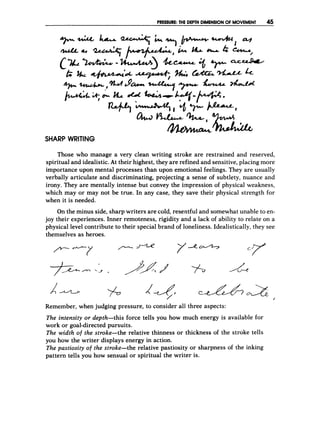
On the minus side, sharp writers are cold, resentful and somewhat unable to en-
joy their experiences. Inner remoteness, rigidity and a lack of ability to relate on a
physical level contribute to their special brand of loneliness. Idealistically, they see
themselves as heroes.
%
Remember, when judging pressure, to consider all three aspects:
The intensity or depth-this force tells you how much energy is available for
work or goal-directed pursuits.
The width of the stroke-the relative thinness or thickness of the stroke tells
you how the writer displays energy in action.
The pastiosity of the stroke-the relative pastiosity or sharpness of the inking
pattern tells you how sensual or spiritual the writer is.
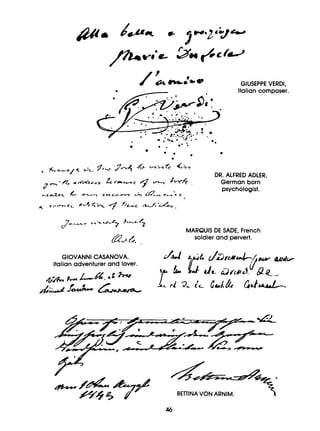
GIOVANNI CASANOVA,
Italian adventurer and lover.
MARQUIS DE SADE, French
soldier and pervert.
BETTINAVON ARNIM.
46
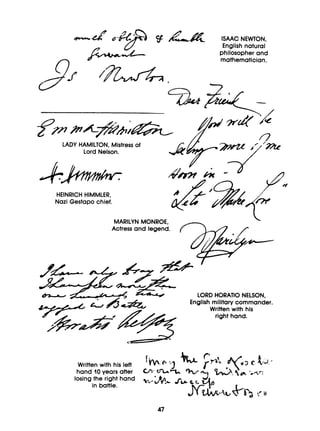
LADY HAMILTON, Mistress of
Lord Nelson.
#-
HEINRICH HIMMLER,
Nazi Gestapo chief.
MAR11 'N ...ONROE,
Actress and legend.
LORD HORATIO NELSON,
EngIish r
niIitary commander.
Written with his
right hand.
c
47
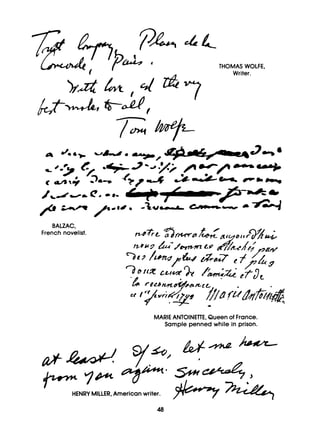
BALZAC,
French novelist.
MARIEANTOINETTE, Queen of France.
Sample penned while in prison.
48
and Spacing
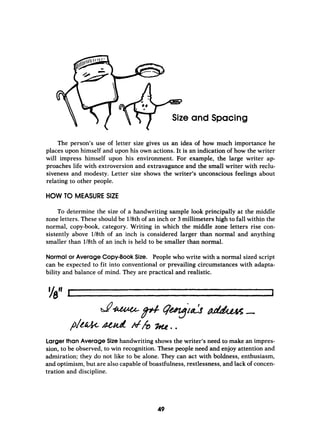
The person’s use of letter size gives us an idea of how much importance he
places upon himself and upon his own actions. It is an indication of how the writer
will impress himself upon his environment. For example, the large writer ap-
proaches life with extroversion and extravagance and the small writer with reclu-
siveness and modesty. Letter size shows the writer’s unconscious feelings about
relating to other people.
HOW T
O MEASURE SIZE
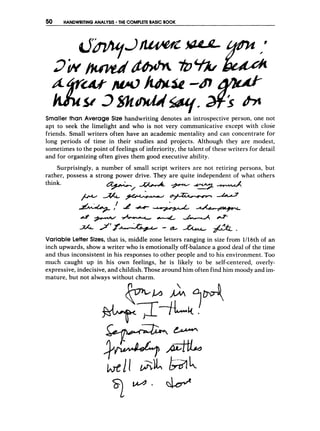
To determine the size of a handwriting sample look principally at the middle
zone letters. These should be 1/8thof an inch or 3 millimeters high to fall within the
normal, copy-book, category. Writing in which the middle zone letters rise con-
sistently above 1/8th of an inch is considered larger than normal and anything
smaller than 1/8th of an inch is held to be smaller than normal.
Normal or Average Copy-Book Size. People who write with ’a normal sized script
can be expected to fit into conventional or prevailing circumstances with adapta-
bility and balance of mind. They are practical and realistic.
,/,,J- I
Larger than Average Size handwriting shows the writer’s need to make an impres-
sion, to be observed, to win recognition. These people need and enjoy attention and
admiration; they do not like to be alone. They can act with boldness, enthusiasm,
and optimism, but are also capable of boastfulness, restlessness, and lack of concen-
tration and discipline.
49
50 HANDWRITING ANALYSIS THECOMPLETE
BASIC BOOK
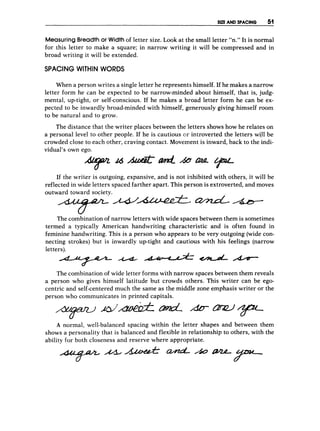
Smaller than Average Size handwriting denotes an introspective person, one not
apt to seek the limelight and who is not very communicative except with close
friends. Small writers often have an academic mentality and can concentrate for
long periods of time in their studies and projects. Although they are modest,
sometimes to the point of feelings of inferiority, the talent of these writers for detail
and for organizing often gives them good executive ability.
Surprisingly, a number of small script writers are not retiring persons, but
rather, possess a strong power drive. They are quite independent of what others
think. + - , - 3 C + v 5 4
/--v;,-+=---
A+-+II.eLT+4&-+p-L
* S
'
f
& - C L & bc."jt.
~ $ w - w A - - + d d L - 4 ~
Variable Letter Sizes, that is, middle zone letters ranging in size from 1116thof an
inch upwards, show a writer who is emotionally off-balance a good deal of the time
and thus inconsistent in his responses to other people and to his environment. Too
much caught up in his own feelings, he is likely to be self-centered, overly-
expressive, indecisive, and childish. Those around him often find him moody and im-
mature, but not always without charm.
SIZE AND SPACING 51
MeasuringBreadtho
r Width of letter size. Look at the small letter “n.” It is normal
for this letter to make a square; in narrow writing it will be compressed and in
broad writing it will be extended.
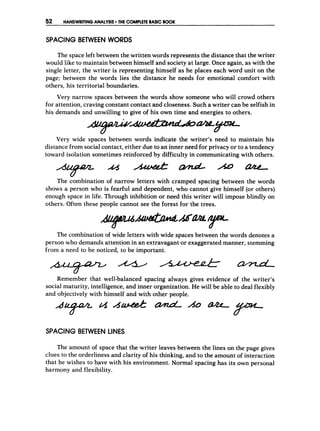
SPACING WITHIN WORDS
When a person writes a single letter he represents himself. If he makes a narrow
letter form he can be expected to be narrow-minded about himself, that is, judg-
mental, up-tight, or self-conscious. If he makes a broad letter form he can be ex-
pected to be inwardly broad-minded with himself, generously giving himself room
to be natural and to grow.
The distance that the writer places between the letters shows how he relates on
a personal level to other people. If he is cautious or introverted the letters will be
crowded close to each other, craving contact. Movement is inward, back to the indi-
vidual’s own ego.
If the writer is outgoing, expansive, and is not inhibited with-others,it will be
reflected in wide letters spaced farther apart. This person is extroverted, and moves
outward toward society.
&-*Me
T
The combination of narrow letters with wide spaces between them is sometimes
termed a typically American handwriting characteristic and is often found in
feminine handwriting. This is a person who appears to be very outgoing (wide con-
necting strokes) but is inwardly up-tight and cautious with his feelings (narrow
letters).
The combination of wide letter forms with narrow spaces between them reveals
a person who gives himself latitude but crowds others. This writer can be ego-
centric and self-centered much the same as the middle zone emphasis writer or the
person who communicates in printed capitals.
A normal, well-balanced spacing within the letter shapes and between them
shows a personality that is balanced and flexible in relationship to others, with the
ability for both closeness and reserve where appropriate.
52 HANDWRITINGANALYSIS THE COMPLETE BASICBOOK
SPACING BETWEEN WORDS
The space left between the written words represents the distance that the writer
would like to maintain between himself and society at large. Once again, as with the
single letter, the writer is representing himself as he places each word unit on the
page; between the words lies the distance he needs for emotional comfort with
others, his territorial boundaries.
Very narrow spaces between the words show someone who will crowd others
for attention, craving constant contact and closeness. Such a writer can be selfish in
his demands and unwilling to give of his own time and energies to others.
Very wide spaces between words indicate the writer’s need to maintain his
distance from social contact, either due to an inner need for privacy or to a tendency
toward isolation sometimes reinforced by difficulty in communicating with others.
The combination of narrow letters with cramped spacing between the words
shows a person who is fearful and dependent, who cannot give himself (or others)
enough space in life. Through inhibition or need this writer will impose blindly on
others. Often these people cannot see the forest for the trees.
The combination of wide letters with wide spaces between the words denotes a
person who demands attention in an extravagant or exaggerated manner, stemming
from a need to be noticed, to be important.
0 e L 0 / U 4 = 4 = -
Remember that well-balanced spacing always gives evidence o
f the writer’s
social maturity, intelligence, and inner organization. He will be able to deal flexibly
and objectively with himself and with other people.
a A
& -A
0
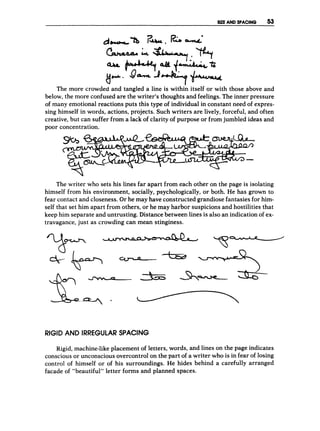
SPACING BETWEEN LINES
The amount of space that the writer leaves between the lines on the page gives
clues to the orderliness and clarity of his thinking, and to the amount of interaction
that he wishes to have with his environment. Normal spacing has its own personal
harmony and flexibility.
SUE AND SPACING 53
The more crowded and tangled a line is within itself or with those above and
below, the more confused are the writer's thoughts and feelings. The inner pressure
of many emotional reactions puts this type of individual in constant need of expres-
sing himself in words, actions, projects. Such writers are lively, forceful, and often
creative, but can suffer from a lack of clarity of purpose or from jumbled ideas and
poor concentration.
The writer who sets his lines far apart from each other on the page is isolating
himself from his environment, socially, psychologically, or both. He has grown to
fear contact and closeness. Or he may have constructed grandiose fantasies for him-
self that set him apart from others, or he may harbor suspicions and hostilities that
keep him separate and untrusting. Distance between lines is also an indication of ex-
travagance, just as crowding can mean stinginess.
RIGID AND IRREGULAR SPACING
Rigid, machine-like placement of letters, words, and lines on the page indicates
conscious or unconscious overcontrol on the part of a writer who is in fear of losing
control of himself or of his surroundings. He hides behind a carefully arranged
facade of "beautiful" letter forms and planned spaces.
54 HANDWRITING ANALYSIS THE COMPLETE BASIC BOOK
3
Irregular spacing on the page is a clue to an inwardly unsettled character in
conflict with its social self, friendly one minute and withdrawn the next. Such a per
son has little sense of social boundaries and is usually unaware of his own moodi-
ness. Uneven spacing that leads to tangled words and lines shows inner confusion,
lack of objectivity, lack of organization, emphasis upon fantasy, and self-centered-
ness. In the lower zone, it shows an unfulfilled love and sexual life which have been
transposed into the realm of the imagination.
SIZE AND SPACING 55
MARGINS
The page is space, and the way that the individual fills his page with script
shows how he will approach the world. The left side of the paper represents the past
from which the writer starts, and the right side symbolizes his goals and the future.
Placement on the page also shows the quality of the person's taste, his social,
cultural, and artistic tendencies, or a lack of these. And, unconscious feelings
toward space and its use give clues to the person's self-esteem and how he will relate
to others.
BALANCED
WIDE LEFT
MARGIN
Awareness of social
boundaries...poise,
order, control ...
aesthetic sense,
WIDE MARGINS
ALL O
V
E
R
Avoidance of the past.. .
sense of culture.. .vitality.. .
communicative., .courage
in facing life.
LEFT MARGIN
WIDENING
WIDE R
I
G
H
T
MARGIN
n
And/3rCk krnr
fk
p
w I'M=
aeh*rrcr)3ut-
r;, k o s c a ~ k
G m h y & ? k -
43 --k&
b k = & u k h
bkch. mm w
e4
0wb-w; ZV'L4451
U
Fear of the future. ..
over-sensitivity...
self-consciousness...
reserve
LEFT MARGIN
NARROWING
Withdrawn and aloof.. .
sensitive to color and
form in surroundings.
Importanceplaced
upon money. Artistic.
Eager to move away
from past into world. ..
optimistic, impatient.
-
Inner fatigue or
depression caused by
haste or overwork.
Can't let go of the
past.
56 HANDWRITING ANALYSIS THECOMPLETE
BASIC BOOK
NARR
O
W MARGINS
B
O
T
HSIDES
U
N
E
V
E
N LEFT
MARGIN
I
Stinginess or acquis-
itiveness...lack of
considerationand
Defianceand rebellion
toward the rules of
society. ..lack of Inner
reserve. order and balance.
WIDE UPPER
MARGIN
Writer eliminatesall
barriers between himself
and others.. .causes strong
negative or positive
reactions in others. ..
talks too much ...fears
empty spaces or death.
Modesty and formality.. .
respect being shown
toward the person
being written to.
WIDE L
O
W
E
R
MARGIN
Losing interest in one's
environment. ..idealism. ..
aloofness. ..reserve.
U
N
E
V
E
N R
I
G
H
T
MARGIN
Impulsive moods.. .
acts and reactions
unreliable.
NA
R
ROW
UPPER MARGIN
InformaIity, directnes
of approach ...lack of
respect, irdifference.
NA
R
ROW
L
O
W
E
R MARGIN
-
+t@W uiw- W3Mt
ha&ha-k/h
U b d 0 W h - k
cllrllc*./ 4uusc
4
4 lC&& *
-
/
l l b C & 4 94
*hmc)uh'
)*rc I
& - 4 9
+ow)l)yoqo b
.(uc41co/4+ A///
!
#
L !
!
$
e
t
+
.
?
*
tck.'
Desireto communicate. , .
materialism...sentimental,
sometimes depressed.
SIZE AND SPACING 57
ENVELOPES
Envelopes, like pages, represent an area of space upon which the writer takes a
personal position that reveals traits of his persona.lity and his relationships with
others. Addresses on envelopes are public ego manifestations for the writer, similar
to signatures, with a good number of capital letters that can be embellished or
personalized.
When the writing on the envelope is consistent in size and form with that of the
letter inside, the writer will behave pretty much the same way in public as he does in
private. Over-embellishment or false show on the envelope is ostentatious and delib-
erately misleading. Naturally, legibility and control in addressing envelopes is of
first importance.
LEGIBLE. ..ordered mind ...
adaptible, cooperative.
ILLEGIBLE. ..confused mind ., .
inabilityto conform.. .anti-social.
TOO FAR RIGHTWARD. . .
escaping past ... impulsive ...restless.
TOO FAR LEFTWARD.. .
clings to past.. .reserved.
58 HANDWRITINGANALYSIS THECOMPLETE
BASIC BOOK
O
V
E
R
-
E
M
B
E
L
L
I
S
H
E
D...phony
facade. ..desirefor fame.
-~
TOO HIGH...lives more in
fantasy than reality ...detached...
lacks confidence.
WORDS RUN INTO STAMP...
hasty, careless...desires com-
plete freedom.
TOO LOW.. .Pessimistic...cautious
depressed. ..suspecting.
Speed: The Pace of
Writing speed increases naturally with practice, but no amount of practice can
make a fluent writer out of a sluggish, overly self-conscious,or dim-witted person.
The speed with which the person moves comfortably over the page reflects the
tempo of his thinking, of his actions and his reactions. Is he “quick” or “slow”? His
personal pace is a measure of his spontaneity and will affect his writing rhythm and
form quality.
Curves are more easily written than straight lines, angles or broken lines, and
tall letters flow more quickly from the pen than tiny ones. Dots are hard to make at
high speed and tend to turn into commas and dashes. The urge toward spontaneity
slants the writing to the right, whereas hesitancy draws the hand back toward an u p
right or leftward slant. Pressure that alternates naturally is more quickly and
smoothly performed than extremely light or heavy lines.
Be on the watch for a change of writing pace in individual words where the
writer has instinctively hesitated; also look for an increase in pace as the writer’s
emotions are aroused. Key words and phrases have a way of changing pace and posi-
tion subtly on the page. The faster the writing the more the size tends to increase
and the strokes to reach out and forward, but no matter how fast, the writing should
not lose its legibility, its power to communicate.
Slower than Average Writing generally appears conventional, over-elaborate, or
clumsy. The stroke is overly controlled or hesitant, or can be tremulous, jerky, and
retouched. The connective forms are more often arcades and angles, and the slant is
upright to leftward. Letters are very small or very large, their shapes narrow or
sprawled out. Ends of words may increase in size, loops are enlarged, and there is
much made of details and flourishes. The pressure is either barely sufficient or ex-
59
46 DISCOVERINGYOURSELF AND OTHERSTHROUGHHANDWRITINGANALYSIS
-
- -
-
cessive, the strokes unrnodulated in width. The rhythm and form level are poor
overall.
Faster than Average or Speedy Writing will have an unadorned, spontaneous and
natural look.The pattern will be animated and rhythmic with smooth, unbroken
strokes and outward swinging curves. The directional trend will be rightward with
the i dots streaklike and placed to the right of the stem or linked to the next letter,
and the t bars extended, placed to the right of the stem. Connective forms are
garland or threadlike and the letters streamlined and of medium size. Endings of
words can become threadlike and there is an overall neglect of detail and flourish.
A naturally speedy writing has a smooth, flowing, and simplified look. The
graphologist finds speed vital to understanding the writer's personality; it shows
the level of spontaneity in personal response and the practicality of character. A
quick legible hand is partly a matter of experience and manual skill, but it always
shows mature and intelligent simplification of letter forms. The natural, open in-
dividual will write with a timesaving simplicity and with grace. Speed gives im-
petus to the individualization of letter forms as the writer unconsciously creates his
own smooth shortcuts. Such forms can be highly original.
Slow writing is almost always suspect of calculation, self-consciousness, even
stupidity and dishonesty. Elaboration and exaggeration give so many negative clues
to personality; neither is possible in a speedy hand. Nor is there time for touching
up, coiling, tangling, breaks, reversed pressure and extraneous leftward motions, all
signs of mental disorder. In its role of producing a simple and sophisticated hand,
speed is a necessary part of good rhythm and form quality.
JOANCRAWFORD, Actress.
61
62
#
- a
&
A
-
AMELIA EARHART
Aviatrix.
JIMMY CARTER
President and wife.
* ROSALYN CARTER,
BOOKER WASHINGTON,
63
Rhythm and Form Quality
Each handwriting has its own unique rhythm. Like heartbeats and light waves,
handwriting shows a regular recurrence and alteration of features. The writer’s suc-
cess at achieving unity and harmony within the self and in relation to the world at
large is revealed in the over-all balance and form quality of his writing.
To determine the rhythm of a sample hold the page up in front of you and allow
yourself to react to the total impression that the pattern of written strokes pro-
duces. Remember that the two major principles of rhythm are repetition and
change. Beware of a rigid machine-like quality which suggests an anxious, uptight
character who fears loss of balance. On the other extreme recognize in an uneven,
fragmented, or neglected script an unstable personality expressing itself.
Since rhythm is a subtle over-view comprised of many individual factors, rating
its quality requires practice and sensitivity. As an aid, keep in mind the following
handwsiting characteristics:
Height. The letter zones. Look for balance between the upper, the middle and the
lower zones.
Width. Examine the breadth of the letters, the distances between letters, words,
lines, the length of the connecting strokes, and the slant of the writing.
Spacing. How does the writing fit on the page? Notice the margins and the space
between lines and the balance between the height and the width of the letters.
Depth. Feel the pressure on the paper and try to determine the direction of the
stroke from the width of the upstrokes and the downstrokes.
The combination of these spatial characteristics on the page: margins; spaces
between lines, words and letters; plus the forms of the letters themselves determine
the rhythmic symmetry of the sample. These writing characteristics demonstrate
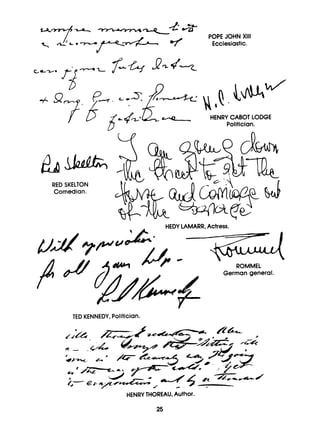
the balance, variety and richness of the personality.
In keeping with the basic principle of rhythm, repetition and change, good form
quality of the letters requires that they not be too rounded, nor too angular,
threaded, arcaded, or even too closely tied to the schoolbook Palmer method. On the
other hand, many so-called “beautiful” writings are the ornamented or artificial
products of those wishing to appear artistic or unusual in some way.
Naturally, it takes time looking at many handwritings to begin to judge success-
fully the quality of the rhythm and the form level. Sometimes this is an aesthetic
64
RHYTHMAND FORM QUALITY 6 5
judgment that will be influenced by the personal values of the analyst. Some react
favorably to more conventional forms, others look for original letter shapes. Above
all, most graphologists value writing that is not artificial or rigid and are suspicious
of extreme mixtures of graphological elements. Regulated handwriting can be
rhythmical providing it is not rigidly artificial. True genius personalities, such as
Leo Tolstoy and Beethoven, tend to create their own exceptional form level and
rhythm.
c
L
E
O TOLSTOY
The Form Quality of the letters is such an important part of the rhythm of the
writing that it deserves special mention. Letter form quality is determined by the
contour, shape, ornamentation, curvature, progression of stroke (ie: backwards or
forwards), and speed of execution. Naturally, legibility is a primary consideration,
even with speedy writers.
The spine of the letter (the downstroke) is drawn by contracting the hand
muscles. Therefore, it is likely to be more static and an indication of inner character
and strength. In contrast, the upstroke is created by a release of muscles, is lighter
in pressure, and gives a fluid variety to the letter forms.
This primary overall evaluation of rhythm and form quality gives the grapholo-
gist a yardstick in deciding whether to interpret a specific sign in the writing in a
positive or a negative way. For example: is a very light-pressured hand indicative of
neurotic impressionability and lack of energy, or of spirituality and responsive sen-
sitivity?The evaluation of the aesthetics of the rhythm and form quality will provide
the base for a positive or a negative interpretation. Even the most intuitive grapholo-
gist should beware of interpreting specific letter characteristics out of the context
of the entire writing, just as one should not evaluate a signature separately from a
portion of the text.
66 HANDWRITINGANALYSIS THE COMPLETEBASIC BOOK
Healthy Mature Rhythm and Form
Quality. Notice the well-balanced
height width, pressure, and spac-
ing. This poised, relaxed, and
smoothly written character re-
s
k
p ~ flects the writer’s inner harmony.
ABA; J???y
w - m ’Q
up”
Unrhythmic Writing with Poor Letter Form Quality. In the three samples below
observe the unstable slant and spacing, the combination of stunted and exaggerated
letter sizes, erratic baselines, uneven pressure and the disintegrated or overly-slow
and elaborated letter forms. All samples show signs of neurotic immaturity, inner
personality disorganization, and a lack of self-awareness and discipline.
Ornamentation and Neglect. As the writing style matures and develops away
from the standard forms it can take two opposite directions, toward simplification
or toward elaboration. A writer who values speed and economy of motion may
streamline the letter form to its essential skeleton, a time-saving simplicity. If rich-
ness is valued, the writer will unconsciously add extra strokes to the letters, for gar-
nish. Creative qualities are judged by how successfully the writer improves yet
simplifiesthe script. As long as the writing is natural and spontaneous, smooth, un-
forced and unselfconscious, it will exhibit a good rhythm and form level.
RHYTHM AND FORM QUALITY 67
The following sample displays a fine balance of good rhythm and form level. It
is neither ornamental nor neglected and manages to convey a feeling of personal
style within a traditional structure.
Overly Embellished Writing. Showy and pretentious script is, like all extremes in
handwriting, a facade or compensation for inner weakness.Ornamented strokes are
slow to make, very self-conscious and reveal a contrived personality. The much-
admired intellectual Greek “e” is slower to write than the Palmer type “e” and does
not have a natural place in many scripts. Ornamented capital letters usually go
beyond a respect for tradition, revealing the vain showman.
NeglectedWriting. Simplification can reach an unrhythmic extreme for quite dif-
ferent reasons than speed or maturity. Remember that a simple and speedy script
is a sign o
fmaturity and purposefulness. Untended, careless, and half-completedlet-
ters and a neglected over-all look, however, arises from a disorganized and unfo-
cused personality with depressive moods. Pressure, downhill baselines, and x-ing
shows suicidal tendencies in the careless writer.
68 HANDWRITINGANALYSIS THE COMPLETE BASIC BOOK
Overly Rigid,Slow, and ControlledWriting. Lack of spontaneity and repression of
communication interferes with good rhythm. This writer believes that he has some-
thing to hide or fears what he might do if he lost control, so he constructs a careful,
self-protective script, usually a conventional or “beautiful” form. This is rigidly
adhered to, and hides inner frustration and immaturity behind its machine-like
regularity.
Rhythmic Disturbance through Nervous Anxiety. Heedless, ill-formed letters,
usually of a variety of sizes, written with erratic pressure, indicate anxiety. Tension
in the hand will cause strokes to lighten suddenly, creating holes. Jerks and tics ap-
pear, parts of letters are missing. Often the anxious writer will mix cursive and
printed script, make numerous mistakes, and tangle.
Rhythmic Disturbance due to Old Age. Specific numerical age cannot be deter-
mined from handwriting, only emotional maturity can. It is natural, however, that
the weakening muscles and eyesight of age will lead to slower, less-coordinated
RHVTHMAND FORMOUACITV 69
writing with shakiness and uneven or lighter pressure. Many older people suffer
from depression, which shows in drooping baselines; others toward the end of their
lives intensify religious feelings and will emphasize upward strokes at the end of
words, looking heavenward for answers. Preoccupation with the body leads to
swelling lower loops.
It is difficult to separate the signs of normal aging from those of physical ill-
ness. The aged writer who feels well shows few rhythm changes, and the aged writer
who is ill will have illness features overshadowing the natural decline of age.
Above is the nineteenthcentury Spencerian script of a twemty yearsld man. Below is the same
writer at the age of sixty-eight.
Below I
s the writing of a vigorous seventy year-old man.
RHYTHM AND FORM LEVEL: PHYSICAL ILLNESS, DRUGS, AND ALCOHOL
PhysicalIllness. Injury to the body most often changes the rhythm and form qual-
ity in the zone of the writing which corresponds to the injured area. Heart disease,
circulatory problems, and nerve disease distribute their signs throughout the zones.
Sometimes the t bars of sick people become longer and stronger as their will to live
is kindled; details like periods are omitted by some writers through fatigue, anxiety,
or a growing fear of endings. Anxious preoccupation with body functions leads to
swelling of lower zone loops, erratic pressure, shakes and tremors, and signs of
depression.
70 HANDWRITING ANALYSIS THE COMPLETE BASIC BOOK
The best way to distinguish physical illness from writing disturbance of mental
origin is to have samples to compare from different periods in the writer's life; most
of all, physical problems will affect the pressure pattern and the smoothness of the
letter strokes.
MIDDLE B
O
D
Y INJURY. Broken and repairedmiddle zone letters...erratic middlezone letter size
and shape.. .MZ threading and falling, depressed words.
N
E
R
V
E DAMAGE. Erratic pressure ...tremulous and jerky strokes. ..poor spacing...slow,overly-
HEART D
I
S
E
A
S
E AND CIRCULATORY PROBLEMS. Dotting and blobs with slow, uneven pressure...
lower loops bent and enlarged.. .pastiosity, light spots, bends, jerks, tics, tangling and depres-
HEALTHY WRITING. Good pressure pattern...relaxed strokes. ..clear spacing and balanced
zone.
R
H
Y
T
H
MAND FORM QUALITY 71
Drugdetection in handwriting is complicated by its similarity to nervous problems.
Minor tranquilizer users have difficulty writing on a level line and keeping even
spacing and letter size; mistakes occur, particularly in halts or breaks in the con-
necting strokes along the baseline.
The stronger anti-depressants and mood-changing drugs cause tiny uncontrol-
lable jerks of the hand. These produce sudden and obvious mistakes and weirdly-
shaped letters. The pressure is very uneven, slant varies at random, and angular
shapes thrust suddenly next to rounded ones. Letters rise and fall unexpectedly.
Overall the rhythm pattern shows evenness punctuated by abrupt and noticeably
bizarre tremors and mistakes.
MINOR TRANQUILIZERS.UncontrollableJerksof the hand cause mistakes and sudde-nodd shapes
...angularlty appears abruptly next to roundness.. .letters change size or rise and fall unex-
pectedly. ..pressureis unevenwith tremors.
MAJOR TRANOUILIZERS.Hospitalizedpatient on the drug, Thorazlne ...extreme disintegration.
b t d Qi1 t [ k 3d B p 4 & &w4e@v--
Alcohol. Most alcoholics, no matter how talented or successful, are inadequate
personalities; they usually have a poor self-image and a critical, easily-frustrated
nature, capable o
f emotional extremes. Reality is often painful for these people; the
numbing fantasy world of alcohol offers escape from anxiety and tension.
In the writing look for signs of immaturity: lead-in strokes, weak and varied
t-bars, over-inflated,emotional loops. The inner critic at work against himself and
others is disclosed in points at the baseline, tics, hooks and sword-like strokes. A
functioning alcoholic will have fast and muddy but legible writing; impulsive and
relaxed, he still strives for control and communication.
72 HANDWRITING ANALYSIS THE C
O
M
P
L
E
T
EBASIC BOOK
' 
P4-y>v a
The immediate effect of alcohol on rhythm and form quality is likely to be more
disintegrating to the non-alcoholic who has little tolerance for the drug than to the
habitual drinker who has learned to hide his problem. In general, expect to find:
increase in pressure, tremors, breaks between the letters, sloppiness and mistakes,
with pastiosity; inability to keep the spacing between the letters even; erratic
pressure pattern; wider loops and longer connecting strokes; a sad, threaded middle
zone or a depressed baseline; an overall jerkiness and disintegration in both rhythm
and form quality.
NAPOLEON BONAPARTE,with
three deteriorating signatures.
TINY TIM, Musician. I
R
O
B
E
R
TBROWNING,Poet. /
THOMAS EDISON,
Inventor.
74
ELVIS PRESLEY,
Deterioration
in signature.
FLOYD ODUM,
Parkinson’s
Disease.
late in life.
75
Strokes & Shapes
There are two basic graphic movements which trace two distinct kinds of
shapes. One is curved movement. The other is straight movement.
CURVED MOVEMENT
The circle is the perfect curved shape. In handwriting, oval letters and loops are
formations of the circle. Many letters are comprised of parts of a circle.
The circle is a symbol of the eternal, perfect and cyclic nature of the universe. It
represents the forces of nature and all aspects of the physical body, emotion and
feeling. It is a loving container of intuitive, instinctive creativity and is the unifica-
tion of the female force and the male force as expressed by the yinlyang principle.
Things made up of circles are atoms, molecules, cells, plant and animal shapes, the
earth and other planets, the sun, solar system, stars, galaxies-in short, the physical
universe in its entirety.
The Circle and its Components. Arrows indicate the usual directional trends as
seen in middle and upper zone letters. Lower zone letters are seen as reflections of
what is above the baseline and are therefore reversed in their directional trend.
‘
0The Yin (female)and Yang (male)Symbol.
Yang is male, light, sky and firm. It is
represented by the upper zone and by the
Right. Yin is female, dark, earth and
yielding. It is represented by the lower
zone and by the Left. In the illustrations
above, B and D are male formations while
A and C are female formations.
76
SIROKES AND SHAPES 77
THE GARLAND FORMATION
A line of garlands looks like this.
The quickest and most natural way to form or correct a letter is with a garland,
the movement being both rhythmic and practical. The garland stroke is the lower
arc of a circle. It is concave in shape, like a cup or an open hand, and indicates an
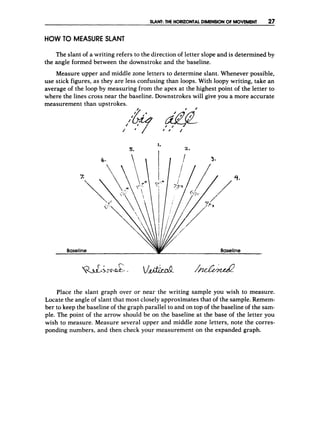
open, receptive and responsive nature.
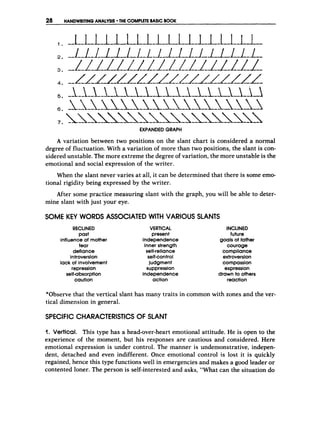
Generally Garlanded Writing
--&r-
Garland writers are passive and non-competitive. In their desire to avoid con-
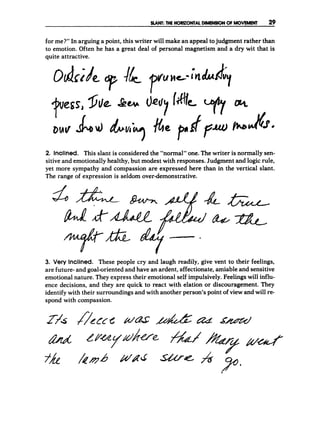
flict, they can compromise themselves by taking the easy way out. These people like
the visible, real world, and though friendly and kindhearted, don’t quite understand
the subtle undertones of situations. Socially, they are adaptable and flexible, but
their strong need for security makes them feel threatened by any changes in their
home, family or lifestyle. These types are expressive yet conventional. They want
communication with and acceptance by other people.
Shallow Garlands. Of all writing formations, shallow garlands are the fastest and
easiest to make. In their avoidance of the lower zone, people who make these strokes
reveal character tendencies of shallowness, thoughtlessness, lack of concern and
even indifference. They prefer the tangible world, and shun the mystical, the deep,
or the unconscious. In their impulsive recklessness to reach goals, they can roll
right over a less hasty person. They make much of connecting to others, but without
deep feeling.
&
L
&
2
-
c
>
- -cc-LFA -4J
J
L
Y
%
-
-
-
L
A A , d<g?&&&
&&C/ L
.
7 r
F--
ClotheslineGarlands. In their eagerness to express themselves and to communi-
cate with others, these writers can come on too stro,ng.At times, their behavior can
be termed exhibitionistic. This is sometimes to distract others from noticing the dif-
ficulty they have in facing up to emotional situations.
78 HANDWRITING ANALYSIS THE COMPLETE BASIC BOOK
Clothesline Garlands.
AeL d?hk 3
.
. y y J
- -
Deep Garlands. These writers give up-some of their horizontal mobility, and in
doing so, place more emphasis on contemplation and the inner world. They are im-
pressionable, sentimental, sedate, sympathetic and conservative. They have a hard
time giving up possessions, and are often collectors.
Droopy Garlands. Here the garland has been carried to extremes. These writers
are too passive for their own good. Guilt feelings make it difficult for them to ex-
press their anger, and they wind up being someone's doormat or dish-rag.This is one
indication of the masochistic personality.
FirmGarlands. These writers express the qualities indicated by the garland forma-
tion. They handle life with ease, are demonstrative of their emotional nature, and
respond in a warm and helpful fashion.
STROKES AND SHAPES 79
Weak Garlands. People who make weak, broken garland strokes lack follow-
through. They have good intentions but their energy level is low. They are easily
taken advantage of, are naive and gullible.
Sham Garlands. The garland with retracing can produce the sham formation. It
indicates a socially repressed personality. The individual cannot express his ag-
gressive feelings in a social situation, and will behave with charm and sweetness
even when he doesn’t like someone or something. It goes against his grain to be of-
fensive, and even a bitter enemy can get a warm greeting in public. It’s an indication
often of a sly and cunning nature-one who can win without being tempermental.
THE ARCAQEFORMATION
n
A line of arcades looks like this.
1
Letter “r’l- 3“
Letter ‘1’ -
The arcade stroke forms the upper part of a circle. Its shape is convex, like an
arch or a roof, and provides support and structure. Generally speaking, arcaded
writers are secretive, guarded, protective, resistant and proud.
As in the yin-yang principle, the arcade (yang)is the masculine counterpart to
the feminine garland (yin).Arcaded writers are as protective and paternal as garland
writers are receptive and maternal.
Generally Arcaded Writing
Socially, the arcaded writer is a traditionalist, and wants to preserve what has
already been established. He can get along with most personalities and finds the
garland type quite pleasant. He has an artistic sense of proportion and is highly
creative. Sometimes, he can be authoritarian, and offends with his seeming indif-
ference to emotion. He’s really just as emotional as the garland writer, but is very
controlled in his expression of it. The arcaded writer can accept change, but it must
be gradual. This type is not domineering, but neither is he to be dominated.
80 HANDWRITINGANALYSIS THE COMPLETE BASIC BOOK
Personally, this writer is almost always eccentric. If everyone else is going one
way (garlands are the most common stroke formation), he’ll go the other. So it’s
really only in his desire to preserve social protocol that the arcaded writer is a tradi-
tionalist. Privately, he’s a rebel. This type has a good memory, but does not absorb
information quickly. He’s serious, and generally needs a lot of time to make up his
mind. Once it’s made up, he’ll stick with the decision.
PredominatelyArcaded. These people rely on instinct and intuition rather than
on reason. They are watchful and defensive and can lack flexibility. They make good
directors or heads of organizations and are fond of public speaking. When very
arched, artistic qualities are present. On the negative side, this type can be too
fascinated by intrigue, or can be involved in covering up or hushing over the true
facts.
Wild or Big Arcades. These wild flourishes are made by dramatic and theatrical
people who wish to call attention to themselves. They have imagination, creative
ability, and extreme pride. Often these extremes are covering feelings of inferiority
with showiness.
Flat Arcades. This formation acts more as a cover-up than as a protector. It has a
sinuous and snaky quality to it and is an indication of an aloof, narrow-minded, rigid
and hypocritical nature. This is a sign of dishonesty.
-
Retraced Arcades. This person is feeling threatened. Behavior will be cautious,
guarded, secretive, evasive and uptight.
STROKES AND SHAPES 84
CIRCULAR STROKES AND SHAPES
ExaggeratedRoundness. While it is considered normal for teenagers to write in a
round style, adults who do so exhibit traits of childishness, immaturity, naivete and
dependency in their personalities. Since roundness is a feminine trait, males who
write a round style will display some feminine characteristics in their behavior.
Round writers are flexible and yielding, preferring compromise to argument, yet
regarding their home and family, they are possessive and jealous and will fight for
these when their security is threatened. These types are emotional and physical, and
find more fulfillment in the real world of experience than they could in the abstract
realm of the mind.
THE LOOP
This stroke is a combination of the arcade and the garland. It is thought of as a
vessel in which emotion and feeling are contained.
Generally Loopy Writers. These people place more emphasis on the emotional and
feeling content of an experience than they do on the conceptual aspects of it. They
are sympathetic, compassionate, and often quite intuitive in their understanding
and response to situations in their environment. Their responses are impulsive
more often than they are premeditated, and they will express in a verbal, sociable
and extroverted manner. When creative, the loopy writer will produce realistic
styles of art or will work with tangible goods.
82 HANDWRITINGANALYSIS THE COMPLETE BASIC BOOK
Normal LOOPS. The emotional feelings being stored by the writer aren’t excessive
or scanty. This is an indication of emotional well-being.
Exaggerated LOOPS. When loops become extreme in their fullness, or appear
everywhere, the person needs more and bigger vessels to store the excessive emo-
tion being harbored. Feeling gets bottled up, because there isn’t enough outlet for it.
A key phrase here is excessive emotional need.
Scanty LOOPS. When writing contains short or meager loops, the writer has pared
down his emotional feelings and needs smaller containers to store them. The ability
to express emotion has been stunted.
Retraced Loops. Some loops become so meager the upstrokes and downstrokes
coincide, one lying on top of the other. Retracing reveals the person who is strongly
inhibited emotionally to the extent that free expression of feeling is impossible. This
writer is emotionally guarded.
Distorted LOOPS. When a loop deviates from its usual ovoid or-circular shape to
trace a twisted path, it reveals the emotionally distorted individual. Here it is impor-
tant to consider the direction and shape of the distortion before determining the
type and extent of the emotional problem.
Reversed LOOPS. Here emphasis is placed on doing the opposite of what is ex-
pected. The emotional nature is rebellious. This is one indication of amorality,
dishonesty or other unconventional behavior.
BrokenLOOPS. Most of the time, broken loops will occur on the upstroke. (It is rare
to see this on the downstroke. If you do, it is usually the result of a physical or men-
tal illness.) When seen in the upstroke, a break is an indication of anxiety over a
future course of action. The person doesn’t feel sure of himself, and is uncertain of
his ideas, relationships, or feelings.
STROKES AND SHAPES 83
413& f-
Breaks at the tops of upper zone loops can indicate problems in the upper body
or in the thinking processes. (Sample below.)
Breaks at the bottoms of lower zone loops can indicate :lower body problem.
Sometimes, women who have had a hysterectomy, or women who are menstruating
will form these breaks. f
Tangled LOOPS. If the course of one loop interferes with the course of another,
tangling results. This is an indication of emotional turbulence. The needs are con-
fused, and the writer has a hard time sorting out feelings.
Leftward-PullingLoops. These writers do not easily get over emotional wounds.
They cling to old ways of being and are dependent on sustained relationships for
emotional fulfillment. The leftward-pull indicates a preoccupation with the mother-
figure and a lack of emotional maturity.
Rightward-PullingLOOPS. Attraction tothe right reveals the ambitious go-getter.
Here the emotional energy is directed to the pursuit of goals.
Y-7
iz&&m&e.-m &
*Y"b""L"
Tall Loops. In the upper zone, tall loops indicate one who reaches for spiritual and
conceptual emotional fulfillment. Emotions focus on the intangible, and fantasy and
imagination are highlighted.
JA &
U
Long LOOPS. In the lower zone, extreme
physically restless and ready to explore new relationships and experiences. These
writers need someone and something to touch.
84 HANDWRITING ANALYSIS THE COMPLETEBASICBOOK
THE OVAL
Ovals are found in the middle zone. They have to do with expression of emotion
on a verbal and social level.
Normal Ovals contain one small loop on the
writers are honest yet discreet.
right side and are lightly closed.
/zLeLmaeatrzLe
These
4
Open Ovals indicate a tendency to reveal too much. These people lack verbal cau-
tion. They are open and gullible.
Closed Ovals are naturally discreet without being secretive. They use tact and
diplomacy in verbal expression.
Tied Ovalshave loops on both sides which overlap. This person is very cautious and
guarded with verbal revelations.
Knotted Ovals are more extreme in formation and more verbally guarded than tied
ovals. The more knotted the oval, the more secretive the writer. These people are in-
hibited and defensive verbally. This can lead to lying.
Stabs in Ovals are a sign of a biting, sarcastic tongue. These writers manage to hurt
people with their sharp words.
w s i u l . d -
& szwcwzL
a
Explosive Ovals are made by those who have repressed their feelings to such a
degree that they will suddenly explode in hostile, angry verbal tirades. These ovals
are narrow and filled with ink.
Upside-DownOvals are a reversal of the usual direction. As such, they indicate in-
directness of approach and manipulative tendencies. Sometimes the intention isn’t
to deceive, but the insincerity results in misunderstanding.
STROKES AND SHAPES 85
Ovais Broken at the Bottomare a sure sign of dishonesty, usually embezzling. These
writers are cunning and deceitful.
Oval Letters Made in TWO Parts are another indication of dishonesty. Be careful
here though, because some European writing styles employ the two-part oval as a
standard formation.
STRAIGHT MOVEMENT
Straight movement results in vertical, horizontal or diagonal strokes, or in the
shapes of the square, the cross, the triangle, or the X.
The straight line and the angular shape both symbolize hurnan aspiration and
the abstract mind. These strokes and shapes are sharp, aggressive, and energetic,
having to do with the mental world. (The circle relates to the physical world.)
Straight movements are unbending and rigid. They convey authority, ambition
and power. Man-made objects and structures are composed almost entirely of lines
and angles.
Upstrokes and Rightward Strokes are released, expressive movement. The up-
stroke places emphasis on personal ambitions and aspirations (upper zonehntangi-
ble) while the rightward stroke places emphasis on action to and reaction from the
environment (goal-directed pursuits). These strokes are associated with Yang, the
male principal.
86 HANDWRITINGANALYSIS THE COMPLETE BASIC BOOK
Downstrokes and Leftward Strokes are contracting and controlled movements.
Here emphasis is placed on the self and on the development of inner abilities (ver-
tical dimension aiming to the sphere of the lower zone) and also on the past and
what is known and already experienced (the left). The Yin, or female principal is
associated with these strokes.
THE ANGULAR FORMATION
A line of angles looks like this:
letter “r”-
letter Y’-
letter 4‘rn”-
This angle is comprised of two movements or gestures. For this reason, it is
slower to write with angles than with garlands or arcades. It is an abrupt stroke,
curt and precise, and as a garland might look like a waltz, the angle looks like a
march.
Generally Angular Writing
We have already identified angularity with mental energy and with aggression.
Those who write a basically angular hand are analytical and logical. They don’t
merely “believe” but must be presented with all the facts. It is necessary to “con-
vince” them, to prove “how” and “why.” Being rigid, inflexible and unyielding, they
prefer argument to compromise, and will seek to impose their will on others. Round
writers see them as cold and inhuman, and their mechanical way of approaching life
and relationships can indeed interfere with the achievement of emotional happi-
ness. They need to cultivate tolerance, or face the disillusionment that comes when
the perfect world they envision never materializes. Principles of action are often
STROKES AND SHAPES 87
more important than results to these writers, and they will be disciplined, firm and
steadfast in their convictions. Once their minds are made up, they rarely get side-
tracked from an intended goal.
The angular stroke does not caress, it strikes. Hence extreme angularity accom-
panied by heavy pressure and pastiosity is an indication of a bad disposition with
violent tendencies.
Angular writers like to figure things out and make excellent strategists, me-
chanics, engineers, electricians, and scientists. Their determination to succeed and
ability to work energetically cannot be equalled by either the garland or the arcade
type, but the variety and complexity of human emotion remains a baffling mystery
to them.
ANGULAR STROKES
Generally LooplessWriters. There are several ways of managing a loopless style of
writing. The writer may choose to print rather than to connect his letters cursively,
or he may proceed directly to the next letter without circling around to the left. This
is called a progression, and it can be curved or an angular formation. These varia-
tions will be discussed more fully when looking at connecting strokes.
Generally speaking, loopless writers place more emphasis on the conceptual
aspects of an experience than upon the emotional and feeling content of it. Here the
tendency is to avoid instinctive emotional response by intellectualizing the feelings.
The Stick-FigureStroke. Here the writer eliminates the loop in preference for the
simple downstroke. It is an abbreviated stroke and indicates efficiency. Emotions
are kept under control, and the writer chooses to act rather than to react. He opts
for directness of approach, albeit with a certain attitude of calculation. Qualities of
maturity and independence are to be found in this writer as well as the ability to
make quick decisions and to eliminate unnecessary details.
-
5
take a firm stand on issues and will hold to their views even when faced with sound
evidence to refute them.
88 HANDWRITING ANALYSIS THE COMPLETE BASIC BOOK
The Tic. This stroke is seen as an unnecessary addition to another stroke. It in-
dicates negative feelings of temper, anger, or hostility.
ANGULAR SHAPES
The Square provides an enclosure for defense and
security. As a symbol, it indicates firmness, practi-
cality, stability, and logic through the construction
of a secure foundation. It is cold, rigid, earthbound
and materialistic.
The Cross is a symbol of wisdom. It is identified with
the Egyptian god Thoth-inventor of writing, the
Roman god Mercury-messenger of the gods, and
the Greek god Hermes-master of alchemy, the oc-
cult, and the mystical. All of these are the same
god known by different names in different cultures,
and each provides some form of communication
through abstract means. The message can be spiri-
tual, moralistic, idealistic or philosophic.
The Triangle stands for communication between
the mental and the physical planes. It displays a
logic similar to that of the square, but is more
aggressive and energetic. The upward pointing tri-
angle (movement directed to the upper zone) is con-
sidered a masculine formation and indicates a
desire for recognition and achievement on a mental
level. The downward pointing triangle (movement
directed to the lower zone) is considered a female
symbol, and here, energy is directed to experience of
a physical, emotional and personal nature.
The X has been identified with death and endings. In
mathematics it represents the unknown quantity.
It also has religious connotations, usually Catholic
or Protestant, and is a symbol of Christ and his
death on the cross. Consequently, it is also a sign of
martyrdom.
STROKES AND SHAPES 09
SQUARES, CROSSES, AND RIGHT-ANGLEDSHAPES
Many squares, crosses, or right-angled shapes are an indication of materialism.
These writers like possessions and the security and protection they can bring.
They're earthy, practical, methodical and stubborn. It is difficult to alter their think-
ing with emotional pleas. They want solid evidence. They have difficulty com-
municating their own needs and have equal difficulty understanding the needs of
others. Sometimes there is a tendency to isolation which stems from a fear of losing
the self to someone else's cause. One aim in life is security through independence.
Another is to avoid disappointments by avoiding relationships. These people are at-
tracted to building, architecture, collections, securities, stocks, money, and all
tangible goods.
TRIANGULAR SHAPES
The Upward PointingTriangle symbolizes the probing mind, searching for answers
to sometimes inexplicable things. Emphasis is placed on qualities of reason. This
type is idealistic. Once the mind-is made up, decisions are stubbornly adhered to.
There is mental aggression.
t/l & d / / I / g M d M f -
The Downward Pointing Triangle indicates that reason is being used to find erno-
tional and personal meaning. The search is on, but the meaning has not been found.
Feeling is something that exists without proof, and the angle wants to have the proof
in hand. These people are self-critical, analytical and logical. Their approach to love
90 HANDWRITING ANALYSIS THE COMPLETE BASIC BOOK
is intellectual. They are often disappointed in their search for the perfect mate or in
their desire for the perfect family. They are physically and emotionally aggressive.
The LeftwardPointingTriangle tells us that this writer is critical of his past life and
relationships. There is a kind of hostility and aggression being directed to events
that have already taken place. The attitude is somewhat bitter, and the writer
wonders why he has been treated so unfairly. The energy is directed to reflection.
The Rightward Pointing Triangle symbolizes ambition in life and love of action.
These writers are aggressive regarding their plans and goals. They are critical when
others don’t measure up to their conception of how the world at large should be, and
are generally pessimistic in daily life.
X’S are symbols of religion, martyrdom, endings, or death. Those who make this
mark are somewhat preoccupied with rituals in their everyday life. They may not be
overtly religious but do have strong beliefs. They fear death, yet have an attraction
to its mystery. When the stroke is found in the lower zone the meaning is intensified.
Feelings of guilt elicit strong reactions and these people can exhibit bizarre beha-
vior. Often too, death has touched them in a personal way-such as through the
death of a loved one or the death of an ideal. Sometimes they are even suicidal. They
can be accident prone, attracted to drugs or alcohol, or self-destructive in other
wavs.
Middle zone and upper zone X-ing means guilt or martyrdom in daily life.
STROKES AND SHAPES 91
Lower zone X-ing indicates self-destructive tendencies.
THREADED MOVEMENT
Threaded movement isn’t entirely either straight or curved, but a little of each.
There is more tendency to evasion than there is to action. The quality of the line is
somewhat formless, and so is the quality of the character. It is a sinuous line that
flattens out-giving the merest hint of the shape it’s describing. It evades commit-
ment, control and direction.
THE THREAD FORMATION
A threaded line looks like this:
Letter “m”- -
-
Generally Threaded Writing
Threaded writers are sensitive and highly impressionable. They take a broad view of
the world and want to see and know everything. Their innate curiosity leads them
into unusual situations. Being broadminded and open to outside influences, they
can be so intuitive that they actually seem to catch and hold the thoughts of others.
They have a love for all the arts and want freedom to follow their own talents. Often,
though, threaded writers sublimate their own creativity in order to bring it out in
others. They seek appreciation rather than material rewards and consequently
make good teachers and social workers.
On the negative side, threaded writers are undisciplined and unpredictable.
They won’t give themselves to a particular course of action, won’t be pinned down,
and often won’t even stand up for their own convictions. The reason for this is that
92 DISCOVERING YOURSELFAND OTHERS
THROUGHHANDWRITINGANALYSIS -
they are unsure about the world and unsure about themselves. They opt for an indef-
inite course and thus make themselves hard to understand. When they make a deci-
sion they are likely to change their minds. Dishonesty is sometimes associated with
threaded writing, an association brought about by the secr-etivenature and formless
character of the threaded writer. In any case, these people are often socially incon-
siderate and eccentric in their attitudes, yet they can be the most fascinating of the
four different formation types.
Often the thread formation appears as a result of speed. The mind is rushing
along while the hand struggles to keep up, sacrificing legibility in the process. This
fast kind of thread looks smooth and the rhythm flows, giving a uniform look to the
writing. The speedy thread is identified with high intelligence-possibly even
genius.
When the thready writing is not legible, the writer has difficulty communicating
his intelligence.
-
-U
*
A
---7---
-7-
-
- - r _
When legible, the fast-flowing thread can be an indication of true genius. These
people are mentally ahead of their own time. They view the world from a wide per-
spective and can develop original theories.
2 6 -4&q&?k n-dq--
--#A- & Z
*
'
& --be
y - * w w
w
- /F;IL!ApLfu .
z
-
-
--&&&L
%
*
* 4
L
.
x-
*
A
&
+-
-
-
- !
2
&
- %
+
Albert Einstein
ThreadingTowards the Ends of Words is a sign of the negotiator and the diplomat.
These writers penetrate the thinking processes of others to see through disguises
while keeping their own personality and position hidden. High intelligence is
indicated.
Threading Towards the E
n
d of CI Body of Writing indicates lagging interest. The
writer is in a hurry to get it over with.
STROKES AND SHAPES 93
Threading in the Middle of Words marks the kind of indecisiveness that charac-
terizes hysteria. These people are falling apart on the inside while maintaining a
front to the outside world.
Inconsistent Threading brings out the more negative aspects o
f threading. Indeci-
sion, poor concentration, lack of attention to detail, evasive behavior, ambiguous-
ness, and impressionable reactions are highlighted. Still, these writers are often the
most spontaneously creative and intuitive, and can have the most original responses.
1
/
rc'
SOPHIA LBREN,Actress.
R
O
B
E
R
TREDFORD,Actor. - - -
OLIVIA DE HAVILLAND,Actress.
A
FRANKLLOYDWRIGHT,Architect.
LEOPOLDSTOKOWSKI,
Conductor.
94
MARYMARTIN,Dancerandactress.
?
6)4 4
L -5 rb-"
-
[Lk
ISAACASIMOV,Sciencefictionwriter.
H
E
N
R
YFONDA,Actor.
FARRAHFAWCETT,Actress.
MARY PICKFORD,Actress.
R
A
Q
U
E
L WELCH,
TELLY SAVALAS, Actor.
95
PRINCE OTT0 VON BISMARCK
SCHONHAUSEN,German
ChanceIIo,r.
t
-
PI
n
W
LAWRENCE OLIVIER,
Actor.
GORE VIDAL,
Writer.
S
T
E
V
E McQUEEN,
Actor.
MARIE DRESSLER,
Broadway entertainer.
PETER MARSHALL,Television host.
A
" JACK LEMMON,Actor.
RICHARDDIEBENKORN,Artist.
c
,
96
STROKES AND SHAPES 97
LEAD-IN STROKES
The stroke which begins the first letter of a word is called a lead-in stroke.
These strokes, or the absence of them, give clues to the manner in which the writer
relates to his family, to his own beginnings, or to the way he initiates action. The
Palmer method of school copybook writing which came into use early in the 20th
century taught a script style which contained lead-in strokes on most of the small
letters and on some of the capitals. Most Americans have been taught this style.
Secondary Lead-ins. In the Palmer Method, these strokes were attached to the
small letters b, e, f, h, i,j, k, 1, p, r, v, s, t, U,w, x,and y. On the way to maturity, many
people drop the use of these strokes in favor of increased speed. Others retain them
throughout life.
The presence of secondary lead-in strokes indicates adherence to patterns of
behavior learned in childhood. These writers retain conventional attitudes and cling
to past experiences and memories, continuing to look to authority figures and insti-
tutions for guidance. They’reresistant to change, and will procrastinate a bit before
entering any new project. It’s as if they must warm up with a lead-in stroke before
plunging into the actual letter.
-- &4&.&&
PrimaryLead-ins. Lead-ins attached to the letters a, c, d, g, m, n, 0,
and q are volun-
tary additions to the Palmer Method. These writers are ambitious, and put energy
into life just as they do into these unlearned lead-in strokes. Still, this energy is
directed into a framework of conforming values. Though opinionated and exhibi-
tionistic, they express themselves without challenging convention or endangering
98 HANDWRITINGANALYSIS THE COMPLETE BASIC BOOK
their acceptance by others. They display emotion yet are deficit in inner emotional
life. Decisions are delayed, spontaneity is reduced.
Absence of Lead-inStrokes. This omission is an indication of maturity. These peo-
ple take a direct route to problem-solving. In action, they are quick and decisive. Ac-
tual intelligence may not be higher than that found in those who retain lead-ins, but
creativity and originality are more freely expressed.
Garland Lead-in. Warm, receptive, responsive, wants communication and accep-
tance. Family ties are very important. Sentimental and emotional.
Long Garland Lead-in. All of the above plus good sense of humor, love of body
movement, gracefully exhibitionistic.
Drooping Garland Lead-in. Feels guilty, wastes time and energy, is easily led,
passive, shallow thinker.
W
Arcade Lead-in. Secretive about past and family. Proud, resistant to change, a tra-
ditionalist yet often personally eccentric. Has something to hide.
Angle Lead-in. Has been hurt or cheated in the past, resents family members, is
skeptical, cautious and somewhat hostile. Energy spent thinking about past.
ThreadLead-in. Not certain of feelings regarding past and family. Has a hard time
making decisions due to conflicting impulses about past events.
LongThread Lead-in. Dramatic, flirtatious, wastes others time, wants to be center
of attention. Can twist the facts of family or past history.
STROKES AND SHAPES 99
-
Hooked Lead-in. Can’t let go of past relationships or past possessions.
Tics on Lead-ins. Irritation or arrogance which is usually temporary.
Lead-inson Capitals. Concern for appearances. Wants to hold the status-quo.
Lead-infrom Below Baseline. Negative past experiences have created aggressive
feelings which result in tension and anxiety. Troubles in the teens through parents.
V
With Garland Formation,
person blames own self.
9:
3 v w e With
person
Arcade
hides Formation,
this.
With Angle Formation,
person blames others.
Lead-insfrom the Upper Zone. Makes a show of own intelligence.
Arcade into Upper Zone. Great imagination.
+A h
+
h
+
Angle into Upper Zone. Probing Mind.
Garland into Upper Zone. Social intelligence.
ENDING STROKES
The stroke which ends a word is called an ending or terminal stroke. The forma-
tion of this stroke gives clues to the manner in which the writer relates to others or
to his own goals.
Strong Endings of any kind. Strong activity drives, interest in environment.
100 HANDWRITINGANALYSIS THE COMPLETEBASIC BOOK^
Absence of Endings. Frugality with time or money. Not dependent upon others for
approval. Mental concentration, directness, self sufficiency.
Short Endings. Shyness, reticence.
7 M '
4 -
Long Endings. Generosity, consideration, friendliness, openness.
Prolonged Endings. Tenacity, extravagance, desire for conquest, mania.
Prolonged to fill space. Determination, suspicion, curiosity, tenacity, generosity,
possessiveness.
Endings Up and Out. Extravagance, depends on approval, will take risks, social
orientation, responsiveness, giving.
Endings Up. Philosophic, seeks a higher order, ambitious, high moral standards,
wants to do good works.
3 , - - * * p m u
Endings Vertical. Secretive, self-conscious, in another world, imaginative, hides
behind a social front.
o L # d A n d u .
Endings Vertical and Tight. Idealistic but not giving.
Leftward Endings. Feels victimized, introverted, self-oriented, moves towards
mother's world of home and protection.
h n 3
I L G d d -
Leftward Endings under words. Self-centered, materialistic, doesn't understand
STROKES AND $HAP€S 101
Leftward endings cross through word. Self destructive, introverted.
d
&
/hccVM'f.zzwu
Endings Short and Blunt. Abrupt person, some sadistic tendencies.
Endings Thick and Clubbed. Brutality, tenacity, sadism, great energy.
*
Endings Down and Weak. Passive, timid, weak.
&?+--++ v *
h T - m M
&p4 6-L -*
Endings Down and Strong. Stubborn, tempermental, sarcastic.
Endings Down and Very Heavy. Violence, tenacity, cruelty, determination.
EndingsLongand Sharp. Hard to get along with, bad temper, sarcastic, biting per-
sonality.
(%44-$-d"t&-L/M-
Endings Descend Vertically. Mind is made up, intolerance, can convince others of
own principles, decisive, strong likes and dislikes.
Upturned Hook. Keeps to traditional modes of communication, egotistic, acquisi-
tive. steadfast.
Downturned Hook. Opinionated, tenacious, materialistic, insecure.
# A d G + y b -
Incomplete Endings. Frugality, curt nature, self-sufficiency, not certain of mode
of action.@ 9 dd,p
/1/ k b z 4 J w .
Dog Leg Endings. Vanity, pretension, dishonesty, cunning.
Slurred Endings. Dislike of detail and method, slurs over things in haste to reach
goals, lack of caution. (Thread.)
102 HANDWRITINGANALYSIS T
H
E COMPLETE BASIC BOOK
6
Angular Endings. Abrupt, decisive, aggressive, critical.
Garland Endings. Warm, responsive, talkative, social.
Arcade Endings. Feels threatened, secretive, protective, hiding something.
&*&--*
Angular and ProlongedEndings. Sees life as a challenge to be met with force and
discipline. * H ~
Flamboyant Endings. Immature, manic, theatrical.
Variety of Endings. Mixed traits-judge most prominent traits according to fre-
quency of occurrence.
CONNE
C
T
lNG STROKES
Connectingstrokes are those which link the letters together. They give clues to the
writers social attitudes and mental abilities. In most writing you will see more than
one type of connecting stroke, but some are pure examples. We'll deal with these
first.
Pure Types
Garland Connectors. These people want to be needed and need to be wanted. They
care what others think of them and want to come off positively. They're emotional in
relationships and require a lot of attention. Communication of all kinds appeals to
them-they're verbal and like to gossip. As a rule, these types are realistic, material-
istic, physical, and extroverted. They're
thinking processes are usually rapid, but
generous, flexible and expressive. Their
not particularly original.
Arcade Connectors. Of the two curved types, the arcade writers are more formal
and controlled than their garland counterparts. They're concerned with keeping
STROKES AND SHAPES 103
face, with traditions and with regulations. More serious than. the garland, they can
be just as genuinely warm, but with less ado about it. They choose their words care-
fully to make them more effective, and make good lecturers and teachers. They don’t
think as rapidly as garland writers do, but they have better memories and come to
more concise conclusions. They’re efficient with words and with time.
Angular Connectors. These writers &e far more socially aggressive than the
round types are. They don’t particularly care whether you like them or not, and
would rather argue with you than smooth things over. Generally, angular writers
don’t have very many friends, and are often rebellious with authority figures or
superiors. They do best in their own businesses or in situations where they can deal
on their terms. They’re hard-working and precise, competitive and critical. These
people are the most hard working of all, and also have the greatest mental potential.
Angularity is a strong indication of high intelligence-usually of the scientific,
Thread Connectors. These people are curious about the world around them with-
out quite becoming involved in it. They’re open and broadminded, but are inconsis-
tent too. By the time you figure out where they stand, they stand somewhere else.
They prefer interesting people to stable ones, and look for reflections of themselves
in others. They’re not very critical, but rather are inclined to overlook the flaws or
the perfections in favor of general aspects of a person or a situation. These people
are often among the most creative, but they don’t follow up on this. They seek expe-
riences rather than things, and don’t want to be involved in lengthy projects.
Mixed Types 5
Garlands with Arcades. A good combination. Emotional balance-neither too
receptive nor too evasive. The arch gives strength to the cup while the cup gives an
expressive quality to the arch. This combination is creative and produces artists of
all types. Social motivation with direct approach.
p/&#YJs m’fi W d ! S
Garlandswith Angles. Another good mix. The angle gives strength to the garland
and the garland provides a happier nature. The writer is observant but may not feel
104 HANDWRITINGANALYSIS THE COMPLETE BASICBOOK
the need to criticize. He'd rather express in a supportive manner.
Garlands with Threads. The mind wanders. These pegple have little initiative or
drive. They are inclined to be lazy and lacking in will power.
Arcadeswith Angles. This combination can produce a rather pompous individual.
Both types are inclined to be perfectionistic, and will rise to the top professionally,
but the emotional life is undeveloped. These people are stubborn and inflexible and
extremely critical. Their lack of tolerance can drive loved ones away.
Arcades with Threads. An extremely creative combination. These people are little
understood by friends and associates. There is a great deal beneath the surface as
both types tend to be secretive. Often this mixture can produce the criminal mind.
The thread urges the arcade to do those bizarre things he's always thinking about.
Without garlands to provide guilt, these people could become actively antisocial.
Angles with Threads. Sometimes this is a brilliant combination. The directness
and aggressive force of the angle can stimulate the thread to action. The openminded
attitudes of the thread can modify the demanding nature of the angle. The angle is
usually the most intelligent while the thread is the most open to stimulation and ex-
perience. Each provides what the other is missing.
Progressions. This is another type of connecting stroke. It proceeds directly from
one letter to the next without returning to the baseline or making a loop on the
letter.
Curved ProgressionsFormedwith Garlands. Here the writer is making a gesture
of friendshipand response without going out on an emotional limb. Give and take at-
titudes with dependency are emphasized.
Curved Progressions Formed with Arcades. These formations emphasize mental
and theatrical orientation. The writer makes a show of his knowledge and behaves
in a defensive or protective manner regarding emotional feelings.
Angular Progressions. These formations emphasize mental concepts. This writer
analyzes and probes, seeking to find the meaning of a situation.
Garland Arcade Angle
4
Connectedness and Disconnectedness
The child who is learning to write first learns each letter separately and only
gradually learns to connect them to form one continuous word. In the maturation
process, as writing becomes automatic, the ability to connect groups of letters is at-
tained. The longer the sequence of joined letters, the higher the degree of con-
nectedness.
Comparative studies of speech and writing have confirmed the close correlation
between these two language functions. Those who write a smooth connected hand
can speak with fluency. Those with speech defects mirror these in their writing.
Writing speed is greater with connected forms because connecting letters facili-
tates the writing process. Even writers who ordinarily disconnect many letters
write with a higher degree of connectedness when circumstances force them to
write faster than their normal pace.
Although the Palmer Method teaches a totally connected (cursive)writing style,
the average adult makes some changes as he matures, and it isn’t uncommon to
pause in the writing sequence to cross t’s, dot i’s or indicate syllables.
The degree of connectedness present in a sample gives clues to the writer’s
thinking processes, mental abilities, and social attitudes.
CONNECTED WRITING
When most of the letters in a body of writing are connected, the writing is
termed “connected.” There are varying degrees of connectedness. Generally speak-
ing, connected writers are logical, rational and analytical. Their thinking is syste-
matic, and their sense of calculation and strategy moves them to want to plan ahead.
They are goal-minded and are persistent and purposeful. They are able to sort out
facts comprehensively, organize them into cohesive tvholes and come to definite
conclusions. These writers are detetmined, practical and realistic. They want
106 HANDWRITING ANALYSIS THECOMPLETE
BASIC BOOK
reasons for everything. They like to start projects at the beginning and proceed
chronologically to the conclusion. Once started on a task, they don’t like to be inter-
rupted until they’ve arrived at a proper stopping point. Great power of concentra-
tion enables them to think, plan, act and execute according to their preconceived
ideas. Connected writers want to bring things together, arrange them into propet-
order and deliver them systematically.
Negatively, connected writers can sometimes get so caught up in the details and
their order that they miss the overall pattern of meaning. They may be intuitive, but
they won’t go with the feeling until they’ve completely dissected and analyzed it.
They want to be sure there’s a reason for feeling the way they do before acting on the
feeling.
Connected writers are restless. They seek and desire change. If their minds
aren’t continually stimulated, they get bored. It’s hard for then1 to sit and stare into
space. A mental challenge is often more relaxing than doing nothing. They’re fond of
crossword puzzles and other games.
Socially, these writers can be inconsiderate and tactless. It’s not that they mean
to be, it’sjust that when they finally come up with the answer to someone’s problem
as they see it, they’re not above saying it like it is. They’re often much better at solv-
ing abstract problems than personal ones, as the closer they are to something the
less able they are to see it clearly. They’re so busy thinking about what has already
happened or what will happen next that they miss what is happening now,
These connected types are fond of reading and study. They make good students
and have very good memories for facts-clear back to childhood, but it’s hard for
them to remember some of their daily-lifeobligations, and to avoid embarrassment,
it becomes necessary to write appointments down.
ExtremeConnectedness. Although this was the way most of us learned to connect
in the Palmer Method, retention of extreme connectedness into adulthood is an in-
dication of compulsive tendencies. This type behaves automatically in social situa-
tions. He has a hard time bringing his feelings to the surface where they can be com-
municated, yet since the connected writer is communicative by nature, he’ll relate
through a symbolic or ritualistic act if he can’t express verbally. The general quali-
ties of connectedness are found magnified in this type, but slavish adherence to
STROKES AND SHAPES 107
copybook connecting indicates blocks to the expression of more creative or unusual
ideas and abilities. Here, the mind tends to focus on the objective to such an extent
that receptivity to change or readiness to accept new opportunities or developments
spontaneously is impossible. This writer limits himself.
Connections Between Words. When writing is so connected that not only letters
but even words are linked together, it is an indication of great concentration. These
writers do everything according to preconceived plans, from the first thought to the
completion of the act. This trait is rare, but is found in the writings of various strate-
gists. Where there is a link between the words while some breaks occur within them,
an avant-garde type of creativity and originality is indicated. These writers are not
bound by convention. In some cases, when the rest of the writing is not particularly
harmonious or well-integrated, this unusual connectedness indicates flightiness of
ideas and an inability to focus on the real issues.
PartialConnectedness. Many adult writers pause periodically to dot i's, cross t's,
move to a nest syllable or think about what comes next. Sometimes too, even though
the motion of the hand is smooth and continuous, the hand will lift just enough to
leave the paper for an instant. Any of these things can be done without disrupting
the flow of the writing. These people possess the qualities of the connected writer,
but are not so single-minded, focused, or compulsive as the totally connected types
are. There is more spontaneity expressed which allows for the development of crea-
tive potential. Some of the qualities of the disconnected writer are incorporated
with the traits of the connected type to produce a broader individual who hopefully
has the best of both worlds.
108 HANDWRITINGANALYSIS THE COMPLETE BASIC BOOK
DISCONNECTED WRITlNG
When the strokes which ordinarily link the letters are nearly or totally absent
the writing is termed “disconnected.” ‘Thefewer the connecting strokes, the more
disconnected is the writing.
Constant interruption of the writing movement with stops and starts between
letters wastes time and energy. With increased speed requirements, even very dis-
connected writing or printing contains more connecting strokes than usual. The
trend to connectedness increases with speed and decreases when the forms are’
slowly and carefully traced.
Ge~er-ally
speaking, disconnected writers are open to the influence of the mo-
rnent. They have a hard time filtering out unnecessary or unwanted stimulation.
Emotional sensitivity and perception are so heightened that groups of people over-
stimulate them, and for self-protective purposes, they generally adopt an almost
hermetic life-style. Personally, they are egocentric, inconsistent, moody, restless,
shy, unsociable, selfish, cautious, fearful, unadaptable, lonely, and insecure. All of
these traits might be considered negative, but keep in mind that these people need to
maintain a certain amount of psychic distance for their own preservation.
The main thing about the mental inclinations of disconnected writers is that
their opinions come from a sense of feeling rather than from reasoning. Certain
inner convictions exist independently of logic and these are relied upon. Their ideas
are very personal and sometimes greatly inventive. They know without knowing
they know; sometimes this intrinsic knowledge shows the inspiration of genius,
while in other cases it is simply a spastic kind of thinking process that leads no-
where. These people think in whole concepts rather than in a systematic order. They
have a good memory for impressions and are extremely observant. More speculative
and original than connected types, they have great imaginative potential, quick
grasp and insight, independence of judgement, inventive and inspirational thoughts,
critical ability, good sense of timing, and individualism. Negatively, disconnected
writers have a lack of ability to see themselves critically, are impractical, unreason-
able and unorganized. They form strong likes and dislikes on the basis of first im-
pressions and appearances. These instantaneous reactions are often emotional, and,
if uncontrolled, are intensified by the senses so strongly that violent outbursts can
result. Their reactions are instinctive in contrast to the connected types who calcu-
late their actions.
STROKES AND SHAPES 4 09
Totally DisconnectedCursive Writing. If you consider the sideways rnovernent of
connecting strokes as links between the ego and the outside world, it becomes clear
that total lack of connectedness is a serious defect. These people have difficulty
understanding relationships or adapting their behavior to suit the situation. It's
hard for them to link their experiences into a meaningful direction. This leads to in-
troversion, social withdrawal or isolation. The desire to absorb rather than to ex-
press or communicate makes these types stingy with social overtures.
Disconnected,Detachedand Original Printing. This is a highly creative category.
These writers are inspired, individualistic, and likely to work in an artistic field.
They size people and situations up quickly and then jump to conclusions.
Full Disconnections with Hesitancyin the Formations. These people have difficulty
translating their thoughts to words or their goals to action.
PrintedWriting. A higher percentage of left-handers adopt printing as their mode
of writing than do right-handers. In both instances, these people may have had trou-
ble learning to write, and as soon as possible, dropped writing in favor of printing.
Qualities of introversion and competitiveness combine to produce personalities who
would rather not participate at all unless they can play to win. Printers feel
rebellious toward traditional social situations and toward ties that bind. They're in-
dividualists, hermits, or anti-social neurotics. They're full of feelings of inadequacy
and isolation, but won't admit to the emptiness they experience. They strive for
perfection in all things and do not wish to become personally involved with others to
any great extent. They're self-centered and lonely-critical and aloof. They'd rather
do things alone than cooperate with others and have difficulty identifying with
causes or goals.
110 HANDWRITING ANALYSIS THE COMPLETE BASICBOOK
Aesthetic Printing. The print-style of some designers and engineers is frequently
constructed to attain physical beauty or for the goal of precision and legibility.
Qualities of appearance are more important to these people than social connections
are, and they may or may not be intuitive or introverted. Other qualities in the
writing will help you decide.
&LL &&OVS' A w€'rH OF: /dmRMAFjON- n ' S
SIMPL€. ZrSPuN.W h w ~ a M A z l W
SPEEO A&Q
Printed Word or Phrase in a Cursive Writing. The writer wants to be personally
removed from or unconnected with the particular name, word, or phrase he has
printed. He may be lying or may feel threatened.
Sporadic Alternation Between Printing and Writing. This indicates confusion
about social roles, inconsistency in thinking processes, or changes in modes of ex-
pression. This is a strong indication of mental or emotional instability.
Printing with All Capital Letters. This is much the same as writing with an over-
developed middle zone and is an indication of self-centeredness, insensitivity to feel-
ing and experience, and focus on daily-lifeactivities. Feelings of guilt block channels
of self-development. The writer may be quite sophisticated and immature at the
same time.
I'VE- mufiy 5 w 0 W D t " t z E a )F p - f q C ~ r ' M h - 7
O ~ W T / N S T ~ ~ ~
O F ~ ~ ~ s E ~ B K E - ~
/ M -
p O S S I l 3 L E ?-U l w e L y I - M Y PEZSOIL)&Ll7-y
PATRlClA NIXON, & -/*&&&&
Wife of President
Richard Nixon.
&a&-
ANITA BRYANT,
Singer and anti-
homosexuaI rights
crusader. -
ARCHIBALDCOX,
Attorney and
SpeciaI Prosecutor,
Nixon Administra-
tion.
HELEN KELLER,
Famous blind
deaf-mute,who
became an out-
standing personality.
111
ELLIOT RICHARDSON,
Attorney General,
Nixon Administration.
fl/&
VlKKl CARR, Singer.
EUNICE KENNEDY SHRIVER,
Sister of President John Kennedy.
VINCENT PRICE,
Actor.
112
JACQUELINE KENNEDY,
Wife of President John Kennedy.
A-
d?
c
. 7-
113
If4mage Conce
THE PERSONAL PRONOUN “I”
The personal pronoun I has great importance in that it is symbolic of the writer
himself. The formation of this single letter reveals the person’s ego, that is, his self-
image and his sense of his own worth. It also gives clues to the regard in which he
wishes to be held by others. And, by studying the personal pronoun I, the degree and
the quality of influence that the mother and father figures have had in shaping the
writer’s personality can be determined.
Normally the space taken for the personal pronoun I is similar to other capital
letters in the handivriting. Extreme ego height as found in a very tall or very inflated
I or the opposite extreme of ego shrinking as seen in tiny or crushed forms are both
aspects of the same thing, self-concern.
Just as with the body of the writing, the more natural or average the slant of the
personal pronoun I, the more freely and flexibly the nvr-iter will respond to others
and his own life situations. Left-tending 1’sare not easily written by the right hand
and tend therefore to be more artificial; the writer is covering an inner reserie,
defensiveness, or rebellion with carefully practiced outer behavior. Genuine for-
ward movement is repressed and inner caution prevails. Often there is a strong tie
to the niother figure.
Those who write a vertical personal pronoun I value their independence and
nish to find their own way in life. These people have the will power to block out
emotional distractions and value harmony and privacy. They respond to life but at
the same time will protect their innermost feelings.
When the personal pronoun I leans to the left and the balance of the writing
moves rightward expect inner neurosis, personal disharmony and conflict. Here is
the lack of insight and empathy associated with the back-slanted I combined fith
the vill to move out and impress the environment.The person is isolated ii,ithin his
self-inrolirenient in spite of his activity.
Take special note of the writer who reverses the writing direction of the I; in
superior writings he could be a genius as he is asserting a private need for origi-
nality. Generally, however, a reversal is covert defiance. The writer is privately hav-
ing his own way, and will do the opposite of what is expected of him.
114
SELF-IMAGECONCEPTS 115
Looking at the male and female aspects of the personal pronoun I, it is to be ex-
pected that the greater the emphasis upon the upper or father-oriented portion of
the letter, the stronger the desire of the writer to r,elateto that image. The longer or
more emphasized the female zone, the stronger the ties are there. Sharp points or
angles in these areas indicate hostility toward that figure,just as retracing indicates
repressed or unacknowledged feeling toward the inother or father, usually painful
feeling.
When the I is printed or written as a single straight line the self may be viewed
as standing alone without encumbering or immature ties to either parent figure, or
indeed without troubling need for emotional support concerning the self-image.
Certain elaborated or overly-embellished versions of the I are done to reassure
the writer and to impress others that things are better than they really are. Such a
person usually possesses little insight about himself, is interested in being con-
sidered creative, and is prone to waste time because of his need to release tension
through imagination or fantasy.
Some I shapes are so malformed as to appear twisted and ill. Such an ego may
indeed be deformed, or a physical problem will reveal itself in the body of the
writing that influences the ego symbol. Clues to the personality also turn up in per-
sonal pronoun 1's that are shaped like dollar signs, circles, cradles, knots, daggers,
or a number, like 2. In this fashion the I constitutes a word in itself, a drawing of the
ego.
SPECIFICS O
F THE P
E
R
S
O
N
A
L PRONOUN I
Printed in Cursive Writing ...clear constructive thinking. ..indepen-
dent. . . desire to stand out.
116 HANDWRITING ANALYSIS THE COMPLETE BASIC BOOK
i
9
9J
9
a.
Stick Figure...very independent . . .culturally aware and mature. . .
lack of facade.
Lower Case Letter.. .either a crushed or totally immature ego, or a
conscious desire to draw attention to self.
Tall Inflated Upper loop. ..a vain person, whose vanity can quickly
disappear under adversity. . .outgoing and enjoys spotlight. . .imagi-
nation. , . wishful thinking.
Tall Narrow Upper LOOP . ..must be in command to feel worthwhile . . .
lofty idealism. . .often unrealistic.
Retraced Loops...repressed feelings about self and others, lack of
spontaneity and confidence. . .conservative. . . if left-slanted, needs
protection and comfort.. . lacks insight into self and others.
Upper Loop without Base...identification with father or male role,
denial of mother. . .idealism and ethical principles are important. . .
self-protective . ..influenced by early life experience.
Open Reclined Cradle. . .overly involved with mother figure, which
can be hostile dependence . . . cannot assert self or say no . . .hates con-
flict . . . vulnerable to male dominance.
Extra Loop on ReclinedCradle . . .strong child-like attachment to ma-
ternal figure.
Arrow to the Left.. .hostility or bitterness toward the mother figure.
Arrow on Upper LOOP.. .anger or disappointment toward the father
figure. . . self-criticism . . .judgemental.
Circleo
rArcaded ...protective of self with limited self-understanding
. . . need for mothering.
Knotted . . .self-centered and ungiving . . . self-protective . . .emotional
in a shallow or showy manner. ..a “butterfly”.
Upper and Lower Endings Rightward.. .resents imagined impositions
. . . tends to blame others when things go wrong.. .very limited in-
sight into self or others.
Springboard or Pedestal Stroke...the lower zone drives are the
source of personal motivation. . .can be stubborn and prejudiced.
NumberTWO Shape . . .writer has felt second-class either physically or
emotionally, or both, and has learned to shield emotions. . .over-
compensates with an acute sense of independence.. . will not relate
intimately.
SELF-IMACECONCEPTS 4 17
Dollar Sign.. .ego involvement with money as a source of personal
value; possibly “bought off” as a child with $ instead of love.. .also
can be a crossing out of self if strokes.angled or scribbled; this highly
neurotic.
t
fl
X-lng .. .strong fears and dependency.
CoiIing . . .self-conscious ...pretentious .. .eccentric.
Distortion ...physical illness or deformity ... self-conscious desire to
be noticed.. .prefers the unusual or romantic to reality. , . rebellion
. . .struggle with self-image
Backward or Reversed Formation...Any letter written in a direction
opposite to that which was taught implies rebellion to some degree on
the part of the writer; in high quality hiandwritings this reversal can be
an expression of genius. In the personal pronoun I the reversed direc-
tion usually indicates talent impaired by neurosis. The writer will be
perverse, will do the opposite of what is expected of him, resents
authority, and might even come to grips with the law.
E
’
.B
-.-
- *
In the reversed personal pronoun I, since the bottom is formed first
there is usually indication of an abnormal affiliation with the mother
figure. The ego has not completely separated from the mother, or
mother substitute, and clings if only to thwart her.
THE SMALL LETTER d A
Always notice the small letter “d.” Like the personal pronoun I, it is especially
revealing of the ego traits and the social attitudes of the writer. The d, however, tells
us more about how the individual can be expected to interact socially with other
people, whereas the personal pronoun I showed us the person’s internalized social
and self image.
General rules of slant and size apply to the d as to all letters. However, there are
certain changes in the d letter shape and in the stem of the d that give clues to per-
sonal traits like vanity, independence, vulnerability, even the possibility of maniacal
behavior. The letter specifics below are the best way to study this important letter.
Stem High and Retraced...quiet pride and dignity. ..independent ...
will not show hurt feelings.
Stem Low and Retraced..shrewd.. .independent.. .modest good
judgement; when too short, a crushed social ego.
Stem Makes Wide LOOP.. .the bigger the loop the more sensitive the
person. . .touchy and vulnerable to both criticism and flattery.
d
cc
118 HANDWRITINGANALYSIS THE COMPLETEBASIC BOOK
d2
61
3
0.t
aL
or
d
8
2
Cl
Stem Makes Tall Wide LOOP . . . vanity, conceit, and arrogance . . .
hyper-sensitive to criticism.
Stem Makes Tall Wide Loop with Point at Top.. .same as above but
with feelings of being alone and different ...often immature and
neurotic about self-image.
Greek d ...love of and concern for culture ...poetic and literary abili-
ties . . .emphasis upon reason and excellence, mature social abilities.
Teepee d ...obstinacy and stubbornness, particularly in social situa-
tions. . .reticence.
Open d ...like the oval letters, a’s and o’s,in the tendency to be volu-
ble, chatty, to talk a lot. ..these letters are like open mouths.
Pedestald ...obstinant, stubborn, and unyielding. ..a desire to con-
trol situations ...firm convictions and strong prejudices.
Stem Makes RightwardFlag ...flirtatious, gay, socially aggressive ...
fun-loving ...pleasure-oriented.
EmbellishedStem ...pretentiousness. ..eccentricity.
Lasso LOOP Stem ...child-like, naive nature .. .sometimes a poetic
nature.
Felon’s Claw Formation...a person who habitually provokes
others ...self-punishing ...impossible to get along with for any length
of time.
Backwardor ReversedFormation ...social conflict with authority ...
contrariness or outright rebellion. ..amorality. . .criminal behavior
...can show sexual inversion such as homosexuality, latent or overt.
Inflated into Lower Zone. ..unconscious fixation upon the mother
figure. ..the same as a left-tending y loop.
Circle Stem ...a magic circle that protects deep neurotic fearfulness
in social situations. ..hidden anti-social impulses , . .self-protective.
Spiral Stem ...egocentricity. ..emotional selfishness ...a narcissist
who loves himself too much to care for another.
Cracked Stem ...extreme touchiness ...neurotic social adjustment
to the environment.
Maniac d ...person given to sudden emotional outbursts or extreme
emotional reactions. ..one of the signs of a criminal nature.
SELFIMAGE CONCEPTS (119
T-BARS: WILL POWER, ACTIVE O
R PASSIVE
Many handwriting analysts consider the letter “t” by far the most graphologi-
cally important letter of the alphabet. In order to make a t-bar the writer interrupts
the normal up, down, and circular movements of his hand to produce a separate and
distinct line. Unconsciously this requires a slight added attention and exertion. How
the writer d r a w this bar tells how will power and personal drive are expressed in
his life.
Will, or directed energy, supplies the drive necessary to overcome constant
everyday obstacles and to achieve an inner discipline; its quality is vital to the har-
mony of the personality. In a person’s handwriting the length, pressure, placement,
and shape of the t crossing reveal the rhythm and force of the will behind. Be aware
of a mixture of t-bars, which indicates conflicting goals and confusion in thought
and action.
Furthermore, the placement of the t-bar on the stem is a major clue to the indi-
vidual’s goals; are they average, high, totally unrealistic? There must be over fifty
different ways to cross a t, and a writer will often change or modify his style as his
personality changes, or his health alters. The most common examples are defined
below.
/t
Length of t Crossing:
Short Crossing ...lack of drive and will power. ..in superior scripts,
reserve and restraint of natural instincts, in inferior script, lack of con-
fidence, timidity.
Average Crossing ...healthy balance, calmness, self-control in
thought and action.
LongCrossing ...energy, vigor, resolution, boldness ...an overly-long
crossing not only implies the same confidence, persistence and en-
thusiasm, but also a person consumed with ambition who cannot be
stopped.
Pressure of t Crossing:
Pressure Lighter than Stem. ..resignation. ..extreme sensitivity. ..
timidity.
Pressure Heavier than Stem ...domineering will and great energy, but
capable of insensitivity and selfishness in pursuing goals.
Starts Thick and Ends Thin ...quick-witted and sarcastic.
Starts Thin and Ends Thick. ..the club shape that means cruelty and
possible brutality.
Angle of t Crossing:
Ascending ...optimism, ardor, enthusiasm, ambition.
120 HANDWRITINGANALYSIS THE COMPLETE BASIC BOOK
Descending with Light Pressure. ..like x-ing, dependency, fear, and
hopeless resignation.
Descending with Heavy Pressure.. .stubborness and an argumenta-
tive nature. ..very heavy pressure leads to despotism, aggressiveness,
destructiveness, and cruelty.
Position of the t Crossing:
A7t-X
-
A.
X
x
r
Low, Medium, and High on Stem ...the individual's goals will be of
corresponding importance to him.
HighAbove Stem .. , imagination and leadership in superior script but
prejudice in lesser scripts ...goals not realistic but are founded in fan-
tasy and imagination . . .found in women who marry for wealth or im-
portance. . .also found in those with love of physical adventure.
Crossing to Left of Stem . ..procrastination, indecisiveness.
Crossing to Right of Stem ...impulsiveness, enthusiasm, animation,
nervous energy.
NO Crossing. . .haste and carelessness. ..absent-mindedness. ..de-
spondency. . .rebelliousness.
Shape of t Crossing:
Hookson t-Bar . ..persistence and tenacity of purpose ., .hooks at each
end show a compulsive and indomitable nature that can drive the per-
son to exhaustion even in tasks of little value.
Bowed Bar High on Stem ...a nature in which strong passions and ap-
petites have been subdued, often through spiritual values.. .can be
inhibition, or protective umbrella.
Inverted Bow ...instability, fickleness, shallow interests, someone
easily influenced with a weak avoidance of confrontations. . .willful-
ness . ..indulgence of sensual appetites. . .guilt-ridden desire to be
victim.
Wavy Bar...fast and intuitive mind.. .fanciful humor.. .good
nature and gaiety. . .gracious and sociable.
Looped or Knotted Bar...persistence and tenacity, a person who
rarely gives up. . .great concentration. . .logical and materialistic.
Star-Shaped Knot. ..hard angles without lifting the pen show not just
persistence but an angry obstinacy.. .the star-shape with a weak bar
not passing through the stem shows procrastination and indecision
coupled with repression.. .the star-shape with a strong bar off the
stem: indomitable.
SELF-MAQE CONCEPTS (124
Leftward Return Stroke...desire to protect self, often to point of sel-
fishness. ..lack of confidence.. .introversion and return to past
Whip Shape t Bar...practical joker.. .show-off.. .mimic.
p./----’ ...jealousy.
THE I-DOT
Shape of t Stem
Loop with NO Bar...usually occurring at the end of a word; hyper-
sensitivity and deep emotions but without the discipline of reason.
RetracedStem with No Bar...usually occurring at the end of a word;
speed and efficiency when other t-crossings present, making it an ac-
ceptable variation of the Palmer style.
LoopedStem with Crossing. ..imagination.. .writer needs consider-
able support from those around him.
Splinting or Double-Stroke Stem ...writer falls into the neurotic
category with conflict between what the mind dictates and what the
emotions demand. ..overly fearful and suspicious.
Crackedor Spiral Stem ...a neurotic person with difficulty in making
adjustments to life. ..odd and eccentric. ..self-involved.
The meaning of the formation and placement of the small letter i-dot is very
similar to that of the variations of the t-bar. Dotting the i is also an interruption of
the forward movement of the writing, and only the slow, careful hand makes it
precisely round and places it exactly over the i. More often we find dots wandering
forward or backward, up or down, or turning into hasty dashes.
Like the t-bar, the location o
f the i-dot in the upper zone relates it to the intellect
and the aspirations. High or low, it tells us of enthusiasm or practicality. The more
strangely the i-dot is made, the farther the person will be removed from the com-
monplace. In cases where the i is not dotted (in such instances we are likely to find
many uncrossed t’s as well),we have an indication of carelessness, poor memory, or
on a deeper level, blind spots in the thinking or depression.
Roundand PlacedOverthe Stem ...order, method, precision .. .con-
scientiousness. ..good memory and concentration.
Roundand PlacedHighAbove the Stem ...great imagination and en-
thusiasm. ..if very light, spirituality.
& Very L O W . . .constraint.. .caution.. .fear.. .illness.
A, Omitted . . . carelessness . . . absent-mindedness . . . lack of mental
orderliness .. .poor memory . ..blind spots ...depression.
122 DISCOVERINGY
O
U
R
S
E
L
F AND O
T
H
E
R
S THROUGH HANDWRITINGANALYSIS
Muddy and Blotched...materialism ...sensualism. ..sensuous ap-
preciation of sounds and colors.
Very Light ...sensitive ...frail ...unassertive.
Very Dark ...emphatic .. .assertive ...overbearing.
Placed After the Stem . . .impatience . . . impulsiveness . ..in good
scripts, a quick mind that looks ahead.
Placed Before the Stem ...procrastination. ..timidity. ..caution
and fear of new ideas.
A Sharp Accent. ..lively wit ...original mind. ..if high and dashed,
vivacity and imagination.
A Sharp Accent Reversed and the Tent Shape. ..good critical sense
and intellectual abilities.
Arrow Shape. ..cruelty and sarcasm.
Club Shape. ..cruelty and irritability. ..domineering. ..if very
4 -
/c heavy, pugnacity.
I
c
A,
Curvedor CrescentShapedo
r Wavy. ..sense of humor. ..vivacity.. .
love of fun.
DotJoined to the FollowingLetter ...activity, a mind that works much
faster than the hand and does not want to lose its train of thought.
Circle I-Dot...interest in arts and crafts, manually dextrous, a feeling
for design in fields of adaptive or interpretive art rather than original
fine art ...in inferior script can be a sign of emotional instability, or a
person who wishes to appear different and “arty” but is basically
merely faddish or highly narcissistic.
In a man’s script the circle i-dotis a feminine trait that points to in-
security over the masculine image and sexual immaturity. His interests
are characteristically feminine, such as fashion, dancing, cosmetics
and hair-styling.
ALFRED NOBEL,
Industrialist and
philanthropist.
'4 SALLY RAND,
L. RON HUBBARD, Fan dancer.
Religious leader.
9
GENERAL WESTMORELAND
Military officer.
DIAHANNCARROLL,Singer.
30YEAR OLD MIME,Performer.
WALTER WRISTON,
Bank president.
FRANKLIN D. ROOSEVELT,
President.
Writer of musicalshows.
123
I MERLE BBERON,
Actress.
JOHN TUNNEY,
U.S. Senator.
WALT DISNEY,Artist.
IGORSTRAVINSKY, Musician, -
.
%+
M U
--
@-
RICHARDNIXONFAMILYU FA w
124
yu? &/&Lee+ql' 4d
y BRUNOHAUPTMAN,
Kidnap-murderer.
KARL MENINGER,
Psychiatrist.
MARY BAKER EDDY,Religiousleader.
LIEBNIZ,
Scientist.
FRANZ KAFKA,
Author.
MOZART,Musician.
I0
LYNDONJOHNSON FAMILY
125
126 DISCOVERINGY
O
U
R
S
E
L
F AND O
T
H
E
R
STHROUGH HANDWRITING ANALYSIS
-
Signatures
The signature and the personal pronoun I are probably the two most intimate
graphic movements that a person makes on the paper. They are representations of
the self, self-image concepts condensed into a small but telling format. However,
where the personal pronoun I tells the graphologist what the writer secretly thinks
of himself, the signature is a conscious form of handwriting.
Although a signature can develop naturally as the person matures, as often as
not it is produced by practice to see whether we “like” it, or it is destroyed by use as
happens to some doctors or directors of corporations who must sign thousands of
stock certificates. This conscious form of handwriting, which is accepted as a repre-
sentation of the self on checks, credit cards, driver’s licences, and documents, repre-
sents our own idea of ourselves and how we hope others will see us. It is the public
self, on view for all to see.
Analyzing a signature by itself rarely can give a complete picture of the writer;
more often than not, the signature will differ from the main body of writing, making
a comparison of the two very important. When the signature is legible and shows no
difference from a legible script, it follows that the writer will be a natural and
unselfconscious person who will behave alike in public and private. Now consider
the meanings of the variations possible between the signature and the styles of the
script:
Signature Smaller than the Script. The writer is more modest than he
demonstrates. He is assuming a mild, forceless, rather servile role in life, and is
likely to put himself down. Occasionally this can be a protective measure on the part
of an over-sensitive, introverted, or shy person.
SignatureLargerthan the Script. The writer is advertising, and wishes to be recog-
nized as an important person. Pride, self-esteem, ambition, self-confidence are
shown, and in overly large signatures these qualities take on the character of false
pride, pretentiousness, a driving need to call attention to the self. In bloated weak
formations this is a false front.
Signature Slants Left with a RightwardScript. This combination is rare and often
temporary. A sort of brake is being applied to the natural responsiveness; a reserve
and restraint has been erected toward the public. There is more reserve and control
in the character structure than anyone would expect.
SELF-IMAGE CONCEPTS 4 27
Signature Slants Right with a Vertical or Leftward Script. Here the writer is pre-
senting a warm and out-going front to the world, but this is actually the cultivated
act of a basically aloof and private personality. Since balance in acting is difficult to
achieve, particularly on a daily basis, these people are often very demonstrative and
effusive, overdoing their inner reserve with a sort of instant intimacy. If clever,
these introverts with the public personalities can carry out schemes of a secretive
nature.
Vertical Signature with Upright or Left Inclined Script. This writer will appear
poised, in command of himself, and often very charming in public. His ability to see
himself and consider his actions makes interpersonal relationships smooth €orhim.
The degree of intimacy of which he is capable on a personal basis depends upon the
spacing and slant of the script, the leftward or reclineldscript always denoting caution.
Placement o
f the Signatureon the Page:
Signatureplacedat the leftof the page shows a writer clinging to the past, afraid of
moving forward into the future. There is inhibition and lack of confidence. An excep-
tion to this is the writer influenced by contemporary business usage which has pro-
moted left placement as being quicker to type. Lik;e all typed business forms this
position sometimes finds its way into personal style.
Signatureplacedat the centerof the page indicates a person who Iikes to be in the
center of things. If the signature is large he wishes to be the center of attention and
to dominate. Actors and actresses often sign like this.
Signature placed at the right of the page is that of a person moving comfortably
with life. Too far to the right or running off the page suggests extreme impul-
siveness and fanaticism.
Legibilityo
f the Signature:
Illegible writing with a legible signature is unusual in its extreme egocentricity.
Rarely does a person write in such a way as not to communicate his thoughts but
only his name. Mental disturbance or immaturity could cause this.
Legiblewritingwith an illegiblesignaturecommunicates the writer’s thoughts but
not his identity. Depending upon the size and formation of the signature he could be
very secretive, creative, impatient, inwardly hateful of himself, or could have re-
duced his name to a hieroglyph like a doctor or an artist sometimes does over the
years.
Illegible writing with an illegible signature in a script of poor rhythm and form
quality indicates drugs or mental illness. Otherwise it is a thoroughly egocentric
and impatient person who simply doesn’t care whether he can be read or not.
Underneath these people are often unstable and lonely, and sometimes resort to
printing in block letters to be a part of the world.
A portionof the signaturereducedinsize,crossed out by another stroke, or written
illegibly shows the writer’s hostility to just that portion of his name. Occasionally
the entire signature is circled protectively or crossed out angrily with slash-ing
t-bars and endings. Such x-ing shows self-directed anger and is one of the signs of
suicidal tendencies.
428 HANDWRITING ANALYSIS THE COMPLETE BASIC BOOK
Actor. U
ROMANPOLANSKI,
LOWELL THOMAS, Travel author.
1
GAMAL ABDUL NASSER,
Egyptian President.
-
, -.
CHARLES DICKENS,
Writer.
BENJAMIN FRANKLiN,
Statesman.
ANN LANDERS,Columnist.
SAMMY DAVIS, JR.,
Entertainer.
Overscoring and Underscoring. The stroke underlining the name, whatever its
quality, shows self-confidence and ego emphasis. Judged by its clarity and elabora-
tion it shows the degree of pride and self-confidence. The overscore signifies
selfishness, and self-protectivensss. Framed by an overscore and underscore both,
the Signature shows great egocentrism as well as inner reserve, mistrust and
selfishness.
LargeCapitals. Elevated and inflated first letters imply extreme pride (unless the
personal pronoun I is small, in which case the writer is compensating for inferiority
feelings). Such a writer wants to achieve a prominent public place in life. Very
unusual large capitals are a projection of inner fantasy life, repressed wishes.
The graphic imagery of the CreativeSignaturewill mirror OF express the nature of
the creative drive, as in the beat of music, the stroke of brush or pen, or creative im-
agery that reflects the professional involvement.
SELF-IMAGECONCEPTS 129
SIGNATURESWHICH R
E
F
L
E
C
T
PRIDE AND TRADITION
CREATIVITY. ..
OSTENTATION...
W
I
L
B
U
R MILLS,
U.S. Senator.
ANDREW YOUNG: Former U.S. Delegate,U.N.
P
I
E
R
R
ETRUDEAU,Canadian PrimeMinister.
GEORGE McGOVERN,
Politician.
+>LE,
Politician.
0.J. SIMPSON, Athlete.
JAMES M.GAVIN,
Actor.
/
JOHNWAYNE,Actor.
/-
LAWRENCEWELK, Musician. JOHNGIELGUD,Actor.
1 f l Below: NELSONA. ROCKEFELLER
JACQUELINEKENNEDY
130 HANDWRITING ANALYSIS THE COMPLETE BASIC BOOK
MATISSE:Artist.
-- Authoress.
SAMMY
CAHN,
Musician.
d 7Jt
5
0 -
PICASSO:Artist.
IRVING BERLIN,
Musician.
Musician.
FOUJITA,
Artist.
ALBERT SCHWEITZER,Philosopher.
.---
-
-
=
-
7
-
ALBERT EINSTEIN, LA-^-^ ,
Scientist.
Author.
S
E
R
G
E PROKOFIEFF, *
d
+
Author.
Musician.
SELF-IMAGE CONCEPTS I31
TAR1 STEWARD, Artist. 
FRANCtSCO FRANCO,Dictator.
/ Sportsfigure.
The Encircled Signature. The circle is a symbol of anxiety, the desire to enclose
and shelter the self; it also indicates inner withdrawal from social relationships,
which are mistrusted. When the name is fully or part.icularly crossed out the writer
is deflecting his aggressive energies back upon himself in a gesture of self-
destruction.
Doctor.
ERNEST HEMINGWAY,
Writer.
0
SAM ERVIN,Senator.
&--
The Directionthat the signature takes, ascending or descending, indicates the mood
of the writer, optimistic or depressed, and can also be interpreted as health or
fatigue level with other signs in the body of the writing.
S i n c e r e l y ,
MARKSPITZ, Athlete.
HUGH M
. HEFNER,
Publisher.
HENRY FORD II,%-
Industrialist.
IllegiblePortionsof the name show hostility toward just that part. Diminished units
indicate effacement and lack of emphasis placed on that initial or name.
132 HANDWRITINGANALYSIS THE COMPUTE BASIC BOOK
FRANKGIFFORD,Athlete. DR. GEORGE BACH, Psychologist,
Author of “Creative Aggression”
The illegible Signature signifies a desire to be secretive and enigmatic, or, with a
poor form level script, inconsideration and egotistical impatience. Some warped
forms indicate eccentricity.
EDWARDKENNEDY, 7
A ‘
H
E
N
R
YMOORE,Sculptor.
v@-
ROBERTKENNEDY,Senator.
X-ingon Letter Formsis a sign of inner fears, disappointments, or depression. In the
signature it relates to serious ego-loss such as death of a loved person, defeat, or
grave illness and age. X-ing turns up in many suicide notes.
CHARLES D
E GAULLE,
French leader.
R y W s a y 4 Artist.
’ JOSEPHCONRAD,Author.
A Dot Followingthe Signature reflects an impulse to come to an end, to have the
final word and cut off further interaction. It can also indicate distrust and
guardedness.
SELNMAGECONCEPTS 433
&Me--.-
/
134 HANDWRITINGANALYSIS THE COMPLETE BASIC BOOK
I n I,” 1,.
1L-f
U.s.s.
SELF-IMAGE CONCEPTS 135
Letter Specifics
Just taken by themselves many letters give clues to personality traits. Certain
generally accepted letter specifics will be considered in the next pages; an explana-
tion of the meaning of every variation of every letter in the alphabet would require
chapters. Also, graphologists show some disagreement themselves as to specific in-
terpretations. The student must test these specifics and add new definitions as they
occur.
CAPITALS
Looking at the capitals first, keep in mind that they represent the public side of
the writer, the way an individual wishes to appear, as well as revealing unconscious
inner attitudes. Capitals are evaluated according to three standards: first, the size
...the larger and more inflated they are, the greater the vanity and pride, or, the
greater the compensation for inner weakness; second, the form. ..excessive embel-
lishment indicates affectation, ostentation and a self-consciousness; third, the in-
herent originality and grace ...the indicator of the writer's true creativity, artistry,
and taste.
In capital letters, as in writing in general, simplification in the letter form
shows a mature writer able to see and act on the essentials in life, to be objective,
constructive and purposeful. Capitals with added curlicues, flourishes, upward
lines, extra loops and hooks show a mind and personality distracted onto various
tangents. Sometimes these additions detract from smooth functioning, sometimes
they add another dimension to the personality. Capital letters used where they
ought not to be are a sign of disordered thinking.
The information below can be applied to all capital letters, not just those
Old Fashioned SpencerianLetter...respect for tradition. ..pro-
tective of others.
Wide Bottom ...gullible.
Narrow Bottom...suspicious and skeptical.
tention.
illustrated.
&
0
13
aaLargeLOOP ...bluffer, showman, politician ...needs to attract at-
e/ Curlicue ...vanity.
136
LETTER SPECIFICS 137
F J T R
K
7rr
Open Top. . .generosity and open-heartedness .. .open to new ex-
periences.
Closed Top. ..conservatism and timidity,. .reserved, keeps own
counsel.
Clear Simple Formation.. .efficiency, good taste, cultura
awareness.
Long Upper Stroke. ..ambitious.
Strokes DO Not Meet. ..problems in social adaption. ..cool aric
distant.
Swinging LOOPS. ..charisma and charm. . .ease of body move-
ment .
Wavy Flags. . .good nature and sense of humor.
Second Hump High ...tenacity and aggressiveness . . .needs to be
in control to feel secure.
First Hump High . . .social ambitions. .. lack of tact, poor taste.
Looped . . .absorption with the self. . .vanity.
Wide. . uninhibited with the body. wasteful, boastful.
Narrowwith Side Indented . . .self-consciousness,rigidity . . .
bitions about the body.
Structural. . .cool efficiency with no frills. . .gets immediate
essentials.
Open Oval . . .talkative.
Palmer Method “S” . . .conventional to the point of dullness.
Long Upper Thrusts. . .ambitious.
nhi-
Y to
Spikes from Upper Zone. ..importance placed upon intellectual
prowess.
Spikes from Lower Zone. . .ties to past and family. ..aggression
. . . materialism. . .need for physical security.
Rounded at Baseline. . .poetic. . .sensitive.
THE GRAPHOLOGICAL MEANING O
F CERTAIN SMALL LETTERS
The personal pronoun I, the d, the t, the i-dot, and the signature all have special
meaning in understanding the self-image of the writer, his social reactions and
goals. There are additional character traits that can be learned from the formation
of certain other of the small letters. That is to say, over the years as handwriting
138 HANDWRITING ANALYSIS THE COMPLETE BASIC BOOK
students continued to test their observations of the psychological meaning of letter
formations, certain small letters consistently gave the same evidence.
For example, the letter w came to be associated with the writer’s ambition, the
letters g and e with culture, the p with athletic inclinations, the square r with
manual dexterity, and the letter y in its lower zone particularly, with sexuality. In in-
terpreting these small letter specifics remember that each must appear often as a
natural characteristic of the script; do not over-emphasize an occasionally mis-
placed, self-conscious, or faulty stroke.
Looking at all of the small letters together in a given writing the analyst can
make some general observations: evenly sized small letters, all pretty much the
same height, show the consistency, sincerity, and conscientiousness of the writer.
Overly rigid, machine-like sameness betrays fear and over-control, overly uneven
sizing shows moodiness, changeability, and shiftiness.
THREE KINDS OF THINKERS AS SEEN IN
THE ROUNDED TOPS OF SMALL m, n, r.
Sharp Needle Points reveal a penetrating, fast, and intuitive
thinker, one who sizes up situations and grasps facts instantly. The
sharper and higher the points the more vivid and rapid the compre-
hension.
UpsidedownV, or Spade Shape shows a critical and investigative
mind which explores and digs for knowledge, always asking ques-
tions and seeking answers; an intellectually thirsty person with
eagerness to learn.
Rounded m, n, r’s reveal the careful and creative mind that accu-
mulates observations and facts and finally uses each piece logically
to build a mental structure. Each piece has to fit. Facts should be
proven.
Overly Rounded Tops of the Small m, n, or r show childish tenden-
cies on the part of the writer. There is a lack of mental acuity,
immaturity, with the yielding and submissive traits of one who is
obedient and follows the rules. Not easily adaptable to cir-
cumstances, and can be somewhat dull and lazy.
Sharp Needle Points with Very Rounded Connections indicate an
inner conflict between a keen mind and a very yielding nature, be-
tween mental maturity and emotional immaturity. The emotional
nature cannot carry through with what the mind perceives, and the
person feels weak and frustrated.
LETTER SPECIFICS ---
‘
I39
SMALL LETTER SPECIFICS
€
Open at lop ...generosity, frankness, truthfulness and sincerity
. . .too wide and rightward: tactlessness. . . talkative.
Tightly Closed ...caution; with a vertical hand, secretiveness;
slyness, craftiness if f and s also ltnotted.
Open at Bottom. . .dishonesty.
Open Lip...credulousness, a tendency to be gullible, trusting, . .
without guile. ..lacks sales resistance.
lightly Closed. ..caution. ..secretiveness.
LOOP on C ...vanity.
Wide Loop on E . ..loves to talk.
Narrow Ink-FilledLetters...possibility of violence.
Greek E ...refinement ...culture . . .or the aspiration rather than
the realization of culture in self-conscious scripts showing desire
to be refined. ..one whose ideals are “nice.”
F ., .Letter of Practicality...big upper loop = many theories with
little follow-through.Big lower loop = actively practical.
F . . .Not Looped,Return Stroke to Right...austerity.
Long Down-Strokes...looped or straight f, g, p, y: love of outdoor
tTPJ
s
sports. ..practical and down-to-earth personality ~ . . restless
sexuality.
Return Stroke to Left...fluency of thought. ..quick mind.
Figure 9 “G”...mathematical ability ...people who tend to be
highly critical and see everything in black and white.. .good
judgment.
Figure 8 “G”...ability to adapt, rapidity of thought, literary
tastes, intellectual flexibility, fine intuition and instinct, innate
understanding and gentleness. ..philosophy and sense of humor.
G Made Like Q or Q Made Like G ...peculiar or contrary value
structure.. .a confusion in the basic drives. ..can mean a mes-
sianic or martyr complex.
Return Stroke Retraces...the impulse is to give but caution rules
against it. ..retracing = hiding and inhibition.
Squared-off Lower Loop. ..aggressiveness and obstinacy plus a
measure of compulsiveness . ..does not give up. . .judgmental.
140 HANDWRITINGANALYSIS THE COMPLETEBASIC BOOK
Upstroke to Right of Stem rather than left.. .aggressiveness, sar-
casm ...haste ...contrariness.
Cradling Lower Zone. ..return to mother figure.
Triangle in Lower Zone. ..prudishness in women; judgmental at-
titude toward women in males.
Rebellious K.. . a letter k that is suddenly written large or
capitalized.
Stick Figure L’s ...intelligence and practicality.
Upper Loop on P ...will argue with emotion.
Argumentative P ...tall spike at the top. ..contentious.
Craftsman’s R ...a square letter showing manual dexterity.
Point on R ...probing mind.
Palmer Method Variation of R ...often taught in Midwestern
public and parochial schools.
S Printed in Script. ..reads alot.
Ambitious W . ..large or flourished w is a sign of ambition.
THE SEXUAL ASPECTS
Everyone unconsciously gives away information about his sexual personality by
the way he writes. Sharp, unkind angles, domineering t-bars, letters jammed
together seeking closeness, or fearful, spaced-out printing are all clues to the
writer’s attitude toward physical intimacy. As simple a feature as how the person
emphasizes or neglects words of sentiment like “dear” and “love” and personal
names shows the quality of his emotionallsexual involvement. Also, look for the
strength of the sexual drive in the degree of pressure and pastiosity in the writing.
The LZ has been established as the area in which biological urges and instinc-
tual drives are expressed. Here there are three broad clues to sexual behavior: the
length and formation of LZloops, particularly on the letter y and g, the slant of these
loops and the pressure exerted by the pen.
LETTER SPECIFICS 141
The length of the LZ formations gives a measure of the strength and potential of
the sexual drive, the formation of the loop expresses the degree of sexual satisfac-
tion. If the lower loop is fully rounded and returns to the baseline it indicates an ac-
tive and healthy sex life. Hugely inflated, heavily written LZ loops show a forceful
sex drive and a vivid sexual imagination. Short, lighitly-pressuredLZ formations are
evidence of the sublimation of sexual energies into ideas, projects, the daily life and
work. When the return stroke of the loop does not reach the baseline but crosses
below, sexual fulfillment is lacking.
LZ loops that pull leftward reveal a sexual dependency upon the partner for in-
itiation of the sexual act and for continued encouragement, support and approval.
Stems or loops drawing toward the right margin show a suppression of erotic drives
in favor of social or ideal concerns. Long, embellished and elaborated loops reveal
self-consciousness about sex; the more bizarre these appear to be the more eccentric
and ornamented the sexual fantasy. Marked irregularity of forms shows sexual
excitability and confusion, whereas monotonous regularity in the size and shape of
loops points to dullness in response or over-control.
The MZ head of the y and g discloses how successfully the LZ sexual energy has
found an object in everyday life. Well-formed upper portions of these letters carry
the drives to realistic, active expression. Flattened, threaded, or barely-existing MZ
anchors for the LZ loops reveal an unsettled focus, the lack of an outlet for the
drives, or, with large loops, more fantasy than reality.
The small letter y is a key to much specific information about the writer's sex-
ual interests, habits, and abilities. The small letter g, which also has many lower
zone possibilities, is an aid as well; but is primarily a cultural letter. Remember that
any middle zone letters or parts that are pulled or distorted into the lower zone will
add an emphasis to the lower zone/sexual preoccupation of the writing.
While examining the y for sexual information remember that the lower zone
also gives information about attitudes toward money and possessions (materialism)
and security (feelingsof personal worth and belonging)and is a source of energy and
creativity. The following letter specifics, however, will concentrate upon the sexual
interpretation of the letter y.
Normal Palmer Method LZ ...a warm and receptive nature free of
T rfear and inhibition. ..flexible.
LongHeavy Plungeinto LZ ...determination, firmness and aggres-
siveness.. .sometimes defensiveness.
Unfinished LZ LOOP, ..unrealistic, possibly wishful, sexual expec-
tations that are unfulfilled.
Downward Ending , ..discouragement, depression, or anger
toward current sexual partner.
7 7
"2flJ
142 HANDWRITINGANALYSIS THE COMPLETE BASIC BOOK
X-ing . . .a grave disappointment in past sexual life or deep fears.
(Lower body illness or alcohol problems.)
Tic Leftward or Rightward.. .sexual frustration, temper and
impatience.
.
I No Middle Zone Formation,. .no focus for sexual energy or fan-
tasy in the daily life. . .deprived.
Lower Zone Ends Light. . . sexual energy starts strong but dissi-
pates quickly. . .need for continual change of sexual partner.
Lower Zone Ends Long and Light. . .extreme sexual restlessness,
vulnerable to strong drives of others. . . when curved = poetic and
open to instinctual expression as well.
77
fy7Ly Y
Small Closed LOOP.. .lack of sexual fulfillment . . . large loops
tied off means materialism (money bags).
Retracing in Lower Zone. . .severe repression of unconscious sex-
ual and emotional needs. . . unlikely to enjoy sex due to overcon-
trol and fear.
Normal Smooth Loops. ..sexually active, fulfilled, can divert
energy. . .very long = restless.
Long Full Round Heavy Loops. ..gets emotionally involved, . .
*
r
d
sexuality dominates . ..energy released physically.
Tangled Large Loops. ..sexuality off-balance . . .disturbed. ..
possibly sexual obsessions.
Left Curve.. .leans to past. , .dependency on others for sexual
strength.
Lower Zone Short: Often Without Loop.. .sublimation of sex or a
tendency to suppress sexual drives. . . practicality and daily life
involvement.
Jerky,Tremulous, BrokenLoopswith LightPressure . . .weakness in
drives. . .disturbed coordination (physical illness or anxiety).
Vagaries in Lower Zone.. , when consistent, show sexual fantasy
. . .can be perversion.
Variety in Lower Zone . . .normal forms = heterosexual versatility
and adaptability . . . degree reveals writer's susceptibility to stimu-
lation and readiness for response.. . marked irregularity = excit-
ability and lack of control.
Monotonous Regularity in Loop Size. . .married into habit pattern
. . . dull temperament. . . over-control . . . sexually conventional.
LETTER SPECIFICS 143
Cradle. ..unresolved emotional tie with mother figure. . .men
-
3
, cannot freely give sexual feeling to another woman; women look
for mother replacement.
Heavy Down Stroke with Light Return.. .strong drive with little
follow through. ..with tiny loop shows disfunction.
Angles in Lower Zone; Strokes End Left...withdrawal. ..anger
. . . Felon’s Claw: unconscious guilt and sexual aberration.
Triangle in Lower Zone ...anger and unresolved sexual anxiety . ..
men have double standard regarding women; they want Virgin
Mary as a wife, and speak loosely of women, yet they are sexually
attracted to “bad” women. Women with this writing characteristic
are prudish and rejective.
Lower Zone Ends Right. ..drawing away from sex. ..sexually
repressed and evasive ...energy moves quickly back to middle
zone . ..sublimation of drives toward social concerns and altruism
. . .(with rightward flags and disconnected d: homosexuality).
Danger Signs
HONESTY AND DISHONESTY
The Honest Person is legitimate, truthful, fair, and straightforward in his conduct.
He behaves with integrity, avoids subterfuge, duplicity, fraud or deception. Honest
writing is clear and legible. There is uniformity of style-especially within the mid-
dle zone. Baselines are even and pressure is firm and steady. There is an absence of
flourishes or ornamentation. Slant is consistent as are size and spacing.
The DishonestPersonhas a disposition to defraud, deceive, betray, forge, lie, embez-
zle, steal, or be faithless. The person who is aware of his deceitful inclinations
reveals symptoms of emotional upset or nervous tension. These symptoms express
through the writing as erratic changes in slant, pressure, sizing, and spatial relation-
ships. Sometimes the person represses his dishonest intentions and compensates
with control as revealed by signs of rigidity in these four basic areas.
Some personality traits that contribute to dishonesty are:
Vanity - large writing with inflated loops, flourishes, circle i-dots.
Acquisitiveness or Materialism-prolonged endings, coiled ovals, hooks, long lower
zone, closed forms, tangling.
Weak Will Power -erratic and often dished t-bars, sinuous baseline, erratic sizing,
threading.
Emotional Instability- tangling, erratic letter spacing, t-bar vacillation, rhythmic
disturbance, excessive looping, erratic spacing, extreme changes in pressure pat-
tern, erratic slant.
Shrewdness- coiled ovals, excessive angularity, threading.
Secretive Nature - coiled ovals, closed forms, tight writing, arcading, threading.
144
DAWER SIGNS 145
Resentment - angularity, temper tics, sudden pressure.
Anti-social Attitudes - angularity, rhythmic disturbance, counter strokes, large and
loopy middle zone that often connects with angularity.
DETERMINING HONESTY AND DISHONESTY
There are many signs in writing which can indicate dishonesty in addition to
extreme fluctuation or rigidity in the four basic areas of slant, size, pressure and
spacing. It is necessary to see an accumulation of many of these signs in order to
determine dishonesty. The more signs present, the stronger the dishonest tenden-
cies within the writer.
Dishonesty Can B
e Suspected in Writing that is:
Indistinctor Illegible - noncommittal nature, inability or unwillingness to communi-
cate in a straightforward fashion.
TOO Slow, Neat or Artificial -pretentious, calculated to deceive, plays a double role
in a jekyll-and-hyde personality, hesitancy, lack of spontaneity, desire to create
illusion.
Too Complex or Too Simplified in Letter Shapes to the extent that they become
ambiguous - deception.
Sinuous Baselines or Highly Erratic Baselines-opportunism, follows lines of least
resistance, finds excuses, too adaptable and unstable in terms of moral and mood
strengths.
Rigid Baselines -premeditation, calculation, forces self into socially acceptable
behavior not naturally felt: a denial, usually covering up an undesirable impulse
person doesn’t want to be blamed for.
(A Reminder: The normal, flexible baseline is a sign of moral adjustment and con-
sistency of mood level.)
Uneven Pressure-falls too easily under the influence of others: weak sense of will
power and short-livedgoals: person gives up too easily, or vacillates under pressure
of inner drives.
Muddy Pressure- desire to satisfy strong urges, often seen in slurred letters or ink-
filled ovals.
Very Light Pressure- falls too easily under the influence of others.
Threaded Strokes or Letters Within Words with Clear Initial and Endings Letters-
presents a clear outer facade yet is devious within: ambiguous motives, imprecise.
Combinationof Extreme Angularitywith Extreme Arcades-aggression and resent-
ment, hypocrisy: a sign of criminality or mental disturbance.
146 HANDWRITINGANALYSIS THE COMPLETE BASIC BOOK
Many or ExtremeArcades -artificiality, hiding something.
FlattenedArcades that Look like Garlands-secretive, underhanded.
Over-Garlanded-extra defensive due to guilt feelings, will sometimes lie to keep
from being blamed.
(A Reminder: Healthiest combination is a variety of garlands, arcades and angles
with threading only sometimes near the ends of words and with all formations being
smooth and direct.)
CrampedLettersor CrampedConnections-pettiness and narrowmindedness that
fears discovery.
Wide Spaces between Words and Lines-personal detachment.
Cramped or Tangled Spacing -complexity of action.
Coiling, Complicated Forms -trickiness or cunning.
Counterstrokes (Reversals from the Normal Direction)-anti-social nature,
rebellious to authority, misdirected energies.
Upwardor DownwardCover Strokes(Retracing)- something to conceal, expression
is inhibited.
Weak or Absent 1-bars-weak or vacillating will-power or goals.
Misplaced Periods (especially inside letters) - compulsion, calculation, guilt.
Awkward or OftenOmittedSmall Lettersor Piecesof LettersOmitted -person leaves
out essential parts of information, ability to slide past commitment.
UnevenLetter Sizing with some Threading -manipulative.
Slurred or ink-filledLetters-habitual concealing.
Many Letters Corrected or Retouched(except in cases to provide more legibility) -
intention to cover-up.
Ovals Excessively Looped, Stabbed, Upside Down, or backwards -all signs of a
secretive, concealing nature.
Extreme Difference between Signature and Script -person not the same in public
life as in private life, discrepancy between presentation of self and actual self.
Broken or FragmentedLetters(especially at the base or to the left)- a sign of anxiety
and lack of certainty.
Prolonged Left-tending Final Strokes (especially in capitals) - acts on aggression
which stems from feelings about the family or the past. (The felon’s claw is a very
good example of this.)
Initial Strokes which Start Strangely (such as lead-ins from below the baseline or
strokes that begin leftward before going rightward) - reluctance to proceed nor-
mally.
DANGER SIGNS 147
Reclined Writing - confusion over role in life, unwillingness to show true feelings.
Dominating Upper or Lower Zone (or both)to the Detriment of the Middle- ideals
and desires are not in line with fulfillment in reality.
Long, Full Lower Zones that are often Angular - frustrated materialism, anger.
Over-inflatedUpper LOOPS- delusional thinking not in line with reality.
Do not forget that in order to determine actual1 dishonesty and not just emo-
tional instability, tension or anxiety, you must see an accumulation of many of the
above signs.
Liars and Lying
Lying - the habitual liar is a social type. He is unwilling to communicate frankly and
shows this with indirect and hesitant conversation. In writing, the liar doesn’t take a
direct route either.
When a Person LeavesOut EssentialParts in RelatingSomething- the first letter is
deceptively clear but later letters are indistinct or omitted.
When One EssentialPart is Left Out and an Invented0-neis Substituted - some let-
ters are replaced with ones that don’t belong there.
When an Essentialis LeftOutand the Gap is Filledwith Chit-Chat- a letter (ormore)
is left out and instead there is a thread.
Pathological liars are compensating for feelings of inferiority. Look for signs of ex-
treme ambition:
Tall Capitals - wants to be very important or evlen famous.
High T-barsoften left of the stem - high aspirations not followed through.
Very Tall Upper Zone - imagination and ambition, high ideals for self.
Very Looped Upper Zone - fantasy and illusion rule thinking.
Erratic or Very FlattenedMiddle Zone - dissatisfaction with daily life.
T-barsOften Above the Stem - unrealistic goals.
Greatly Reduced Pressure on Upstrokes and Rightward Strokes - can’t follow
through.
Very Slow Writing - calculated for appearance, premeditation.
Too Much Roundness-immaturity, lack of ego strength.
Rhythmic Disturbance (too dispersed and uncontrolled or too rigid) - anxiety,
tension.
The pathological liar identifies with the roles he assumes and will often show:
Two Different Styles of Writing (or more)- more than one personality.
A Very FlamboyantSignature- theatrical public self.
Erratic Changes in Pressure(with more tendency to lighten up on the stroke) -
sudden changes in intensity and mode of expression.
Tall Upper Zone with Short Lower Zone - identifies with illusions, not rooted in
reality, impractical.
448 HANDWRITING ANALYSIS THE COMPLETE BASIC BOOK
Large,Embellished,Bizarre,Inflatedor HighlyOrnamentedWriting-indicates
delusions of grandeur.
ExtremeArcading -hypocrisy.
Very Light Pressure- ability to change way of feeling and expressing without
much effort.
SAMPLES SHOWING DISHONESTY
-
a -
A woman who is selfish, materialistic,doesn't return things, exaggerates and fibs.
I I 1 I
I
I
I I
i ! 1
A man who is sneaky, clever, and suspicious. He wiggles out of responsibility by
blaming others.
A young man with a history of shoplifting.
DANGERSIGNS 149
Writing of a counsellor who is attracted to young girls in violation of his morai
responsibilities.
A man who Is dishonest in his personaiand business life.
Greed -shown by inflated numbers, inflated lower zone, hooks on lead-inor ending
strokes, leftward-tendingstrokes, large writing with few ending strokes, inflated
loops, coiling, tangling.
450 HANDWRITING ANALYSIS THE COMPLETE BASIC BOOK
--
Forgers- Signs which niake it possible for one to forge the writing of another:
Smooth Rhythm- possesses motor coordination necessary to control writing
movement.
Angular Letter Formations- mechanical skill, attention to detail, perfectionistic
and observant nature.
Tapering Words - quick thinker, directness of action.
Natural Shading - artistic, creative, imitative ability.
Exaggeratedand Sweeping Capitals- coordination, love of body movement.
Naturally, not all people with these qualities in their writing will be forgers, but
if they were so inclined, it would be possible for them to imitate the writing of
another. In order to determine whether it’s in their nature to forge, check the list of
34 dishonest signs and locate at least 8 of them in the suspect writing.
SIGNS OF VIOLENCE
Major Signs:
Highly Pastiose Writing which looks Muddyand Smeary- indulgence of sensuality
and libido urges.
Heavy Pressure that is often Variable o
r Misplaced- intense feelings with strong
reactions. These writers seek to make their mark on life around them. When the
pressure is displaced from the downstrokes (contracting strokes) to the upstrokes or
horizontal strokes (release strokes) we see that expressive force is directed against
the environment. Variable or erratic pressure indicates fluctuation in the ability to
express feelings and in the intensity of expression.
DANGER SIGNS 151
Remember that it is natural to be lighter on the upstroke and heavier on the
downstroke-lighter on the release stroke and heavier on the contracting stroke.
Also Look For:
Heavy DescendingT-bars- domineering nature, aggressive force.
M&+
Clubbing in Lower Zone Endings- aggression released physically.
Clubbing in T-bars- force of will is hostile and aggreszve.
L&Ld&a @ i d
h8+&lYLfr;41Lrd
Downward Endings- stubborn, temperamental, sarcastic.
Downward, Thick, and Clubbed Endings-brutality, tenac
energy left over at the end, violence, cruelty.
ty, sadism, too muc 1
Sharp Endings Descending Vertically - intolerance, strong likes and dislikes, bad
temper.
Long, Sharp Stick-Figure Strokes into the Lower Zone (dagger-like appearance) -
disturbance in libido takes a sarcastic, slashing form of expression.
r,,rmv7~7
fiy
Slashing Strokes and Pressure Horizontally- energy directed against the environ-
ment.
Generally Heavy Pressure- when seen with other signs of violence, heavy pressure
indicates that the writer has the force and inclination to demonstrate the anger he
---=yy---M&&&-
feels inside.
W h 4 l ' E l h @ y / y / - h t i W*!
Extremely Long Lower Zone that Doesn't Complete with a Loop-strong libidinal
urges that have bottled up due to inability to express them normally in daily life.
152 HANDWRITINGANALYSIS THE COMPLETE BASIC BOOK
The Maniacal “d” or Other Maniacal Letters (these letters slant more to the right
than the rest of the writing)-capable of sudden changes in temperament which
result in impulsive and erratic behavior. Because the “d” is a social self-image let-
ter, it is more serious when the sudden move to the right occurs on this letter.
Clubbed “d” which Stands on its Own Stem -obstinancy and desire to control
situations combined with a calculated, cruel nature.
Lettersor Words which have been Gone Over more than Once - an indication the
writer has experienced a lapse of consciousness. When seen in combination with
other signs of violence such as extreme pastiosity or misplaced pressure within a
generally heavy pattern, the writer can become very dangerous and inav not
remember later what happened. The mental processes are not smooth, and the
thinking is obsessional. The instincts are ready to express without the usual
restraint of will-power.
-3v syLpAmJ-&*.
Misplaced Capital Letterswithin Words -violent nature, sudden and impulsive out-
bursts, over-reactive. /
When misplaced capitals occur at the beginnings of words it is not nearly as
serious. Still, this person places too much importance upon his own actions and
overreacts emotionallv.
Extreme Changes in the Sizes of Middle Zone Letter‘s- socially erratic behavior,
anti-social tendencies.
Tiny, Ink-filled Ovals with some Large Ovals - tension, excitability, verbally
Extreme Angularity - aggression. When found with heavy pressure, pastiosity, and
other signs of temper or violence, the aggression is expressed physically.
DANGER SIGNS 153
Rhythmic Disturbance with More Angles and Arcades than Usual (if garlands are
present, they are usually flattened-out or squared-off)- tension within the writer,
potentially explosive situation due to pent-up emotions and anxiety: frustration,
feelings of isolation (seen in angles at the tops of upper zone loops and the bottoms
of lower zones): extreme angularity with extrem,e arcades = emotional distur-
Minor Signs: (Any of these need to be supported with major signs)
Reclined PersonalPronoun “I” with Over-Sensitive “d”- repression over self-image
with too much sensitivity and pride, ego still too attached to the mother figure: with
other signs, explosive outbursts.
4 cQuX8+&&*
Inattention to Marginswhich are Often Crowded or Otherwise Peculiar Looking-
disdain for authority and rules.
Sudden Changes from Writing to Printing- divided nature, not sure whether to be
socially expressive or socially withdrawn.
well, when I O U s-g z
%
.
?
?
- ‘w not--
7
m - l - 7 ‘3““ vcally Ccd:t+&
J
Printed Writing with NOConnections - hides personality, fear of exposure and in-
volvement, secretive and guarded.
r s + e v + e d , W J - + I m W L C -
1,STPlnrkm P m M n N G wt(t=cK) I &S
f
Defiant k - rebellious to authority figures and traditional values.
The Shark’sTooth - biting trait to the character (a combination of a cover-stroke and
~ & &
& *
an angle).
1 s HANDWRITING ANALYSIS THE COMPLETE BASIC BOOK
False Embellishment -egocentrism, hiding, tension released on nonessentials: con
artists often embellish.
,,/--
-
(@-
&&/&+-+//
Lines Coming Too Close to the Right Edge-impulsive, has a hard time holding
back.
Presence of Check-mark o
r X-like Formations - thoughts of endings or
depression. /
death,
7 5
A man who I
santi-socialand
explosive.
FRANKLIN
ROOSEVELT,
American President.
DANGER SIGNS 1%
Writing of a manwith a violent temper.H
e gets carried away emotionally,blows up about it, and
then apologizeslater. He has frequent temper outburstsand verbal rages. He’sjealous and pos-
sessive,ardent and romantic.He’ssecretive at first and then very open.
EMOTIONAL INSTABILITY
Three behavior characteristics are commonly considered in defining emotional
instability: distress of the person himself, disturbance of others due to his own
distress, and the resultant handicaps experienced by the person in trying to organize
and experience his own life.
It makes sense to view emotional instability as a continuum in which incapacita-
tion and distress are extreme at one end and minimal at the other. Most of us fall in
the middle with some mild inhibitions or anxieties that do not seriously handicap
us.
The biggest clue to emotional instability as revealed by writing is rhythmic
disturbance. If you determine a problem in the rhythm, it is still necessary to sup-
port this with several other signs of instability. The more signs you are able to find
within one sample, the more extreme are the indications of emotional problems.
456 HANDWRITING ANALYSIS THE COMPLETE BASICBOOK
Most of the following signs have already been discussed to some extent in each of
their separate areas. Here they are listed together to help you determine the extent
of disturbance to the emotional balance of an individual.
SIGNS O
F EMOTIONAL INSTABILITY
Rhythm- Rhythm has been described as a balance between the contracting and
releasing qualities of the writing. In the following extremes of rhythmic distur-
bance, the person is out of harmony with himself and with his surroundings.
Extreme Release indicates absence of control and strong feelings of anxiety. The
person is experiencing a strong or dominating blend of uncertainty, agitation,
dread, and a brooding fear about some contingency. His behavior is uneasy, unreal-
istic, and irrational.
Extreme Contraction indiczes absence of spontaneity and strong feelings of ten-
sion. Here the person is experiencing increased psychological stress and inner
unrest. Extra control is placed on the actions due to a fear of expressing the hostility
being felt.
k 9 a f r n
In addition to rhythmic disintegration and rhythmic rigidity, other qualities of
rhythmic disturbance are:
Splintingof Letters-fractured mental processes.
Retouching-uncertainty, lack of confidence, nervousness, anxiety.
Tremor - tremor is a muscular agitation brought on by mental or physical problems.
It indicates fatigue, dependency, weakness and passivity.
Zonal Imbalance -lack of harmony in three basic areas of ego development.
Inflated UpperZone -delusional thinking dominated by fantasy and illusion, lack of
secure hold on reality.
DANGER SIGNS 157
InflatedMiddle Zone -lack of maturity.
InflatedLower Zone -insecurity, instinctual drives out of control.
Shrunken Upper Zone -lacks inspiration, no confidence in mental abilities.
Shrunken MiddleZone - inability to cope with daily life, unhappiness.
Shrunken Lower Zone -sexual immaturity, fear, trauma.
Highly Erratic Baselines- lack of moral adjustment, inconsistent attitudes.
Very Rigid Baselines- narrow-mindedness, tension, inhibition, fears.
Extreme Risingof Baselines-flightiness, restlessness, lack of firm hold on reality.
Falling Baselines- depression, unhappiness.
Erratic Slant -nervous, unsettled, erratic mode of expression.
Extremely Inclined Slant (more than 45 degrees over from the vertical) - reactive,
hysterical, impulsive, unsettled, fanatical, obsessive.
ExtremelyReclinedSlant(morethan 35 degrees back from the vertical) - withdrawn,
evasive, emotional development is blocked.
Extremely Heavy Pressure- internally inhibited, potentially explosive.
Sudden Bursts of Pressure within a Heavy Pattern-paranoid personality.
Extremely Light Pressure-erratic feeling response.
Highly Irregular Pressure-evasive behavior, lack of involvement.
Pressure MisplacedInto HorizontalDimension-anxiety, hysteria, possible schizoid
personality disorder.
Pressureso Light it Breaks in Places-anxiety, nervousness, doubts over own ability
to face difficulty.
Extreme Pastiosity-highly sensual nature, possible violence, sexual perversion,
alcohol or drug abuse, criminality, mental or physical illness.
Crowded or Tangled Writing -confusion, lack of inner harmony and balance.
Uneven Margins-anti-social behavior, rebelliousness.
No Margins or Space Anywhere -fears, especially of death, overly talkative.
Gigantic Writing -mania, lack of awareness of boundaries between self and the en-
vironment, exhibitionism.
MicroscopicWriting - introversion, fear, inhibition, creation of private world, lack
of ability to relate realistically to others.
Extreme Variation of Letter Size - inconsistent in responses to environment, over-
sensitive, indecisive,childish, moody.
Narrow Letters- self-critical, up-tight, self-conscious,repressed.
Too Much Space Everywhere- fear of enclosure, isolation, withdrawal, suspicion.
Erratic Spacing -lack of inner organization, inner conflict, moodiness.
Rigid Spacing and Placement on Page-fears losing control of self or sur-
roundings.
Illegible Writing - out of touch with reality, inability to communicate needs and
ideas.
158 HANDWRITINGANALYSIS THE COMPLETE BASIC BOOK
Overly Round Writing - immaturity, dependency, lack of intellectual development,
compulsive tendencies,naivete.
Drooping Garlands - feels guilty, lets self be taken advantage of.
ProminentArcades - exhibitionism, avoidance of dealing with emotional problems,
hides behind a facade.
ExaggeratedLoops- emotional needs not being satisfied.
Stunted LOOPS- ability to express emotion is impaired.
Retraced LOOPS- inhibition, fears emotional involvement.
Distortions in loops -warped emotional response; neurosis.
Reversed Loops - rebelliousness, anti-social tendencies.
Broken LOOPS- anxiety over a future course of action.
Knotted Ovals - defensive and inhibited.
Small Ink-FilledOvals - explosive temperament.
Extreme Angularity - out of touch with emotions and feelings of love, aggressive,
critical.
ExtremeSquaring of Letters and Connecting Strokes -possible psychosis.
FrequentX-ing- self-destructive tendencies, feelings of martyrdom.
ExtremeThreading - lack of direction or purpose, lack of hold on reality.
Inconsistent Threading - anxiety, hysteria.
Long Lead-inStrokes - strong dependency ties, exhibitionism.
Lead-inStroke From Below Baseline-repressed aggression with tension and anxie-
ty: needs to establish healthier relationships with men.
No Ending Strokes- inability to give of oneself to others.
ExaggeratedEndings- defensive behavior, fear of being hurt.
Weak Endings-passivity, fear of life, depression.
Heavy or Angular Endings-aggression, hostility directed to environment.
Lower Zone Loops Which Don’t Return to the Baseline, or Don’t Cross the Stem-
frustration of basic drives, thwarted physical energy.
Lower Zones That Turn Away From the Baseline- sexual hostility and resentment.
Horizontal Slashes and Dashes- emotional ability and excitability.
Exaggerated Leftward Movement - fear of the future, defensive, hang-ups on the
past.
Many Hooks-tenacity, fear of change, craves security.
PredominantlyAngular ConnectingStrokes-social aggression, argumentative, out
of touch with feelings of self and others.
Arcades With Angles - lack of clear understanding of emotion.
Extremely Connected Writing-compulsive tendencies, too much focus on objec-
tives and too little on the actual situation at hand, delayed emotional reactions.
Totally Disconnected Writing - difficulty in linking experiences meaningfully, in-
troversion, isolation, withdrawal.
Printing- lack of social adjustment, introversion.
Sporadic Alternation BetweenPrintingand Writing -confusion over social roles,in-
consistency in thinking.
DANGER SIGNS 159
Reclined ‘‘1’’ - neurosis, personal disharmony and conflict, lack of insight into own
problems.
Reversal in Direction of “1” (makes bottom part first)- covert defiance.
Exaggerated Upper Part of “I” - continues to be influenced by father-figures.
ExaggeratedLower Part of “I” - continues to be influenced by mother-figures.
Elaboratedor Over-Embellished“I” -uncertain self-image, needs a lot of attention.
Distortion of “I” -distorted self-image, struggling with self-image.
Enlarged LOOP on “d” - great pride, overly-sensitive social self-image.
Stem Made First Then Oval Part on “d” (felon’s claw formation)- self-punishing,
challenging and provoking personality, deviant behavior.
Oval of “d” Enclosed in Big Looped Stem - neurotic social fears, anti-social
impulses.
Maniac “d” -sudden emotional outbursts, volatile nature.
Cracked Stem on “d”- lack of social adjustment, neurotic.
Long Strokes Through the Signature - unhappiness with self-image or self-
destructive tendencies.
Signature Which is Very Different From Script -unrealistic self-image.
Mixture of T-Bars- lack of consistency of will.
Short T-Bars- restraint of instinct, lack of confidence.
Weak Pressure on T-Bar- resignation, weak will power.
Descendingwith Light Pressure on T-Bar-hopeless resignation, fear, dependency.
T-Bar Left of Stem - procrastination, indecision.
No T-Bar Crossing- absent-mindedness, despondency, rebellion.
DishedT-Bar- lack of resistance, guilt, instability.
Wild T-Bars-emotional disturbance, lack of direction.
Variety of Letter Style or Formation-lack of continuity in thinking, restlessness.
Remember that in order to determine emotional instability it is necessary to
first observe rhythmic disturbance. In addition, there must be many other signs of
personality instability seen within the rhythmically disturbed sample. The more
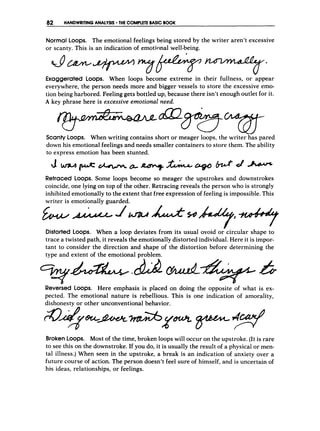
signs you are able to find which indicate instability the more disturbed is the emo-
tional nature.
L
U
D
W
I
G II, the “Mad”
King of Bavaria,
four signatures at
various ages.
JOSEF STALIN, Russian leader.
NIE
T
Z
S
C
H
E, German
philosopher and poet.
Above: 1889,shortly
before mental collapse.
Left: 1891 after going mad.
_L_I
FIDEL CASTRO,
Cuban leader.
I60
GARY GILMORE,
“Right to die
killer.‘I
STEVE GROGAN, Manson
Gang member.
RICHARDSPECK,
Mass murderer.
SIRHAN SIRHAN,
Convicted assassin
of Robert Kennedy.
LEE HARVEY OSWALD, Convicted killer.
162
Children’sHandwriting
INFANT T
O THIRD GRADE
Most of the same rules applied.to analyzing adult writing are used for children’s
writing, but with allowance made, of course, for the roundness, irregularity and un-
steadiness of stroke natural to the youngster’s untrained motor control. Starting in
first grade, American children are usually taught the Palmer method, which is
modeled by the teacher on the blackboard as well. The initial printed characters
give way to a cursive hand as the child’s speed and skill increase.
Even pre-school scribbles reveal the child’s in-born temperament and dispo-
sition. The active, vigorous tot seizes his crayon and attacks the paper with gusto,
covering it with swirls and slashes; the passive, sensitive child exerts slighter effort,
content to fill a small portion of the sheet with delicate marks. Both extremes
express normal temperament and activity needs.
Early scribbles and drawings, like adult doodles, can be analyzed in terms of
movement, forms, and arrangement on the page. The cheerful scribbler covers his
paper with wide springy curves, the anxious scribbler constricts his pattern, the sad
child reduces the size of his picture and gives the lines a downhill cast, and the angry
one increases the angularity and vehemence of his strokes.
Once in first grade and learning to write, a child continues to draw each letter as
a separate picture, but with lines to keep him in the proper place on the paper. At the
age of six the average child has motor development and eye-hand control that are
mature enough to make both up and down strokes; prior to six the strokes upward
are hard to manage.
164 HANDWRITINGANALYSIS THE COMPLETEBASIC BOOK
In third grade, at the age of eight, when the alphabet is familiar and natural
coordination and control have matured further, individual personality, intelligence,
and thinking patterns will start to distinguish the writing. The printed form con-
tinues to be practiced because the sideways movement of connecting strokes is still
developing. The eight year old below shows normal
organization for her age.
development, clarity and
FIFTH GRADE
The average nine year old in fourth grade has mastered both upstrokes and
turns; he knows the alphabet and can read. He has ceased drawing letter formatiorls
as separate little units, for now his eye and hand are well-enough coordinated with
the idea in his mind that he can express himself in entire words and sentences.
By the age of ten or eleven round curves dominate and there is a developed
pressure pattern. More often than not, the original copybook pattern no longer feels
right to the child so he has unconsciously begun to make letters his own way, alter-
ing speed, shapes and pressure to fit his personal needs. The child who carries the
conventional Palmer method all through his school years, and many times through
his adult life, is likely to be quite satisfied with his routine surroundings and tasks
and feels no incentive to be different. Also, many times these conventional writers
remember how they were praised for their “beautiful hand” by teachers and
parents, and so have maintained it with pleasure.
Usually there is a gradual change and gathering of individuality until, by the age
of ten, the writing is unique. Personality differences, varying levels of maturity and
perception, concentration, and motor control are best revealed when studied com-
paratively. The following samples were written by a fifth grade class of ten year
olds, to a classmate sick in bed at home. The students used pen and ink and strove
for good form as this was a penmanship lesson.
This first sample was chosen to show a mature ten year old girl. The consistent,
clearly-shaped letters indicate a smart and logical mind and a good self-image; she
has dropped the curlicues and frills of the Palmer method and is a practical and effi-
cient young lady. The pressure pattern is normal; the writing is neither too relaxed
nor too rigid. The points on the m’s and n’s indicate a quick mind. The rightward
slant and close spacing between sentences show her need to be in touch emotionally
with others.
CHILDREN'S HANDWRITING 165
~+$?w+UuW.
"Ao;c+++
4
&
-
b
+
d
The next writing is that of a mature ten year old boy, this chosen for its unusual
upright slant and over-developed upper zone. Here is a most imaginative child who,
unless he develops some forward movement into the world could be starting a life of
unproductive fantasy. The spacing between the words already shows aloofness, but
the strong t-bars, clarity of form and strong middle zone are indicators that he is
sociable and goal-oriented.
4m-L
This sample is that of an immature boy of ten, who is quite disorganized, undis-
ciplined, and unable to concentrate. The downward long t-bars and pastiosity, right-
ward slant and disregard for the first capital letter proclaim an uncontrollable
emotional intensity on the level of a temper-tantrum prone two year old. His self
image is amazingly consistent for so undisciplined a hand, and all three personal
pronoun 1's showjealousy. The writing looks fast but the writer burnt himself out in
one-third of the space taken by other members of the class. The bent strokes indicate
nervous tension. Such penmanship exhibits very inconsistent upbringing and ten-
sion in the home.
This next sample is chosen to show a lack of motor control; the functions of the
eye and hand are not sufficiently co-ordinated. Like the previous child this boy has a
tense and emotional nature, but the extreme cracking, bending, twisting, patching
and snarling of the strokes goes beyond emotional instability and into muscle prob-
466 HANDWRITING ANALYSIS THE C
O
M
P
L
E
T
EBASIC B
O
O
K
lems as well. The writing is light and thin and there are many pale sketchy strokes
where the pen has grazed the paper seeking a way to control the next movement.
This could be the writing of
The final sample is a classic case of depression. The small, ragged, neglected let-
ters move across the page withbut punctuation or capitals, with weak and uneven
pressure and many mistakes. These problems could be aggravated by poor eyesight.
The even spacing and often clear letter forms show the boy’s desire to communicate
and to cooperate, but emotionally he is crushed.
- 4 - U n J & * ~ A & - A - a P - L - - -
-
c
-
-
+
- &
A
-
L - - * k 2 e - L - d - M ~ &
_.-cLA+-P.L-7:b&---
d =
- - w
The tremendous individuality of grade school children is astonishing. The child
cannot separate his emotional feeling from anything he does; it takes years to
develop the defenses that enable the adult to cope. Keep a collection of the writings
of your children over their formative years. Objective analysis of these can give a
parent many helpful insights.
THE CHILD AND AUTHORITY
The ,child’s world starts at home with his mother and father, sisters and
brothers, then broadens to school where he spends more than half of each day with
the teacher. How does he view these authority figures? What are his fears, and what
defenses does he develop to deal with the people and situations in his life? Ulti-
mately, what does the child think of himself? Clues to childhood attitudes are to be
seen in certain specific characteristics of his handwriting.
ATTITUDE
Personal
TOWARD
Pronoun
PARENTS.
I . ..variations in form and slant. .b d l A
Size of written words, “mother” and “father”..,
Mistakes on those words. ..confusion ...hostility
CHILDREN'SHANDWRITING 167
L
A
C
K
S R
E
S
P
E
C
TF
O
R A
U
T
H
O
R
I
T
Y
.
T
E
M
P
E
R T
A
N
T
R
U
M
S
.
SPIRITUAL DEVELOPMENT...NO
S
E
N
S
E O
F GUILT.
WARPED O
R TWISTED THINKING.
D
E
C
E
I
T
.
JEALOUSY.
% i t z & h
R
E
S
T
L
E
S
S
N
E
S
S
.
INDEPENDENCE.
OverinflatedK's . ..capitals out of place.. .
rebellious nature.. .discipline problem.
Ticklike strokes. ..heavy slashed 1-dots...
blobs and pastiosity ...downward t-barsto
right of stem. ..maniac d. ..temper often a
protectivedevice. A domineeringattitudeoften
covers for child'sfeelings of inadequacy.
Upper loops that are consistently madethe
same height as lower-caseletters...wobbly
base line. , .upbringingat fault. A combi-
nationof high and stunted upper loops shows
lack of spiritualdevelopment.
Upper loops appear dented.
A's and 0's have double loops. Fear of punish-
ment causes child to lie; he will mislead others
when it suits his purpose. With acqulsltiveness
(initial hooks)could becomea thief.
Pinched loops in chlld'swriting or s-strokethat
returns leftward.
Lower loops appear extremely long; confusion
results when there is tangling.Athletic
p = loop on bottom.
Concentrationis found in small writing. This in-
tensifies every other trait in personality. Very
small writing suggests unnaturaltension.
Child is being overpowered with guilt.. .must
relax.
Short d and t stems. ..pride is long retracedd
stem.
DETECTINGCHILDHOOD FEARS AND UNDERLYING INSECURITIES
FEAR O
F FAlLURElGUlLTYCOVER-UP.
FEAR O
F BEINGALONE.
FEAR O
F THE FUTURElLlVlNGINTHE PAST.
Slow, careful, retouched.. .rigid writing with
conservatismand restraint.
Crowding.. .touchingzones. . .writing con-
fined to limitedspace on the paper.
Back to self strokes. ..cover
strokes. ..left tending lead-ins(dependency).
4&a HANDWRITINGANALYSIS THECOMPLETE
BASIC BOOK
THE D
E
P
E
N
D
E
N
TCHILD. Immaturelead-in strokes. . .lower loops drawn
to left.
J T Y+
f
l
y
AFRAID T
O START. Small i's are dotted and t's are crossed to the
left of the stem.
UNCOMFORTABLEAROUND O
T
H
E
R
S
/
SELF-CONSCIOUS.
Last hump of m and n rises andlor is crushed
to left. Child is insecure and cannot relax
and accept himself. . . inferioritycomplex. .
aloof.
SHY. Small and left-slanting.
9%&(nit i%
AoLoRa/ &.
D
I
S
T
R
U
S
T O
F O
T
H
E
R
S
.
DEPRESS18N/GLOOM/PESSIMISM.
FEAR O
F DISAPPROVAL.
3hQQ-
.
-
L
u
u
&
Q
& J c Q m d - -
L
P
* Aa&
&ma22L&
FEELS UNWORTHYlLOWGOALS.
HIQES FEELINGSIREPRESSION.
Small pinched loops on the end of a down
stroke on g and y show clannishness. Child se-
lects only few friends.
Inflexibleinitial strokes indicate resentment
toward real or imagined imposition.Child has
learned to suspect others' motives.
Stubbornness can be seen in brace-liketee-
pees. Child resists domination by others.
Downhill andlor disintegratedforms are
evidence of many inner fears and discourage-
ment.
Fat loops in d's and t's. Child feurs criticism
which he interprets as rejection.. .hyper-
sensitive.
Low-crossedt's in which the bar runs into the
lower-caseletters. Rejectionand disap-
proval of parentscauses this in child.
Retracing.Child afraid to show true feelings
...suffers inwardly.. .due to early trauma like
loss of love.
Loopedfinals on ovals. The insecure child
resortsto secrecy to hide his feelings. . .feel-
ings often buried.
CHILDHOOD DEFENSES AND PROTECTIVE M
E
A
S
U
R
E
S
AND THE CHILD'S SELF-IMAGE
D
E
F
E
N
S
I
V
EGUILT FEELINGS. Drawingstrokes into ovals of o's, a's, d's and g's
reveals guilty feelings,a defense against in-
adequacy child feels.
CHILDREN'S HANDWRITING 169
AVOIDS FACINGREALITY.
Ad@-/&
F
A
N
T
A
S
YW
O
R
L
D
.
a CJd
CLINGINGF
O
R S
E
C
U
R
I
T
Y
.
Am%-+&-
ALWAYS T
R
I
E
S T
O PLEASE.
F-
THE NATURAL DIPLOMAT.
THE SHOW-OFF.
A
T
T
I
T
U
D
E T
O
W
A
R
D SELF.
Bloated upper zone or initial loops on ovals.
Disturbedchild escapes through self-
decelt ...rationalizes. ..evasive ...
ready excuses.
T bars flout above stem ...tall lettersempha-
sized. Child escapes into daydreams to
avoid harsh realities.
Final hooks on words. Child fears changes and
clings to secure past; also note left-
ward slant and excessive lead-Ins.
Lower case p's and s's appear to sprawl weak-
ly In script. Child always gives in in effort to
gain approvaland love.
Handwritingprogressively tapers off. Child
avoids controversy; can hide true feelings if
necessary to gain ends.
Finalstend to rise above lower-caseletters. Ex-
cesslvs ornamentation and flourisheswhich
compensate often for feelings of inadequacy.
A combinationof personal pronoun 1 and clear
consistentform level, slant and good rhythm. At
left is a maturesixth grader.
Fluctuationsin writing slant. Child's self-
Confidence easily lost and regained.
I hope I U; I 8') f i p s t Reliableconsistent confidence.
Feels superior. Iand UZ lettersreach high; also
can mean small attention to everyday affairs.
fairs.
1 llbe '"7 58hC h d C ;c,
170 HANDWRITINGANALYSIS THECOMPLETE
BASIC BOOK
CHILDHQOD HANDWRITING PROFll
Here are three samples of a boy's handwriting spanning ages 11 to 20 which
show how a constrained and outwardly dutiful youngster becomes a most in-
dividual adult. The discipline of school and everyday duties was not comfortable or
natural to this personality and it quite literally exploded.
The 11year old reproduces the sixth grade penmanship model below with great
slownessand pressure and excessivecare. He is rigorously constricting himself out
of desire to please and to fit into formal expectations.
Four years later, a sophoniore in high school, he has rebelled against the stric-
tures of the model and employs large, bouncy, disconnected print-writing with
many rebellious capital letters jumping up.
Again four years later, at the age of 20, the writer has settled down considerably
in size, showing a willingness to concentrate, but the letter forms are even more
fragmented and original. The even baselines and spacing are evidence of his moral
and social sense, but the form quality marks him as highli independent and impa-
tient of authority, the mundane, and details.
CHILDREN’S HANDWRITING (171
CHILDHOOD HANDWRITING PROFILE II
This group of seven samples in close sequence profiles a girl from the age of 12
to 20. The first three samples at twelve years were written the same summer and
demonstrate the changeability of adolescent slant and size, and the uneven baseline,
a variety that almost obscures the basically consistent rhythm and letter forms.
At the age of 15 the self-imageletter I is written two different ways, the indepen-
dent pedestal form and a self-enclosed and protective circle. The slant draws to the
left; the baseline is settling down.
(t72 HANDWRlMGANAlYSS THE COMPUTE BASK: BOOK
A year later at sixteen the personal pronoun is consistently self-absorbed and
circular, slant has moved to the vertical, and there are more connections, more un-
usual letter forms and more attention to appearance on the page.
At the age of 17the hand begins its rightward movement. The personal pronoun
has emerged from a circle into a rebellious and self-conscioussmall letter i. Loops,
flourishes, and felon’s claws are disappearing, giving way to underlying maturity
and efficiency of form.
Three years later at the age of 20 the writing has taken on its mature
characteristics with the exception of a still unsettled lower zone, the area most
prone to change form throughout life. The script now covers the paper, the baseline
rises, slant is rightward, manifesting energy, enthusiasm, and the intent to make an
impression an life.
THE HANDWRITING O
F ADOLESCENTS
Up to the time of puberty, that is, the period at which sexual maturity is
reached, most children’s handwriting strives to emulate school-imposed forms.
Starting, however, about the 12th to 14th year, as physical maturity begins to ac-
celerate, the child’s writing form breaks into confusion. Loose loops, blotches, un-
even baselines, varied slant, stabs of pressure, extravagant formations reflect both
inward tension and impulsive, exuberant acting-out. Often signs of guilt, emotional
tension,or overcontrol appear as the adolescent copes with developingsexual drives
and characteristics, trying to fit into the restraints of authority and still be himself.
For a demonstration of this energy and individuality, pass a junior high as classes
let out. Most adults feel engulfed and overwhelmed.
Just as girls were about two years ahead of the boys in motor development in
grade school, so their sexual maturation occurs sooner, close to 12 years of age. The
average boy matures around 14. As the adolescent years (12 to 15 or so)proceed, the
rate of sexual maturation difference diminishes. Normally, there are no significant
differences remaining by the age of 18. Emotional maturity is, of course, a longer
and harder-won process. But by 18the handwriting can be expected to have settled
down and taken on most of its life-long qualities.
Writing pressure tends to decline progressively as children advance through
elementary school and levels off around 1
1
2 years. A brief pressure break occurs
about the 17th year when pressure drops to an unprecedented low, reflecting the
sudden release of tension after puberty. Within less than a year, however, pressure
returns to the writer's natural level. (These pressure changes have been recorded in
psychological studies using special pressure-sensitive writing tools.)
All this is to say that parent and teacher should expect rhythmic disturbance in
adolescent writing; only when the imbalance or its opposite, unnatural rigidity, per-
sist into maturity is there cause for alarm. Also, adolescents often imitate the
writing characteristics of someone whom they admire, and they like to experiment
with writing fads and embellishments like the circle i dot and special signatures.
Quite usually there is a period of trying out different slants, the reclined writing
being a favorite, before the personality finds its own individual expression.
Once allowance is made for adolescent emotionalism and exaggeration, analyz-
ing writing of this age group is like analyzing adult writing in terms of strokes,
shapes, zones and rhythm. The sample below is that of an energetic and extroverted
girl of 15who still lacks control over her feelings and needs a lot of emotional room.
The puffed-up capitals, pastiosity, uneven pressure, slant and letter size will settle
down. This satisfactory adjustment is predicted by the presence of good t-bars,
smooth contracting strokes, fairly disciplined baselines with little tangling for so
much crowding, also legibility, and few lead-ins.
Note the felon's claw which shows the presence of guilt. Such a writer will pro-
voke others, consciously or unconsciously depending upon the zone in which it is
found, in order to be punished by another's anger. In adolescent writings it is also
the sign of a desire to form cliques, clubs, close and secure groups of special friends,
what graphologists call "clannishness."
The following writing is that of a hard-working, responsible 15 year old boy,
who is making a cautious and controlled transition to adulthood. He is trying very
hard to govern his moods and to meet all expectations; notice how the baseline
174 HANDWRITINGANALYSIS THE COMPLETEBASICB
O
O
K
moves up or down as he stops to consider what he will write next. No impulsiveness
or exuberance here, he is rather too close to the model to be lively company, but
with the garlands and loops it is a friendly and feeling script.
DISTURBED ADOLESCENTS
Not all young people make a smooth transition to maturity. The 16year old girl
writing below is the classic follower for better or for worse, lacking any standards
or determination of her own. The dished t-bars, drooping garlands and pale
pressure illustrate the victim. Note also the vacillating baseline, uneven spacing,
and slow awkward letter forms. Although a friendly and kind garlanded script, she
will seek approval of any kind and cannot say no.
The 16 year old boy in the next sample has already served time in prison for a
violent crime. The handwriting pressure is uneven and heavy, the forms muddy and
clubbed, with slashing angry strokes and an unstable slant and baseline.
w
w
Tips and Guideline
I
for Doing Your Own Analysis
When you meet someone new and are curious about him or her, don’t be shy-
ask for a sample. Most people feel pleased that you are interested in them and are
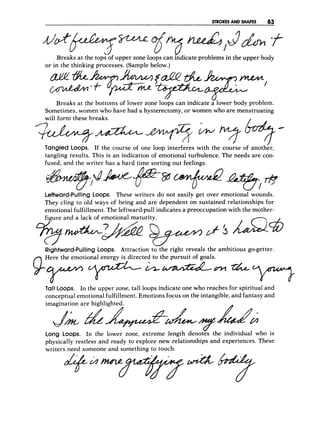
eager to hear what you have to say.
When you have this opportunity of getting the sample yourself, get it on unlined
paper so the writer can choose the spacing. We recommend you use a consistent size
and weight of paper: this will enable you to get an accurate size, spacing and
pressure comparison between samples.
To ensure yourself the most accurate analysis possible, have the writer use a
ballpoint pen. These pens or very sharp pencils show many aspects of writing that a
felt tip pen or dull pencil will blur. Some individuals have a favorite pen they always
use. If so, let them use it, because such a preference will give you additional infor-
mation. The best colors of ink for future reproduction purposes are black and red,
while blue doesn’t photocopy well at all: Keep this in mind, for one day you may
want to make copies of some of your samples.
Ask your writers to pen at least two paragraphs, sign and date the sample. Some
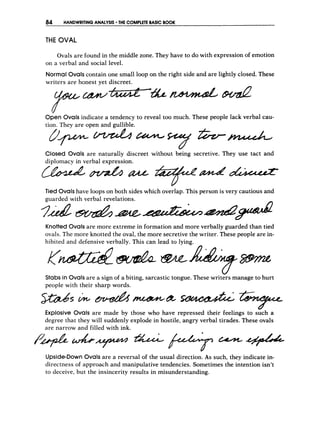
people find it easy to think of something to say, while others don’t know what to
write and get nervous. (Already this tells you something.) To help, you can suggest
they write a letter to themselves relating something they’ve seen or done recently, or
describe what they see around them at the moment, or you can dictate something.
Tell them that it really doesn’t matter what they say-which it doesn’t-and that you
will be analyzing how they write, not the content itself.
In fact, when you observe a writing, it is a good idea not to read it until you have
received your graphological impressions based on the look of the writing. Often the
verbal content is distracting or even false (people will sometimes try to fool you),
and to read the sample too soon may reduce the accuracy of your interpretation.
Somewhere on the sample make a note of the date on which it was written and
the age, sex and handedness of the writer. This is pertinent information that can’t
usually be determined from the writing, and you’ll find it valuable to your analysis
and in building your collection of samples.
When the writer or someone who knows him well is present for the analysis, be
sure to jot down whatever personal information you receive as you progress. The
176 HANDWRITING ANALYSIS THE COMPLETE BASIC BOOK
graphological facts will always be there to see, but the personal history of the writer
can only be told by him or by those who are acquainted with him. Staple this infor-
mation to the sample.
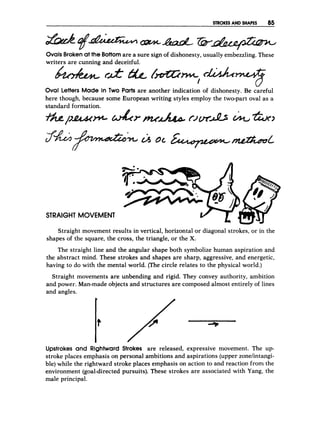
You’llbe tempted to mark on your samples as you make observations. Don’t do
it. It alters the original clarity. Instead, we suggest the tracing paper method. Place a
sheet about the same size over the sample and affix it with staples or tape. Then on
that surface you can circle any traits that seem unusual, draw lines to determine
slant, underline words or phrases that stand out-all without changing your sample
from its original condition.
Establish a good filing system right from the start. Some people prefer to file
alphabetically by name, others do so by personal association such as family.
Another good system is to file by outstanding traits revealed by the writing, such as
violence, instability, conventionality, illness, dishonesty, or by rhythmic distur-
bance, inflated loops or zonal extremes. Tt doesn’t matter what system you use, as
long as it provides you access to that certain sample when you want to see it.
When you are doing someone’s analysis and other people are present, respect
the privacy and feelings of the writer. If you are alone with the person, you have the
opportunity to be more specific. Most people will ask to hear the bad things about
themselves as well as the good things, but may not wish to hear them in front of
others.
Most of the time, it will be the writing itself which will tell you what tone to take
as you deliver your analysis. A very rightward slant with a tall, loopy d and a vulner-
able personal pronoun I warns you of an extremely sensitive nature. Be aware of
this. Use tact in your delivery. On the other hand, a vertical slant with many stick
figures and strong pressure shows you a writer who can roll with the punches.
Practice analyzing your own writing. Whenever something new appears, think
about how you are feeling as you write. You’ll learn a lot fhis way.
Always be honest. If you see characteristics you don’t wish to discuss, avoid
doing so, but don’t be tempted to flatter the writer at the expense of graphological
truth.
TIPS AND GUIDELINESFOR DOING YOUR OWN ANALYSIS 177
PROCEDURE F
O
R ANALYSIS
The observation chart on the following pages is meant for your use as an aid in
doing analysis. We suggest you make copies of these pages before using them so you
will always have blanks to work with.
First, scan the sample for a few minutes without writing anything down. Keep
yourself open and try not to focus on any particular formation. How do you react to
the writing? Once you have received an overall impact of impressions, begin to
notice what it is about the writing that makes it different-uniquely its own. Look
for extremes, such as very small or very large writing, bizarre spacing, unusual for-
mations, odd proportions, erratic pressure or slant. Make a note of these. The
importance of your first impressions can’t be overemphasized. Often they are ama-
zingly accurate.
Now you are ready to use your checklist of characteristics. As you examine your
sample, place a check next to each characteristic that fits, You should contemplate
the checklist before trying to come to any conclusion about what each trait means.
When you have finished, go back to the beginning of the list and jot down the per-
sonal meaning associated with the graphological traits you’ve found. You should
always be aware that one trait can modify or shade the meaning of another. The
writing as a whole picture is more important than any tiny detail.
Name:
H
A
N
D
W
R
I
T
I
N
GANALYSIS O
B
S
E
R
V
A
T
I
O
NC
H
A
R
T
Age: Sex: Date of Sample:
First Impressions,overall look, personal reactions, graphologicalextremes:
Systematic Checklist: Check all the characteristics you can observe in each area.
Z
O
N
E
S - Indicatorsof inner balanceand character.
balanced
dominating UZ
dominating MZ
dominating LZ
-dominating UZ and LZ
erratic proportion
additional zonal observations:
BASELINE - Measure of temperament, mood level and quality of social control.
straight
rigid
-sinuous
rising
falling
other observations:
SLANT - Social orientation and degree of emotional expression.
vertical
i.ncIined
very inclined
extremely inclined
reclined
very reclined
unstable
additional slant observations:
-extremely reclined
PRESSURE - Intensity of energy, how displayed, sensuality of the writer
___ medium
heavy
light
average width
thick
thin
-shaded
pastiose
very pastiose
additional pressure observations:
___ sharp
SIZE - Emphasis placed by the writer on his own importance.
-average
-large
small
variabIe
other size observations
SPACING - Relationship between the writer and other people or situations.
narrow letters
wide letters
letters close together
letters wide apart
words close together
words wide apart
lines close together
lines far apart
tangling between lines
rigid spacing
irregular spacing
wide margins
narrow margins
other margin observations:
other spatial observations:
SPEED - Mentaland physicalagilty
fast
slow
(179
RHYTHM and FORM QUALITY - Balanceand harmony within the self and betweenthe self and the
world at large; personal style of expression.
good rhythm
bad rhythm
.
- embellished
-- simplified
___ negl8Cted
other rhythmic observations:
other form level observations:
STROKES and SHAPES - Qualities of activity, thought, expression and communication.
Overall look:
round
-angular
~-
threaded
-mixed
loops - what kind?
-stick-figurestrokes
Ovals:
___ open
closed
-knotted
lead-ins- what kind?
endings - what kind?
garland
arcaded
-angular
-threaded
-mixed
-very connected writing
-mostly connected writing
disconnected writing
___ totally disconnected writing
printing
other observations:
ConnectingStrokes:
180
What do you observe about the following:
personal pronoun “I”:
small letter “d”:
t-bars:
I-dotsi
the signature:
capital letter formations:
small letter formations:
the “y” and the “g”:
Are there signs of emotional distress?
Are there signs of dishonesty?
Any other special considerations?
SUMMATION:
Bib1iograPhY
GENERAL REFERENCE
Bunker, M. N. Handwriting Analysis - The Science of Determining Personality by
Graphoanalysis. Nelson-Hall Co., Publishers, 1974. Founder, International Grapho-
analysis Society. Uneven and chatty.
Falcon, Hal, Ph.D. How to Analyze Handwriting. Trident Press. 1964.General anec-
dotal discussion with chapters on determining whether one is eye, ear, or action-
minded.
French, William Leslie. Graphoanalysis - Your Handwriting and What It Means.
Newcastle Publishing Co., 1974. Vague and chatty with samples of famous people.
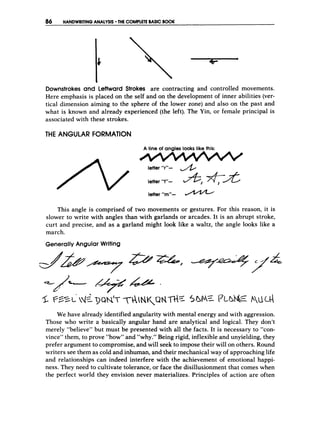
Hartford, Huntington. You Are What You Write. Macmillan Publishing Co. Inc.,
1973. Mr. Hartford is the founder of The Handwriting Institute in New York City.
Summarizes leading graphologists through history. Recommended.
Jacoby, H. J. Analysis of Handwriting - A n Introduction to Scientific Graphology.
George Allen & Unwin Ltd., 1968. Chapters on children, criminology, vocational
guidance. Not enough samples for illustration.
Le Guen, Monique. Graphdogy. Media Books S.A. Nyon, 1976.Visually elegant book
with unusual chapter on international handwriting styles.
Marcuse, Irene, Ph.D. Guide to Personality Through Your Handwriting. Arc0
Publishing Company, Inc. 1974. Children and adolescents, mental disorders,
criminal tendencies. Special section on famous composers through history.
Olyanova, Nadya. Handwriting Tells. Wilshire Book Company, 1973. Intuitive and
experienced woman. Recommended.
Olyanova, Nadya. The Psychology of Handwriting - Secrets of Handwriting Analysis.
Wilshire Book Company, 1973. Many examples by famous personalities. Chapters
on emotional and physical illness. Recommended.
Rosen, Billie Pesin. The Science of Handwriting Analysis - A Guide to Character and
Personality. Paperback Library, Inc., 1968. Chapters on Criminology. Recom-
mended.
Smith, Albert J. Applied Graphology - A Textbook on CharacterAnalysis From Hand-
writing. The Gregg Publishing Company, 1920. Appendix gives personality traits
alphabetically with corresponding writing traits.
182
BIBLIOGRAPHY 183
Solomon, Shirl. How to Really Know Yourself Through Your Handwriting. Tap-
linger Publishing Company, 1973. An individual approach to letter formation
through geometric symbols - circle, triangle, square and squiggle.
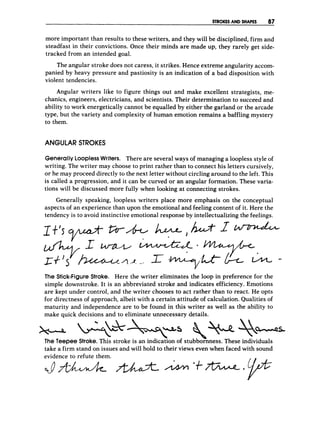
Teltscher, Dr. Herry 0. Handwriting, Revelation of Self -A Source Book of Psycho-
graphology. Hawthorn Books, 1971.Touches on children’s writings, personnel selec-
tion, criminology, growth and decline of personality.
INTRODUCTORY
Holder, Robert. You Can Analyze Handwriting - A Practical Tool for Self-knowledge
and Personal Power. Wilshire Book Company, 1974..Lists general personality types
with corresponding writing traits,
Hughes, Albert E. Self-analysis From Your Handwriting. Grosset & Dunlap, 1966.
Chapters on intelligence, unreliability and dishonesty.
Marley, John. Handwriting Analysis Made Easy. Wilshire Book Co., 1976.Very basic
with lists of positive and negative personality traits.
Martin, Renee. Your Script is Showing. Western Publishing Co., Inc., 1969.
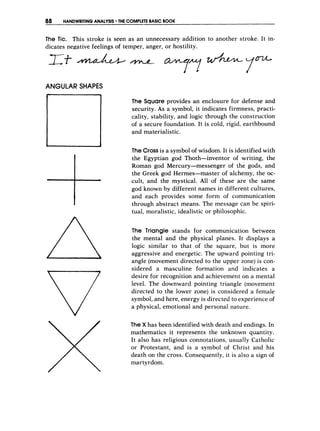
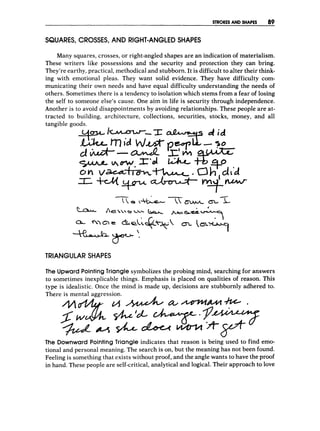
Meyer, Jerome S. The Handwriting Analyzer. Simon & Schuster, 1974. Workbook
format with tables and charts - especially good one on letter specifics.
Paterson, Jane. Interpreting Handwriting. David McKay Company Inc., 1976.
Precisely presented basic format.
Sara, Dorothy. Personality and Penmanship - A Guide to Handwriting Analysis. H.C.
Publishers, Inc., 1969. Very simplistic. A chapter on doodles.
TECHNICAL
Allport, Gordon. Studies in Expressive Movement. The Macmillan Company, 1933.
Mendel, A. 0. Personality in Handwriting - A Handbook of American Graphology.
Stephen Daye Press, New York, 1947. Chapters on psychopathology plus a section
by Alfred Kanfer on physiology and pathology. Recommended.
Pulver, Max. Symbolism of Handwriting. Orell Fussli Verlag, 1931.Gives a symbolic
meaning to the writing space.
Roman, Klara. The Encyclopedia of the Written Word - A Lexicon for Graphology
and Other Aspects of Writing. Frederick Ungar Publishing Co., 1968.Dictionary for-
mat combines definition with discussion.
104 HANDWRITINGANALYSIS THECOMPLETE
BASIC BOOK
Roman, Klara. Handwriting,A Key to Personality. Noonday Press, 1952.Chapters on
children and adolescents. Mrs. Roman is a Ph.D. in psychology and has taught
graphology at the New School for Social Research, New York. Highly recom-
mended.
Saudek, Robert. The Psychology of Handwriting. George Alien and Unwin Ltd., 1925.
Sohnemann, Ulrich, Ph.D. Handwriting Analysis as a Psychodiagnostic Tool. Grune
and Stratton, Inc. 1950. Professor at The New School for Social Research, New
York. Complex and rewarding. Highly recommended.
Wolff, Werner, Ph.D. Diagrams of the Unconscious-Handwriting and Personality in
Measurement, Experiment and Analysis. Grune & Stratton, 1948.Pioneer work with
signatures. Professor of Psychology, Bard College,Annandale-on-Hudson.Technical
but excellent.
SPECIAL INTEREST
Currer-Briggs, Noel, Kennett, Brian, and Patterson, Jane. Handwriting Analysis in
Business - The Use of Graphology in Personnel Selection. Associated Business Pro-
grammes, 1971. Excellent samples and analysis.
De Sainte Colombe, Paul. Grapho-Therapeutics: The Pen and Pencil Therapy.
Popular Library 1972. How to change your personality through handwriting.
Friedenhain, Paula. Write and Reveal - Interpretation of Handwriting. Peter Owen
Ltd. Saudek’s technique of analysis with chapters on the writing and drawing of
deaf and normal children.
Green, Jane Nugent. You and Your Private I - GraphologicalAnalysis focused on the
Personal Pronoun I. Llewellyn Publications, 1975.
Holder, Robert. Sex, Health and Your Handwriting. Award Books, New York, 1971.
A very generalized text with good samples.
Kaminsky, A. R. Behold: the Inner Universe of Handwriting. O’Sullivan Woodside
and Company, 1974. Personal anecdotes by a man who can construct physical ap-
pearance from handwriting.
Marcuse, Irene. Guide to the Disturbed Personality Through Handwriting. Arc0
Publishing Co., 1’969.
M-oretti, Girolamo. The Saints Through Their Handwriting. The Macmillan Com-
pany, 1964. Catholic bias.
BIBUOGRAPHY 185
Pelton, Robert W. Handwriting and Drawings Reveal Your Child’s Personality.
Hawthorn Books,Inc. 1973.
Solomon, Shirl. Knowing Your Child Through His Handwriting and Drawings.
Crown Publishers.Inc. New York. 1978.
This page intentionally left blank
Index
Page numbers for the handwriting
examples are printed in italics.
Abnormalities, physical, 8
Academic community, v
Adler, Dr. Alfred (psychologist), 46
Adolescents’ handwriting, 172- 174
revealed in handwriting, 8
clannishness, 173
disturbed, 174
experimentation, 173
rhythmic disturbance, 173
Aggression, 86, 102
mental, 89, 90
physical, 90, 104, 120, 137, 139, 140
sexual, 141
social, 103
Alcohol, problem of, 71-72, 142
Ambition, 18, 83, 85, 86, 90, 100, 119, 126,
Amorality, 118
Analysis, handwriting, v
diagnosing illness, v
doing your own, 175-181
AnguIar formations, 4, 86, 140, 146
connectors, 103
extreme, 152, 158
letters, 150
shapes, 4, 88
shark’s tooth, 253
strokes, 86, 87-88
connectors, 102-103
extreme, 148
prominent, 58
capitals, 136
manual dexterity, 122
Asimov, Isaac (writer), 95
Audience, need for, 13, 80, 102, 105
Austerity, 139
Authoritarian, 79
127
Arcade formation, 4, 79-80
Artistic ability, 42, 44, 54, 55, 80, 104, 109
Balance, rhythmic, 9
personal maturity and, 9
Balzac (novelist),48
Baselines, 2, 9, 17-25, 26, 145, 157
characteristics, 9
drug use and, 71
ego-adjustment line, 17
levelness, 17
normal, 145
types, 17-19
unsteadiness, 17
Beethoven, Ludwig von, 65, 65
Berkowitz, David (killer), 162
Bill, Max (artist), 95
Biological drives, 19. See also Sexual
Bismarck, Prince Otto von, Schonhausen
Bonaparte, Napoleon (French leader), 74
Bond, Julian (Georgia congressman), 35
Breaks, MZ letters, 16
Brown, Edmund G., Jr. (California gover-
Browning, Robert (poet), 74
Bryant, Anita (singerlcrusader), 111
Burnett, Carol (entertainer), 36
traits
(German chancellor), 96
nor), 34
Capital letters, 136
evaluation, 136
exaggerated, 150
misplaced, 152
tall, 147
Carelessness, 57, 101, 120, 121
Carr, Vikki (singer), 112
Carroll, Diahann (singer), 123
Carter
Amy (President’s daughter), 34
Jimrny (President), 63
Rosalyn (First Lady), 63
Casanova, Giovanni (adventurer/lover),46
Castro, Fidel (Cuban leader), 160
Characteristics, handwriting, 1
Character traits in handwriting, iv, 1. See
Check-mark, 154
Children’s handwriting, 163-174
aZso specific trait checklist, 178-181
adolescents, 172-174
authority, the child and, 166-167
defenses, 168-169
detecting fears, 167-168
disturbed adolescents, 174
fifth grade, 164-166
107
188 HANDWRITINGANALYSIS THE COMPLETE BASICB W K
infant to third grade, 163-164
profiles, 170-172
self-image, 168-169
circles, 85
exaggerated, 81
feminine trait, 81
Clannishness, 173
Clubs, 21, 119, 122, 151, 152
capacity for cruelty, 20
Cody, Buffalo Bill (entertainer), 75
Colette (author), 23
Collectors, 78
Communicate, desire to, 56, 77
Compassionate, 81
Connectedness, 5, 102-105, 158
Circular strokes and shapes, 81
between words, 107
extreme, 106- 107
mixed strokes, 103-105
partial, 107
pure types, 102-103
and speech, 105
Conscience, 10-1 1, 12
Conservative, 78, 116, 137
Contrariness, 140
Conventional attitudes, 97, 137
Cox, Archibald (attorney), 111
Crawford, Joan (actress), 61
Creativity, 15, 42, 53, 66, 71, 80, 81, 93, 98,
Criminology, handwriting expert, iv
Cross, 88, 89
Culture, 139
104, 109, 127, 128
avant garde, 107
symbolism, 88
aspires to, 139
g and e, 138
love of, 118
circle, 76
circular strokes, shapes, 81
garland, 77-79
oval, 84-85
symbolism, 76
Curved movement, 76-85
loop, 81-83
d, 117-118
clubbed, 152
danger signs, 159
felon’s claw, 118, 146, 159, 173
maniacal, 152, 159
over-sensitive, with I, 153
Danger signs, 144-162
dishonesty, 144-150
emotional instability, 155- 162
violence, 150-1 55
Davis, Bette (actress), 35
Davis, Sammy, Jr. (entertainer), 128
Defenses, childhood, 168-169
Defiant k, 153
Dependence, 12, 33, 52, 81, 104, 116, 117,
Depth, 7, 37. See also Pressure
De Sade, Marquis (soldierlpervert), 46
Determination, 21, 100
Dickens, Charles (writer), 128
Dickinson, Emily (poetess), 62
Diebenkorn, Richard (artist), 96
Dignity, 117
Dillinger, John (criminal), 36
Discipline problem, 167
Disconnectedness, 105, 108-110, 158
120
rhythm and, 64
printing, 109-1 10
total, 109
Discreet, 84
Dishonesty, 80, 85, 91, 101, 139, 144-150.
potential for, 16
Disney, Walt (artist), 124
Doing your own analysis, 175-181
checklist of characteristics, 178-181
collecting samples, 175
getting sample, 175
ink, 175
procedures, 177
sensitive subjects, 176
tracing paper method, 176
Dot following signature, 132
Dotting, 43
Downstrokes (contracting),37, 38, 65, 86
willpower, 1
Dressler, Marie (entertainer), 96
Drug use, 71, 90
See also Negative traits
Earhart, Amelia (aviatrix), 6
Eccentric, 80, 91, 98, 117, 118, 121, 132
Eddy, Mary Baker (religious leader), 125
Edison, Thomas A. (inventor), 74
Efficiency, 87, 103, 187
Ego, 1, 8, 9, 114, 115. See also Self-image
deformed, 115
instinctual drives, 8
intellectual/spiritual sphere, 8
life force of, 37
major areas, 8
social self, 8
zonal balance and, 9
Egocentrism, 51, 108, 128. See also Self-
centered
egoistic, 101
ego-loss, 132
Einstein, Albert, 15, 15, 92
Elaborated
I, 115
slow writing, 60
Embellishment, 136, 148. See also Orna-
mentation
INDEX ,,, 189
Emotional traits
aloofness, 30
anxiety, 39, 44, 68, 69, 82, 131, 147
balance, 103
children’s, 166, 167-169
compulsiveness, 15, 106
confusion, 53
defensive, 22, 105
depression, 18, 19, 56, 58, 67, 69, 132,
141, 166, 168
disorders, 20
disorganized, 66, 67
distrust, 132
drug use, 44,71
erratic, 31
excitable, 18
exhibitionistic, 98
expression of, 84
extreme reactions, 118
factors of, iii-iv
fearful, 118, 120, 121
fears, 132, 142, 167-168
feels threatened, 80, 102
feels victimized, 100
fulfilhent, 83
guilt feelings, 78, 90, 98, 110
hostility, 98, 99, 115, 116, 127
hypersensitive, 121
hysteria, 39
immaturity, 66, 68, 71, 81, 83, 110, 127,
impulsive, 55, 57, 71, 122, 127
indecisive, 93
inhibition, 17, 38, 82, 127, 139
insensitive, 110
instability, 110, 120, 122, 144, 147, 155-
intensity, 165
jealousy, 81, 165, 167
loops and, 13
manipulative, 84
martyrdom, 90
maturity, 66, 67
narcissistic, 118, 122
self-limiting, 107
sensitivity, 39, 56, 91, 108, 117, 122, 176
stunted expression, 82
temper tantrums, 167
uninhibited, 40, 55
“volcano,” 30
Emotional types, 81
Ending strokes, 5, 99-102, 158
absence of, 100
downward, 151
types, 99- 102
ambition, 97
healthy vitality, 39
lack of, 19, 79
138
162
Energy, 18, 38, 42, 87, 101
mental, 86
split, 39
avoidance of, 31
righthand direction, 31
Enthusiasm, 49, 119, 120, 121
Environment, contact with, 26, 31
Evasion, 91
Fairbanks, Douglas (actor), 23
Fame, desire for, 57
Famous people’s signatures, 130-135. See
also specific names
Fantasy, 10, 11, 12, 83
Fatigue, 18, 69
Fawcett, Farrah (actress), 95
Feeling about specific word, 18
Felon’s claw, 118, 146, 159, 173
Fonda, Henry (actor), 95
Force, degree of, 37-40. See also Pressure
energy indicator, 37, 38
feeling original sample, 37
maintaining, 38
Form quality, 64-72
alcohol and, 71-72
capitals, 136
drugs and, 71-72
evaluation, 65
illness and, 69-70
mature, 66
poor, 66-67
rigid, 68
France, v
Franklin, Benjamin (statesrnah); 128
Freud, Sigmund (psychologist),8, 73
Fromme, Lynette “Squeaky” (Marison
Frost, Robert (poet), 112
Future, goals in, 54, 106. See also Goals
Gang member), 161
fear of, 56
Galsworthy, John (author), 24
Garland formation, 4, 77-79, 146
connectors, 102
drooping, 158
types, 77-79
Gavin, James M. (actor), 129
Generostiy, 100, 137, 139
Genius, 65, 92, 108
Germany, v
Gielgud, John (actor),129
Gilmore, Gary (killer), 161
Goals, 12, 120, 137
conflicting, 119
Good taste, 137
Graphologists, iv, 65, 136
positive or negative interpretations, 65
Graphology, iv, v
diagnostic tool, v
psychology and, v
190 HANDWRITINGANALYSIS THECOMPLETE
BASIC
BOOK
Greek d, 118
Greek e, 67, 139
Grogan, Steve (Manson Gang member), 161
Hamilton, Lady (wife of Lord Nelson), 47
Handwriting expert. See also Graphologist
“examiner of questioned documents,” iv
licensed, iv
profiles, children’s, 170-172
study, iv
two identical, iii
Haste, 101, 120, 140
Hauptman, Bruno (criminal), 225
de Havilland, Qlivia (actress), 94
Hayes, Bill (actor), 24, 128
Head-over-heart, 28-29
Health, emotional, 29
Healthy writing, 70
Hearst, Patricia (kidnapped heiress), 34
Height, letters, 64
Hermes, 88
Himmler, Heinrich (Nazi), 47
Holmes, Qliver Wendell (poet), 75
Honesty, 84
Handwriting, pattern, 7
and dishonesty, 144-150
forgers, 150
liars and lying, 147-148
samples showing dishonesty, 148-150
Hooks, 149, 158
Horizontal dimension, 1, 7. See also Slant;
Width
left movement, 86, 158
rightward stroke, 85
slashes, dashes, 158
strokes, pressure of, 1, 39
Hubbard, L. Ron (religious leader), 223
Humor, sense of, 14, 98, 120, 122, 137, 139
I (personal pronoun), 114-1 17
danger signs, 159
reclined, 33
signature and, 126
specifics, 115-1 17
Idealism, 40, 45, 100
i-dot, 121-122
Illegible writing, 145, 157
Illness indications
overdevelopment of zone, 10
shown in handwriting, 8
Illness, mental, 44, 60, 70,82, 83, 118, 127,
145,
disturbed adolescents, 174
hysteria, 93
manic, 102
martyr complex, 139
masochistic, 78
neurotic, 118, 121
paranoid, 39
pathological liar, 147
schizoid, 39
Illness, physical, 20, 44,69, 70, 1IS, 117,
142
circulatory, 70
clues to, v
heart disease, 70
middle body injury, 70
motor control, loss, 165-166
nerve damage, v, 70
Parkinson’s disease, 75
speech defects, 105
Illusion, 10
Imagination, 10, 80
Immaturity, signs of, 66, 68, 71, 81, 83,
110, 127, 138
lead-in strokes, 71
t-bars, 71
tics, 71
loops, 71
Impracticality, indicator of, 16
Impressionable, 18, 38, 78, 91
Inclined slant, 29-30
Inconsistency, 31, 103
Independence, 15, 21, 30, 50, 89, 115, 116,
Individualist, 108, 109
Infant-young child scribbles, 163-164
Inferiority feelings, 80
Inflated numbers, 149
Inhibition, 17, 38, 82, 127, 139
117, 167
intellectual, 13
lack of, 40, 55
Inking patterns, 7, 37, 43
Instability, 18. See also Emotional traits
Instinctual urges, 8, 19, 140
Intelligence, 8, 42, 45, 50, 92, 99. See also
Thinking
concentration, 50
modesty, 50
Introspective person, 50
Jerks and tremors, MZ letters, 16
Johnson, Lady Bird (former First Lady), 36
Julian, Leroy (adventurer),95
Lyndon, family, 225
Kafka, Franz (author), 225
Keller, Helen (famous blind deaf-mute),
Kennedy
212
Jacqueline (former First Lady), 113, 129
John (former President), 113
Ted (politician), 25
Key words and phrases, 59
change of writing pace, 60
Knight, Arthur (film critic), 24
Lack of discipline,,49, 55
Lamarr, Hedy (actress), 25
Landers, Ann (columnist), 128
Lazy, 104
carelessness, 57, 101, 120, 121
INDEX 191
Lead-in strokes, 5, 97-99
absence of, 98
Palmer method, 97
types, 98-99
Lee, Robert E. (Confederate general), 111
Left-handed writing, 32
printing and, 109
Leftward strokes, 86
Legibility, 57, 59, 65, 92
Leibniz (scientist), 125
Lemmon, Jack (actor), 96
Lennon, John (musician), 35
Letter form quality, 4
Letters
signature, 127
bizarre, 153
broken, 146
corrected, 146, 152
maniacal, 152
middle zone size, 152
splinting, 156
squaring, 158
Letter shapes, 4
Letter specifics, 136-143
capitals, 136-137
small letters, 137-140
three kinds of thinkers, 138-140
y, sexual aspects, 140-143
Levin, Arnie (artist), 124
Lewis, Jerry (actor), 23
Liars and lying, 84, 147-148
Life-space, individual, 7
Lincoln, Abraham (president), 73
Line slope, 1
Lodge, Henry Cabot (politician), 25
Longfellow, Henry Wadsworth (writer), 36
Loopless writing, 87
emotion and, 13
lower zone, 69, 140, 158
overinflated upper, 147
upper zone, 12, 14, 147
Loren, Sophia (actress), 94
Lower zone (LZ), 8, 11, 19-22, 116, 140
biological urges, 140
dominant, 10, 20
long stick figures, 22
normal, 19
pull to left, 33
pull to right, 33
retracing, 21
short stick figures, 21
stunted, 20
triangles, 22
variety in forms, 22
pathological, 147
signs of, 147-148
LOOPS,13, 81-84, 157
Ludwig I1 (“Mad” king), 260
m, 138
Manual dexterity, 122, 140
Margins, 54-56, 154, 157
inattention to, 153
left, 54, 55
meanings of, 55-56
right, 54, 55
Marie Antoinette (Queen of France), 48
Marshall, Peter (television host), 96
Martin, Mary (dancerlactress), 95
Materialism, 19, 55, 56, 89, 100, 102, 120,
122, 137, 141, 142, 144
extravagance, 53, 100
frugality, 100, 101
money involvement, 117
possessiveness, 81
stinginess, 53, 55
traits
lackof, 102
personal, 9
Maturity, 98, 118. See also Emotional
McGovern, George (politician), 129
McQueen, Steve (actor), 96
Medical diagnoses
handwriting clues, v
Memory, good, 80, 100, 121
Menninger, Karl (psychiatrist), 125
Mercury (Greek god), 88
Michelangelo (artist), 73
Middle zone (MZ),9, 11, 147
characteristics, specific, 14-19
dominant, 10
dwarfed, 15
fluctuation, letter size, 16, 152
jerks, breaks, 16
letters, 70
normal, 14-15
small, 15
tangling, 15, 16
Miller, Henry (writer), 48
Mills, Wilbur (senator),129
Mimic, 121
Modesty, 126
Monroe, Marilyn (actress), 47
Mood, 131
changes, reflected in handwriting, iii
level, 1
stability, 16
Moodiness, 54
Moore, Clement (poet), 62
Moral standards, 2, 100
Morals line, 2, 9. See also Baseline
Movement, dimensions
horizontal, 26
leftlright, 26
pressure, 7
slant, 7
vertical, 7-25
zones, 7-25
Mozart (musician), 225
Musicians, 44
Muskie, Ed (Secretary of State), 229
192 HANDWRITINGANALYSIS .THE COMPLETE BASIC BOOK
n, 138
Naive example, last, viii
Naivete, 79, 118
Nasser, Gamal Abdul (Egyptian president),
128
Negative traits. See also Emotional traits;
Dishonesty; Self-destructive traits
alcoholic, 71-72
anger, 88
bad temper, 88, 101
brutality, 101, 119
criminal, 104, 118, 174
cruelty, 119, 120, 122
deceit, 167
dishonesty, 1 6 80, 85, 91, 101, 139, 144-
drug use, 71
emotional instability, 155-162
fanaticism, 127
follower, classic, 174
forger, 50
greed, 149
hostility, 88, 98, 99
intolerance, 108
liars, lying, 147-148
pugnacity, 122
sadism, 101
victim, desire to be, 120
violence, 101, 139, 150-155
Neglected writing, 4, 66, 67
Nelson, Lord Horatio (military com-
mander), 47
Neurotic infantilism, 20. See also Emo-
tional traits; Illness, mental
Newton, Isaac (philosopherlmathemati-
cian), 47
Nietzsche, Friedrich (German philoso-
pher), 160
Nixon
150
family, 124
Patricia (former First Lady), 111
Richard (former President), 160
Nobel, Alfred (philanthropist), 123
Oberon, Merle (actress), 124
Odum, Floyd (victim of Parkinson’s
O’Keefe, Georgia (artist),23
Old age, 68-69
normal, 69
Olivier, Lawrence (actor), 96
Optimism, 18, 19
Orientation, writer’s
external, 26
Originality of thought, 14
Ornamentation, 4, 66, 148. See also Em-
disease), 75
bellishment
overembellished writing, 57, 67
Oswald, Lee Harvey (alleged assassin), 162
Ovals, 84-85
knotted, 157
tiny, ink-filled, 152, 157
Overcontrol, 53
p (athletic), 138
Page, writing, 7
harmony with, 7
Palmer method, 5, 64, 97, 105, 106, 121,
Parental influence
denial of, 116
identification with father, 116
mother’s, 30, 31, 33, 83, 100, 143
personal pronoun I and, 114, 115, f 16
young children, 166
resistance, 40
avoidance, 55, 56
escaping, 57
writer’s, 30, 31, 54, 55, 57, 90
Pastiosity, 3, 37, 43-45, 87, 140, 157
pen failure and, 43
Pauling, Linus (scientist), 124
Pen or pencil choice, 41
Perfectionist, 15, 104
Personality, 1, 17
development, iv, 8
influences or&17
Pessimistic, 58
Physical traits, 81, 102
action, love of, 90
activity drives, 99, 139
biological drives, 19
body movement, 98, 137
fatigue, 131
fragility, 40
health, 131
hyper-activity, 166
inhibited, 137
restlessness, 22, 83, 106, 108, 167
sexuality, 140-143. See also Sexual
sports, love of, 139
tests, handwriting, v
uninhibited, 137
weakness, 45
writing process, iii, iv, v
Pickford, Mary (actress), 95
Pictographs, graphology, 1-5
Poetic, 137, 142
Polanski, Roman (movie director), 128
Pompadour, Madame de (mistress of King
Louis XV), 113
Pope John XI11 (ecclesiastic),25
Power drive, 10, 50
Practicality, 12, 21, 106, 121, 139
Practical joker, 121
140, 141, 163, 164
Passive personality, 77, 78, 101
Past, 127
traits
INDEX 193
Presley, Elvis (singer), 75
Pressure (depth), 7, 37-48, 64, 87, 140. See
also Force
aspects, 45
danger signs, 144, 145, 147, 150, 157
erratic, 69, 71, 72, 147
feeling for, 37
force, degree of, 37-40
heavy, 38-39, 150-151
pastiosity, 43-45
pattern, 70
sharp writing, 3, 37, 43, 45
width of stroke, 40-43
Presumptuousness, 14
Price, Vincent (actor),112
Pride, 38, 80, 126, 128
Printing, 87, 109-110, 115, 140, 158
aesthetic, 109
sudden change to, 153
writing and, 158
Procrastination, 120, 122
Protective, 79
Prudishness, 22, 140
Psychiatrists, v
Psychic distance, 108
Psychologists, v
r, 138, 140
Radziwill, Lee (sister of Jacqueline
Rand, Sally (fan dancer), 123
Reagan, Ronald (politician),24
Reassurance, need for, 12
Rebellious person, 55, 57, 80, 103, 109,
117, 118, 120, 140, 167
Reclined slant, 30-3 1
Redford, Robert (actor),94
Regulated handwriting, 65
Repression, 21, 30, 31, 33, 44, 68, 116. See
instinctual needs, 33
Reserved, 45, 56
Responses, normal emotional, 43, 102
normal sensual, 43
Responsive nature, 75
Reynolds, Burt (actor),94
Rhythm, 64-72
change, 64
contraction, 156
disturbances, 147, 153, 155, 156, 159
drugs and, 71
evaluating, 64-65
“heartbeat of handwriting,” 4
letter height, 64
release, 156
repetition, 64
smooth, 150
unstable, 66
Kennedy), 113
as compensation, 30
ulso Emotional traits
Richardson, Elliot (former Attorney
General), 112
Rightward stroke, 85
Rituals, 90
Roberts, Oral (religious leader), 35
Rockefeller, Nelson A. (former governor),
Rommel, Erwin (German general),25
Roosevelt, Franklin D.(former President),
Rorschach inkblot test, v
Roundedness, 147, 158
129
123
Sand, George (author),63
Savalas, Telly (actor),95
Secretive, 79, 80, 84, 100, 102, 104
Seeger, Pete (musician), 24
Self-assurance, 16
Self-awareness, 12
Self-centered, 50, 51, 109, 110, 128. See
also Egocentric
Self-confidence, 128
Self-control, 17, 79, 102, 120
overcontrol, 53
Self-destructive tendencies, 90-9 1, 101.
lack of, 66
See also Illness, mental; Negative
traits
accident-prone, 90
alcohol, 71-72, 90, 142
drugs, 71, 90
suicidal, 67, 90, 127
X-ing, 132
Self-discipline, 41, 45
lack of, 66, 91
Self-esteem, 54
Self-image, 11-12, 114-125, 126, 137
of being different, 14
broadminded, 51
i-dot, 121-122
narrow-minded, 51
personal pronoun I, 114-1 17
poor, 12,71
repression, 33
t-bars, 119-121
Self-interest, 30
Self-orientation, conceptual, 12
Self-protective, 116, 121, 128
Self-punishing, 118
Self-reliant, 38. See also Independence
Sensuality, 43, 44, 122
Sentimental, 42, 56, 78, 98
Sexual traits, 38, 44, 140-143
d, 117-118
aberration, 143
anger, 141, 142, 143
anxiety, 143
aspects of y, 138, 140-143
changes, need for, 142
494 HANDWRITINGANALYSIS THE COMPLETEBASICBOOK
dependency, 141, 142
disappointment, 142
drive, 141, 143
emotion a d , 140, 142
frustration, 142
guilt, 143
homosexuality, 118, 143
immaturity, 20, 122
inadequacy, 38
judgmental attitude, 22
normal, 141, 142
parents’ influence, 143
perversion, 142
prudishness, 22, 140
repression, 142
restlessness, 139, 142
sublimation, 141, 142, 143
unfulfilled, 54, 141, 142
unsettled focus, 22
“Virgin Mary” complex, 22, 140
Shading, 150
depth, 42-43
Sharp writing, 3, 37, 43, 45
Shrewdness, 144
Shriver, Eunice Kennedy (sister of former
Shyness, 100
Signatures, 126-1 35
capitals in, 128
danger signs, 159
direction, 131
encircled, 131
examples offamous people, 130-1 35
flamboyant, 147
legibility, 127, 131-132
over- and underscoring, 128
placement, 127
size, 126
slant, 126-127
Show-off, 121
President Kennedy), 112
Simplification of handwriting, 4, 60, 66,
136
neglect and, 67
speed and, 66
Simpson, 0. J. (athlete), 129
Sirhan Sirhan (assassin), 162
Sitwell, Sacheverell (author), 61
Size of letters, 49-51
capitals, 130
danger signs, 144, 145, 146, 152, 157
large, 49
measuring, 51
microscopic, 157
middle zone, 49
small, 50
variable, 50
Skelton, Red (comedian),25
Slant, 7, 26-36
angles, 26-28
body positioning, 32
characteristics, 28-3 1
danger signs, 144, 145, 147, 157
express the present, 26
handedness and, 31-32
I and, 114
inclined, 29-30
key words, 28
measuring, 27-28
personality and, 26
reclined, 30-3 1
specifics, 32-33
unstable, 31
vertical, 28-29
Slope, 7. See also Slant
Slyness, 79
Small letters, 137-138, 139-140
Smith, Kate (musician),24
Social traits, 8, 26, 56, 77, 105, 106
aloofness, 55, 56, 80, 165
antisocial, 100, 104, 109, 145
attention, need for, 49, 52, 77, 127, 136
avoiding relationships, 89, 108
bad disposition, 87
balanced, 51, 52
caution, 127
competitive, 103, 109
confusion, roles, 110
cooperative, 57
diplomacy, 92
extroverts, 51, 99, 102
fearful, 52
friendly, 100, 104, 118
inconsiderate, 55,91
inferiority, feeling of, 31
introverts, 51, 100, 109, 121, 127
isolation, 53, 109
lefthanders, 32
motivation, 104
privacy, need for, 52
repressed, 79
resentment, 145
reserve, 126, 128, 137
respect for others, 55
unsettled, 54
Space, area of, 1
envelopes, 56
margins, 54
Spacing, 51-58, 140
“American characteristic,” 51
between lines, 3, 52-53
between words, 3, 52
danger signs, 144, 145, 146, 157
envelopes, 56-58
margins, 54-56
rhythm and, 64
tangled, 146, 157
within words, 3, 51
Speck, Richard (murderer), 161
Speed, 4, 59-63, 105
aailitv and. 4
INDEX 195
change of pace, 60
curves, 59
fast writing, 60
slow writing, 59-60,145-147
Spine of letter, 65.See also Downstroke
Spiritual values, 8,43,45,83,120,121
lack of, 167
Spontaneity, 59-60,107
lack of, 68
Square, 88,89
symbolism, 88
Squaring, extreme, 158
Stability, 9
Stalin, Joseph (Russian leader), 160
Steinbeck, John (writer),34
Stevenson, Robert Louis (authodpoet), 35
Stokowski, Leopold (conductor),94
Straight movement, 85-86
Stravinsky, Igor (musician), 124
Strokes, 1, 37,146,147,149,158.See aIso
Downstrokes; Ending strokes; Up-
strokes
symbolism, 85
counter-, 146
pen or pencil, 4
1
retracing (cover), 146
slashing, 151
stick figure, 87
teepee, 87
threaded, 145
width, 40-43
Stubbornness, 87,101,104,116,118
Students, good, 106
Superego, 15.See also Conscience
Switzerland, v
Sympathetic, 8
1
Talent
Tangling, 149,157
impaired by neurosis, 117
coiling, 149
lines, 53
loops, 83
LZ, 20
MZ, 15,53
aesthetic sense, 56
clubbed, 151
danger signs, 159
heavy, 151
high, 147
types, 119-121
willpower and, 119
Taste, personal, 54
T-bars, 69,119-121,140,146
Tenacity, 38,100,137.See also Stubbornness
Tension, 165,167
affecting writing, 1
6
rigidity, 144,145
signs of, 68,144,147
Thackeray, William M. (writer),36
Theatrical, 102,105
Thinking, 52,85,90,93,98,100,101,105,
131
absentminded, 121
analytical, 86,89,105,106
broadminded, 103
concentration, 106,107,120,121
confused, 53,57,119
creative, 13, 138.See also Creativity
criticalhnvestigative, 122,136,138,140
decisive, 101,102
depressed, 55, 121
disorderly, 13,55,136
goal related, 99
gullible, 136,139
idealism, 56,89,116
imaginative, 99,108,121,122,165
immature, 138
inconsistent, 110
indecisive, 18,120
intelligent, 99,103,104,105,137,138,
intuitive, 80, 81,91,93,107,108
judgmental, 116,139
lively, 122
logical, 86,89,103,120,164
mathematical ability in, 139
memory and, 80,100, 121
optimistic, 55, 119
orderly, 52, 121
philosophic, 100
systematic, 105,106
three kinds, 138-140
warped, 167
139,140
30 year old mime (performer), 123
Thomas, Lowell (travel author), 128
Thoreau, Henry (author), 25
Thoth, 88
Threading, 146
connectors, 103
extreme, 158
inconsistent, 158
letter shapes, 4
movement, 91-93
Tic, 88
Time and space, 8
lefthight movement, 26
Tiny Tim (musician), 74
Tolstoy, Leo (author),65,65
Traditionalist, 79,103,136
Tranquilizers, 71
Thorazine, 71
Tremor, 156
Triangle, 88,89-91
symbolism, 88
Trudeau, Pierre (Canadian Prime
Tunney, John V. (Senator), 124
Twain, Mark (author), 23
25 year old woman, 73
Minister), 129
196 HANDWRITINGANALYSIS T
H
E COMPLETE BASICBOOK
Uninvolved, 103
Unstable slant, 31
Upper zone (UZ),8, 10-14, 147
aspirations, 8
balloon loops, 14
dominant, 10
height, 11
inflated loops, 12
normal, 10- 12
overextended, 11
pointed loops, 14
retraced formations, 13
self-awareness, 8
specific characteristics, 10
spirituallmental realm, 10-1 1
stick figures in, 12
tangling in, 13
very small, 11-12
broken loops, 82
Upstrokes (release), 37, 38, 65, 85
Valentina (clothes designer), 23
Vanity, 101, 116, 118, 136, 137, 139, 194
facade, 67
Verbal expression, 84, 85, 106
argumentative, 86, 120, 153
assertive, 122
critical, 102, 103, 104
effective, 102
gossip, 102
lying, 147-148
opinionated, 101
repression, 84
reticence, 118
sarcasm, 84, 101, 122, 140
secretive, 79, 80, 84, 100, 102, 104, 127,
132, 139, 144
sdpportive, 104
tactless, 137
talkative, 82, 102, 137, 139
Verdi, Giuseppe (composer), 46
Vertical dimension, 7-23. See also Zones
Vidal, Gore (writer), 96
Violence, 87, 150-155. See also Negative
slant, 29
traits
heavy pressure, 150-1 51
major signs, 150-151
minor signs, 153- 155
pastiosity, 150
Von Arnim, Bettina, 46
w (ambition), 138
Warhol, Andy (artist), 62
Washington, Booker T. (educator), 63
Wayne, John (actor), 129
Weaver, Dennis (actor), 34
Welch, Raquel (actress), 95
Welk, Lawrence (musician), 129
Westmoreland, General (military leader),
Width, rhythm and, 64. See also Hori-
Willpower, 39
123
zontal dimension
domineering, 119, 120
lack of, 104, 119, 120, 121
t-bars and, 119-12 1
Wolfe, Thomas (writer), 48
Words
capitals within, 152
retouching, 156
retraced, 152
spacing, 51-52
tapering, 150
Wright, Frank Lloyd (architect), 94
Wriston, Walter (bank president), 123
Writer of musical shows, 123
Writing
affected by tension, 16
artificial, 145
bizarre, 148
exaggerated forms, iv
inflated, 149
illegible, 145, 157
mindbody activity, v
printed, 153, 158,See also Printing
surface, resistance of, 37
two styles, 147
Slow, 59-60, 145, 147
x-ing, 154, 158
y, sexual aspects, 138, 140-143
Yang (male),76, 79, 85
Yin (female), 76, 79, 86
Young, Andrew (former U.N. delegate), 129
symbolism, 76
symbolism, 76
Zola, Emile (author),61
Zones, 7-25, 26
baselines, 8, 17-18
dominating, 147
graphology and, 9- 14
illness and, 69
imbalance, 156-1 57
lower, 8, 10, 19-25, 151, 158
middle, 8, 10, 14-16
normal balance between, 9-10
upper, 8, 10-13

Handwriting analysis

  • 2.
    Handwriting Analysis The CompZeteBasic Book NEW PAGE BOOKS A division of The Career Press, Inc. Franklin Lakes, NJ
  • 3.
    Copyright0 1980 byKaren Amend and Mary S. Ruiz All rights reserved under the Pan-American and International Copyright Conventions. This book may not be reproduced, in whole or in part, in any form or by any means electronic or mechanical, includ- ing photocopying, recording, or by any information storage and retrieval system now known or here- after invented,without written permission from the publisher,The Career Press. HANDWRITING ANALYSIS Printed in the U.S.A. by Book-mart Press ISBN 0-87877-050-X To order this title, please call toll-fiee I-800-CAREER-1 (NJ and Canada: 201-848-0310) to order using VISA or MasterCard,or for fbrther information on books fiom Career Press. The Career Press, Inc., 3 Tice Road, PO Box 687, Franklin Lakes, NJ 07417 The author of this book does not dispense medical advice nor prescribe the use of any technique as a form of treatment for medical problems without the advice of a physician, either directly or indirectly. The intent of the author is only to offer information.ofa generalnature to help you cooperate with your doctor in your mutual quest for health. In the event you use any of the information in this book for yourself,you are prescribing for yourselc which is your constitutional right, but the author and pub lisher assumeno responsibility for your actions. Library of CongressCataloging-in-Publicationinformationavailable upon request. To the Reader: The authors and editors of this manual have taken painstaking efforts to maintain the anonymity and rights of privacy of all persons whose handwriting samples appear herein. With respect to the hand- writing samples of any person who is not a public figure, such samples may in fact have been altered, for purposes of concealing their identity, and will not necessarily be actual examples of any person’s true penmanship. Notwithstanding this, if it occurs that any person is thought to be identified, on the basis of any handwriting sample contained herein, the reader should bear in mind that the text accom- panying each respective sample represents only the authors’ analysis of said sample, based on gener- ally acceptedgraphologicalprinciples, and makes no comment on the characterof any real person.
  • 4.
    Introduction In this closingquarter of the 20th century, we live in an era emphasizing the achievement of inner peace and harmony. Institutions, groups and individuals have dedicated themselves to helping others attain personal enlightenment and self awareness; synthesizing the mind and body into one smoothly functioning unit is the goal. Physical well-being is an indication of mental well-being,yet when we speak of the healthy individual, we refer to more than the akppearance of a trim, active and disease-free body. Some people have the ability to mask their mental and emotional instabilities with an external personality facade designed to give an impression of inner balance. Occasionally the facade is so complete that even the person himself is fooled and the communication with deeper needs and feelings is lost. The outer behavior protects the vulnerable self within; the individual has succeeded in con- structing a protective shield against the pain of negative experience. While we cannot read minds, we can see certain body movements. Tone of voice, gestures, posture, body structure and manner of dress can be interpreted as clues to inner psychological make-up and behavior. Often, the outer style reflects the inner one. It is possible through thoughtful observation to penetrate the disguise and re- veal the inner character behind the mask. Certain facial expressions are associated with certain moods. We can watch a conversation taking place inside a telephone booth and without a sound escaping, still sense the mood of the conversation. The caller tells all with facial expressions and body posture. Thus we demonstrate thoughts arid feelings through the silent yet expressive language of our bodies. Handwriting, too, is an expressive and silent gesture. As you write you are consciously attempting a message. Beyond the conscious information contained in the written words, the handwriting also divulges informa- tion about you and how you felt unconsciously as you wrote. Writing is a physical process. The brain sends an order through the nervous sys- tem to the arm, hand and fingers, where together they manipulate the writing tool. In this way, the intent to write forms deep within the creative processes of the mind and makes writing an expressive gesture representative of the mind behind the pen. Despite the teaching of a standard letter model to form the letters and words necessary to express our ideas, no two writings are exactly alike. An American statistician determined that the possibility of two writings being identical is one chance in 68 trillion!
  • 5.
    iV HANDWRITlNG ANALYSISTHE COMPLETE BASIC BOOK Every written sample displays the same wonderful variety as the Faces, finger- prints, voices and bodies of us all. We recognize our friends’voices on the phone, and by the tone alone know their state of happiness or sadness, anger or warmth. Handwriting is a reflection of mood changes, characterizing the writer’s state of mind at that moment. Emotional factors dictate the form of the writing stroke. It is possible to deter- mine personal behavior by studying the mannerisms of formation and spacing within a writing. Handwriting matures, grows or disintegrates along with the per- sonality, or with physical changes due to age, health, or tension. Personality devel- opment can be studied by examining samples penned at various times through the years. These examples provide a visual history of the development of a life emo- tionally, physically and mentally. The word “graphology” is a combination of the Greek word grapheirt, which means “to write,” and the suffix “ology,” a branch of scientific study. Graphology, then, is the study of writing based on a growing body of knowledge which is con- stantly being tested in practical use. Since it is a continuing and growing body of knowledge, and not a codified system like basic arithmetic, the student should not be alarmed to find varying, sometimes conflicting interpretations assigned to a stroke or shape. It is possible to understand writing character using different ap- proaches to the specific origins, just as the medical and psychological fields get re- sults even when starting from different positions. And like medicine, graphology is also an art of combining and synthesizing information that requires training and judgment in its application. This book gives the most widely accepted and most practical basic elements of graphology and their meanings. At the end of the book, you will find tips and guidelines for doing your own analyses. People study handwriting for various reasons. For example, the science of crim- inology offers courses of study which entitle one to be licensed as a handwriting expert. Testimony of the handwriting expert is admissable in a court of law for pur- poses of establishing identification or validity of a particular docurlien t,. The profes- sional title for one qualified in this field is “examiner of questioned documents.” These experts work in cooperation with law enforcement agencies, attorneys or anyone interested in determining officially who wrote what, where and under what conditions. Famous trial cases have involved the services of a handwriting expert to help determine guilt or innocence of the defendant, just as such trials have involved psychologists and psychi3trists. There is another, larger group of people who study handwriting as a means to discover themselves and others. These people are called graphologists. They know that exaggerations in writing formations suggest similar exaggerations in the per- sonality of the writer. Character traits that deviate from the norm will show up in the handwriting. The graphologist learns to analyze the difference between normal and abnormal traits in the writing. Both fundamental knowledge and interpretive skill have their importance in an accurate analysis of a handwriting sample, and all
  • 6.
    INTRODUCTION V interpreters unavoidablybring their own personal shadings and colorings to the portrait. The realm of the mind is a subjective area of study. Any kind of psycho- analytic diagnosis or therapy presents the same problem of subjectivity. Hand- writing analysis is not infallible. The systematic and critical study of our bodies and minds teaches us about our- selves. We take blood samples to look for possible negative elements in the body and biopsies to test for possible malignancy. These examples could continue, but the point is that analyzing specific information helps us to understand ourselves. Writing is initially motivated by the mind. The intricate nerve-muscle interplay necessary to accomplish the writing task originates in the central nervous system. Therefore the study of writing has its analytical importance in dealing with both the mind and the body. Medical science is demonstrating new interest in the clues hand- writing provides to physical illness or abnormality. In the past, the medical focus has been to determine what changes emotional and mental disorders cause in hand- writing. Now there are handwriting tests that discriminate between certain medical disorders, such as shaking palsy and Parkinson’s Disease or between the hardening of the arteries that nourish the brain and those that feed the heart. Handwriting analysis can distinguish between those crippled with arthritis and those suffering from high blood pressure. Other diseases that indicate a loss of nerve control over fine muscular coordination are tuberculosis, cancer, some psychoses, epilepsy, alco- holism and drug addiction. Such factors as the appearance of a tremor in the writing stroke, changes in pressure or inking patteirns, and rigidity or loss of free flow within the writing are indicative of such physical illnesses within the writer. Graphology dynamically enlarges its scope in combination with insights from other projective techniques. It is now widely applied as an additional diagnostic tool by psychologists and psychiatrists who have found it as helpful as the famed Ror- schach inkblot test. The structural ambiguity of the Rorschach inkblots allows a wide variety of interpretation for both patient and psychologist. This is also the case with handwriting when writers unconsciously choose the movements and forma- tions characteristic of their state of mind at that time, and the graphologists draw conclusions on the basis of their training. The academic community resists acceptance of graphology-perhaps because the scientific mind is most comfortable applying sequential thinking to a one- directed end. Students of graphology must by necessity broaden their scope of ap- praisal from a narrow, linear focus to one of more diversity which provides an understanding of the nature of pattern thinking. Creative minds are more comfor- table with the idea that the whole is greater than the sum of its parts and gain advan- tage through their ability to easily appraise patteirn qualities. It is due to a few particularly visionary academicians that graphology has gained its admittedly tenuous footholds in its climb toward deserved respect within the American college and university systems. Interesting to note is the fact that graphology has been part
  • 7.
    of the accreditedcurriculum in the psychology departments of universities in France, Germany and Switzerland since the end of the 19th century. Toward the hope that you the reader will discover an unexplored area within yourself and come to a closer understanding of yourself and others, we inscribe this book.
  • 8.
    Contents ... Introduction..................................................................III GraphologyPictographs...................................................... I ThreeDimensionsof Movement:Zones,Slantand Pressure...................... 7 Zones: The VerticalDimensionof Movement ................................... 8 The Upper Zone, 10 The Middle Zone, 14 Baselines, 17 The Lower Zone, 19 Slant: The HorizontalDimensionof Movement.. ........, ......................26 Pressure: The DepthDimensionof Movement.. ............................., ..37 The Degree of Force, 37 The Width of the Stroke, 40 Pastiosity,43 How to MeasureSize, 49 Spacing Within Words, 51 Spacing Between Words, 52 Spacing Between Lines, 52 Rigidand Irregular Spacing,53 Margins, 55 Envelopes,57 SizeandSpacing ........................................................., ..49 Speed: The Paceof Writing. ...................................., ..........., .59 Rhythmand FormQuality ................................................., ..64 StrokesandShapes ..........................................................76 Curved Movement, 76 Straight Movement, 85 Threaded Movement, 91 lead-InStrokes, 97 Ending Strokes, 99 ConnectingStrokes, 102 Connectednessand Disconnectedness.........., ..........................,105 Self-ImageConcepts.......................................................,114 The Personal Pronoun I, 114 The Small Letter d, 117 T-Bars, 119 Signatures, 126 Capitals, 136 Small Letters, 139 The Sexual Aspects of y, 140 Honesty and Dishonesty, 144 Signs of Violence, 150 Emotional Instability,155 Infant to Third Grade, 163 Fifth Grade, 164 Adolescents, 172 I-dot,121 LetterSpecifics .............................................................I36 DangerSigns ...............................................................I 4 4 Children’sHandwriting......................................................I63 Tips andGuidelinesfor DoingYour OwnAnalysis , , ........................, , .I75 Bibliography ., , .........., .................................................I82 Index..., ...................................................................I86
  • 9.
    YOUR OWN WRITING:A LAST NAIVE SAMPLE Write a letter to yourself of at least two paragraphs. The verbal content of your message is unimportant, so just relax and write in your usual style with no pre- tenses. If you often print or have more than one style of writing, provide a sample of these as well. Sign and date your sample. Remember, the more you write now, the happier you’ll be later to have this last unbiased sample. viii
  • 10.
  • 11.
  • 13.
  • 14.
  • 15.
  • 16.
    Three Dimensionsof Zones, Slantand All the world is but a page and each must write his part. This is the most basic principle of graphology.Thewriting page, as a background for the writing itself, can be considered the individual platform, stage or life-spaceagainst which the drama of life is spun out in the weavingso fhandwriting patterns. Takenas a whole pattern, the handwriting is a picture of how the individual fills his life-space.It is the tracing of his actions as he progresses through life, a physical expression of a mental, emo- tional and physical state. We live in and move through a three-dimensional world of height, width and depth. Each of these dimensions has a symbolic correlation in graphic movement. The dimension of height, which is the vertical dimension, is seen in the proportion and movement of the letters upward and downward through the writing zones. The horizontal dimension,width, is seen in movement from left to right across the page. You will observe this sideways movement in the angle of letter slope, or slant. The third dimension, depth, is found in movement into and out of the writing surface, and is represented by force of pressure and inkingpatterns. Thebalanced individual seeks harmony between his actions and his environment. If he is successful, his writing should reflect this in good rhythm and form quality. The three dimensions of mokementwill integrate, and the resulting patterns will establish a harmony with the background page. 7
  • 17.
    Zones: The VerticalDimen THE THREE ZONES O F HANDWRITING: UPPER, MIDDLE, AND LOWER Zonal movement takes place in the vertical dimension o f writing, the dimension of the self, and thus is the sturdy column of character. Zonal movement supports all of the horizontal and peripheral flourishes of personality like a backbone or a tree trunk. The proportions of the three zones determine the balance between the three major areas of ego development: the intellectual and spiritual sphere of the indi- vidual, his everyday social self and his often unconscious instinctual drives. Zonal symmetry in handwriting is a measure of the person’s inner equilibrium and maturity. Symbolically the three zones can be interpreted in terms of time and space, as divisions of the body and as levels of consciousness as first defined by Sigmund Freud. In the sequence of time, the upper zone represents the future, the middle zone the present and the lower zone the past. A spatial analogy to this would be a tree, with its branches and leaves reaching into the sky, the playground of the mind and abstract thought, its trunk thrusting out of the baseline earth, the area closest to the concerns of human endeavor, and the root system reaching unseen below repre- senting energy in the area of instinctual drives. Good growth balance between branches, trunk and roots promises that our tree/writer will withstand many a storm. The human body has been used in the following drawing to represent zonal areas because a person’s handwriting accurately reflects the physical characteris- tics of each zone. The head in the upper zone (referred to as UZ, for short)contains the intellect, imagination and spiritual aspirations, as well as the articulation of the moral attitudes of the writer and his conscience. In the upper zone the writer shows the degree and quality of his self-awareness. Physical illness or abnormalities reveal themselves as writing irregularities in the zone that corresponds to that area of the body. Upper body problems will most clearly affect the formation of the upper zone portions of letters, just as the middle zone or trunk of the body influences the flow of letter strokes in that area, and the lower zone of the writing responds to physical and psychic conditions there. In the formation o f personality the three zones interact with each other, just as the body functions as a whole. The demands of UZ rules’of conduct try to adapt to the instinctual energies, unconscious drives and organic needs, which are stored in the unconscious and expressed in the lower zone (LZ)of the writing. The middle zone 8
  • 18.
    ZONES: THE VERTICALDIMENSIONOF MOVEMENT 9 (MZ)of handwriting embodies the ego or self-conscious, social, goal-oriented part of personality, which acts in the real world of facts, events, and other people. Along the baseline, or morals line, of the writing can be traced the success of the balancing act between the zones. The ego is obliged to effect a smooth compromise that will satisfy both intellectual and moral considerations, as well as allow fair ex- pression to the innate physical energies and drives welling up from the unconscious. The characteristics of the baseline indicate the degree of success the ego is having in managing these often conflicting forces in such a way as to accomplish the ego’s own social and practical goals. Thus we see that handwriting, which is the mirror of the total person, cannot have one “good” zone or one “bad” zone. Here rhythmic balance is all-important for personal maturity. ---- UPPER &QEGj -sp+e_ ,em - imaqinxh& ,mkct & s p i ~ k . ;vrtte& Er cket+iv;+y.. UPPER Z O N E Future Upper body Mental perceptions Concepts Conscious spiritual, intellectual, and cultural aspirations Fantasy ZONAL CHARACTERISTICS MIDDLEZ O N E Present Middle body Action Emotional expression Realistic,practical and social expression of the ego Immediacy L O W E R Z O N E Past Lower body Sensual perception Basic drives Unconsciousdrives and biological needs Memory UPPER Z O N E LETTERS MIDDLEZ O N E LETTERS L O W E R Z O N E LETTERS THE ZONES IN T E R M S OF GRAPHOLOGY: ZONAL BALANCE Normal Balance Between the Zones. When the zonal dimensions are well-bal- anced and in good, flexible form, the writer shows stability at the most basic level, as well as involvement and initiative. He can handle his own thoughts and feelings so as to get on with others, express himself, and accomplish his goals. The egohas an inner equilibrium that accords an equal focus of attention to all areas of the writer’s life.
  • 19.
    10 HANDWRITINGANALYSIS THECOMPLETEBASIC BOOK - -4hq[Lzy 9&-& 4 t . - :&*- [ ' [ A d 74. > + J 2 & - - t ' T ; . 3 . dC T V L S A G 2 +4/2A+'~ C t C4k-L A A C d 2 ? t p - yl7 n-tcc/t *J /cM,cG, ; & A C & h d s * Overdevelopment of any one zone always occurs at the expense of one or both of the others. A greatly extended zone often tangles with the one above or below, which increases the confusion that the personality is having in sorting out its thoughts and drives. Sometimes illness in a portion of the body causes the corresponding zone to enlarge or distort, or both. Seen together below are examples of a single zone dominating. SPECIFIC CHARACTERISTlC S O F Normal Upper Zone. Graphology has made the U2 the realm of the mind and the guardian of spiritual aspirations. Here can be seen the intellect, imagination, illu- sion, fantasy and the drive for power. Here also, the demands of the conscienceare
  • 20.
    ZONES THE VERTICALDIMENSIONOF MOVEMENT 11 formed, as well as an individual’s idea of himself. Well-proportioned loops and stems with sensibly placed i-dots and t-bars reveal mental capability and alertness, If the UpperZone is Overly Extendedat the expenseof the MZ and the LZ,the writer will be a person of intelligenceand ambition whose emotional developmenthas not matured enough to carry out his plans with much success. Great UZ height reveals the idealist and dreamer with a wealth of theories that he cannot seem to carry through in practical experience.The tall UZ is quite literally too far away-too “far out”-to reach daily life in the MZ. Yet a step farther from reality is the extremely tall, distorted, cracked or embellished UZ, which shows totally undirected mental activity, a retreat into fan- tasy that can be serious enough to indicate mentaJ illness. The dominant UZ also indicates the presence of a demandingconscience,one in- corporating the uncomprising ideas of right and wrong learned as a child, which in- hibits and depresses both the daily life and the instincts. Such a person is critical of himself and others, finds little joy in life, and under pressure flees to dreams. When the Upper Zone is Very Small in relation to the MZ and LZ, the writer is one who lacks creativity and imagination; he has little capacity for and takes small pleasure in intellectual matters. His importance is placed instead upon practical considerations. In a good script he is self-reliant,,realistic and sociable; with poor
  • 21.
    12 HANDWRITING ANALYSISTHE COMPLETE BASICB O O K form level, the absence of the monitoring function of the U2 conscience leads to greed, materialism and sensuality. Since the UZ is the origin o f conceptual self-orientation and much of a person’s self-awareness, when this zone is stunted, the writer is likely to lack understanding of his goals, his self-image or the impression he wishes to make. * Widely Inflated or Swollen U2 loops are a sign o f overcompensation for feelings of intellectual inferiorityand an emotional need for constant reassurance. The bloated UZ loop writer resorts to exaggeration and boastfulness to compensate for his low opinion of himself. His boasts, of course, are based on fantasy. Stick Figure UZ Formations indicate a realistic, practical, and independent thinker, one with a controlled but inquiring mentality that thrives on facts. Indeed, such a person is most at home with concrete data; he mistrusts mental embroidery and subjective thinking.
  • 22.
    ZONES THE VERTICALDIMENSIONOF MOVEMENT 13 Retraced U2 Formations always show inhibition and repression in the intellectual life. When the hand moves back along the same stroke so that the result is one line where there would normally be a loop, the graphological meaning is the inhibition of feeling because of painful associations. Because loops represent emotion, the retraced writer is denying much of his creative and intellectual stimulus and capac- ity. The realm of spirit and ideas has associations with ridicule or failure for him. Thrusts into the UZ. A thrust is a sudden plunge of the pen from one zone of hand- writing into another; it is legible and does not cross into other letter strokes.Thrusts upward indicate one who uses a keen mind to advantage, a person who is constantly thinking in a creative and innovative way, actively using his mental talents. When too many of these MZ forms thrust themselves into the UZ, the writing betrays a brilliant mind that is determined to show off its cleverness. Such writers are often successful authors, actors or musicians, brit they always need an audience. Tangling. A tangled UZ is one that runs into the line abqve it in a random and messy manner. Tangling most frequently appears in the LZ because that portion of writing fluctuates and enlarges most easily; it is noltoften seen in the upper or mid- dle zones. Tangling between zones always shows distraction in that area of life, sometimes to the point of irresponsibility. In the IJZ the interpretation is muddled thinking, mental clutter and jumble of unsorted stimuli, thought and reactions. Such writers often have, however, surprising charm and creativity.
  • 23.
    (I4 HANDWRITINGANALYSIS THECOMPLETE BASIC BOOK Points at the Top of LOOPS are clues to a person of intelligence who thinks of him- self as being different from others, of marching to a different drum. Sometimes he feels isolated and lonely and other times thinks himself in possession of special truths and insights. He is prone to emotional thinking and usually has feelings against established ideas or authority. Little Balloons as UZ LOOPS, particularly with a swingling lead-in, are a sure sign of originality of thought and a sense of humor. These little round areas must be close to the MZand natural-looking, not isolated embellishments at the end of a long stick, which would indicate eccentricity. SPECIFIC CHARACTERISTICS OF THE MIDDLE ZONE Normal MiddleZone. What the writer thinks of himself and of his role in life, and how he can be expected to project this self-image onto others is expressed in the MZ. This area reveals the quality and consistency of effort toward the conscious pursuit of goals. MZ emphasis is upon social and work activity and shows the individual's actual progression into the environment. Medium height, in balance with the other zones, and well-formed letters indicate wholesome selfconfidence and sensible ad- fld &d & justment to life. If the Middle Zone is Strongly Developed, but neither the upper nor lower zones are, the writer is one who is overly concerned for himself and his own daily activi- ties. His self-assuranceborders on presumptuousness and conceit, and he will make great issues of trivial things. The danger to this sort of writer is boredom and con- finement in a self-centered world. The degree of fluctuation in middle zone letter size and disconnectedness are indicators of the sensitivity of the person to feeling and experience.
  • 24.
    ZONES: THE VERTICALDIMENSION OF MOVEMENT 45 The low super-ego or conscience development in very large MZ writers leads to difficulty in delaying pleasure. Often leaders, self-reliant, strong-willed, and prac- tical where letters are clearly formed, these writers cannot achieve a harmonious realism within themselves because they lack mature detachment and philosophical attitudes. A very small writing can be entirely of MZ emphasis with no extensions into the UZ or LZ.In this case, the smaller and more uniform the letter size, the more com- pulsive and perfectionistic the writer. If the Middle Zone is Dwarfed by the UZ and LZ, the person tends to underrate himself and suffer from inferiority feelings; he finds little joy in daily life and prefers not to cope with its problems. In studying the zones, however, notice how good a balancing act the MZ, or ego, is maintaining. If the MZ is very small but both of the other zones are extended and the baseline firin but flexible, the personality has found equilibrium, albeit on a tightrope. With good form quality, such a writer is usually creative. A Very Small M Z in writing with all the zones well-formed and in proportion, shows a writer of great independence who can shut out ego needs and concentrate long hours alone. With original characteristics and form level, these writers are geniuses. One such writer was Albert Einstein, whose writing appears on page 92.
  • 25.
    16 HANDWRITINGANALYSIS THECOMPLETEBASIC BOOK Fluctuation in MZ Letter Size is the key to determining mood stability. A combina- tion of large and small letters in the same word and line warns of emotional vola- tility. Such moodiness and inconsistency of reaction makes the person hard to understand and get along with. Excessive fluctuation in any zone points to great im- pressionability and difficulty in coping with emotional stimuli. Jerksand Breaksin MZ Letters. A break in a letter occurs when the hand interrupts its movement just enough to leave the slightest opening in the stroke that forms the letter, not the connecting stroke. These breaks, and also jerks and tremors, are the result of anxiety and tension. Fears, work pressure, a strong inner judgmental system, a personal problem, any such tensions can unconsciously inhibit and cramp body muscles long enough to affect the flow of the writing. Tangling in the MZ shows in the snarling, coiling and overlapping of strokes in this ego area. Here is someone who takes on more than he can handle; he is impractical and cannot manage his work in an orderly way. His social goals, duties, and obli- gations are similarly confused and undisciplined. The writer will have the warmth and sociability that goes with loopy strokes, but the potential for dishonesty is great.
  • 26.
    ZONES THE VERTICALDIMENSIONOF MOVEMENT 17 The tangling inthe signatureof the famous musicianaboveshows difficulty in handlingeveryday affairs as they relateto the public image. It also illustratesthe freedom and creativityof a gifted artist. The baseline of a handwriting forms an invisible line between the middle and upper zones above and the lower zone below. Through its characteristics of level- ness or unsteadiness it shows how well the personality is handling the mixture of in- fluences from the intellectual, social and instinctual drives. Visualize the baseline as a linear graph between the ego and the conscience above and somatic tensions below; if it holds stea,dy but relaxed, the writing is closer to a healthy whole, but if it is tugged up by thoughts and ego concerns and down by instinctual needs, or if it is as rigid as a bayonet, the personality is in trou- ble. As an indicator of mood, moral and social control, temperament, disposition and flexibility, the baseline is the ego-adjustment line. NORMALLY STRAIGHT LINES: Composure, orderliness, emotional stability, dependability, perse- verance. -mind disciplines & d ' c;t-A his emotions. A , - 2. - * &(3, L p - - A / - - - + - - % RIGID: Overcontrol for fear of losing control, inhibited. . p t l W d m h r r J I . UmLeaa.8.- IdAzlfL 9 UXLL' lonuehepe L)n+ The writer protects himself against additional outbursts, but drains his spontaneity and energy for action. ltlmhm$ umi dk it)tvce N u n(LLb
  • 27.
    18 HANDWRITING ANALYSISTHECOMPLETE BASIC BOOK ERRATIC: Unstablemoodsand working habits, indecisiveness, confusion between realityand iilu- sion, hyper-emotlonal,lacklng Inwill-power. r -. SINUOUS: Flexible, nervous,energetic,diplomatic, sometimes exciteable and moody. a The writer’s moral values are flexible; he is very re- sponsive to the influences of others. RISING: Buoyant spirit, ambition, optimism, restlessness. The writer wants to escape the demands of routine. He is excitable and quickly stlrred to action. At times he loses himself to external influences. SPECIFIC W O R D S RISE: Indicatespositive emphasis on that particular word. b% w i h yah! - T a b - - FALLING: Fatigue, depressions, disappointment, unhappiness, discouragement.Also, obstinacy and determination. SPECIFIC W O R D S FALL: Indicates negativeor uneasy feeling about that particular word. - - - HOLLOWor CONCAVELINES: Startsenthusiastically,then losesinterest, butmustersenergy tofinish.
  • 28.
    ZONES: THE VERTICALDIMENSION O F MOVEMENT 19 ARCHED or CONVEX LINES: Ambitions and enthusiasm but too little stamina or energy to sustain interest. V‘ DESCENDINGSTEPS: Writer fights against depressive mood. - - - ASCENDING STEPS: Writer must continually check his impulse to become overly optimistic or excited. SPECIFIC CHARACTERISTICS OF THE LOWER ZONE Normal Lower Zone. The LZ is below the level of consciousness. Inborn biological drives, instinctual urges for security and satisfaction, and material demands jostle here with unacknowledged memories and experiences from the first hours of life. In our culture this powerful realm of drives and sensations is the most private. A nor- mal LZ is usually slightly longer than the UZ,and there is the possibility for more variety of form here within the bounds of legibility and good rhythm. Look for smoothly written, unembellished strokes of a size that balances with the other zones.
  • 29.
    20 HANDWRITING ANALYSISTHE COMPLETEBASIC 5OOK * If the LZ Dominates in size both the middle and upper zones, it follows that the writer will be dominated by those powerful unconscious forces relating to sur- vival needs, materialism and reproductive imperatives. Driven excessively by in- stinctual wants, the large, loopy LZ writer is restless and needs constant variety and change; much of his time is spent trying to satisfy his enormous appetites for money, sex and variety. When his security needs take over, this person exhibits a neurotic infantilism, a purposeful lack of control over his daily life. Such emotional people have creative ideas and physical energy, but need help in carrying out a project. f J Tangling easily occurs with large and exaggerated lower loops. This adds fur- ther psychic confusion. Now the person has trouble determiningjust which of his in- stinctual needs is pressuring him, and becomes inwardly too disordered to satisfy any of them. Also, a physical illness that makes more demands than the patient can handle will cause the lower zone to balloon or distort. A Stunted Lower Zone in proportion to the upper and middle zones expresses a lack of the material rootedness and concern necessary for successful planning in life, or can indicate sexual immaturity, fear or trauma.
  • 30.
    ZONES THE VERTICALDIMENSIONO F MOVEMENT 21 Retraced LZ. The introduction of material from the unconscious mind into con- sciousness can be painful,particularly early childhlood traumas and sexual feelings that were learned as "bad." One defense is repression of these hurts, keeping them unconscious, where they remain unacknowledged, a source of tension and loss of energy to the ego. This repression shows in retraceld LZ strokes; instead of a loop or a straight downstroke, the hand carefully comes back up over the downstroke, covering it and canceling it out. These writers have blocked somuch responsiveness that close relationships with them are difficult. w h c " y /- ShortStick FigureLowerZone writers can be counted upon to be practical and inde- pendent. This type of self-directed writer is determined not to become caught up in the needs and emotional powers of the LZ. When the short downward stroke ends in a pool of ink, the expression of physical or sexuatlenergy has become blunted too soon, however, and the extra aggressive force is capable of expressing itself in a negative way. In low-quality writings these endings are called "clubs," and they show a capacity for cruelty. When the downstroke is long but ends in a pool of ink, it means that the person has energy left over and is capable of continued determination.
  • 31.
    22 HANDWRITINGANALYSIS THECOMPLETEBASIC BOOK Long Stick Figures in the U share the hesitancy of the short stick figure writer to become emotionally engaged in LZ considerations, but the additional length here means restlessness and above all, defensiveness.This writer feels very vulnerable and fears actually losing himself to his drives or to others with strong instinctual demands. He draws a wall to protect himself. If the stroke ends in a point, he is all the more sensitive and vulnerable to others’ basic demands. Triangles in the E are slow and awkward for the hand to write; all hesitancy carries a strong meaning. In women’s writings 1.Z triangles show prudishness and a strongly judgmental nature regarding sexual matters. Triangles in a male LZ are evidence of the “Virgin Mary Complex.’’Often a religious upbringing or bias leads the man to think of sex as unclean and a woman with whom he enjoys sex as “bad.” He will marry or admire the good, clean woman but inevitably find real sexual satisfaction only with a prostitute, or a woman he is not obliged to respect. d - . Great Variety in LZ Forms. Harmonious variety in handwritten forms is always a plus. But excessivechanges and flip-flopsin any zone show internal personality con- flict; in the LZ this takes the form of unsettled sexual focus. While it is not possible to determine gender from handwriting, nor, with any consistency, sexual prefer- ence, a confused or bisexual personality is always evident in writing with three or four noticeably different LZ formations.
  • 32.
  • 33.
  • 34.
    RED SKELTON Cornedian. H E D Y LAMARR,Actress. c A- German general. TED KENNEDY,Politician. Y H E N R YTHOREAU,Author. 25
  • 35.
    Slant: The HorizontalDimension of Movement Whenever you write, you are expressing your present situation, so that all writing is an instantaneous graph of that exact moment. But writing is also a se- quential movement that takes place through time. The beginning of a message is older than its end. The beginning of a line at the left of a page is older than the end of that same line at the right. As you move away from the left side of the page, you are beginning. You are moving away from your past. As you progress to the right, you are moving toward your goal, completion. The left of the page, left of a word, the beginning stroke-these are all place- ments in the past. Alternately, the right of the page, the right of a word and the ending strokes are all directions to the future. It can be seen that this leftlright movement through time takes place along the baseline in the horizontal dimension. Since the baseline has already been identified in meaning with the surface of the earth, action along it implies contact with environment. Horizontal movement is a measure of external orientation and social development. Here you can observe the manner in which the writer faces life situations, his abilities to communicate and ex- press himself emotionally, his choices of behavior and his objectives. Along this hor- izontal plane, all of these aspects of personality are clearly revealed. The angle of slant observed in a writing will tell you more about the nature of the writer’s personality than any other consideration of horizontal movement. It is extremely important to recognize the differences between what an appraisal of zones tells you about the writer’s inner character, and what slant tells you about his outer personality. ZONES AND THE VERTICAL DIMENSION SLANT AND THE HORIZONTAL DIMENSION Character Self Perception Internal Containment Perception Analysis Thought Individual PersonaIity Others Emotion External Dispersement Reaction Relationship Communication Social 26
  • 36.
    SLANT: THEHORIZONTAL DIMENSIONOFMOVEMENT 27 HOW T OMEASURE SLANT The slant of a writing refers to the direction of letter slope and is determined by the angle formed between the downstroke and the baseline. Measure upper and middle zone letters to determine slant. Whenever possible, use stick figures, as they are less confusing than loops. With loopy writing, take an average of the loop by measuring from the apex at the highest point of the letter to where the lines cross near the baseline. Downstrokes will give you a more accurate measurement than upstrokes. 1. 2 . I S. Baseline Baseline Place the slant graph over or near the writing sample you wish to measure. Locate the angle of slant that most closely approximates that of the sample. Remem- ber to keep the baseline of the graph parallel to and on top of the baseline of the sam- ple. The point of the arrow should be on the baseline at the base of the letter you wish to measure. Measure several upper and middle zone letters, note the corres- ponding numbers, and then check your measurement on the expanded graph.
  • 37.
    28 HANDWRITING ANALYSIS.THECOMPLETE BASICBOOK EXPANDEDGRAPH A variation between two positions on the slant chart is considered a normal degree of fluctuation. With a variation of niore than two positions, the slant is con- sidered unstable. The more extreme the degree of variation, the more unstable is the emotional and social expression of the writer. When the slant never varies at all, it can be determined that there is some emo- tional rigidity being expressed by the writer. mine slant with just your eye. After some practice measuring slant with the graph, you will be able to deter- SOME KEY WORDS ASSOCIATED WITH VARIOUS SLANTS RECLINED past influence of mother fear deflance introverslon lack of involvement repression self-absorption caution VERTICAL present independence inner strength self-reliance self-control judgment suppression Independence action INCLINED future goals of father courage compliance extroversion compassion expression drawn to others reaction *Observe that the vertical slant has many traits in common with zones and the ver- tical dimension in general. SPECIFIC CHARACTERISTICS O F SLANT 2. Vertical. This type has a head-over-heart emotional attitude. He is open to the experience of the moment, but his responses are cautious and considered. Here emotional expression is under control. The manner is undemonstrative, indepen- dent, detached and even indifferent. Once emotional control is lost it is quickly regained, hence this type functions well in emergencies and makes a good leader or contented loner. The person is self-interested and asks, “What can the situation do
  • 38.
    s u r a THE HOR~XONTAL DIME”OFMOVEMENT 29 for me?”In arguing a point, this writer will make an appeal tojudgment rather than to emotion. Often he has a great deal of personal magnetism arid a dry wit that is quite attractive. 2. Inclined. This slant is considered the “normal” one. The writer is normally sen- sitive and emotionallyhealthy, but modest with responses. Judgment and logicrule, yet more sympathy and compassion are expressed here than in the vertical slant. The range of expression is seldom overdemonstrative. 3. Very Inclined. These people cry and laugh readily, give vent to their feelings, are future-and goal-orientedand have an ardent, affectionate, amiable and sensitive emotional nature. They express their emotional self impulsively. Feelings will influ- ence decisions, and they are quick to react with elation or discouragement, They identifywith their surroundings and with another person’spoint o fview and will re- spond with compassion.
  • 39.
    30 HANDWRITING ANALYSISTHE COMPLETE BASIC BOOK 4. Extremely Inclined. This type is a volcano of emotional reactions: extremely ar- dent, passionate, jealous, easily offended, very demonstrative with affections, susceptible to hurt arid can hate bitterly and with abandon, loves the same way, restless, unsettled, impulsive, capable of hysteria, wears self out, strongly influ- enced by likes and dislikes, can be stirred by and stirs other peoples' emotions, plunges into relationships or causes: an emotional brushfire. The more the writing leans to the right past #4, the more extreme the social and emotional behavior. This is very abnormal, and a strong indication of fanaticism and emotional illness. 5, Reclined. The public self-image of the reclined writer is often quite polished. Don't be fooled. It's a well constructed front made to cover up and compensate for inner withdrawal. These writers somehow manage to be charming in social sit- uations while remaining emotionally aloof. Feelings are repressed-fears and anx- ieties are not acknowledged. These writers are out of touch with themselves emo- tionally yet are self-absorbed at the same time. They feel an inward longing to be different and will give more to the development of inner abilities and resources than to emotional development. Often there is found an immature attachment to the ideals and values of their mother figure, who has usually played the dominant role in shaping the social personality. In most cases of reclined writing, the father has played a weak or negative role, and positive male identification is jeopardized. Reclined writers resist accepting progress or change. 6. Very Reclined. This type of slant indicates complete self-interest.The writer is independent, hard to fathom and difficult to get along with. He may act friendly while keeping you at arms' length but rarely shows true feelings or desires. He is past-oriented and strongly influenced by the values of his mother. Emotionally,he is cold, yet may still seem sociable.
  • 40.
    SLANT: THE HORIZONTALDIMENSIONOF MOVEMENT 31 7. Extremely Reclined. This slant is very rare. This type has all of the above char- acteristics amplified. The behavior is very evasive and the emotional nature is with- drawn. The writer is out of touch with his environment and lives in the past. Mother identification is so strong that individual development is blocked. These writers can still show the well-developed and charming public personality so often found with the reclined slant. 8. Unstable Slant. This type is unsettled and inconsistent. He is subject to the moods and thoughts of the moment. The emotional nature is erratic; you never know how he will react. He swings between repression and expression with a complete lack of prevailing attitude. The nature is nervous, undisciplined, capricious, ex- citable, fickle and lacking in good judgment or common sense. Inside, the person feels socially inferior and off-center. 6 A CONSIDERATION O F THE EFFECTS OF HANDEDNESSON SLANT When a righthanded person swings that arm away from the body, it swings out in a righthand direction. This is the direction of contact with environment. In writing, the natural swing of the hand produces a slant of 35 to 40 degrees right- ward. If one is righthanded yet slants to the left, it is a sign of contact avoidance and concentration instead upon the self.
  • 41.
    32 HANDWRITINGANALYSIS THECOMPLETEBASIC 600% But what about lefthanders? Research has shown that they have an impulse to swing the left arm away from the body in a leftward direction. The most natural writing for a lefthander would be from right to left with reversed letter formations and a leftward slope of 35 to 40 degrees. In order to conform to the writing style of the western world, he must continually fight the impulse to go to the left, and must come up with a more natural way of producing a rightward slant and direction. Sope lefthanded writings reveal the frustration of their counter-movements while others do not. Why is this so? Physically, the angle of slant comes about as a result of body positioning. The pen to the fingers and hand, the hand to the writing surface, the angle of that surface to the writers body-all are important factors. But body position is only the means of achieving the slant on life which has been dictated by the emotions. It is possible for a lefthander to achieve a fluid, rightward motion by adjusting his body and the paper, so there is very little evidence to support the popular notion that lefthanders will always slant to the left. In fact, there is only a small percentage of difference between the number of lefthanders who do so and the number of right- handers. This is not to deny that handedness plays a role in the social development of an individual. There is evidence that it does. Yet in the final analysis, we must assume that when a writer is allowed to adjust his body position to the pen and writing surface, he will, regardless of handedness, produce the slant that correctly describes his ability to express himself socially. SLANT SPECIFICS Person begins with reserve, then drops it and proceeds normally forward. Begins with control but then quickly gets carried away. Starts off with enthusiasm, then gets more controlled. Sudden change of slant on one word indicates discomfort with the word-could be a lie. Repressive feelings are associ- ated with this word. Expressive feelings associated with this word.
  • 42.
    SLANT THE HORIZONTALDIMENSION OF MOVEMENT 33 The Reclined“I”. Somewriters manage to remain consistent in their angle of slant except for the personal pronoun “I.” This is an indication of repression regarding the self-image. These people are better at understanding everyone else’s problems than their own. They have a fixation on the mother figure which blocks the avenue to emotional maturity. Lower Zones that Pull to the Right. In this example the lower-zone has taken a reclined position. This is an indication of repression of instinctual needs and feel- ings. Sexual energy has been displaced into work or other goal-directed pursuits. U The example above clearly illustrates both the reclined “I”and rightward pull- ing lower zones. Lower Zones that Pull to the L e f t . This indicates dependence on others for fulfill- ment of inner needs and drives. Men with this type of lower zone slant change are dependent on their wives or lovers and feel shattered by any breakup of that rela- tionship. They often marry young and will quickly remarry if the first union ends. In this case the wife or partner is seen as an extension of the motherlson relationship. Women with this type of lower zone are also very dependent on their spouses. They continue to seek the security of childhood through their mates and expect a form of mothering from them. Both sexes seem fixated on a need for maternal care.
  • 43.
  • 44.
    L expressingdifferent moods. O R A L R O B E R T S , Religious leader. d J 4@ L h K H ’ a. JOHNLENNON,Musician, . one o f the Beatles. 35
  • 45.
    H E N R Y WADSWORTH LONGFELLOW,Writer. LADYBIRDJOHNSON, Wife of President LyndonJohnson. U & CAROL B U R N E T T , Entertainer. 36
  • 46.
    Pressure: The DepthDimension of Movement Pressure is the degreeof force applied by the writer against the writing surface. It is also the resultant thinness or thickness of the stroke and the relative pastiosity or sharpness of the inking pattern. THE DEGREE OF FORCE Theforce of the pressure tells you how much energy is available for work or for goal-directed pursuits. Think of pressure as outward-pouring energy meeting the resistance of the environment. The energy pouring outward is the life force of the ego as seen in the writing stroke. The resistance is everyone and everything else the ego encounters, and is symbolized by the writing surface. The degree of force can only be determined by feeling an original sample with your thumb and index finger. After you have felt a lot of samples, you will begin to know when a writing is unusually heavy or unusually light in pressure. Your eye can aid you, but the eye is better at determining the thinness or thickness of the stroke or the relative pastiosity and sharpness of the inking pattern-the other two aspects of pressure. It is very difficult to assess the force of pressure from photocopies. Upstrokes are release strokes and are indicated by dotted lines. Downstrokes are contracting strokes and are indicated by solid lines. The contraction and release action of the fingers continually modifies the force o f the pen against the paper. It is natural for the upstrokes and the rightward strokes (release) to be somewhat lighter than the downstrokes (contraction). Con- tracting strokes carry more strength. This can be demonstrated by the jaw or the hand. When you clench your jaw or your fist, more strength is exerted than is possi- ble by opening your jaw or extending your fingers. 37
  • 47.
    38 HANDWRITINGANALYSIS THECOMPLETE BASICBOOK It is important to observe how the strength of pressure is maintained as the direction of the stroke changes. This determines how the writer is able to project his available energy upon his environment. Pressure strong on directional change indicates that the energy level is consis- Pressure weak on directional change shows an inability to modify actions in time to meet environmerfal changes smoothly. Heavy Pressure. These types make an impression. There is a great deal of energy available to them for their actions. They express in a heavy manner, are strong- willed, firm and easily excited to hot-blooded actions. Those with forceful pressure can inspire others. Negatively, they can be stern, stubborn and inclined to morose thoughts or depression. You definitely know when they are around. ExtremelyHeavy. This person falls into kcategory of reversal of the usual meaning of heavy pressure. He cannot seem to release the forces within to meet the environ- ment and overcome its resistance. This type is internally inhibited, and his power is blocked from expression. When extreme pressure is found in the vertical dimension (up and down move- ment) the writer adheres strongly to his principles. He is proud, even boastful, and self-reliant rather than trusting of others. He is tenacious, fearful of change, self- centered and possibly even brutal. Expect intense sexual preoccupation from this writer as over-compensation for feelings of sexual inadequacy and inhibition. Some- times libertine behavior develops or the sexual energy is displaced and the writer is overly ambitious. He is critical, irritable and opinionated.
  • 48.
    P R E S S U R E :THE D E P T H DIMENSIONOF MOVEMENT 39 When extreme pressure is found in the horizontal dimension (lead-in, ending and connecting strokes or t-bars) the person feels a split between his inner vitality and his ability to express it. The social self, the personality, will express erratically and often flamboyantly, sometimes striking out with vocal tirades or physical move- ments. Remember that it isn't natural to be heavy on these release strokes. This is one sign of the schizoid personality and is also seen in the writing of highly-anxious Sudden bursts of pressure within a generally heavypattern are displayed in the writing of the paranoid personality. The paranoid is unable to take responsibility for the hostility he feels inside, and instead sees it reflected back at him from others. Pressure exerted at the top of a letter instead of increasing with the downward motion can be taken as another sign of anxiety. Remember that the above specific characteristics of pressure must be seen in combination with very heavy pressure in order to interpret the misplaced pressure pattern as extreme. Medium Pressure. This is the norm between the extremes and is an indication of healthy vitality and willpower.
  • 49.
    40 HANDWRITINGANALYSIS THECOMPLETEBASICBOOK Light Pressure. These people possess a certain delicacy of feeling. The personality is sensitive and impressionable. There is often great creative ability, but the po- tential is seldom fulfilled as these writers seem unable to absorb their experiences. The willpower is not strong, so the light-pressure writer can easily succumb to the dominance of a heavier writer. They are far more tolerant and genial than their counterparts, and though they can lapse into superficiality, their lack of inhibition can be refreshing. When the rest of the writing is harmonious, the finest peaks of spirituality and idealism are reached. & p - With unharmonious writing, light pressure is an indicator of fragility and At an extreme point of lightness within the pressure pattern we reach the same reversal of meaning we do with very heavy pressure. It takes a certain amount of strength and willpower to check pressure. This passive resistance is expressed gently, but is a firm indication of a refusal to be committed. Very light pressure fre- quently turns up in the writing of actors or actresses, who must be able to drop their own force of personality in order to play the role of another. THE WIDTH OF THE STROKE The relative thinness or thickness of the stroke tells us how the writer displays energy in action. This aspect o f pressure has more to do with the manner in which a person grasps the pen than it does with muscular energy. One pen can produce different results in the hands of different people. The following three examples were supplied by three different individuals using the same pen-a wide-point felt tip. Note the unique effect produced by each writer.
  • 50.
    P R E S S U R E : THE DEPTHDIMENSION O F MOVEMENT 41 - fie”+ It is also true that the choice of the pen or penci! plays an important part in this assessment. One person can produce different widths with different pens. The fol- lowing five examples were penned by one individual using various instruments. It becomes obvious that the pen plays a role in the resultant thickness of the stroke. The person who chooses a pen or pencil that traces a thick line is stating a pref- erence for a thick stroke. Likewise, one who chooses a pen which draws a thin line has a preference for this thinner stroke. Four Widths of Stroke Standard. How do you recognize the standard width? As you study the sample you note that the strokes maintain an equality with the background of the page- they aren’t thick or thin. These types can be said to possess discipline, but without the creativity of either of the extremes. Their energy is displayed conservatively through conventional means.
  • 51.
    42 HANDWRITINGANALYSIS THECOMPLETE BASICBOOK Thick. These strokes are soft and dark and appear to dominate the background of the page. They are made by those who apply their energy to everything they do. These writers have a vitality about them and seek a wide range of application for their energies. They become so involved in whatever they are doing that future obli- gations can be momentarily forgotten. They are sentimental in nature and express it warmly. Thin. These strokes appear dry and sparse on the background of the page. Those who write with thin strokes are attentive to detail and concept. They are intellectual in their approach to life. They apply their energy with precision and efficiency. &/AA /A- 4 r b- G & / J : ? Shaded (Thick andThin). Writing on a page is marked by two dimensions, height and width. Pressure with shading produces the third dimension, depth. When gen- erally heavy pressure is accompanied by shading of the stroke, it is the mark of creativity. These writers respond sensually to color, light and sound in the environ- ment. Artists of all kinds, as well as individuals who are creative in their work, are to be found within this group. The shading of the stroke can be seen in both vertical and horizontal movement. In this example, the broad-point of the pen nib makes theshading easy to observe.
  • 52.
    PRESSURE: THE D E P T HDIMENSIONOF MOVEMENT 43 This example is also shaded. In this case, the fine-line felt tip makes it more difficult to spot. This sample was penned with a fountain pen. It is easy to see the shading of the stroke. PASTIOSITY The word “pastiose” describes a stroke that is thick and doughy looking. It re- sults from the relaxed manipulation of the pen, which allows for more ink flow. The manner in which the arm rests on the writing surface helps determine this, as does the pause before the change in direction of the stroke. Writing records these nearly imperceptible changes in the flow of the ink, as even a slight pause allows more ink to spill from the pen to produce an extra dark spot. Generally, sharper strokes are faster ones, while the blur of pastiosity indicates a slowing down. To understand this better, think of the writing as a roadway mapped out by the path of an automobile. As the car approaches the turn, it slows to a degree depen- dent on the abruptness of the turn and then accelerates as it makes the turn. This slowing and speeding up helps the car (and the writing stroke) maintain a smooth traction on the roadway (the paper). To detect pastiosity, look for a blob of ink or a slight widening of the strokes near the tops of upper zone and the bottoms of lower zone loops at the completion of curves. Often the blob will be followed by a slight lightening of the stroke. Do not confuse these blobs of pastiosity with “dotting.” Pastiosity occurs on the stroke and is part of it. For dotting to occur, the pen must actually lift from the paper and set down again. Thus it may be seen anywhere in the writing-either alongside or on top of the stroke. Much apparent pastiosity is the result of a broken-down pen. Some ballpoints spill indiscriminantly, and some fountain pens or felt-tippens have damaged points. Carehl consideration of the sample should enable you to distinguish pen failure from extreme pastiosity. The relative pastiosity or sharpness of the inking pattern will tell you how sen- sual or spiritual the writer is. Normal Pastiosity. These writers have normal sensual and emotional responses; there is a desire for tactile stimulation and the need for physical contact with others. Another interpretation of pastiosity is genuine warmth and humor as well as a deep capacity for the enjoyment and appreciation of new situations.
  • 53.
    44 HANDWRITINGANALYSIS THECOMPLETEBASIC 800K Normal Pastiosity. , a t , Extreme Pastiosity. Many blobs of ink with occasional smearing and sometimes ink-filled ovals characterize this writing. These writers are physically oriented, sen- sual, attracted to pleasurable activities and intensely absorbed in their own experi- ences. Artists, musicians and others who work in areas meaningfully creative to themselves can express their sensuality through their work and interpersonal rela- tionships. However, when there is no creative or emotional outlet, a person can become undisciplined in seeking sensual pleasure. Thus the pastiose writer who is deeply inhibited or externally thwarted will exhibit the negative characteristics of his inherent sensuality. For example, pastiosity which produces ink-filled ovals shows a personality capable of explosive outbursts. The anxiety produced from the repressed sexuality also makes the person guarded about natural self-expression. Or, the same anxiety in another personality may lead to the verbal expression of sexual innuendos. Excessively pastiose writers can be distracted from the responsibilities of daily life or escape from them through sexual day-dreaming,alcohol,narcotic stimulation or psychosomatic illnesses. And they are far more likely to commit crimes of vio- lence than are non-pastiose writers. Excessive pastiosity is often displayed in the writing of the physically or mentally ill.
  • 54.
    PRESSURE:T H E DEPTH DIMENSIONOFMOVEMENT SHARP WRITING Those who manage a very clean writing stroke are restrained and reserved, spiritual and idealistic. At their highest, they are re:finedand sensitive, placing more importance upon mental processes than upon emotional feelings. They are usually verbally articulate and discriminating, projecting a sense of subtlety, nuance and irony. They are mentally intense but convey the iimpression of physical weakness, which may or may not be true. In any case, they save their physical strength for when it is needed. On the minus side, sharp writers are cold, resentful and somewhat unable to en- joy their experiences. Inner remoteness, rigidity and a lack of ability to relate on a physical level contribute to their special brand of loneliness. Idealistically, they see themselves as heroes. % Remember, when judging pressure, to consider all three aspects: The intensity or depth-this force tells you how much energy is available for work or goal-directed pursuits. The width of the stroke-the relative thinness or thickness of the stroke tells you how the writer displays energy in action. The pastiosity of the stroke-the relative pastiosity or sharpness of the inking pattern tells you how sensual or spiritual the writer is.
  • 55.
    GIOVANNI CASANOVA, Italian adventurerand lover. MARQUIS DE SADE, French soldier and pervert. BETTINAVON ARNIM. 46
  • 56.
    LADY HAMILTON, Mistressof Lord Nelson. #- HEINRICH HIMMLER, Nazi Gestapo chief. MAR11 'N ...ONROE, Actress and legend. LORD HORATIO NELSON, EngIish r niIitary commander. Written with his right hand. c 47
  • 57.
    BALZAC, French novelist. MARIEANTOINETTE, Queenof France. Sample penned while in prison. 48
  • 58.
    and Spacing The person’suse of letter size gives us an idea of how much importance he places upon himself and upon his own actions. It is an indication of how the writer will impress himself upon his environment. For example, the large writer ap- proaches life with extroversion and extravagance and the small writer with reclu- siveness and modesty. Letter size shows the writer’s unconscious feelings about relating to other people. HOW T O MEASURE SIZE To determine the size of a handwriting sample look principally at the middle zone letters. These should be 1/8thof an inch or 3 millimeters high to fall within the normal, copy-book, category. Writing in which the middle zone letters rise con- sistently above 1/8th of an inch is considered larger than normal and anything smaller than 1/8th of an inch is held to be smaller than normal. Normal or Average Copy-Book Size. People who write with ’a normal sized script can be expected to fit into conventional or prevailing circumstances with adapta- bility and balance of mind. They are practical and realistic. ,/,,J- I Larger than Average Size handwriting shows the writer’s need to make an impres- sion, to be observed, to win recognition. These people need and enjoy attention and admiration; they do not like to be alone. They can act with boldness, enthusiasm, and optimism, but are also capable of boastfulness, restlessness, and lack of concen- tration and discipline. 49
  • 59.
    50 HANDWRITING ANALYSISTHECOMPLETE BASIC BOOK Smaller than Average Size handwriting denotes an introspective person, one not apt to seek the limelight and who is not very communicative except with close friends. Small writers often have an academic mentality and can concentrate for long periods of time in their studies and projects. Although they are modest, sometimes to the point of feelings of inferiority, the talent of these writers for detail and for organizing often gives them good executive ability. Surprisingly, a number of small script writers are not retiring persons, but rather, possess a strong power drive. They are quite independent of what others think. + - , - 3 C + v 5 4 /--v;,-+=--- A+-+II.eLT+4&-+p-L * S ' f & - C L & bc."jt. ~ $ w - w A - - + d d L - 4 ~ Variable Letter Sizes, that is, middle zone letters ranging in size from 1116thof an inch upwards, show a writer who is emotionally off-balance a good deal of the time and thus inconsistent in his responses to other people and to his environment. Too much caught up in his own feelings, he is likely to be self-centered, overly- expressive, indecisive, and childish. Those around him often find him moody and im- mature, but not always without charm.
  • 60.
    SIZE AND SPACING51 MeasuringBreadtho r Width of letter size. Look at the small letter “n.” It is normal for this letter to make a square; in narrow writing it will be compressed and in broad writing it will be extended. SPACING WITHIN WORDS When a person writes a single letter he represents himself. If he makes a narrow letter form he can be expected to be narrow-minded about himself, that is, judg- mental, up-tight, or self-conscious. If he makes a broad letter form he can be ex- pected to be inwardly broad-minded with himself, generously giving himself room to be natural and to grow. The distance that the writer places between the letters shows how he relates on a personal level to other people. If he is cautious or introverted the letters will be crowded close to each other, craving contact. Movement is inward, back to the indi- vidual’s own ego. If the writer is outgoing, expansive, and is not inhibited with-others,it will be reflected in wide letters spaced farther apart. This person is extroverted, and moves outward toward society. &-*Me T The combination of narrow letters with wide spaces between them is sometimes termed a typically American handwriting characteristic and is often found in feminine handwriting. This is a person who appears to be very outgoing (wide con- necting strokes) but is inwardly up-tight and cautious with his feelings (narrow letters). The combination of wide letter forms with narrow spaces between them reveals a person who gives himself latitude but crowds others. This writer can be ego- centric and self-centered much the same as the middle zone emphasis writer or the person who communicates in printed capitals. A normal, well-balanced spacing within the letter shapes and between them shows a personality that is balanced and flexible in relationship to others, with the ability for both closeness and reserve where appropriate.
  • 61.
    52 HANDWRITINGANALYSIS THECOMPLETE BASICBOOK SPACING BETWEEN WORDS The space left between the written words represents the distance that the writer would like to maintain between himself and society at large. Once again, as with the single letter, the writer is representing himself as he places each word unit on the page; between the words lies the distance he needs for emotional comfort with others, his territorial boundaries. Very narrow spaces between the words show someone who will crowd others for attention, craving constant contact and closeness. Such a writer can be selfish in his demands and unwilling to give of his own time and energies to others. Very wide spaces between words indicate the writer’s need to maintain his distance from social contact, either due to an inner need for privacy or to a tendency toward isolation sometimes reinforced by difficulty in communicating with others. The combination of narrow letters with cramped spacing between the words shows a person who is fearful and dependent, who cannot give himself (or others) enough space in life. Through inhibition or need this writer will impose blindly on others. Often these people cannot see the forest for the trees. The combination of wide letters with wide spaces between the words denotes a person who demands attention in an extravagant or exaggerated manner, stemming from a need to be noticed, to be important. 0 e L 0 / U 4 = 4 = - Remember that well-balanced spacing always gives evidence o f the writer’s social maturity, intelligence, and inner organization. He will be able to deal flexibly and objectively with himself and with other people. a A & -A 0 SPACING BETWEEN LINES The amount of space that the writer leaves between the lines on the page gives clues to the orderliness and clarity of his thinking, and to the amount of interaction that he wishes to have with his environment. Normal spacing has its own personal harmony and flexibility.
  • 62.
    SUE AND SPACING53 The more crowded and tangled a line is within itself or with those above and below, the more confused are the writer's thoughts and feelings. The inner pressure of many emotional reactions puts this type of individual in constant need of expres- sing himself in words, actions, projects. Such writers are lively, forceful, and often creative, but can suffer from a lack of clarity of purpose or from jumbled ideas and poor concentration. The writer who sets his lines far apart from each other on the page is isolating himself from his environment, socially, psychologically, or both. He has grown to fear contact and closeness. Or he may have constructed grandiose fantasies for him- self that set him apart from others, or he may harbor suspicions and hostilities that keep him separate and untrusting. Distance between lines is also an indication of ex- travagance, just as crowding can mean stinginess. RIGID AND IRREGULAR SPACING Rigid, machine-like placement of letters, words, and lines on the page indicates conscious or unconscious overcontrol on the part of a writer who is in fear of losing control of himself or of his surroundings. He hides behind a carefully arranged facade of "beautiful" letter forms and planned spaces.
  • 63.
    54 HANDWRITING ANALYSISTHE COMPLETE BASIC BOOK 3 Irregular spacing on the page is a clue to an inwardly unsettled character in conflict with its social self, friendly one minute and withdrawn the next. Such a per son has little sense of social boundaries and is usually unaware of his own moodi- ness. Uneven spacing that leads to tangled words and lines shows inner confusion, lack of objectivity, lack of organization, emphasis upon fantasy, and self-centered- ness. In the lower zone, it shows an unfulfilled love and sexual life which have been transposed into the realm of the imagination.
  • 64.
    SIZE AND SPACING55 MARGINS The page is space, and the way that the individual fills his page with script shows how he will approach the world. The left side of the paper represents the past from which the writer starts, and the right side symbolizes his goals and the future. Placement on the page also shows the quality of the person's taste, his social, cultural, and artistic tendencies, or a lack of these. And, unconscious feelings toward space and its use give clues to the person's self-esteem and how he will relate to others. BALANCED WIDE LEFT MARGIN Awareness of social boundaries...poise, order, control ... aesthetic sense, WIDE MARGINS ALL O V E R Avoidance of the past.. . sense of culture.. .vitality.. . communicative., .courage in facing life. LEFT MARGIN WIDENING WIDE R I G H T MARGIN n And/3rCk krnr fk p w I'M= aeh*rrcr)3ut- r;, k o s c a ~ k G m h y & ? k - 43 --k& b k = & u k h bkch. mm w e4 0wb-w; ZV'L4451 U Fear of the future. .. over-sensitivity... self-consciousness... reserve LEFT MARGIN NARROWING Withdrawn and aloof.. . sensitive to color and form in surroundings. Importanceplaced upon money. Artistic. Eager to move away from past into world. .. optimistic, impatient. - Inner fatigue or depression caused by haste or overwork. Can't let go of the past.
  • 65.
    56 HANDWRITING ANALYSISTHECOMPLETE BASIC BOOK NARR O W MARGINS B O T HSIDES U N E V E N LEFT MARGIN I Stinginess or acquis- itiveness...lack of considerationand Defianceand rebellion toward the rules of society. ..lack of Inner reserve. order and balance. WIDE UPPER MARGIN Writer eliminatesall barriers between himself and others.. .causes strong negative or positive reactions in others. .. talks too much ...fears empty spaces or death. Modesty and formality.. . respect being shown toward the person being written to. WIDE L O W E R MARGIN Losing interest in one's environment. ..idealism. .. aloofness. ..reserve. U N E V E N R I G H T MARGIN Impulsive moods.. . acts and reactions unreliable. NA R ROW UPPER MARGIN InformaIity, directnes of approach ...lack of respect, irdifference. NA R ROW L O W E R MARGIN - +t@W uiw- W3Mt ha&ha-k/h U b d 0 W h - k cllrllc*./ 4uusc 4 4 lC&& * - / l l b C & 4 94 *hmc)uh' )*rc I & - 4 9 +ow)l)yoqo b .(uc41co/4+ A/// ! # L ! ! $ e t + . ? * tck.' Desireto communicate. , . materialism...sentimental, sometimes depressed.
  • 66.
    SIZE AND SPACING57 ENVELOPES Envelopes, like pages, represent an area of space upon which the writer takes a personal position that reveals traits of his persona.lity and his relationships with others. Addresses on envelopes are public ego manifestations for the writer, similar to signatures, with a good number of capital letters that can be embellished or personalized. When the writing on the envelope is consistent in size and form with that of the letter inside, the writer will behave pretty much the same way in public as he does in private. Over-embellishment or false show on the envelope is ostentatious and delib- erately misleading. Naturally, legibility and control in addressing envelopes is of first importance. LEGIBLE. ..ordered mind ... adaptible, cooperative. ILLEGIBLE. ..confused mind ., . inabilityto conform.. .anti-social. TOO FAR RIGHTWARD. . . escaping past ... impulsive ...restless. TOO FAR LEFTWARD.. . clings to past.. .reserved.
  • 67.
    58 HANDWRITINGANALYSIS THECOMPLETE BASICBOOK O V E R - E M B E L L I S H E D...phony facade. ..desirefor fame. -~ TOO HIGH...lives more in fantasy than reality ...detached... lacks confidence. WORDS RUN INTO STAMP... hasty, careless...desires com- plete freedom. TOO LOW.. .Pessimistic...cautious depressed. ..suspecting.
  • 68.
    Speed: The Paceof Writing speed increases naturally with practice, but no amount of practice can make a fluent writer out of a sluggish, overly self-conscious,or dim-witted person. The speed with which the person moves comfortably over the page reflects the tempo of his thinking, of his actions and his reactions. Is he “quick” or “slow”? His personal pace is a measure of his spontaneity and will affect his writing rhythm and form quality. Curves are more easily written than straight lines, angles or broken lines, and tall letters flow more quickly from the pen than tiny ones. Dots are hard to make at high speed and tend to turn into commas and dashes. The urge toward spontaneity slants the writing to the right, whereas hesitancy draws the hand back toward an u p right or leftward slant. Pressure that alternates naturally is more quickly and smoothly performed than extremely light or heavy lines. Be on the watch for a change of writing pace in individual words where the writer has instinctively hesitated; also look for an increase in pace as the writer’s emotions are aroused. Key words and phrases have a way of changing pace and posi- tion subtly on the page. The faster the writing the more the size tends to increase and the strokes to reach out and forward, but no matter how fast, the writing should not lose its legibility, its power to communicate. Slower than Average Writing generally appears conventional, over-elaborate, or clumsy. The stroke is overly controlled or hesitant, or can be tremulous, jerky, and retouched. The connective forms are more often arcades and angles, and the slant is upright to leftward. Letters are very small or very large, their shapes narrow or sprawled out. Ends of words may increase in size, loops are enlarged, and there is much made of details and flourishes. The pressure is either barely sufficient or ex- 59
  • 69.
    46 DISCOVERINGYOURSELF ANDOTHERSTHROUGHHANDWRITINGANALYSIS - - - - cessive, the strokes unrnodulated in width. The rhythm and form level are poor overall. Faster than Average or Speedy Writing will have an unadorned, spontaneous and natural look.The pattern will be animated and rhythmic with smooth, unbroken strokes and outward swinging curves. The directional trend will be rightward with the i dots streaklike and placed to the right of the stem or linked to the next letter, and the t bars extended, placed to the right of the stem. Connective forms are garland or threadlike and the letters streamlined and of medium size. Endings of words can become threadlike and there is an overall neglect of detail and flourish. A naturally speedy writing has a smooth, flowing, and simplified look. The graphologist finds speed vital to understanding the writer's personality; it shows the level of spontaneity in personal response and the practicality of character. A quick legible hand is partly a matter of experience and manual skill, but it always shows mature and intelligent simplification of letter forms. The natural, open in- dividual will write with a timesaving simplicity and with grace. Speed gives im- petus to the individualization of letter forms as the writer unconsciously creates his own smooth shortcuts. Such forms can be highly original. Slow writing is almost always suspect of calculation, self-consciousness, even stupidity and dishonesty. Elaboration and exaggeration give so many negative clues to personality; neither is possible in a speedy hand. Nor is there time for touching up, coiling, tangling, breaks, reversed pressure and extraneous leftward motions, all signs of mental disorder. In its role of producing a simple and sophisticated hand, speed is a necessary part of good rhythm and form quality.
  • 70.
  • 71.
  • 72.
    # - a & A - AMELIA EARHART Aviatrix. JIMMYCARTER President and wife. * ROSALYN CARTER, BOOKER WASHINGTON, 63
  • 73.
    Rhythm and FormQuality Each handwriting has its own unique rhythm. Like heartbeats and light waves, handwriting shows a regular recurrence and alteration of features. The writer’s suc- cess at achieving unity and harmony within the self and in relation to the world at large is revealed in the over-all balance and form quality of his writing. To determine the rhythm of a sample hold the page up in front of you and allow yourself to react to the total impression that the pattern of written strokes pro- duces. Remember that the two major principles of rhythm are repetition and change. Beware of a rigid machine-like quality which suggests an anxious, uptight character who fears loss of balance. On the other extreme recognize in an uneven, fragmented, or neglected script an unstable personality expressing itself. Since rhythm is a subtle over-view comprised of many individual factors, rating its quality requires practice and sensitivity. As an aid, keep in mind the following handwsiting characteristics: Height. The letter zones. Look for balance between the upper, the middle and the lower zones. Width. Examine the breadth of the letters, the distances between letters, words, lines, the length of the connecting strokes, and the slant of the writing. Spacing. How does the writing fit on the page? Notice the margins and the space between lines and the balance between the height and the width of the letters. Depth. Feel the pressure on the paper and try to determine the direction of the stroke from the width of the upstrokes and the downstrokes. The combination of these spatial characteristics on the page: margins; spaces between lines, words and letters; plus the forms of the letters themselves determine the rhythmic symmetry of the sample. These writing characteristics demonstrate the balance, variety and richness of the personality. In keeping with the basic principle of rhythm, repetition and change, good form quality of the letters requires that they not be too rounded, nor too angular, threaded, arcaded, or even too closely tied to the schoolbook Palmer method. On the other hand, many so-called “beautiful” writings are the ornamented or artificial products of those wishing to appear artistic or unusual in some way. Naturally, it takes time looking at many handwritings to begin to judge success- fully the quality of the rhythm and the form level. Sometimes this is an aesthetic 64
  • 74.
    RHYTHMAND FORM QUALITY6 5 judgment that will be influenced by the personal values of the analyst. Some react favorably to more conventional forms, others look for original letter shapes. Above all, most graphologists value writing that is not artificial or rigid and are suspicious of extreme mixtures of graphological elements. Regulated handwriting can be rhythmical providing it is not rigidly artificial. True genius personalities, such as Leo Tolstoy and Beethoven, tend to create their own exceptional form level and rhythm. c L E O TOLSTOY The Form Quality of the letters is such an important part of the rhythm of the writing that it deserves special mention. Letter form quality is determined by the contour, shape, ornamentation, curvature, progression of stroke (ie: backwards or forwards), and speed of execution. Naturally, legibility is a primary consideration, even with speedy writers. The spine of the letter (the downstroke) is drawn by contracting the hand muscles. Therefore, it is likely to be more static and an indication of inner character and strength. In contrast, the upstroke is created by a release of muscles, is lighter in pressure, and gives a fluid variety to the letter forms. This primary overall evaluation of rhythm and form quality gives the grapholo- gist a yardstick in deciding whether to interpret a specific sign in the writing in a positive or a negative way. For example: is a very light-pressured hand indicative of neurotic impressionability and lack of energy, or of spirituality and responsive sen- sitivity?The evaluation of the aesthetics of the rhythm and form quality will provide the base for a positive or a negative interpretation. Even the most intuitive grapholo- gist should beware of interpreting specific letter characteristics out of the context of the entire writing, just as one should not evaluate a signature separately from a portion of the text.
  • 75.
    66 HANDWRITINGANALYSIS THECOMPLETEBASIC BOOK Healthy Mature Rhythm and Form Quality. Notice the well-balanced height width, pressure, and spac- ing. This poised, relaxed, and smoothly written character re- s k p ~ flects the writer’s inner harmony. ABA; J???y w - m ’Q up” Unrhythmic Writing with Poor Letter Form Quality. In the three samples below observe the unstable slant and spacing, the combination of stunted and exaggerated letter sizes, erratic baselines, uneven pressure and the disintegrated or overly-slow and elaborated letter forms. All samples show signs of neurotic immaturity, inner personality disorganization, and a lack of self-awareness and discipline. Ornamentation and Neglect. As the writing style matures and develops away from the standard forms it can take two opposite directions, toward simplification or toward elaboration. A writer who values speed and economy of motion may streamline the letter form to its essential skeleton, a time-saving simplicity. If rich- ness is valued, the writer will unconsciously add extra strokes to the letters, for gar- nish. Creative qualities are judged by how successfully the writer improves yet simplifiesthe script. As long as the writing is natural and spontaneous, smooth, un- forced and unselfconscious, it will exhibit a good rhythm and form level.
  • 76.
    RHYTHM AND FORMQUALITY 67 The following sample displays a fine balance of good rhythm and form level. It is neither ornamental nor neglected and manages to convey a feeling of personal style within a traditional structure. Overly Embellished Writing. Showy and pretentious script is, like all extremes in handwriting, a facade or compensation for inner weakness.Ornamented strokes are slow to make, very self-conscious and reveal a contrived personality. The much- admired intellectual Greek “e” is slower to write than the Palmer type “e” and does not have a natural place in many scripts. Ornamented capital letters usually go beyond a respect for tradition, revealing the vain showman. NeglectedWriting. Simplification can reach an unrhythmic extreme for quite dif- ferent reasons than speed or maturity. Remember that a simple and speedy script is a sign o fmaturity and purposefulness. Untended, careless, and half-completedlet- ters and a neglected over-all look, however, arises from a disorganized and unfo- cused personality with depressive moods. Pressure, downhill baselines, and x-ing shows suicidal tendencies in the careless writer.
  • 77.
    68 HANDWRITINGANALYSIS THECOMPLETE BASIC BOOK Overly Rigid,Slow, and ControlledWriting. Lack of spontaneity and repression of communication interferes with good rhythm. This writer believes that he has some- thing to hide or fears what he might do if he lost control, so he constructs a careful, self-protective script, usually a conventional or “beautiful” form. This is rigidly adhered to, and hides inner frustration and immaturity behind its machine-like regularity. Rhythmic Disturbance through Nervous Anxiety. Heedless, ill-formed letters, usually of a variety of sizes, written with erratic pressure, indicate anxiety. Tension in the hand will cause strokes to lighten suddenly, creating holes. Jerks and tics ap- pear, parts of letters are missing. Often the anxious writer will mix cursive and printed script, make numerous mistakes, and tangle. Rhythmic Disturbance due to Old Age. Specific numerical age cannot be deter- mined from handwriting, only emotional maturity can. It is natural, however, that the weakening muscles and eyesight of age will lead to slower, less-coordinated
  • 78.
    RHVTHMAND FORMOUACITV 69 writingwith shakiness and uneven or lighter pressure. Many older people suffer from depression, which shows in drooping baselines; others toward the end of their lives intensify religious feelings and will emphasize upward strokes at the end of words, looking heavenward for answers. Preoccupation with the body leads to swelling lower loops. It is difficult to separate the signs of normal aging from those of physical ill- ness. The aged writer who feels well shows few rhythm changes, and the aged writer who is ill will have illness features overshadowing the natural decline of age. Above is the nineteenthcentury Spencerian script of a twemty yearsld man. Below is the same writer at the age of sixty-eight. Below I s the writing of a vigorous seventy year-old man. RHYTHM AND FORM LEVEL: PHYSICAL ILLNESS, DRUGS, AND ALCOHOL PhysicalIllness. Injury to the body most often changes the rhythm and form qual- ity in the zone of the writing which corresponds to the injured area. Heart disease, circulatory problems, and nerve disease distribute their signs throughout the zones. Sometimes the t bars of sick people become longer and stronger as their will to live is kindled; details like periods are omitted by some writers through fatigue, anxiety, or a growing fear of endings. Anxious preoccupation with body functions leads to swelling of lower zone loops, erratic pressure, shakes and tremors, and signs of depression.
  • 79.
    70 HANDWRITING ANALYSISTHE COMPLETE BASIC BOOK The best way to distinguish physical illness from writing disturbance of mental origin is to have samples to compare from different periods in the writer's life; most of all, physical problems will affect the pressure pattern and the smoothness of the letter strokes. MIDDLE B O D Y INJURY. Broken and repairedmiddle zone letters...erratic middlezone letter size and shape.. .MZ threading and falling, depressed words. N E R V E DAMAGE. Erratic pressure ...tremulous and jerky strokes. ..poor spacing...slow,overly- HEART D I S E A S E AND CIRCULATORY PROBLEMS. Dotting and blobs with slow, uneven pressure... lower loops bent and enlarged.. .pastiosity, light spots, bends, jerks, tics, tangling and depres- HEALTHY WRITING. Good pressure pattern...relaxed strokes. ..clear spacing and balanced zone.
  • 80.
    R H Y T H MAND FORM QUALITY71 Drugdetection in handwriting is complicated by its similarity to nervous problems. Minor tranquilizer users have difficulty writing on a level line and keeping even spacing and letter size; mistakes occur, particularly in halts or breaks in the con- necting strokes along the baseline. The stronger anti-depressants and mood-changing drugs cause tiny uncontrol- lable jerks of the hand. These produce sudden and obvious mistakes and weirdly- shaped letters. The pressure is very uneven, slant varies at random, and angular shapes thrust suddenly next to rounded ones. Letters rise and fall unexpectedly. Overall the rhythm pattern shows evenness punctuated by abrupt and noticeably bizarre tremors and mistakes. MINOR TRANQUILIZERS.UncontrollableJerksof the hand cause mistakes and sudde-nodd shapes ...angularlty appears abruptly next to roundness.. .letters change size or rise and fall unex- pectedly. ..pressureis unevenwith tremors. MAJOR TRANOUILIZERS.Hospitalizedpatient on the drug, Thorazlne ...extreme disintegration. b t d Qi1 t [ k 3d B p 4 & &w4e@v-- Alcohol. Most alcoholics, no matter how talented or successful, are inadequate personalities; they usually have a poor self-image and a critical, easily-frustrated nature, capable o f emotional extremes. Reality is often painful for these people; the numbing fantasy world of alcohol offers escape from anxiety and tension. In the writing look for signs of immaturity: lead-in strokes, weak and varied t-bars, over-inflated,emotional loops. The inner critic at work against himself and others is disclosed in points at the baseline, tics, hooks and sword-like strokes. A functioning alcoholic will have fast and muddy but legible writing; impulsive and relaxed, he still strives for control and communication.
  • 81.
    72 HANDWRITING ANALYSISTHE C O M P L E T EBASIC BOOK ' P4-y>v a The immediate effect of alcohol on rhythm and form quality is likely to be more disintegrating to the non-alcoholic who has little tolerance for the drug than to the habitual drinker who has learned to hide his problem. In general, expect to find: increase in pressure, tremors, breaks between the letters, sloppiness and mistakes, with pastiosity; inability to keep the spacing between the letters even; erratic pressure pattern; wider loops and longer connecting strokes; a sad, threaded middle zone or a depressed baseline; an overall jerkiness and disintegration in both rhythm and form quality.
  • 83.
    NAPOLEON BONAPARTE,with three deterioratingsignatures. TINY TIM, Musician. I R O B E R TBROWNING,Poet. / THOMAS EDISON, Inventor. 74
  • 84.
    ELVIS PRESLEY, Deterioration in signature. FLOYDODUM, Parkinson’s Disease. late in life. 75
  • 85.
    Strokes & Shapes Thereare two basic graphic movements which trace two distinct kinds of shapes. One is curved movement. The other is straight movement. CURVED MOVEMENT The circle is the perfect curved shape. In handwriting, oval letters and loops are formations of the circle. Many letters are comprised of parts of a circle. The circle is a symbol of the eternal, perfect and cyclic nature of the universe. It represents the forces of nature and all aspects of the physical body, emotion and feeling. It is a loving container of intuitive, instinctive creativity and is the unifica- tion of the female force and the male force as expressed by the yinlyang principle. Things made up of circles are atoms, molecules, cells, plant and animal shapes, the earth and other planets, the sun, solar system, stars, galaxies-in short, the physical universe in its entirety. The Circle and its Components. Arrows indicate the usual directional trends as seen in middle and upper zone letters. Lower zone letters are seen as reflections of what is above the baseline and are therefore reversed in their directional trend. ‘ 0The Yin (female)and Yang (male)Symbol. Yang is male, light, sky and firm. It is represented by the upper zone and by the Right. Yin is female, dark, earth and yielding. It is represented by the lower zone and by the Left. In the illustrations above, B and D are male formations while A and C are female formations. 76
  • 86.
    SIROKES AND SHAPES77 THE GARLAND FORMATION A line of garlands looks like this. The quickest and most natural way to form or correct a letter is with a garland, the movement being both rhythmic and practical. The garland stroke is the lower arc of a circle. It is concave in shape, like a cup or an open hand, and indicates an open, receptive and responsive nature. Generally Garlanded Writing --&r- Garland writers are passive and non-competitive. In their desire to avoid con- flict, they can compromise themselves by taking the easy way out. These people like the visible, real world, and though friendly and kindhearted, don’t quite understand the subtle undertones of situations. Socially, they are adaptable and flexible, but their strong need for security makes them feel threatened by any changes in their home, family or lifestyle. These types are expressive yet conventional. They want communication with and acceptance by other people. Shallow Garlands. Of all writing formations, shallow garlands are the fastest and easiest to make. In their avoidance of the lower zone, people who make these strokes reveal character tendencies of shallowness, thoughtlessness, lack of concern and even indifference. They prefer the tangible world, and shun the mystical, the deep, or the unconscious. In their impulsive recklessness to reach goals, they can roll right over a less hasty person. They make much of connecting to others, but without deep feeling. & L & 2 - c > - -cc-LFA -4J J L Y % - - - L A A , d<g?&&& &&C/ L . 7 r F-- ClotheslineGarlands. In their eagerness to express themselves and to communi- cate with others, these writers can come on too stro,ng.At times, their behavior can be termed exhibitionistic. This is sometimes to distract others from noticing the dif- ficulty they have in facing up to emotional situations.
  • 87.
    78 HANDWRITING ANALYSISTHE COMPLETE BASIC BOOK Clothesline Garlands. AeL d?hk 3 . . y y J - - Deep Garlands. These writers give up-some of their horizontal mobility, and in doing so, place more emphasis on contemplation and the inner world. They are im- pressionable, sentimental, sedate, sympathetic and conservative. They have a hard time giving up possessions, and are often collectors. Droopy Garlands. Here the garland has been carried to extremes. These writers are too passive for their own good. Guilt feelings make it difficult for them to ex- press their anger, and they wind up being someone's doormat or dish-rag.This is one indication of the masochistic personality. FirmGarlands. These writers express the qualities indicated by the garland forma- tion. They handle life with ease, are demonstrative of their emotional nature, and respond in a warm and helpful fashion.
  • 88.
    STROKES AND SHAPES79 Weak Garlands. People who make weak, broken garland strokes lack follow- through. They have good intentions but their energy level is low. They are easily taken advantage of, are naive and gullible. Sham Garlands. The garland with retracing can produce the sham formation. It indicates a socially repressed personality. The individual cannot express his ag- gressive feelings in a social situation, and will behave with charm and sweetness even when he doesn’t like someone or something. It goes against his grain to be of- fensive, and even a bitter enemy can get a warm greeting in public. It’s an indication often of a sly and cunning nature-one who can win without being tempermental. THE ARCAQEFORMATION n A line of arcades looks like this. 1 Letter “r’l- 3“ Letter ‘1’ - The arcade stroke forms the upper part of a circle. Its shape is convex, like an arch or a roof, and provides support and structure. Generally speaking, arcaded writers are secretive, guarded, protective, resistant and proud. As in the yin-yang principle, the arcade (yang)is the masculine counterpart to the feminine garland (yin).Arcaded writers are as protective and paternal as garland writers are receptive and maternal. Generally Arcaded Writing Socially, the arcaded writer is a traditionalist, and wants to preserve what has already been established. He can get along with most personalities and finds the garland type quite pleasant. He has an artistic sense of proportion and is highly creative. Sometimes, he can be authoritarian, and offends with his seeming indif- ference to emotion. He’s really just as emotional as the garland writer, but is very controlled in his expression of it. The arcaded writer can accept change, but it must be gradual. This type is not domineering, but neither is he to be dominated.
  • 89.
    80 HANDWRITINGANALYSIS THECOMPLETE BASIC BOOK Personally, this writer is almost always eccentric. If everyone else is going one way (garlands are the most common stroke formation), he’ll go the other. So it’s really only in his desire to preserve social protocol that the arcaded writer is a tradi- tionalist. Privately, he’s a rebel. This type has a good memory, but does not absorb information quickly. He’s serious, and generally needs a lot of time to make up his mind. Once it’s made up, he’ll stick with the decision. PredominatelyArcaded. These people rely on instinct and intuition rather than on reason. They are watchful and defensive and can lack flexibility. They make good directors or heads of organizations and are fond of public speaking. When very arched, artistic qualities are present. On the negative side, this type can be too fascinated by intrigue, or can be involved in covering up or hushing over the true facts. Wild or Big Arcades. These wild flourishes are made by dramatic and theatrical people who wish to call attention to themselves. They have imagination, creative ability, and extreme pride. Often these extremes are covering feelings of inferiority with showiness. Flat Arcades. This formation acts more as a cover-up than as a protector. It has a sinuous and snaky quality to it and is an indication of an aloof, narrow-minded, rigid and hypocritical nature. This is a sign of dishonesty. - Retraced Arcades. This person is feeling threatened. Behavior will be cautious, guarded, secretive, evasive and uptight.
  • 90.
    STROKES AND SHAPES84 CIRCULAR STROKES AND SHAPES ExaggeratedRoundness. While it is considered normal for teenagers to write in a round style, adults who do so exhibit traits of childishness, immaturity, naivete and dependency in their personalities. Since roundness is a feminine trait, males who write a round style will display some feminine characteristics in their behavior. Round writers are flexible and yielding, preferring compromise to argument, yet regarding their home and family, they are possessive and jealous and will fight for these when their security is threatened. These types are emotional and physical, and find more fulfillment in the real world of experience than they could in the abstract realm of the mind. THE LOOP This stroke is a combination of the arcade and the garland. It is thought of as a vessel in which emotion and feeling are contained. Generally Loopy Writers. These people place more emphasis on the emotional and feeling content of an experience than they do on the conceptual aspects of it. They are sympathetic, compassionate, and often quite intuitive in their understanding and response to situations in their environment. Their responses are impulsive more often than they are premeditated, and they will express in a verbal, sociable and extroverted manner. When creative, the loopy writer will produce realistic styles of art or will work with tangible goods.
  • 91.
    82 HANDWRITINGANALYSIS THECOMPLETE BASIC BOOK Normal LOOPS. The emotional feelings being stored by the writer aren’t excessive or scanty. This is an indication of emotional well-being. Exaggerated LOOPS. When loops become extreme in their fullness, or appear everywhere, the person needs more and bigger vessels to store the excessive emo- tion being harbored. Feeling gets bottled up, because there isn’t enough outlet for it. A key phrase here is excessive emotional need. Scanty LOOPS. When writing contains short or meager loops, the writer has pared down his emotional feelings and needs smaller containers to store them. The ability to express emotion has been stunted. Retraced Loops. Some loops become so meager the upstrokes and downstrokes coincide, one lying on top of the other. Retracing reveals the person who is strongly inhibited emotionally to the extent that free expression of feeling is impossible. This writer is emotionally guarded. Distorted LOOPS. When a loop deviates from its usual ovoid or-circular shape to trace a twisted path, it reveals the emotionally distorted individual. Here it is impor- tant to consider the direction and shape of the distortion before determining the type and extent of the emotional problem. Reversed LOOPS. Here emphasis is placed on doing the opposite of what is ex- pected. The emotional nature is rebellious. This is one indication of amorality, dishonesty or other unconventional behavior. BrokenLOOPS. Most of the time, broken loops will occur on the upstroke. (It is rare to see this on the downstroke. If you do, it is usually the result of a physical or men- tal illness.) When seen in the upstroke, a break is an indication of anxiety over a future course of action. The person doesn’t feel sure of himself, and is uncertain of his ideas, relationships, or feelings.
  • 92.
    STROKES AND SHAPES83 413& f- Breaks at the tops of upper zone loops can indicate problems in the upper body or in the thinking processes. (Sample below.) Breaks at the bottoms of lower zone loops can indicate :lower body problem. Sometimes, women who have had a hysterectomy, or women who are menstruating will form these breaks. f Tangled LOOPS. If the course of one loop interferes with the course of another, tangling results. This is an indication of emotional turbulence. The needs are con- fused, and the writer has a hard time sorting out feelings. Leftward-PullingLoops. These writers do not easily get over emotional wounds. They cling to old ways of being and are dependent on sustained relationships for emotional fulfillment. The leftward-pull indicates a preoccupation with the mother- figure and a lack of emotional maturity. Rightward-PullingLOOPS. Attraction tothe right reveals the ambitious go-getter. Here the emotional energy is directed to the pursuit of goals. Y-7 iz&&m&e.-m & *Y"b""L" Tall Loops. In the upper zone, tall loops indicate one who reaches for spiritual and conceptual emotional fulfillment. Emotions focus on the intangible, and fantasy and imagination are highlighted. JA & U Long LOOPS. In the lower zone, extreme physically restless and ready to explore new relationships and experiences. These writers need someone and something to touch.
  • 93.
    84 HANDWRITING ANALYSISTHE COMPLETEBASICBOOK THE OVAL Ovals are found in the middle zone. They have to do with expression of emotion on a verbal and social level. Normal Ovals contain one small loop on the writers are honest yet discreet. right side and are lightly closed. /zLeLmaeatrzLe These 4 Open Ovals indicate a tendency to reveal too much. These people lack verbal cau- tion. They are open and gullible. Closed Ovals are naturally discreet without being secretive. They use tact and diplomacy in verbal expression. Tied Ovalshave loops on both sides which overlap. This person is very cautious and guarded with verbal revelations. Knotted Ovals are more extreme in formation and more verbally guarded than tied ovals. The more knotted the oval, the more secretive the writer. These people are in- hibited and defensive verbally. This can lead to lying. Stabs in Ovals are a sign of a biting, sarcastic tongue. These writers manage to hurt people with their sharp words. w s i u l . d - & szwcwzL a Explosive Ovals are made by those who have repressed their feelings to such a degree that they will suddenly explode in hostile, angry verbal tirades. These ovals are narrow and filled with ink. Upside-DownOvals are a reversal of the usual direction. As such, they indicate in- directness of approach and manipulative tendencies. Sometimes the intention isn’t to deceive, but the insincerity results in misunderstanding.
  • 94.
    STROKES AND SHAPES85 Ovais Broken at the Bottomare a sure sign of dishonesty, usually embezzling. These writers are cunning and deceitful. Oval Letters Made in TWO Parts are another indication of dishonesty. Be careful here though, because some European writing styles employ the two-part oval as a standard formation. STRAIGHT MOVEMENT Straight movement results in vertical, horizontal or diagonal strokes, or in the shapes of the square, the cross, the triangle, or the X. The straight line and the angular shape both symbolize hurnan aspiration and the abstract mind. These strokes and shapes are sharp, aggressive, and energetic, having to do with the mental world. (The circle relates to the physical world.) Straight movements are unbending and rigid. They convey authority, ambition and power. Man-made objects and structures are composed almost entirely of lines and angles. Upstrokes and Rightward Strokes are released, expressive movement. The up- stroke places emphasis on personal ambitions and aspirations (upper zonehntangi- ble) while the rightward stroke places emphasis on action to and reaction from the environment (goal-directed pursuits). These strokes are associated with Yang, the male principal.
  • 95.
    86 HANDWRITINGANALYSIS THECOMPLETE BASIC BOOK Downstrokes and Leftward Strokes are contracting and controlled movements. Here emphasis is placed on the self and on the development of inner abilities (ver- tical dimension aiming to the sphere of the lower zone) and also on the past and what is known and already experienced (the left). The Yin, or female principal is associated with these strokes. THE ANGULAR FORMATION A line of angles looks like this: letter “r”- letter Y’- letter 4‘rn”- This angle is comprised of two movements or gestures. For this reason, it is slower to write with angles than with garlands or arcades. It is an abrupt stroke, curt and precise, and as a garland might look like a waltz, the angle looks like a march. Generally Angular Writing We have already identified angularity with mental energy and with aggression. Those who write a basically angular hand are analytical and logical. They don’t merely “believe” but must be presented with all the facts. It is necessary to “con- vince” them, to prove “how” and “why.” Being rigid, inflexible and unyielding, they prefer argument to compromise, and will seek to impose their will on others. Round writers see them as cold and inhuman, and their mechanical way of approaching life and relationships can indeed interfere with the achievement of emotional happi- ness. They need to cultivate tolerance, or face the disillusionment that comes when the perfect world they envision never materializes. Principles of action are often
  • 96.
    STROKES AND SHAPES87 more important than results to these writers, and they will be disciplined, firm and steadfast in their convictions. Once their minds are made up, they rarely get side- tracked from an intended goal. The angular stroke does not caress, it strikes. Hence extreme angularity accom- panied by heavy pressure and pastiosity is an indication of a bad disposition with violent tendencies. Angular writers like to figure things out and make excellent strategists, me- chanics, engineers, electricians, and scientists. Their determination to succeed and ability to work energetically cannot be equalled by either the garland or the arcade type, but the variety and complexity of human emotion remains a baffling mystery to them. ANGULAR STROKES Generally LooplessWriters. There are several ways of managing a loopless style of writing. The writer may choose to print rather than to connect his letters cursively, or he may proceed directly to the next letter without circling around to the left. This is called a progression, and it can be curved or an angular formation. These varia- tions will be discussed more fully when looking at connecting strokes. Generally speaking, loopless writers place more emphasis on the conceptual aspects of an experience than upon the emotional and feeling content of it. Here the tendency is to avoid instinctive emotional response by intellectualizing the feelings. The Stick-FigureStroke. Here the writer eliminates the loop in preference for the simple downstroke. It is an abbreviated stroke and indicates efficiency. Emotions are kept under control, and the writer chooses to act rather than to react. He opts for directness of approach, albeit with a certain attitude of calculation. Qualities of maturity and independence are to be found in this writer as well as the ability to make quick decisions and to eliminate unnecessary details. - 5 take a firm stand on issues and will hold to their views even when faced with sound evidence to refute them.
  • 97.
    88 HANDWRITING ANALYSISTHE COMPLETE BASIC BOOK The Tic. This stroke is seen as an unnecessary addition to another stroke. It in- dicates negative feelings of temper, anger, or hostility. ANGULAR SHAPES The Square provides an enclosure for defense and security. As a symbol, it indicates firmness, practi- cality, stability, and logic through the construction of a secure foundation. It is cold, rigid, earthbound and materialistic. The Cross is a symbol of wisdom. It is identified with the Egyptian god Thoth-inventor of writing, the Roman god Mercury-messenger of the gods, and the Greek god Hermes-master of alchemy, the oc- cult, and the mystical. All of these are the same god known by different names in different cultures, and each provides some form of communication through abstract means. The message can be spiri- tual, moralistic, idealistic or philosophic. The Triangle stands for communication between the mental and the physical planes. It displays a logic similar to that of the square, but is more aggressive and energetic. The upward pointing tri- angle (movement directed to the upper zone) is con- sidered a masculine formation and indicates a desire for recognition and achievement on a mental level. The downward pointing triangle (movement directed to the lower zone) is considered a female symbol, and here, energy is directed to experience of a physical, emotional and personal nature. The X has been identified with death and endings. In mathematics it represents the unknown quantity. It also has religious connotations, usually Catholic or Protestant, and is a symbol of Christ and his death on the cross. Consequently, it is also a sign of martyrdom.
  • 98.
    STROKES AND SHAPES09 SQUARES, CROSSES, AND RIGHT-ANGLEDSHAPES Many squares, crosses, or right-angled shapes are an indication of materialism. These writers like possessions and the security and protection they can bring. They're earthy, practical, methodical and stubborn. It is difficult to alter their think- ing with emotional pleas. They want solid evidence. They have difficulty com- municating their own needs and have equal difficulty understanding the needs of others. Sometimes there is a tendency to isolation which stems from a fear of losing the self to someone else's cause. One aim in life is security through independence. Another is to avoid disappointments by avoiding relationships. These people are at- tracted to building, architecture, collections, securities, stocks, money, and all tangible goods. TRIANGULAR SHAPES The Upward PointingTriangle symbolizes the probing mind, searching for answers to sometimes inexplicable things. Emphasis is placed on qualities of reason. This type is idealistic. Once the mind-is made up, decisions are stubbornly adhered to. There is mental aggression. t/l & d / / I / g M d M f - The Downward Pointing Triangle indicates that reason is being used to find erno- tional and personal meaning. The search is on, but the meaning has not been found. Feeling is something that exists without proof, and the angle wants to have the proof in hand. These people are self-critical, analytical and logical. Their approach to love
  • 99.
    90 HANDWRITING ANALYSISTHE COMPLETE BASIC BOOK is intellectual. They are often disappointed in their search for the perfect mate or in their desire for the perfect family. They are physically and emotionally aggressive. The LeftwardPointingTriangle tells us that this writer is critical of his past life and relationships. There is a kind of hostility and aggression being directed to events that have already taken place. The attitude is somewhat bitter, and the writer wonders why he has been treated so unfairly. The energy is directed to reflection. The Rightward Pointing Triangle symbolizes ambition in life and love of action. These writers are aggressive regarding their plans and goals. They are critical when others don’t measure up to their conception of how the world at large should be, and are generally pessimistic in daily life. X’S are symbols of religion, martyrdom, endings, or death. Those who make this mark are somewhat preoccupied with rituals in their everyday life. They may not be overtly religious but do have strong beliefs. They fear death, yet have an attraction to its mystery. When the stroke is found in the lower zone the meaning is intensified. Feelings of guilt elicit strong reactions and these people can exhibit bizarre beha- vior. Often too, death has touched them in a personal way-such as through the death of a loved one or the death of an ideal. Sometimes they are even suicidal. They can be accident prone, attracted to drugs or alcohol, or self-destructive in other wavs. Middle zone and upper zone X-ing means guilt or martyrdom in daily life.
  • 100.
    STROKES AND SHAPES91 Lower zone X-ing indicates self-destructive tendencies. THREADED MOVEMENT Threaded movement isn’t entirely either straight or curved, but a little of each. There is more tendency to evasion than there is to action. The quality of the line is somewhat formless, and so is the quality of the character. It is a sinuous line that flattens out-giving the merest hint of the shape it’s describing. It evades commit- ment, control and direction. THE THREAD FORMATION A threaded line looks like this: Letter “m”- - - Generally Threaded Writing Threaded writers are sensitive and highly impressionable. They take a broad view of the world and want to see and know everything. Their innate curiosity leads them into unusual situations. Being broadminded and open to outside influences, they can be so intuitive that they actually seem to catch and hold the thoughts of others. They have a love for all the arts and want freedom to follow their own talents. Often, though, threaded writers sublimate their own creativity in order to bring it out in others. They seek appreciation rather than material rewards and consequently make good teachers and social workers. On the negative side, threaded writers are undisciplined and unpredictable. They won’t give themselves to a particular course of action, won’t be pinned down, and often won’t even stand up for their own convictions. The reason for this is that
  • 101.
    92 DISCOVERING YOURSELFANDOTHERS THROUGHHANDWRITINGANALYSIS - they are unsure about the world and unsure about themselves. They opt for an indef- inite course and thus make themselves hard to understand. When they make a deci- sion they are likely to change their minds. Dishonesty is sometimes associated with threaded writing, an association brought about by the secr-etivenature and formless character of the threaded writer. In any case, these people are often socially incon- siderate and eccentric in their attitudes, yet they can be the most fascinating of the four different formation types. Often the thread formation appears as a result of speed. The mind is rushing along while the hand struggles to keep up, sacrificing legibility in the process. This fast kind of thread looks smooth and the rhythm flows, giving a uniform look to the writing. The speedy thread is identified with high intelligence-possibly even genius. When the thready writing is not legible, the writer has difficulty communicating his intelligence. - -U * A ---7--- -7- - - - r _ When legible, the fast-flowing thread can be an indication of true genius. These people are mentally ahead of their own time. They view the world from a wide per- spective and can develop original theories. 2 6 -4&q&?k n-dq-- --#A- & Z * ' & --be y - * w w w - /F;IL!ApLfu . z - - --&&&L % * * 4 L . x- * A & +- - - - ! 2 & - % + Albert Einstein ThreadingTowards the Ends of Words is a sign of the negotiator and the diplomat. These writers penetrate the thinking processes of others to see through disguises while keeping their own personality and position hidden. High intelligence is indicated. Threading Towards the E n d of CI Body of Writing indicates lagging interest. The writer is in a hurry to get it over with.
  • 102.
    STROKES AND SHAPES93 Threading in the Middle of Words marks the kind of indecisiveness that charac- terizes hysteria. These people are falling apart on the inside while maintaining a front to the outside world. Inconsistent Threading brings out the more negative aspects o f threading. Indeci- sion, poor concentration, lack of attention to detail, evasive behavior, ambiguous- ness, and impressionable reactions are highlighted. Still, these writers are often the most spontaneously creative and intuitive, and can have the most original responses.
  • 103.
    1 / rc' SOPHIA LBREN,Actress. R O B E R TREDFORD,Actor. -- - OLIVIA DE HAVILLAND,Actress. A FRANKLLOYDWRIGHT,Architect. LEOPOLDSTOKOWSKI, Conductor. 94
  • 104.
    MARYMARTIN,Dancerandactress. ? 6)4 4 L -5rb-" - [Lk ISAACASIMOV,Sciencefictionwriter. H E N R YFONDA,Actor. FARRAHFAWCETT,Actress. MARY PICKFORD,Actress. R A Q U E L WELCH, TELLY SAVALAS, Actor. 95
  • 105.
    PRINCE OTT0 VONBISMARCK SCHONHAUSEN,German ChanceIIo,r. t - PI n W LAWRENCE OLIVIER, Actor. GORE VIDAL, Writer. S T E V E McQUEEN, Actor. MARIE DRESSLER, Broadway entertainer. PETER MARSHALL,Television host. A " JACK LEMMON,Actor. RICHARDDIEBENKORN,Artist. c , 96
  • 106.
    STROKES AND SHAPES97 LEAD-IN STROKES The stroke which begins the first letter of a word is called a lead-in stroke. These strokes, or the absence of them, give clues to the manner in which the writer relates to his family, to his own beginnings, or to the way he initiates action. The Palmer method of school copybook writing which came into use early in the 20th century taught a script style which contained lead-in strokes on most of the small letters and on some of the capitals. Most Americans have been taught this style. Secondary Lead-ins. In the Palmer Method, these strokes were attached to the small letters b, e, f, h, i,j, k, 1, p, r, v, s, t, U,w, x,and y. On the way to maturity, many people drop the use of these strokes in favor of increased speed. Others retain them throughout life. The presence of secondary lead-in strokes indicates adherence to patterns of behavior learned in childhood. These writers retain conventional attitudes and cling to past experiences and memories, continuing to look to authority figures and insti- tutions for guidance. They’reresistant to change, and will procrastinate a bit before entering any new project. It’s as if they must warm up with a lead-in stroke before plunging into the actual letter. -- &4&.&& PrimaryLead-ins. Lead-ins attached to the letters a, c, d, g, m, n, 0, and q are volun- tary additions to the Palmer Method. These writers are ambitious, and put energy into life just as they do into these unlearned lead-in strokes. Still, this energy is directed into a framework of conforming values. Though opinionated and exhibi- tionistic, they express themselves without challenging convention or endangering
  • 107.
    98 HANDWRITINGANALYSIS THECOMPLETE BASIC BOOK their acceptance by others. They display emotion yet are deficit in inner emotional life. Decisions are delayed, spontaneity is reduced. Absence of Lead-inStrokes. This omission is an indication of maturity. These peo- ple take a direct route to problem-solving. In action, they are quick and decisive. Ac- tual intelligence may not be higher than that found in those who retain lead-ins, but creativity and originality are more freely expressed. Garland Lead-in. Warm, receptive, responsive, wants communication and accep- tance. Family ties are very important. Sentimental and emotional. Long Garland Lead-in. All of the above plus good sense of humor, love of body movement, gracefully exhibitionistic. Drooping Garland Lead-in. Feels guilty, wastes time and energy, is easily led, passive, shallow thinker. W Arcade Lead-in. Secretive about past and family. Proud, resistant to change, a tra- ditionalist yet often personally eccentric. Has something to hide. Angle Lead-in. Has been hurt or cheated in the past, resents family members, is skeptical, cautious and somewhat hostile. Energy spent thinking about past. ThreadLead-in. Not certain of feelings regarding past and family. Has a hard time making decisions due to conflicting impulses about past events. LongThread Lead-in. Dramatic, flirtatious, wastes others time, wants to be center of attention. Can twist the facts of family or past history.
  • 108.
    STROKES AND SHAPES99 - Hooked Lead-in. Can’t let go of past relationships or past possessions. Tics on Lead-ins. Irritation or arrogance which is usually temporary. Lead-inson Capitals. Concern for appearances. Wants to hold the status-quo. Lead-infrom Below Baseline. Negative past experiences have created aggressive feelings which result in tension and anxiety. Troubles in the teens through parents. V With Garland Formation, person blames own self. 9: 3 v w e With person Arcade hides Formation, this. With Angle Formation, person blames others. Lead-insfrom the Upper Zone. Makes a show of own intelligence. Arcade into Upper Zone. Great imagination. +A h + h + Angle into Upper Zone. Probing Mind. Garland into Upper Zone. Social intelligence. ENDING STROKES The stroke which ends a word is called an ending or terminal stroke. The forma- tion of this stroke gives clues to the manner in which the writer relates to others or to his own goals. Strong Endings of any kind. Strong activity drives, interest in environment.
  • 109.
    100 HANDWRITINGANALYSIS THECOMPLETEBASIC BOOK^ Absence of Endings. Frugality with time or money. Not dependent upon others for approval. Mental concentration, directness, self sufficiency. Short Endings. Shyness, reticence. 7 M ' 4 - Long Endings. Generosity, consideration, friendliness, openness. Prolonged Endings. Tenacity, extravagance, desire for conquest, mania. Prolonged to fill space. Determination, suspicion, curiosity, tenacity, generosity, possessiveness. Endings Up and Out. Extravagance, depends on approval, will take risks, social orientation, responsiveness, giving. Endings Up. Philosophic, seeks a higher order, ambitious, high moral standards, wants to do good works. 3 , - - * * p m u Endings Vertical. Secretive, self-conscious, in another world, imaginative, hides behind a social front. o L # d A n d u . Endings Vertical and Tight. Idealistic but not giving. Leftward Endings. Feels victimized, introverted, self-oriented, moves towards mother's world of home and protection. h n 3 I L G d d - Leftward Endings under words. Self-centered, materialistic, doesn't understand
  • 110.
    STROKES AND $HAP€S101 Leftward endings cross through word. Self destructive, introverted. d & /hccVM'f.zzwu Endings Short and Blunt. Abrupt person, some sadistic tendencies. Endings Thick and Clubbed. Brutality, tenacity, sadism, great energy. * Endings Down and Weak. Passive, timid, weak. &?+--++ v * h T - m M &p4 6-L -* Endings Down and Strong. Stubborn, tempermental, sarcastic. Endings Down and Very Heavy. Violence, tenacity, cruelty, determination. EndingsLongand Sharp. Hard to get along with, bad temper, sarcastic, biting per- sonality. (%44-$-d"t&-L/M- Endings Descend Vertically. Mind is made up, intolerance, can convince others of own principles, decisive, strong likes and dislikes. Upturned Hook. Keeps to traditional modes of communication, egotistic, acquisi- tive. steadfast. Downturned Hook. Opinionated, tenacious, materialistic, insecure. # A d G + y b - Incomplete Endings. Frugality, curt nature, self-sufficiency, not certain of mode of action.@ 9 dd,p /1/ k b z 4 J w . Dog Leg Endings. Vanity, pretension, dishonesty, cunning. Slurred Endings. Dislike of detail and method, slurs over things in haste to reach goals, lack of caution. (Thread.)
  • 111.
    102 HANDWRITINGANALYSIS T H ECOMPLETE BASIC BOOK 6 Angular Endings. Abrupt, decisive, aggressive, critical. Garland Endings. Warm, responsive, talkative, social. Arcade Endings. Feels threatened, secretive, protective, hiding something. &*&--* Angular and ProlongedEndings. Sees life as a challenge to be met with force and discipline. * H ~ Flamboyant Endings. Immature, manic, theatrical. Variety of Endings. Mixed traits-judge most prominent traits according to fre- quency of occurrence. CONNE C T lNG STROKES Connectingstrokes are those which link the letters together. They give clues to the writers social attitudes and mental abilities. In most writing you will see more than one type of connecting stroke, but some are pure examples. We'll deal with these first. Pure Types Garland Connectors. These people want to be needed and need to be wanted. They care what others think of them and want to come off positively. They're emotional in relationships and require a lot of attention. Communication of all kinds appeals to them-they're verbal and like to gossip. As a rule, these types are realistic, material- istic, physical, and extroverted. They're thinking processes are usually rapid, but generous, flexible and expressive. Their not particularly original. Arcade Connectors. Of the two curved types, the arcade writers are more formal and controlled than their garland counterparts. They're concerned with keeping
  • 112.
    STROKES AND SHAPES103 face, with traditions and with regulations. More serious than. the garland, they can be just as genuinely warm, but with less ado about it. They choose their words care- fully to make them more effective, and make good lecturers and teachers. They don’t think as rapidly as garland writers do, but they have better memories and come to more concise conclusions. They’re efficient with words and with time. Angular Connectors. These writers &e far more socially aggressive than the round types are. They don’t particularly care whether you like them or not, and would rather argue with you than smooth things over. Generally, angular writers don’t have very many friends, and are often rebellious with authority figures or superiors. They do best in their own businesses or in situations where they can deal on their terms. They’re hard-working and precise, competitive and critical. These people are the most hard working of all, and also have the greatest mental potential. Angularity is a strong indication of high intelligence-usually of the scientific, Thread Connectors. These people are curious about the world around them with- out quite becoming involved in it. They’re open and broadminded, but are inconsis- tent too. By the time you figure out where they stand, they stand somewhere else. They prefer interesting people to stable ones, and look for reflections of themselves in others. They’re not very critical, but rather are inclined to overlook the flaws or the perfections in favor of general aspects of a person or a situation. These people are often among the most creative, but they don’t follow up on this. They seek expe- riences rather than things, and don’t want to be involved in lengthy projects. Mixed Types 5 Garlands with Arcades. A good combination. Emotional balance-neither too receptive nor too evasive. The arch gives strength to the cup while the cup gives an expressive quality to the arch. This combination is creative and produces artists of all types. Social motivation with direct approach. p/&#YJs m’fi W d ! S Garlandswith Angles. Another good mix. The angle gives strength to the garland and the garland provides a happier nature. The writer is observant but may not feel
  • 113.
    104 HANDWRITINGANALYSIS THECOMPLETE BASICBOOK the need to criticize. He'd rather express in a supportive manner. Garlands with Threads. The mind wanders. These pegple have little initiative or drive. They are inclined to be lazy and lacking in will power. Arcadeswith Angles. This combination can produce a rather pompous individual. Both types are inclined to be perfectionistic, and will rise to the top professionally, but the emotional life is undeveloped. These people are stubborn and inflexible and extremely critical. Their lack of tolerance can drive loved ones away. Arcades with Threads. An extremely creative combination. These people are little understood by friends and associates. There is a great deal beneath the surface as both types tend to be secretive. Often this mixture can produce the criminal mind. The thread urges the arcade to do those bizarre things he's always thinking about. Without garlands to provide guilt, these people could become actively antisocial. Angles with Threads. Sometimes this is a brilliant combination. The directness and aggressive force of the angle can stimulate the thread to action. The openminded attitudes of the thread can modify the demanding nature of the angle. The angle is usually the most intelligent while the thread is the most open to stimulation and ex- perience. Each provides what the other is missing. Progressions. This is another type of connecting stroke. It proceeds directly from one letter to the next without returning to the baseline or making a loop on the letter. Curved ProgressionsFormedwith Garlands. Here the writer is making a gesture of friendshipand response without going out on an emotional limb. Give and take at- titudes with dependency are emphasized. Curved Progressions Formed with Arcades. These formations emphasize mental and theatrical orientation. The writer makes a show of his knowledge and behaves in a defensive or protective manner regarding emotional feelings. Angular Progressions. These formations emphasize mental concepts. This writer analyzes and probes, seeking to find the meaning of a situation. Garland Arcade Angle
  • 114.
    4 Connectedness and Disconnectedness Thechild who is learning to write first learns each letter separately and only gradually learns to connect them to form one continuous word. In the maturation process, as writing becomes automatic, the ability to connect groups of letters is at- tained. The longer the sequence of joined letters, the higher the degree of con- nectedness. Comparative studies of speech and writing have confirmed the close correlation between these two language functions. Those who write a smooth connected hand can speak with fluency. Those with speech defects mirror these in their writing. Writing speed is greater with connected forms because connecting letters facili- tates the writing process. Even writers who ordinarily disconnect many letters write with a higher degree of connectedness when circumstances force them to write faster than their normal pace. Although the Palmer Method teaches a totally connected (cursive)writing style, the average adult makes some changes as he matures, and it isn’t uncommon to pause in the writing sequence to cross t’s, dot i’s or indicate syllables. The degree of connectedness present in a sample gives clues to the writer’s thinking processes, mental abilities, and social attitudes. CONNECTED WRITING When most of the letters in a body of writing are connected, the writing is termed “connected.” There are varying degrees of connectedness. Generally speak- ing, connected writers are logical, rational and analytical. Their thinking is syste- matic, and their sense of calculation and strategy moves them to want to plan ahead. They are goal-minded and are persistent and purposeful. They are able to sort out facts comprehensively, organize them into cohesive tvholes and come to definite conclusions. These writers are detetmined, practical and realistic. They want
  • 115.
    106 HANDWRITING ANALYSISTHECOMPLETE BASIC BOOK reasons for everything. They like to start projects at the beginning and proceed chronologically to the conclusion. Once started on a task, they don’t like to be inter- rupted until they’ve arrived at a proper stopping point. Great power of concentra- tion enables them to think, plan, act and execute according to their preconceived ideas. Connected writers want to bring things together, arrange them into propet- order and deliver them systematically. Negatively, connected writers can sometimes get so caught up in the details and their order that they miss the overall pattern of meaning. They may be intuitive, but they won’t go with the feeling until they’ve completely dissected and analyzed it. They want to be sure there’s a reason for feeling the way they do before acting on the feeling. Connected writers are restless. They seek and desire change. If their minds aren’t continually stimulated, they get bored. It’s hard for then1 to sit and stare into space. A mental challenge is often more relaxing than doing nothing. They’re fond of crossword puzzles and other games. Socially, these writers can be inconsiderate and tactless. It’s not that they mean to be, it’sjust that when they finally come up with the answer to someone’s problem as they see it, they’re not above saying it like it is. They’re often much better at solv- ing abstract problems than personal ones, as the closer they are to something the less able they are to see it clearly. They’re so busy thinking about what has already happened or what will happen next that they miss what is happening now, These connected types are fond of reading and study. They make good students and have very good memories for facts-clear back to childhood, but it’s hard for them to remember some of their daily-lifeobligations, and to avoid embarrassment, it becomes necessary to write appointments down. ExtremeConnectedness. Although this was the way most of us learned to connect in the Palmer Method, retention of extreme connectedness into adulthood is an in- dication of compulsive tendencies. This type behaves automatically in social situa- tions. He has a hard time bringing his feelings to the surface where they can be com- municated, yet since the connected writer is communicative by nature, he’ll relate through a symbolic or ritualistic act if he can’t express verbally. The general quali- ties of connectedness are found magnified in this type, but slavish adherence to
  • 116.
    STROKES AND SHAPES107 copybook connecting indicates blocks to the expression of more creative or unusual ideas and abilities. Here, the mind tends to focus on the objective to such an extent that receptivity to change or readiness to accept new opportunities or developments spontaneously is impossible. This writer limits himself. Connections Between Words. When writing is so connected that not only letters but even words are linked together, it is an indication of great concentration. These writers do everything according to preconceived plans, from the first thought to the completion of the act. This trait is rare, but is found in the writings of various strate- gists. Where there is a link between the words while some breaks occur within them, an avant-garde type of creativity and originality is indicated. These writers are not bound by convention. In some cases, when the rest of the writing is not particularly harmonious or well-integrated, this unusual connectedness indicates flightiness of ideas and an inability to focus on the real issues. PartialConnectedness. Many adult writers pause periodically to dot i's, cross t's, move to a nest syllable or think about what comes next. Sometimes too, even though the motion of the hand is smooth and continuous, the hand will lift just enough to leave the paper for an instant. Any of these things can be done without disrupting the flow of the writing. These people possess the qualities of the connected writer, but are not so single-minded, focused, or compulsive as the totally connected types are. There is more spontaneity expressed which allows for the development of crea- tive potential. Some of the qualities of the disconnected writer are incorporated with the traits of the connected type to produce a broader individual who hopefully has the best of both worlds.
  • 117.
    108 HANDWRITINGANALYSIS THECOMPLETE BASIC BOOK DISCONNECTED WRITlNG When the strokes which ordinarily link the letters are nearly or totally absent the writing is termed “disconnected.” ‘Thefewer the connecting strokes, the more disconnected is the writing. Constant interruption of the writing movement with stops and starts between letters wastes time and energy. With increased speed requirements, even very dis- connected writing or printing contains more connecting strokes than usual. The trend to connectedness increases with speed and decreases when the forms are’ slowly and carefully traced. Ge~er-ally speaking, disconnected writers are open to the influence of the mo- rnent. They have a hard time filtering out unnecessary or unwanted stimulation. Emotional sensitivity and perception are so heightened that groups of people over- stimulate them, and for self-protective purposes, they generally adopt an almost hermetic life-style. Personally, they are egocentric, inconsistent, moody, restless, shy, unsociable, selfish, cautious, fearful, unadaptable, lonely, and insecure. All of these traits might be considered negative, but keep in mind that these people need to maintain a certain amount of psychic distance for their own preservation. The main thing about the mental inclinations of disconnected writers is that their opinions come from a sense of feeling rather than from reasoning. Certain inner convictions exist independently of logic and these are relied upon. Their ideas are very personal and sometimes greatly inventive. They know without knowing they know; sometimes this intrinsic knowledge shows the inspiration of genius, while in other cases it is simply a spastic kind of thinking process that leads no- where. These people think in whole concepts rather than in a systematic order. They have a good memory for impressions and are extremely observant. More speculative and original than connected types, they have great imaginative potential, quick grasp and insight, independence of judgement, inventive and inspirational thoughts, critical ability, good sense of timing, and individualism. Negatively, disconnected writers have a lack of ability to see themselves critically, are impractical, unreason- able and unorganized. They form strong likes and dislikes on the basis of first im- pressions and appearances. These instantaneous reactions are often emotional, and, if uncontrolled, are intensified by the senses so strongly that violent outbursts can result. Their reactions are instinctive in contrast to the connected types who calcu- late their actions.
  • 118.
    STROKES AND SHAPES4 09 Totally DisconnectedCursive Writing. If you consider the sideways rnovernent of connecting strokes as links between the ego and the outside world, it becomes clear that total lack of connectedness is a serious defect. These people have difficulty understanding relationships or adapting their behavior to suit the situation. It's hard for them to link their experiences into a meaningful direction. This leads to in- troversion, social withdrawal or isolation. The desire to absorb rather than to ex- press or communicate makes these types stingy with social overtures. Disconnected,Detachedand Original Printing. This is a highly creative category. These writers are inspired, individualistic, and likely to work in an artistic field. They size people and situations up quickly and then jump to conclusions. Full Disconnections with Hesitancyin the Formations. These people have difficulty translating their thoughts to words or their goals to action. PrintedWriting. A higher percentage of left-handers adopt printing as their mode of writing than do right-handers. In both instances, these people may have had trou- ble learning to write, and as soon as possible, dropped writing in favor of printing. Qualities of introversion and competitiveness combine to produce personalities who would rather not participate at all unless they can play to win. Printers feel rebellious toward traditional social situations and toward ties that bind. They're in- dividualists, hermits, or anti-social neurotics. They're full of feelings of inadequacy and isolation, but won't admit to the emptiness they experience. They strive for perfection in all things and do not wish to become personally involved with others to any great extent. They're self-centered and lonely-critical and aloof. They'd rather do things alone than cooperate with others and have difficulty identifying with causes or goals.
  • 119.
    110 HANDWRITING ANALYSISTHE COMPLETE BASICBOOK Aesthetic Printing. The print-style of some designers and engineers is frequently constructed to attain physical beauty or for the goal of precision and legibility. Qualities of appearance are more important to these people than social connections are, and they may or may not be intuitive or introverted. Other qualities in the writing will help you decide. &LL &&OVS' A w€'rH OF: /dmRMAFjON- n ' S SIMPL€. ZrSPuN.W h w ~ a M A z l W SPEEO A&Q Printed Word or Phrase in a Cursive Writing. The writer wants to be personally removed from or unconnected with the particular name, word, or phrase he has printed. He may be lying or may feel threatened. Sporadic Alternation Between Printing and Writing. This indicates confusion about social roles, inconsistency in thinking processes, or changes in modes of ex- pression. This is a strong indication of mental or emotional instability. Printing with All Capital Letters. This is much the same as writing with an over- developed middle zone and is an indication of self-centeredness, insensitivity to feel- ing and experience, and focus on daily-lifeactivities. Feelings of guilt block channels of self-development. The writer may be quite sophisticated and immature at the same time. I'VE- mufiy 5 w 0 W D t " t z E a )F p - f q C ~ r ' M h - 7 O ~ W T / N S T ~ ~ ~ O F ~ ~ ~ s E ~ B K E - ~ / M - p O S S I l 3 L E ?-U l w e L y I - M Y PEZSOIL)&Ll7-y
  • 120.
    PATRlClA NIXON, &-/*&&&& Wife of President Richard Nixon. &a&- ANITA BRYANT, Singer and anti- homosexuaI rights crusader. - ARCHIBALDCOX, Attorney and SpeciaI Prosecutor, Nixon Administra- tion. HELEN KELLER, Famous blind deaf-mute,who became an out- standing personality. 111
  • 121.
    ELLIOT RICHARDSON, Attorney General, NixonAdministration. fl/& VlKKl CARR, Singer. EUNICE KENNEDY SHRIVER, Sister of President John Kennedy. VINCENT PRICE, Actor. 112
  • 122.
    JACQUELINE KENNEDY, Wife ofPresident John Kennedy. A- d? c . 7- 113
  • 123.
    If4mage Conce THE PERSONALPRONOUN “I” The personal pronoun I has great importance in that it is symbolic of the writer himself. The formation of this single letter reveals the person’s ego, that is, his self- image and his sense of his own worth. It also gives clues to the regard in which he wishes to be held by others. And, by studying the personal pronoun I, the degree and the quality of influence that the mother and father figures have had in shaping the writer’s personality can be determined. Normally the space taken for the personal pronoun I is similar to other capital letters in the handivriting. Extreme ego height as found in a very tall or very inflated I or the opposite extreme of ego shrinking as seen in tiny or crushed forms are both aspects of the same thing, self-concern. Just as with the body of the writing, the more natural or average the slant of the personal pronoun I, the more freely and flexibly the nvr-iter will respond to others and his own life situations. Left-tending 1’sare not easily written by the right hand and tend therefore to be more artificial; the writer is covering an inner reserie, defensiveness, or rebellion with carefully practiced outer behavior. Genuine for- ward movement is repressed and inner caution prevails. Often there is a strong tie to the niother figure. Those who write a vertical personal pronoun I value their independence and nish to find their own way in life. These people have the will power to block out emotional distractions and value harmony and privacy. They respond to life but at the same time will protect their innermost feelings. When the personal pronoun I leans to the left and the balance of the writing moves rightward expect inner neurosis, personal disharmony and conflict. Here is the lack of insight and empathy associated with the back-slanted I combined fith the vill to move out and impress the environment.The person is isolated ii,ithin his self-inrolirenient in spite of his activity. Take special note of the writer who reverses the writing direction of the I; in superior writings he could be a genius as he is asserting a private need for origi- nality. Generally, however, a reversal is covert defiance. The writer is privately hav- ing his own way, and will do the opposite of what is expected of him. 114
  • 124.
    SELF-IMAGECONCEPTS 115 Looking atthe male and female aspects of the personal pronoun I, it is to be ex- pected that the greater the emphasis upon the upper or father-oriented portion of the letter, the stronger the desire of the writer to r,elateto that image. The longer or more emphasized the female zone, the stronger the ties are there. Sharp points or angles in these areas indicate hostility toward that figure,just as retracing indicates repressed or unacknowledged feeling toward the inother or father, usually painful feeling. When the I is printed or written as a single straight line the self may be viewed as standing alone without encumbering or immature ties to either parent figure, or indeed without troubling need for emotional support concerning the self-image. Certain elaborated or overly-embellished versions of the I are done to reassure the writer and to impress others that things are better than they really are. Such a person usually possesses little insight about himself, is interested in being con- sidered creative, and is prone to waste time because of his need to release tension through imagination or fantasy. Some I shapes are so malformed as to appear twisted and ill. Such an ego may indeed be deformed, or a physical problem will reveal itself in the body of the writing that influences the ego symbol. Clues to the personality also turn up in per- sonal pronoun 1's that are shaped like dollar signs, circles, cradles, knots, daggers, or a number, like 2. In this fashion the I constitutes a word in itself, a drawing of the ego. SPECIFICS O F THE P E R S O N A L PRONOUN I Printed in Cursive Writing ...clear constructive thinking. ..indepen- dent. . . desire to stand out.
  • 125.
    116 HANDWRITING ANALYSISTHE COMPLETE BASIC BOOK i 9 9J 9 a. Stick Figure...very independent . . .culturally aware and mature. . . lack of facade. Lower Case Letter.. .either a crushed or totally immature ego, or a conscious desire to draw attention to self. Tall Inflated Upper loop. ..a vain person, whose vanity can quickly disappear under adversity. . .outgoing and enjoys spotlight. . .imagi- nation. , . wishful thinking. Tall Narrow Upper LOOP . ..must be in command to feel worthwhile . . . lofty idealism. . .often unrealistic. Retraced Loops...repressed feelings about self and others, lack of spontaneity and confidence. . .conservative. . . if left-slanted, needs protection and comfort.. . lacks insight into self and others. Upper Loop without Base...identification with father or male role, denial of mother. . .idealism and ethical principles are important. . . self-protective . ..influenced by early life experience. Open Reclined Cradle. . .overly involved with mother figure, which can be hostile dependence . . . cannot assert self or say no . . .hates con- flict . . . vulnerable to male dominance. Extra Loop on ReclinedCradle . . .strong child-like attachment to ma- ternal figure. Arrow to the Left.. .hostility or bitterness toward the mother figure. Arrow on Upper LOOP.. .anger or disappointment toward the father figure. . . self-criticism . . .judgemental. Circleo rArcaded ...protective of self with limited self-understanding . . . need for mothering. Knotted . . .self-centered and ungiving . . . self-protective . . .emotional in a shallow or showy manner. ..a “butterfly”. Upper and Lower Endings Rightward.. .resents imagined impositions . . . tends to blame others when things go wrong.. .very limited in- sight into self or others. Springboard or Pedestal Stroke...the lower zone drives are the source of personal motivation. . .can be stubborn and prejudiced. NumberTWO Shape . . .writer has felt second-class either physically or emotionally, or both, and has learned to shield emotions. . .over- compensates with an acute sense of independence.. . will not relate intimately.
  • 126.
    SELF-IMACECONCEPTS 4 17 DollarSign.. .ego involvement with money as a source of personal value; possibly “bought off” as a child with $ instead of love.. .also can be a crossing out of self if strokes.angled or scribbled; this highly neurotic. t fl X-lng .. .strong fears and dependency. CoiIing . . .self-conscious ...pretentious .. .eccentric. Distortion ...physical illness or deformity ... self-conscious desire to be noticed.. .prefers the unusual or romantic to reality. , . rebellion . . .struggle with self-image Backward or Reversed Formation...Any letter written in a direction opposite to that which was taught implies rebellion to some degree on the part of the writer; in high quality hiandwritings this reversal can be an expression of genius. In the personal pronoun I the reversed direc- tion usually indicates talent impaired by neurosis. The writer will be perverse, will do the opposite of what is expected of him, resents authority, and might even come to grips with the law. E ’ .B -.- - * In the reversed personal pronoun I, since the bottom is formed first there is usually indication of an abnormal affiliation with the mother figure. The ego has not completely separated from the mother, or mother substitute, and clings if only to thwart her. THE SMALL LETTER d A Always notice the small letter “d.” Like the personal pronoun I, it is especially revealing of the ego traits and the social attitudes of the writer. The d, however, tells us more about how the individual can be expected to interact socially with other people, whereas the personal pronoun I showed us the person’s internalized social and self image. General rules of slant and size apply to the d as to all letters. However, there are certain changes in the d letter shape and in the stem of the d that give clues to per- sonal traits like vanity, independence, vulnerability, even the possibility of maniacal behavior. The letter specifics below are the best way to study this important letter. Stem High and Retraced...quiet pride and dignity. ..independent ... will not show hurt feelings. Stem Low and Retraced..shrewd.. .independent.. .modest good judgement; when too short, a crushed social ego. Stem Makes Wide LOOP.. .the bigger the loop the more sensitive the person. . .touchy and vulnerable to both criticism and flattery. d cc
  • 127.
    118 HANDWRITINGANALYSIS THECOMPLETEBASIC BOOK d2 61 3 0.t aL or d 8 2 Cl Stem Makes Tall Wide LOOP . . . vanity, conceit, and arrogance . . . hyper-sensitive to criticism. Stem Makes Tall Wide Loop with Point at Top.. .same as above but with feelings of being alone and different ...often immature and neurotic about self-image. Greek d ...love of and concern for culture ...poetic and literary abili- ties . . .emphasis upon reason and excellence, mature social abilities. Teepee d ...obstinacy and stubbornness, particularly in social situa- tions. . .reticence. Open d ...like the oval letters, a’s and o’s,in the tendency to be volu- ble, chatty, to talk a lot. ..these letters are like open mouths. Pedestald ...obstinant, stubborn, and unyielding. ..a desire to con- trol situations ...firm convictions and strong prejudices. Stem Makes RightwardFlag ...flirtatious, gay, socially aggressive ... fun-loving ...pleasure-oriented. EmbellishedStem ...pretentiousness. ..eccentricity. Lasso LOOP Stem ...child-like, naive nature .. .sometimes a poetic nature. Felon’s Claw Formation...a person who habitually provokes others ...self-punishing ...impossible to get along with for any length of time. Backwardor ReversedFormation ...social conflict with authority ... contrariness or outright rebellion. ..amorality. . .criminal behavior ...can show sexual inversion such as homosexuality, latent or overt. Inflated into Lower Zone. ..unconscious fixation upon the mother figure. ..the same as a left-tending y loop. Circle Stem ...a magic circle that protects deep neurotic fearfulness in social situations. ..hidden anti-social impulses , . .self-protective. Spiral Stem ...egocentricity. ..emotional selfishness ...a narcissist who loves himself too much to care for another. Cracked Stem ...extreme touchiness ...neurotic social adjustment to the environment. Maniac d ...person given to sudden emotional outbursts or extreme emotional reactions. ..one of the signs of a criminal nature.
  • 128.
    SELFIMAGE CONCEPTS (119 T-BARS:WILL POWER, ACTIVE O R PASSIVE Many handwriting analysts consider the letter “t” by far the most graphologi- cally important letter of the alphabet. In order to make a t-bar the writer interrupts the normal up, down, and circular movements of his hand to produce a separate and distinct line. Unconsciously this requires a slight added attention and exertion. How the writer d r a w this bar tells how will power and personal drive are expressed in his life. Will, or directed energy, supplies the drive necessary to overcome constant everyday obstacles and to achieve an inner discipline; its quality is vital to the har- mony of the personality. In a person’s handwriting the length, pressure, placement, and shape of the t crossing reveal the rhythm and force of the will behind. Be aware of a mixture of t-bars, which indicates conflicting goals and confusion in thought and action. Furthermore, the placement of the t-bar on the stem is a major clue to the indi- vidual’s goals; are they average, high, totally unrealistic? There must be over fifty different ways to cross a t, and a writer will often change or modify his style as his personality changes, or his health alters. The most common examples are defined below. /t Length of t Crossing: Short Crossing ...lack of drive and will power. ..in superior scripts, reserve and restraint of natural instincts, in inferior script, lack of con- fidence, timidity. Average Crossing ...healthy balance, calmness, self-control in thought and action. LongCrossing ...energy, vigor, resolution, boldness ...an overly-long crossing not only implies the same confidence, persistence and en- thusiasm, but also a person consumed with ambition who cannot be stopped. Pressure of t Crossing: Pressure Lighter than Stem. ..resignation. ..extreme sensitivity. .. timidity. Pressure Heavier than Stem ...domineering will and great energy, but capable of insensitivity and selfishness in pursuing goals. Starts Thick and Ends Thin ...quick-witted and sarcastic. Starts Thin and Ends Thick. ..the club shape that means cruelty and possible brutality. Angle of t Crossing: Ascending ...optimism, ardor, enthusiasm, ambition.
  • 129.
    120 HANDWRITINGANALYSIS THECOMPLETE BASIC BOOK Descending with Light Pressure. ..like x-ing, dependency, fear, and hopeless resignation. Descending with Heavy Pressure.. .stubborness and an argumenta- tive nature. ..very heavy pressure leads to despotism, aggressiveness, destructiveness, and cruelty. Position of the t Crossing: A7t-X - A. X x r Low, Medium, and High on Stem ...the individual's goals will be of corresponding importance to him. HighAbove Stem .. , imagination and leadership in superior script but prejudice in lesser scripts ...goals not realistic but are founded in fan- tasy and imagination . . .found in women who marry for wealth or im- portance. . .also found in those with love of physical adventure. Crossing to Left of Stem . ..procrastination, indecisiveness. Crossing to Right of Stem ...impulsiveness, enthusiasm, animation, nervous energy. NO Crossing. . .haste and carelessness. ..absent-mindedness. ..de- spondency. . .rebelliousness. Shape of t Crossing: Hookson t-Bar . ..persistence and tenacity of purpose ., .hooks at each end show a compulsive and indomitable nature that can drive the per- son to exhaustion even in tasks of little value. Bowed Bar High on Stem ...a nature in which strong passions and ap- petites have been subdued, often through spiritual values.. .can be inhibition, or protective umbrella. Inverted Bow ...instability, fickleness, shallow interests, someone easily influenced with a weak avoidance of confrontations. . .willful- ness . ..indulgence of sensual appetites. . .guilt-ridden desire to be victim. Wavy Bar...fast and intuitive mind.. .fanciful humor.. .good nature and gaiety. . .gracious and sociable. Looped or Knotted Bar...persistence and tenacity, a person who rarely gives up. . .great concentration. . .logical and materialistic. Star-Shaped Knot. ..hard angles without lifting the pen show not just persistence but an angry obstinacy.. .the star-shape with a weak bar not passing through the stem shows procrastination and indecision coupled with repression.. .the star-shape with a strong bar off the stem: indomitable.
  • 130.
    SELF-MAQE CONCEPTS (124 LeftwardReturn Stroke...desire to protect self, often to point of sel- fishness. ..lack of confidence.. .introversion and return to past Whip Shape t Bar...practical joker.. .show-off.. .mimic. p./----’ ...jealousy. THE I-DOT Shape of t Stem Loop with NO Bar...usually occurring at the end of a word; hyper- sensitivity and deep emotions but without the discipline of reason. RetracedStem with No Bar...usually occurring at the end of a word; speed and efficiency when other t-crossings present, making it an ac- ceptable variation of the Palmer style. LoopedStem with Crossing. ..imagination.. .writer needs consider- able support from those around him. Splinting or Double-Stroke Stem ...writer falls into the neurotic category with conflict between what the mind dictates and what the emotions demand. ..overly fearful and suspicious. Crackedor Spiral Stem ...a neurotic person with difficulty in making adjustments to life. ..odd and eccentric. ..self-involved. The meaning of the formation and placement of the small letter i-dot is very similar to that of the variations of the t-bar. Dotting the i is also an interruption of the forward movement of the writing, and only the slow, careful hand makes it precisely round and places it exactly over the i. More often we find dots wandering forward or backward, up or down, or turning into hasty dashes. Like the t-bar, the location o f the i-dot in the upper zone relates it to the intellect and the aspirations. High or low, it tells us of enthusiasm or practicality. The more strangely the i-dot is made, the farther the person will be removed from the com- monplace. In cases where the i is not dotted (in such instances we are likely to find many uncrossed t’s as well),we have an indication of carelessness, poor memory, or on a deeper level, blind spots in the thinking or depression. Roundand PlacedOverthe Stem ...order, method, precision .. .con- scientiousness. ..good memory and concentration. Roundand PlacedHighAbove the Stem ...great imagination and en- thusiasm. ..if very light, spirituality. & Very L O W . . .constraint.. .caution.. .fear.. .illness. A, Omitted . . . carelessness . . . absent-mindedness . . . lack of mental orderliness .. .poor memory . ..blind spots ...depression.
  • 131.
    122 DISCOVERINGY O U R S E L F ANDO T H E R S THROUGH HANDWRITINGANALYSIS Muddy and Blotched...materialism ...sensualism. ..sensuous ap- preciation of sounds and colors. Very Light ...sensitive ...frail ...unassertive. Very Dark ...emphatic .. .assertive ...overbearing. Placed After the Stem . . .impatience . . . impulsiveness . ..in good scripts, a quick mind that looks ahead. Placed Before the Stem ...procrastination. ..timidity. ..caution and fear of new ideas. A Sharp Accent. ..lively wit ...original mind. ..if high and dashed, vivacity and imagination. A Sharp Accent Reversed and the Tent Shape. ..good critical sense and intellectual abilities. Arrow Shape. ..cruelty and sarcasm. Club Shape. ..cruelty and irritability. ..domineering. ..if very 4 - /c heavy, pugnacity. I c A, Curvedor CrescentShapedo r Wavy. ..sense of humor. ..vivacity.. . love of fun. DotJoined to the FollowingLetter ...activity, a mind that works much faster than the hand and does not want to lose its train of thought. Circle I-Dot...interest in arts and crafts, manually dextrous, a feeling for design in fields of adaptive or interpretive art rather than original fine art ...in inferior script can be a sign of emotional instability, or a person who wishes to appear different and “arty” but is basically merely faddish or highly narcissistic. In a man’s script the circle i-dotis a feminine trait that points to in- security over the masculine image and sexual immaturity. His interests are characteristically feminine, such as fashion, dancing, cosmetics and hair-styling.
  • 132.
    ALFRED NOBEL, Industrialist and philanthropist. '4SALLY RAND, L. RON HUBBARD, Fan dancer. Religious leader. 9 GENERAL WESTMORELAND Military officer. DIAHANNCARROLL,Singer. 30YEAR OLD MIME,Performer. WALTER WRISTON, Bank president. FRANKLIN D. ROOSEVELT, President. Writer of musicalshows. 123
  • 133.
    I MERLE BBERON, Actress. JOHNTUNNEY, U.S. Senator. WALT DISNEY,Artist. IGORSTRAVINSKY, Musician, - . %+ M U -- @- RICHARDNIXONFAMILYU FA w 124
  • 134.
    yu? &/&Lee+ql' 4d yBRUNOHAUPTMAN, Kidnap-murderer. KARL MENINGER, Psychiatrist. MARY BAKER EDDY,Religiousleader. LIEBNIZ, Scientist. FRANZ KAFKA, Author. MOZART,Musician. I0 LYNDONJOHNSON FAMILY 125
  • 135.
    126 DISCOVERINGY O U R S E L F ANDO T H E R STHROUGH HANDWRITING ANALYSIS - Signatures The signature and the personal pronoun I are probably the two most intimate graphic movements that a person makes on the paper. They are representations of the self, self-image concepts condensed into a small but telling format. However, where the personal pronoun I tells the graphologist what the writer secretly thinks of himself, the signature is a conscious form of handwriting. Although a signature can develop naturally as the person matures, as often as not it is produced by practice to see whether we “like” it, or it is destroyed by use as happens to some doctors or directors of corporations who must sign thousands of stock certificates. This conscious form of handwriting, which is accepted as a repre- sentation of the self on checks, credit cards, driver’s licences, and documents, repre- sents our own idea of ourselves and how we hope others will see us. It is the public self, on view for all to see. Analyzing a signature by itself rarely can give a complete picture of the writer; more often than not, the signature will differ from the main body of writing, making a comparison of the two very important. When the signature is legible and shows no difference from a legible script, it follows that the writer will be a natural and unselfconscious person who will behave alike in public and private. Now consider the meanings of the variations possible between the signature and the styles of the script: Signature Smaller than the Script. The writer is more modest than he demonstrates. He is assuming a mild, forceless, rather servile role in life, and is likely to put himself down. Occasionally this can be a protective measure on the part of an over-sensitive, introverted, or shy person. SignatureLargerthan the Script. The writer is advertising, and wishes to be recog- nized as an important person. Pride, self-esteem, ambition, self-confidence are shown, and in overly large signatures these qualities take on the character of false pride, pretentiousness, a driving need to call attention to the self. In bloated weak formations this is a false front. Signature Slants Left with a RightwardScript. This combination is rare and often temporary. A sort of brake is being applied to the natural responsiveness; a reserve and restraint has been erected toward the public. There is more reserve and control in the character structure than anyone would expect.
  • 136.
    SELF-IMAGE CONCEPTS 427 Signature Slants Right with a Vertical or Leftward Script. Here the writer is pre- senting a warm and out-going front to the world, but this is actually the cultivated act of a basically aloof and private personality. Since balance in acting is difficult to achieve, particularly on a daily basis, these people are often very demonstrative and effusive, overdoing their inner reserve with a sort of instant intimacy. If clever, these introverts with the public personalities can carry out schemes of a secretive nature. Vertical Signature with Upright or Left Inclined Script. This writer will appear poised, in command of himself, and often very charming in public. His ability to see himself and consider his actions makes interpersonal relationships smooth €orhim. The degree of intimacy of which he is capable on a personal basis depends upon the spacing and slant of the script, the leftward or reclineldscript always denoting caution. Placement o f the Signatureon the Page: Signatureplacedat the leftof the page shows a writer clinging to the past, afraid of moving forward into the future. There is inhibition and lack of confidence. An excep- tion to this is the writer influenced by contemporary business usage which has pro- moted left placement as being quicker to type. Lik;e all typed business forms this position sometimes finds its way into personal style. Signatureplacedat the centerof the page indicates a person who Iikes to be in the center of things. If the signature is large he wishes to be the center of attention and to dominate. Actors and actresses often sign like this. Signature placed at the right of the page is that of a person moving comfortably with life. Too far to the right or running off the page suggests extreme impul- siveness and fanaticism. Legibilityo f the Signature: Illegible writing with a legible signature is unusual in its extreme egocentricity. Rarely does a person write in such a way as not to communicate his thoughts but only his name. Mental disturbance or immaturity could cause this. Legiblewritingwith an illegiblesignaturecommunicates the writer’s thoughts but not his identity. Depending upon the size and formation of the signature he could be very secretive, creative, impatient, inwardly hateful of himself, or could have re- duced his name to a hieroglyph like a doctor or an artist sometimes does over the years. Illegible writing with an illegible signature in a script of poor rhythm and form quality indicates drugs or mental illness. Otherwise it is a thoroughly egocentric and impatient person who simply doesn’t care whether he can be read or not. Underneath these people are often unstable and lonely, and sometimes resort to printing in block letters to be a part of the world. A portionof the signaturereducedinsize,crossed out by another stroke, or written illegibly shows the writer’s hostility to just that portion of his name. Occasionally the entire signature is circled protectively or crossed out angrily with slash-ing t-bars and endings. Such x-ing shows self-directed anger and is one of the signs of suicidal tendencies.
  • 137.
    428 HANDWRITING ANALYSISTHE COMPLETE BASIC BOOK Actor. U ROMANPOLANSKI, LOWELL THOMAS, Travel author. 1 GAMAL ABDUL NASSER, Egyptian President. - , -. CHARLES DICKENS, Writer. BENJAMIN FRANKLiN, Statesman. ANN LANDERS,Columnist. SAMMY DAVIS, JR., Entertainer. Overscoring and Underscoring. The stroke underlining the name, whatever its quality, shows self-confidence and ego emphasis. Judged by its clarity and elabora- tion it shows the degree of pride and self-confidence. The overscore signifies selfishness, and self-protectivensss. Framed by an overscore and underscore both, the Signature shows great egocentrism as well as inner reserve, mistrust and selfishness. LargeCapitals. Elevated and inflated first letters imply extreme pride (unless the personal pronoun I is small, in which case the writer is compensating for inferiority feelings). Such a writer wants to achieve a prominent public place in life. Very unusual large capitals are a projection of inner fantasy life, repressed wishes. The graphic imagery of the CreativeSignaturewill mirror OF express the nature of the creative drive, as in the beat of music, the stroke of brush or pen, or creative im- agery that reflects the professional involvement.
  • 138.
    SELF-IMAGECONCEPTS 129 SIGNATURESWHICH R E F L E C T PRIDEAND TRADITION CREATIVITY. .. OSTENTATION... W I L B U R MILLS, U.S. Senator. ANDREW YOUNG: Former U.S. Delegate,U.N. P I E R R ETRUDEAU,Canadian PrimeMinister. GEORGE McGOVERN, Politician. +>LE, Politician. 0.J. SIMPSON, Athlete. JAMES M.GAVIN, Actor. / JOHNWAYNE,Actor. /- LAWRENCEWELK, Musician. JOHNGIELGUD,Actor. 1 f l Below: NELSONA. ROCKEFELLER JACQUELINEKENNEDY
  • 139.
    130 HANDWRITING ANALYSISTHE COMPLETE BASIC BOOK MATISSE:Artist. -- Authoress. SAMMY CAHN, Musician. d 7Jt 5 0 - PICASSO:Artist. IRVING BERLIN, Musician. Musician. FOUJITA, Artist. ALBERT SCHWEITZER,Philosopher. .--- - - = - 7 - ALBERT EINSTEIN, LA-^-^ , Scientist. Author. S E R G E PROKOFIEFF, * d + Author. Musician.
  • 140.
    SELF-IMAGE CONCEPTS I31 TAR1STEWARD, Artist. FRANCtSCO FRANCO,Dictator. / Sportsfigure. The Encircled Signature. The circle is a symbol of anxiety, the desire to enclose and shelter the self; it also indicates inner withdrawal from social relationships, which are mistrusted. When the name is fully or part.icularly crossed out the writer is deflecting his aggressive energies back upon himself in a gesture of self- destruction. Doctor. ERNEST HEMINGWAY, Writer. 0 SAM ERVIN,Senator. &-- The Directionthat the signature takes, ascending or descending, indicates the mood of the writer, optimistic or depressed, and can also be interpreted as health or fatigue level with other signs in the body of the writing. S i n c e r e l y , MARKSPITZ, Athlete. HUGH M . HEFNER, Publisher. HENRY FORD II,%- Industrialist. IllegiblePortionsof the name show hostility toward just that part. Diminished units indicate effacement and lack of emphasis placed on that initial or name.
  • 141.
    132 HANDWRITINGANALYSIS THECOMPUTE BASIC BOOK FRANKGIFFORD,Athlete. DR. GEORGE BACH, Psychologist, Author of “Creative Aggression” The illegible Signature signifies a desire to be secretive and enigmatic, or, with a poor form level script, inconsideration and egotistical impatience. Some warped forms indicate eccentricity. EDWARDKENNEDY, 7 A ‘ H E N R YMOORE,Sculptor. v@- ROBERTKENNEDY,Senator. X-ingon Letter Formsis a sign of inner fears, disappointments, or depression. In the signature it relates to serious ego-loss such as death of a loved person, defeat, or grave illness and age. X-ing turns up in many suicide notes. CHARLES D E GAULLE, French leader. R y W s a y 4 Artist. ’ JOSEPHCONRAD,Author. A Dot Followingthe Signature reflects an impulse to come to an end, to have the final word and cut off further interaction. It can also indicate distrust and guardedness.
  • 142.
  • 143.
    134 HANDWRITINGANALYSIS THECOMPLETE BASIC BOOK I n I,” 1,. 1L-f U.s.s.
  • 144.
  • 145.
    Letter Specifics Just takenby themselves many letters give clues to personality traits. Certain generally accepted letter specifics will be considered in the next pages; an explana- tion of the meaning of every variation of every letter in the alphabet would require chapters. Also, graphologists show some disagreement themselves as to specific in- terpretations. The student must test these specifics and add new definitions as they occur. CAPITALS Looking at the capitals first, keep in mind that they represent the public side of the writer, the way an individual wishes to appear, as well as revealing unconscious inner attitudes. Capitals are evaluated according to three standards: first, the size ...the larger and more inflated they are, the greater the vanity and pride, or, the greater the compensation for inner weakness; second, the form. ..excessive embel- lishment indicates affectation, ostentation and a self-consciousness; third, the in- herent originality and grace ...the indicator of the writer's true creativity, artistry, and taste. In capital letters, as in writing in general, simplification in the letter form shows a mature writer able to see and act on the essentials in life, to be objective, constructive and purposeful. Capitals with added curlicues, flourishes, upward lines, extra loops and hooks show a mind and personality distracted onto various tangents. Sometimes these additions detract from smooth functioning, sometimes they add another dimension to the personality. Capital letters used where they ought not to be are a sign of disordered thinking. The information below can be applied to all capital letters, not just those Old Fashioned SpencerianLetter...respect for tradition. ..pro- tective of others. Wide Bottom ...gullible. Narrow Bottom...suspicious and skeptical. tention. illustrated. & 0 13 aaLargeLOOP ...bluffer, showman, politician ...needs to attract at- e/ Curlicue ...vanity. 136
  • 146.
    LETTER SPECIFICS 137 FJ T R K 7rr Open Top. . .generosity and open-heartedness .. .open to new ex- periences. Closed Top. ..conservatism and timidity,. .reserved, keeps own counsel. Clear Simple Formation.. .efficiency, good taste, cultura awareness. Long Upper Stroke. ..ambitious. Strokes DO Not Meet. ..problems in social adaption. ..cool aric distant. Swinging LOOPS. ..charisma and charm. . .ease of body move- ment . Wavy Flags. . .good nature and sense of humor. Second Hump High ...tenacity and aggressiveness . . .needs to be in control to feel secure. First Hump High . . .social ambitions. .. lack of tact, poor taste. Looped . . .absorption with the self. . .vanity. Wide. . uninhibited with the body. wasteful, boastful. Narrowwith Side Indented . . .self-consciousness,rigidity . . . bitions about the body. Structural. . .cool efficiency with no frills. . .gets immediate essentials. Open Oval . . .talkative. Palmer Method “S” . . .conventional to the point of dullness. Long Upper Thrusts. . .ambitious. nhi- Y to Spikes from Upper Zone. ..importance placed upon intellectual prowess. Spikes from Lower Zone. . .ties to past and family. ..aggression . . . materialism. . .need for physical security. Rounded at Baseline. . .poetic. . .sensitive. THE GRAPHOLOGICAL MEANING O F CERTAIN SMALL LETTERS The personal pronoun I, the d, the t, the i-dot, and the signature all have special meaning in understanding the self-image of the writer, his social reactions and goals. There are additional character traits that can be learned from the formation of certain other of the small letters. That is to say, over the years as handwriting
  • 147.
    138 HANDWRITING ANALYSISTHE COMPLETE BASIC BOOK students continued to test their observations of the psychological meaning of letter formations, certain small letters consistently gave the same evidence. For example, the letter w came to be associated with the writer’s ambition, the letters g and e with culture, the p with athletic inclinations, the square r with manual dexterity, and the letter y in its lower zone particularly, with sexuality. In in- terpreting these small letter specifics remember that each must appear often as a natural characteristic of the script; do not over-emphasize an occasionally mis- placed, self-conscious, or faulty stroke. Looking at all of the small letters together in a given writing the analyst can make some general observations: evenly sized small letters, all pretty much the same height, show the consistency, sincerity, and conscientiousness of the writer. Overly rigid, machine-like sameness betrays fear and over-control, overly uneven sizing shows moodiness, changeability, and shiftiness. THREE KINDS OF THINKERS AS SEEN IN THE ROUNDED TOPS OF SMALL m, n, r. Sharp Needle Points reveal a penetrating, fast, and intuitive thinker, one who sizes up situations and grasps facts instantly. The sharper and higher the points the more vivid and rapid the compre- hension. UpsidedownV, or Spade Shape shows a critical and investigative mind which explores and digs for knowledge, always asking ques- tions and seeking answers; an intellectually thirsty person with eagerness to learn. Rounded m, n, r’s reveal the careful and creative mind that accu- mulates observations and facts and finally uses each piece logically to build a mental structure. Each piece has to fit. Facts should be proven. Overly Rounded Tops of the Small m, n, or r show childish tenden- cies on the part of the writer. There is a lack of mental acuity, immaturity, with the yielding and submissive traits of one who is obedient and follows the rules. Not easily adaptable to cir- cumstances, and can be somewhat dull and lazy. Sharp Needle Points with Very Rounded Connections indicate an inner conflict between a keen mind and a very yielding nature, be- tween mental maturity and emotional immaturity. The emotional nature cannot carry through with what the mind perceives, and the person feels weak and frustrated.
  • 148.
    LETTER SPECIFICS --- ‘ I39 SMALLLETTER SPECIFICS € Open at lop ...generosity, frankness, truthfulness and sincerity . . .too wide and rightward: tactlessness. . . talkative. Tightly Closed ...caution; with a vertical hand, secretiveness; slyness, craftiness if f and s also ltnotted. Open at Bottom. . .dishonesty. Open Lip...credulousness, a tendency to be gullible, trusting, . . without guile. ..lacks sales resistance. lightly Closed. ..caution. ..secretiveness. LOOP on C ...vanity. Wide Loop on E . ..loves to talk. Narrow Ink-FilledLetters...possibility of violence. Greek E ...refinement ...culture . . .or the aspiration rather than the realization of culture in self-conscious scripts showing desire to be refined. ..one whose ideals are “nice.” F ., .Letter of Practicality...big upper loop = many theories with little follow-through.Big lower loop = actively practical. F . . .Not Looped,Return Stroke to Right...austerity. Long Down-Strokes...looped or straight f, g, p, y: love of outdoor tTPJ s sports. ..practical and down-to-earth personality ~ . . restless sexuality. Return Stroke to Left...fluency of thought. ..quick mind. Figure 9 “G”...mathematical ability ...people who tend to be highly critical and see everything in black and white.. .good judgment. Figure 8 “G”...ability to adapt, rapidity of thought, literary tastes, intellectual flexibility, fine intuition and instinct, innate understanding and gentleness. ..philosophy and sense of humor. G Made Like Q or Q Made Like G ...peculiar or contrary value structure.. .a confusion in the basic drives. ..can mean a mes- sianic or martyr complex. Return Stroke Retraces...the impulse is to give but caution rules against it. ..retracing = hiding and inhibition. Squared-off Lower Loop. ..aggressiveness and obstinacy plus a measure of compulsiveness . ..does not give up. . .judgmental.
  • 149.
    140 HANDWRITINGANALYSIS THECOMPLETEBASIC BOOK Upstroke to Right of Stem rather than left.. .aggressiveness, sar- casm ...haste ...contrariness. Cradling Lower Zone. ..return to mother figure. Triangle in Lower Zone. ..prudishness in women; judgmental at- titude toward women in males. Rebellious K.. . a letter k that is suddenly written large or capitalized. Stick Figure L’s ...intelligence and practicality. Upper Loop on P ...will argue with emotion. Argumentative P ...tall spike at the top. ..contentious. Craftsman’s R ...a square letter showing manual dexterity. Point on R ...probing mind. Palmer Method Variation of R ...often taught in Midwestern public and parochial schools. S Printed in Script. ..reads alot. Ambitious W . ..large or flourished w is a sign of ambition. THE SEXUAL ASPECTS Everyone unconsciously gives away information about his sexual personality by the way he writes. Sharp, unkind angles, domineering t-bars, letters jammed together seeking closeness, or fearful, spaced-out printing are all clues to the writer’s attitude toward physical intimacy. As simple a feature as how the person emphasizes or neglects words of sentiment like “dear” and “love” and personal names shows the quality of his emotionallsexual involvement. Also, look for the strength of the sexual drive in the degree of pressure and pastiosity in the writing. The LZ has been established as the area in which biological urges and instinc- tual drives are expressed. Here there are three broad clues to sexual behavior: the length and formation of LZloops, particularly on the letter y and g, the slant of these loops and the pressure exerted by the pen.
  • 150.
    LETTER SPECIFICS 141 Thelength of the LZ formations gives a measure of the strength and potential of the sexual drive, the formation of the loop expresses the degree of sexual satisfac- tion. If the lower loop is fully rounded and returns to the baseline it indicates an ac- tive and healthy sex life. Hugely inflated, heavily written LZ loops show a forceful sex drive and a vivid sexual imagination. Short, lighitly-pressuredLZ formations are evidence of the sublimation of sexual energies into ideas, projects, the daily life and work. When the return stroke of the loop does not reach the baseline but crosses below, sexual fulfillment is lacking. LZ loops that pull leftward reveal a sexual dependency upon the partner for in- itiation of the sexual act and for continued encouragement, support and approval. Stems or loops drawing toward the right margin show a suppression of erotic drives in favor of social or ideal concerns. Long, embellished and elaborated loops reveal self-consciousness about sex; the more bizarre these appear to be the more eccentric and ornamented the sexual fantasy. Marked irregularity of forms shows sexual excitability and confusion, whereas monotonous regularity in the size and shape of loops points to dullness in response or over-control. The MZ head of the y and g discloses how successfully the LZ sexual energy has found an object in everyday life. Well-formed upper portions of these letters carry the drives to realistic, active expression. Flattened, threaded, or barely-existing MZ anchors for the LZ loops reveal an unsettled focus, the lack of an outlet for the drives, or, with large loops, more fantasy than reality. The small letter y is a key to much specific information about the writer's sex- ual interests, habits, and abilities. The small letter g, which also has many lower zone possibilities, is an aid as well; but is primarily a cultural letter. Remember that any middle zone letters or parts that are pulled or distorted into the lower zone will add an emphasis to the lower zone/sexual preoccupation of the writing. While examining the y for sexual information remember that the lower zone also gives information about attitudes toward money and possessions (materialism) and security (feelingsof personal worth and belonging)and is a source of energy and creativity. The following letter specifics, however, will concentrate upon the sexual interpretation of the letter y. Normal Palmer Method LZ ...a warm and receptive nature free of T rfear and inhibition. ..flexible. LongHeavy Plungeinto LZ ...determination, firmness and aggres- siveness.. .sometimes defensiveness. Unfinished LZ LOOP, ..unrealistic, possibly wishful, sexual expec- tations that are unfulfilled. Downward Ending , ..discouragement, depression, or anger toward current sexual partner. 7 7 "2flJ
  • 151.
    142 HANDWRITINGANALYSIS THECOMPLETE BASIC BOOK X-ing . . .a grave disappointment in past sexual life or deep fears. (Lower body illness or alcohol problems.) Tic Leftward or Rightward.. .sexual frustration, temper and impatience. . I No Middle Zone Formation,. .no focus for sexual energy or fan- tasy in the daily life. . .deprived. Lower Zone Ends Light. . . sexual energy starts strong but dissi- pates quickly. . .need for continual change of sexual partner. Lower Zone Ends Long and Light. . .extreme sexual restlessness, vulnerable to strong drives of others. . . when curved = poetic and open to instinctual expression as well. 77 fy7Ly Y Small Closed LOOP.. .lack of sexual fulfillment . . . large loops tied off means materialism (money bags). Retracing in Lower Zone. . .severe repression of unconscious sex- ual and emotional needs. . . unlikely to enjoy sex due to overcon- trol and fear. Normal Smooth Loops. ..sexually active, fulfilled, can divert energy. . .very long = restless. Long Full Round Heavy Loops. ..gets emotionally involved, . . * r d sexuality dominates . ..energy released physically. Tangled Large Loops. ..sexuality off-balance . . .disturbed. .. possibly sexual obsessions. Left Curve.. .leans to past. , .dependency on others for sexual strength. Lower Zone Short: Often Without Loop.. .sublimation of sex or a tendency to suppress sexual drives. . . practicality and daily life involvement. Jerky,Tremulous, BrokenLoopswith LightPressure . . .weakness in drives. . .disturbed coordination (physical illness or anxiety). Vagaries in Lower Zone.. , when consistent, show sexual fantasy . . .can be perversion. Variety in Lower Zone . . .normal forms = heterosexual versatility and adaptability . . . degree reveals writer's susceptibility to stimu- lation and readiness for response.. . marked irregularity = excit- ability and lack of control. Monotonous Regularity in Loop Size. . .married into habit pattern . . . dull temperament. . . over-control . . . sexually conventional.
  • 152.
    LETTER SPECIFICS 143 Cradle...unresolved emotional tie with mother figure. . .men - 3 , cannot freely give sexual feeling to another woman; women look for mother replacement. Heavy Down Stroke with Light Return.. .strong drive with little follow through. ..with tiny loop shows disfunction. Angles in Lower Zone; Strokes End Left...withdrawal. ..anger . . . Felon’s Claw: unconscious guilt and sexual aberration. Triangle in Lower Zone ...anger and unresolved sexual anxiety . .. men have double standard regarding women; they want Virgin Mary as a wife, and speak loosely of women, yet they are sexually attracted to “bad” women. Women with this writing characteristic are prudish and rejective. Lower Zone Ends Right. ..drawing away from sex. ..sexually repressed and evasive ...energy moves quickly back to middle zone . ..sublimation of drives toward social concerns and altruism . . .(with rightward flags and disconnected d: homosexuality).
  • 153.
    Danger Signs HONESTY ANDDISHONESTY The Honest Person is legitimate, truthful, fair, and straightforward in his conduct. He behaves with integrity, avoids subterfuge, duplicity, fraud or deception. Honest writing is clear and legible. There is uniformity of style-especially within the mid- dle zone. Baselines are even and pressure is firm and steady. There is an absence of flourishes or ornamentation. Slant is consistent as are size and spacing. The DishonestPersonhas a disposition to defraud, deceive, betray, forge, lie, embez- zle, steal, or be faithless. The person who is aware of his deceitful inclinations reveals symptoms of emotional upset or nervous tension. These symptoms express through the writing as erratic changes in slant, pressure, sizing, and spatial relation- ships. Sometimes the person represses his dishonest intentions and compensates with control as revealed by signs of rigidity in these four basic areas. Some personality traits that contribute to dishonesty are: Vanity - large writing with inflated loops, flourishes, circle i-dots. Acquisitiveness or Materialism-prolonged endings, coiled ovals, hooks, long lower zone, closed forms, tangling. Weak Will Power -erratic and often dished t-bars, sinuous baseline, erratic sizing, threading. Emotional Instability- tangling, erratic letter spacing, t-bar vacillation, rhythmic disturbance, excessive looping, erratic spacing, extreme changes in pressure pat- tern, erratic slant. Shrewdness- coiled ovals, excessive angularity, threading. Secretive Nature - coiled ovals, closed forms, tight writing, arcading, threading. 144
  • 154.
    DAWER SIGNS 145 Resentment- angularity, temper tics, sudden pressure. Anti-social Attitudes - angularity, rhythmic disturbance, counter strokes, large and loopy middle zone that often connects with angularity. DETERMINING HONESTY AND DISHONESTY There are many signs in writing which can indicate dishonesty in addition to extreme fluctuation or rigidity in the four basic areas of slant, size, pressure and spacing. It is necessary to see an accumulation of many of these signs in order to determine dishonesty. The more signs present, the stronger the dishonest tenden- cies within the writer. Dishonesty Can B e Suspected in Writing that is: Indistinctor Illegible - noncommittal nature, inability or unwillingness to communi- cate in a straightforward fashion. TOO Slow, Neat or Artificial -pretentious, calculated to deceive, plays a double role in a jekyll-and-hyde personality, hesitancy, lack of spontaneity, desire to create illusion. Too Complex or Too Simplified in Letter Shapes to the extent that they become ambiguous - deception. Sinuous Baselines or Highly Erratic Baselines-opportunism, follows lines of least resistance, finds excuses, too adaptable and unstable in terms of moral and mood strengths. Rigid Baselines -premeditation, calculation, forces self into socially acceptable behavior not naturally felt: a denial, usually covering up an undesirable impulse person doesn’t want to be blamed for. (A Reminder: The normal, flexible baseline is a sign of moral adjustment and con- sistency of mood level.) Uneven Pressure-falls too easily under the influence of others: weak sense of will power and short-livedgoals: person gives up too easily, or vacillates under pressure of inner drives. Muddy Pressure- desire to satisfy strong urges, often seen in slurred letters or ink- filled ovals. Very Light Pressure- falls too easily under the influence of others. Threaded Strokes or Letters Within Words with Clear Initial and Endings Letters- presents a clear outer facade yet is devious within: ambiguous motives, imprecise. Combinationof Extreme Angularitywith Extreme Arcades-aggression and resent- ment, hypocrisy: a sign of criminality or mental disturbance.
  • 155.
    146 HANDWRITINGANALYSIS THECOMPLETE BASIC BOOK Many or ExtremeArcades -artificiality, hiding something. FlattenedArcades that Look like Garlands-secretive, underhanded. Over-Garlanded-extra defensive due to guilt feelings, will sometimes lie to keep from being blamed. (A Reminder: Healthiest combination is a variety of garlands, arcades and angles with threading only sometimes near the ends of words and with all formations being smooth and direct.) CrampedLettersor CrampedConnections-pettiness and narrowmindedness that fears discovery. Wide Spaces between Words and Lines-personal detachment. Cramped or Tangled Spacing -complexity of action. Coiling, Complicated Forms -trickiness or cunning. Counterstrokes (Reversals from the Normal Direction)-anti-social nature, rebellious to authority, misdirected energies. Upwardor DownwardCover Strokes(Retracing)- something to conceal, expression is inhibited. Weak or Absent 1-bars-weak or vacillating will-power or goals. Misplaced Periods (especially inside letters) - compulsion, calculation, guilt. Awkward or OftenOmittedSmall Lettersor Piecesof LettersOmitted -person leaves out essential parts of information, ability to slide past commitment. UnevenLetter Sizing with some Threading -manipulative. Slurred or ink-filledLetters-habitual concealing. Many Letters Corrected or Retouched(except in cases to provide more legibility) - intention to cover-up. Ovals Excessively Looped, Stabbed, Upside Down, or backwards -all signs of a secretive, concealing nature. Extreme Difference between Signature and Script -person not the same in public life as in private life, discrepancy between presentation of self and actual self. Broken or FragmentedLetters(especially at the base or to the left)- a sign of anxiety and lack of certainty. Prolonged Left-tending Final Strokes (especially in capitals) - acts on aggression which stems from feelings about the family or the past. (The felon’s claw is a very good example of this.) Initial Strokes which Start Strangely (such as lead-ins from below the baseline or strokes that begin leftward before going rightward) - reluctance to proceed nor- mally.
  • 156.
    DANGER SIGNS 147 ReclinedWriting - confusion over role in life, unwillingness to show true feelings. Dominating Upper or Lower Zone (or both)to the Detriment of the Middle- ideals and desires are not in line with fulfillment in reality. Long, Full Lower Zones that are often Angular - frustrated materialism, anger. Over-inflatedUpper LOOPS- delusional thinking not in line with reality. Do not forget that in order to determine actual1 dishonesty and not just emo- tional instability, tension or anxiety, you must see an accumulation of many of the above signs. Liars and Lying Lying - the habitual liar is a social type. He is unwilling to communicate frankly and shows this with indirect and hesitant conversation. In writing, the liar doesn’t take a direct route either. When a Person LeavesOut EssentialParts in RelatingSomething- the first letter is deceptively clear but later letters are indistinct or omitted. When One EssentialPart is Left Out and an Invented0-neis Substituted - some let- ters are replaced with ones that don’t belong there. When an Essentialis LeftOutand the Gap is Filledwith Chit-Chat- a letter (ormore) is left out and instead there is a thread. Pathological liars are compensating for feelings of inferiority. Look for signs of ex- treme ambition: Tall Capitals - wants to be very important or evlen famous. High T-barsoften left of the stem - high aspirations not followed through. Very Tall Upper Zone - imagination and ambition, high ideals for self. Very Looped Upper Zone - fantasy and illusion rule thinking. Erratic or Very FlattenedMiddle Zone - dissatisfaction with daily life. T-barsOften Above the Stem - unrealistic goals. Greatly Reduced Pressure on Upstrokes and Rightward Strokes - can’t follow through. Very Slow Writing - calculated for appearance, premeditation. Too Much Roundness-immaturity, lack of ego strength. Rhythmic Disturbance (too dispersed and uncontrolled or too rigid) - anxiety, tension. The pathological liar identifies with the roles he assumes and will often show: Two Different Styles of Writing (or more)- more than one personality. A Very FlamboyantSignature- theatrical public self. Erratic Changes in Pressure(with more tendency to lighten up on the stroke) - sudden changes in intensity and mode of expression. Tall Upper Zone with Short Lower Zone - identifies with illusions, not rooted in reality, impractical.
  • 157.
    448 HANDWRITING ANALYSISTHE COMPLETE BASIC BOOK Large,Embellished,Bizarre,Inflatedor HighlyOrnamentedWriting-indicates delusions of grandeur. ExtremeArcading -hypocrisy. Very Light Pressure- ability to change way of feeling and expressing without much effort. SAMPLES SHOWING DISHONESTY - a - A woman who is selfish, materialistic,doesn't return things, exaggerates and fibs. I I 1 I I I I I i ! 1 A man who is sneaky, clever, and suspicious. He wiggles out of responsibility by blaming others. A young man with a history of shoplifting.
  • 158.
    DANGERSIGNS 149 Writing ofa counsellor who is attracted to young girls in violation of his morai responsibilities. A man who Is dishonest in his personaiand business life. Greed -shown by inflated numbers, inflated lower zone, hooks on lead-inor ending strokes, leftward-tendingstrokes, large writing with few ending strokes, inflated loops, coiling, tangling.
  • 159.
    450 HANDWRITING ANALYSISTHE COMPLETE BASIC BOOK -- Forgers- Signs which niake it possible for one to forge the writing of another: Smooth Rhythm- possesses motor coordination necessary to control writing movement. Angular Letter Formations- mechanical skill, attention to detail, perfectionistic and observant nature. Tapering Words - quick thinker, directness of action. Natural Shading - artistic, creative, imitative ability. Exaggeratedand Sweeping Capitals- coordination, love of body movement. Naturally, not all people with these qualities in their writing will be forgers, but if they were so inclined, it would be possible for them to imitate the writing of another. In order to determine whether it’s in their nature to forge, check the list of 34 dishonest signs and locate at least 8 of them in the suspect writing. SIGNS OF VIOLENCE Major Signs: Highly Pastiose Writing which looks Muddyand Smeary- indulgence of sensuality and libido urges. Heavy Pressure that is often Variable o r Misplaced- intense feelings with strong reactions. These writers seek to make their mark on life around them. When the pressure is displaced from the downstrokes (contracting strokes) to the upstrokes or horizontal strokes (release strokes) we see that expressive force is directed against the environment. Variable or erratic pressure indicates fluctuation in the ability to express feelings and in the intensity of expression.
  • 160.
    DANGER SIGNS 151 Rememberthat it is natural to be lighter on the upstroke and heavier on the downstroke-lighter on the release stroke and heavier on the contracting stroke. Also Look For: Heavy DescendingT-bars- domineering nature, aggressive force. M&+ Clubbing in Lower Zone Endings- aggression released physically. Clubbing in T-bars- force of will is hostile and aggreszve. L&Ld&a @ i d h8+&lYLfr;41Lrd Downward Endings- stubborn, temperamental, sarcastic. Downward, Thick, and Clubbed Endings-brutality, tenac energy left over at the end, violence, cruelty. ty, sadism, too muc 1 Sharp Endings Descending Vertically - intolerance, strong likes and dislikes, bad temper. Long, Sharp Stick-Figure Strokes into the Lower Zone (dagger-like appearance) - disturbance in libido takes a sarcastic, slashing form of expression. r,,rmv7~7 fiy Slashing Strokes and Pressure Horizontally- energy directed against the environ- ment. Generally Heavy Pressure- when seen with other signs of violence, heavy pressure indicates that the writer has the force and inclination to demonstrate the anger he ---=yy---M&&&- feels inside. W h 4 l ' E l h @ y / y / - h t i W*! Extremely Long Lower Zone that Doesn't Complete with a Loop-strong libidinal urges that have bottled up due to inability to express them normally in daily life.
  • 161.
    152 HANDWRITINGANALYSIS THECOMPLETE BASIC BOOK The Maniacal “d” or Other Maniacal Letters (these letters slant more to the right than the rest of the writing)-capable of sudden changes in temperament which result in impulsive and erratic behavior. Because the “d” is a social self-image let- ter, it is more serious when the sudden move to the right occurs on this letter. Clubbed “d” which Stands on its Own Stem -obstinancy and desire to control situations combined with a calculated, cruel nature. Lettersor Words which have been Gone Over more than Once - an indication the writer has experienced a lapse of consciousness. When seen in combination with other signs of violence such as extreme pastiosity or misplaced pressure within a generally heavy pattern, the writer can become very dangerous and inav not remember later what happened. The mental processes are not smooth, and the thinking is obsessional. The instincts are ready to express without the usual restraint of will-power. -3v syLpAmJ-&*. Misplaced Capital Letterswithin Words -violent nature, sudden and impulsive out- bursts, over-reactive. / When misplaced capitals occur at the beginnings of words it is not nearly as serious. Still, this person places too much importance upon his own actions and overreacts emotionallv. Extreme Changes in the Sizes of Middle Zone Letter‘s- socially erratic behavior, anti-social tendencies. Tiny, Ink-filled Ovals with some Large Ovals - tension, excitability, verbally Extreme Angularity - aggression. When found with heavy pressure, pastiosity, and other signs of temper or violence, the aggression is expressed physically.
  • 162.
    DANGER SIGNS 153 RhythmicDisturbance with More Angles and Arcades than Usual (if garlands are present, they are usually flattened-out or squared-off)- tension within the writer, potentially explosive situation due to pent-up emotions and anxiety: frustration, feelings of isolation (seen in angles at the tops of upper zone loops and the bottoms of lower zones): extreme angularity with extrem,e arcades = emotional distur- Minor Signs: (Any of these need to be supported with major signs) Reclined PersonalPronoun “I” with Over-Sensitive “d”- repression over self-image with too much sensitivity and pride, ego still too attached to the mother figure: with other signs, explosive outbursts. 4 cQuX8+&&* Inattention to Marginswhich are Often Crowded or Otherwise Peculiar Looking- disdain for authority and rules. Sudden Changes from Writing to Printing- divided nature, not sure whether to be socially expressive or socially withdrawn. well, when I O U s-g z % . ? ? - ‘w not-- 7 m - l - 7 ‘3““ vcally Ccd:t+& J Printed Writing with NOConnections - hides personality, fear of exposure and in- volvement, secretive and guarded. r s + e v + e d , W J - + I m W L C - 1,STPlnrkm P m M n N G wt(t=cK) I &S f Defiant k - rebellious to authority figures and traditional values. The Shark’sTooth - biting trait to the character (a combination of a cover-stroke and ~ & & & * an angle).
  • 163.
    1 s HANDWRITINGANALYSIS THE COMPLETE BASIC BOOK False Embellishment -egocentrism, hiding, tension released on nonessentials: con artists often embellish. ,,/-- - (@- &&/&+-+// Lines Coming Too Close to the Right Edge-impulsive, has a hard time holding back. Presence of Check-mark o r X-like Formations - thoughts of endings or depression. / death, 7 5 A man who I santi-socialand explosive. FRANKLIN ROOSEVELT, American President.
  • 164.
    DANGER SIGNS 1% Writingof a manwith a violent temper.H e gets carried away emotionally,blows up about it, and then apologizeslater. He has frequent temper outburstsand verbal rages. He’sjealous and pos- sessive,ardent and romantic.He’ssecretive at first and then very open. EMOTIONAL INSTABILITY Three behavior characteristics are commonly considered in defining emotional instability: distress of the person himself, disturbance of others due to his own distress, and the resultant handicaps experienced by the person in trying to organize and experience his own life. It makes sense to view emotional instability as a continuum in which incapacita- tion and distress are extreme at one end and minimal at the other. Most of us fall in the middle with some mild inhibitions or anxieties that do not seriously handicap us. The biggest clue to emotional instability as revealed by writing is rhythmic disturbance. If you determine a problem in the rhythm, it is still necessary to sup- port this with several other signs of instability. The more signs you are able to find within one sample, the more extreme are the indications of emotional problems.
  • 165.
    456 HANDWRITING ANALYSISTHE COMPLETE BASICBOOK Most of the following signs have already been discussed to some extent in each of their separate areas. Here they are listed together to help you determine the extent of disturbance to the emotional balance of an individual. SIGNS O F EMOTIONAL INSTABILITY Rhythm- Rhythm has been described as a balance between the contracting and releasing qualities of the writing. In the following extremes of rhythmic distur- bance, the person is out of harmony with himself and with his surroundings. Extreme Release indicates absence of control and strong feelings of anxiety. The person is experiencing a strong or dominating blend of uncertainty, agitation, dread, and a brooding fear about some contingency. His behavior is uneasy, unreal- istic, and irrational. Extreme Contraction indiczes absence of spontaneity and strong feelings of ten- sion. Here the person is experiencing increased psychological stress and inner unrest. Extra control is placed on the actions due to a fear of expressing the hostility being felt. k 9 a f r n In addition to rhythmic disintegration and rhythmic rigidity, other qualities of rhythmic disturbance are: Splintingof Letters-fractured mental processes. Retouching-uncertainty, lack of confidence, nervousness, anxiety. Tremor - tremor is a muscular agitation brought on by mental or physical problems. It indicates fatigue, dependency, weakness and passivity. Zonal Imbalance -lack of harmony in three basic areas of ego development. Inflated UpperZone -delusional thinking dominated by fantasy and illusion, lack of secure hold on reality.
  • 166.
    DANGER SIGNS 157 InflatedMiddleZone -lack of maturity. InflatedLower Zone -insecurity, instinctual drives out of control. Shrunken Upper Zone -lacks inspiration, no confidence in mental abilities. Shrunken MiddleZone - inability to cope with daily life, unhappiness. Shrunken Lower Zone -sexual immaturity, fear, trauma. Highly Erratic Baselines- lack of moral adjustment, inconsistent attitudes. Very Rigid Baselines- narrow-mindedness, tension, inhibition, fears. Extreme Risingof Baselines-flightiness, restlessness, lack of firm hold on reality. Falling Baselines- depression, unhappiness. Erratic Slant -nervous, unsettled, erratic mode of expression. Extremely Inclined Slant (more than 45 degrees over from the vertical) - reactive, hysterical, impulsive, unsettled, fanatical, obsessive. ExtremelyReclinedSlant(morethan 35 degrees back from the vertical) - withdrawn, evasive, emotional development is blocked. Extremely Heavy Pressure- internally inhibited, potentially explosive. Sudden Bursts of Pressure within a Heavy Pattern-paranoid personality. Extremely Light Pressure-erratic feeling response. Highly Irregular Pressure-evasive behavior, lack of involvement. Pressure MisplacedInto HorizontalDimension-anxiety, hysteria, possible schizoid personality disorder. Pressureso Light it Breaks in Places-anxiety, nervousness, doubts over own ability to face difficulty. Extreme Pastiosity-highly sensual nature, possible violence, sexual perversion, alcohol or drug abuse, criminality, mental or physical illness. Crowded or Tangled Writing -confusion, lack of inner harmony and balance. Uneven Margins-anti-social behavior, rebelliousness. No Margins or Space Anywhere -fears, especially of death, overly talkative. Gigantic Writing -mania, lack of awareness of boundaries between self and the en- vironment, exhibitionism. MicroscopicWriting - introversion, fear, inhibition, creation of private world, lack of ability to relate realistically to others. Extreme Variation of Letter Size - inconsistent in responses to environment, over- sensitive, indecisive,childish, moody. Narrow Letters- self-critical, up-tight, self-conscious,repressed. Too Much Space Everywhere- fear of enclosure, isolation, withdrawal, suspicion. Erratic Spacing -lack of inner organization, inner conflict, moodiness. Rigid Spacing and Placement on Page-fears losing control of self or sur- roundings. Illegible Writing - out of touch with reality, inability to communicate needs and ideas.
  • 167.
    158 HANDWRITINGANALYSIS THECOMPLETE BASIC BOOK Overly Round Writing - immaturity, dependency, lack of intellectual development, compulsive tendencies,naivete. Drooping Garlands - feels guilty, lets self be taken advantage of. ProminentArcades - exhibitionism, avoidance of dealing with emotional problems, hides behind a facade. ExaggeratedLoops- emotional needs not being satisfied. Stunted LOOPS- ability to express emotion is impaired. Retraced LOOPS- inhibition, fears emotional involvement. Distortions in loops -warped emotional response; neurosis. Reversed Loops - rebelliousness, anti-social tendencies. Broken LOOPS- anxiety over a future course of action. Knotted Ovals - defensive and inhibited. Small Ink-FilledOvals - explosive temperament. Extreme Angularity - out of touch with emotions and feelings of love, aggressive, critical. ExtremeSquaring of Letters and Connecting Strokes -possible psychosis. FrequentX-ing- self-destructive tendencies, feelings of martyrdom. ExtremeThreading - lack of direction or purpose, lack of hold on reality. Inconsistent Threading - anxiety, hysteria. Long Lead-inStrokes - strong dependency ties, exhibitionism. Lead-inStroke From Below Baseline-repressed aggression with tension and anxie- ty: needs to establish healthier relationships with men. No Ending Strokes- inability to give of oneself to others. ExaggeratedEndings- defensive behavior, fear of being hurt. Weak Endings-passivity, fear of life, depression. Heavy or Angular Endings-aggression, hostility directed to environment. Lower Zone Loops Which Don’t Return to the Baseline, or Don’t Cross the Stem- frustration of basic drives, thwarted physical energy. Lower Zones That Turn Away From the Baseline- sexual hostility and resentment. Horizontal Slashes and Dashes- emotional ability and excitability. Exaggerated Leftward Movement - fear of the future, defensive, hang-ups on the past. Many Hooks-tenacity, fear of change, craves security. PredominantlyAngular ConnectingStrokes-social aggression, argumentative, out of touch with feelings of self and others. Arcades With Angles - lack of clear understanding of emotion. Extremely Connected Writing-compulsive tendencies, too much focus on objec- tives and too little on the actual situation at hand, delayed emotional reactions. Totally Disconnected Writing - difficulty in linking experiences meaningfully, in- troversion, isolation, withdrawal. Printing- lack of social adjustment, introversion. Sporadic Alternation BetweenPrintingand Writing -confusion over social roles,in- consistency in thinking.
  • 168.
    DANGER SIGNS 159 Reclined‘‘1’’ - neurosis, personal disharmony and conflict, lack of insight into own problems. Reversal in Direction of “1” (makes bottom part first)- covert defiance. Exaggerated Upper Part of “I” - continues to be influenced by father-figures. ExaggeratedLower Part of “I” - continues to be influenced by mother-figures. Elaboratedor Over-Embellished“I” -uncertain self-image, needs a lot of attention. Distortion of “I” -distorted self-image, struggling with self-image. Enlarged LOOP on “d” - great pride, overly-sensitive social self-image. Stem Made First Then Oval Part on “d” (felon’s claw formation)- self-punishing, challenging and provoking personality, deviant behavior. Oval of “d” Enclosed in Big Looped Stem - neurotic social fears, anti-social impulses. Maniac “d” -sudden emotional outbursts, volatile nature. Cracked Stem on “d”- lack of social adjustment, neurotic. Long Strokes Through the Signature - unhappiness with self-image or self- destructive tendencies. Signature Which is Very Different From Script -unrealistic self-image. Mixture of T-Bars- lack of consistency of will. Short T-Bars- restraint of instinct, lack of confidence. Weak Pressure on T-Bar- resignation, weak will power. Descendingwith Light Pressure on T-Bar-hopeless resignation, fear, dependency. T-Bar Left of Stem - procrastination, indecision. No T-Bar Crossing- absent-mindedness, despondency, rebellion. DishedT-Bar- lack of resistance, guilt, instability. Wild T-Bars-emotional disturbance, lack of direction. Variety of Letter Style or Formation-lack of continuity in thinking, restlessness. Remember that in order to determine emotional instability it is necessary to first observe rhythmic disturbance. In addition, there must be many other signs of personality instability seen within the rhythmically disturbed sample. The more signs you are able to find which indicate instability the more disturbed is the emo- tional nature.
  • 169.
    L U D W I G II, the“Mad” King of Bavaria, four signatures at various ages. JOSEF STALIN, Russian leader. NIE T Z S C H E, German philosopher and poet. Above: 1889,shortly before mental collapse. Left: 1891 after going mad. _L_I FIDEL CASTRO, Cuban leader. I60
  • 170.
    GARY GILMORE, “Right todie killer.‘I STEVE GROGAN, Manson Gang member. RICHARDSPECK, Mass murderer.
  • 171.
    SIRHAN SIRHAN, Convicted assassin ofRobert Kennedy. LEE HARVEY OSWALD, Convicted killer. 162
  • 172.
    Children’sHandwriting INFANT T O THIRDGRADE Most of the same rules applied.to analyzing adult writing are used for children’s writing, but with allowance made, of course, for the roundness, irregularity and un- steadiness of stroke natural to the youngster’s untrained motor control. Starting in first grade, American children are usually taught the Palmer method, which is modeled by the teacher on the blackboard as well. The initial printed characters give way to a cursive hand as the child’s speed and skill increase. Even pre-school scribbles reveal the child’s in-born temperament and dispo- sition. The active, vigorous tot seizes his crayon and attacks the paper with gusto, covering it with swirls and slashes; the passive, sensitive child exerts slighter effort, content to fill a small portion of the sheet with delicate marks. Both extremes express normal temperament and activity needs. Early scribbles and drawings, like adult doodles, can be analyzed in terms of movement, forms, and arrangement on the page. The cheerful scribbler covers his paper with wide springy curves, the anxious scribbler constricts his pattern, the sad child reduces the size of his picture and gives the lines a downhill cast, and the angry one increases the angularity and vehemence of his strokes. Once in first grade and learning to write, a child continues to draw each letter as a separate picture, but with lines to keep him in the proper place on the paper. At the age of six the average child has motor development and eye-hand control that are mature enough to make both up and down strokes; prior to six the strokes upward are hard to manage.
  • 173.
    164 HANDWRITINGANALYSIS THECOMPLETEBASIC BOOK In third grade, at the age of eight, when the alphabet is familiar and natural coordination and control have matured further, individual personality, intelligence, and thinking patterns will start to distinguish the writing. The printed form con- tinues to be practiced because the sideways movement of connecting strokes is still developing. The eight year old below shows normal organization for her age. development, clarity and FIFTH GRADE The average nine year old in fourth grade has mastered both upstrokes and turns; he knows the alphabet and can read. He has ceased drawing letter formatiorls as separate little units, for now his eye and hand are well-enough coordinated with the idea in his mind that he can express himself in entire words and sentences. By the age of ten or eleven round curves dominate and there is a developed pressure pattern. More often than not, the original copybook pattern no longer feels right to the child so he has unconsciously begun to make letters his own way, alter- ing speed, shapes and pressure to fit his personal needs. The child who carries the conventional Palmer method all through his school years, and many times through his adult life, is likely to be quite satisfied with his routine surroundings and tasks and feels no incentive to be different. Also, many times these conventional writers remember how they were praised for their “beautiful hand” by teachers and parents, and so have maintained it with pleasure. Usually there is a gradual change and gathering of individuality until, by the age of ten, the writing is unique. Personality differences, varying levels of maturity and perception, concentration, and motor control are best revealed when studied com- paratively. The following samples were written by a fifth grade class of ten year olds, to a classmate sick in bed at home. The students used pen and ink and strove for good form as this was a penmanship lesson. This first sample was chosen to show a mature ten year old girl. The consistent, clearly-shaped letters indicate a smart and logical mind and a good self-image; she has dropped the curlicues and frills of the Palmer method and is a practical and effi- cient young lady. The pressure pattern is normal; the writing is neither too relaxed nor too rigid. The points on the m’s and n’s indicate a quick mind. The rightward slant and close spacing between sentences show her need to be in touch emotionally with others.
  • 174.
    CHILDREN'S HANDWRITING 165 ~+$?w+UuW. "Ao;c+++ 4 & - b + d Thenext writing is that of a mature ten year old boy, this chosen for its unusual upright slant and over-developed upper zone. Here is a most imaginative child who, unless he develops some forward movement into the world could be starting a life of unproductive fantasy. The spacing between the words already shows aloofness, but the strong t-bars, clarity of form and strong middle zone are indicators that he is sociable and goal-oriented. 4m-L This sample is that of an immature boy of ten, who is quite disorganized, undis- ciplined, and unable to concentrate. The downward long t-bars and pastiosity, right- ward slant and disregard for the first capital letter proclaim an uncontrollable emotional intensity on the level of a temper-tantrum prone two year old. His self image is amazingly consistent for so undisciplined a hand, and all three personal pronoun 1's showjealousy. The writing looks fast but the writer burnt himself out in one-third of the space taken by other members of the class. The bent strokes indicate nervous tension. Such penmanship exhibits very inconsistent upbringing and ten- sion in the home. This next sample is chosen to show a lack of motor control; the functions of the eye and hand are not sufficiently co-ordinated. Like the previous child this boy has a tense and emotional nature, but the extreme cracking, bending, twisting, patching and snarling of the strokes goes beyond emotional instability and into muscle prob-
  • 175.
    466 HANDWRITING ANALYSISTHE C O M P L E T EBASIC B O O K lems as well. The writing is light and thin and there are many pale sketchy strokes where the pen has grazed the paper seeking a way to control the next movement. This could be the writing of The final sample is a classic case of depression. The small, ragged, neglected let- ters move across the page withbut punctuation or capitals, with weak and uneven pressure and many mistakes. These problems could be aggravated by poor eyesight. The even spacing and often clear letter forms show the boy’s desire to communicate and to cooperate, but emotionally he is crushed. - 4 - U n J & * ~ A & - A - a P - L - - - - c - - + - & A - L - - * k 2 e - L - d - M ~ & _.-cLA+-P.L-7:b&--- d = - - w The tremendous individuality of grade school children is astonishing. The child cannot separate his emotional feeling from anything he does; it takes years to develop the defenses that enable the adult to cope. Keep a collection of the writings of your children over their formative years. Objective analysis of these can give a parent many helpful insights. THE CHILD AND AUTHORITY The ,child’s world starts at home with his mother and father, sisters and brothers, then broadens to school where he spends more than half of each day with the teacher. How does he view these authority figures? What are his fears, and what defenses does he develop to deal with the people and situations in his life? Ulti- mately, what does the child think of himself? Clues to childhood attitudes are to be seen in certain specific characteristics of his handwriting. ATTITUDE Personal TOWARD Pronoun PARENTS. I . ..variations in form and slant. .b d l A Size of written words, “mother” and “father”.., Mistakes on those words. ..confusion ...hostility
  • 176.
    CHILDREN'SHANDWRITING 167 L A C K S R E S P E C TF O RA U T H O R I T Y . T E M P E R T A N T R U M S . SPIRITUAL DEVELOPMENT...NO S E N S E O F GUILT. WARPED O R TWISTED THINKING. D E C E I T . JEALOUSY. % i t z & h R E S T L E S S N E S S . INDEPENDENCE. OverinflatedK's . ..capitals out of place.. . rebellious nature.. .discipline problem. Ticklike strokes. ..heavy slashed 1-dots... blobs and pastiosity ...downward t-barsto right of stem. ..maniac d. ..temper often a protectivedevice. A domineeringattitudeoften covers for child'sfeelings of inadequacy. Upper loops that are consistently madethe same height as lower-caseletters...wobbly base line. , .upbringingat fault. A combi- nationof high and stunted upper loops shows lack of spiritualdevelopment. Upper loops appear dented. A's and 0's have double loops. Fear of punish- ment causes child to lie; he will mislead others when it suits his purpose. With acqulsltiveness (initial hooks)could becomea thief. Pinched loops in chlld'swriting or s-strokethat returns leftward. Lower loops appear extremely long; confusion results when there is tangling.Athletic p = loop on bottom. Concentrationis found in small writing. This in- tensifies every other trait in personality. Very small writing suggests unnaturaltension. Child is being overpowered with guilt.. .must relax. Short d and t stems. ..pride is long retracedd stem. DETECTINGCHILDHOOD FEARS AND UNDERLYING INSECURITIES FEAR O F FAlLURElGUlLTYCOVER-UP. FEAR O F BEINGALONE. FEAR O F THE FUTURElLlVlNGINTHE PAST. Slow, careful, retouched.. .rigid writing with conservatismand restraint. Crowding.. .touchingzones. . .writing con- fined to limitedspace on the paper. Back to self strokes. ..cover strokes. ..left tending lead-ins(dependency).
  • 177.
    4&a HANDWRITINGANALYSIS THECOMPLETE BASICBOOK THE D E P E N D E N TCHILD. Immaturelead-in strokes. . .lower loops drawn to left. J T Y+ f l y AFRAID T O START. Small i's are dotted and t's are crossed to the left of the stem. UNCOMFORTABLEAROUND O T H E R S / SELF-CONSCIOUS. Last hump of m and n rises andlor is crushed to left. Child is insecure and cannot relax and accept himself. . . inferioritycomplex. . aloof. SHY. Small and left-slanting. 9%&(nit i% AoLoRa/ &. D I S T R U S T O F O T H E R S . DEPRESS18N/GLOOM/PESSIMISM. FEAR O F DISAPPROVAL. 3hQQ- . - L u u & Q & J c Q m d - - L P * Aa& &ma22L& FEELS UNWORTHYlLOWGOALS. HIQES FEELINGSIREPRESSION. Small pinched loops on the end of a down stroke on g and y show clannishness. Child se- lects only few friends. Inflexibleinitial strokes indicate resentment toward real or imagined imposition.Child has learned to suspect others' motives. Stubbornness can be seen in brace-liketee- pees. Child resists domination by others. Downhill andlor disintegratedforms are evidence of many inner fears and discourage- ment. Fat loops in d's and t's. Child feurs criticism which he interprets as rejection.. .hyper- sensitive. Low-crossedt's in which the bar runs into the lower-caseletters. Rejectionand disap- proval of parentscauses this in child. Retracing.Child afraid to show true feelings ...suffers inwardly.. .due to early trauma like loss of love. Loopedfinals on ovals. The insecure child resortsto secrecy to hide his feelings. . .feel- ings often buried. CHILDHOOD DEFENSES AND PROTECTIVE M E A S U R E S AND THE CHILD'S SELF-IMAGE D E F E N S I V EGUILT FEELINGS. Drawingstrokes into ovals of o's, a's, d's and g's reveals guilty feelings,a defense against in- adequacy child feels.
  • 178.
    CHILDREN'S HANDWRITING 169 AVOIDSFACINGREALITY. Ad@-/& F A N T A S YW O R L D . a CJd CLINGINGF O R S E C U R I T Y . Am%-+&- ALWAYS T R I E S T O PLEASE. F- THE NATURAL DIPLOMAT. THE SHOW-OFF. A T T I T U D E T O W A R D SELF. Bloated upper zone or initial loops on ovals. Disturbedchild escapes through self- decelt ...rationalizes. ..evasive ... ready excuses. T bars flout above stem ...tall lettersempha- sized. Child escapes into daydreams to avoid harsh realities. Final hooks on words. Child fears changes and clings to secure past; also note left- ward slant and excessive lead-Ins. Lower case p's and s's appear to sprawl weak- ly In script. Child always gives in in effort to gain approvaland love. Handwritingprogressively tapers off. Child avoids controversy; can hide true feelings if necessary to gain ends. Finalstend to rise above lower-caseletters. Ex- cesslvs ornamentation and flourisheswhich compensate often for feelings of inadequacy. A combinationof personal pronoun 1 and clear consistentform level, slant and good rhythm. At left is a maturesixth grader. Fluctuationsin writing slant. Child's self- Confidence easily lost and regained. I hope I U; I 8') f i p s t Reliableconsistent confidence. Feels superior. Iand UZ lettersreach high; also can mean small attention to everyday affairs. fairs. 1 llbe '"7 58hC h d C ;c,
  • 179.
    170 HANDWRITINGANALYSIS THECOMPLETE BASICBOOK CHILDHQOD HANDWRITING PROFll Here are three samples of a boy's handwriting spanning ages 11 to 20 which show how a constrained and outwardly dutiful youngster becomes a most in- dividual adult. The discipline of school and everyday duties was not comfortable or natural to this personality and it quite literally exploded. The 11year old reproduces the sixth grade penmanship model below with great slownessand pressure and excessivecare. He is rigorously constricting himself out of desire to please and to fit into formal expectations. Four years later, a sophoniore in high school, he has rebelled against the stric- tures of the model and employs large, bouncy, disconnected print-writing with many rebellious capital letters jumping up. Again four years later, at the age of 20, the writer has settled down considerably in size, showing a willingness to concentrate, but the letter forms are even more fragmented and original. The even baselines and spacing are evidence of his moral and social sense, but the form quality marks him as highli independent and impa- tient of authority, the mundane, and details.
  • 180.
    CHILDREN’S HANDWRITING (171 CHILDHOODHANDWRITING PROFILE II This group of seven samples in close sequence profiles a girl from the age of 12 to 20. The first three samples at twelve years were written the same summer and demonstrate the changeability of adolescent slant and size, and the uneven baseline, a variety that almost obscures the basically consistent rhythm and letter forms. At the age of 15 the self-imageletter I is written two different ways, the indepen- dent pedestal form and a self-enclosed and protective circle. The slant draws to the left; the baseline is settling down.
  • 181.
    (t72 HANDWRlMGANAlYSS THECOMPUTE BASK: BOOK A year later at sixteen the personal pronoun is consistently self-absorbed and circular, slant has moved to the vertical, and there are more connections, more un- usual letter forms and more attention to appearance on the page. At the age of 17the hand begins its rightward movement. The personal pronoun has emerged from a circle into a rebellious and self-conscioussmall letter i. Loops, flourishes, and felon’s claws are disappearing, giving way to underlying maturity and efficiency of form. Three years later at the age of 20 the writing has taken on its mature characteristics with the exception of a still unsettled lower zone, the area most prone to change form throughout life. The script now covers the paper, the baseline rises, slant is rightward, manifesting energy, enthusiasm, and the intent to make an impression an life. THE HANDWRITING O F ADOLESCENTS Up to the time of puberty, that is, the period at which sexual maturity is reached, most children’s handwriting strives to emulate school-imposed forms. Starting, however, about the 12th to 14th year, as physical maturity begins to ac- celerate, the child’s writing form breaks into confusion. Loose loops, blotches, un- even baselines, varied slant, stabs of pressure, extravagant formations reflect both inward tension and impulsive, exuberant acting-out. Often signs of guilt, emotional tension,or overcontrol appear as the adolescent copes with developingsexual drives and characteristics, trying to fit into the restraints of authority and still be himself. For a demonstration of this energy and individuality, pass a junior high as classes let out. Most adults feel engulfed and overwhelmed. Just as girls were about two years ahead of the boys in motor development in grade school, so their sexual maturation occurs sooner, close to 12 years of age. The
  • 182.
    average boy maturesaround 14. As the adolescent years (12 to 15 or so)proceed, the rate of sexual maturation difference diminishes. Normally, there are no significant differences remaining by the age of 18. Emotional maturity is, of course, a longer and harder-won process. But by 18the handwriting can be expected to have settled down and taken on most of its life-long qualities. Writing pressure tends to decline progressively as children advance through elementary school and levels off around 1 1 2 years. A brief pressure break occurs about the 17th year when pressure drops to an unprecedented low, reflecting the sudden release of tension after puberty. Within less than a year, however, pressure returns to the writer's natural level. (These pressure changes have been recorded in psychological studies using special pressure-sensitive writing tools.) All this is to say that parent and teacher should expect rhythmic disturbance in adolescent writing; only when the imbalance or its opposite, unnatural rigidity, per- sist into maturity is there cause for alarm. Also, adolescents often imitate the writing characteristics of someone whom they admire, and they like to experiment with writing fads and embellishments like the circle i dot and special signatures. Quite usually there is a period of trying out different slants, the reclined writing being a favorite, before the personality finds its own individual expression. Once allowance is made for adolescent emotionalism and exaggeration, analyz- ing writing of this age group is like analyzing adult writing in terms of strokes, shapes, zones and rhythm. The sample below is that of an energetic and extroverted girl of 15who still lacks control over her feelings and needs a lot of emotional room. The puffed-up capitals, pastiosity, uneven pressure, slant and letter size will settle down. This satisfactory adjustment is predicted by the presence of good t-bars, smooth contracting strokes, fairly disciplined baselines with little tangling for so much crowding, also legibility, and few lead-ins. Note the felon's claw which shows the presence of guilt. Such a writer will pro- voke others, consciously or unconsciously depending upon the zone in which it is found, in order to be punished by another's anger. In adolescent writings it is also the sign of a desire to form cliques, clubs, close and secure groups of special friends, what graphologists call "clannishness." The following writing is that of a hard-working, responsible 15 year old boy, who is making a cautious and controlled transition to adulthood. He is trying very hard to govern his moods and to meet all expectations; notice how the baseline
  • 183.
    174 HANDWRITINGANALYSIS THECOMPLETEBASICB O O K moves up or down as he stops to consider what he will write next. No impulsiveness or exuberance here, he is rather too close to the model to be lively company, but with the garlands and loops it is a friendly and feeling script. DISTURBED ADOLESCENTS Not all young people make a smooth transition to maturity. The 16year old girl writing below is the classic follower for better or for worse, lacking any standards or determination of her own. The dished t-bars, drooping garlands and pale pressure illustrate the victim. Note also the vacillating baseline, uneven spacing, and slow awkward letter forms. Although a friendly and kind garlanded script, she will seek approval of any kind and cannot say no. The 16 year old boy in the next sample has already served time in prison for a violent crime. The handwriting pressure is uneven and heavy, the forms muddy and clubbed, with slashing angry strokes and an unstable slant and baseline.
  • 184.
    w w Tips and Guideline I forDoing Your Own Analysis When you meet someone new and are curious about him or her, don’t be shy- ask for a sample. Most people feel pleased that you are interested in them and are eager to hear what you have to say. When you have this opportunity of getting the sample yourself, get it on unlined paper so the writer can choose the spacing. We recommend you use a consistent size and weight of paper: this will enable you to get an accurate size, spacing and pressure comparison between samples. To ensure yourself the most accurate analysis possible, have the writer use a ballpoint pen. These pens or very sharp pencils show many aspects of writing that a felt tip pen or dull pencil will blur. Some individuals have a favorite pen they always use. If so, let them use it, because such a preference will give you additional infor- mation. The best colors of ink for future reproduction purposes are black and red, while blue doesn’t photocopy well at all: Keep this in mind, for one day you may want to make copies of some of your samples. Ask your writers to pen at least two paragraphs, sign and date the sample. Some people find it easy to think of something to say, while others don’t know what to write and get nervous. (Already this tells you something.) To help, you can suggest they write a letter to themselves relating something they’ve seen or done recently, or describe what they see around them at the moment, or you can dictate something. Tell them that it really doesn’t matter what they say-which it doesn’t-and that you will be analyzing how they write, not the content itself. In fact, when you observe a writing, it is a good idea not to read it until you have received your graphological impressions based on the look of the writing. Often the verbal content is distracting or even false (people will sometimes try to fool you), and to read the sample too soon may reduce the accuracy of your interpretation. Somewhere on the sample make a note of the date on which it was written and the age, sex and handedness of the writer. This is pertinent information that can’t usually be determined from the writing, and you’ll find it valuable to your analysis and in building your collection of samples. When the writer or someone who knows him well is present for the analysis, be sure to jot down whatever personal information you receive as you progress. The
  • 185.
    176 HANDWRITING ANALYSISTHE COMPLETE BASIC BOOK graphological facts will always be there to see, but the personal history of the writer can only be told by him or by those who are acquainted with him. Staple this infor- mation to the sample. You’llbe tempted to mark on your samples as you make observations. Don’t do it. It alters the original clarity. Instead, we suggest the tracing paper method. Place a sheet about the same size over the sample and affix it with staples or tape. Then on that surface you can circle any traits that seem unusual, draw lines to determine slant, underline words or phrases that stand out-all without changing your sample from its original condition. Establish a good filing system right from the start. Some people prefer to file alphabetically by name, others do so by personal association such as family. Another good system is to file by outstanding traits revealed by the writing, such as violence, instability, conventionality, illness, dishonesty, or by rhythmic distur- bance, inflated loops or zonal extremes. Tt doesn’t matter what system you use, as long as it provides you access to that certain sample when you want to see it. When you are doing someone’s analysis and other people are present, respect the privacy and feelings of the writer. If you are alone with the person, you have the opportunity to be more specific. Most people will ask to hear the bad things about themselves as well as the good things, but may not wish to hear them in front of others. Most of the time, it will be the writing itself which will tell you what tone to take as you deliver your analysis. A very rightward slant with a tall, loopy d and a vulner- able personal pronoun I warns you of an extremely sensitive nature. Be aware of this. Use tact in your delivery. On the other hand, a vertical slant with many stick figures and strong pressure shows you a writer who can roll with the punches. Practice analyzing your own writing. Whenever something new appears, think about how you are feeling as you write. You’ll learn a lot fhis way. Always be honest. If you see characteristics you don’t wish to discuss, avoid doing so, but don’t be tempted to flatter the writer at the expense of graphological truth.
  • 186.
    TIPS AND GUIDELINESFORDOING YOUR OWN ANALYSIS 177 PROCEDURE F O R ANALYSIS The observation chart on the following pages is meant for your use as an aid in doing analysis. We suggest you make copies of these pages before using them so you will always have blanks to work with. First, scan the sample for a few minutes without writing anything down. Keep yourself open and try not to focus on any particular formation. How do you react to the writing? Once you have received an overall impact of impressions, begin to notice what it is about the writing that makes it different-uniquely its own. Look for extremes, such as very small or very large writing, bizarre spacing, unusual for- mations, odd proportions, erratic pressure or slant. Make a note of these. The importance of your first impressions can’t be overemphasized. Often they are ama- zingly accurate. Now you are ready to use your checklist of characteristics. As you examine your sample, place a check next to each characteristic that fits, You should contemplate the checklist before trying to come to any conclusion about what each trait means. When you have finished, go back to the beginning of the list and jot down the per- sonal meaning associated with the graphological traits you’ve found. You should always be aware that one trait can modify or shade the meaning of another. The writing as a whole picture is more important than any tiny detail.
  • 187.
    Name: H A N D W R I T I N GANALYSIS O B S E R V A T I O NC H A R T Age: Sex:Date of Sample: First Impressions,overall look, personal reactions, graphologicalextremes: Systematic Checklist: Check all the characteristics you can observe in each area. Z O N E S - Indicatorsof inner balanceand character. balanced dominating UZ dominating MZ dominating LZ -dominating UZ and LZ erratic proportion additional zonal observations: BASELINE - Measure of temperament, mood level and quality of social control. straight rigid -sinuous rising falling other observations: SLANT - Social orientation and degree of emotional expression. vertical i.ncIined very inclined extremely inclined reclined very reclined unstable additional slant observations: -extremely reclined
  • 188.
    PRESSURE - Intensityof energy, how displayed, sensuality of the writer ___ medium heavy light average width thick thin -shaded pastiose very pastiose additional pressure observations: ___ sharp SIZE - Emphasis placed by the writer on his own importance. -average -large small variabIe other size observations SPACING - Relationship between the writer and other people or situations. narrow letters wide letters letters close together letters wide apart words close together words wide apart lines close together lines far apart tangling between lines rigid spacing irregular spacing wide margins narrow margins other margin observations: other spatial observations: SPEED - Mentaland physicalagilty fast slow (179
  • 189.
    RHYTHM and FORMQUALITY - Balanceand harmony within the self and betweenthe self and the world at large; personal style of expression. good rhythm bad rhythm . - embellished -- simplified ___ negl8Cted other rhythmic observations: other form level observations: STROKES and SHAPES - Qualities of activity, thought, expression and communication. Overall look: round -angular ~- threaded -mixed loops - what kind? -stick-figurestrokes Ovals: ___ open closed -knotted lead-ins- what kind? endings - what kind? garland arcaded -angular -threaded -mixed -very connected writing -mostly connected writing disconnected writing ___ totally disconnected writing printing other observations: ConnectingStrokes: 180
  • 190.
    What do youobserve about the following: personal pronoun “I”: small letter “d”: t-bars: I-dotsi the signature: capital letter formations: small letter formations: the “y” and the “g”: Are there signs of emotional distress? Are there signs of dishonesty? Any other special considerations? SUMMATION:
  • 191.
    Bib1iograPhY GENERAL REFERENCE Bunker, M.N. Handwriting Analysis - The Science of Determining Personality by Graphoanalysis. Nelson-Hall Co., Publishers, 1974. Founder, International Grapho- analysis Society. Uneven and chatty. Falcon, Hal, Ph.D. How to Analyze Handwriting. Trident Press. 1964.General anec- dotal discussion with chapters on determining whether one is eye, ear, or action- minded. French, William Leslie. Graphoanalysis - Your Handwriting and What It Means. Newcastle Publishing Co., 1974. Vague and chatty with samples of famous people. Hartford, Huntington. You Are What You Write. Macmillan Publishing Co. Inc., 1973. Mr. Hartford is the founder of The Handwriting Institute in New York City. Summarizes leading graphologists through history. Recommended. Jacoby, H. J. Analysis of Handwriting - A n Introduction to Scientific Graphology. George Allen & Unwin Ltd., 1968. Chapters on children, criminology, vocational guidance. Not enough samples for illustration. Le Guen, Monique. Graphdogy. Media Books S.A. Nyon, 1976.Visually elegant book with unusual chapter on international handwriting styles. Marcuse, Irene, Ph.D. Guide to Personality Through Your Handwriting. Arc0 Publishing Company, Inc. 1974. Children and adolescents, mental disorders, criminal tendencies. Special section on famous composers through history. Olyanova, Nadya. Handwriting Tells. Wilshire Book Company, 1973. Intuitive and experienced woman. Recommended. Olyanova, Nadya. The Psychology of Handwriting - Secrets of Handwriting Analysis. Wilshire Book Company, 1973. Many examples by famous personalities. Chapters on emotional and physical illness. Recommended. Rosen, Billie Pesin. The Science of Handwriting Analysis - A Guide to Character and Personality. Paperback Library, Inc., 1968. Chapters on Criminology. Recom- mended. Smith, Albert J. Applied Graphology - A Textbook on CharacterAnalysis From Hand- writing. The Gregg Publishing Company, 1920. Appendix gives personality traits alphabetically with corresponding writing traits. 182
  • 192.
    BIBLIOGRAPHY 183 Solomon, Shirl.How to Really Know Yourself Through Your Handwriting. Tap- linger Publishing Company, 1973. An individual approach to letter formation through geometric symbols - circle, triangle, square and squiggle. Teltscher, Dr. Herry 0. Handwriting, Revelation of Self -A Source Book of Psycho- graphology. Hawthorn Books, 1971.Touches on children’s writings, personnel selec- tion, criminology, growth and decline of personality. INTRODUCTORY Holder, Robert. You Can Analyze Handwriting - A Practical Tool for Self-knowledge and Personal Power. Wilshire Book Company, 1974..Lists general personality types with corresponding writing traits, Hughes, Albert E. Self-analysis From Your Handwriting. Grosset & Dunlap, 1966. Chapters on intelligence, unreliability and dishonesty. Marley, John. Handwriting Analysis Made Easy. Wilshire Book Co., 1976.Very basic with lists of positive and negative personality traits. Martin, Renee. Your Script is Showing. Western Publishing Co., Inc., 1969. Meyer, Jerome S. The Handwriting Analyzer. Simon & Schuster, 1974. Workbook format with tables and charts - especially good one on letter specifics. Paterson, Jane. Interpreting Handwriting. David McKay Company Inc., 1976. Precisely presented basic format. Sara, Dorothy. Personality and Penmanship - A Guide to Handwriting Analysis. H.C. Publishers, Inc., 1969. Very simplistic. A chapter on doodles. TECHNICAL Allport, Gordon. Studies in Expressive Movement. The Macmillan Company, 1933. Mendel, A. 0. Personality in Handwriting - A Handbook of American Graphology. Stephen Daye Press, New York, 1947. Chapters on psychopathology plus a section by Alfred Kanfer on physiology and pathology. Recommended. Pulver, Max. Symbolism of Handwriting. Orell Fussli Verlag, 1931.Gives a symbolic meaning to the writing space. Roman, Klara. The Encyclopedia of the Written Word - A Lexicon for Graphology and Other Aspects of Writing. Frederick Ungar Publishing Co., 1968.Dictionary for- mat combines definition with discussion.
  • 193.
    104 HANDWRITINGANALYSIS THECOMPLETE BASICBOOK Roman, Klara. Handwriting,A Key to Personality. Noonday Press, 1952.Chapters on children and adolescents. Mrs. Roman is a Ph.D. in psychology and has taught graphology at the New School for Social Research, New York. Highly recom- mended. Saudek, Robert. The Psychology of Handwriting. George Alien and Unwin Ltd., 1925. Sohnemann, Ulrich, Ph.D. Handwriting Analysis as a Psychodiagnostic Tool. Grune and Stratton, Inc. 1950. Professor at The New School for Social Research, New York. Complex and rewarding. Highly recommended. Wolff, Werner, Ph.D. Diagrams of the Unconscious-Handwriting and Personality in Measurement, Experiment and Analysis. Grune & Stratton, 1948.Pioneer work with signatures. Professor of Psychology, Bard College,Annandale-on-Hudson.Technical but excellent. SPECIAL INTEREST Currer-Briggs, Noel, Kennett, Brian, and Patterson, Jane. Handwriting Analysis in Business - The Use of Graphology in Personnel Selection. Associated Business Pro- grammes, 1971. Excellent samples and analysis. De Sainte Colombe, Paul. Grapho-Therapeutics: The Pen and Pencil Therapy. Popular Library 1972. How to change your personality through handwriting. Friedenhain, Paula. Write and Reveal - Interpretation of Handwriting. Peter Owen Ltd. Saudek’s technique of analysis with chapters on the writing and drawing of deaf and normal children. Green, Jane Nugent. You and Your Private I - GraphologicalAnalysis focused on the Personal Pronoun I. Llewellyn Publications, 1975. Holder, Robert. Sex, Health and Your Handwriting. Award Books, New York, 1971. A very generalized text with good samples. Kaminsky, A. R. Behold: the Inner Universe of Handwriting. O’Sullivan Woodside and Company, 1974. Personal anecdotes by a man who can construct physical ap- pearance from handwriting. Marcuse, Irene. Guide to the Disturbed Personality Through Handwriting. Arc0 Publishing Co., 1’969. M-oretti, Girolamo. The Saints Through Their Handwriting. The Macmillan Com- pany, 1964. Catholic bias.
  • 194.
    BIBUOGRAPHY 185 Pelton, RobertW. Handwriting and Drawings Reveal Your Child’s Personality. Hawthorn Books,Inc. 1973. Solomon, Shirl. Knowing Your Child Through His Handwriting and Drawings. Crown Publishers.Inc. New York. 1978.
  • 195.
  • 196.
    Index Page numbers forthe handwriting examples are printed in italics. Abnormalities, physical, 8 Academic community, v Adler, Dr. Alfred (psychologist), 46 Adolescents’ handwriting, 172- 174 revealed in handwriting, 8 clannishness, 173 disturbed, 174 experimentation, 173 rhythmic disturbance, 173 Aggression, 86, 102 mental, 89, 90 physical, 90, 104, 120, 137, 139, 140 sexual, 141 social, 103 Alcohol, problem of, 71-72, 142 Ambition, 18, 83, 85, 86, 90, 100, 119, 126, Amorality, 118 Analysis, handwriting, v diagnosing illness, v doing your own, 175-181 AnguIar formations, 4, 86, 140, 146 connectors, 103 extreme, 152, 158 letters, 150 shapes, 4, 88 shark’s tooth, 253 strokes, 86, 87-88 connectors, 102-103 extreme, 148 prominent, 58 capitals, 136 manual dexterity, 122 Asimov, Isaac (writer), 95 Audience, need for, 13, 80, 102, 105 Austerity, 139 Authoritarian, 79 127 Arcade formation, 4, 79-80 Artistic ability, 42, 44, 54, 55, 80, 104, 109 Balance, rhythmic, 9 personal maturity and, 9 Balzac (novelist),48 Baselines, 2, 9, 17-25, 26, 145, 157 characteristics, 9 drug use and, 71 ego-adjustment line, 17 levelness, 17 normal, 145 types, 17-19 unsteadiness, 17 Beethoven, Ludwig von, 65, 65 Berkowitz, David (killer), 162 Bill, Max (artist), 95 Biological drives, 19. See also Sexual Bismarck, Prince Otto von, Schonhausen Bonaparte, Napoleon (French leader), 74 Bond, Julian (Georgia congressman), 35 Breaks, MZ letters, 16 Brown, Edmund G., Jr. (California gover- Browning, Robert (poet), 74 Bryant, Anita (singerlcrusader), 111 Burnett, Carol (entertainer), 36 traits (German chancellor), 96 nor), 34 Capital letters, 136 evaluation, 136 exaggerated, 150 misplaced, 152 tall, 147 Carelessness, 57, 101, 120, 121 Carr, Vikki (singer), 112 Carroll, Diahann (singer), 123 Carter Amy (President’s daughter), 34 Jimrny (President), 63 Rosalyn (First Lady), 63 Casanova, Giovanni (adventurer/lover),46 Castro, Fidel (Cuban leader), 160 Characteristics, handwriting, 1 Character traits in handwriting, iv, 1. See Check-mark, 154 Children’s handwriting, 163-174 aZso specific trait checklist, 178-181 adolescents, 172-174 authority, the child and, 166-167 defenses, 168-169 detecting fears, 167-168 disturbed adolescents, 174 fifth grade, 164-166 107
  • 197.
    188 HANDWRITINGANALYSIS THECOMPLETE BASICB W K infant to third grade, 163-164 profiles, 170-172 self-image, 168-169 circles, 85 exaggerated, 81 feminine trait, 81 Clannishness, 173 Clubs, 21, 119, 122, 151, 152 capacity for cruelty, 20 Cody, Buffalo Bill (entertainer), 75 Colette (author), 23 Collectors, 78 Communicate, desire to, 56, 77 Compassionate, 81 Connectedness, 5, 102-105, 158 Circular strokes and shapes, 81 between words, 107 extreme, 106- 107 mixed strokes, 103-105 partial, 107 pure types, 102-103 and speech, 105 Conscience, 10-1 1, 12 Conservative, 78, 116, 137 Contrariness, 140 Conventional attitudes, 97, 137 Cox, Archibald (attorney), 111 Crawford, Joan (actress), 61 Creativity, 15, 42, 53, 66, 71, 80, 81, 93, 98, Criminology, handwriting expert, iv Cross, 88, 89 Culture, 139 104, 109, 127, 128 avant garde, 107 symbolism, 88 aspires to, 139 g and e, 138 love of, 118 circle, 76 circular strokes, shapes, 81 garland, 77-79 oval, 84-85 symbolism, 76 Curved movement, 76-85 loop, 81-83 d, 117-118 clubbed, 152 danger signs, 159 felon’s claw, 118, 146, 159, 173 maniacal, 152, 159 over-sensitive, with I, 153 Danger signs, 144-162 dishonesty, 144-150 emotional instability, 155- 162 violence, 150-1 55 Davis, Bette (actress), 35 Davis, Sammy, Jr. (entertainer), 128 Defenses, childhood, 168-169 Defiant k, 153 Dependence, 12, 33, 52, 81, 104, 116, 117, Depth, 7, 37. See also Pressure De Sade, Marquis (soldierlpervert), 46 Determination, 21, 100 Dickens, Charles (writer), 128 Dickinson, Emily (poetess), 62 Diebenkorn, Richard (artist), 96 Dignity, 117 Dillinger, John (criminal), 36 Discipline problem, 167 Disconnectedness, 105, 108-110, 158 120 rhythm and, 64 printing, 109-1 10 total, 109 Discreet, 84 Dishonesty, 80, 85, 91, 101, 139, 144-150. potential for, 16 Disney, Walt (artist), 124 Doing your own analysis, 175-181 checklist of characteristics, 178-181 collecting samples, 175 getting sample, 175 ink, 175 procedures, 177 sensitive subjects, 176 tracing paper method, 176 Dot following signature, 132 Dotting, 43 Downstrokes (contracting),37, 38, 65, 86 willpower, 1 Dressler, Marie (entertainer), 96 Drug use, 71, 90 See also Negative traits Earhart, Amelia (aviatrix), 6 Eccentric, 80, 91, 98, 117, 118, 121, 132 Eddy, Mary Baker (religious leader), 125 Edison, Thomas A. (inventor), 74 Efficiency, 87, 103, 187 Ego, 1, 8, 9, 114, 115. See also Self-image deformed, 115 instinctual drives, 8 intellectual/spiritual sphere, 8 life force of, 37 major areas, 8 social self, 8 zonal balance and, 9 Egocentrism, 51, 108, 128. See also Self- centered egoistic, 101 ego-loss, 132 Einstein, Albert, 15, 15, 92 Elaborated I, 115 slow writing, 60 Embellishment, 136, 148. See also Orna- mentation
  • 198.
    INDEX ,,, 189 Emotionaltraits aloofness, 30 anxiety, 39, 44, 68, 69, 82, 131, 147 balance, 103 children’s, 166, 167-169 compulsiveness, 15, 106 confusion, 53 defensive, 22, 105 depression, 18, 19, 56, 58, 67, 69, 132, 141, 166, 168 disorders, 20 disorganized, 66, 67 distrust, 132 drug use, 44,71 erratic, 31 excitable, 18 exhibitionistic, 98 expression of, 84 extreme reactions, 118 factors of, iii-iv fearful, 118, 120, 121 fears, 132, 142, 167-168 feels threatened, 80, 102 feels victimized, 100 fulfilhent, 83 guilt feelings, 78, 90, 98, 110 hostility, 98, 99, 115, 116, 127 hypersensitive, 121 hysteria, 39 immaturity, 66, 68, 71, 81, 83, 110, 127, impulsive, 55, 57, 71, 122, 127 indecisive, 93 inhibition, 17, 38, 82, 127, 139 insensitive, 110 instability, 110, 120, 122, 144, 147, 155- intensity, 165 jealousy, 81, 165, 167 loops and, 13 manipulative, 84 martyrdom, 90 maturity, 66, 67 narcissistic, 118, 122 self-limiting, 107 sensitivity, 39, 56, 91, 108, 117, 122, 176 stunted expression, 82 temper tantrums, 167 uninhibited, 40, 55 “volcano,” 30 Emotional types, 81 Ending strokes, 5, 99-102, 158 absence of, 100 downward, 151 types, 99- 102 ambition, 97 healthy vitality, 39 lack of, 19, 79 138 162 Energy, 18, 38, 42, 87, 101 mental, 86 split, 39 avoidance of, 31 righthand direction, 31 Enthusiasm, 49, 119, 120, 121 Environment, contact with, 26, 31 Evasion, 91 Fairbanks, Douglas (actor), 23 Fame, desire for, 57 Famous people’s signatures, 130-135. See also specific names Fantasy, 10, 11, 12, 83 Fatigue, 18, 69 Fawcett, Farrah (actress), 95 Feeling about specific word, 18 Felon’s claw, 118, 146, 159, 173 Fonda, Henry (actor), 95 Force, degree of, 37-40. See also Pressure energy indicator, 37, 38 feeling original sample, 37 maintaining, 38 Form quality, 64-72 alcohol and, 71-72 capitals, 136 drugs and, 71-72 evaluation, 65 illness and, 69-70 mature, 66 poor, 66-67 rigid, 68 France, v Franklin, Benjamin (statesrnah); 128 Freud, Sigmund (psychologist),8, 73 Fromme, Lynette “Squeaky” (Marison Frost, Robert (poet), 112 Future, goals in, 54, 106. See also Goals Gang member), 161 fear of, 56 Galsworthy, John (author), 24 Garland formation, 4, 77-79, 146 connectors, 102 drooping, 158 types, 77-79 Gavin, James M. (actor), 129 Generostiy, 100, 137, 139 Genius, 65, 92, 108 Germany, v Gielgud, John (actor),129 Gilmore, Gary (killer), 161 Goals, 12, 120, 137 conflicting, 119 Good taste, 137 Graphologists, iv, 65, 136 positive or negative interpretations, 65 Graphology, iv, v diagnostic tool, v psychology and, v
  • 199.
    190 HANDWRITINGANALYSIS THECOMPLETE BASIC BOOK Greekd, 118 Greek e, 67, 139 Grogan, Steve (Manson Gang member), 161 Hamilton, Lady (wife of Lord Nelson), 47 Handwriting expert. See also Graphologist “examiner of questioned documents,” iv licensed, iv profiles, children’s, 170-172 study, iv two identical, iii Haste, 101, 120, 140 Hauptman, Bruno (criminal), 225 de Havilland, Qlivia (actress), 94 Hayes, Bill (actor), 24, 128 Head-over-heart, 28-29 Health, emotional, 29 Healthy writing, 70 Hearst, Patricia (kidnapped heiress), 34 Height, letters, 64 Hermes, 88 Himmler, Heinrich (Nazi), 47 Holmes, Qliver Wendell (poet), 75 Honesty, 84 Handwriting, pattern, 7 and dishonesty, 144-150 forgers, 150 liars and lying, 147-148 samples showing dishonesty, 148-150 Hooks, 149, 158 Horizontal dimension, 1, 7. See also Slant; Width left movement, 86, 158 rightward stroke, 85 slashes, dashes, 158 strokes, pressure of, 1, 39 Hubbard, L. Ron (religious leader), 223 Humor, sense of, 14, 98, 120, 122, 137, 139 I (personal pronoun), 114-1 17 danger signs, 159 reclined, 33 signature and, 126 specifics, 115-1 17 Idealism, 40, 45, 100 i-dot, 121-122 Illegible writing, 145, 157 Illness indications overdevelopment of zone, 10 shown in handwriting, 8 Illness, mental, 44, 60, 70,82, 83, 118, 127, 145, disturbed adolescents, 174 hysteria, 93 manic, 102 martyr complex, 139 masochistic, 78 neurotic, 118, 121 paranoid, 39 pathological liar, 147 schizoid, 39 Illness, physical, 20, 44,69, 70, 1IS, 117, 142 circulatory, 70 clues to, v heart disease, 70 middle body injury, 70 motor control, loss, 165-166 nerve damage, v, 70 Parkinson’s disease, 75 speech defects, 105 Illusion, 10 Imagination, 10, 80 Immaturity, signs of, 66, 68, 71, 81, 83, 110, 127, 138 lead-in strokes, 71 t-bars, 71 tics, 71 loops, 71 Impracticality, indicator of, 16 Impressionable, 18, 38, 78, 91 Inclined slant, 29-30 Inconsistency, 31, 103 Independence, 15, 21, 30, 50, 89, 115, 116, Individualist, 108, 109 Infant-young child scribbles, 163-164 Inferiority feelings, 80 Inflated numbers, 149 Inhibition, 17, 38, 82, 127, 139 117, 167 intellectual, 13 lack of, 40, 55 Inking patterns, 7, 37, 43 Instability, 18. See also Emotional traits Instinctual urges, 8, 19, 140 Intelligence, 8, 42, 45, 50, 92, 99. See also Thinking concentration, 50 modesty, 50 Introspective person, 50 Jerks and tremors, MZ letters, 16 Johnson, Lady Bird (former First Lady), 36 Julian, Leroy (adventurer),95 Lyndon, family, 225 Kafka, Franz (author), 225 Keller, Helen (famous blind deaf-mute), Kennedy 212 Jacqueline (former First Lady), 113, 129 John (former President), 113 Ted (politician), 25 Key words and phrases, 59 change of writing pace, 60 Knight, Arthur (film critic), 24 Lack of discipline,,49, 55 Lamarr, Hedy (actress), 25 Landers, Ann (columnist), 128 Lazy, 104 carelessness, 57, 101, 120, 121
  • 200.
    INDEX 191 Lead-in strokes,5, 97-99 absence of, 98 Palmer method, 97 types, 98-99 Lee, Robert E. (Confederate general), 111 Left-handed writing, 32 printing and, 109 Leftward strokes, 86 Legibility, 57, 59, 65, 92 Leibniz (scientist), 125 Lemmon, Jack (actor), 96 Lennon, John (musician), 35 Letter form quality, 4 Letters signature, 127 bizarre, 153 broken, 146 corrected, 146, 152 maniacal, 152 middle zone size, 152 splinting, 156 squaring, 158 Letter shapes, 4 Letter specifics, 136-143 capitals, 136-137 small letters, 137-140 three kinds of thinkers, 138-140 y, sexual aspects, 140-143 Levin, Arnie (artist), 124 Lewis, Jerry (actor), 23 Liars and lying, 84, 147-148 Life-space, individual, 7 Lincoln, Abraham (president), 73 Line slope, 1 Lodge, Henry Cabot (politician), 25 Longfellow, Henry Wadsworth (writer), 36 Loopless writing, 87 emotion and, 13 lower zone, 69, 140, 158 overinflated upper, 147 upper zone, 12, 14, 147 Loren, Sophia (actress), 94 Lower zone (LZ), 8, 11, 19-22, 116, 140 biological urges, 140 dominant, 10, 20 long stick figures, 22 normal, 19 pull to left, 33 pull to right, 33 retracing, 21 short stick figures, 21 stunted, 20 triangles, 22 variety in forms, 22 pathological, 147 signs of, 147-148 LOOPS,13, 81-84, 157 Ludwig I1 (“Mad” king), 260 m, 138 Manual dexterity, 122, 140 Margins, 54-56, 154, 157 inattention to, 153 left, 54, 55 meanings of, 55-56 right, 54, 55 Marie Antoinette (Queen of France), 48 Marshall, Peter (television host), 96 Martin, Mary (dancerlactress), 95 Materialism, 19, 55, 56, 89, 100, 102, 120, 122, 137, 141, 142, 144 extravagance, 53, 100 frugality, 100, 101 money involvement, 117 possessiveness, 81 stinginess, 53, 55 traits lackof, 102 personal, 9 Maturity, 98, 118. See also Emotional McGovern, George (politician), 129 McQueen, Steve (actor), 96 Medical diagnoses handwriting clues, v Memory, good, 80, 100, 121 Menninger, Karl (psychiatrist), 125 Mercury (Greek god), 88 Michelangelo (artist), 73 Middle zone (MZ),9, 11, 147 characteristics, specific, 14-19 dominant, 10 dwarfed, 15 fluctuation, letter size, 16, 152 jerks, breaks, 16 letters, 70 normal, 14-15 small, 15 tangling, 15, 16 Miller, Henry (writer), 48 Mills, Wilbur (senator),129 Mimic, 121 Modesty, 126 Monroe, Marilyn (actress), 47 Mood, 131 changes, reflected in handwriting, iii level, 1 stability, 16 Moodiness, 54 Moore, Clement (poet), 62 Moral standards, 2, 100 Morals line, 2, 9. See also Baseline Movement, dimensions horizontal, 26 leftlright, 26 pressure, 7 slant, 7 vertical, 7-25 zones, 7-25 Mozart (musician), 225 Musicians, 44 Muskie, Ed (Secretary of State), 229
  • 201.
    192 HANDWRITINGANALYSIS .THECOMPLETE BASIC BOOK n, 138 Naive example, last, viii Naivete, 79, 118 Nasser, Gamal Abdul (Egyptian president), 128 Negative traits. See also Emotional traits; Dishonesty; Self-destructive traits alcoholic, 71-72 anger, 88 bad temper, 88, 101 brutality, 101, 119 criminal, 104, 118, 174 cruelty, 119, 120, 122 deceit, 167 dishonesty, 1 6 80, 85, 91, 101, 139, 144- drug use, 71 emotional instability, 155-162 fanaticism, 127 follower, classic, 174 forger, 50 greed, 149 hostility, 88, 98, 99 intolerance, 108 liars, lying, 147-148 pugnacity, 122 sadism, 101 victim, desire to be, 120 violence, 101, 139, 150-155 Neglected writing, 4, 66, 67 Nelson, Lord Horatio (military com- mander), 47 Neurotic infantilism, 20. See also Emo- tional traits; Illness, mental Newton, Isaac (philosopherlmathemati- cian), 47 Nietzsche, Friedrich (German philoso- pher), 160 Nixon 150 family, 124 Patricia (former First Lady), 111 Richard (former President), 160 Nobel, Alfred (philanthropist), 123 Oberon, Merle (actress), 124 Odum, Floyd (victim of Parkinson’s O’Keefe, Georgia (artist),23 Old age, 68-69 normal, 69 Olivier, Lawrence (actor), 96 Optimism, 18, 19 Orientation, writer’s external, 26 Originality of thought, 14 Ornamentation, 4, 66, 148. See also Em- disease), 75 bellishment overembellished writing, 57, 67 Oswald, Lee Harvey (alleged assassin), 162 Ovals, 84-85 knotted, 157 tiny, ink-filled, 152, 157 Overcontrol, 53 p (athletic), 138 Page, writing, 7 harmony with, 7 Palmer method, 5, 64, 97, 105, 106, 121, Parental influence denial of, 116 identification with father, 116 mother’s, 30, 31, 33, 83, 100, 143 personal pronoun I and, 114, 115, f 16 young children, 166 resistance, 40 avoidance, 55, 56 escaping, 57 writer’s, 30, 31, 54, 55, 57, 90 Pastiosity, 3, 37, 43-45, 87, 140, 157 pen failure and, 43 Pauling, Linus (scientist), 124 Pen or pencil choice, 41 Perfectionist, 15, 104 Personality, 1, 17 development, iv, 8 influences or&17 Pessimistic, 58 Physical traits, 81, 102 action, love of, 90 activity drives, 99, 139 biological drives, 19 body movement, 98, 137 fatigue, 131 fragility, 40 health, 131 hyper-activity, 166 inhibited, 137 restlessness, 22, 83, 106, 108, 167 sexuality, 140-143. See also Sexual sports, love of, 139 tests, handwriting, v uninhibited, 137 weakness, 45 writing process, iii, iv, v Pickford, Mary (actress), 95 Pictographs, graphology, 1-5 Poetic, 137, 142 Polanski, Roman (movie director), 128 Pompadour, Madame de (mistress of King Louis XV), 113 Pope John XI11 (ecclesiastic),25 Power drive, 10, 50 Practicality, 12, 21, 106, 121, 139 Practical joker, 121 140, 141, 163, 164 Passive personality, 77, 78, 101 Past, 127 traits
  • 202.
    INDEX 193 Presley, Elvis(singer), 75 Pressure (depth), 7, 37-48, 64, 87, 140. See also Force aspects, 45 danger signs, 144, 145, 147, 150, 157 erratic, 69, 71, 72, 147 feeling for, 37 force, degree of, 37-40 heavy, 38-39, 150-151 pastiosity, 43-45 pattern, 70 sharp writing, 3, 37, 43, 45 width of stroke, 40-43 Presumptuousness, 14 Price, Vincent (actor),112 Pride, 38, 80, 126, 128 Printing, 87, 109-110, 115, 140, 158 aesthetic, 109 sudden change to, 153 writing and, 158 Procrastination, 120, 122 Protective, 79 Prudishness, 22, 140 Psychiatrists, v Psychic distance, 108 Psychologists, v r, 138, 140 Radziwill, Lee (sister of Jacqueline Rand, Sally (fan dancer), 123 Reagan, Ronald (politician),24 Reassurance, need for, 12 Rebellious person, 55, 57, 80, 103, 109, 117, 118, 120, 140, 167 Reclined slant, 30-3 1 Redford, Robert (actor),94 Regulated handwriting, 65 Repression, 21, 30, 31, 33, 44, 68, 116. See instinctual needs, 33 Reserved, 45, 56 Responses, normal emotional, 43, 102 normal sensual, 43 Responsive nature, 75 Reynolds, Burt (actor),94 Rhythm, 64-72 change, 64 contraction, 156 disturbances, 147, 153, 155, 156, 159 drugs and, 71 evaluating, 64-65 “heartbeat of handwriting,” 4 letter height, 64 release, 156 repetition, 64 smooth, 150 unstable, 66 Kennedy), 113 as compensation, 30 ulso Emotional traits Richardson, Elliot (former Attorney General), 112 Rightward stroke, 85 Rituals, 90 Roberts, Oral (religious leader), 35 Rockefeller, Nelson A. (former governor), Rommel, Erwin (German general),25 Roosevelt, Franklin D.(former President), Rorschach inkblot test, v Roundedness, 147, 158 129 123 Sand, George (author),63 Savalas, Telly (actor),95 Secretive, 79, 80, 84, 100, 102, 104 Seeger, Pete (musician), 24 Self-assurance, 16 Self-awareness, 12 Self-centered, 50, 51, 109, 110, 128. See also Egocentric Self-confidence, 128 Self-control, 17, 79, 102, 120 overcontrol, 53 Self-destructive tendencies, 90-9 1, 101. lack of, 66 See also Illness, mental; Negative traits accident-prone, 90 alcohol, 71-72, 90, 142 drugs, 71, 90 suicidal, 67, 90, 127 X-ing, 132 Self-discipline, 41, 45 lack of, 66, 91 Self-esteem, 54 Self-image, 11-12, 114-125, 126, 137 of being different, 14 broadminded, 51 i-dot, 121-122 narrow-minded, 51 personal pronoun I, 114-1 17 poor, 12,71 repression, 33 t-bars, 119-121 Self-interest, 30 Self-orientation, conceptual, 12 Self-protective, 116, 121, 128 Self-punishing, 118 Self-reliant, 38. See also Independence Sensuality, 43, 44, 122 Sentimental, 42, 56, 78, 98 Sexual traits, 38, 44, 140-143 d, 117-118 aberration, 143 anger, 141, 142, 143 anxiety, 143 aspects of y, 138, 140-143 changes, need for, 142
  • 203.
    494 HANDWRITINGANALYSIS THECOMPLETEBASICBOOK dependency, 141, 142 disappointment, 142 drive, 141, 143 emotion a d , 140, 142 frustration, 142 guilt, 143 homosexuality, 118, 143 immaturity, 20, 122 inadequacy, 38 judgmental attitude, 22 normal, 141, 142 parents’ influence, 143 perversion, 142 prudishness, 22, 140 repression, 142 restlessness, 139, 142 sublimation, 141, 142, 143 unfulfilled, 54, 141, 142 unsettled focus, 22 “Virgin Mary” complex, 22, 140 Shading, 150 depth, 42-43 Sharp writing, 3, 37, 43, 45 Shrewdness, 144 Shriver, Eunice Kennedy (sister of former Shyness, 100 Signatures, 126-1 35 capitals in, 128 danger signs, 159 direction, 131 encircled, 131 examples offamous people, 130-1 35 flamboyant, 147 legibility, 127, 131-132 over- and underscoring, 128 placement, 127 size, 126 slant, 126-127 Show-off, 121 President Kennedy), 112 Simplification of handwriting, 4, 60, 66, 136 neglect and, 67 speed and, 66 Simpson, 0. J. (athlete), 129 Sirhan Sirhan (assassin), 162 Sitwell, Sacheverell (author), 61 Size of letters, 49-51 capitals, 130 danger signs, 144, 145, 146, 152, 157 large, 49 measuring, 51 microscopic, 157 middle zone, 49 small, 50 variable, 50 Skelton, Red (comedian),25 Slant, 7, 26-36 angles, 26-28 body positioning, 32 characteristics, 28-3 1 danger signs, 144, 145, 147, 157 express the present, 26 handedness and, 31-32 I and, 114 inclined, 29-30 key words, 28 measuring, 27-28 personality and, 26 reclined, 30-3 1 specifics, 32-33 unstable, 31 vertical, 28-29 Slope, 7. See also Slant Slyness, 79 Small letters, 137-138, 139-140 Smith, Kate (musician),24 Social traits, 8, 26, 56, 77, 105, 106 aloofness, 55, 56, 80, 165 antisocial, 100, 104, 109, 145 attention, need for, 49, 52, 77, 127, 136 avoiding relationships, 89, 108 bad disposition, 87 balanced, 51, 52 caution, 127 competitive, 103, 109 confusion, roles, 110 cooperative, 57 diplomacy, 92 extroverts, 51, 99, 102 fearful, 52 friendly, 100, 104, 118 inconsiderate, 55,91 inferiority, feeling of, 31 introverts, 51, 100, 109, 121, 127 isolation, 53, 109 lefthanders, 32 motivation, 104 privacy, need for, 52 repressed, 79 resentment, 145 reserve, 126, 128, 137 respect for others, 55 unsettled, 54 Space, area of, 1 envelopes, 56 margins, 54 Spacing, 51-58, 140 “American characteristic,” 51 between lines, 3, 52-53 between words, 3, 52 danger signs, 144, 145, 146, 157 envelopes, 56-58 margins, 54-56 rhythm and, 64 tangled, 146, 157 within words, 3, 51 Speck, Richard (murderer), 161 Speed, 4, 59-63, 105 aailitv and. 4
  • 204.
    INDEX 195 change ofpace, 60 curves, 59 fast writing, 60 slow writing, 59-60,145-147 Spine of letter, 65.See also Downstroke Spiritual values, 8,43,45,83,120,121 lack of, 167 Spontaneity, 59-60,107 lack of, 68 Square, 88,89 symbolism, 88 Squaring, extreme, 158 Stability, 9 Stalin, Joseph (Russian leader), 160 Steinbeck, John (writer),34 Stevenson, Robert Louis (authodpoet), 35 Stokowski, Leopold (conductor),94 Straight movement, 85-86 Stravinsky, Igor (musician), 124 Strokes, 1, 37,146,147,149,158.See aIso Downstrokes; Ending strokes; Up- strokes symbolism, 85 counter-, 146 pen or pencil, 4 1 retracing (cover), 146 slashing, 151 stick figure, 87 teepee, 87 threaded, 145 width, 40-43 Stubbornness, 87,101,104,116,118 Students, good, 106 Superego, 15.See also Conscience Switzerland, v Sympathetic, 8 1 Talent Tangling, 149,157 impaired by neurosis, 117 coiling, 149 lines, 53 loops, 83 LZ, 20 MZ, 15,53 aesthetic sense, 56 clubbed, 151 danger signs, 159 heavy, 151 high, 147 types, 119-121 willpower and, 119 Taste, personal, 54 T-bars, 69,119-121,140,146 Tenacity, 38,100,137.See also Stubbornness Tension, 165,167 affecting writing, 1 6 rigidity, 144,145 signs of, 68,144,147 Thackeray, William M. (writer),36 Theatrical, 102,105 Thinking, 52,85,90,93,98,100,101,105, 131 absentminded, 121 analytical, 86,89,105,106 broadminded, 103 concentration, 106,107,120,121 confused, 53,57,119 creative, 13, 138.See also Creativity criticalhnvestigative, 122,136,138,140 decisive, 101,102 depressed, 55, 121 disorderly, 13,55,136 goal related, 99 gullible, 136,139 idealism, 56,89,116 imaginative, 99,108,121,122,165 immature, 138 inconsistent, 110 indecisive, 18,120 intelligent, 99,103,104,105,137,138, intuitive, 80, 81,91,93,107,108 judgmental, 116,139 lively, 122 logical, 86,89,103,120,164 mathematical ability in, 139 memory and, 80,100, 121 optimistic, 55, 119 orderly, 52, 121 philosophic, 100 systematic, 105,106 three kinds, 138-140 warped, 167 139,140 30 year old mime (performer), 123 Thomas, Lowell (travel author), 128 Thoreau, Henry (author), 25 Thoth, 88 Threading, 146 connectors, 103 extreme, 158 inconsistent, 158 letter shapes, 4 movement, 91-93 Tic, 88 Time and space, 8 lefthight movement, 26 Tiny Tim (musician), 74 Tolstoy, Leo (author),65,65 Traditionalist, 79,103,136 Tranquilizers, 71 Thorazine, 71 Tremor, 156 Triangle, 88,89-91 symbolism, 88 Trudeau, Pierre (Canadian Prime Tunney, John V. (Senator), 124 Twain, Mark (author), 23 25 year old woman, 73 Minister), 129
  • 205.
    196 HANDWRITINGANALYSIS T H ECOMPLETE BASICBOOK Uninvolved, 103 Unstable slant, 31 Upper zone (UZ),8, 10-14, 147 aspirations, 8 balloon loops, 14 dominant, 10 height, 11 inflated loops, 12 normal, 10- 12 overextended, 11 pointed loops, 14 retraced formations, 13 self-awareness, 8 specific characteristics, 10 spirituallmental realm, 10-1 1 stick figures in, 12 tangling in, 13 very small, 11-12 broken loops, 82 Upstrokes (release), 37, 38, 65, 85 Valentina (clothes designer), 23 Vanity, 101, 116, 118, 136, 137, 139, 194 facade, 67 Verbal expression, 84, 85, 106 argumentative, 86, 120, 153 assertive, 122 critical, 102, 103, 104 effective, 102 gossip, 102 lying, 147-148 opinionated, 101 repression, 84 reticence, 118 sarcasm, 84, 101, 122, 140 secretive, 79, 80, 84, 100, 102, 104, 127, 132, 139, 144 sdpportive, 104 tactless, 137 talkative, 82, 102, 137, 139 Verdi, Giuseppe (composer), 46 Vertical dimension, 7-23. See also Zones Vidal, Gore (writer), 96 Violence, 87, 150-155. See also Negative slant, 29 traits heavy pressure, 150-1 51 major signs, 150-151 minor signs, 153- 155 pastiosity, 150 Von Arnim, Bettina, 46 w (ambition), 138 Warhol, Andy (artist), 62 Washington, Booker T. (educator), 63 Wayne, John (actor), 129 Weaver, Dennis (actor), 34 Welch, Raquel (actress), 95 Welk, Lawrence (musician), 129 Westmoreland, General (military leader), Width, rhythm and, 64. See also Hori- Willpower, 39 123 zontal dimension domineering, 119, 120 lack of, 104, 119, 120, 121 t-bars and, 119-12 1 Wolfe, Thomas (writer), 48 Words capitals within, 152 retouching, 156 retraced, 152 spacing, 51-52 tapering, 150 Wright, Frank Lloyd (architect), 94 Wriston, Walter (bank president), 123 Writer of musical shows, 123 Writing affected by tension, 16 artificial, 145 bizarre, 148 exaggerated forms, iv inflated, 149 illegible, 145, 157 mindbody activity, v printed, 153, 158,See also Printing surface, resistance of, 37 two styles, 147 Slow, 59-60, 145, 147 x-ing, 154, 158 y, sexual aspects, 138, 140-143 Yang (male),76, 79, 85 Yin (female), 76, 79, 86 Young, Andrew (former U.N. delegate), 129 symbolism, 76 symbolism, 76 Zola, Emile (author),61 Zones, 7-25, 26 baselines, 8, 17-18 dominating, 147 graphology and, 9- 14 illness and, 69 imbalance, 156-1 57 lower, 8, 10, 19-25, 151, 158 middle, 8, 10, 14-16 normal balance between, 9-10 upper, 8, 10-13