



GUILLERMO ANTIÑOLO
DIRECTOR DE LA UNIDAD DE GESTIÓN CLÍNICA DE GENÉTICA, REPRODUCCIÓN Y MEDICINA
              FETAL DEL HOSPITAL UNIVERSITARIO VIRGEN DEL ROCÍO

                        DIRECTOR CIENTÍFICO MGP/GBPA

               PROFESOR TITULAR DE OBSTETRICIA Y GINECOLOGÍA
                       DE LA UNIVERSIDAD DE SEVILLA
Healthcare in the 21st Century
Genomic Medicine and Personalized Medicine
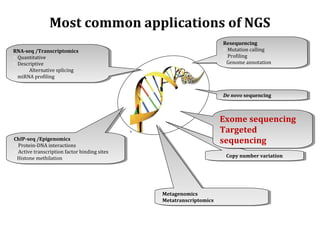
Most common applications of NGS
                                                                      Resequencing
                                                                       Resequencing
RNA-seq /Transcriptomics                                              oo Mutation calling
                                                                        Mutation calling
 RNA-seq /Transcriptomics
oo Quantitative
  Quantitative                                                        oo Profiling
                                                                        Profiling
oo Descriptive
  Descriptive                                                         ooGenome annotation
                                                                       Genome annotation
      Alternative splicing
        Alternative splicing
oo miRNA profiling
  miRNA profiling


                                                                      De novo sequencing
                                                                       De novo sequencing


                                                                      Exome sequencing
                                                                       Exome sequencing
                                                                      Targeted
                                                                       Targeted
ChIP-seq /Epigenomics
 ChIP-seq /Epigenomics
oo Protein-DNA interactions
  Protein-DNA interactions
                                                                      sequencing
                                                                       sequencing
oo Active transcription factor binding sites
  Active transcription factor binding sites
ooHistone methilation
 Histone methilation                                                   Copy number variation
                                                                        Copy number variation


                                               Metagenomics
                                                Metagenomics
                                               Metatranscriptomics
                                                Metatranscriptomics
Introduction
     Next-Generation Sequencing (NGS) technology is changing the way
Big data in Biology, a new scenario
     how researchers perform experiments. Many new experiments are
     being conducted by sequencing: exome re-sequencing, RNA-seq,
     Meth-seq, ChIP-seq, ...

    NGS is allowing researches to:
     ● Find exome and genomic variants responsible of diseases
     ● Study the whole transcriptome of a phenotype
     ● Establish the methylation state of a condition
     ● Locate DNA binding proteins

    But experiments have increased data size by 1000x when compared
    with microarrays, i.e. from MB to hundreds of GB in transcriptomics

    Data processing and analysis are becoming a bottleneck and a
    nightmare, from days or weeks with microarrays to months with
    NGS, and it will be worse as more data become available
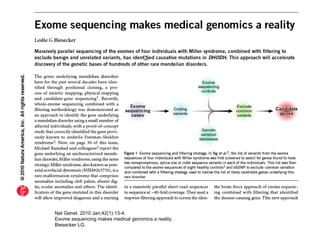
Nat Genet. 2010 Jan;42(1):13-4.
Exome sequencing makes medical genomics a reality.
Biesecker LG.
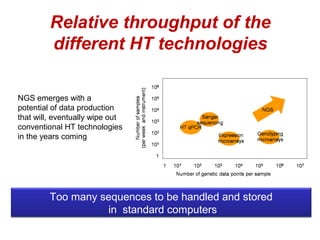
Relative throughput of the
         different HT technologies

NGS emerges with a
potential of data production
that will, eventually wipe out
conventional HT technologies
in the years coming


         Too many sequences to be handled and stored
                   in standard computers
The Pursuit of Better and more Efficient Healthcare
as well as Clinical Innovation through Genetic and
                Genomic Research
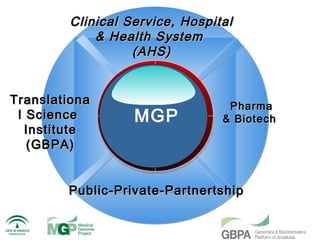
Clinical Service, Hospital
            & Health System
                  (AHS)

                Text   Text
Translationa                     Pharma
 l Science         MGP          & Biotech
   Institute    Text   Text

   (GBPA)


        Public-Private-Partnertship
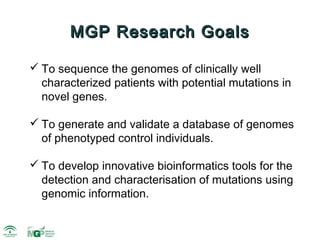
MGP Research Goals

 To sequence the genomes of clinically well
  characterized patients with potential mutations in
  novel genes.

 To generate and validate a database of genomes
  of phenotyped control individuals.

 To develop innovative bioinformatics tools for the
  detection and characterisation of mutations using
  genomic information.
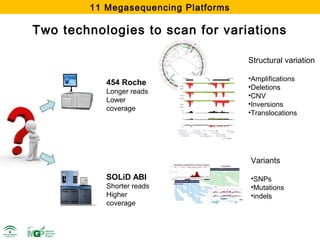
11 Megasequencing Platforms

Two technologies to scan for variations

                                      Structural variation

                                      •Amplifications
           454 Roche
                                      •Deletions
           Longer reads
                                      •CNV
           Lower
                                      •Inversions
           coverage
                                      •Translocations


                                      Variants

           SOLiD ABI                  •SNPs
           Shorter reads              •Mutations
           Higher                     •indels
           coverage
Big data challenges and solutions
   “Big data is a collection of data sets so large and complex that it
    becomes difficult to process using on-hand database management
    tools or traditional data processing applications”
   Big data is not a new scenario for other science areas: astronomy,
    physics, internet search, finance, business, ...
   Which are the main Big data challenges?: curation, search, sharing,
    storage, analysis and visualization
   We need to study and use new computational technologies :
     
         High-Performance Computing (HPC): multi-core CPUs, SSE/AVX, GPUs
     
         Distributed computing: Apache Hadoop MapReduce, MPI
     
         Distributed and NoSQL databases: Apache Cassandra, HBase, …
     
         Web apps: HTML5 (SVG, WebGL, ...), Javascript, RESTful WS, ...
     
         Clouds: Amazon AWS, Google Cloud, Microsoft Azure, …
        Biomed: Machine learning, data mining, clustering, probablistic
         graphicals models, visualization, health infprmation management and genomic
         data...
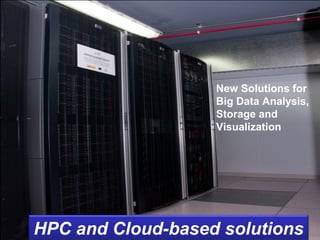
New Solutions for
                   Big Data Analysis,
                   Storage and
                   Visualization


HPC and Cloud-based solutions
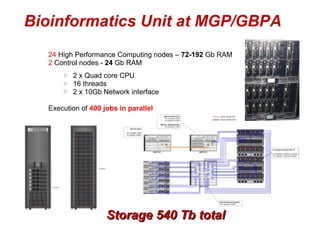
Bioinformatics Unit at MGP/GBPA
  24 High Performance Computing nodes – 72-192 Gb RAM
  2 Control nodes - 24 Gb RAM
      o   2 x Quad core CPU
      o   16 threads
      o   2 x 10Gb Network interface

  Execution of 400 jobs in parallel


                    Storage 540 Tb total
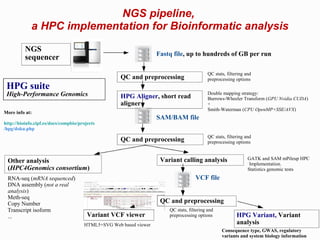
NGS pipeline,
             a HPC implementation for Bioinformatic analysis
          NGS
                                                                   Fastq file, up to hundreds of GB per run
          sequencer
                                                                                           QC stats, filtering and
                                                    QC and preprocessing                   preprocessing options
 HPG suite
 High-Performance Genomics                          HPG Aligner, short read
                                                                                           Double mapping strategy:
                                                                                           Burrows-Wheeler Transform (GPU Nvidia CUDA)
                                                    aligner                                +
                                                                                           Smith-Waterman (CPU OpenMP+SSE/AVX)
More info at:
                                                                   SAM/BAM file
http://bioinfo.cipf.es/docs/compbio/projects
/hpg/doku.php
                                                                                           QC stats, filtering and
                                                    QC and preprocessing                   preprocessing options


                                                                    Variant calling analysis                    GATK and SAM mPileup HPC
 Other analysis                                                                                                  Implementation.
 (HPC4Genomics consortium)                                                                                      Statistics genomic tests
 RNA-seq (mRNA sequenced)                                                           VCF file
 DNA assembly (not a real
 analysis)
 Meth-seq
 Copy Number                                                        QC and preprocessing
 Transcript isoform                                                    QC stats, filtering and
 ...                                    Variant VCF viewer             preprocessing options              HPG Variant, Variant
                                      HTML5+SVG Web based viewer                                          analysis
                                                                                                  Consequence type, GWAS, regulatory
                                                                                                  variants and system biology information
“…Me parece increíble e injustificable el abismo
     que existe entre los resultados de las
 investigaciones y su aplicación cotidiana a los
                  enfermos…”

                Eduard Punset
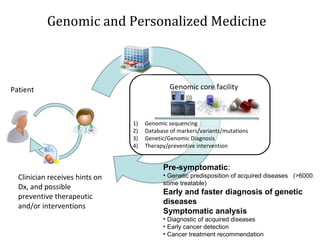
Genomic and Personalized Medicine


Patient                                       Genomic core facility


                                1)   Genomic sequencing
                                2)   Database of markers/variants/mutations
                                3)   Genetic/Genomic Diagnosis
                                4)   Therapy/preventive intervention


                                           Pre-symptomatic:
  Clinician receives hints on              • Genetic predisposition of acquired diseases (>6000.
                                           some treatable)
  Dx, and possible
                                           Early and faster diagnosis of genetic
  preventive therapeutic
                                           diseases
  and/or interventions
                                           Symptomatic analysis
                                           • Diagnostic of acquired diseases
                                           • Early cancer detection
                                           • Cancer treatment recommendation
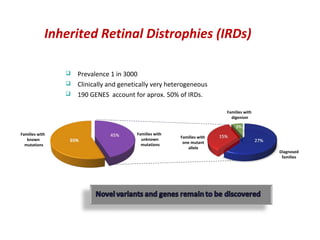
Inherited Retinal Distrophies (IRDs)

                 Prevalence 1 in 3000
                 Clinically and genetically very heterogeneous
                 190 GENES account for aprox. 50% of IRDs.


                                                                       Families with
                                                                         digenism


Families with                          Families with
                                         unknown       Families with
   known
                                         mutations      one mutant
  mutations
                                                           allele
                                                                                       Diagnosed
                                                                                        families
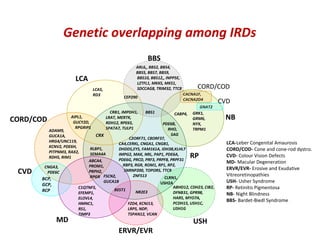
Genetic overlapping among IRDs
                                                           BBS
                                                      ARL6,, BBS2, BBS4,
                                                      BBS5, BBS7, BBS9,
                       LCA                            BBS10, BBS12,, INPP5E,
                                                      LZTFL1, MKKS, MKS1,
                                LCA5,                 SDCCAG8, TRIM32, TTC8         CORD/COD
                                RD3                                            CACNA1F,
                                                CEP290
                                                                               CACNA2D4
                                                                                             CVD
                                                                                     GNAT2
                                          CRB1, IMPDH1,   BBS1          CABP4,    GRK1,
CORD/COD            AIPL1,              LRAT, MERTK,                              GRM6,       NB
                     GUCY2D,            RDH12, RPE65,            PDE6B,           NYX,
                      RPGRIP1           SPATA7, TULP1               RHO,          TRPM1
          ADAM9,
          GUCA1A,               CRX                                  SAG
                                                C2ORF71, C8ORF37,
          HRG4/UNC119,                                                                         LCA-Leber Congenital Amaurosis
                                           CA4,CERKL, CNGA1, CNGB1,
          KCNV2, PDE6H,
          PITPNM3, RAX2,
                             RLBP1,        DHDDS,EYS, FAM161A, IDH3B,KLHL7                     CORD/COD- Cone and cone-rod dystro.
          RDH5, RIM1
                             SEMA4A        IMPG2, MAK, NRL, PAP1, PDE6A,
                                           PDE6G, PRCD, PRF3, PRPF8, PRPF31
                                                                                 RP            CVD- Colour Vision Defects
                             ABCA4,                                                            MD- Macular Degeneration
        CNGA3,               PROM1,          RBP3, RGR, ROM1, RP1, RP2,
                                                                                               ERVR/EVR- Erosive and Exudative
 CVD     PDE6C               PRPH2,
                                    FSCN2,
                                             SNRNP200, TOPORS, TTC8
                                                  ZNF513                                       Vitreoretinopathies
       BCP,                  RPGR                                 CLRN1,
                                    GUCA1B                      USH2A                          USH- Usher Syndrome
       GCP,
                        C1QTNF5,
                                         BEST1
                                                                      ABHD12, CDH23, CIB2,     RP- Retinitis Pigmentosa
       RCP              EFEMP1,                    NR2E3              DFNB31, GPR98,           NB- Night Blindness
                        ELOVL4,                                       HARS, MYO7A,
                                                                      PCDH15, USH1C,
                                                                                               BBS- Bardet-Biedl Syndrome
                        HMNC1,                 FZD4, KCNJ13,
                        RS1,                   LRP5, NDP,             USH1G
                        TIMP3                  TSPAN12, VCAN
             MD                                                                    USH
                                              ERVR/EVR
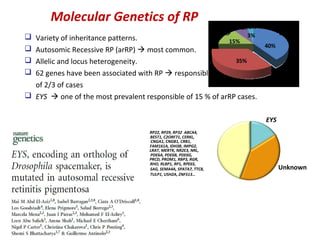
Molecular Genetics of RP
                                                                       RPLX UN
                                                                 ADRP 7% 3%            RPE
 Variety of inheritance patterns.                                   15%
                                                                                 40%
 Autosomic Recessive RP (arRP)  most common.
 Allelic and locus heterogeneity.                           35%
 62 genes have been associated with RP  responsible
  of 2/3 of cases                                          ARRP
 EYS  one of the most prevalent responsible of 15 % of arRP cases.

                                                                                 EYS
                                    RP22, RP29, RP32 ABCA4,
                                    BEST1, C2ORF71, CERKL,
                                    CNGA1, CNGB1, CRB1,
                                    FAM161A, IDH3B, IMPG2,
                                    LRAT, MERTK, NR2E3, NRL,
                                    PDE6A, PDE6B, PDE6G,
                                    PRCD, PROM1, RBP3, RGR,
                                    RHO, RLBP1, RP1, RPE65,
                                    SAG, SEMA4A, SPATA7, TTC8,                         Unknown
                                    TULP1, USH2A, ZNF513…
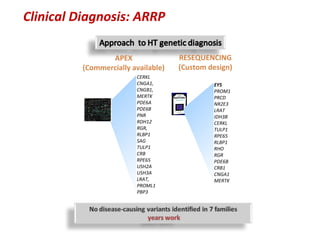
Clinical Diagnosis: ARRP

                 APEX                RESEQUENCING
          (Commercially available)   (Custom design)
                         CERKL
                         CNGA1,               EYS
                         CNGB1,               PROM1
                         MERTK                PRCD
                         PDE6A                NR2E3
                         PDE6B                LRAT
                         PNR                  IDH3B
                         RDH12                CERKL
                         RGR,                 TULP1
                         RLBP1                RPE65
                         SAG                  RLBP1
                         TULP1                RHO
                         CRB                  RGR
                         RPE65                PDE6B
                         USH2A                CRB1
                         USH3A                CNGA1
                         LRAT,                MERTK
                         PROML1
                         PBP3
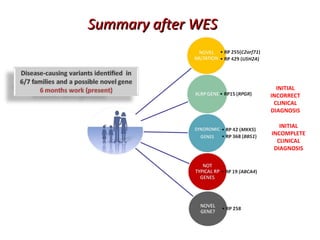
Summary after WES


                      INITIAL
                    INCORRECT
                     CLINICAL
                    DIAGNOSIS

                       INITIAL
                    INCOMPLETE
                      CLINICAL
                     DIAGNOSIS
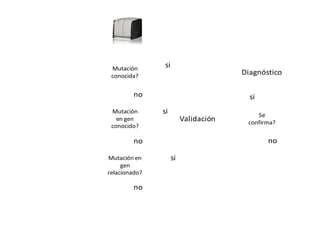
Mutación       si
 conocida?
                                       Diagnóstico

         no                              si
 Mutación      si                          Se
   en gen                 Validación    confirma?
 conocido?

         no                                   no

Mutación en          si
     gen
relacionado?

         no
Next steps
                  cloud-based and open solutions
   cloud-based environment integration ready, codename: GASC
    
        Storage: efficient storage and data retrieval of ~TB, transparent
        connection to others clouds such as Amazon AWS or Microsoft Azure
    
        Analysis: many tools ready to use (aligners, GATK, …), users can
        upload their tools to extend functionality, SGE queue, …
       Search and access: data is indexed and can be queried efficiently,
        RESTful WS allows users to access to data and analysis programatically
       Sharing: users can share their data and analysis, public and private data
       Visualization: HTML5-SVG based web applications to visualize data
   Open development initiative
    
        HPG project, CellBase, Genome Maps, GASC, … released as open
        source development initiative
       Source code controlled with Git, hosted freely in GitHub
       Scientist are encouraged to collaborate and extend functionality, a
        HPC4G consortium from universities already created
High-throughputtechnologies such as NGS is
 pushing BioMedicine into Big Data
We  must learn how to deal with this huge amount
  of data to translate it into clinically relevant
  information
This new scenario demands new solutions as well
 as new computational technologies
Open  development model allows researchers to
 join forces and build up better solutions
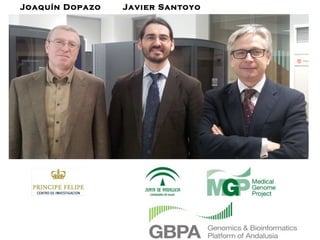
Joaquín Dopazo   Javier Santoyo
UGC Genética, Reproducción y
       Medicina Fetal
   Hospital Universitario
      Virgen del Rocío
           Sevilla

 Salud Borrego                 Alicia Vela     Nacho Medina
 Cristina méndez               Antonio Rueda
 María Gónzalez                F.J. López
 Lorena Fernández
 Nereida Bravo

Experimentos de nubes científicas: Medical Genome Project

  • 1.
    GUILLERMO ANTIÑOLO DIRECTOR DELA UNIDAD DE GESTIÓN CLÍNICA DE GENÉTICA, REPRODUCCIÓN Y MEDICINA FETAL DEL HOSPITAL UNIVERSITARIO VIRGEN DEL ROCÍO DIRECTOR CIENTÍFICO MGP/GBPA PROFESOR TITULAR DE OBSTETRICIA Y GINECOLOGÍA DE LA UNIVERSIDAD DE SEVILLA
  • 5.
    Healthcare in the21st Century Genomic Medicine and Personalized Medicine
  • 6.
    Most common applicationsof NGS Resequencing Resequencing RNA-seq /Transcriptomics oo Mutation calling Mutation calling RNA-seq /Transcriptomics oo Quantitative Quantitative oo Profiling Profiling oo Descriptive Descriptive ooGenome annotation Genome annotation Alternative splicing Alternative splicing oo miRNA profiling miRNA profiling De novo sequencing De novo sequencing Exome sequencing Exome sequencing Targeted Targeted ChIP-seq /Epigenomics ChIP-seq /Epigenomics oo Protein-DNA interactions Protein-DNA interactions sequencing sequencing oo Active transcription factor binding sites Active transcription factor binding sites ooHistone methilation Histone methilation Copy number variation Copy number variation Metagenomics Metagenomics Metatranscriptomics Metatranscriptomics
  • 7.
    Introduction Next-Generation Sequencing (NGS) technology is changing the way Big data in Biology, a new scenario how researchers perform experiments. Many new experiments are being conducted by sequencing: exome re-sequencing, RNA-seq, Meth-seq, ChIP-seq, ... NGS is allowing researches to: ● Find exome and genomic variants responsible of diseases ● Study the whole transcriptome of a phenotype ● Establish the methylation state of a condition ● Locate DNA binding proteins But experiments have increased data size by 1000x when compared with microarrays, i.e. from MB to hundreds of GB in transcriptomics Data processing and analysis are becoming a bottleneck and a nightmare, from days or weeks with microarrays to months with NGS, and it will be worse as more data become available
  • 8.
    Nat Genet. 2010Jan;42(1):13-4. Exome sequencing makes medical genomics a reality. Biesecker LG.
  • 9.
    Relative throughput ofthe different HT technologies NGS emerges with a potential of data production that will, eventually wipe out conventional HT technologies in the years coming Too many sequences to be handled and stored in standard computers
  • 10.
    The Pursuit ofBetter and more Efficient Healthcare as well as Clinical Innovation through Genetic and Genomic Research
  • 11.
    Clinical Service, Hospital & Health System (AHS) Text Text Translationa Pharma l Science MGP & Biotech Institute Text Text (GBPA) Public-Private-Partnertship
  • 12.
    MGP Research Goals To sequence the genomes of clinically well characterized patients with potential mutations in novel genes.  To generate and validate a database of genomes of phenotyped control individuals.  To develop innovative bioinformatics tools for the detection and characterisation of mutations using genomic information.
  • 13.
    11 Megasequencing Platforms Twotechnologies to scan for variations Structural variation •Amplifications 454 Roche •Deletions Longer reads •CNV Lower •Inversions coverage •Translocations Variants SOLiD ABI •SNPs Shorter reads •Mutations Higher •indels coverage
  • 14.
    Big data challengesand solutions  “Big data is a collection of data sets so large and complex that it becomes difficult to process using on-hand database management tools or traditional data processing applications”  Big data is not a new scenario for other science areas: astronomy, physics, internet search, finance, business, ...  Which are the main Big data challenges?: curation, search, sharing, storage, analysis and visualization  We need to study and use new computational technologies :  High-Performance Computing (HPC): multi-core CPUs, SSE/AVX, GPUs  Distributed computing: Apache Hadoop MapReduce, MPI  Distributed and NoSQL databases: Apache Cassandra, HBase, …  Web apps: HTML5 (SVG, WebGL, ...), Javascript, RESTful WS, ...  Clouds: Amazon AWS, Google Cloud, Microsoft Azure, …  Biomed: Machine learning, data mining, clustering, probablistic graphicals models, visualization, health infprmation management and genomic data...
  • 15.
    New Solutions for Big Data Analysis, Storage and Visualization HPC and Cloud-based solutions
  • 16.
    Bioinformatics Unit atMGP/GBPA 24 High Performance Computing nodes – 72-192 Gb RAM 2 Control nodes - 24 Gb RAM o 2 x Quad core CPU o 16 threads o 2 x 10Gb Network interface Execution of 400 jobs in parallel Storage 540 Tb total
  • 17.
    NGS pipeline, a HPC implementation for Bioinformatic analysis NGS Fastq file, up to hundreds of GB per run sequencer QC stats, filtering and QC and preprocessing preprocessing options HPG suite High-Performance Genomics HPG Aligner, short read Double mapping strategy: Burrows-Wheeler Transform (GPU Nvidia CUDA) aligner + Smith-Waterman (CPU OpenMP+SSE/AVX) More info at: SAM/BAM file http://bioinfo.cipf.es/docs/compbio/projects /hpg/doku.php QC stats, filtering and QC and preprocessing preprocessing options Variant calling analysis GATK and SAM mPileup HPC Other analysis Implementation. (HPC4Genomics consortium) Statistics genomic tests RNA-seq (mRNA sequenced) VCF file DNA assembly (not a real analysis) Meth-seq Copy Number QC and preprocessing Transcript isoform QC stats, filtering and ... Variant VCF viewer preprocessing options HPG Variant, Variant HTML5+SVG Web based viewer analysis Consequence type, GWAS, regulatory variants and system biology information
  • 19.
    “…Me parece increíblee injustificable el abismo que existe entre los resultados de las investigaciones y su aplicación cotidiana a los enfermos…” Eduard Punset
  • 20.
    Genomic and PersonalizedMedicine Patient Genomic core facility 1) Genomic sequencing 2) Database of markers/variants/mutations 3) Genetic/Genomic Diagnosis 4) Therapy/preventive intervention Pre-symptomatic: Clinician receives hints on • Genetic predisposition of acquired diseases (>6000. some treatable) Dx, and possible Early and faster diagnosis of genetic preventive therapeutic diseases and/or interventions Symptomatic analysis • Diagnostic of acquired diseases • Early cancer detection • Cancer treatment recommendation
  • 22.
    Inherited Retinal Distrophies(IRDs)  Prevalence 1 in 3000  Clinically and genetically very heterogeneous  190 GENES account for aprox. 50% of IRDs. Families with digenism Families with Families with unknown Families with known mutations one mutant mutations allele Diagnosed families
  • 23.
    Genetic overlapping amongIRDs BBS ARL6,, BBS2, BBS4, BBS5, BBS7, BBS9, LCA BBS10, BBS12,, INPP5E, LZTFL1, MKKS, MKS1, LCA5, SDCCAG8, TRIM32, TTC8 CORD/COD RD3 CACNA1F, CEP290 CACNA2D4 CVD GNAT2 CRB1, IMPDH1, BBS1 CABP4, GRK1, CORD/COD AIPL1, LRAT, MERTK, GRM6, NB GUCY2D, RDH12, RPE65, PDE6B, NYX, RPGRIP1 SPATA7, TULP1 RHO, TRPM1 ADAM9, GUCA1A, CRX SAG C2ORF71, C8ORF37, HRG4/UNC119, LCA-Leber Congenital Amaurosis CA4,CERKL, CNGA1, CNGB1, KCNV2, PDE6H, PITPNM3, RAX2, RLBP1, DHDDS,EYS, FAM161A, IDH3B,KLHL7 CORD/COD- Cone and cone-rod dystro. RDH5, RIM1 SEMA4A IMPG2, MAK, NRL, PAP1, PDE6A, PDE6G, PRCD, PRF3, PRPF8, PRPF31 RP CVD- Colour Vision Defects ABCA4, MD- Macular Degeneration CNGA3, PROM1, RBP3, RGR, ROM1, RP1, RP2, ERVR/EVR- Erosive and Exudative CVD PDE6C PRPH2, FSCN2, SNRNP200, TOPORS, TTC8 ZNF513 Vitreoretinopathies BCP, RPGR CLRN1, GUCA1B USH2A USH- Usher Syndrome GCP, C1QTNF5, BEST1 ABHD12, CDH23, CIB2, RP- Retinitis Pigmentosa RCP EFEMP1, NR2E3 DFNB31, GPR98, NB- Night Blindness ELOVL4, HARS, MYO7A, PCDH15, USH1C, BBS- Bardet-Biedl Syndrome HMNC1, FZD4, KCNJ13, RS1, LRP5, NDP, USH1G TIMP3 TSPAN12, VCAN MD USH ERVR/EVR
  • 24.
    Molecular Genetics ofRP RPLX UN ADRP 7% 3% RPE  Variety of inheritance patterns. 15% 40%  Autosomic Recessive RP (arRP)  most common.  Allelic and locus heterogeneity. 35%  62 genes have been associated with RP  responsible of 2/3 of cases ARRP  EYS  one of the most prevalent responsible of 15 % of arRP cases. EYS RP22, RP29, RP32 ABCA4, BEST1, C2ORF71, CERKL, CNGA1, CNGB1, CRB1, FAM161A, IDH3B, IMPG2, LRAT, MERTK, NR2E3, NRL, PDE6A, PDE6B, PDE6G, PRCD, PROM1, RBP3, RGR, RHO, RLBP1, RP1, RPE65, SAG, SEMA4A, SPATA7, TTC8, Unknown TULP1, USH2A, ZNF513…
  • 25.
    Clinical Diagnosis: ARRP APEX RESEQUENCING (Commercially available) (Custom design) CERKL CNGA1, EYS CNGB1, PROM1 MERTK PRCD PDE6A NR2E3 PDE6B LRAT PNR IDH3B RDH12 CERKL RGR, TULP1 RLBP1 RPE65 SAG RLBP1 TULP1 RHO CRB RGR RPE65 PDE6B USH2A CRB1 USH3A CNGA1 LRAT, MERTK PROML1 PBP3
  • 26.
    Summary after WES INITIAL INCORRECT CLINICAL DIAGNOSIS INITIAL INCOMPLETE CLINICAL DIAGNOSIS
  • 27.
    Mutación si conocida? Diagnóstico no si Mutación si Se en gen Validación confirma? conocido? no no Mutación en si gen relacionado? no
  • 28.
    Next steps cloud-based and open solutions  cloud-based environment integration ready, codename: GASC  Storage: efficient storage and data retrieval of ~TB, transparent connection to others clouds such as Amazon AWS or Microsoft Azure  Analysis: many tools ready to use (aligners, GATK, …), users can upload their tools to extend functionality, SGE queue, …  Search and access: data is indexed and can be queried efficiently, RESTful WS allows users to access to data and analysis programatically  Sharing: users can share their data and analysis, public and private data  Visualization: HTML5-SVG based web applications to visualize data  Open development initiative  HPG project, CellBase, Genome Maps, GASC, … released as open source development initiative  Source code controlled with Git, hosted freely in GitHub  Scientist are encouraged to collaborate and extend functionality, a HPC4G consortium from universities already created
  • 29.
    High-throughputtechnologies such asNGS is pushing BioMedicine into Big Data We must learn how to deal with this huge amount of data to translate it into clinically relevant information This new scenario demands new solutions as well as new computational technologies Open development model allows researchers to join forces and build up better solutions
  • 30.
    Joaquín Dopazo Javier Santoyo
  • 31.
    UGC Genética, Reproduccióny Medicina Fetal Hospital Universitario Virgen del Rocío Sevilla Salud Borrego Alicia Vela Nacho Medina Cristina méndez Antonio Rueda María Gónzalez F.J. López Lorena Fernández Nereida Bravo

Editor's Notes

  • #7 01/30/12 02/04/12
  • #10 01/30/12 02/04/12
  • #11 Thank forum hosts for soliciting views from diverse groups involved in research on the important topic of family consent. The informed consent process is central to the obligation to protect the rights and welfare of research participants The integrity of the informed consent process, whether the issue is family consent or some other aspect of informed consent, is a shared interest and responsibility of researchers, ethics committees, regulators and study sponsors.
  • #23 Las distrofias de retina con un grupo de enfermedades genética y fenotípicamente heterogéneas caracterizadas por la degeneración de la retina, que conduce a una ceguera parcial o total. La identificación de nuevos genes responsables de enfermedades de retina es la base por tanto de los avances en el conocimiento de la fisiología y la patología de la retina; de esta manera, será posible establecer nuevas líneas celulares y modelos animales para estudiar las funciones de los genes relevantes que permitan en última instancia mejorar las alternativas terapéuticas para las distrofias de retina.
  • #25 La RP es una enfermedad muy heterogénea, tanto clínica como genéticamente, siendo ésta una de las razones que dificultan la labor de desentrañar su causa, progresión, e incluso la obtención de un tratamiento. Diferentes mutaciones en el mismo gen pueden producir el mismo o distintos fenotipos (heterogeneidad alélica) y así mismo, mutaciones en distintos genes pueden producir el mismo fenotipo (heterogeneidad de locus ). El tipo de herencia puede ser autosómica dominante, autosómica recesiva, ligada al cromosoma X, e incluso se han descrito patrones más complejos como la herencia digénica o la disomía uniparental. La forma más común es la autosómica recesiva, de la que hasta el momento se han identificado 35 loci , que en conjunto serían responsables de un 35-45% de los casos de RPar. Sin embargo, el gen EYS , identificado por nuestro grupo en 2008, podría ser responsable del 15,9 % de los casos en España.