Shevchuk Nadia
33
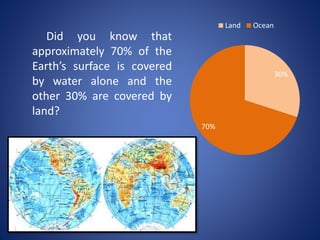
Did you know that
approximately 70% of the
Earth’s surface is covered
by water alone and the
other 30% are covered by
land?
30%
70%
Land Ocean
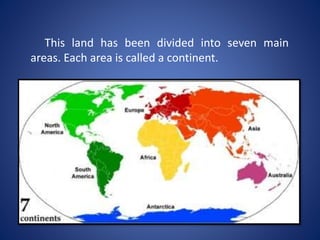
This land has been divided into seven main
areas. Each area is called a continent.
The seven continents are Asia, Australia, Africa,
Antarctica, North America, South America and Europe.
It is seen that each continent has a special shape.
Some of these continents are connected while the
water separates others.
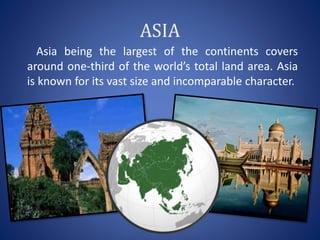
ASIA
Asia being the largest of the continents covers
around one-third of the world’s total land area. Asia
is known for its vast size and incomparable character.
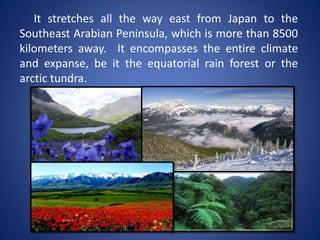
It stretches all the way east from Japan to the
Southeast Arabian Peninsula, which is more than 8500
kilometers away. It encompasses the entire climate
and expanse, be it the equatorial rain forest or the
arctic tundra.
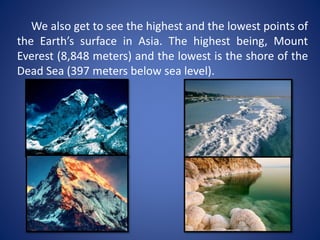
We also get to see the highest and the lowest points of
the Earth’s surface in Asia. The highest being, Mount
Everest (8,848 meters) and the lowest is the shore of the
Dead Sea (397 meters below sea level).
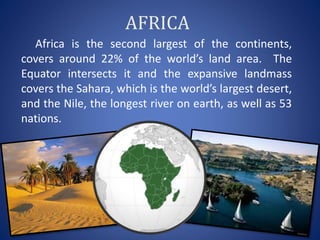
AFRICA
Africa is the second largest of the continents,
covers around 22% of the world’s land area. The
Equator intersects it and the expansive landmass
covers the Sahara, which is the world’s largest desert,
and the Nile, the longest river on earth, as well as 53
nations.
Most of Africa is a desert region.
Namib Desert Kalahari Desert Libyan Desert Sahara
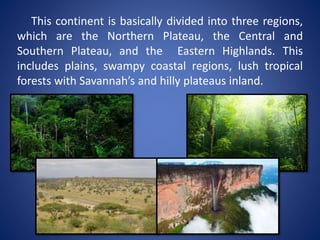
This continent is basically divided into three regions,
which are the Northern Plateau, the Central and
Southern Plateau, and the Eastern Highlands. This
includes plains, swampy coastal regions, lush tropical
forests with Savannah’s and hilly plateaus inland.
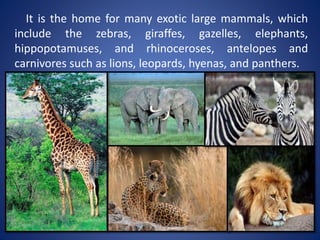
It is the home for many exotic large mammals, which
include the zebras, giraffes, gazelles, elephants,
hippopotamuses, and rhinoceroses, antelopes and
carnivores such as lions, leopards, hyenas, and panthers.
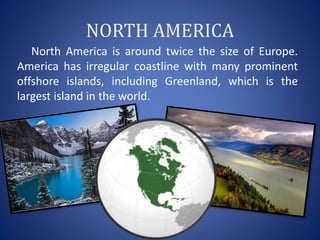
NORTH AMERICA
North America is around twice the size of Europe.
America has irregular coastline with many prominent
offshore islands, including Greenland, which is the
largest island in the world.
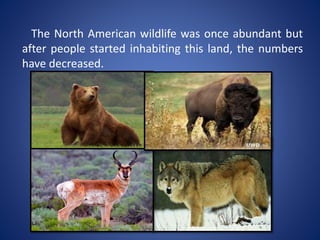
The North American wildlife was once abundant but
after people started inhabiting this land, the numbers
have decreased.
More than 1,700 species of birds live and breed on
this continent.
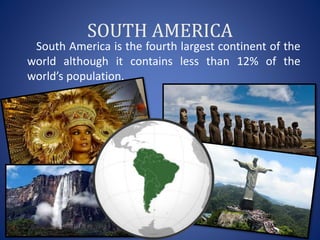
SOUTH AMERICA
South America is the fourth largest continent of the
world although it contains less than 12% of the
world’s population.
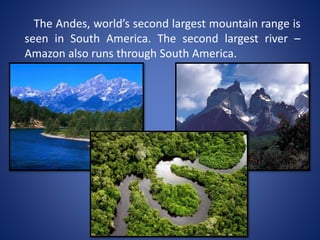
The Andes, world’s second largest mountain range is
seen in South America. The second largest river –
Amazon also runs through South America.
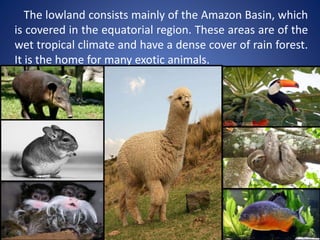
The lowland consists mainly of the Amazon Basin, which
is covered in the equatorial region. These areas are of the
wet tropical climate and have a dense cover of rain forest.
It is the home for many exotic animals.
EUROPE
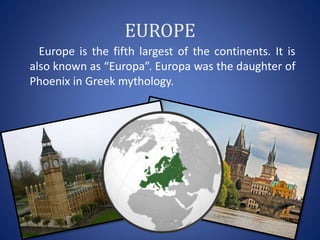
Europe is the fifth largest of the continents. It is
also known as “Europa”. Europa was the daughter of
Phoenix in Greek mythology.
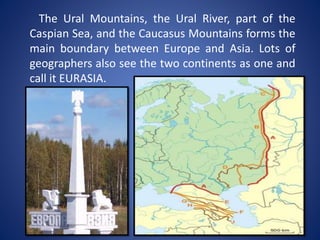
The Ural Mountains, the Ural River, part of the
Caspian Sea, and the Caucasus Mountains forms the
main boundary between Europe and Asia. Lots of
geographers also see the two continents as one and
call it EURASIA.
Europe has a more or less a radial pattern of drainage.
Most streams flow outward from the core of the
continent.
ANTARCTICA
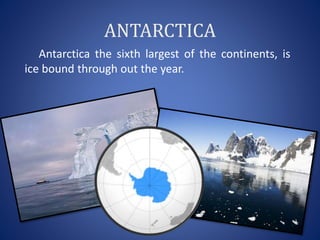
Antarctica the sixth largest of the continents, is
ice bound through out the year.
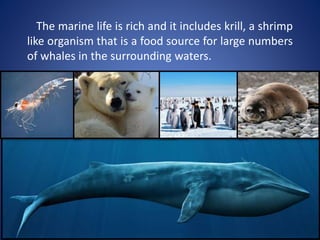
The marine life is rich and it includes krill, a shrimp
like organism that is a food source for large numbers
of whales in the surrounding waters.
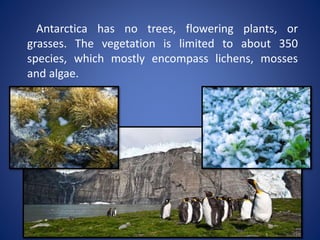
Antarctica has no trees, flowering plants, or
grasses. The vegetation is limited to about 350
species, which mostly encompass lichens, mosses
and algae.
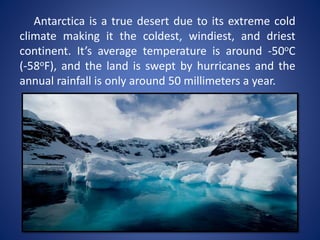
Antarctica is a true desert due to its extreme cold
climate making it the coldest, windiest, and driest
continent. It’s average temperature is around -50oC
(-58oF), and the land is swept by hurricanes and the
annual rainfall is only around 50 millimeters a year.
AUSTRALIA
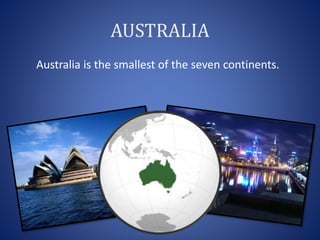
Australia is the smallest of the seven continents.
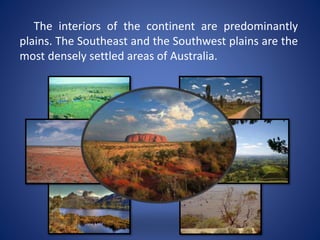
The interiors of the continent are predominantly
plains. The Southeast and the Southwest plains are the
most densely settled areas of Australia.
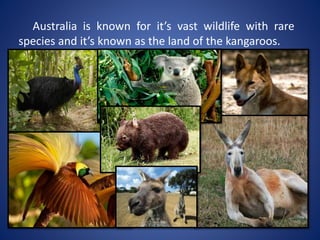
Australia is known for it’s vast wildlife with rare
species and it’s known as the land of the kangaroos.
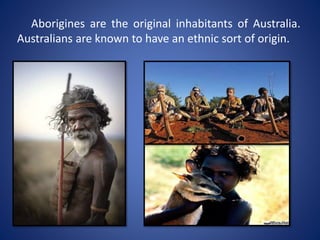
Aborigines are the original inhabitants of Australia.
Australians are known to have an ethnic sort of origin.
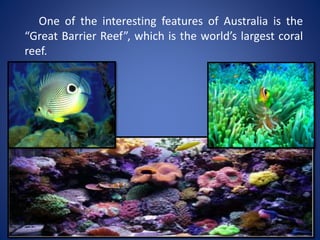
One of the interesting features of Australia is the
“Great Barrier Reef”, which is the world’s largest coral
reef.

7 continents

  • 1.
  • 2.
    Did you knowthat approximately 70% of the Earth’s surface is covered by water alone and the other 30% are covered by land? 30% 70% Land Ocean
  • 3.
    This land hasbeen divided into seven main areas. Each area is called a continent.
  • 4.
    The seven continentsare Asia, Australia, Africa, Antarctica, North America, South America and Europe. It is seen that each continent has a special shape. Some of these continents are connected while the water separates others.
  • 5.
    ASIA Asia being thelargest of the continents covers around one-third of the world’s total land area. Asia is known for its vast size and incomparable character.
  • 6.
    It stretches allthe way east from Japan to the Southeast Arabian Peninsula, which is more than 8500 kilometers away. It encompasses the entire climate and expanse, be it the equatorial rain forest or the arctic tundra.
  • 7.
    We also getto see the highest and the lowest points of the Earth’s surface in Asia. The highest being, Mount Everest (8,848 meters) and the lowest is the shore of the Dead Sea (397 meters below sea level).
  • 8.
    AFRICA Africa is thesecond largest of the continents, covers around 22% of the world’s land area. The Equator intersects it and the expansive landmass covers the Sahara, which is the world’s largest desert, and the Nile, the longest river on earth, as well as 53 nations.
  • 9.
    Most of Africais a desert region. Namib Desert Kalahari Desert Libyan Desert Sahara
  • 10.
    This continent isbasically divided into three regions, which are the Northern Plateau, the Central and Southern Plateau, and the Eastern Highlands. This includes plains, swampy coastal regions, lush tropical forests with Savannah’s and hilly plateaus inland.
  • 11.
    It is thehome for many exotic large mammals, which include the zebras, giraffes, gazelles, elephants, hippopotamuses, and rhinoceroses, antelopes and carnivores such as lions, leopards, hyenas, and panthers.
  • 12.
    NORTH AMERICA North Americais around twice the size of Europe. America has irregular coastline with many prominent offshore islands, including Greenland, which is the largest island in the world.
  • 13.
    The North Americanwildlife was once abundant but after people started inhabiting this land, the numbers have decreased.
  • 14.
    More than 1,700species of birds live and breed on this continent.
  • 15.
    SOUTH AMERICA South Americais the fourth largest continent of the world although it contains less than 12% of the world’s population.
  • 16.
    The Andes, world’ssecond largest mountain range is seen in South America. The second largest river – Amazon also runs through South America.
  • 17.
    The lowland consistsmainly of the Amazon Basin, which is covered in the equatorial region. These areas are of the wet tropical climate and have a dense cover of rain forest. It is the home for many exotic animals.
  • 18.
    EUROPE Europe is thefifth largest of the continents. It is also known as “Europa”. Europa was the daughter of Phoenix in Greek mythology.
  • 19.
    The Ural Mountains,the Ural River, part of the Caspian Sea, and the Caucasus Mountains forms the main boundary between Europe and Asia. Lots of geographers also see the two continents as one and call it EURASIA.
  • 20.
    Europe has amore or less a radial pattern of drainage. Most streams flow outward from the core of the continent.
  • 21.
    ANTARCTICA Antarctica the sixthlargest of the continents, is ice bound through out the year.
  • 22.
    The marine lifeis rich and it includes krill, a shrimp like organism that is a food source for large numbers of whales in the surrounding waters.
  • 23.
    Antarctica has notrees, flowering plants, or grasses. The vegetation is limited to about 350 species, which mostly encompass lichens, mosses and algae.
  • 24.
    Antarctica is atrue desert due to its extreme cold climate making it the coldest, windiest, and driest continent. It’s average temperature is around -50oC (-58oF), and the land is swept by hurricanes and the annual rainfall is only around 50 millimeters a year.
  • 25.
    AUSTRALIA Australia is thesmallest of the seven continents.
  • 26.
    The interiors ofthe continent are predominantly plains. The Southeast and the Southwest plains are the most densely settled areas of Australia.
  • 27.
    Australia is knownfor it’s vast wildlife with rare species and it’s known as the land of the kangaroos.
  • 28.
    Aborigines are theoriginal inhabitants of Australia. Australians are known to have an ethnic sort of origin.
  • 29.
    One of theinteresting features of Australia is the “Great Barrier Reef”, which is the world’s largest coral reef.