The world is the planet Earth and all life upon it,
including human civilization.[1] In a philosophical
context, the world is the whole of the
physical Universe, or an ontological world. In a
theological context, the world is the material or the
profane sphere, as opposed to the celestial, spiritual,
transcendent or sacred. The "end of the world" refers
to scenarios of the final end of human history, often
in religious contexts.
CONTINENTS
 A continent is one of several very large landmasses on
Earth. Generally identified by convention rather than
any strict criteria, up to seven regions are commonly
regarded as continents.
CONTINENTS OF THE WORLD
 Asia
 Australia
 Antarctica
 Africa
 Europe
 North America
 South America
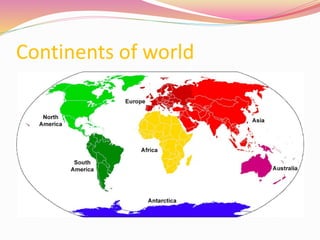
Continents of world
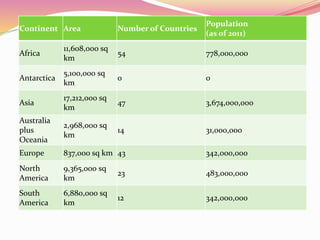
Continent Area Number of Countries
Population
(as of 2011)
Africa
11,608,000 sq
km
54 778,000,000
Antarctica
5,100,000 sq
km
0 0
Asia
17,212,000 sq
km
47 3,674,000,000
Australia
plus
Oceania
2,968,000 sq
km
14 31,000,000
Europe 837,000 sq km 43 342,000,000
North
America
9,365,000 sq
km
23 483,000,000
South
America
6,880,000 sq
km
12 342,000,000
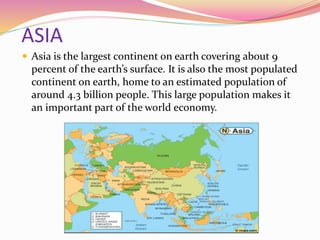
ASIA
 Asia is the largest continent on earth covering about 9
percent of the earth’s surface. It is also the most populated
continent on earth, home to an estimated population of
around 4.3 billion people. This large population makes it
an important part of the world economy.
COUNTRIES IN ASIA
 There are 53 countries in Asia including Russia and Turkey
which lie in both Europe and Asia and Taiwan which is
technically a part of China and not officially recognised as a
country by the United Nations.
 Afghanistan, Armenia, Azerbaijan, Bahrain, Bangladesh,
Bhutan, Brunei, Cambodia, China, Georgia, Hong Kong,
India, Indonesia, Iran, Iraq, Israel, Japan, Jordan,
Kazakhstan, North Korea, South Korea,
Kuwait, Kyrgyzstan, Laos, Lebanon, Macau, Maldives,
Malaysia, Maldives, Mongolia, Myanmar, Nepal, Oman,
Pakistan, Palestine, Philippines, Qatar, Russia, Saudi
Arabia, Singapore, Sri Lanka, Syria, Taiwan, Tajikistan,
Timor-Leste, Turkey, Turkmenistan, United Arab Emirates,
Uzbekistan, Vietnam, Yemen.
FACTS ABOUT ASIA
 Asia is the World’s largest continent – 43,810,582 km².
covering approximately 30% of the Earth’s land and 8.66%
of the Earth’s surface.
 It is bordered by the Ural Mountains to the east, the Arctic
Ocean to the north, the Pacific Ocean to the west and the
Indian Ocean to the south.
 The highest point in the World, is Mount Everest
(8,848 m)
 The longest river in Asia and third longest in the World is
the Yangtze (6,211 km) which flows through China.
 The largest desert in Asia is the Gobi desert measuring
281,800 km².
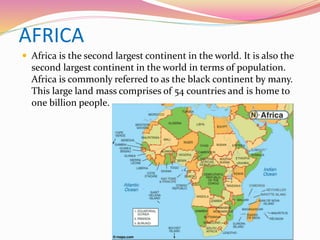
AFRICA
 Africa is the second largest continent in the world. It is also the
second largest continent in the world in terms of population.
Africa is commonly referred to as the black continent by many.
This large land mass comprises of 54 countries and is home to
one billion people.
COUNTRIES OF AFRICA
 There are 53 countries in Africa.
 Algeria, Angola, Benin, Botswana, Burkina Faso, Burundi,
Cameroon, Cape Verde, Central African Republic, Chad,
Comoros, Congo, Congo (DRC), Cote d’Ivoire, Djibouti,
Egypt, Equatorial Guinea, Eritrea, Ethiopia, Gabon,
Gambia, Ghana, Guinea, Guinea-Bissau, Kenya, Lesotho,
Liberia, Libya, Madagascar, Malawi, Mali, Mauritania,
Mauritius, Morocco, Mozambique, Namibia, Niger,
Nigeria, Rwanda, Sao Tome & Principe, Senegal,
Seychelles, Sierra Leone, Somalia, South Africa, Sudan,
South Sudan, Swaziland, Tanzania, Togo, Tunisia, Uganda,
Western Sahara, Zambia, Zimbabwe. Click on the map
(right) for a larger image.
FACTS ABOUT AFRICA
 Africa is the World’s second-largest continent – 30,065,000
km² covering approximately 20% of the Earth’s land and 6% of
the Earth’s surface .
 It is bordered by the Atlantic Ocean to the east, the Indian
Ocean to the west and the Mediterranean Sea to the north. The
Red Sea and Suez Canal lie to the north-east and separate Africa
from Asia.
 The longest river in the World, The Nile, measuring 6,695 km
– flows north ending in a delta that empties into the
Mediterranean Sea.
 The World’s largest desert, The Sahara, measuring 9,000,000
km², covers much of north Africa. The Kalahari desert in south-
west Africa measures 259,000 km².
 The Atlas mountain range lies in the north-west of Africa and
the highest mountain, Kilimanjaro, 5895 m, is in Tanzania.
EUROPE Europe is the second smallest continent in the world. It comprises
the westernmost peninsula of the giant Eurasian landmass.
Covering almost 2 percent of the earth’s surface Europe takes 6.8
percent of the world’s total land area. Europe is home to almost 50
countries and is the third most populated continent in the world
after Asia and Africa.
COUNTRIES OF EUROPE
 There are 47 countries in Europe including Turkey and
Russia which lie in both Europe and Asia.
 Albania, Andorra, Austria, Belarus, Belgium, Bosnia and
Herzegovina, Bulgaria, Croatia, Cyprus, Czech Republic,
Denmark, Estonia, Finland, France, Germany, Greece,
Hungary, Iceland, Ireland, Italy, Latvia, Liechtenstein,
Lithuania, Luxembourg, Macedonia, Malta, Moldova,
Monaco, Montenegro, Netherlands, Norway, Poland,
Portugal, Romania, Russia, San Marino, Serbia, Slovakia,
Slovenia, Spain, Sweden, Switzerland, Turkey, Ukraine,
United Kingdom, Vatican City.
FACTS ABOUT EUROPE
 Europe is the World’s second-smallest continent –
10,180,000 km² covering approximately 6.7% of the Earth’s
land and 2% of the Earth’s surface .
 It is bordered by the Atlantic Ocean to the west, the Arctic
Ocean to the north and the Mediterranean Sea to the
south. The Ural mountains in Russia mark the eastern
extreme.
 The southern regions are higher and include the Pyrenees,
the Alps and the Carpathian mountain ranges.
 The longest river in Europe is the Volga (2,850 km) in
Russia.
 The highest mountain is Elbrus (5,642 m) in Russia.
AUSTRALIA
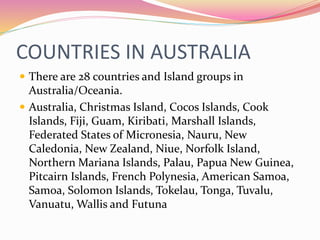
 The continent of Australia is a single country continent. It
is the sixth largest country by total area, and is also the
smallest of all the seven continents. Because of its size, and
isolated location, it is also called as island continent.
Covering an area of 7617930 square kilometres, Australia
lies in the Indo- Australian Plate.
COUNTRIES IN AUSTRALIA
 There are 28 countries and Island groups in
Australia/Oceania.
 Australia, Christmas Island, Cocos Islands, Cook
Islands, Fiji, Guam, Kiribati, Marshall Islands,
Federated States of Micronesia, Nauru, New
Caledonia, New Zealand, Niue, Norfolk Island,
Northern Mariana Islands, Palau, Papua New Guinea,
Pitcairn Islands, French Polynesia, American Samoa,
Samoa, Solomon Islands, Tokelau, Tonga, Tuvalu,
Vanuatu, Wallis and Futuna
FACTS ABOUT AUSTRALIA
 Australia, also called Oceania or Australia/Oceania, is the
World’s smallest continent – 8,112,000 km² covering
approximately 5.3% of the Earth’s land and 1.5% of the
Earth’s surface.
 It is situated partly in the Pacific ocean, bordered by the
Indian Ocean to the west and the Southern ocean to the
south.
 The highest point is Mount Wilhelm (4509 m) in Papua
New Guinea.
 The longest river is the Darling river (2,739 km) which is a
tributary of the Murray river in Australia.
 Australia is the flattest continent with much of Australia
being desert.
ANTARCTICA
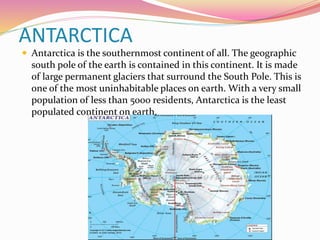
 Antarctica is the southernmost continent of all. The geographic
south pole of the earth is contained in this continent. It is made
of large permanent glaciers that surround the South Pole. This is
one of the most uninhabitable places on earth. With a very small
population of less than 5000 residents, Antarctica is the least
populated continent on earth.
COUNTRIES IN ANTARCTICA
 There are no countries in Antarctica but various
regions have been named.
FACTS ABOUT ANTARCTICA
 Antarctica is the World’s fifth-largest continent
measuring approximately 14 million km², covering
approximately 8.9% of the Earth’s land and 2.7% of the
Earth’s surface.
 It is surrounded by the Southern Ocean and lies almost
entirely within the Antarctic circle.
 98% of the land area is permanently covered with ice
 The Eastern side of Antarctica is higher than the West. The
highest point is Vinson Massif measuring 4,897 m.
 Antarctica is the coldest place on Earth. The higher,
eastern side of Antarctica is colder than the lower west and
the peninsula of Graham Land is the warmest region.
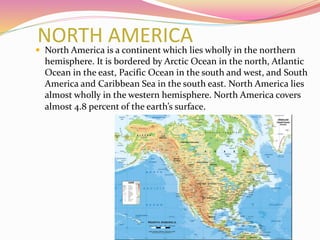
NORTH AMERICA North America is a continent which lies wholly in the northern
hemisphere. It is bordered by Arctic Ocean in the north, Atlantic
Ocean in the east, Pacific Ocean in the south and west, and South
America and Caribbean Sea in the south east. North America lies
almost wholly in the western hemisphere. North America covers
almost 4.8 percent of the earth’s surface.
COUNRIES IN NORTH AMERICA
 There are 38 countries and Islands in North America.
 Anguilla, Antigua and Barbuda, Aruba, The Bahamas,
Barbados, Belize, Bermuda, British Virgin Islands, Canada,
Cayman Islands, Costa Rica, Cuba, Dominica, Dominican
Republic, El Salvador, Greenland, Grenada, Guadeloupe,
Guatemala, Haiti, Honduras, Jamaica, Martinique, Mexico,
Montserrat, Navassa Islands, Netherlands Antilles,
Nicaragua, Panama, Puerto Rico, Saint Kitts and Nevis,
Saint Lucia, Saint-Pierre and Miquelon, Saint Vincent and
the Grenadines, Trinidad and Tobago, United States of
America, US Virgin Islands.
FACTS ABOUT NORTH AMERICA
 North America is the World’s third-largest continent –
24,474,000 km² covering approximately 16.5% of the
Earth’s land and 5% of the Earth’s surface.
 It is bordered by the Atlantic Ocean to the east, the Arctic
Ocean to the north and the Pacific Ocean to the west.
 The eastern side of the continent is generally lower than
the west which contains the Rocky mountains. The five
Great Lakes lie on the United States Canadian border.
 The highest mountain is Mt McKinley in Alaska (6,194
m) and the longest river is the Mississippi (3,765 km).
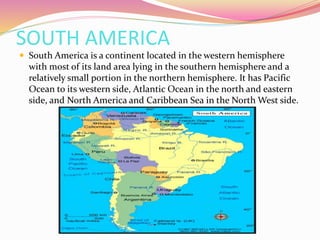
SOUTH AMERICA
 South America is a continent located in the western hemisphere
with most of its land area lying in the southern hemisphere and a
relatively small portion in the northern hemisphere. It has Pacific
Ocean to its western side, Atlantic Ocean in the north and eastern
side, and North America and Caribbean Sea in the North West side.
COUNTRIES IN SOUTH AMERICA
 There are 16 countries and Islands in South America.
 Argentina, Bolivia, Brazil, Chile, Colombia, Ecuador,
Falkland Islands, French Guiana, Guyana, Paraguay,
Peru, South Georgia and South Sandwich Islands,
Suriname, Uruguay, Venezuela.
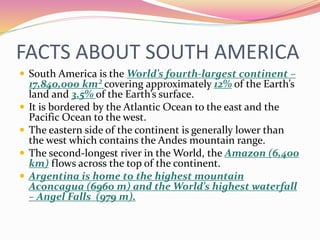
FACTS ABOUT SOUTH AMERICA
 South America is the World’s fourth-largest continent –
17,840,000 km² covering approximately 12% of the Earth’s
land and 3.5% of the Earth’s surface.
 It is bordered by the Atlantic Ocean to the east and the
Pacific Ocean to the west.
 The eastern side of the continent is generally lower than
the west which contains the Andes mountain range.
 The second-longest river in the World, the Amazon (6,400
km) flows across the top of the continent.
 Argentina is home to the highest mountain
Aconcagua (6960 m) and the World’s highest waterfall
– Angel Falls (979 m).
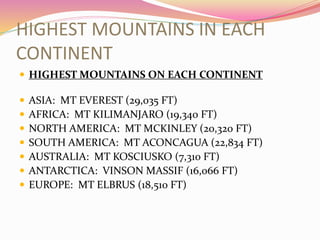
HIGHEST MOUNTAINS IN EACH
CONTINENT
 HIGHEST MOUNTAINS ON EACH CONTINENT
 ASIA: MT EVEREST (29,035 FT)
 AFRICA: MT KILIMANJARO (19,340 FT)
 NORTH AMERICA: MT MCKINLEY (20,320 FT)
 SOUTH AMERICA: MT ACONCAGUA (22,834 FT)
 AUSTRALIA: MT KOSCIUSKO (7,310 FT)
 ANTARCTICA: VINSON MASSIF (16,066 FT)
 EUROPE: MT ELBRUS (18,510 FT)
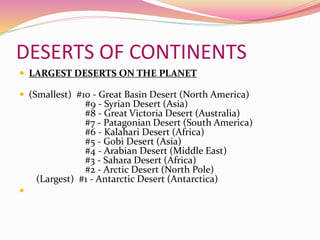
DESERTS OF CONTINENTS
 LARGEST DESERTS ON THE PLANET
 (Smallest) #10 - Great Basin Desert (North America)
#9 - Syrian Desert (Asia)
#8 - Great Victoria Desert (Australia)
#7 - Patagonian Desert (South America)
#6 - Kalahari Desert (Africa)
#5 - Gobi Desert (Asia)
#4 - Arabian Desert (Middle East)
#3 - Sahara Desert (Africa)
#2 - Arctic Desert (North Pole)
(Largest) #1 - Antarctic Desert (Antarctica)

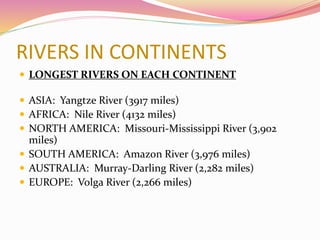
RIVERS IN CONTINENTS
 LONGEST RIVERS ON EACH CONTINENT
 ASIA: Yangtze River (3917 miles)
 AFRICA: Nile River (4132 miles)
 NORTH AMERICA: Missouri-Mississippi River (3,902
miles)
 SOUTH AMERICA: Amazon River (3,976 miles)
 AUSTRALIA: Murray-Darling River (2,282 miles)
 EUROPE: Volga River (2,266 miles)
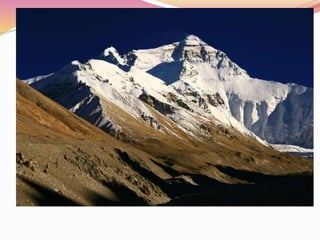
Highest Point Of The World
 The tallest point in the world, Mount Everest, reaches
as high as 29,035 feet. It is the mountain that is on
every adventurer’s bucket list to climb. It was first
discovered in the 1850s, and it was named after a
retired Surveyor General, George Everest, who
ironically never even saw the peak. It has been climbed
by both man and child alike.
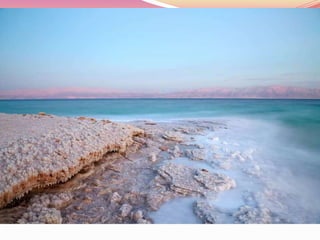
Lowest Point In the World
 Dead Sea is the lowest point in the world. The sea
itself is located 434 meters below sea level (as sea
below sea level? That irony). Apparently, in the past 40
years, the Dead Sea has fallen even further, by 80 feet
(25 meters).
Northernmost Point Of Land
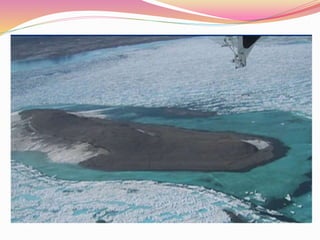
 It might be the northernmost point on earth, but the
northernmost point of land is Kaffeklubben Island,
which is located in the Arctic Ocean, Greenland.
However, this island is located 713.5 kilometers (443.3
miles) away from the North Pole, so maybe a visit to
Santa is not an impossibility after all. It was first
discovered in 1900 by Robert E. Peary, who was an
American Arctic explorer.
Southernmost Point Of Land
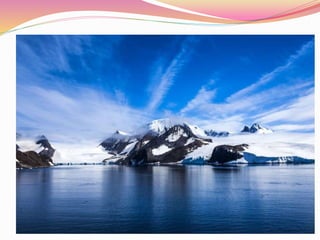
 It is located in Antarctica ,Once in the South Pole, all
the directions from there are north, because it is in a
location where all the lines of longitude converge
(including the North Pole) and the latitude is 90
degrees south.
 The land is only about a 100 meters above sea level,
and the ice is about 2,700 meters (9,000 feet) thick,
making the South Pole even colder than the North
Pole.
THE END
THANKU,

Presentation on world

  • 1.
    The world isthe planet Earth and all life upon it, including human civilization.[1] In a philosophical context, the world is the whole of the physical Universe, or an ontological world. In a theological context, the world is the material or the profane sphere, as opposed to the celestial, spiritual, transcendent or sacred. The "end of the world" refers to scenarios of the final end of human history, often in religious contexts.
  • 2.
    CONTINENTS  A continentis one of several very large landmasses on Earth. Generally identified by convention rather than any strict criteria, up to seven regions are commonly regarded as continents.
  • 3.
    CONTINENTS OF THEWORLD  Asia  Australia  Antarctica  Africa  Europe  North America  South America
  • 4.
  • 5.
    Continent Area Numberof Countries Population (as of 2011) Africa 11,608,000 sq km 54 778,000,000 Antarctica 5,100,000 sq km 0 0 Asia 17,212,000 sq km 47 3,674,000,000 Australia plus Oceania 2,968,000 sq km 14 31,000,000 Europe 837,000 sq km 43 342,000,000 North America 9,365,000 sq km 23 483,000,000 South America 6,880,000 sq km 12 342,000,000
  • 6.
    ASIA  Asia isthe largest continent on earth covering about 9 percent of the earth’s surface. It is also the most populated continent on earth, home to an estimated population of around 4.3 billion people. This large population makes it an important part of the world economy.
  • 7.
    COUNTRIES IN ASIA There are 53 countries in Asia including Russia and Turkey which lie in both Europe and Asia and Taiwan which is technically a part of China and not officially recognised as a country by the United Nations.  Afghanistan, Armenia, Azerbaijan, Bahrain, Bangladesh, Bhutan, Brunei, Cambodia, China, Georgia, Hong Kong, India, Indonesia, Iran, Iraq, Israel, Japan, Jordan, Kazakhstan, North Korea, South Korea, Kuwait, Kyrgyzstan, Laos, Lebanon, Macau, Maldives, Malaysia, Maldives, Mongolia, Myanmar, Nepal, Oman, Pakistan, Palestine, Philippines, Qatar, Russia, Saudi Arabia, Singapore, Sri Lanka, Syria, Taiwan, Tajikistan, Timor-Leste, Turkey, Turkmenistan, United Arab Emirates, Uzbekistan, Vietnam, Yemen.
  • 8.
    FACTS ABOUT ASIA Asia is the World’s largest continent – 43,810,582 km². covering approximately 30% of the Earth’s land and 8.66% of the Earth’s surface.  It is bordered by the Ural Mountains to the east, the Arctic Ocean to the north, the Pacific Ocean to the west and the Indian Ocean to the south.  The highest point in the World, is Mount Everest (8,848 m)  The longest river in Asia and third longest in the World is the Yangtze (6,211 km) which flows through China.  The largest desert in Asia is the Gobi desert measuring 281,800 km².
  • 9.
    AFRICA  Africa isthe second largest continent in the world. It is also the second largest continent in the world in terms of population. Africa is commonly referred to as the black continent by many. This large land mass comprises of 54 countries and is home to one billion people.
  • 10.
    COUNTRIES OF AFRICA There are 53 countries in Africa.  Algeria, Angola, Benin, Botswana, Burkina Faso, Burundi, Cameroon, Cape Verde, Central African Republic, Chad, Comoros, Congo, Congo (DRC), Cote d’Ivoire, Djibouti, Egypt, Equatorial Guinea, Eritrea, Ethiopia, Gabon, Gambia, Ghana, Guinea, Guinea-Bissau, Kenya, Lesotho, Liberia, Libya, Madagascar, Malawi, Mali, Mauritania, Mauritius, Morocco, Mozambique, Namibia, Niger, Nigeria, Rwanda, Sao Tome & Principe, Senegal, Seychelles, Sierra Leone, Somalia, South Africa, Sudan, South Sudan, Swaziland, Tanzania, Togo, Tunisia, Uganda, Western Sahara, Zambia, Zimbabwe. Click on the map (right) for a larger image.
  • 11.
    FACTS ABOUT AFRICA Africa is the World’s second-largest continent – 30,065,000 km² covering approximately 20% of the Earth’s land and 6% of the Earth’s surface .  It is bordered by the Atlantic Ocean to the east, the Indian Ocean to the west and the Mediterranean Sea to the north. The Red Sea and Suez Canal lie to the north-east and separate Africa from Asia.  The longest river in the World, The Nile, measuring 6,695 km – flows north ending in a delta that empties into the Mediterranean Sea.  The World’s largest desert, The Sahara, measuring 9,000,000 km², covers much of north Africa. The Kalahari desert in south- west Africa measures 259,000 km².  The Atlas mountain range lies in the north-west of Africa and the highest mountain, Kilimanjaro, 5895 m, is in Tanzania.
  • 12.
    EUROPE Europe isthe second smallest continent in the world. It comprises the westernmost peninsula of the giant Eurasian landmass. Covering almost 2 percent of the earth’s surface Europe takes 6.8 percent of the world’s total land area. Europe is home to almost 50 countries and is the third most populated continent in the world after Asia and Africa.
  • 13.
    COUNTRIES OF EUROPE There are 47 countries in Europe including Turkey and Russia which lie in both Europe and Asia.  Albania, Andorra, Austria, Belarus, Belgium, Bosnia and Herzegovina, Bulgaria, Croatia, Cyprus, Czech Republic, Denmark, Estonia, Finland, France, Germany, Greece, Hungary, Iceland, Ireland, Italy, Latvia, Liechtenstein, Lithuania, Luxembourg, Macedonia, Malta, Moldova, Monaco, Montenegro, Netherlands, Norway, Poland, Portugal, Romania, Russia, San Marino, Serbia, Slovakia, Slovenia, Spain, Sweden, Switzerland, Turkey, Ukraine, United Kingdom, Vatican City.
  • 14.
    FACTS ABOUT EUROPE Europe is the World’s second-smallest continent – 10,180,000 km² covering approximately 6.7% of the Earth’s land and 2% of the Earth’s surface .  It is bordered by the Atlantic Ocean to the west, the Arctic Ocean to the north and the Mediterranean Sea to the south. The Ural mountains in Russia mark the eastern extreme.  The southern regions are higher and include the Pyrenees, the Alps and the Carpathian mountain ranges.  The longest river in Europe is the Volga (2,850 km) in Russia.  The highest mountain is Elbrus (5,642 m) in Russia.
  • 15.
    AUSTRALIA  The continentof Australia is a single country continent. It is the sixth largest country by total area, and is also the smallest of all the seven continents. Because of its size, and isolated location, it is also called as island continent. Covering an area of 7617930 square kilometres, Australia lies in the Indo- Australian Plate.
  • 16.
    COUNTRIES IN AUSTRALIA There are 28 countries and Island groups in Australia/Oceania.  Australia, Christmas Island, Cocos Islands, Cook Islands, Fiji, Guam, Kiribati, Marshall Islands, Federated States of Micronesia, Nauru, New Caledonia, New Zealand, Niue, Norfolk Island, Northern Mariana Islands, Palau, Papua New Guinea, Pitcairn Islands, French Polynesia, American Samoa, Samoa, Solomon Islands, Tokelau, Tonga, Tuvalu, Vanuatu, Wallis and Futuna
  • 17.
    FACTS ABOUT AUSTRALIA Australia, also called Oceania or Australia/Oceania, is the World’s smallest continent – 8,112,000 km² covering approximately 5.3% of the Earth’s land and 1.5% of the Earth’s surface.  It is situated partly in the Pacific ocean, bordered by the Indian Ocean to the west and the Southern ocean to the south.  The highest point is Mount Wilhelm (4509 m) in Papua New Guinea.  The longest river is the Darling river (2,739 km) which is a tributary of the Murray river in Australia.  Australia is the flattest continent with much of Australia being desert.
  • 18.
    ANTARCTICA  Antarctica isthe southernmost continent of all. The geographic south pole of the earth is contained in this continent. It is made of large permanent glaciers that surround the South Pole. This is one of the most uninhabitable places on earth. With a very small population of less than 5000 residents, Antarctica is the least populated continent on earth.
  • 19.
    COUNTRIES IN ANTARCTICA There are no countries in Antarctica but various regions have been named.
  • 20.
    FACTS ABOUT ANTARCTICA Antarctica is the World’s fifth-largest continent measuring approximately 14 million km², covering approximately 8.9% of the Earth’s land and 2.7% of the Earth’s surface.  It is surrounded by the Southern Ocean and lies almost entirely within the Antarctic circle.  98% of the land area is permanently covered with ice  The Eastern side of Antarctica is higher than the West. The highest point is Vinson Massif measuring 4,897 m.  Antarctica is the coldest place on Earth. The higher, eastern side of Antarctica is colder than the lower west and the peninsula of Graham Land is the warmest region.
  • 21.
    NORTH AMERICA NorthAmerica is a continent which lies wholly in the northern hemisphere. It is bordered by Arctic Ocean in the north, Atlantic Ocean in the east, Pacific Ocean in the south and west, and South America and Caribbean Sea in the south east. North America lies almost wholly in the western hemisphere. North America covers almost 4.8 percent of the earth’s surface.
  • 22.
    COUNRIES IN NORTHAMERICA  There are 38 countries and Islands in North America.  Anguilla, Antigua and Barbuda, Aruba, The Bahamas, Barbados, Belize, Bermuda, British Virgin Islands, Canada, Cayman Islands, Costa Rica, Cuba, Dominica, Dominican Republic, El Salvador, Greenland, Grenada, Guadeloupe, Guatemala, Haiti, Honduras, Jamaica, Martinique, Mexico, Montserrat, Navassa Islands, Netherlands Antilles, Nicaragua, Panama, Puerto Rico, Saint Kitts and Nevis, Saint Lucia, Saint-Pierre and Miquelon, Saint Vincent and the Grenadines, Trinidad and Tobago, United States of America, US Virgin Islands.
  • 23.
    FACTS ABOUT NORTHAMERICA  North America is the World’s third-largest continent – 24,474,000 km² covering approximately 16.5% of the Earth’s land and 5% of the Earth’s surface.  It is bordered by the Atlantic Ocean to the east, the Arctic Ocean to the north and the Pacific Ocean to the west.  The eastern side of the continent is generally lower than the west which contains the Rocky mountains. The five Great Lakes lie on the United States Canadian border.  The highest mountain is Mt McKinley in Alaska (6,194 m) and the longest river is the Mississippi (3,765 km).
  • 24.
    SOUTH AMERICA  SouthAmerica is a continent located in the western hemisphere with most of its land area lying in the southern hemisphere and a relatively small portion in the northern hemisphere. It has Pacific Ocean to its western side, Atlantic Ocean in the north and eastern side, and North America and Caribbean Sea in the North West side.
  • 25.
    COUNTRIES IN SOUTHAMERICA  There are 16 countries and Islands in South America.  Argentina, Bolivia, Brazil, Chile, Colombia, Ecuador, Falkland Islands, French Guiana, Guyana, Paraguay, Peru, South Georgia and South Sandwich Islands, Suriname, Uruguay, Venezuela.
  • 26.
    FACTS ABOUT SOUTHAMERICA  South America is the World’s fourth-largest continent – 17,840,000 km² covering approximately 12% of the Earth’s land and 3.5% of the Earth’s surface.  It is bordered by the Atlantic Ocean to the east and the Pacific Ocean to the west.  The eastern side of the continent is generally lower than the west which contains the Andes mountain range.  The second-longest river in the World, the Amazon (6,400 km) flows across the top of the continent.  Argentina is home to the highest mountain Aconcagua (6960 m) and the World’s highest waterfall – Angel Falls (979 m).
  • 27.
    HIGHEST MOUNTAINS INEACH CONTINENT  HIGHEST MOUNTAINS ON EACH CONTINENT  ASIA: MT EVEREST (29,035 FT)  AFRICA: MT KILIMANJARO (19,340 FT)  NORTH AMERICA: MT MCKINLEY (20,320 FT)  SOUTH AMERICA: MT ACONCAGUA (22,834 FT)  AUSTRALIA: MT KOSCIUSKO (7,310 FT)  ANTARCTICA: VINSON MASSIF (16,066 FT)  EUROPE: MT ELBRUS (18,510 FT)
  • 28.
    DESERTS OF CONTINENTS LARGEST DESERTS ON THE PLANET  (Smallest) #10 - Great Basin Desert (North America) #9 - Syrian Desert (Asia) #8 - Great Victoria Desert (Australia) #7 - Patagonian Desert (South America) #6 - Kalahari Desert (Africa) #5 - Gobi Desert (Asia) #4 - Arabian Desert (Middle East) #3 - Sahara Desert (Africa) #2 - Arctic Desert (North Pole) (Largest) #1 - Antarctic Desert (Antarctica) 
  • 29.
    RIVERS IN CONTINENTS LONGEST RIVERS ON EACH CONTINENT  ASIA: Yangtze River (3917 miles)  AFRICA: Nile River (4132 miles)  NORTH AMERICA: Missouri-Mississippi River (3,902 miles)  SOUTH AMERICA: Amazon River (3,976 miles)  AUSTRALIA: Murray-Darling River (2,282 miles)  EUROPE: Volga River (2,266 miles)
  • 30.
    Highest Point OfThe World  The tallest point in the world, Mount Everest, reaches as high as 29,035 feet. It is the mountain that is on every adventurer’s bucket list to climb. It was first discovered in the 1850s, and it was named after a retired Surveyor General, George Everest, who ironically never even saw the peak. It has been climbed by both man and child alike.
  • 32.
    Lowest Point Inthe World  Dead Sea is the lowest point in the world. The sea itself is located 434 meters below sea level (as sea below sea level? That irony). Apparently, in the past 40 years, the Dead Sea has fallen even further, by 80 feet (25 meters).
  • 34.
    Northernmost Point OfLand  It might be the northernmost point on earth, but the northernmost point of land is Kaffeklubben Island, which is located in the Arctic Ocean, Greenland. However, this island is located 713.5 kilometers (443.3 miles) away from the North Pole, so maybe a visit to Santa is not an impossibility after all. It was first discovered in 1900 by Robert E. Peary, who was an American Arctic explorer.
  • 36.
    Southernmost Point OfLand  It is located in Antarctica ,Once in the South Pole, all the directions from there are north, because it is in a location where all the lines of longitude converge (including the North Pole) and the latitude is 90 degrees south.  The land is only about a 100 meters above sea level, and the ice is about 2,700 meters (9,000 feet) thick, making the South Pole even colder than the North Pole.
  • 38.