6-Minute Walk Test (6MWT)
Background
 6MWT is a practical simple test that requires a 100-ft hallway but no exercise
equipment or advanced training for technicians.
 This test measures the distance that a patient can quickly walk on a flat, hard
surface in a period of 6 minutes (the 6MWD).
 Developed in 1963 by Balke to evaluate functional capacity in person.
 Easy to administer, better tolerated, and more reflective of activities of daily living
than the other walk tests.
1. Am J Respir Crit Care Med Vol 166. pp 111–117, 2002. DOI: 10.1164/rccm.166/1/111
2. https://www.rheumatology.org/I-Am-A/Rheumatologist/Research/Clinician-Researchers/Six-Minute-Walk-Test-SMWT
Other similar tests to evaluate functional exercise capacity
 Stair climbing
 Shuttle-walk test
 Detection of exercise-induced asthma
 A cardiac stress test (e.g., Bruce protocol)
 A cardiopulmonary exercise test
Am J Respir Crit Care Med Vol 166. pp 111–117, 2002. DOI: 10.1164/rccm.166/1/111
What does it evaluates?
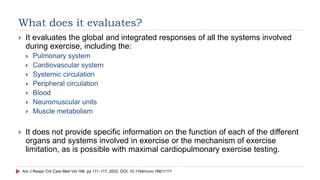
 It evaluates the global and integrated responses of all the systems involved
during exercise, including the:
 Pulmonary system
 Cardiovascular system
 Systemic circulation
 Peripheral circulation
 Blood
 Neuromuscular units
 Muscle metabolism
 It does not provide specific information on the function of each of the different
organs and systems involved in exercise or the mechanism of exercise
limitation, as is possible with maximal cardiopulmonary exercise testing.
Am J Respir Crit Care Med Vol 166. pp 111–117, 2002. DOI: 10.1164/rccm.166/1/111
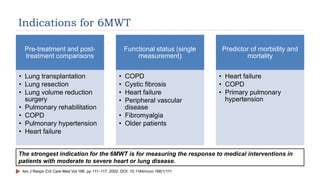
Indications for 6MWT
Pre-treatment and post-
treatment comparisons
• Lung transplantation
• Lung resection
• Lung volume reduction
surgery
• Pulmonary rehabilitation
• COPD
• Pulmonary hypertension
• Heart failure
Functional status (single
measurement)
• COPD
• Cystic fibrosis
• Heart failure
• Peripheral vascular
disease
• Fibromyalgia
• Older patients
Predictor of morbidity and
mortality
• Heart failure
• COPD
• Primary pulmonary
hypertension
Am J Respir Crit Care Med Vol 166. pp 111–117, 2002. DOI: 10.1164/rccm.166/1/111
The strongest indication for the 6MWT is for measuring the response to medical interventions in
patients with moderate to severe heart or lung disease.
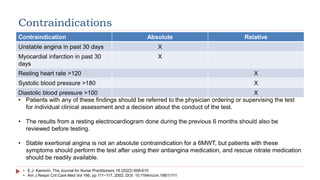
Contraindications
Contraindication Absolute Relative
Unstable angina in past 30 days X
Myocardial infarction in past 30
days
X
Resting heart rate >120 X
Systolic blood pressure >180 X
Diastolic blood pressure >100 X
• E.J. Kammin. The Journal for Nurse Practitioners 18 (2022) 608-610
• Am J Respir Crit Care Med Vol 166. pp 111–117, 2002. DOI: 10.1164/rccm.166/1/111
• Patients with any of these findings should be referred to the physician ordering or supervising the test
for individual clinical assessment and a decision about the conduct of the test.
• The results from a resting electrocardiogram done during the previous 6 months should also be
reviewed before testing.
• Stable exertional angina is not an absolute contraindication for a 6MWT, but patients with these
symptoms should perform the test after using their antiangina medication, and rescue nitrate medication
should be readily available.
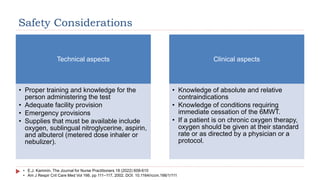
Safety Considerations
Technical aspects
• Proper training and knowledge for the
person administering the test
• Adequate facility provision
• Emergency provisions
• Supplies that must be available include
oxygen, sublingual nitroglycerine, aspirin,
and albuterol (metered dose inhaler or
nebulizer).
Clinical aspects
• Knowledge of absolute and relative
contraindications
• Knowledge of conditions requiring
immediate cessation of the 6MWT.
• If a patient is on chronic oxygen therapy,
oxygen should be given at their standard
rate or as directed by a physician or a
protocol.
• E.J. Kammin. The Journal for Nurse Practitioners 18 (2022) 608-610
• Am J Respir Crit Care Med Vol 166. pp 111–117, 2002. DOI: 10.1164/rccm.166/1/111
Reasons for Immediate Cessation of 6-Minute Walk Test
 Chest pain
 Intolerable dyspnea
 Leg cramps
 Staggering
 Diaphoresis
 Pale or ashen appearance
• Technicians must be trained to recognize these problems and the appropriate responses.
• If a test is stopped for any of these reasons, the patient should sit or lie supine as appropriate
depending on the severity or the event and the technician’s assessment of the severity of the event
and the risk of syncope.
• The following should be obtained based on the judgment of the technician: blood pressure, pulse rate,
oxygen saturation, and a physician evaluation. Oxygen should be administered as appropriate.
• E.J. Kammin. The Journal for Nurse Practitioners 18 (2022) 608-610
• Am J Respir Crit Care Med Vol 166. pp 111–117, 2002. DOI: 10.1164/rccm.166/1/111
Location criteria for conducting the test
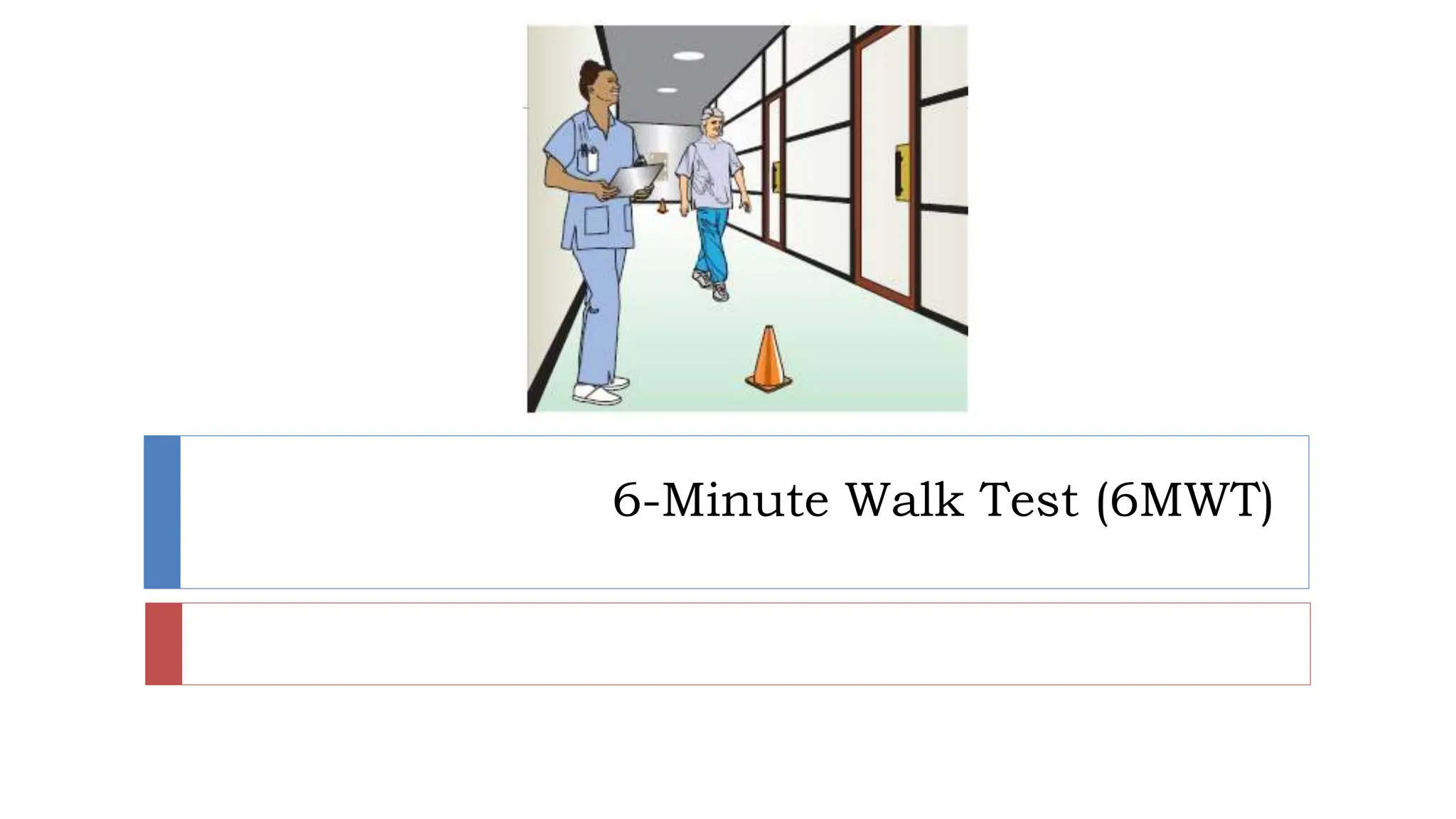
 Should be performed indoors, along a long, flat, straight, enclosed corridor with a
hard surface that is seldom traveled.
 If the weather is comfortable, the test may be performed outdoors.
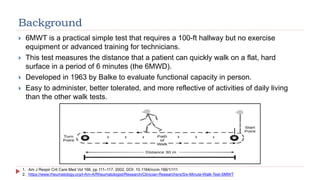
 The walking course must be 30 m in length. A 100-ft hallway is, therefore, required.
 The length of the corridor should be marked every 3 m.
 The turnaround points should be marked with a cone (such as an orange traffic
cone).
 A starting line, which marks the beginning and end of each 60-m lap, should be
marked on the floor using brightly colored tape.
 The use of a treadmill to determine the 6MWD might save space and allow constant
monitoring during the exercise, but the use of a treadmill for 6-minute walk testing is
not recommended.
Am J Respir Crit Care Med Vol 166. pp 111–117, 2002. DOI: 10.1164/rccm.166/1/111
Required equipment
1. Countdown timer (or stopwatch)
2. Mechanical lap counter
3. Two small cones to mark the turnaround points
4. A chair that can be easily moved along the walking course
5. Worksheets on a clipboard
6. A source of oxygen
7. Sphygmomanometer
8. Telephone
9. Automated electronic defibrillator
Am J Respir Crit Care Med Vol 166. pp 111–117, 2002. DOI: 10.1164/rccm.166/1/111
Patient preparation
1. Comfortable clothing should be worn.
2. Appropriate shoes for walking should be worn.
3. Patients should use their usual walking aids during the test (cane, walker,
etc.).
4. The patient’s usual medical regimen should be continued.
5. A light meal is acceptable before early morning or early afternoon tests.
6. Patients should not have exercised vigorously within 2 hours of beginning
the test.
Am J Respir Crit Care Med Vol 166. pp 111–117, 2002. DOI: 10.1164/rccm.166/1/111
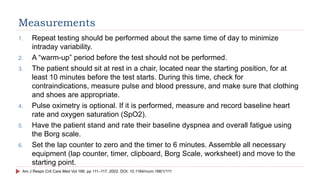
Measurements
1. Repeat testing should be performed about the same time of day to minimize
intraday variability.
2. A “warm-up” period before the test should not be performed.
3. The patient should sit at rest in a chair, located near the starting position, for at
least 10 minutes before the test starts. During this time, check for
contraindications, measure pulse and blood pressure, and make sure that clothing
and shoes are appropriate.
4. Pulse oximetry is optional. If it is performed, measure and record baseline heart
rate and oxygen saturation (SpO2).
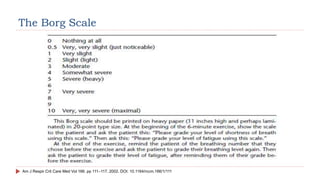
5. Have the patient stand and rate their baseline dyspnea and overall fatigue using
the Borg scale.
6. Set the lap counter to zero and the timer to 6 minutes. Assemble all necessary
equipment (lap counter, timer, clipboard, Borg Scale, worksheet) and move to the
starting point.
Am J Respir Crit Care Med Vol 166. pp 111–117, 2002. DOI: 10.1164/rccm.166/1/111
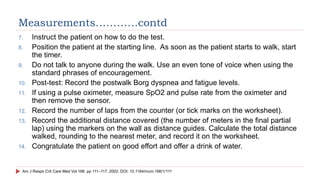
Measurements…………contd
7. Instruct the patient on how to do the test.
8. Position the patient at the starting line. As soon as the patient starts to walk, start
the timer.
9. Do not talk to anyone during the walk. Use an even tone of voice when using the
standard phrases of encouragement.
10. Post-test: Record the postwalk Borg dyspnea and fatigue levels.
11. If using a pulse oximeter, measure SpO2 and pulse rate from the oximeter and
then remove the sensor.
12. Record the number of laps from the counter (or tick marks on the worksheet).
13. Record the additional distance covered (the number of meters in the final partial
lap) using the markers on the wall as distance guides. Calculate the total distance
walked, rounding to the nearest meter, and record it on the worksheet.
14. Congratulate the patient on good effort and offer a drink of water.
Am J Respir Crit Care Med Vol 166. pp 111–117, 2002. DOI: 10.1164/rccm.166/1/111
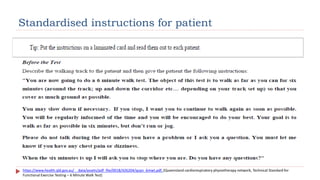
Standardised instructions for patient
https://www.health.qld.gov.au/__data/assets/pdf_file/0018/426204/qcpn_6mwt.pdf, (Queensland cardiorespiratory physiotherapy network, Technical Standard for
Functional Exercise Testing – 6 Minute Walk Test)
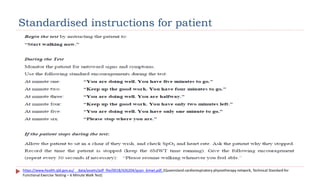
Standardised instructions for patient
https://www.health.qld.gov.au/__data/assets/pdf_file/0018/426204/qcpn_6mwt.pdf, (Queensland cardiorespiratory physiotherapy network, Technical Standard for
Functional Exercise Testing – 6 Minute Walk Test)
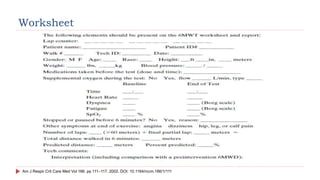
Worksheet
Am J Respir Crit Care Med Vol 166. pp 111–117, 2002. DOI: 10.1164/rccm.166/1/111
The Borg Scale
Am J Respir Crit Care Med Vol 166. pp 111–117, 2002. DOI: 10.1164/rccm.166/1/111
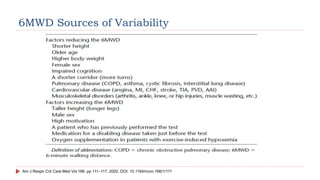
6MWD Sources of Variability
Am J Respir Crit Care Med Vol 166. pp 111–117, 2002. DOI: 10.1164/rccm.166/1/111
Interpreting the Results
 Ideally, you would calculate the predicted distance using equations from a
published study of healthy people of the same age group, much like for
spirometry tests.
 Healthy subjects’ 6MWDs range from 400 to 700 m.
 It is recommended that change in 6MWD be expressed as an absolute value
(e.g., the patient walked 50 m farther).
 A low 6MWD is nonspecific and nondiagnostic (just like a low maximum
voluntary ventilation).
 If the 6MWD is low, thoroughly search for the cause(s) of the impairment. The
following tests may then be helpful: pulmonary function, cardiac function,
ankle-arm index, muscle strength, nutritional status, orthopedic function, and
cognitive function.
Paul L Enright. Respir Care 2003;48(8):783–785
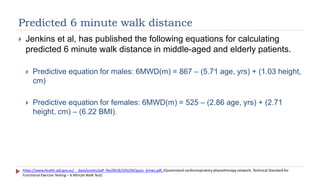
Predicted 6 minute walk distance
 Jenkins et al, has published the following equations for calculating
predicted 6 minute walk distance in middle-aged and elderly patients.
 Predictive equation for males: 6MWD(m) = 867 – (5.71 age, yrs) + (1.03 height,
cm)
 Predictive equation for females: 6MWD(m) = 525 – (2.86 age, yrs) + (2.71
height, cm) – (6.22 BMI).
https://www.health.qld.gov.au/__data/assets/pdf_file/0018/426204/qcpn_6mwt.pdf, (Queensland cardiorespiratory physiotherapy network, Technical Standard for
Functional Exercise Testing – 6 Minute Walk Test)
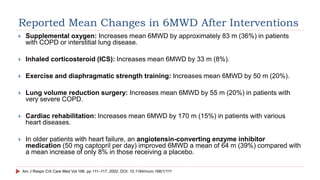
Reported Mean Changes in 6MWD After Interventions
 Supplemental oxygen: Increases mean 6MWD by approximately 83 m (36%) in patients
with COPD or interstitial lung disease.
 Inhaled corticosteroid (ICS): Increases mean 6MWD by 33 m (8%).
 Exercise and diaphragmatic strength training: Increases mean 6MWD by 50 m (20%).
 Lung volume reduction surgery: Increases mean 6MWD by 55 m (20%) in patients with
very severe COPD.
 Cardiac rehabilitation: Increases mean 6MWD by 170 m (15%) in patients with various
heart diseases.
 In older patients with heart failure, an angiotensin-converting enzyme inhibitor
medication (50 mg captopril per day) improved 6MWD a mean of 64 m (39%) compared with
a mean increase of only 8% in those receiving a placebo.
Am J Respir Crit Care Med Vol 166. pp 111–117, 2002. DOI: 10.1164/rccm.166/1/111
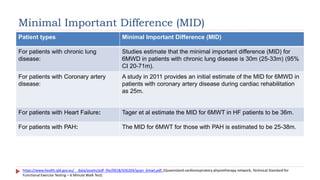
Minimal Important Difference (MID)
Patient types Minimal Important Difference (MID)
For patients with chronic lung
disease:
Studies estimate that the minimal important difference (MID) for
6MWD in patients with chronic lung disease is 30m (25-33m) (95%
CI 20-71m).
For patients with Coronary artery
disease:
A study in 2011 provides an initial estimate of the MID for 6MWD in
patients with coronary artery disease during cardiac rehabilitation
as 25m.
For patients with Heart Failure: Tager et al estimate the MID for 6MWT in HF patients to be 36m.
For patients with PAH: The MID for 6MWT for those with PAH is estimated to be 25-38m.
https://www.health.qld.gov.au/__data/assets/pdf_file/0018/426204/qcpn_6mwt.pdf, (Queensland cardiorespiratory physiotherapy network, Technical Standard for
Functional Exercise Testing – 6 Minute Walk Test)
Guideline recommendations
 American Thoracic Society (ATS)
 European Respiratory Society
• Am J Respir Crit Care Med Vol 166. pp 111–117, 2002. DOI: 10.1164/rccm.166/1/111, https://www.atsjournals.org/doi/epdf/10.1164/ajrccm.166.1.at1102?role=tab
• Eur Respir J 2014; 44: 1428–1446 | DOI: 10.1183/09031936.00150314, https://erj.ersjournals.com/content/erj/44/6/1428.full.pdf
6 Minute Walk Test Instructional Video
 https://www.youtube.com/watch?v=nXuJIs25z1U
Summary
 The 6MWT is a useful measure of functional capacity, targeted at people with
at least moderately severe impairment.
 It has been widely used for measuring the response to therapeutic
interventions for pulmonary and cardiac disease.
 The American Thoracic Society 2002 guidelines provide a standardized
approach for performing the test.
 Safer, easier to administer, better tolerated, and better reflects activities of
daily living than other walk tests (such as the shuttle walk test).
 The primary measurement is 6-min walk distance (6MWD), but during the
6MWT data can also be collected about the patient’s blood oxygen saturation
and perception of dyspnea during exertion.
 If the 6MWD is low, thoroughly search for the cause(s) of the impairment.
 For interpretation, use the latest available 6MWD reference equations.
Paul L Enright. Respir Care 2003;48(8):783–785

6-Minute Walk Test.pptx

  • 1.
  • 2.
    Background  6MWT isa practical simple test that requires a 100-ft hallway but no exercise equipment or advanced training for technicians.  This test measures the distance that a patient can quickly walk on a flat, hard surface in a period of 6 minutes (the 6MWD).  Developed in 1963 by Balke to evaluate functional capacity in person.  Easy to administer, better tolerated, and more reflective of activities of daily living than the other walk tests. 1. Am J Respir Crit Care Med Vol 166. pp 111–117, 2002. DOI: 10.1164/rccm.166/1/111 2. https://www.rheumatology.org/I-Am-A/Rheumatologist/Research/Clinician-Researchers/Six-Minute-Walk-Test-SMWT
  • 3.
    Other similar teststo evaluate functional exercise capacity  Stair climbing  Shuttle-walk test  Detection of exercise-induced asthma  A cardiac stress test (e.g., Bruce protocol)  A cardiopulmonary exercise test Am J Respir Crit Care Med Vol 166. pp 111–117, 2002. DOI: 10.1164/rccm.166/1/111
  • 4.
    What does itevaluates?  It evaluates the global and integrated responses of all the systems involved during exercise, including the:  Pulmonary system  Cardiovascular system  Systemic circulation  Peripheral circulation  Blood  Neuromuscular units  Muscle metabolism  It does not provide specific information on the function of each of the different organs and systems involved in exercise or the mechanism of exercise limitation, as is possible with maximal cardiopulmonary exercise testing. Am J Respir Crit Care Med Vol 166. pp 111–117, 2002. DOI: 10.1164/rccm.166/1/111
  • 5.
    Indications for 6MWT Pre-treatmentand post- treatment comparisons • Lung transplantation • Lung resection • Lung volume reduction surgery • Pulmonary rehabilitation • COPD • Pulmonary hypertension • Heart failure Functional status (single measurement) • COPD • Cystic fibrosis • Heart failure • Peripheral vascular disease • Fibromyalgia • Older patients Predictor of morbidity and mortality • Heart failure • COPD • Primary pulmonary hypertension Am J Respir Crit Care Med Vol 166. pp 111–117, 2002. DOI: 10.1164/rccm.166/1/111 The strongest indication for the 6MWT is for measuring the response to medical interventions in patients with moderate to severe heart or lung disease.
  • 6.
    Contraindications Contraindication Absolute Relative Unstableangina in past 30 days X Myocardial infarction in past 30 days X Resting heart rate >120 X Systolic blood pressure >180 X Diastolic blood pressure >100 X • E.J. Kammin. The Journal for Nurse Practitioners 18 (2022) 608-610 • Am J Respir Crit Care Med Vol 166. pp 111–117, 2002. DOI: 10.1164/rccm.166/1/111 • Patients with any of these findings should be referred to the physician ordering or supervising the test for individual clinical assessment and a decision about the conduct of the test. • The results from a resting electrocardiogram done during the previous 6 months should also be reviewed before testing. • Stable exertional angina is not an absolute contraindication for a 6MWT, but patients with these symptoms should perform the test after using their antiangina medication, and rescue nitrate medication should be readily available.
  • 7.
    Safety Considerations Technical aspects •Proper training and knowledge for the person administering the test • Adequate facility provision • Emergency provisions • Supplies that must be available include oxygen, sublingual nitroglycerine, aspirin, and albuterol (metered dose inhaler or nebulizer). Clinical aspects • Knowledge of absolute and relative contraindications • Knowledge of conditions requiring immediate cessation of the 6MWT. • If a patient is on chronic oxygen therapy, oxygen should be given at their standard rate or as directed by a physician or a protocol. • E.J. Kammin. The Journal for Nurse Practitioners 18 (2022) 608-610 • Am J Respir Crit Care Med Vol 166. pp 111–117, 2002. DOI: 10.1164/rccm.166/1/111
  • 8.
    Reasons for ImmediateCessation of 6-Minute Walk Test  Chest pain  Intolerable dyspnea  Leg cramps  Staggering  Diaphoresis  Pale or ashen appearance • Technicians must be trained to recognize these problems and the appropriate responses. • If a test is stopped for any of these reasons, the patient should sit or lie supine as appropriate depending on the severity or the event and the technician’s assessment of the severity of the event and the risk of syncope. • The following should be obtained based on the judgment of the technician: blood pressure, pulse rate, oxygen saturation, and a physician evaluation. Oxygen should be administered as appropriate. • E.J. Kammin. The Journal for Nurse Practitioners 18 (2022) 608-610 • Am J Respir Crit Care Med Vol 166. pp 111–117, 2002. DOI: 10.1164/rccm.166/1/111
  • 9.
    Location criteria forconducting the test  Should be performed indoors, along a long, flat, straight, enclosed corridor with a hard surface that is seldom traveled.  If the weather is comfortable, the test may be performed outdoors.  The walking course must be 30 m in length. A 100-ft hallway is, therefore, required.  The length of the corridor should be marked every 3 m.  The turnaround points should be marked with a cone (such as an orange traffic cone).  A starting line, which marks the beginning and end of each 60-m lap, should be marked on the floor using brightly colored tape.  The use of a treadmill to determine the 6MWD might save space and allow constant monitoring during the exercise, but the use of a treadmill for 6-minute walk testing is not recommended. Am J Respir Crit Care Med Vol 166. pp 111–117, 2002. DOI: 10.1164/rccm.166/1/111
  • 10.
    Required equipment 1. Countdowntimer (or stopwatch) 2. Mechanical lap counter 3. Two small cones to mark the turnaround points 4. A chair that can be easily moved along the walking course 5. Worksheets on a clipboard 6. A source of oxygen 7. Sphygmomanometer 8. Telephone 9. Automated electronic defibrillator Am J Respir Crit Care Med Vol 166. pp 111–117, 2002. DOI: 10.1164/rccm.166/1/111
  • 11.
    Patient preparation 1. Comfortableclothing should be worn. 2. Appropriate shoes for walking should be worn. 3. Patients should use their usual walking aids during the test (cane, walker, etc.). 4. The patient’s usual medical regimen should be continued. 5. A light meal is acceptable before early morning or early afternoon tests. 6. Patients should not have exercised vigorously within 2 hours of beginning the test. Am J Respir Crit Care Med Vol 166. pp 111–117, 2002. DOI: 10.1164/rccm.166/1/111
  • 12.
    Measurements 1. Repeat testingshould be performed about the same time of day to minimize intraday variability. 2. A “warm-up” period before the test should not be performed. 3. The patient should sit at rest in a chair, located near the starting position, for at least 10 minutes before the test starts. During this time, check for contraindications, measure pulse and blood pressure, and make sure that clothing and shoes are appropriate. 4. Pulse oximetry is optional. If it is performed, measure and record baseline heart rate and oxygen saturation (SpO2). 5. Have the patient stand and rate their baseline dyspnea and overall fatigue using the Borg scale. 6. Set the lap counter to zero and the timer to 6 minutes. Assemble all necessary equipment (lap counter, timer, clipboard, Borg Scale, worksheet) and move to the starting point. Am J Respir Crit Care Med Vol 166. pp 111–117, 2002. DOI: 10.1164/rccm.166/1/111
  • 13.
    Measurements…………contd 7. Instruct thepatient on how to do the test. 8. Position the patient at the starting line. As soon as the patient starts to walk, start the timer. 9. Do not talk to anyone during the walk. Use an even tone of voice when using the standard phrases of encouragement. 10. Post-test: Record the postwalk Borg dyspnea and fatigue levels. 11. If using a pulse oximeter, measure SpO2 and pulse rate from the oximeter and then remove the sensor. 12. Record the number of laps from the counter (or tick marks on the worksheet). 13. Record the additional distance covered (the number of meters in the final partial lap) using the markers on the wall as distance guides. Calculate the total distance walked, rounding to the nearest meter, and record it on the worksheet. 14. Congratulate the patient on good effort and offer a drink of water. Am J Respir Crit Care Med Vol 166. pp 111–117, 2002. DOI: 10.1164/rccm.166/1/111
  • 14.
    Standardised instructions forpatient https://www.health.qld.gov.au/__data/assets/pdf_file/0018/426204/qcpn_6mwt.pdf, (Queensland cardiorespiratory physiotherapy network, Technical Standard for Functional Exercise Testing – 6 Minute Walk Test)
  • 15.
    Standardised instructions forpatient https://www.health.qld.gov.au/__data/assets/pdf_file/0018/426204/qcpn_6mwt.pdf, (Queensland cardiorespiratory physiotherapy network, Technical Standard for Functional Exercise Testing – 6 Minute Walk Test)
  • 16.
    Worksheet Am J RespirCrit Care Med Vol 166. pp 111–117, 2002. DOI: 10.1164/rccm.166/1/111
  • 17.
    The Borg Scale AmJ Respir Crit Care Med Vol 166. pp 111–117, 2002. DOI: 10.1164/rccm.166/1/111
  • 18.
    6MWD Sources ofVariability Am J Respir Crit Care Med Vol 166. pp 111–117, 2002. DOI: 10.1164/rccm.166/1/111
  • 19.
    Interpreting the Results Ideally, you would calculate the predicted distance using equations from a published study of healthy people of the same age group, much like for spirometry tests.  Healthy subjects’ 6MWDs range from 400 to 700 m.  It is recommended that change in 6MWD be expressed as an absolute value (e.g., the patient walked 50 m farther).  A low 6MWD is nonspecific and nondiagnostic (just like a low maximum voluntary ventilation).  If the 6MWD is low, thoroughly search for the cause(s) of the impairment. The following tests may then be helpful: pulmonary function, cardiac function, ankle-arm index, muscle strength, nutritional status, orthopedic function, and cognitive function. Paul L Enright. Respir Care 2003;48(8):783–785
  • 20.
    Predicted 6 minutewalk distance  Jenkins et al, has published the following equations for calculating predicted 6 minute walk distance in middle-aged and elderly patients.  Predictive equation for males: 6MWD(m) = 867 – (5.71 age, yrs) + (1.03 height, cm)  Predictive equation for females: 6MWD(m) = 525 – (2.86 age, yrs) + (2.71 height, cm) – (6.22 BMI). https://www.health.qld.gov.au/__data/assets/pdf_file/0018/426204/qcpn_6mwt.pdf, (Queensland cardiorespiratory physiotherapy network, Technical Standard for Functional Exercise Testing – 6 Minute Walk Test)
  • 21.
    Reported Mean Changesin 6MWD After Interventions  Supplemental oxygen: Increases mean 6MWD by approximately 83 m (36%) in patients with COPD or interstitial lung disease.  Inhaled corticosteroid (ICS): Increases mean 6MWD by 33 m (8%).  Exercise and diaphragmatic strength training: Increases mean 6MWD by 50 m (20%).  Lung volume reduction surgery: Increases mean 6MWD by 55 m (20%) in patients with very severe COPD.  Cardiac rehabilitation: Increases mean 6MWD by 170 m (15%) in patients with various heart diseases.  In older patients with heart failure, an angiotensin-converting enzyme inhibitor medication (50 mg captopril per day) improved 6MWD a mean of 64 m (39%) compared with a mean increase of only 8% in those receiving a placebo. Am J Respir Crit Care Med Vol 166. pp 111–117, 2002. DOI: 10.1164/rccm.166/1/111
  • 22.
    Minimal Important Difference(MID) Patient types Minimal Important Difference (MID) For patients with chronic lung disease: Studies estimate that the minimal important difference (MID) for 6MWD in patients with chronic lung disease is 30m (25-33m) (95% CI 20-71m). For patients with Coronary artery disease: A study in 2011 provides an initial estimate of the MID for 6MWD in patients with coronary artery disease during cardiac rehabilitation as 25m. For patients with Heart Failure: Tager et al estimate the MID for 6MWT in HF patients to be 36m. For patients with PAH: The MID for 6MWT for those with PAH is estimated to be 25-38m. https://www.health.qld.gov.au/__data/assets/pdf_file/0018/426204/qcpn_6mwt.pdf, (Queensland cardiorespiratory physiotherapy network, Technical Standard for Functional Exercise Testing – 6 Minute Walk Test)
  • 23.
    Guideline recommendations  AmericanThoracic Society (ATS)  European Respiratory Society • Am J Respir Crit Care Med Vol 166. pp 111–117, 2002. DOI: 10.1164/rccm.166/1/111, https://www.atsjournals.org/doi/epdf/10.1164/ajrccm.166.1.at1102?role=tab • Eur Respir J 2014; 44: 1428–1446 | DOI: 10.1183/09031936.00150314, https://erj.ersjournals.com/content/erj/44/6/1428.full.pdf
  • 24.
    6 Minute WalkTest Instructional Video  https://www.youtube.com/watch?v=nXuJIs25z1U
  • 25.
    Summary  The 6MWTis a useful measure of functional capacity, targeted at people with at least moderately severe impairment.  It has been widely used for measuring the response to therapeutic interventions for pulmonary and cardiac disease.  The American Thoracic Society 2002 guidelines provide a standardized approach for performing the test.  Safer, easier to administer, better tolerated, and better reflects activities of daily living than other walk tests (such as the shuttle walk test).  The primary measurement is 6-min walk distance (6MWD), but during the 6MWT data can also be collected about the patient’s blood oxygen saturation and perception of dyspnea during exertion.  If the 6MWD is low, thoroughly search for the cause(s) of the impairment.  For interpretation, use the latest available 6MWD reference equations. Paul L Enright. Respir Care 2003;48(8):783–785

Editor's Notes

  • #3 The effectiveness of exercise interventions and the factors associated with the physical performance in older adults. July 2016. Thesis for: PT, PhDAdvisor: Juan francisco Lisón Párraga, Pedro Rosado Calatayud, Eva Segura Ortí