6 minute walk test
DR. ANAND PATEL
M.P.T. CARDIO-RESPIRATORY
ASSISTANT PROFESSOR
Six minute walk test
Introduction
Assessment of functional capacity has traditionally been done by merely
asking patients the following:
 How many flights of stairs can you climb ?
 How many blocks can you walk ?
However, patients vary in their recollection and may report
overestimations or underestimations of their true functional capacity.
In the early 1960s, Balke developed a simple
test to evaluate the functional capacity by
measuring the distance walked during a
defined period of time.
A 12-minute field performance test was then
developed to evaluate the level of physical
fitness of healthy individuals.
The self-paced 6MWT assesses the
submaximal level of functional capacity.
In an attempt to accommodate patients
with respiratory disease for whom walking
12 minutes was too exhausting, a 6-
minute walk test came into being.
The 6MWT is a practical simple test that
requires a 100-ft hallway but no exercise
equipment or advanced training for
technicians.
 It evaluates the global and integrated responses of all the systems
involved during exercise but It does not provide specific
information on the function of each of the different organs and
systems involved in exercise or the mechanism of exercise
limitation.
 However, because most activities of daily living are performed at
submaximal levels of exertion, the 6MWD may better reflect the
functional exercise level for daily physical activities.
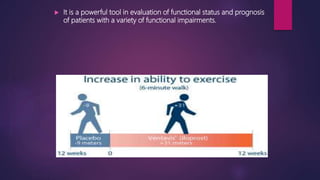
 It is a powerful tool in evaluation of functional status and prognosis
of patients with a variety of functional impairments.
 The 6 Minute Walk Test is a
sub-maximal exercise test
used to assess aerobic
capacity and endurance.
 The distance covered over a
time of 6 minutes is used as
the outcome by which to
compare changes in
performance capacity.
 The 6MWT can be used in preschool children (2-5 years), children (6-12 years)
adults (18-64 years), elderly adults (65+) with a wide range of diagnoses .
 The test was initially designed to help in the assessment of patient with
cardiopulmonary issues.
 It evaluates the functional capacity of the individual and it provides valuable
information regarding all the systems during physical activity, including
pulmonary and cardiovascular systems, blood circulation, neuromuscular units,
body metabolism, and peripheral circulation
Some conditions where 6MWT can be
used are listed below:
•Arthritis
•Fibromyalgia
•Geriatrics
•Multiple Sclerosis
•Parkinson’s Disease
•Spinal Cord Injury
•Stroke
•Muscle disorders
•Spinal Muscular Atrophy
INDICATIONS FOR
THE SIX-MINUTE WALK TEST
 PRETREATMENT AND
POSTTREATMENT
COMPARISONS
1. Lung transplantation
2. Lung resection
3. Lung volume reduction surgery
4. Pulmonary rehabilitation
5. COPD
6. Pulmonary hypertension
7. Heart failure
 FUNCTIONAL STATUS
1. COPD
2. Cystic fibrosis
3. Heart failure
4. Peripheral vascular disease
5. Fibromyalgia
6. Older patients
 Prediction equations from one study are profiled below.
 Men
 6 MWD = (7.57 × Height cm) – (1.76 × weight kg) – (5.02 × age) – 309 m
 An alternate equation using body mass index (BMI)
 6 MWD = 1140 m – (5.61 × BMI) – (6.94 × age)
 With both equations subtract 153 m to obtain lower limit of normal (lower 95%
confidence interval)
 Women
 6 MWD = (2.11 × Height cm) – (2.29 × weight kg) – (5.78 × age) + 667 m
 An alternative equation using BMI
 6 MWD = 1017 m – (6.24 × BMI) – (5.83 × age)
 With both equations subtract 139 m to obtain lower limit of normal (lower 95%
confidence interval)
Contraindications
 ABSOLUTE
1) Unstable angina
2) Myocardial infarction during previous month
 RELATIVE
1) Resting heart rate >120/ min
2) Systolic blood pressure > 180mm Hg
3) Diastolic blood pressure > 100mm Hg
 Stable exertional angina is not a
contraindication but patients having it should
perform the test after taking anti angina
medications and rescue nitrate medication
should be readily available.
Technical aspects
 Test Is performed indoors
 Along a long, flat, straight, enclosed corridor with a hard surface
that is seldom traveled.
 The walking course must be 30 m in length thus a 100-ft hallway is
required.
 The length of the corridor should be marked every 3 m.
 The turnaround points should be marked with a cone.
 A starting line, which marks the beginning and end of each 30-m
lap, should be marked on the floor using brightly colored tape.
Patient preparation
 Comfortable clothing should be worn.
 Appropriate shoes for walking should be
worn.
 Patients should use their usual walking aids
during the test (cane, walker, etc.).
 The patient's usual medical regimen should be continued.
 A light meal is acceptable before early morning or early afternoon
tests.
 Patients should not have exercised vigorously within 2 hours of
beginning the test.
Measurements
 Repeat testing should be performed about the same time of day to
minimize intraday variability.
 A "warm-up" period before the test should not be performed.
 Pulse oximetry is optional. If it is performed, measure and record
baseline heart rate and oxygen saturation (SpO2)
 The patient should sit at rest in a chair, located near the starting position,
for at least 10 minutes before the test starts. During this time, check for
contraindications, measure pulse and blood pressure, and make sure that
clothing and shoes are appropriate.
 Have the patient stand and rate their baseline dyspnea and overall
fatigue using the Borg scale.
 Set the lap counter to zero and the timer to 6 minutes.
 Then the patient walking at a comfortable pace walks and every lap that
is covered by him is marked on the sheet.
 The patient if gets tired while walking then he is allowed to rest but
the timer is not stopped.
 The patient is informed about every passing minute but no words
of encouragement or instructions to hurry up is given to the
patient.
 Once the timer rings the patient is asked to stop where he is
and following things are carried out :
1. Post-test: Record the post walk Borg dyspnea and fatigue levels.
2. Record the number of laps from the counter
3. If using a pulse oximeter, measure SpO2 and pulse rate from the
oximeter .
3. Calculate the total distance walked, rounding to the nearest
meter.
3. Congratulate the patient on good effort and offer a drink of
water.
Borg scale
0 Nothing at all
0.5 Very, very slight (just noticeable)
1 Very slight
2 Slight (light)
3 Moderate
4 Somewhat severe
5 Severe (heavy)
6
7 Very severe
8
9
10 Very, very severe (maximal)
 This Borg scale should be printed on heavy paper and preferably
laminated.
 At the beginning of the 6-minute exercise, show the scale to the
patient and ask the patient to grade his shortness of breath and
fatigue according to the scale.
 Post test he is reminded of his previous scores and is asked to
grade his shortness of breath and fatigue after completion of test
again.
 Then the result of pre and post treatment value is compared and
the result is given as an absolute value like patient improved by 50
meters.
 Reliable reference equations establishing standard performance
during six minute walk test in healthy individuals is not available.
1. Chest pain
2. Severe dyspnea
3. Leg cramps
4. Diaphoresis
5. Profound oxyhemoglobin desaturation.
SAFETY ISSUES
 Testing should be performed in a location where a
rapid,appropriate response to an emergency is possible
 Supplies that must be available include oxygen, sublingual
nitroglycerine, aspirin, and albuterol (mdi)
 technician should be certified in cardiopulmonary
resuscitation
 If a patient is on chronic oxygen therapy, oxygen should be
given at their standard rate
Factors reducing six minute walk
test
 Short height
 Older age
 Female sex
 Higher body weight
 Impaired cognition
 Short corridor i.e. walking distance
 Pulmonary disease (COPD, asthma, cystic fibrosis, interstitial lung
disease)
 Musculoskeletal disorders (arthritis, ankle, knee, or hip injuries,
muscle wasting, etc.)
 Cardiovascular disease (angina, MI, CHF, stroke, TIA, PVD)
Factors increasing six minute
walk test
 Male sex
 Higher motivation
 Taller height or long legs
 A person who has performed the test previously
 Medication for a disabling disease taken just before the test
N
The 6MWT is a useful measure of functional
capacity targeted at people with at least
moderately severe impairment. The test
has been widely used for preoperative and
postoperative evaluation and for measuring
the response to therapeutic interventions for
pulmonary and cardiac disease
6 mwt

6 mwt

  • 1.
    6 minute walktest DR. ANAND PATEL M.P.T. CARDIO-RESPIRATORY ASSISTANT PROFESSOR
  • 2.
    Six minute walktest Introduction Assessment of functional capacity has traditionally been done by merely asking patients the following:  How many flights of stairs can you climb ?  How many blocks can you walk ? However, patients vary in their recollection and may report overestimations or underestimations of their true functional capacity.
  • 3.
    In the early1960s, Balke developed a simple test to evaluate the functional capacity by measuring the distance walked during a defined period of time. A 12-minute field performance test was then developed to evaluate the level of physical fitness of healthy individuals. The self-paced 6MWT assesses the submaximal level of functional capacity.
  • 4.
    In an attemptto accommodate patients with respiratory disease for whom walking 12 minutes was too exhausting, a 6- minute walk test came into being. The 6MWT is a practical simple test that requires a 100-ft hallway but no exercise equipment or advanced training for technicians.
  • 5.
     It evaluatesthe global and integrated responses of all the systems involved during exercise but It does not provide specific information on the function of each of the different organs and systems involved in exercise or the mechanism of exercise limitation.  However, because most activities of daily living are performed at submaximal levels of exertion, the 6MWD may better reflect the functional exercise level for daily physical activities.
  • 6.
     It isa powerful tool in evaluation of functional status and prognosis of patients with a variety of functional impairments.

  • 7.
     The 6Minute Walk Test is a sub-maximal exercise test used to assess aerobic capacity and endurance.  The distance covered over a time of 6 minutes is used as the outcome by which to compare changes in performance capacity.
  • 8.
     The 6MWTcan be used in preschool children (2-5 years), children (6-12 years) adults (18-64 years), elderly adults (65+) with a wide range of diagnoses .  The test was initially designed to help in the assessment of patient with cardiopulmonary issues.  It evaluates the functional capacity of the individual and it provides valuable information regarding all the systems during physical activity, including pulmonary and cardiovascular systems, blood circulation, neuromuscular units, body metabolism, and peripheral circulation
  • 9.
    Some conditions where6MWT can be used are listed below: •Arthritis •Fibromyalgia •Geriatrics •Multiple Sclerosis •Parkinson’s Disease •Spinal Cord Injury •Stroke •Muscle disorders •Spinal Muscular Atrophy
  • 10.
    INDICATIONS FOR THE SIX-MINUTEWALK TEST  PRETREATMENT AND POSTTREATMENT COMPARISONS 1. Lung transplantation 2. Lung resection 3. Lung volume reduction surgery 4. Pulmonary rehabilitation 5. COPD 6. Pulmonary hypertension 7. Heart failure  FUNCTIONAL STATUS 1. COPD 2. Cystic fibrosis 3. Heart failure 4. Peripheral vascular disease 5. Fibromyalgia 6. Older patients
  • 11.
     Prediction equationsfrom one study are profiled below.  Men  6 MWD = (7.57 × Height cm) – (1.76 × weight kg) – (5.02 × age) – 309 m  An alternate equation using body mass index (BMI)  6 MWD = 1140 m – (5.61 × BMI) – (6.94 × age)  With both equations subtract 153 m to obtain lower limit of normal (lower 95% confidence interval)
  • 12.
     Women  6MWD = (2.11 × Height cm) – (2.29 × weight kg) – (5.78 × age) + 667 m  An alternative equation using BMI  6 MWD = 1017 m – (6.24 × BMI) – (5.83 × age)  With both equations subtract 139 m to obtain lower limit of normal (lower 95% confidence interval)
  • 13.
    Contraindications  ABSOLUTE 1) Unstableangina 2) Myocardial infarction during previous month  RELATIVE 1) Resting heart rate >120/ min 2) Systolic blood pressure > 180mm Hg 3) Diastolic blood pressure > 100mm Hg  Stable exertional angina is not a contraindication but patients having it should perform the test after taking anti angina medications and rescue nitrate medication should be readily available.
  • 14.
    Technical aspects  TestIs performed indoors  Along a long, flat, straight, enclosed corridor with a hard surface that is seldom traveled.  The walking course must be 30 m in length thus a 100-ft hallway is required.  The length of the corridor should be marked every 3 m.  The turnaround points should be marked with a cone.  A starting line, which marks the beginning and end of each 30-m lap, should be marked on the floor using brightly colored tape.
  • 15.
    Patient preparation  Comfortableclothing should be worn.  Appropriate shoes for walking should be worn.  Patients should use their usual walking aids during the test (cane, walker, etc.).
  • 16.
     The patient'susual medical regimen should be continued.  A light meal is acceptable before early morning or early afternoon tests.  Patients should not have exercised vigorously within 2 hours of beginning the test.
  • 17.
    Measurements  Repeat testingshould be performed about the same time of day to minimize intraday variability.  A "warm-up" period before the test should not be performed.  Pulse oximetry is optional. If it is performed, measure and record baseline heart rate and oxygen saturation (SpO2)
  • 18.
     The patientshould sit at rest in a chair, located near the starting position, for at least 10 minutes before the test starts. During this time, check for contraindications, measure pulse and blood pressure, and make sure that clothing and shoes are appropriate.  Have the patient stand and rate their baseline dyspnea and overall fatigue using the Borg scale.  Set the lap counter to zero and the timer to 6 minutes.  Then the patient walking at a comfortable pace walks and every lap that is covered by him is marked on the sheet.
  • 19.
     The patientif gets tired while walking then he is allowed to rest but the timer is not stopped.  The patient is informed about every passing minute but no words of encouragement or instructions to hurry up is given to the patient.  Once the timer rings the patient is asked to stop where he is and following things are carried out : 1. Post-test: Record the post walk Borg dyspnea and fatigue levels. 2. Record the number of laps from the counter
  • 20.
    3. If usinga pulse oximeter, measure SpO2 and pulse rate from the oximeter . 3. Calculate the total distance walked, rounding to the nearest meter. 3. Congratulate the patient on good effort and offer a drink of water.
  • 21.
    Borg scale 0 Nothingat all 0.5 Very, very slight (just noticeable) 1 Very slight 2 Slight (light) 3 Moderate 4 Somewhat severe 5 Severe (heavy) 6 7 Very severe 8 9 10 Very, very severe (maximal)
  • 22.
     This Borgscale should be printed on heavy paper and preferably laminated.  At the beginning of the 6-minute exercise, show the scale to the patient and ask the patient to grade his shortness of breath and fatigue according to the scale.
  • 23.
     Post testhe is reminded of his previous scores and is asked to grade his shortness of breath and fatigue after completion of test again.  Then the result of pre and post treatment value is compared and the result is given as an absolute value like patient improved by 50 meters.  Reliable reference equations establishing standard performance during six minute walk test in healthy individuals is not available.
  • 24.
    1. Chest pain 2.Severe dyspnea 3. Leg cramps 4. Diaphoresis 5. Profound oxyhemoglobin desaturation.
  • 25.
    SAFETY ISSUES  Testingshould be performed in a location where a rapid,appropriate response to an emergency is possible  Supplies that must be available include oxygen, sublingual nitroglycerine, aspirin, and albuterol (mdi)  technician should be certified in cardiopulmonary resuscitation  If a patient is on chronic oxygen therapy, oxygen should be given at their standard rate
  • 26.
    Factors reducing sixminute walk test  Short height  Older age  Female sex  Higher body weight  Impaired cognition  Short corridor i.e. walking distance  Pulmonary disease (COPD, asthma, cystic fibrosis, interstitial lung disease)  Musculoskeletal disorders (arthritis, ankle, knee, or hip injuries, muscle wasting, etc.)  Cardiovascular disease (angina, MI, CHF, stroke, TIA, PVD)
  • 27.
    Factors increasing sixminute walk test  Male sex  Higher motivation  Taller height or long legs  A person who has performed the test previously  Medication for a disabling disease taken just before the test
  • 28.
    N The 6MWT isa useful measure of functional capacity targeted at people with at least moderately severe impairment. The test has been widely used for preoperative and postoperative evaluation and for measuring the response to therapeutic interventions for pulmonary and cardiac disease