Chronic Kidney Disease with Type 2 Diabetes Mellitus
CASE 1
• Patient Sawami, aged 63 years retired from government office working in firm
visits his primary care physician with complaints of increased fatigue, also 2
episodes oh hypoglycemia.
• He was K/C/O of
• Diabetes since 11 years
• Hypertension since 6.5 years
Patient Profile
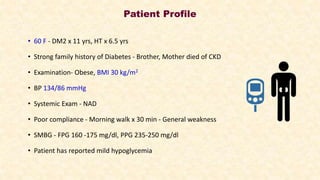
• 60 F - DM2 x 11 yrs, HT x 6.5 yrs
• Strong family history of Diabetes - Brother, Mother died of CKD
• Examination- Obese, BMI 30 kg/m2
• BP 134/86 mmHg
• Systemic Exam - NAD
• Poor compliance - Morning walk x 30 min - General weakness
• SMBG - FPG 160 -175 mg/dl, PPG 235-250 mg/dl
• Patient has reported mild hypoglycemia
Current Treatment
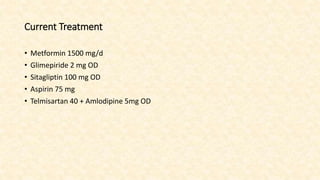
• Metformin 1500 mg/d
• Glimepiride 2 mg OD
• Sitagliptin 100 mg OD
• Aspirin 75 mg
• Telmisartan 40 + Amlodipine 5mg OD
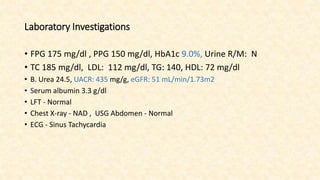
Laboratory Investigations
• FPG 175 mg/dl , PPG 150 mg/dl, HbA1c 9.0%, Urine R/M: N
• TC 185 mg/dl, LDL: 112 mg/dl, TG: 140, HDL: 72 mg/dl
• B. Urea 24.5, UACR: 435 mg/g, eGFR: 51 mL/min/1.73m2
• Serum albumin 3.3 g/dl
• LFT - Normal
• Chest X-ray - NAD , USG Abdomen - Normal
• ECG - Sinus Tachycardia
Diagnosis
Uncontrolled Type 2 Diabetes with high Risk of ASCVD and
Declining Renal Function
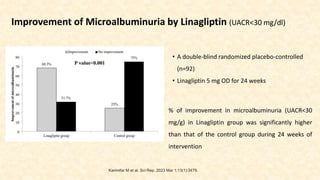
Improvement of Microalbuminuria by Linagliptin (UACR<30 mg/dl)
% of improvement in microalbuminuria (UACR<30
mg/g) in Linagliptin group was significantly higher
than that of the control group during 24 weeks of
intervention
• A double-blind randomized placebo-controlled
(n=92)
• Linagliptin 5 mg OD for 24 weeks
Karimifar M et al. Sci Rep. 2023 Mar 1;13(1):3479.
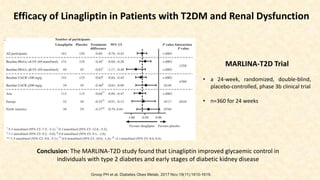
Efficacy of Linagliptin in Patients with T2DM and Renal Dysfunction
MARLINA-T2D Trial
• a 24-week, randomized, double-blind,
placebo-controlled, phase 3b clinical trial
• n=360 for 24 weeks
Conclusion: The MARLINA-T2D study found that Linagliptin improved glycaemic control in
individuals with type 2 diabetes and early stages of diabetic kidney disease
Groop PH et al. Diabetes Obes Metab. 2017 Nov;19(11):1610-1619.
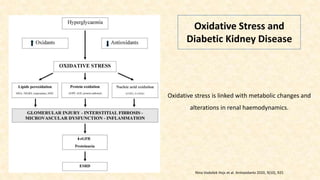
Oxidative Stress and
Diabetic Kidney Disease
Oxidative stress is linked with metabolic changes and
alterations in renal haemodynamics.
Nina Vodošek Hojs et al. Antioxidants 2020, 9(10), 925
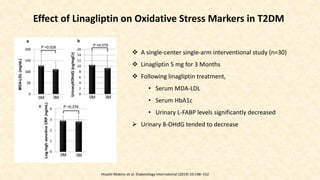
Effect of Linagliptin on Oxidative Stress Markers in T2DM
 A single-center single-arm interventional study (n=30)
 Linagliptin 5 mg for 3 Months
 Following linagliptin treatment,
• Serum MDA-LDL
• Serum HbA1c
• Urinary L-FABP levels significantly decreased
 Urinary 8-OHdG tended to decrease
Hisashi Makino et al. Diabetology International (2019) 10:148–152
Date of Download: 8/2/2023
1. Diabetes Care. 2020;43(11):2889-2893. doi:10.2337/dc20-0902
2. Diabetologia (2016) 59:2579–2587
Renal hemodynamic and tubular effects of linagliptin and glimepiride after 8 weeks of
treatment. Mean ± SEM (A–C and F), median [IQR] (D and E), and baseline-corrected mean
difference (95% CI). Multivariable linear regression models were used to examine baseline-
corrected linagliptin-induced effects compared with glimepiride. Paired t tests (A–C and F) or
Wilcoxon signed rank tests (D and E) were used for within-group comparisons. Significant
differences are indicated in boldface type. PAH, para-aminohippuric acid; Wk, week.
Compared to Glimepiride,
• Linagliptin had no significant impact on fasting GFR
and ERPF. 1
Compare to Glimepiride, Linagliptin tended to
• Reduce UACR by 26% from baseline
• No between-group differences were observed.1
This neutral effect of Linagliptin on
• GFR and ERPF is consistent with previous placebo-
controlled trials involving T2DM patients without
renal impairment. 2
Effects of DPP-4 Inhibitor Linagliptin Versus Sulfonylurea Glimepiride as Add-on to
Metformin on Renal Physiology in Overweight Patients With Type 2 Diabetes (RENALIS):
A Randomized, Double-Blind Trial
GFR: Glomerular Filtration Rate
ERPF: Effective Renal Plasma Flow
UACR: urinary albumin-to-creatinine ratio
Effects of Linagliptin on Cardiovascular and Kidney
Outcomes in People With Normal and Reduced
Kidney Function: Secondary Analysis of the
CARMELINA Trial
Linagliptin vs. placebo effect on 3P-MACE (major
adverse cardiovascular events): No significant
difference (HR 1.02 [95% CI 0.89, 1.17])
Linagliptin vs. placebo effect on secondary
kidney outcome: No significant difference (HR
1.04 [95% CI 0.89, 1.22])
Albuminuria progression reduced with
linagliptin regardless of eGFR
HbA1c levels decreased with linagliptin without
increasing hypoglycemia risk
Adverse events (AEs) balanced among groups overall
and across eGFR categories
Diabetes Care 2020;43(8):1803–1812
Study population:
• 6,979 subjects, mean age 65.9 years
• eGFR 54.6 mL/min/1.73 m², 80.1% with albuminuria
• Follow-up duration: 2.2 years
Overall effects on eGFR (MDRD) slope from baseline to last value on treatment and by
eGFR category G ≤ 2 to ≥ G4 for linagliptin (Lina) vs. placebo (pbo)
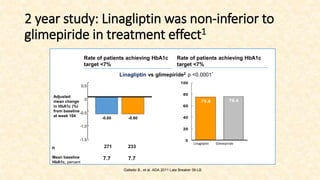
2 year study: Linagliptin was non-inferior to
glimepiride in treatment effect1
Rate of patients achieving HbA1c
target <7%
75.6 76.4
0
20
40
60
80
100
Linagliptin Glimepiride
0.5
0
-0.5
-1.0
-1.5
Adjusted
mean change
in HbA1c (%)
from baseline
at week 104
n
Mean baseline
HbA1c, percent
-0.60 -0.60
7.7
7.7
Rate of patients achieving HbA1c
target <7%
271 233
Gallwitz B., et al. ADA 2011 Late Breaker 39-LB
Linagliptin vs glimepiride2 p <0.0001*
Why substituted Glimepiride with Gliclazide in
addition to Linagliptin?
Is there any benefits with Gliclazide
Linagliptin !!!
Effectiveness and safety of Gliclazide and
Linagliptin switched from Glimepiride
J Endocr Soc. 2021 May 3; 5(Suppl 1): A407–A408.
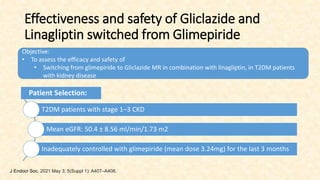
Effectiveness and safety of Gliclazide and
Linagliptin switched from Glimepiride
T2DM patients with stage 1–3 CKD
Mean eGFR: 50.4 ± 8.56 ml/min/1.73 m2
Inadequately controlled with glimepiride (mean dose 3.24mg) for the last 3 months
J Endocr Soc. 2021 May 3; 5(Suppl 1): A407–A408.
Objective:
• To assess the efficacy and safety of
• Switching from glimepiride to Gliclazide MR in combination with linagliptin, in T2DM patients
with kidney disease
Patient Selection:
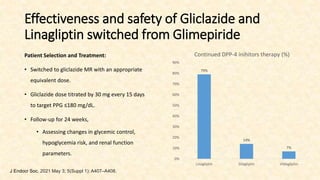
Patient Selection and Treatment:
• Switched to gliclazide MR with an appropriate
equivalent dose.
• Gliclazide dose titrated by 30 mg every 15 days
to target PPG ≤180 mg/dL.
• Follow-up for 24 weeks,
• Assessing changes in glycemic control,
hypoglycemia risk, and renal function
parameters.
79%
14%
7%
0%
10%
20%
30%
40%
50%
60%
70%
80%
90%
Linagliptin Sitagliptin Vildagliptin
Continued DPP-4 inihitors therapy (%)
Effectiveness and safety of Gliclazide and
Linagliptin switched from Glimepiride
J Endocr Soc. 2021 May 3; 5(Suppl 1): A407–A408.
Effectiveness and safety of Gliclazide and
Linagliptin switched from Glimepiride
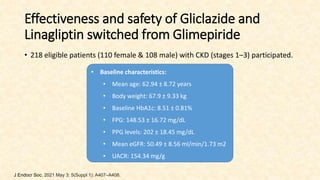
• 218 eligible patients (110 female & 108 male) with CKD (stages 1–3) participated.
J Endocr Soc. 2021 May 3; 5(Suppl 1): A407–A408.
• Baseline characteristics:
• Mean age: 62.94 ± 8.72 years
• Body weight: 67.9 ± 9.33 kg
• Baseline HbA1c: 8.51 ± 0.81%
• FPG: 148.53 ± 16.72 mg/dL
• PPG levels: 202 ± 18.45 mg/dL
• Mean eGFR: 50.49 ± 8.56 ml/min/1.73 m2
• UACR: 154.34 mg/g
Results: Switching from glimepiride to
Gliclazide
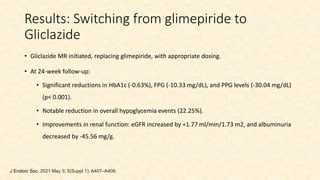
• Gliclazide MR initiated, replacing glimepiride, with appropriate dosing.
• At 24-week follow-up:
• Significant reductions in HbA1c (-0.63%), FPG (-10.33 mg/dL), and PPG levels (-30.04 mg/dL)
(p< 0.001).
• Notable reduction in overall hypoglycemia events (22.25%).
• Improvements in renal function: eGFR increased by +1.77 ml/min/1.73 m2, and albuminuria
decreased by -45.56 mg/g.
J Endocr Soc. 2021 May 3; 5(Suppl 1): A407–A408.
Effectiveness and safety of Gliclazide and
Linagliptin switched from Glimepiride
Conclusion:
• This study demonstrates the clinical effectiveness and safety of gliclazide MR in
combination with DPP-4 inhibitors, such as linagliptin, as a viable alternative to
glimepiride in T2DM patients with chronic kidney disease.
J Endocr Soc. 2021 May 3; 5(Suppl 1): A407–A408.
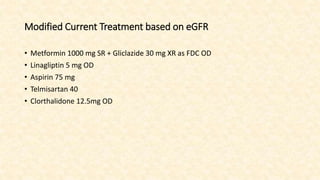
Modified Current Treatment based on eGFR
• Metformin 1000 mg SR + Gliclazide 30 mg XR as FDC OD
• Linagliptin 5 mg OD
• Aspirin 75 mg
• Telmisartan 40
• Clorthalidone 12.5mg OD
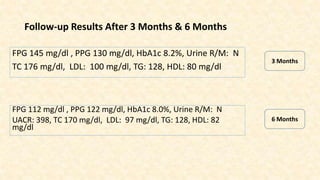
Follow-up Results After 3 Months & 6 Months
FPG 145 mg/dl , PPG 130 mg/dl, HbA1c 8.2%, Urine R/M: N
TC 176 mg/dl, LDL: 100 mg/dl, TG: 128, HDL: 80 mg/dl
3 Months
FPG 112 mg/dl , PPG 122 mg/dl, HbA1c 8.0%, Urine R/M: N
UACR: 398, TC 170 mg/dl, LDL: 97 mg/dl, TG: 128, HDL: 82
mg/dl
6 Months
Thank You!

Linagliptin Endocrinologist Prespective - Case.pptx

  • 1.
    Chronic Kidney Diseasewith Type 2 Diabetes Mellitus
  • 2.
    CASE 1 • PatientSawami, aged 63 years retired from government office working in firm visits his primary care physician with complaints of increased fatigue, also 2 episodes oh hypoglycemia. • He was K/C/O of • Diabetes since 11 years • Hypertension since 6.5 years
  • 3.
    Patient Profile • 60F - DM2 x 11 yrs, HT x 6.5 yrs • Strong family history of Diabetes - Brother, Mother died of CKD • Examination- Obese, BMI 30 kg/m2 • BP 134/86 mmHg • Systemic Exam - NAD • Poor compliance - Morning walk x 30 min - General weakness • SMBG - FPG 160 -175 mg/dl, PPG 235-250 mg/dl • Patient has reported mild hypoglycemia
  • 4.
    Current Treatment • Metformin1500 mg/d • Glimepiride 2 mg OD • Sitagliptin 100 mg OD • Aspirin 75 mg • Telmisartan 40 + Amlodipine 5mg OD
  • 5.
    Laboratory Investigations • FPG175 mg/dl , PPG 150 mg/dl, HbA1c 9.0%, Urine R/M: N • TC 185 mg/dl, LDL: 112 mg/dl, TG: 140, HDL: 72 mg/dl • B. Urea 24.5, UACR: 435 mg/g, eGFR: 51 mL/min/1.73m2 • Serum albumin 3.3 g/dl • LFT - Normal • Chest X-ray - NAD , USG Abdomen - Normal • ECG - Sinus Tachycardia
  • 6.
    Diagnosis Uncontrolled Type 2Diabetes with high Risk of ASCVD and Declining Renal Function
  • 7.
    Improvement of Microalbuminuriaby Linagliptin (UACR<30 mg/dl) % of improvement in microalbuminuria (UACR<30 mg/g) in Linagliptin group was significantly higher than that of the control group during 24 weeks of intervention • A double-blind randomized placebo-controlled (n=92) • Linagliptin 5 mg OD for 24 weeks Karimifar M et al. Sci Rep. 2023 Mar 1;13(1):3479.
  • 8.
    Efficacy of Linagliptinin Patients with T2DM and Renal Dysfunction MARLINA-T2D Trial • a 24-week, randomized, double-blind, placebo-controlled, phase 3b clinical trial • n=360 for 24 weeks Conclusion: The MARLINA-T2D study found that Linagliptin improved glycaemic control in individuals with type 2 diabetes and early stages of diabetic kidney disease Groop PH et al. Diabetes Obes Metab. 2017 Nov;19(11):1610-1619.
  • 9.
    Oxidative Stress and DiabeticKidney Disease Oxidative stress is linked with metabolic changes and alterations in renal haemodynamics. Nina Vodošek Hojs et al. Antioxidants 2020, 9(10), 925
  • 10.
    Effect of Linagliptinon Oxidative Stress Markers in T2DM  A single-center single-arm interventional study (n=30)  Linagliptin 5 mg for 3 Months  Following linagliptin treatment, • Serum MDA-LDL • Serum HbA1c • Urinary L-FABP levels significantly decreased  Urinary 8-OHdG tended to decrease Hisashi Makino et al. Diabetology International (2019) 10:148–152
  • 11.
    Date of Download:8/2/2023 1. Diabetes Care. 2020;43(11):2889-2893. doi:10.2337/dc20-0902 2. Diabetologia (2016) 59:2579–2587 Renal hemodynamic and tubular effects of linagliptin and glimepiride after 8 weeks of treatment. Mean ± SEM (A–C and F), median [IQR] (D and E), and baseline-corrected mean difference (95% CI). Multivariable linear regression models were used to examine baseline- corrected linagliptin-induced effects compared with glimepiride. Paired t tests (A–C and F) or Wilcoxon signed rank tests (D and E) were used for within-group comparisons. Significant differences are indicated in boldface type. PAH, para-aminohippuric acid; Wk, week. Compared to Glimepiride, • Linagliptin had no significant impact on fasting GFR and ERPF. 1 Compare to Glimepiride, Linagliptin tended to • Reduce UACR by 26% from baseline • No between-group differences were observed.1 This neutral effect of Linagliptin on • GFR and ERPF is consistent with previous placebo- controlled trials involving T2DM patients without renal impairment. 2 Effects of DPP-4 Inhibitor Linagliptin Versus Sulfonylurea Glimepiride as Add-on to Metformin on Renal Physiology in Overweight Patients With Type 2 Diabetes (RENALIS): A Randomized, Double-Blind Trial GFR: Glomerular Filtration Rate ERPF: Effective Renal Plasma Flow UACR: urinary albumin-to-creatinine ratio
  • 12.
    Effects of Linagliptinon Cardiovascular and Kidney Outcomes in People With Normal and Reduced Kidney Function: Secondary Analysis of the CARMELINA Trial Linagliptin vs. placebo effect on 3P-MACE (major adverse cardiovascular events): No significant difference (HR 1.02 [95% CI 0.89, 1.17]) Linagliptin vs. placebo effect on secondary kidney outcome: No significant difference (HR 1.04 [95% CI 0.89, 1.22]) Albuminuria progression reduced with linagliptin regardless of eGFR HbA1c levels decreased with linagliptin without increasing hypoglycemia risk Adverse events (AEs) balanced among groups overall and across eGFR categories Diabetes Care 2020;43(8):1803–1812 Study population: • 6,979 subjects, mean age 65.9 years • eGFR 54.6 mL/min/1.73 m², 80.1% with albuminuria • Follow-up duration: 2.2 years Overall effects on eGFR (MDRD) slope from baseline to last value on treatment and by eGFR category G ≤ 2 to ≥ G4 for linagliptin (Lina) vs. placebo (pbo)
  • 13.
    2 year study:Linagliptin was non-inferior to glimepiride in treatment effect1 Rate of patients achieving HbA1c target <7% 75.6 76.4 0 20 40 60 80 100 Linagliptin Glimepiride 0.5 0 -0.5 -1.0 -1.5 Adjusted mean change in HbA1c (%) from baseline at week 104 n Mean baseline HbA1c, percent -0.60 -0.60 7.7 7.7 Rate of patients achieving HbA1c target <7% 271 233 Gallwitz B., et al. ADA 2011 Late Breaker 39-LB Linagliptin vs glimepiride2 p <0.0001*
  • 14.
    Why substituted Glimepiridewith Gliclazide in addition to Linagliptin? Is there any benefits with Gliclazide Linagliptin !!!
  • 15.
    Effectiveness and safetyof Gliclazide and Linagliptin switched from Glimepiride J Endocr Soc. 2021 May 3; 5(Suppl 1): A407–A408.
  • 16.
    Effectiveness and safetyof Gliclazide and Linagliptin switched from Glimepiride T2DM patients with stage 1–3 CKD Mean eGFR: 50.4 ± 8.56 ml/min/1.73 m2 Inadequately controlled with glimepiride (mean dose 3.24mg) for the last 3 months J Endocr Soc. 2021 May 3; 5(Suppl 1): A407–A408. Objective: • To assess the efficacy and safety of • Switching from glimepiride to Gliclazide MR in combination with linagliptin, in T2DM patients with kidney disease Patient Selection:
  • 17.
    Patient Selection andTreatment: • Switched to gliclazide MR with an appropriate equivalent dose. • Gliclazide dose titrated by 30 mg every 15 days to target PPG ≤180 mg/dL. • Follow-up for 24 weeks, • Assessing changes in glycemic control, hypoglycemia risk, and renal function parameters. 79% 14% 7% 0% 10% 20% 30% 40% 50% 60% 70% 80% 90% Linagliptin Sitagliptin Vildagliptin Continued DPP-4 inihitors therapy (%) Effectiveness and safety of Gliclazide and Linagliptin switched from Glimepiride J Endocr Soc. 2021 May 3; 5(Suppl 1): A407–A408.
  • 18.
    Effectiveness and safetyof Gliclazide and Linagliptin switched from Glimepiride • 218 eligible patients (110 female & 108 male) with CKD (stages 1–3) participated. J Endocr Soc. 2021 May 3; 5(Suppl 1): A407–A408. • Baseline characteristics: • Mean age: 62.94 ± 8.72 years • Body weight: 67.9 ± 9.33 kg • Baseline HbA1c: 8.51 ± 0.81% • FPG: 148.53 ± 16.72 mg/dL • PPG levels: 202 ± 18.45 mg/dL • Mean eGFR: 50.49 ± 8.56 ml/min/1.73 m2 • UACR: 154.34 mg/g
  • 19.
    Results: Switching fromglimepiride to Gliclazide • Gliclazide MR initiated, replacing glimepiride, with appropriate dosing. • At 24-week follow-up: • Significant reductions in HbA1c (-0.63%), FPG (-10.33 mg/dL), and PPG levels (-30.04 mg/dL) (p< 0.001). • Notable reduction in overall hypoglycemia events (22.25%). • Improvements in renal function: eGFR increased by +1.77 ml/min/1.73 m2, and albuminuria decreased by -45.56 mg/g. J Endocr Soc. 2021 May 3; 5(Suppl 1): A407–A408.
  • 20.
    Effectiveness and safetyof Gliclazide and Linagliptin switched from Glimepiride Conclusion: • This study demonstrates the clinical effectiveness and safety of gliclazide MR in combination with DPP-4 inhibitors, such as linagliptin, as a viable alternative to glimepiride in T2DM patients with chronic kidney disease. J Endocr Soc. 2021 May 3; 5(Suppl 1): A407–A408.
  • 21.
    Modified Current Treatmentbased on eGFR • Metformin 1000 mg SR + Gliclazide 30 mg XR as FDC OD • Linagliptin 5 mg OD • Aspirin 75 mg • Telmisartan 40 • Clorthalidone 12.5mg OD
  • 22.
    Follow-up Results After3 Months & 6 Months FPG 145 mg/dl , PPG 130 mg/dl, HbA1c 8.2%, Urine R/M: N TC 176 mg/dl, LDL: 100 mg/dl, TG: 128, HDL: 80 mg/dl 3 Months FPG 112 mg/dl , PPG 122 mg/dl, HbA1c 8.0%, Urine R/M: N UACR: 398, TC 170 mg/dl, LDL: 97 mg/dl, TG: 128, HDL: 82 mg/dl 6 Months
  • 23.

Editor's Notes

  • #17 Background: Type 2 diabetes (T2DM) patients are at high risk of developing chronic kidney disease (CKD) and adverse renal outcomes compared to nondiabetic individuals. This study aims to assess the efficacy and safety of switching from glimepiride to gliclazide MR in combination with linagliptin, focusing on potential benefits related to albuminuria reduction and delaying the progression of adverse renal outcomes in T2DM patients with kidney disease, as suggested by previous data. Methodology: The study included T2DM patients with stage 1–3 CKD and a mean estimated glomerular filtration rate (eGFR) of 50.4 ± 8.56 ml/min/1.73 m2 who were inadequately controlled with glimepiride (mean dose 3.24mg) for the last 3 months. Patients were switched to gliclazide MR with an appropriate equivalent dose while continuing DPP-4 inhibitors like linagliptin (79%), sitagliptin (14%), or vildagliptin (7%) as background therapy. Gliclazide dose was titrated by 30 mg every 15 days to achieve a target post-prandial glucose (PPG) ≤180 mg/dL. Patients were followed for 24 weeks, and the analysis included changes in glycemic control, risk of hypoglycemia, and renal function parameters. Results: A total of 218 eligible patients (110 female & 108 male) with CKD (stages 1–3) participated in the study. Key baseline characteristics included mean age (62.94 ± 8.72 years), body weight (67.9 ± 9.33 kg), baseline HbA1c (8.51 ± 0.81%), FPG (148.53 ± 16.72 mg/dL), PPG levels (202 ± 18.45 mg/dL), mean eGFR (50.49 ± 8.56 ml/min/1.73 m2), and UACR (urine albumin creatinine ratio) (154.34 mg/g). Gliclazide MR was initiated, replacing glimepiride, with appropriate dosing. At the 24-week follow-up, significant reductions were observed in HbA1c (-0.63), FPG (-10.33), and PPG levels (-30.04%) (p< 0.001). There was a notable reduction in overall hypoglycemia events (22.25%). Improvements in renal function were evident, with an increase in eGFR level (+1.77 ml/min/1.73 m2) and a reduction in albuminuria (-45.56 mg/g). Conclusion: This study demonstrates the clinical effectiveness and safety of gliclazide MR in combination with DPP-4 inhibitors, such as linagliptin, as a viable alternative to glimepiride in T2DM patients with chronic kidney disease.
  • #18 Background: Type 2 diabetes (T2DM) patients are at high risk of developing chronic kidney disease (CKD) and adverse renal outcomes compared to nondiabetic individuals. This study aims to assess the efficacy and safety of switching from glimepiride to gliclazide MR in combination with linagliptin, focusing on potential benefits related to albuminuria reduction and delaying the progression of adverse renal outcomes in T2DM patients with kidney disease, as suggested by previous data. Methodology: The study included T2DM patients with stage 1–3 CKD and a mean estimated glomerular filtration rate (eGFR) of 50.4 ± 8.56 ml/min/1.73 m2 who were inadequately controlled with glimepiride (mean dose 3.24mg) for the last 3 months. Patients were switched to gliclazide MR with an appropriate equivalent dose while continuing DPP-4 inhibitors like linagliptin (79%), sitagliptin (14%), or vildagliptin (7%) as background therapy. Gliclazide dose was titrated by 30 mg every 15 days to achieve a target post-prandial glucose (PPG) ≤180 mg/dL. Patients were followed for 24 weeks, and the analysis included changes in glycemic control, risk of hypoglycemia, and renal function parameters. Results: A total of 218 eligible patients (110 female & 108 male) with CKD (stages 1–3) participated in the study. Key baseline characteristics included mean age (62.94 ± 8.72 years), body weight (67.9 ± 9.33 kg), baseline HbA1c (8.51 ± 0.81%), FPG (148.53 ± 16.72 mg/dL), PPG levels (202 ± 18.45 mg/dL), mean eGFR (50.49 ± 8.56 ml/min/1.73 m2), and UACR (urine albumin creatinine ratio) (154.34 mg/g). Gliclazide MR was initiated, replacing glimepiride, with appropriate dosing. At the 24-week follow-up, significant reductions were observed in HbA1c (-0.63), FPG (-10.33), and PPG levels (-30.04%) (p< 0.001). There was a notable reduction in overall hypoglycemia events (22.25%). Improvements in renal function were evident, with an increase in eGFR level (+1.77 ml/min/1.73 m2) and a reduction in albuminuria (-45.56 mg/g). Conclusion: This study demonstrates the clinical effectiveness and safety of gliclazide MR in combination with DPP-4 inhibitors, such as linagliptin, as a viable alternative to glimepiride in T2DM patients with chronic kidney disease. reduced the text in bullet pointer with sub heading "The study included T2DM patients with stage 1–3 CKD and a mean estimated glomerular filtration rate (eGFR) of 50.4 ± 8.56 ml/min/1.73 m2 who were inadequately controlled with glimepiride (mean dose 3.24mg) for the last 3 months. Patients were switched to gliclazide MR with an appropriate equivalent dose while continuing DPP-4 inhibitors like linagliptin (79%), sitagliptin (14%), or vildagliptin (7%) as background therapy. Gliclazide dose was titrated by 30 mg every 15 days to achieve a target post-prandial glucose (PPG) ≤180 mg/dL. Patients were followed for 24 weeks, and the analysis included changes in glycemic control, risk of hypoglycemia, and renal function parameters." ChatGPT Patient Selection and Treatment: T2DM patients with stage 1–3 CKD and mean eGFR of 50.4 ± 8.56 ml/min/1.73 m2. Inadequately controlled with glimepiride (mean dose 3.24mg) for the last 3 months. Switched to gliclazide MR with an appropriate equivalent dose. Continued background therapy with DPP-4 inhibitors, including linagliptin (79%), sitagliptin (14%), or vildagliptin (7%). Gliclazide dose titrated by 30 mg every 15 days to target PPG ≤180 mg/dL. Follow-up for 24 weeks, assessing changes in glycemic control, hypoglycemia risk, and renal function parameters.
  • #19 Background: Type 2 diabetes (T2DM) patients are at high risk of developing chronic kidney disease (CKD) and adverse renal outcomes compared to nondiabetic individuals. This study aims to assess the efficacy and safety of switching from glimepiride to gliclazide MR in combination with linagliptin, focusing on potential benefits related to albuminuria reduction and delaying the progression of adverse renal outcomes in T2DM patients with kidney disease, as suggested by previous data. Methodology: The study included T2DM patients with stage 1–3 CKD and a mean estimated glomerular filtration rate (eGFR) of 50.4 ± 8.56 ml/min/1.73 m2 who were inadequately controlled with glimepiride (mean dose 3.24mg) for the last 3 months. Patients were switched to gliclazide MR with an appropriate equivalent dose while continuing DPP-4 inhibitors like linagliptin (79%), sitagliptin (14%), or vildagliptin (7%) as background therapy. Gliclazide dose was titrated by 30 mg every 15 days to achieve a target post-prandial glucose (PPG) ≤180 mg/dL. Patients were followed for 24 weeks, and the analysis included changes in glycemic control, risk of hypoglycemia, and renal function parameters. Results: A total of 218 eligible patients (110 female & 108 male) with CKD (stages 1–3) participated in the study. Key baseline characteristics included mean age (62.94 ± 8.72 years), body weight (67.9 ± 9.33 kg), baseline HbA1c (8.51 ± 0.81%), FPG (148.53 ± 16.72 mg/dL), PPG levels (202 ± 18.45 mg/dL), mean eGFR (50.49 ± 8.56 ml/min/1.73 m2), and UACR (urine albumin creatinine ratio) (154.34 mg/g). Gliclazide MR was initiated, replacing glimepiride, with appropriate dosing. At the 24-week follow-up, significant reductions were observed in HbA1c (-0.63), FPG (-10.33), and PPG levels (-30.04%) (p< 0.001). There was a notable reduction in overall hypoglycemia events (22.25%). Improvements in renal function were evident, with an increase in eGFR level (+1.77 ml/min/1.73 m2) and a reduction in albuminuria (-45.56 mg/g). Conclusion: This study demonstrates the clinical effectiveness and safety of gliclazide MR in combination with DPP-4 inhibitors, such as linagliptin, as a viable alternative to glimepiride in T2DM patients with chronic kidney disease. reduced the text in bullet pointer with sub heading "The study included T2DM patients with stage 1–3 CKD and a mean estimated glomerular filtration rate (eGFR) of 50.4 ± 8.56 ml/min/1.73 m2 who were inadequately controlled with glimepiride (mean dose 3.24mg) for the last 3 months. Patients were switched to gliclazide MR with an appropriate equivalent dose while continuing DPP-4 inhibitors like linagliptin (79%), sitagliptin (14%), or vildagliptin (7%) as background therapy. Gliclazide dose was titrated by 30 mg every 15 days to achieve a target post-prandial glucose (PPG) ≤180 mg/dL. Patients were followed for 24 weeks, and the analysis included changes in glycemic control, risk of hypoglycemia, and renal function parameters." ChatGPT Patient Selection and Treatment: T2DM patients with stage 1–3 CKD and mean eGFR of 50.4 ± 8.56 ml/min/1.73 m2. Inadequately controlled with glimepiride (mean dose 3.24mg) for the last 3 months. Switched to gliclazide MR with an appropriate equivalent dose. Continued background therapy with DPP-4 inhibitors, including linagliptin (79%), sitagliptin (14%), or vildagliptin (7%). Gliclazide dose titrated by 30 mg every 15 days to target PPG ≤180 mg/dL. Follow-up for 24 weeks, assessing changes in glycemic control, hypoglycemia risk, and renal function parameters.