IMPROVING PROCESS PERFORMANCE BY REDUCING INPROCESS  REJECTION USING SIX  SIGMA METHODOLOGY
CONTENTS INTRODUCTION METHODOLOGY CASE STUDY ANALYSIS AND RESULTS CONCLUSION AND RE COMMENDATIONS.
INTRODUCTION As international competition is growing, every industry is trying to improve quality of the product and in turn reduce rejection. In-house rejection should be controlled as it affects COQ Six sigma methodology discussed in this paper is the business philosophy that enables world-class quality and continuous improvement. This paper discusses the success story carried out by the authors
SIX  σ  METHODOLOGY DMAIC Methodology is central to six sigma improvement process. Specific tools are used to turn a practical problem into statistical problem,genrate a statistical solution and then convert back into practical solution
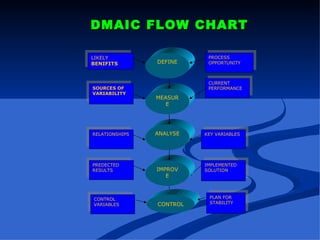
DMAIC FLOW CHART DEFINE MEASURE ANALYSE PROCESS OPPORTUNITY LIKELY  BENIFITS CURRENT PERFORMANCE SOURCES OF VARIABILITY KEY VARIABLES RELATIONSHIPS IMPLEMENTED SOLUTION PREDECTED RESULTS IMPROVE CONTROL CONTROL VARIABLES PLAN FOR STABILITY
CASE STUDY A manufacturing unit producing wheel cylinder was facing a problem of rejection. The jobs were rejected due to several reasons. After studying the statistics of rejection data ,it was decided to Solve the problem by DMAIC approach.
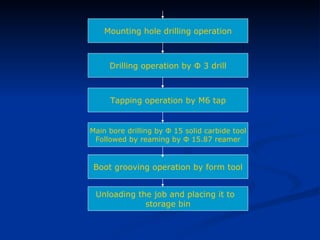
DEFINE PHASE In this phase all the parameters related with the process flow were studied. The process flow chart is as follows, Receiving casting from foundry department Loading the casting at station 1 by  pneumatic feeder continue
Mounting hole drilling operation Drilling operation by Φ 3 drill Tapping operation by M6 tap Main bore drilling by Φ 15 solid carbide tool Followed by reaming by Φ 15.87 reamer Boot grooving operation by form tool Unloading the job and placing it to  storage bin
MEASURE PHASE 3586 205 57161 November 4124 290 70319 October 5804 344 59265 September PPM Rejected jobs Total production Month
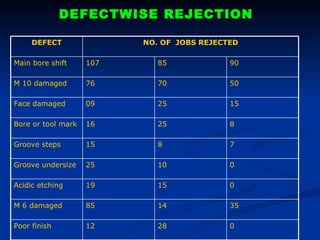
DEFECTWISE REJECTION 0 28 12 Poor finish 35 14 85 M 6 damaged 0 15 19 Acidic etching 0 10 25 Groove undersize 7 8 15 Groove steps 8 25 16 Bore or tool mark 15 25 09 Face damaged 50 70 76 M 10 damaged 90 85 107 Main bore shift NO. OF  JOBS REJECTED DEFECT
ANALYSIS PHASE Pareto for month of November.
Main causes of rejection From pareto diagram it can be seen that the prime elements causing rejection of the jobs are, 1) Main bore shift. 2) M10 damaged. Hence it was decided to find out the root causes for this defects by plotting fishbone diagram.
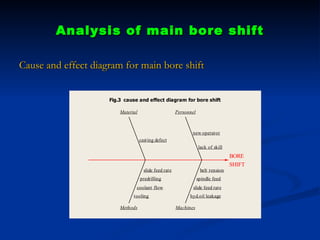
Analysis of main bore shift Cause and effect diagram for main bore shift
Analysis of M10 shift Cause and effect diagram for M10 shift .
IMPROVEMENT PHASE Implementation plan Implemented Hydraulic leakage corrected Hydraulic leakage causing pressure drop Bore shift Implemented V block rework for perfect clamping V block damaged Bore shift Implemented Proper fettling of liquid metal during casting process Excess material job M 10 shift Implemented Reservoir added to reduce pressure drop Air pressure drop below 0.8 Mpa M 10 shift Present status Corrective action Current status Concerned parameter
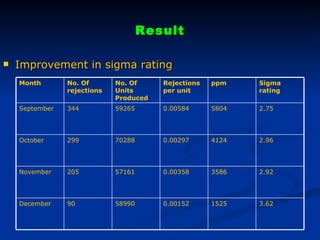
Result Improvement in sigma rating 3.62 1525 0.00152 58990 90 December 2.92 3586 0.00358 57161 205 November 2.96 4124 0.00297 70288 299 October 2.75 5804 0.00584 59265 344 September Sigma rating ppm Rejections per unit No. Of Units Produced No. Of rejections Month
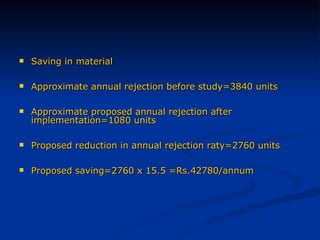
Saving in material Approximate annual rejection before study=3840 units Approximate proposed annual rejection after implementation=1080 units Proposed reduction in annual rejection raty=2760 units Proposed saving=2760 x 15.5 =Rs.42780/annum
CONCLUSION The purpose of this study is to give more insight to six sigma methodology. Comprehensive quality management system is required to achieve six sigma level Case study shows that sigma level for a manufacturing unit increased to 3.62,hence more emphasis is required to improve the quality.

Six Sigma Case Study

  • 1.
    IMPROVING PROCESS PERFORMANCEBY REDUCING INPROCESS REJECTION USING SIX SIGMA METHODOLOGY
  • 2.
    CONTENTS INTRODUCTION METHODOLOGYCASE STUDY ANALYSIS AND RESULTS CONCLUSION AND RE COMMENDATIONS.
  • 3.
    INTRODUCTION As internationalcompetition is growing, every industry is trying to improve quality of the product and in turn reduce rejection. In-house rejection should be controlled as it affects COQ Six sigma methodology discussed in this paper is the business philosophy that enables world-class quality and continuous improvement. This paper discusses the success story carried out by the authors
  • 4.
    SIX σ METHODOLOGY DMAIC Methodology is central to six sigma improvement process. Specific tools are used to turn a practical problem into statistical problem,genrate a statistical solution and then convert back into practical solution
  • 5.
    DMAIC FLOW CHARTDEFINE MEASURE ANALYSE PROCESS OPPORTUNITY LIKELY BENIFITS CURRENT PERFORMANCE SOURCES OF VARIABILITY KEY VARIABLES RELATIONSHIPS IMPLEMENTED SOLUTION PREDECTED RESULTS IMPROVE CONTROL CONTROL VARIABLES PLAN FOR STABILITY
  • 6.
    CASE STUDY Amanufacturing unit producing wheel cylinder was facing a problem of rejection. The jobs were rejected due to several reasons. After studying the statistics of rejection data ,it was decided to Solve the problem by DMAIC approach.
  • 7.
    DEFINE PHASE Inthis phase all the parameters related with the process flow were studied. The process flow chart is as follows, Receiving casting from foundry department Loading the casting at station 1 by pneumatic feeder continue
  • 8.
    Mounting hole drillingoperation Drilling operation by Φ 3 drill Tapping operation by M6 tap Main bore drilling by Φ 15 solid carbide tool Followed by reaming by Φ 15.87 reamer Boot grooving operation by form tool Unloading the job and placing it to storage bin
  • 9.
    MEASURE PHASE 3586205 57161 November 4124 290 70319 October 5804 344 59265 September PPM Rejected jobs Total production Month
  • 10.
    DEFECTWISE REJECTION 028 12 Poor finish 35 14 85 M 6 damaged 0 15 19 Acidic etching 0 10 25 Groove undersize 7 8 15 Groove steps 8 25 16 Bore or tool mark 15 25 09 Face damaged 50 70 76 M 10 damaged 90 85 107 Main bore shift NO. OF JOBS REJECTED DEFECT
  • 11.
    ANALYSIS PHASE Paretofor month of November.
  • 12.
    Main causes ofrejection From pareto diagram it can be seen that the prime elements causing rejection of the jobs are, 1) Main bore shift. 2) M10 damaged. Hence it was decided to find out the root causes for this defects by plotting fishbone diagram.
  • 13.
    Analysis of mainbore shift Cause and effect diagram for main bore shift
  • 14.
    Analysis of M10shift Cause and effect diagram for M10 shift .
  • 15.
    IMPROVEMENT PHASE Implementationplan Implemented Hydraulic leakage corrected Hydraulic leakage causing pressure drop Bore shift Implemented V block rework for perfect clamping V block damaged Bore shift Implemented Proper fettling of liquid metal during casting process Excess material job M 10 shift Implemented Reservoir added to reduce pressure drop Air pressure drop below 0.8 Mpa M 10 shift Present status Corrective action Current status Concerned parameter
  • 16.
    Result Improvement insigma rating 3.62 1525 0.00152 58990 90 December 2.92 3586 0.00358 57161 205 November 2.96 4124 0.00297 70288 299 October 2.75 5804 0.00584 59265 344 September Sigma rating ppm Rejections per unit No. Of Units Produced No. Of rejections Month
  • 17.
    Saving in materialApproximate annual rejection before study=3840 units Approximate proposed annual rejection after implementation=1080 units Proposed reduction in annual rejection raty=2760 units Proposed saving=2760 x 15.5 =Rs.42780/annum
  • 18.
    CONCLUSION The purposeof this study is to give more insight to six sigma methodology. Comprehensive quality management system is required to achieve six sigma level Case study shows that sigma level for a manufacturing unit increased to 3.62,hence more emphasis is required to improve the quality.