6 σ   SIX SIGMA
SIX SIGMA Developed by Bill Smith at Motorola in 1980s Adopted by General Electric, Allied Signal, Ford Company Many Organizations run at 4 σ  or 5 σ  level 230 to 6210 defects per million
SIX SIGMA Six Sigma is a Quality objective that identifies the variability of a process in terms of the specifications of the product, so that product quality and reliability meet and exceed customer’s requirements. Six Sigma refers to a process capability  that generates 3.4 defects per million.
Based on teachings of Dr. Walter Shewhart, Dr. W. E. Deming & Dr. J. Juran. Process Control; Plan Do Check Act; Common and Special Causes; Improvement can be done project by project Statistical tools Hawthorne Plant Experiences Developed by Bill Smith at Motorola in 1980s What is Six Sigma ?
What Is Six Sigma?  Degree of variation; Level of performance in terms of defects; Statistical measurement of process capability; Benchmark for comparison; Process improvement methodology; It is a Goal; Strategy for change; A commitment to customers to achieve an acceptable level of performance
Six Sigma Definitions Business Definition A break through strategy to significantly improve customer satisfaction and shareholder value by reducing variability in every aspect of business. Technical Definition A statistical term signifying  3.4  defects per million opportunities.
68 times 3.4 6   27 times 230 5   11 times 6,210 4   5 times 66,800 3   2  times 308,000 2   690,000 1   Rate of Improvement  Defects Per Million Opportunities Sigma Level
Goals of Six Sigma Reduce Defects Improve Yield Improve Customer Satisfaction Reduce Variation Ensure Continual Improvement Increase Shareholder Value
Benefits of Six Sigma Generates sustained success Sets performance goal for everyone Enhances value for customers Accelerates rate of improvement Promotes learning across boundaries Executes strategic change
Six Sigma Results Six Sigma Savings as % of revenue vary from  1.2 to 4.5 % For $ 30 million/yr sales – Savings potential $ 360,000 to $ 1.35 million. Investment: salary of in house experts, training, process redesign. Annual Savings Company *$1.5 billion  (*since inception in 1998) JP Morgan Chase $600 million Honeywell  $500 million Johnson & Johnson $ 16 billion  (*since inception in 1980s) Motorola $2.0+ billion General Electric
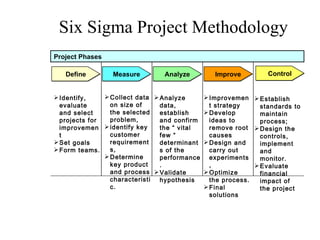
Six Sigma Project Methodology Control Define Measure Analyze Improve Establish standards to maintain process; Design the controls,  implement and monitor.  Evaluate financial impact of the project Identify, evaluate and select projects for improvement Set goals Form teams.  Collect data on size of the selected problem, identify key customer requirements, Determine key product and process characteristic .  Analyze data, establish and confirm the “ vital few “ determinants of the performance. Validate hypothesis Improvement strategy Develop ideas to remove root causes Design and carry out experiments, Optimize the process.  Final solutions Project Phases
DCOV Model Define  Characterize Optimize Verify
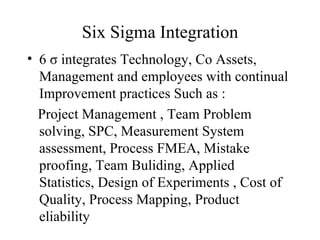
Six Sigma Integration 6  σ  integrates  Technology, Co Assets, Management and employees with continual Improvement practices Such as : Project Management , Team Problem solving, SPC, Measurement System assessment, Process FMEA, Mistake proofing, Team Buliding, Applied Statistics, Design of Experiments , Cost of Quality, Process Mapping, Product eliability

6 sigma

  • 1.
    6 σ SIX SIGMA
  • 2.
    SIX SIGMA Developedby Bill Smith at Motorola in 1980s Adopted by General Electric, Allied Signal, Ford Company Many Organizations run at 4 σ or 5 σ level 230 to 6210 defects per million
  • 3.
    SIX SIGMA SixSigma is a Quality objective that identifies the variability of a process in terms of the specifications of the product, so that product quality and reliability meet and exceed customer’s requirements. Six Sigma refers to a process capability that generates 3.4 defects per million.
  • 4.
    Based on teachingsof Dr. Walter Shewhart, Dr. W. E. Deming & Dr. J. Juran. Process Control; Plan Do Check Act; Common and Special Causes; Improvement can be done project by project Statistical tools Hawthorne Plant Experiences Developed by Bill Smith at Motorola in 1980s What is Six Sigma ?
  • 5.
    What Is SixSigma? Degree of variation; Level of performance in terms of defects; Statistical measurement of process capability; Benchmark for comparison; Process improvement methodology; It is a Goal; Strategy for change; A commitment to customers to achieve an acceptable level of performance
  • 6.
    Six Sigma DefinitionsBusiness Definition A break through strategy to significantly improve customer satisfaction and shareholder value by reducing variability in every aspect of business. Technical Definition A statistical term signifying 3.4 defects per million opportunities.
  • 7.
    68 times 3.46  27 times 230 5  11 times 6,210 4  5 times 66,800 3  2 times 308,000 2  690,000 1  Rate of Improvement Defects Per Million Opportunities Sigma Level
  • 8.
    Goals of SixSigma Reduce Defects Improve Yield Improve Customer Satisfaction Reduce Variation Ensure Continual Improvement Increase Shareholder Value
  • 9.
    Benefits of SixSigma Generates sustained success Sets performance goal for everyone Enhances value for customers Accelerates rate of improvement Promotes learning across boundaries Executes strategic change
  • 10.
    Six Sigma ResultsSix Sigma Savings as % of revenue vary from 1.2 to 4.5 % For $ 30 million/yr sales – Savings potential $ 360,000 to $ 1.35 million. Investment: salary of in house experts, training, process redesign. Annual Savings Company *$1.5 billion (*since inception in 1998) JP Morgan Chase $600 million Honeywell $500 million Johnson & Johnson $ 16 billion (*since inception in 1980s) Motorola $2.0+ billion General Electric
  • 11.
    Six Sigma ProjectMethodology Control Define Measure Analyze Improve Establish standards to maintain process; Design the controls, implement and monitor. Evaluate financial impact of the project Identify, evaluate and select projects for improvement Set goals Form teams. Collect data on size of the selected problem, identify key customer requirements, Determine key product and process characteristic . Analyze data, establish and confirm the “ vital few “ determinants of the performance. Validate hypothesis Improvement strategy Develop ideas to remove root causes Design and carry out experiments, Optimize the process. Final solutions Project Phases
  • 12.
    DCOV Model Define Characterize Optimize Verify
  • 13.
    Six Sigma Integration6 σ integrates Technology, Co Assets, Management and employees with continual Improvement practices Such as : Project Management , Team Problem solving, SPC, Measurement System assessment, Process FMEA, Mistake proofing, Team Buliding, Applied Statistics, Design of Experiments , Cost of Quality, Process Mapping, Product eliability