
Excellence in Execution
Keynote
10%
NINE
the whole strategy
implementation
challenge.
underestimateLeaders
“One of the criticisms we would
have of some of our colleagues who have
studied strategy (and some consultants
who advice on strategy) is that they
assum e that once you design strategy it
gets executed”
STRATEGY
IMPLEMENTATION
Joseph Bowler,
Professor of Business Admin
Harvard Business School
“They don’t lookinside the process
and realize that its much more complicated.”
Leaders are educated
to plan not to
implemen
Leaders are educated
to plan not to
implement
We only teach
strategy, not
its
implementatio
n
Why Does
Implementation
Fail?
90%
Failur
e
Rate
Top Six Reasons Implementation Fails
Bridges Research
1. Strategy is long-term and they run the business short-term/
quarterly
2. Leaders underestimate the implementation challenge
3. Leaders are trained to plan not to execute
5. People do not understands what the new strategy is, why we
need it and how it impacts the business
6. Failing to align everyone in the organization to take the right
actions
4. Implementation never goes according to plan
STRATEGY
IMPLEMENTATION
© Bridges Business Consultancy Int, 2010
The Story of Strategy Implementation
so far…
+
The Current Equation
Vision, Mission &
Values
Strategy
Change
Management
= RESULTS
xNOT FOR NINE OUT
OF 10 COMPANIES
+
What do the one in ten companies do different?
Implementation Challenge
Vision,
Mission &
Values
Change
Management Implementation
Go beyond traditional
change management
Strategy
Creation
Implementation is
Impossible without
People Engagement
Are you motivating
employees to be
involved in the
implementation and do
they know what action
to take?
Create a Sense of
Urgency
Explain why you need a
new strategy both
emotionally and
logically.
Successful
Communication Evolves
Two Waves
Is everyone constantly
communicated to about
what’s working, what’s
not and what’s going to
happen next?
Is everyone constantly
communicated to about
what’s working, what’s
not and what’s going to
happen next?
© 2010 Bridges Business Consultancy Int All Rights Reserved
What is the goal of
communicating strategy?
Is everyone constantly
communicated to about
what’s working, what’s
not and what’s going to
happen next?
Align Processes to the
New Strategy
Do staff members
have an opportunity to
change the daily
processes to meet the
requirements of the
new strategy?
Changing Pay Grabs
People’s Attention
Are the behaviors and
actions required to
implement the new
strategy encouraged and
reinforced?
People Support
Biz Case Urgency
Communicate What’s Happening
Measure Performance
Culture Alignment
Process Synergize
Reinforce Right Actions
Review Discipline of Doing
Implementation Compass Summary
2. What worked?
Discussion Questions
3. What did not workwell?
1. Identify an implementation you were involved in?
4. What did you learn?
5. What would you do differently going forward fromwhat you have
learned fromthis presentation?
Designed & Developed by:
www.bridgesconsultancy.com
Downloadable from www.implementation-hub.com

Excellence in Execution with speakers notes

Editor's Notes

  • #2 Strategy and implementation are of equal importance. A successful leader today needs both the skill to craft the strategy and the ability to execute it.
  • #3 Somewhere in the world, on any given day there is a CEO launching a new strategy to great fanfare. But what percentage of strategies are successfully implemented?
  • #4 That's it! Nine out of ten strategies fail to be implemented successfully. When I say successfully I mean that they do not even deliver 50% of the objectives they set out to achieve. We need to improve the way we implement strategy. The research I am quoting is from Bridges Business Consultancy Int, a specialist in strategy implementation based out of Singapore. Initially their research was Asia centric and after first publishing that only 10% of implementations succeed in 2002 they then looked overseas to further verify the research.
  • #5 Nine out of ten strategy implementations failing is a horrific failure rate that needs to be addressed.
  • #6 One of the key messages for leaders is a warning.
  • #7 One of the biggest mistakes leaders make is to underestimate the whole implementation challenge.
  • #8 Professor Bowler’s quote emphasizes the need for leaders to consider carefully the implementation challenge ahead of them and to look carefully at what it takes to succeeed.
  • #9 Part of the reason leaders underestimate the whole implementation challenge is that in business school they are taught how to plan NOT how to implement.
  • #10 Leaders have not been taught how to implement strategy only how to craft it.
  • #11 Ask the audience why they feel implementation fails in their organization. Typical answers include: Lack of communication No support from their boss No buy-in Resistance from staff members No clear goals
  • #12 These top six reasons implementation fails comes from Bridges Business Consultancy Int research. Leaders are constantly in conflict between delivering short term performance and implementing the long term strategy. As mentioned already leaders habitually underestimate the challenge and when they do they are unprepared and unorganized throughout the implementation. There is a gap in leadership training today that they are trained to plan and not to execute. Whatever is planned in the boardroom will change when it is rolled out and leaders must constantly adapt the implementation. Most staff members in most companies do not understand the impact of the new strategy and as a result continue doing what they were doing before. Leaders must explain to staff members what actions they need to take and ensure everyone is aligned.
  • #13 Introduce the current implementation equation.
  • #14 A successful organization will first set the: Vision – the future state Mission – the core purpose of the organization Values – the guiding principles Then they will craft the strategy – the plan of action to deliver the vision. Then they will apply change management to deliver the results. Ask the audience if they agree with this equation – most will. Then show them that this is an equation for failure nine out of ten times. Explain that they are comfortable with the equation as this is what they normally do but normally most implementations fail.
  • #15 So what do the one in 10 who are successful do different? (A rhetorical question)
  • #16 The one in 10 who are successful go beyond traditional change management and focus on “implementation”. This involves eight areas.
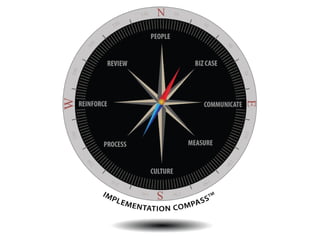
  • #17 Introduce the Implementation Compass™ as a framework for implementing strategy and that successful implementation is not about doing one or two things right, such as communication and training but about being conscious of eight areas. Eight areas that are all essential to achieve excellence in execution. Explain that the Implementation Compass is a metaphor for the framework as it guides you through the implementation challenge. Briefly run through the eight areas: People – the ones who do the implementation Biz Case – the need to create a sense of urgency Communicate – not just explaining what the strategy is but ongoing communication about its implementation Measure – putting in place the right measures to track the implementation and the business Culture – drives the way our organization implements our strategy Process – changing the way people work in alignment with the new strategy Reinforce – rewarding and recognizing people when they participate in the implementation Review – checking every two weeks how the implementation is progressing
  • #18 If strategy is about making the right choices then implementation is about taking the right actions. Leaders are responsible for ensuring staff members know and are taking the right actions.
  • #19 Introduce in more detail the eight areas of excellence for execution that make up the Implementation Compass. At north is People. Leaders don’t implement the strategy, the People do and they must be engaged and know what to do.
  • #20 At north-east is the Biz Case. This is the least understood area on the Compass. The Biz Case creates a sense of urgency by appealing to both the hearts (emotional) and minds (logic) of everyone in the organization. The Biz Case does not explain what the strategy is (that happens under Communication), it explains why we need a new strategy and why the organization must change.
  • #21 At east is Communicate. As communication becomes easier, many leaders are becoming worse at it. Bridges 2012 research reveals that only 5% of staff members can explain what their own organization’s strategy is.
  • #22 Ask the question What is the goal of communicating strategy?
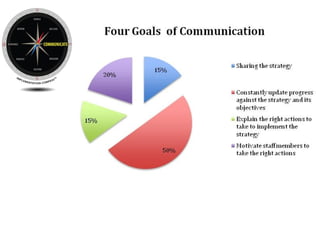
  • #23 Explain the four goals of communication and emphasize that in implementation most of the time should be spent constantly updating the progress against the strategy and the objectives.
  • #24 At south-east is Measure. Two key messages are: When a organization changes its strategy it must change the measures. The measures track the implementation and provide critical feedback on the implementation progress and what is and not working. Change your Strategy, Change your Measures. Measures drive behaviors. The measure will influence the performance of the staff members.
  • #25 At south is Culture. The organization’s culture will drive the way you implement your strategy. Two companies can have the same strategy e.g. to be number one, but how they implement it is driven by the culture.
  • #26 At south-west is Process. Translating strategy into the business means… examining what needs to change in the way people do their work and empowering them to make the required changes. A strategy implementation provides an excellent opportunity to invite staff members to eliminate non –value adding work and to improve the processes.
  • #27 Leaders must also identify and inform staff members what they should “STOP” doing, for example, with the new strategy what customer segments do we no longer target or which products are we no longer selling.
  • #28 At west is Reinforce. Implementation is only sustained when you reward and recognize individuals for taking the right actions. Leaders must reinforce the right actions both with financial and non-financially reinforcement. The reward system must change. Ignoring it is not an option.
  • #29 At north-west is Review. Many companies only review their strategy once or twice a year. This is not enough. We must review part of the implementation every two-weeks and the whole implementation every quarter. Staff members pay attention to what leaders pay attention to. Regular reviews keep everyone focused.
  • #30 A summary of the Compass.
  • #31 Ask the audience to find a partner (or at a table) and to discuss the following 5 questions. Present each question one at a time.
  • #32 This presentation was designed and developed by Bridges Business Consultancy Int. The icons have hyperlinks and is available for download from the links on the page. Thank you.