Building Partnerships: Think Global, Act Local
- an approach to faculty based research support
Introduction
A recent longitudinal study found that “….the top 10% of individuals are responsible for 90% of all
income from research contracts…” (Perkmann et al, 2015).
This correlates closely with our own faculty outputs and suggests we are only servicing a small
percentage of our total cohort.
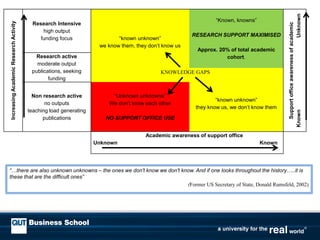
We identified knowledge gaps – Academic awareness of support office & Support office awareness of
academic – which if resolved could provide new support to a majority, and an enhanced level of
support to the existing minority.
Summary of Poster presentation by David Wiseman
Australasian Research Management Society Annual Conference, Singapore 2015
“…there are also unknown unknowns – the ones we don't know we don't know. And if one looks throughout the history…..it is
these that are the difficult ones”
(Former US Secretary of State, Donald Rumsfeld, 2002)
IncreasingAcademicResearchActivity
Research Intensive
high output
funding focus “known unknown”
we know them, they don’t know us
“Known, knowns”
RESEARCH SUPPORT MAXIMISED
Approx. 20% of total academic
cohort.
Supportofficeawarenessofacademic
KnownUnknown
Research active
moderate output
publications, seeking
funding
“known unknown”
they know us, we don’t know them
Non research active
no outputs
teaching load generating
publications
“Unknown unknowns”
We don’t know each other
NO SUPPORT OFFICE USE
Academic awareness of support office
Unknown Known
KNOWLEDGE GAPS
Approach
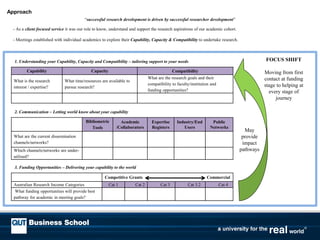
“successful research development is driven by successful researcher development”
- As a client focused service it was our role to know, understand and support the research aspirations of our academic cohort.
- Meetings established with individual academics to explore their Capability, Capacity & Compatibility to undertake research.
Capability Capacity Compatibility
What is the research
interest / expertise?
What time/resources are available to
pursue research?
What are the research goals and their
compatibility to faculty/institution and
funding opportunities?
Bibliometric
Tools
Academic
/Collaborators
Expertise
Registers
Industry/End
Users
Public
Networks
What are the current dissemination
channels/networks?
Which channels/networks are under-
utilised?
Competitive Grants Commercial
Australian Research Income Categories Cat 1 Cat 2 Cat 3 Cat 3.2 Cat 4
What funding opportunities will provide best
pathway for academic in meeting goals?
1. Understanding your Capability, Capacity and Compatibility – tailoring support to your needs
2. Communication – Letting world know about your capability
3. Funding Opportunities – Delivering your capability to the world
FOCUS SHIFT
Moving from first
contact at funding
stage to helping at
every stage of
journey
May
provide
impact
pathways
Some implementation tips
 Ensure everyone is clear on the purpose before
meeting academics
 Make clear that process is adjunct to Academic
Performance Review
 Academics may “open up” in the conversation
about issues outside your control – have
mechanisms for reaffirming role of academic
supervisor
 Consider mechanism for feedback of observations
from academics that may represent systemic issues
to be addressed by school/faculty
 Ensure professional staff are comfortable having a
conversation with academic staff about their
research goals/career aspirations
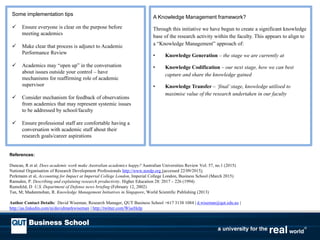
A Knowledge Management framework?
Through this initiative we have begun to create a significant knowledge
base of the research activity within the faculty. This appears to align to
a “Knowledge Management” approach of:
• Knowledge Generation – the stage we are currently at
• Knowledge Codification – our next stage, how we can best
capture and share the knowledge gained
• Knowledge Transfer – ‘final’stage, knowledge utilised to
maximise value of the research undertaken in our faculty
References:
Duncan, R et al. Does academic work make Australian academics happy? Australian Universities Review Vol. 57, no.1 (2015)
National Organisation of Research Development Professionals http://www.nordp.org (accessed 22/09/2015)
Perkmann et al, Accounting for Impact at Imperial College London, Imperial College London, Business School (March 2015)
Ramsden, P. Describing and explaining research productivity. Higher Education 28: 2017 – 226 (1994)
Rumsfeld, D U.S. Department of Defense news briefing (February 12, 2002)
Tan, M; Madanmohan, R. Knowledge Management Initiatives in Singapore, World Scientific Publishing (2013)
Author Contact Details: David Wiseman, Research Manager, QUT Business School +617 3138 1084 | d.wiseman@qut.edu.au |
http://au.linkedin.com/in/davidmarkwiseman | http://twitter.com/WiseHelp

Building Partnerships: Think Global, Act Local

  • 1.
    Building Partnerships: ThinkGlobal, Act Local - an approach to faculty based research support Introduction A recent longitudinal study found that “….the top 10% of individuals are responsible for 90% of all income from research contracts…” (Perkmann et al, 2015). This correlates closely with our own faculty outputs and suggests we are only servicing a small percentage of our total cohort. We identified knowledge gaps – Academic awareness of support office & Support office awareness of academic – which if resolved could provide new support to a majority, and an enhanced level of support to the existing minority. Summary of Poster presentation by David Wiseman Australasian Research Management Society Annual Conference, Singapore 2015
  • 2.
    “…there are alsounknown unknowns – the ones we don't know we don't know. And if one looks throughout the history…..it is these that are the difficult ones” (Former US Secretary of State, Donald Rumsfeld, 2002) IncreasingAcademicResearchActivity Research Intensive high output funding focus “known unknown” we know them, they don’t know us “Known, knowns” RESEARCH SUPPORT MAXIMISED Approx. 20% of total academic cohort. Supportofficeawarenessofacademic KnownUnknown Research active moderate output publications, seeking funding “known unknown” they know us, we don’t know them Non research active no outputs teaching load generating publications “Unknown unknowns” We don’t know each other NO SUPPORT OFFICE USE Academic awareness of support office Unknown Known KNOWLEDGE GAPS
  • 3.
    Approach “successful research developmentis driven by successful researcher development” - As a client focused service it was our role to know, understand and support the research aspirations of our academic cohort. - Meetings established with individual academics to explore their Capability, Capacity & Compatibility to undertake research. Capability Capacity Compatibility What is the research interest / expertise? What time/resources are available to pursue research? What are the research goals and their compatibility to faculty/institution and funding opportunities? Bibliometric Tools Academic /Collaborators Expertise Registers Industry/End Users Public Networks What are the current dissemination channels/networks? Which channels/networks are under- utilised? Competitive Grants Commercial Australian Research Income Categories Cat 1 Cat 2 Cat 3 Cat 3.2 Cat 4 What funding opportunities will provide best pathway for academic in meeting goals? 1. Understanding your Capability, Capacity and Compatibility – tailoring support to your needs 2. Communication – Letting world know about your capability 3. Funding Opportunities – Delivering your capability to the world FOCUS SHIFT Moving from first contact at funding stage to helping at every stage of journey May provide impact pathways
  • 4.
    Some implementation tips Ensure everyone is clear on the purpose before meeting academics  Make clear that process is adjunct to Academic Performance Review  Academics may “open up” in the conversation about issues outside your control – have mechanisms for reaffirming role of academic supervisor  Consider mechanism for feedback of observations from academics that may represent systemic issues to be addressed by school/faculty  Ensure professional staff are comfortable having a conversation with academic staff about their research goals/career aspirations A Knowledge Management framework? Through this initiative we have begun to create a significant knowledge base of the research activity within the faculty. This appears to align to a “Knowledge Management” approach of: • Knowledge Generation – the stage we are currently at • Knowledge Codification – our next stage, how we can best capture and share the knowledge gained • Knowledge Transfer – ‘final’stage, knowledge utilised to maximise value of the research undertaken in our faculty References: Duncan, R et al. Does academic work make Australian academics happy? Australian Universities Review Vol. 57, no.1 (2015) National Organisation of Research Development Professionals http://www.nordp.org (accessed 22/09/2015) Perkmann et al, Accounting for Impact at Imperial College London, Imperial College London, Business School (March 2015) Ramsden, P. Describing and explaining research productivity. Higher Education 28: 2017 – 226 (1994) Rumsfeld, D U.S. Department of Defense news briefing (February 12, 2002) Tan, M; Madanmohan, R. Knowledge Management Initiatives in Singapore, World Scientific Publishing (2013) Author Contact Details: David Wiseman, Research Manager, QUT Business School +617 3138 1084 | d.wiseman@qut.edu.au | http://au.linkedin.com/in/davidmarkwiseman | http://twitter.com/WiseHelp