Supply Side Economics
Dr. K. SUNDARAM
Associate Professor of Economics
Ayya Nadar Janaki Ammal College (Autonomous), Sivakasi
Introduction
• The term "supply-side economics" was thought for some
time to have been coined by journalist JudeWanniski in
1975.
• According to Robert D. Atkinson the term "supply side" was
first used in 1976 by Herbert Stein (a former economic
adviser to President Richard Nixon)
• Latterly this term repeated by JudeWanniski.
• Its use connotes the ideas of economists Robert
Mundell and Arthur Laffer.
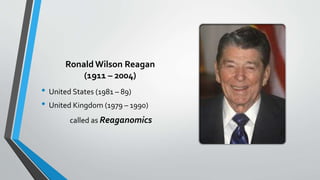
Ronald Wilson Reagan
(1911 – 2004)
• United States (1981 – 89)
• United Kingdom (1979 – 1990)
called as Reaganomics
“
”
economic growth can be most effectively created
by using incentives to people to produce (supply)
good sand services such as adjusting income tax
and capital gains tax
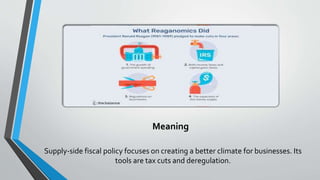
Meaning
Supply-side economics is the theory that says increased
production drives economic growth.The factors of
production are capital, labor, entrepreneurship, and land.
Meaning
Supply-side fiscal policy focuses on creating a better climate for businesses. Its
tools are tax cuts and deregulation.
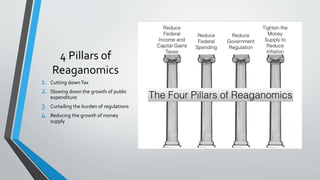
4 Pillars of
Reaganomics
1. Cutting downTax
2. Slowing down the growth of public
expenditure
3. Curtailing the burden of regulations
4. Reducing the growth of money
supply
Propositions of supply-side Economics
•Taxation and Labour – supply
•Incentives to Save and Invest
•Cost – Push Effect of theTaxWedge
•Underground Economy
•Tax Revenue and Laffer Curve
Supply SideVs Demand Side Economics
• Supply-side is the opposite of
Keynesian theory. It states that
demand is the primary driving
force of economic growth.
Supporters use fiscal policy to
better the lives of consumers
regardless of whether they work or
not.
• The demand side economics had
completed ignored the fiscal
implications of a tax cut on
aggregate supply.The
phenomenon of stagflation in
western countries during 1970s
pushed the demand side
economics for introspection and to
crucial test.
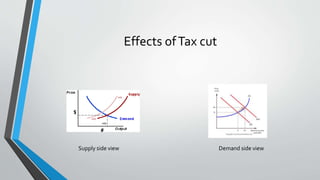
Effects ofTax cut
Supply side view Demand side view
Essentials of Supply Side Economics
• Validity of Say’s Law of Market
• Determinants of Output or supply
• Classical interest – elastic saving and investment
• Determinant of growth rate of labour
• Free market system
Implications of Supply Side Economics
 Tax rates raise tax revenues
 Reduction in tax rates cure stagflation
 Reduction in government spending
 Monetary policy
 Increased depreciation
 Reduction in welfare benefits
 Reducing union power
 Deregulation and privatisation
 Free trade and capital movements
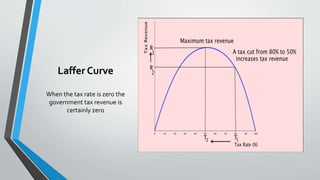
Laffer Curve
•the Laffer curve illustrates a theoretical
relationship between rates of taxation and
the resulting levels of the government's tax
revenue.
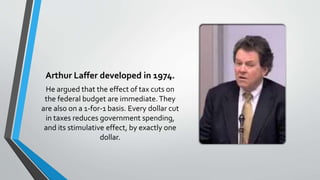
Arthur Laffer developed in 1974.
He argued that the effect of tax cuts on
the federal budget are immediate.They
are also on a 1-for-1 basis. Every dollar cut
in taxes reduces government spending,
and its stimulative effect, by exactly one
dollar.
Laffer Curve
When the tax rate is zero the
government tax revenue is
certainly zero
Policy Recommendations
Supply Side Economics
Recommendations
• Reduction in personal and corporate income tax rates
• Change in tax laws
• Reduction in government regulation
• Balancing of federal budget
• Stabilizing money growth rates
• Free international trade and capital movements
• Reduction in the strength of labour
Criticism of Supply Side Economics
• More ideology, less analysis
• No solution of poverty and unemployment
• Tax cuts not dependable
• No trickle down effects and rise in income inequalities
• Weak as a theory of underdevelopment
• Less role for public sector is not ideal
• Difficult to locate optimal tax point or the exact shape of the Laffer curve
• It is not possible to measure work effort specifically as a result of tax cut
• Critics argue that some persons have target real income when taxes are reduced,
they will work less and have more leisure to maintain their target income.
ThankYou

Supply side economics

  • 1.
    Supply Side Economics Dr.K. SUNDARAM Associate Professor of Economics Ayya Nadar Janaki Ammal College (Autonomous), Sivakasi
  • 2.
    Introduction • The term"supply-side economics" was thought for some time to have been coined by journalist JudeWanniski in 1975. • According to Robert D. Atkinson the term "supply side" was first used in 1976 by Herbert Stein (a former economic adviser to President Richard Nixon) • Latterly this term repeated by JudeWanniski. • Its use connotes the ideas of economists Robert Mundell and Arthur Laffer.
  • 3.
    Ronald Wilson Reagan (1911– 2004) • United States (1981 – 89) • United Kingdom (1979 – 1990) called as Reaganomics
  • 4.
    “ ” economic growth canbe most effectively created by using incentives to people to produce (supply) good sand services such as adjusting income tax and capital gains tax Meaning Supply-side economics is the theory that says increased production drives economic growth.The factors of production are capital, labor, entrepreneurship, and land.
  • 5.
    Meaning Supply-side fiscal policyfocuses on creating a better climate for businesses. Its tools are tax cuts and deregulation.
  • 6.
    4 Pillars of Reaganomics 1.Cutting downTax 2. Slowing down the growth of public expenditure 3. Curtailing the burden of regulations 4. Reducing the growth of money supply
  • 7.
    Propositions of supply-sideEconomics •Taxation and Labour – supply •Incentives to Save and Invest •Cost – Push Effect of theTaxWedge •Underground Economy •Tax Revenue and Laffer Curve
  • 8.
    Supply SideVs DemandSide Economics • Supply-side is the opposite of Keynesian theory. It states that demand is the primary driving force of economic growth. Supporters use fiscal policy to better the lives of consumers regardless of whether they work or not. • The demand side economics had completed ignored the fiscal implications of a tax cut on aggregate supply.The phenomenon of stagflation in western countries during 1970s pushed the demand side economics for introspection and to crucial test.
  • 9.
    Effects ofTax cut Supplyside view Demand side view
  • 10.
    Essentials of SupplySide Economics • Validity of Say’s Law of Market • Determinants of Output or supply • Classical interest – elastic saving and investment • Determinant of growth rate of labour • Free market system
  • 11.
    Implications of SupplySide Economics  Tax rates raise tax revenues  Reduction in tax rates cure stagflation  Reduction in government spending  Monetary policy  Increased depreciation  Reduction in welfare benefits  Reducing union power  Deregulation and privatisation  Free trade and capital movements
  • 12.
    Laffer Curve •the Laffercurve illustrates a theoretical relationship between rates of taxation and the resulting levels of the government's tax revenue.
  • 13.
    Arthur Laffer developedin 1974. He argued that the effect of tax cuts on the federal budget are immediate.They are also on a 1-for-1 basis. Every dollar cut in taxes reduces government spending, and its stimulative effect, by exactly one dollar.
  • 14.
    Laffer Curve When thetax rate is zero the government tax revenue is certainly zero
  • 15.
  • 16.
    Recommendations • Reduction inpersonal and corporate income tax rates • Change in tax laws • Reduction in government regulation • Balancing of federal budget • Stabilizing money growth rates • Free international trade and capital movements • Reduction in the strength of labour
  • 17.
    Criticism of SupplySide Economics • More ideology, less analysis • No solution of poverty and unemployment • Tax cuts not dependable • No trickle down effects and rise in income inequalities • Weak as a theory of underdevelopment • Less role for public sector is not ideal • Difficult to locate optimal tax point or the exact shape of the Laffer curve • It is not possible to measure work effort specifically as a result of tax cut • Critics argue that some persons have target real income when taxes are reduced, they will work less and have more leisure to maintain their target income.
  • 18.