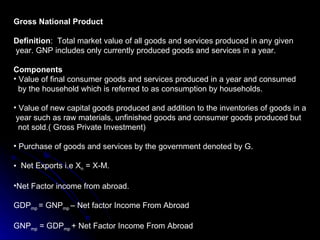
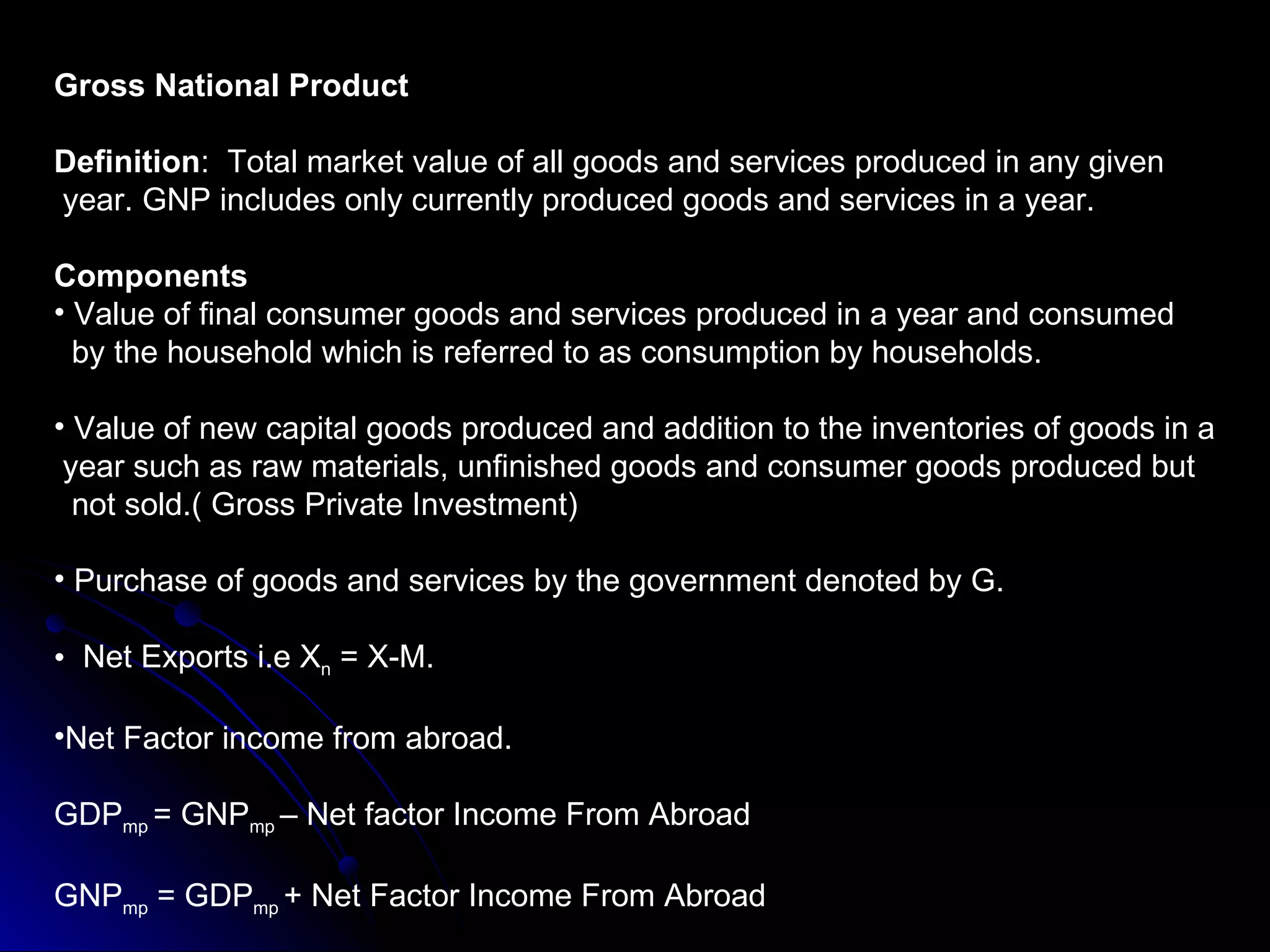
Gross National Product Definition :  Total market value of all goods and services produced in any given year. GNP includes only currently produced goods and services in a year. Components  Value of final consumer goods and services produced in a year and consumed  by the household which is referred to as consumption by households. Value of new capital goods produced and addition to the inventories of goods in a  year such as raw materials, unfinished goods and consumer goods produced but  not sold.( Gross Private Investment) Purchase of goods and services by the government denoted by G. Net Exports i.e X n  = X-M. Net Factor income from abroad. GDP mp  = GNP mp  – Net factor Income From Abroad GNP mp  = GDP mp  + Net Factor Income From Abroad
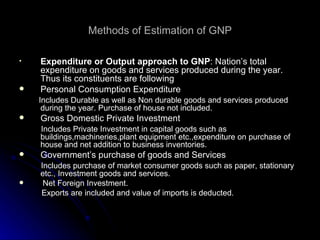
Methods of Estimation of GNP Expenditure or Output approach to GNP : Nation’s total expenditure on goods and services produced during the year. Thus its constituents are following Personal Consumption Expenditure Includes Durable as well as Non durable goods and services produced during the year. Purchase of house not included. Gross Domestic Private Investment Includes Private Investment in capital goods such as buildings,machineries,plant equipment etc.,expenditure on purchase of house and net addition to business inventories. Government’s purchase of goods and Services Includes purchase of market consumer goods such as paper, stationary etc., Investment goods and services. Net Foreign Investment. Exports are included and value of imports is deducted.
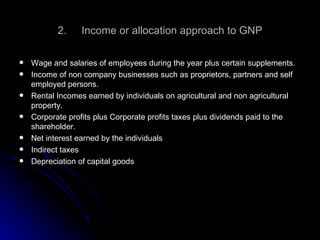
2.  Income or allocation approach to GNP Wage and salaries of employees during the year plus certain supplements. Income of non company businesses such as proprietors, partners and self employed persons. Rental Incomes earned by individuals on agricultural and non agricultural property. Corporate profits plus Corporate profits taxes plus dividends paid to the shareholder. Net interest earned by the individuals Indirect taxes Depreciation of capital goods
Net National Product NNP= GNP- Depreciation  Known as National Income at market prices Better index than GNP as depreciation is not included in NNP Gives an idea of net increase in production. Helpful in analysis of long run problem of maintaining physical supply of goods. Highly useful concept for the study of growth economics. However fixation of depreciation charges is an issue.
National Income Known as National Income at Factor cost. It is the total of all incomes payments received by the factors of production i.e. land, labour and capital. National Income = Net national product-Indirect taxes + subsidies- profits accruing to the government. It helps us to know the distribution side of the national output that is how the national output is distributed among the various factors of production.
Personal Income It is that income which is actually received by the individuals or households in a country during the year from all   sources. Personal Income = National income – Corporate Income Taxes – Undistributed Corporate Profits – Social Contributions + Transfer Payments It is a useful tool for estimating the potential purchasing power of the households in an economy. It helps to measure the general welfare of the people in the country. However, it does not tells us the actual amount of money available to the households for spending and saving.
Disposable Personal Income  That part of personal income which is left behind after payment of personal direct taxes is called disposable personal income. Disposoable Personal Income=Personal Income – Personal direct Taxes. Disposoable Personal Income = Consumption + Saving.  Money burden of Personal direct taxation can be find out with the help of personal income
Difficulties in calculation of National Income Statistics inadequate and unreliable Large non-monetized sector in underdeveloped economies. Majority of small producers in underdeveloped countries are illiterate and ignorant. Occupational specialization is not there in these countries.
Importance of National Income  Gives the idea of aggregate production in the country. Increasing national Income is an indicator of economic progress. Economic welfare is closely connected with the magnitude of National income Contribution from various sectors can be known. Gives a picture about distribution of income among the various sections. Volume of consumption, savings and investment in the country. Formulation of economic policies and planning.
Relation between Economic Welfare and National Income The effect of National income on economic welfare an be studied in two ways The change in the size of National Income: Positive change in NI increases its volume, as a result people consume more of goods and services, which leads to increase in economic welfare and vice versa. This relationship depends on various factors. Only real increase in national income increases economic welfare. NI cannot be a reliable index if per capita income is not taken into account. Sometimes even with increase in NI and Per capita income economic welfare decreases due to unequal distribution of economic wealth. Influence of increase in National Income on economic welfare also depends on the spending habit of the consumers. The change in distribution of National Income Change can be from rich to poor and from poor to rich and economic welfare is said to increase when former situation is implemented.

National income accounting

  • 1.
    Gross National ProductDefinition : Total market value of all goods and services produced in any given year. GNP includes only currently produced goods and services in a year. Components Value of final consumer goods and services produced in a year and consumed by the household which is referred to as consumption by households. Value of new capital goods produced and addition to the inventories of goods in a year such as raw materials, unfinished goods and consumer goods produced but not sold.( Gross Private Investment) Purchase of goods and services by the government denoted by G. Net Exports i.e X n = X-M. Net Factor income from abroad. GDP mp = GNP mp – Net factor Income From Abroad GNP mp = GDP mp + Net Factor Income From Abroad
  • 2.
    Methods of Estimationof GNP Expenditure or Output approach to GNP : Nation’s total expenditure on goods and services produced during the year. Thus its constituents are following Personal Consumption Expenditure Includes Durable as well as Non durable goods and services produced during the year. Purchase of house not included. Gross Domestic Private Investment Includes Private Investment in capital goods such as buildings,machineries,plant equipment etc.,expenditure on purchase of house and net addition to business inventories. Government’s purchase of goods and Services Includes purchase of market consumer goods such as paper, stationary etc., Investment goods and services. Net Foreign Investment. Exports are included and value of imports is deducted.
  • 3.
    2. Incomeor allocation approach to GNP Wage and salaries of employees during the year plus certain supplements. Income of non company businesses such as proprietors, partners and self employed persons. Rental Incomes earned by individuals on agricultural and non agricultural property. Corporate profits plus Corporate profits taxes plus dividends paid to the shareholder. Net interest earned by the individuals Indirect taxes Depreciation of capital goods
  • 4.
    Net National ProductNNP= GNP- Depreciation Known as National Income at market prices Better index than GNP as depreciation is not included in NNP Gives an idea of net increase in production. Helpful in analysis of long run problem of maintaining physical supply of goods. Highly useful concept for the study of growth economics. However fixation of depreciation charges is an issue.
  • 5.
    National Income Knownas National Income at Factor cost. It is the total of all incomes payments received by the factors of production i.e. land, labour and capital. National Income = Net national product-Indirect taxes + subsidies- profits accruing to the government. It helps us to know the distribution side of the national output that is how the national output is distributed among the various factors of production.
  • 6.
    Personal Income Itis that income which is actually received by the individuals or households in a country during the year from all sources. Personal Income = National income – Corporate Income Taxes – Undistributed Corporate Profits – Social Contributions + Transfer Payments It is a useful tool for estimating the potential purchasing power of the households in an economy. It helps to measure the general welfare of the people in the country. However, it does not tells us the actual amount of money available to the households for spending and saving.
  • 7.
    Disposable Personal Income That part of personal income which is left behind after payment of personal direct taxes is called disposable personal income. Disposoable Personal Income=Personal Income – Personal direct Taxes. Disposoable Personal Income = Consumption + Saving. Money burden of Personal direct taxation can be find out with the help of personal income
  • 8.
    Difficulties in calculationof National Income Statistics inadequate and unreliable Large non-monetized sector in underdeveloped economies. Majority of small producers in underdeveloped countries are illiterate and ignorant. Occupational specialization is not there in these countries.
  • 9.
    Importance of NationalIncome Gives the idea of aggregate production in the country. Increasing national Income is an indicator of economic progress. Economic welfare is closely connected with the magnitude of National income Contribution from various sectors can be known. Gives a picture about distribution of income among the various sections. Volume of consumption, savings and investment in the country. Formulation of economic policies and planning.
  • 10.
    Relation between EconomicWelfare and National Income The effect of National income on economic welfare an be studied in two ways The change in the size of National Income: Positive change in NI increases its volume, as a result people consume more of goods and services, which leads to increase in economic welfare and vice versa. This relationship depends on various factors. Only real increase in national income increases economic welfare. NI cannot be a reliable index if per capita income is not taken into account. Sometimes even with increase in NI and Per capita income economic welfare decreases due to unequal distribution of economic wealth. Influence of increase in National Income on economic welfare also depends on the spending habit of the consumers. The change in distribution of National Income Change can be from rich to poor and from poor to rich and economic welfare is said to increase when former situation is implemented.