By prof. dr.ir. Faisal
Glucose is essential for us to make
energy and survive.
When we get glucose in our blood, it is
transported to cells and used to make
energy.
When glucose levels rise, insulin is
released to convert and store excess
glucose, usually as fat.
Post-Prandial Glucose Rise
• Blood glucose goes up after a carbohydrate
meal
- Uptake to the cells mediated by insulin.
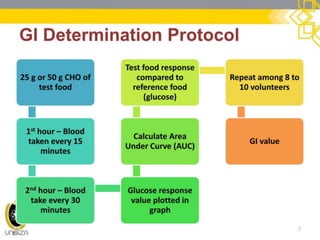
• Glucose test or Glucose tolerance test(GTT)
• Eat or drink a sugary solid or drinks
 1 g/kg body weight, or 50 g or 70 g
 Measure blood glucose changes:
 “Normal” is 5 mM at time zero
 rises to a peak at about 30 min
 back down to basal by 60 min
 Glucose intolerance:
• Glucose peak is higher and time to return to basal is longer
• Glucose is not being taken up properly
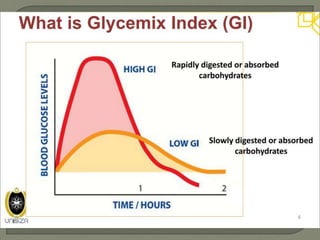
BloodGlucoseResponseCurve
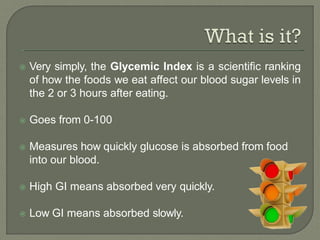
 Very simply, the Glycemic Index is a scientific ranking
of how the foods we eat affect our blood sugar levels in
the 2 or 3 hours after eating.
 Goes from 0-100
 Measures how quickly glucose is absorbed from food
into our blood.
 High GI means absorbed very quickly.
 Low GI means absorbed slowly.
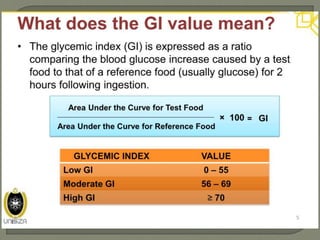
 High GI (70-100) Carbohydrates which break
down quickly during digestion, releasing blood
sugarrapidly into the bloodstream – causing
marked fluctuations in blood sugar levels.
 Medium GI (56-69) Carbohydrates which
break down moderately during digestion,
releasing blood sugar moderately into the
bloodstream.
 Low GI (0-55) Carbohydrates which break down
slowly during digestion, releasing blood
sugargradually into the bloodstream – keeping
blood sugar levels steady … and so provide you
with the best health benefits!
GI CLASSIFICATION
Developed By: Glycemic Index Research Unit
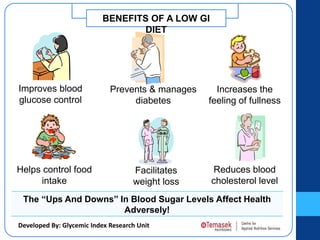
The “Ups And Downs” In Blood Sugar Levels Affect Health
Adversely!
BENEFITS OF A LOW GI
DIET
Improves blood
glucose control
Prevents & manages
diabetes
Increases the
feeling of fullness
Helps control food
intake
Facilitates
weight loss
Reduces blood
cholesterol level
Developed By: Glycemic Index Research Unit
Bran acts as a physical barrier that slows down enzymatic activity
on the internal starch layer.
Just because a food is low GI,
doesn’t necessarily make it a good
food!
Some foods may have a low GI, but may
be high in saturated fats, include
additives, flavourings, colourings, or
preservatives, or simply provide little in
the way of nutrients by offering
“empty” calories!
http://www.lowgihealth.com.au/glycemic-ind
Be careful!
GI is not the only way to measure the
nutritional value of food.
Even if it releases energy slowly, it may
not have much nutrients. Also, somehigh
GI foods are necessary because of the
nutrients they contain.
The only way to get the right amount of
nutrients, maintain a healthy weight and
prevent diet related diseases is to
•Eat a BALANCED DIET, and
•EXERCISE REGULARLY
Blood sugar levels are also affected by….
• Physical activity.
• Hormones.
• Medications.
• Nutritional composition or product formulations.
• Individuals response can vary from person to person.
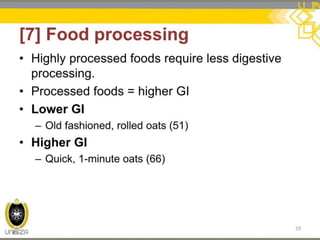
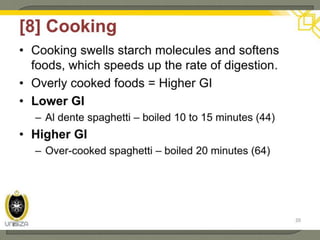
• GI values can vary depending on the ripeness of the food, the degree of
processing, and the cooking method.
•
GI and GL lecture.pptx

GI and GL lecture.pptx

  • 1.
  • 3.
    Glucose is essentialfor us to make energy and survive. When we get glucose in our blood, it is transported to cells and used to make energy. When glucose levels rise, insulin is released to convert and store excess glucose, usually as fat.
  • 4.
    Post-Prandial Glucose Rise •Blood glucose goes up after a carbohydrate meal - Uptake to the cells mediated by insulin. • Glucose test or Glucose tolerance test(GTT) • Eat or drink a sugary solid or drinks  1 g/kg body weight, or 50 g or 70 g  Measure blood glucose changes:  “Normal” is 5 mM at time zero  rises to a peak at about 30 min  back down to basal by 60 min  Glucose intolerance: • Glucose peak is higher and time to return to basal is longer • Glucose is not being taken up properly
  • 5.
  • 6.
     Very simply,the Glycemic Index is a scientific ranking of how the foods we eat affect our blood sugar levels in the 2 or 3 hours after eating.  Goes from 0-100  Measures how quickly glucose is absorbed from food into our blood.  High GI means absorbed very quickly.  Low GI means absorbed slowly.
  • 7.
     High GI(70-100) Carbohydrates which break down quickly during digestion, releasing blood sugarrapidly into the bloodstream – causing marked fluctuations in blood sugar levels.  Medium GI (56-69) Carbohydrates which break down moderately during digestion, releasing blood sugar moderately into the bloodstream.  Low GI (0-55) Carbohydrates which break down slowly during digestion, releasing blood sugargradually into the bloodstream – keeping blood sugar levels steady … and so provide you with the best health benefits!
  • 8.
    GI CLASSIFICATION Developed By:Glycemic Index Research Unit
  • 13.
    The “Ups AndDowns” In Blood Sugar Levels Affect Health Adversely! BENEFITS OF A LOW GI DIET Improves blood glucose control Prevents & manages diabetes Increases the feeling of fullness Helps control food intake Facilitates weight loss Reduces blood cholesterol level Developed By: Glycemic Index Research Unit
  • 17.
    Bran acts asa physical barrier that slows down enzymatic activity on the internal starch layer.
  • 25.
    Just because afood is low GI, doesn’t necessarily make it a good food! Some foods may have a low GI, but may be high in saturated fats, include additives, flavourings, colourings, or preservatives, or simply provide little in the way of nutrients by offering “empty” calories! http://www.lowgihealth.com.au/glycemic-ind
  • 26.
    Be careful! GI isnot the only way to measure the nutritional value of food. Even if it releases energy slowly, it may not have much nutrients. Also, somehigh GI foods are necessary because of the nutrients they contain.
  • 27.
    The only wayto get the right amount of nutrients, maintain a healthy weight and prevent diet related diseases is to •Eat a BALANCED DIET, and •EXERCISE REGULARLY
  • 28.
    Blood sugar levelsare also affected by…. • Physical activity. • Hormones. • Medications. • Nutritional composition or product formulations. • Individuals response can vary from person to person. • GI values can vary depending on the ripeness of the food, the degree of processing, and the cooking method. •