Erik Stålberg
Uppsala
Sweden
What can we assess with EMG?What can we assess with EMG?
• Muscle membrane function - spontaneous
• Muscle fibre characteristics; diameter
• MU organization
– number of fibers
– grouping
• N-M transmission
• Motor units
– total number
– activation; pattern, fullness Stålberg
Parameters to quantify inParameters to quantify in
Conc/Monopolar EMGConc/Monopolar EMG
• spontaneous activityspontaneous activity
• shape of individual MUPsshape of individual MUPs
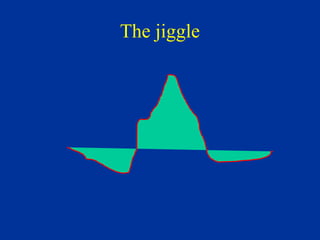
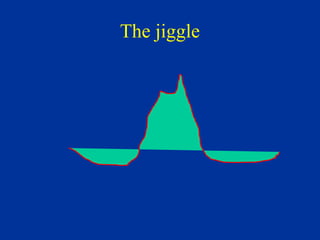
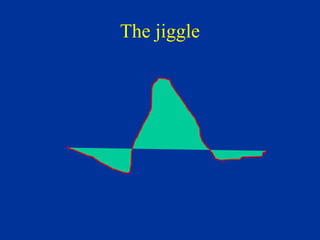
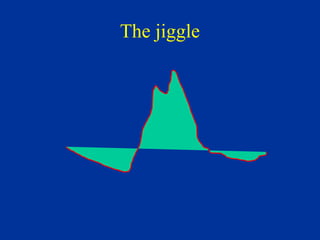
• jigglejiggle
• recruitment (recruitment (early, reducedearly, reduced))
• fullness at strong activationfullness at strong activation
• dynamic changes with time (dynamic changes with time (fatiguefatigue))
Spontaneous activity in normal
• insertional activity
• end-plate noise
• ”nerve spikes”
• positive wave at end-plate zone
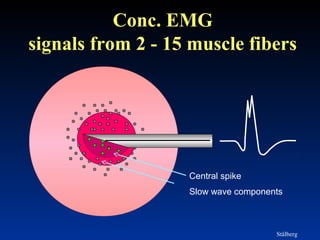
Conc. EMG
signals from 2 - 15 muscle fibers
Stålberg
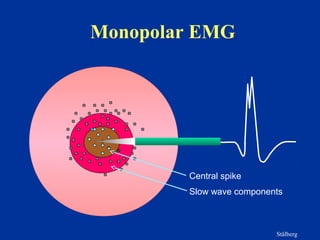
Central spike
Slow wave components
Monopolar EMG
Stålberg
Central spike
Slow wave components
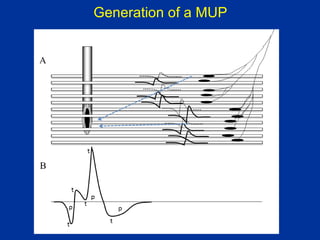
Generation of a MUP
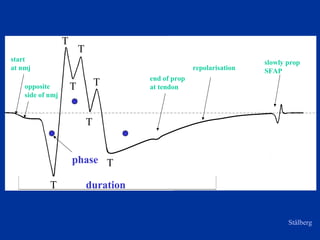
opposite
side of nmj
end of prop
at tendon
slowly prop
SFAPrepolarisation
T
T
T
T
duration
start
at nmj
phase
Stålberg
T
T
T
27
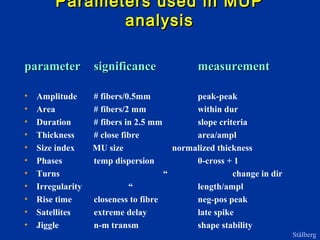
Parameters used in MUPParameters used in MUP
analysisanalysis
parameterparameter significancesignificance measurementmeasurement
• Amplitude # fibers/0.5mm peak-peak
• Area # fibers/2 mm within dur
• Duration # fibers in 2.5 mm slope criteria
• Thickness # close fibre area/ampl
• Size index MU size normalized thickness
• Phases temp dispersion 0-cross + 1
• Turns “ change in dir
• Irregularity “ length/ampl
• Rise time closeness to fibre neg-pos peak
• Satellites extreme delay late spike
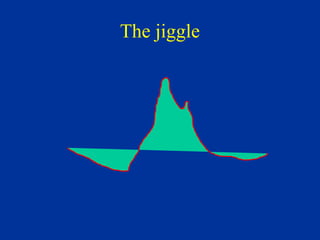
• Jiggle n-m transm shape stability
Stålberg
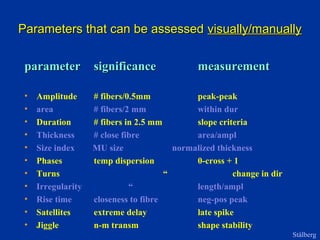
Parameters that can be assessedParameters that can be assessed visually/manuallyvisually/manually
parameterparameter significancesignificance measurementmeasurement
• Amplitude # fibers/0.5mm peak-peak
• area # fibers/2 mm within dur
• Duration # fibers in 2.5 mm slope criteria
• Thickness # close fibre area/ampl
• Size index MU size normalized thickness
• Phases temp dispersion 0-cross + 1
• Turns “ change in dir
• Irregularity “ length/ampl
• Rise time closeness to fibre neg-pos peak
• Satellites extreme delay late spike
• Jiggle n-m transm shape stability
Stålberg
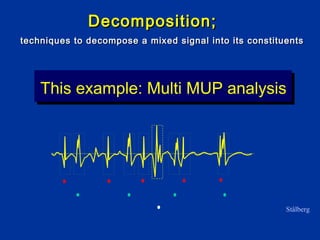
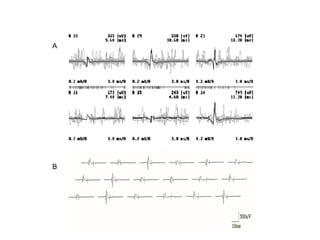
This example: Multi MUP analysis
techniques to decompose a mixed signal into its constituentstechniques to decompose a mixed signal into its constituents
Decomposition;Decomposition;
Stålberg
A
B
C
500 uV
10 ms
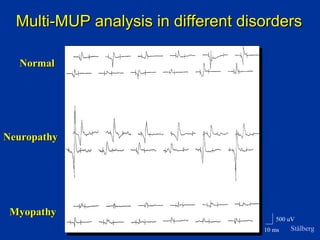
NormalNormal
NeuropathyNeuropathy
MyopathyMyopathy
Multi-MUP analysis in different disordersMulti-MUP analysis in different disorders
Stålberg
A
m
p
L
I
t
u
d
e
Amplitude
Measured peak-peak
* note that jiggle will reduce
mean amplitude
(measured
after averaging)
Duration
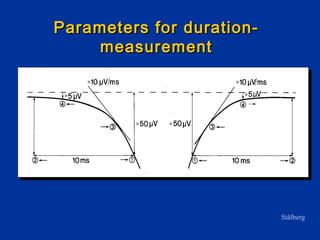
Parameters for duration-Parameters for duration-
measurementmeasurement
Stålberg
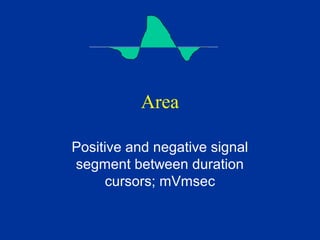
area
Area
Positive and negative signal
segment between duration
cursors; mVmsec
Thick-
ness
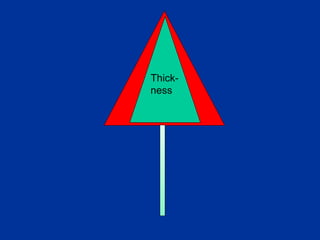
Thickness
Calculated as
area/ampl
(In a triangle, area/height=base/2)
Size
index
Sonoo,Stålberg 1993
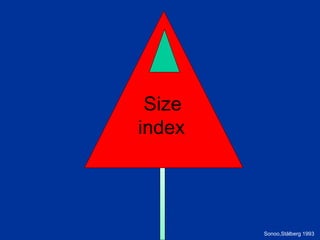
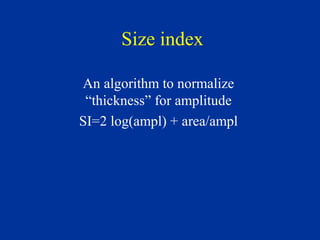
Size index
An algorithm to normalize
“thickness” for amplitude
SI=2 log(ampl) + area/ampl
C X
E
L
P
M
O
T
I Y
Phases, turns
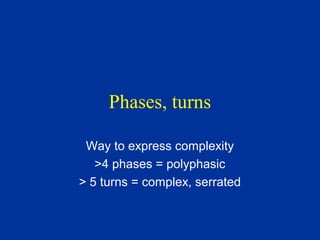
Phases, turns
Way to express complexity
>4 phases = polyphasic
> 5 turns = complex, serrated
I R
R
L
U
G
E
T
I
R
A Y
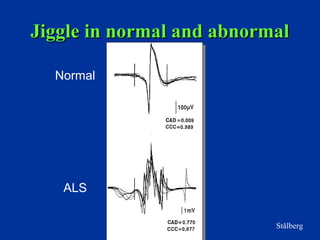
The jiggle
The jiggle
The jiggle
The jiggle
The jiggle
Jiggle in normal and abnormalJiggle in normal and abnormal
MUPsMUPs
Stålberg
Normal
ALS
So, shall I use all these
parameters??
Which one is best?
Let us look at the diagnostic power of
a few parameters
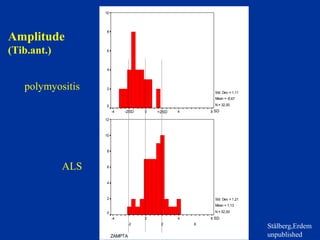
Amplitude
(Tib.ant.)
ZAMPTA
8
6
4
2
0
-2
-4
10
8
6
4
2
0
Std. Dev = 1,11
Mean = -1
N = 32,00
ZAMPTA
8
6
4
2
0
-2
-4
12
10
8
6
4
2
0
Std. Dev = 1,21
Mean = 1
N = 52,00
0.87
,13
polymyositis
ALS
Stålberg,Erdem
unpublished
SD
SD
-2SD +2SD
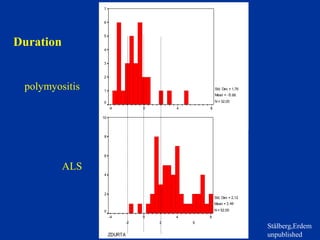
Duration
ZDURTA
8
6
4
2
0
-2
-4
7
6
5
4
3
2
1
0
Std. Dev = 1,76
Mean = -1
N = 32,00
ZDURTA
8
6
4
2
0
-2
-4
10
8
6
4
2
0
Std. Dev = 2,12
Mean = 3
N = 52,00
0.88
.46
polymyositis
ALS
Stålberg,Erdem
unpublished
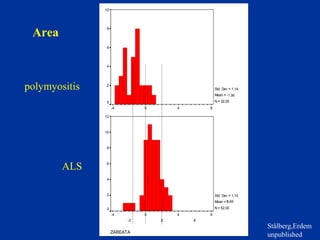
Area
ZAREATA
8
6
4
2
0
-2
-4
10
8
6
4
2
0
Std. Dev = 1,14
Mean = -1
N = 32,00
ZAREATA
8
6
4
2
0
-2
-4
12
10
8
6
4
2
0
Std. Dev = 1,10
Mean = 1
N = 52,00
.36
0,85
polymyositis
ALS
Stålberg,Erdem
unpublished
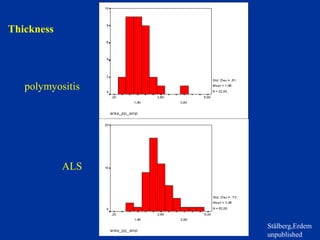
Thickness
polymyositis
ALS
Stålberg,Erdem
unpublished
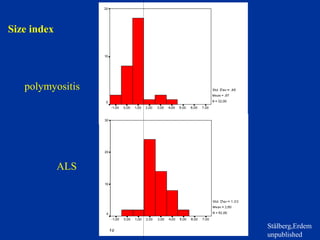
Size index
polymyositis
ALS
Stålberg,Erdem
unpublished
No single parameter
Is superior to the other
In each case
Reference values
necessary to separate abnormal from normal
This is a crucial point in quantitative EMG analysis
• mean, SD (# of SDs = Z-score)
• median, percentiles
• outliers
• combine different data (multivariate analysis, index)
A few examples
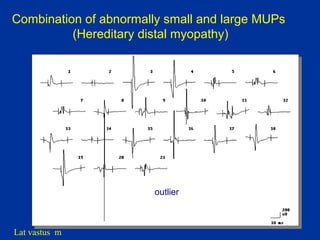
Lat vastus m
outlier
Combination of abnormally small and large MUPs
(Hereditary distal myopathy)
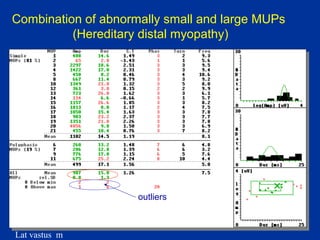
Lat vastus m
Combination of abnormally small and large MUPs
(Hereditary distal myopathy)
outliers
InterferenceInterference
patternpattern
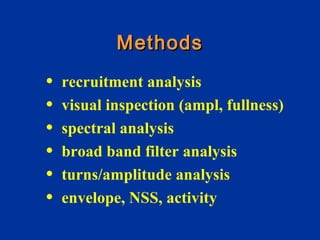
MethodsMethods
• recruitment analysis
• visual inspection (ampl, fullness)
• spectral analysis
• broad band filter analysis
• turns/amplitude analysis
• envelope, NSS, activity
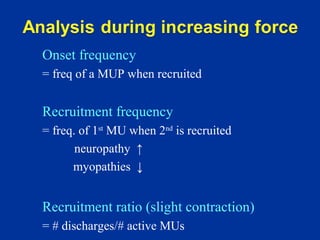
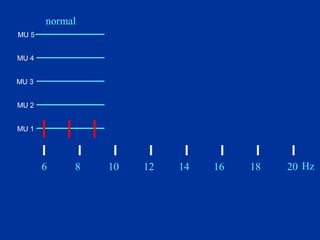
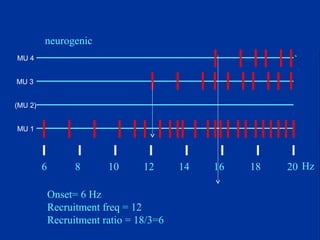
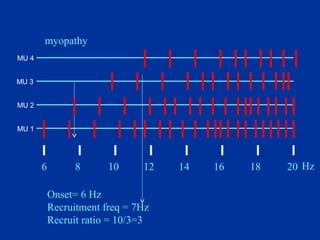
Onset frequency
= freq of a MUP when recruited
Recruitment frequency
= freq. of 1st
MU when 2nd
is recruited
neuropathy ↑
myopathies ↓
Recruitment ratio (slight contraction)
= # discharges/# active MUs
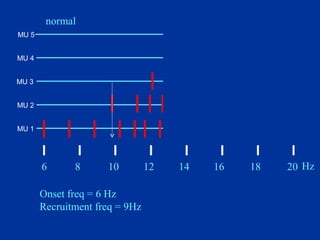
Onset freq = 6 Hz
Recruitment freq = 9Hz
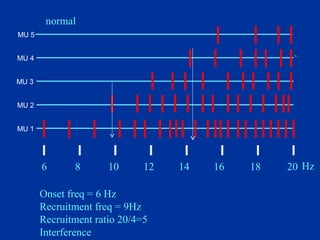
Recruitment ratio 20/4=5
Interference
6 8 10 12 14 16 18 20 Hz
normal
MU 1
MU 2
MU 3
MU 4
MU 5
Onset freq = 6 Hz
Recruitment freq = 9Hz
Recruitment ratio 20/4=5
Interference
6 8 10 12 14 16 18 20 Hz
normal
MU 1
MU 2
MU 3
MU 4
MU 5
Onset freq = 6 Hz
Recruitment freq = 9Hz
Recruitment ratio 20/4=5
Interference
6 8 10 12 14 16 18 20 Hz
normal
MU 1
MU 2
MU 3
MU 4
MU 5
6 8 10 12 14 16 18 20 Hz
Onset= 6 Hz
Recruitment freq = 12
Recruitment ratio = 18/3=6
neurogenic
MU 1
(MU 2)
MU 3
MU 4
6 8 10 12 14 16 18 20 Hz
Onset= 6 Hz
Recruitment freq = 7Hz
Recruit ratio = 10/3=3
myopathy
MU 1
MU 2
MU 3
MU 4
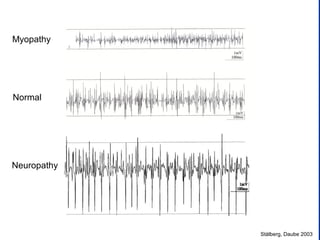
Stålberg, Daube 2003
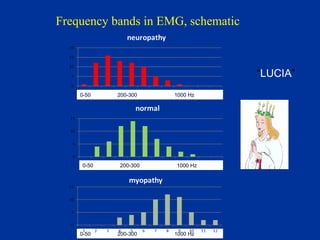
Myopathy
Normal
Neuropathy
Frequency bands in EMG, schematic
0-50 200-300 1000 Hz
“LUCIA”
0-50 200-300 1000 Hz
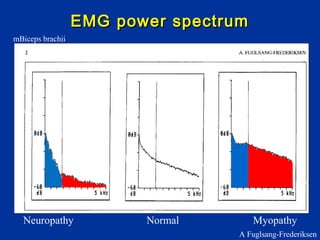
EMG power spectrumEMG power spectrum
Neuropathy Normal Myopathy
mBiceps brachii
A Fuglsang-Frederiksen
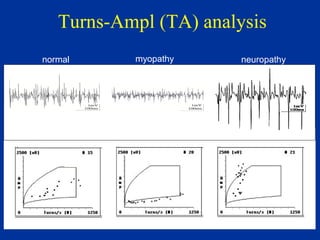
Turns-Ampl (TA) analysis
normal neuropathymyopathy
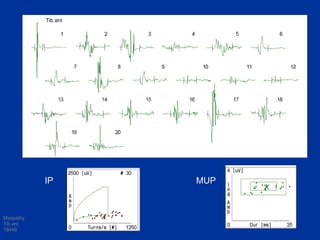
Myopathy
Tib ant
18446
IP MUP
Tib ant
How to quantitateHow to quantitate
Central driveCentral drive
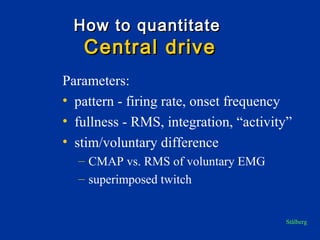
Parameters:
• pattern - firing rate, onset frequency
• fullness - RMS, integration, “activity”
• stim/voluntary difference
– CMAP vs. RMS of voluntary EMG
– superimposed twitch
Stålberg
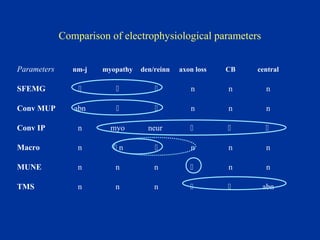
Comparison of electrophysiological parameters
Parameters nm-j myopathy den/reinn axon loss CB central
SFEMG    n n n
Conv MUP abn   n n n
Conv IP n myo neur   
Macro n  n  n n n
MUNE n n n  n n
TMS n n n   abn
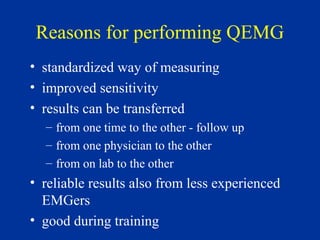
Reasons for performing QEMG
• standardized way of measuring
• improved sensitivity
• results can be transferred
– from one time to the other - follow up
– from one physician to the other
– from on lab to the other
• reliable results also from less experienced
EMGers
• good during training

6. Basic and Gemg