Review by James Ko, The Hong Kong Institute of Education and
Pamela Sammons, with Linda Bakkum, Oxford University Department of Education
Effective
teaching
Effective
teaching
Education Development Trust Highbridge House, 16–18 Duke Street, Reading, Berkshire RG1 4RU
T +44 (0) 118 902 1000 E enquiries@educationdevelopmenttrust.com W www.educationdevelopmenttrust.com
1
EFFECTIVE TEACHING
© COPYRIGHT EDUCATION DEVELOPMENT TRUST 2016. THE VIEWS AND OPINIONS EXPRESSED IN THIS PUBLICATION
ARE THOSE OF THE AUTHORS AND DO NOT NECESSARILY REPRESENT THE VIEWS OF EDUCATION DEVELOPMENT TRUST.
REPRINT OF 2014 REPORT 978-1-909437-75-3
2
EFFECTIVE TEACHING
Contents Education Development Trust	 4
School improvement: international reviews
of best practice	 5
Executive summary	 7
Introduction	8
The Definition challenge	 11
The Perspective challenge	 17
Inspection evidence	 18
Teachers’ perceptions	 23
Students’ perceptions	 25
Principals’ perceptions	 26
The Characterisation challenge	 29
General profiles of effective teachers and
effective teaching	 29
Characterisation and categorisation of
effective teaching practices	 31
The primacy of teacher effects and the
relative effectiveness of teacher variables	 33
Differential departmental and school
impacts on teacher effects	 36
The Measurement challenge	 39
Multidimensionality of teaching practices	 39
Measuring with two instruments and
other measures	 40
The Theorisation challenge	 45
Developing valid instrument(s) to
characterise generic teacher effectiveness
in different countries	 45
Contrasting instruments and characterising
generic teacher effectiveness	 46
Combining qualitative and
quantitative approaches to evaluating
teacher effectiveness	 48
Summary and conclusions	 51
References	54
3
EFFECTIVE TEACHING
Education Development Trust
Education Development Trust, established over 40 years ago as the Centre for
British Teaching and later known as CfBT Education Trust, is a large educational
organisation providing education services for public benefit in the UK and
internationally. We aspire to be the world’s leading provider of education services,
with a particular interest in school effectiveness.
Our work involves school improvement through inspection, school workforce
development and curriculum design for the UK’s Department for Education, local
authorities and an increasing number of independent and state schools, free
schools and academies. We provide services direct to learners in our schools.
Internationally we have successfully implemented education programmes for
governments in the Middle East, Sub-Saharan Africa and South East Asia, and
work on projects funded by donors such as the Department for International
Development, the European Commission, the Australian Department of
Foreign Affairs and Trade, the World Bank and the US Agency for International
Development, in low- and middle-income countries.
Surpluses generated by our operations are reinvested in our educational research
programme.
Please visit www.educationdevelopmenttrust.com for more information.
4
EFFECTIVE TEACHING
School improvement: international reviews of best practice
Working with partners including the Department of Education at Oxford University,
the Centre for Equity in Education at the University of Manchester, the University
of Glasgow, the University of Nottingham and the Hong Kong Institute of
Education, Education Development Trust has commissioned a series of reviews of
international literature. These reviews cover a range of topics related to school
improvement including assessment for learning; the inclusion of students with
special educational needs; effective teaching practice; school self-evaluation; and
successful school leadership.
The idea that schools can impact positively on student outcomes is a crucial driver
in the rise of interest in school improvement research and practice. These reviews
highlight international examples of best practice in order to effect change and
identify how effective school improvement manifests itself. It forms a useful tool
for schools and school leaders, but also acts as a lesson for policymakers in terms
of what works around the world.
This review focuses on:
Effective teaching
Teachers are one of the key elements in any school and effective teaching is one of
the key propellers for school improvement. This review is concerned with how to
define a teacher’s effectiveness and what makes an effective teacher. It draws out
implications for policymakers in education and for improving classroom practice.
The other four reviews in this series focus on:
Assessment for learning
Assessment for learning – where the first priority is to promote learning – is
a key means of initiating improvement. The features, strategies and principles
underpinning assessment for learning form the basis of this review.
From exclusion to inclusion
With a specific focus on children with special educational needs (SEN), this review
addresses the forms of classroom practice that can help all children to participate.
The review particularly focuses on elements of inclusive education and the
implications for schools and school leaders.
School self-evaluation for school improvement
School self-evaluation can be a fundamental force in achieving school
improvement. This review establishes what the key debates are in relation to
school self-evaluation, what principles and processes are associated with it, and
what the implications are for school self-evaluation as a means of leading school
improvement. The review also incorporates a framework for conducting self-
evaluation and case study examples from systems and schools that have previously
undergone the process.
5
EFFECTIVE TEACHING
Successful leadership
School leaders are under considerable pressure to demonstrate the contribution
of their work to school improvement, which has resulted in the creation
of a wide range of literature which addresses leadership in the context of
school improvement. This review pays particular attention to issues including
transformational leadership, instructional/pedagogical leadership and distributed
leadership.
Education Development Trust is a world authority on school improvement. We
work directly with schools and governments improving education outcomes
through evaluation, training and professional development programmes. This
series of reviews fits into our aim to develop evidence for education and supports
our goal to provide school improvement programmes which are evidence based.
6
EFFECTIVE TEACHING
Executive summary
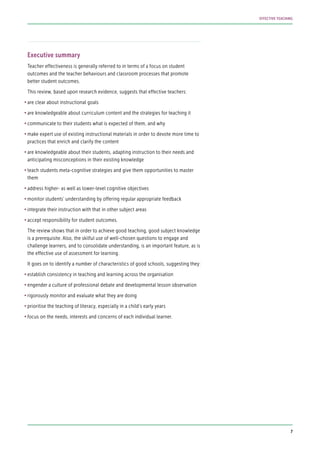
Teacher effectiveness is generally referred to in terms of a focus on student
outcomes and the teacher behaviours and classroom processes that promote
better student outcomes.
This review, based upon research evidence, suggests that effective teachers:
•	are clear about instructional goals
•	are knowledgeable about curriculum content and the strategies for teaching it
•	communicate to their students what is expected of them, and why
•	make expert use of existing instructional materials in order to devote more time to
practices that enrich and clarify the content
•	are knowledgeable about their students, adapting instruction to their needs and
anticipating misconceptions in their existing knowledge
•	teach students meta-cognitive strategies and give them opportunities to master
them
•	address higher- as well as lower-level cognitive objectives
•	monitor students’ understanding by offering regular appropriate feedback
•	integrate their instruction with that in other subject areas
•	accept responsibility for student outcomes.
The review shows that in order to achieve good teaching, good subject knowledge
is a prerequisite. Also, the skilful use of well-chosen questions to engage and
challenge learners, and to consolidate understanding, is an important feature, as is
the effective use of assessment for learning.
It goes on to identify a number of characteristics of good schools, suggesting they:
•	establish consistency in teaching and learning across the organisation
•	engender a culture of professional debate and developmental lesson observation
•	rigorously monitor and evaluate what they are doing
•	prioritise the teaching of literacy, especially in a child’s early years
•	focus on the needs, interests and concerns of each individual learner.
7
EFFECTIVE TEACHING
Introduction
This report highlights key issues and findings about two related but distinctive
topics – how to define a teacher’s effectiveness and what is known about effective
teaching practices. It also seeks to identify the implications for policymakers in
education and for improving classroom practice. The report also includes the study
of inspection evidence that involves making judgements about teaching quality in
schools.
It examines the meaning of ‘effective teaching’ and the ways the literature defines
who are considered to be ‘effective teachers’ both in terms of research and
inspection evidence and also from the perspectives of various key stakeholders in
education (teachers, school principals, students and parents). Drawing on a large
body of research evidence, it seeks to identify and summarise some of the key
characteristics and processes of effective classroom practices, including particular
features of pedagogy (by which we refer to strategies of instruction).1
In summarising the evidence the main focus is on features of effective teaching
and classroom organisation that lead to better student outcomes. We also
identify some implications for policymakers and practitioners seeking to improve
educational practice and student outcomes. In addition, the review highlights
some of the difficulties inherent in trying to identify teacher effects, and in the
characterisation and categorisation of effective practices. We consider some
issues of the measurement challenge that have to be considered in trying to
identify teacher effects and the characteristics and processes of effective teaching.
Examples of classroom observation instruments that can be used to identify
various dimensions of effective teaching practices are also discussed.
The main sections in this report discuss the definition of teacher and teaching
effectiveness in more detail, outline the different perspectives and sources of
evidence that can be used, and explore measurement issues. Then findings are
presented on the knowledge base and characteristics of effectiveness in teaching
and classroom practices, and models and theories used in teacher effectiveness
research (TER) and school effectiveness research (SER). Five interrelated challenges
are used to organise the review evidence, and for each of these challenges, a
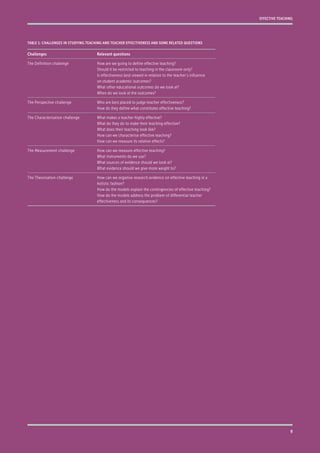
number of relevant questions will be addressed (see Table 1, following).
1
Pedagogy refers to the strategies of instruction, or a style of instruction. For example, Muijs & Reynolds (2000) compared the relative effectiveness of instruction methods like Direct
Teaching, Individual Practice, Interactive Teaching, and Constructivist Methods.
8
EFFECTIVE TEACHING
Challenges Relevant questions
The Definition challenge How are we going to define effective teaching?
Should it be restricted to teaching in the classroom only?
Is effectiveness best viewed in relation to the teacher’s influence
on student academic outcomes?
What other educational outcomes do we look at?
When do we look at the outcomes?
The Perspective challenge Who are best placed to judge teacher effectiveness?
How do they define what constitutes effective teaching?
The Characterisation challenge What makes a teacher highly effective?
What do they do to make their teaching effective?
What does their teaching look like?
How can we characterise effective teaching?
How can we measure its relative effects?
The Measurement challenge How can we measure effective teaching?
What instruments do we use?
What sources of evidence should we look at?
What evidence should we give more weight to?
The Theorisation challenge How can we organise research evidence on effective teaching in a
holistic fashion?
How do the models explain the contingencies of effective teaching?
How do the models address the problem of differential teacher
effectiveness and its consequences?
TABLE 1: CHALLENGES IN STUDYING TEACHING AND TEACHER EFFECTIVENESS AND SOME RELATED QUESTIONS
9
EFFECTIVE TEACHING
Defining the effective teacher, effective teaching and teaching effectiveness
can be complex and controversial. ‘Effectiveness’ is a contested term that
can evoke strong emotions because of its perceived links with notions of
professional competency and high stakes accountability in some systems.
It may question individual teachers’ beliefs about their professional
autonomy.2
Notions of what constitutes high quality or good teaching, the
idea that teaching is an art or a craft rather than a science, are sometimes
used to raise concerns with narrower concepts of effectiveness. However,
beliefs about what constitutes ‘good’ or ‘high’ quality practice in teaching
can vary markedly for different age groups of students, at different times
and in different contexts.
Educational effectiveness is a term that was developed to provide a more
contained definition than notions of ‘good’ or ‘quality’ education. It relates to
the idea of examining effectiveness at different levels of an education system,
such as nationally, at a Local Authority/School district level, for individual
schools, for departments within a school or for individual teachers in terms of
their success in achieving particular goals or educational outcomes.
Educational effectiveness researchers who study school and teacher
effectiveness have emphasised the need to unpack the concept of effectiveness
by addressing questions such as:
•	Effective in promoting which outcomes? This relates to the goals of education
for students.
•	Effective over what time period? This relates to the idea of change and
improvement over time.
•	Effective for whom? This relates to effectiveness in promoting outcomes for
different groups of students (e.g. by gender or ethnic/language group).3
The Definition
challenge
Educational
effectiveness
is a term that
was developed
to provide a
more contained
definition than
notions of ‘good’ or
‘quality’ education
2
Sammons (1996); Day (2004) 3
Sammons (1996).
11
EFFECTIVE TEACHING
Key idea:
Effective teaching requires criteria for effectiveness. These criteria refer to the
objectives of education in general and of teaching in particular. Visions about
the criteria are the result of a political and societal debate, but educational
professionals, teachers and schools can also take part in it. Although objectives of
education have changed over time, language, reading and mathematics remain the
core studies.4
When we seek to define educational effectiveness in this way we recognise that a
focus on outcomes reflects the value-driven choices and priorities about the goals
of education that are deemed to be important in the wider education system (for
example by policymakers in central or local government and at the individual school
or departmental level).5
The emphasis on the achievement of agreed outcomes is
often prioritised. For example, one definition that has been given is:
A teacher is effective if he/she can accomplish the planned goals and assigned
tasks in accordance with school goals.6
Thus, the objectives of education and the definitions of the quality and effectiveness
of education are closely connected. This means that defining effective teaching
must be done in relation to understanding the objectives of education. Promoting
students’ cognitive development can be seen as one of the prime purposes of
education and teaching, though there are also likely to be other important social,
behavioural and affective current and future oriented purposes and goals of
education. These might include developing students to become good citizens,
promoting their physical, emotional and economic well-being and inculcating skills
and attitudes that encourage lifelong learning. Therefore:
Even when the objectives of education change, the stable component in it is that
at least schools and education have to contribute to the cognitive development
of students. The same holds for teaching. Even when we expect that schools
can contribute to more than academic outcomes, and teaching is more than
instruction, effective instruction remains an important component of it.7
Key questions:
•	What are the main goals or objectives for education in my education system?
•	How have they changed during the last decade and what are the implications for
schools and for teachers’ work?
Terms such as ‘instructional effectiveness’, ‘teacher effectiveness’ and ‘teaching
effectiveness’ have been used interchangeably in much of the research literature.8
This reflects the fact that the primary nature of a teacher’s work is instructional and
that teaching or instruction is generally carried out in the classroom. Part of the
confusion is because sometimes the focus is on the teacher’s influence on student
outcomes, and at other times on the classroom behaviours and practices that
The emphasis on
the achievement of
agreed outcomes
is often prioritised
4
Creemers (1999: 51) 5
Stufflebeam & Shinkfield (1995); Sammons (1996) 6
Campbell et al. (2004: 61) 7
Creemers (1999: 52) 8
Like Scheerens (2004, 2008)
12
EFFECTIVE TEACHING
teachers use to promote better outcomes for students. Table 2 illustrates some
definitions found in the literature.
Teacher effectiveness is generally referred to in terms of the focus on student
outcomes and the teacher behaviours and classroom processes that promote
better student outcomes as outlined in the TER definitions (numbered 1–3 in
Table 2). However, some authors view teacher effectiveness in a broader sense.
They adopt criteria that seek to encompass the duties that are seen to be part
of the wider role of teachers in the 21st century (as suggested in definitions 4–6
of Table 2), because the role of a teacher is rarely restricted to instruction only.
In many countries a teacher’s work has extended beyond the instructional or
pedagogical role in the classroom. He/she may be facilitating his/her colleagues’
teaching, engaging in broader leadership roles in the school, enhancing the quality
of his/her teaching through his/ her own reflection or engaging in professional
development programmes.
An operative definition focusing
on observations of teaching in
the classroom
The effectiveness of observable behaviours seen during
classroom observation of a typical lesson.9
A value-added definition
prevailing in the SER that
focuses on student outcomes
The ability to produce gains on student achievement
scores;10
taking account of a baseline measure of
students’ prior attainment and other characteristics of
student intake, the teacher effect is identified in relation
to students’ progress measured by later attainment. Such
measures are often calculated in terms of progress over
a school year.
A narrow TER definition that
focuses on the relationship
between teacher behaviours
and classroom practices and
student outcomes
The impact on students’ performance of various
classroom process factors like teaching methods,
teacher expectations, classroom organisation, and use of
classroom resources.11
A broader TER definition
whichincludes references to
factors beyond the classroom processes
Covers pre-existing teacher characteristics, teacher
competence, teacher performance/behaviour, students’
learning experience, student behaviour or learning
outcomes, teacher training, external teaching context,
internal teaching context and individual student
characteristics.12
Differentiated teacher
effectiveness
Covers the consistency of teacher effects in terms of
time stability, subject consistency, differentiation in
the requirements of the stakeholders (e.g. students,
colleagues, parents) and working environments
(e.g. school type, community) for instructional and
noninstructional roles.13
Total teacher effectiveness Nine components in Definition 4 plus teacher evaluation
and professional development.14
TABLE 2: DEFINITIONS OF EFFECTIVENESS
9
Ko (2010) 10
Little, Goe & Bell (2009) 11
Campbell et al. (2004) 12
Medley (1982: 1894-5) 13
Campbell et al. (2004) 14
Cheng (1995, 1996); Cheng & Tsui (1996)
13
EFFECTIVE TEACHING
Analyses of students’ progress or learning gains measured in achievement
tests can be used to produce value-added indicators of teacher effectiveness.15
However, these can provide only a partial source of evidence if the achievement
tests do not reflect the wider goals and outcomes of education. Nonetheless,
students’ performance levels in cognitive attainment in core areas such as
language, reading, mathematics – and increasingly in science and technology –
remain highly important for most countries and are the focus of many attempts
at educational reform and system-wide improvement. The increased attention
paid to the results of variations within and between countries in international
achievement tests such as PIRLS, TIMMS and PISA, and the impact of relatively poor
performance in such tests leading to concerns about economic competitiveness
is well documented.16
In European countries such as Germany and Denmark, as
well as the US, for example, concerns about poor country results in international
performance have stimulated major reform initiatives to increase the quality
of teaching and education to enhance student attainment levels.17
Increased
accountability and standards-based reforms have also been linked to sustained
improvements in attainment levels in England, and these have laid an emphasis
on improving teaching (for example, through introducing inspection, reforms to
teacher education and professional development, and later through the National
Literacy and Numeracy Strategies for primary schools in the late 1990s).18
15
McCaffrey et al. (2003, 2004); Darling-Hammond et al. (2010) 16
Döbert, Klieme & Sroka (2004) 17
Döbert & Sroka (2004) 18
Sammons (2008)
In many countries
a teacher’s work
has extended
beyond the
instructional or
pedagogical role in
the classroom
14
EFFECTIVE TEACHING
15
EFFECTIVE TEACHING
The Perspective
challenge
There are numerous sources of information and data about teachers’ behaviour
and classroom practices that can be drawn upon to provide evidence to inform
our understanding of teacher effectiveness. These sources involve a range of data
collection methods (e.g. classroom observation, interviews, inspection frameworks
and judgements by trained professionals, examination and test data about student
achievement, policy documentation, and questionnaire surveys). There are also
different informants offering perspectives from key stakeholders in the system,
including inspectors, school principals, heads of departments, teachers and students.
Key idea:
Different sources of information can be used to provide evidence about teacher
effectiveness and effective teaching practices, e.g.
•	analyses of students’ educational outcomes including attainment in core areas like
language, mathematics and science
•	professional judgements by inspectors
•	observation of teachers’ classroom practices
•	students’ and teachers’ views.
As noted earlier there is a tradition in TER of using measures of student attainment
(especially value-added analyses of student progress or gains in attainment) and other
non-cognitive student outcomes data (e.g. academic self-concept, behaviour and
attitudes to learning) to identify both school effects and teacher effects. Estimates
suggest that schools account for around 5–15 per cent of the variation in student
outcomes after taking account of students’ prior attainment and background, while
teacher effects are generally much larger at 20–40 per cent when progress is examined
over an academic year (more details on value-added indicators of effectiveness are
provided in the section on measurement).
Estimates
suggest that
schools account
for around
5–15 per cent
of the variation
in student
outcomes…
while teacher
effects are
generally much
larger
17
EFFECTIVE TEACHING
Such value added studies show that teachers vary in their effectiveness in promoting
student learning as measured by their progress. They have also been used to allow
the study of which teacher behaviours and practices account for the variations in
student progress,19
thus allowing the identification of teachers whose students
make significantly better progress than similar students do in general. These allow
researchers to conduct case studies of highly effective teachers and their practices.20
Reviews of TER have produced results that identify consistent patterns of teacher
practices that promote better outcomes for students, and these provide a valuable
source of evidence on some key features of effective teaching.21
For example,
whole-class interactive teaching was found to relate to seven ‘behaviourist’ effective
teaching factors (i.e. classroom management, behaviour management, direct
teaching, varied teaching, interactive teaching, individual practice, and classroom
climate).22
We discuss these features in more detail in later sections.
Inspection evidence
School inspection serves different purposes in different countries. In some systems
it is used for quality assurance and accountability purposes. In others it is intended
to help support teachers in developing and improving their practices. In England, the
Office for Standards in Education (Ofsted) was introduced in 1993 to change more
traditional quality assurance functions of inspection (where previously inspection
reports were not published at the school level and inspection occurred only very
infrequently) to a high-profile accountability mechanism that involved regular
inspection of all schools on a three-year cycle. This publicly identified and graded
school performance and involved sanctions for schools deemed to be failing,
showing serious weaknesses or needing to improve. The threat of closure was
introduced for schools deemed to be failing that did not improve sufficiently within
a short period of time (two years). Ofsted’s self-selected aim was ‘improvement
through inspection’.23
As well as publishing individual schools’ inspection reports
to inform parents, an annual report commenting on standards of attainment, the
quality of education, school leadership and of teaching and learning was published,
based on an analysis of all the inspections conducted in a year. Evidence from
inspection visits has been used to address topics of policy or practitioner interest,
including features of teaching and learning. Ofsted has also issued a number of
guidance documents on effective teaching based on inspection evidence.
Key idea:
The publication of inspection evidence can provide a major source of evidence on
effective teaching that informs practitioners about what practices are considered
to be most ‘effective’, ‘high quality’ or ‘good’ and the features of ‘unsatisfactory’
‘good’ and ‘excellent’ teaching are defined according to the professional judgements
of inspectors. Such evidence often provides examples and vignettes to illustrate
effective practice observed by inspectors.
In England,
the Office for
Standards in
Education (Ofsted)
was introduced in
1993 to change
more traditional
quality assurance
functions of
inspection
19
Muijs & Reynolds (2000) 20
Muijs & Reynolds (2000); Day et al. (2006); Siraj-Blatchford et al. (2011) 21
E.g. Porter & Brophy (1988); McBer (2000); for details, see the Measurement section;
in particular, the discussion on effective teaching variables identified by Hattie’s (2009) synthesis of meta-analyses and the ‘best practice’ identified by Slavin’s (2010) meta-analysis. See also
Muijs & Reynolds’ (2000) characterisation of multidimensionality of teaching 22
Muijs & Reynolds (2000) 23
Matthews & Sammons (2004, 2005).
18
EFFECTIVE TEACHING
Inspectors can evaluate the implementation of national educational policies
(e.g. the National Curriculum) and may use regulative mechanisms (e.g. school
inspection and self-evaluation systems such as those found in both the UK and
Hong Kong) to steer practitioners toward best practices. Inspections often
involve classroom observation, as well as the study of samples of students’
work, and of schools’ performance data to evaluate standards of teaching and
learning in schools.
Inspections (e.g. in England, the Netherlands and Hong Kong) are mainly
conducted by experienced inspectors over a number of years. These inspectors
typically receive regular training and in some systems their judgements are
checked for reliability. Therefore, inspection reports and documents can provide
a valuable source of evidence on effective teaching practices and on educational
standards built on professional judgement and experience, and directly related
to the stated aims of an education system. A recent Ofsted report,24
for example,
examines the extent to which the English educational system can match the
characteristics that underpin good performance of the most successful education
systems identified in an international study.25
This stresses the importance of
maintaining consistency in the quality of teaching of individual teachers and
reducing variation within and among schools. Box 1 highlights some overall
features of good teaching and good schools based on inspection judgements.
What good teaching shows:
•	Good subject knowledge is an essential prerequisite for good teaching.
•	Well-structured lessons share a number of key characteristics.
•	The skilful use of well-chosen questions to engage and challenge learners
and to consolidate understanding is an important feature of good teaching.
•	Effective assessment for learning… is a vital ingredient in good teaching.
What good schools look like – they:
•	Establish consistency in teaching and learning across the whole organisation
•	Engender a culture of professional debate and developmental lesson
observation; share good practice
•	Rigorously monitor and evaluate what they are doing
•	Stress building good literacy, especially in a child’s early years
•	In outstanding providers there is a strong focus on the needs, interests and
concerns of each individual learner.
Similarly, an earlier inspection report on primary teaching identified a number of
general teacher/ teaching features associated with high standards of achievement
in England (see Box 2).
Inspections (e.g.
in England, the
Netherlands and
Hong Kong) are
mainly conducted
by experienced
inspectors over a
number of years
BOX 1: KEY FEATURES OF GOOD TEACHING AND GOOD SCHOOLS IN ENGLAND26
24
Ofsted (2009a) 25
Barber & Mourshed (2007) 26
Ofsted (2009a)
19
EFFECTIVE TEACHING
What effective teaching looks like in primary schools:
•	Good subject knowledge
•	Good questioning skills
•	An emphasis upon instruction
•	A balance of grouping strategies
•	Clear objectives
•	Good time management
As well as evidence on general guidance on features of effective practice, subject-
specific advice has also been produced in Ofsted reports for secondary and
primary schools.28
In addition, guidance on topics such as teaching children with
special educational needs, raising the attainment of ethnic minority students,
assessment for learning, and effective behaviour management has been published.
Case studies of outstanding schools that excel against the odds have also been
conducted and highlighted to stimulate school improvement fitting with the idea
of learning from and disseminating ‘best practice’ to improve the education system
as a whole. An example of the commentary on teaching and learning in one case
study school is shown below.29
Lessons at Bartley Green School demonstrate consistent good practice, evidence
of continuing professional development and rigorous performance management.
The rapport between teachers and students is very positive, the pace is brisk and
activities varied; and students respond promptly and confidently to opportunities
to collaborate, solve problems and present ideas to their peers. There are clear and
non-negotiable expectations about appropriate behaviour, which are calmly and
firmly insisted upon.
The publication of the Framework for inspection and use of contextualised
value-added measures provides important checks through making transparent the
basis of inspection judgements and recognising the importance of student intake
differences in shaping school performance levels.30
Annual reports, if based on appropriate national samples of schools, may be able
to reflect longitudinal changes in education standards. They can be used to help
evaluate the impact of new reforms (e.g. in England Ofsted conducted special
inspections to evaluate the use of the National Strategies in primary schools, to
identify the features of effective teaching in challenging (disadvantaged) contexts,
to identify good practice in assessment for learning and to study the impact of
school improvement initiatives such as Academies).31
As well as
evidence on
general guidance
on features of
effective practice,
subject-specific
advice has also
been produced
in Ofsted reports
for secondary and
primary schools
BOX 2: KEY FINDINGS IN INSPECTIONS OF PRIMARY SCHOOLS IN EARLY 1990 IN ENGLAND27
27
Ofsted (1994) 28
Ofsted (2002) 29
Ofsted (2009b: 19) 30
Teddlie & Reynolds (2000); Sammons (2007) 31
Matthews & Sammons (2004)
•	Appropriate range of teacher assessment
techniques
•	Well-established classroom routines
•	Effective planning
•	Good classroom organisation
•	Effective use of other adults in the classroom
20
EFFECTIVE TEACHING
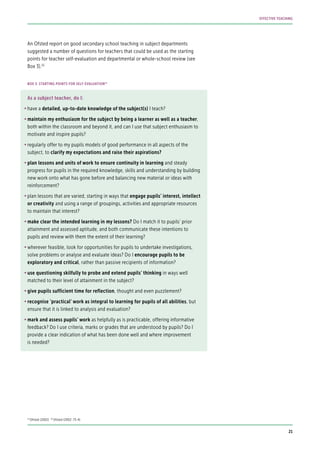
An Ofsted report on good secondary school teaching in subject departments
suggested a number of questions for teachers that could be used as the starting
points for teacher self-evaluation and departmental or whole-school review (see
Box 3).32
As a subject teacher, do I:
•	have a detailed, up-to-date knowledge of the subject(s) I teach?
•	maintain my enthusiasm for the subject by being a learner as well as a teacher,
both within the classroom and beyond it, and can I use that subject enthusiasm to
motivate and inspire pupils?
•	regularly offer to my pupils models of good performance in all aspects of the
subject, to clarify my expectations and raise their aspirations?
•	plan lessons and units of work to ensure continuity in learning and steady
progress for pupils in the required knowledge, skills and understanding by building
new work onto what has gone before and balancing new material or ideas with
reinforcement?
•	plan lessons that are varied, starting in ways that engage pupils’ interest, intellect
or creativity and using a range of groupings, activities and appropriate resources
to maintain that interest?
•	make clear the intended learning in my lessons? Do I match it to pupils’ prior
attainment and assessed aptitude, and both communicate these intentions to
pupils and review with them the extent of their learning?
•	wherever feasible, look for opportunities for pupils to undertake investigations,
solve problems or analyse and evaluate ideas? Do I encourage pupils to be
exploratory and critical, rather than passive recipients of information?
•	use questioning skilfully to probe and extend pupils’ thinking in ways well
matched to their level of attainment in the subject?
•	give pupils sufficient time for reflection, thought and even puzzlement?
•	recognise ‘practical’ work as integral to learning for pupils of all abilities, but
ensure that it is linked to analysis and evaluation?
•	mark and assess pupils’ work as helpfully as is practicable, offering informative
feedback? Do I use criteria, marks or grades that are understood by pupils? Do I
provide a clear indication of what has been done well and where improvement
is needed?
BOX 3: STARTING POINTS FOR SELF-EVALUATION33
32
Ofsted (2002) 33
Ofsted (2002: 73-4)
21
EFFECTIVE TEACHING
Increasing emphasis has been given to encouraging school self-evaluation and
review in recent inspection publications in England. Although inspection can
provide an authoritative source of evidence on good practice, there have been
many criticisms of the high-stakes accountability system used in England, and
arguments that this tends to reduce teachers’ freedom to be creative and so may
damage their professional autonomy. Inspection is also claimed to have added to
teachers’ and schools’ workload, increased stress on teachers and decreased job
satisfaction. Having said this, there is much evidence that inspection has helped to
raise educational standards in combination with other education reforms.34
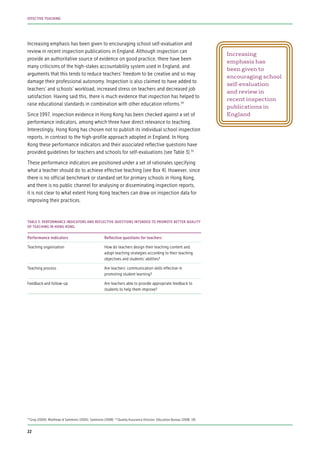
Since 1997, inspection evidence in Hong Kong has been checked against a set of
performance indicators, among which three have direct relevance to teaching.
Interestingly, Hong Kong has chosen not to publish its individual school inspection
reports, in contrast to the high-profile approach adopted in England. In Hong
Kong these performance indicators and their associated reflective questions have
provided guidelines for teachers and schools for self-evaluations (see Table 3).35
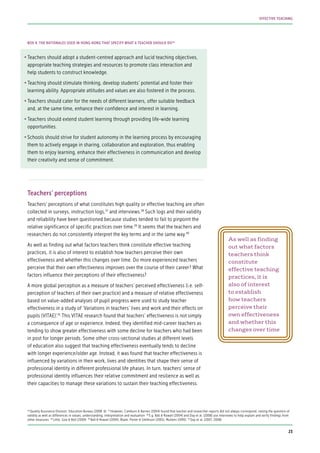
These performance indicators are positioned under a set of rationales specifying
what a teacher should do to achieve effective teaching (see Box 4). However, since
there is no official benchmark or standard set for primary schools in Hong Kong,
and there is no public channel for analysing or disseminating inspection reports,
it is not clear to what extent Hong Kong teachers can draw on inspection data for
improving their practices.
Performance indicators Reflective questions for teachers
Teaching organisation How do teachers design their teaching content and
adopt teaching strategies according to their teaching
objectives and students’ abilities?
Teaching process Are teachers’ communication skills effective in
promoting student learning?
Feedback and follow-up Are teachers able to provide appropriate feedback to
students to help them improve?
TABLE 3: PERFORMANCE INDICATORS AND REFLECTIVE QUESTIONS INTENDED TO PROMOTE BETTER QUALITY
OF TEACHING IN HONG KONG
34
Gray (2000); Matthews & Sammons (2005); Sammons (2008) 35
Quality Assurance Division, Education Bureau (2008: 19)
Increasing
emphasis has
been given to
encouraging school
self-evaluation
and review in
recent inspection
publications in
England
22
EFFECTIVE TEACHING
•	Teachers should adopt a student-centred approach and lucid teaching objectives,
appropriate teaching strategies and resources to promote class interaction and
help students to construct knowledge.
•	Teaching should stimulate thinking, develop students’ potential and foster their
learning ability. Appropriate attitudes and values are also fostered in the process.
•	Teachers should cater for the needs of different learners, offer suitable feedback
and, at the same time, enhance their confidence and interest in learning.
•	Teachers should extend student learning through providing life-wide learning
opportunities.
•	Schools should strive for student autonomy in the learning process by encouraging
them to actively engage in sharing, collaboration and exploration, thus enabling
them to enjoy learning, enhance their effectiveness in communication and develop
their creativity and sense of commitment.
Teachers’ perceptions
Teachers’ perceptions of what constitutes high quality or effective teaching are often
collected in surveys, instruction logs,37
and interviews.38
Such logs and their validity
and reliability have been questioned because studies tended to fail to pinpoint the
relative significance of specific practices over time.39
It seems that the teachers and
researchers do not consistently interpret the key terms and in the same way.40
As well as finding out what factors teachers think constitute effective teaching
practices, it is also of interest to establish how teachers perceive their own
effectiveness and whether this changes over time. Do more experienced teachers
perceive that their own effectiveness improves over the course of their career? What
factors influence their perceptions of their effectiveness?
A more global perception as a measure of teachers’ perceived effectiveness (i.e. self-
perception of teachers of their own practice) and a measure of relative effectiveness
based on value-added analyses of pupil progress were used to study teacher
effectiveness in a study of ‘Variations in teachers’ lives and work and their effects on
pupils (VITAE)’.41
This VITAE research found that teachers’ effectiveness is not simply
a consequence of age or experience. Indeed, they identified mid-career teachers as
tending to show greater effectiveness with some decline for teachers who had been
in post for longer periods. Some other cross-sectional studies at different levels
of education also suggest that teaching effectiveness eventually tends to decline
with longer experience/older age. Instead, it was found that teacher effectiveness is
influenced by variations in their work, lives and identities that shape their sense of
professional identity in different professional life phases. In turn, teachers’ sense of
professional identity influences their relative commitment and resilience as well as
their capacities to manage these variations to sustain their teaching effectiveness.
BOX 4: THE RATIONALES USED IN HONG KONG THAT SPECIFY WHAT A TEACHER SHOULD DO36
36
Quality Assurance Division, Education Bureau (2008: 6) 37
However, Camburn & Barnes (2004) found that teacher and researcher reports did not always correspond, raising the question of
validity as well as differences in values, understanding, interpretation and evaluation 38
E.g. Ball & Rowan (2004) and Day et al. (2008) use interviews to help explain and verify findings from
other measures 39
Little, Goe & Bell (2009) 40
Ball & Rowan (2004), Blank, Porter & Smithson (2001), Mullens (1995) 41
Day et al. (2007, 2008)
As well as finding
out what factors
teachers think
constitute
effective teaching
practices, it is
also of interest
to establish
how teachers
perceive their
own effectiveness
and whether this
changes over time
23
EFFECTIVE TEACHING
These findings are important in two ways. First, they suggest that studies that simply
control for age and teaching experience would miss important roles of personal,
situated and contextual factors that help to shape teachers’ professional identities
and their capacities to manage variations and sustain their effectiveness over the
course of their teaching careers. Second, the results suggest that we should not view
teacher effectiveness as an isolated characteristic of the teacher, but a consequence
of many interacting factors. This research suggests that a teacher may be more or by
contrast less effective in different circumstances and at different times, and thus there
is a need to examine the factors that affect teachers’ observed teaching behaviours,
their overall teaching effectiveness, and their variation and stability over time.42
Of
particular interest is research that helps us to understand what factors help teachers
to change and improve their classroom practice in line with behaviours and processes
that the literature has shown tend to characterise effective teaching. The VITAE
research suggests that school leadership, professional development and support from
colleagues can be important in sustaining teachers’ professional identities, their job
satisfaction, commitment to teaching, resilience and perceived effectiveness.
The literature discussed so far largely reflects Western perspectives of what
constitutes teacher effectiveness. It is appropriate to address non-Western cultural
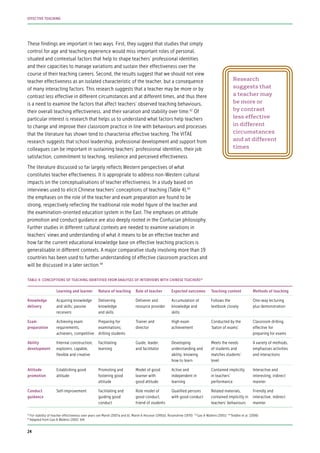
impacts on the conceptualisations of teacher effectiveness. In a study based on
interviews used to elicit Chinese teachers’ conceptions of teaching (Table 4),43
the emphases on the role of the teacher and exam preparation are found to be
strong, respectively reflecting the traditional role model figure of the teacher and
the examination-oriented education system in the East. The emphases on attitude
promotion and conduct guidance are also deeply rooted in the Confucian philosophy.
Further studies in different cultural contexts are needed to examine variations in
teachers’ views and understanding of what it means to be an effective teacher and
how far the current educational knowledge base on effective teaching practices is
generalisable in different contexts. A major comparative study involving more than 19
countries has been used to further understanding of effective classroom practices and
will be discussed in a later section.44
Learning and learner Nature of teaching Role of teacher Expected outcomes Teaching content Methods of teaching
Knowledge
delivery
Acquiring knowledge
and skills; passive
receivers
Delivering
knowledge
and skills
Deliverer and
resource provider
Accumulation of
knowledge and
skills
Follows the
textbook closely
One-way lecturing
plus demonstration
Exam
preparation
Achieving exam
requirements,
achievers, competitive
Preparing for
examinations;
drilling students
Trainer and
director
High exam
achievement
Conducted by the
‘baton of exams’
Classroom drilling,
effective for
preparing for exams
Ability
development
Internal construction;
explorers, capable,
flexible and creative
Facilitating
learning
Guide, leader,
and facilitator
Developing
understanding and
ability, knowing
how to learn
Meets the needs
of students and
matches students’
level
A variety of methods,
emphasises activities
and interactions
Attitude
promotion
Establishing good
attitude
Promoting and
fostering good
attitude
Model of good
learner with
good attitude
Active and
independent in
learning
Contained implicitly
in teachers’
performance
Interactive and
interesting; indirect
manner
Conduct
guidance
Self-improvement Facilitating and
guiding good
conduct
Role model of
good conduct,
friend of students
Qualified persons
with good conduct
Related materials,
contained implicitly in
teachers’ behaviours
Friendly and
interactive; indirect
manner
TABLE 4: CONCEPTIONS OF TEACHING IDENTIFIED FROM ANALYSES OF INTERVIEWS WITH CHINESE TEACHERS45
42
For stability of teacher effectiveness over years see Marsh (2007a and b); Marsh & Hocevar (1991b); Rosenshine (1970) 43
Gao & Watkins (2001) 44
Teddlie et al. (2006)
45
Adapted from Gao & Watkins (2002: 64)
Research
suggests that
a teacher may
be more or
by contrast
less effective
in different
circumstances
and at different
times
24
EFFECTIVE TEACHING
Students’ perceptions
Although students are the major stakeholders, some authors have expressed
scepticism about the appropriateness of using student ratings as a source of
evidence about teachers’ classroom practice. Such authors stress students’
general lack of knowledge about the full context of teaching and raise concerns
that students’ ratings of individuals may be unduly affected by students’ views
of teachers’ personalities or by students’ own grades. However, the validity and
reliability of using students’ course evaluations to understand teacher effectiveness
has been established in a number of studies in various countries,46
based on
various measures.47
For example, in Students’ Evaluation of Education Quality
(SEEQ), there are items measuring the instructor’s enthusiasm (Instructor was
enthusiastic about teaching the course), organisation (Course materials were well
prepared and carefully explained), group interaction (Students were encouraged to
participate in class discussions), or individual rapports (Instructor had a genuine
interest in individual students). These items closely match items found in other
measures used to study different dimensions of teaching in research mentioned
in the Measurement challenge section. However, it is uncommon for surveys
of students’ views to focus only on instruction in the classroom, they may also
include what the teacher/instructor does outside the classroom or after the
lectures (e.g. items such as: Feedback on examinations/graded materials was
valuable; or: Required readings/texts were valuable).48
Key question:
How can the students’ perspectives on effective teaching be incorporated into the
work of schools and teachers in your educational context?
Research has indicated those students’ evaluations of university teachers can
identify clear dimensions related to effectiveness of teaching49
and stability over
years,50
and were more reliable than ratings given by principals and teachers
themselves.51
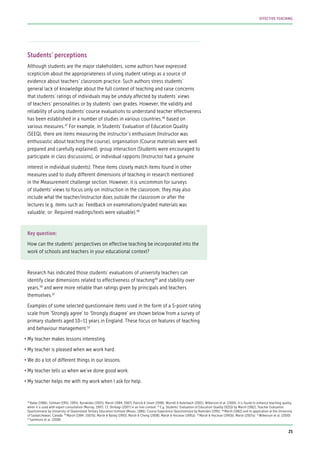
Examples of some selected questionnaire items used in the form of a 5-point rating
scale from ‘Strongly agree’ to ‘Strongly disagree’ are shown below from a survey of
primary students aged 10–11 years in England. These focus on features of teaching
and behaviour management.52
•	My teacher makes lessons interesting.
•	My teacher is pleased when we work hard.
•	We do a lot of different things in our lessons.
•	My teacher tells us when we’ve done good work.
•	My teacher helps me with my work when I ask for help.
46
Baker (1986); Follman (1992, 1995); Kyriakides (2005); Marsh (1984, 1987); Patrick & Smart (1998); Worrell & Kuterbach (2001); Wilkerson et al. (2000). It is found to enhance teaching quality
when it is used with expert consultation (Murray, 1997). Cf. Shirbagi (2007) in an Iran context 47
E.g. Students’ Evaluation of Education Quality (SEEQ) by Marsh (1982); Teacher Evaluation
Questionnaire by University of Queensland Tertiary Education Institute (Moses, 1986); Course Experience Questionnaire by Ramsden (1991) 48
Marsh (1982) and its application at the University
of Saskatchewan, Canada 49
Marsh (1984, 2007b); Marsh & Bailey (1993); Marsh & Cheng (2008); Marsh & Hocevar (1991a) 50
Marsh & Hocevar (1991b); Marsh (2007a) 51
Wilkerson et al. (2000)
52
Sammons et al. (2008)
25
EFFECTIVE TEACHING
•	I often find the work too easy in class.
•	My teacher gets the class to behave well.
•	My teacher is always there at the start of lessons.
•	My teacher is not pleased if pupils are late for lessons or school.
•	My teacher tells us off when we make mistakes with our work.
Other ways of listening to the student ‘voice’ and encouraging active engagement
of students in the educational process are becoming popular in various education
systems including small-group interviews with students, students engaging in their
own action research in schools, students giving teachers feedback on their lessons
and student involvement in teacher selection interviews.
Principals’ perceptions
In some countries one of the duties of the principal is to monitor the quality of
teaching and learning in their schools and this can involve conducting classroom
observations – either themselves or via heads of department or others in the
senior leadership team. However, it can be argued that principals’ ratings of
teacher behaviours may be biased because they are especially susceptible to
differences in the power relations between teachers and principals. Studies in the
US found significant district variations.53
Mixed results were obtained in studies
linking subjective principal ratings of teachers and value-added scores of student
achievement.54
For teacher evaluation purposes, a peer teacher or content expert
like the subject department head or a Local Authority adviser or inspector may be
in a better position than the principal to make informed judgements,55
indicating
that expert knowledge of the person rating may be crucial. In the section on
Observation later in the review (see ‘The Measurement challenge’), more details
are given on the use of different instruments and how teacher observation may be
used to enhance classroom practice.
53
Brandt et al. (2007); Heneman et al. (2006) 54
Harris & Sass (2009); Jacob & Lefgren (2005, 2008); Medley & Coker (1987); Wilkerson et al. (2000) 55
Stodolsky (1990); Yon, Burnap & Kohut (2002)
In some countries
one of the duties
of the principal
is to monitor the
quality of teaching
and learning in
their schools and
this can involve
conducting
classroom
observations
26
EFFECTIVE TEACHING
27
EFFECTIVE TEACHING
The Characterisation
challenge
The ultimate aim of characterising effective teaching practices involves identifying the
generic features and dimensions of effective teaching, measuring the relative impacts of
teacher effects on students’ learning outcomes, and establishing the relative influence of
contextual conditions that may influence teacher effectiveness. The first task begins with
summarising results of research that sought to provide profiles of effective teachers and
effective teaching.
General profiles of effective teachers and effective teaching
A large number of reviews have synthesised research findings on effective teacher
behaviours.56
These reviews indicate some consensus in TER about broad features of what
an effective teacher would look like. Effective teachers have been found to be ‘semi-
autonomous professionals’ who are thoughtful and reflective about their practice (see Box 5).
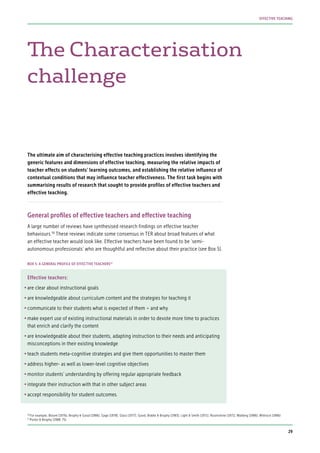
Effective teachers:
•	are clear about instructional goals
•	are knowledgeable about curriculum content and the strategies for teaching it
•	communicate to their students what is expected of them – and why
•	make expert use of existing instructional materials in order to devote more time to practices
that enrich and clarify the content
•	are knowledgeable about their students, adapting instruction to their needs and anticipating
misconceptions in their existing knowledge
•	teach students meta-cognitive strategies and give them opportunities to master them
•	address higher- as well as lower-level cognitive objectives
•	monitor students’ understanding by offering regular appropriate feedback
•	integrate their instruction with that in other subject areas
•	accept responsibility for student outcomes.
BOX 5: A GENERAL PROFILE OF EFFECTIVE TEACHERS57
56
For example, Bloom (1976); Brophy & Good (1986); Gage (1978); Glass (1977); Good, Biddle & Brophy (1983); Light & Smith (1971); Rosenshine (1971); Walberg (1986); Wittrock (1986)
57
Porter & Brophy (1988: 75)
29
EFFECTIVE TEACHING
•	Inconsistent approaches to the curriculum and teaching
•	Inconsistent expectations for different learners that are lower for disadvantaged
students from low SES families
•	An emphasis on supervising and communicating about routines
•	Low levels of teacher-student interactions
•	Low levels of student involvement in their work
•	Student perceptions of their teachers as not caring, unhelpful, under-appreciative
of the importance of learning and their work
•	More frequent use of negative criticism and feedback.
In contrast, ineffective classroom practices show different characteristics, outlined
in Box 6.
A comparison of teaching characteristics in effective primary schools in England59
and secondary schools in the US60
in Table 5 reveals some similarities of these
teaching behaviours and the possibility of categorising them. The fine-grained
behaviours of effective teachers in most reviews of teacher profiles seem to
be widely applicable, as they are evident in research conducted in a number of
different countries.61
BOX 6: CHARACTERISTICS OF INEFFECTIVE CLASSROOM PRACTICE58
Aspect Effective teaching in primary Effective teaching in secondary
Structuring Teacher is responsible for ordering activities during the
day for pupils, i.e. structured teaching
Emphasises academic goals; makes [goals] explicit and expect
pupils to be able to master the curriculum; carefully organises
and sequences the curriculum
Delivery Spends greater amount of time communicating with
pupils about the content of their work, but not routine
matters
Clearly explains and illustrates what pupils are to learn
Management Keeps a lower level of noise and movement in pupils
Interaction Maintains high levels of interaction
with the whole class
Focus Keeps a fairly narrow focus within individual sessions Corrects mistakes and allow pupils to use a skill until it is
over-learned and automatic; gives pupils ample opportunity
to practise
Student
involvement
Maintains high levels of pupil involvement in tasks
appropriate for their levels of ability
Lets pupils have some responsibility for their work and
independence in these sessions
Reviews work regularly and holds pupils accountable for
their work
Emotive and cognitive
feedback
Has high levels of praise and encouragement Gives prompts and feedback to ensure success
Keeps a positive atmosphere in the classroom
TABLE 5: COMPARING AND CLASSIFYING THE TEACHING CHARACTERISTICS OF EFFECTIVE TEACHERS
58
Stoll & Fink (1994) 59
Mortimore et al. (1988: 227-31) 60
Doyle (1987: 95) 61
See Creemers et al. (2002)
30
EFFECTIVE TEACHING
Studies also
show that socio-
economically
disadvantaged
students benefited
more when
the teaching
is structured
and promotes
cognitive
attainment in the
basic skills
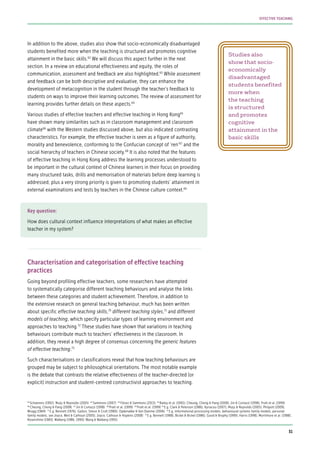
In addition to the above, studies also show that socio-economically disadvantaged
students benefited more when the teaching is structured and promotes cognitive
attainment in the basic skills.62
We will discuss this aspect further in the next
section. In a review on educational effectiveness and equity, the roles of
communication, assessment and feedback are also highlighted.63
While assessment
and feedback can be both descriptive and evaluative, they can enhance the
development of metacognition in the student through the teacher’s feedback to
students on ways to improve their learning outcomes. The review of assessment for
learning provides further details on these aspects.64
Various studies of effective teachers and effective teaching in Hong Kong65
have shown many similarities such as in classroom management and classroom
climate66
with the Western studies discussed above, but also indicated contrasting
characteristics. For example, the effective teacher is seen as a figure of authority,
morality and benevolence, conforming to the Confucian concept of ‘ren’67
and the
social hierarchy of teachers in Chinese society.68
It is also noted that the features
of effective teaching in Hong Kong address the learning processes understood to
be important in the cultural context of Chinese learners in their focus on providing
many structured tasks, drills and memorisation of materials before deep learning is
addressed; plus a very strong priority is given to promoting students’ attainment in
external examinations and tests by teachers in the Chinese culture context.69
Key question:
How does cultural context influence interpretations of what makes an effective
teacher in my system?
Characterisation and categorisation of effective teaching
practices
Going beyond profiling effective teachers, some researchers have attempted
to systematically categorise different teaching behaviours and analyse the links
between these categories and student achievement. Therefore, in addition to
the extensive research on general teaching behaviour, much has been written
about specific effective teaching skills,70
different teaching styles,71
and different
models of teaching, which specify particular types of learning environment and
approaches to teaching.72
These studies have shown that variations in teaching
behaviours contribute much to teachers’ effectiveness in the classroom. In
addition, they reveal a high degree of consensus concerning the generic features
of effective teaching.73
Such characterisations or classifications reveal that how teaching behaviours are
grouped may be subject to philosophical orientations. The most notable example
is the debate that contrasts the relative effectiveness of the teacher-directed (or
explicit) instruction and student-centred constructivist approaches to teaching.
62
Scheerens (1992); Muijs & Reynolds (2005) 63
Sammons (2007) 64
Flórez & Sammons (2013) 65
Bailey et al. (1992); Cheung, Cheng & Pang (2008); Jin & Cortazzi (1998); Pratt et al. (1999)
66
Cheung, Cheng & Pang (2008) 67
Jin & Cortazzi (1998) 68
Pratt et al. (1999) 69
Pratt et al. (1999) 70
E.g. Clark & Peterson (1986); Kyriacou (2007); Muijs & Reynolds (2005); Philpott (2009),
Wragg (1984) 71
E.g. Bennett (1976); Galton, Simon & Croll (1980); Opdenakke & Van Damme (2006) 72
E.g. informational processing models, behavioural systems family models, personal
family models; see Joyce, Weil & Calhoun (2005); Joyce, Calhoun & Hopkins (2008) 73
E.g. Bennett (1988), Bickel & Bickel (1986); Good & Brophy (1999); Harris (1998); Mortimore et al. (1988);
Rosenshine (1983); Walberg (1986, 1990); Wang & Walberg (1991)
31
EFFECTIVE TEACHING
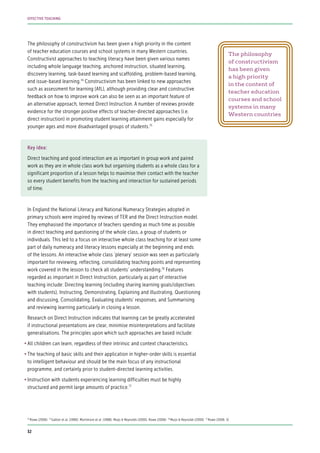
The philosophy of constructivism has been given a high priority in the content
of teacher education courses and school systems in many Western countries.
Constructivist approaches to teaching literacy have been given various names
including whole language teaching, anchored instruction, situated learning,
discovery learning, task-based learning and scaffolding, problem-based learning,
and issue-based learning.74
Constructivism has been linked to new approaches
such as assessment for learning (AfL), although providing clear and constructive
feedback on how to improve work can also be seen as an important feature of
an alternative approach, termed Direct Instruction. A number of reviews provide
evidence for the stronger positive effects of teacher-directed approaches (i.e.
direct instruction) in promoting student learning attainment gains especially for
younger ages and more disadvantaged groups of students.75
Key idea:
Direct teaching and good interaction are as important in group work and paired
work as they are in whole class work but organising students as a whole class for a
significant proportion of a lesson helps to maximise their contact with the teacher
so every student benefits from the teaching and interaction for sustained periods
of time.
In England the National Literacy and National Numeracy Strategies adopted in
primary schools were inspired by reviews of TER and the Direct Instruction model.
They emphasised the importance of teachers spending as much time as possible
in direct teaching and questioning of the whole class, a group of students or
individuals. This led to a focus on interactive whole class teaching for at least some
part of daily numeracy and literacy lessons especially at the beginning and ends
of the lessons. An interactive whole class ‘plenary’ session was seen as particularly
important for reviewing, reflecting, consolidating teaching points and representing
work covered in the lesson to check all students’ understanding.76
Features
regarded as important in Direct Instruction, particularly as part of interactive
teaching include: Directing learning (including sharing learning goals/objectives
with students), Instructing, Demonstrating, Explaining and illustrating, Questioning
and discussing, Consolidating, Evaluating students’ responses, and Summarising
and reviewing learning particularly in closing a lesson.
Research on Direct Instruction indicates that learning can be greatly accelerated
if instructional presentations are clear, minimise misinterpretations and facilitate
generalisations. The principles upon which such approaches are based include:
•	All children can learn, regardless of their intrinsic and context characteristics.
•	The teaching of basic skills and their application in higher-order skills is essential
to intelligent behaviour and should be the main focus of any instructional
programme, and certainly prior to student-directed learning activities.
•	Instruction with students experiencing learning difficulties must be highly
structured and permit large amounts of practice.77
74
Rowe (2006) 75
Galton et al. (1980); Mortimore et al. (1988); Muijs & Reynolds (2000); Rowe (2006) 76
Muijs & Reynolds (2000) 77
Rowe (2006: 5)
The philosophy
of constructivism
has been given
a high priority
in the content of
teacher education
courses and school
systems in many
Western countries
32
EFFECTIVE TEACHING
Nonetheless, it is argued that the Constructivist and Direct Instruction approaches
can both be used and do not have to be seen as necessarily in conflict. Both can
have value depending on the purposes of the lesson and the characteristics and
prior skills of the learner. The choice and balance depends on the goals of the
teacher for a particular lesson and group of students:
The relative utility of direct instruction and constructivist approaches to
teaching and learning are neither mutually exclusive nor independent. Both
approaches have merit in their own right, provided that students have the
basic knowledge and skills (best provided initially by direct instruction) before
engagement in ‘rich’ constructivist learning activities. The problem arises when
constructivist learning activities precede explicit teaching, or replace it, with
the assumption that students have adequate knowledge and skills to efficiently
and effectively engage with constructivist learning activities designed to
generate new learning.78
Key questions:
•	How well do the features of Direct Instruction approaches and interactive whole
class teaching fit with current teacher practices in my system?
•	What is the appropriate balance between Constructivist and Direct Instruction /
interactive whole class teaching?
•	What are the advantages and disadvantages of both approaches?
The primacy of teacher effects and the relative effectiveness
of teacher variables
As early traditional TER predominantly focused on teacher effects on student
learning outcomes, other contextual variables in the school, the community, and
education system tended to be ignored.79
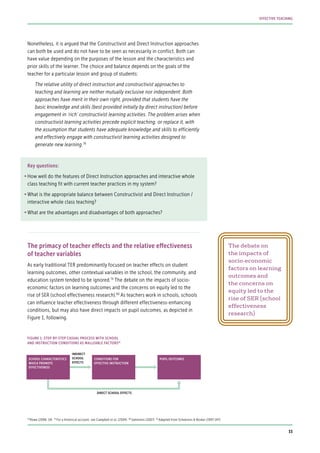
The debate on the impacts of socio-
economic factors on learning outcomes and the concerns on equity led to the
rise of SER (school effectiveness research).80
As teachers work in schools, schools
can influence teacher effectiveness through different effectiveness-enhancing
conditions, but may also have direct impacts on pupil outcomes, as depicted in
Figure 1, following.
78
Rowe (2006: 14) 79
For a historical account, see Campbell et al. (2004) 80
Sammons (2007) 81
Adapted from Scheerens & Bosker (1997:147)
The debate on
the impacts of
socio-economic
factors on learning
outcomes and
the concerns on
equity led to the
rise of SER (school
effectiveness
research)
SCHOOL CHARACTERISTICS
WHICH PROMOTE
EFFECTIVENESS
CONDITIONS FOR
EFFECTIVE INSTRUCTION
INDIRECT
SCHOOL
EFFECTS
DIRECT SCHOOL EFFECTS
PUPIL OUTCOMES
FIGURE 1: STEP-BY-STEP CASUAL PROCESS WITH SCHOOL
AND INSTRUCTION CONDITIONS AS MALLEABLE FACTORS81
33
EFFECTIVE TEACHING
Various school-level factors have been identified in several post-1990 reviews.82
However, although many researchers found that the profiles of effective schools
also shown that characteristics of effective classroom processes contributed to
fostering pupils’ learning and progress, much of the research evidence to date
on educational effectiveness suggests that: while schools can make a difference
to student achievement, the most substantial portion of that difference may be
attributed to teachers.83
Box 7 shows the statement of a review on the relative significance of teacher and
school effects, which confirms the primacy of teacher effect, how teacher effects
can accumulate over several school years and how students of the most effective
teachers benefited.
Of all the contextual variables that have been studied to date (indicators of socio-
economic status, class size, student variability within classrooms, etc.), the single
largest factor affecting academic growth of populations of students is differences
in the effectiveness of individual classroom teachers. Also, the effects of teachers
appeared to be cumulative. At the extreme, a high-high-high sequence [of 3-year
teacher effects of 5th grade pupils] resulted in more than a 50 percentile point
higher score in 5th-grade maths achievement than the low-low-low sequence...
As the level of teacher effectiveness increased, students of lower achievement
were the first to benefit, and only teachers of the highest effectiveness generally
were effective with all students.
Similarly, another review of the educational effectiveness evidence in the US85
concluded that as the major determinant of differences in student learning,
differential teacher effectiveness outweighs the effects of differences in class size
and class heterogeneity. Efforts to assess teacher effectiveness in the US have
sought to use value-added models based on student test scores. However, there
are many concerns about using value-added methods to judge individual teacher
performance for accountability purposes because fine (rank order) distinctions are
not statistically valid.86
The relatively stronger impacts of teacher and classroom factors than of school
factors on student achievements are also evident in meta-analyses. A meta-analysis
synthesising over 800 studies relating to the influences on achievement in school-
aged students87
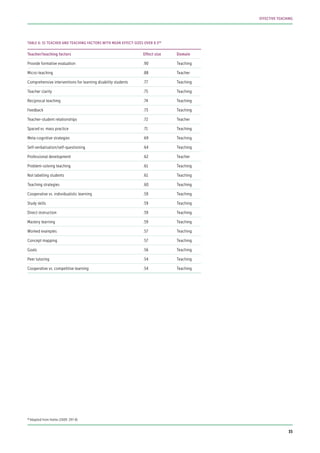
shows that in the top thirty most influential variables out of a
rank of 138 variables affecting student achievement, nineteen variables related to
teachers or teaching with an effect size above 0.5 (see Table 6).
BOX 7: RELATIVE SIGNIFICANCE OF TEACHER AND SCHOOL EFFECTS AND THE CUMULATIVE EFFECTS84
82
Cotton (1995); Levine & Lezotte (1990); Marzano (2003); Sammons, Hillman & Mortimore (1995); Scheerens & Bosker (1997) 83
E.g. Creemers (1994); Creemers & Kyriakides (2008); Hill &
Rowe (1996, 1998); Konstantopoulos (2007); Kyriakides & Creemers (2008a, 2008b); Nye, Konstantopoulos & Hedges (2004); Muñoz & Chang (2007); Sammons et al. (1997); Sanders (1998,
2000); Scheerens et al. (1989); Tymms (1993) 84
Sanders (1998: 27). It should be noted that a similar cumulative school effect was also found in English primary schools (Mortimore et al.,
1988) 85
Darling-Hammond (2000) 86
McCaffrey et al. (2004); Darling-Hammond et al. (2010) 87
Hattie (2009)
Efforts to
assess teacher
effectiveness
in the US have
sought to use
value-added
models based
on student test
scores
34
EFFECTIVE TEACHING
Teacher/teaching factors Effect size Domain
Provide formative evaluation .90 Teaching
Micro-teaching .88 Teacher
Comprehensive interventions for learning disability students .77 Teaching
Teacher clarity .75 Teaching
Reciprocal teaching .74 Teaching
Feedback .73 Teaching
Teacher-student relationships .72 Teacher
Spaced vs. mass practice .71 Teaching
Meta-cognitive strategies .69 Teaching
Self-verbalisation/self-questioning .64 Teaching
Professional development .62 Teacher
Problem-solving teaching .61 Teaching
Not labelling students .61 Teaching
Teaching strategies .60 Teaching
Cooperative vs. individualistic learning .59 Teaching
Study skills .59 Teaching
Direct instruction .59 Teaching
Mastery learning .59 Teaching
Worked examples .57 Teaching
Concept mapping .57 Teaching
Goals .56 Teaching
Peer tutoring .54 Teaching
Cooperative vs. competitive learning .54 Teaching
TABLE 6: 31 TEACHER AND TEACHING FACTORS WITH MEAN EFFECT-SIZES OVER 0.588
88
Adapted from Hattie (2009: 297-8)
35
EFFECTIVE TEACHING
Differential departmental and school impacts on teacher effects
As the immediate working contexts of teachers, departments may contribute more
and directly to differential teacher effectiveness than schools.89
Schools generally
vary in teaching effectiveness for different subjects. The subject inconsistency
in results within, as well as between, schools seems to be larger in secondary
schools than primary schools.90
Eight school processes were identified that explain
differences in the effectiveness levels of schools and departments (see Box 8).
•	Productive climate and culture
•	Focus on central learning skills
•	Appropriate monitoring
•	Practice-oriented staff development
Regarding the relative significance between the department effect and school
effect, results suggest a strong impact of departments but more variation from year
to year. Typically most schools were found to contain both effective and ineffective
departments, emphasising the importance of studying within-school variation and
reducing this to promote overall school improvement.92
Key factors cited by heads
of department in judging departmental effectiveness include:
•	Quality of the teaching in the department
•	Extent to which departmental staff work together as a team
•	Commitment/enthusiasm of teaching staff
•	High staff expectations of students
•	Prior attainment of students (at intake to school)
•	The extent to which independent student learning is fostered
•	Examination results.93
The first three factors highlighted the significance of consistency and quality of
teaching in the department. Similarly, in reviewing the relative school and teacher
effects in the literature, consistency in teacher effectiveness in the department
is stressed.
BOX 8: SCHOOL PROCESSES IDENTIFIED TO EXPLAIN THE (IN)EFFECTIVENESS OF SCHOOLS AND DEPARTMENTS91
•	Professional leadership
•	Parental involvement
•	Effective instructional arrangements
•	High expectations
89
E.g. Ainley (1994), Harris, Jamieson & Russ (1995); Luyten (1994); Sammons et al. (1997); Witziers (1994) 90
Scheerens & Bosker (1997); Sammons (1999) 91
Scheerens & Bosker (1997: 214)
92
FitzGibbon (1991), based on the multilevel results of the Scottish system 93
Sammons et al. (1997: 112)
The subject
inconsistency in
results within, as
well as between,
schools seems
to be larger in
secondary schools
than primary
schools
36
EFFECTIVE TEACHING
Key idea:
These findings strongly imply that a good education for all students will be best
attained by close monitoring of departments. What can be learned from the
most consistently effective departments and what actions are needed to improve
consistently underperforming departments?
However, the school effect should not be neglected – some secondary schools
provided a more supportive environment for departments to be effective whereas
in other schools it was ‘harder’ for departments to be effective due to lack of
overall leadership, shared goals and vision, poor expectations and inconsistent
approaches.94
In conclusion, research suggests a need to address teacher effectiveness within a
departmental context and to explore consistency in the quality of teaching in the
department across different years and grade levels.
94
Sammons et al. (1997: 145).
37
EFFECTIVE TEACHING
The Measurement
challenge
One lesson learned in the International School Effectiveness Research
Project (ISERP) was that there were few agreed international constructs
concerning teaching effectiveness.95
Different instruments may measure
different constructs and instruments can vary significantly in their external
validity, that is, their applicability in different educational and national
contexts. Accordingly, it was recognised that there was a pressing need
to develop a classroom observation instrument that would measure some
agreed teacher effectiveness constructs.96
While there are thousands of
classroom observation instruments,97
only few attempts in the literature have
used different instruments simultaneously and there is little recent research
on this topic.98
Thus, one of most neglected areas in classroom observation
research is using multiple instruments to examine the multidimensionality of
teaching practices.
Multidimensionality of teaching practices
Other than experimental studies, naturalistic classroom observation is the
major method of enquiry in TER and other different domains of educational
research. There are theoretical links between SER/TER and teacher evaluation
because classroom observations using variables from the TER literature may
inform teacher evaluation, staff development, teacher development, and
eventually teacher and school improvement.99
However, developing valid and
reliable instruments is not easy. For example, early research100
using classroom
observation evidence to characterise teacher styles proved problematic.101
The Mathematics Enhancement Classroom Observation Record (MECORS),102
a classroom observation instrument previously validated in the US,103
was used
in England and a seven-factor model of effective teaching behaviours was
identified.104
It was found that whole-class teaching creates the conditions
While there
are thousands
of classroom
observation
instruments,only
few attempts in
the literature have
used different
instruments
simultaneously
and there is little
recent research on
this topic
95
Reynolds (2006) 96
Darling-Hammond and colleagues (2010: 88) 97
The anthology of 92 classroom observation instruments with detailed accounts edited by Simon and Boyer (1967-1970)
runs up to 14 volumes. Another single volume sourcebook, Borich and Madden (1977), described only 10 instruments that specifically aim at obtaining information about the teacher from
an observer. A dated UK anthology by Galton (1978, 1979) consisted of 41 instruments – see Meehan et al. (2004) for details 98
E.g. Emmer & Peck (1973); Ober, Wood, & Cunningham (1970);
Wood, Brown, Ober & Soar (1969) 99
Teddlie et al. (2003) 100
E.g. Galton et al. (1980); Galton & Simon (1980); Galton (1995); Galton et al. (1999) 101
Mortimore et al. (1988) noted that variance
within styles was far greater than variance between styles 102
This is a modified version of the classroom observation schedule Special Strategies Observation System (SSOS) by Schaffer,
Nesselrodt and Stringfield (1991), as cited in Meehan et al. (2004) 103
Schaffer et al. (1998) as cited in Muijs & Reynolds (2000) 104
Muijs & Reynolds (2000).
39
EFFECTIVE TEACHING
for effective teaching to occur but did not directly affect pupil progress. The
researchers also concluded that effective teachers would tend be effective in most
or all aspects because they found strong correlations among different dimensions
of teaching observed.
Measuring with two instruments and other measures
Two instruments, the Instructional Environment Observation (IEO) Scale105
and the
Classroom Observation System for Fifth Grade (COS-5),106
were used in a recent
large-scale longitudinal study of the impact of pre-school and primary school on
children’s developmental outcomes in England.107
They were selected because
they were devised relatively recently for the primary age group, covering a wider
range of pupil and teacher behaviours and offering the opportunity to facilitate
comparison with research in other contexts.108
The underlying dimensions of
each instrument are presented respectively in Table 7 and Table 8. Although the
IEO covers subscales exploring some common aspects of teacher behaviours like
classroom climate or student engagement, it has a strong focus on pedagogical
practices associated with learning in Literacy and Mathematics. In contrast, the
COS-5 covers the frequency of both teachers’ and children’s classroom behaviours
in six categories of many twenty-minute blocks of observation cycle. This helps
to capture the correlations between teachers’ and children’s behaviours and
interactions better.
Literacy Numeracy
Pedagogy
• Classroom climate
• Classroom routines
• Social support for student learning
• Student engagement
• Instructional conversations
Pedagogy
• Classroom climate
• Classroom routines
• Social support for student learning
• Student engagement
Subject development
• Higher order thinking in writing
• Purposeful development of writing skills
Subject development
• Use of maths analysis
• Depth of knowledge and student understanding
• Basic skill development in the context of problem solving
• Maths discourse and communication
• Locus of maths authority
Learning linkages
• Cross-disciplinary connections
• Linkage to life beyond the classroom
Learning linkages
• Cross-disciplinary connections
• Linkage to life beyond the classroom
TABLE 7: UNDERLYING DIMENSIONS OF INSTRUCTIONAL ENVIRONMENT OBSERVATION SCALE
105
Stipek (1999). 106
NICHD (2001) 107
For details of the project and findings, see Sammons et al. (2006, 2007) 108
This contrasts with the previous research; see Galton et al. (1999)
40
EFFECTIVE TEACHING
Classroom codes measure Teachers’ Classroom Practice and Processes
Child codes measure Child’s classroom behaviours
Quality of pedagogy • Classroom codes – Richness of instructional method
• Classroom codes – Detachment/teacher
• Classroom codes – Positive classroom climate
• Classroom codes – Productive use of instructional time
• Classroom codes – Evaluative feedback
• Classroom codes – Teacher sensitivity
Disorganisation • Child code – Disruptive
• Classroom codes – Chaos
• Classroom codes – Negative classroom climate
Child positivity • Child code – Self-reliance
• Child code – Sociable/cooperative with peers
• Child code – Child-teacher relationship
Positive engagement • Child code – Positive affect
• Child code – Activity level
Attention and control • Child code – Attention
• Classroom codes – Over-control
TABLE 8: UNDERLYING DIMENSIONS OF CLASSROOM OBSERVATION SYSTEM FOR FIFTH GRADE (COS-5):
MEASURES OF OBSERVED QUALITY OF CLASSROOM PRACTICE
The first of the COS-5 factors to be extracted represents general classroom
processes and pedagogy and was termed ‘Quality of pedagogy’. This factor
is associated with six of the classroom quality measures (see Table 8). Child’s
‘Disruptive’ behaviour, ‘Chaos’ and ‘Negative classroom climate’ formed the
second factor. This dimension identifies the extent of classroom ‘Disorganisation’.
High scores are characterised by general chaotic and negative classroom climate
and pupils’ disruptive behaviour. This clustering indicates that disruptive behaviour
and negative or chaotic classroom atmosphere are likely to coincide; however,
whether a chaotic atmosphere in the classroom produces disruptive behaviour or
whether it is caused by it cannot be ascertained. It seems likely that the two tend to
reinforce each other. ‘Self-reliance’, ‘Sociable/cooperative with peers’ and ‘Child-
teacher relationship’ converged into the third dimension, suggesting in classes
where children are observed to be more self-reliant, they are also more likely to
demonstrate the social skills of cooperation. This dimension is referred to as ‘Child
positivity’. ‘Activity level’ and child ‘Positive affect’ formed a fourth factor termed
‘Positive engagement’ as this clustering indicates that in classes where children are
observed to be occupied they are also more likely to be rated as happy.
Finally, the fifth factor to be extracted brought together ‘Attention’ and ‘Over
control’ into a single dimension termed ‘Attention and control’. This is in many
respects different from the ‘Disorganisation’ dimension where ‘Chaos’ and
‘Disruptive behaviour’ are replaced by more teacher control and attentive
behaviour.
41
EFFECTIVE TEACHING
Box 9, following, summarises several key findings identified in the quantitative
analyses of the EPPE project. The qualitative field notes completed by classroom
observers (trained researchers) were recently analysed and used to complement
these findings (Table 9).
•	The observational research identified significant variation in both teachers’
classroom practice and pupils’ behaviour in class and distinguished between better
and poorer quality in the educational experiences of Year 5 pupils.
•	Levels of student engagement were found to be relatively high and classroom
climates were generally positive. Teacher detachment was generally low and there
was little pupil ‘off task’ behaviour observed.
•	Teachers varied in many aspects of their pedagogical practice and classroom
organisation (for example the teaching of analysis skills and the extent of emphasis
on basic skills) and several important features of observed practices (e.g. related to
classroom climate, smooth organisational routines etc.).
•	The quality of teaching and pupil response was found to be consistently higher in
classes where a plenary was used in both literacy and numeracy lessons and lowest
in classes where no plenary was used in either subject.
•	Overall teaching quality (defined by factors in the analysis) could be identified
and teachers identified as showing mainly high- rather than low-quality practices
predicted better student progress in both mathematics and reading.
A measure of overall Teaching quality derived from these dimensions was
constructed and teachers were grouped in terms of overall quality of practice. This
measure of overall Teaching quality was a statistically significant and moderately
strong predictor of better reading (ES=0.37) and mathematics progress for students
(ES=0.35).
In-depth qualitative analyses of field notes were used to distinguish the practice
of more effective teachers in observed classroom practice-based on the two
instruments described above.
BOX 9: KEY FINDINGS FROM SYSTEMATIC OBSERVATIONS IN YEAR 5 CLASSES IN THE EPPE RESEARCH109
109
Sammons et al. (2006)
42
EFFECTIVE TEACHING
Teaching aspects Sample descriptions of more effective classrooms
Organisation Effective: A well-oiled machine. Happy confident children move
easily from one activity to the next
Ineffective: Children take a long time to respond and are often late
arriving for sets. Teacher does not seem to mind this
Shared goals Effective: Teacher and children were absolutely clear about what
should be happening at all times combined with a commitment on
both parts to ensure that goals were achieved
Ineffective: Teachers were slow to check – and correct where
necessary – their pupils’ understanding of key concepts and ideas
Classroom climate Effective: Very positive feeling. A quiet buzz of work. All respect
each other
Behaviour management Effective: The whole class and all children are on task, but control is
established by involving children in their learning
Collaborative learning Effective: Worked closely with peers, discussing work and approach
to the problem
Personalised teaching and
learning
Effective: Children were involved in their learning and enjoying
the experience. Indicating teacher sensitivity and understanding of
children’s needs
Making links explicit Effective: A practical science session investigating sweeteners…
totally absorbed all children
Dialogic teaching and learning Effective: The teacher discusses choice books in a friendly manner
– respects the child’s opinion re: their choice
Assessment for learning Effective: Feedback at the individual level and also at class level;
there was depth
Plenary Effective: The plenary allowed children to consolidate their
understanding of poetry techniques, to work collaboratively by
helping each other to improve
and by contributing their own work and to extend their knowledge
and skills
Homework Ineffective: Homework was rarely mentioned in any of the
observations of the other schools with low academic effectiveness
TABLE 9: A SUMMARY OF SAMPLE DESCRIPTIONS OF MORE EFFECTIVE PRACTICE FROM QUALITATIVE
ANALYSES OF OBSERVATION FIELD NOTES IN THE EPPE RESEARCH110
110
Siraj-Blatchford (2010)
43
EFFECTIVE TEACHING
The Theorisation
challenge
Developing valid instrument(s) to characterise generic
teacher effectiveness in different countries
To date, the most extensive results on differential teacher and school effects
in different countries using the same instruments were from the report of
the ISERP project.111
Teacher effectiveness of this project was measured with
the Virgilio Teacher Behaviour Inventory (VTBI)112
and QAIT.113
The findings of
this study were enriched by its employment of multiple measures and both
quantitative and qualitative measures to triangulate findings. Classroom
management, classroom climate and teaching/instruction were the three
factors that had statistically significant positive impacts on student academic
outcomes in the US, the UK, and Norway. However, this research pointed to
the need to develop an International Instrument for Teacher Observation and
Feedback (ISTOF). The ISTOF project was intended to create an observation
instrument to study the generic characteristics of teacher effectiveness in
lessons with a broad external validity for a variety of country and cultural
settings. The scale was produced as part of a collaborative, cross-national
research initiative involving 21 countries. It involved researchers, practitioners
and education advisers/ inspectors, whose expert opinions about what
constitutes effective teaching were used to supplement TER evidence to
generate the various components in the observation instrument.
The original scale comprises 45 items and seven theoretical components.114
These
45 items were descriptive statements specifying a particular teacher behaviour (e.g.
Item 1: The teacher makes explicitly clear why an answer is correct or not). Of the
45 items, two to four items were grouped to represent an indicator that describes
a certain dimension of teaching behaviours. As a result, there were 21 indicators
(e.g. Indicator 1.1: The teacher gives explicit, detailed and constructive feedback),
two to four of which were further grouped under one of the seven theoretical
components (e.g. Component 1: Assessment and Evaluation). Although counting
the occurrence of the specific teaching behaviours is not required, the rating is
expected to be based on the observed relative frequency of the behaviours without
passing judgements on whether the observed behaviour was ‘good’ or ‘poor’.
Classroom
management,
classroom climate
and teaching/
instruction
were the three
factors that had
statistically
significant
positive impacts
on student
academic
outcomes in the
US, the UK, and
Norway
111
Reynolds et al. (2002) 112
Teddlie, Virgilio & Oescher (1990); Virgilio, Teddlie & Oescher (1991) 113
The acronym stands for the different subscales: Quality of instruction, Appropriate level of
interaction, Incentive, and Time. This is an updated version of Special Strategies Observation Systems (SSOS), Schaffer, Nesselrodt & Stringfield (1994); for details see Meehan et al. (2004)
114
This is different from the version reported in Teddlie et al. (2006), which only had 43 items
45
EFFECTIVE TEACHING
The Lesson Observation Form for Evaluating the Quality of Teaching (QoT) is another
classroom observation protocol developed to be tested internationally.115
This was a
product of the collaboration between the English and the Dutch Inspectorates. Thus,
the framework was expected to conform to an inspection model of what constituted
effective teaching or good practice based on professional judgements. It consists of
evaluative categories of practices based on the experiences of the inspectors and
the pre-determined and agreed categories of teaching behaviours and practices
originated in TER. However, like ISTOF, QoT was intended to study the generic
teacher behaviours in the classroom: ‘the standards and indicators [of QoT] must be
observable in (almost) each lesson’116
such that the instrument could be used every
time in classrooms in an inspection visit. Inspectors are expected to rate teachers’
behaviours in terms of their perceived effectiveness, rather than their frequency. The
internal consistency, inter-rater reliability and validity of the QoT and its application
to identify the quality difference in the teacher strategies were confirmed in a study in
England and the Netherlands117
and later in another study in four areas: England, the
Netherlands, Flanders (Belgium) and Lower Saxony (Germany).118
Like the original Dutch inspection instrument, the QoT Form comprised a detailed
checklist of 26 indicators (e.g. Indicator 1.1 [The teacher] ensures a relaxed
atmosphere), covering nine criteria (e.g. Criterion 1: Safe and orderly school
climate) for evaluating the quality of teaching.119
To facilitate making judgements,
each indicator is supplemented with a few corresponding descriptive statements of
teaching behaviours provided as good practice examples. Raters are instructed to
give a score indicating more strengths than weaknesses only when all good practice
examples (if applicable) are observed. The 2004 version of the QoT differed from its
Dutch predecessor in its inclusion of an overall grade for teaching to reflect an overall
judgement of the lesson quality, which was a distinctive characteristic of the English
inspection model.120
It was expected that the correlation analysis would indicate
which teacher behaviours have the greatest association with the global judgement of
teacher effectiveness and eventually a set of indicators suitable for an international
comparative analysis of characteristics of effective teaching would be developed.
Contrasting instruments and characterising generic teacher
effectiveness
The Effective Classroom Practice (ECP) project in England employed not only the
ISTOF (a behavioural instrument), but also the QoT (an evaluative instrument).121
The
ECP explored the underlying dimensions of the observed teaching behaviours of a
purposive sample of typical and more effective teachers in England. A report in the
study identified two sets of underlying factors that might define effective classroom
practices, one for each of the two instruments employed.122
As shown in Table
10, these underlying dimensions share similar focuses on climate, management,
objectives/purposes, and support/feedback.123
High scores of their purposive sample of primary and secondary teachers were found
in a number of the underlying factors and on particular items. These findings lent
The Lesson
Observation Form
for Evaluating
the Quality of
Teaching (QoT) is
another classroom
observation
protocol developed
to be tested
internationally
115
van de Grift (2007); van de Grift et al. (2004) 116
van de Grift (2007: 128) 117
van de Grift et al. (2004) 118
van de Grift (2007) 119
According to van de Grift et al. (2004), the original Dutch
instrument only had 23 indicators and seven criteria. This older version is different from the one reported in van de Grift (2007), which has only 24 indicators. The two indicators deleted in
the latest version concern the classroom layout (i.e. Indicator 9.1: [The teacher] ensures the classroom layout supports the pupil activities; and Indicator 9.2: The teaching environment is
educational and contemporary). This new version was not available prior to the conduction of the ECP study 120
van de Grift (2007) 121
Day et al. (2008); Sammons & Ko (2008) 122
Sammons &
Ko (2008) 123
Sammons & Ko (2008)
46
EFFECTIVE TEACHING
support to the generic concept of teacher effectiveness, which holds that effective
teachers would excel in the generic characteristics of effective classroom practices.
However, the distribution patterns of the factor scores of the various confirmatory
factor analysis models of the two instruments shown there was variation across teachers
in the sample for most factors, although this was greater in some areas measured than
in others. This also provided some support for a differentiated concept of teacher
effectiveness in revealing that variation may exist in teachers’ teaching behaviours when
the students, working environments, and subjects taught are different.
Combining quantitative evidence derived from analyses of the two systematic
observation schedules with detailed analyses of teacher interview data, pupil surveys
and qualitative field notes, the ECP research sought to distinguish the main features
that are important in creating Effective Classroom Practice, as outlined in Figure 2.
These features go beyond the specifics of teaching behaviours to cover other important
aspects including planning and organisation, understanding of pupil needs, assessment
and teacher-pupil relationships. The research also pointed to the role of professional
development and support from other colleagues and senior staff in school in supporting
the conditions for effective classroom practice.
Evaluative instrument Behavioural instrument
Supportive lesson climate Clear and coherent lesson in a supportive learning climate
Proactive lesson management Engaging students with assignments and activities
Well organised lesson with clear objectives Positive classroom management
Environmental and teacher support Purposive learning
Quality questioning and feedback for students
TABLE 10: UNDERLYING DIMENSIONS FOUND IN THE RATINGS USING THE TWO INSTRUMENTS (ISTOF AND QOT)
CLIMATE FOR
LEARNING
CHARACTER-
ISTICS OF
EFFECTIVE
PRACTICE
RELATIONSHIPS
LEARNING FOR
TEACHING
PUPIL NEEDS
ASSESSMENT
FOR LEARNING
RESOURCES AND
ENVIRONMENT
PLANNING AND
ORGANISATION
FIGURE 2: CHARACTERISTICS OF
EFFECTIVE CLASSROOM PRACTICE
47
EFFECTIVE TEACHING
The recently developed classroom assessment scoring system (CLASS)124
is a tool
for observing teachers which also seeks to provide feedback that can help improve
teachers’ interactions and relationships with students. It was designed with the aim
of coupling observations with support. This came from the idea that if teachers’
behaviour is indeed an important factor influencing student achievement, a
standardised framework for looking at behaviour, considering both the effective
and ineffective elements, could prove very useful in improving teachers’ practice
and in turn improving student outcomes. The instrument covers three major
domains – Emotional Supports, Classroom Organisation, and Instructional
Supports.
Additionally, more specific dimensions of classroom interactions that are
considered to be important to students’ academic and/or social development are
also described. The domain of Emotional Supports includes three dimensions:
positive classroom climate, teacher sensitivity, and regard for student perspectives.
Classroom Organisation includes effective behaviour management, productivity,
and instructional learning formats; and the Instructional Support domain includes
the dimensions of concept development, quality of feedback and language
modelling. The observation manuals used for CLASS are highly detailed, with
descriptions of each dimension and the behavioural indicators associated with
each dimension. In addition, in the manual itself and associated supporting
materials, attention is paid to observers’ interpretations of behaviour in relation to
culture and background.
A key feature of the CLASS system is that it centres observer judgements regarding
the relative value of teachers’ behaviours or interactions toward students on the
basis of how individual students react and how teachers respond to individuals.
The observer is trained to look at individual children’s cues, teacher responses,
and the children’s subsequent behaviours based on the premise that the meanings
and developmental value of interactions are highly individualised and not based on
some group to which the child may or may not belong. Although the basis for any
rating is the behaviour between the teacher and child, the CLASS system gathers
evidence using a standardised approach that can be applied to large numbers of
children and teachers.
Combining qualitative and quantitative approaches to
evaluating teacher effectiveness
Value added teacher effectiveness research is primarily quantitative; however,
there is an increased recognition of the importance of a qualitative element
to further illuminate the statistical data. One research study125
for example,
compared 24 middle school mathematics teachers’ value-added scores with
survey- and observation-based indicators of teacher quality, instruction, and
student characteristics. Evidence was found showing that teachers’ value-added
scores were positively correlated with expert ratings of their instruction. However,
although many teachers were classified similarly by their value-added and
observational scores, a minority were not.
The recently
developed
classroom
assessment
scoring system
(CLASS) is a tool
for observing
teachers which
also seeks to
provide feedback
that can help
improve teachers’
interactions and
relationships with
students
124
Pianta & Hamre (2009a & b) 125
Hill & Matthews (2010: 33)
48
EFFECTIVE TEACHING
It is suggested that, although value-added scores are important and provide a
useful tool in assessing teacher effectiveness, they are insufficient on their own
to identify teachers for reward, remediation, or removal. The authors recognise
that their correlations are in the same range as those of other studies that have
investigated the relationship between value-added scores and external criteria;
they also point out that there is still disagreement in the categorisation of teachers
as effective or not effective. These findings were supported by the case studies,
which suggested that high value-added teachers did not necessarily score highly in
observations of their teaching.
The Effective Classroom Practice project126
further supported the idea that value-
added scores alone are not sufficient to assess teachers. The project collected
and integrated observational datasets for individual teachers. The results indicate
that, while there are core classroom competencies in terms of organisation
and management, pedagogical context knowledge, pedagogical skills, and
interpersonal qualities, they may be enacted differently by teachers in different
sectors, year groups, subject groups, and socioeconomic contexts. Overall it
is suggested that combining approaches to investigate teacher effectiveness,
including value-added measures of student outcomes, observations of classroom
practice, measures of teachers’ subject knowledge and student ratings of their
classroom experiences is helpful. Such triangulation provides a better basis for
making judgements about teacher performance and evidence to support teacher
self-evaluation.
Key ideas:
•	To promote improved classroom practice a relationship of trust between the
observed teacher and the observer is desirable. The observer needs to be seen as a
‘critical friend’.
•	The observer should start by focusing on strong points in a lesson, then point out
any less successful elements of a lesson.
•	The criteria for the observation should be clear and feedback should be
constructive and positive.
•	The observed teacher should contribute to the discussion and have the
opportunity to comment on the observations.
•	Peer observation can often be helpful where teachers take turns to observe
each other teaching and give feedback in turn. Feedback should be on observed
behaviour that the teacher can change.127
The Effective
Classroom
Practice project
further supported
the idea that value-
added scores alone
are not sufficient
to assess teachers
126
Kington et al. (2011); Day et al. (2008) 127
After Muijs & Reynolds (2011).
49
EFFECTIVE TEACHING
Summary and
conclusions
The importance of ensuring high quality teaching (defined in terms of impact
on student outcomes as in the TER tradition) is illustrated in the following
quotation.128
The effect of poor quality teaching on student outcomes is debilitating and
cumulative. … The effects of quality teaching on educational outcomes are greater
than those that arise from students’ backgrounds. … A reliance on curriculum
standards and state-wide assessment strategies without paying due attention to
teacher quality appears to be insufficient to gain the improvements in student
outcomes sought. … The quality of teacher education and teaching appear to be
more strongly related to student achievement than class sizes, overall spending
levels or teacher salaries.
The TER tradition has not attempted to define and identify ‘good’ or by implication
‘bad’ teachers but rather to study the size and nature of the teacher effect on
student outcomes, to identify and measure variation in teaching practices and
to highlight those that promote better educational outcomes for students. In the
past, TER focused on a narrower concept of effectiveness in fostering just better
academic outcomes for students in the classroom, but gradually TER has extended
to examine a teacher’s non-instructional roles and measures of students’ non-
academic outcomes as well. Within this framework, we argue that an emphasis on
students’ social, behavioural and affective – as well as their cognitive – outcomes
is necessary to obtain a rounded picture of teacher effectiveness.
A number of common features of effective teachers and the practices that
constitute effective teaching have been identified in a large number of research
studies conducted in a range of school settings and countries. TER, therefore,
provides an important evidence base on the correlates of effective schools and
teachers and the behaviours and classroom processes that predict better outcomes
for students. It has stimulated initiatives to strengthen and enhance teacher quality
through improvements to initial teacher education and continuing professional
development programmes at school, district/local authority and national levels.
A number of
common features
of effective
teachers and
the practices
that constitute
effective teaching
have been
identified in a
large number of
research studies
conducted in a
range of school
settings and
countries
128
Darling-Hammond (2000: 3)
51
EFFECTIVE TEACHING
Quality assurance and accountability processes in various countries are not only
aimed at schools but also increasingly at teachers, for example through inspection
and the publication of performance data. In some systems, inspection evidence has
been informed by SER and TER. It can be used to monitor and provide guidance on
the features of effective practice.
This review of evidence has sought to provide guidance on how we can define
and measure a teacher’s effectiveness and what characterises effective teaching
behaviours; and has explored some of the implications for teacher evaluation,
teacher self-reflection, school improvement, and school inspection. We conclude
that defining teacher effectiveness is not a simple matter. The differentiated teacher
effectiveness definition raises the question of whether it is appropriate to think in
simple categories such as more effective or less effective teachers or teaching. Do
some teachers excel in all aspects of their teaching, or in terms of promoting different
outcomes, and with different student groups or in different educational contexts and
at all times? In other words, does teacher effectiveness vary over time (from day to
day or across the course of their career)? Does it vary when teaching different student
groups or in different types of school (e.g. high or low disadvantage student intakes)?
There is a need to:
•	adopt a broader definition of teacher effectiveness that emphasises the promotion of
students’ academic, and other kinds of educational, outcomes
•	understand that effective teaching is not automatically guaranteed through teacher
training, professional development or long years of experience
•	recognise that teachers may vary in their effectiveness over time (across years) and
in achieving different kinds of student outcomes and in teaching different groups of
students or in different school contexts
•	disseminate and study relevant research and, where available, inspection evidence on
effective teaching practices and evaluate their applicability in different classes and
school contexts
•	identify and disseminate examples of successful practice from case studies of the
work of effective teachers, effective departments and effective schools, through
appropriate guidance and learning networks
•	pay attention to the influence of other factors in the school, the education system,
the community and the culture that can support or that may hinder effective teaching
•	encourage evidence-informed teacher collaboration and self-reflection as strategies
to enhance effectiveness and achieve consistency in improving effectiveness in all
aspects of teaching
•	encourage monitoring and observation using appropriate research-based protocols
to support professional learning and the development of effective practices among
teachers and among subject departments
•	incorporate the students’ perspectives and experiences to promote positive school
and classroom climates that engage and motivate learners.
Quality assurance
and accountability
processes in
various countries
are not only aimed
at schools but also
increasingly at
teachers
52
EFFECTIVE TEACHING
The following six practical guidelines are recommended when practitioners are
to apply the research findings in teacher evaluation:
Recognise the value of knowledge from research that uses a range of sources,
including: value-added measures of student progress; observations of classroom
practices; teacher self-report; evidence from student surveys and the professional
judgements of inspectors.
Consider the purposes of any teacher evaluation before deciding on the appropriate
measures to employ.
Remember that validity depends on how well the instrument measures what you
have deemed important and how the instrument is used in practice; there are
advantages in using well developed international instruments often supplemented
by additional items of particular local relevance.
Seek out or create appropriate measures to capture important information
about teachers’ contributions to other student outcomes that go beyond student
achievement score gains.
Include different education stakeholders in making decisions about what is
important to measure.
Keep in mind that valid measurement may be costly.129
Although it may be difficult to ensure all students experience high quality teaching
the fact that teachers and teaching make such an important difference to student
outcomes and life chances should provide impetus to policymakers and practitioners
to address the crucial issues of educational effectiveness, quality teaching and
teaching standards. Attracting high quality entrants to the teaching profession, and
providing high quality pre-service education and ongoing professional development
are important requirements for maintaining and raising standards in teaching. However,
they are unlikely to be sufficient to ensure high quality teaching across a system. Since
teachers are the most valuable resource available to schools, ongoing investment in
teacher professionalism is needed to ensure that they are equipped with an evidence-
based repertoire of pedagogical skills that are effective in meeting the developmental
and learning needs of all students.130
It is important to recognise that teaching is not
just an art, but that there is a growing knowledge base from research evidence that can
provide relevant guidance to promote effective practice and support improvement.
There is a need to reduce the variation in the quality of teaching both within and
between schools, and to ensure that vulnerable students at risk of poor educational
outcomes experience high quality teaching to enhance their educational life chances.
It is important to recognise that teachers rarely work in isolation but typically in the
context of schools and of local and national education systems. Research findings
have repeatedly shown that there are variations in teacher effectiveness among the
teachers of a department and in a single school.131
There are likely to be both some
more effective and some less effective teachers in all schools, both in those that are
defined as more effective as well as in those that are classed as typical or less effective
schools. However, in an effective school it is likely that there are a higher number of
teachers who typically use more effective practices. In an ineffective school the reverse
is usually the case; thus one of the most important factors that distinguishes effective
from ineffective schools is the proportion of effective teachers.
Attracting high
quality entrants
to the teaching
profession, and
providing high
quality pre-
service education
and ongoing
professional
development
are important
requirements for
maintaining and
raising standards
in teaching
1
2
3
4
5
6
129
Little, Goe & Bell (2009) 130
Rowe (2006) 131
Fitz-Gibbon (1996); Mortimore et al. (1988); Sammons et al. (1997)
53
EFFECTIVE TEACHING
References
Ainley, J. (1994) ‘Curriculum areas in secondary schools:
differences in student response’. Paper presented at the
International Congress for School Effectiveness and School
Improvement, Melbourne, Australia, 1994.
Bailey, K.M., Dale, T. & Squire, B. (1992) ‘Some reflections on
collaborative language teaching’. In K.M. Bailey & D. Nunan (eds),
Voices from the language classroom (pp. 162-178). Cambridge:
CUP.
Baker, A.M. (1986) ‘Validity of Palestinian university students’
responses in evaluating their instructors’. Assessment &
evaluation in higher education, 11(1), 70-75.
Ball, D.L. & Rowan, B. (2004) ‘Introduction: Measuring instruction’.
Elementary school journal, 105(1), 3-10.
Barber, M. & Mourshed, M. (2007) How the world’s best-
performing school systems come out on top. New York: McKinsey
& Company.
Bennett, N. (1976) Teaching styles and pupil progress. London:
Open Books.
Bennett, N. (1988) ‘The effective primary school teacher:
the search for a theory of pedagogy’. Teaching and teacher
education, 4(1), 19-30.
Bickel, E. & Bickel, D. (1986) ‘Effective schools, classrooms
and instruction: implications for special children’. Exceptional
children, 52(6), 489-500.
Blank, R.K., Porter, A. & Smithson, J. (2001) ‘New tools for
analyzing teaching, curriculum and standards in mathematics
and science. Results from survey of enacted curriculum project’.
Final Report to the National Science Foundation on Contract no.
REC98-03080. Washington, DC: Council of Chief State School
Officers.
Bloom, B. (1976) Human characteristics and school learning. New
York: McGraw Hill.
Borich, G. & Madden, S. (1977) Evaluating classroom instruction:
sourcebook of instruments. Final report. Austin, TX: Research and
Development Centre, University of Texas.
Brandt, C., Mathers, C., Oliva, M., Brown-Sims, M. & Hess, J.
(2007) ‘Examining district guidance to schools on teacher
evaluation policies in the Midwest region’. Issues & answers
report. Washington, DC: US Department of Education, Institute of
Education Sciences, National Center for Education Evaluation and
Regional Assistance, Regional Educational Laboratory Midwest.
Retrieved from http://ies.ed.gov/ncee/edlabs/regions/midwest/
pdf/REL_2007030.pdf [Accessed August 2013]
Brophy, J. & Good, T. (1986) ‘Teacher behaviour and student
achievement’. In M. Wittrock (ed.), Handbook of research on
teaching (3rd edn, 328-375). New York: Macmillan.
Camburn, E. & Barnes, C.A. (2004) ‘Assessing the validity of a
language arts log through triangulation’. Elementary school
journal, 105, 49-74.
Campbell, J., Kyriakides, L., Muijs, D. & Robinson, W. (2004)
Assessing teacher effectiveness: developing a differentiated
model. Abingdon, UK: RoutledgeFalmer.
Cheng, Y.C. (1995) Function and effectiveness of education
(3rd edn). Hong Kong: Wide Angle Press.
Cheng, Y.C. (1996) School effectiveness and school based
management. London: Falmer.
Cheng, Y.C. & Tsui, K.T. (1996) ‘Total teacher effectiveness:
new conception and improvement’. International journal of
educational management, 10(6), 7-17.
Cheung, L.M., Cheng, M.H. & Pang, K.C. (2008) ‘Building a model
to define the concept of teacher success in Hong Kong’. Teaching
and teacher education, 24, 623-634.
Clark, C. & Peterson, P. (1986) ‘Teachers’ thought processes’. In M.
Wittrock (ed.), Handbook of research on teaching (pp. 255-296).
New York: Macmillan.
Cotton, K. (1995) Effective schooling practices: a research
synthesis 1995 update. Portland, OR: Northwest Regional
Educational Laboratory.
Creemers, B.P.M. (1994) The effective classroom. London: Cassell.
Creemers, B.P.M. (1999) ‘The effective teacher: what changes
and remains’. Asia-Pacific journal of teacher education and
development, 2, 51-64.
Creemers, B.P.M. & Kyriakides, L. (2008) The dynamics of
educational effectiveness. New York: Routledge.
Creemers, B.P.M., Stringfield, S. & Guldemond, H. (2002) ‘The
quantitative data’. In D. Reynolds, B. Creemers, S. Stringfield,
C. Teddlie & E. Schaffer, World class schools: international
perspectives on school effectiveness (pp. 33-55). London:
RoutledgeFalmer.
Darling-Hammond, L. (2000) ‘Teacher quality and student
achievement: a review of state policy evidence’. Education policy
analysis archives, 8(1).
Darling-Hammond, L., Dieckmann, J., Haertel, E., Lotan, R.,
Newton, X., Philipose, S., Spang, E., Thomas, E. & Williamson,
P. (2010) ‘Studying teacher effectiveness: the challenges of
developing valid measures’. In G. Walford and E. Tucker (eds),
The handbook of measurement: how social scientists generate,
modify, and validate indicators and scales. Thousand Oaks, CA:
Sage Publications.
Day, C. (2004) ‘Change agendas: the roles of teacher educators’.
Teaching education, 15(2), 145-158.
Day C., Sammons, P., Stobart, G., Kington, A. & Gu, Q. (2007)
Teachers matter. Milton Keynes: Open University Press.
Day, C., Sammons, P., Kington, A. & Regan, E.K. (2008) Effective
classroom practice (ECP): a mixedmethod study of influences and
outcomes. Swindon: ESRC.
54
EFFECTIVE TEACHING
Day, C., Stobart, G., Sammons, P. & Kington, A. (2006) ‘Variations
in the work and lives of teachers: relative and relational
effectiveness’. Teachers and teaching: theory and practice, 12(1),
169-192.
Döbert, H. & Sroka, W. (2004) Features of successful school
systems, a comparison of schooling in six countries. Munster:
Waxmann.
Döbert, H., Klieme, E. & Sroka, W. (eds) (2004) Conditions
of school performance in seven countries: a quest for
understanding the international variation of PISA results. Munster:
Waxmann.
Doyle, W. (1987) ‘Research on teaching effects as a resource
for improving instruction’. In M. Wideen & I. Andrews (eds), Staff
development for school improvement, 91-102. Lewes, UK: Falmer
Press.
Emmer, E. & Peck, R. (1973) ‘Dimensions of classroom behavior’.
Journal of educational psychology, 64(2), 223-240.
FitzGibbon, C. (1991) ‘Multilevel modelling in an indicator system’.
In S.W. Raudenbush and J.D. Willms (eds), Schools, classrooms
and pupils. International studies of schooling from a multilevel
perspective. San Diego: Academic Press.
Fitz-Gibbon, C. (1996) Monitoring education: indicators, quality
and effectiveness. London: Cassell.
Flórez, M.T. & Sammons, P. (2013) Assessment for learning: effects
and impact. Reading: CfBT.
Follman, J. (1992) ‘Secondary school students’ ratings of teacher
effectiveness’. The high school journal, 75(1), 168-178.
Follman, J. (1995) ‘Elementary public school pupil rating of
teacher effectiveness’. Child study journal, 25(1), 57-78.
Gage, M. (1978) The scientific basis of the art of teaching. NY:
Columbia University Teacher College Press.
Galton, M. (1978) British mirrors: a collection of classroom
observation systems. Leicester: University of Leicester, School of
Education.
Galton, M. (1979) ‘Systematic classroom observation’. Educational
research, 21(2), 109-115.
Galton, M. (1995) Crisis in the primary classroom. London: David
Fulton.
Galton, M., Simon, B. & Croll, P. (1980) Inside the primary
classroom. London: Routledge and Kegan Paul.
Galton, M. & Simon, B. (eds) (1980) Progress and performance in
the primary classroom. London: Routledge and Kegan Paul.
Galton, M., Hargreaves, L., Comber, C., Pell, T. and Wall, D. (1999)
Inside the primary classroom: 20 years on. London: Routledge.
Gao, L. & Watkins, D. (2001) ‘Identifying and assessing the
conceptions of teaching of secondary school physics teachers in
China’. British journal of educational psychology, 71, 443-469.
Gao, L. & Watkins, D. (2002) ‘Conceptions of teaching held by
school science teachers in P.R. China: identification and cross-
cultural comparisons’. International journal of science education,
24 (1), 61-79.
Glass, G.V. (1977) ‘Integrating findings: the meta-analysis of
research’. Review of research in education, 47(5), 351-379.
Good, T.L., Biddle, B J. & Brophy, J.E. (1983) Teacher
effectiveness: research findings and policy implications.
Washington, DC: Dingle Asssociates, Inc.
Good, T.L. & Brophy, J.E. (1999) Looking in classrooms (8th edn).
Boston: Allyn & Bacon.
Gray, J. (2000) Causing concern but improving: a review of
schools’ experiences on special measures. London: Department
for Education and Employment.
Harris, A. (1998) ‘Effective teaching: a review of the literature’.
School leadership and management, 18(2), 169-183.
Harris, A., Jamieson, I. & Russ, J. (1995) ‘A study of effective
departments in secondary schools’. School organisation, 15(3),
283-289.
Harris, D.N. & Sass, T.R. (2009) ‘The effects of NBPTS-certified
teachers on student achievement’. Journal of policy analysis
and management http://www.caldercenter.org/PDF/1001060_
NBPTS_Certified.pdf [Accessed August 2013]
Hattie, J. (2009) Visible learning: a synthesis of over 800 meta-
analyses relating to achievement. Abingdon: Routledge.
Heneman, H.G.I., Milanowski, A.T., Kimball, S.M. & Odden, A.
(2006) Standards-based teacher evaluation as a foundation for
knowledge- and skill-based pay (RB-45). Philadelphia: University
of Pennsylvania Graduate School of Education, Consortium for
Policy Research in Education.
Hill, P. & Rowe, K. (1996) ‘Multilevel modelling in school
effectiveness research’, School effectiveness and school
improvement, 7(1), 1-34.
Hill, P. & Rowe, K. (1998) ‘Modelling student progress in studies
of educational effectiveness’. School effectiveness and school
improvement, 9(3), 310-333.
Hill, R. & Matthews, P. (2010) Schools leading schools II: the
growing impact of national leaders of education. Nottingham:
National College for School Leadership.
Jacob, B.A. & Lefgren, L. (2005) Principals as agents: subjective
performance measurement in education, NBER Working Papers
11463, National Bureau of Economic Research, Inc. http://www.
nber.org/papers/w11463.pdf [Accessed August 2013]
55
EFFECTIVE TEACHING
Jacob, B.A. & Lefgren, L. (2008) ‘Can principals identify effective
teachers? Evidence on subjective performance evaluation in
education’. Journal of labor economics, 26, 101-136.
Jin, L. & Cortazzi, M. (1998) ‘Dimensions of dialogue: large
classes in China’. International journal of educational research,
29, 739-761.
Joyce, B., Calhoun, E. & Hopkins, D. (2008) Models of learning,
tools for teaching (3rd edn). Buckingham: Open University Press.
Joyce, B., Weil, M. & Calhoun, E. (2005) Models of teaching (7th
edn). Boston: Allyn & Bacon.
Kington, A., Sammons, P., Day, C., Regan, E. (2011) ‘Stories
and statistics: describing a mixed methods study of effective
classroom practice’. Journal of mixed methods research, 5(2)
103-125.
Ko, J. (2010) ‘Consistency and variation in classroom practice: a
mixed-method investigation based on case studies of four EFL
teachers of a disadvantaged secondary school in Hong Kong’.
Doctoral thesis. Nottingham, UK: University of Nottingham.
Retrieved from: http://etheses.nottingham.ac.uk/1363/1/CVCP_
SUBMISSION_(FINAL)PB3.pdf [Accessed August 2013]
Konstantopoulos, S. (2007) How long do teacher effects persist?
Bonn: Institute for the Study of Labor (IZA).
Kyriacou, C. (2007) Effective teaching in schools – theory and
practice. Cheltenham: Nelson Thornes.
Kyriakides, L. (2005) ‘Drawing from teacher effectiveness
research and research into teacher interpersonal behaviour
to establish a teacher evaluation system: a study on the use
of student ratings to evaluate teacher behavior’. Journal of
classroom interaction, 40(2), 44-66.
Kyriakides, L. & Creemers, B.P. (2008a) ‘Using a multidimensional
approach to measure the impact of classroom-level factors upon
student achievement: a study testing the validity of the dynamic
model’. School effectiveness and school improvement, 19(2),
183-205.
Kyriakides, L. & Creemers, B.P. (2008b) ‘A longitudinal study on
the stability over time of school and teacher effects on student
outcomes’. Oxford review of education, 34(5), 521-545.
Levine, D. & Lezotte, L. (1990) Unusually effective schools:
a review and analysis of research and practice. Madison, WI:
National Center for Effective Schools Research and Development.
Light, R. & Smith, P. (1971) ‘Accumulating evidence: procedures
for resolving contradictions among different studies’. Harvard
educational review, 41(4), 429-471.
Little, O., Goe, L. & Bell, C. (2009) A practical guide to evaluating
teacher effectiveness. Washington, DC: National Comprehensive
Center of Teacher Quality.
Luyten, H. (1994) ‘Stability of school effects in Dutch secondary
education: the impact of variance across subjects and years’.
International journal of educational research, 197-216.
Marsh, H.W. (1982) ‘SEEQ: a reliable, valid, and useful instrument
for collecting students’ evaluations of university teaching:
dimensionality, reliability, validity, potential biases, and utility’.
British journal of educational psychology, 52, 77-95.
Marsh, H.W. (1984) ‘Students’ evaluations of university teaching:
dimensionality, reliability, validity, potential biases, and utility’.
Journal of educational psychology, 76(5), 707-754.
Marsh, H.W. (1987) ‘Students’ evaluations of university teaching:
research findings, methodological issues, and directions for
future research’. International journal of educational research,
11(3), 253-388.
Marsh, H.W. (2007a) ‘Do university teachers become more
effective with experience? A multilevel growth model of students’
evaluations of teaching over 13 years’. Journal of educational
psychology, 99(4), 775-90.
Marsh, H.W. (2007b) ‘Students’ evaluations of university teaching:
a multidimensional perspective’. In R.P. Perry & J.C. Smart (eds),
The scholarship of teaching and learning in higher education: an
evidencebased perspective. New York: Springer.
Marsh, H.W. & Bailey, M. (1993) ‘Multidimensional students’
evaluations of teaching effectiveness: a profile analysis’. Journal
of higher education, 64, 1-18.
Marsh, H.W. & Cheng, J.H.S. (2008) NSS: Dimensionality,
multilevel structure, and differentiation at the level of university
and discipline. Retrieved from http://www.heacademy.ac.uk/
resources/detail/nss/Herb_marsh_280808 [Accessed August
2013]
Marsh, H.W. & Hocevar, D. (1991a) ‘The multidimensionality of
students’ evaluations of teaching effectiveness: the generality of
factor structures across academic discipline, instructor level, and
course level’. Teaching and teacher education, 7, 9-18.
Marsh, H.W. & Hocevar, D. (1991b) ‘Students’ evaluations of
teaching effectiveness: the stability of mean ratings of the same
teachers over a 13-year period’. Teaching and teacher education,
7, 303-314.
Marzano, R. (2003) What works in schools: translating research
into action. Alexandria, VA: ASCD.
Matthews, P. & Sammons, P. (2004) Improvement through
inspection: an evaluation of the impact of Ofsted’s work. London:
Ofsted/Institute of Education.
Matthews, P. & Sammons, P. (2005) ‘Survival of the weakest: the
differential improvement of schools causing concern in England’.
London review of education, 3(2), 159-176.
56
EFFECTIVE TEACHING
McBer, H. (2000) Research into teacher effectiveness: a model of
teacher effectiveness. London: DfEE.
McCaffrey, D.F., Lockwood, J.R., Koretz, D.M. & Hamilton, L.S.
(2003) Evaluating value-added models for teacher accountability.
Santa Monica: RAND.
McCaffrey, D.F., Lockwood, J.R., Koretz, D.M. & Hamilton, L.S.
(2004) ‘Models for value-added modelling of teacher effects’.
Journal of educational and behavioural statistics, 29(1), 67-101.
Medley, D.M. (1982) ‘Teacher effectiveness’. In H. Mitzel,
Encyclopedia of educational research (5th edn, pp. 1841-51). New
York: Free Press.
Medley, D.M. & Coker, H. (1987) ‘The accuracy of principals’
judgments of teacher performance’. Journal of educational
research, 80(4), 242-247.
Meehan, M.L., Cowley, K.S., Finch, N., Chadwick, K., Ermolov,
L.D. & Riffle, J.S. (2004) Special strategies observation system –
revised: a useful tool for educational research and evaluation.
Charleston, WV: AEL.
Mortimore, P., Sammons, P., Stoll, L., Lewis, D. & Ecob, R. (1988)
School matters: the junior years. Wells, Somerset: Open Books.
Moses, I. (1986) ‘Self and student evaluation of academic staff’.
Assessment & evaluation in higher education, 11(1), 76-86.
Muijs, D. & Reynolds, D. (2000) ‘School effectiveness and teacher
effectiveness in mathematics: some preliminary findings from
the evaluation of the Mathematics Enhancement programme
(Primary)’. School effectiveness and school improvement, 11(3),
273-303.
Muijs, D. & Reynolds, D. (2005) Effective teaching: evidence and
practice (2nd edn). London: Sage.
Muijs, D. & Reynolds, D. (2011) Effective teaching: evidence and
practice (3rd edn). London: Sage.
Mullens, J. (1995) Classroom instructional processes: a review of
existing measurement approaches and their applicability for the
teacher follow-up survey (NCES 95-15). Washington, DC: National
Center for Education Statistics.
Muñoz, M. & Chang, F. (2007) ‘The elusive relationship between
teacher characteristics and student academic growth: a
longitudinal multilevel model for change’. Journal of personnel
evaluation in education, 20, 147-164.
Murray, H.G. (1997) ‘Does evaluation of teaching lead to
improvement of teaching?’ International journal for academic
development, 2(1), 8-23.
NICHD (2001) Fifth grade school observation procedures
manual; NICHD study of early child care and youth development.
Rockville, MD: National Institute of Child Health and Human
Development.
Nye, B., Konstantopoulos, S. & Hedges, L.V. (2004) ‘How large
are teacher effects?’ Educational evaluation and policy analysis,
26(3), 237-257.
Ober, R., Wood, S. & Cunningham, G. (1970) ‘Simultaneous use
of four different observational systems to assess student teacher
classroom behavior’. Paper presented at the annual meeting of
AERA, Minneapolis, March 1970.
Office for Standards in Education (Ofsted) (1994) Primary matters:
a discussion on teaching and learning in primary schools.
London: Ofsted.
Ofsted (2002) Organising the daily mathematics lesson in mixed
Reception/Year 1 classes. London: Ofsted.
Ofsted (2009a) The annual report of Her Majesty’s chief inspector
of education, children’s services and skills 2008/09. London:
Ofsted. Retrieved from http://www.ofsted.gov.uk/resources/
annual-reportof-her-majestys-chief-inspector-of-education-
childrens-services-and-skills-200809 [Accessed August 2013]
Ofsted (2009b) Twenty outstanding primary schools: excelling
against the odds. London: Ofsted.
Opdenakke, M-C. & Van Damme, J. (2006) ‘Teacher
characteristics and teaching styles as effectiveness enhancing
factors of classroom practice’. Teaching and teacher education,
22(1), 1-21.
Patrick, J. & Smart, R.M. (1998) ‘An empirical evaluation of teacher
effectiveness: the emergence of three critical factors’. Assessment
and evaluation in higher education, 23(2), 165-178.
Philpott, J. (2009) Captivating your class: effective teaching skills.
London: Continuum.
Pianta, R.C. & Hamre, B.K. (2009a) ‘Conceptualization,
measurement, and improvement of classroom processes:
standardized observation can leverage capacity’. [2] Educational
researcher, 38, 109-119.
Pianta, R.C. & Hamre, B.K. (2009b) ‘A lot of students and their
teachers need support: using a common framework to observe
teacher practices might help’. Educational researcher, 38, vol. 7,
546-548.
Porter, A. & Brophy, J. (1988) ‘Synthesis of research on good
teaching: insights from the work of the Institute for Research on
Teaching’. Educational leadership, 46, 74-85.
Pratt, D., Kelly, M. & Wong, W. (1999) ‘Chinese conceptions of
effective teaching in Hong Kong: towards culturally sensitive
evaluation of teaching’. International journal of lifelong
education, 18(4), 241-258.
Quality Assurance Division (2008) Performance indicators for
Hong Kong schools 2008 with evidence of performance for
secondary, primary and special schools. Hong Kong: Education
Bureau.
57
EFFECTIVE TEACHING
Ramsden, P. (1991) ‘A performance indicator of teaching quality in
higher education: the course experience questionnaire’. Studies in
higher education, 16(2), 129-150.
Reynolds, D. (2006) ‘World class schools: some methodological
and substantive findings and implications of the International
School Effectiveness Research Project (ISERP)’. Educational
research and evaluation,12(6), 535-560.
Reynolds, D., Creemers, B., Stringfield, S., Teddlie, C. & Schaffer,
G. (eds) (2002) World class schools: international perspectives on
school effectiveness. London: RoutledgeFalmer.
Rosenshine, B. (1970) ‘The stability of teacher effects upon
student achievement’. Review of educational research, 40, 647-
662.
Rosenshine, B. (1971) Teaching behaviours and student
achievement. London: NFER.
Rosenshine, B. (1983) ‘Teaching functions in instructional
programs’. Elementary school journal, 83(4), 335-351
Rowe, K. (2006) ‘Effective teaching practices for students
with and without learning difficulties: issues and implications’.
Australian journal of learning disabilities, 11(3), 99-115.
Sammons, P. (1996) ‘Complexities in the judgement of school
effectiveness’. Educational research and evaluation, 2(2), 113-49.
Sammons, P. (1999) School effectiveness: coming of age in the
21st century. Lisse: Swets & Zeitlinger.
Sammons, P. (2007) School effectiveness and equity: making
connections. A review of school effectiveness and improvement
research and its implications for practitioners and policy makers.
Reading: CfBT.
Sammons, P. (2008) ‘Zero tolerance of failure and New Labour
approaches to school improvement in England’. Oxford review of
education, 34(6), 651-664.
Sammons, P. & Ko, J. (2008) Using systematic classroom
observation schedules to investigate effective teaching: overview
of quantitative findings. An Effective Classroom Practice project
report. Swindon: ESRC.
Sammons, P., Hillman, J. & Mortimore, P. (1995) Key
characteristics of effective schools: a review of school
effectiveness research. London: Ofsted.
Sammons, P., Taggart, B., Siraj-Blatchford, I., Sylva, K., Melhuish,
E. & Barreau, S. (2006) ‘The Effective Pre-school and Primary
Education 3-11 project (EPPE 3-11)’. Summary report – variations
in teacher and pupil behaviours in Year 5 classes. London: DfES/
Institute of Education, University of London.
Sammons, P., Sylva, K., Melhuish, E., Siraj-Blatchford, I., Taggart,
B., Grabbe, Y. & Barreau, S. (2007) ‘The Effective Pre-school and
Primary Education 3-11 Project (EPPE 3-11)’. Summary report –
influences on children’s attainment and progress in Key Stage 2:
cognitive outcomes in Year 5. Nottingham: DfES.
Sammons, P., Sylva, K., Siraj-Blatchford, I., Taggart, B., Smees, R.
& Melhuish, E. (2008) Exploring pupils’ views of primary school
in Year 5. An EPPE3-11 Research report. London: Institute of
Education, University of London.
Sammons, P., Thomas, S. & Mortimore, P. (1997) Forging links:
effective schools and effective departments. London: Sage.
Sanders, W. (1998) ‘Value-added assessment’. School
administrator, 11(3), 24-27.
Sanders, W. (2000) ‘Value-added assessment from student
achievement data: opportunities and hurdles’. Journal of
personnel evaluation in education, 14(4), 329-39.
Schaffer, E., Muijs, D., Kitson, C. & Reynolds, D. (1998)
Mathematics enhancement classroom observation record.
Newcastle upon Tyne: Educational Effectiveness and
Improvement Centre.
Schaffer, E., Nesselrodt, P. & Stringfield, S. (1991) ‘The groundings
of an observational instrument: the teacher behaviour – student
learning research base of the special strategies observation
system’. Kaohsiung, Taiwan: International research workshop,
26-27 Sept 1991, Kaohsiung Normal University.
Schaffer, E., Nesselrodt, P. & Stringfield, S. (1994) ‘The
contribution of classroom observation to school effectiveness
research’. In B. Creemers, P. Nesselrodt, E. Schaffer, S. Stringfield
& C. Teddlie (eds), Advances in school effectiveness research and
practice (pp. 133-150). Oxford: Pergamon Press.
Scheerens, J. (1992) Effective schooling: research, theory and
practice. London: Cassell.
Scheerens, J. (2004) Review of school and instructional
effectiveness research. Retrieved from http://unesdoc.unesco.
org/images/0014/001466/146695e.pdf [Accessed August 2013]
Scheerens, J. (2008) Review of research on school and
instructional effectiveness. Enschede, Netherlands: University of
Twente.
Scheerens, J. & Bosker, R. (1997) The foundation of educational
effectiveness. Oxford: Pergamon.
Scheerens, J., Vermeulen, C.J. & Pelgrum, W.J. (1989)
‘Generalizibility of instructional and school effectiveness
indicators across nations’. International journal of educational
research, 13(7), 789-800.
Siraj-Blatchford, I. (2010) ‘Learning in the home and at school:
how working class children “succeed against the odds”’. British
educational research journal, 36(3), 463-482.
Siraj-Blatchford, I., Shepard, D-L., Melhuish, E., Taggart, B.,
Sammons, P. & Sylva. K. (2011) Effective primary pedagogical
strategies in English and mathematics in Key Stage 2: a study of
Year 5 classroom practice from the EPPSE 3-6 longitudinal study.
Research Report DFE-RR129, Institute of Education, Birkbeck
(University of London) and University of Oxford. Retrieved from:
http://dera.ioe.ac.uk/3876/1/3876_DFE-RR129.pdf [Accessed
August 2013]
58
EFFECTIVE TEACHING
Shirbagi, N. (2007) ‘Are students’ evaluations of teaching valid?
Evidence from an Iranian higher education institution’. Bulletin of
education & research, 29(2), 21-32.
Simon, A. & Boyer, E.G. (eds) (1967-1970) Mirrors for behavior: an
anthology of classroom observation instruments. Philadelphia:
Research for Better Schools.
Slavin, R. (2010) ‘Effective programmes in reading and
Mathematics: lessons from the best evidence encyclopaedia’.
Keynote speech at the second meeting of the European
Association for Research on Learning and Instruction (EARLI)
special interest group on Educational Effectiveness: Models,
Methods and Applications, Leuven, Belgium.
Stipek, D. (1999) Instructional environment observation scale.
University of California: MacArthur Pathways through Middle
Childhood Network.
Stodolsky, S.S. (1990) ‘Classroom observation’. In J. Millman
& L. Darling-Hammond (eds), The new handbook of teacher
evaluation: assessing elementary and secondary school teachers
(pp. 175-190). Newbury Park, CA: Sage.
Stoll, L. & Fink, D. (1994) ‘Views from the field: linking school
effectiveness and school improvement’, School effectiveness and
school improvement, 5(2), 149-177.
Stufflebeam, D. & Shinkfield, A. (1995) Teacher evaluation: guide
to effective practice. Norwell: Kluwer.
Teddlie, C., Stringfield, S. & Burdett, J. (2003) ‘International
comparisons of the relationships among educational
effectiveness, evaluation and improvement variables: an
overview’. Journal of personnel evaluation in education, 17, 5-20.
Teddlie, C. & Reynolds, D. (2000) The international handbook of
school effectiveness research. London: Routledge Falmer.
Teddlie, C., Creemers, B., Kyriakides, L., Muijs, D. & Yu, F. (2006)
‘The international system for teacher observation and feedback:
evolution of an international study of teacher effectiveness
construct’. Educational research and evaluation, 12(6), 561-582.
Teddlie, C., Virgilio, I. & Oescher, J. (1990) ‘Development and
validation of the Virgilio Teacher Behavior Inventory’. Educational
and psychological measurement, 50(2), 421-430.
Tymms, P.B. (1993) ‘Accountability – can it be fair?’ Oxford review
of education, 19 (3), 291-299.
van de Grift, W. (2007) ‘Quality of teaching in four European
countries: a review of the literature and application of an
assessment instrument’. Educational research, 49(2), 127-152.
van de Grift, W., Matthews, P., Tabak, l. & de Rijcke, F. (2004)
Comparative research into the inspection of teaching in England
and the Netherlands. London: Ofsted.
Virgilio, I., Teddlie, C. & Oescher, J. (1991) ‘Variance and context
differences in teaching at differentially effective schools’. School
effectiveness and school improvement, 2(2), 152-168.
Walberg, H.J. (1986) ‘Syntheses of research on teaching’. In M.
Wittrock (ed.), Handbook of research on teaching (3rd edn, pp.
570-602). New York: Macmillan.
Walberg, H.J. (1990) ‘Productive teaching and instruction:
assessing the knowledge base’. Phi delta kappan, 71(6), 470-478.
Wang, M. & Walberg, H. (1991) ‘Teaching and educational
effectiveness: research synthesis and consensus from the field’.
In H. Waxman, & H. Walberg (eds), Effective teaching: current
research (pp. 81-104). Berkeley, CA: McCutchan Publishing
Corporation.
Wilkerson, D.J., Manatt, R.P., Rogers, M.A. & Maughan, R. (2000)
‘Validation of student, principal, and self-ratings in 360° feedback
for teacher evaluation’. Journal of personnel evaluation in
education, 14(2), 179-192.
Wittrock, M. (ed.) (1986) Handbook of research on teaching (3rd
edn). New York: Macmillan.
Witziers, B. (1994) ‘Coordination in secondary schools and its
implications for student achievement’. Paper presented at the
annual conference of the AERA, 4-8 April, New Orleans.
Wood, S., Brown, B., Ober, R. & Soar, R. (1969) ‘A factor analysis
of three sets of simultaneously collected observational data –
theory and implications’. Paper read at Symposium of American
Educational Research Association program, 5-8 February 1969,
Los Angeles, California.
Worrell, F.C. & Kuterbach, L.D. (2001) ‘The use of student ratings
of teacher behaviors with academically talented high school
students’. The journal of secondary gifted education, 14, 236-247.
Wragg, E. (1984) Classroom teaching skills. London: Croom Helm.
Yon, M., Burnap, C. & Kohut, G. (2002) ‘Evidence of effective
teaching: perceptions of peer reviewers’. College teaching, 50,
104-110.
59
EFFECTIVE TEACHING
60
EFFECTIVE TEACHING
Education Development Trust… we’ve changed from CfBT
We changed our name from CfBT Education Trust in January 2016. Our aim
is to transform lives by improving education around the world and to help
achieve this, we work in different ways in many locations.
CfBT was established nearly 50 years ago; since then our work has naturally
diversified and intensified and so today, the name CfBT (which used to stand
for Centre for British Teachers) is not representative of who we are or what
we do. We believe that our new company name, Education Development Trust
– while it is a signature, not an autobiography – better represents both what
we do and, as a not for profit organisation strongly guided by our core values,
the outcomes we want for young people around the world.
Education Development Trust Highbridge House, 16–18 Duke Street, Reading, Berkshire RG1 4RU
T +44 (0) 118 902 1000 E enquiries@educationdevelopmenttrust.com W www.educationdevelopmenttrust.com
Education Development Trust is a registered charity (No. 270901) and company limited by guarantee (No. 867944) • Registered in England and Wales • Registered office as above

Effective teaching

  • 1.
    Review by JamesKo, The Hong Kong Institute of Education and Pamela Sammons, with Linda Bakkum, Oxford University Department of Education Effective teaching
  • 3.
    Effective teaching Education Development TrustHighbridge House, 16–18 Duke Street, Reading, Berkshire RG1 4RU T +44 (0) 118 902 1000 E enquiries@educationdevelopmenttrust.com W www.educationdevelopmenttrust.com 1 EFFECTIVE TEACHING
  • 4.
    © COPYRIGHT EDUCATIONDEVELOPMENT TRUST 2016. THE VIEWS AND OPINIONS EXPRESSED IN THIS PUBLICATION ARE THOSE OF THE AUTHORS AND DO NOT NECESSARILY REPRESENT THE VIEWS OF EDUCATION DEVELOPMENT TRUST. REPRINT OF 2014 REPORT 978-1-909437-75-3 2 EFFECTIVE TEACHING
  • 5.
    Contents Education DevelopmentTrust 4 School improvement: international reviews of best practice 5 Executive summary 7 Introduction 8 The Definition challenge 11 The Perspective challenge 17 Inspection evidence 18 Teachers’ perceptions 23 Students’ perceptions 25 Principals’ perceptions 26 The Characterisation challenge 29 General profiles of effective teachers and effective teaching 29 Characterisation and categorisation of effective teaching practices 31 The primacy of teacher effects and the relative effectiveness of teacher variables 33 Differential departmental and school impacts on teacher effects 36 The Measurement challenge 39 Multidimensionality of teaching practices 39 Measuring with two instruments and other measures 40 The Theorisation challenge 45 Developing valid instrument(s) to characterise generic teacher effectiveness in different countries 45 Contrasting instruments and characterising generic teacher effectiveness 46 Combining qualitative and quantitative approaches to evaluating teacher effectiveness 48 Summary and conclusions 51 References 54 3 EFFECTIVE TEACHING
  • 6.
    Education Development Trust EducationDevelopment Trust, established over 40 years ago as the Centre for British Teaching and later known as CfBT Education Trust, is a large educational organisation providing education services for public benefit in the UK and internationally. We aspire to be the world’s leading provider of education services, with a particular interest in school effectiveness. Our work involves school improvement through inspection, school workforce development and curriculum design for the UK’s Department for Education, local authorities and an increasing number of independent and state schools, free schools and academies. We provide services direct to learners in our schools. Internationally we have successfully implemented education programmes for governments in the Middle East, Sub-Saharan Africa and South East Asia, and work on projects funded by donors such as the Department for International Development, the European Commission, the Australian Department of Foreign Affairs and Trade, the World Bank and the US Agency for International Development, in low- and middle-income countries. Surpluses generated by our operations are reinvested in our educational research programme. Please visit www.educationdevelopmenttrust.com for more information. 4 EFFECTIVE TEACHING
  • 7.
    School improvement: internationalreviews of best practice Working with partners including the Department of Education at Oxford University, the Centre for Equity in Education at the University of Manchester, the University of Glasgow, the University of Nottingham and the Hong Kong Institute of Education, Education Development Trust has commissioned a series of reviews of international literature. These reviews cover a range of topics related to school improvement including assessment for learning; the inclusion of students with special educational needs; effective teaching practice; school self-evaluation; and successful school leadership. The idea that schools can impact positively on student outcomes is a crucial driver in the rise of interest in school improvement research and practice. These reviews highlight international examples of best practice in order to effect change and identify how effective school improvement manifests itself. It forms a useful tool for schools and school leaders, but also acts as a lesson for policymakers in terms of what works around the world. This review focuses on: Effective teaching Teachers are one of the key elements in any school and effective teaching is one of the key propellers for school improvement. This review is concerned with how to define a teacher’s effectiveness and what makes an effective teacher. It draws out implications for policymakers in education and for improving classroom practice. The other four reviews in this series focus on: Assessment for learning Assessment for learning – where the first priority is to promote learning – is a key means of initiating improvement. The features, strategies and principles underpinning assessment for learning form the basis of this review. From exclusion to inclusion With a specific focus on children with special educational needs (SEN), this review addresses the forms of classroom practice that can help all children to participate. The review particularly focuses on elements of inclusive education and the implications for schools and school leaders. School self-evaluation for school improvement School self-evaluation can be a fundamental force in achieving school improvement. This review establishes what the key debates are in relation to school self-evaluation, what principles and processes are associated with it, and what the implications are for school self-evaluation as a means of leading school improvement. The review also incorporates a framework for conducting self- evaluation and case study examples from systems and schools that have previously undergone the process. 5 EFFECTIVE TEACHING
  • 8.
    Successful leadership School leadersare under considerable pressure to demonstrate the contribution of their work to school improvement, which has resulted in the creation of a wide range of literature which addresses leadership in the context of school improvement. This review pays particular attention to issues including transformational leadership, instructional/pedagogical leadership and distributed leadership. Education Development Trust is a world authority on school improvement. We work directly with schools and governments improving education outcomes through evaluation, training and professional development programmes. This series of reviews fits into our aim to develop evidence for education and supports our goal to provide school improvement programmes which are evidence based. 6 EFFECTIVE TEACHING
  • 9.
    Executive summary Teacher effectivenessis generally referred to in terms of a focus on student outcomes and the teacher behaviours and classroom processes that promote better student outcomes. This review, based upon research evidence, suggests that effective teachers: • are clear about instructional goals • are knowledgeable about curriculum content and the strategies for teaching it • communicate to their students what is expected of them, and why • make expert use of existing instructional materials in order to devote more time to practices that enrich and clarify the content • are knowledgeable about their students, adapting instruction to their needs and anticipating misconceptions in their existing knowledge • teach students meta-cognitive strategies and give them opportunities to master them • address higher- as well as lower-level cognitive objectives • monitor students’ understanding by offering regular appropriate feedback • integrate their instruction with that in other subject areas • accept responsibility for student outcomes. The review shows that in order to achieve good teaching, good subject knowledge is a prerequisite. Also, the skilful use of well-chosen questions to engage and challenge learners, and to consolidate understanding, is an important feature, as is the effective use of assessment for learning. It goes on to identify a number of characteristics of good schools, suggesting they: • establish consistency in teaching and learning across the organisation • engender a culture of professional debate and developmental lesson observation • rigorously monitor and evaluate what they are doing • prioritise the teaching of literacy, especially in a child’s early years • focus on the needs, interests and concerns of each individual learner. 7 EFFECTIVE TEACHING
  • 10.
    Introduction This report highlightskey issues and findings about two related but distinctive topics – how to define a teacher’s effectiveness and what is known about effective teaching practices. It also seeks to identify the implications for policymakers in education and for improving classroom practice. The report also includes the study of inspection evidence that involves making judgements about teaching quality in schools. It examines the meaning of ‘effective teaching’ and the ways the literature defines who are considered to be ‘effective teachers’ both in terms of research and inspection evidence and also from the perspectives of various key stakeholders in education (teachers, school principals, students and parents). Drawing on a large body of research evidence, it seeks to identify and summarise some of the key characteristics and processes of effective classroom practices, including particular features of pedagogy (by which we refer to strategies of instruction).1 In summarising the evidence the main focus is on features of effective teaching and classroom organisation that lead to better student outcomes. We also identify some implications for policymakers and practitioners seeking to improve educational practice and student outcomes. In addition, the review highlights some of the difficulties inherent in trying to identify teacher effects, and in the characterisation and categorisation of effective practices. We consider some issues of the measurement challenge that have to be considered in trying to identify teacher effects and the characteristics and processes of effective teaching. Examples of classroom observation instruments that can be used to identify various dimensions of effective teaching practices are also discussed. The main sections in this report discuss the definition of teacher and teaching effectiveness in more detail, outline the different perspectives and sources of evidence that can be used, and explore measurement issues. Then findings are presented on the knowledge base and characteristics of effectiveness in teaching and classroom practices, and models and theories used in teacher effectiveness research (TER) and school effectiveness research (SER). Five interrelated challenges are used to organise the review evidence, and for each of these challenges, a number of relevant questions will be addressed (see Table 1, following). 1 Pedagogy refers to the strategies of instruction, or a style of instruction. For example, Muijs & Reynolds (2000) compared the relative effectiveness of instruction methods like Direct Teaching, Individual Practice, Interactive Teaching, and Constructivist Methods. 8 EFFECTIVE TEACHING
  • 11.
    Challenges Relevant questions TheDefinition challenge How are we going to define effective teaching? Should it be restricted to teaching in the classroom only? Is effectiveness best viewed in relation to the teacher’s influence on student academic outcomes? What other educational outcomes do we look at? When do we look at the outcomes? The Perspective challenge Who are best placed to judge teacher effectiveness? How do they define what constitutes effective teaching? The Characterisation challenge What makes a teacher highly effective? What do they do to make their teaching effective? What does their teaching look like? How can we characterise effective teaching? How can we measure its relative effects? The Measurement challenge How can we measure effective teaching? What instruments do we use? What sources of evidence should we look at? What evidence should we give more weight to? The Theorisation challenge How can we organise research evidence on effective teaching in a holistic fashion? How do the models explain the contingencies of effective teaching? How do the models address the problem of differential teacher effectiveness and its consequences? TABLE 1: CHALLENGES IN STUDYING TEACHING AND TEACHER EFFECTIVENESS AND SOME RELATED QUESTIONS 9 EFFECTIVE TEACHING
  • 13.
    Defining the effectiveteacher, effective teaching and teaching effectiveness can be complex and controversial. ‘Effectiveness’ is a contested term that can evoke strong emotions because of its perceived links with notions of professional competency and high stakes accountability in some systems. It may question individual teachers’ beliefs about their professional autonomy.2 Notions of what constitutes high quality or good teaching, the idea that teaching is an art or a craft rather than a science, are sometimes used to raise concerns with narrower concepts of effectiveness. However, beliefs about what constitutes ‘good’ or ‘high’ quality practice in teaching can vary markedly for different age groups of students, at different times and in different contexts. Educational effectiveness is a term that was developed to provide a more contained definition than notions of ‘good’ or ‘quality’ education. It relates to the idea of examining effectiveness at different levels of an education system, such as nationally, at a Local Authority/School district level, for individual schools, for departments within a school or for individual teachers in terms of their success in achieving particular goals or educational outcomes. Educational effectiveness researchers who study school and teacher effectiveness have emphasised the need to unpack the concept of effectiveness by addressing questions such as: • Effective in promoting which outcomes? This relates to the goals of education for students. • Effective over what time period? This relates to the idea of change and improvement over time. • Effective for whom? This relates to effectiveness in promoting outcomes for different groups of students (e.g. by gender or ethnic/language group).3 The Definition challenge Educational effectiveness is a term that was developed to provide a more contained definition than notions of ‘good’ or ‘quality’ education 2 Sammons (1996); Day (2004) 3 Sammons (1996). 11 EFFECTIVE TEACHING
  • 14.
    Key idea: Effective teachingrequires criteria for effectiveness. These criteria refer to the objectives of education in general and of teaching in particular. Visions about the criteria are the result of a political and societal debate, but educational professionals, teachers and schools can also take part in it. Although objectives of education have changed over time, language, reading and mathematics remain the core studies.4 When we seek to define educational effectiveness in this way we recognise that a focus on outcomes reflects the value-driven choices and priorities about the goals of education that are deemed to be important in the wider education system (for example by policymakers in central or local government and at the individual school or departmental level).5 The emphasis on the achievement of agreed outcomes is often prioritised. For example, one definition that has been given is: A teacher is effective if he/she can accomplish the planned goals and assigned tasks in accordance with school goals.6 Thus, the objectives of education and the definitions of the quality and effectiveness of education are closely connected. This means that defining effective teaching must be done in relation to understanding the objectives of education. Promoting students’ cognitive development can be seen as one of the prime purposes of education and teaching, though there are also likely to be other important social, behavioural and affective current and future oriented purposes and goals of education. These might include developing students to become good citizens, promoting their physical, emotional and economic well-being and inculcating skills and attitudes that encourage lifelong learning. Therefore: Even when the objectives of education change, the stable component in it is that at least schools and education have to contribute to the cognitive development of students. The same holds for teaching. Even when we expect that schools can contribute to more than academic outcomes, and teaching is more than instruction, effective instruction remains an important component of it.7 Key questions: • What are the main goals or objectives for education in my education system? • How have they changed during the last decade and what are the implications for schools and for teachers’ work? Terms such as ‘instructional effectiveness’, ‘teacher effectiveness’ and ‘teaching effectiveness’ have been used interchangeably in much of the research literature.8 This reflects the fact that the primary nature of a teacher’s work is instructional and that teaching or instruction is generally carried out in the classroom. Part of the confusion is because sometimes the focus is on the teacher’s influence on student outcomes, and at other times on the classroom behaviours and practices that The emphasis on the achievement of agreed outcomes is often prioritised 4 Creemers (1999: 51) 5 Stufflebeam & Shinkfield (1995); Sammons (1996) 6 Campbell et al. (2004: 61) 7 Creemers (1999: 52) 8 Like Scheerens (2004, 2008) 12 EFFECTIVE TEACHING
  • 15.
    teachers use topromote better outcomes for students. Table 2 illustrates some definitions found in the literature. Teacher effectiveness is generally referred to in terms of the focus on student outcomes and the teacher behaviours and classroom processes that promote better student outcomes as outlined in the TER definitions (numbered 1–3 in Table 2). However, some authors view teacher effectiveness in a broader sense. They adopt criteria that seek to encompass the duties that are seen to be part of the wider role of teachers in the 21st century (as suggested in definitions 4–6 of Table 2), because the role of a teacher is rarely restricted to instruction only. In many countries a teacher’s work has extended beyond the instructional or pedagogical role in the classroom. He/she may be facilitating his/her colleagues’ teaching, engaging in broader leadership roles in the school, enhancing the quality of his/her teaching through his/ her own reflection or engaging in professional development programmes. An operative definition focusing on observations of teaching in the classroom The effectiveness of observable behaviours seen during classroom observation of a typical lesson.9 A value-added definition prevailing in the SER that focuses on student outcomes The ability to produce gains on student achievement scores;10 taking account of a baseline measure of students’ prior attainment and other characteristics of student intake, the teacher effect is identified in relation to students’ progress measured by later attainment. Such measures are often calculated in terms of progress over a school year. A narrow TER definition that focuses on the relationship between teacher behaviours and classroom practices and student outcomes The impact on students’ performance of various classroom process factors like teaching methods, teacher expectations, classroom organisation, and use of classroom resources.11 A broader TER definition whichincludes references to factors beyond the classroom processes Covers pre-existing teacher characteristics, teacher competence, teacher performance/behaviour, students’ learning experience, student behaviour or learning outcomes, teacher training, external teaching context, internal teaching context and individual student characteristics.12 Differentiated teacher effectiveness Covers the consistency of teacher effects in terms of time stability, subject consistency, differentiation in the requirements of the stakeholders (e.g. students, colleagues, parents) and working environments (e.g. school type, community) for instructional and noninstructional roles.13 Total teacher effectiveness Nine components in Definition 4 plus teacher evaluation and professional development.14 TABLE 2: DEFINITIONS OF EFFECTIVENESS 9 Ko (2010) 10 Little, Goe & Bell (2009) 11 Campbell et al. (2004) 12 Medley (1982: 1894-5) 13 Campbell et al. (2004) 14 Cheng (1995, 1996); Cheng & Tsui (1996) 13 EFFECTIVE TEACHING
  • 16.
    Analyses of students’progress or learning gains measured in achievement tests can be used to produce value-added indicators of teacher effectiveness.15 However, these can provide only a partial source of evidence if the achievement tests do not reflect the wider goals and outcomes of education. Nonetheless, students’ performance levels in cognitive attainment in core areas such as language, reading, mathematics – and increasingly in science and technology – remain highly important for most countries and are the focus of many attempts at educational reform and system-wide improvement. The increased attention paid to the results of variations within and between countries in international achievement tests such as PIRLS, TIMMS and PISA, and the impact of relatively poor performance in such tests leading to concerns about economic competitiveness is well documented.16 In European countries such as Germany and Denmark, as well as the US, for example, concerns about poor country results in international performance have stimulated major reform initiatives to increase the quality of teaching and education to enhance student attainment levels.17 Increased accountability and standards-based reforms have also been linked to sustained improvements in attainment levels in England, and these have laid an emphasis on improving teaching (for example, through introducing inspection, reforms to teacher education and professional development, and later through the National Literacy and Numeracy Strategies for primary schools in the late 1990s).18 15 McCaffrey et al. (2003, 2004); Darling-Hammond et al. (2010) 16 Döbert, Klieme & Sroka (2004) 17 Döbert & Sroka (2004) 18 Sammons (2008) In many countries a teacher’s work has extended beyond the instructional or pedagogical role in the classroom 14 EFFECTIVE TEACHING
  • 17.
  • 19.
    The Perspective challenge There arenumerous sources of information and data about teachers’ behaviour and classroom practices that can be drawn upon to provide evidence to inform our understanding of teacher effectiveness. These sources involve a range of data collection methods (e.g. classroom observation, interviews, inspection frameworks and judgements by trained professionals, examination and test data about student achievement, policy documentation, and questionnaire surveys). There are also different informants offering perspectives from key stakeholders in the system, including inspectors, school principals, heads of departments, teachers and students. Key idea: Different sources of information can be used to provide evidence about teacher effectiveness and effective teaching practices, e.g. • analyses of students’ educational outcomes including attainment in core areas like language, mathematics and science • professional judgements by inspectors • observation of teachers’ classroom practices • students’ and teachers’ views. As noted earlier there is a tradition in TER of using measures of student attainment (especially value-added analyses of student progress or gains in attainment) and other non-cognitive student outcomes data (e.g. academic self-concept, behaviour and attitudes to learning) to identify both school effects and teacher effects. Estimates suggest that schools account for around 5–15 per cent of the variation in student outcomes after taking account of students’ prior attainment and background, while teacher effects are generally much larger at 20–40 per cent when progress is examined over an academic year (more details on value-added indicators of effectiveness are provided in the section on measurement). Estimates suggest that schools account for around 5–15 per cent of the variation in student outcomes… while teacher effects are generally much larger 17 EFFECTIVE TEACHING
  • 20.
    Such value addedstudies show that teachers vary in their effectiveness in promoting student learning as measured by their progress. They have also been used to allow the study of which teacher behaviours and practices account for the variations in student progress,19 thus allowing the identification of teachers whose students make significantly better progress than similar students do in general. These allow researchers to conduct case studies of highly effective teachers and their practices.20 Reviews of TER have produced results that identify consistent patterns of teacher practices that promote better outcomes for students, and these provide a valuable source of evidence on some key features of effective teaching.21 For example, whole-class interactive teaching was found to relate to seven ‘behaviourist’ effective teaching factors (i.e. classroom management, behaviour management, direct teaching, varied teaching, interactive teaching, individual practice, and classroom climate).22 We discuss these features in more detail in later sections. Inspection evidence School inspection serves different purposes in different countries. In some systems it is used for quality assurance and accountability purposes. In others it is intended to help support teachers in developing and improving their practices. In England, the Office for Standards in Education (Ofsted) was introduced in 1993 to change more traditional quality assurance functions of inspection (where previously inspection reports were not published at the school level and inspection occurred only very infrequently) to a high-profile accountability mechanism that involved regular inspection of all schools on a three-year cycle. This publicly identified and graded school performance and involved sanctions for schools deemed to be failing, showing serious weaknesses or needing to improve. The threat of closure was introduced for schools deemed to be failing that did not improve sufficiently within a short period of time (two years). Ofsted’s self-selected aim was ‘improvement through inspection’.23 As well as publishing individual schools’ inspection reports to inform parents, an annual report commenting on standards of attainment, the quality of education, school leadership and of teaching and learning was published, based on an analysis of all the inspections conducted in a year. Evidence from inspection visits has been used to address topics of policy or practitioner interest, including features of teaching and learning. Ofsted has also issued a number of guidance documents on effective teaching based on inspection evidence. Key idea: The publication of inspection evidence can provide a major source of evidence on effective teaching that informs practitioners about what practices are considered to be most ‘effective’, ‘high quality’ or ‘good’ and the features of ‘unsatisfactory’ ‘good’ and ‘excellent’ teaching are defined according to the professional judgements of inspectors. Such evidence often provides examples and vignettes to illustrate effective practice observed by inspectors. In England, the Office for Standards in Education (Ofsted) was introduced in 1993 to change more traditional quality assurance functions of inspection 19 Muijs & Reynolds (2000) 20 Muijs & Reynolds (2000); Day et al. (2006); Siraj-Blatchford et al. (2011) 21 E.g. Porter & Brophy (1988); McBer (2000); for details, see the Measurement section; in particular, the discussion on effective teaching variables identified by Hattie’s (2009) synthesis of meta-analyses and the ‘best practice’ identified by Slavin’s (2010) meta-analysis. See also Muijs & Reynolds’ (2000) characterisation of multidimensionality of teaching 22 Muijs & Reynolds (2000) 23 Matthews & Sammons (2004, 2005). 18 EFFECTIVE TEACHING
  • 21.
    Inspectors can evaluatethe implementation of national educational policies (e.g. the National Curriculum) and may use regulative mechanisms (e.g. school inspection and self-evaluation systems such as those found in both the UK and Hong Kong) to steer practitioners toward best practices. Inspections often involve classroom observation, as well as the study of samples of students’ work, and of schools’ performance data to evaluate standards of teaching and learning in schools. Inspections (e.g. in England, the Netherlands and Hong Kong) are mainly conducted by experienced inspectors over a number of years. These inspectors typically receive regular training and in some systems their judgements are checked for reliability. Therefore, inspection reports and documents can provide a valuable source of evidence on effective teaching practices and on educational standards built on professional judgement and experience, and directly related to the stated aims of an education system. A recent Ofsted report,24 for example, examines the extent to which the English educational system can match the characteristics that underpin good performance of the most successful education systems identified in an international study.25 This stresses the importance of maintaining consistency in the quality of teaching of individual teachers and reducing variation within and among schools. Box 1 highlights some overall features of good teaching and good schools based on inspection judgements. What good teaching shows: • Good subject knowledge is an essential prerequisite for good teaching. • Well-structured lessons share a number of key characteristics. • The skilful use of well-chosen questions to engage and challenge learners and to consolidate understanding is an important feature of good teaching. • Effective assessment for learning… is a vital ingredient in good teaching. What good schools look like – they: • Establish consistency in teaching and learning across the whole organisation • Engender a culture of professional debate and developmental lesson observation; share good practice • Rigorously monitor and evaluate what they are doing • Stress building good literacy, especially in a child’s early years • In outstanding providers there is a strong focus on the needs, interests and concerns of each individual learner. Similarly, an earlier inspection report on primary teaching identified a number of general teacher/ teaching features associated with high standards of achievement in England (see Box 2). Inspections (e.g. in England, the Netherlands and Hong Kong) are mainly conducted by experienced inspectors over a number of years BOX 1: KEY FEATURES OF GOOD TEACHING AND GOOD SCHOOLS IN ENGLAND26 24 Ofsted (2009a) 25 Barber & Mourshed (2007) 26 Ofsted (2009a) 19 EFFECTIVE TEACHING
  • 22.
    What effective teachinglooks like in primary schools: • Good subject knowledge • Good questioning skills • An emphasis upon instruction • A balance of grouping strategies • Clear objectives • Good time management As well as evidence on general guidance on features of effective practice, subject- specific advice has also been produced in Ofsted reports for secondary and primary schools.28 In addition, guidance on topics such as teaching children with special educational needs, raising the attainment of ethnic minority students, assessment for learning, and effective behaviour management has been published. Case studies of outstanding schools that excel against the odds have also been conducted and highlighted to stimulate school improvement fitting with the idea of learning from and disseminating ‘best practice’ to improve the education system as a whole. An example of the commentary on teaching and learning in one case study school is shown below.29 Lessons at Bartley Green School demonstrate consistent good practice, evidence of continuing professional development and rigorous performance management. The rapport between teachers and students is very positive, the pace is brisk and activities varied; and students respond promptly and confidently to opportunities to collaborate, solve problems and present ideas to their peers. There are clear and non-negotiable expectations about appropriate behaviour, which are calmly and firmly insisted upon. The publication of the Framework for inspection and use of contextualised value-added measures provides important checks through making transparent the basis of inspection judgements and recognising the importance of student intake differences in shaping school performance levels.30 Annual reports, if based on appropriate national samples of schools, may be able to reflect longitudinal changes in education standards. They can be used to help evaluate the impact of new reforms (e.g. in England Ofsted conducted special inspections to evaluate the use of the National Strategies in primary schools, to identify the features of effective teaching in challenging (disadvantaged) contexts, to identify good practice in assessment for learning and to study the impact of school improvement initiatives such as Academies).31 As well as evidence on general guidance on features of effective practice, subject-specific advice has also been produced in Ofsted reports for secondary and primary schools BOX 2: KEY FINDINGS IN INSPECTIONS OF PRIMARY SCHOOLS IN EARLY 1990 IN ENGLAND27 27 Ofsted (1994) 28 Ofsted (2002) 29 Ofsted (2009b: 19) 30 Teddlie & Reynolds (2000); Sammons (2007) 31 Matthews & Sammons (2004) • Appropriate range of teacher assessment techniques • Well-established classroom routines • Effective planning • Good classroom organisation • Effective use of other adults in the classroom 20 EFFECTIVE TEACHING
  • 23.
    An Ofsted reporton good secondary school teaching in subject departments suggested a number of questions for teachers that could be used as the starting points for teacher self-evaluation and departmental or whole-school review (see Box 3).32 As a subject teacher, do I: • have a detailed, up-to-date knowledge of the subject(s) I teach? • maintain my enthusiasm for the subject by being a learner as well as a teacher, both within the classroom and beyond it, and can I use that subject enthusiasm to motivate and inspire pupils? • regularly offer to my pupils models of good performance in all aspects of the subject, to clarify my expectations and raise their aspirations? • plan lessons and units of work to ensure continuity in learning and steady progress for pupils in the required knowledge, skills and understanding by building new work onto what has gone before and balancing new material or ideas with reinforcement? • plan lessons that are varied, starting in ways that engage pupils’ interest, intellect or creativity and using a range of groupings, activities and appropriate resources to maintain that interest? • make clear the intended learning in my lessons? Do I match it to pupils’ prior attainment and assessed aptitude, and both communicate these intentions to pupils and review with them the extent of their learning? • wherever feasible, look for opportunities for pupils to undertake investigations, solve problems or analyse and evaluate ideas? Do I encourage pupils to be exploratory and critical, rather than passive recipients of information? • use questioning skilfully to probe and extend pupils’ thinking in ways well matched to their level of attainment in the subject? • give pupils sufficient time for reflection, thought and even puzzlement? • recognise ‘practical’ work as integral to learning for pupils of all abilities, but ensure that it is linked to analysis and evaluation? • mark and assess pupils’ work as helpfully as is practicable, offering informative feedback? Do I use criteria, marks or grades that are understood by pupils? Do I provide a clear indication of what has been done well and where improvement is needed? BOX 3: STARTING POINTS FOR SELF-EVALUATION33 32 Ofsted (2002) 33 Ofsted (2002: 73-4) 21 EFFECTIVE TEACHING
  • 24.
    Increasing emphasis hasbeen given to encouraging school self-evaluation and review in recent inspection publications in England. Although inspection can provide an authoritative source of evidence on good practice, there have been many criticisms of the high-stakes accountability system used in England, and arguments that this tends to reduce teachers’ freedom to be creative and so may damage their professional autonomy. Inspection is also claimed to have added to teachers’ and schools’ workload, increased stress on teachers and decreased job satisfaction. Having said this, there is much evidence that inspection has helped to raise educational standards in combination with other education reforms.34 Since 1997, inspection evidence in Hong Kong has been checked against a set of performance indicators, among which three have direct relevance to teaching. Interestingly, Hong Kong has chosen not to publish its individual school inspection reports, in contrast to the high-profile approach adopted in England. In Hong Kong these performance indicators and their associated reflective questions have provided guidelines for teachers and schools for self-evaluations (see Table 3).35 These performance indicators are positioned under a set of rationales specifying what a teacher should do to achieve effective teaching (see Box 4). However, since there is no official benchmark or standard set for primary schools in Hong Kong, and there is no public channel for analysing or disseminating inspection reports, it is not clear to what extent Hong Kong teachers can draw on inspection data for improving their practices. Performance indicators Reflective questions for teachers Teaching organisation How do teachers design their teaching content and adopt teaching strategies according to their teaching objectives and students’ abilities? Teaching process Are teachers’ communication skills effective in promoting student learning? Feedback and follow-up Are teachers able to provide appropriate feedback to students to help them improve? TABLE 3: PERFORMANCE INDICATORS AND REFLECTIVE QUESTIONS INTENDED TO PROMOTE BETTER QUALITY OF TEACHING IN HONG KONG 34 Gray (2000); Matthews & Sammons (2005); Sammons (2008) 35 Quality Assurance Division, Education Bureau (2008: 19) Increasing emphasis has been given to encouraging school self-evaluation and review in recent inspection publications in England 22 EFFECTIVE TEACHING
  • 25.
    • Teachers should adopta student-centred approach and lucid teaching objectives, appropriate teaching strategies and resources to promote class interaction and help students to construct knowledge. • Teaching should stimulate thinking, develop students’ potential and foster their learning ability. Appropriate attitudes and values are also fostered in the process. • Teachers should cater for the needs of different learners, offer suitable feedback and, at the same time, enhance their confidence and interest in learning. • Teachers should extend student learning through providing life-wide learning opportunities. • Schools should strive for student autonomy in the learning process by encouraging them to actively engage in sharing, collaboration and exploration, thus enabling them to enjoy learning, enhance their effectiveness in communication and develop their creativity and sense of commitment. Teachers’ perceptions Teachers’ perceptions of what constitutes high quality or effective teaching are often collected in surveys, instruction logs,37 and interviews.38 Such logs and their validity and reliability have been questioned because studies tended to fail to pinpoint the relative significance of specific practices over time.39 It seems that the teachers and researchers do not consistently interpret the key terms and in the same way.40 As well as finding out what factors teachers think constitute effective teaching practices, it is also of interest to establish how teachers perceive their own effectiveness and whether this changes over time. Do more experienced teachers perceive that their own effectiveness improves over the course of their career? What factors influence their perceptions of their effectiveness? A more global perception as a measure of teachers’ perceived effectiveness (i.e. self- perception of teachers of their own practice) and a measure of relative effectiveness based on value-added analyses of pupil progress were used to study teacher effectiveness in a study of ‘Variations in teachers’ lives and work and their effects on pupils (VITAE)’.41 This VITAE research found that teachers’ effectiveness is not simply a consequence of age or experience. Indeed, they identified mid-career teachers as tending to show greater effectiveness with some decline for teachers who had been in post for longer periods. Some other cross-sectional studies at different levels of education also suggest that teaching effectiveness eventually tends to decline with longer experience/older age. Instead, it was found that teacher effectiveness is influenced by variations in their work, lives and identities that shape their sense of professional identity in different professional life phases. In turn, teachers’ sense of professional identity influences their relative commitment and resilience as well as their capacities to manage these variations to sustain their teaching effectiveness. BOX 4: THE RATIONALES USED IN HONG KONG THAT SPECIFY WHAT A TEACHER SHOULD DO36 36 Quality Assurance Division, Education Bureau (2008: 6) 37 However, Camburn & Barnes (2004) found that teacher and researcher reports did not always correspond, raising the question of validity as well as differences in values, understanding, interpretation and evaluation 38 E.g. Ball & Rowan (2004) and Day et al. (2008) use interviews to help explain and verify findings from other measures 39 Little, Goe & Bell (2009) 40 Ball & Rowan (2004), Blank, Porter & Smithson (2001), Mullens (1995) 41 Day et al. (2007, 2008) As well as finding out what factors teachers think constitute effective teaching practices, it is also of interest to establish how teachers perceive their own effectiveness and whether this changes over time 23 EFFECTIVE TEACHING
  • 26.
    These findings areimportant in two ways. First, they suggest that studies that simply control for age and teaching experience would miss important roles of personal, situated and contextual factors that help to shape teachers’ professional identities and their capacities to manage variations and sustain their effectiveness over the course of their teaching careers. Second, the results suggest that we should not view teacher effectiveness as an isolated characteristic of the teacher, but a consequence of many interacting factors. This research suggests that a teacher may be more or by contrast less effective in different circumstances and at different times, and thus there is a need to examine the factors that affect teachers’ observed teaching behaviours, their overall teaching effectiveness, and their variation and stability over time.42 Of particular interest is research that helps us to understand what factors help teachers to change and improve their classroom practice in line with behaviours and processes that the literature has shown tend to characterise effective teaching. The VITAE research suggests that school leadership, professional development and support from colleagues can be important in sustaining teachers’ professional identities, their job satisfaction, commitment to teaching, resilience and perceived effectiveness. The literature discussed so far largely reflects Western perspectives of what constitutes teacher effectiveness. It is appropriate to address non-Western cultural impacts on the conceptualisations of teacher effectiveness. In a study based on interviews used to elicit Chinese teachers’ conceptions of teaching (Table 4),43 the emphases on the role of the teacher and exam preparation are found to be strong, respectively reflecting the traditional role model figure of the teacher and the examination-oriented education system in the East. The emphases on attitude promotion and conduct guidance are also deeply rooted in the Confucian philosophy. Further studies in different cultural contexts are needed to examine variations in teachers’ views and understanding of what it means to be an effective teacher and how far the current educational knowledge base on effective teaching practices is generalisable in different contexts. A major comparative study involving more than 19 countries has been used to further understanding of effective classroom practices and will be discussed in a later section.44 Learning and learner Nature of teaching Role of teacher Expected outcomes Teaching content Methods of teaching Knowledge delivery Acquiring knowledge and skills; passive receivers Delivering knowledge and skills Deliverer and resource provider Accumulation of knowledge and skills Follows the textbook closely One-way lecturing plus demonstration Exam preparation Achieving exam requirements, achievers, competitive Preparing for examinations; drilling students Trainer and director High exam achievement Conducted by the ‘baton of exams’ Classroom drilling, effective for preparing for exams Ability development Internal construction; explorers, capable, flexible and creative Facilitating learning Guide, leader, and facilitator Developing understanding and ability, knowing how to learn Meets the needs of students and matches students’ level A variety of methods, emphasises activities and interactions Attitude promotion Establishing good attitude Promoting and fostering good attitude Model of good learner with good attitude Active and independent in learning Contained implicitly in teachers’ performance Interactive and interesting; indirect manner Conduct guidance Self-improvement Facilitating and guiding good conduct Role model of good conduct, friend of students Qualified persons with good conduct Related materials, contained implicitly in teachers’ behaviours Friendly and interactive; indirect manner TABLE 4: CONCEPTIONS OF TEACHING IDENTIFIED FROM ANALYSES OF INTERVIEWS WITH CHINESE TEACHERS45 42 For stability of teacher effectiveness over years see Marsh (2007a and b); Marsh & Hocevar (1991b); Rosenshine (1970) 43 Gao & Watkins (2001) 44 Teddlie et al. (2006) 45 Adapted from Gao & Watkins (2002: 64) Research suggests that a teacher may be more or by contrast less effective in different circumstances and at different times 24 EFFECTIVE TEACHING
  • 27.
    Students’ perceptions Although studentsare the major stakeholders, some authors have expressed scepticism about the appropriateness of using student ratings as a source of evidence about teachers’ classroom practice. Such authors stress students’ general lack of knowledge about the full context of teaching and raise concerns that students’ ratings of individuals may be unduly affected by students’ views of teachers’ personalities or by students’ own grades. However, the validity and reliability of using students’ course evaluations to understand teacher effectiveness has been established in a number of studies in various countries,46 based on various measures.47 For example, in Students’ Evaluation of Education Quality (SEEQ), there are items measuring the instructor’s enthusiasm (Instructor was enthusiastic about teaching the course), organisation (Course materials were well prepared and carefully explained), group interaction (Students were encouraged to participate in class discussions), or individual rapports (Instructor had a genuine interest in individual students). These items closely match items found in other measures used to study different dimensions of teaching in research mentioned in the Measurement challenge section. However, it is uncommon for surveys of students’ views to focus only on instruction in the classroom, they may also include what the teacher/instructor does outside the classroom or after the lectures (e.g. items such as: Feedback on examinations/graded materials was valuable; or: Required readings/texts were valuable).48 Key question: How can the students’ perspectives on effective teaching be incorporated into the work of schools and teachers in your educational context? Research has indicated those students’ evaluations of university teachers can identify clear dimensions related to effectiveness of teaching49 and stability over years,50 and were more reliable than ratings given by principals and teachers themselves.51 Examples of some selected questionnaire items used in the form of a 5-point rating scale from ‘Strongly agree’ to ‘Strongly disagree’ are shown below from a survey of primary students aged 10–11 years in England. These focus on features of teaching and behaviour management.52 • My teacher makes lessons interesting. • My teacher is pleased when we work hard. • We do a lot of different things in our lessons. • My teacher tells us when we’ve done good work. • My teacher helps me with my work when I ask for help. 46 Baker (1986); Follman (1992, 1995); Kyriakides (2005); Marsh (1984, 1987); Patrick & Smart (1998); Worrell & Kuterbach (2001); Wilkerson et al. (2000). It is found to enhance teaching quality when it is used with expert consultation (Murray, 1997). Cf. Shirbagi (2007) in an Iran context 47 E.g. Students’ Evaluation of Education Quality (SEEQ) by Marsh (1982); Teacher Evaluation Questionnaire by University of Queensland Tertiary Education Institute (Moses, 1986); Course Experience Questionnaire by Ramsden (1991) 48 Marsh (1982) and its application at the University of Saskatchewan, Canada 49 Marsh (1984, 2007b); Marsh & Bailey (1993); Marsh & Cheng (2008); Marsh & Hocevar (1991a) 50 Marsh & Hocevar (1991b); Marsh (2007a) 51 Wilkerson et al. (2000) 52 Sammons et al. (2008) 25 EFFECTIVE TEACHING
  • 28.
    • I often findthe work too easy in class. • My teacher gets the class to behave well. • My teacher is always there at the start of lessons. • My teacher is not pleased if pupils are late for lessons or school. • My teacher tells us off when we make mistakes with our work. Other ways of listening to the student ‘voice’ and encouraging active engagement of students in the educational process are becoming popular in various education systems including small-group interviews with students, students engaging in their own action research in schools, students giving teachers feedback on their lessons and student involvement in teacher selection interviews. Principals’ perceptions In some countries one of the duties of the principal is to monitor the quality of teaching and learning in their schools and this can involve conducting classroom observations – either themselves or via heads of department or others in the senior leadership team. However, it can be argued that principals’ ratings of teacher behaviours may be biased because they are especially susceptible to differences in the power relations between teachers and principals. Studies in the US found significant district variations.53 Mixed results were obtained in studies linking subjective principal ratings of teachers and value-added scores of student achievement.54 For teacher evaluation purposes, a peer teacher or content expert like the subject department head or a Local Authority adviser or inspector may be in a better position than the principal to make informed judgements,55 indicating that expert knowledge of the person rating may be crucial. In the section on Observation later in the review (see ‘The Measurement challenge’), more details are given on the use of different instruments and how teacher observation may be used to enhance classroom practice. 53 Brandt et al. (2007); Heneman et al. (2006) 54 Harris & Sass (2009); Jacob & Lefgren (2005, 2008); Medley & Coker (1987); Wilkerson et al. (2000) 55 Stodolsky (1990); Yon, Burnap & Kohut (2002) In some countries one of the duties of the principal is to monitor the quality of teaching and learning in their schools and this can involve conducting classroom observations 26 EFFECTIVE TEACHING
  • 29.
  • 31.
    The Characterisation challenge The ultimateaim of characterising effective teaching practices involves identifying the generic features and dimensions of effective teaching, measuring the relative impacts of teacher effects on students’ learning outcomes, and establishing the relative influence of contextual conditions that may influence teacher effectiveness. The first task begins with summarising results of research that sought to provide profiles of effective teachers and effective teaching. General profiles of effective teachers and effective teaching A large number of reviews have synthesised research findings on effective teacher behaviours.56 These reviews indicate some consensus in TER about broad features of what an effective teacher would look like. Effective teachers have been found to be ‘semi- autonomous professionals’ who are thoughtful and reflective about their practice (see Box 5). Effective teachers: • are clear about instructional goals • are knowledgeable about curriculum content and the strategies for teaching it • communicate to their students what is expected of them – and why • make expert use of existing instructional materials in order to devote more time to practices that enrich and clarify the content • are knowledgeable about their students, adapting instruction to their needs and anticipating misconceptions in their existing knowledge • teach students meta-cognitive strategies and give them opportunities to master them • address higher- as well as lower-level cognitive objectives • monitor students’ understanding by offering regular appropriate feedback • integrate their instruction with that in other subject areas • accept responsibility for student outcomes. BOX 5: A GENERAL PROFILE OF EFFECTIVE TEACHERS57 56 For example, Bloom (1976); Brophy & Good (1986); Gage (1978); Glass (1977); Good, Biddle & Brophy (1983); Light & Smith (1971); Rosenshine (1971); Walberg (1986); Wittrock (1986) 57 Porter & Brophy (1988: 75) 29 EFFECTIVE TEACHING
  • 32.
    • Inconsistent approaches tothe curriculum and teaching • Inconsistent expectations for different learners that are lower for disadvantaged students from low SES families • An emphasis on supervising and communicating about routines • Low levels of teacher-student interactions • Low levels of student involvement in their work • Student perceptions of their teachers as not caring, unhelpful, under-appreciative of the importance of learning and their work • More frequent use of negative criticism and feedback. In contrast, ineffective classroom practices show different characteristics, outlined in Box 6. A comparison of teaching characteristics in effective primary schools in England59 and secondary schools in the US60 in Table 5 reveals some similarities of these teaching behaviours and the possibility of categorising them. The fine-grained behaviours of effective teachers in most reviews of teacher profiles seem to be widely applicable, as they are evident in research conducted in a number of different countries.61 BOX 6: CHARACTERISTICS OF INEFFECTIVE CLASSROOM PRACTICE58 Aspect Effective teaching in primary Effective teaching in secondary Structuring Teacher is responsible for ordering activities during the day for pupils, i.e. structured teaching Emphasises academic goals; makes [goals] explicit and expect pupils to be able to master the curriculum; carefully organises and sequences the curriculum Delivery Spends greater amount of time communicating with pupils about the content of their work, but not routine matters Clearly explains and illustrates what pupils are to learn Management Keeps a lower level of noise and movement in pupils Interaction Maintains high levels of interaction with the whole class Focus Keeps a fairly narrow focus within individual sessions Corrects mistakes and allow pupils to use a skill until it is over-learned and automatic; gives pupils ample opportunity to practise Student involvement Maintains high levels of pupil involvement in tasks appropriate for their levels of ability Lets pupils have some responsibility for their work and independence in these sessions Reviews work regularly and holds pupils accountable for their work Emotive and cognitive feedback Has high levels of praise and encouragement Gives prompts and feedback to ensure success Keeps a positive atmosphere in the classroom TABLE 5: COMPARING AND CLASSIFYING THE TEACHING CHARACTERISTICS OF EFFECTIVE TEACHERS 58 Stoll & Fink (1994) 59 Mortimore et al. (1988: 227-31) 60 Doyle (1987: 95) 61 See Creemers et al. (2002) 30 EFFECTIVE TEACHING
  • 33.
    Studies also show thatsocio- economically disadvantaged students benefited more when the teaching is structured and promotes cognitive attainment in the basic skills In addition to the above, studies also show that socio-economically disadvantaged students benefited more when the teaching is structured and promotes cognitive attainment in the basic skills.62 We will discuss this aspect further in the next section. In a review on educational effectiveness and equity, the roles of communication, assessment and feedback are also highlighted.63 While assessment and feedback can be both descriptive and evaluative, they can enhance the development of metacognition in the student through the teacher’s feedback to students on ways to improve their learning outcomes. The review of assessment for learning provides further details on these aspects.64 Various studies of effective teachers and effective teaching in Hong Kong65 have shown many similarities such as in classroom management and classroom climate66 with the Western studies discussed above, but also indicated contrasting characteristics. For example, the effective teacher is seen as a figure of authority, morality and benevolence, conforming to the Confucian concept of ‘ren’67 and the social hierarchy of teachers in Chinese society.68 It is also noted that the features of effective teaching in Hong Kong address the learning processes understood to be important in the cultural context of Chinese learners in their focus on providing many structured tasks, drills and memorisation of materials before deep learning is addressed; plus a very strong priority is given to promoting students’ attainment in external examinations and tests by teachers in the Chinese culture context.69 Key question: How does cultural context influence interpretations of what makes an effective teacher in my system? Characterisation and categorisation of effective teaching practices Going beyond profiling effective teachers, some researchers have attempted to systematically categorise different teaching behaviours and analyse the links between these categories and student achievement. Therefore, in addition to the extensive research on general teaching behaviour, much has been written about specific effective teaching skills,70 different teaching styles,71 and different models of teaching, which specify particular types of learning environment and approaches to teaching.72 These studies have shown that variations in teaching behaviours contribute much to teachers’ effectiveness in the classroom. In addition, they reveal a high degree of consensus concerning the generic features of effective teaching.73 Such characterisations or classifications reveal that how teaching behaviours are grouped may be subject to philosophical orientations. The most notable example is the debate that contrasts the relative effectiveness of the teacher-directed (or explicit) instruction and student-centred constructivist approaches to teaching. 62 Scheerens (1992); Muijs & Reynolds (2005) 63 Sammons (2007) 64 Flórez & Sammons (2013) 65 Bailey et al. (1992); Cheung, Cheng & Pang (2008); Jin & Cortazzi (1998); Pratt et al. (1999) 66 Cheung, Cheng & Pang (2008) 67 Jin & Cortazzi (1998) 68 Pratt et al. (1999) 69 Pratt et al. (1999) 70 E.g. Clark & Peterson (1986); Kyriacou (2007); Muijs & Reynolds (2005); Philpott (2009), Wragg (1984) 71 E.g. Bennett (1976); Galton, Simon & Croll (1980); Opdenakke & Van Damme (2006) 72 E.g. informational processing models, behavioural systems family models, personal family models; see Joyce, Weil & Calhoun (2005); Joyce, Calhoun & Hopkins (2008) 73 E.g. Bennett (1988), Bickel & Bickel (1986); Good & Brophy (1999); Harris (1998); Mortimore et al. (1988); Rosenshine (1983); Walberg (1986, 1990); Wang & Walberg (1991) 31 EFFECTIVE TEACHING
  • 34.
    The philosophy ofconstructivism has been given a high priority in the content of teacher education courses and school systems in many Western countries. Constructivist approaches to teaching literacy have been given various names including whole language teaching, anchored instruction, situated learning, discovery learning, task-based learning and scaffolding, problem-based learning, and issue-based learning.74 Constructivism has been linked to new approaches such as assessment for learning (AfL), although providing clear and constructive feedback on how to improve work can also be seen as an important feature of an alternative approach, termed Direct Instruction. A number of reviews provide evidence for the stronger positive effects of teacher-directed approaches (i.e. direct instruction) in promoting student learning attainment gains especially for younger ages and more disadvantaged groups of students.75 Key idea: Direct teaching and good interaction are as important in group work and paired work as they are in whole class work but organising students as a whole class for a significant proportion of a lesson helps to maximise their contact with the teacher so every student benefits from the teaching and interaction for sustained periods of time. In England the National Literacy and National Numeracy Strategies adopted in primary schools were inspired by reviews of TER and the Direct Instruction model. They emphasised the importance of teachers spending as much time as possible in direct teaching and questioning of the whole class, a group of students or individuals. This led to a focus on interactive whole class teaching for at least some part of daily numeracy and literacy lessons especially at the beginning and ends of the lessons. An interactive whole class ‘plenary’ session was seen as particularly important for reviewing, reflecting, consolidating teaching points and representing work covered in the lesson to check all students’ understanding.76 Features regarded as important in Direct Instruction, particularly as part of interactive teaching include: Directing learning (including sharing learning goals/objectives with students), Instructing, Demonstrating, Explaining and illustrating, Questioning and discussing, Consolidating, Evaluating students’ responses, and Summarising and reviewing learning particularly in closing a lesson. Research on Direct Instruction indicates that learning can be greatly accelerated if instructional presentations are clear, minimise misinterpretations and facilitate generalisations. The principles upon which such approaches are based include: • All children can learn, regardless of their intrinsic and context characteristics. • The teaching of basic skills and their application in higher-order skills is essential to intelligent behaviour and should be the main focus of any instructional programme, and certainly prior to student-directed learning activities. • Instruction with students experiencing learning difficulties must be highly structured and permit large amounts of practice.77 74 Rowe (2006) 75 Galton et al. (1980); Mortimore et al. (1988); Muijs & Reynolds (2000); Rowe (2006) 76 Muijs & Reynolds (2000) 77 Rowe (2006: 5) The philosophy of constructivism has been given a high priority in the content of teacher education courses and school systems in many Western countries 32 EFFECTIVE TEACHING
  • 35.
    Nonetheless, it isargued that the Constructivist and Direct Instruction approaches can both be used and do not have to be seen as necessarily in conflict. Both can have value depending on the purposes of the lesson and the characteristics and prior skills of the learner. The choice and balance depends on the goals of the teacher for a particular lesson and group of students: The relative utility of direct instruction and constructivist approaches to teaching and learning are neither mutually exclusive nor independent. Both approaches have merit in their own right, provided that students have the basic knowledge and skills (best provided initially by direct instruction) before engagement in ‘rich’ constructivist learning activities. The problem arises when constructivist learning activities precede explicit teaching, or replace it, with the assumption that students have adequate knowledge and skills to efficiently and effectively engage with constructivist learning activities designed to generate new learning.78 Key questions: • How well do the features of Direct Instruction approaches and interactive whole class teaching fit with current teacher practices in my system? • What is the appropriate balance between Constructivist and Direct Instruction / interactive whole class teaching? • What are the advantages and disadvantages of both approaches? The primacy of teacher effects and the relative effectiveness of teacher variables As early traditional TER predominantly focused on teacher effects on student learning outcomes, other contextual variables in the school, the community, and education system tended to be ignored.79 The debate on the impacts of socio- economic factors on learning outcomes and the concerns on equity led to the rise of SER (school effectiveness research).80 As teachers work in schools, schools can influence teacher effectiveness through different effectiveness-enhancing conditions, but may also have direct impacts on pupil outcomes, as depicted in Figure 1, following. 78 Rowe (2006: 14) 79 For a historical account, see Campbell et al. (2004) 80 Sammons (2007) 81 Adapted from Scheerens & Bosker (1997:147) The debate on the impacts of socio-economic factors on learning outcomes and the concerns on equity led to the rise of SER (school effectiveness research) SCHOOL CHARACTERISTICS WHICH PROMOTE EFFECTIVENESS CONDITIONS FOR EFFECTIVE INSTRUCTION INDIRECT SCHOOL EFFECTS DIRECT SCHOOL EFFECTS PUPIL OUTCOMES FIGURE 1: STEP-BY-STEP CASUAL PROCESS WITH SCHOOL AND INSTRUCTION CONDITIONS AS MALLEABLE FACTORS81 33 EFFECTIVE TEACHING
  • 36.
    Various school-level factorshave been identified in several post-1990 reviews.82 However, although many researchers found that the profiles of effective schools also shown that characteristics of effective classroom processes contributed to fostering pupils’ learning and progress, much of the research evidence to date on educational effectiveness suggests that: while schools can make a difference to student achievement, the most substantial portion of that difference may be attributed to teachers.83 Box 7 shows the statement of a review on the relative significance of teacher and school effects, which confirms the primacy of teacher effect, how teacher effects can accumulate over several school years and how students of the most effective teachers benefited. Of all the contextual variables that have been studied to date (indicators of socio- economic status, class size, student variability within classrooms, etc.), the single largest factor affecting academic growth of populations of students is differences in the effectiveness of individual classroom teachers. Also, the effects of teachers appeared to be cumulative. At the extreme, a high-high-high sequence [of 3-year teacher effects of 5th grade pupils] resulted in more than a 50 percentile point higher score in 5th-grade maths achievement than the low-low-low sequence... As the level of teacher effectiveness increased, students of lower achievement were the first to benefit, and only teachers of the highest effectiveness generally were effective with all students. Similarly, another review of the educational effectiveness evidence in the US85 concluded that as the major determinant of differences in student learning, differential teacher effectiveness outweighs the effects of differences in class size and class heterogeneity. Efforts to assess teacher effectiveness in the US have sought to use value-added models based on student test scores. However, there are many concerns about using value-added methods to judge individual teacher performance for accountability purposes because fine (rank order) distinctions are not statistically valid.86 The relatively stronger impacts of teacher and classroom factors than of school factors on student achievements are also evident in meta-analyses. A meta-analysis synthesising over 800 studies relating to the influences on achievement in school- aged students87 shows that in the top thirty most influential variables out of a rank of 138 variables affecting student achievement, nineteen variables related to teachers or teaching with an effect size above 0.5 (see Table 6). BOX 7: RELATIVE SIGNIFICANCE OF TEACHER AND SCHOOL EFFECTS AND THE CUMULATIVE EFFECTS84 82 Cotton (1995); Levine & Lezotte (1990); Marzano (2003); Sammons, Hillman & Mortimore (1995); Scheerens & Bosker (1997) 83 E.g. Creemers (1994); Creemers & Kyriakides (2008); Hill & Rowe (1996, 1998); Konstantopoulos (2007); Kyriakides & Creemers (2008a, 2008b); Nye, Konstantopoulos & Hedges (2004); Muñoz & Chang (2007); Sammons et al. (1997); Sanders (1998, 2000); Scheerens et al. (1989); Tymms (1993) 84 Sanders (1998: 27). It should be noted that a similar cumulative school effect was also found in English primary schools (Mortimore et al., 1988) 85 Darling-Hammond (2000) 86 McCaffrey et al. (2004); Darling-Hammond et al. (2010) 87 Hattie (2009) Efforts to assess teacher effectiveness in the US have sought to use value-added models based on student test scores 34 EFFECTIVE TEACHING
  • 37.
    Teacher/teaching factors Effectsize Domain Provide formative evaluation .90 Teaching Micro-teaching .88 Teacher Comprehensive interventions for learning disability students .77 Teaching Teacher clarity .75 Teaching Reciprocal teaching .74 Teaching Feedback .73 Teaching Teacher-student relationships .72 Teacher Spaced vs. mass practice .71 Teaching Meta-cognitive strategies .69 Teaching Self-verbalisation/self-questioning .64 Teaching Professional development .62 Teacher Problem-solving teaching .61 Teaching Not labelling students .61 Teaching Teaching strategies .60 Teaching Cooperative vs. individualistic learning .59 Teaching Study skills .59 Teaching Direct instruction .59 Teaching Mastery learning .59 Teaching Worked examples .57 Teaching Concept mapping .57 Teaching Goals .56 Teaching Peer tutoring .54 Teaching Cooperative vs. competitive learning .54 Teaching TABLE 6: 31 TEACHER AND TEACHING FACTORS WITH MEAN EFFECT-SIZES OVER 0.588 88 Adapted from Hattie (2009: 297-8) 35 EFFECTIVE TEACHING
  • 38.
    Differential departmental andschool impacts on teacher effects As the immediate working contexts of teachers, departments may contribute more and directly to differential teacher effectiveness than schools.89 Schools generally vary in teaching effectiveness for different subjects. The subject inconsistency in results within, as well as between, schools seems to be larger in secondary schools than primary schools.90 Eight school processes were identified that explain differences in the effectiveness levels of schools and departments (see Box 8). • Productive climate and culture • Focus on central learning skills • Appropriate monitoring • Practice-oriented staff development Regarding the relative significance between the department effect and school effect, results suggest a strong impact of departments but more variation from year to year. Typically most schools were found to contain both effective and ineffective departments, emphasising the importance of studying within-school variation and reducing this to promote overall school improvement.92 Key factors cited by heads of department in judging departmental effectiveness include: • Quality of the teaching in the department • Extent to which departmental staff work together as a team • Commitment/enthusiasm of teaching staff • High staff expectations of students • Prior attainment of students (at intake to school) • The extent to which independent student learning is fostered • Examination results.93 The first three factors highlighted the significance of consistency and quality of teaching in the department. Similarly, in reviewing the relative school and teacher effects in the literature, consistency in teacher effectiveness in the department is stressed. BOX 8: SCHOOL PROCESSES IDENTIFIED TO EXPLAIN THE (IN)EFFECTIVENESS OF SCHOOLS AND DEPARTMENTS91 • Professional leadership • Parental involvement • Effective instructional arrangements • High expectations 89 E.g. Ainley (1994), Harris, Jamieson & Russ (1995); Luyten (1994); Sammons et al. (1997); Witziers (1994) 90 Scheerens & Bosker (1997); Sammons (1999) 91 Scheerens & Bosker (1997: 214) 92 FitzGibbon (1991), based on the multilevel results of the Scottish system 93 Sammons et al. (1997: 112) The subject inconsistency in results within, as well as between, schools seems to be larger in secondary schools than primary schools 36 EFFECTIVE TEACHING
  • 39.
    Key idea: These findingsstrongly imply that a good education for all students will be best attained by close monitoring of departments. What can be learned from the most consistently effective departments and what actions are needed to improve consistently underperforming departments? However, the school effect should not be neglected – some secondary schools provided a more supportive environment for departments to be effective whereas in other schools it was ‘harder’ for departments to be effective due to lack of overall leadership, shared goals and vision, poor expectations and inconsistent approaches.94 In conclusion, research suggests a need to address teacher effectiveness within a departmental context and to explore consistency in the quality of teaching in the department across different years and grade levels. 94 Sammons et al. (1997: 145). 37 EFFECTIVE TEACHING
  • 41.
    The Measurement challenge One lessonlearned in the International School Effectiveness Research Project (ISERP) was that there were few agreed international constructs concerning teaching effectiveness.95 Different instruments may measure different constructs and instruments can vary significantly in their external validity, that is, their applicability in different educational and national contexts. Accordingly, it was recognised that there was a pressing need to develop a classroom observation instrument that would measure some agreed teacher effectiveness constructs.96 While there are thousands of classroom observation instruments,97 only few attempts in the literature have used different instruments simultaneously and there is little recent research on this topic.98 Thus, one of most neglected areas in classroom observation research is using multiple instruments to examine the multidimensionality of teaching practices. Multidimensionality of teaching practices Other than experimental studies, naturalistic classroom observation is the major method of enquiry in TER and other different domains of educational research. There are theoretical links between SER/TER and teacher evaluation because classroom observations using variables from the TER literature may inform teacher evaluation, staff development, teacher development, and eventually teacher and school improvement.99 However, developing valid and reliable instruments is not easy. For example, early research100 using classroom observation evidence to characterise teacher styles proved problematic.101 The Mathematics Enhancement Classroom Observation Record (MECORS),102 a classroom observation instrument previously validated in the US,103 was used in England and a seven-factor model of effective teaching behaviours was identified.104 It was found that whole-class teaching creates the conditions While there are thousands of classroom observation instruments,only few attempts in the literature have used different instruments simultaneously and there is little recent research on this topic 95 Reynolds (2006) 96 Darling-Hammond and colleagues (2010: 88) 97 The anthology of 92 classroom observation instruments with detailed accounts edited by Simon and Boyer (1967-1970) runs up to 14 volumes. Another single volume sourcebook, Borich and Madden (1977), described only 10 instruments that specifically aim at obtaining information about the teacher from an observer. A dated UK anthology by Galton (1978, 1979) consisted of 41 instruments – see Meehan et al. (2004) for details 98 E.g. Emmer & Peck (1973); Ober, Wood, & Cunningham (1970); Wood, Brown, Ober & Soar (1969) 99 Teddlie et al. (2003) 100 E.g. Galton et al. (1980); Galton & Simon (1980); Galton (1995); Galton et al. (1999) 101 Mortimore et al. (1988) noted that variance within styles was far greater than variance between styles 102 This is a modified version of the classroom observation schedule Special Strategies Observation System (SSOS) by Schaffer, Nesselrodt and Stringfield (1991), as cited in Meehan et al. (2004) 103 Schaffer et al. (1998) as cited in Muijs & Reynolds (2000) 104 Muijs & Reynolds (2000). 39 EFFECTIVE TEACHING

  • 42.
    for effective teachingto occur but did not directly affect pupil progress. The researchers also concluded that effective teachers would tend be effective in most or all aspects because they found strong correlations among different dimensions of teaching observed. Measuring with two instruments and other measures Two instruments, the Instructional Environment Observation (IEO) Scale105 and the Classroom Observation System for Fifth Grade (COS-5),106 were used in a recent large-scale longitudinal study of the impact of pre-school and primary school on children’s developmental outcomes in England.107 They were selected because they were devised relatively recently for the primary age group, covering a wider range of pupil and teacher behaviours and offering the opportunity to facilitate comparison with research in other contexts.108 The underlying dimensions of each instrument are presented respectively in Table 7 and Table 8. Although the IEO covers subscales exploring some common aspects of teacher behaviours like classroom climate or student engagement, it has a strong focus on pedagogical practices associated with learning in Literacy and Mathematics. In contrast, the COS-5 covers the frequency of both teachers’ and children’s classroom behaviours in six categories of many twenty-minute blocks of observation cycle. This helps to capture the correlations between teachers’ and children’s behaviours and interactions better. Literacy Numeracy Pedagogy • Classroom climate • Classroom routines • Social support for student learning • Student engagement • Instructional conversations Pedagogy • Classroom climate • Classroom routines • Social support for student learning • Student engagement Subject development • Higher order thinking in writing • Purposeful development of writing skills Subject development • Use of maths analysis • Depth of knowledge and student understanding • Basic skill development in the context of problem solving • Maths discourse and communication • Locus of maths authority Learning linkages • Cross-disciplinary connections • Linkage to life beyond the classroom Learning linkages • Cross-disciplinary connections • Linkage to life beyond the classroom TABLE 7: UNDERLYING DIMENSIONS OF INSTRUCTIONAL ENVIRONMENT OBSERVATION SCALE 105 Stipek (1999). 106 NICHD (2001) 107 For details of the project and findings, see Sammons et al. (2006, 2007) 108 This contrasts with the previous research; see Galton et al. (1999) 40 EFFECTIVE TEACHING
  • 43.
    Classroom codes measureTeachers’ Classroom Practice and Processes Child codes measure Child’s classroom behaviours Quality of pedagogy • Classroom codes – Richness of instructional method • Classroom codes – Detachment/teacher • Classroom codes – Positive classroom climate • Classroom codes – Productive use of instructional time • Classroom codes – Evaluative feedback • Classroom codes – Teacher sensitivity Disorganisation • Child code – Disruptive • Classroom codes – Chaos • Classroom codes – Negative classroom climate Child positivity • Child code – Self-reliance • Child code – Sociable/cooperative with peers • Child code – Child-teacher relationship Positive engagement • Child code – Positive affect • Child code – Activity level Attention and control • Child code – Attention • Classroom codes – Over-control TABLE 8: UNDERLYING DIMENSIONS OF CLASSROOM OBSERVATION SYSTEM FOR FIFTH GRADE (COS-5): MEASURES OF OBSERVED QUALITY OF CLASSROOM PRACTICE The first of the COS-5 factors to be extracted represents general classroom processes and pedagogy and was termed ‘Quality of pedagogy’. This factor is associated with six of the classroom quality measures (see Table 8). Child’s ‘Disruptive’ behaviour, ‘Chaos’ and ‘Negative classroom climate’ formed the second factor. This dimension identifies the extent of classroom ‘Disorganisation’. High scores are characterised by general chaotic and negative classroom climate and pupils’ disruptive behaviour. This clustering indicates that disruptive behaviour and negative or chaotic classroom atmosphere are likely to coincide; however, whether a chaotic atmosphere in the classroom produces disruptive behaviour or whether it is caused by it cannot be ascertained. It seems likely that the two tend to reinforce each other. ‘Self-reliance’, ‘Sociable/cooperative with peers’ and ‘Child- teacher relationship’ converged into the third dimension, suggesting in classes where children are observed to be more self-reliant, they are also more likely to demonstrate the social skills of cooperation. This dimension is referred to as ‘Child positivity’. ‘Activity level’ and child ‘Positive affect’ formed a fourth factor termed ‘Positive engagement’ as this clustering indicates that in classes where children are observed to be occupied they are also more likely to be rated as happy. Finally, the fifth factor to be extracted brought together ‘Attention’ and ‘Over control’ into a single dimension termed ‘Attention and control’. This is in many respects different from the ‘Disorganisation’ dimension where ‘Chaos’ and ‘Disruptive behaviour’ are replaced by more teacher control and attentive behaviour. 41 EFFECTIVE TEACHING
  • 44.
    Box 9, following,summarises several key findings identified in the quantitative analyses of the EPPE project. The qualitative field notes completed by classroom observers (trained researchers) were recently analysed and used to complement these findings (Table 9). • The observational research identified significant variation in both teachers’ classroom practice and pupils’ behaviour in class and distinguished between better and poorer quality in the educational experiences of Year 5 pupils. • Levels of student engagement were found to be relatively high and classroom climates were generally positive. Teacher detachment was generally low and there was little pupil ‘off task’ behaviour observed. • Teachers varied in many aspects of their pedagogical practice and classroom organisation (for example the teaching of analysis skills and the extent of emphasis on basic skills) and several important features of observed practices (e.g. related to classroom climate, smooth organisational routines etc.). • The quality of teaching and pupil response was found to be consistently higher in classes where a plenary was used in both literacy and numeracy lessons and lowest in classes where no plenary was used in either subject. • Overall teaching quality (defined by factors in the analysis) could be identified and teachers identified as showing mainly high- rather than low-quality practices predicted better student progress in both mathematics and reading. A measure of overall Teaching quality derived from these dimensions was constructed and teachers were grouped in terms of overall quality of practice. This measure of overall Teaching quality was a statistically significant and moderately strong predictor of better reading (ES=0.37) and mathematics progress for students (ES=0.35). In-depth qualitative analyses of field notes were used to distinguish the practice of more effective teachers in observed classroom practice-based on the two instruments described above. BOX 9: KEY FINDINGS FROM SYSTEMATIC OBSERVATIONS IN YEAR 5 CLASSES IN THE EPPE RESEARCH109 109 Sammons et al. (2006) 42 EFFECTIVE TEACHING
  • 45.
    Teaching aspects Sampledescriptions of more effective classrooms Organisation Effective: A well-oiled machine. Happy confident children move easily from one activity to the next Ineffective: Children take a long time to respond and are often late arriving for sets. Teacher does not seem to mind this Shared goals Effective: Teacher and children were absolutely clear about what should be happening at all times combined with a commitment on both parts to ensure that goals were achieved Ineffective: Teachers were slow to check – and correct where necessary – their pupils’ understanding of key concepts and ideas Classroom climate Effective: Very positive feeling. A quiet buzz of work. All respect each other Behaviour management Effective: The whole class and all children are on task, but control is established by involving children in their learning Collaborative learning Effective: Worked closely with peers, discussing work and approach to the problem Personalised teaching and learning Effective: Children were involved in their learning and enjoying the experience. Indicating teacher sensitivity and understanding of children’s needs Making links explicit Effective: A practical science session investigating sweeteners… totally absorbed all children Dialogic teaching and learning Effective: The teacher discusses choice books in a friendly manner – respects the child’s opinion re: their choice Assessment for learning Effective: Feedback at the individual level and also at class level; there was depth Plenary Effective: The plenary allowed children to consolidate their understanding of poetry techniques, to work collaboratively by helping each other to improve and by contributing their own work and to extend their knowledge and skills Homework Ineffective: Homework was rarely mentioned in any of the observations of the other schools with low academic effectiveness TABLE 9: A SUMMARY OF SAMPLE DESCRIPTIONS OF MORE EFFECTIVE PRACTICE FROM QUALITATIVE ANALYSES OF OBSERVATION FIELD NOTES IN THE EPPE RESEARCH110 110 Siraj-Blatchford (2010) 43 EFFECTIVE TEACHING
  • 47.
    The Theorisation challenge Developing validinstrument(s) to characterise generic teacher effectiveness in different countries To date, the most extensive results on differential teacher and school effects in different countries using the same instruments were from the report of the ISERP project.111 Teacher effectiveness of this project was measured with the Virgilio Teacher Behaviour Inventory (VTBI)112 and QAIT.113 The findings of this study were enriched by its employment of multiple measures and both quantitative and qualitative measures to triangulate findings. Classroom management, classroom climate and teaching/instruction were the three factors that had statistically significant positive impacts on student academic outcomes in the US, the UK, and Norway. However, this research pointed to the need to develop an International Instrument for Teacher Observation and Feedback (ISTOF). The ISTOF project was intended to create an observation instrument to study the generic characteristics of teacher effectiveness in lessons with a broad external validity for a variety of country and cultural settings. The scale was produced as part of a collaborative, cross-national research initiative involving 21 countries. It involved researchers, practitioners and education advisers/ inspectors, whose expert opinions about what constitutes effective teaching were used to supplement TER evidence to generate the various components in the observation instrument. The original scale comprises 45 items and seven theoretical components.114 These 45 items were descriptive statements specifying a particular teacher behaviour (e.g. Item 1: The teacher makes explicitly clear why an answer is correct or not). Of the 45 items, two to four items were grouped to represent an indicator that describes a certain dimension of teaching behaviours. As a result, there were 21 indicators (e.g. Indicator 1.1: The teacher gives explicit, detailed and constructive feedback), two to four of which were further grouped under one of the seven theoretical components (e.g. Component 1: Assessment and Evaluation). Although counting the occurrence of the specific teaching behaviours is not required, the rating is expected to be based on the observed relative frequency of the behaviours without passing judgements on whether the observed behaviour was ‘good’ or ‘poor’. Classroom management, classroom climate and teaching/ instruction were the three factors that had statistically significant positive impacts on student academic outcomes in the US, the UK, and Norway 111 Reynolds et al. (2002) 112 Teddlie, Virgilio & Oescher (1990); Virgilio, Teddlie & Oescher (1991) 113 The acronym stands for the different subscales: Quality of instruction, Appropriate level of interaction, Incentive, and Time. This is an updated version of Special Strategies Observation Systems (SSOS), Schaffer, Nesselrodt & Stringfield (1994); for details see Meehan et al. (2004) 114 This is different from the version reported in Teddlie et al. (2006), which only had 43 items 45 EFFECTIVE TEACHING
  • 48.
    The Lesson ObservationForm for Evaluating the Quality of Teaching (QoT) is another classroom observation protocol developed to be tested internationally.115 This was a product of the collaboration between the English and the Dutch Inspectorates. Thus, the framework was expected to conform to an inspection model of what constituted effective teaching or good practice based on professional judgements. It consists of evaluative categories of practices based on the experiences of the inspectors and the pre-determined and agreed categories of teaching behaviours and practices originated in TER. However, like ISTOF, QoT was intended to study the generic teacher behaviours in the classroom: ‘the standards and indicators [of QoT] must be observable in (almost) each lesson’116 such that the instrument could be used every time in classrooms in an inspection visit. Inspectors are expected to rate teachers’ behaviours in terms of their perceived effectiveness, rather than their frequency. The internal consistency, inter-rater reliability and validity of the QoT and its application to identify the quality difference in the teacher strategies were confirmed in a study in England and the Netherlands117 and later in another study in four areas: England, the Netherlands, Flanders (Belgium) and Lower Saxony (Germany).118 Like the original Dutch inspection instrument, the QoT Form comprised a detailed checklist of 26 indicators (e.g. Indicator 1.1 [The teacher] ensures a relaxed atmosphere), covering nine criteria (e.g. Criterion 1: Safe and orderly school climate) for evaluating the quality of teaching.119 To facilitate making judgements, each indicator is supplemented with a few corresponding descriptive statements of teaching behaviours provided as good practice examples. Raters are instructed to give a score indicating more strengths than weaknesses only when all good practice examples (if applicable) are observed. The 2004 version of the QoT differed from its Dutch predecessor in its inclusion of an overall grade for teaching to reflect an overall judgement of the lesson quality, which was a distinctive characteristic of the English inspection model.120 It was expected that the correlation analysis would indicate which teacher behaviours have the greatest association with the global judgement of teacher effectiveness and eventually a set of indicators suitable for an international comparative analysis of characteristics of effective teaching would be developed. Contrasting instruments and characterising generic teacher effectiveness The Effective Classroom Practice (ECP) project in England employed not only the ISTOF (a behavioural instrument), but also the QoT (an evaluative instrument).121 The ECP explored the underlying dimensions of the observed teaching behaviours of a purposive sample of typical and more effective teachers in England. A report in the study identified two sets of underlying factors that might define effective classroom practices, one for each of the two instruments employed.122 As shown in Table 10, these underlying dimensions share similar focuses on climate, management, objectives/purposes, and support/feedback.123 High scores of their purposive sample of primary and secondary teachers were found in a number of the underlying factors and on particular items. These findings lent The Lesson Observation Form for Evaluating the Quality of Teaching (QoT) is another classroom observation protocol developed to be tested internationally 115 van de Grift (2007); van de Grift et al. (2004) 116 van de Grift (2007: 128) 117 van de Grift et al. (2004) 118 van de Grift (2007) 119 According to van de Grift et al. (2004), the original Dutch instrument only had 23 indicators and seven criteria. This older version is different from the one reported in van de Grift (2007), which has only 24 indicators. The two indicators deleted in the latest version concern the classroom layout (i.e. Indicator 9.1: [The teacher] ensures the classroom layout supports the pupil activities; and Indicator 9.2: The teaching environment is educational and contemporary). This new version was not available prior to the conduction of the ECP study 120 van de Grift (2007) 121 Day et al. (2008); Sammons & Ko (2008) 122 Sammons & Ko (2008) 123 Sammons & Ko (2008) 46 EFFECTIVE TEACHING
  • 49.
    support to thegeneric concept of teacher effectiveness, which holds that effective teachers would excel in the generic characteristics of effective classroom practices. However, the distribution patterns of the factor scores of the various confirmatory factor analysis models of the two instruments shown there was variation across teachers in the sample for most factors, although this was greater in some areas measured than in others. This also provided some support for a differentiated concept of teacher effectiveness in revealing that variation may exist in teachers’ teaching behaviours when the students, working environments, and subjects taught are different. Combining quantitative evidence derived from analyses of the two systematic observation schedules with detailed analyses of teacher interview data, pupil surveys and qualitative field notes, the ECP research sought to distinguish the main features that are important in creating Effective Classroom Practice, as outlined in Figure 2. These features go beyond the specifics of teaching behaviours to cover other important aspects including planning and organisation, understanding of pupil needs, assessment and teacher-pupil relationships. The research also pointed to the role of professional development and support from other colleagues and senior staff in school in supporting the conditions for effective classroom practice. Evaluative instrument Behavioural instrument Supportive lesson climate Clear and coherent lesson in a supportive learning climate Proactive lesson management Engaging students with assignments and activities Well organised lesson with clear objectives Positive classroom management Environmental and teacher support Purposive learning Quality questioning and feedback for students TABLE 10: UNDERLYING DIMENSIONS FOUND IN THE RATINGS USING THE TWO INSTRUMENTS (ISTOF AND QOT) CLIMATE FOR LEARNING CHARACTER- ISTICS OF EFFECTIVE PRACTICE RELATIONSHIPS LEARNING FOR TEACHING PUPIL NEEDS ASSESSMENT FOR LEARNING RESOURCES AND ENVIRONMENT PLANNING AND ORGANISATION FIGURE 2: CHARACTERISTICS OF EFFECTIVE CLASSROOM PRACTICE 47 EFFECTIVE TEACHING
  • 50.
    The recently developedclassroom assessment scoring system (CLASS)124 is a tool for observing teachers which also seeks to provide feedback that can help improve teachers’ interactions and relationships with students. It was designed with the aim of coupling observations with support. This came from the idea that if teachers’ behaviour is indeed an important factor influencing student achievement, a standardised framework for looking at behaviour, considering both the effective and ineffective elements, could prove very useful in improving teachers’ practice and in turn improving student outcomes. The instrument covers three major domains – Emotional Supports, Classroom Organisation, and Instructional Supports. Additionally, more specific dimensions of classroom interactions that are considered to be important to students’ academic and/or social development are also described. The domain of Emotional Supports includes three dimensions: positive classroom climate, teacher sensitivity, and regard for student perspectives. Classroom Organisation includes effective behaviour management, productivity, and instructional learning formats; and the Instructional Support domain includes the dimensions of concept development, quality of feedback and language modelling. The observation manuals used for CLASS are highly detailed, with descriptions of each dimension and the behavioural indicators associated with each dimension. In addition, in the manual itself and associated supporting materials, attention is paid to observers’ interpretations of behaviour in relation to culture and background. A key feature of the CLASS system is that it centres observer judgements regarding the relative value of teachers’ behaviours or interactions toward students on the basis of how individual students react and how teachers respond to individuals. The observer is trained to look at individual children’s cues, teacher responses, and the children’s subsequent behaviours based on the premise that the meanings and developmental value of interactions are highly individualised and not based on some group to which the child may or may not belong. Although the basis for any rating is the behaviour between the teacher and child, the CLASS system gathers evidence using a standardised approach that can be applied to large numbers of children and teachers. Combining qualitative and quantitative approaches to evaluating teacher effectiveness Value added teacher effectiveness research is primarily quantitative; however, there is an increased recognition of the importance of a qualitative element to further illuminate the statistical data. One research study125 for example, compared 24 middle school mathematics teachers’ value-added scores with survey- and observation-based indicators of teacher quality, instruction, and student characteristics. Evidence was found showing that teachers’ value-added scores were positively correlated with expert ratings of their instruction. However, although many teachers were classified similarly by their value-added and observational scores, a minority were not. The recently developed classroom assessment scoring system (CLASS) is a tool for observing teachers which also seeks to provide feedback that can help improve teachers’ interactions and relationships with students 124 Pianta & Hamre (2009a & b) 125 Hill & Matthews (2010: 33) 48 EFFECTIVE TEACHING
  • 51.
    It is suggestedthat, although value-added scores are important and provide a useful tool in assessing teacher effectiveness, they are insufficient on their own to identify teachers for reward, remediation, or removal. The authors recognise that their correlations are in the same range as those of other studies that have investigated the relationship between value-added scores and external criteria; they also point out that there is still disagreement in the categorisation of teachers as effective or not effective. These findings were supported by the case studies, which suggested that high value-added teachers did not necessarily score highly in observations of their teaching. The Effective Classroom Practice project126 further supported the idea that value- added scores alone are not sufficient to assess teachers. The project collected and integrated observational datasets for individual teachers. The results indicate that, while there are core classroom competencies in terms of organisation and management, pedagogical context knowledge, pedagogical skills, and interpersonal qualities, they may be enacted differently by teachers in different sectors, year groups, subject groups, and socioeconomic contexts. Overall it is suggested that combining approaches to investigate teacher effectiveness, including value-added measures of student outcomes, observations of classroom practice, measures of teachers’ subject knowledge and student ratings of their classroom experiences is helpful. Such triangulation provides a better basis for making judgements about teacher performance and evidence to support teacher self-evaluation. Key ideas: • To promote improved classroom practice a relationship of trust between the observed teacher and the observer is desirable. The observer needs to be seen as a ‘critical friend’. • The observer should start by focusing on strong points in a lesson, then point out any less successful elements of a lesson. • The criteria for the observation should be clear and feedback should be constructive and positive. • The observed teacher should contribute to the discussion and have the opportunity to comment on the observations. • Peer observation can often be helpful where teachers take turns to observe each other teaching and give feedback in turn. Feedback should be on observed behaviour that the teacher can change.127 The Effective Classroom Practice project further supported the idea that value- added scores alone are not sufficient to assess teachers 126 Kington et al. (2011); Day et al. (2008) 127 After Muijs & Reynolds (2011). 49 EFFECTIVE TEACHING

  • 53.
    Summary and conclusions The importanceof ensuring high quality teaching (defined in terms of impact on student outcomes as in the TER tradition) is illustrated in the following quotation.128 The effect of poor quality teaching on student outcomes is debilitating and cumulative. … The effects of quality teaching on educational outcomes are greater than those that arise from students’ backgrounds. … A reliance on curriculum standards and state-wide assessment strategies without paying due attention to teacher quality appears to be insufficient to gain the improvements in student outcomes sought. … The quality of teacher education and teaching appear to be more strongly related to student achievement than class sizes, overall spending levels or teacher salaries. The TER tradition has not attempted to define and identify ‘good’ or by implication ‘bad’ teachers but rather to study the size and nature of the teacher effect on student outcomes, to identify and measure variation in teaching practices and to highlight those that promote better educational outcomes for students. In the past, TER focused on a narrower concept of effectiveness in fostering just better academic outcomes for students in the classroom, but gradually TER has extended to examine a teacher’s non-instructional roles and measures of students’ non- academic outcomes as well. Within this framework, we argue that an emphasis on students’ social, behavioural and affective – as well as their cognitive – outcomes is necessary to obtain a rounded picture of teacher effectiveness. A number of common features of effective teachers and the practices that constitute effective teaching have been identified in a large number of research studies conducted in a range of school settings and countries. TER, therefore, provides an important evidence base on the correlates of effective schools and teachers and the behaviours and classroom processes that predict better outcomes for students. It has stimulated initiatives to strengthen and enhance teacher quality through improvements to initial teacher education and continuing professional development programmes at school, district/local authority and national levels. A number of common features of effective teachers and the practices that constitute effective teaching have been identified in a large number of research studies conducted in a range of school settings and countries 128 Darling-Hammond (2000: 3) 51 EFFECTIVE TEACHING
  • 54.
    Quality assurance andaccountability processes in various countries are not only aimed at schools but also increasingly at teachers, for example through inspection and the publication of performance data. In some systems, inspection evidence has been informed by SER and TER. It can be used to monitor and provide guidance on the features of effective practice. This review of evidence has sought to provide guidance on how we can define and measure a teacher’s effectiveness and what characterises effective teaching behaviours; and has explored some of the implications for teacher evaluation, teacher self-reflection, school improvement, and school inspection. We conclude that defining teacher effectiveness is not a simple matter. The differentiated teacher effectiveness definition raises the question of whether it is appropriate to think in simple categories such as more effective or less effective teachers or teaching. Do some teachers excel in all aspects of their teaching, or in terms of promoting different outcomes, and with different student groups or in different educational contexts and at all times? In other words, does teacher effectiveness vary over time (from day to day or across the course of their career)? Does it vary when teaching different student groups or in different types of school (e.g. high or low disadvantage student intakes)? There is a need to: • adopt a broader definition of teacher effectiveness that emphasises the promotion of students’ academic, and other kinds of educational, outcomes • understand that effective teaching is not automatically guaranteed through teacher training, professional development or long years of experience • recognise that teachers may vary in their effectiveness over time (across years) and in achieving different kinds of student outcomes and in teaching different groups of students or in different school contexts • disseminate and study relevant research and, where available, inspection evidence on effective teaching practices and evaluate their applicability in different classes and school contexts • identify and disseminate examples of successful practice from case studies of the work of effective teachers, effective departments and effective schools, through appropriate guidance and learning networks • pay attention to the influence of other factors in the school, the education system, the community and the culture that can support or that may hinder effective teaching • encourage evidence-informed teacher collaboration and self-reflection as strategies to enhance effectiveness and achieve consistency in improving effectiveness in all aspects of teaching • encourage monitoring and observation using appropriate research-based protocols to support professional learning and the development of effective practices among teachers and among subject departments • incorporate the students’ perspectives and experiences to promote positive school and classroom climates that engage and motivate learners. Quality assurance and accountability processes in various countries are not only aimed at schools but also increasingly at teachers 52 EFFECTIVE TEACHING
  • 55.
    The following sixpractical guidelines are recommended when practitioners are to apply the research findings in teacher evaluation: Recognise the value of knowledge from research that uses a range of sources, including: value-added measures of student progress; observations of classroom practices; teacher self-report; evidence from student surveys and the professional judgements of inspectors. Consider the purposes of any teacher evaluation before deciding on the appropriate measures to employ. Remember that validity depends on how well the instrument measures what you have deemed important and how the instrument is used in practice; there are advantages in using well developed international instruments often supplemented by additional items of particular local relevance. Seek out or create appropriate measures to capture important information about teachers’ contributions to other student outcomes that go beyond student achievement score gains. Include different education stakeholders in making decisions about what is important to measure. Keep in mind that valid measurement may be costly.129 Although it may be difficult to ensure all students experience high quality teaching the fact that teachers and teaching make such an important difference to student outcomes and life chances should provide impetus to policymakers and practitioners to address the crucial issues of educational effectiveness, quality teaching and teaching standards. Attracting high quality entrants to the teaching profession, and providing high quality pre-service education and ongoing professional development are important requirements for maintaining and raising standards in teaching. However, they are unlikely to be sufficient to ensure high quality teaching across a system. Since teachers are the most valuable resource available to schools, ongoing investment in teacher professionalism is needed to ensure that they are equipped with an evidence- based repertoire of pedagogical skills that are effective in meeting the developmental and learning needs of all students.130 It is important to recognise that teaching is not just an art, but that there is a growing knowledge base from research evidence that can provide relevant guidance to promote effective practice and support improvement. There is a need to reduce the variation in the quality of teaching both within and between schools, and to ensure that vulnerable students at risk of poor educational outcomes experience high quality teaching to enhance their educational life chances. It is important to recognise that teachers rarely work in isolation but typically in the context of schools and of local and national education systems. Research findings have repeatedly shown that there are variations in teacher effectiveness among the teachers of a department and in a single school.131 There are likely to be both some more effective and some less effective teachers in all schools, both in those that are defined as more effective as well as in those that are classed as typical or less effective schools. However, in an effective school it is likely that there are a higher number of teachers who typically use more effective practices. In an ineffective school the reverse is usually the case; thus one of the most important factors that distinguishes effective from ineffective schools is the proportion of effective teachers. Attracting high quality entrants to the teaching profession, and providing high quality pre- service education and ongoing professional development are important requirements for maintaining and raising standards in teaching 1 2 3 4 5 6 129 Little, Goe & Bell (2009) 130 Rowe (2006) 131 Fitz-Gibbon (1996); Mortimore et al. (1988); Sammons et al. (1997) 53 EFFECTIVE TEACHING
  • 56.
    References Ainley, J. (1994)‘Curriculum areas in secondary schools: differences in student response’. Paper presented at the International Congress for School Effectiveness and School Improvement, Melbourne, Australia, 1994. Bailey, K.M., Dale, T. & Squire, B. (1992) ‘Some reflections on collaborative language teaching’. In K.M. Bailey & D. Nunan (eds), Voices from the language classroom (pp. 162-178). Cambridge: CUP. Baker, A.M. (1986) ‘Validity of Palestinian university students’ responses in evaluating their instructors’. Assessment & evaluation in higher education, 11(1), 70-75. Ball, D.L. & Rowan, B. (2004) ‘Introduction: Measuring instruction’. Elementary school journal, 105(1), 3-10. Barber, M. & Mourshed, M. (2007) How the world’s best- performing school systems come out on top. New York: McKinsey & Company. Bennett, N. (1976) Teaching styles and pupil progress. London: Open Books. Bennett, N. (1988) ‘The effective primary school teacher: the search for a theory of pedagogy’. Teaching and teacher education, 4(1), 19-30. Bickel, E. & Bickel, D. (1986) ‘Effective schools, classrooms and instruction: implications for special children’. Exceptional children, 52(6), 489-500. Blank, R.K., Porter, A. & Smithson, J. (2001) ‘New tools for analyzing teaching, curriculum and standards in mathematics and science. Results from survey of enacted curriculum project’. Final Report to the National Science Foundation on Contract no. REC98-03080. Washington, DC: Council of Chief State School Officers. Bloom, B. (1976) Human characteristics and school learning. New York: McGraw Hill. Borich, G. & Madden, S. (1977) Evaluating classroom instruction: sourcebook of instruments. Final report. Austin, TX: Research and Development Centre, University of Texas. Brandt, C., Mathers, C., Oliva, M., Brown-Sims, M. & Hess, J. (2007) ‘Examining district guidance to schools on teacher evaluation policies in the Midwest region’. Issues & answers report. Washington, DC: US Department of Education, Institute of Education Sciences, National Center for Education Evaluation and Regional Assistance, Regional Educational Laboratory Midwest. Retrieved from http://ies.ed.gov/ncee/edlabs/regions/midwest/ pdf/REL_2007030.pdf [Accessed August 2013] Brophy, J. & Good, T. (1986) ‘Teacher behaviour and student achievement’. In M. Wittrock (ed.), Handbook of research on teaching (3rd edn, 328-375). New York: Macmillan. Camburn, E. & Barnes, C.A. (2004) ‘Assessing the validity of a language arts log through triangulation’. Elementary school journal, 105, 49-74. Campbell, J., Kyriakides, L., Muijs, D. & Robinson, W. (2004) Assessing teacher effectiveness: developing a differentiated model. Abingdon, UK: RoutledgeFalmer. Cheng, Y.C. (1995) Function and effectiveness of education (3rd edn). Hong Kong: Wide Angle Press. Cheng, Y.C. (1996) School effectiveness and school based management. London: Falmer. Cheng, Y.C. & Tsui, K.T. (1996) ‘Total teacher effectiveness: new conception and improvement’. International journal of educational management, 10(6), 7-17. Cheung, L.M., Cheng, M.H. & Pang, K.C. (2008) ‘Building a model to define the concept of teacher success in Hong Kong’. Teaching and teacher education, 24, 623-634. Clark, C. & Peterson, P. (1986) ‘Teachers’ thought processes’. In M. Wittrock (ed.), Handbook of research on teaching (pp. 255-296). New York: Macmillan. Cotton, K. (1995) Effective schooling practices: a research synthesis 1995 update. Portland, OR: Northwest Regional Educational Laboratory. Creemers, B.P.M. (1994) The effective classroom. London: Cassell. Creemers, B.P.M. (1999) ‘The effective teacher: what changes and remains’. Asia-Pacific journal of teacher education and development, 2, 51-64. Creemers, B.P.M. & Kyriakides, L. (2008) The dynamics of educational effectiveness. New York: Routledge. Creemers, B.P.M., Stringfield, S. & Guldemond, H. (2002) ‘The quantitative data’. In D. Reynolds, B. Creemers, S. Stringfield, C. Teddlie & E. Schaffer, World class schools: international perspectives on school effectiveness (pp. 33-55). London: RoutledgeFalmer. Darling-Hammond, L. (2000) ‘Teacher quality and student achievement: a review of state policy evidence’. Education policy analysis archives, 8(1). Darling-Hammond, L., Dieckmann, J., Haertel, E., Lotan, R., Newton, X., Philipose, S., Spang, E., Thomas, E. & Williamson, P. (2010) ‘Studying teacher effectiveness: the challenges of developing valid measures’. In G. Walford and E. Tucker (eds), The handbook of measurement: how social scientists generate, modify, and validate indicators and scales. Thousand Oaks, CA: Sage Publications. Day, C. (2004) ‘Change agendas: the roles of teacher educators’. Teaching education, 15(2), 145-158. Day C., Sammons, P., Stobart, G., Kington, A. & Gu, Q. (2007) Teachers matter. Milton Keynes: Open University Press. Day, C., Sammons, P., Kington, A. & Regan, E.K. (2008) Effective classroom practice (ECP): a mixedmethod study of influences and outcomes. Swindon: ESRC. 54 EFFECTIVE TEACHING
  • 57.
    Day, C., Stobart,G., Sammons, P. & Kington, A. (2006) ‘Variations in the work and lives of teachers: relative and relational effectiveness’. Teachers and teaching: theory and practice, 12(1), 169-192. Döbert, H. & Sroka, W. (2004) Features of successful school systems, a comparison of schooling in six countries. Munster: Waxmann. Döbert, H., Klieme, E. & Sroka, W. (eds) (2004) Conditions of school performance in seven countries: a quest for understanding the international variation of PISA results. Munster: Waxmann. Doyle, W. (1987) ‘Research on teaching effects as a resource for improving instruction’. In M. Wideen & I. Andrews (eds), Staff development for school improvement, 91-102. Lewes, UK: Falmer Press. Emmer, E. & Peck, R. (1973) ‘Dimensions of classroom behavior’. Journal of educational psychology, 64(2), 223-240. FitzGibbon, C. (1991) ‘Multilevel modelling in an indicator system’. In S.W. Raudenbush and J.D. Willms (eds), Schools, classrooms and pupils. International studies of schooling from a multilevel perspective. San Diego: Academic Press. Fitz-Gibbon, C. (1996) Monitoring education: indicators, quality and effectiveness. London: Cassell. Flórez, M.T. & Sammons, P. (2013) Assessment for learning: effects and impact. Reading: CfBT. Follman, J. (1992) ‘Secondary school students’ ratings of teacher effectiveness’. The high school journal, 75(1), 168-178. Follman, J. (1995) ‘Elementary public school pupil rating of teacher effectiveness’. Child study journal, 25(1), 57-78. Gage, M. (1978) The scientific basis of the art of teaching. NY: Columbia University Teacher College Press. Galton, M. (1978) British mirrors: a collection of classroom observation systems. Leicester: University of Leicester, School of Education. Galton, M. (1979) ‘Systematic classroom observation’. Educational research, 21(2), 109-115. Galton, M. (1995) Crisis in the primary classroom. London: David Fulton. Galton, M., Simon, B. & Croll, P. (1980) Inside the primary classroom. London: Routledge and Kegan Paul. Galton, M. & Simon, B. (eds) (1980) Progress and performance in the primary classroom. London: Routledge and Kegan Paul. Galton, M., Hargreaves, L., Comber, C., Pell, T. and Wall, D. (1999) Inside the primary classroom: 20 years on. London: Routledge. Gao, L. & Watkins, D. (2001) ‘Identifying and assessing the conceptions of teaching of secondary school physics teachers in China’. British journal of educational psychology, 71, 443-469. Gao, L. & Watkins, D. (2002) ‘Conceptions of teaching held by school science teachers in P.R. China: identification and cross- cultural comparisons’. International journal of science education, 24 (1), 61-79. Glass, G.V. (1977) ‘Integrating findings: the meta-analysis of research’. Review of research in education, 47(5), 351-379. Good, T.L., Biddle, B J. & Brophy, J.E. (1983) Teacher effectiveness: research findings and policy implications. Washington, DC: Dingle Asssociates, Inc. Good, T.L. & Brophy, J.E. (1999) Looking in classrooms (8th edn). Boston: Allyn & Bacon. Gray, J. (2000) Causing concern but improving: a review of schools’ experiences on special measures. London: Department for Education and Employment. Harris, A. (1998) ‘Effective teaching: a review of the literature’. School leadership and management, 18(2), 169-183. Harris, A., Jamieson, I. & Russ, J. (1995) ‘A study of effective departments in secondary schools’. School organisation, 15(3), 283-289. Harris, D.N. & Sass, T.R. (2009) ‘The effects of NBPTS-certified teachers on student achievement’. Journal of policy analysis and management http://www.caldercenter.org/PDF/1001060_ NBPTS_Certified.pdf [Accessed August 2013] Hattie, J. (2009) Visible learning: a synthesis of over 800 meta- analyses relating to achievement. Abingdon: Routledge. Heneman, H.G.I., Milanowski, A.T., Kimball, S.M. & Odden, A. (2006) Standards-based teacher evaluation as a foundation for knowledge- and skill-based pay (RB-45). Philadelphia: University of Pennsylvania Graduate School of Education, Consortium for Policy Research in Education. Hill, P. & Rowe, K. (1996) ‘Multilevel modelling in school effectiveness research’, School effectiveness and school improvement, 7(1), 1-34. Hill, P. & Rowe, K. (1998) ‘Modelling student progress in studies of educational effectiveness’. School effectiveness and school improvement, 9(3), 310-333. Hill, R. & Matthews, P. (2010) Schools leading schools II: the growing impact of national leaders of education. Nottingham: National College for School Leadership. Jacob, B.A. & Lefgren, L. (2005) Principals as agents: subjective performance measurement in education, NBER Working Papers 11463, National Bureau of Economic Research, Inc. http://www. nber.org/papers/w11463.pdf [Accessed August 2013] 55 EFFECTIVE TEACHING
  • 58.
    Jacob, B.A. &Lefgren, L. (2008) ‘Can principals identify effective teachers? Evidence on subjective performance evaluation in education’. Journal of labor economics, 26, 101-136. Jin, L. & Cortazzi, M. (1998) ‘Dimensions of dialogue: large classes in China’. International journal of educational research, 29, 739-761. Joyce, B., Calhoun, E. & Hopkins, D. (2008) Models of learning, tools for teaching (3rd edn). Buckingham: Open University Press. Joyce, B., Weil, M. & Calhoun, E. (2005) Models of teaching (7th edn). Boston: Allyn & Bacon. Kington, A., Sammons, P., Day, C., Regan, E. (2011) ‘Stories and statistics: describing a mixed methods study of effective classroom practice’. Journal of mixed methods research, 5(2) 103-125. Ko, J. (2010) ‘Consistency and variation in classroom practice: a mixed-method investigation based on case studies of four EFL teachers of a disadvantaged secondary school in Hong Kong’. Doctoral thesis. Nottingham, UK: University of Nottingham. Retrieved from: http://etheses.nottingham.ac.uk/1363/1/CVCP_ SUBMISSION_(FINAL)PB3.pdf [Accessed August 2013] Konstantopoulos, S. (2007) How long do teacher effects persist? Bonn: Institute for the Study of Labor (IZA). Kyriacou, C. (2007) Effective teaching in schools – theory and practice. Cheltenham: Nelson Thornes. Kyriakides, L. (2005) ‘Drawing from teacher effectiveness research and research into teacher interpersonal behaviour to establish a teacher evaluation system: a study on the use of student ratings to evaluate teacher behavior’. Journal of classroom interaction, 40(2), 44-66. Kyriakides, L. & Creemers, B.P. (2008a) ‘Using a multidimensional approach to measure the impact of classroom-level factors upon student achievement: a study testing the validity of the dynamic model’. School effectiveness and school improvement, 19(2), 183-205. Kyriakides, L. & Creemers, B.P. (2008b) ‘A longitudinal study on the stability over time of school and teacher effects on student outcomes’. Oxford review of education, 34(5), 521-545. Levine, D. & Lezotte, L. (1990) Unusually effective schools: a review and analysis of research and practice. Madison, WI: National Center for Effective Schools Research and Development. Light, R. & Smith, P. (1971) ‘Accumulating evidence: procedures for resolving contradictions among different studies’. Harvard educational review, 41(4), 429-471. Little, O., Goe, L. & Bell, C. (2009) A practical guide to evaluating teacher effectiveness. Washington, DC: National Comprehensive Center of Teacher Quality. Luyten, H. (1994) ‘Stability of school effects in Dutch secondary education: the impact of variance across subjects and years’. International journal of educational research, 197-216. Marsh, H.W. (1982) ‘SEEQ: a reliable, valid, and useful instrument for collecting students’ evaluations of university teaching: dimensionality, reliability, validity, potential biases, and utility’. British journal of educational psychology, 52, 77-95. Marsh, H.W. (1984) ‘Students’ evaluations of university teaching: dimensionality, reliability, validity, potential biases, and utility’. Journal of educational psychology, 76(5), 707-754. Marsh, H.W. (1987) ‘Students’ evaluations of university teaching: research findings, methodological issues, and directions for future research’. International journal of educational research, 11(3), 253-388. Marsh, H.W. (2007a) ‘Do university teachers become more effective with experience? A multilevel growth model of students’ evaluations of teaching over 13 years’. Journal of educational psychology, 99(4), 775-90. Marsh, H.W. (2007b) ‘Students’ evaluations of university teaching: a multidimensional perspective’. In R.P. Perry & J.C. Smart (eds), The scholarship of teaching and learning in higher education: an evidencebased perspective. New York: Springer. Marsh, H.W. & Bailey, M. (1993) ‘Multidimensional students’ evaluations of teaching effectiveness: a profile analysis’. Journal of higher education, 64, 1-18. Marsh, H.W. & Cheng, J.H.S. (2008) NSS: Dimensionality, multilevel structure, and differentiation at the level of university and discipline. Retrieved from http://www.heacademy.ac.uk/ resources/detail/nss/Herb_marsh_280808 [Accessed August 2013] Marsh, H.W. & Hocevar, D. (1991a) ‘The multidimensionality of students’ evaluations of teaching effectiveness: the generality of factor structures across academic discipline, instructor level, and course level’. Teaching and teacher education, 7, 9-18. Marsh, H.W. & Hocevar, D. (1991b) ‘Students’ evaluations of teaching effectiveness: the stability of mean ratings of the same teachers over a 13-year period’. Teaching and teacher education, 7, 303-314. Marzano, R. (2003) What works in schools: translating research into action. Alexandria, VA: ASCD. Matthews, P. & Sammons, P. (2004) Improvement through inspection: an evaluation of the impact of Ofsted’s work. London: Ofsted/Institute of Education. Matthews, P. & Sammons, P. (2005) ‘Survival of the weakest: the differential improvement of schools causing concern in England’. London review of education, 3(2), 159-176. 56 EFFECTIVE TEACHING
  • 59.
    McBer, H. (2000)Research into teacher effectiveness: a model of teacher effectiveness. London: DfEE. McCaffrey, D.F., Lockwood, J.R., Koretz, D.M. & Hamilton, L.S. (2003) Evaluating value-added models for teacher accountability. Santa Monica: RAND. McCaffrey, D.F., Lockwood, J.R., Koretz, D.M. & Hamilton, L.S. (2004) ‘Models for value-added modelling of teacher effects’. Journal of educational and behavioural statistics, 29(1), 67-101. Medley, D.M. (1982) ‘Teacher effectiveness’. In H. Mitzel, Encyclopedia of educational research (5th edn, pp. 1841-51). New York: Free Press. Medley, D.M. & Coker, H. (1987) ‘The accuracy of principals’ judgments of teacher performance’. Journal of educational research, 80(4), 242-247. Meehan, M.L., Cowley, K.S., Finch, N., Chadwick, K., Ermolov, L.D. & Riffle, J.S. (2004) Special strategies observation system – revised: a useful tool for educational research and evaluation. Charleston, WV: AEL. Mortimore, P., Sammons, P., Stoll, L., Lewis, D. & Ecob, R. (1988) School matters: the junior years. Wells, Somerset: Open Books. Moses, I. (1986) ‘Self and student evaluation of academic staff’. Assessment & evaluation in higher education, 11(1), 76-86. Muijs, D. & Reynolds, D. (2000) ‘School effectiveness and teacher effectiveness in mathematics: some preliminary findings from the evaluation of the Mathematics Enhancement programme (Primary)’. School effectiveness and school improvement, 11(3), 273-303. Muijs, D. & Reynolds, D. (2005) Effective teaching: evidence and practice (2nd edn). London: Sage. Muijs, D. & Reynolds, D. (2011) Effective teaching: evidence and practice (3rd edn). London: Sage. Mullens, J. (1995) Classroom instructional processes: a review of existing measurement approaches and their applicability for the teacher follow-up survey (NCES 95-15). Washington, DC: National Center for Education Statistics. Muñoz, M. & Chang, F. (2007) ‘The elusive relationship between teacher characteristics and student academic growth: a longitudinal multilevel model for change’. Journal of personnel evaluation in education, 20, 147-164. Murray, H.G. (1997) ‘Does evaluation of teaching lead to improvement of teaching?’ International journal for academic development, 2(1), 8-23. NICHD (2001) Fifth grade school observation procedures manual; NICHD study of early child care and youth development. Rockville, MD: National Institute of Child Health and Human Development. Nye, B., Konstantopoulos, S. & Hedges, L.V. (2004) ‘How large are teacher effects?’ Educational evaluation and policy analysis, 26(3), 237-257. Ober, R., Wood, S. & Cunningham, G. (1970) ‘Simultaneous use of four different observational systems to assess student teacher classroom behavior’. Paper presented at the annual meeting of AERA, Minneapolis, March 1970. Office for Standards in Education (Ofsted) (1994) Primary matters: a discussion on teaching and learning in primary schools. London: Ofsted. Ofsted (2002) Organising the daily mathematics lesson in mixed Reception/Year 1 classes. London: Ofsted. Ofsted (2009a) The annual report of Her Majesty’s chief inspector of education, children’s services and skills 2008/09. London: Ofsted. Retrieved from http://www.ofsted.gov.uk/resources/ annual-reportof-her-majestys-chief-inspector-of-education- childrens-services-and-skills-200809 [Accessed August 2013] Ofsted (2009b) Twenty outstanding primary schools: excelling against the odds. London: Ofsted. Opdenakke, M-C. & Van Damme, J. (2006) ‘Teacher characteristics and teaching styles as effectiveness enhancing factors of classroom practice’. Teaching and teacher education, 22(1), 1-21. Patrick, J. & Smart, R.M. (1998) ‘An empirical evaluation of teacher effectiveness: the emergence of three critical factors’. Assessment and evaluation in higher education, 23(2), 165-178. Philpott, J. (2009) Captivating your class: effective teaching skills. London: Continuum. Pianta, R.C. & Hamre, B.K. (2009a) ‘Conceptualization, measurement, and improvement of classroom processes: standardized observation can leverage capacity’. [2] Educational researcher, 38, 109-119. Pianta, R.C. & Hamre, B.K. (2009b) ‘A lot of students and their teachers need support: using a common framework to observe teacher practices might help’. Educational researcher, 38, vol. 7, 546-548. Porter, A. & Brophy, J. (1988) ‘Synthesis of research on good teaching: insights from the work of the Institute for Research on Teaching’. Educational leadership, 46, 74-85. Pratt, D., Kelly, M. & Wong, W. (1999) ‘Chinese conceptions of effective teaching in Hong Kong: towards culturally sensitive evaluation of teaching’. International journal of lifelong education, 18(4), 241-258. Quality Assurance Division (2008) Performance indicators for Hong Kong schools 2008 with evidence of performance for secondary, primary and special schools. Hong Kong: Education Bureau. 57 EFFECTIVE TEACHING
  • 60.
    Ramsden, P. (1991)‘A performance indicator of teaching quality in higher education: the course experience questionnaire’. Studies in higher education, 16(2), 129-150. Reynolds, D. (2006) ‘World class schools: some methodological and substantive findings and implications of the International School Effectiveness Research Project (ISERP)’. Educational research and evaluation,12(6), 535-560. Reynolds, D., Creemers, B., Stringfield, S., Teddlie, C. & Schaffer, G. (eds) (2002) World class schools: international perspectives on school effectiveness. London: RoutledgeFalmer. Rosenshine, B. (1970) ‘The stability of teacher effects upon student achievement’. Review of educational research, 40, 647- 662. Rosenshine, B. (1971) Teaching behaviours and student achievement. London: NFER. Rosenshine, B. (1983) ‘Teaching functions in instructional programs’. Elementary school journal, 83(4), 335-351 Rowe, K. (2006) ‘Effective teaching practices for students with and without learning difficulties: issues and implications’. Australian journal of learning disabilities, 11(3), 99-115. Sammons, P. (1996) ‘Complexities in the judgement of school effectiveness’. Educational research and evaluation, 2(2), 113-49. Sammons, P. (1999) School effectiveness: coming of age in the 21st century. Lisse: Swets & Zeitlinger. Sammons, P. (2007) School effectiveness and equity: making connections. A review of school effectiveness and improvement research and its implications for practitioners and policy makers. Reading: CfBT. Sammons, P. (2008) ‘Zero tolerance of failure and New Labour approaches to school improvement in England’. Oxford review of education, 34(6), 651-664. Sammons, P. & Ko, J. (2008) Using systematic classroom observation schedules to investigate effective teaching: overview of quantitative findings. An Effective Classroom Practice project report. Swindon: ESRC. Sammons, P., Hillman, J. & Mortimore, P. (1995) Key characteristics of effective schools: a review of school effectiveness research. London: Ofsted. Sammons, P., Taggart, B., Siraj-Blatchford, I., Sylva, K., Melhuish, E. & Barreau, S. (2006) ‘The Effective Pre-school and Primary Education 3-11 project (EPPE 3-11)’. Summary report – variations in teacher and pupil behaviours in Year 5 classes. London: DfES/ Institute of Education, University of London. Sammons, P., Sylva, K., Melhuish, E., Siraj-Blatchford, I., Taggart, B., Grabbe, Y. & Barreau, S. (2007) ‘The Effective Pre-school and Primary Education 3-11 Project (EPPE 3-11)’. Summary report – influences on children’s attainment and progress in Key Stage 2: cognitive outcomes in Year 5. Nottingham: DfES. Sammons, P., Sylva, K., Siraj-Blatchford, I., Taggart, B., Smees, R. & Melhuish, E. (2008) Exploring pupils’ views of primary school in Year 5. An EPPE3-11 Research report. London: Institute of Education, University of London. Sammons, P., Thomas, S. & Mortimore, P. (1997) Forging links: effective schools and effective departments. London: Sage. Sanders, W. (1998) ‘Value-added assessment’. School administrator, 11(3), 24-27. Sanders, W. (2000) ‘Value-added assessment from student achievement data: opportunities and hurdles’. Journal of personnel evaluation in education, 14(4), 329-39. Schaffer, E., Muijs, D., Kitson, C. & Reynolds, D. (1998) Mathematics enhancement classroom observation record. Newcastle upon Tyne: Educational Effectiveness and Improvement Centre. Schaffer, E., Nesselrodt, P. & Stringfield, S. (1991) ‘The groundings of an observational instrument: the teacher behaviour – student learning research base of the special strategies observation system’. Kaohsiung, Taiwan: International research workshop, 26-27 Sept 1991, Kaohsiung Normal University. Schaffer, E., Nesselrodt, P. & Stringfield, S. (1994) ‘The contribution of classroom observation to school effectiveness research’. In B. Creemers, P. Nesselrodt, E. Schaffer, S. Stringfield & C. Teddlie (eds), Advances in school effectiveness research and practice (pp. 133-150). Oxford: Pergamon Press. Scheerens, J. (1992) Effective schooling: research, theory and practice. London: Cassell. Scheerens, J. (2004) Review of school and instructional effectiveness research. Retrieved from http://unesdoc.unesco. org/images/0014/001466/146695e.pdf [Accessed August 2013] Scheerens, J. (2008) Review of research on school and instructional effectiveness. Enschede, Netherlands: University of Twente. Scheerens, J. & Bosker, R. (1997) The foundation of educational effectiveness. Oxford: Pergamon. Scheerens, J., Vermeulen, C.J. & Pelgrum, W.J. (1989) ‘Generalizibility of instructional and school effectiveness indicators across nations’. International journal of educational research, 13(7), 789-800. Siraj-Blatchford, I. (2010) ‘Learning in the home and at school: how working class children “succeed against the odds”’. British educational research journal, 36(3), 463-482. Siraj-Blatchford, I., Shepard, D-L., Melhuish, E., Taggart, B., Sammons, P. & Sylva. K. (2011) Effective primary pedagogical strategies in English and mathematics in Key Stage 2: a study of Year 5 classroom practice from the EPPSE 3-6 longitudinal study. Research Report DFE-RR129, Institute of Education, Birkbeck (University of London) and University of Oxford. Retrieved from: http://dera.ioe.ac.uk/3876/1/3876_DFE-RR129.pdf [Accessed August 2013] 58 EFFECTIVE TEACHING
  • 61.
    Shirbagi, N. (2007)‘Are students’ evaluations of teaching valid? Evidence from an Iranian higher education institution’. Bulletin of education & research, 29(2), 21-32. Simon, A. & Boyer, E.G. (eds) (1967-1970) Mirrors for behavior: an anthology of classroom observation instruments. Philadelphia: Research for Better Schools. Slavin, R. (2010) ‘Effective programmes in reading and Mathematics: lessons from the best evidence encyclopaedia’. Keynote speech at the second meeting of the European Association for Research on Learning and Instruction (EARLI) special interest group on Educational Effectiveness: Models, Methods and Applications, Leuven, Belgium. Stipek, D. (1999) Instructional environment observation scale. University of California: MacArthur Pathways through Middle Childhood Network. Stodolsky, S.S. (1990) ‘Classroom observation’. In J. Millman & L. Darling-Hammond (eds), The new handbook of teacher evaluation: assessing elementary and secondary school teachers (pp. 175-190). Newbury Park, CA: Sage. Stoll, L. & Fink, D. (1994) ‘Views from the field: linking school effectiveness and school improvement’, School effectiveness and school improvement, 5(2), 149-177. Stufflebeam, D. & Shinkfield, A. (1995) Teacher evaluation: guide to effective practice. Norwell: Kluwer. Teddlie, C., Stringfield, S. & Burdett, J. (2003) ‘International comparisons of the relationships among educational effectiveness, evaluation and improvement variables: an overview’. Journal of personnel evaluation in education, 17, 5-20. Teddlie, C. & Reynolds, D. (2000) The international handbook of school effectiveness research. London: Routledge Falmer. Teddlie, C., Creemers, B., Kyriakides, L., Muijs, D. & Yu, F. (2006) ‘The international system for teacher observation and feedback: evolution of an international study of teacher effectiveness construct’. Educational research and evaluation, 12(6), 561-582. Teddlie, C., Virgilio, I. & Oescher, J. (1990) ‘Development and validation of the Virgilio Teacher Behavior Inventory’. Educational and psychological measurement, 50(2), 421-430. Tymms, P.B. (1993) ‘Accountability – can it be fair?’ Oxford review of education, 19 (3), 291-299. van de Grift, W. (2007) ‘Quality of teaching in four European countries: a review of the literature and application of an assessment instrument’. Educational research, 49(2), 127-152. van de Grift, W., Matthews, P., Tabak, l. & de Rijcke, F. (2004) Comparative research into the inspection of teaching in England and the Netherlands. London: Ofsted. Virgilio, I., Teddlie, C. & Oescher, J. (1991) ‘Variance and context differences in teaching at differentially effective schools’. School effectiveness and school improvement, 2(2), 152-168. Walberg, H.J. (1986) ‘Syntheses of research on teaching’. In M. Wittrock (ed.), Handbook of research on teaching (3rd edn, pp. 570-602). New York: Macmillan. Walberg, H.J. (1990) ‘Productive teaching and instruction: assessing the knowledge base’. Phi delta kappan, 71(6), 470-478. Wang, M. & Walberg, H. (1991) ‘Teaching and educational effectiveness: research synthesis and consensus from the field’. In H. Waxman, & H. Walberg (eds), Effective teaching: current research (pp. 81-104). Berkeley, CA: McCutchan Publishing Corporation. Wilkerson, D.J., Manatt, R.P., Rogers, M.A. & Maughan, R. (2000) ‘Validation of student, principal, and self-ratings in 360° feedback for teacher evaluation’. Journal of personnel evaluation in education, 14(2), 179-192. Wittrock, M. (ed.) (1986) Handbook of research on teaching (3rd edn). New York: Macmillan. Witziers, B. (1994) ‘Coordination in secondary schools and its implications for student achievement’. Paper presented at the annual conference of the AERA, 4-8 April, New Orleans. Wood, S., Brown, B., Ober, R. & Soar, R. (1969) ‘A factor analysis of three sets of simultaneously collected observational data – theory and implications’. Paper read at Symposium of American Educational Research Association program, 5-8 February 1969, Los Angeles, California. Worrell, F.C. & Kuterbach, L.D. (2001) ‘The use of student ratings of teacher behaviors with academically talented high school students’. The journal of secondary gifted education, 14, 236-247. Wragg, E. (1984) Classroom teaching skills. London: Croom Helm. Yon, M., Burnap, C. & Kohut, G. (2002) ‘Evidence of effective teaching: perceptions of peer reviewers’. College teaching, 50, 104-110. 59 EFFECTIVE TEACHING
  • 62.
  • 63.
    Education Development Trust…we’ve changed from CfBT We changed our name from CfBT Education Trust in January 2016. Our aim is to transform lives by improving education around the world and to help achieve this, we work in different ways in many locations. CfBT was established nearly 50 years ago; since then our work has naturally diversified and intensified and so today, the name CfBT (which used to stand for Centre for British Teachers) is not representative of who we are or what we do. We believe that our new company name, Education Development Trust – while it is a signature, not an autobiography – better represents both what we do and, as a not for profit organisation strongly guided by our core values, the outcomes we want for young people around the world.
  • 64.
    Education Development TrustHighbridge House, 16–18 Duke Street, Reading, Berkshire RG1 4RU T +44 (0) 118 902 1000 E enquiries@educationdevelopmenttrust.com W www.educationdevelopmenttrust.com Education Development Trust is a registered charity (No. 270901) and company limited by guarantee (No. 867944) • Registered in England and Wales • Registered office as above