Why using the curriculum
as a progression model
may be harder than you
think
researchED
4th September 2021
@DavidDidau
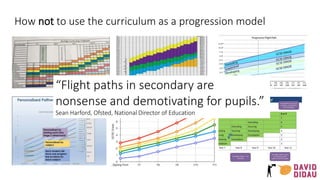
How not to use the curriculum as a progression model
“Flight paths in secondary are
nonsense and demotivating for pupils.”
Sean Harford, Ofsted, National Director of Education
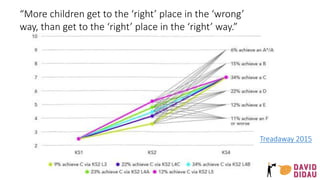
Treadaway 2015
“More children get to the ‘right’ place in the ‘wrong’
way, than get to the ‘right’ place in the ‘right’ way.”
The problem with flight paths
● Beliefs matter
● Predictions can become self fulfilling prophesies
● Predictions are probabilistic – they are only ever accurate on
average.
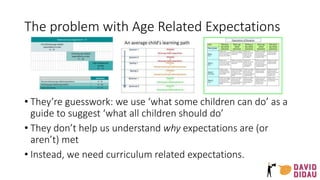
The problem with Age Related Expectations
• They’re guesswork: we use ‘what some children can do’ as a
guide to suggest ‘what all children should do’
• They don’t help us understand why expectations are (or
aren’t) met
• Instead, we need curriculum related expectations.
What does it mean to use the
curriculum as a progression model?
• Students are making progress if the they know, remember and can do
more of the curriculum
• But what does this look like?
• The specificity problem: How specific do CREs have to be in order to
be useful?
• If they’re too specific we risk generating endless tick box checklists
(No one wants a return to APP!)
• If they’re too broad they risk becoming meaninglessly bland.
CREs need to be both very specific and very broad…
…depending on the audience.
What do students need to know?
• Where am I?
• Where am I going?
• How am I going to get there?
What do teachers need to know?
• Gaps to fill (individuals and class)
• next steps; effectiveness of instruction/curriculum
• Responsiveness applies at a curricular as well as instructional
level.
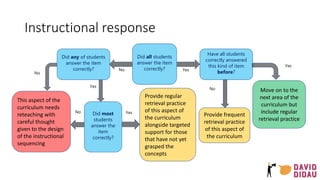
Did all students
answer the item
correctly?
Yes
No
Have all students
correctly answered
this kind of item
before?
Did any of students
answer the item
correctly?
No
Yes
No
Yes
Move on to the
next area of the
curriculum but
include regular
retrieval practice
Provide regular
retrieval practice
of this aspect of
the curriculum
alongside targeted
support for those
that have not yet
grasped the
concepts
Provide frequent
retrieval practice
of this aspect of
the curriculum
This aspect of the
curriculum needs
reteaching with
careful thought
given to the design
of the instructional
sequencing
Did most
students
answer the
item
correctly?
Yes
No
Instructional response
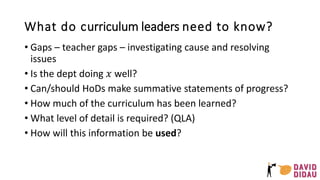
What do curriculum leaders need to know?
• Gaps – teacher gaps – investigating cause and resolving
issues
• Is the dept doing 𝑥 well?
• Can/should HoDs make summative statements of progress?
• How much of the curriculum has been learned?
• What level of detail is required? (QLA)
• How will this information be used?
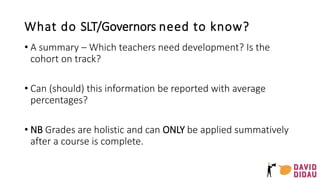
What do SLT/Governors need to know?
• A summary – Which teachers need development? Is the
cohort on track?
• Can (should) this information be reported with average
percentages?
• NB Grades are holistic and can ONLY be applied summatively
after a course is complete.
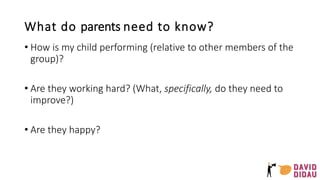
What do parents need to know?
• How is my child performing (relative to other members of the
group)?
• Are they working hard? (What, specifically, do they need to
improve?)
• Are they happy?
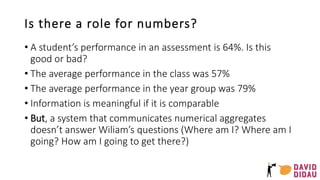
Is there a role for numbers?
• A student’s performance in an assessment is 64%. Is this
good or bad?
• The average performance in the class was 57%
• The average performance in the year group was 79%
• Information is meaningful if it is comparable
• But, a system that communicates numerical aggregates
doesn’t answer Wiliam’s questions (Where am I? Where am I
going? How am I going to get there?)
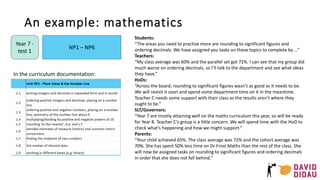
An example: mathematics
Year 7 -
test 1
NP1 – NP6
In the curriculum documentation:
Students:
“The areas you need to practise more are rounding to significant figures and
ordering decimals. We have assigned you tasks on these topics to complete by …”
Teachers:
“My class average was 60% and the parallel set got 72%. I can see that my group did
much worse on ordering decimals, so I’ll talk to the department and see what ideas
they have.”
HoDs:
“Across the board, rounding to significant figures wasn’t as good as it needs to be.
We will revisit it soon and spend some department time on it in the meantime.
Teacher C needs some support with their class as the results aren’t where they
ought to be.”
SLT/Governors:
“Year 7 are mostly attaining well on the maths curriculum this year, so will be ready
for Year 8. Teacher C’s group is a little concern. We will spend time with the HoD to
check what’s happening and how we might support.”
Parents:
“Your child achieved 65%. The class average was 72% and the cohort average was
70%. She has spent 50% less time on Dr Frost Maths than the rest of the class. She
will now be assigned tasks on rounding to significant figures and ordering decimals
in order that she does not fall behind.”
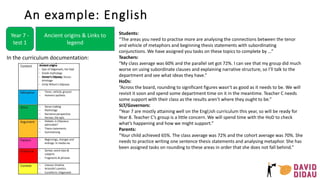
An example: English
In the curriculum documentation:
Students:
“The areas you need to practise more are analysing the connections between the tenor
and vehicle of metaphors and beginning thesis statements with subordinating
conjunctions. We have assigned you tasks on these topics to complete by …”
Teachers:
“My class average was 60% and the parallel set got 72%. I can see that my group did much
worse on using subordinate clauses and explaining narrative structure, so I’ll talk to the
department and see what ideas they have.”
HoDs:
“Across the board, rounding to significant figures wasn’t as good as it needs to be. We will
revisit it soon and spend some department time on it in the meantime. Teacher C needs
some support with their class as the results aren’t where they ought to be.”
SLT/Governors:
“Year 7 are mostly attaining well on the Engl;ish curriculum this year, so will be ready for
Year 8. Teacher C’s group is a little concern. We will spend time with the HoD to check
what’s happening and how we might support.”
Parents:
“Your child achieved 65%. The class average was 72% and the cohort average was 70%. She
needs to practice writing one sentence thesis statements and analysing metaphor. She has
been assigned tasks on rounding to these areas in order that she does not fall behind.”
Year 7 -
test 1
Ancient origins & Links to
legend
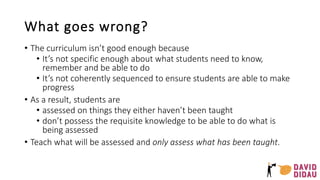
What goes wrong?
• The curriculum isn’t good enough because
• It’s not specific enough about what students need to know,
remember and be able to do
• It’s not coherently sequenced to ensure students are able to make
progress
• As a result, students are
• assessed on things they either haven’t been taught
• don’t possess the requisite knowledge to be able to do what is
being assessed
• Teach what will be assessed and only assess what has been taught.
Curriculum Related Expectations
• What specifically do we want students to know and be able to do?
Bad: students will learn how to write an analytic essay
Better: students will learn how to scaffold an analytic essay as a
‘conversation’ between 2 points of view (they say/I say)
Best: students will learn how to write an introduction beginning with a
subordinating conjunction and using a list of triple/quadruple adjectives to
frame the arguments they will develop
• These must be reasonable expectations of what students should
learn
• The more specific you are, the more likely you are to teach and
assess what has been specified.
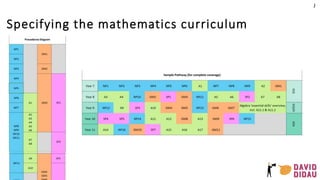
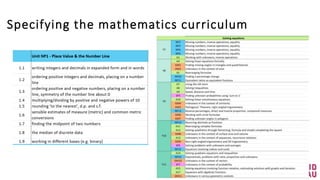
Specifying the mathematics curriculum
J
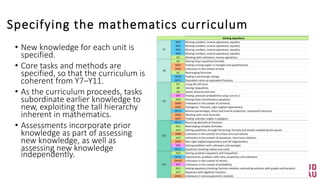
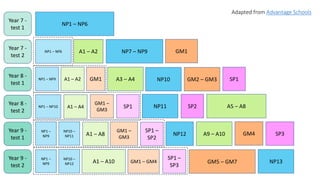
Specifying the mathematics curriculum
• New knowledge for each unit is
specified.
• Core tasks and methods are
specified, so that the curriculum is
coherent from Y7–Y11.
• As the curriculum proceeds, tasks
subordinate earlier knowledge to
new, exploiting the tall hierarchy
inherent in mathematics.
• Assessments incorporate prior
knowledge as part of assessing
new knowledge, as well as
assessing new knowledge
independently.
Specifying the mathematics curriculum
Year 7 -
test 1
Year 7 -
test 2
Year 8 -
test 1
Year 8 -
test 2
Year 9 -
test 1
Year 9 -
test 2
NP1 – NP6
NP1 – NP6 A1 – A2 NP7 – NP9
NP1 – NP9 A1 – A2 GM1 A3 – A4
NP1 – NP10
NP10
NP1 –
NP9
NP1 –
NP9
GM1
GM2 – GM3 SP1
A1 – A4
GM1 –
GM3
SP1 NP11 SP2 A5 – A8
NP10 –
NP11
GM1 –
GM3
SP1 –
SP2
NP12 A9 – A10 GM4 SP3
NP10 –
NP12 GM1 – GM4
SP1 –
SP3
A1 – A10 GM5 – GM7 NP13
A1 – A8
Adapted from Advantage Schools
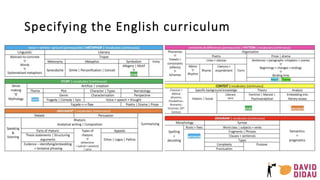
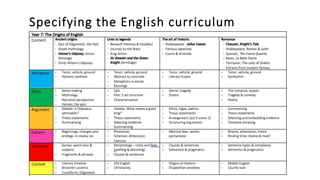
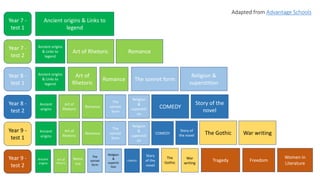
Specifying the English curriculum
Year 7 -
test 1
Year 7 -
test 2
Year 8 -
test 1
Year 8 -
test 2
Year 9 -
test 1
Year 9 -
test 2
Ancient origins & Links to
legend
Ancient origins
& Links to
legend
Art of Rhetoric Romance
Ancient origins
& Links to
legend
Art of
Rhetoric
Romance The sonnet form
Ancient
origins
Art of
Rhetoric
Romance
The
sonnet
form
Religion &
superstition
Religion
&
superstiti
on
COMEDY
Story of the
novel
Ancient
origins
Art of
Rhetoric
Romance
The
sonnet
form
Religion
&
superstiti
on
COMEDY
Story of
the novel The Gothic
Ancient
origins
Art of
Rhetoric
Roma
nce
The
sonnet
form
Religion
&
supersti
tion
COMEDY
Story
of the
novel
The
Gothic
War writing
War
writing
Tragedy Freedom
Women in
Literature
Adapted from Advantage Schools
Potential benefits of CREs
• The lack of emphasis on raising students’ rank means that the curriculum is
less likely to be warped by proxies
• Less need to reify and quantify aspects of the curriculum
• Clearer sense of what has been taught effectively
• More precise knowledge of what each student has and has not learned
• Clearer sense of what needs to retaught
• Greater clarity of which students require intervention in which areas
• No need to assign global grades of competence to individual students
• Less risk that students who have not met a CRE are likely to view this an an
inherent quality
• Less risk of students seeking the external validation of a grade.
Key points
1. No one is asking for internal data – if you are going to
produce it you need to have a very clear rationale
2. Only assess what students have been taught
3. Data can help to make comparisons but is unlikely to help
students make progress
4. Students are making progress if they know more, remember
more and are able to do more of the curriculum
5. To be used as a progression model the curriculum must be
highly specific and carefully sequenced.
@DavidDidau
academy.learningspy.co.uk
ddidau@gmail.com
“It is so easy to be wrong – and to persist in being wrong – when
the costs of being wrong are paid by others.”
Thomas Sowell

Research ed curriculum as progression model 2021

  • 1.
    Why using thecurriculum as a progression model may be harder than you think researchED 4th September 2021 @DavidDidau
  • 2.
    How not touse the curriculum as a progression model “Flight paths in secondary are nonsense and demotivating for pupils.” Sean Harford, Ofsted, National Director of Education
  • 3.
    Treadaway 2015 “More childrenget to the ‘right’ place in the ‘wrong’ way, than get to the ‘right’ place in the ‘right’ way.”
  • 4.
    The problem withflight paths ● Beliefs matter ● Predictions can become self fulfilling prophesies ● Predictions are probabilistic – they are only ever accurate on average.
  • 5.
    The problem withAge Related Expectations • They’re guesswork: we use ‘what some children can do’ as a guide to suggest ‘what all children should do’ • They don’t help us understand why expectations are (or aren’t) met • Instead, we need curriculum related expectations.
  • 6.
    What does itmean to use the curriculum as a progression model? • Students are making progress if the they know, remember and can do more of the curriculum • But what does this look like? • The specificity problem: How specific do CREs have to be in order to be useful? • If they’re too specific we risk generating endless tick box checklists (No one wants a return to APP!) • If they’re too broad they risk becoming meaninglessly bland. CREs need to be both very specific and very broad… …depending on the audience.
  • 7.
    What do studentsneed to know? • Where am I? • Where am I going? • How am I going to get there?
  • 8.
    What do teachersneed to know? • Gaps to fill (individuals and class) • next steps; effectiveness of instruction/curriculum • Responsiveness applies at a curricular as well as instructional level.
  • 9.
    Did all students answerthe item correctly? Yes No Have all students correctly answered this kind of item before? Did any of students answer the item correctly? No Yes No Yes Move on to the next area of the curriculum but include regular retrieval practice Provide regular retrieval practice of this aspect of the curriculum alongside targeted support for those that have not yet grasped the concepts Provide frequent retrieval practice of this aspect of the curriculum This aspect of the curriculum needs reteaching with careful thought given to the design of the instructional sequencing Did most students answer the item correctly? Yes No Instructional response
  • 10.
    What do curriculumleaders need to know? • Gaps – teacher gaps – investigating cause and resolving issues • Is the dept doing 𝑥 well? • Can/should HoDs make summative statements of progress? • How much of the curriculum has been learned? • What level of detail is required? (QLA) • How will this information be used?
  • 11.
    What do SLT/Governorsneed to know? • A summary – Which teachers need development? Is the cohort on track? • Can (should) this information be reported with average percentages? • NB Grades are holistic and can ONLY be applied summatively after a course is complete.
  • 12.
    What do parentsneed to know? • How is my child performing (relative to other members of the group)? • Are they working hard? (What, specifically, do they need to improve?) • Are they happy?
  • 13.
    Is there arole for numbers? • A student’s performance in an assessment is 64%. Is this good or bad? • The average performance in the class was 57% • The average performance in the year group was 79% • Information is meaningful if it is comparable • But, a system that communicates numerical aggregates doesn’t answer Wiliam’s questions (Where am I? Where am I going? How am I going to get there?)
  • 14.
    An example: mathematics Year7 - test 1 NP1 – NP6 In the curriculum documentation: Students: “The areas you need to practise more are rounding to significant figures and ordering decimals. We have assigned you tasks on these topics to complete by …” Teachers: “My class average was 60% and the parallel set got 72%. I can see that my group did much worse on ordering decimals, so I’ll talk to the department and see what ideas they have.” HoDs: “Across the board, rounding to significant figures wasn’t as good as it needs to be. We will revisit it soon and spend some department time on it in the meantime. Teacher C needs some support with their class as the results aren’t where they ought to be.” SLT/Governors: “Year 7 are mostly attaining well on the maths curriculum this year, so will be ready for Year 8. Teacher C’s group is a little concern. We will spend time with the HoD to check what’s happening and how we might support.” Parents: “Your child achieved 65%. The class average was 72% and the cohort average was 70%. She has spent 50% less time on Dr Frost Maths than the rest of the class. She will now be assigned tasks on rounding to significant figures and ordering decimals in order that she does not fall behind.”
  • 15.
    An example: English Inthe curriculum documentation: Students: “The areas you need to practise more are analysing the connections between the tenor and vehicle of metaphors and beginning thesis statements with subordinating conjunctions. We have assigned you tasks on these topics to complete by …” Teachers: “My class average was 60% and the parallel set got 72%. I can see that my group did much worse on using subordinate clauses and explaining narrative structure, so I’ll talk to the department and see what ideas they have.” HoDs: “Across the board, rounding to significant figures wasn’t as good as it needs to be. We will revisit it soon and spend some department time on it in the meantime. Teacher C needs some support with their class as the results aren’t where they ought to be.” SLT/Governors: “Year 7 are mostly attaining well on the Engl;ish curriculum this year, so will be ready for Year 8. Teacher C’s group is a little concern. We will spend time with the HoD to check what’s happening and how we might support.” Parents: “Your child achieved 65%. The class average was 72% and the cohort average was 70%. She needs to practice writing one sentence thesis statements and analysing metaphor. She has been assigned tasks on rounding to these areas in order that she does not fall behind.” Year 7 - test 1 Ancient origins & Links to legend
  • 16.
    What goes wrong? •The curriculum isn’t good enough because • It’s not specific enough about what students need to know, remember and be able to do • It’s not coherently sequenced to ensure students are able to make progress • As a result, students are • assessed on things they either haven’t been taught • don’t possess the requisite knowledge to be able to do what is being assessed • Teach what will be assessed and only assess what has been taught.
  • 17.
    Curriculum Related Expectations •What specifically do we want students to know and be able to do? Bad: students will learn how to write an analytic essay Better: students will learn how to scaffold an analytic essay as a ‘conversation’ between 2 points of view (they say/I say) Best: students will learn how to write an introduction beginning with a subordinating conjunction and using a list of triple/quadruple adjectives to frame the arguments they will develop • These must be reasonable expectations of what students should learn • The more specific you are, the more likely you are to teach and assess what has been specified.
  • 18.
  • 19.
  • 20.
    • New knowledgefor each unit is specified. • Core tasks and methods are specified, so that the curriculum is coherent from Y7–Y11. • As the curriculum proceeds, tasks subordinate earlier knowledge to new, exploiting the tall hierarchy inherent in mathematics. • Assessments incorporate prior knowledge as part of assessing new knowledge, as well as assessing new knowledge independently. Specifying the mathematics curriculum
  • 21.
    Year 7 - test1 Year 7 - test 2 Year 8 - test 1 Year 8 - test 2 Year 9 - test 1 Year 9 - test 2 NP1 – NP6 NP1 – NP6 A1 – A2 NP7 – NP9 NP1 – NP9 A1 – A2 GM1 A3 – A4 NP1 – NP10 NP10 NP1 – NP9 NP1 – NP9 GM1 GM2 – GM3 SP1 A1 – A4 GM1 – GM3 SP1 NP11 SP2 A5 – A8 NP10 – NP11 GM1 – GM3 SP1 – SP2 NP12 A9 – A10 GM4 SP3 NP10 – NP12 GM1 – GM4 SP1 – SP3 A1 – A10 GM5 – GM7 NP13 A1 – A8 Adapted from Advantage Schools
  • 22.
  • 23.
  • 24.
    Year 7 - test1 Year 7 - test 2 Year 8 - test 1 Year 8 - test 2 Year 9 - test 1 Year 9 - test 2 Ancient origins & Links to legend Ancient origins & Links to legend Art of Rhetoric Romance Ancient origins & Links to legend Art of Rhetoric Romance The sonnet form Ancient origins Art of Rhetoric Romance The sonnet form Religion & superstition Religion & superstiti on COMEDY Story of the novel Ancient origins Art of Rhetoric Romance The sonnet form Religion & superstiti on COMEDY Story of the novel The Gothic Ancient origins Art of Rhetoric Roma nce The sonnet form Religion & supersti tion COMEDY Story of the novel The Gothic War writing War writing Tragedy Freedom Women in Literature Adapted from Advantage Schools
  • 25.
    Potential benefits ofCREs • The lack of emphasis on raising students’ rank means that the curriculum is less likely to be warped by proxies • Less need to reify and quantify aspects of the curriculum • Clearer sense of what has been taught effectively • More precise knowledge of what each student has and has not learned • Clearer sense of what needs to retaught • Greater clarity of which students require intervention in which areas • No need to assign global grades of competence to individual students • Less risk that students who have not met a CRE are likely to view this an an inherent quality • Less risk of students seeking the external validation of a grade.
  • 26.
    Key points 1. Noone is asking for internal data – if you are going to produce it you need to have a very clear rationale 2. Only assess what students have been taught 3. Data can help to make comparisons but is unlikely to help students make progress 4. Students are making progress if they know more, remember more and are able to do more of the curriculum 5. To be used as a progression model the curriculum must be highly specific and carefully sequenced.
  • 27.
    @DavidDidau academy.learningspy.co.uk ddidau@gmail.com “It is soeasy to be wrong – and to persist in being wrong – when the costs of being wrong are paid by others.” Thomas Sowell