Training on 5S
Topics covered
• Introduction
• Why its required ?
• Benefits
• 5S in details
• Exercise
Benefits of
5S
Why implement work place
organisation?
5S is far more than
housekeeping
• 5S provides a firm foundation on which to build
other Lean improvements
• It is about organising your workplace in an
efficient manner not just Housekeeping
• Standardised operations lead to repeatable and
predictable processes
• 5S makes abnormalities immediately obvious
5S efficiency
gains
• 5S removes instances of the seven wastes
within your working environment;
• Transport
• Inventory
• Motion
• Waiting
• Overproduction
• Over Processing
• Defects
Efficiency
improvements
CopyrightLeanman 2015 Leanmanufacturingtools.org
• Typically in the order of 10% to 30%
• Workspace more Ergonomic
• Items located in easy reach
• No clutter to cause delays
Reduction in
delays
CopyrightLeanman 2015 Leanmanufacturingtools.org
• 5S will reduce delays in your process
• Visual management shows when products and
tools are missing
• Problems highlighted
– Materials out of place
– Leaks and other machine problems
Reduced
setups
CopyrightLeanman 2015 Leanmanufacturingtools.org
• Setup times reduced through the same
process as increasing production efficiency
• Ergonomic workplace
• All tools to hand
• Standardized process
Improved
quality
CopyrightLeanman 2015 Leanmanufacturingtools.org
• The right tools and equipment available
• Standardized processes
• Improved handling so less damage
• Improved reliability of equipment
safety
CopyrightLeanman 2015 Leanmanufacturingtools.org
• No clutter to create obstacles and hazards
• Ergonomic stress free workplace
– No stretching or reaching
– No lifting heavy objects
• Standardized ways of working
Marketing
CopyrightLeanman 2015 Leanmanufacturingtools.org
• A highly visual and tidy workplace
can give a great impression to a
current or potential customer.
Morale and
motivation
CopyrightLeanman 2015 Leanmanufacturingtools.org
• Less stress for operators
• Safer work environment
• Involvement in making own improvements
• Empowerment to make changes
Continuous improvement and problem
solving
CopyrightLeanman 2015 Leanmanufacturingtools.org
• Implemented correctly 5S will drive continuous
improvement of your products and processes.
• Abnormalities are immediately visible allowing
action to be taken
• Can you afford not to implement 5S??
5S
16
5S
17
There are basically three
different types of workplaces...
5S
18
5S
19
5S
20
5S
21
5S
22
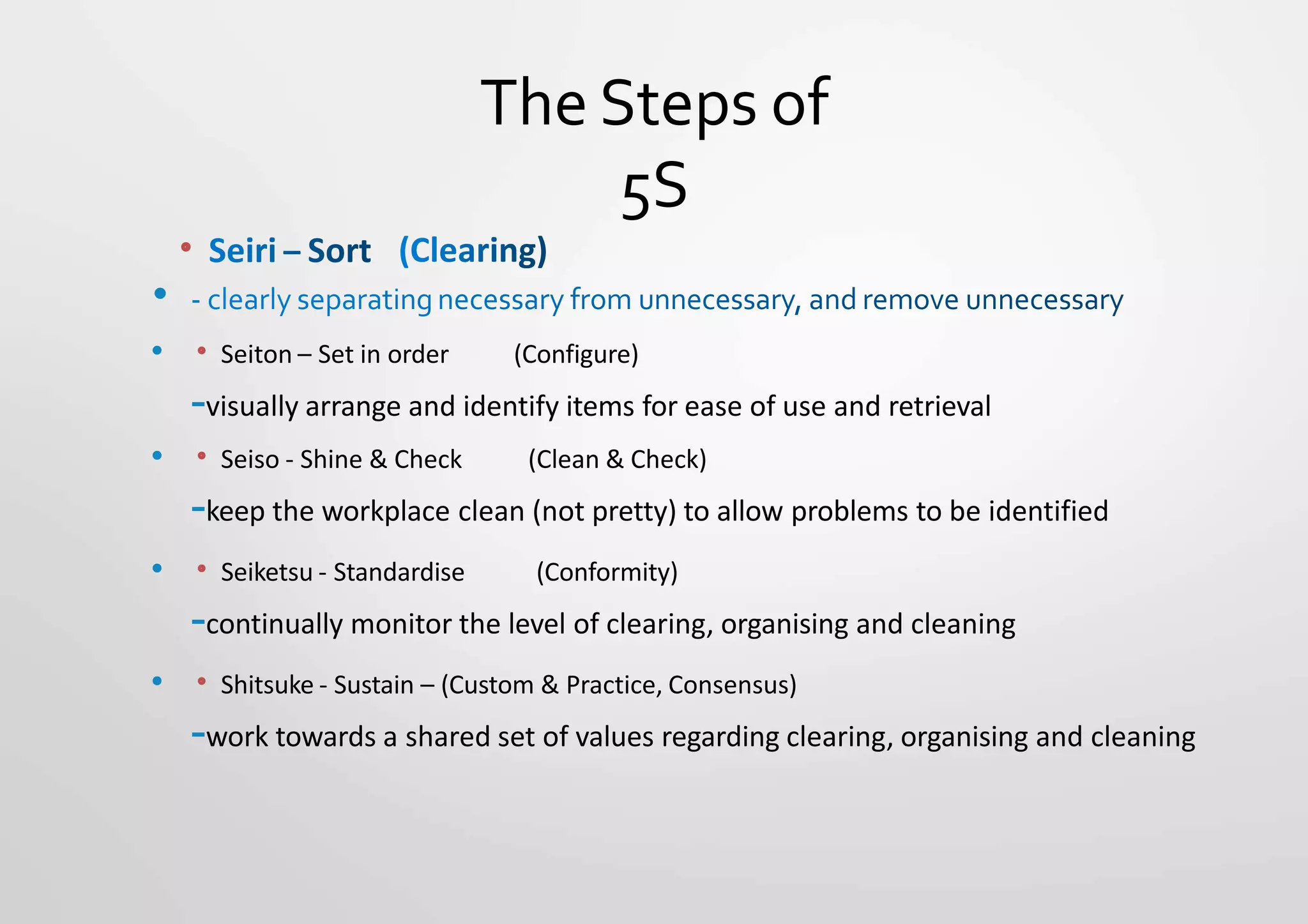
The Steps of
5S
•
•  Seiton – Set in order (Configure)
-visually arrange and identify items for ease of use and retrieval
•  Seiso - Shine & Check (Clean & Check)
-keep the workplace clean (not pretty) to allow problems to be identified
•  Seiketsu - Standardise (Conformity)
-continually monitor the level of clearing, organising and cleaning
•  Shitsuke - Sustain – (Custom & Practice, Consensus)
-work towards a shared set of values regarding clearing, organising and cleaning

The First “S”; Seiri or
Sort
CopyrightLeanman 2015 Leanmanufacturingtools.org
• The aim is to remove everything but what is
actually required every day from the work
space.
• Only items that are needed remain in the
workplace, all others are removed or
scrapped.
Why remove clutter?
CopyrightLeanman 2015 Leanmanufacturingtools.org
• Frees up space.
• Removes clutter/obstacles.
• Stops people adding to it.
• Stops hoarding.
• Improves safety.
• Gives control of what is in your area.
• Begins the orderliness process
Who is involved?
CopyrightLeanman 2015 Leanmanufacturingtools.org
• Everyone in the 5S team and the area concerned.
• Team should involve people who are from
outside the area who are more likely to challenge
and question the need for some items.
Sort
process
CopyrightLeanman 2015 Leanmanufacturingtools.org
• Whole team should spend a few hours going through the
entire area (Inside cabinets, under and behind machines,
everywhere!);
• All obvious scrap should be put in the skip
• All unidentified items should be put in the “red tag” /
quarantine / “Crime watch” area.
• All unnecessary items which have value should also be placed
in this area
• Items which are too big or difficult to remove should have red
tag attached.
• Only Items that are required should remain
Red tag / quarantine / crime watch area
CopyrightLeanman 2015 Leanmanufacturingtools.org
• Storage area for unidentified items and items
that are not required but have a value.
Red tag area and
items
CopyrightLeanman 2015 Leanmanufacturingtools.org
• The red tag area should be reviewed after the
clearing process.
• Involve everyone to decide disposition of the items;
• Scrap
• Storage
• Return to area
• Machines and other items with red tags attached
should also be reviewed and disposition decided and
planned.
Before and after
CopyrightLeanman 2015 Leanmanufacturingtools.org
What’s next?
CopyrightLeanman 2015 Leanmanufacturingtools.org
• At the end of seiri (Sort or Clearing) you
should only have the items in your area that
are required.
• The next stage of 5S is Seiton (Set in Order)
where we set those items in order.
5S Seiton – set in order
Configuring the workplace the second stage of 5S
Leanmanufacturi
ngtools.org
Copyright Leanman 2015
Stages of 5S
-clearly separating necessary from unnecessary, and remove
unnecessary
• 
-
•  Seiso - Shine & Check (Clean &Check)
-keep the workplace clean (not pretty) to allow problems to be
identified
•  Seiketsu- Standardise (Conformity)
-continually monitor the level of clearing, organising and cleaning
•  Shitsuke- Sustain – (Custom & Practice,Consensus)
-work towards a shared set of values regarding clearing, organising and
cleaning
 Seiri – Sort (Clearing)
Purpose of seiton – set in order
Leanmanufacturi
ngtools.org
Copyright Leanman 2015
• A place for everything and everything in its place.
• To arrange all necessary items for economy of
movement.
• Place according to frequency of use.
• To have a designated place for everything, label,
classify and make easily visible.
• Provide safe storage - heavy items low, light
items high.
• Ensure safe access.
• Begins the process of standardization.
Organizing the
workspace
• Set in order is not just about labeling
everything and putting it on a shelf.
• What is the best location for an item to reduce
wasted movement in the process and reduce
safety issues?
• How can we make the process more visible?
Set in order
examples
Leanmanufacturi
ngtools.org
Copyright Leanman 2015
Set in order for economy of
movement
• Place items in the most ergonomic position to
reduce reaching, turning and bending;
• Component boxes fed from the rear of the work area.
• Tools hanging from overhead.
• Components presented in the right orientation to prevent
having to turn them
• Scissor lift platforms to deliver items at a uniform height.
• Solutions should be no-cost or low-cost, if we
have to spend large sums of money then we have
not thought hard enough about the problem.
What should be in place at the end of
Seiton
• A place for everything and everything in its
place.
• Should be obvious if anything is missing or out
of place
• Organized ergonomically and for frequency of
use
• Movement and access should be safe without
obstacles
2S
Straighten
5S
39
5S
40
Small
Crescent
Wrench
Small Claw
Hammer
Flat Tip
Screwdriver
Large
Crescent
Wrench
Large Claw
Hammer
5S
41
5S
42
5S
43
5S
44
Stage 1 Stage 4
5S
45
Stage 2 Stage 3
5S
46
Before
5S
47
After
Before
5S
48
After
Before
5S
49
After
Before
5S
50
After
What is after Seiton – Set in
Order
Leanmanufacturi
ngtools.org
Copyright Leanman 2015
• The 3rd and next stage of 5S is Seiso or Shine
and Check;
• In this stage we will inspect and clean
everything to ensure that all items are bought
back to an “as new” condition and maintained
as such.
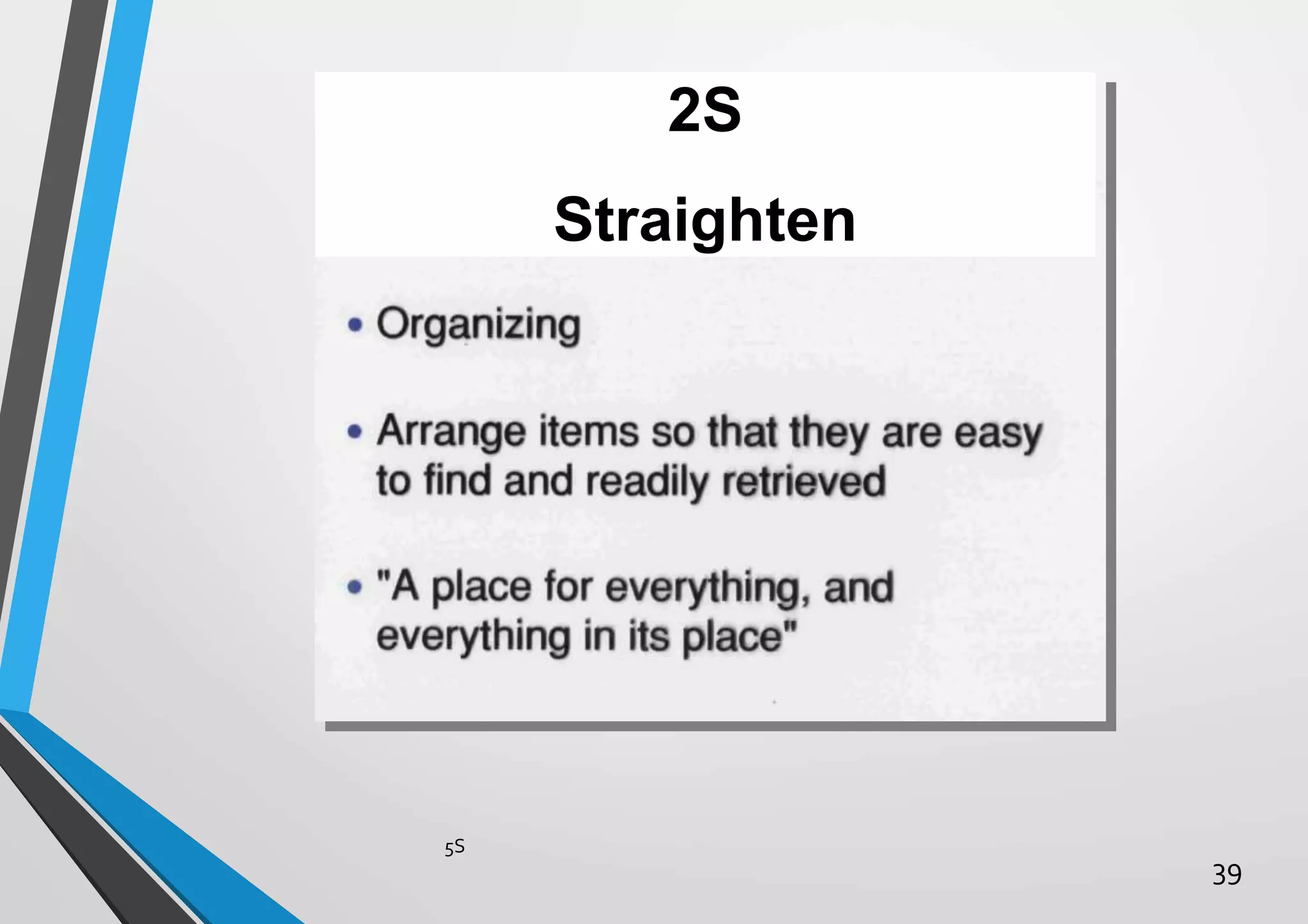
Stages of 5S
-clearly separating necessary from unnecessary, and
remove unnecessary
•  Seiton – Set in order (Configure)
-visually arrange and identify items for ease of use
and retrieval
• 
•
•  Seiketsu - Standardise (Conformity)
-continually monitor the level of clearing, organising
and cleaning
 Seiri – Sort (Clearing)
Not just
cleaning
• This stage is not just to make everything look
clean and pretty (Although it can do..)
• Thoroughly inspect everything for damage
and problems.
• Bring everything back to “As New”
Copyright Leanman 2015 Leanmanufacturingtools.org
Benefits of
cleaning
• Makes defects easier to detect.
• Better customer perception.
• Creates a better working environment.
• Aids efficiency and reduces accidents.
• Helps standardisation.
Copyright Leanman 2015 Leanmanufacturingtools.org
Initial clean down
• Correct or schedule repairs for all problems
discovered
• If possible prevent dirt creation – eliminate or
reduce
• Links with Total Productive Maintenance (TPM)
Copyright Leanman 2015 Leanmanufacturingtools.org
Who, what, when, where, how?
• Cleaning is an ongoing process;
• Define and document;
– Who is responsible for cleaning
– When it will be done
– What needs to be cleaned and where
– How is it to be done
– Provide the required tools for cleaning
Copyright Leanman 2015 Leanmanufacturingtools.org
Why Shine?
5S
57
5S
58
5S
59
5S
60
Shine Targets
5S
61
5S
62
It is important that we
establish the first 3S
before we progress to
the next 2S.
5S
63
Copyright Leanman 2015 Leanmanufacturingtools.org
The next
stage
• The next step is seiketsu or standardization.
• The next stage will build on everything you
have achieved in the last three stages.
Stages of
5S
-clearly separating necessary from unnecessary, and remove
unnecessary
•  Seiton – Set in order (Configure)
-visually arrange and identify items for ease of use and retrieval
•  Seiso - Shine & Check (Clean &Check)
-keep the workplace clean (not pretty) to allow problems to be
identified
• 
•
•  Shitsuke- Sustain – (Custom & Practice,Consensus)
• - work towards a shared set of values regarding clearing, organising and
cleaning
 Seiri – Sort (Clearing)
Why
standardize?
Leanmanufacturi
ngtools.org
Copyright Leanman 2015
• It makes 5S routine.
• Sustains all improvements.
• Builds on the improvements already made.
• Maintains agreed procedures.
• Ensures we don’t fall back into our old ways.
How do we
standardize
Leanmanufacturi
ngtools.org
Copyright Leanman 2015
• Document standard ways of working
• Standard Operating Procedures (SOP)
• Standardize labeling, signage and flow
• 5S audits
Standard
work
Leanmanufacturi
ngtools.org
Copyright Leanman 2015
• Document the current agreed way of doing a
process.
– Provides a baseline for improvement
Reduces variation between people/shifts
• Use text
• Camera
• video
Standardize flow and
signage
Leanmanufacturi
ngtools.org
Copyright Leanman 2015
• Common methods to show where work enters
and leaves a cell.
• Standard methods for identifying components
and tool locations
🞭 5S is a highly visual tool
– everything should be
obvious.
5S
Audit
Leanmanufacturi
ngtools.org
Copyright Leanman 2015
• Independent audit of an areas adherence to
5S
• Capture current state – use color Photographs
• Create simple audit sheets – With Score
Example checklist:
Engineering Ltd
Workplace Organisation Audit
• Conduct audits
Filling Line Seven Pass / Fail
1 (max) pallet of bottles in defined location at scrambler
1 (max) pallet of collapsed boxes in stacked in defined location
IBC 1 under mix stand in defined location
IBC 2 next to IBC 1 in defined location
1 litter bin in defined location at labeller, not overflowing
Batch number table surface clear, except magnifying glass
All handtools on shadowboard at filler
Head calibration board on peg and filled in and up to date
Date: Auditor: Score: out of = %
5S
auditing
Leanmanufacturi
ngtools.org
Copyright Leanman 2015
Q: Can you write a clear and fair checklist?
those being measured cannot fail or pass for anything ambiguous
(eg locations, quantity, cleanliness, etc) - there should be no "shades of grey"
If not, revisit "Organising" to visually clarify groundrules and
expectations or rewrite the checklist
Q: Do those being audited agree the audit is fair and reasonable?
have they seen the audit? They can almost certainly devise a better one!
Periodically re-audit (eg weekly, fortnightly) and cross-check using
auditors from other areas to form auditing group
Give immediate verbal feedback from audit, display results on
noticeboard, and chart against past results
Identify problem areas and set targets for improvement
for example, can a lack of cleanliness be prevented through controlling contamination?
What is the next stage of
5S?
Leanmanufacturi
ngtools.org
Copyright Leanman 2015
• The hardest step of 5S is that of Shitsuke or
Sustaining.
• We need to ensure that we maintain and
continuously improve on the gains that we
have made through the first 4 steps of 5S
Stages of 5S
-clearly separating necessary from unnecessary, and remove
unnecessary
•  Seiton– Set in order (Configure)
-visually arrange and identify items for ease of use and retrieval
•  Seiso - Shine &Check (Clean &Check)
-keep the workplace clean (not pretty) to allow problems to be
identified
•  Seiketsu- Standardise (Conformity)
-continually monitor the level of clearing, organising and cleaning
• 
•
 Seiri – Sort (Clearing)
Sustaining the gains made through
5s
Leanmanufacturi
ngtools.org
Copyright Leanman 2015
• 5S will have allowed you to go from..
To
Do you want to slip back?
The hardest part of
5S
Leanmanufacturi
ngtools.org
Copyright Leanman 2015
• You need to keep the gains..
Sustaining
5s
Leanmanufacturi
ngtools.org
Copyright Leanman 2015
Probably the most difficult step;
Maintain audits
Maintain cleaning
Walk the walk! Management must lead by
example and not ignore issues..
Visual
management
Leanmanufacturi
ngtools.org
Copyright Leanman 2015
• 5S provides a system of visual management
– Any abnormalities are now obvious.
• All locations identified, work flow should be
clear..
– Items and materials that are out of place give a
clear indication of a problem and a need for
action.
What has 5S done for us?
Leanmanufacturi
ngtools.org
Copyright Leanman 2015
• Improves safety.
• A structured approach.
• Applicable to the General Manager and everyone else.
• Improves productivity.
• Improves quality.
• Intolerant to waste.
• Improves morale and teamwork.
• Enjoy - working in a clean, organised, quality,
successful, safe environment.
Show everyone what 5S has
achieved
Leanmanufacturi
ngtools.org
Copyright Leanman 2015
5S
Story board
Continuous
improvement
Leanmanufacturi
ngtools.org
Copyright Leanman 2015
• Use the teams that you have formed to
implement 5S to begin the use of Kaizen
• Use Kaizen and empower your teams to
continually improve on the gains they have
made through 5S – constantly challenge the
teams.
• Instigate daily management walk through.
5S Training Exercise
The 5S paper exercise
A Quick Paper ExerciseTo Demonstrate
5S
• This is a simple and easy to use demonstration of
the power and simplicity of 5S.
• Provide each of the people in the room with a
copy of the pages that follow.
• Ask them to strike out the phrase “Workplace
organisation” one letter at a time in order on the
page and put their hands up when complete.
• When they put their hand up record the time
taken to complete the task.
The First
Task
• This is your workplace before any application
of 5S.
• Score out “workplace organisation” one letter
at a time in order and record the time taken as
your baseline for this exercise.
#
w
o
a
s
i
R
a
k
r
l
e
n
g
o
I
o
i
N
t
t
I
s
u
o
M
h
%
;
A typical work place - Score Out “Workplace Organisation”
L
p
C
n
R
g
b
h
m
V
Y
7
c
p
H
s
W
k
Q
e
c
5
1
8
@
V ?
g
b i
U
P
L
z
Task 2 – Seiri / Sort / Clearing
• The first stage of 5S is Seiri or Sort
• During Sort we remove all of the unnecessary
items from the workplace.
• So for this exercise we remove all unnecessary
random characters from the sheet.
• Once again score out “workplace
organisation” and record the time.
w
o
a
s
R
a
k
r
e
n
g
o
I
Task 2 – Score out “Workplace Organisation”
l
o
i
N
t
t
i
s
u
o
M
h
L
p
C
n
R p
H
g
b
h
m
k
Q
V
Y b i
U
L
z
c
e
s
W
c
V
g
P
Task 3 – Seiton / Set in Order
• We now repeat the exercise with all of the
letters grouped together as if they have been
arranged according to Seiton / Set in Order.
• Once again strike out “Workplace
Organisation” and record the time taken.
a
a
k
l
i i i
e
n
g
I N
n
p
M
g
b
h
m
k
c c
H e
h
g
b
Task 3 - Score Out “Workplace Organisation”
C
L
L
w
R
p
r
o
o
t
t
s
s
R
oo
Q
Y
U
z
s
W
V V
P
u
Task 4 – Seiso / Shine and Check
• For this task we apply the principles of Seiso
or Shine and Check.
• We have “cleaned” the sheet by orienting all
of the letters the same way.
• Again score out “Workplace Organisation” and
record the time taken.
a
a
k
l i
i i
e
C
n
n
g g
g
I N
d
M
m
b
b
h H
h
k
c e
c
L
L
Task 4 - Score Out “Workplace Organisation”
p
o
o t t
R r
R
oo
Q
Y z
s
s s
Ww
V V
P
Uu
Task 5 – Seiketsu / Standardize
• We now have a standard arrangement for all
of the letters and all are oriented and of the
same case as you would expect with a
standardised process.
• Again strike out “Workplace Organisation” and
record the time taken.
Task 5 - Score Out “Workplace Organisation”
a a a a b b c c c c d e e g g g
h h h I I I I I j k k L L m m n n n
o o o o p p q r r r s s s t t t
u u v v w w y y z z
What DidWe Learn?
• Unless something has gone drastically wrong
you will have noticed an improvement in
times taken between each stage.
• There will have been a SIGNIFICANT
improvement from the first to the last task.
• The simple methodology provided by 5S
allows you to improve your process
significantly with little or no expense.
A FinalTask and an Important Lesson
Regarding 5S
• This time take the two following sheets and
provide half the participants with one sheet
and the other half with the other.
• Ask them to score out “World Class
Manufacturing” and raise their hands when
they finish or if they have a problem
completing the task (But do not mention the
problem) – again record the time.
#
w
o
a
s
i
R
a
k
r
l
e
n
g
o
I
o
i
N
t
t
I
s
u
o
M
h
%
;
Task 6 Sheet A - Score Out “World Class Manufacturing”
L
p
C
n
R
g
b
h
m
V
Y
7
c
p
H
s
W
k
Q
e
c
5
1
8
@
V ?
g
b i
U
P
L
z
Task 6 Sheet B - Score Out “World Class Manufacturing”
a a a a b b c c c c d e e g g g
h h h I I I I I j k k L L m m n n n
o o o o p p q r r r s s s t t t
u u v v w w y y z z
5S Makes Problems
Obvious
• In a disorganised and jumbled workplace it is
hard to see if something is missing or
misplaced.
• In a well organised and logical workplace it
soon becomes obvious if something is not
there.
• Task 6 will quickly show that difference.

5S- Training.pptx

  • 1.
  • 2.
    Topics covered • Introduction •Why its required ? • Benefits • 5S in details • Exercise
  • 5.
    Benefits of 5S Why implementwork place organisation?
  • 6.
    5S is farmore than housekeeping • 5S provides a firm foundation on which to build other Lean improvements • It is about organising your workplace in an efficient manner not just Housekeeping • Standardised operations lead to repeatable and predictable processes • 5S makes abnormalities immediately obvious
  • 7.
    5S efficiency gains • 5Sremoves instances of the seven wastes within your working environment; • Transport • Inventory • Motion • Waiting • Overproduction • Over Processing • Defects
  • 8.
    Efficiency improvements CopyrightLeanman 2015 Leanmanufacturingtools.org •Typically in the order of 10% to 30% • Workspace more Ergonomic • Items located in easy reach • No clutter to cause delays
  • 9.
    Reduction in delays CopyrightLeanman 2015Leanmanufacturingtools.org • 5S will reduce delays in your process • Visual management shows when products and tools are missing • Problems highlighted – Materials out of place – Leaks and other machine problems
  • 10.
    Reduced setups CopyrightLeanman 2015 Leanmanufacturingtools.org •Setup times reduced through the same process as increasing production efficiency • Ergonomic workplace • All tools to hand • Standardized process
  • 11.
    Improved quality CopyrightLeanman 2015 Leanmanufacturingtools.org •The right tools and equipment available • Standardized processes • Improved handling so less damage • Improved reliability of equipment
  • 12.
    safety CopyrightLeanman 2015 Leanmanufacturingtools.org •No clutter to create obstacles and hazards • Ergonomic stress free workplace – No stretching or reaching – No lifting heavy objects • Standardized ways of working
  • 13.
    Marketing CopyrightLeanman 2015 Leanmanufacturingtools.org •A highly visual and tidy workplace can give a great impression to a current or potential customer.
  • 14.
    Morale and motivation CopyrightLeanman 2015Leanmanufacturingtools.org • Less stress for operators • Safer work environment • Involvement in making own improvements • Empowerment to make changes
  • 15.
    Continuous improvement andproblem solving CopyrightLeanman 2015 Leanmanufacturingtools.org • Implemented correctly 5S will drive continuous improvement of your products and processes. • Abnormalities are immediately visible allowing action to be taken • Can you afford not to implement 5S??
  • 16.
  • 17.
  • 18.
    There are basicallythree different types of workplaces... 5S 18
  • 19.
  • 20.
  • 21.
  • 22.
  • 23.
    The Steps of 5S • • Seiton – Set in order (Configure) -visually arrange and identify items for ease of use and retrieval •  Seiso - Shine & Check (Clean & Check) -keep the workplace clean (not pretty) to allow problems to be identified •  Seiketsu - Standardise (Conformity) -continually monitor the level of clearing, organising and cleaning •  Shitsuke - Sustain – (Custom & Practice, Consensus) -work towards a shared set of values regarding clearing, organising and cleaning 
  • 24.
    The First “S”;Seiri or Sort CopyrightLeanman 2015 Leanmanufacturingtools.org • The aim is to remove everything but what is actually required every day from the work space. • Only items that are needed remain in the workplace, all others are removed or scrapped.
  • 25.
    Why remove clutter? CopyrightLeanman2015 Leanmanufacturingtools.org • Frees up space. • Removes clutter/obstacles. • Stops people adding to it. • Stops hoarding. • Improves safety. • Gives control of what is in your area. • Begins the orderliness process
  • 26.
    Who is involved? CopyrightLeanman2015 Leanmanufacturingtools.org • Everyone in the 5S team and the area concerned. • Team should involve people who are from outside the area who are more likely to challenge and question the need for some items.
  • 27.
    Sort process CopyrightLeanman 2015 Leanmanufacturingtools.org •Whole team should spend a few hours going through the entire area (Inside cabinets, under and behind machines, everywhere!); • All obvious scrap should be put in the skip • All unidentified items should be put in the “red tag” / quarantine / “Crime watch” area. • All unnecessary items which have value should also be placed in this area • Items which are too big or difficult to remove should have red tag attached. • Only Items that are required should remain
  • 28.
    Red tag /quarantine / crime watch area CopyrightLeanman 2015 Leanmanufacturingtools.org • Storage area for unidentified items and items that are not required but have a value.
  • 29.
    Red tag areaand items CopyrightLeanman 2015 Leanmanufacturingtools.org • The red tag area should be reviewed after the clearing process. • Involve everyone to decide disposition of the items; • Scrap • Storage • Return to area • Machines and other items with red tags attached should also be reviewed and disposition decided and planned.
  • 30.
    Before and after CopyrightLeanman2015 Leanmanufacturingtools.org
  • 31.
    What’s next? CopyrightLeanman 2015Leanmanufacturingtools.org • At the end of seiri (Sort or Clearing) you should only have the items in your area that are required. • The next stage of 5S is Seiton (Set in Order) where we set those items in order.
  • 32.
    5S Seiton –set in order Configuring the workplace the second stage of 5S Leanmanufacturi ngtools.org Copyright Leanman 2015
  • 33.
    Stages of 5S -clearlyseparating necessary from unnecessary, and remove unnecessary •  - •  Seiso - Shine & Check (Clean &Check) -keep the workplace clean (not pretty) to allow problems to be identified •  Seiketsu- Standardise (Conformity) -continually monitor the level of clearing, organising and cleaning •  Shitsuke- Sustain – (Custom & Practice,Consensus) -work towards a shared set of values regarding clearing, organising and cleaning  Seiri – Sort (Clearing)
  • 34.
    Purpose of seiton– set in order Leanmanufacturi ngtools.org Copyright Leanman 2015 • A place for everything and everything in its place. • To arrange all necessary items for economy of movement. • Place according to frequency of use. • To have a designated place for everything, label, classify and make easily visible. • Provide safe storage - heavy items low, light items high. • Ensure safe access. • Begins the process of standardization.
  • 35.
    Organizing the workspace • Setin order is not just about labeling everything and putting it on a shelf. • What is the best location for an item to reduce wasted movement in the process and reduce safety issues? • How can we make the process more visible?
  • 36.
  • 37.
    Set in orderfor economy of movement • Place items in the most ergonomic position to reduce reaching, turning and bending; • Component boxes fed from the rear of the work area. • Tools hanging from overhead. • Components presented in the right orientation to prevent having to turn them • Scissor lift platforms to deliver items at a uniform height. • Solutions should be no-cost or low-cost, if we have to spend large sums of money then we have not thought hard enough about the problem.
  • 38.
    What should bein place at the end of Seiton • A place for everything and everything in its place. • Should be obvious if anything is missing or out of place • Organized ergonomically and for frequency of use • Movement and access should be safe without obstacles
  • 39.
  • 40.
  • 41.
  • 42.
  • 43.
  • 44.
  • 45.
    Stage 1 Stage4 5S 45 Stage 2 Stage 3
  • 46.
  • 47.
  • 48.
  • 49.
  • 50.
  • 51.
    What is afterSeiton – Set in Order Leanmanufacturi ngtools.org Copyright Leanman 2015 • The 3rd and next stage of 5S is Seiso or Shine and Check; • In this stage we will inspect and clean everything to ensure that all items are bought back to an “as new” condition and maintained as such.
  • 52.
    Stages of 5S -clearlyseparating necessary from unnecessary, and remove unnecessary •  Seiton – Set in order (Configure) -visually arrange and identify items for ease of use and retrieval •  • •  Seiketsu - Standardise (Conformity) -continually monitor the level of clearing, organising and cleaning  Seiri – Sort (Clearing)
  • 53.
    Not just cleaning • Thisstage is not just to make everything look clean and pretty (Although it can do..) • Thoroughly inspect everything for damage and problems. • Bring everything back to “As New” Copyright Leanman 2015 Leanmanufacturingtools.org
  • 54.
    Benefits of cleaning • Makesdefects easier to detect. • Better customer perception. • Creates a better working environment. • Aids efficiency and reduces accidents. • Helps standardisation. Copyright Leanman 2015 Leanmanufacturingtools.org
  • 55.
    Initial clean down •Correct or schedule repairs for all problems discovered • If possible prevent dirt creation – eliminate or reduce • Links with Total Productive Maintenance (TPM) Copyright Leanman 2015 Leanmanufacturingtools.org
  • 56.
    Who, what, when,where, how? • Cleaning is an ongoing process; • Define and document; – Who is responsible for cleaning – When it will be done – What needs to be cleaned and where – How is it to be done – Provide the required tools for cleaning Copyright Leanman 2015 Leanmanufacturingtools.org
  • 57.
  • 58.
  • 59.
  • 60.
  • 61.
  • 62.
  • 63.
    It is importantthat we establish the first 3S before we progress to the next 2S. 5S 63
  • 64.
    Copyright Leanman 2015Leanmanufacturingtools.org The next stage • The next step is seiketsu or standardization. • The next stage will build on everything you have achieved in the last three stages.
  • 65.
    Stages of 5S -clearly separatingnecessary from unnecessary, and remove unnecessary •  Seiton – Set in order (Configure) -visually arrange and identify items for ease of use and retrieval •  Seiso - Shine & Check (Clean &Check) -keep the workplace clean (not pretty) to allow problems to be identified •  • •  Shitsuke- Sustain – (Custom & Practice,Consensus) • - work towards a shared set of values regarding clearing, organising and cleaning  Seiri – Sort (Clearing)
  • 66.
    Why standardize? Leanmanufacturi ngtools.org Copyright Leanman 2015 •It makes 5S routine. • Sustains all improvements. • Builds on the improvements already made. • Maintains agreed procedures. • Ensures we don’t fall back into our old ways.
  • 67.
    How do we standardize Leanmanufacturi ngtools.org CopyrightLeanman 2015 • Document standard ways of working • Standard Operating Procedures (SOP) • Standardize labeling, signage and flow • 5S audits
  • 68.
    Standard work Leanmanufacturi ngtools.org Copyright Leanman 2015 •Document the current agreed way of doing a process. – Provides a baseline for improvement Reduces variation between people/shifts • Use text • Camera • video
  • 69.
    Standardize flow and signage Leanmanufacturi ngtools.org CopyrightLeanman 2015 • Common methods to show where work enters and leaves a cell. • Standard methods for identifying components and tool locations 🞭 5S is a highly visual tool – everything should be obvious.
  • 70.
    5S Audit Leanmanufacturi ngtools.org Copyright Leanman 2015 •Independent audit of an areas adherence to 5S • Capture current state – use color Photographs • Create simple audit sheets – With Score Example checklist: Engineering Ltd Workplace Organisation Audit • Conduct audits Filling Line Seven Pass / Fail 1 (max) pallet of bottles in defined location at scrambler 1 (max) pallet of collapsed boxes in stacked in defined location IBC 1 under mix stand in defined location IBC 2 next to IBC 1 in defined location 1 litter bin in defined location at labeller, not overflowing Batch number table surface clear, except magnifying glass All handtools on shadowboard at filler Head calibration board on peg and filled in and up to date Date: Auditor: Score: out of = %
  • 71.
    5S auditing Leanmanufacturi ngtools.org Copyright Leanman 2015 Q:Can you write a clear and fair checklist? those being measured cannot fail or pass for anything ambiguous (eg locations, quantity, cleanliness, etc) - there should be no "shades of grey" If not, revisit "Organising" to visually clarify groundrules and expectations or rewrite the checklist Q: Do those being audited agree the audit is fair and reasonable? have they seen the audit? They can almost certainly devise a better one! Periodically re-audit (eg weekly, fortnightly) and cross-check using auditors from other areas to form auditing group Give immediate verbal feedback from audit, display results on noticeboard, and chart against past results Identify problem areas and set targets for improvement for example, can a lack of cleanliness be prevented through controlling contamination?
  • 72.
    What is thenext stage of 5S? Leanmanufacturi ngtools.org Copyright Leanman 2015 • The hardest step of 5S is that of Shitsuke or Sustaining. • We need to ensure that we maintain and continuously improve on the gains that we have made through the first 4 steps of 5S
  • 73.
    Stages of 5S -clearlyseparating necessary from unnecessary, and remove unnecessary •  Seiton– Set in order (Configure) -visually arrange and identify items for ease of use and retrieval •  Seiso - Shine &Check (Clean &Check) -keep the workplace clean (not pretty) to allow problems to be identified •  Seiketsu- Standardise (Conformity) -continually monitor the level of clearing, organising and cleaning •  •  Seiri – Sort (Clearing)
  • 74.
    Sustaining the gainsmade through 5s Leanmanufacturi ngtools.org Copyright Leanman 2015 • 5S will have allowed you to go from.. To Do you want to slip back?
  • 75.
    The hardest partof 5S Leanmanufacturi ngtools.org Copyright Leanman 2015 • You need to keep the gains..
  • 76.
    Sustaining 5s Leanmanufacturi ngtools.org Copyright Leanman 2015 Probablythe most difficult step; Maintain audits Maintain cleaning Walk the walk! Management must lead by example and not ignore issues..
  • 77.
    Visual management Leanmanufacturi ngtools.org Copyright Leanman 2015 •5S provides a system of visual management – Any abnormalities are now obvious. • All locations identified, work flow should be clear.. – Items and materials that are out of place give a clear indication of a problem and a need for action.
  • 78.
    What has 5Sdone for us? Leanmanufacturi ngtools.org Copyright Leanman 2015 • Improves safety. • A structured approach. • Applicable to the General Manager and everyone else. • Improves productivity. • Improves quality. • Intolerant to waste. • Improves morale and teamwork. • Enjoy - working in a clean, organised, quality, successful, safe environment.
  • 79.
    Show everyone what5S has achieved Leanmanufacturi ngtools.org Copyright Leanman 2015 5S Story board
  • 80.
    Continuous improvement Leanmanufacturi ngtools.org Copyright Leanman 2015 •Use the teams that you have formed to implement 5S to begin the use of Kaizen • Use Kaizen and empower your teams to continually improve on the gains they have made through 5S – constantly challenge the teams. • Instigate daily management walk through.
  • 81.
    5S Training Exercise The5S paper exercise
  • 82.
    A Quick PaperExerciseTo Demonstrate 5S • This is a simple and easy to use demonstration of the power and simplicity of 5S. • Provide each of the people in the room with a copy of the pages that follow. • Ask them to strike out the phrase “Workplace organisation” one letter at a time in order on the page and put their hands up when complete. • When they put their hand up record the time taken to complete the task.
  • 83.
    The First Task • Thisis your workplace before any application of 5S. • Score out “workplace organisation” one letter at a time in order and record the time taken as your baseline for this exercise.
  • 84.
    # w o a s i R a k r l e n g o I o i N t t I s u o M h % ; A typical workplace - Score Out “Workplace Organisation” L p C n R g b h m V Y 7 c p H s W k Q e c 5 1 8 @ V ? g b i U P L z
  • 85.
    Task 2 –Seiri / Sort / Clearing • The first stage of 5S is Seiri or Sort • During Sort we remove all of the unnecessary items from the workplace. • So for this exercise we remove all unnecessary random characters from the sheet. • Once again score out “workplace organisation” and record the time.
  • 86.
    w o a s R a k r e n g o I Task 2 –Score out “Workplace Organisation” l o i N t t i s u o M h L p C n R p H g b h m k Q V Y b i U L z c e s W c V g P
  • 87.
    Task 3 –Seiton / Set in Order • We now repeat the exercise with all of the letters grouped together as if they have been arranged according to Seiton / Set in Order. • Once again strike out “Workplace Organisation” and record the time taken.
  • 88.
    a a k l i i i e n g IN n p M g b h m k c c H e h g b Task 3 - Score Out “Workplace Organisation” C L L w R p r o o t t s s R oo Q Y U z s W V V P u
  • 89.
    Task 4 –Seiso / Shine and Check • For this task we apply the principles of Seiso or Shine and Check. • We have “cleaned” the sheet by orienting all of the letters the same way. • Again score out “Workplace Organisation” and record the time taken.
  • 90.
    a a k l i i i e C n n gg g I N d M m b b h H h k c e c L L Task 4 - Score Out “Workplace Organisation” p o o t t R r R oo Q Y z s s s Ww V V P Uu
  • 91.
    Task 5 –Seiketsu / Standardize • We now have a standard arrangement for all of the letters and all are oriented and of the same case as you would expect with a standardised process. • Again strike out “Workplace Organisation” and record the time taken.
  • 92.
    Task 5 -Score Out “Workplace Organisation” a a a a b b c c c c d e e g g g h h h I I I I I j k k L L m m n n n o o o o p p q r r r s s s t t t u u v v w w y y z z
  • 93.
    What DidWe Learn? •Unless something has gone drastically wrong you will have noticed an improvement in times taken between each stage. • There will have been a SIGNIFICANT improvement from the first to the last task. • The simple methodology provided by 5S allows you to improve your process significantly with little or no expense.
  • 94.
    A FinalTask andan Important Lesson Regarding 5S • This time take the two following sheets and provide half the participants with one sheet and the other half with the other. • Ask them to score out “World Class Manufacturing” and raise their hands when they finish or if they have a problem completing the task (But do not mention the problem) – again record the time.
  • 95.
    # w o a s i R a k r l e n g o I o i N t t I s u o M h % ; Task 6 SheetA - Score Out “World Class Manufacturing” L p C n R g b h m V Y 7 c p H s W k Q e c 5 1 8 @ V ? g b i U P L z
  • 96.
    Task 6 SheetB - Score Out “World Class Manufacturing” a a a a b b c c c c d e e g g g h h h I I I I I j k k L L m m n n n o o o o p p q r r r s s s t t t u u v v w w y y z z
  • 97.
    5S Makes Problems Obvious •In a disorganised and jumbled workplace it is hard to see if something is missing or misplaced. • In a well organised and logical workplace it soon becomes obvious if something is not there. • Task 6 will quickly show that difference.