Causes of Inequalities in Health: Socio-economic Status
Inequalities in Health A number of studies have been carried out by  various groups over the years. Their reports revealed: the  nature  of health inequalities the  scale  of the health inequalities  the  causes  of these inequalities in the UK.
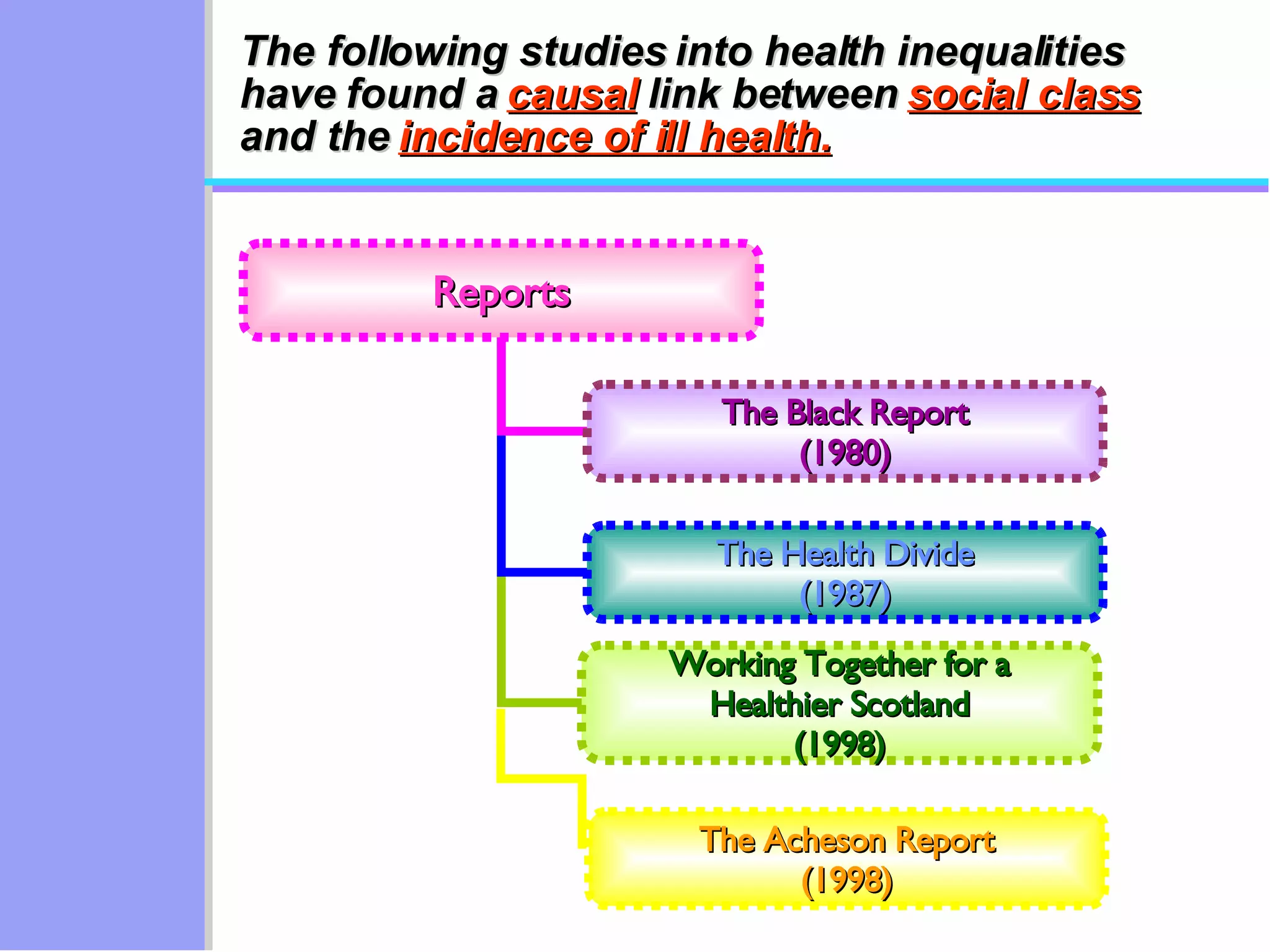
The following studies into health inequalities have found a  causal  link between  social class  and the  incidence of ill health. The Acheson Report (1998) Reports The Black Report (1980) The Health Divide (1987) Working Together for a Healthier Scotland (1998)
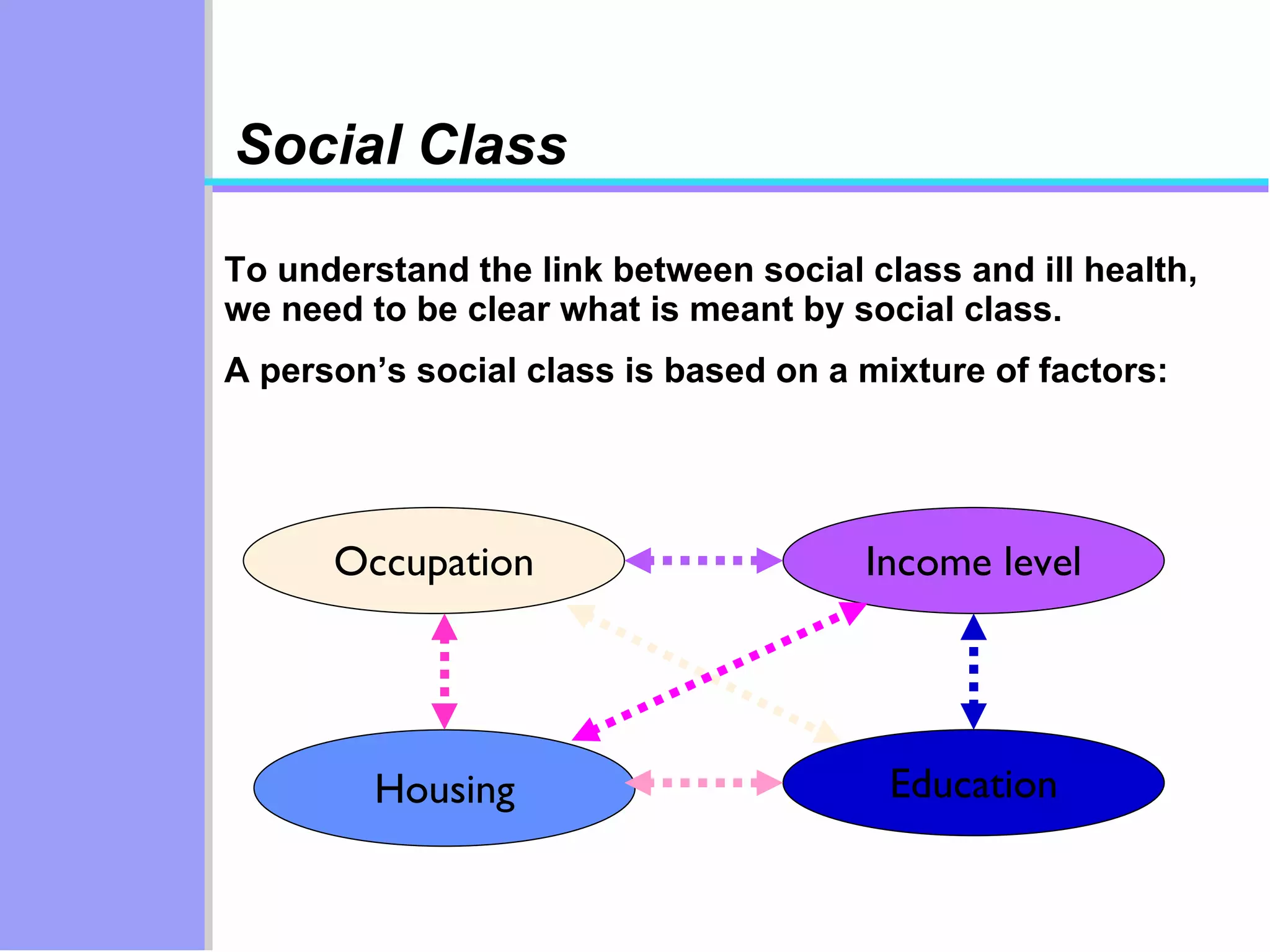
Social Class To understand the link between social class and ill health, we need to be clear what is meant by social class. A person’s social class is based on a mixture of factors: Occupation Income level Housing Education
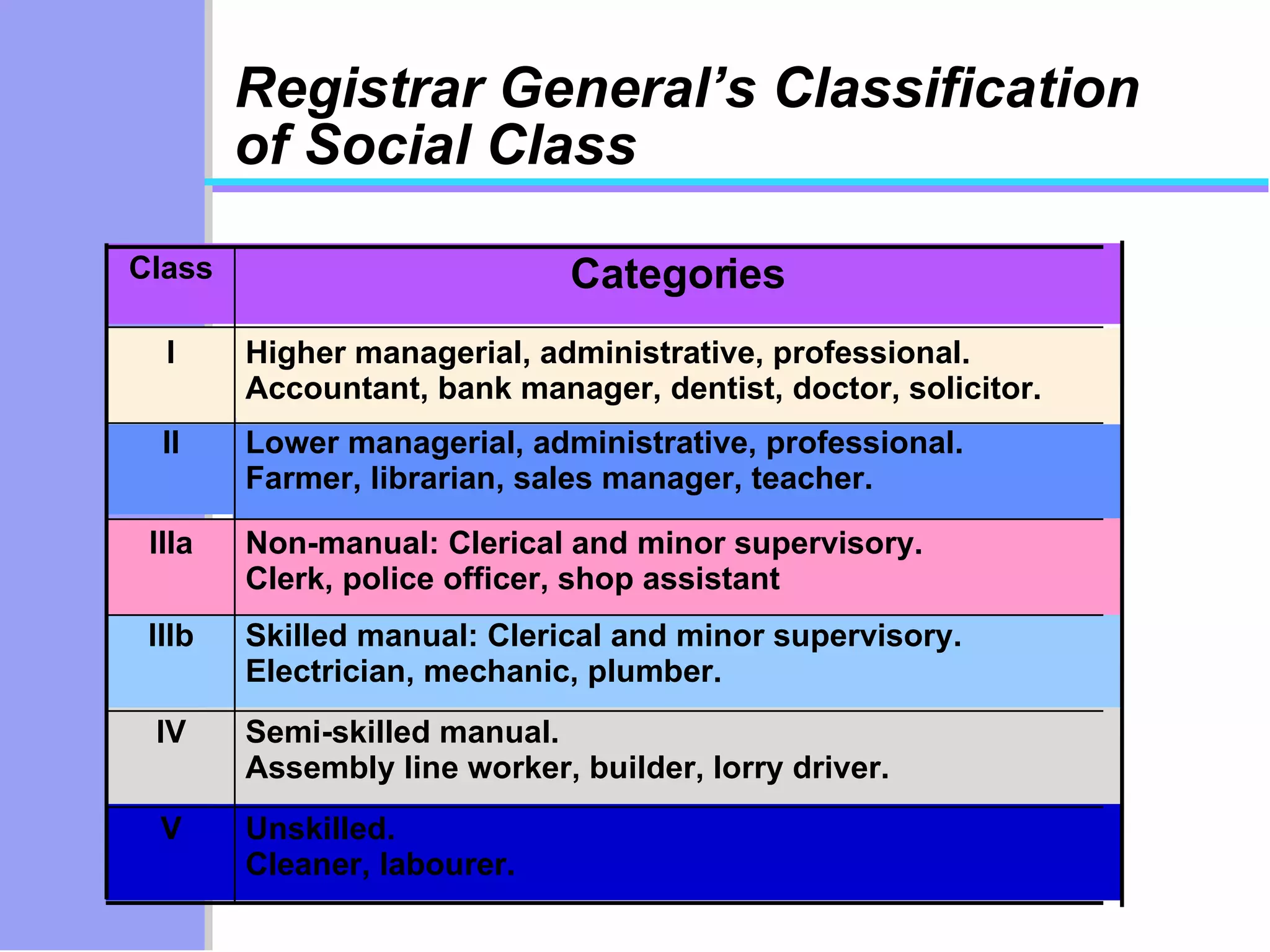
Registrar General’s Classification of Social Class Unskilled. Cleaner, labourer. Semi-skilled manual. Assembly line worker, builder, lorry driver. Skilled manual: Clerical and minor supervisory. Electrician, mechanic, plumber. Non-manual: Clerical and minor supervisory. Clerk, police officer, shop assistant Lower managerial, administrative, professional. Farmer, librarian, sales manager, teacher. Higher managerial, administrative, professional. Accountant, bank manager, dentist, doctor, solicitor. Categories V IV IIIb IIIa II I Class
The Black Report (1980) Remit To investigate the problem of inequalities in health in the UK.  To analyse the lifestyles and health records of people from all social classes (based on the Registrar General’s categories).
The Black Report (1980) Findings The health of the nation had improved generally but the improvement had not been equal across all the social classes.  Gap in inequalities of health between lower and higher social classes was widening.
The Black Report (1980) Findings Health standards were directly linked to social class. Ill health increased down the social scale. The problem had little to do with the NHS.  Problems were linked with social and economic factors such as: income  unemployment poor environment poor housing  education
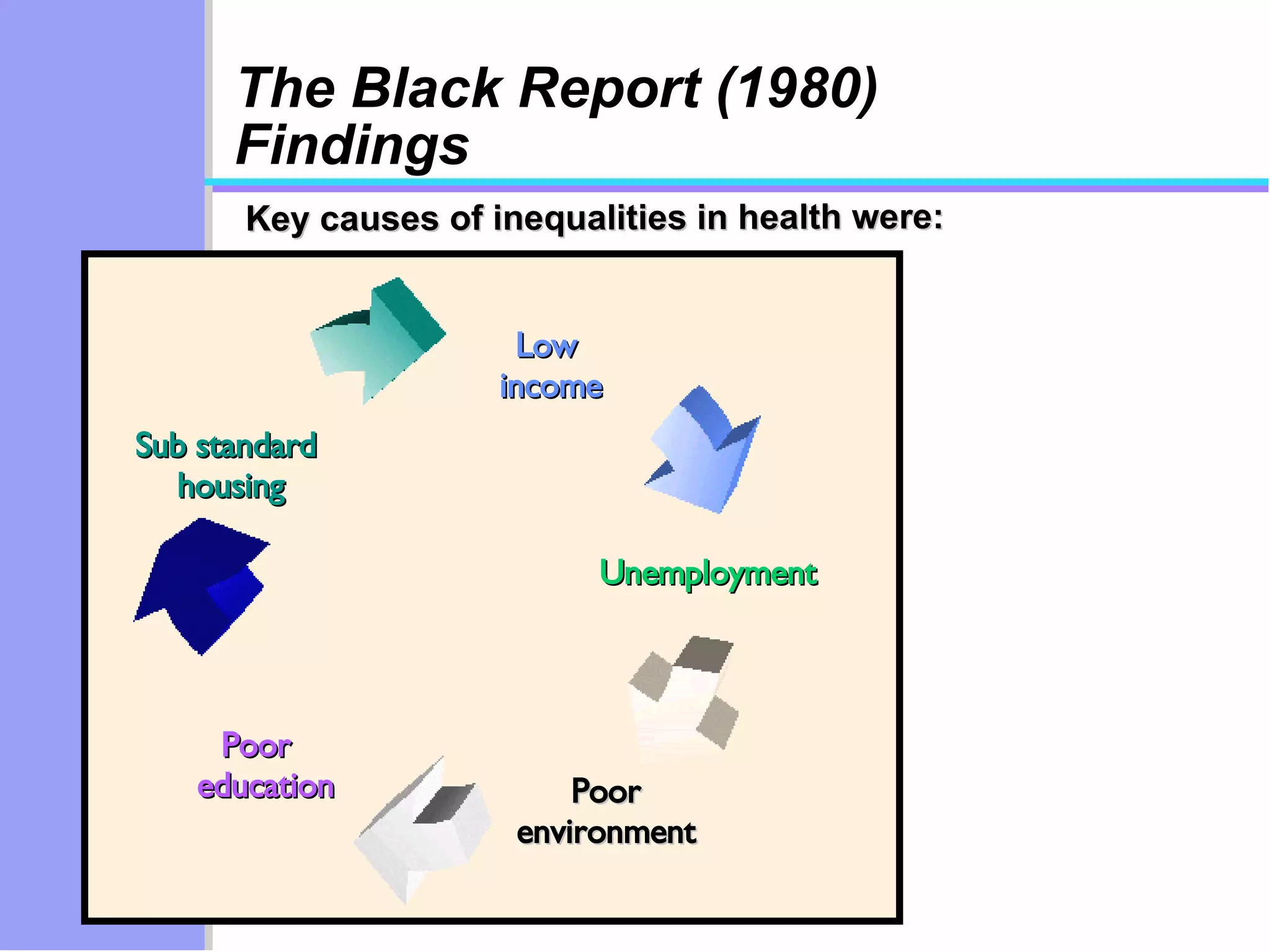
The Black Report (1980) Findings Key causes of inequalities in health were: Low  income Unemployment Sub standard housing Poor environment Poor  education
The Black Report (1980) Recommendations Report contained 37 recommendations which focused on two main areas: Government  should adopt a policy: aimed at reducing poverty in the UK of spending  more money on health education and the prevention of Illness.
The Black Report (1980) Reaction by Government When the Report was published there was a change of government. Conservatives were now in government and they criticised the Report. Report did not  explain inequalities  in health. Spending more on  health services would  make no difference to health  standards. Contrary to what the Report said, poor people did use health services.
The Black Report (1980) Took the individualist approach – people should  eat, drink and smoke  less Argued that individual  behaviour within social classes shaped health Regarded the Report  as old-fashioned,  socialist explanations of ill-health They wanted to reduce public  expenditure Government  disagreed Problem was:
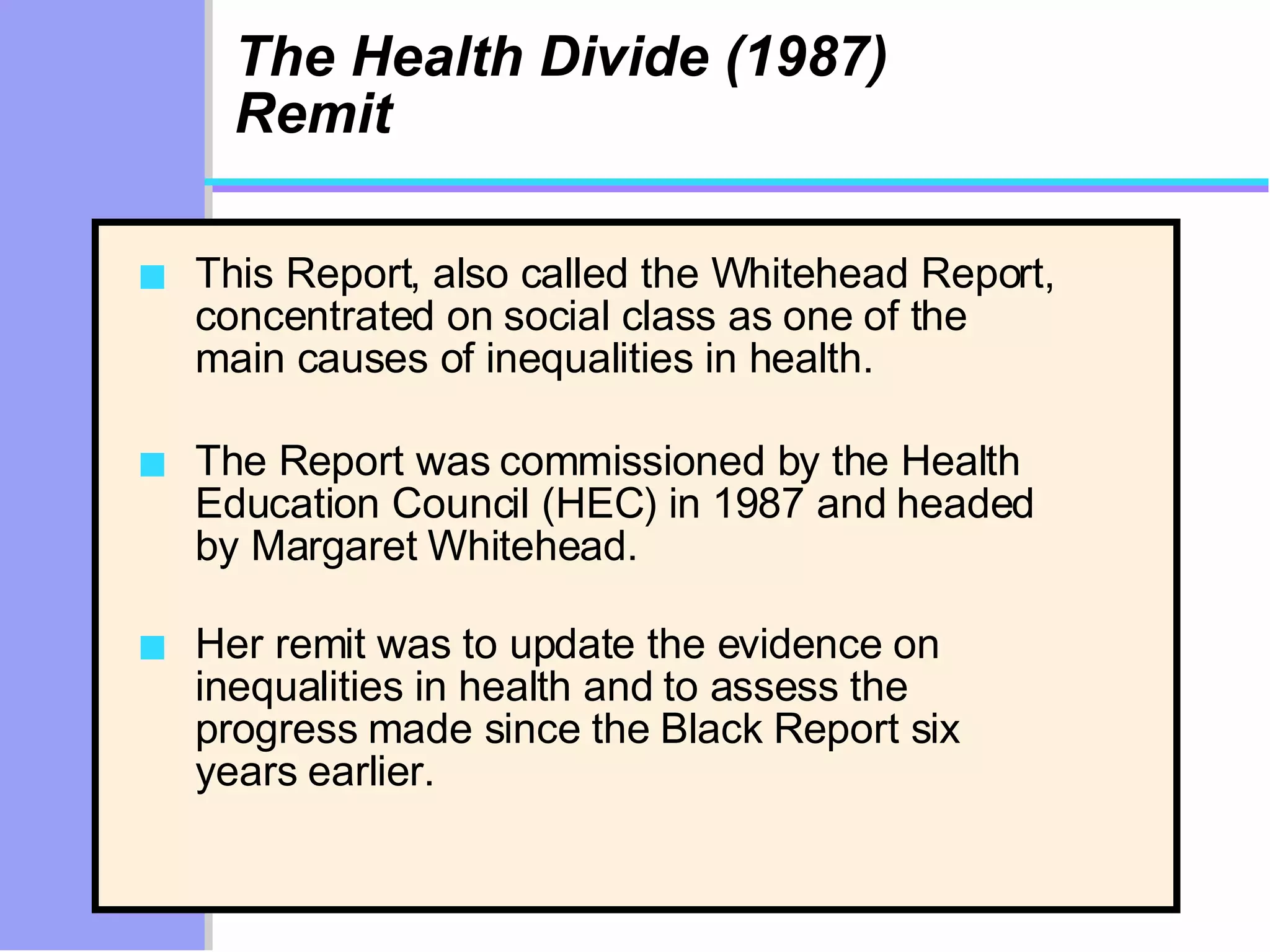
The Health Divide (1987) Remit This Report, also called the Whitehead Report, concentrated on social class as one of the main causes of inequalities in health.  The Report was commissioned by the Health Education Council (HEC) in 1987 and headed by Margaret Whitehead.  Her remit was to update the evidence on inequalities in health and to assess the progress made since the Black Report six years earlier.
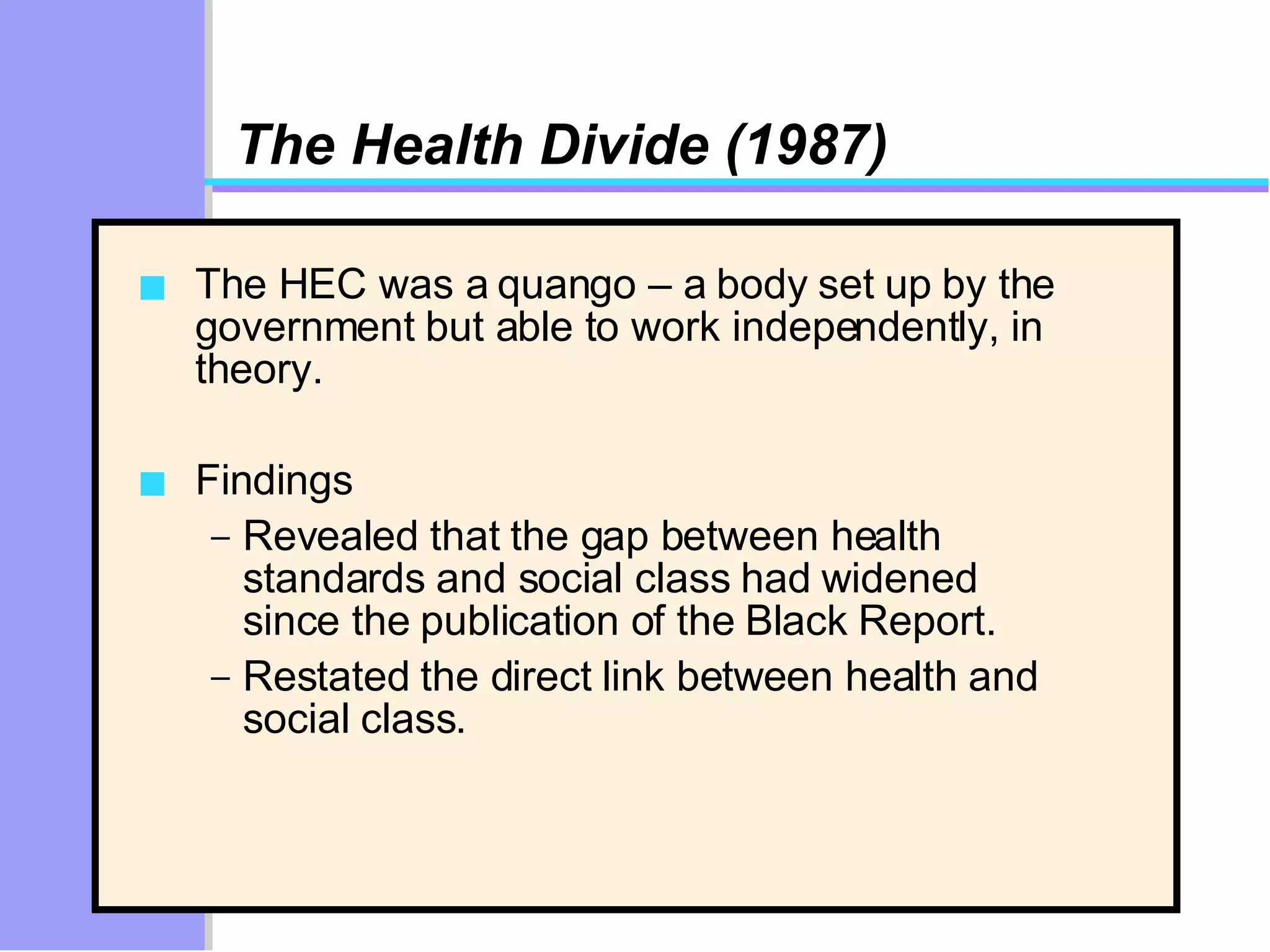
The Health Divide (1987) The HEC was a quango – a body set up by the government but able to work independently, in theory.  Findings Revealed that the gap between health standards and social class had widened since the publication of the Black Report. Restated the direct link between health and social class.
The Health Divide (1987) Government reaction  Just when the Report was being commissioned, the government announced that the HEC was to be scrapped.  HEC was campaigning on alcohol, tobacco and diet issues  which upset some of the government’s financial supporters – tobacco manufacturers gave a lot to party funds.  One week before findings were due to be made public, a press conference was cancelled with no explanation. Clearly pressure had been put on the Chairman of the HEC to cancel because of the controversial nature of the report’s findings.
“ Working Together for a Healthier Scotland”
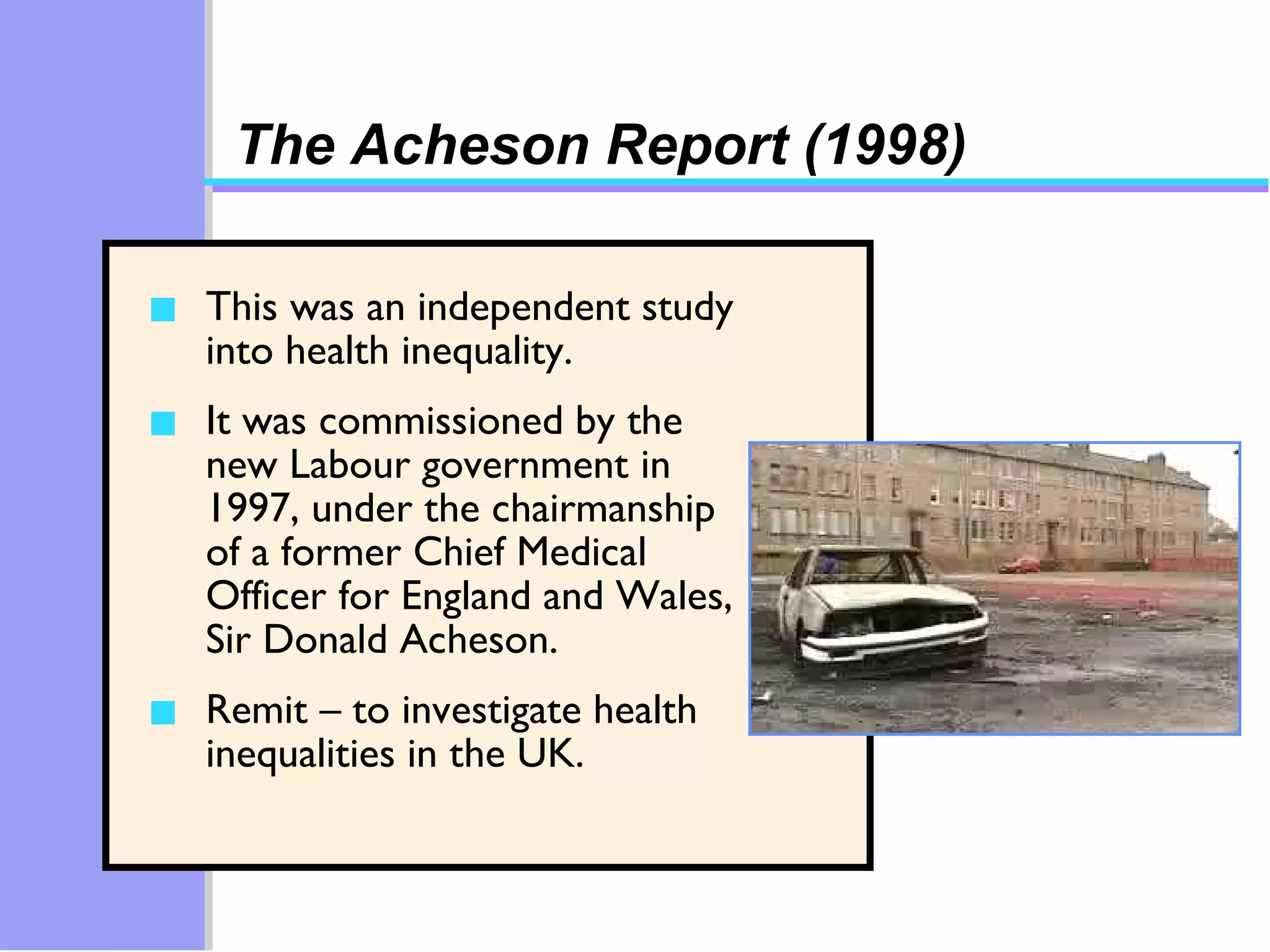
The Acheson Report (1998) This was an independent study into health inequality. It was commissioned by the new Labour government in 1997, under the chairmanship of a former Chief Medical Officer for England and Wales, Sir Donald Acheson.  Remit – to investigate health inequalities in the UK.
The Acheson Report (1998) It was a very comprehensive survey of those in society described as disadvantaged. Its findings mirrored those of the Black Report.  The root cause of inequalities in health was  poverty .  It concluded that in order improve the health of millions, the gap between the richest and poorest in UK society had to be reduced.
The Acheson Report (1998) Findings Children from poor families weighed on average 1.30gms less than those from wealthy families Infant mortality rates: 7/1000 – lower social classes 5/1000 – upper social classes  Long term illness 17% of profession men aged 45-64  48% of  lower class men aged 45-64 Income levels 2.2 million children live on income levels 50% below the national average  Health campaigns Higher uptake of screening amongst upper social classes – widened health gap
The Acheson Report (1998) Findings Poor men are 68% more likely to die in middle age than richer men. Poor women are 55% more likely to die young. Health inequalities start before birth  A key factor in low weight babies is the mother’s birth weight and her pre-pregnant weight. Coronary heart disease Strokes Lung cancer Accidents & suicides Respiratory diseases Risk increases Social class I Social class V
Scotland Health Survey 2003

Inequalities in health - social class

  • 1.
    Causes of Inequalitiesin Health: Socio-economic Status
  • 2.
    Inequalities in HealthA number of studies have been carried out by various groups over the years. Their reports revealed: the nature of health inequalities the scale of the health inequalities the causes of these inequalities in the UK.
  • 3.
    The following studiesinto health inequalities have found a causal link between social class and the incidence of ill health. The Acheson Report (1998) Reports The Black Report (1980) The Health Divide (1987) Working Together for a Healthier Scotland (1998)
  • 4.
    Social Class Tounderstand the link between social class and ill health, we need to be clear what is meant by social class. A person’s social class is based on a mixture of factors: Occupation Income level Housing Education
  • 5.
    Registrar General’s Classificationof Social Class Unskilled. Cleaner, labourer. Semi-skilled manual. Assembly line worker, builder, lorry driver. Skilled manual: Clerical and minor supervisory. Electrician, mechanic, plumber. Non-manual: Clerical and minor supervisory. Clerk, police officer, shop assistant Lower managerial, administrative, professional. Farmer, librarian, sales manager, teacher. Higher managerial, administrative, professional. Accountant, bank manager, dentist, doctor, solicitor. Categories V IV IIIb IIIa II I Class
  • 6.
    The Black Report(1980) Remit To investigate the problem of inequalities in health in the UK. To analyse the lifestyles and health records of people from all social classes (based on the Registrar General’s categories).
  • 7.
    The Black Report(1980) Findings The health of the nation had improved generally but the improvement had not been equal across all the social classes. Gap in inequalities of health between lower and higher social classes was widening.
  • 8.
    The Black Report(1980) Findings Health standards were directly linked to social class. Ill health increased down the social scale. The problem had little to do with the NHS. Problems were linked with social and economic factors such as: income unemployment poor environment poor housing education
  • 9.
    The Black Report(1980) Findings Key causes of inequalities in health were: Low income Unemployment Sub standard housing Poor environment Poor education
  • 10.
    The Black Report(1980) Recommendations Report contained 37 recommendations which focused on two main areas: Government should adopt a policy: aimed at reducing poverty in the UK of spending more money on health education and the prevention of Illness.
  • 11.
    The Black Report(1980) Reaction by Government When the Report was published there was a change of government. Conservatives were now in government and they criticised the Report. Report did not explain inequalities in health. Spending more on health services would make no difference to health standards. Contrary to what the Report said, poor people did use health services.
  • 12.
    The Black Report(1980) Took the individualist approach – people should eat, drink and smoke less Argued that individual behaviour within social classes shaped health Regarded the Report as old-fashioned, socialist explanations of ill-health They wanted to reduce public expenditure Government disagreed Problem was:
  • 13.
    The Health Divide(1987) Remit This Report, also called the Whitehead Report, concentrated on social class as one of the main causes of inequalities in health. The Report was commissioned by the Health Education Council (HEC) in 1987 and headed by Margaret Whitehead. Her remit was to update the evidence on inequalities in health and to assess the progress made since the Black Report six years earlier.
  • 14.
    The Health Divide(1987) The HEC was a quango – a body set up by the government but able to work independently, in theory. Findings Revealed that the gap between health standards and social class had widened since the publication of the Black Report. Restated the direct link between health and social class.
  • 15.
    The Health Divide(1987) Government reaction Just when the Report was being commissioned, the government announced that the HEC was to be scrapped. HEC was campaigning on alcohol, tobacco and diet issues which upset some of the government’s financial supporters – tobacco manufacturers gave a lot to party funds. One week before findings were due to be made public, a press conference was cancelled with no explanation. Clearly pressure had been put on the Chairman of the HEC to cancel because of the controversial nature of the report’s findings.
  • 16.
    “ Working Togetherfor a Healthier Scotland”
  • 17.
    The Acheson Report(1998) This was an independent study into health inequality. It was commissioned by the new Labour government in 1997, under the chairmanship of a former Chief Medical Officer for England and Wales, Sir Donald Acheson. Remit – to investigate health inequalities in the UK.
  • 18.
    The Acheson Report(1998) It was a very comprehensive survey of those in society described as disadvantaged. Its findings mirrored those of the Black Report. The root cause of inequalities in health was poverty . It concluded that in order improve the health of millions, the gap between the richest and poorest in UK society had to be reduced.
  • 19.
    The Acheson Report(1998) Findings Children from poor families weighed on average 1.30gms less than those from wealthy families Infant mortality rates: 7/1000 – lower social classes 5/1000 – upper social classes Long term illness 17% of profession men aged 45-64 48% of lower class men aged 45-64 Income levels 2.2 million children live on income levels 50% below the national average Health campaigns Higher uptake of screening amongst upper social classes – widened health gap
  • 20.
    The Acheson Report(1998) Findings Poor men are 68% more likely to die in middle age than richer men. Poor women are 55% more likely to die young. Health inequalities start before birth A key factor in low weight babies is the mother’s birth weight and her pre-pregnant weight. Coronary heart disease Strokes Lung cancer Accidents & suicides Respiratory diseases Risk increases Social class I Social class V
  • 21.