Electronics Exercise 2: The 555 Timer and it’s applications
Mechatronics Instructional Laboratory
Woodruff School of Mechanical Engineering
Georgia Institute of Technology
Lab Director: I. Charles Ume, Professor
Author: Kita , Development TA Summer 2004
Revised by Jie, TA Fall 2011:

Objective:
1. Learn about the 555 timer integrated circuit and applications
2. Apply the 555 timer to build an infrared (IR) transmitter and receiver

1. The 555 Timer
The 555 timer integrated circuit (IC) has become a mainstay in electronics design. A 555 timer will
produce a pulse when a trigger signal is applied to it. The pulse length is determined by charging then
discharging a capacitor connected to a 555 timer. A 555 timer can be used to debounce switches, modulate
signals, create accurate clock signals, create pulse width modulated (PWM) signals, etc. A 555 timer can be
obtained from various manufacturers including Fairchild Semiconductor and National Semiconductor.

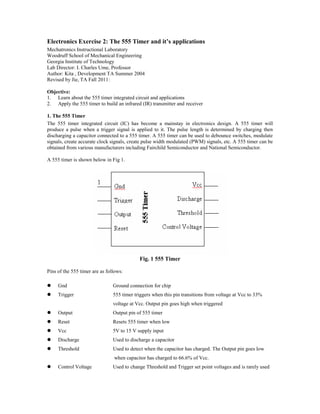
A 555 timer is shown below in Fig 1.


                                            Fig. 1 555 Timer

Pins of the 555 timer are as follows:

    Gnd                        Ground connection for chip
    Trigger                    555 timer triggers when this pin transitions from voltage at Vcc to 33%
     v                          voltage at Vcc. Output pin goes high when triggered
    Output                     Output pin of 555 timer
    Reset                      Resets 555 timer when low
    Vcc                        5V to 15 V supply input
    Discharge                  Used to discharge a capacitor
    Threshold                  Used to detect when the capacitor has charged. The Output pin goes low
     w                          when capacitor has charged to 66.6% of Vcc.
    Control Voltage            Used to change Threshold and Trigger set point voltages and is rarely used
1.1 555 Timer Monostable Circuit
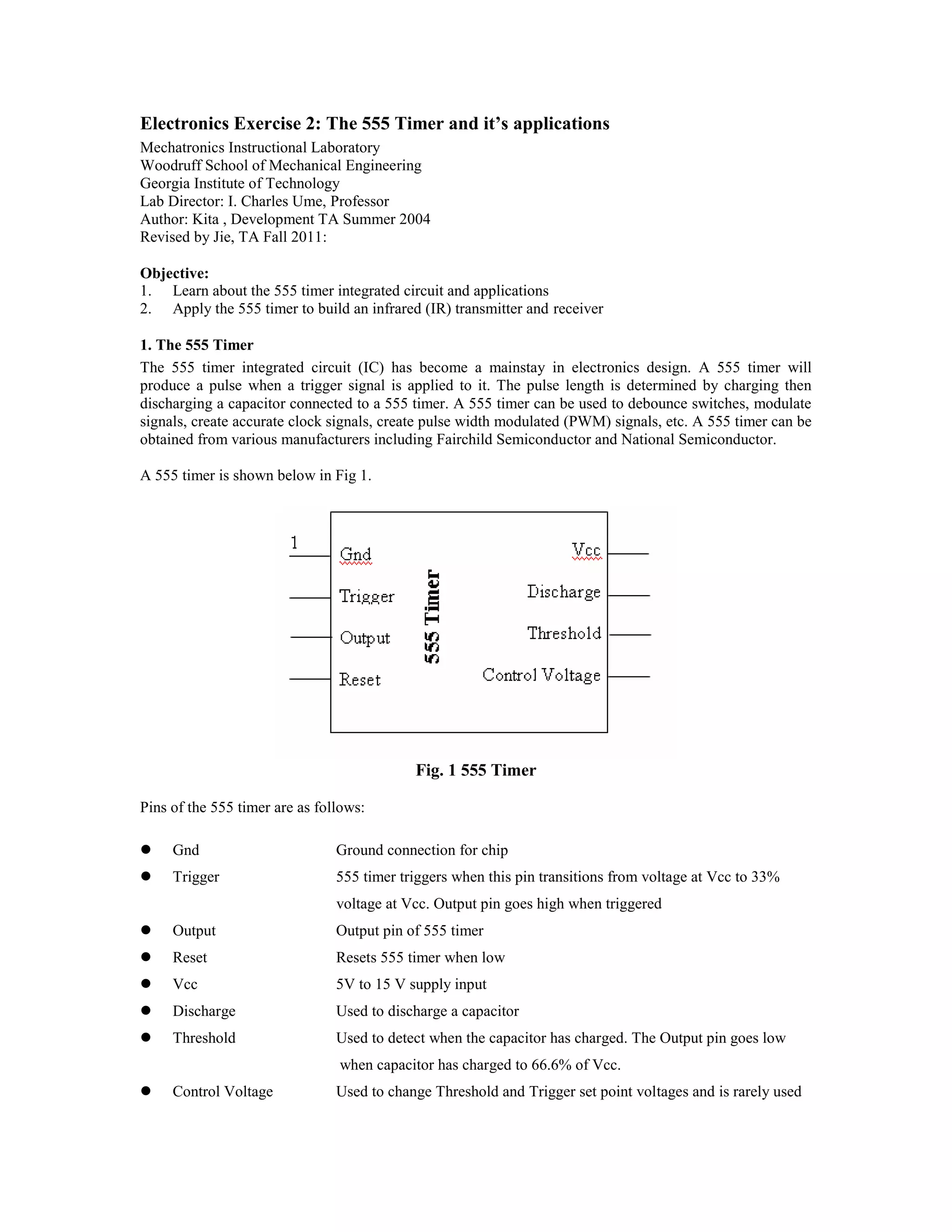
Fig. 2 shows a monostable 555 timer circuit. The monostable circuit outputs one pulse for each high to low
transition of the trigger pin.


                                   Fig. 2 Monostable 555 Timer Circuit

The discharge pin is internally connected to ground. The discharge pin is disconnected from ground and
output pin is set high when the trigger pin transitions from Vcc to 33% Vcc Voltage. The capacitor, C,
starts to charge through resistor, R. The threshold pin is used to detect when the voltage across the
capacitor reaches 66.6% Vcc voltage. When the voltage across the capacitor reaches 66.6% Vcc voltage,
the output pin is set low and the discharge pin is connected back to ground. When the discharge pin is
connected back to ground, the capacitor is discharged.

The length of the output pulse depends on when the capacitor reaches 66.6% Vcc voltage. This rate is
determined by the charge capacity of the capacitor, C, and resistance, R. The length of the output pulse, tP,
is:

                                           t = 1.1 RC
                                            P


The monostable 555 timer circuit can be used in the following applications:
1. Debounce a momentary/pushbutton switch
2. Turning on an actuator for a set period of time
3. Turn an output from a resistive sensor from analog signal to digital signal. ( Example: A
potentiometer is a variable resistor. A project requires determining the position of a potentiometer used for
user input. All analog to digital (A/D) converters on a microcontroller have already been used but there are
some digital inputs and outputs available. The potentiometer can be used as the resistor in a monostable
555 timer circuit. The microcontroller can then trigger the monostable circuit and measure tP since tP now
depends on the position of the potentiomenter.)

1.2 555 Timer Astable Circuit
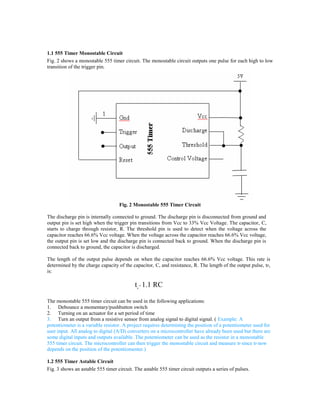
Fig. 3 shows an astable 555 timer circuit. The astable 555 timer circuit outputs a series of pulses.
Fig. 3 Astable 555 Timer Circuit

When the circuit is first turned on, the discharge pin is disconnected from ground and output pin is set high
because the trigger pin is below 33% Vcc Voltage. The capacitor, C, starts to charge through resistors R1
and R2. The threshold pin is used to detect when the voltage across the capacitor reaches 66.6% Vcc
voltage. When the voltage across the capacitor reaches 66.6% Vcc voltage, the output pin is set low and the
discharge pin is connected back to ground. When the discharge pin is connected back to ground, the
capacitor starts discharging though resistor R2. When the voltage across the capacitor reaches 33.3% Vcc
voltage, the cycle repeats and creates a series of output pulses. An astable circuit triggers from previous
output pulse whereas a monostable circuit requires an externally applied trigger.

The output pin oscillates from high to low creating a series of output pulses. The duration the output pin
stays high , t , is given below:
             HIGH


                                          t   HIGH
                                                     =   .693 ⋅C ⋅(R1+ R2)

The duration the output pin stays low, t , is given below:
                                         LOW


                                                         t .693⋅ C ⋅ R2
                                                         LOW


The frequency, f, of the series of pulses is:
                                                                      1
                                                         f=t
                                                               HIGH   +t LOW

The astable 555 timer circuit can be used in the following applications:
1. Modulate transmitters such as ultrasonic and IR transmitters
2. Create an accurate clock signal (Example: There is a pulse accumulator pin on the 68HC11
microcontroller that counts pulses. You can apply an astable 555 timer circuit set at 1 Hz frequency to the
pulse accumulator pin and create a seconds counter within the microcontroller. The pulse accumulator will
be covered in later in the course.)
3. Turn on and off an actuator at set time intervals for a fixed duration
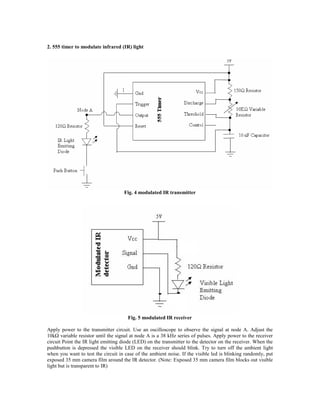
2. 555 timer to modulate infrared (IR) light


                                    Fig. 4 modulated IR transmitter


                                      Fig. 5 modulated IR receiver

Apply power to the transmitter circuit. Use an oscilloscope to observe the signal at node A. Adjust the
10kΩ variable resistor until the signal at node A is a 38 kHz series of pulses. Apply power to the receiver
circuit Point the IR light emitting diode (LED) on the transmitter to the detector on the receiver. When the
pushbutton is depressed the visible LED on the receiver should blink. Try to turn off the ambient light
when you want to test the circuit in case of the ambient noise. If the visible led is blinking randomly, put
exposed 35 mm camera film around the IR detector. (Note: Exposed 35 mm camera film blocks out visible
light but is transparent to IR)
Questions:
1     How far away can the transmitter and receiver be before the signal from the transmitter to receiver is
lost?
2     What applications can this circuit be used for?

555 timer

  • 1.
    Electronics Exercise 2:The 555 Timer and it’s applications Mechatronics Instructional Laboratory Woodruff School of Mechanical Engineering Georgia Institute of Technology Lab Director: I. Charles Ume, Professor Author: Kita , Development TA Summer 2004 Revised by Jie, TA Fall 2011: Objective: 1. Learn about the 555 timer integrated circuit and applications 2. Apply the 555 timer to build an infrared (IR) transmitter and receiver 1. The 555 Timer The 555 timer integrated circuit (IC) has become a mainstay in electronics design. A 555 timer will produce a pulse when a trigger signal is applied to it. The pulse length is determined by charging then discharging a capacitor connected to a 555 timer. A 555 timer can be used to debounce switches, modulate signals, create accurate clock signals, create pulse width modulated (PWM) signals, etc. A 555 timer can be obtained from various manufacturers including Fairchild Semiconductor and National Semiconductor. A 555 timer is shown below in Fig 1. Fig. 1 555 Timer Pins of the 555 timer are as follows:  Gnd Ground connection for chip  Trigger 555 timer triggers when this pin transitions from voltage at Vcc to 33% v voltage at Vcc. Output pin goes high when triggered  Output Output pin of 555 timer  Reset Resets 555 timer when low  Vcc 5V to 15 V supply input  Discharge Used to discharge a capacitor  Threshold Used to detect when the capacitor has charged. The Output pin goes low w when capacitor has charged to 66.6% of Vcc.  Control Voltage Used to change Threshold and Trigger set point voltages and is rarely used
  • 2.
    1.1 555 TimerMonostable Circuit Fig. 2 shows a monostable 555 timer circuit. The monostable circuit outputs one pulse for each high to low transition of the trigger pin. Fig. 2 Monostable 555 Timer Circuit The discharge pin is internally connected to ground. The discharge pin is disconnected from ground and output pin is set high when the trigger pin transitions from Vcc to 33% Vcc Voltage. The capacitor, C, starts to charge through resistor, R. The threshold pin is used to detect when the voltage across the capacitor reaches 66.6% Vcc voltage. When the voltage across the capacitor reaches 66.6% Vcc voltage, the output pin is set low and the discharge pin is connected back to ground. When the discharge pin is connected back to ground, the capacitor is discharged. The length of the output pulse depends on when the capacitor reaches 66.6% Vcc voltage. This rate is determined by the charge capacity of the capacitor, C, and resistance, R. The length of the output pulse, tP, is: t = 1.1 RC P The monostable 555 timer circuit can be used in the following applications: 1. Debounce a momentary/pushbutton switch 2. Turning on an actuator for a set period of time 3. Turn an output from a resistive sensor from analog signal to digital signal. ( Example: A potentiometer is a variable resistor. A project requires determining the position of a potentiometer used for user input. All analog to digital (A/D) converters on a microcontroller have already been used but there are some digital inputs and outputs available. The potentiometer can be used as the resistor in a monostable 555 timer circuit. The microcontroller can then trigger the monostable circuit and measure tP since tP now depends on the position of the potentiomenter.) 1.2 555 Timer Astable Circuit Fig. 3 shows an astable 555 timer circuit. The astable 555 timer circuit outputs a series of pulses.
  • 3.
    Fig. 3 Astable555 Timer Circuit When the circuit is first turned on, the discharge pin is disconnected from ground and output pin is set high because the trigger pin is below 33% Vcc Voltage. The capacitor, C, starts to charge through resistors R1 and R2. The threshold pin is used to detect when the voltage across the capacitor reaches 66.6% Vcc voltage. When the voltage across the capacitor reaches 66.6% Vcc voltage, the output pin is set low and the discharge pin is connected back to ground. When the discharge pin is connected back to ground, the capacitor starts discharging though resistor R2. When the voltage across the capacitor reaches 33.3% Vcc voltage, the cycle repeats and creates a series of output pulses. An astable circuit triggers from previous output pulse whereas a monostable circuit requires an externally applied trigger. The output pin oscillates from high to low creating a series of output pulses. The duration the output pin stays high , t , is given below: HIGH t HIGH = .693 ⋅C ⋅(R1+ R2) The duration the output pin stays low, t , is given below: LOW t .693⋅ C ⋅ R2 LOW The frequency, f, of the series of pulses is: 1 f=t HIGH +t LOW The astable 555 timer circuit can be used in the following applications: 1. Modulate transmitters such as ultrasonic and IR transmitters 2. Create an accurate clock signal (Example: There is a pulse accumulator pin on the 68HC11 microcontroller that counts pulses. You can apply an astable 555 timer circuit set at 1 Hz frequency to the pulse accumulator pin and create a seconds counter within the microcontroller. The pulse accumulator will be covered in later in the course.) 3. Turn on and off an actuator at set time intervals for a fixed duration
  • 4.
    2. 555 timerto modulate infrared (IR) light Fig. 4 modulated IR transmitter Fig. 5 modulated IR receiver Apply power to the transmitter circuit. Use an oscilloscope to observe the signal at node A. Adjust the 10kΩ variable resistor until the signal at node A is a 38 kHz series of pulses. Apply power to the receiver circuit Point the IR light emitting diode (LED) on the transmitter to the detector on the receiver. When the pushbutton is depressed the visible LED on the receiver should blink. Try to turn off the ambient light when you want to test the circuit in case of the ambient noise. If the visible led is blinking randomly, put exposed 35 mm camera film around the IR detector. (Note: Exposed 35 mm camera film blocks out visible light but is transparent to IR)
  • 5.
    Questions: 1 How far away can the transmitter and receiver be before the signal from the transmitter to receiver is lost? 2 What applications can this circuit be used for?