Please read this disclaimer before proceeding:
This document is confidential and intended solely for the educational purpose of RMK
Group of Educational Institutions. If you have received this document through email in
error, please notify the system manager. This document contains proprietary
information and is intended only to the respective group / learning community as
intended. If you are not the addressee you should not disseminate, distribute or copy
through e-mail. Please notify the sender immediately by e-mail if you have received
this document by mistake and delete this document from your system. If you are not
the intended recipient you are notified that disclosing, copying, distributing or taking
any action in reliance on the contents of this information is strictly prohibited.
CS8451
Design and Analysis of Algorithms
Department: IT
Batch/Year: 2020-24/II
Created by:
Dr.B.Kalpana
Table of Contents
Sl.
No.
Topics
Page
No.
1. Contents 5
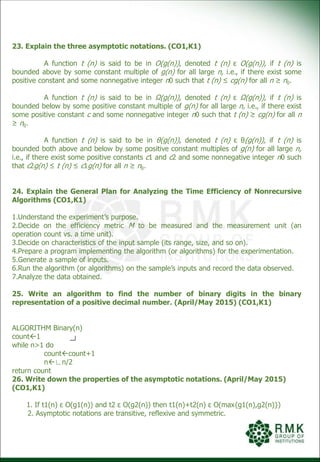
2. Course Objectives 7
3. Pre Requisites (Course Name with Code) 9
4. Syllabus (With Subject Code, Name, LTPC details) 11
5. Course Outcomes (6) 13
6. CO-PO/PSO Mapping 15
7.
Lecture Plan (S.No., Topic, No. of Periods, Proposed date,
Actual Lecture Date, pertaining CO, Taxonomy level, Mode of
Delivery)
17
8. Activity based learning 20
9.
Lecture Notes ( with Links to Videos, e-book reference, PPTs,
Quiz and any other learning materials )
22
10.
Assignments ( For higher level learning and Evaluation -
Examples: Case study, Comprehensive design, etc.,)
71
11. Part A Q & A (with K level and CO) 73
12. Part B Qs (with K level and CO) 80
13.
Supportive online Certification courses (NPTEL, Swayam,
Coursera, Udemy, etc.,)
82
14. Real time Applications in day to day life and to Industry 84
15.
Contents beyond the Syllabus ( COE related Value added
courses)
86
16. Assessment Schedule ( Proposed Date & Actual Date) 89
17. Prescribed Text Books & Reference Books 91
18. Mini Project 93
Course Objectives
Course Objectives
• To understand and apply the algorithm analysis techniques.
• To critically analyze the efficiency of alternative algorithmic solutions for the same
problem
• To understand different algorithm design techniques.
• To understand the limitations of Algorithmic power.
Pre Requisites
Prerequisites
SUBJECT CODE: CS8291
SUBJECT NAME: Data Structures
Syllabus
Syllabus
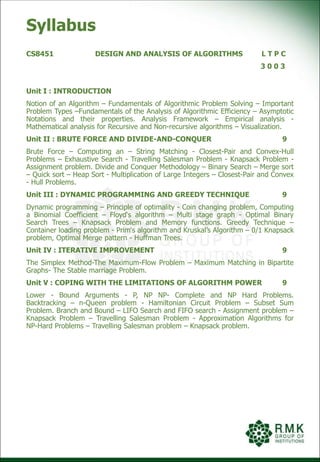
CS8451 DESIGN AND ANALYSIS OF ALGORITHMS L T P C
3 0 0 3
Unit I : INTRODUCTION
Notion of an Algorithm – Fundamentals of Algorithmic Problem Solving – Important
Problem Types –Fundamentals of the Analysis of Algorithmic Efficiency – Asymptotic
Notations and their properties. Analysis Framework – Empirical analysis -
Mathematical analysis for Recursive and Non-recursive algorithms – Visualization.
Unit II : BRUTE FORCE AND DIVIDE-AND-CONQUER 9
Brute Force – Computing an – String Matching - Closest-Pair and Convex-Hull
Problems – Exhaustive Search - Travelling Salesman Problem - Knapsack Problem -
Assignment problem. Divide and Conquer Methodology – Binary Search – Merge sort
– Quick sort – Heap Sort - Multiplication of Large Integers – Closest-Pair and Convex
- Hull Problems.
Unit III : DYNAMIC PROGRAMMING AND GREEDY TECHNIQUE 9
Dynamic programming – Principle of optimality - Coin changing problem, Computing
a Binomial Coefficient – Floyd‘s algorithm – Multi stage graph - Optimal Binary
Search Trees – Knapsack Problem and Memory functions. Greedy Technique –
Container loading problem - Prim‘s algorithm and Kruskal’s Algorithm – 0/1 Knapsack
problem, Optimal Merge pattern - Huffman Trees.
Unit IV : ITERATIVE IMPROVEMENT 9
The Simplex Method-The Maximum-Flow Problem – Maximum Matching in Bipartite
Graphs- The Stable marriage Problem.
Unit V : COPING WITH THE LIMITATIONS OF ALGORITHM POWER 9
Lower - Bound Arguments - P, NP NP- Complete and NP Hard Problems.
Backtracking – n-Queen problem - Hamiltonian Circuit Problem – Subset Sum
Problem. Branch and Bound – LIFO Search and FIFO search - Assignment problem –
Knapsack Problem – Travelling Salesman Problem - Approximation Algorithms for
NP-Hard Problems – Travelling Salesman problem – Knapsack problem.
Course Outcomes
Course Outcomes
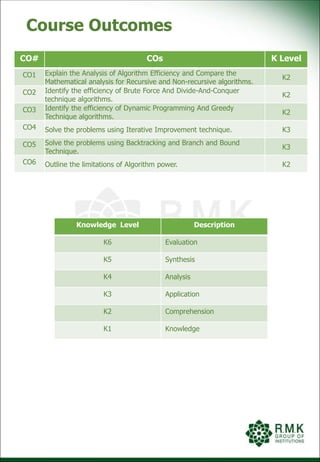
CO# COs K Level
CO1 Explain the Analysis of Algorithm Efficiency and Compare the
Mathematical analysis for Recursive and Non-recursive algorithms.
K2
CO2 Identify the efficiency of Brute Force And Divide-And-Conquer
technique algorithms.
K2
CO3 Identify the efficiency of Dynamic Programming And Greedy
Technique algorithms.
K2
CO4 Solve the problems using Iterative Improvement technique. K3
CO5 Solve the problems using Backtracking and Branch and Bound
Technique.
K3
CO6 Outline the limitations of Algorithm power. K2
Knowledge Level Description
K6 Evaluation
K5 Synthesis
K4 Analysis
K3 Application
K2 Comprehension
K1 Knowledge
CO – PO/PSO Mapping
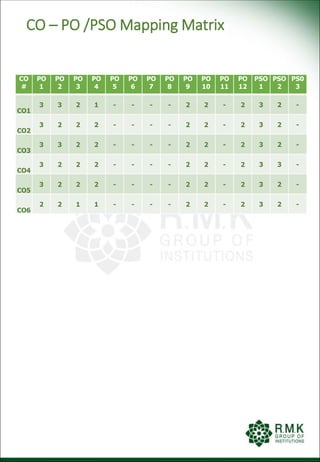
CO – PO /PSO Mapping Matrix
CO
#
PO
1
PO
2
PO
3
PO
4
PO
5
PO
6
PO
7
PO
8
PO
9
PO
10
PO
11
PO
12
PSO
1
PSO
2
PS0
3
CO1
3 3 2 1 - - - - 2 2 - 2 3 2 -
CO2
3 2 2 2 - - - - 2 2 - 2 3 2 -
CO3
3 3 2 2 - - - - 2 2 - 2 3 2 -
CO4
3 2 2 2 - - - - 2 2 - 2 3 3 -
CO5
3 2 2 2 - - - - 2 2 - 2 3 2 -
CO6
2 2 1 1 - - - - 2 2 - 2 3 2 -
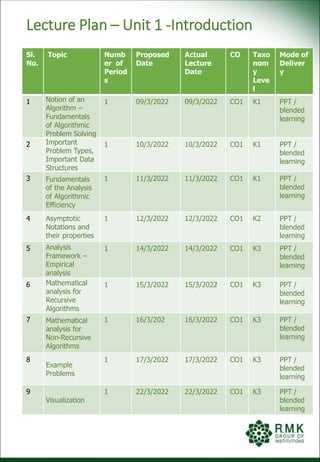
Lecture Plan
Unit I
Lecture Plan – Unit 1 -Introduction
Sl.
No.
Topic Numb
er of
Period
s
Proposed
Date
Actual
Lecture
Date
CO Taxo
nom
y
Leve
l
Mode of
Deliver
y
1 Notion of an
Algorithm –
Fundamentals
of Algorithmic
Problem Solving
1 09/3/2022 09/3/2022 CO1 K1 PPT /
blended
learning
2 Important
Problem Types,
Important Data
Structures
1 10/3/2022 10/3/2022 CO1 K1 PPT /
blended
learning
3 Fundamentals
of the Analysis
of Algorithmic
Efficiency
1 11/3/2022 11/3/2022 CO1 K1 PPT /
blended
learning
4 Asymptotic
Notations and
their properties
1 12/3/2022 12/3/2022 CO1 K2 PPT /
blended
learning
5 Analysis
Framework –
Empirical
analysis
1 14/3/2022 14/3/2022 CO1 K3 PPT /
blended
learning
6 Mathematical
analysis for
Recursive
Algorithms
1 15/3/2022 15/3/2022 CO1 K3 PPT /
blended
learning
7 Mathematical
analysis for
Non-Recursive
Algorithms
1 16/3/202 16/3/2022 CO1 K3 PPT /
blended
learning
8
Example
Problems
1 17/3/2022 17/3/2022 CO1 K3 PPT /
blended
learning
9
Visualization
1 22/3/2022 22/3/2022 CO1 K3 PPT /
blended
learning
Activity Based Learning
Unit I
Activity Based Learning
Flash cards
Programming Skills
https://hr.gs/daaunit1-test1
https://hr.gs/daaunit1-test2
https://hr.gs/DAA-mcqunit1-test1
https://hr.gs/DAA-mcqunit1-test2
https://www.brainscape.com/p/3PP0P-LH-ABREL
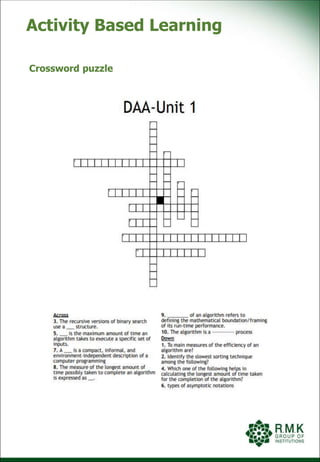
Activity Based Learning
Crossword puzzle
Lecture Notes – Unit 1
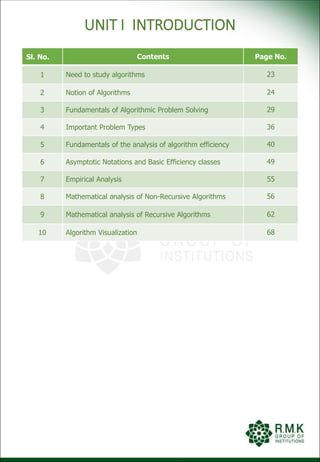
UNIT I INTRODUCTION
Sl. No. Contents Page No.
1 Need to study algorithms 23
2 Notion of Algorithms 24
3 Fundamentals of Algorithmic Problem Solving 29
4 Important Problem Types 36
5 Fundamentals of the analysis of algorithm efficiency 40
6 Asymptotic Notations and Basic Efficiency classes 49
7 Empirical Analysis 55
8 Mathematical analysis of Non-Recursive Algorithms 56
9 Mathematical analysis of Recursive Algorithms 62
10 Algorithm Visualization 68
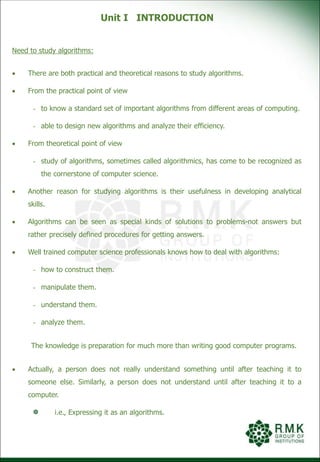
Unit I INTRODUCTION
Need to study algorithms:
 There are both practical and theoretical reasons to study algorithms.
 From the practical point of view
- to know a standard set of important algorithms from different areas of computing.
- able to design new algorithms and analyze their efficiency.
 From theoretical point of view
- study of algorithms, sometimes called algorithmics, has come to be recognized as
the cornerstone of computer science.
 Another reason for studying algorithms is their usefulness in developing analytical
skills.
 Algorithms can be seen as special kinds of solutions to problems-not answers but
rather precisely defined procedures for getting answers.
 Well trained computer science professionals knows how to deal with algorithms:
- how to construct them.
- manipulate them.
- understand them.
- analyze them.
The knowledge is preparation for much more than writing good computer programs.
 Actually, a person does not really understand something until after teaching it to
someone else. Similarly, a person does not understand until after teaching it to a
computer.
i.e., Expressing it as an algorithms.
Unit I INTRODUCTION
1.0 Notion of algorithms
What is an algorithm?
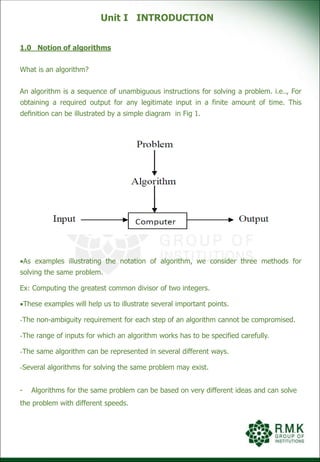
An algorithm is a sequence of unambiguous instructions for solving a problem. i.e.., For
obtaining a required output for any legitimate input in a finite amount of time. This
definition can be illustrated by a simple diagram in Fig 1.
Fig 1 Notion of Algorithms
As examples illustrating the notation of algorithm, we consider three methods for
solving the same problem.
Ex: Computing the greatest common divisor of two integers.
These examples will help us to illustrate several important points.
-The non-ambiguity requirement for each step of an algorithm cannot be compromised.
-The range of inputs for which an algorithm works has to be specified carefully.
-The same algorithm can be represented in several different ways.
-Several algorithms for solving the same problem may exist.
- Algorithms for the same problem can be based on very different ideas and can solve
the problem with different speeds.
Unit I INTRODUCTION
Problem:
Greatest common divisor of two non-negative, non-both zero integers m and n, denoted
gcd(m,n).
gcd(m,n) is defined as the largest integer that divides both m and n evenly, i.e., with a
remainder zero.
I Method:
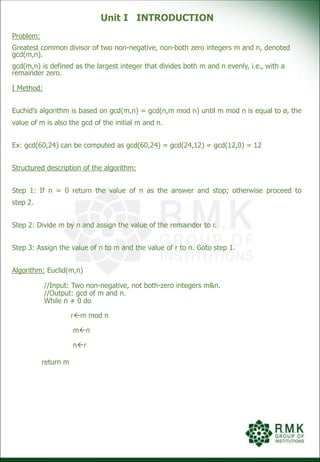
Euchid’s algorithm is based on gcd(m,n) = gcd(n,m mod n) until m mod n is equal to ø, the
value of m is also the gcd of the initial m and n.
Ex: gcd(60,24) can be computed as gcd(60,24) = gcd(24,12) = gcd(12,0) = 12
Structured description of the algorithm:
Step 1: If n = 0 return the value of n as the answer and stop; otherwise proceed to
step 2.
Step 2: Divide m by n and assign the value of the remainder to r.
Step 3: Assign the value of n to m and the value of r to n. Goto step 1.
Algorithm: Euclid(m,n)
//Input: Two non-negative, not both-zero integers m&n.
//Output: gcd of m and n.
While n ≠ 0 do
rm mod n
mn
nr
return m
Unit I INTRODUCTION
How this loop terminates:
From the observation, the second number of the pair gets smaller with each iteration
and it cannot be negative.
Hence the value of the second number in the pair eventually becomes 0, and the
algorithm stops.
II Method:
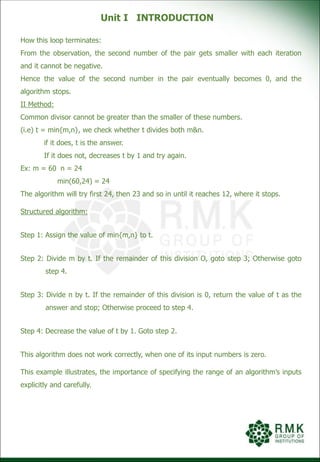
Common divisor cannot be greater than the smaller of these numbers.
(i.e) t = min{m,n}, we check whether t divides both m&n.
if it does, t is the answer.
If it does not, decreases t by 1 and try again.
Ex: m = 60 n = 24
min(60,24) = 24
The algorithm will try first 24, then 23 and so in until it reaches 12, where it stops.
Structured algorithm:
Step 1: Assign the value of min{m,n} to t.
Step 2: Divide m by t. If the remainder of this division O, goto step 3; Otherwise goto
step 4.
Step 3: Divide n by t. If the remainder of this division is 0, return the value of t as the
answer and stop; Otherwise proceed to step 4.
Step 4: Decrease the value of t by 1. Goto step 2.
This algorithm does not work correctly, when one of its input numbers is zero.
This example illustrates, the importance of specifying the range of an algorithm’s inputs
explicitly and carefully.
Unit I INTRODUCTION
III Method:
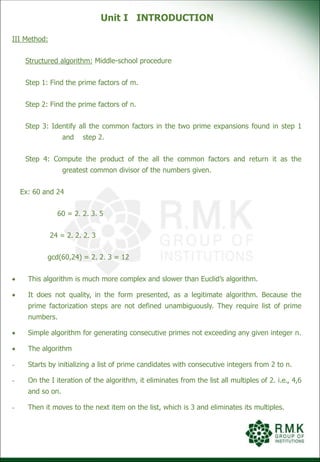
Structured algorithm: Middle-school procedure
Step 1: Find the prime factors of m.
Step 2: Find the prime factors of n.
Step 3: Identify all the common factors in the two prime expansions found in step 1
and step 2.
Step 4: Compute the product of the all the common factors and return it as the
greatest common divisor of the numbers given.
Ex: 60 and 24
60 = 2. 2. 3. 5
24 = 2. 2. 2. 3
gcd(60,24) = 2. 2. 3 = 12
 This algorithm is much more complex and slower than Euclid’s algorithm.
 It does not quality, in the form presented, as a legitimate algorithm. Because the
prime factorization steps are not defined unambiguously. They require list of prime
numbers.
 Simple algorithm for generating consecutive primes not exceeding any given integer n.
 The algorithm
- Starts by initializing a list of prime candidates with consecutive integers from 2 to n.
- On the I iteration of the algorithm, it eliminates from the list all multiples of 2. i.e., 4,6
and so on.
- Then it moves to the next item on the list, which is 3 and eliminates its multiples.
Unit I INTRODUCTION
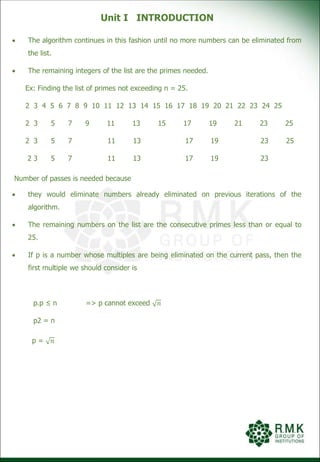
 The algorithm continues in this fashion until no more numbers can be eliminated from
the list.
 The remaining integers of the list are the primes needed.
Ex: Finding the list of primes not exceeding n = 25.
2 3 4 5 6 7 8 9 10 11 12 13 14 15 16 17 18 19 20 21 22 23 24 25
2 3 5 7 9 11 13 15 17 19 21 23 25
2 3 5 7 11 13 17 19 23 25
2 3 5 7 11 13 17 19 23
Number of passes is needed because
 they would eliminate numbers already eliminated on previous iterations of the
algorithm.
 The remaining numbers on the list are the consecutive primes less than or equal to
25.
 If p is a number whose multiples are being eliminated on the current pass, then the
first multiple we should consider is
p.p ≤ n => p cannot exceed 𝑛
p2 = n
p = 𝑛
Unit I INTRODUCTION
Algorithm: Sieve(n)
for p  2 to n do A[p]  p
for p  2 to [ 𝑛] do
if A[p] ≠ 0
j  p*p
while j < n do
A[j]  0
j j+p
i 0
for p  2 to n do
if A[p] ≠ 0
L[i]  A[p]
i i+1
return L
So, we incorporate the sieve into middle school procedure to get a legitimate algorithm for
computing gcd.
1.1 Fundamentals of algorithm problem solving
Sequence of steps in designing & analyzing an algorithm.
Understanding the problem:
 Before designing an algorithm is to understand completely the problem.
 Read the problems description and ask questions or doubt about the problems.
 Solve the few small examples by hand.
 Think about special cases and ask questions again if needed.
 There are few types of problems that arise in computing applications quite often.
 There are known algorithms for solving it. It might help us to understand how such an
algorithm works and know its strengths and weakness.
Unit I INTRODUCTION
 There will not be readily available algorithm for some problems and we have to design
on our own.
 An input to an algorithm specifies an instance of the problem the algorithm solves.
 It is very important to specify exactly the range of instances the algorithm needs to
handle.
 If we fail to do, the algorithm may work for majority of inputs but crash on some
“boundary” value.
Unit I INTRODUCTION
Ascertaining the capabilities of a computional device:
 The next step is to ascertain the capabilities of the computational device the algorithm
is intended for.
 The algorithms in use today are still designed to be programmed for a computer
closely resembles the current architecture.
 This architecture is captured by the so-called random-access machine (RAM).
 Its central assumption is that instructions are executed one after another, one
operation at a time.
 Accordingly, algorithms designed to be executed on such machines are called
sequential algorithms.
 The central assumptions does not hold for some newer computers that can execute
operations concurrently. i.e in parallel. This type of algorithms are called parallel
algorithms.
 If it is a scientific problem, the algorithm can be designed independent of specification
parameters for a particular computer.
 If we were designing as a practical tool, the answer may depend on a problem you
need to solve.
 In many problems, we are not bothering about a computer speed and memory.
 There are important problems, which are very complex, have to process huge volumes
of data, in that case it is imperative to be aware of the speed and memory available
on a particular system.
Choosing between exact and approximate problems solving:
 The next principal decision is to choose between solving the problem exactly or
solving it approximately.
Unit I INTRODUCTION
 In former case, it is solving the problem exactly called exact algorithm, latter
approximation algorithm.
 What is the need for approximation algorithm?
i) There are important problems that cannot be solved exactly such as
o Extracting square roots.
o Solving non-linear equations.
o Evaluation definite integrals.
ii) The algorithms for solving a problem exactly can be unacceptably slow because of
the problems intrinsic complexity.
o Ex: Travelling salesman problem.
iii) Approximation algorithm can be part of a more sophisticated algorithm that solves a
problem exactly.
Deciding on approximate data structures:
 Some algorithms do not demand any ingenuity in representing their inputs.
 But others are, in fact predicated on ingenious data structures.
Algorithm design techniques:
 An algorithm design technique is a general approach to solving problems
algorithmically that is applicable to a variety of problems from different areas of
computing.
 Need for learning algorithm design techniques:
i) They provide guidance for designing algorithms for new problems.
ii) Algorithm design techniques make it possible to classify algorithms according
to an underlying design idea, therefore, they can serve as natural way to both
categorize and study algorithm.
Unit I INTRODUCTION
Methods of specifying an algorithm:
 There are two options that are most widely used nowadays for specifying algorithms:
i) Pseudo code
ii) Flowchart
 Pseudo code is a mixture of a natural language and programming language like
constructs.
 A pseudo code is usually more precise than a natural language and its usage of ten
yields more algorithm description.
 Flowchart a method of expressing algorithm by a collection of connected geometric
shapes containing descriptions of the algorithms steps.
 Pseudo code cannot be directly fed into a computer, instead it needs to be converted
into a computer program written in a particular computer language.
Proving an algorithms correctness:
 Once an algorithm has been specified, you have to prove its correctness.
 That it, you have to prove that the algorithm yields a required result for every
legitimate input in a finite amount of time.
For Ex: Euclid’s algorithm for computing the gcd
gcd(m,n) = gcd(n,m mod n)
 The simple observation that the second number gets smaller on every iteration of the
algorithm.
 Algorithm gets terminated when m mod n becomes 0.
 For some algorithms, a proof of correctness is quite easy; for others, it can be quite
complex.
 A common technique for proving correctness is to use mathematical induction.
Unit I INTRODUCTION
 In order to show that an algorithm is incorrect, we need just one instance of its input of which
the algorithm fails.
 If the algorithm is found to be incorrect, we need to redesign it.
Analyzing an algorithm:
 After correctness, the most important quality is efficiency.
 There are two kinds of algorithm efficiency
i) Time Efficiency.
ii) Space Efficiency.
- Time Efficiency indicates how fast the algorithm runs.
- Space Efficiency indicates how much extra memory the algorithm needs.
 Another desirable characteristic of an algorithm is simplicity.
 Simpler algorithms are easier to understand and easier to program. The resulting programs
usually contain fewer bugs.
 Another desirable characteristic of an algorithm is generality.
 There are two issues:
i) Generality of the problem the algorithm solves.
ii) The range of inputs it accepts.
First issue:
- Sometimes easier to design an algorithm for a problem posed in more general terms.
Ex: gcd
- There are situations where designing a more general algorithm is unnecessary or
difficult or even impossible.
Ex: Quadratic equation cannot be generalized.
Unit I INTRODUCTION
Second issue:
-Designing an algorithm that can handle a range of inputs that is natural for
the problem at hand.
 If we are not satisfied with the algorithms efficiency, simplicity, generality, we
must redesign the algorithm.
 In fact, even evaluation is positive, it is still worth searching for other
algorithms solutions.
Coding an algorithm:
 Most algorithms are destined to be ultimately implemented as computer
programs.
 Correctness of the computer program is proven with mathematical rigor.
 As a practical matter, the validity of programs is still established by testing.
 Test and debug the program thoroughly whenever we implement an algorithm.
 Implementing an algorithm correctly is necessary but not sufficient. We should
have efficient algorithm.
 Better algorithm can make a difference in running time by orders of magnitude.
 Empirical analysis of the algorithm is based on timing the program on several
inputs and then analyzing the results obtained.
 An important issue of algorithms problem solving is whether or not every
problem can be solved by an algorithm.
 Ex: Finding real root of a quadratic equation with a negative discriminant there
is no solution.
Unit I INTRODUCTION
1.2 Important problem types
 There are many problems one may encounters in computing, but there are few areas
that have attracted particular attention from researchers.
 The most important problem types
o i) Sorting
o ii) Searching
o iii) String processing
o iv) Graph problems
o v) Combinational problems
o vi) Geometric problems
o vii) Numerical problems
Sorting:
 The sorting problem is rearranging the items of a given list in ascending order.
 Usually need to sort the lists of numbers, characters from a alphabet, character
strings and most important, records similar to those maintained by schools, companies
about their employees.
 In case of records, we need to choose a piece of information to guide sorting.
Ex: Student records can be maintained in alphabetical order or by student number.
 Such specially chosen piece of information is called a key.
Unit I INTRODUCTION
Need for a sorted list
 Sorting makes many questions about the list easier to answer.
 The most important is searching, that’s why dictionaries, telephone books and
so on are sorted.
 There are dozens of sorting algorithm.
 Although some algorithms are indeed better than others, there is no algorithms
that would be the best solution in all situations.
 Some of the algorithms are simple but relatively slow while others are faster but
more complex, some work better on randomly ordered pairs (inputs) while
others do better on almost sorted lists.
 Some are suitable only for lists residing in the fast memory while others can be
adapted for sorting large files stored on a disk and so on.
 Two properties of sorting algorithm
i) Stable
ii) In place
- Stable algorithm means it preserves the relative order of any two equal
elements in its input.
- If an input contain two equal elements in positions i & j, where i < j, then in
the sorted list they have to be in positions i1 and j1 respectively such that i1 < j1
Ex: Students list sorted alphabetically and we want to sort it according
to GPA means
- Stable algorithm will yield a list in which students with the same GPA will still be
sorted alphabetically.
- An algorithm is said to be in place if it does not require extra memory, except,
possibly, for a few memory units.
Unit I INTRODUCTION
Searching:
 The searching problem deals with finding a given value called a search key, in a given
set.
 There are many searching algorithms range from the straight forward sequential
search to a limited binary search algorithms.
 There is no single algorithm that fits all situations best.
 Some algorithms work faster than other but require more memory. Some are very fast
but applicable only to sorted arrays and so on.
 There is no stability problem.
String processing:
 A string is a sequence of characters from an alphabet.
 Strings which comprise letters, numbers and special characters, bit strings which
comprise zeros and ones.
 String processing algorithms are important in computer science for a long time in
conjunction with computer languages and compiling issues.
 Searching for a given word in a text is called string matching.
Graph problems:
 Graph can be thought of as a collection of points called vertices, some of which are
connected by line segments call edges.
 Graphs can be used for modeling a wide variety of real-life applications including
transportation & communication networks, project scheduling.
Unit I INTRODUCTION
 Basic graph algorithm includes
i) Graph traversal algorithms
ii) Shortest path algorithms
iii) Topological sorting
 Some graph problems are computationally every hard that is only very small instances
of such problems can be solved in a realistic amount of time even with the fastest
computers imaginable.
Ex: Travelling sales man problem graph coloring problem.
Combinatorial problems:
 The above two said problems are examples of combinational problems.
 For these problems, need to find a combinatorial object – such as permutation, a
combination, or a subset – that satisfies certain constraints and has some desired
property.
 Combinational problems are the most difficult problems in computing.
 There are two reasons for that:
o i) Number of combinational objects typically grows extremely fast with a
problem’s size.
o ii) There are no known algorithms for solving most such problems exactly in an
acceptable amount of time.
Geometric problems:
 Geometric problems deal with geometric objects such as points, lines and polygons.
 Algorithms are developed for constructing simple geometric shapes – triangles, circles
and so on.
Unit I INTRODUCTION
 There are algorithms for two classic problems
o i) Closest pair problem
o ii) Convex hull problem
o Closest pair problem  Given n points in the plane, find the closest pair among
them.
o Convex hull problem  Find the smallest convex polygon that would include all
points of a given set.
Numerical problems:
 Another special area of applications that involve mathematical objects of continuous
nature: Solving equations, systems of equations, computing definite integrals,
evaluating functions and so on.
 These problems can be solved approximately.
 There are many algorithms that play a critical role in many scientific and engineering
applications.
1.3 Fundamentals of the analysis of algorithm efficiency
 The term “ analysis of algorithms” mean an investigation of an algorithms efficiency
with respect to two resources: running time and memory space.
1.3.1 - Analysis framework:
 Outlining a general framework for analyzing the efficiency of algorithms.
 There are two kinds of efficiency:
i) Time efficiency indicates how fast an algorithm runs.
ii) Space efficiency deals with extra space the algorithm requires.
Unit I INTRODUCTION
1.3.2 - Measuring an input’s size:
 The most obvious observation that almost all algorithms run longer on larger inputs.
Ex: It takes longer to sort larger arrays, multiply larger matrices and so on.
 Therefore, it is logical to investigate an algorithm’s efficiency as a function of some
parameter n indicating the algorithm’s input size.
 In some cases, selecting such a parameter is quite straight forward.
Ex: Sorting, searching  where the size of the list will be taken.
 For the problem of evaluating a polynomial
p(x) = an xn + …… + a0 of degree n.
Parameters may be
i) Polynomial’s degree
ii) Number of its co-efficient.
In some situation, where the input size matters.
Ex: Computing the product of two n x n matrices.
There are two natural measures:
i) Matrix order n
ii) Total number of element N.
 So, the algorithm efficiency will be qualitatively different depending on which of the
two measures we use.
 The choice of an appropriate size metric can be influenced by operations of the
algorithm in question.
Unit I INTRODUCTION
Ex: Measuring input’s size for spell checking algorithm.
i) If the algorithm examines individual characters of its input, then measure the
size by the number of characters.
ii) If it works by processing words, should count their number in the input.
 Should make a special note about measuring size of inputs for algorithms involving
properties of numbers.
Ex: Checking for prime.
Computer scientists prefer measuring size by the number of bits b in the n’s binary
representation.
b = [log2 n]+1
This gives the efficiency of algorithms.
1.3.3 - Units for measuring running time:
 Concerns about units of measuring an algorithm’s running time.
 We can simply use some standard unit of time measurement – a second, a millisecond
and so on to measure the running time of a program implementing the algorithm.
Drawbacks:
i) Dependence on the speed of a particular computer.
ii) Dependence on the quality of a program implementing the algorithm.
iii) The compiler used in generating the machine code.
iv) The difficulty of clocking the actual running time of the program.
 We should have a metric that does not depend on these extraneous factors.
 One possible approach is to identify the most important operation of the algorithm,
called the basic operation. The operation contributing the most for the total running
time and compute the number of times the basic operation is executed.
Unit I INTRODUCTION
 It is not difficult to identify the basic operation of an algorithm.
Ex-1: Sorting algorithms work by comparing elements of a list being sorted with each
other. The basic operation is a key comparison.
Ex-2 : Matrix multiplication and polynomial evaluation which requires two arithmetic
operations: Multiplication and addition.
 Thus, the established frame work for the analysis of an algorithm’s time efficiency
suggests measuring it by counting the number of time the algorithm’s basic operation
is executed in inputs of size n.
 The important application
Cop – The time of execution of an algorithm’s basic operation on a particular computer.
C(n) – The number of times this operation needs to be executed for this algorithm.
Estimating the running time T(n) of a program implementing this algorithm on that
computer is
T(n) ≈ Cop C(n)
 In this formula, the count C(n) does not contain any information about operations that
are not basic. So, the count is computed approximately.
 Cop is also approximation.
 Unless n is extremely small or large, the formula can give a reasonable estimate of the
algorithm’s running time.
Assuming that C(n) = ½ n (n-1)
How much longer will the algorithm run if double its input size?
C (n) = ½ (n) (n-1) = ½ n2 – ½ n ≈ ½ n2
and therefore
Unit I INTRODUCTION
The answer is 4 times longer
o Cop value is not knowing. The value was neatly cancelled out in the ratio.
o ½ the multiplicative constant in the formula for the count C(n), was also
cancelled out.
Therefore, the efficiency analysis framework ignores multiplicative constants and
concentrates on the count’s order of growth to within a constant multiple for larger-size
inputs.
1.3.4 - Orders of growth:
 A difference in running times on small inputs is not what really distinguishes efficient
algorithms from inefficient ones.
Ex: Computing gcd of two small numbers, the efficiency is not clear when Euclid’s
algorithm is compared with other two algorithms.
It is only clear when we find gcd of two large numbers.
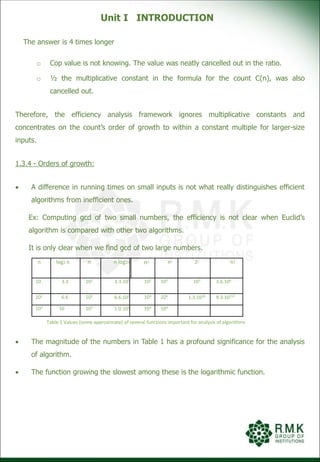
 The magnitude of the numbers in Table 1 has a profound significance for the analysis
of algorithm.
 The function growing the slowest among these is the logarithmic function.
n log2 n n n log2n n2 n3 2n n!
10 3.3 101 3.3.101 102 103 103 3.6.106
102 6.6 102
6.6.102 104 106
1.3.1030 9.3.10157
103 10 103
1.0.104 106 109
Table 1 Values (some approximate) of several functions important for analysis of algorithms
Unit I INTRODUCTION
 On the other hand of the spectrum are the exponential function 2n and n!. Both these
functions grow so fast that their values become astronomically large even for rather
small values of n.
 Another way to appreciate the qualitative difference among the orders of growth of
the functions in table is if we increase two fold in the value of their argument n.
The function
log2 n => log2 2n = log2 2 + log2 n = 1+log2 n => increases in value by just 1.
n log2 n => 2n log2 2n = 2n [1+log2 n] => increases slightly more than 2 fold.
n2 => (2n)2 = 4n2 => 4 fold
n3 => (2n)3 = 8n3 => 8 fold
n! = increases much more than the above
1.3.5 - Worst-case, Best-case and Average-case Efficiencies:
 To measure an algorithm’s efficiency as a function of a parameter indicating the size of
the algorithm’s input.
 But there are many algorithms for which running time depends not only on an input
size but also on the specific of a particular input.
Ex: Sequential search.
This is a straight forward algorithm that searches for a given item in a list of n
elements by checking successive elements of the list until either a match with the
search key is found or the list is exhausted.
Unit I INTRODUCTION
Algorithm:
Sequential search (A[0… n-1], K)
// Input: An array A[0…n-1] and a search key K.
// Output: Returns the index of the first element of A that matches K or -1 if there are no
matching elements.
i  0
while i < n and A[i] ≠ K do
i  i+ 1
if i < n return i
else return -1
The running time of this algorithm can be quite different for the same list size n depends
where the K appears.
In the worst case, when there are no matching elements or the first matching element
happens to be the last one on the list, the algorithm makes the largest number of key
comparisons among all possible inputs of size n:
Cworst (n) = n
The Worst Case Efficiency (WCE) of an algorithm is its efficiency for the worst-case
input of size n, which is an input of size n for which the algorithm runs the longest among
all possible inputs of that size.
Computing worst-case efficiency is straight forward, analyze what kind of inputs yield the
largest value of the basic operation’s count C(n) among all possible inputs of size n and
then compute the worst-case value
Cworst (n)
Unit I INTRODUCTION
 WCE provides important information about an algorithm’s efficiency by
bounding its running time.
It guarantees the running time will not exceed Cworst (n)
 The Best Case Efficiency (BCE) of an algorithm is its efficiency for the best-
case input of size (n), which is an input of size n for which the algorithm runs
fastest among all possible inputs of that size.
Analyze the BCE:
i) Determine the kind of inputs for which the count C(n) will be the smallest
among all possible inputs of size n.
ii) Ascertain the value of C(n) on the most convenient inputs.
Ex: Sequential search
The first element is equal to a search key.
Cbest (n) = 1
Average Case Efficiency provide the necessary information about an algorithm’s
behavior on a “typical” or “random” input.
 We must take some assumptions about possible inputs of size n.
 The standard assumptions are
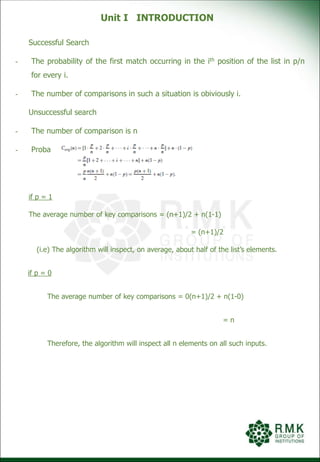
i) The probability of a successful search is equal to p(0 ≤ p ≤1)
ii) The probability of the first match occurring in the ith position of the list is the
same for every i.
 Find the average number of key comparisons.
Cavg (n) as follows
Unit I INTRODUCTION
Successful Search
- The probability of the first match occurring in the ith position of the list in p/n
for every i.
- The number of comparisons in such a situation is obiviously i.
Unsuccessful search
- The number of comparison is n
- Probability is (1-p)
if p = 1
The average number of key comparisons = (n+1)/2 + n(1-1)
= (n+1)/2
(i.e) The algorithm will inspect, on average, about half of the list’s elements.
if p = 0
The average number of key comparisons = 0(n+1)/2 + n(1-0)
= n
Therefore, the algorithm will inspect all n elements on all such inputs.
Unit I INTRODUCTION
 Investigation of the ACE is considerably more difficult than investigation of the worst-
case & best-case efficiencies.
 The direct approach for doing it involves dividing all instances of size n into several
classes so that for each instance of the class the number of times the algorithm’s basic
operation is executed is the same.
 The probability distribution of inputs need to be obtained or assumed so that the
expected value of the basic operation’s count then be derived.
1.3.6 - Amortized Efficiency:
 It applies not to a single run of an algorithm but rather to a sequence of operations
performed on the same data structure.
 It turns out that in some situations a single operation can be expensive, but the total
time for an entire sequence of n such operations is always significantly better than the
worst-case efficiency of that single operation multiplied by n.
1.4 - Asymptotic Notations And Basic Efficiency Classes
 To compare orders of growth, there are three notations
i) Ο (Big Oh)
ii) Ω (Big Omega)
iii) θ (Big Theta)
t(n) and g(n) can be any non-negative functions defined on the set of natural numbers.
t(n) = algorithms running time.
g(n) = simple function to compare the count.
Unit I INTRODUCTION
1.4.1 - Introduction
 Ω(g(n)) stands for the set of all function with a larger or same order of growth as
g(n).
n3Ω(n2), ½ n(n-1)  Ω(n2),
100 + 5  Ω(n2)
• θ(g(n)) is a set of all functions that have the same growth as g(n).
an2 + bn + c with a>0 θ(n2)
1.4.2 Asymptotic Notations and its Properties
Informal Introduction
O(g(n)) is the set of all functions with a smaller or same order of growth as g(n).
Examples:
n ε O(n2), 100n+5 ε O(n2), ½n(n-1) ε O(n2),
The first two function are linear and have a smaller order of growth than g(n)=n2.
But the last one quadratic and has the same order of growth as n2.
The second notation Ω(g(n)), set of all functions with a larger or same order of
growth as g(n).
Examples:
n3 ε Ω(n2), ½n(n-1) ε Ω(n2)
Finally Θ(g(n)), set of all functions have the same order of growth as g(n). Thus
every quadratic equation, an2+bn+c with a>0 is in Θ(n2).
Unit I INTRODUCTION
1.4.3 O-notation
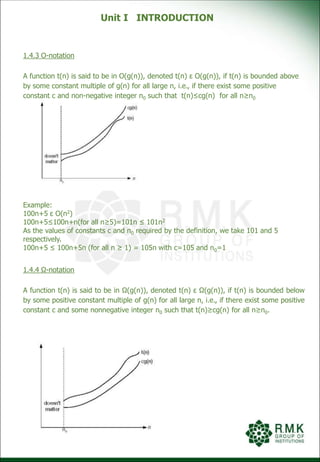
A function t(n) is said to be in O(g(n)), denoted t(n) ε O(g(n)), if t(n) is bounded above
by some constant multiple of g(n) for all large n, i.e., if there exist some positive
constant c and non-negative integer n0 such that t(n)≤cg(n) for all n≥n0
Example:
100n+5 ε O(n2)
100n+5≤100n+n(for all n≥5)=101n ≤ 101n2
As the values of constants c and n0 required by the definition, we take 101 and 5
respectively.
100n+5 ≤ 100n+5n (for all n ≥ 1) = 105n with c=105 and n0=1
1.4.4 Ω-notation
A function t(n) is said to be in Ω(g(n)), denoted t(n) ε Ω(g(n)), if t(n) is bounded below
by some positive constant multiple of g(n) for all large n, i.e., if there exist some positive
constant c and some nonnegative integer n0 such that t(n)≥cg(n) for all n≥n0.
Unit I INTRODUCTION
Example:
n3 ε Ω(n2)
n3≥n2 for all n≥0
i.e., we can select c=1 and n0=0.
1.4.5 Θ-notation
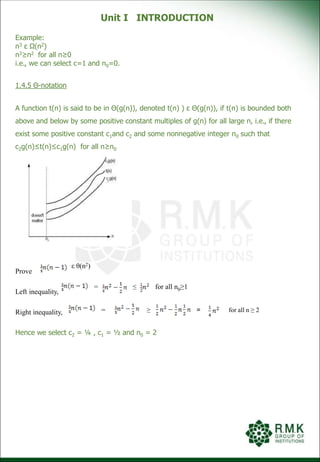
A function t(n) is said to be in Θ(g(n)), denoted t(n) ) ε Θ(g(n)), if t(n) is bounded both
above and below by some positive constant multiples of g(n) for all large n, i.e., if there
exist some positive constant c1and c2 and some nonnegative integer n0 such that
c2g(n)≤t(n)≤c1g(n) for all n≥n0
Prove
Left inequality,
Right inequality,
Hence we select c2 = ¼ , c1 = ½ and n0 = 2
ε θ(n2)
= ≤ for all n0≥1
= ≥ = for all n ≥ 2
Unit I INTRODUCTION
1.4.6 Properties of Asymptotic Notations
Theorem: If t1(n) ε O(g1(n)) and t2 ε O(g2(n)) then t1(n)+t2(n) ε
O(max{g1(n),g2(n)})
Proof: simple fact about four arbitrary real numbers a1, a2, b1, b2: if a1 ≤ b1 and a2 ≤
b2, then a1+a2 ≤ 2 max{b1,b2}.
Since if t1(n) ε O(g1(n)), there exist some positive constant c1 and some nonnegative
integer n1 such that
t1(n) ≤ c1g1(n) for all n≥n1
Since if t2(n) ε O(g2(n)), t2(n) ≤ c2g2(n) for all n≥n2
Let us denote c3=max{c1,c2} and consider n≥max{n1,n2} we can use both inequalities.
T1(n)+t2(n)≤c1g1(n)+c2g2(n)
≤c3g1(n)+c3g2(n)=c3[g1(n)+g2(n)]
≤c32max{g1(n),g2(n)}
So t1(n)+t2(n) ε O(max{g1(n),g2(n)})
It implies that the algorithm’s overall efficiency is determined by the part with a larger
order of growth.
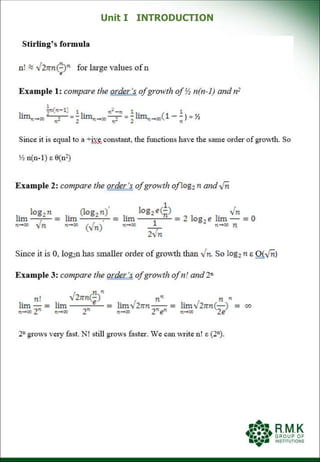
1.4.7 Comparing Order’s of Growth using Limits.
Though definitions of Ο, Ω and θ are indispensable for proving their abstract properties,
they are rarely used for comparisons of orders of growth of two specific functions.
A much more convenient method for doing so is based on computing the limit of the
ratio of two functions.
Three principal cases may arise
0 implies that t(n) has a smaller order of growth than g(n)
c > 0 implies that t(n) has a same order of growth as g(n)
∞ implies that t(n) has a larger order of growth than g(n)
First two cases mean that t(n)  Ο(g(n))
Last two cases mean that t(n)  Ω(g(n))
Second case mean that t(n)  θ(g(n))
=
Unit I INTRODUCTION
Unit I INTRODUCTION
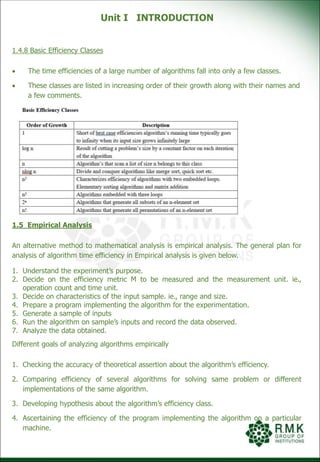
1.4.8 Basic Efficiency Classes
 The time efficiencies of a large number of algorithms fall into only a few classes.
 These classes are listed in increasing order of their growth along with their names and
a few comments.
1.5 Empirical Analysis
An alternative method to mathematical analysis is empirical analysis. The general plan for
analysis of algorithm time efficiency in Empirical analysis is given below.
1. Understand the experiment’s purpose.
2. Decide on the efficiency metric M to be measured and the measurement unit. ie.,
operation count and time unit.
3. Decide on characteristics of the input sample. ie., range and size.
4. Prepare a program implementing the algorithm for the experimentation.
5. Generate a sample of inputs
6. Run the algorithm on sample’s inputs and record the data observed.
7. Analyze the data obtained.
Different goals of analyzing algorithms empirically
1. Checking the accuracy of theoretical assertion about the algorithm’s efficiency.
2. Comparing efficiency of several algorithms for solving same problem or different
implementations of the same algorithm.
3. Developing hypothesis about the algorithm’s efficiency class.
4. Ascertaining the efficiency of the program implementing the algorithm on a particular
machine.
Unit I INTRODUCTION
How the algorithm’s efficiency is to be measured?
1. Insert a counter in the program to count the number of times the algorithm’s basic
operation is executed.
2. Use UNIX system command time
3. Measure the running time of a code fragment before starting, tstart and tfinish and then
compute the difference (tstart and tfinish).
Important facts
1. System time is not very accurate.
2. Using high speed modern computers may fail to register the running time.
3. On a computer running under a time-sharing system, the reported running time may
include the time spent by the CPU on other programs.
The physical running time provides very specific information about an algorithm’s
performance in a particular computing environment and measuring time spent on different
segments. Getting such data called as profiling is an important resource in the empirical
analysis of an algorithm’s running time.
Use a sample representing a typical input which is to be developed by the experimenter.
Several sizes of same sizes can be included. The instances can be generated randomly.
The empirical data obtained as the result of an experiment need to be recorded and then
presented for an analysis. Data can be presented numerically in a table or graphically in a
scatterplot. One of the possible applications of the empirical analysis is to predict the
algorithm’s performance on an instance not included in the sample.
1.6. Mathematical Analysis of Non-Recursive & Recursive Algorithms
1.6.1 Mathematical Analysis of Non-Recursive Algorithms
• Analyzing the efficiency of non-recursive algorithms.
 Before proceeding with examples, we review about list of summation formulas and
two basic rules of sum manipulation.
Unit I INTRODUCTION
Problem: Finding the value of the largest element in a list of n numbers.
Assumption: List is implemented as array.
Algorithm:
maxval A[0]
for i 1 to n-1 do
if A[i] >maxval
maxval A[i]
return maxval
Applying general framework outlined.
i) Measuring an input’s size:
- The input size is the number of elements in the array i.e.., n
i) Units for measuring running time:
- The operations most often executed are in the for loop.
- There are two operations
o Comparison A[i] >maxval
o Assignment maxval A[i]
Which have to consider?
- Comparison is executed on each repetition of the loop
- Assignment is no. So, the basic operation is comparison
 The number of comparisons will be the same for all arrays of size n. There is no need
to distinguish among the worst, average and best cases.
 Count the number of times the basic operation performed and try to formulate as
function of size n.
 The algorithm makes one comparison on each execution of the loop, which is
repeated for each value of the loop’s variable I within the bounds between 1 and n-1.
𝐶 𝑛 =
𝑖=1
𝑛−1
1 =>
𝑖=1
𝑛−1
= 𝑛 − 1 − 1 + 1 = 𝑛 − 1 𝜖 𝜃(𝑛)
Unit I INTRODUCTION
General plan for analyzing efficiency of non-recursive algorithms:
i) Decide on a parameter indicating an input’s size.
ii) Identify the algorithm’s basic operation.
iii) Check whether the number of times the basic operation is executed depends only on
the size of an input.
iv) Set up a sum expressing the number of times the algorithm’s basic operation is
executed.
v) Establish its order of growth.
Example 2: Element uniqueness problem
Algorithm:
for i  0 to n-2 do
for j  i+1 to n-1 do
if A[i] = A[j] return false
return true
i) Measuring input’s size:
- The number of elements in the array- n elements
i) Measuring running time:
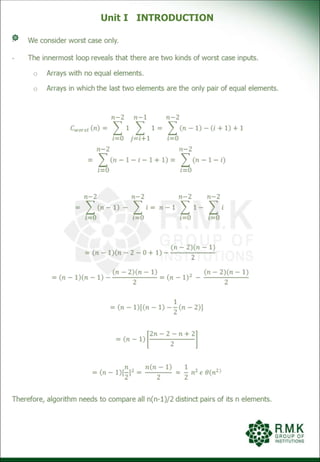
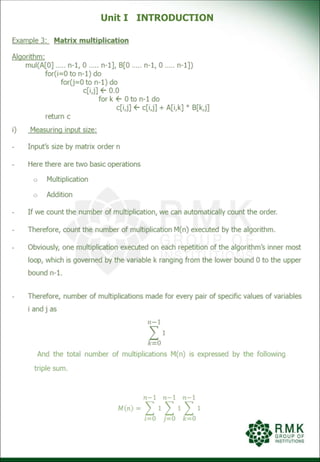
- The innermost loops contains a single operation.
- This is the basic operation
- The number of elements comparison will depend not only on n but also on whether
there are equal elements in the array and if there are, which array positions they
occupy..
Unit I INTRODUCTION
Unit I INTRODUCTION
Unit I INTRODUCTION
Unit I INTRODUCTION
Unit I INTRODUCTION
- To determine a solution uniquely for recurrence relation, we need an initial condition
that tells us the value with which the sequence starts.
- We can obtain this value by inspecting the condition that makes the algorithm stop its
recursive calls.
if n = 0 return 1
M(0) = 0
The call stop when n = 0
- Thus, we succeed in setting up the recurrence relation and initial condition for the
algorithm’s number of multiplication M(n):
M(n) = M(n-1) + 1 for n > 0
M(0) = 0
- There are two recursively defined functions
o Factorial function F(n)
o Number of multiplications M(n)
- For solving recurrence relations, we use the method of backward substitutions
M(n) = M(n-1) + 1 substitute M(n-1) = M(n-2) + 1
=[M(n-2) + 1] + 1 = M(n-2) + 2 substitute M(n-2) = M(n-3) + 1
= [M(n-3) + 1] + 2 = M(n-3) + 3
Therefore, general formula = M(n) = M(n-i) + i
M(n) = M(n-1) + 1 . . . . = M(n-i) + i = . . . . .
Initial condition n=0 so substitute i=n
M(n-n) + n = n
Unit I INTRODUCTION
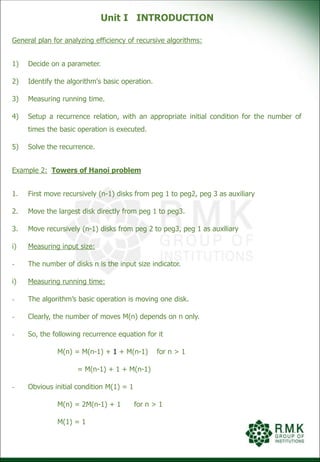
General plan for analyzing efficiency of recursive algorithms:
1) Decide on a parameter.
2) Identify the algorithm's basic operation.
3) Measuring running time.
4) Setup a recurrence relation, with an appropriate initial condition for the number of
times the basic operation is executed.
5) Solve the recurrence.
Example 2: Towers of Hanoi problem
1. First move recursively (n-1) disks from peg 1 to peg2, peg 3 as auxiliary
2. Move the largest disk directly from peg 1 to peg3.
3. Move recursively (n-1) disks from peg 2 to peg3, peg 1 as auxiliary
i) Measuring input size:
- The number of disks n is the input size indicator.
i) Measuring running time:
- The algorithm’s basic operation is moving one disk.
- Clearly, the number of moves M(n) depends on n only.
- So, the following recurrence equation for it
M(n) = M(n-1) + 1 + M(n-1) for n > 1
= M(n-1) + 1 + M(n-1)
- Obvious initial condition M(1) = 1
M(n) = 2M(n-1) + 1 for n > 1
M(1) = 1
Unit I INTRODUCTION
Solving recurrence relation equation by backward substitutions
M(n) = 2M(n-1) + 1 sub M(n-1) = 2M(n-2) + 1
= 2 [2M(n-2) + 1) + 1
= 22 M(n-2) + 2 + 1 sub M(n-2) = 2M(n-3) + 1
= 22 [2M (n-3) + 1] + 2 + 1
= 23 M(n-3) + 22 + 2 + 1
Therefore, after I substitutions, we get
M(n) = 2i M(n-i) + 2i-1 + 2i-2 + ……. + 2 + 1
= 2i M(n-i) + 2i -1
M(n) = 2n-1 M(n-(n-1)) + 2n-1 -1 n-i= 1, i= n-1
= 2n-1 M(n-n+1) + 2n-1 -1
= 2n-1 M(1) + 2n-1 -1
= 2n-1 + 2n-1 -1
= 2 . 2n-1 -1 = 2n -1
Thus we have an exponential algorithm, which will run for an unimaginably long time even
for moderate values of n. This is not due to the fact that this algorithm is poor.
It is the problem’s intrinsic difficulty that makes it so computationally difficult.
Example 3: Counting the number of binary digits
Algorithm: Bin Rec(n)
if n = 1 return 1
else return Bin Rec([n/2]) + 1
Unit I INTRODUCTION
- The number of additions made in computing Bin Rec([n/2]) is A([n/2]), plus one more
addition is made by the algorithm to increase the returned value by 1.
A[n] = A([n/2]) + 1 for n > 1
- if n = 1, the recursive calls end, there are no additions made, the initial condition is
A(1) = 0
- The presence of [n/2] in the function’s argument makes the method of backward
substitutions stumble on values of n that are not powers of 2.
- Therefore the standard approach to solving such a recurrence is to solve it only for n
= 2k and then
o Apply the theorem called the smoothness rule.
o This theorem gives correct answer about the order of growth for all values of n.
- For n = 2k takes the form
A(2k) = A(2k-1) + 1 for k > 0
A(20) = 0
Now backward substitutions encounter no problems:
A(2k) = A(2k-1) + 1 substitute A(2k-1) = A(2k-2)+1
= [A(2k-2) + 1] + 1
= A(2k-2) + 2 substitute A(2k-2) = A(2k-3) + 1
=[A(2k-3) + 1] + 2
= A[2k-3] + 3
= A[2k-i] + i
= A[2k-k] + k
Unit I INTRODUCTION
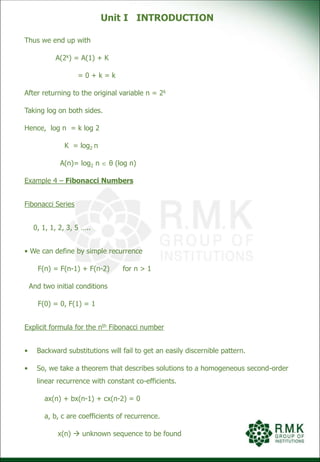
Thus we end up with
A(2k) = A(1) + K
= 0 + k = k
After returning to the original variable n = 2k
Taking log on both sides.
Hence, log n = k log 2
K = log2 n
A(n)= log2 n  θ (log n)
Example 4 – Fibonacci Numbers
Fibonacci Series
0, 1, 1, 2, 3, 5 …..
• We can define by simple recurrence
F(n) = F(n-1) + F(n-2) for n > 1
And two initial conditions
F(0) = 0, F(1) = 1
Explicit formula for the nth Fibonacci number
• Backward substitutions will fail to get an easily discernible pattern.
• So, we take a theorem that describes solutions to a homogeneous second-order
linear recurrence with constant co-efficients.
ax(n) + bx(n-1) + cx(n-2) = 0
a, b, c are coefficients of recurrence.
x(n)  unknown sequence to be found
Unit I INTRODUCTION
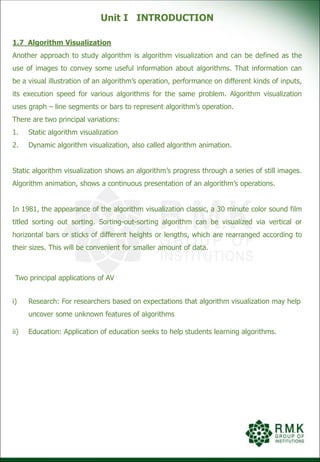
1.7 Algorithm Visualization
Another approach to study algorithm is algorithm visualization and can be defined as the
use of images to convey some useful information about algorithms. That information can
be a visual illustration of an algorithm’s operation, performance on different kinds of inputs,
its execution speed for various algorithms for the same problem. Algorithm visualization
uses graph – line segments or bars to represent algorithm’s operation.
There are two principal variations:
1. Static algorithm visualization
2. Dynamic algorithm visualization, also called algorithm animation.
Static algorithm visualization shows an algorithm’s progress through a series of still images.
Algorithm animation, shows a continuous presentation of an algorithm’s operations.
In 1981, the appearance of the algorithm visualization classic, a 30 minute color sound film
titled sorting out sorting. Sorting-out-sorting algorithm can be visualized via vertical or
horizontal bars or sticks of different heights or lengths, which are rearranged according to
their sizes. This will be convenient for smaller amount of data.
Two principal applications of AV
i) Research: For researchers based on expectations that algorithm visualization may help
uncover some unknown features of algorithms
ii) Education: Application of education seeks to help students learning algorithms.
Unit I INTRODUCTION
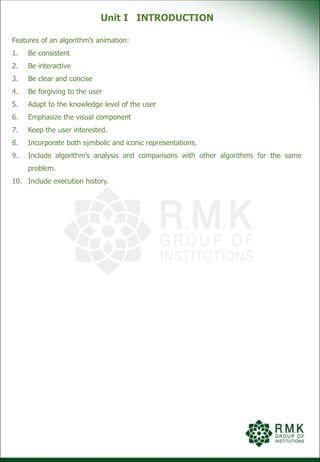
Features of an algorithm’s animation:
1. Be consistent
2. Be interactive
3. Be clear and concise
4. Be forgiving to the user
5. Adapt to the knowledge level of the user
6. Emphasize the visual component
7. Keep the user interested.
8. Incorporate both symbolic and iconic representations.
9. Include algorithm’s analysis and comparisons with other algorithms for the same
problem.
10. Include execution history.
Assignments
Assignments
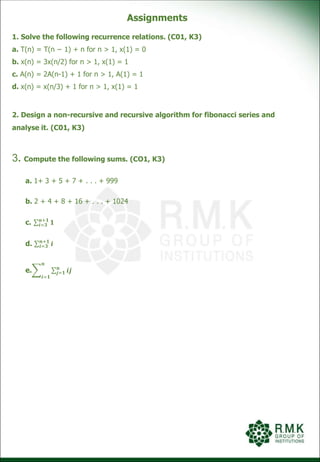
1. Solve the following recurrence relations. (C01, K3)
a. T(n) = T(n − 1) + n for n > 1, x(1) = 0
b. x(n) = 3x(n/2) for n > 1, x(1) = 1
c. A(n) = 2A(n-1) + 1 for n > 1, A(1) = 1
d. x(n) = x(n/3) + 1 for n > 1, x(1) = 1
2. Design a non-recursive and recursive algorithm for fibonacci series and
analyse it. (C01, K3)
3. Compute the following sums. (CO1, K3)
a. 1+ 3 + 5 + 7 + . . . + 999
b. 2 + 4 + 8 + 16 + . . . + 1024
c. 𝒊=𝟑
𝒏+𝟏
𝟏
d. 𝒊=𝟑
𝒏+𝟏
𝒊
e.
𝒊=𝟏
𝒏
𝒋=𝟏
𝒏
𝒊𝒋
Part A – Q & A
Unit - I
PART - A Questions
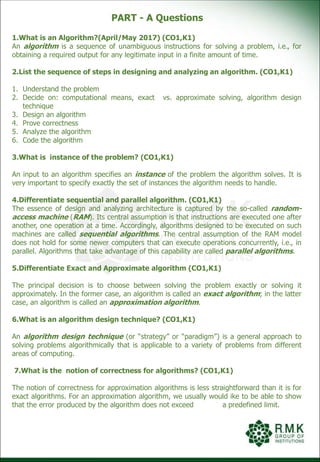
1.What is an Algorithm?(April/May 2017) (CO1,K1)
An algorithm is a sequence of unambiguous instructions for solving a problem, i.e., for
obtaining a required output for any legitimate input in a finite amount of time.
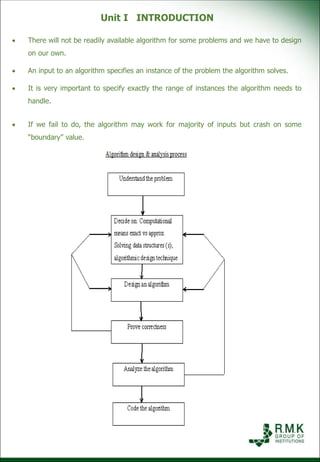
2.List the sequence of steps in designing and analyzing an algorithm. (CO1,K1)
1. Understand the problem
2. Decide on: computational means, exact vs. approximate solving, algorithm design
technique
3. Design an algorithm
4. Prove correctness
5. Analyze the algorithm
6. Code the algorithm
3.What is instance of the problem? (CO1,K1)
An input to an algorithm specifies an instance of the problem the algorithm solves. It is
very important to specify exactly the set of instances the algorithm needs to handle.
4.Differentiate sequential and parallel algorithm. (CO1,K1)
The essence of design and analyzing architecture is captured by the so-called random-
access machine (RAM). Its central assumption is that instructions are executed one after
another, one operation at a time. Accordingly, algorithms designed to be executed on such
machines are called sequential algorithms. The central assumption of the RAM model
does not hold for some newer computers that can execute operations concurrently, i.e., in
parallel. Algorithms that take advantage of this capability are called parallel algorithms.
5.Differentiate Exact and Approximate algorithm (CO1,K1)
The principal decision is to choose between solving the problem exactly or solving it
approximately. In the former case, an algorithm is called an exact algorithm; in the latter
case, an algorithm is called an approximation algorithm.
6.What is an algorithm design technique? (CO1,K1)
An algorithm design technique (or “strategy” or “paradigm”) is a general approach to
solving problems algorithmically that is applicable to a variety of problems from different
areas of computing.
7.What is the notion of correctness for algorithms? (CO1,K1)
The notion of correctness for approximation algorithms is less straightforward than it is for
exact algorithms. For an approximation algorithm, we usually would ike to be able to show
that the error produced by the algorithm does not exceed a predefined limit.
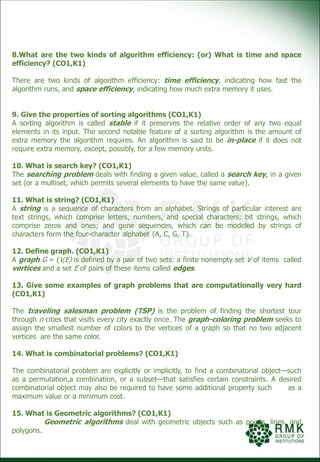
8.What are the two kinds of algorithm efficiency: (or) What is time and space
efficiency? (CO1,K1)
There are two kinds of algorithm efficiency: time efficiency, indicating how fast the
algorithm runs, and space efficiency, indicating how much extra memory it uses.
9. Give the properties of sorting algorithms (CO1,K1)
A sorting algorithm is called stable if it preserves the relative order of any two equal
elements in its input. The second notable feature of a sorting algorithm is the amount of
extra memory the algorithm requires. An algorithm is said to be in-place if it does not
require extra memory, except, possibly, for a few memory units.
10. What is search key? (CO1,K1)
The searching problem deals with finding a given value, called a search key, in a given
set (or a multiset, which permits several elements to have the same value).
11. What is string? (CO1,K1)
A string is a sequence of characters from an alphabet. Strings of particular interest are
text strings, which comprise letters, numbers, and special characters; bit strings, which
comprise zeros and ones; and gene sequences, which can be modeled by strings of
characters form the four-character alphabet {A, C, G, T}.
12. Define graph. (CO1,K1)
A graph G = (V,E) is defined by a pair of two sets: a finite nonempty set V of items called
vertices and a set E of pairs of these items called edges.
13. Give some examples of graph problems that are computationally very hard
(CO1,K1)
The traveling salesman problem (TSP) is the problem of finding the shortest tour
through n cities that visits every city exactly once. The graph-coloring problem seeks to
assign the smallest number of colors to the vertices of a graph so that no two adjacent
vertices are the same color.
14. What is combinatorial problems? (CO1,K1)
The combinatorial problem are explicitly or implicitly, to find a combinatorial object—such
as a permutation,a combination, or a subset—that satisfies certain constraints. A desired
combinatorial object may also be required to have some additional property such as a
maximum value or a minimum cost.
15. What is Geometric algorithms? (CO1,K1)
Geometric algorithms deal with geometric objects such as points, lines, and
polygons.
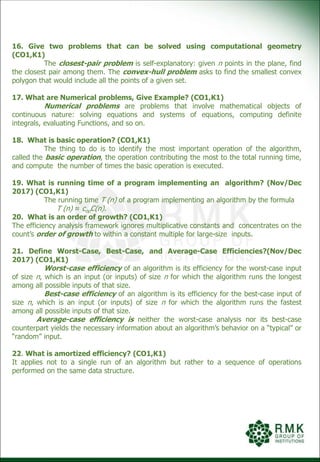
16. Give two problems that can be solved using computational geometry
(CO1,K1)
The closest-pair problem is self-explanatory: given n points in the plane, find
the closest pair among them. The convex-hull problem asks to find the smallest convex
polygon that would include all the points of a given set.
17. What are Numerical problems, Give Example? (CO1,K1)
Numerical problems are problems that involve mathematical objects of
continuous nature: solving equations and systems of equations, computing definite
integrals, evaluating Functions, and so on.
18. What is basic operation? (CO1,K1)
The thing to do is to identify the most important operation of the algorithm,
called the basic operation, the operation contributing the most to the total running time,
and compute the number of times the basic operation is executed.
19. What is running time of a program implementing an algorithm? (Nov/Dec
2017) (CO1,K1)
The running time T (n) of a program implementing an algorithm by the formula
T (n) ≈ copC(n).
20. What is an order of growth? (CO1,K1)
The efficiency analysis framework ignores multiplicative constants and concentrates on the
count’s order of growth to within a constant multiple for large-size inputs.
21. Define Worst-Case, Best-Case, and Average-Case Efficiencies?(Nov/Dec
2017) (CO1,K1)
Worst-case efficiency of an algorithm is its efficiency for the worst-case input
of size n, which is an input (or inputs) of size n for which the algorithm runs the longest
among all possible inputs of that size.
Best-case efficiency of an algorithm is its efficiency for the best-case input of
size n, which is an input (or inputs) of size n for which the algorithm runs the fastest
among all possible inputs of that size.
Average-case efficiency is neither the worst-case analysis nor its best-case
counterpart yields the necessary information about an algorithm’s behavior on a “typical” or
“random” input.
22. What is amortized efficiency? (CO1,K1)
It applies not to a single run of an algorithm but rather to a sequence of operations
performed on the same data structure.
23. Explain the three asymptotic notations. (CO1,K1)
A function t (n) is said to be in O(g(n)), denoted t (n) ε O(g(n)), if t (n) is
bounded above by some constant multiple of g(n) for all large n, i.e., if there exist some
positive constant and some nonnegative integer n0 such that t (n) ≤ cg(n) for all n ≥ n0.
A function t (n) is said to be in Ω(g(n)), denoted t (n) ε Ω(g(n)), if t (n) is
bounded below by some positive constant multiple of g(n) for all large n, i.e., if there exist
some positive constant c and some nonnegative integer n0 such that t (n) ≥ cg(n) for all n
≥ n0.
A function t (n) is said to be in θ(g(n)), denoted t (n) ε θ(g(n)), if t (n) is
bounded both above and below by some positive constant multiples of g(n) for all large n,
i.e., if there exist some positive constants c1 and c2 and some nonnegative integer n0 such
that c2g(n) ≤ t (n) ≤ c1g(n) for all n ≥ n0.
24. Explain the General Plan for Analyzing the Time Efficiency of Nonrecursive
Algorithms (CO1,K1)
1.Understand the experiment’s purpose.
2.Decide on the efficiency metric M to be measured and the measurement unit (an
operation count vs. a time unit).
3.Decide on characteristics of the input sample (its range, size, and so on).
4.Prepare a program implementing the algorithm (or algorithms) for the experimentation.
5.Generate a sample of inputs.
6.Run the algorithm (or algorithms) on the sample’s inputs and record the data observed.
7.Analyze the data obtained.
25. Write an algorithm to find the number of binary digits in the binary
representation of a positive decimal number. (April/May 2015) (CO1,K1)
ALGORITHM Binary(n)
count1
while n>1 do
countcount+1
n∟n/2
return count
26. Write down the properties of the asymptotic notations. (April/May 2015)
(CO1,K1)
1. If t1(n) ε O(g1(n)) and t2 ε O(g2(n)) then t1(n)+t2(n) ε O(max{g1(n),g2(n)})
2. Asymptotic notations are transitive, reflexive and symmetric.
Unit I INTRODUCTION
27. Give the Euclid’s algorithm for computing gcd(m, n) (May/June
2016,April/May 2017) (CO1,K1)
ALGORITHM Euclid_gcd(m, n)
//Computes gcd(m, n) by Euclid’s algorithm
//Input: Two nonnegative, not-both-zero integers m and n
//Output: Greatest common divisor of m and n
while n ≠ 0 do
r ←m mod n
m←n
n←r
return m
Example: gcd(60, 24) = gcd(24, 12) = gcd(12, 0) = 12.
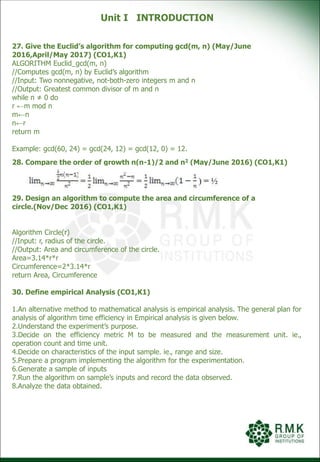
28. Compare the order of growth n(n-1)/2 and n2 (May/June 2016) (CO1,K1)
29. Design an algorithm to compute the area and circumference of a
circle.(Nov/Dec 2016) (CO1,K1)
Algorithm Circle(r)
//Input: r, radius of the circle.
//Output: Area and circumference of the circle.
Area=3.14*r*r
Circumference=2*3.14*r
return Area, Circumference
30. Define empirical Analysis (CO1,K1)
1.An alternative method to mathematical analysis is empirical analysis. The general plan for
analysis of algorithm time efficiency in Empirical analysis is given below.
2.Understand the experiment’s purpose.
3.Decide on the efficiency metric M to be measured and the measurement unit. ie.,
operation count and time unit.
4.Decide on characteristics of the input sample. ie., range and size.
5.Prepare a program implementing the algorithm for the experimentation.
6.Generate a sample of inputs
7.Run the algorithm on sample’s inputs and record the data observed.
8.Analyze the data obtained.
Unit I INTRODUCTION
31. Define scatterplot (CO1,K1)
The empirical data obtained as the result of an experiment need to be recorded and then
presented for an analysis. Data can be presented numerically in a table or graphically in a
scatterplot.
32. Define Profiling (CO1,K1)
The physical running time provides very specific information about an algorithm’s
performance in a particular computing environment and measuring time spent on different
segments. Getting such data called as profiling is an important resource in the empirical
analysis of an algorithm’s running time.
33. What is algorithm visualization? (CO1,K1)
Another approach to study algorithm is algorithm visualization and can be defined as the
use of images to convey some useful information about algorithms. That information can
be a visual illustration of an algorithm’s operation, performance on different kinds of inputs,
its execution speed for various algorithms for the same problem. Algorithm visualization
uses graph – line segments or bars to represent algorithm’s operation.
34. List out two principal variations of visualizations (CO1,K1)
1. Static algorithm visualization
2. Dynamic algorithm visualization, also called algorithm animation.
3. Static algorithm visualization shows an algorithm’s progress through a series of still
images. Algorithm animation, shows a continuous presentation of an algorithm’s
operations.
Part B – Questions
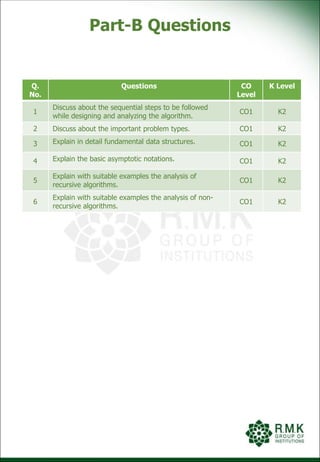
Part-B Questions
Q.
No.
Questions CO
Level
K Level
1
Discuss about the sequential steps to be followed
while designing and analyzing the algorithm.
CO1 K2
2 Discuss about the important problem types. CO1 K2
3 Explain in detail fundamental data structures. CO1 K2
4 Explain the basic asymptotic notations. CO1 K2
5
Explain with suitable examples the analysis of
recursive algorithms.
CO1 K2
6
Explain with suitable examples the analysis of non-
recursive algorithms.
CO1 K2
Supportive online
Certification courses
(NPTEL, Swayam,
Coursera, Udemy, etc.,)
Supportive Online Certification
Courses
Sl.
No.
Courses Platform
1 Design and analysis of algorithms NPTEL
2 The Design and Analysis of Algorithm Udemy
3 Algorithms Specialization Coursera
4 Algorithm Design and Analysis edX
Real time Applications in
day to day life and to
Industry
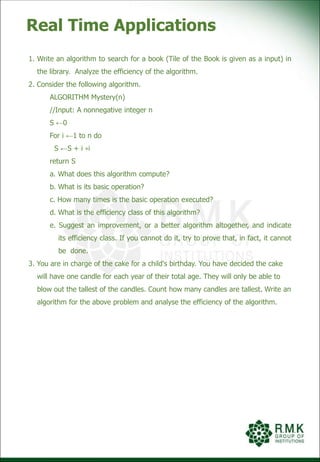
Real Time Applications
1. Write an algorithm to search for a book (Tile of the Book is given as a input) in
the library. Analyze the efficiency of the algorithm.
2. Consider the following algorithm.
ALGORITHM Mystery(n)
//Input: A nonnegative integer n
S ←0
For i ←1 to n do
S ←S + i ∗i
return S
a. What does this algorithm compute?
b. What is its basic operation?
c. How many times is the basic operation executed?
d. What is the efficiency class of this algorithm?
e. Suggest an improvement, or a better algorithm altogether, and indicate
its efficiency class. If you cannot do it, try to prove that, in fact, it cannot
be done.
3. You are in charge of the cake for a child's birthday. You have decided the cake
will have one candle for each year of their total age. They will only be able to
blow out the tallest of the candles. Count how many candles are tallest. Write an
algorithm for the above problem and analyse the efficiency of the algorithm.
Content Beyond Syllabus
Unit I Content Beyond Syllabus
Important Data Structures
Graphs:
A graph G=(V,E) is defined by a pair of two sets: A finite set V of items called vertices and
a set E of items called edges. If a pair of vertices (u,v) is same as (v,u) in a graph then the
graph is called as undirected graph. If pair of vertices (u,v) and (v,u) is not same in a graph
then it is called as directed graph or digraph. A graph with every pair of vertices connected
by an edge is called complete. A graph with relatively few possible edges missing is called
dense; a graph with few edges relative to number of its vertices is called sparse.
Graph representations: Adjacency Matrix and Adjacency List.
Adjacency Matrix: A graph with n vertices is represented by nxn matrix. The entries of the
matrix are 0 and 1. The entry A[u,v]=0 indicates there is no edge from u to v and A[u,v]=1
if the edge from u to v is present.
Adjacency List: Collection of linked lists, one for each vertex that contains all the vertices
adjacent to the particular vertex.
Weighted graph is a graph with numbers assigned its edges. These numbers are called as
weights. If this graph is represented by adjacency matrix A[u,v]=weight of the edge [u,v]
and ∞ if there is no edge. Such a matrix is called as weight matrix or cost matrix.
A path from vertex u to vertex v is sequence of adjacent vertices starts with u and ends
with v. length of the path is total number of vertices in a vertex sequence defining the path
minus 1. A directed path is a sequence of vertices in which every consecutive pair of the
vertices is connected by a directed edge. A graph is said to be connected if for every pair of
its vertices u and v there is a path from u to v. a graph with no cycles is said to be acyclic.
Trees:
A tree is a connected acyclic graph.
|E|=|V|-1 no of edges is no of vertices -1
Rooted trees: for every two vertices in a tree there exists one simple path from one of
these vertices to the other. Select an arbitrary vertex in a free tree and it is root.
Ancestors: for any vertex v in a tree, all the vertices on the simple path from the root to
that vertex are called ancestors of v.
Parent & child: if (u,v) is the last edge of the simple path from the root to vertex v, u is
parent and v is child.
Siblings: vertices that have same parent
Unit I Content Beyond Syllabus
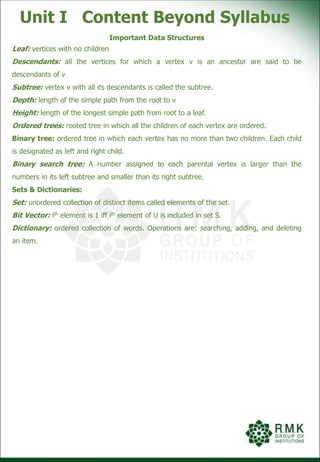
Important Data Structures
Leaf: vertices with no children
Descendants: all the vertices for which a vertex v is an ancestor are said to be
descendants of v
Subtree: vertex v with all its descendants is called the subtree.
Depth: length of the simple path from the root to v
Height: length of the longest simple path from root to a leaf.
Ordered trees: rooted tree in which all the children of each vertex are ordered.
Binary tree: ordered tree in which each vertex has no more than two children. Each child
is designated as left and right child.
Binary search tree: A number assigned to each parental vertex is larger than the
numbers in its left subtree and smaller than its right subtree.
Sets & Dictionaries:
Set: unordered collection of distinct items called elements of the set.
Bit Vector: ith element is 1 iff ith element of U is included in set S.
Dictionary: ordered collection of words. Operations are: searching, adding, and deleting
an item.
Assessment Schedule
(Proposed Date & Actual
Date)
Assessment Schedule
Assessment
Tool
Proposed Date Actual Date Course Outcome Program
Outcome
(Filled Gap)
Assessment I 06.04.2022 CO1, CO2
Assessment II 09.05.2022 CO3, CO4
Model 02.06.2022 CO1, CO2, CO3,
CO4, CO5, CO6
Prescribed Text Books &
Reference
Prescribed Text & Reference
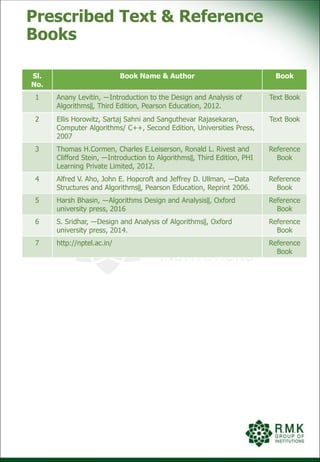
Books
Sl.
No.
Book Name & Author Book
1 Anany Levitin, ―Introduction to the Design and Analysis of
Algorithms‖, Third Edition, Pearson Education, 2012.
Text Book
2 Ellis Horowitz, Sartaj Sahni and Sanguthevar Rajasekaran,
Computer Algorithms/ C++, Second Edition, Universities Press,
2007
Text Book
3 Thomas H.Cormen, Charles E.Leiserson, Ronald L. Rivest and
Clifford Stein, ―Introduction to Algorithms‖, Third Edition, PHI
Learning Private Limited, 2012.
Reference
Book
4 Alfred V. Aho, John E. Hopcroft and Jeffrey D. Ullman, ―Data
Structures and Algorithms‖, Pearson Education, Reprint 2006.
Reference
Book
5 Harsh Bhasin, ―Algorithms Design and Analysis‖, Oxford
university press, 2016
Reference
Book
6 S. Sridhar, ―Design and Analysis of Algorithms‖, Oxford
university press, 2014.
Reference
Book
7 http://nptel.ac.in/ Reference
Book
Mini Project Suggestions
Mini Project
QUIZ GAME:
1. This is complete and error free quiz game mini project in c language
designed as a simple console application.
2. In this project, there are 2 levels containing 6 subject. 10 questions are
asked for each subject, and the user is able to go to the next subject only
if he/she clears the 1st subject with more than 25 points.
3. In this the questions are based on the subject of CSE subjects such as
Computer Networks, Software Engineering, Operating System, etc.
Disclaimer:
This document is confidential and intended solely for the educational purpose of RMK Group of
Educational Institutions. If you have received this document through email in error, please notify the
system manager. This document contains proprietary information and is intended only to the
respective group / learning community as intended. If you are not the addressee you should not
disseminate, distribute or copy through e-mail. Please notify the sender immediately by e-mail if you
have received this document by mistake and delete this document from your system. If you are not
the intended recipient you are notified that disclosing, copying, distributing or taking any action in
reliance on the contents of this information is strictly prohibited.
Thank you

CS8451 DAA Unit-I.pptx

  • 3.
    Please read thisdisclaimer before proceeding: This document is confidential and intended solely for the educational purpose of RMK Group of Educational Institutions. If you have received this document through email in error, please notify the system manager. This document contains proprietary information and is intended only to the respective group / learning community as intended. If you are not the addressee you should not disseminate, distribute or copy through e-mail. Please notify the sender immediately by e-mail if you have received this document by mistake and delete this document from your system. If you are not the intended recipient you are notified that disclosing, copying, distributing or taking any action in reliance on the contents of this information is strictly prohibited.
  • 4.
    CS8451 Design and Analysisof Algorithms Department: IT Batch/Year: 2020-24/II Created by: Dr.B.Kalpana
  • 5.
    Table of Contents Sl. No. Topics Page No. 1.Contents 5 2. Course Objectives 7 3. Pre Requisites (Course Name with Code) 9 4. Syllabus (With Subject Code, Name, LTPC details) 11 5. Course Outcomes (6) 13 6. CO-PO/PSO Mapping 15 7. Lecture Plan (S.No., Topic, No. of Periods, Proposed date, Actual Lecture Date, pertaining CO, Taxonomy level, Mode of Delivery) 17 8. Activity based learning 20 9. Lecture Notes ( with Links to Videos, e-book reference, PPTs, Quiz and any other learning materials ) 22 10. Assignments ( For higher level learning and Evaluation - Examples: Case study, Comprehensive design, etc.,) 71 11. Part A Q & A (with K level and CO) 73 12. Part B Qs (with K level and CO) 80 13. Supportive online Certification courses (NPTEL, Swayam, Coursera, Udemy, etc.,) 82 14. Real time Applications in day to day life and to Industry 84 15. Contents beyond the Syllabus ( COE related Value added courses) 86 16. Assessment Schedule ( Proposed Date & Actual Date) 89 17. Prescribed Text Books & Reference Books 91 18. Mini Project 93
  • 6.
  • 7.
    Course Objectives • Tounderstand and apply the algorithm analysis techniques. • To critically analyze the efficiency of alternative algorithmic solutions for the same problem • To understand different algorithm design techniques. • To understand the limitations of Algorithmic power.
  • 8.
  • 9.
  • 10.
  • 11.
    Syllabus CS8451 DESIGN ANDANALYSIS OF ALGORITHMS L T P C 3 0 0 3 Unit I : INTRODUCTION Notion of an Algorithm – Fundamentals of Algorithmic Problem Solving – Important Problem Types –Fundamentals of the Analysis of Algorithmic Efficiency – Asymptotic Notations and their properties. Analysis Framework – Empirical analysis - Mathematical analysis for Recursive and Non-recursive algorithms – Visualization. Unit II : BRUTE FORCE AND DIVIDE-AND-CONQUER 9 Brute Force – Computing an – String Matching - Closest-Pair and Convex-Hull Problems – Exhaustive Search - Travelling Salesman Problem - Knapsack Problem - Assignment problem. Divide and Conquer Methodology – Binary Search – Merge sort – Quick sort – Heap Sort - Multiplication of Large Integers – Closest-Pair and Convex - Hull Problems. Unit III : DYNAMIC PROGRAMMING AND GREEDY TECHNIQUE 9 Dynamic programming – Principle of optimality - Coin changing problem, Computing a Binomial Coefficient – Floyd‘s algorithm – Multi stage graph - Optimal Binary Search Trees – Knapsack Problem and Memory functions. Greedy Technique – Container loading problem - Prim‘s algorithm and Kruskal’s Algorithm – 0/1 Knapsack problem, Optimal Merge pattern - Huffman Trees. Unit IV : ITERATIVE IMPROVEMENT 9 The Simplex Method-The Maximum-Flow Problem – Maximum Matching in Bipartite Graphs- The Stable marriage Problem. Unit V : COPING WITH THE LIMITATIONS OF ALGORITHM POWER 9 Lower - Bound Arguments - P, NP NP- Complete and NP Hard Problems. Backtracking – n-Queen problem - Hamiltonian Circuit Problem – Subset Sum Problem. Branch and Bound – LIFO Search and FIFO search - Assignment problem – Knapsack Problem – Travelling Salesman Problem - Approximation Algorithms for NP-Hard Problems – Travelling Salesman problem – Knapsack problem.
  • 12.
  • 13.
    Course Outcomes CO# COsK Level CO1 Explain the Analysis of Algorithm Efficiency and Compare the Mathematical analysis for Recursive and Non-recursive algorithms. K2 CO2 Identify the efficiency of Brute Force And Divide-And-Conquer technique algorithms. K2 CO3 Identify the efficiency of Dynamic Programming And Greedy Technique algorithms. K2 CO4 Solve the problems using Iterative Improvement technique. K3 CO5 Solve the problems using Backtracking and Branch and Bound Technique. K3 CO6 Outline the limitations of Algorithm power. K2 Knowledge Level Description K6 Evaluation K5 Synthesis K4 Analysis K3 Application K2 Comprehension K1 Knowledge
  • 14.
  • 15.
    CO – PO/PSO Mapping Matrix CO # PO 1 PO 2 PO 3 PO 4 PO 5 PO 6 PO 7 PO 8 PO 9 PO 10 PO 11 PO 12 PSO 1 PSO 2 PS0 3 CO1 3 3 2 1 - - - - 2 2 - 2 3 2 - CO2 3 2 2 2 - - - - 2 2 - 2 3 2 - CO3 3 3 2 2 - - - - 2 2 - 2 3 2 - CO4 3 2 2 2 - - - - 2 2 - 2 3 3 - CO5 3 2 2 2 - - - - 2 2 - 2 3 2 - CO6 2 2 1 1 - - - - 2 2 - 2 3 2 -
  • 16.
  • 17.
    Lecture Plan –Unit 1 -Introduction Sl. No. Topic Numb er of Period s Proposed Date Actual Lecture Date CO Taxo nom y Leve l Mode of Deliver y 1 Notion of an Algorithm – Fundamentals of Algorithmic Problem Solving 1 09/3/2022 09/3/2022 CO1 K1 PPT / blended learning 2 Important Problem Types, Important Data Structures 1 10/3/2022 10/3/2022 CO1 K1 PPT / blended learning 3 Fundamentals of the Analysis of Algorithmic Efficiency 1 11/3/2022 11/3/2022 CO1 K1 PPT / blended learning 4 Asymptotic Notations and their properties 1 12/3/2022 12/3/2022 CO1 K2 PPT / blended learning 5 Analysis Framework – Empirical analysis 1 14/3/2022 14/3/2022 CO1 K3 PPT / blended learning 6 Mathematical analysis for Recursive Algorithms 1 15/3/2022 15/3/2022 CO1 K3 PPT / blended learning 7 Mathematical analysis for Non-Recursive Algorithms 1 16/3/202 16/3/2022 CO1 K3 PPT / blended learning 8 Example Problems 1 17/3/2022 17/3/2022 CO1 K3 PPT / blended learning 9 Visualization 1 22/3/2022 22/3/2022 CO1 K3 PPT / blended learning
  • 18.
  • 19.
    Activity Based Learning Flashcards Programming Skills https://hr.gs/daaunit1-test1 https://hr.gs/daaunit1-test2 https://hr.gs/DAA-mcqunit1-test1 https://hr.gs/DAA-mcqunit1-test2 https://www.brainscape.com/p/3PP0P-LH-ABREL
  • 20.
  • 21.
  • 22.
    UNIT I INTRODUCTION Sl.No. Contents Page No. 1 Need to study algorithms 23 2 Notion of Algorithms 24 3 Fundamentals of Algorithmic Problem Solving 29 4 Important Problem Types 36 5 Fundamentals of the analysis of algorithm efficiency 40 6 Asymptotic Notations and Basic Efficiency classes 49 7 Empirical Analysis 55 8 Mathematical analysis of Non-Recursive Algorithms 56 9 Mathematical analysis of Recursive Algorithms 62 10 Algorithm Visualization 68
  • 23.
    Unit I INTRODUCTION Needto study algorithms:  There are both practical and theoretical reasons to study algorithms.  From the practical point of view - to know a standard set of important algorithms from different areas of computing. - able to design new algorithms and analyze their efficiency.  From theoretical point of view - study of algorithms, sometimes called algorithmics, has come to be recognized as the cornerstone of computer science.  Another reason for studying algorithms is their usefulness in developing analytical skills.  Algorithms can be seen as special kinds of solutions to problems-not answers but rather precisely defined procedures for getting answers.  Well trained computer science professionals knows how to deal with algorithms: - how to construct them. - manipulate them. - understand them. - analyze them. The knowledge is preparation for much more than writing good computer programs.  Actually, a person does not really understand something until after teaching it to someone else. Similarly, a person does not understand until after teaching it to a computer. i.e., Expressing it as an algorithms.
  • 24.
    Unit I INTRODUCTION 1.0Notion of algorithms What is an algorithm? An algorithm is a sequence of unambiguous instructions for solving a problem. i.e.., For obtaining a required output for any legitimate input in a finite amount of time. This definition can be illustrated by a simple diagram in Fig 1. Fig 1 Notion of Algorithms As examples illustrating the notation of algorithm, we consider three methods for solving the same problem. Ex: Computing the greatest common divisor of two integers. These examples will help us to illustrate several important points. -The non-ambiguity requirement for each step of an algorithm cannot be compromised. -The range of inputs for which an algorithm works has to be specified carefully. -The same algorithm can be represented in several different ways. -Several algorithms for solving the same problem may exist. - Algorithms for the same problem can be based on very different ideas and can solve the problem with different speeds.
  • 25.
    Unit I INTRODUCTION Problem: Greatestcommon divisor of two non-negative, non-both zero integers m and n, denoted gcd(m,n). gcd(m,n) is defined as the largest integer that divides both m and n evenly, i.e., with a remainder zero. I Method: Euchid’s algorithm is based on gcd(m,n) = gcd(n,m mod n) until m mod n is equal to ø, the value of m is also the gcd of the initial m and n. Ex: gcd(60,24) can be computed as gcd(60,24) = gcd(24,12) = gcd(12,0) = 12 Structured description of the algorithm: Step 1: If n = 0 return the value of n as the answer and stop; otherwise proceed to step 2. Step 2: Divide m by n and assign the value of the remainder to r. Step 3: Assign the value of n to m and the value of r to n. Goto step 1. Algorithm: Euclid(m,n) //Input: Two non-negative, not both-zero integers m&n. //Output: gcd of m and n. While n ≠ 0 do rm mod n mn nr return m
  • 26.
    Unit I INTRODUCTION Howthis loop terminates: From the observation, the second number of the pair gets smaller with each iteration and it cannot be negative. Hence the value of the second number in the pair eventually becomes 0, and the algorithm stops. II Method: Common divisor cannot be greater than the smaller of these numbers. (i.e) t = min{m,n}, we check whether t divides both m&n. if it does, t is the answer. If it does not, decreases t by 1 and try again. Ex: m = 60 n = 24 min(60,24) = 24 The algorithm will try first 24, then 23 and so in until it reaches 12, where it stops. Structured algorithm: Step 1: Assign the value of min{m,n} to t. Step 2: Divide m by t. If the remainder of this division O, goto step 3; Otherwise goto step 4. Step 3: Divide n by t. If the remainder of this division is 0, return the value of t as the answer and stop; Otherwise proceed to step 4. Step 4: Decrease the value of t by 1. Goto step 2. This algorithm does not work correctly, when one of its input numbers is zero. This example illustrates, the importance of specifying the range of an algorithm’s inputs explicitly and carefully.
  • 27.
    Unit I INTRODUCTION IIIMethod: Structured algorithm: Middle-school procedure Step 1: Find the prime factors of m. Step 2: Find the prime factors of n. Step 3: Identify all the common factors in the two prime expansions found in step 1 and step 2. Step 4: Compute the product of the all the common factors and return it as the greatest common divisor of the numbers given. Ex: 60 and 24 60 = 2. 2. 3. 5 24 = 2. 2. 2. 3 gcd(60,24) = 2. 2. 3 = 12  This algorithm is much more complex and slower than Euclid’s algorithm.  It does not quality, in the form presented, as a legitimate algorithm. Because the prime factorization steps are not defined unambiguously. They require list of prime numbers.  Simple algorithm for generating consecutive primes not exceeding any given integer n.  The algorithm - Starts by initializing a list of prime candidates with consecutive integers from 2 to n. - On the I iteration of the algorithm, it eliminates from the list all multiples of 2. i.e., 4,6 and so on. - Then it moves to the next item on the list, which is 3 and eliminates its multiples.
  • 28.
    Unit I INTRODUCTION The algorithm continues in this fashion until no more numbers can be eliminated from the list.  The remaining integers of the list are the primes needed. Ex: Finding the list of primes not exceeding n = 25. 2 3 4 5 6 7 8 9 10 11 12 13 14 15 16 17 18 19 20 21 22 23 24 25 2 3 5 7 9 11 13 15 17 19 21 23 25 2 3 5 7 11 13 17 19 23 25 2 3 5 7 11 13 17 19 23 Number of passes is needed because  they would eliminate numbers already eliminated on previous iterations of the algorithm.  The remaining numbers on the list are the consecutive primes less than or equal to 25.  If p is a number whose multiples are being eliminated on the current pass, then the first multiple we should consider is p.p ≤ n => p cannot exceed 𝑛 p2 = n p = 𝑛
  • 29.
    Unit I INTRODUCTION Algorithm:Sieve(n) for p  2 to n do A[p]  p for p  2 to [ 𝑛] do if A[p] ≠ 0 j  p*p while j < n do A[j]  0 j j+p i 0 for p  2 to n do if A[p] ≠ 0 L[i]  A[p] i i+1 return L So, we incorporate the sieve into middle school procedure to get a legitimate algorithm for computing gcd. 1.1 Fundamentals of algorithm problem solving Sequence of steps in designing & analyzing an algorithm. Understanding the problem:  Before designing an algorithm is to understand completely the problem.  Read the problems description and ask questions or doubt about the problems.  Solve the few small examples by hand.  Think about special cases and ask questions again if needed.  There are few types of problems that arise in computing applications quite often.  There are known algorithms for solving it. It might help us to understand how such an algorithm works and know its strengths and weakness.
  • 30.
    Unit I INTRODUCTION There will not be readily available algorithm for some problems and we have to design on our own.  An input to an algorithm specifies an instance of the problem the algorithm solves.  It is very important to specify exactly the range of instances the algorithm needs to handle.  If we fail to do, the algorithm may work for majority of inputs but crash on some “boundary” value.
  • 31.
    Unit I INTRODUCTION Ascertainingthe capabilities of a computional device:  The next step is to ascertain the capabilities of the computational device the algorithm is intended for.  The algorithms in use today are still designed to be programmed for a computer closely resembles the current architecture.  This architecture is captured by the so-called random-access machine (RAM).  Its central assumption is that instructions are executed one after another, one operation at a time.  Accordingly, algorithms designed to be executed on such machines are called sequential algorithms.  The central assumptions does not hold for some newer computers that can execute operations concurrently. i.e in parallel. This type of algorithms are called parallel algorithms.  If it is a scientific problem, the algorithm can be designed independent of specification parameters for a particular computer.  If we were designing as a practical tool, the answer may depend on a problem you need to solve.  In many problems, we are not bothering about a computer speed and memory.  There are important problems, which are very complex, have to process huge volumes of data, in that case it is imperative to be aware of the speed and memory available on a particular system. Choosing between exact and approximate problems solving:  The next principal decision is to choose between solving the problem exactly or solving it approximately.
  • 32.
    Unit I INTRODUCTION In former case, it is solving the problem exactly called exact algorithm, latter approximation algorithm.  What is the need for approximation algorithm? i) There are important problems that cannot be solved exactly such as o Extracting square roots. o Solving non-linear equations. o Evaluation definite integrals. ii) The algorithms for solving a problem exactly can be unacceptably slow because of the problems intrinsic complexity. o Ex: Travelling salesman problem. iii) Approximation algorithm can be part of a more sophisticated algorithm that solves a problem exactly. Deciding on approximate data structures:  Some algorithms do not demand any ingenuity in representing their inputs.  But others are, in fact predicated on ingenious data structures. Algorithm design techniques:  An algorithm design technique is a general approach to solving problems algorithmically that is applicable to a variety of problems from different areas of computing.  Need for learning algorithm design techniques: i) They provide guidance for designing algorithms for new problems. ii) Algorithm design techniques make it possible to classify algorithms according to an underlying design idea, therefore, they can serve as natural way to both categorize and study algorithm.
  • 33.
    Unit I INTRODUCTION Methodsof specifying an algorithm:  There are two options that are most widely used nowadays for specifying algorithms: i) Pseudo code ii) Flowchart  Pseudo code is a mixture of a natural language and programming language like constructs.  A pseudo code is usually more precise than a natural language and its usage of ten yields more algorithm description.  Flowchart a method of expressing algorithm by a collection of connected geometric shapes containing descriptions of the algorithms steps.  Pseudo code cannot be directly fed into a computer, instead it needs to be converted into a computer program written in a particular computer language. Proving an algorithms correctness:  Once an algorithm has been specified, you have to prove its correctness.  That it, you have to prove that the algorithm yields a required result for every legitimate input in a finite amount of time. For Ex: Euclid’s algorithm for computing the gcd gcd(m,n) = gcd(n,m mod n)  The simple observation that the second number gets smaller on every iteration of the algorithm.  Algorithm gets terminated when m mod n becomes 0.  For some algorithms, a proof of correctness is quite easy; for others, it can be quite complex.  A common technique for proving correctness is to use mathematical induction.
  • 34.
    Unit I INTRODUCTION In order to show that an algorithm is incorrect, we need just one instance of its input of which the algorithm fails.  If the algorithm is found to be incorrect, we need to redesign it. Analyzing an algorithm:  After correctness, the most important quality is efficiency.  There are two kinds of algorithm efficiency i) Time Efficiency. ii) Space Efficiency. - Time Efficiency indicates how fast the algorithm runs. - Space Efficiency indicates how much extra memory the algorithm needs.  Another desirable characteristic of an algorithm is simplicity.  Simpler algorithms are easier to understand and easier to program. The resulting programs usually contain fewer bugs.  Another desirable characteristic of an algorithm is generality.  There are two issues: i) Generality of the problem the algorithm solves. ii) The range of inputs it accepts. First issue: - Sometimes easier to design an algorithm for a problem posed in more general terms. Ex: gcd - There are situations where designing a more general algorithm is unnecessary or difficult or even impossible. Ex: Quadratic equation cannot be generalized.
  • 35.
    Unit I INTRODUCTION Secondissue: -Designing an algorithm that can handle a range of inputs that is natural for the problem at hand.  If we are not satisfied with the algorithms efficiency, simplicity, generality, we must redesign the algorithm.  In fact, even evaluation is positive, it is still worth searching for other algorithms solutions. Coding an algorithm:  Most algorithms are destined to be ultimately implemented as computer programs.  Correctness of the computer program is proven with mathematical rigor.  As a practical matter, the validity of programs is still established by testing.  Test and debug the program thoroughly whenever we implement an algorithm.  Implementing an algorithm correctly is necessary but not sufficient. We should have efficient algorithm.  Better algorithm can make a difference in running time by orders of magnitude.  Empirical analysis of the algorithm is based on timing the program on several inputs and then analyzing the results obtained.  An important issue of algorithms problem solving is whether or not every problem can be solved by an algorithm.  Ex: Finding real root of a quadratic equation with a negative discriminant there is no solution.
  • 36.
    Unit I INTRODUCTION 1.2Important problem types  There are many problems one may encounters in computing, but there are few areas that have attracted particular attention from researchers.  The most important problem types o i) Sorting o ii) Searching o iii) String processing o iv) Graph problems o v) Combinational problems o vi) Geometric problems o vii) Numerical problems Sorting:  The sorting problem is rearranging the items of a given list in ascending order.  Usually need to sort the lists of numbers, characters from a alphabet, character strings and most important, records similar to those maintained by schools, companies about their employees.  In case of records, we need to choose a piece of information to guide sorting. Ex: Student records can be maintained in alphabetical order or by student number.  Such specially chosen piece of information is called a key.
  • 37.
    Unit I INTRODUCTION Needfor a sorted list  Sorting makes many questions about the list easier to answer.  The most important is searching, that’s why dictionaries, telephone books and so on are sorted.  There are dozens of sorting algorithm.  Although some algorithms are indeed better than others, there is no algorithms that would be the best solution in all situations.  Some of the algorithms are simple but relatively slow while others are faster but more complex, some work better on randomly ordered pairs (inputs) while others do better on almost sorted lists.  Some are suitable only for lists residing in the fast memory while others can be adapted for sorting large files stored on a disk and so on.  Two properties of sorting algorithm i) Stable ii) In place - Stable algorithm means it preserves the relative order of any two equal elements in its input. - If an input contain two equal elements in positions i & j, where i < j, then in the sorted list they have to be in positions i1 and j1 respectively such that i1 < j1 Ex: Students list sorted alphabetically and we want to sort it according to GPA means - Stable algorithm will yield a list in which students with the same GPA will still be sorted alphabetically. - An algorithm is said to be in place if it does not require extra memory, except, possibly, for a few memory units.
  • 38.
    Unit I INTRODUCTION Searching: The searching problem deals with finding a given value called a search key, in a given set.  There are many searching algorithms range from the straight forward sequential search to a limited binary search algorithms.  There is no single algorithm that fits all situations best.  Some algorithms work faster than other but require more memory. Some are very fast but applicable only to sorted arrays and so on.  There is no stability problem. String processing:  A string is a sequence of characters from an alphabet.  Strings which comprise letters, numbers and special characters, bit strings which comprise zeros and ones.  String processing algorithms are important in computer science for a long time in conjunction with computer languages and compiling issues.  Searching for a given word in a text is called string matching. Graph problems:  Graph can be thought of as a collection of points called vertices, some of which are connected by line segments call edges.  Graphs can be used for modeling a wide variety of real-life applications including transportation & communication networks, project scheduling.
  • 39.
    Unit I INTRODUCTION Basic graph algorithm includes i) Graph traversal algorithms ii) Shortest path algorithms iii) Topological sorting  Some graph problems are computationally every hard that is only very small instances of such problems can be solved in a realistic amount of time even with the fastest computers imaginable. Ex: Travelling sales man problem graph coloring problem. Combinatorial problems:  The above two said problems are examples of combinational problems.  For these problems, need to find a combinatorial object – such as permutation, a combination, or a subset – that satisfies certain constraints and has some desired property.  Combinational problems are the most difficult problems in computing.  There are two reasons for that: o i) Number of combinational objects typically grows extremely fast with a problem’s size. o ii) There are no known algorithms for solving most such problems exactly in an acceptable amount of time. Geometric problems:  Geometric problems deal with geometric objects such as points, lines and polygons.  Algorithms are developed for constructing simple geometric shapes – triangles, circles and so on.
  • 40.
    Unit I INTRODUCTION There are algorithms for two classic problems o i) Closest pair problem o ii) Convex hull problem o Closest pair problem  Given n points in the plane, find the closest pair among them. o Convex hull problem  Find the smallest convex polygon that would include all points of a given set. Numerical problems:  Another special area of applications that involve mathematical objects of continuous nature: Solving equations, systems of equations, computing definite integrals, evaluating functions and so on.  These problems can be solved approximately.  There are many algorithms that play a critical role in many scientific and engineering applications. 1.3 Fundamentals of the analysis of algorithm efficiency  The term “ analysis of algorithms” mean an investigation of an algorithms efficiency with respect to two resources: running time and memory space. 1.3.1 - Analysis framework:  Outlining a general framework for analyzing the efficiency of algorithms.  There are two kinds of efficiency: i) Time efficiency indicates how fast an algorithm runs. ii) Space efficiency deals with extra space the algorithm requires.
  • 41.
    Unit I INTRODUCTION 1.3.2- Measuring an input’s size:  The most obvious observation that almost all algorithms run longer on larger inputs. Ex: It takes longer to sort larger arrays, multiply larger matrices and so on.  Therefore, it is logical to investigate an algorithm’s efficiency as a function of some parameter n indicating the algorithm’s input size.  In some cases, selecting such a parameter is quite straight forward. Ex: Sorting, searching  where the size of the list will be taken.  For the problem of evaluating a polynomial p(x) = an xn + …… + a0 of degree n. Parameters may be i) Polynomial’s degree ii) Number of its co-efficient. In some situation, where the input size matters. Ex: Computing the product of two n x n matrices. There are two natural measures: i) Matrix order n ii) Total number of element N.  So, the algorithm efficiency will be qualitatively different depending on which of the two measures we use.  The choice of an appropriate size metric can be influenced by operations of the algorithm in question.
  • 42.
    Unit I INTRODUCTION Ex:Measuring input’s size for spell checking algorithm. i) If the algorithm examines individual characters of its input, then measure the size by the number of characters. ii) If it works by processing words, should count their number in the input.  Should make a special note about measuring size of inputs for algorithms involving properties of numbers. Ex: Checking for prime. Computer scientists prefer measuring size by the number of bits b in the n’s binary representation. b = [log2 n]+1 This gives the efficiency of algorithms. 1.3.3 - Units for measuring running time:  Concerns about units of measuring an algorithm’s running time.  We can simply use some standard unit of time measurement – a second, a millisecond and so on to measure the running time of a program implementing the algorithm. Drawbacks: i) Dependence on the speed of a particular computer. ii) Dependence on the quality of a program implementing the algorithm. iii) The compiler used in generating the machine code. iv) The difficulty of clocking the actual running time of the program.  We should have a metric that does not depend on these extraneous factors.  One possible approach is to identify the most important operation of the algorithm, called the basic operation. The operation contributing the most for the total running time and compute the number of times the basic operation is executed.
  • 43.
    Unit I INTRODUCTION It is not difficult to identify the basic operation of an algorithm. Ex-1: Sorting algorithms work by comparing elements of a list being sorted with each other. The basic operation is a key comparison. Ex-2 : Matrix multiplication and polynomial evaluation which requires two arithmetic operations: Multiplication and addition.  Thus, the established frame work for the analysis of an algorithm’s time efficiency suggests measuring it by counting the number of time the algorithm’s basic operation is executed in inputs of size n.  The important application Cop – The time of execution of an algorithm’s basic operation on a particular computer. C(n) – The number of times this operation needs to be executed for this algorithm. Estimating the running time T(n) of a program implementing this algorithm on that computer is T(n) ≈ Cop C(n)  In this formula, the count C(n) does not contain any information about operations that are not basic. So, the count is computed approximately.  Cop is also approximation.  Unless n is extremely small or large, the formula can give a reasonable estimate of the algorithm’s running time. Assuming that C(n) = ½ n (n-1) How much longer will the algorithm run if double its input size? C (n) = ½ (n) (n-1) = ½ n2 – ½ n ≈ ½ n2 and therefore
  • 44.
    Unit I INTRODUCTION Theanswer is 4 times longer o Cop value is not knowing. The value was neatly cancelled out in the ratio. o ½ the multiplicative constant in the formula for the count C(n), was also cancelled out. Therefore, the efficiency analysis framework ignores multiplicative constants and concentrates on the count’s order of growth to within a constant multiple for larger-size inputs. 1.3.4 - Orders of growth:  A difference in running times on small inputs is not what really distinguishes efficient algorithms from inefficient ones. Ex: Computing gcd of two small numbers, the efficiency is not clear when Euclid’s algorithm is compared with other two algorithms. It is only clear when we find gcd of two large numbers.  The magnitude of the numbers in Table 1 has a profound significance for the analysis of algorithm.  The function growing the slowest among these is the logarithmic function. n log2 n n n log2n n2 n3 2n n! 10 3.3 101 3.3.101 102 103 103 3.6.106 102 6.6 102 6.6.102 104 106 1.3.1030 9.3.10157 103 10 103 1.0.104 106 109 Table 1 Values (some approximate) of several functions important for analysis of algorithms
  • 45.
    Unit I INTRODUCTION On the other hand of the spectrum are the exponential function 2n and n!. Both these functions grow so fast that their values become astronomically large even for rather small values of n.  Another way to appreciate the qualitative difference among the orders of growth of the functions in table is if we increase two fold in the value of their argument n. The function log2 n => log2 2n = log2 2 + log2 n = 1+log2 n => increases in value by just 1. n log2 n => 2n log2 2n = 2n [1+log2 n] => increases slightly more than 2 fold. n2 => (2n)2 = 4n2 => 4 fold n3 => (2n)3 = 8n3 => 8 fold n! = increases much more than the above 1.3.5 - Worst-case, Best-case and Average-case Efficiencies:  To measure an algorithm’s efficiency as a function of a parameter indicating the size of the algorithm’s input.  But there are many algorithms for which running time depends not only on an input size but also on the specific of a particular input. Ex: Sequential search. This is a straight forward algorithm that searches for a given item in a list of n elements by checking successive elements of the list until either a match with the search key is found or the list is exhausted.
  • 46.
    Unit I INTRODUCTION Algorithm: Sequentialsearch (A[0… n-1], K) // Input: An array A[0…n-1] and a search key K. // Output: Returns the index of the first element of A that matches K or -1 if there are no matching elements. i  0 while i < n and A[i] ≠ K do i  i+ 1 if i < n return i else return -1 The running time of this algorithm can be quite different for the same list size n depends where the K appears. In the worst case, when there are no matching elements or the first matching element happens to be the last one on the list, the algorithm makes the largest number of key comparisons among all possible inputs of size n: Cworst (n) = n The Worst Case Efficiency (WCE) of an algorithm is its efficiency for the worst-case input of size n, which is an input of size n for which the algorithm runs the longest among all possible inputs of that size. Computing worst-case efficiency is straight forward, analyze what kind of inputs yield the largest value of the basic operation’s count C(n) among all possible inputs of size n and then compute the worst-case value Cworst (n)
  • 47.
    Unit I INTRODUCTION WCE provides important information about an algorithm’s efficiency by bounding its running time. It guarantees the running time will not exceed Cworst (n)  The Best Case Efficiency (BCE) of an algorithm is its efficiency for the best- case input of size (n), which is an input of size n for which the algorithm runs fastest among all possible inputs of that size. Analyze the BCE: i) Determine the kind of inputs for which the count C(n) will be the smallest among all possible inputs of size n. ii) Ascertain the value of C(n) on the most convenient inputs. Ex: Sequential search The first element is equal to a search key. Cbest (n) = 1 Average Case Efficiency provide the necessary information about an algorithm’s behavior on a “typical” or “random” input.  We must take some assumptions about possible inputs of size n.  The standard assumptions are i) The probability of a successful search is equal to p(0 ≤ p ≤1) ii) The probability of the first match occurring in the ith position of the list is the same for every i.  Find the average number of key comparisons. Cavg (n) as follows
  • 48.
    Unit I INTRODUCTION SuccessfulSearch - The probability of the first match occurring in the ith position of the list in p/n for every i. - The number of comparisons in such a situation is obiviously i. Unsuccessful search - The number of comparison is n - Probability is (1-p) if p = 1 The average number of key comparisons = (n+1)/2 + n(1-1) = (n+1)/2 (i.e) The algorithm will inspect, on average, about half of the list’s elements. if p = 0 The average number of key comparisons = 0(n+1)/2 + n(1-0) = n Therefore, the algorithm will inspect all n elements on all such inputs.
  • 49.
    Unit I INTRODUCTION Investigation of the ACE is considerably more difficult than investigation of the worst- case & best-case efficiencies.  The direct approach for doing it involves dividing all instances of size n into several classes so that for each instance of the class the number of times the algorithm’s basic operation is executed is the same.  The probability distribution of inputs need to be obtained or assumed so that the expected value of the basic operation’s count then be derived. 1.3.6 - Amortized Efficiency:  It applies not to a single run of an algorithm but rather to a sequence of operations performed on the same data structure.  It turns out that in some situations a single operation can be expensive, but the total time for an entire sequence of n such operations is always significantly better than the worst-case efficiency of that single operation multiplied by n. 1.4 - Asymptotic Notations And Basic Efficiency Classes  To compare orders of growth, there are three notations i) Ο (Big Oh) ii) Ω (Big Omega) iii) θ (Big Theta) t(n) and g(n) can be any non-negative functions defined on the set of natural numbers. t(n) = algorithms running time. g(n) = simple function to compare the count.
  • 50.
    Unit I INTRODUCTION 1.4.1- Introduction  Ω(g(n)) stands for the set of all function with a larger or same order of growth as g(n). n3Ω(n2), ½ n(n-1)  Ω(n2), 100 + 5  Ω(n2) • θ(g(n)) is a set of all functions that have the same growth as g(n). an2 + bn + c with a>0 θ(n2) 1.4.2 Asymptotic Notations and its Properties Informal Introduction O(g(n)) is the set of all functions with a smaller or same order of growth as g(n). Examples: n ε O(n2), 100n+5 ε O(n2), ½n(n-1) ε O(n2), The first two function are linear and have a smaller order of growth than g(n)=n2. But the last one quadratic and has the same order of growth as n2. The second notation Ω(g(n)), set of all functions with a larger or same order of growth as g(n). Examples: n3 ε Ω(n2), ½n(n-1) ε Ω(n2) Finally Θ(g(n)), set of all functions have the same order of growth as g(n). Thus every quadratic equation, an2+bn+c with a>0 is in Θ(n2).
  • 51.
    Unit I INTRODUCTION 1.4.3O-notation A function t(n) is said to be in O(g(n)), denoted t(n) ε O(g(n)), if t(n) is bounded above by some constant multiple of g(n) for all large n, i.e., if there exist some positive constant c and non-negative integer n0 such that t(n)≤cg(n) for all n≥n0 Example: 100n+5 ε O(n2) 100n+5≤100n+n(for all n≥5)=101n ≤ 101n2 As the values of constants c and n0 required by the definition, we take 101 and 5 respectively. 100n+5 ≤ 100n+5n (for all n ≥ 1) = 105n with c=105 and n0=1 1.4.4 Ω-notation A function t(n) is said to be in Ω(g(n)), denoted t(n) ε Ω(g(n)), if t(n) is bounded below by some positive constant multiple of g(n) for all large n, i.e., if there exist some positive constant c and some nonnegative integer n0 such that t(n)≥cg(n) for all n≥n0.
  • 52.
    Unit I INTRODUCTION Example: n3ε Ω(n2) n3≥n2 for all n≥0 i.e., we can select c=1 and n0=0. 1.4.5 Θ-notation A function t(n) is said to be in Θ(g(n)), denoted t(n) ) ε Θ(g(n)), if t(n) is bounded both above and below by some positive constant multiples of g(n) for all large n, i.e., if there exist some positive constant c1and c2 and some nonnegative integer n0 such that c2g(n)≤t(n)≤c1g(n) for all n≥n0 Prove Left inequality, Right inequality, Hence we select c2 = ¼ , c1 = ½ and n0 = 2 ε θ(n2) = ≤ for all n0≥1 = ≥ = for all n ≥ 2
  • 53.
    Unit I INTRODUCTION 1.4.6Properties of Asymptotic Notations Theorem: If t1(n) ε O(g1(n)) and t2 ε O(g2(n)) then t1(n)+t2(n) ε O(max{g1(n),g2(n)}) Proof: simple fact about four arbitrary real numbers a1, a2, b1, b2: if a1 ≤ b1 and a2 ≤ b2, then a1+a2 ≤ 2 max{b1,b2}. Since if t1(n) ε O(g1(n)), there exist some positive constant c1 and some nonnegative integer n1 such that t1(n) ≤ c1g1(n) for all n≥n1 Since if t2(n) ε O(g2(n)), t2(n) ≤ c2g2(n) for all n≥n2 Let us denote c3=max{c1,c2} and consider n≥max{n1,n2} we can use both inequalities. T1(n)+t2(n)≤c1g1(n)+c2g2(n) ≤c3g1(n)+c3g2(n)=c3[g1(n)+g2(n)] ≤c32max{g1(n),g2(n)} So t1(n)+t2(n) ε O(max{g1(n),g2(n)}) It implies that the algorithm’s overall efficiency is determined by the part with a larger order of growth. 1.4.7 Comparing Order’s of Growth using Limits. Though definitions of Ο, Ω and θ are indispensable for proving their abstract properties, they are rarely used for comparisons of orders of growth of two specific functions. A much more convenient method for doing so is based on computing the limit of the ratio of two functions. Three principal cases may arise 0 implies that t(n) has a smaller order of growth than g(n) c > 0 implies that t(n) has a same order of growth as g(n) ∞ implies that t(n) has a larger order of growth than g(n) First two cases mean that t(n)  Ο(g(n)) Last two cases mean that t(n)  Ω(g(n)) Second case mean that t(n)  θ(g(n)) =
  • 54.
  • 55.
    Unit I INTRODUCTION 1.4.8Basic Efficiency Classes  The time efficiencies of a large number of algorithms fall into only a few classes.  These classes are listed in increasing order of their growth along with their names and a few comments. 1.5 Empirical Analysis An alternative method to mathematical analysis is empirical analysis. The general plan for analysis of algorithm time efficiency in Empirical analysis is given below. 1. Understand the experiment’s purpose. 2. Decide on the efficiency metric M to be measured and the measurement unit. ie., operation count and time unit. 3. Decide on characteristics of the input sample. ie., range and size. 4. Prepare a program implementing the algorithm for the experimentation. 5. Generate a sample of inputs 6. Run the algorithm on sample’s inputs and record the data observed. 7. Analyze the data obtained. Different goals of analyzing algorithms empirically 1. Checking the accuracy of theoretical assertion about the algorithm’s efficiency. 2. Comparing efficiency of several algorithms for solving same problem or different implementations of the same algorithm. 3. Developing hypothesis about the algorithm’s efficiency class. 4. Ascertaining the efficiency of the program implementing the algorithm on a particular machine.
  • 56.
    Unit I INTRODUCTION Howthe algorithm’s efficiency is to be measured? 1. Insert a counter in the program to count the number of times the algorithm’s basic operation is executed. 2. Use UNIX system command time 3. Measure the running time of a code fragment before starting, tstart and tfinish and then compute the difference (tstart and tfinish). Important facts 1. System time is not very accurate. 2. Using high speed modern computers may fail to register the running time. 3. On a computer running under a time-sharing system, the reported running time may include the time spent by the CPU on other programs. The physical running time provides very specific information about an algorithm’s performance in a particular computing environment and measuring time spent on different segments. Getting such data called as profiling is an important resource in the empirical analysis of an algorithm’s running time. Use a sample representing a typical input which is to be developed by the experimenter. Several sizes of same sizes can be included. The instances can be generated randomly. The empirical data obtained as the result of an experiment need to be recorded and then presented for an analysis. Data can be presented numerically in a table or graphically in a scatterplot. One of the possible applications of the empirical analysis is to predict the algorithm’s performance on an instance not included in the sample. 1.6. Mathematical Analysis of Non-Recursive & Recursive Algorithms 1.6.1 Mathematical Analysis of Non-Recursive Algorithms • Analyzing the efficiency of non-recursive algorithms.  Before proceeding with examples, we review about list of summation formulas and two basic rules of sum manipulation.
  • 57.
    Unit I INTRODUCTION Problem:Finding the value of the largest element in a list of n numbers. Assumption: List is implemented as array. Algorithm: maxval A[0] for i 1 to n-1 do if A[i] >maxval maxval A[i] return maxval Applying general framework outlined. i) Measuring an input’s size: - The input size is the number of elements in the array i.e.., n i) Units for measuring running time: - The operations most often executed are in the for loop. - There are two operations o Comparison A[i] >maxval o Assignment maxval A[i] Which have to consider? - Comparison is executed on each repetition of the loop - Assignment is no. So, the basic operation is comparison  The number of comparisons will be the same for all arrays of size n. There is no need to distinguish among the worst, average and best cases.  Count the number of times the basic operation performed and try to formulate as function of size n.  The algorithm makes one comparison on each execution of the loop, which is repeated for each value of the loop’s variable I within the bounds between 1 and n-1. 𝐶 𝑛 = 𝑖=1 𝑛−1 1 => 𝑖=1 𝑛−1 = 𝑛 − 1 − 1 + 1 = 𝑛 − 1 𝜖 𝜃(𝑛)
  • 58.
    Unit I INTRODUCTION Generalplan for analyzing efficiency of non-recursive algorithms: i) Decide on a parameter indicating an input’s size. ii) Identify the algorithm’s basic operation. iii) Check whether the number of times the basic operation is executed depends only on the size of an input. iv) Set up a sum expressing the number of times the algorithm’s basic operation is executed. v) Establish its order of growth. Example 2: Element uniqueness problem Algorithm: for i  0 to n-2 do for j  i+1 to n-1 do if A[i] = A[j] return false return true i) Measuring input’s size: - The number of elements in the array- n elements i) Measuring running time: - The innermost loops contains a single operation. - This is the basic operation - The number of elements comparison will depend not only on n but also on whether there are equal elements in the array and if there are, which array positions they occupy..
  • 59.
  • 60.
  • 61.
  • 62.
  • 63.
    Unit I INTRODUCTION -To determine a solution uniquely for recurrence relation, we need an initial condition that tells us the value with which the sequence starts. - We can obtain this value by inspecting the condition that makes the algorithm stop its recursive calls. if n = 0 return 1 M(0) = 0 The call stop when n = 0 - Thus, we succeed in setting up the recurrence relation and initial condition for the algorithm’s number of multiplication M(n): M(n) = M(n-1) + 1 for n > 0 M(0) = 0 - There are two recursively defined functions o Factorial function F(n) o Number of multiplications M(n) - For solving recurrence relations, we use the method of backward substitutions M(n) = M(n-1) + 1 substitute M(n-1) = M(n-2) + 1 =[M(n-2) + 1] + 1 = M(n-2) + 2 substitute M(n-2) = M(n-3) + 1 = [M(n-3) + 1] + 2 = M(n-3) + 3 Therefore, general formula = M(n) = M(n-i) + i M(n) = M(n-1) + 1 . . . . = M(n-i) + i = . . . . . Initial condition n=0 so substitute i=n M(n-n) + n = n
  • 64.
    Unit I INTRODUCTION Generalplan for analyzing efficiency of recursive algorithms: 1) Decide on a parameter. 2) Identify the algorithm's basic operation. 3) Measuring running time. 4) Setup a recurrence relation, with an appropriate initial condition for the number of times the basic operation is executed. 5) Solve the recurrence. Example 2: Towers of Hanoi problem 1. First move recursively (n-1) disks from peg 1 to peg2, peg 3 as auxiliary 2. Move the largest disk directly from peg 1 to peg3. 3. Move recursively (n-1) disks from peg 2 to peg3, peg 1 as auxiliary i) Measuring input size: - The number of disks n is the input size indicator. i) Measuring running time: - The algorithm’s basic operation is moving one disk. - Clearly, the number of moves M(n) depends on n only. - So, the following recurrence equation for it M(n) = M(n-1) + 1 + M(n-1) for n > 1 = M(n-1) + 1 + M(n-1) - Obvious initial condition M(1) = 1 M(n) = 2M(n-1) + 1 for n > 1 M(1) = 1
  • 65.
    Unit I INTRODUCTION Solvingrecurrence relation equation by backward substitutions M(n) = 2M(n-1) + 1 sub M(n-1) = 2M(n-2) + 1 = 2 [2M(n-2) + 1) + 1 = 22 M(n-2) + 2 + 1 sub M(n-2) = 2M(n-3) + 1 = 22 [2M (n-3) + 1] + 2 + 1 = 23 M(n-3) + 22 + 2 + 1 Therefore, after I substitutions, we get M(n) = 2i M(n-i) + 2i-1 + 2i-2 + ……. + 2 + 1 = 2i M(n-i) + 2i -1 M(n) = 2n-1 M(n-(n-1)) + 2n-1 -1 n-i= 1, i= n-1 = 2n-1 M(n-n+1) + 2n-1 -1 = 2n-1 M(1) + 2n-1 -1 = 2n-1 + 2n-1 -1 = 2 . 2n-1 -1 = 2n -1 Thus we have an exponential algorithm, which will run for an unimaginably long time even for moderate values of n. This is not due to the fact that this algorithm is poor. It is the problem’s intrinsic difficulty that makes it so computationally difficult. Example 3: Counting the number of binary digits Algorithm: Bin Rec(n) if n = 1 return 1 else return Bin Rec([n/2]) + 1
  • 66.
    Unit I INTRODUCTION -The number of additions made in computing Bin Rec([n/2]) is A([n/2]), plus one more addition is made by the algorithm to increase the returned value by 1. A[n] = A([n/2]) + 1 for n > 1 - if n = 1, the recursive calls end, there are no additions made, the initial condition is A(1) = 0 - The presence of [n/2] in the function’s argument makes the method of backward substitutions stumble on values of n that are not powers of 2. - Therefore the standard approach to solving such a recurrence is to solve it only for n = 2k and then o Apply the theorem called the smoothness rule. o This theorem gives correct answer about the order of growth for all values of n. - For n = 2k takes the form A(2k) = A(2k-1) + 1 for k > 0 A(20) = 0 Now backward substitutions encounter no problems: A(2k) = A(2k-1) + 1 substitute A(2k-1) = A(2k-2)+1 = [A(2k-2) + 1] + 1 = A(2k-2) + 2 substitute A(2k-2) = A(2k-3) + 1 =[A(2k-3) + 1] + 2 = A[2k-3] + 3 = A[2k-i] + i = A[2k-k] + k
  • 67.
    Unit I INTRODUCTION Thuswe end up with A(2k) = A(1) + K = 0 + k = k After returning to the original variable n = 2k Taking log on both sides. Hence, log n = k log 2 K = log2 n A(n)= log2 n  θ (log n) Example 4 – Fibonacci Numbers Fibonacci Series 0, 1, 1, 2, 3, 5 ….. • We can define by simple recurrence F(n) = F(n-1) + F(n-2) for n > 1 And two initial conditions F(0) = 0, F(1) = 1 Explicit formula for the nth Fibonacci number • Backward substitutions will fail to get an easily discernible pattern. • So, we take a theorem that describes solutions to a homogeneous second-order linear recurrence with constant co-efficients. ax(n) + bx(n-1) + cx(n-2) = 0 a, b, c are coefficients of recurrence. x(n)  unknown sequence to be found
  • 68.
    Unit I INTRODUCTION 1.7Algorithm Visualization Another approach to study algorithm is algorithm visualization and can be defined as the use of images to convey some useful information about algorithms. That information can be a visual illustration of an algorithm’s operation, performance on different kinds of inputs, its execution speed for various algorithms for the same problem. Algorithm visualization uses graph – line segments or bars to represent algorithm’s operation. There are two principal variations: 1. Static algorithm visualization 2. Dynamic algorithm visualization, also called algorithm animation. Static algorithm visualization shows an algorithm’s progress through a series of still images. Algorithm animation, shows a continuous presentation of an algorithm’s operations. In 1981, the appearance of the algorithm visualization classic, a 30 minute color sound film titled sorting out sorting. Sorting-out-sorting algorithm can be visualized via vertical or horizontal bars or sticks of different heights or lengths, which are rearranged according to their sizes. This will be convenient for smaller amount of data. Two principal applications of AV i) Research: For researchers based on expectations that algorithm visualization may help uncover some unknown features of algorithms ii) Education: Application of education seeks to help students learning algorithms.
  • 69.
    Unit I INTRODUCTION Featuresof an algorithm’s animation: 1. Be consistent 2. Be interactive 3. Be clear and concise 4. Be forgiving to the user 5. Adapt to the knowledge level of the user 6. Emphasize the visual component 7. Keep the user interested. 8. Incorporate both symbolic and iconic representations. 9. Include algorithm’s analysis and comparisons with other algorithms for the same problem. 10. Include execution history.
  • 70.
  • 71.
    Assignments 1. Solve thefollowing recurrence relations. (C01, K3) a. T(n) = T(n − 1) + n for n > 1, x(1) = 0 b. x(n) = 3x(n/2) for n > 1, x(1) = 1 c. A(n) = 2A(n-1) + 1 for n > 1, A(1) = 1 d. x(n) = x(n/3) + 1 for n > 1, x(1) = 1 2. Design a non-recursive and recursive algorithm for fibonacci series and analyse it. (C01, K3) 3. Compute the following sums. (CO1, K3) a. 1+ 3 + 5 + 7 + . . . + 999 b. 2 + 4 + 8 + 16 + . . . + 1024 c. 𝒊=𝟑 𝒏+𝟏 𝟏 d. 𝒊=𝟑 𝒏+𝟏 𝒊 e. 𝒊=𝟏 𝒏 𝒋=𝟏 𝒏 𝒊𝒋
  • 72.
    Part A –Q & A Unit - I
  • 73.
    PART - AQuestions 1.What is an Algorithm?(April/May 2017) (CO1,K1) An algorithm is a sequence of unambiguous instructions for solving a problem, i.e., for obtaining a required output for any legitimate input in a finite amount of time. 2.List the sequence of steps in designing and analyzing an algorithm. (CO1,K1) 1. Understand the problem 2. Decide on: computational means, exact vs. approximate solving, algorithm design technique 3. Design an algorithm 4. Prove correctness 5. Analyze the algorithm 6. Code the algorithm 3.What is instance of the problem? (CO1,K1) An input to an algorithm specifies an instance of the problem the algorithm solves. It is very important to specify exactly the set of instances the algorithm needs to handle. 4.Differentiate sequential and parallel algorithm. (CO1,K1) The essence of design and analyzing architecture is captured by the so-called random- access machine (RAM). Its central assumption is that instructions are executed one after another, one operation at a time. Accordingly, algorithms designed to be executed on such machines are called sequential algorithms. The central assumption of the RAM model does not hold for some newer computers that can execute operations concurrently, i.e., in parallel. Algorithms that take advantage of this capability are called parallel algorithms. 5.Differentiate Exact and Approximate algorithm (CO1,K1) The principal decision is to choose between solving the problem exactly or solving it approximately. In the former case, an algorithm is called an exact algorithm; in the latter case, an algorithm is called an approximation algorithm. 6.What is an algorithm design technique? (CO1,K1) An algorithm design technique (or “strategy” or “paradigm”) is a general approach to solving problems algorithmically that is applicable to a variety of problems from different areas of computing. 7.What is the notion of correctness for algorithms? (CO1,K1) The notion of correctness for approximation algorithms is less straightforward than it is for exact algorithms. For an approximation algorithm, we usually would ike to be able to show that the error produced by the algorithm does not exceed a predefined limit.
  • 74.
    8.What are thetwo kinds of algorithm efficiency: (or) What is time and space efficiency? (CO1,K1) There are two kinds of algorithm efficiency: time efficiency, indicating how fast the algorithm runs, and space efficiency, indicating how much extra memory it uses. 9. Give the properties of sorting algorithms (CO1,K1) A sorting algorithm is called stable if it preserves the relative order of any two equal elements in its input. The second notable feature of a sorting algorithm is the amount of extra memory the algorithm requires. An algorithm is said to be in-place if it does not require extra memory, except, possibly, for a few memory units. 10. What is search key? (CO1,K1) The searching problem deals with finding a given value, called a search key, in a given set (or a multiset, which permits several elements to have the same value). 11. What is string? (CO1,K1) A string is a sequence of characters from an alphabet. Strings of particular interest are text strings, which comprise letters, numbers, and special characters; bit strings, which comprise zeros and ones; and gene sequences, which can be modeled by strings of characters form the four-character alphabet {A, C, G, T}. 12. Define graph. (CO1,K1) A graph G = (V,E) is defined by a pair of two sets: a finite nonempty set V of items called vertices and a set E of pairs of these items called edges. 13. Give some examples of graph problems that are computationally very hard (CO1,K1) The traveling salesman problem (TSP) is the problem of finding the shortest tour through n cities that visits every city exactly once. The graph-coloring problem seeks to assign the smallest number of colors to the vertices of a graph so that no two adjacent vertices are the same color. 14. What is combinatorial problems? (CO1,K1) The combinatorial problem are explicitly or implicitly, to find a combinatorial object—such as a permutation,a combination, or a subset—that satisfies certain constraints. A desired combinatorial object may also be required to have some additional property such as a maximum value or a minimum cost. 15. What is Geometric algorithms? (CO1,K1) Geometric algorithms deal with geometric objects such as points, lines, and polygons.
  • 75.
    16. Give twoproblems that can be solved using computational geometry (CO1,K1) The closest-pair problem is self-explanatory: given n points in the plane, find the closest pair among them. The convex-hull problem asks to find the smallest convex polygon that would include all the points of a given set. 17. What are Numerical problems, Give Example? (CO1,K1) Numerical problems are problems that involve mathematical objects of continuous nature: solving equations and systems of equations, computing definite integrals, evaluating Functions, and so on. 18. What is basic operation? (CO1,K1) The thing to do is to identify the most important operation of the algorithm, called the basic operation, the operation contributing the most to the total running time, and compute the number of times the basic operation is executed. 19. What is running time of a program implementing an algorithm? (Nov/Dec 2017) (CO1,K1) The running time T (n) of a program implementing an algorithm by the formula T (n) ≈ copC(n). 20. What is an order of growth? (CO1,K1) The efficiency analysis framework ignores multiplicative constants and concentrates on the count’s order of growth to within a constant multiple for large-size inputs. 21. Define Worst-Case, Best-Case, and Average-Case Efficiencies?(Nov/Dec 2017) (CO1,K1) Worst-case efficiency of an algorithm is its efficiency for the worst-case input of size n, which is an input (or inputs) of size n for which the algorithm runs the longest among all possible inputs of that size. Best-case efficiency of an algorithm is its efficiency for the best-case input of size n, which is an input (or inputs) of size n for which the algorithm runs the fastest among all possible inputs of that size. Average-case efficiency is neither the worst-case analysis nor its best-case counterpart yields the necessary information about an algorithm’s behavior on a “typical” or “random” input. 22. What is amortized efficiency? (CO1,K1) It applies not to a single run of an algorithm but rather to a sequence of operations performed on the same data structure.
  • 76.
    23. Explain thethree asymptotic notations. (CO1,K1) A function t (n) is said to be in O(g(n)), denoted t (n) ε O(g(n)), if t (n) is bounded above by some constant multiple of g(n) for all large n, i.e., if there exist some positive constant and some nonnegative integer n0 such that t (n) ≤ cg(n) for all n ≥ n0. A function t (n) is said to be in Ω(g(n)), denoted t (n) ε Ω(g(n)), if t (n) is bounded below by some positive constant multiple of g(n) for all large n, i.e., if there exist some positive constant c and some nonnegative integer n0 such that t (n) ≥ cg(n) for all n ≥ n0. A function t (n) is said to be in θ(g(n)), denoted t (n) ε θ(g(n)), if t (n) is bounded both above and below by some positive constant multiples of g(n) for all large n, i.e., if there exist some positive constants c1 and c2 and some nonnegative integer n0 such that c2g(n) ≤ t (n) ≤ c1g(n) for all n ≥ n0. 24. Explain the General Plan for Analyzing the Time Efficiency of Nonrecursive Algorithms (CO1,K1) 1.Understand the experiment’s purpose. 2.Decide on the efficiency metric M to be measured and the measurement unit (an operation count vs. a time unit). 3.Decide on characteristics of the input sample (its range, size, and so on). 4.Prepare a program implementing the algorithm (or algorithms) for the experimentation. 5.Generate a sample of inputs. 6.Run the algorithm (or algorithms) on the sample’s inputs and record the data observed. 7.Analyze the data obtained. 25. Write an algorithm to find the number of binary digits in the binary representation of a positive decimal number. (April/May 2015) (CO1,K1) ALGORITHM Binary(n) count1 while n>1 do countcount+1 n∟n/2 return count 26. Write down the properties of the asymptotic notations. (April/May 2015) (CO1,K1) 1. If t1(n) ε O(g1(n)) and t2 ε O(g2(n)) then t1(n)+t2(n) ε O(max{g1(n),g2(n)}) 2. Asymptotic notations are transitive, reflexive and symmetric.
  • 77.
    Unit I INTRODUCTION 27.Give the Euclid’s algorithm for computing gcd(m, n) (May/June 2016,April/May 2017) (CO1,K1) ALGORITHM Euclid_gcd(m, n) //Computes gcd(m, n) by Euclid’s algorithm //Input: Two nonnegative, not-both-zero integers m and n //Output: Greatest common divisor of m and n while n ≠ 0 do r ←m mod n m←n n←r return m Example: gcd(60, 24) = gcd(24, 12) = gcd(12, 0) = 12. 28. Compare the order of growth n(n-1)/2 and n2 (May/June 2016) (CO1,K1) 29. Design an algorithm to compute the area and circumference of a circle.(Nov/Dec 2016) (CO1,K1) Algorithm Circle(r) //Input: r, radius of the circle. //Output: Area and circumference of the circle. Area=3.14*r*r Circumference=2*3.14*r return Area, Circumference 30. Define empirical Analysis (CO1,K1) 1.An alternative method to mathematical analysis is empirical analysis. The general plan for analysis of algorithm time efficiency in Empirical analysis is given below. 2.Understand the experiment’s purpose. 3.Decide on the efficiency metric M to be measured and the measurement unit. ie., operation count and time unit. 4.Decide on characteristics of the input sample. ie., range and size. 5.Prepare a program implementing the algorithm for the experimentation. 6.Generate a sample of inputs 7.Run the algorithm on sample’s inputs and record the data observed. 8.Analyze the data obtained.
  • 78.
    Unit I INTRODUCTION 31.Define scatterplot (CO1,K1) The empirical data obtained as the result of an experiment need to be recorded and then presented for an analysis. Data can be presented numerically in a table or graphically in a scatterplot. 32. Define Profiling (CO1,K1) The physical running time provides very specific information about an algorithm’s performance in a particular computing environment and measuring time spent on different segments. Getting such data called as profiling is an important resource in the empirical analysis of an algorithm’s running time. 33. What is algorithm visualization? (CO1,K1) Another approach to study algorithm is algorithm visualization and can be defined as the use of images to convey some useful information about algorithms. That information can be a visual illustration of an algorithm’s operation, performance on different kinds of inputs, its execution speed for various algorithms for the same problem. Algorithm visualization uses graph – line segments or bars to represent algorithm’s operation. 34. List out two principal variations of visualizations (CO1,K1) 1. Static algorithm visualization 2. Dynamic algorithm visualization, also called algorithm animation. 3. Static algorithm visualization shows an algorithm’s progress through a series of still images. Algorithm animation, shows a continuous presentation of an algorithm’s operations.
  • 79.
    Part B –Questions
  • 80.
    Part-B Questions Q. No. Questions CO Level KLevel 1 Discuss about the sequential steps to be followed while designing and analyzing the algorithm. CO1 K2 2 Discuss about the important problem types. CO1 K2 3 Explain in detail fundamental data structures. CO1 K2 4 Explain the basic asymptotic notations. CO1 K2 5 Explain with suitable examples the analysis of recursive algorithms. CO1 K2 6 Explain with suitable examples the analysis of non- recursive algorithms. CO1 K2
  • 81.
    Supportive online Certification courses (NPTEL,Swayam, Coursera, Udemy, etc.,)
  • 82.
    Supportive Online Certification Courses Sl. No. CoursesPlatform 1 Design and analysis of algorithms NPTEL 2 The Design and Analysis of Algorithm Udemy 3 Algorithms Specialization Coursera 4 Algorithm Design and Analysis edX
  • 83.
    Real time Applicationsin day to day life and to Industry
  • 84.
    Real Time Applications 1.Write an algorithm to search for a book (Tile of the Book is given as a input) in the library. Analyze the efficiency of the algorithm. 2. Consider the following algorithm. ALGORITHM Mystery(n) //Input: A nonnegative integer n S ←0 For i ←1 to n do S ←S + i ∗i return S a. What does this algorithm compute? b. What is its basic operation? c. How many times is the basic operation executed? d. What is the efficiency class of this algorithm? e. Suggest an improvement, or a better algorithm altogether, and indicate its efficiency class. If you cannot do it, try to prove that, in fact, it cannot be done. 3. You are in charge of the cake for a child's birthday. You have decided the cake will have one candle for each year of their total age. They will only be able to blow out the tallest of the candles. Count how many candles are tallest. Write an algorithm for the above problem and analyse the efficiency of the algorithm.
  • 85.
  • 86.
    Unit I ContentBeyond Syllabus Important Data Structures Graphs: A graph G=(V,E) is defined by a pair of two sets: A finite set V of items called vertices and a set E of items called edges. If a pair of vertices (u,v) is same as (v,u) in a graph then the graph is called as undirected graph. If pair of vertices (u,v) and (v,u) is not same in a graph then it is called as directed graph or digraph. A graph with every pair of vertices connected by an edge is called complete. A graph with relatively few possible edges missing is called dense; a graph with few edges relative to number of its vertices is called sparse. Graph representations: Adjacency Matrix and Adjacency List. Adjacency Matrix: A graph with n vertices is represented by nxn matrix. The entries of the matrix are 0 and 1. The entry A[u,v]=0 indicates there is no edge from u to v and A[u,v]=1 if the edge from u to v is present. Adjacency List: Collection of linked lists, one for each vertex that contains all the vertices adjacent to the particular vertex. Weighted graph is a graph with numbers assigned its edges. These numbers are called as weights. If this graph is represented by adjacency matrix A[u,v]=weight of the edge [u,v] and ∞ if there is no edge. Such a matrix is called as weight matrix or cost matrix. A path from vertex u to vertex v is sequence of adjacent vertices starts with u and ends with v. length of the path is total number of vertices in a vertex sequence defining the path minus 1. A directed path is a sequence of vertices in which every consecutive pair of the vertices is connected by a directed edge. A graph is said to be connected if for every pair of its vertices u and v there is a path from u to v. a graph with no cycles is said to be acyclic. Trees: A tree is a connected acyclic graph. |E|=|V|-1 no of edges is no of vertices -1 Rooted trees: for every two vertices in a tree there exists one simple path from one of these vertices to the other. Select an arbitrary vertex in a free tree and it is root. Ancestors: for any vertex v in a tree, all the vertices on the simple path from the root to that vertex are called ancestors of v. Parent & child: if (u,v) is the last edge of the simple path from the root to vertex v, u is parent and v is child. Siblings: vertices that have same parent
  • 87.
    Unit I ContentBeyond Syllabus Important Data Structures Leaf: vertices with no children Descendants: all the vertices for which a vertex v is an ancestor are said to be descendants of v Subtree: vertex v with all its descendants is called the subtree. Depth: length of the simple path from the root to v Height: length of the longest simple path from root to a leaf. Ordered trees: rooted tree in which all the children of each vertex are ordered. Binary tree: ordered tree in which each vertex has no more than two children. Each child is designated as left and right child. Binary search tree: A number assigned to each parental vertex is larger than the numbers in its left subtree and smaller than its right subtree. Sets & Dictionaries: Set: unordered collection of distinct items called elements of the set. Bit Vector: ith element is 1 iff ith element of U is included in set S. Dictionary: ordered collection of words. Operations are: searching, adding, and deleting an item.
  • 88.
  • 89.
    Assessment Schedule Assessment Tool Proposed DateActual Date Course Outcome Program Outcome (Filled Gap) Assessment I 06.04.2022 CO1, CO2 Assessment II 09.05.2022 CO3, CO4 Model 02.06.2022 CO1, CO2, CO3, CO4, CO5, CO6
  • 90.
  • 91.
    Prescribed Text &Reference Books Sl. No. Book Name & Author Book 1 Anany Levitin, ―Introduction to the Design and Analysis of Algorithms‖, Third Edition, Pearson Education, 2012. Text Book 2 Ellis Horowitz, Sartaj Sahni and Sanguthevar Rajasekaran, Computer Algorithms/ C++, Second Edition, Universities Press, 2007 Text Book 3 Thomas H.Cormen, Charles E.Leiserson, Ronald L. Rivest and Clifford Stein, ―Introduction to Algorithms‖, Third Edition, PHI Learning Private Limited, 2012. Reference Book 4 Alfred V. Aho, John E. Hopcroft and Jeffrey D. Ullman, ―Data Structures and Algorithms‖, Pearson Education, Reprint 2006. Reference Book 5 Harsh Bhasin, ―Algorithms Design and Analysis‖, Oxford university press, 2016 Reference Book 6 S. Sridhar, ―Design and Analysis of Algorithms‖, Oxford university press, 2014. Reference Book 7 http://nptel.ac.in/ Reference Book
  • 92.
  • 93.
    Mini Project QUIZ GAME: 1.This is complete and error free quiz game mini project in c language designed as a simple console application. 2. In this project, there are 2 levels containing 6 subject. 10 questions are asked for each subject, and the user is able to go to the next subject only if he/she clears the 1st subject with more than 25 points. 3. In this the questions are based on the subject of CSE subjects such as Computer Networks, Software Engineering, Operating System, etc.
  • 94.
    Disclaimer: This document isconfidential and intended solely for the educational purpose of RMK Group of Educational Institutions. If you have received this document through email in error, please notify the system manager. This document contains proprietary information and is intended only to the respective group / learning community as intended. If you are not the addressee you should not disseminate, distribute or copy through e-mail. Please notify the sender immediately by e-mail if you have received this document by mistake and delete this document from your system. If you are not the intended recipient you are notified that disclosing, copying, distributing or taking any action in reliance on the contents of this information is strictly prohibited. Thank you