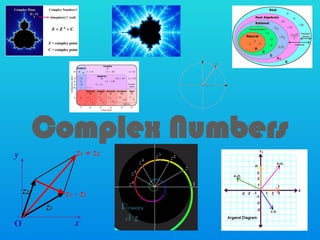
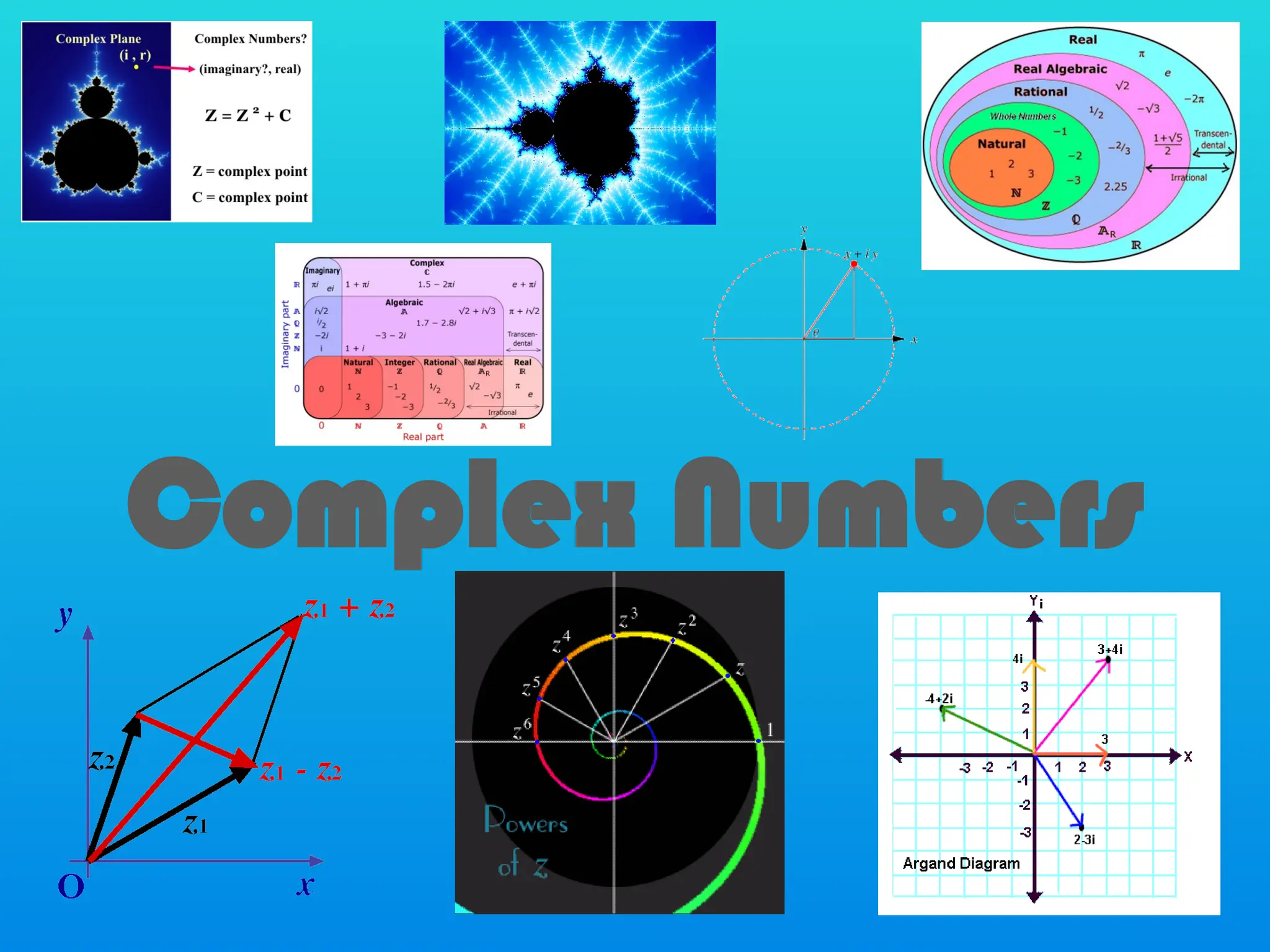
Introduction
• The firstchapter of FP1 introduces you to imaginary and
complex numbers
• You will have seen at GCSE level that some quadratic equations
cannot be solved
• Imaginary and complex numbers will allow us to actually solve
these equations!
• We will also see how to represent them on an Argand diagram
• We will also see how to use complex numbers to solve cubic and
quartic equations
Complex Numbers
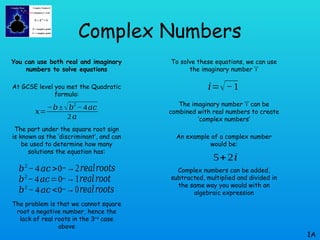
You canuse both real and imaginary
numbers to solve equations
At GCSE level you met the Quadratic
formula:
The part under the square root sign
is known as the ‘discriminant’, and can
be used to determine how many
solutions the equation has:
The problem is that we cannot square
root a negative number, hence the
lack of real roots in the 3rd
case
above
1A
𝑥=
−𝑏±√𝑏
2
−4𝑎𝑐
2𝑎
𝑏2
−4𝑎𝑐 >0
𝑏2
−4𝑎𝑐=0
𝑏2
−4𝑎𝑐 <0
−→2𝑟𝑒𝑎𝑙𝑟𝑜𝑜𝑡𝑠
−→1𝑟𝑒𝑎𝑙𝑟𝑜𝑜𝑡
−→0𝑟𝑒𝑎𝑙𝑟𝑜𝑜𝑡𝑠
To solve these equations, we can use
the imaginary number ‘i’
The imaginary number ‘i’ can be
combined with real numbers to create
‘complex numbers’
An example of a complex number
would be:
Complex numbers can be added,
subtracted, multiplied and divided in
the same way you would with an
algebraic expression
𝑖=√−1
5+2𝑖
5.
Complex Numbers
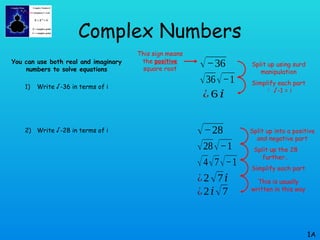
You canuse both real and imaginary
numbers to solve equations
1) Write √-36 in terms of i
2) Write √-28 in terms of i
1A
√−36
√36√−1
¿ 6 𝑖
This sign means
the positive
square root
Split up using surd
manipulation
Simplify each part
√-1 = i
√−28
√28√−1
√4√7√−1
Split up into a positive
and negative part
Split up the 28
further…
¿2√7𝑖
¿2𝑖√7
Simplify each part
This is usually
written in this way
6.
Complex Numbers
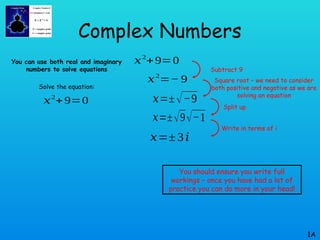
You canuse both real and imaginary
numbers to solve equations
Solve the equation:
1A
𝑥2
+9=0
𝑥2
+9=0
𝑥2
=− 9
𝑥=±√−9
𝑥=±√9√−1
𝑥=± 3𝑖
Subtract 9
Square root – we need to consider
both positive and negative as we are
solving an equation
Split up
Write in terms of i
You should ensure you write full
workings – once you have had a lot of
practice you can do more in your head!
7.
Complex Numbers
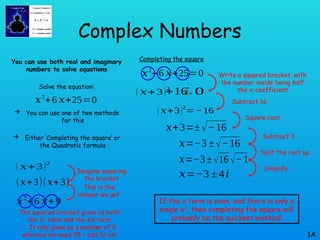
You canuse both real and imaginary
numbers to solve equations
Solve the equation:
You can use one of two methods
for this
Either ‘Completing the square’ or
the Quadratic formula
1A
𝑥2
+6 𝑥+25=0
𝑥2
+6 𝑥+25=0
( 𝑥+ 3)2
( 𝑥+ 3)2
(𝑥+3)(𝑥+3)
𝑥2
+6 𝑥+9
+16
¿ 0
( 𝑥+3)2
=−16
𝑥+3=±√−16
𝑥=−3 ±√−16
𝑥=−3 ±√16 √−1
𝑥=−3 ±4𝑖
Write a squared bracket, with
the number inside being half
the x-coefficient
Imagine squaring
the bracket
This is the
answer we get
The squared bracket gives us both
the x2
term and the 6x term
It only gives us a number of 9,
whereas we need 25 – add 16 on!
Completing the square
If the x term is even, and there is only a
single x2
, then completing the square will
probably be the quickest method!
Subtract 16
Square root
Subtract 3
Split the root up
Simplify
8.
Complex Numbers
You canuse both real and imaginary
numbers to solve equations
Solve the equation:
You can use one of two methods
for this
Either ‘Completing the square’ or
the Quadratic formula
1A
𝑥2
+6 𝑥+25=0
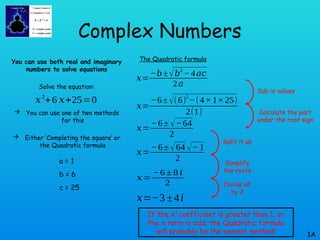
The Quadratic formula
𝑥=
−𝑏± √𝑏
2
−4𝑎𝑐
2𝑎
𝑥=
−6±√(6)
2
−(4×1×25)
2(1)
a = 1
b = 6
c = 25
𝑥=
−6± √−64
2
𝑥=
−6± √64 √− 1
2
𝑥=
−6 ± 8 𝑖
2
𝑥=−3 ±4𝑖
Sub in values
Calculate the part
under the root sign
Split it up
Simplify
the roots
Divide all
by 2
If the x2
coefficient is greater than 1, or
the x term is odd, the Quadratic formula
will probably be the easiest method!
9.
Complex Numbers
You canuse both real and imaginary
numbers to solve equations
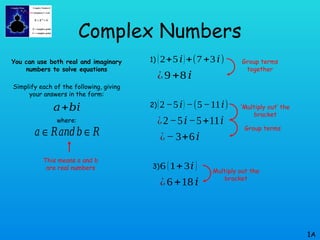
Simplify each of the following, giving
your answers in the form:
where:
1A
𝑎+𝑏𝑖
𝑎∈𝑅𝑎𝑛𝑑𝑏∈𝑅
This means a and b
are real numbers
1) (2+5𝑖)+(7+3𝑖)
¿9 +8 𝑖
2)(2−5𝑖) −(5−11𝑖)
¿− 3+6𝑖
¿2−5𝑖−5+11𝑖
3)6 (1+3𝑖)
¿6+18𝑖
Group terms
together
‘Multiply out’ the
bracket
Group terms
Multiply out the
bracket
Complex Numbers
You canmultiply complex numbers
and simplify powers of I
Complex numbers can be multiplied
using the same techniques as used in
algebra.
You can also use the following rule to
simplify powers of i:
1B
𝑖=√−1
𝑖2
=−1
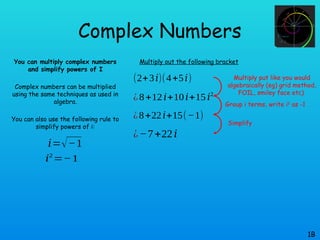
Multiply out the following bracket
(2+3𝑖)(4+5𝑖)
¿8+12𝑖+10𝑖+15𝑖2
¿8+22𝑖+15(−1)
¿−7+22𝑖
Multiply put like you would
algebraically (eg) grid method,
FOIL, smiley face etc)
Group i terms, write i2
as -1
Simplify
12.
Complex Numbers
You canmultiply complex numbers
and simplify powers of I
Complex numbers can be multiplied
using the same techniques as used in
algebra.
You can also use the following rule to
simplify powers of i:
1B
𝑖=√−1
𝑖2
=−1
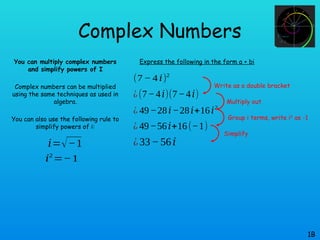
Express the following in the form a + bi
(7 − 4 𝑖)2
¿(7−4𝑖)(7−4𝑖)
¿ 49−28𝑖−28𝑖+16𝑖2
¿ 49−56𝑖+16(−1)
¿33−56𝑖
Write as a double bracket
Multiply out
Group i terms, write i2
as -1
Simplify
13.
Complex Numbers
You canmultiply complex numbers
and simplify powers of I
Complex numbers can be multiplied
using the same techniques as used in
algebra.
You can also use the following rule to
simplify powers of i:
1B
𝑖=√−1
𝑖2
=−1
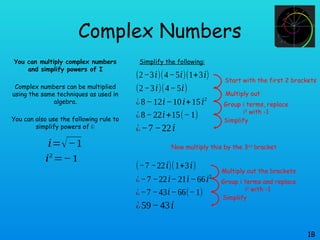
Simplify the following:
(2−3𝑖)(4−5𝑖)(1+3𝑖)
(2−3𝑖)(4−5𝑖)
¿8−12𝑖−10𝑖+15𝑖2
¿8−22𝑖+15(−1)
¿−7 −22𝑖
(−7 −22𝑖)(1+3𝑖)
¿−7 −22𝑖−21𝑖−66𝑖2
¿−7 −43𝑖−66(−1)
¿59−43𝑖
Start with the first 2 brackets
Multiply out
Group i terms, replace
i2
with -1
Simplify
Now multiply this by the 3rd
bracket
Multiply out the brackets
Group i terms and replace
i2
with -1
Simplify
14.
Complex Numbers
You canmultiply complex numbers
and simplify powers of I
Complex numbers can be multiplied
using the same techniques as used in
algebra.
You can also use the following rule to
simplify powers of i:
1B
𝑖=√−1
𝑖2
=−1
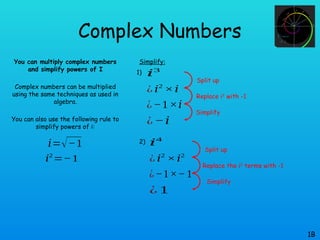
Simplify:
𝑖3
¿ 𝑖2
×𝑖
¿−1×𝑖
¿ −𝑖
1)
𝑖4
¿ 𝑖2
×𝑖2
¿−1×−1
¿ 1
2)
Split up
Replace i2
with -1
Simplify
Split up
Replace the i2
terms with -1
Simplify
15.
Complex Numbers
You canmultiply complex numbers
and simplify powers of I
Complex numbers can be multiplied
using the same techniques as used in
algebra.
You can also use the following rule to
simplify powers of i:
1B
𝑖=√−1
𝑖2
=−1
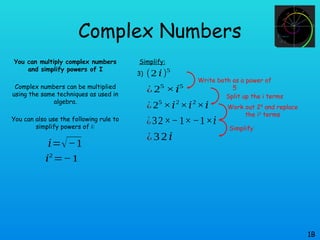
Simplify:
(2 𝑖)5
3)
¿ 25
×𝑖5
¿25
×𝑖2
×𝑖2
×𝑖
¿32×−1×−1×𝑖
¿32𝑖
Write both as a power of
5
Split up the i terms
Work out 25
and replace
the i2
terms
Simplify
Complex Numbers
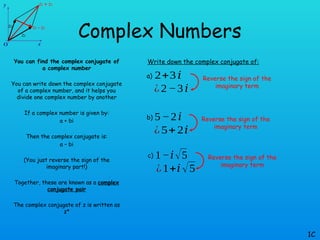
You canfind the complex conjugate of
a complex number
You can write down the complex conjugate
of a complex number, and it helps you
divide one complex number by another
If a complex number is given by:
a + bi
Then the complex conjugate is:
a – bi
(You just reverse the sign of the
imaginary part!)
Together, these are known as a complex
conjugate pair
The complex conjugate of z is written as
z*
1C
Write down the complex conjugate of:
a) 2+3𝑖
¿2−3𝑖
b) 5−2𝑖
¿5+2𝑖
c) 1−𝑖√5
¿1+𝑖√5
Reverse the sign of the
imaginary term
Reverse the sign of the
imaginary term
Reverse the sign of the
imaginary term
18.
Complex Numbers
You canfind the complex conjugate
of a complex number
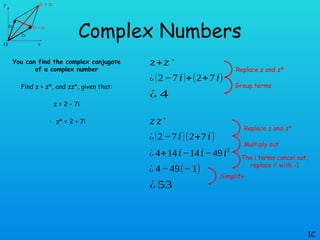
Find z + z*, and zz*, given that:
z = 2 – 7i
z* = 2 + 7i
1C
𝑧+𝑧∗
¿(2−7𝑖)+(2+7𝑖)
¿ 4
Replace z and z*
Group terms
𝑧 𝑧∗
¿(2−7𝑖)(2+7𝑖)
¿ 4+14𝑖−14𝑖−49𝑖2
Replace z and z*
Multiply out
¿ 4−49(−1)
¿ 53
The i terms cancel out,
replace i2
with -1
Simplify
19.
Complex Numbers
You canfind the complex conjugate
of a complex number
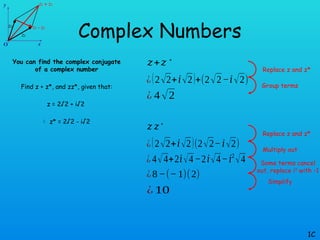
Find z + z*, and zz*, given that:
z = 2√2 + i√2
z* = 2√2 - i√2
1C
𝑧+𝑧∗
¿(2√2+𝑖√2)+(2√2−𝑖√2)
¿ 4√2
Replace z and z*
Group terms
𝑧 𝑧∗
¿(2√2+𝑖√2)(2√2−𝑖√2)
¿ 4√4+2𝑖√4 −2𝑖√4−𝑖2
√4
Replace z and z*
Multiply out
¿8−(−1)(2)
¿ 10
Some terms cancel
out, replace i2
with -1
Simplify
20.
Complex Numbers
You canfind the complex conjugate
of a complex number
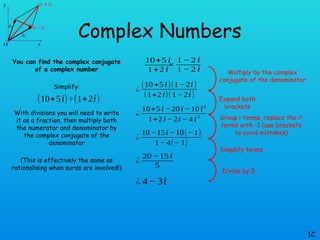
Simplify:
With divisions you will need to write
it as a fraction, then multiply both
the numerator and denominator by
the complex conjugate of the
denominator
(This is effectively the same as
rationalising when surds are involved!)
1C
(10+5𝑖)÷(1+2𝑖)
10+5 𝑖
1+2 𝑖
×
1 −2 𝑖
1 −2 𝑖
¿
(10+5 𝑖)(1− 2𝑖)
(1+2𝑖)(1− 2𝑖)
¿
10+5 𝑖−20𝑖−10 𝑖2
1+2𝑖− 2𝑖− 4 𝑖
2
¿
10−15𝑖−10(−1)
1− 4(− 1)
¿
20 −15 𝑖
5
¿ 4−3𝑖
Multiply by the complex
conjugate of the denominator
Expand both
brackets
Group i terms, replace the i2
terms with -1 (use brackets
to avoid mistakes)
Simplify terms
Divide by 5
21.
Complex Numbers
You canfind the complex conjugate
of a complex number
Simplify:
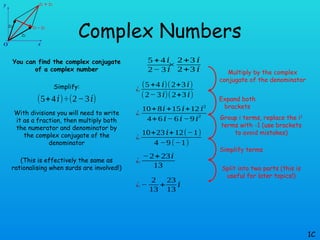
With divisions you will need to write
it as a fraction, then multiply both
the numerator and denominator by
the complex conjugate of the
denominator
(This is effectively the same as
rationalising when surds are involved!)
1C
(5+4𝑖)÷(2−3𝑖)
5 +4 𝑖
2− 3 𝑖
×
2+3 𝑖
2+3 𝑖
¿
(5+4 𝑖)(2+3 𝑖)
(2− 3𝑖)(2+3 𝑖)
¿
10+8𝑖+15 𝑖+12 𝑖2
4+6 𝑖− 6 𝑖 −9 𝑖
2
¿
10+23 𝑖+12(−1)
4 −9(−1)
¿
−2+23𝑖
13
¿−
2
13
+
23
13
𝑖
Multiply by the complex
conjugate of the denominator
Expand both
brackets
Group i terms, replace the i2
terms with -1 (use brackets
to avoid mistakes)
Simplify terms
Split into two parts (this is
useful for later topics!)
22.
Complex Numbers
You canfind the complex conjugate
of a complex number
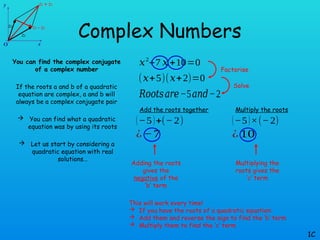
If the roots a and b of a quadratic
equation are complex, a and b will
always be a complex conjugate pair
You can find what a quadratic
equation was by using its roots
Let us start by considering a
quadratic equation with real
solutions…
1C
𝑥2
+7 𝑥+10=0
(𝑥+5)(𝑥+2)=0
𝑅𝑜𝑜𝑡𝑠𝑎𝑟𝑒−5𝑎𝑛𝑑−2
Add the roots together
(−5)+(− 2)
¿ −7
Multiply the roots
(−5)×(−2)
¿ 10
Factorise
Solve
Adding the roots
gives the
negative of the
‘b’ term
Multiplying the
roots gives the
‘c’ term
This will work every time!
If you have the roots of a quadratic equation:
Add them and reverse the sign to find the ‘b’ term
Multiply them to find the ‘c’ term
23.
Complex Numbers
You canfind the complex conjugate
of a complex number
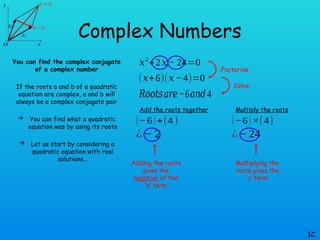
If the roots a and b of a quadratic
equation are complex, a and b will
always be a complex conjugate pair
You can find what a quadratic
equation was by using its roots
Let us start by considering a
quadratic equation with real
solutions…
1C
𝑥2
+2𝑥− 24=0
(𝑥+6)(𝑥−4)=0
𝑅𝑜𝑜𝑡𝑠𝑎𝑟𝑒−6𝑎𝑛𝑑 4
Add the roots together
(−6)+(4)
¿ − 2
Multiply the roots
(−6) ×(4)
¿− 24
Factorise
Solve
Adding the roots
gives the
negative of the
‘b’ term
Multiplying the
roots gives the
‘c’ term
24.
Complex Numbers
You canfind the complex conjugate
of a complex number
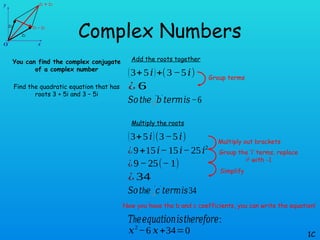
Find the quadratic equation that has
roots 3 + 5i and 3 – 5i
1C
Add the roots together
(3+5𝑖)+(3−5𝑖)
¿ 6
𝑆𝑜 h
𝑡 𝑒 𝑏
❑
′ ′
𝑡𝑒𝑟𝑚𝑖𝑠−6
Multiply the roots
(3+5𝑖)(3−5𝑖)
¿9+15𝑖−15𝑖−25𝑖2
𝑆𝑜 h
𝑡 𝑒 𝑐
❑
′ ′
𝑡𝑒𝑟𝑚𝑖𝑠34
¿9−25(−1)
¿ 34
h
𝑇 𝑒𝑒𝑞𝑢𝑎𝑡𝑖𝑜𝑛𝑖𝑠 h
𝑡 𝑒𝑟𝑒𝑓𝑜𝑟𝑒:
𝑥2
−6 𝑥+34=0
Group terms
Multiply out brackets
Group the ‘i’ terms, replace
i2
with -1
Simplify
Now you have the b and c coefficients, you can write the equation!
Complex Numbers
You canrepresent complex
numbers on an Argand diagram
A grid where values for x and y can
be plotted is known as a Cartesian
set of axes (after Rene Descartes)
An Argand diagram is very similar,
but the x-axis represents real
numbers and the y-axis represents
imaginary numbers.
Complex numbers can be plotted on
an Argand diagram, by considering
the real and imaginary parts as
coordinates
1D
27.
Complex Numbers
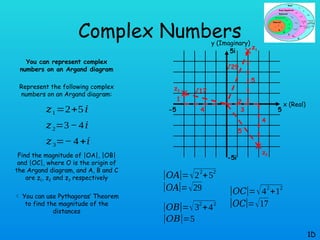
You canrepresent complex
numbers on an Argand diagram
Represent the following complex
numbers on an Argand diagram:
Find the magnitude of |OA|, |OB|
and |OC|, where O is the origin of
the Argand diagram, and A, B and C
are z1, z2 and z3 respectively
You can use Pythagoras’ Theorem
to find the magnitude of the
distances
1D
𝑧1=2+5𝑖
𝑧2=3− 4𝑖
𝑧3=− 4+𝑖
x (Real)
y (Imaginary)
z1
z2
z3
2
5
4
3
4
1
5
-5
-5i
5i
|𝑂𝐴|=√22
+52
|𝑂𝐴|=√29
|𝑂𝐵|=√32
+42
|𝑂𝐵|=5
|𝑂𝐶|=√42
+12
|𝑂𝐶|=√17
√29
5
√17
28.
Complex Numbers
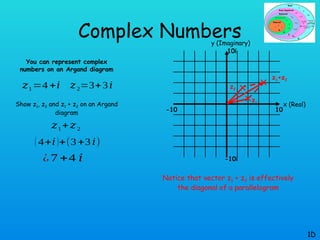
You canrepresent complex
numbers on an Argand diagram
Show z1, z2 and z1 + z2 on an Argand
diagram
1D
𝑧1=4 +𝑖 𝑧2=3+3𝑖
𝑧1+𝑧2
( 4+𝑖)+(3 +3 𝑖)
¿ 7 +4 𝑖
x (Real)
y (Imaginary)
10
-10
-10i
10i
z1
z2
z1+z2
Notice that vector z1 + z2 is effectively
the diagonal of a parallelogram
29.
Complex Numbers
You canrepresent complex
numbers on an Argand diagram
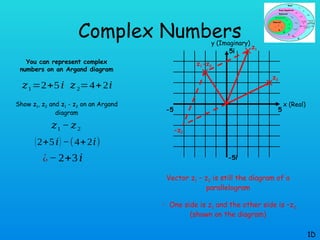
Show z1, z2 and z1 - z2 on an Argand
diagram
1D
𝑧1=2+5𝑖 𝑧2=4+2𝑖
𝑧1 − 𝑧2
(2+5𝑖) −(4+2𝑖)
¿− 2+3𝑖
x (Real)
y (Imaginary)
5
-5
-5i
5i
z1
z2
z1-z2
Vector z1 – z2 is still the diagram of a
parallelogram
One side is z1 and the other side is –z2
(shown on the diagram)
-z2
Complex Numbers
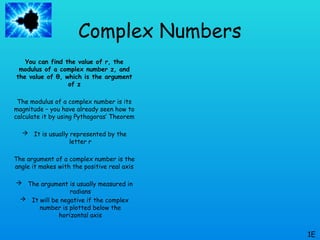
You canfind the value of r, the
modulus of a complex number z, and
the value of θ, which is the argument
of z
The modulus of a complex number is its
magnitude – you have already seen how to
calculate it by using Pythagoras’ Theorem
It is usually represented by the
letter r
The argument of a complex number is the
angle it makes with the positive real axis
The argument is usually measured in
radians
It will be negative if the complex
number is plotted below the
horizontal axis
1E
32.
Complex Numbers
You canfind the value of r, the
modulus of a complex number z, and
the value of θ, which is the argument
of z
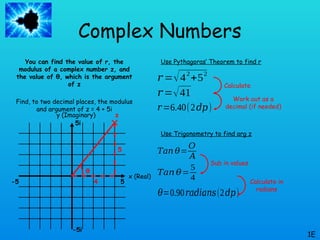
Find, to two decimal places, the modulus
and argument of z = 4 + 5i
1E
x (Real)
y (Imaginary)
5
-5
-5i
5i
z
4
5
𝑟 =√42
+52
Use Pythagoras’ Theorem to find r
𝑟 =√41
𝑟=6.40(2𝑑𝑝)
Use Trigonometry to find arg z
θ
𝑇𝑎𝑛 𝜃=
𝑂
𝐴
𝑇𝑎𝑛 𝜃=
5
4
𝜃=0.90𝑟𝑎𝑑𝑖𝑎𝑛𝑠(2𝑑𝑝)
Calculate
Work out as a
decimal (if needed)
Sub in values
Calculate in
radians
33.
Complex Numbers
You canfind the value of r, the
modulus of a complex number z, and
the value of θ, which is the argument
of z
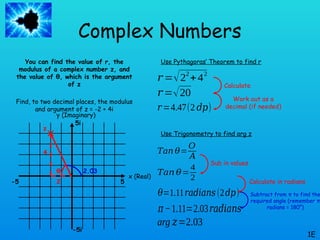
Find, to two decimal places, the modulus
and argument of z = -2 + 4i
1E
x (Real)
y (Imaginary)
5
-5
-5i
5i
z
2
4
𝑟 =√22
+42
Use Pythagoras’ Theorem to find r
𝑟 =√20
𝑟=4.47(2 𝑑𝑝)
Use Trigonometry to find arg z
θ
𝑇𝑎𝑛 𝜃=
𝑂
𝐴
𝑇𝑎𝑛 𝜃=
4
2
𝜃=1.11𝑟𝑎𝑑𝑖𝑎𝑛𝑠(2𝑑𝑝)
Calculate
Work out as a
decimal (if needed)
Sub in values
Calculate in radians
𝜋−1.11=2.03𝑟𝑎𝑑𝑖𝑎𝑛𝑠
arg 𝑧=2.03
2.03
Subtract from π to find the
required angle (remember π
radians = 180°)
34.
Complex Numbers
You canfind the value of r, the
modulus of a complex number z, and
the value of θ, which is the argument
of z
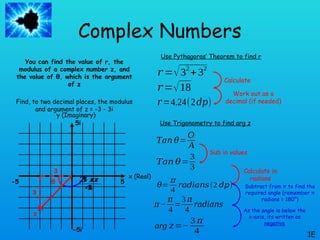
Find, to two decimal places, the modulus
and argument of z = -3 - 3i
1E
x (Real)
y (Imaginary)
5
-5
-5i
5i
z
3
3
θ
𝑟 =√32
+32
Use Pythagoras’ Theorem to find r
𝑟 =√18
𝑟=4.24(2𝑑𝑝)
Use Trigonometry to find arg z
𝑇𝑎𝑛 𝜃=
𝑂
𝐴
𝑇𝑎𝑛 𝜃=
3
3
𝜃=
𝜋
4
𝑟𝑎𝑑𝑖𝑎𝑛𝑠(2 𝑑𝑝)
Calculate
Work out as a
decimal (if needed)
Sub in values
Calculate in
radians
Subtract from π to find the
required angle (remember π
radians = 180°)
𝜋 −
𝜋
4
=
3 𝜋
4
𝑟𝑎𝑑𝑖𝑎𝑛𝑠
arg 𝑧=−
3 𝜋
4
As the angle is below the
x-axis, its written as
negative
𝟑 𝝅
𝟒
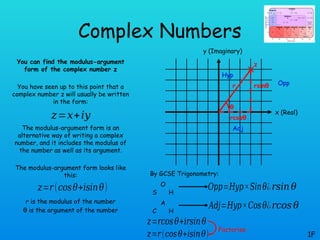
Complex Numbers
You canfind the modulus-argument
form of the complex number z
You have seen up to this point that a
complex number z will usually be written
in the form:
The modulus-argument form is an
alternative way of writing a complex
number, and it includes the modulus of
the number as well as its argument.
The modulus-argument form looks like
this:
r is the modulus of the number
θ is the argument of the number
1F
𝑧=𝑥+𝑖𝑦
𝑧=𝑟(𝑐𝑜𝑠𝜃+𝑖𝑠𝑖𝑛𝜃)
x (Real)
y (Imaginary)
z
r
rcosθ
θ
rsinθ
By GCSE Trigonometry:
S
O
H
C
A
H
𝑂𝑝𝑝=𝐻𝑦𝑝×𝑆𝑖𝑛𝜃
𝐴𝑑𝑗=𝐻𝑦𝑝×𝐶𝑜𝑠𝜃
Opp
Adj
Hyp
¿𝑟𝑠𝑖𝑛 𝜃
¿𝑟𝑐𝑜𝑠 𝜃
𝑧=𝑟𝑐𝑜𝑠𝜃+𝑖𝑟𝑠𝑖𝑛𝜃
𝑧=𝑟(𝑐𝑜𝑠𝜃+𝑖𝑠𝑖𝑛𝜃)
Factorise
37.
θ
θ
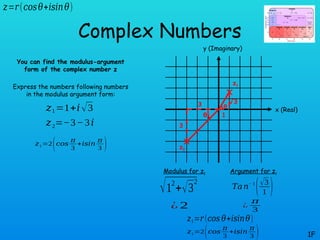
Complex Numbers
You canfind the modulus-argument
form of the complex number z
Express the numbers following numbers
in the modulus argument form:
1F
𝑧1=1+𝑖√3
𝑧=𝑟(𝑐𝑜𝑠𝜃+𝑖𝑠𝑖𝑛𝜃)
𝑧2=−3−3𝑖
x (Real)
y (Imaginary)
3
3
1
√3
z1
z2
Modulus for z1 Argument for z1
√12
+√3
2
¿ 2
𝑇𝑎𝑛− 1
(√3
1 )
¿
𝜋
3
𝑧1=𝑟(𝑐𝑜𝑠 𝜃+𝑖𝑠𝑖𝑛𝜃)
𝑧1=2(𝑐𝑜𝑠
𝜋
3
+𝑖𝑠𝑖𝑛
𝜋
3 )
𝑧1=2(𝑐𝑜𝑠
𝜋
3
+𝑖𝑠𝑖𝑛
𝜋
3 )
38.
θ
θ
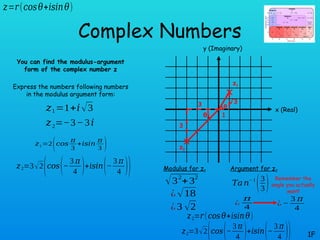
Complex Numbers
You canfind the modulus-argument
form of the complex number z
Express the numbers following numbers
in the modulus argument form:
1F
𝑧1=1+𝑖√3
𝑧=𝑟(𝑐𝑜𝑠𝜃+𝑖𝑠𝑖𝑛𝜃)
𝑧2=−3−3𝑖
x (Real)
y (Imaginary)
3
3
1
√3
z1
z2
Modulus for z2 Argument for z2
√32
+32
¿√18
𝑇𝑎𝑛− 1
(3
3)
¿
𝜋
4
𝑧2=𝑟(𝑐𝑜𝑠𝜃+𝑖𝑠𝑖𝑛𝜃)
𝑧2=3√2
(𝑐𝑜𝑠(−
3 𝜋
4 )+𝑖𝑠𝑖𝑛(−
3 𝜋
4 ))
𝑧1=2(𝑐𝑜𝑠
𝜋
3
+𝑖𝑠𝑖𝑛
𝜋
3 )
¿3 √2
𝑧2=3√2
(𝑐𝑜𝑠(−
3 𝜋
4 )+𝑖𝑠𝑖𝑛(−
3 𝜋
4 ))
¿ −
3 𝜋
4
Remember the
angle you actually
want!
39.
θ
θ
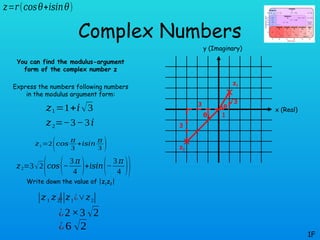
Complex Numbers
You canfind the modulus-argument
form of the complex number z
Express the numbers following numbers
in the modulus argument form:
Write down the value of |z1z2|
1F
𝑧1=1+𝑖√3
𝑧=𝑟(𝑐𝑜𝑠𝜃+𝑖𝑠𝑖𝑛𝜃)
𝑧2=−3−3𝑖
x (Real)
y (Imaginary)
3
3
1
√3
z1
z2
𝑧1=2(𝑐𝑜𝑠
𝜋
3
+𝑖𝑠𝑖𝑛
𝜋
3 )
𝑧2=3√2
(𝑐𝑜𝑠(−
3 𝜋
4 )+𝑖𝑠𝑖𝑛(−
3 𝜋
4 ))
|𝑧1 𝑧2
|
¿|𝑧1¿∨𝑧2|
¿2×3 √2
¿6 √2
40.
Complex Numbers
You canfind the modulus-argument
form of the complex number z
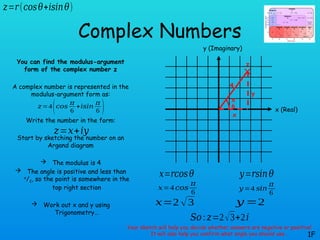
A complex number is represented in the
modulus-argument form as:
Write the number in the form:
Start by sketching the number on an
Argand diagram
The modulus is 4
The angle is positive and less than
π
/2, so the point is somewhere in the
top right section
Work out x and y using
Trigonometry…
1F
𝑧=𝑟(𝑐𝑜𝑠𝜃+𝑖𝑠𝑖𝑛𝜃)
x (Real)
y (Imaginary)
𝑧=4(𝑐𝑜𝑠
𝜋
6
+𝑖𝑠𝑖𝑛
𝜋
6 )
z
4
x
𝑧=𝑥+𝑖𝑦
y
π
6
𝑥=𝑟𝑐𝑜𝑠𝜃 𝑦=𝑟𝑠𝑖𝑛𝜃
𝑥=4 𝑐𝑜𝑠
𝜋
6
𝑦=4 𝑠𝑖𝑛
𝜋
6
𝑥=2 √3 𝑦 =2
𝑆𝑜:𝑧=2√3+2𝑖
Your sketch will help you decide whether answers are negative or positive!
It will also help you confirm what angle you should use…
Complex Numbers
You cansolve problems involving
complex numbers
Problems can be solved by equating
the real and imaginary parts of a
complex equation
This technique can also be used to
square root a number
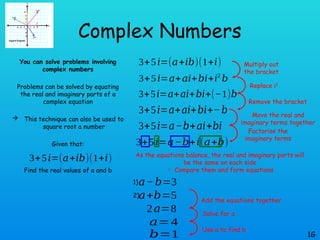
Given that:
Find the real values of a and b
1G
3+5𝑖=(𝑎+𝑖𝑏)(1+𝑖)
3+5𝑖=(𝑎+𝑖𝑏)(1+𝑖)
3+5𝑖=𝑎+𝑎𝑖+𝑏𝑖+𝑖2
𝑏
3+5𝑖=𝑎+𝑎𝑖+𝑏𝑖+(−1)𝑏
3+5𝑖=𝑎+𝑎𝑖+𝑏𝑖+−𝑏
3+5𝑖=𝑎−𝑏+𝑎𝑖+𝑏𝑖
3+5𝑖=𝑎−𝑏+𝑖(𝑎+𝑏)
Multiply out
the bracket
Replace i2
Remove the bracket
Move the real and
imaginary terms together
Factorise the
imaginary terms
As the equations balance, the real and imaginary parts will
be the same on each side
Compare them and form equations
𝑎−𝑏=3
𝑎+𝑏=5
1)
2)
2𝑎=8
𝑎=4
𝑏=1
Add the equations together
Solve for a
Use a to find b
43.
Complex Numbers
You cansolve problems involving
complex numbers
Problems can be solved by equating
the real and imaginary parts of a
complex equation
This technique can also be used to
square root a number
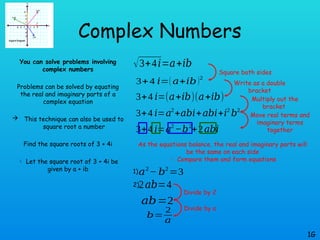
Find the square roots of 3 + 4i
Let the square root of 3 + 4i be
given by a + ib
1G
√3+4𝑖=𝑎+𝑖𝑏
3+4 𝑖=( 𝑎+𝑖𝑏)2
3+4 𝑖=(𝑎+𝑖𝑏)(𝑎+𝑖𝑏)
3+4 𝑖=𝑎2
+𝑎𝑏𝑖+𝑎𝑏𝑖+𝑖2
𝑏2
3+4 𝑖=𝑎2
−𝑏2
+2𝑎𝑏𝑖
Square both sides
Multiply out the
bracket
Write as a double
bracket
Move real terms and
imaginary terms
together
As the equations balance, the real and imaginary parts will
be the same on each side
Compare them and form equations
𝑎2
− 𝑏2
=3
2𝑎𝑏=4
1)
2)
𝑎𝑏=2
𝑏=
2
𝑎
Divide by 2
Divide by a
44.
Complex Numbers
You cansolve problems involving
complex numbers
Problems can be solved by equating
the real and imaginary parts of a
complex equation
This technique can also be used to
square root a number
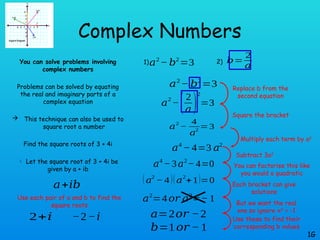
Find the square roots of 3 + 4i
Let the square root of 3 + 4i be
given by a + ib
1G
𝑎2
− 𝑏2
=3
1) 2) 𝑏=
2
𝑎
𝑎2
− 𝑏2
=3
𝑎
2
−(2
𝑎 )
2
=3
𝑎
2
−
4
𝑎
2
=3
𝑎4
− 4=3 𝑎2
𝑎4
−3𝑎2
−4=0
(𝑎2
− 4)(𝑎2
+1)=0
𝑎2
=4𝑜𝑟 𝑎2
=− 1
𝑎=2𝑜𝑟 −2
𝑏=1𝑜𝑟 − 1
𝑎+𝑖𝑏
2+𝑖 −2−𝑖
Replace b from the
second equation
Square the bracket
Multiply each term by a2
Subtract 3a2
You can factorise this like
you would a quadratic
Each bracket can give
solutions
But we want the real
one so ignore x2
= -1
Use these to find their
corresponding b values
Use each pair of a and b to find the
square roots
Complex Numbers
You canfind the complex conjugate
of a complex number
If the roots a and b of a quadratic
equation are complex, a and b will
always be a complex conjugate pair
You can find what a quadratic
equation was by using its roots
Let us start by considering a
quadratic equation with real
solutions…
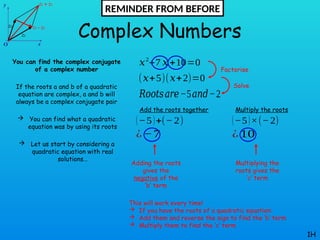
1H
𝑥2
+7 𝑥+10=0
(𝑥+5)(𝑥+2)=0
𝑅𝑜𝑜𝑡𝑠𝑎𝑟𝑒−5𝑎𝑛𝑑−2
Add the roots together
(−5)+(− 2)
¿ −7
Multiply the roots
(−5)×(−2)
¿ 10
Factorise
Solve
Adding the roots
gives the
negative of the
‘b’ term
Multiplying the
roots gives the
‘c’ term
This will work every time!
If you have the roots of a quadratic equation:
Add them and reverse the sign to find the ‘b’ term
Multiply them to find the ‘c’ term
REMINDER FROM BEFORE
47.
Complex Numbers
You canfind the complex conjugate
of a complex number
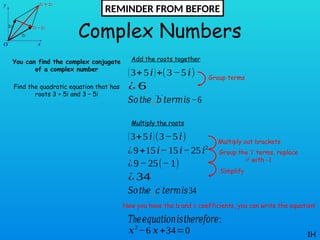
Find the quadratic equation that has
roots 3 + 5i and 3 – 5i
1H
Add the roots together
(3+5𝑖)+(3−5𝑖)
¿ 6
𝑆𝑜 h
𝑡 𝑒 𝑏
❑
′ ′
𝑡𝑒𝑟𝑚𝑖𝑠−6
Multiply the roots
(3+5𝑖)(3−5𝑖)
¿9+15𝑖−15𝑖−25𝑖2
𝑆𝑜 h
𝑡 𝑒 𝑐
❑
′ ′
𝑡𝑒𝑟𝑚𝑖𝑠34
¿9−25(−1)
¿ 34
h
𝑇 𝑒𝑒𝑞𝑢𝑎𝑡𝑖𝑜𝑛𝑖𝑠 h
𝑡 𝑒𝑟𝑒𝑓𝑜𝑟𝑒:
𝑥2
−6 𝑥+34=0
Group terms
Multiply out brackets
Group the ‘i’ terms, replace
i2
with -1
Simplify
Now you have the b and c coefficients, you can write the equation!
REMINDER FROM BEFORE
48.
Complex Numbers
You cansolve some types of polynomial
equation with real coefficients
You have seen that if the roots of an
equation are complex, they occur as a
complex conjugate pair
If you know one complex root of a
quadratic equation, you can find the
whole equation itself
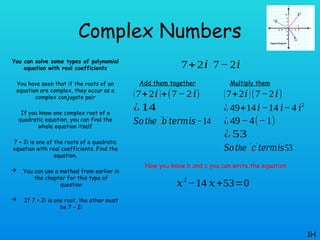
7 + 2i is one of the roots of a quadratic
equation with real coefficients. Find the
equation.
You can use a method from earlier in
the chapter for this type of
question
If 7 + 2i is one root, the other must
be 7 – 2i
1H
7+2𝑖 7− 2𝑖
Add them together
(7+2𝑖)+(7− 2𝑖)
¿ 14
𝑆𝑜 h
𝑡 𝑒 𝑏
❑
′ ′
𝑡𝑒𝑟𝑚𝑖𝑠−14
Multiply them
(7+2𝑖)(7−2𝑖)
¿ 49+14𝑖−14 𝑖−4 𝑖2
¿ 49−4(−1)
¿ 53
𝑆𝑜 h
𝑡 𝑒 𝑐
❑
′ ′
𝑡𝑒𝑟𝑚𝑖𝑠53
Now you know b and c you can write the equation
𝑥2
−14 𝑥+53=0
49.
Complex Numbers
You cansolve some types of
polynomial equation with real
coefficients
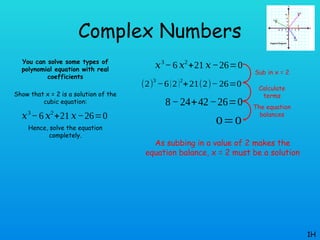
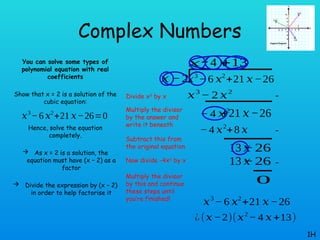
Show that x = 2 is a solution of the
cubic equation:
Hence, solve the equation
completely.
1H
𝑥3
−6 𝑥2
+21 𝑥−26=0
𝑥3
−6 𝑥2
+21 𝑥−26=0
(2)
3
−6(2)2
+21(2)− 26=0
8−24+42−26=0
0=0
Sub in x = 2
Calculate
terms
The equation
balances
As subbing in a value of 2 makes the
equation balance, x = 2 must be a solution
50.
Complex Numbers
You cansolve some types of
polynomial equation with real
coefficients
Show that x = 2 is a solution of the
cubic equation:
Hence, solve the equation
completely.
As x = 2 is a solution, the
equation must have (x – 2) as a
factor
Divide the expression by (x – 2)
in order to help factorise it
1H
𝑥3
−6 𝑥2
+21 𝑥−26=0
𝑥3
− 6 𝑥2
+21 𝑥−26
𝑥 −2
𝑥2
𝑥3
− 2 𝑥2
− 4 𝑥2
+21 𝑥−26
− 4 𝑥
− 4 𝑥2
+8 𝑥
13 𝑥
−26
+13
13 𝑥
−26
0
𝑥3
− 6 𝑥2
+21 𝑥−26
¿(𝑥−2)(𝑥2
− 4 𝑥+13)
Divide x3
by x
Multiply the divisor
by the answer and
write it beneath
Subtract this from
the original equation
Now divide -4x2
by x
Multiply the divisor
by this and continue
these steps until
you’re finished!
-
-
-
51.
Complex Numbers
You cansolve some types of
polynomial equation with real
coefficients
Show that x = 2 is a solution of the
cubic equation:
Hence, solve the equation
completely.
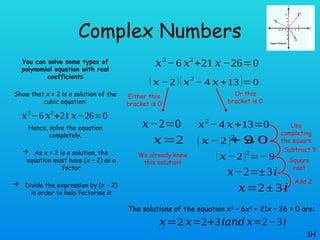
As x = 2 is a solution, the
equation must have (x – 2) as a
factor
Divide the expression by (x – 2)
in order to help factorise it
1H
𝑥3
−6 𝑥2
+21 𝑥−26=0
𝑥3
− 6 𝑥2
+21 𝑥−26=0
( 𝑥 −2 )(𝑥
2
− 4 𝑥 +13 )=0
𝑥−2=0
𝑥=2
Either this
bracket is 0
We already knew
this solution!
Or this
bracket is 0
𝑥2
− 4 𝑥+13=0
( 𝑥 −2 )2
+ 9
¿ 0
( 𝑥 −2 )2
=− 9
𝑥−2=±3𝑖
𝑥=2± 3𝑖
Use
completing
the square
Subtract 9
Square
root
Add 2
The solutions of the equation x3
– 6x2
+ 21x – 26 = 0 are:
𝑥=2 𝑥=2+3𝑖 𝑥=2−3𝑖
𝑎𝑛𝑑
52.
Complex Numbers
You cansolve some types of
polynomial equation with real
coefficients
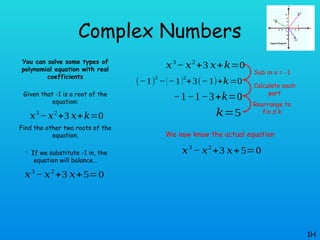
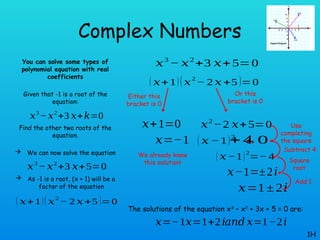
Given that -1 is a root of the
equation:
Find the other two roots of the
equation.
If we substitute -1 in, the
equation will balance…
1H
𝑥3
−𝑥2
+3 𝑥+𝑘=0
𝑥3
− 𝑥2
+3 𝑥+𝑘=0
(−1)
3
−(−1)2
+3(− 1)+𝑘=0
−1−1−3+𝑘=0
𝑘=5
Sub in x = -1
Calculate each
part
Rearrange to
fin d k
𝑥3
− 𝑥2
+3 𝑥+5=0
We now know the actual equation
𝑥3
− 𝑥2
+3 𝑥+5=0
53.
Complex Numbers
You cansolve some types of
polynomial equation with real
coefficients
Given that -1 is a root of the
equation:
Find the other two roots of the
equation.
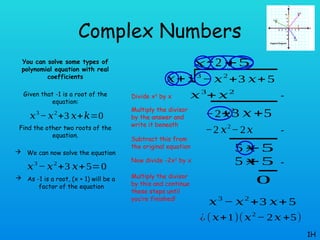
We can now solve the equation
As -1 is a root, (x + 1) will be a
factor of the equation
1H
𝑥3
−𝑥2
+3 𝑥+𝑘=0
𝑥3
− 𝑥2
+3 𝑥+5=0
𝑥3
− 𝑥2
+3 𝑥+ 5
𝑥+1
𝑥2
𝑥3
+ 𝑥2
−2 𝑥2
+3 𝑥 +5
−2 𝑥
−2 𝑥2
−2𝑥
5 𝑥
+5
+5
5 𝑥
+5
0
𝑥3
− 𝑥2
+3 𝑥+ 5
¿ (𝑥+1)(𝑥2
− 2 𝑥 +5)
Divide x3
by x
Multiply the divisor
by the answer and
write it beneath
Subtract this from
the original equation
Now divide -2x2
by x
Multiply the divisor
by this and continue
these steps until
you’re finished!
-
-
-
54.
Complex Numbers
You cansolve some types of
polynomial equation with real
coefficients
Given that -1 is a root of the
equation:
Find the other two roots of the
equation.
We can now solve the equation
As -1 is a root, (x + 1) will be a
factor of the equation
1H
𝑥3
−𝑥2
+3 𝑥+𝑘=0
𝑥3
− 𝑥2
+3 𝑥+5=0
( 𝑥+1)(𝑥2
− 2 𝑥 +5 )=0
𝑥3
− 𝑥2
+3 𝑥+5=0
( 𝑥+1)(𝑥
2
− 2 𝑥 +5 )=0
𝑥+1=0
𝑥=−1
Either this
bracket is 0
We already knew
this solution!
Or this
bracket is 0
𝑥2
−2 𝑥+5=0
( 𝑥 −1)2
+ 4
¿ 0
( 𝑥 −1)2
=− 4
𝑥−1=±2𝑖
𝑥=1± 2𝑖
Use
completing
the square
Subtract 4
Square
root
Add 1
The solutions of the equation x3
– x2
+ 3x + 5 = 0 are:
𝑥=−1𝑥=1+2𝑖 𝑥=1−2𝑖
𝑎𝑛𝑑
55.
Complex Numbers
You cansolve some types of
polynomial equation with real
coefficients
1H
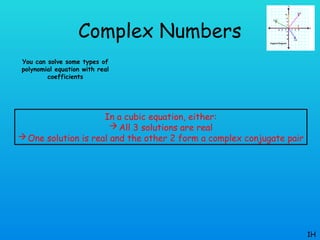
In a cubic equation, either:
All 3 solutions are real
One solution is real and the other 2 form a complex conjugate pair
56.
Complex Numbers
You cansolve some types of
polynomial equation with real
coefficients
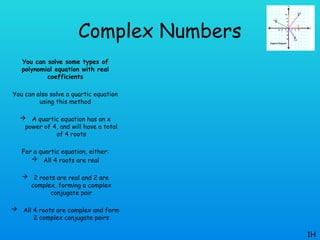
You can also solve a quartic equation
using this method
A quartic equation has an x
power of 4, and will have a total
of 4 roots
For a quartic equation, either:
All 4 roots are real
2 roots are real and 2 are
complex, forming a complex
conjugate pair
All 4 roots are complex and form
2 complex conjugate pairs
1H
57.
Complex Numbers
You cansolve some types of
polynomial equation with real
coefficients
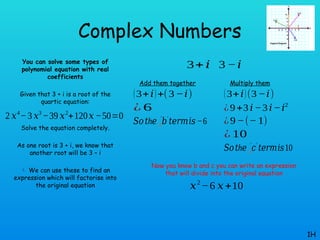
Given that 3 + i is a root of the
quartic equation:
Solve the equation completely.
As one root is 3 + i, we know that
another root will be 3 – i
We can use these to find an
expression which will factorise into
the original equation
1H
2 𝑥4
−3 𝑥3
−39 𝑥2
+120𝑥 −50=0
3+𝑖 3 −𝑖
Add them together
(3+𝑖)+(3 −𝑖)
¿ 6
𝑆𝑜 h
𝑡 𝑒 𝑏
❑
′ ′
𝑡𝑒𝑟𝑚𝑖𝑠−6
Multiply them
(3+𝑖)(3−𝑖)
¿9+3𝑖−3𝑖−𝑖2
¿9−(− 1)
¿ 10
𝑆𝑜 h
𝑡 𝑒 𝑐
❑
′ ′
𝑡𝑒𝑟𝑚𝑖𝑠10
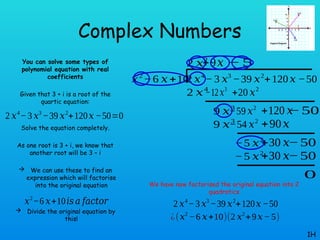
Now you know b and c you can write an expression
that will divide into the original equation
𝑥2
−6 𝑥+10
58.
Complex Numbers
You cansolve some types of
polynomial equation with real
coefficients
Given that 3 + i is a root of the
quartic equation:
Solve the equation completely.
As one root is 3 + i, we know that
another root will be 3 – i
We can use these to find an
expression which will factorise
into the original equation
Divide the original equation by
this!
1H
2 𝑥4
−3 𝑥3
−39 𝑥2
+120𝑥 −50=0
𝑥2
−6 𝑥+10𝑖𝑠 𝑎 𝑓𝑎𝑐𝑡𝑜𝑟
2 𝑥4
− 3 𝑥3
−39 𝑥2
+120𝑥 −50
𝑥2
−6 𝑥+10
2 𝑥2
+20 𝑥2
2 𝑥4
−12𝑥3
9 𝑥3
−59 𝑥2
+120 𝑥
−50
+9𝑥
9 𝑥3
−54 𝑥2
+90𝑥
−5 𝑥2
+30 𝑥−50
−5
−5 𝑥2
+30 𝑥−50
0
2 𝑥4
−3 𝑥3
−39 𝑥2
+120𝑥 −50
¿(𝑥2
−6 𝑥+10)(2 𝑥2
+9𝑥−5)
We have now factorised the original equation into 2
quadratics
59.
Complex Numbers
You cansolve some types of
polynomial equation with real
coefficients
Given that 3 + i is a root of the
quartic equation:
Solve the equation completely.
As one root is 3 + i, we know that
another root will be 3 – i
We can use these to find an
expression which will factorise
into the original equation
Divide the original equation by
this!
1H
2 𝑥4
−3 𝑥3
−39 𝑥2
+120𝑥 −50=0
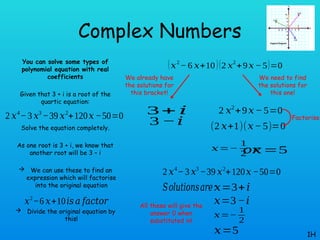
𝑥2
−6 𝑥+10𝑖𝑠 𝑎 𝑓𝑎𝑐𝑡𝑜𝑟
(𝑥2
− 6 𝑥+10)(2 𝑥2
+9𝑥− 5)=0
3+ 𝑖
3 −𝑖
We already have
the solutions for
this bracket!
We need to find
the solutions for
this one!
2 𝑥2
+9𝑥− 5=0
(2 𝑥+1)(𝑥−5)=0
𝑥=−
1
2 𝑥=5
𝑜𝑟
Factorise
2 𝑥4
−3 𝑥3
−39 𝑥2
+120𝑥 −50=0
𝑆𝑜𝑙𝑢𝑡𝑖𝑜𝑛𝑠𝑎𝑟𝑒:𝑥=3+𝑖
𝑥=3−𝑖
𝑥=−
1
2
𝑥=5
All these will give the
answer 0 when
substituted in!
60.
Summary
• You havebeen introduced to imaginary and complex numbers
• You have seen how these finally allow all quadratic equations to
be solved
• You have learnt how to show complex numbers on an Argand
diagram
• You have seen how to write the modulus-argument form of a
complex number
• You have also seen how to solve cubic and quartic equations using
complex numbers