ADVANCING LEARNING: CONNECTING THE DOTS


              Hybrid Mode:
          Blending Synchronous
            and Asynchronous
        Student-Centered Learning

              Carol Carruthers
              May 24, 2012
FOUNDATIONAL MATHEMATICS

   Why was it developed? Who takes it?
   Teaching collaborative
   Technology integration
   Student-centered community learning
TECHNOLOGY INTEGRATION 2008:

 Hewlett Packard Higher Education Technology
  for Teaching Grant - 21 tablet PC „s for Applied
  Science Technology Program (Math/Science)
 DyKnow Vision licenses
  (FASET/ACS/grant/contest)
  http://www.dyknow.com/

Project Goals:
1) Potential for engagement and retention of students
2) Enhancing student learning and concept application
3) Demonstration of teaching strategy to other educators
TECHNOLOGY INTEGRATION 2010:

 Wireless/Mobile 40 Tablet PC lab
 DyKnow Vision
 Shared by FASET (Foundational Math/AST)
  & ELS (Remedial English)

Project Goals:
1) Effectiveness in a larger class size
2) Reproducibility
3) Multi-discipline application
TECHNOLOGY INTEGRATION 2012:

 2011 A third 20 seat tablet lab at another
  campus
 Foundational math in mixed-mode (hybrid)
 Tablets on the move
 Screen casting math group (Technology,
  Business, Health Sciences, Learning Centers)
 CAATtablet group – six Ontario Colleges
  investigating pen/touch computing
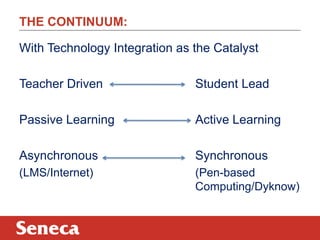
THE CONTINUUM:

With Technology Integration as the Catalyst

Teacher Driven                 Student Lead

Passive Learning               Active Learning

Asynchronous                   Synchronous
(LMS/Internet)                 (Pen-based
                               Computing/Dyknow)
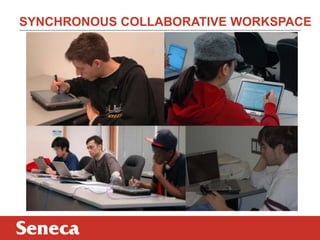
SYNCHRONOUS COLLABORATIVE WORKSPACE
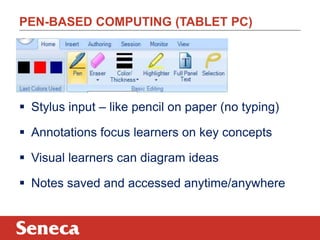
PEN-BASED COMPUTING (TABLET PC)


 Stylus input – like pencil on paper (no typing)

 Annotations focus learners on key concepts

 Visual learners can diagram ideas

 Notes saved and accessed anytime/anywhere
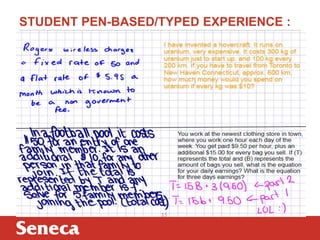
STUDENT PEN-BASED/TYPED EXPERIENCE :
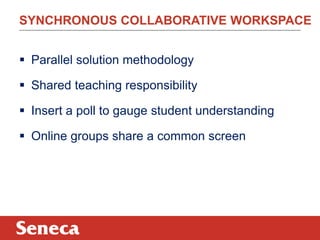
SYNCHRONOUS COLLABORATIVE WORKSPACE


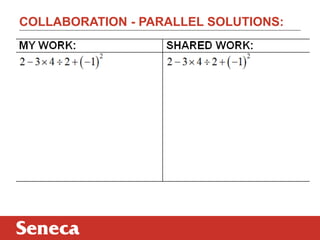
 Parallel solution methodology

 Shared teaching responsibility

 Insert a poll to gauge student understanding

 Online groups share a common screen
COLLABORATION - PARALLEL SOLUTIONS:
REALTIME FEEDBACK/ASSESSMENT:


 Request status

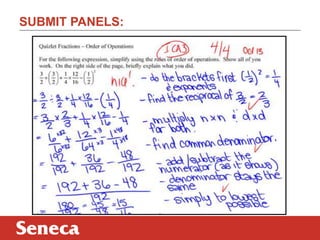
 Students submit panels

 Students „chat‟ a question
SUBMIT PANELS:
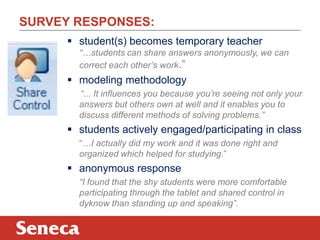
SURVEY RESPONSES:
       student(s) becomes temporary teacher
        “…students can share answers anonymously, we can
        correct each other’s work.”
       modeling methodology
        “... It influences you because you’re seeing not only your
        answers but others own at well and it enables you to
        discuss different methods of solving problems.”
       students actively engaged/participating in class
        “…I actually did my work and it was done right and
        organized which helped for studying.”
       anonymous response
        “I found that the shy students were more comfortable
        participating through the tablet and shared control in
        dyknow than standing up and speaking”.
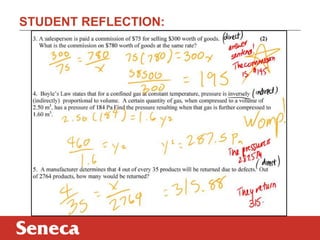
STUDENT REFLECTION:
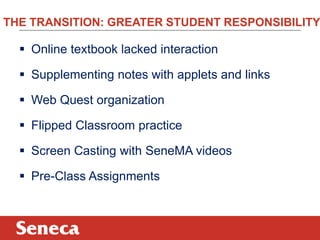
THE TRANSITION: GREATER STUDENT RESPONSIBILITY

   Online textbook lacked interaction

   Supplementing notes with applets and links

   Web Quest organization

   Flipped Classroom practice

   Screen Casting with SeneMA videos

   Pre-Class Assignments
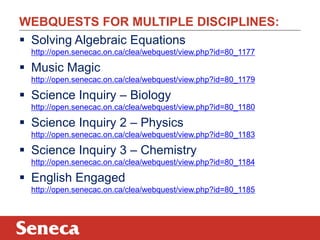
WEBQUESTS FOR MULTIPLE DISCIPLINES:
 Solving Algebraic Equations
  http://open.senecac.on.ca/clea/webquest/view.php?id=80_1177

 Music Magic
  http://open.senecac.on.ca/clea/webquest/view.php?id=80_1179

 Science Inquiry – Biology
  http://open.senecac.on.ca/clea/webquest/view.php?id=80_1180

 Science Inquiry 2 – Physics
  http://open.senecac.on.ca/clea/webquest/view.php?id=80_1183

 Science Inquiry 3 – Chemistry
  http://open.senecac.on.ca/clea/webquest/view.php?id=80_1184

 English Engaged
  http://open.senecac.on.ca/clea/webquest/view.php?id=80_1185
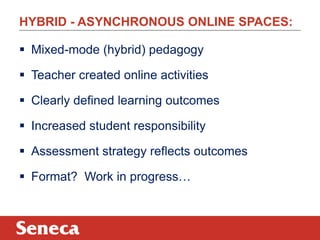
HYBRID - ASYNCHRONOUS ONLINE SPACES:

 Mixed-mode (hybrid) pedagogy

 Teacher created online activities

 Clearly defined learning outcomes

 Increased student responsibility

 Assessment strategy reflects outcomes

 Format? Work in progress…
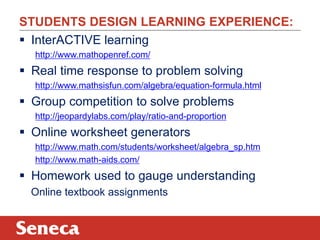
STUDENTS DESIGN LEARNING EXPERIENCE:
 InterACTIVE learning
  http://www.mathopenref.com/
 Real time response to problem solving
  http://www.mathsisfun.com/algebra/equation-formula.html
 Group competition to solve problems
  http://jeopardylabs.com/play/ratio-and-proportion
 Online worksheet generators
  http://www.math.com/students/worksheet/algebra_sp.htm
  http://www.math-aids.com/
 Homework used to gauge understanding
  Online textbook assignments
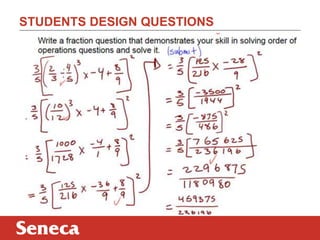
STUDENTS DESIGN QUESTIONS
MORE INFORMATION:
 HP Technology for Teaching Grant
  http://www.hp.com/hpinfo/socialinnovation/us/programs/t
  ech_teaching/hied_global.html
 Seneca‟s HP website/Carol‟s blog
  http://open.senecac.on.ca/HPtabletproject/
  https://teachmathwithtech.wordpress.com/
 DyKnow software
  http://www.dyknow.com/
 Student videos
  http://www.youtube.com/watch?v=il-k65CFqpE
  http://www.youtube.com/watch?v=Hd7BsEF1x6g

5.24.12 advancing learning hybrid mode - carruthers

  • 1.
    ADVANCING LEARNING: CONNECTINGTHE DOTS Hybrid Mode: Blending Synchronous and Asynchronous Student-Centered Learning Carol Carruthers May 24, 2012
  • 2.
    FOUNDATIONAL MATHEMATICS  Why was it developed? Who takes it?  Teaching collaborative  Technology integration  Student-centered community learning
  • 3.
    TECHNOLOGY INTEGRATION 2008: Hewlett Packard Higher Education Technology for Teaching Grant - 21 tablet PC „s for Applied Science Technology Program (Math/Science)  DyKnow Vision licenses (FASET/ACS/grant/contest) http://www.dyknow.com/ Project Goals: 1) Potential for engagement and retention of students 2) Enhancing student learning and concept application 3) Demonstration of teaching strategy to other educators
  • 4.
    TECHNOLOGY INTEGRATION 2010: Wireless/Mobile 40 Tablet PC lab  DyKnow Vision  Shared by FASET (Foundational Math/AST) & ELS (Remedial English) Project Goals: 1) Effectiveness in a larger class size 2) Reproducibility 3) Multi-discipline application
  • 5.
    TECHNOLOGY INTEGRATION 2012: 2011 A third 20 seat tablet lab at another campus  Foundational math in mixed-mode (hybrid)  Tablets on the move  Screen casting math group (Technology, Business, Health Sciences, Learning Centers)  CAATtablet group – six Ontario Colleges investigating pen/touch computing
  • 6.
    THE CONTINUUM: With TechnologyIntegration as the Catalyst Teacher Driven Student Lead Passive Learning Active Learning Asynchronous Synchronous (LMS/Internet) (Pen-based Computing/Dyknow)
  • 7.
  • 8.
    PEN-BASED COMPUTING (TABLETPC)  Stylus input – like pencil on paper (no typing)  Annotations focus learners on key concepts  Visual learners can diagram ideas  Notes saved and accessed anytime/anywhere
  • 9.
  • 10.
    SYNCHRONOUS COLLABORATIVE WORKSPACE Parallel solution methodology  Shared teaching responsibility  Insert a poll to gauge student understanding  Online groups share a common screen
  • 11.
  • 12.
    REALTIME FEEDBACK/ASSESSMENT:  Requeststatus  Students submit panels  Students „chat‟ a question
  • 13.
  • 14.
    SURVEY RESPONSES:  student(s) becomes temporary teacher “…students can share answers anonymously, we can correct each other’s work.”  modeling methodology “... It influences you because you’re seeing not only your answers but others own at well and it enables you to discuss different methods of solving problems.”  students actively engaged/participating in class “…I actually did my work and it was done right and organized which helped for studying.”  anonymous response “I found that the shy students were more comfortable participating through the tablet and shared control in dyknow than standing up and speaking”.
  • 15.
  • 16.
    THE TRANSITION: GREATERSTUDENT RESPONSIBILITY  Online textbook lacked interaction  Supplementing notes with applets and links  Web Quest organization  Flipped Classroom practice  Screen Casting with SeneMA videos  Pre-Class Assignments
  • 17.
    WEBQUESTS FOR MULTIPLEDISCIPLINES:  Solving Algebraic Equations http://open.senecac.on.ca/clea/webquest/view.php?id=80_1177  Music Magic http://open.senecac.on.ca/clea/webquest/view.php?id=80_1179  Science Inquiry – Biology http://open.senecac.on.ca/clea/webquest/view.php?id=80_1180  Science Inquiry 2 – Physics http://open.senecac.on.ca/clea/webquest/view.php?id=80_1183  Science Inquiry 3 – Chemistry http://open.senecac.on.ca/clea/webquest/view.php?id=80_1184  English Engaged http://open.senecac.on.ca/clea/webquest/view.php?id=80_1185
  • 18.
    HYBRID - ASYNCHRONOUSONLINE SPACES:  Mixed-mode (hybrid) pedagogy  Teacher created online activities  Clearly defined learning outcomes  Increased student responsibility  Assessment strategy reflects outcomes  Format? Work in progress…
  • 19.
    STUDENTS DESIGN LEARNINGEXPERIENCE:  InterACTIVE learning http://www.mathopenref.com/  Real time response to problem solving http://www.mathsisfun.com/algebra/equation-formula.html  Group competition to solve problems http://jeopardylabs.com/play/ratio-and-proportion  Online worksheet generators http://www.math.com/students/worksheet/algebra_sp.htm http://www.math-aids.com/  Homework used to gauge understanding Online textbook assignments
  • 20.
  • 21.
    MORE INFORMATION:  HPTechnology for Teaching Grant http://www.hp.com/hpinfo/socialinnovation/us/programs/t ech_teaching/hied_global.html  Seneca‟s HP website/Carol‟s blog http://open.senecac.on.ca/HPtabletproject/ https://teachmathwithtech.wordpress.com/  DyKnow software http://www.dyknow.com/  Student videos http://www.youtube.com/watch?v=il-k65CFqpE http://www.youtube.com/watch?v=Hd7BsEF1x6g