+

Mutual Funds
+

“It is not wise to put all eggs into one basket”
So its better to invest your money differently.
+
Mutual Fund - Definition


A mutual fund is a trust that
pools together the savings of
a number of investors who
share a common financial
goal.



The money thus collected is
then invested in capital
market instruments such as
shares, stocks, bonds, shortterm money market
instruments, debentures and
other securities.
+
 Started

in Europe in the
mid 1800.

 Massachuse

History of Mutual
Funds.

Hs Investors
Trust - First official Mutual
Funds.

 First

27 years slow
Growth & index funds
were born in 1970.
Mutual Fund in India.
The mutual fund industry in India started in 1963
with the formation of Unit Trust of India, at the
initiative of the Government of India and
Reserve Bank.

+

The history of mutual funds in India can be
broadly divided into four distinct phases.
1st Phase
=
1964-1987
2nd Phase
=
1987-1993
3rd Phase
=
1993-2003
4th Phase
=
2003
+

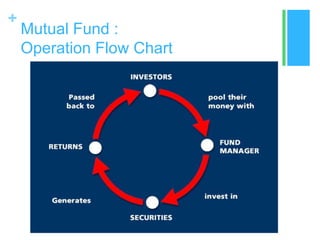
Mutual Fund :
Operation Flow Chart
Growth in India (in Rs.)

+



ICICI prudential mutual fund



TATA mutual fund



HDFC mutual fund



Birla sun life mutual fund



Reliance mutual fund



+

State Bank of India mutual fund

Kotak Mahindra mutual fund etc..

Various Mutual Funds in
India
+
*Mutual funds
are subject to
market risk please
read the offer
document
carefully before
investing.
+
Types of Mutual Fund
+

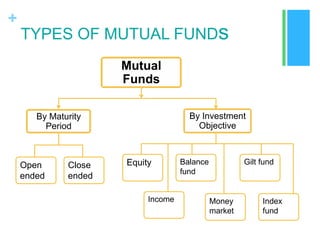
TYPES OF MUTUAL FUNDs
Mutual
Funds
By Investment
Objective

By Maturity
Period

Open
ended

Close
ended

Equity

Income

Balance
fund

Gilt fund

Money
market

Index
fund
+

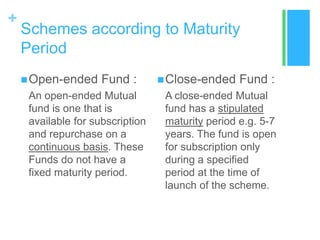
Schemes according to Maturity
Period
 Open-ended

Fund :

An open-ended Mutual
fund is one that is
available for subscription
and repurchase on a
continuous basis. These
Funds do not have a
fixed maturity period.

 Close-ended

Fund :

A close-ended Mutual
fund has a stipulated
maturity period e.g. 5-7
years. The fund is open
for subscription only
during a specified
period at the time of
launch of the scheme.
+

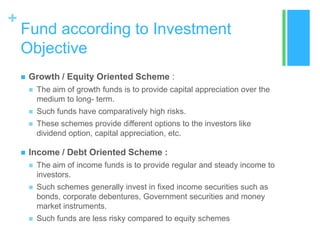
Fund according to Investment
Objective


Growth / Equity Oriented Scheme :




Such funds have comparatively high risks.





The aim of growth funds is to provide capital appreciation over the
medium to long- term.
These schemes provide different options to the investors like
dividend option, capital appreciation, etc.

Income / Debt Oriented Scheme :


The aim of income funds is to provide regular and steady income to
investors.



Such schemes generally invest in fixed income securities such as
bonds, corporate debentures, Government securities and money
market instruments.



Such funds are less risky compared to equity schemes
+


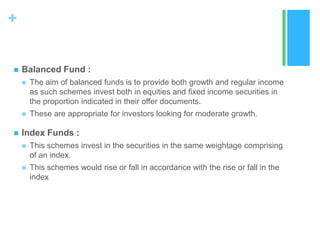
Balanced Fund :






The aim of balanced funds is to provide both growth and regular income
as such schemes invest both in equities and fixed income securities in
the proportion indicated in their offer documents.
These are appropriate for investors looking for moderate growth.

Index Funds :


This schemes invest in the securities in the same weightage comprising
of an index.



This schemes would rise or fall in accordance with the rise or fall in the
index
+


Money Market :




These schemes invest exclusively in safer short-term instruments
such as treasury bills, commercial paper and government securities,
etc.





These funds are also income funds and their aim is to provide easy
liquidity, preservation of capital and moderate income.

These funds are appropriate for corporate and individual investors
as a means to park their surplus funds for short periods.

Gilt Funds :


These funds invest exclusively in government securities.



Government securities have no default risk.
+ Advantages
+

REASONS TO INVEST
EXPERT ON YOUR SIDE: When you invest in a mutual fund, you
buy into the experience and skills of a fund manager and an army
of professional analysts
LIMITED RISK: Mutual funds are diversification in action and
hence do not rely on the performance of a single entity.
MORE FOR LESS: For the price of one blue chip stock for
instance, you could get yourself a number of units across a
number of companies and industries when you invest in a fund!
EASY INVESTING: You can invest in a mutual fund with as little as
Rs. 5,000. Salaried individuals also have the option of investing in
a monthly savings plan.
CONVENIENCE: You can invest directly with a fund house, or
through your bank or financial adviser, or even over the internet.
+
INVESTOR PROTECTION: A mutual fund in India is registered with
SEBI, which also monitors the operations of the fund to protect
your interests.
QUICK ACCESS TO YOUR MONEY: It's good to know that should
you need your money at short notice, you can usually get it in
four working days.

TRANSPARENCY: As an investor, you get updates on the value of
your units, information on specific investments made by the
mutual fund and the fund manager's strategy and outlook.
LOW TRANSACTION COSTS: A mutual fund, by sheer scale of its
investments is able to carry out cost-effective brokerage
transactions.
TAX BENEFITS: Over the years, tax policies on mutual funds have
been favorable to investors and continue to be so.
+

HOW TO BUY?
Financial Goals
Identify „What to Buy‟
Evaluate Funds from various Mutual Fund Cos.
Online

Offline

Mutual Fund Co. and
others

Financial Distributor

Fill Up Form
Attach Relevant Documents
Submit
+ Risk in Investing
+ RISK FACTORS OF MUTUAL FUNDS
THE RISK-RETURN TRADE-OFF: The most important relationship to
understand is the risk-return trade-off. Higher the risk greater the
returns/loss and lower the risk lesser the returns/loss.
MARKET RISK: Sometimes prices and yields of all securities rise and fall.
Broad outside influences affecting the market in general lead to this.
CREDIT RISK: The debt servicing ability of a company through its cash
flows determines the Credit Risk faced by you.

Inflation Risk: Inflation is the loss of purchasing power over time.
INTEREST RATE RISK: In a free market economy interest rates are difficult
if not impossible to predict.
POLITICAL/GOVERNMENT POLICY RISK: Changes in government policy
and political decision can change the investment environment.
LIQUIDITY RISK: Liquidity risk arises when it becomes difficult to sell the
securities that one has purchased.
+

Summary
The Mutual Fund Industry is a growth
industry.
Mutual Funds cover a spectrum of
Investment Options.
Start Investing Early & Systematically.

We invest directly or through a Professional
Money Manager.
+

Mutual Funds

  • 1.
  • 2.
    + “It is notwise to put all eggs into one basket” So its better to invest your money differently.
  • 3.
    + Mutual Fund -Definition  A mutual fund is a trust that pools together the savings of a number of investors who share a common financial goal.  The money thus collected is then invested in capital market instruments such as shares, stocks, bonds, shortterm money market instruments, debentures and other securities.
  • 4.
    +  Started in Europein the mid 1800.  Massachuse History of Mutual Funds. Hs Investors Trust - First official Mutual Funds.  First 27 years slow Growth & index funds were born in 1970.
  • 5.
    Mutual Fund inIndia. The mutual fund industry in India started in 1963 with the formation of Unit Trust of India, at the initiative of the Government of India and Reserve Bank. + The history of mutual funds in India can be broadly divided into four distinct phases. 1st Phase = 1964-1987 2nd Phase = 1987-1993 3rd Phase = 1993-2003 4th Phase = 2003
  • 6.
  • 7.
    Growth in India(in Rs.) +
  • 8.
      ICICI prudential mutualfund  TATA mutual fund  HDFC mutual fund  Birla sun life mutual fund  Reliance mutual fund  + State Bank of India mutual fund Kotak Mahindra mutual fund etc.. Various Mutual Funds in India
  • 9.
    + *Mutual funds are subjectto market risk please read the offer document carefully before investing.
  • 10.
  • 11.
    + TYPES OF MUTUALFUNDs Mutual Funds By Investment Objective By Maturity Period Open ended Close ended Equity Income Balance fund Gilt fund Money market Index fund
  • 12.
    + Schemes according toMaturity Period  Open-ended Fund : An open-ended Mutual fund is one that is available for subscription and repurchase on a continuous basis. These Funds do not have a fixed maturity period.  Close-ended Fund : A close-ended Mutual fund has a stipulated maturity period e.g. 5-7 years. The fund is open for subscription only during a specified period at the time of launch of the scheme.
  • 13.
    + Fund according toInvestment Objective  Growth / Equity Oriented Scheme :   Such funds have comparatively high risks.   The aim of growth funds is to provide capital appreciation over the medium to long- term. These schemes provide different options to the investors like dividend option, capital appreciation, etc. Income / Debt Oriented Scheme :  The aim of income funds is to provide regular and steady income to investors.  Such schemes generally invest in fixed income securities such as bonds, corporate debentures, Government securities and money market instruments.  Such funds are less risky compared to equity schemes
  • 14.
    +  Balanced Fund :    Theaim of balanced funds is to provide both growth and regular income as such schemes invest both in equities and fixed income securities in the proportion indicated in their offer documents. These are appropriate for investors looking for moderate growth. Index Funds :  This schemes invest in the securities in the same weightage comprising of an index.  This schemes would rise or fall in accordance with the rise or fall in the index
  • 15.
    +  Money Market :   Theseschemes invest exclusively in safer short-term instruments such as treasury bills, commercial paper and government securities, etc.   These funds are also income funds and their aim is to provide easy liquidity, preservation of capital and moderate income. These funds are appropriate for corporate and individual investors as a means to park their surplus funds for short periods. Gilt Funds :  These funds invest exclusively in government securities.  Government securities have no default risk.
  • 16.
  • 17.
    + REASONS TO INVEST EXPERTON YOUR SIDE: When you invest in a mutual fund, you buy into the experience and skills of a fund manager and an army of professional analysts LIMITED RISK: Mutual funds are diversification in action and hence do not rely on the performance of a single entity. MORE FOR LESS: For the price of one blue chip stock for instance, you could get yourself a number of units across a number of companies and industries when you invest in a fund! EASY INVESTING: You can invest in a mutual fund with as little as Rs. 5,000. Salaried individuals also have the option of investing in a monthly savings plan. CONVENIENCE: You can invest directly with a fund house, or through your bank or financial adviser, or even over the internet.
  • 18.
    + INVESTOR PROTECTION: Amutual fund in India is registered with SEBI, which also monitors the operations of the fund to protect your interests. QUICK ACCESS TO YOUR MONEY: It's good to know that should you need your money at short notice, you can usually get it in four working days. TRANSPARENCY: As an investor, you get updates on the value of your units, information on specific investments made by the mutual fund and the fund manager's strategy and outlook. LOW TRANSACTION COSTS: A mutual fund, by sheer scale of its investments is able to carry out cost-effective brokerage transactions. TAX BENEFITS: Over the years, tax policies on mutual funds have been favorable to investors and continue to be so.
  • 19.
    + HOW TO BUY? FinancialGoals Identify „What to Buy‟ Evaluate Funds from various Mutual Fund Cos. Online Offline Mutual Fund Co. and others Financial Distributor Fill Up Form Attach Relevant Documents Submit
  • 20.
    + Risk inInvesting
  • 21.
    + RISK FACTORSOF MUTUAL FUNDS THE RISK-RETURN TRADE-OFF: The most important relationship to understand is the risk-return trade-off. Higher the risk greater the returns/loss and lower the risk lesser the returns/loss. MARKET RISK: Sometimes prices and yields of all securities rise and fall. Broad outside influences affecting the market in general lead to this. CREDIT RISK: The debt servicing ability of a company through its cash flows determines the Credit Risk faced by you. Inflation Risk: Inflation is the loss of purchasing power over time. INTEREST RATE RISK: In a free market economy interest rates are difficult if not impossible to predict. POLITICAL/GOVERNMENT POLICY RISK: Changes in government policy and political decision can change the investment environment. LIQUIDITY RISK: Liquidity risk arises when it becomes difficult to sell the securities that one has purchased.
  • 22.
    + Summary The Mutual FundIndustry is a growth industry. Mutual Funds cover a spectrum of Investment Options. Start Investing Early & Systematically. We invest directly or through a Professional Money Manager.
  • 23.